


Nursery
1. Seedlings and grafts are produced in nursery and the fruit
orchards and ornamental
gardens can be established with minimum care, cost and
maintenance.
2. The nursery planting materials are available at the beginning of
the planting season.
This saves the time, money and efforts of the farmers to raise
seedlings.
3. There is a wide scope for fruit orchards, ornamental, vegetable,
and landscape
Nursery Management
1. Introduction
Nursery is a place where seedlings, cuttings and grafts
are raised with care before transplanting. Nursery
management The main phases of nursery management
are-
Planning - demand for planting material, provision of
mother blocks, requirement of land area, water supply,
working tools, growing structures and input availability.
Implementation - land treatment, protection against
biotic interference and soil erosion, proper layout, input
supply, etc.
Monitoring and evaluation –
physical presence, rapid response, critical analysis,
incentive to workers, etc.
Feed back for further refinement.
The key elements of hi-tech nursery management are
the place, the plant and the person behind nursery
management.
Advantages of Nursery Management
1. It is possible to provide favorable growth conditions
i.e. germination as well as growth
2. Better care of younger plants as it is easy to look
after nursery in small area against pathogenic
infection pest and weed.
3. Crop grown by nursery raising is quite early and fetch
higher price in the market. So economically more
profitable.
4. There is saving of land and labor as main field will be
occupied by the crop for lesser duration. Hence
intensive crop rotation can be followed.
5. More time is available for the preparation of main field
because nursery is grown separately.
6. As vegetable seeds are very expensive, particularly
hybrids, seed cost can be economized by sowing
them in the nursery
2. Nursery Site
Types of Plant Propagation Nurseries-:
 A nursery is a place where plants are propagated and
grown to usable size.
The various types of nurseries can be classified based
on various criteria.
 They include, Sale: Retail nurseries which sell to the
general public.
Wholesale nurseries, which sell only to businesses such
as other nurseries and to commercial gardeners, private
nurseries .
Some retail and wholesale nurseries sell by mail.
Type of plant:
Ground covers, shade plants, fruit trees, or rock
garden plants. The nursery business is highly seasonal.
It is affected by temperature, drought, cheaper foreign
competition, fashion, etc.
Plants may be propagated by seeds, but often
desirable cultivars are propagated asexually by
budding, grafting, layering, or other nursery techniques.
Types of Nurseries According to Type of Plants Grown
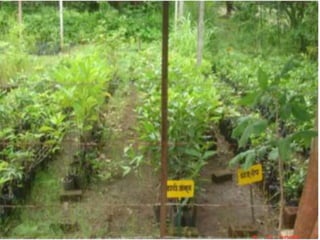
1. Fruit Plant Nurseries
Fruit Plants Nursery Fruit crops are mainly
propagated vegetative and need special techniques
for propagations as well as maintenance.
Mango, Guava, Pomegranate, Sapota, Oranges etc.
are propagated with vegetative means.
Fruit nurseries are essential for production of grafts
as well as the mother plants of scions and rootstocks.
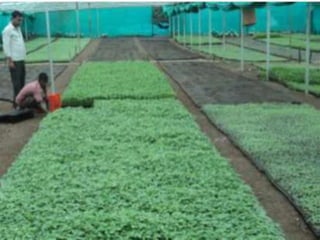
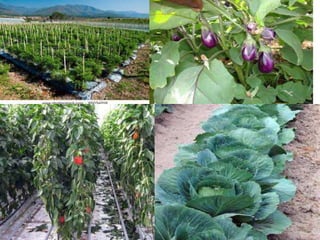
2. Vegetable Nurseries
All vegetables except few like potatoes, sweet potato,
bulbous vegetables and some other are raised by
seedlings. Very few vegetables are perennials like,
little gourd, drumsticks, Alocasia etc. Seedlings are to
be produced on a large scale in short period.
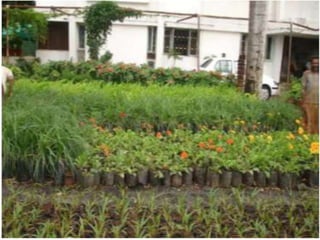
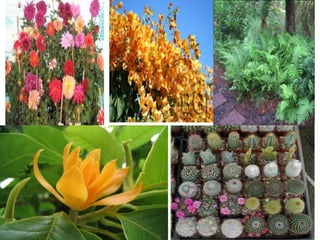
3. Ornamental Plant Nurseries
Ornamental and floricultural crops are numerous and
are propagated vegetatively, like gladiolus, carnation,
roses, lilies etc.
There is a large group of ornamental plants, which is
propagated by seeds and seedling; Asters, Marigolds,
Salvias, etc. are some of them.
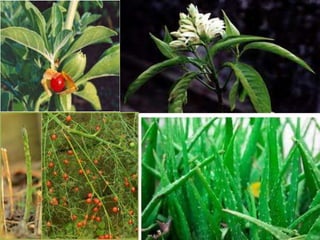
4. Medicinal and Aromatic Plant Nurseries
There is considerable increase in people adopting
ayurvedic medicines with the changing life style.
It is also necessary to conserve the fast depleting
precious medicinal and aromatic plants. To save and
multiply the valuable medicinal and other auspicious
plants, nurseries specializing in these plants have
begun to flourish. These plants are also demanded by
the Ayurvedic medicinal practitioners.
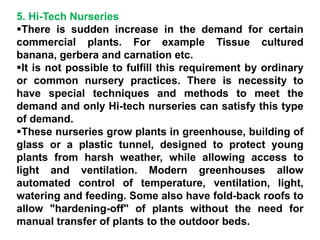
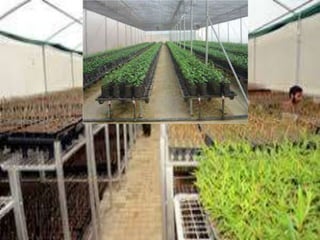
5. Hi-Tech Nurseries
There is sudden increase in the demand for certain
commercial plants. For example Tissue cultured
banana, gerbera and carnation etc.
It is not possible to fulfill this requirement by ordinary
or common nursery practices. There is necessity to
have special techniques and methods to meet the
demand and only Hi-tech nurseries can satisfy this type
of demand.
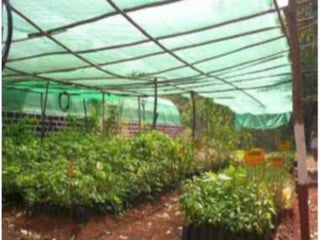
These nurseries grow plants in greenhouse, building of
glass or a plastic tunnel, designed to protect young
plants from harsh weather, while allowing access to
light and ventilation. Modern greenhouses allow
automated control of temperature, ventilation, light,
watering and feeding. Some also have fold-back roofs to
allow "hardening-off" of plants without the need for
manual transfer of plants to the outdoor beds.
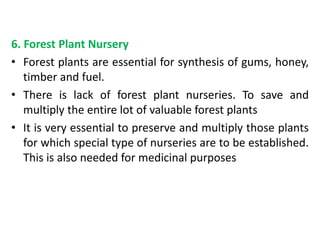
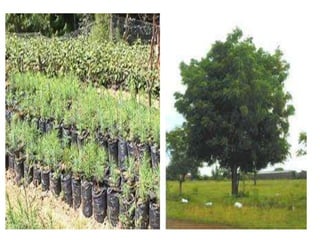
6. Forest Plant Nursery
• Forest plants are essential for synthesis of gums, honey,
timber and fuel.
• There is lack of forest plant nurseries. To save and
multiply the entire lot of valuable forest plants
• It is very essential to preserve and multiply those plants
for which special type of nurseries are to be established.
This is also needed for medicinal purposes
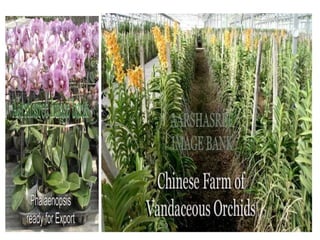
7. Orchid nursery
• Orchids are one of the largest and most diverse of the
flowering plant families. Thought to have well over
20,000 species and with thousands more hybrids bred
every year
• They are fast becoming one of the most popular house
plants available.
• Orchids grow on every continent apart from Antarctica
and have adapted to every habitat you can imagine, from
terrestrial forms like
• all those that are native to the UK and grow in the soil, to
lithophytes that grow naturally on rocks.
• Most however come from the tropics and are epiphytes,
living harmlessly on trees.
• They have specialized aerial roots to absorb water and
nutrients
Types of Nurseries According to the Type of Sale
1. Retail Nurseries:
Retail nurseries raise plants for sale to the general
public. These places are small, locally owned
nurseries that sell seasonal, annuals, ornamental
trees, other landscaping plants and garden decoration
to the general public or companies that specialize in a
particular type of plant, such as tropical plants, citrus
trees, bulbs or roses.
2. Wholesale Nurseries:
Wholesale nurseries usually grow plants in bulk for the
purpose of selling to large clients.
These clients may include florists, garden centers or
departmental stores. A wholesale nursery may fill a niche
for particular types of plants, such as vegetables or
houseplants, or they may grow a general selection of
plants to sell such as fruits, vegetables and landscaping
plants.
3. Private Nurseries:
A private nursery grows plants exclusively for a single
client. The private nursery may be owned by the client
or it may be under contract for use by the client.
Clients for private nurseries include large estates,
corporations and institutions.
These nurseries are concerned with raising documented
historical plants for the historic preservation of the
estates
4. Mail Order:
Privately owned, retail and wholesale businesses may
all be involved in mail order businesses.
As shipping technology improved, it became possible
to ship dormant ornamental trees and bedding plants
via mail.
The internet has largely shifted mail order from catalog
to online shopping.
Bedding plants may be shipped via postal carrier, but
are primarily handled through third-party shipping
agents
• Basic Infrastructure of Nursery
• 1)Workshed: The workshed of 6 m x 4.5 m with thatch roofs and
locally available materials like bamboo, wood, etc. may be
constructed. Mainly used protect the nursery plant from direct
sunlight.
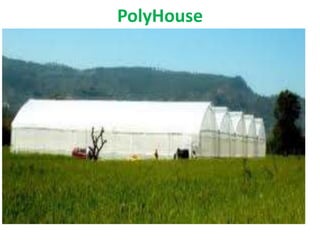
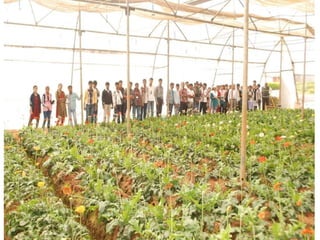
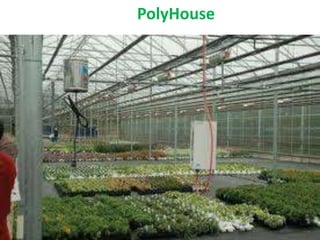
• 2)Polyhouse: The polyhouse of 9 m x 4 m dimension with 90 cm,
brick wall, 3.6 m tall rhombus netting with expanded metal and
polythene roof supported by local materials like bamboo, wood
and planks, may be constructed. sss
• 3)Nursey entrance : nursery entrance provides the first and most
important opportunity to present a good image and impression.
• 4)Roads and path :should be a proper planning
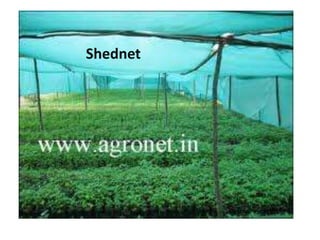
Shednet
PolyHouse
PolyHouse
• 5)Store-cum-office: A store-cum-office of 6.0 m x 4.5 m
constructed with locally available materials may serve the
purpose.is require for storing ,packin materials,poly
bags,tools,pesticides and fertilisers.
• 6)Fencing:(kunpan) A goat proof fencing only will be effective for
a nursery. Nursery should be well protected by providing walls or
wire fences
• 7)Land preparation: The land development for nursery is very
important. In nursery, the land may be divided into minimum
four parts:
• area for mother plant,area for seed production,area for raising
flower seedlings and area for storing of seedlings or vegetatively
propagated perennial plants.
• The land of a nursery is prepared by ploughing and cross
ploughing. All kinds of waste materials are to be removed and
the land must be levelled properly.
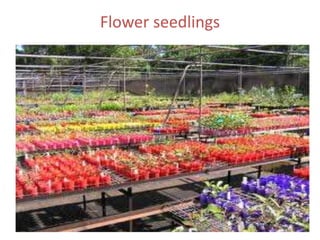
Flower seedlings
• 8)Seedbed and nursery beds: For raising flower seedlings,
some permanent or temporary structures for seed bed may
be prepared. These beds will be minimum 0.5 to 0.75 m high
from ground level. The beds may be 0.75m to 1.00m in
breadth and length may be as per the availability of land.
The nursery beds will be prepared for storing of perennial
plants or the plants that should be kept for sale.
• 9)Potting mixture: potting mixture for different purposes can
be prepared by mixing fertile red soil, garden poyata soil,
well rotten farm yard manure, leaf mold, oil cakes.
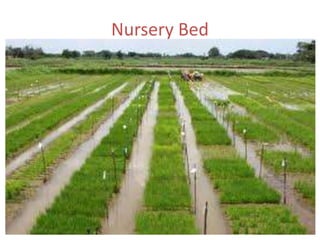
Nursery Bed
• 14)Electricity: There should be separate electricity supply power
station for the nursery .
• 15)Storage of propagated plants in nursery beds: The propagated
plants are planted in nursery beds for better growth or hardening
the plants. In general, this type of nursery bed is prepared under
partial shade.
• 16)Manuring: Manuring is to be done very carefully. Vigorous
growth of plant is always attractive to the buyer. Again, heavy
manuring is not beneficial for storage of plants.
• 17)Chemical control in nursery: Keen observation on attack of
different pests and diseases is required. If the mother plants are
infected, the propagated plants will be infected also. Necessary
control measures should be taken immediately on observation
• 18)Transporting vehicles: Tempoes and small trucks should be
provided to the nursery for transporting the material .
• 19)Growth harmones or regulators: Gibberelline(GA) ,indol acetic
acid (IAA), ethylene and cytokines etc.
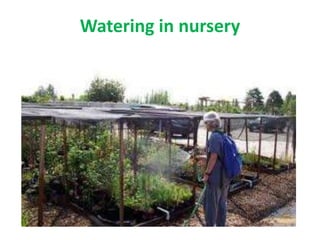
10)Nurse water supply: the source of water should be within the
nursery area. a number of water taps water reservoirs (well and
pond) inside the nursery area. Like manuring, watering is also
important. Watering will be done according to need of the plant.
11) Drainage : Proper drainage system is required for an ideal
nursery
12)Containers: Containers for producing plug seedlings eg.
Earthen pots ,seed pans and seed boxes, polythene bags, plastic
pots etc.
13) Nursery tools : Khurpi, hand fork, water can, hand sprayer,
secator budding and grafting knife
Watering in nursery
Plant nursery industry

Plant nursery industry

  • 2.
    Nursery 1. Seedlings andgrafts are produced in nursery and the fruit orchards and ornamental gardens can be established with minimum care, cost and maintenance. 2. The nursery planting materials are available at the beginning of the planting season. This saves the time, money and efforts of the farmers to raise seedlings. 3. There is a wide scope for fruit orchards, ornamental, vegetable, and landscape
  • 3.
    Nursery Management 1. Introduction Nurseryis a place where seedlings, cuttings and grafts are raised with care before transplanting. Nursery management The main phases of nursery management are- Planning - demand for planting material, provision of mother blocks, requirement of land area, water supply, working tools, growing structures and input availability. Implementation - land treatment, protection against biotic interference and soil erosion, proper layout, input supply, etc.
  • 4.
    Monitoring and evaluation– physical presence, rapid response, critical analysis, incentive to workers, etc. Feed back for further refinement. The key elements of hi-tech nursery management are the place, the plant and the person behind nursery management.
  • 5.
    Advantages of NurseryManagement 1. It is possible to provide favorable growth conditions i.e. germination as well as growth 2. Better care of younger plants as it is easy to look after nursery in small area against pathogenic infection pest and weed. 3. Crop grown by nursery raising is quite early and fetch higher price in the market. So economically more profitable. 4. There is saving of land and labor as main field will be occupied by the crop for lesser duration. Hence intensive crop rotation can be followed. 5. More time is available for the preparation of main field because nursery is grown separately. 6. As vegetable seeds are very expensive, particularly hybrids, seed cost can be economized by sowing them in the nursery
  • 6.
    2. Nursery Site Typesof Plant Propagation Nurseries-:  A nursery is a place where plants are propagated and grown to usable size. The various types of nurseries can be classified based on various criteria.  They include, Sale: Retail nurseries which sell to the general public. Wholesale nurseries, which sell only to businesses such as other nurseries and to commercial gardeners, private nurseries . Some retail and wholesale nurseries sell by mail.
  • 7.
    Type of plant: Groundcovers, shade plants, fruit trees, or rock garden plants. The nursery business is highly seasonal. It is affected by temperature, drought, cheaper foreign competition, fashion, etc. Plants may be propagated by seeds, but often desirable cultivars are propagated asexually by budding, grafting, layering, or other nursery techniques.
  • 8.
    Types of NurseriesAccording to Type of Plants Grown 1. Fruit Plant Nurseries Fruit Plants Nursery Fruit crops are mainly propagated vegetative and need special techniques for propagations as well as maintenance. Mango, Guava, Pomegranate, Sapota, Oranges etc. are propagated with vegetative means. Fruit nurseries are essential for production of grafts as well as the mother plants of scions and rootstocks.
  • 11.
    2. Vegetable Nurseries Allvegetables except few like potatoes, sweet potato, bulbous vegetables and some other are raised by seedlings. Very few vegetables are perennials like, little gourd, drumsticks, Alocasia etc. Seedlings are to be produced on a large scale in short period.
  • 14.
    3. Ornamental PlantNurseries Ornamental and floricultural crops are numerous and are propagated vegetatively, like gladiolus, carnation, roses, lilies etc. There is a large group of ornamental plants, which is propagated by seeds and seedling; Asters, Marigolds, Salvias, etc. are some of them.
  • 17.
    4. Medicinal andAromatic Plant Nurseries There is considerable increase in people adopting ayurvedic medicines with the changing life style. It is also necessary to conserve the fast depleting precious medicinal and aromatic plants. To save and multiply the valuable medicinal and other auspicious plants, nurseries specializing in these plants have begun to flourish. These plants are also demanded by the Ayurvedic medicinal practitioners.
  • 20.
    5. Hi-Tech Nurseries Thereis sudden increase in the demand for certain commercial plants. For example Tissue cultured banana, gerbera and carnation etc. It is not possible to fulfill this requirement by ordinary or common nursery practices. There is necessity to have special techniques and methods to meet the demand and only Hi-tech nurseries can satisfy this type of demand. These nurseries grow plants in greenhouse, building of glass or a plastic tunnel, designed to protect young plants from harsh weather, while allowing access to light and ventilation. Modern greenhouses allow automated control of temperature, ventilation, light, watering and feeding. Some also have fold-back roofs to allow "hardening-off" of plants without the need for manual transfer of plants to the outdoor beds.
  • 22.
    6. Forest PlantNursery • Forest plants are essential for synthesis of gums, honey, timber and fuel. • There is lack of forest plant nurseries. To save and multiply the entire lot of valuable forest plants • It is very essential to preserve and multiply those plants for which special type of nurseries are to be established. This is also needed for medicinal purposes
  • 24.
    7. Orchid nursery •Orchids are one of the largest and most diverse of the flowering plant families. Thought to have well over 20,000 species and with thousands more hybrids bred every year • They are fast becoming one of the most popular house plants available. • Orchids grow on every continent apart from Antarctica and have adapted to every habitat you can imagine, from terrestrial forms like • all those that are native to the UK and grow in the soil, to lithophytes that grow naturally on rocks. • Most however come from the tropics and are epiphytes, living harmlessly on trees. • They have specialized aerial roots to absorb water and nutrients
  • 26.
    Types of NurseriesAccording to the Type of Sale 1. Retail Nurseries: Retail nurseries raise plants for sale to the general public. These places are small, locally owned nurseries that sell seasonal, annuals, ornamental trees, other landscaping plants and garden decoration to the general public or companies that specialize in a particular type of plant, such as tropical plants, citrus trees, bulbs or roses.
  • 27.
    2. Wholesale Nurseries: Wholesalenurseries usually grow plants in bulk for the purpose of selling to large clients. These clients may include florists, garden centers or departmental stores. A wholesale nursery may fill a niche for particular types of plants, such as vegetables or houseplants, or they may grow a general selection of plants to sell such as fruits, vegetables and landscaping plants.
  • 28.
    3. Private Nurseries: Aprivate nursery grows plants exclusively for a single client. The private nursery may be owned by the client or it may be under contract for use by the client. Clients for private nurseries include large estates, corporations and institutions. These nurseries are concerned with raising documented historical plants for the historic preservation of the estates
  • 29.
    4. Mail Order: Privatelyowned, retail and wholesale businesses may all be involved in mail order businesses. As shipping technology improved, it became possible to ship dormant ornamental trees and bedding plants via mail. The internet has largely shifted mail order from catalog to online shopping. Bedding plants may be shipped via postal carrier, but are primarily handled through third-party shipping agents
  • 30.
    • Basic Infrastructureof Nursery • 1)Workshed: The workshed of 6 m x 4.5 m with thatch roofs and locally available materials like bamboo, wood, etc. may be constructed. Mainly used protect the nursery plant from direct sunlight. • 2)Polyhouse: The polyhouse of 9 m x 4 m dimension with 90 cm, brick wall, 3.6 m tall rhombus netting with expanded metal and polythene roof supported by local materials like bamboo, wood and planks, may be constructed. sss • 3)Nursey entrance : nursery entrance provides the first and most important opportunity to present a good image and impression. • 4)Roads and path :should be a proper planning
  • 31.
  • 32.
  • 35.
  • 36.
    • 5)Store-cum-office: Astore-cum-office of 6.0 m x 4.5 m constructed with locally available materials may serve the purpose.is require for storing ,packin materials,poly bags,tools,pesticides and fertilisers. • 6)Fencing:(kunpan) A goat proof fencing only will be effective for a nursery. Nursery should be well protected by providing walls or wire fences • 7)Land preparation: The land development for nursery is very important. In nursery, the land may be divided into minimum four parts: • area for mother plant,area for seed production,area for raising flower seedlings and area for storing of seedlings or vegetatively propagated perennial plants. • The land of a nursery is prepared by ploughing and cross ploughing. All kinds of waste materials are to be removed and the land must be levelled properly.
  • 37.
  • 38.
    • 8)Seedbed andnursery beds: For raising flower seedlings, some permanent or temporary structures for seed bed may be prepared. These beds will be minimum 0.5 to 0.75 m high from ground level. The beds may be 0.75m to 1.00m in breadth and length may be as per the availability of land. The nursery beds will be prepared for storing of perennial plants or the plants that should be kept for sale. • 9)Potting mixture: potting mixture for different purposes can be prepared by mixing fertile red soil, garden poyata soil, well rotten farm yard manure, leaf mold, oil cakes.
  • 39.
  • 40.
    • 14)Electricity: Thereshould be separate electricity supply power station for the nursery . • 15)Storage of propagated plants in nursery beds: The propagated plants are planted in nursery beds for better growth or hardening the plants. In general, this type of nursery bed is prepared under partial shade. • 16)Manuring: Manuring is to be done very carefully. Vigorous growth of plant is always attractive to the buyer. Again, heavy manuring is not beneficial for storage of plants. • 17)Chemical control in nursery: Keen observation on attack of different pests and diseases is required. If the mother plants are infected, the propagated plants will be infected also. Necessary control measures should be taken immediately on observation • 18)Transporting vehicles: Tempoes and small trucks should be provided to the nursery for transporting the material . • 19)Growth harmones or regulators: Gibberelline(GA) ,indol acetic acid (IAA), ethylene and cytokines etc.
  • 41.
    10)Nurse water supply:the source of water should be within the nursery area. a number of water taps water reservoirs (well and pond) inside the nursery area. Like manuring, watering is also important. Watering will be done according to need of the plant. 11) Drainage : Proper drainage system is required for an ideal nursery 12)Containers: Containers for producing plug seedlings eg. Earthen pots ,seed pans and seed boxes, polythene bags, plastic pots etc. 13) Nursery tools : Khurpi, hand fork, water can, hand sprayer, secator budding and grafting knife
  • 42.