
ANTI-MONEY LAUNDERING, COMBATING THE FINANCING OF
TERRORISM & COUNTERING PROLIFERATION FINANCING
(AML/ CFT/ CPF) REGULATIONS
FOR
STATE BANK OF PAKISTAN’S REGULATED ENTITIES
(SBP-REs)
(Updated up to September 30, 2020)
proliferation financing” means the
Financing of proliferation of weapons of mass destruction;
 ‫ہتھیار‬ ‫والے‬ ‫پھیالنے‬ ‫تباہی‬ ‫پر‬ ‫پیمانے‬ ‫بڑے‬
Types of Weapons of Mass Destruction
 Biological Weapons . Include bacterial, pandemic, Epidemic, Fevers, small pox,
hepatitis, include bacterial. There are three ways biological weapons work: One is
contact with the skin, two is gastrointestinal, and three is pulmonary.
 Chemical weapon is any weapon that uses a manufactured chemical to kill people.
 The first chemical weapon used effectively in battle was chlorine gas, which burns
and destroys lung tissue. Chlorine is not an exotic chemical. Most municipal water
systems use it today to kill bacteria.
 Nerve gas, tear gas
 Nuclear Weapons of Mass Destruction. Gun nuclear, ballistic missiles
REGULATION – 1
RISK BASED APPROACH TO AML / CFT
1. SBP REs shall comply with risk based approach
2. SBP REs shall ensure entity level Internal Risk Assessment Report (IRAR)
which covers Transnational TF risk.
3. IRAR shall include results of National Risk Assessment (NRA)
4. IRAR should be used for evaluating Residual Risk
5. SBP REs shall formulate policy for application of SDD, CDD and EDD.
6. Periodic updation of IRAR
7. SBP REs shall develop AML / CFT / CPF policies / procedures / controls /
obligation / preventive measures
REGULATION – 2
Definition of Due Diligence
1. REs shall at minimum conduct CDD of the customers / occasional
customers as set out in section 7A (1) of the AML Act
2. REs shall apply CDD measures as per section 7A (2) of the AML Act
3. For identification of the customer / occasional customer, REs shall obtain
information mentioned in Annexure I
4. For purpose of verification of identity of the customer / occasional
customer, REs shall obtain information mentioned in Annexure II
5. Reliable and independent document
6. Customers, Product & Services, delivery channels and geographic location
7. Person who acts on behalf of the customer (authorized agent or
representative)
8. Ascertain the beneficial ownership
9. Additional documentation
10. Measures to verify the identity of beneficial owners of legal persons
- CUSTOMER DUE DILIGENCE (CDD)
11. Measures to verify the identity of beneficial owners of legal arrangements
12. REs shall not open numbered accounts and shall not conduct transactions on fake
identity documents
13. Name of entity with abbreviated, REs shall satisfy themselves that the title is in
accordance with the constituent documents
14. SBP REs shall comply Section 7A of the Act for all type of customers
Enhanced Due Diligence
15. SBP Res shall apply EDD in the following circumstances:
 Business relationships and transactions with natural and legal persons when the risks are
higher.
 High Risk Countries.
 PEPs and their close associates and family members.
16. EDD measures may include:
 Obtaining additional information of the customer
 Obtaining additional information on the intended nature of the business
 Obtaining additional information on the source of funds
 Obtaining additional information on the reason for performed transaction
 Taking reasonable measures to establish the source of funds involved in the transaction
 Obtaining approval from the Senior Management to commence or continue the business
 Where applicable, conducting enhanced monitoring of the business relationship
 Where available, requiring the first payment to be deposited through an account in the
customer’s name with a bank subject to similar CDD standards
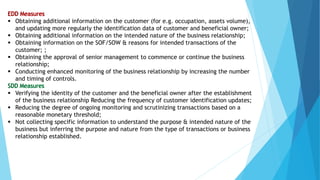
 Obtaining additional information on the customer (for e.g. occupation, assets volume),
and updating more regularly the identification data of customer and beneficial owner;
 Obtaining additional information on the intended nature of the business relationship;
 Obtaining information on the SOF/SOW & reasons for intended transactions of the
customer; ;
 Obtaining the approval of senior management to commence or continue the business
relationship;
 Conducting enhanced monitoring of the business relationship by increasing the number
and timing of controls.
 Verifying the identity of the customer and the beneficial owner after the establishment
of the business relationship Reducing the frequency of customer identification updates;
 Reducing the degree of ongoing monitoring and scrutinizing transactions based on a
reasonable monetary threshold;
 Not collecting specific information to understand the purpose & intended nature of the
business but inferring the purpose and nature from the type of transactions or business
relationship established.
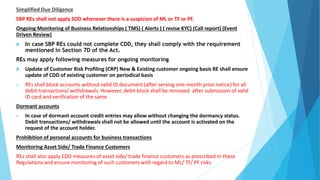
Simplified Due Diligence
SBP REs shall not apply SDD whenever there is a suspicion of ML or TF or PF.
Ongoing Monitoring of Business Relationships ( TMS) ( Alerts ) ( revise KYC) (Call report) (Event
Driven Review)
 In case SBP REs could not complete CDD, they shall comply with the requirement
mentioned in Section 7D of the Act.
REs may apply following measures for ongoing monitoring
 Update of Customer Risk Profiling (CRP) New & Existing customer ongoing basis RE shall ensure
update of CDD of existing customer on periodical basis
a. REs shall block accounts without valid ID document (after serving one-month prior notice) for all
debit transactions/ withdrawals. However, debit block shall be removed after submission of valid
ID card and verification of the same.
Dormant accounts
 In case of dormant account credit entries may allow without changing the dormancy status.
Debit transactions/ withdrawals shall not be allowed until the account is activated on the
request of the account holder.
Prohibition of personal accounts for business transactions
Monitoring Asset Side/ Trade Finance Customers
REs shall also apply CDD measures of asset side/ trade finance customers as prescribed in these
Regulations and ensure monitoring of such customers with regard to ML/ TF/ PF risks
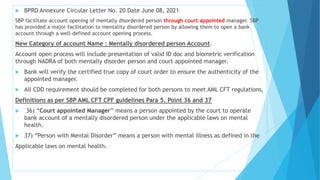
 BPRD Annexure Circular Letter No. 20 Date June 08, 2021
SBP facilitate account opening of mentally disordered person through court appointed manager. SBP
has provided a major facilitation to mentality disordered person by allowing them to open a bank
account through a well-defined account opening process.
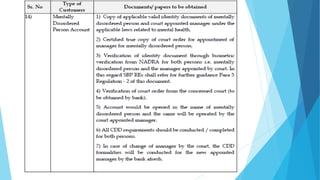
New Category of account Name : Mentally disordered person Account.
Account open process will include presentation of valid ID doc and biometric verification
through NADRA of both mentally disorder person and court appointed manager.
 Bank will verify the certified true copy of court order to ensure the authenticity of the
appointed manager.
 All CDD requirement should be completed for both persons to meet AML CFT regulations.
Definitions as per SBP AML CFT CPF guidelines Para 5. Point 36 and 37
 36) “Court appointed Manager” means a person appointed by the court to operate
bank account of a mentally disordered person under the applicable laws on mental
health.
 37) “Person with Mental Disorder” means a person with mental illness as defined in the
Applicable laws on mental health.
 REs (except ECs/ ECs-B) allowed to rely on third party FIs for CDD.
 REs shall satisfy themselves that the third party financial institution is regulated, and has measures in place for
compliance with CDD & other regulations.
 REs shall ensure compliance of High Risk Jurisdictions Regulation-14. (The lists of countries which falls in High-
Risk jurisdictions have significant strategic deficiencies.)
REGULATION – 4
FINANCIAL SANCTIONS UNDER UNSC ACT, 1948 AND ATA, 1997
 Under the UNSC Act and ATA, Designated Person and Proscribed Person, Entities owned or controlled, directly
or indirectly, by them; or Individuals and entities acting on their behalf, or at their direction
 RE will ensure the real-time screening of customers / occasional customers.
 If any relationship is found REs shall
a) Freeze, without delay and without prior notice, the funds or other assets of the identified
relationship. Compliance will report STR to FMU.
REGULATION – 3
RELIANCE ON THIRD PARTY FINANCIAL INSTITUTIONS FOR CDD
MEASURES
b) Report the freezing of funds or other financial assets to SBP, within 48 hours of
freezing, in the manner prescribed by SBP.
 SBP REs shall ensure compliance with TFS obligations with regard to their vendors,
employees (permanent, contractual or hired through outsourcing), BoD, owners, sponsor
shareholders, etc.
REs shall permit deposits (credits) in frozen accounts without changing status of the
accounts. However, no charges shall be deducted from frozen accounts
REGULATION – 5
POLITICALLY EXPOSED PERSONS (PEPs)
In relation to PEPs and their close associates or family members, SBP REs shall:
a) Implement appropriate internal policies, procedures and controls to determine if a customer or
beneficial owner is a PEP or a close associate or a family member of a PEP, both prior to establishing a
business relationship.
b) Obtain approval from the senior management where the customer or a beneficial owner is a PEP.
c) Establish, by appropriate means, the sources of wealth and the source of funds of customers and
beneficial owners identified as PEP.
d) Conduct enhanced ongoing monitoring of business relations with the customer or beneficial owner
identified as PEP,
Detail of Amended Regulations: Regulation – 4
Targeted Financial Sanctions under UNSC Act, 1948 and ATA, 1997
 3) SBP REs shall ensure mechanisms, processes and procedures for real-time
screening of customers/ occasional customers, by implementing effective name
screening solution and allocate sufficient trained resources. Unquote]
 In this regard you are advised to coordinate with Country Operations to create
tool for screening of Home remittance transactions with Sanctions Lists i.e. UNSC,
OFAC, EU, NACTA and FIA Redbook, and share it with concerns who perform Homer
remittance transactions and instruct them to keep proper record of screen results
alongwith copy of valid ID document with each transaction for audit review.
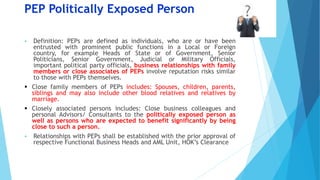
PEP Politically Exposed Person
 Definition: PEPs are defined as individuals, who are or have been
entrusted with prominent public functions in a Local or Foreign
country, for example Heads of State or of Government, Senior
Politicians, Senior Government, Judicial or Military Officials,
important political party officials, business relationships with family
members or close associates of PEPs involve reputation risks similar
to those with PEPs themselves.
 Close family members of PEPs includes: Spouses, children, parents,
siblings and may also include other blood relatives and relatives by
marriage.
 Closely associated persons includes: Close business colleagues and
personal Advisors/ Consultants to the politically exposed person as
well as persons who are expected to benefit significantly by being
close to such a person.
 Relationships with PEPs shall be established with the prior approval of
respective Functional Business Heads and AML Unit, HOK’s Clearance
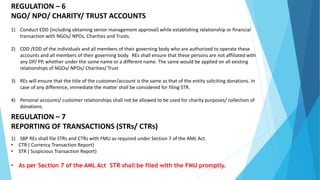
REGULATION – 6
NGO/ NPO/ CHARITY/ TRUST ACCOUNTS
1) Conduct EDD (including obtaining senior management approval) while establishing relationship or financial
transaction with NGOs/ NPOs, Charities and Trusts.
2) CDD /EDD of the individuals and all members of their governing body who are authorized to operate these
accounts and all members of their governing body. REs shall ensure that these persons are not affiliated with
any DP/ PP, whether under the same name or a different name. The same would be applied on all existing
relationships of NGOs/ NPOs/ Charities/ Trust
3) REs will ensure that the title of the customer/account is the same as that of the entity soliciting donations. In
case of any difference, immediate the matter shall be considered for filing STR.
4) Personal accounts/ customer relationships shall not be allowed to be used for charity purposes/ collection of
donations.
REGULATION – 7
REPORTING OF TRANSACTIONS (STRs/ CTRs)
1) SBP REs shall file STRs and CTRs with FMU as required under Section 7 of the AML Act.
• CTR ( Currency Transaction Report)
• STR ( Suspicious Transaction Report)
• As per Section 7 of the AML Act STR shall be filed with the FMU promptly.
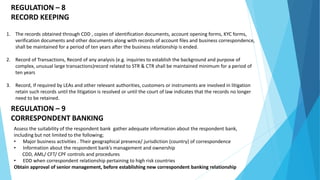
REGULATION – 8
RECORD KEEPING
1. The records obtained through CDD , copies of identification documents, account opening forms, KYC forms,
verification documents and other documents along with records of account files and business correspondence,
shall be maintained for a period of ten years after the business relationship is ended.
2. Record of Transactions, Record of any analysis (e.g. inquiries to establish the background and purpose of
complex, unusual large transactions)record related to STR & CTR shall be maintained minimum for a period of
ten years
3. Record, If required by LEAs and other relevant authorities, customers or instruments are involved in litigation
retain such records until the litigation is resolved or until the court of law indicates that the records no longer
need to be retained.
REGULATION – 9
CORRESPONDENT BANKING
Assess the suitability of the respondent bank gather adequate information about the respondent bank,
including but not limited to the following;
• Major business activities . Their geographical presence/ jurisdiction (country) of correspondence
• Information about the respondent bank’s management and ownership
CDD, AML/ CFT/ CPF controls and procedures
• EDD when correspondent relationship pertaining to high risk countries
Obtain approval of senior management, before establishing new correspondent banking relationship
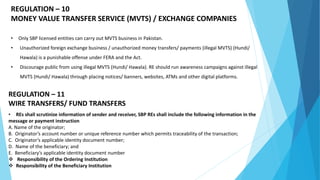
REGULATION – 10
MONEY VALUE TRANSFER SERVICE (MVTS) / EXCHANGE COMPANIES
• Only SBP licensed entities can carry out MVTS business in Pakistan.
• Unauthorized foreign exchange business / unauthorized money transfers/ payments (illegal MVTS) (Hundi/
Hawala) is a punishable offense under FERA and the Act.
• Discourage public from using illegal MVTS (Hundi/ Hawala). RE should run awareness campaigns against illegal
MVTS (Hundi/ Hawala) through placing notices/ banners, websites, ATMs and other digital platforms.
REGULATION – 11
WIRE TRANSFERS/ FUND TRANSFERS
• REs shall scrutinize information of sender and receiver, SBP REs shall include the following information in the
message or payment instruction
A. Name of the originator;
B. Originator’s account number or unique reference number which permits traceability of the transaction;
C. Originator’s applicable identity document number;
D. Name of the beneficiary; and
E. Beneficiary’s applicable identity document number
 Responsibility of the Ordering Institution
 Responsibility of the Beneficiary Institution
REGULATION – 12
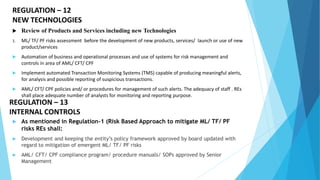
NEW TECHNOLOGIES
 Review of Products and Services including new Technologies
1. ML/ TF/ PF risks assessment before the development of new products, services/ launch or use of new
product/services
 Automation of business and operational processes and use of systems for risk management and
controls in area of AML/ CFT/ CPF
 Implement automated Transaction Monitoring Systems (TMS) capable of producing meaningful alerts,
for analysis and possible reporting of suspicious transactions.
 AML/ CFT/ CPF policies and/ or procedures for management of such alerts. The adequacy of staff . REs
shall place adequate number of analysts for monitoring and reporting purpose.
REGULATION – 13
INTERNAL CONTROLS
 As mentioned in Regulation-1 (Risk Based Approach to mitigate ML/ TF/ PF
risks REs shall:
 Development and keeping the entity’s policy framework approved by board updated with
regard to mitigation of emergent ML/ TF/ PF risks
 AML/ CFT/ CPF compliance program/ procedure manuals/ SOPs approved by Senior
Management
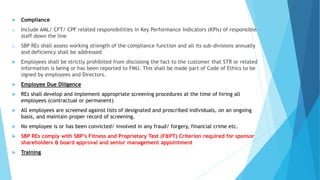
 Compliance
a. Include AML/ CFT/ CPF related responsibilities in Key Performance Indicators (KPIs) of responsible
staff down the line
b. SBP REs shall assess working strength of the compliance function and all its sub-divisions annually
and deficiency shall be addressed
 Employees shall be strictly prohibited from disclosing the fact to the customer that STR or related
information is being or has been reported to FMU. This shall be made part of Code of Ethics to be
signed by employees and Directors.
 Employee Due Diligence
 REs shall develop and implement appropriate screening procedures at the time of hiring all
employees (contractual or permanent)
 All employees are screened against lists of designated and proscribed individuals, on an ongoing
basis, and maintain proper record of screening.
 No employee is or has been convicted/ involved in any fraud/ forgery, financial crime etc.
 SBP REs comply with SBP’s Fitness and Proprietary Test (F&PT) Criterion required for sponsor
shareholders & board approval and senior management appointment
 Training
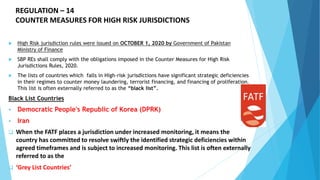
REGULATION – 14
COUNTER MEASURES FOR HIGH RISK JURISDICTIONS
 High Risk jurisdiction rules were issued on OCTOBER 1, 2020 by Government of Pakistan
Ministry of Finance
 SBP REs shall comply with the obligations imposed in the Counter Measures for High Risk
Jurisdictions Rules, 2020.
 The lists of countries which falls in High-risk jurisdictions have significant strategic deficiencies
in their regimes to counter money laundering, terrorist financing, and financing of proliferation.
This list is often externally referred to as the “black list”.
Black List Countries
 Democratic People's Republic of Korea (DPRK)
 Iran
 When the FATF places a jurisdiction under increased monitoring, it means the
country has committed to resolve swiftly the identified strategic deficiencies within
agreed timeframes and is subject to increased monitoring. This list is often externally
referred to as the
 ‘Grey List Countries’
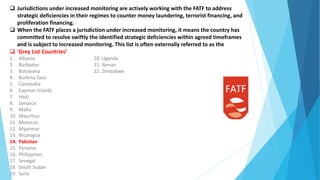
 Jurisdictions under increased monitoring are actively working with the FATF to address
strategic deficiencies in their regimes to counter money laundering, terrorist financing, and
proliferation financing.
 When the FATF places a jurisdiction under increased monitoring, it means the country has
committed to resolve swiftly the identified strategic deficiencies within agreed timeframes
and is subject to increased monitoring. This list is often externally referred to as the
 ‘Grey List Countries’
1. Albania 20. Uganda
2. Barbados 21. Yeman
3. Botswana 22. Zimbabwe
4. Burkina Faso
5. Cambodia
6. Cayman Islands
7. Haiti
8. Jamaica
9. Malta
10. Mauritius
11. Morocco
12. Myanmar
13. Nicaragua
14. Pakistan
15. Panama
16. Philippines
17. Senegal
18. South Sudan
19. Syria
REGULATION – 15
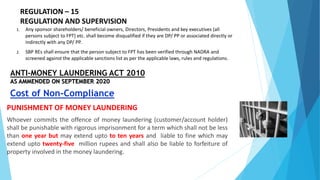
REGULATION AND SUPERVISION
1. Any sponsor shareholders/ beneficial owners, Directors, Presidents and key executives (all
persons subject to FPT) etc. shall become disqualified if they are DP/ PP or associated directly or
indirectly with any DP/ PP.
2. SBP REs shall ensure that the person subject to FPT has been verified through NADRA and
screened against the applicable sanctions list as per the applicable laws, rules and regulations.
ANTI-MONEY LAUNDERING ACT 2010
AS AMMENDED ON SEPTEMBER 2020
PUNISHMENT OF MONEY LAUNDERING
Whoever commits the offence of money laundering (customer/account holder)
shall be punishable with rigorous imprisonment for a term which shall not be less
than one year but may extend upto to ten years and liable to fine which may
extend upto twenty-five million rupees and shall also be liable to forfeiture of
property involved in the money laundering.
Cost of Non-Compliance
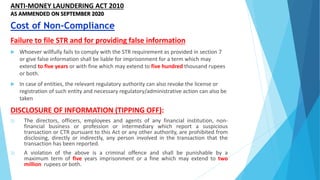
ANTI-MONEY LAUNDERING ACT 2010
AS AMMENDED ON SEPTEMBER 2020
Failure to file STR and for providing false information
 Whoever willfully fails to comply with the STR requirement as provided in section 7
or give false information shall be liable for imprisonment for a term which may
extend to five years or with fine which may extend to five hundred thousand rupees
or both.
 In case of entities, the relevant regulatory authority can also revoke the license or
registration of such entity and necessary regulatory/administrative action can also be
taken
DISCLOSURE OF INFORMATION (TIPPING OFF):
1) The directors, officers, employees and agents of any financial institution, non-
financial business or profession or intermediary which report a suspicious
transaction or CTR pursuant to this Act or any other authority, are prohibited from
disclosing, directly or indirectly, any person involved in the transaction that the
transaction has been reported.
2) A violation of the above is a criminal offence and shall be punishable by a
maximum term of five years imprisonment or a fine which may extend to two
million rupees or both.
Cost of Non-Compliance

Main presentation aml cft

  • 1.
    ANTI-MONEY LAUNDERING, COMBATINGTHE FINANCING OF TERRORISM & COUNTERING PROLIFERATION FINANCING (AML/ CFT/ CPF) REGULATIONS FOR STATE BANK OF PAKISTAN’S REGULATED ENTITIES (SBP-REs) (Updated up to September 30, 2020)
  • 2.
    proliferation financing” meansthe Financing of proliferation of weapons of mass destruction;  ‫ہتھیار‬ ‫والے‬ ‫پھیالنے‬ ‫تباہی‬ ‫پر‬ ‫پیمانے‬ ‫بڑے‬ Types of Weapons of Mass Destruction  Biological Weapons . Include bacterial, pandemic, Epidemic, Fevers, small pox, hepatitis, include bacterial. There are three ways biological weapons work: One is contact with the skin, two is gastrointestinal, and three is pulmonary.  Chemical weapon is any weapon that uses a manufactured chemical to kill people.  The first chemical weapon used effectively in battle was chlorine gas, which burns and destroys lung tissue. Chlorine is not an exotic chemical. Most municipal water systems use it today to kill bacteria.  Nerve gas, tear gas  Nuclear Weapons of Mass Destruction. Gun nuclear, ballistic missiles
  • 4.
    REGULATION – 1 RISKBASED APPROACH TO AML / CFT 1. SBP REs shall comply with risk based approach 2. SBP REs shall ensure entity level Internal Risk Assessment Report (IRAR) which covers Transnational TF risk. 3. IRAR shall include results of National Risk Assessment (NRA) 4. IRAR should be used for evaluating Residual Risk 5. SBP REs shall formulate policy for application of SDD, CDD and EDD. 6. Periodic updation of IRAR 7. SBP REs shall develop AML / CFT / CPF policies / procedures / controls / obligation / preventive measures
  • 5.
    REGULATION – 2 Definitionof Due Diligence 1. REs shall at minimum conduct CDD of the customers / occasional customers as set out in section 7A (1) of the AML Act 2. REs shall apply CDD measures as per section 7A (2) of the AML Act 3. For identification of the customer / occasional customer, REs shall obtain information mentioned in Annexure I 4. For purpose of verification of identity of the customer / occasional customer, REs shall obtain information mentioned in Annexure II 5. Reliable and independent document 6. Customers, Product & Services, delivery channels and geographic location 7. Person who acts on behalf of the customer (authorized agent or representative) 8. Ascertain the beneficial ownership 9. Additional documentation 10. Measures to verify the identity of beneficial owners of legal persons
  • 6.
    - CUSTOMER DUEDILIGENCE (CDD) 11. Measures to verify the identity of beneficial owners of legal arrangements 12. REs shall not open numbered accounts and shall not conduct transactions on fake identity documents 13. Name of entity with abbreviated, REs shall satisfy themselves that the title is in accordance with the constituent documents 14. SBP REs shall comply Section 7A of the Act for all type of customers Enhanced Due Diligence 15. SBP Res shall apply EDD in the following circumstances:  Business relationships and transactions with natural and legal persons when the risks are higher.  High Risk Countries.  PEPs and their close associates and family members. 16. EDD measures may include:  Obtaining additional information of the customer  Obtaining additional information on the intended nature of the business  Obtaining additional information on the source of funds  Obtaining additional information on the reason for performed transaction  Taking reasonable measures to establish the source of funds involved in the transaction  Obtaining approval from the Senior Management to commence or continue the business  Where applicable, conducting enhanced monitoring of the business relationship  Where available, requiring the first payment to be deposited through an account in the customer’s name with a bank subject to similar CDD standards
  • 7.
     Obtaining additionalinformation on the customer (for e.g. occupation, assets volume), and updating more regularly the identification data of customer and beneficial owner;  Obtaining additional information on the intended nature of the business relationship;  Obtaining information on the SOF/SOW & reasons for intended transactions of the customer; ;  Obtaining the approval of senior management to commence or continue the business relationship;  Conducting enhanced monitoring of the business relationship by increasing the number and timing of controls.  Verifying the identity of the customer and the beneficial owner after the establishment of the business relationship Reducing the frequency of customer identification updates;  Reducing the degree of ongoing monitoring and scrutinizing transactions based on a reasonable monetary threshold;  Not collecting specific information to understand the purpose & intended nature of the business but inferring the purpose and nature from the type of transactions or business relationship established.
  • 8.
    Simplified Due Diligence SBPREs shall not apply SDD whenever there is a suspicion of ML or TF or PF. Ongoing Monitoring of Business Relationships ( TMS) ( Alerts ) ( revise KYC) (Call report) (Event Driven Review)  In case SBP REs could not complete CDD, they shall comply with the requirement mentioned in Section 7D of the Act. REs may apply following measures for ongoing monitoring  Update of Customer Risk Profiling (CRP) New & Existing customer ongoing basis RE shall ensure update of CDD of existing customer on periodical basis a. REs shall block accounts without valid ID document (after serving one-month prior notice) for all debit transactions/ withdrawals. However, debit block shall be removed after submission of valid ID card and verification of the same. Dormant accounts  In case of dormant account credit entries may allow without changing the dormancy status. Debit transactions/ withdrawals shall not be allowed until the account is activated on the request of the account holder. Prohibition of personal accounts for business transactions Monitoring Asset Side/ Trade Finance Customers REs shall also apply CDD measures of asset side/ trade finance customers as prescribed in these Regulations and ensure monitoring of such customers with regard to ML/ TF/ PF risks
  • 9.
     BPRD AnnexureCircular Letter No. 20 Date June 08, 2021 SBP facilitate account opening of mentally disordered person through court appointed manager. SBP has provided a major facilitation to mentality disordered person by allowing them to open a bank account through a well-defined account opening process. New Category of account Name : Mentally disordered person Account. Account open process will include presentation of valid ID doc and biometric verification through NADRA of both mentally disorder person and court appointed manager.  Bank will verify the certified true copy of court order to ensure the authenticity of the appointed manager.  All CDD requirement should be completed for both persons to meet AML CFT regulations. Definitions as per SBP AML CFT CPF guidelines Para 5. Point 36 and 37  36) “Court appointed Manager” means a person appointed by the court to operate bank account of a mentally disordered person under the applicable laws on mental health.  37) “Person with Mental Disorder” means a person with mental illness as defined in the Applicable laws on mental health.
  • 11.
     REs (exceptECs/ ECs-B) allowed to rely on third party FIs for CDD.  REs shall satisfy themselves that the third party financial institution is regulated, and has measures in place for compliance with CDD & other regulations.  REs shall ensure compliance of High Risk Jurisdictions Regulation-14. (The lists of countries which falls in High- Risk jurisdictions have significant strategic deficiencies.) REGULATION – 4 FINANCIAL SANCTIONS UNDER UNSC ACT, 1948 AND ATA, 1997  Under the UNSC Act and ATA, Designated Person and Proscribed Person, Entities owned or controlled, directly or indirectly, by them; or Individuals and entities acting on their behalf, or at their direction  RE will ensure the real-time screening of customers / occasional customers.  If any relationship is found REs shall a) Freeze, without delay and without prior notice, the funds or other assets of the identified relationship. Compliance will report STR to FMU. REGULATION – 3 RELIANCE ON THIRD PARTY FINANCIAL INSTITUTIONS FOR CDD MEASURES
  • 12.
    b) Report thefreezing of funds or other financial assets to SBP, within 48 hours of freezing, in the manner prescribed by SBP.  SBP REs shall ensure compliance with TFS obligations with regard to their vendors, employees (permanent, contractual or hired through outsourcing), BoD, owners, sponsor shareholders, etc. REs shall permit deposits (credits) in frozen accounts without changing status of the accounts. However, no charges shall be deducted from frozen accounts REGULATION – 5 POLITICALLY EXPOSED PERSONS (PEPs) In relation to PEPs and their close associates or family members, SBP REs shall: a) Implement appropriate internal policies, procedures and controls to determine if a customer or beneficial owner is a PEP or a close associate or a family member of a PEP, both prior to establishing a business relationship. b) Obtain approval from the senior management where the customer or a beneficial owner is a PEP. c) Establish, by appropriate means, the sources of wealth and the source of funds of customers and beneficial owners identified as PEP. d) Conduct enhanced ongoing monitoring of business relations with the customer or beneficial owner identified as PEP,
  • 13.
    Detail of AmendedRegulations: Regulation – 4 Targeted Financial Sanctions under UNSC Act, 1948 and ATA, 1997  3) SBP REs shall ensure mechanisms, processes and procedures for real-time screening of customers/ occasional customers, by implementing effective name screening solution and allocate sufficient trained resources. Unquote]  In this regard you are advised to coordinate with Country Operations to create tool for screening of Home remittance transactions with Sanctions Lists i.e. UNSC, OFAC, EU, NACTA and FIA Redbook, and share it with concerns who perform Homer remittance transactions and instruct them to keep proper record of screen results alongwith copy of valid ID document with each transaction for audit review.
  • 14.
    PEP Politically ExposedPerson  Definition: PEPs are defined as individuals, who are or have been entrusted with prominent public functions in a Local or Foreign country, for example Heads of State or of Government, Senior Politicians, Senior Government, Judicial or Military Officials, important political party officials, business relationships with family members or close associates of PEPs involve reputation risks similar to those with PEPs themselves.  Close family members of PEPs includes: Spouses, children, parents, siblings and may also include other blood relatives and relatives by marriage.  Closely associated persons includes: Close business colleagues and personal Advisors/ Consultants to the politically exposed person as well as persons who are expected to benefit significantly by being close to such a person.  Relationships with PEPs shall be established with the prior approval of respective Functional Business Heads and AML Unit, HOK’s Clearance
  • 15.
    REGULATION – 6 NGO/NPO/ CHARITY/ TRUST ACCOUNTS 1) Conduct EDD (including obtaining senior management approval) while establishing relationship or financial transaction with NGOs/ NPOs, Charities and Trusts. 2) CDD /EDD of the individuals and all members of their governing body who are authorized to operate these accounts and all members of their governing body. REs shall ensure that these persons are not affiliated with any DP/ PP, whether under the same name or a different name. The same would be applied on all existing relationships of NGOs/ NPOs/ Charities/ Trust 3) REs will ensure that the title of the customer/account is the same as that of the entity soliciting donations. In case of any difference, immediate the matter shall be considered for filing STR. 4) Personal accounts/ customer relationships shall not be allowed to be used for charity purposes/ collection of donations. REGULATION – 7 REPORTING OF TRANSACTIONS (STRs/ CTRs) 1) SBP REs shall file STRs and CTRs with FMU as required under Section 7 of the AML Act. • CTR ( Currency Transaction Report) • STR ( Suspicious Transaction Report) • As per Section 7 of the AML Act STR shall be filed with the FMU promptly.
  • 16.
    REGULATION – 8 RECORDKEEPING 1. The records obtained through CDD , copies of identification documents, account opening forms, KYC forms, verification documents and other documents along with records of account files and business correspondence, shall be maintained for a period of ten years after the business relationship is ended. 2. Record of Transactions, Record of any analysis (e.g. inquiries to establish the background and purpose of complex, unusual large transactions)record related to STR & CTR shall be maintained minimum for a period of ten years 3. Record, If required by LEAs and other relevant authorities, customers or instruments are involved in litigation retain such records until the litigation is resolved or until the court of law indicates that the records no longer need to be retained. REGULATION – 9 CORRESPONDENT BANKING Assess the suitability of the respondent bank gather adequate information about the respondent bank, including but not limited to the following; • Major business activities . Their geographical presence/ jurisdiction (country) of correspondence • Information about the respondent bank’s management and ownership CDD, AML/ CFT/ CPF controls and procedures • EDD when correspondent relationship pertaining to high risk countries Obtain approval of senior management, before establishing new correspondent banking relationship
  • 17.
    REGULATION – 10 MONEYVALUE TRANSFER SERVICE (MVTS) / EXCHANGE COMPANIES • Only SBP licensed entities can carry out MVTS business in Pakistan. • Unauthorized foreign exchange business / unauthorized money transfers/ payments (illegal MVTS) (Hundi/ Hawala) is a punishable offense under FERA and the Act. • Discourage public from using illegal MVTS (Hundi/ Hawala). RE should run awareness campaigns against illegal MVTS (Hundi/ Hawala) through placing notices/ banners, websites, ATMs and other digital platforms. REGULATION – 11 WIRE TRANSFERS/ FUND TRANSFERS • REs shall scrutinize information of sender and receiver, SBP REs shall include the following information in the message or payment instruction A. Name of the originator; B. Originator’s account number or unique reference number which permits traceability of the transaction; C. Originator’s applicable identity document number; D. Name of the beneficiary; and E. Beneficiary’s applicable identity document number  Responsibility of the Ordering Institution  Responsibility of the Beneficiary Institution
  • 18.
    REGULATION – 12 NEWTECHNOLOGIES  Review of Products and Services including new Technologies 1. ML/ TF/ PF risks assessment before the development of new products, services/ launch or use of new product/services  Automation of business and operational processes and use of systems for risk management and controls in area of AML/ CFT/ CPF  Implement automated Transaction Monitoring Systems (TMS) capable of producing meaningful alerts, for analysis and possible reporting of suspicious transactions.  AML/ CFT/ CPF policies and/ or procedures for management of such alerts. The adequacy of staff . REs shall place adequate number of analysts for monitoring and reporting purpose. REGULATION – 13 INTERNAL CONTROLS  As mentioned in Regulation-1 (Risk Based Approach to mitigate ML/ TF/ PF risks REs shall:  Development and keeping the entity’s policy framework approved by board updated with regard to mitigation of emergent ML/ TF/ PF risks  AML/ CFT/ CPF compliance program/ procedure manuals/ SOPs approved by Senior Management
  • 19.
     Compliance a. IncludeAML/ CFT/ CPF related responsibilities in Key Performance Indicators (KPIs) of responsible staff down the line b. SBP REs shall assess working strength of the compliance function and all its sub-divisions annually and deficiency shall be addressed  Employees shall be strictly prohibited from disclosing the fact to the customer that STR or related information is being or has been reported to FMU. This shall be made part of Code of Ethics to be signed by employees and Directors.  Employee Due Diligence  REs shall develop and implement appropriate screening procedures at the time of hiring all employees (contractual or permanent)  All employees are screened against lists of designated and proscribed individuals, on an ongoing basis, and maintain proper record of screening.  No employee is or has been convicted/ involved in any fraud/ forgery, financial crime etc.  SBP REs comply with SBP’s Fitness and Proprietary Test (F&PT) Criterion required for sponsor shareholders & board approval and senior management appointment  Training
  • 20.
    REGULATION – 14 COUNTERMEASURES FOR HIGH RISK JURISDICTIONS  High Risk jurisdiction rules were issued on OCTOBER 1, 2020 by Government of Pakistan Ministry of Finance  SBP REs shall comply with the obligations imposed in the Counter Measures for High Risk Jurisdictions Rules, 2020.  The lists of countries which falls in High-risk jurisdictions have significant strategic deficiencies in their regimes to counter money laundering, terrorist financing, and financing of proliferation. This list is often externally referred to as the “black list”. Black List Countries  Democratic People's Republic of Korea (DPRK)  Iran  When the FATF places a jurisdiction under increased monitoring, it means the country has committed to resolve swiftly the identified strategic deficiencies within agreed timeframes and is subject to increased monitoring. This list is often externally referred to as the  ‘Grey List Countries’
  • 21.
     Jurisdictions underincreased monitoring are actively working with the FATF to address strategic deficiencies in their regimes to counter money laundering, terrorist financing, and proliferation financing.  When the FATF places a jurisdiction under increased monitoring, it means the country has committed to resolve swiftly the identified strategic deficiencies within agreed timeframes and is subject to increased monitoring. This list is often externally referred to as the  ‘Grey List Countries’ 1. Albania 20. Uganda 2. Barbados 21. Yeman 3. Botswana 22. Zimbabwe 4. Burkina Faso 5. Cambodia 6. Cayman Islands 7. Haiti 8. Jamaica 9. Malta 10. Mauritius 11. Morocco 12. Myanmar 13. Nicaragua 14. Pakistan 15. Panama 16. Philippines 17. Senegal 18. South Sudan 19. Syria
  • 22.
    REGULATION – 15 REGULATIONAND SUPERVISION 1. Any sponsor shareholders/ beneficial owners, Directors, Presidents and key executives (all persons subject to FPT) etc. shall become disqualified if they are DP/ PP or associated directly or indirectly with any DP/ PP. 2. SBP REs shall ensure that the person subject to FPT has been verified through NADRA and screened against the applicable sanctions list as per the applicable laws, rules and regulations. ANTI-MONEY LAUNDERING ACT 2010 AS AMMENDED ON SEPTEMBER 2020 PUNISHMENT OF MONEY LAUNDERING Whoever commits the offence of money laundering (customer/account holder) shall be punishable with rigorous imprisonment for a term which shall not be less than one year but may extend upto to ten years and liable to fine which may extend upto twenty-five million rupees and shall also be liable to forfeiture of property involved in the money laundering. Cost of Non-Compliance
  • 23.
    ANTI-MONEY LAUNDERING ACT2010 AS AMMENDED ON SEPTEMBER 2020 Failure to file STR and for providing false information  Whoever willfully fails to comply with the STR requirement as provided in section 7 or give false information shall be liable for imprisonment for a term which may extend to five years or with fine which may extend to five hundred thousand rupees or both.  In case of entities, the relevant regulatory authority can also revoke the license or registration of such entity and necessary regulatory/administrative action can also be taken DISCLOSURE OF INFORMATION (TIPPING OFF): 1) The directors, officers, employees and agents of any financial institution, non- financial business or profession or intermediary which report a suspicious transaction or CTR pursuant to this Act or any other authority, are prohibited from disclosing, directly or indirectly, any person involved in the transaction that the transaction has been reported. 2) A violation of the above is a criminal offence and shall be punishable by a maximum term of five years imprisonment or a fine which may extend to two million rupees or both. Cost of Non-Compliance