Introduction to SBP Green Banking Guidelines
Implementation in Banking Sector
Issuing Department:
Operational Risk Management Department
Risk Management Division
September ‘2020
Introduction to Green Banking
Green Banking acknowledges responsibility of the financial sector in supporting policy initiatives for
transforming country’s economy towards low carbon and climate resilient economy.
And contributes towards sustainability to reduce the vulnerability and risks arising from banking operations in
accordance with green banking guidelines issued by State Bank of Pakistan.
Green Banking envisions inculcation of environmental consciousness as part of organizational culture and
reorientation of banking products/ services and operations to reduce environmental impact of banks on the
economy.
Regulatory Requirements for Green Banking
.
• SBP issued the Guidelines on October 08, 2017.
• A comprehensive policy on green banking.
• Procedures to identify, assess, mitigate, monitor and report on environmental risks.
• Financial mechanisms which are adapted to fit green investments.
• A system that reduces environmental impacts stemming from banks /DFI’s own operations.
• Review banks overall portfolio, its environmental risk positions and report to relevant stakeholders
• SBP is monitoring progress of banks and DFIs in implementation of Green Banking Guidelines.
What is Green Banking
A shift from banking as usual that provides necessary tools and techniques to leverage banking channels for promotion of
resource efficiency, environmental protection and climate resilience for an equitable and sustainable development of
economy”.
Banking sector’s interacts with the environment in two ways.
 Direct: Day to day operations such as use of paper, electricity, stationary, lighting, air conditioning,
electronic equipment etc.
 Indirect: Through on-lending to business/ industries which include sectors like steel, paper, cement,
chemicals, fertilizers, power, textiles etc.
What is Green Culture
Green culture may be defined as a lifestyle of making deliberate choices and decisions regarding the resources used for daily
living for the purpose of minimizing resources used or to use resources that are renewable.
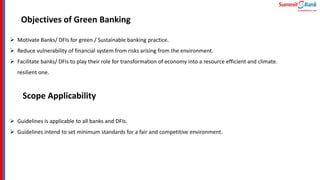
Objectives of Green Banking
 Motivate Banks/ DFIs for green / Sustainable banking practice.
 Reduce vulnerability of financial system from risks arising from the environment.
 Facilitate banks/ DFIs to play their role for transformation of economy into a resource efficient and climate.
resilient one.
Scope Applicability
 Guidelines is applicable to all banks and DFIs.
 Guidelines intend to set minimum standards for a fair and competitive environment.
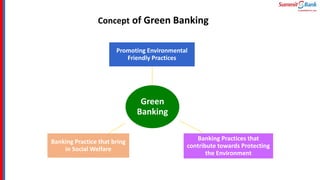
Concept of Green Banking
Green
Banking
Promoting Environmental
Friendly Practices
Banking Practices that
contribute towards Protecting
the Environment
Banking Practice that bring
in Social Welfare
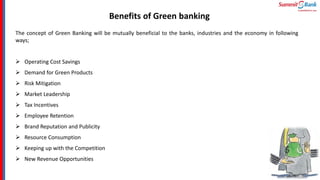
Benefits of Green banking
The concept of Green Banking will be mutually beneficial to the banks, industries and the economy in following
ways;
 Operating Cost Savings
 Demand for Green Products
 Risk Mitigation
 Market Leadership
 Tax Incentives
 Employee Retention
 Brand Reputation and Publicity
 Resource Consumption
 Keeping up with the Competition
 New Revenue Opportunities
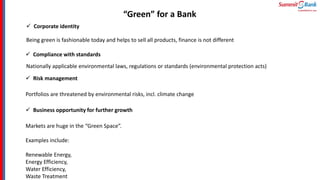
“Green” for a Bank
 Corporate identity
Being green is fashionable today and helps to sell all products, finance is not different
 Compliance with standards
Nationally applicable environmental laws, regulations or standards (environmental protection acts)
 Risk management
Portfolios are threatened by environmental risks, incl. climate change
 Business opportunity for further growth
Markets are huge in the “Green Space”.
Examples include:
Renewable Energy,
Energy Efficiency,
Water Efficiency,
Waste Treatment
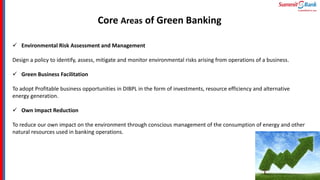
Core Areas of Green Banking
 Environmental Risk Assessment and Management
Design a policy to identify, assess, mitigate and monitor environmental risks arising from operations of a business.
 Green Business Facilitation
To adopt Profitable business opportunities in DIBPL in the form of investments, resource efficiency and alternative
energy generation.
 Own Impact Reduction
To reduce our own impact on the environment through conscious management of the consumption of energy and other
natural resources used in banking operations.
Shariah Perspective for Environmental Protection (Cleanliness)
Prophet Muhammad (SAW) not only gave importance to personal hygiene but also informed us to keep the
environment clean.
• Abu Malik Al-Ash`ari (RA) reported that the Messenger of Allah (SAW) said:
“Cleanliness is half of iman (faith).“
• Abu Dharr Al-Ghafari (RA) reported that the Prophet (SAW) said,
“Removing harmful things from the road is an act of charity (sadaqah).”
Shariah Perspective for Own Impact Reduction
• Prophet Muhammad (SAW) said:
"By Allah, he does not believe!
By Allah, he does not believe!
By Allah, he does not believe!"
It was said, "Who is that, O Allah's Messenger " He (SAW) said, "That person whose neighbor does not feel safe from his
evil (Bad Deeds)."
(Sahih Bukhari Vol #8, Hadith # 6016)
• Prophet Muhammad (SAW) said:
“Whoever believes in Allah and the Last Day should not harm his neighbor.”
(Sahih Bukhari Vol #7, Hadith # 5185)
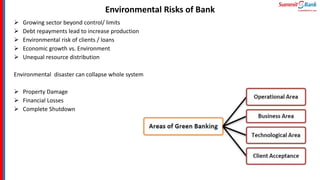
Environmental Risks of Bank
 Growing sector beyond control/ limits
 Debt repayments lead to increase production
 Environmental risk of clients / loans
 Economic growth vs. Environment
 Unequal resource distribution
Environmental disaster can collapse whole system
 Property Damage
 Financial Losses
 Complete Shutdown
Benefits for Banks and Their Clients
For Clients
 Cost savings –Improved Productivity/Quality of Output –Competitiveness
 Reasonable pay-back period –Investments recovered from energy cost savings
 Reduced footprint –Sustainable access to global supply chains
For FIs
1. Expanded market through a new business line:
 Innovative product
 Monetize existing client base-Attract quality new clients
 Sell on value to customer, not pricing
 New marketing channels through vendor partnerships
2. Improved risk profile of portfolio:
 Energy cost savings as a part of cash-flow
 Positive social and environmental impacts
 Enhanced brand reputation, PR opportunities
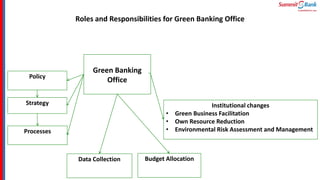
Roles and Responsibilities for Green Banking Office
Green Banking
Office
Policy
Strategy
Processes
Institutional changes
• Green Business Facilitation
• Own Resource Reduction
• Environmental Risk Assessment and Management
Data Collection Budget Allocation
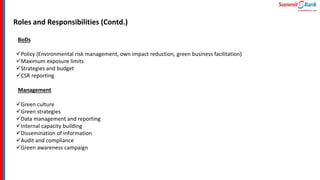
Roles and Responsibilities (Contd.)
BoDs
Policy (Environmental risk management, own impact reduction, green business facilitation)
Maximum exposure limits
Strategies and budget
CSR reporting
Management
Green culture
Green strategies
Data management and reporting
Internal capacity building
Dissemination of information
Audit and compliance
Green awareness campaign
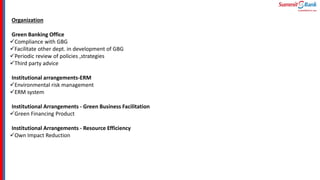
Organization
Green Banking Office
Compliance with GBG
Facilitate other dept. in development of GBG
Periodic review of policies ,strategies
Third party advice
Institutional arrangements-ERM
Environmental risk management
ERM system
Institutional Arrangements - Green Business Facilitation
Green Financing Product
Institutional Arrangements - Resource Efficiency
Own Impact Reduction
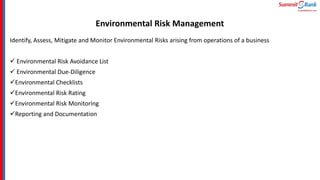
Environmental Risk Management
Identify, Assess, Mitigate and Monitor Environmental Risks arising from operations of a business
 Environmental Risk Avoidance List
 Environmental Due-Diligence
Environmental Checklists
Environmental Risk Rating
Environmental Risk Monitoring
Reporting and Documentation
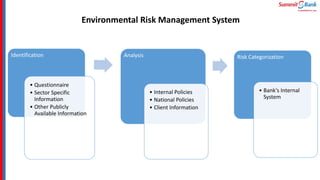
Environmental Risk Management System
Identification
• Questionnaire
• Sector Specific
Information
• Other Publicly
Available Information
Analysis
• Internal Policies
• National Policies
• Client Information
Risk Categorization
• Bank‘s Internal
System
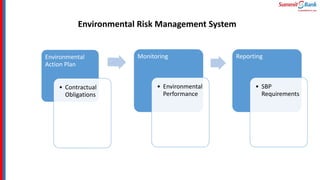
Environmental Risk Management System
Environmental
Action Plan
• Contractual
Obligations
Monitoring
• Environmental
Performance
Reporting
• SBP
Requirements
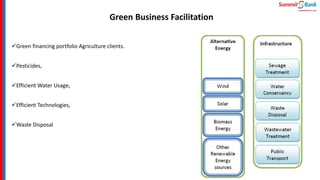
Green Business Facilitation
Green financing portfolio Agriculture clients.
Pesticides,
Efficient Water Usage,
Efficient Technologies,
Waste Disposal
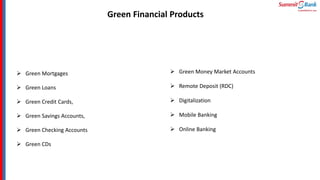
 Green Mortgages
 Green Loans
 Green Credit Cards,
 Green Savings Accounts,
 Green Checking Accounts
 Green CDs
Green Financial Products
 Green Money Market Accounts
 Remote Deposit (RDC)
 Digitalization
 Mobile Banking
 Online Banking
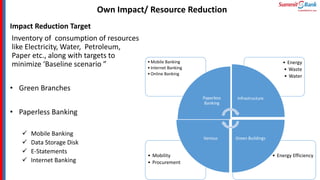
Own Impact/ Resource Reduction
• Energy Efficiency
• Mobility
• Procurement
• Energy
• Waste
• Water
•Mobile Banking
•Internet Banking
•Online Banking
Paperless
Banking
Infrastructure
Green Buildings
Various
Impact Reduction Target
Inventory of consumption of resources
like Electricity, Water, Petroleum,
Paper etc., along with targets to
minimize ‘Baseline scenario ”
• Green Branches
• Paperless Banking
 Mobile Banking
 Data Storage Disk
 E-Statements
 Internet Banking
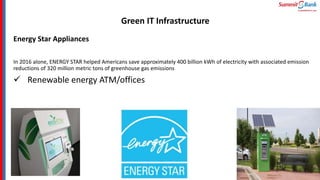
Green IT Infrastructure
Energy Star Appliances
In 2016 alone, ENERGY STAR helped Americans save approximately 400 billion kWh of electricity with associated emission
reductions of 320 million metric tons of greenhouse gas emissions
 Renewable energy ATM/offices
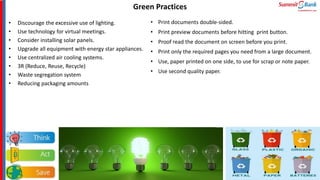
• Discourage the excessive use of lighting.
• Use technology for virtual meetings.
• Consider installing solar panels.
• Upgrade all equipment with energy star appliances.
• Use centralized air cooling systems.
• 3R (Reduce, Reuse, Recycle)
• Waste segregation system
• Reducing packaging amounts
Green Practices
• Print documents double-sided.
• Print preview documents before hitting print button.
• Proof read the document on screen before you print.
• Print only the required pages you need from a large document.
• Use, paper printed on one side, to use for scrap or note paper.
• Use second quality paper.
For Feedback & Suggestions Please Contact:
Shahrukh Alam
Aakash Bajaj
Operational Risk Management Department| Risk Management Division
Summit Tower, 11th Floor, Plot No. G-2, Block 2, Clifton, Karachi.

SBP Green Banking

  • 1.
    Introduction to SBPGreen Banking Guidelines Implementation in Banking Sector Issuing Department: Operational Risk Management Department Risk Management Division September ‘2020
  • 2.
    Introduction to GreenBanking Green Banking acknowledges responsibility of the financial sector in supporting policy initiatives for transforming country’s economy towards low carbon and climate resilient economy. And contributes towards sustainability to reduce the vulnerability and risks arising from banking operations in accordance with green banking guidelines issued by State Bank of Pakistan. Green Banking envisions inculcation of environmental consciousness as part of organizational culture and reorientation of banking products/ services and operations to reduce environmental impact of banks on the economy.
  • 3.
    Regulatory Requirements forGreen Banking . • SBP issued the Guidelines on October 08, 2017. • A comprehensive policy on green banking. • Procedures to identify, assess, mitigate, monitor and report on environmental risks. • Financial mechanisms which are adapted to fit green investments. • A system that reduces environmental impacts stemming from banks /DFI’s own operations. • Review banks overall portfolio, its environmental risk positions and report to relevant stakeholders • SBP is monitoring progress of banks and DFIs in implementation of Green Banking Guidelines.
  • 4.
    What is GreenBanking A shift from banking as usual that provides necessary tools and techniques to leverage banking channels for promotion of resource efficiency, environmental protection and climate resilience for an equitable and sustainable development of economy”. Banking sector’s interacts with the environment in two ways.  Direct: Day to day operations such as use of paper, electricity, stationary, lighting, air conditioning, electronic equipment etc.  Indirect: Through on-lending to business/ industries which include sectors like steel, paper, cement, chemicals, fertilizers, power, textiles etc. What is Green Culture Green culture may be defined as a lifestyle of making deliberate choices and decisions regarding the resources used for daily living for the purpose of minimizing resources used or to use resources that are renewable.
  • 5.
    Objectives of GreenBanking  Motivate Banks/ DFIs for green / Sustainable banking practice.  Reduce vulnerability of financial system from risks arising from the environment.  Facilitate banks/ DFIs to play their role for transformation of economy into a resource efficient and climate. resilient one. Scope Applicability  Guidelines is applicable to all banks and DFIs.  Guidelines intend to set minimum standards for a fair and competitive environment.
  • 6.
    Concept of GreenBanking Green Banking Promoting Environmental Friendly Practices Banking Practices that contribute towards Protecting the Environment Banking Practice that bring in Social Welfare
  • 7.
    Benefits of Greenbanking The concept of Green Banking will be mutually beneficial to the banks, industries and the economy in following ways;  Operating Cost Savings  Demand for Green Products  Risk Mitigation  Market Leadership  Tax Incentives  Employee Retention  Brand Reputation and Publicity  Resource Consumption  Keeping up with the Competition  New Revenue Opportunities
  • 8.
    “Green” for aBank  Corporate identity Being green is fashionable today and helps to sell all products, finance is not different  Compliance with standards Nationally applicable environmental laws, regulations or standards (environmental protection acts)  Risk management Portfolios are threatened by environmental risks, incl. climate change  Business opportunity for further growth Markets are huge in the “Green Space”. Examples include: Renewable Energy, Energy Efficiency, Water Efficiency, Waste Treatment
  • 9.
    Core Areas ofGreen Banking  Environmental Risk Assessment and Management Design a policy to identify, assess, mitigate and monitor environmental risks arising from operations of a business.  Green Business Facilitation To adopt Profitable business opportunities in DIBPL in the form of investments, resource efficiency and alternative energy generation.  Own Impact Reduction To reduce our own impact on the environment through conscious management of the consumption of energy and other natural resources used in banking operations.
  • 10.
    Shariah Perspective forEnvironmental Protection (Cleanliness) Prophet Muhammad (SAW) not only gave importance to personal hygiene but also informed us to keep the environment clean. • Abu Malik Al-Ash`ari (RA) reported that the Messenger of Allah (SAW) said: “Cleanliness is half of iman (faith).“ • Abu Dharr Al-Ghafari (RA) reported that the Prophet (SAW) said, “Removing harmful things from the road is an act of charity (sadaqah).”
  • 11.
    Shariah Perspective forOwn Impact Reduction • Prophet Muhammad (SAW) said: "By Allah, he does not believe! By Allah, he does not believe! By Allah, he does not believe!" It was said, "Who is that, O Allah's Messenger " He (SAW) said, "That person whose neighbor does not feel safe from his evil (Bad Deeds)." (Sahih Bukhari Vol #8, Hadith # 6016) • Prophet Muhammad (SAW) said: “Whoever believes in Allah and the Last Day should not harm his neighbor.” (Sahih Bukhari Vol #7, Hadith # 5185)
  • 12.
    Environmental Risks ofBank  Growing sector beyond control/ limits  Debt repayments lead to increase production  Environmental risk of clients / loans  Economic growth vs. Environment  Unequal resource distribution Environmental disaster can collapse whole system  Property Damage  Financial Losses  Complete Shutdown
  • 13.
    Benefits for Banksand Their Clients For Clients  Cost savings –Improved Productivity/Quality of Output –Competitiveness  Reasonable pay-back period –Investments recovered from energy cost savings  Reduced footprint –Sustainable access to global supply chains For FIs 1. Expanded market through a new business line:  Innovative product  Monetize existing client base-Attract quality new clients  Sell on value to customer, not pricing  New marketing channels through vendor partnerships 2. Improved risk profile of portfolio:  Energy cost savings as a part of cash-flow  Positive social and environmental impacts  Enhanced brand reputation, PR opportunities
  • 14.
    Roles and Responsibilitiesfor Green Banking Office Green Banking Office Policy Strategy Processes Institutional changes • Green Business Facilitation • Own Resource Reduction • Environmental Risk Assessment and Management Data Collection Budget Allocation
  • 15.
    Roles and Responsibilities(Contd.) BoDs Policy (Environmental risk management, own impact reduction, green business facilitation) Maximum exposure limits Strategies and budget CSR reporting Management Green culture Green strategies Data management and reporting Internal capacity building Dissemination of information Audit and compliance Green awareness campaign
  • 16.
    Organization Green Banking Office Compliancewith GBG Facilitate other dept. in development of GBG Periodic review of policies ,strategies Third party advice Institutional arrangements-ERM Environmental risk management ERM system Institutional Arrangements - Green Business Facilitation Green Financing Product Institutional Arrangements - Resource Efficiency Own Impact Reduction
  • 17.
    Environmental Risk Management Identify,Assess, Mitigate and Monitor Environmental Risks arising from operations of a business  Environmental Risk Avoidance List  Environmental Due-Diligence Environmental Checklists Environmental Risk Rating Environmental Risk Monitoring Reporting and Documentation
  • 18.
    Environmental Risk ManagementSystem Identification • Questionnaire • Sector Specific Information • Other Publicly Available Information Analysis • Internal Policies • National Policies • Client Information Risk Categorization • Bank‘s Internal System
  • 19.
    Environmental Risk ManagementSystem Environmental Action Plan • Contractual Obligations Monitoring • Environmental Performance Reporting • SBP Requirements
  • 20.
    Green Business Facilitation Greenfinancing portfolio Agriculture clients. Pesticides, Efficient Water Usage, Efficient Technologies, Waste Disposal
  • 21.
     Green Mortgages Green Loans  Green Credit Cards,  Green Savings Accounts,  Green Checking Accounts  Green CDs Green Financial Products  Green Money Market Accounts  Remote Deposit (RDC)  Digitalization  Mobile Banking  Online Banking
  • 24.
    Own Impact/ ResourceReduction • Energy Efficiency • Mobility • Procurement • Energy • Waste • Water •Mobile Banking •Internet Banking •Online Banking Paperless Banking Infrastructure Green Buildings Various Impact Reduction Target Inventory of consumption of resources like Electricity, Water, Petroleum, Paper etc., along with targets to minimize ‘Baseline scenario ” • Green Branches • Paperless Banking  Mobile Banking  Data Storage Disk  E-Statements  Internet Banking
  • 25.
    Green IT Infrastructure EnergyStar Appliances In 2016 alone, ENERGY STAR helped Americans save approximately 400 billion kWh of electricity with associated emission reductions of 320 million metric tons of greenhouse gas emissions  Renewable energy ATM/offices
  • 26.
    • Discourage theexcessive use of lighting. • Use technology for virtual meetings. • Consider installing solar panels. • Upgrade all equipment with energy star appliances. • Use centralized air cooling systems. • 3R (Reduce, Reuse, Recycle) • Waste segregation system • Reducing packaging amounts Green Practices • Print documents double-sided. • Print preview documents before hitting print button. • Proof read the document on screen before you print. • Print only the required pages you need from a large document. • Use, paper printed on one side, to use for scrap or note paper. • Use second quality paper.
  • 27.
    For Feedback &Suggestions Please Contact: Shahrukh Alam Aakash Bajaj Operational Risk Management Department| Risk Management Division Summit Tower, 11th Floor, Plot No. G-2, Block 2, Clifton, Karachi.