BAFIA 2073
Presented By
Anil Rasaili
Kusum Bhandari
Arbind Pathak
Prabin Acharya
Historical Perspective of Banking
Acts in Nepal
 Nepal Bank Limited established in 1937 AD.
 Nepal Rastra Bank act was formulated in 2012.
(Amendment 2058)
 Bank and Financial Institution Act,2063
 Banking Offence and Punishment Act, 2064
DISPUTE OVER BAFIA 2073
 The central bank formed a taskforce under the
coordination of NRB Executive Director Bhaskar Mani
Gnawali to prepare the draft of the new BAFIA.
 The bill, was first tabled by the then finance minister
Ram Sharan Mahat in August 2013.
 The bill had drawn widespread criticism due to
involvement of some lawmakers who also have
ownership in bank and financial institution.
 Finally Bill pass by Parliament in Poush 26 2073 and
approved by President Baisakh 12.
(Source:- Arthiknews.com, Baisakh 12)
WHY BAFIA ?
 Nepal Rasta Bank have formulated many directives,
monetary policies, company act, Nepal Rasta Bank act
for bank and financial institution.
 Before these acts’ it was necessary of such act which
would define bank and financial institution clearly so
BAFIA was formulated by Parliament.
 The act is amended time and again to address the
changes in Banking Industry.
..
 The amendment of BAFIA was done in 2063 but that
was not enough. The new amendment covers area like
the issues of corporate governance, Concept of
Infrastructure Development Bank.
 Protect and promote the right and interest of
depositors, provide quality and reliable banking and
financial intermediately through healthy competition.
Issued Capital for General Public
and Employees (Chapter 3, Section 9)
 Every bank or financial institution shall set aside at
least thirty per cent of its total issued capital for
subscription by the general public. The bank or
financial institution may set aside a maximum of five
per cent of the shares so set aside for its employees.
(BAFIA 2063)
 The bank or financial institution may set a maximum
of 0.5 % of the shares from remaining so set for its
employees.
Conversion of Promoters Shares
into Public Shares
 BAFIA 2073 has also a provision which allows
conversion of promoter shares into public shares after
a lock-up period of 10 years (Chapter 3, Section 11,
Subsection 4)
 Notwithstanding Clause 9 sub-section 1 and 2 Bank and
Financial Institutions can convert its promoter shares into
public shares after the commencement of 10 years with
considering the situations of Capital Market , Banking
and overall Financial sector. (Subject to NRB for prior
approval)
Provision related to Board of Directors
(Formation)
 The Board shall consist of not less than five and not
more than seven Directors. (Chapter 4, Section 14)
Conditions (Chapter 4, Section 15)
 More then one member from same family are not
eligible for BOD.
 In case of Independent Directors person of his/her
family who subscribed more then 1 % shares of
concern BFI’s are not eligible for Independent
Directors of BFI’s.
 Same person does not eligible for different BFI’s Board
of Directors.
Provision related to Board of Directors
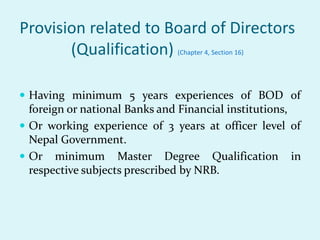
(Qualification) (Chapter 4, Section 16)
 Having minimum 5 years experiences of BOD of
foreign or national Banks and Financial institutions,
 Or working experience of 3 years at officer level of
Nepal Government.
 Or minimum Master Degree Qualification in
respective subjects prescribed by NRB.
Provision related to Independent Directors
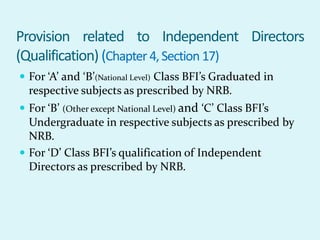
(Qualification) (Chapter4,Section17)
 For ‘A’ and ‘B’(National Level) Class BFI’s Graduated in
respective subjects as prescribed by NRB.
 For ‘B’ (Other except National Level) and ‘C’ Class BFI’s
Undergraduate in respective subjects as prescribed by
NRB.
 For ‘D’ Class BFI’s qualification of Independent
Directors as prescribed by NRB.
Provision related to Board of
Directors
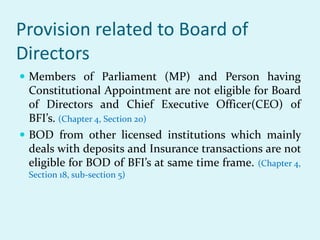
 Members of Parliament (MP) and Person having
Constitutional Appointment are not eligible for Board
of Directors and Chief Executive Officer(CEO) of
BFI’s. (Chapter 4, Section 20)
 BOD from other licensed institutions which mainly
deals with deposits and Insurance transactions are not
eligible for BOD of BFI’s at same time frame. (Chapter 4,
Section 18, sub-section 5)
Qualifications of Chief Executive
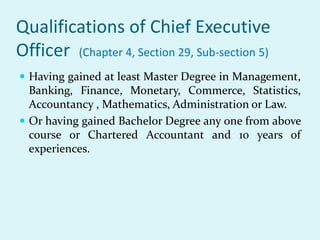
Officer (Chapter 4, Section 29, Sub-section 5)
 Having gained at least Master Degree in Management,
Banking, Finance, Monetary, Commerce, Statistics,
Accountancy , Mathematics, Administration or Law.
 Or having gained Bachelor Degree any one from above
course or Chartered Accountant and 10 years of
experiences.
Tenure Of BOD and CEO
In Case of BOD (Chapter 4, Section 15, Sub-section 1)
Independent Directors :- For Only One Tenure.
In Case of CEO (Chapter 4, Section 29, Sub-section 2)
 First appointment is maximum for 4 years. Can re-
appoint for next one tenure. BOD have authority to
fire CEO if performance is not satisfactory.
Classification of Banks
 Commercial Banks ‘A’ Class
 Development Bank ‘B’ Class
 Finance Companies ‘C’ Class
 Laghubitta Bittiya Sanstha (Micro Finance
Institutions) ‘D’ Class
 Infrastructure Banks (Chapter 7, Section 49, Sub-Section 5)
Other Notable Changes
 Remove the provision regarding Conversion of
licensed institution of higher class into licensed
institution of lower class
(BAFIA 2063, Chapter 5, Section 37)
 ‘D’ Class Microfinance banks are not allowed to write
them as Bank. As per Chapter 7 section 49 sub-section
4 ‘D’ BFI’s will term as Laghubitta Bittiya Sanstha.
 Voluntary Cancellation of BFI’s
Implementation of BAFIA 2073
 Nepal Rastra Bank says it will take at least one year to
fully implementation of BAFIA 2073. (NRB spokesperson
Narayan Poudel, Bizmandu May 8)
 Ichharaj Tamang , Chairperson Civil Bank Limited
resign from his post because of conflicting interest
with Chapter 4, Section 20.
 Devi Prasad Bhattachan, Chairperson of Prabhu Bank
and Prabhu Insurance resign from Prabhu Insurance
Chairperson because of conflicting interest with
Chapter 4, Section 18, sub-section 5.
Changes Still Need to Address
 Banking System Under Federal System in Nepal
 Power of CEO Vs. Board of Director
THANK YOU

BAFIA Major AMENDMENT 2073

  • 1.
    BAFIA 2073 Presented By AnilRasaili Kusum Bhandari Arbind Pathak Prabin Acharya
  • 2.
    Historical Perspective ofBanking Acts in Nepal  Nepal Bank Limited established in 1937 AD.  Nepal Rastra Bank act was formulated in 2012. (Amendment 2058)  Bank and Financial Institution Act,2063  Banking Offence and Punishment Act, 2064
  • 3.
    DISPUTE OVER BAFIA2073  The central bank formed a taskforce under the coordination of NRB Executive Director Bhaskar Mani Gnawali to prepare the draft of the new BAFIA.  The bill, was first tabled by the then finance minister Ram Sharan Mahat in August 2013.  The bill had drawn widespread criticism due to involvement of some lawmakers who also have ownership in bank and financial institution.  Finally Bill pass by Parliament in Poush 26 2073 and approved by President Baisakh 12. (Source:- Arthiknews.com, Baisakh 12)
  • 4.
    WHY BAFIA ? Nepal Rasta Bank have formulated many directives, monetary policies, company act, Nepal Rasta Bank act for bank and financial institution.  Before these acts’ it was necessary of such act which would define bank and financial institution clearly so BAFIA was formulated by Parliament.  The act is amended time and again to address the changes in Banking Industry.
  • 5.
    ..  The amendmentof BAFIA was done in 2063 but that was not enough. The new amendment covers area like the issues of corporate governance, Concept of Infrastructure Development Bank.  Protect and promote the right and interest of depositors, provide quality and reliable banking and financial intermediately through healthy competition.
  • 7.
    Issued Capital forGeneral Public and Employees (Chapter 3, Section 9)  Every bank or financial institution shall set aside at least thirty per cent of its total issued capital for subscription by the general public. The bank or financial institution may set aside a maximum of five per cent of the shares so set aside for its employees. (BAFIA 2063)  The bank or financial institution may set a maximum of 0.5 % of the shares from remaining so set for its employees.
  • 8.
    Conversion of PromotersShares into Public Shares  BAFIA 2073 has also a provision which allows conversion of promoter shares into public shares after a lock-up period of 10 years (Chapter 3, Section 11, Subsection 4)  Notwithstanding Clause 9 sub-section 1 and 2 Bank and Financial Institutions can convert its promoter shares into public shares after the commencement of 10 years with considering the situations of Capital Market , Banking and overall Financial sector. (Subject to NRB for prior approval)
  • 9.
    Provision related toBoard of Directors (Formation)  The Board shall consist of not less than five and not more than seven Directors. (Chapter 4, Section 14) Conditions (Chapter 4, Section 15)  More then one member from same family are not eligible for BOD.  In case of Independent Directors person of his/her family who subscribed more then 1 % shares of concern BFI’s are not eligible for Independent Directors of BFI’s.  Same person does not eligible for different BFI’s Board of Directors.
  • 10.
    Provision related toBoard of Directors (Qualification) (Chapter 4, Section 16)  Having minimum 5 years experiences of BOD of foreign or national Banks and Financial institutions,  Or working experience of 3 years at officer level of Nepal Government.  Or minimum Master Degree Qualification in respective subjects prescribed by NRB.
  • 11.
    Provision related toIndependent Directors (Qualification) (Chapter4,Section17)  For ‘A’ and ‘B’(National Level) Class BFI’s Graduated in respective subjects as prescribed by NRB.  For ‘B’ (Other except National Level) and ‘C’ Class BFI’s Undergraduate in respective subjects as prescribed by NRB.  For ‘D’ Class BFI’s qualification of Independent Directors as prescribed by NRB.
  • 12.
    Provision related toBoard of Directors  Members of Parliament (MP) and Person having Constitutional Appointment are not eligible for Board of Directors and Chief Executive Officer(CEO) of BFI’s. (Chapter 4, Section 20)  BOD from other licensed institutions which mainly deals with deposits and Insurance transactions are not eligible for BOD of BFI’s at same time frame. (Chapter 4, Section 18, sub-section 5)
  • 13.
    Qualifications of ChiefExecutive Officer (Chapter 4, Section 29, Sub-section 5)  Having gained at least Master Degree in Management, Banking, Finance, Monetary, Commerce, Statistics, Accountancy , Mathematics, Administration or Law.  Or having gained Bachelor Degree any one from above course or Chartered Accountant and 10 years of experiences.
  • 14.
    Tenure Of BODand CEO In Case of BOD (Chapter 4, Section 15, Sub-section 1) Independent Directors :- For Only One Tenure. In Case of CEO (Chapter 4, Section 29, Sub-section 2)  First appointment is maximum for 4 years. Can re- appoint for next one tenure. BOD have authority to fire CEO if performance is not satisfactory.
  • 15.
    Classification of Banks Commercial Banks ‘A’ Class  Development Bank ‘B’ Class  Finance Companies ‘C’ Class  Laghubitta Bittiya Sanstha (Micro Finance Institutions) ‘D’ Class  Infrastructure Banks (Chapter 7, Section 49, Sub-Section 5)
  • 16.
    Other Notable Changes Remove the provision regarding Conversion of licensed institution of higher class into licensed institution of lower class (BAFIA 2063, Chapter 5, Section 37)  ‘D’ Class Microfinance banks are not allowed to write them as Bank. As per Chapter 7 section 49 sub-section 4 ‘D’ BFI’s will term as Laghubitta Bittiya Sanstha.  Voluntary Cancellation of BFI’s
  • 17.
    Implementation of BAFIA2073  Nepal Rastra Bank says it will take at least one year to fully implementation of BAFIA 2073. (NRB spokesperson Narayan Poudel, Bizmandu May 8)  Ichharaj Tamang , Chairperson Civil Bank Limited resign from his post because of conflicting interest with Chapter 4, Section 20.  Devi Prasad Bhattachan, Chairperson of Prabhu Bank and Prabhu Insurance resign from Prabhu Insurance Chairperson because of conflicting interest with Chapter 4, Section 18, sub-section 5.
  • 18.
    Changes Still Needto Address  Banking System Under Federal System in Nepal  Power of CEO Vs. Board of Director
  • 19.