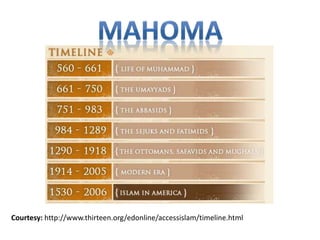
Courtesy: http://www.thirteen.org/edonline/accessislam/timeline.html
Islam is a word derived from the Arabic "salima" 
which can be translated as submission to the will 
of God, obedience, peace or salvation. Represents 
a Saudi-born religion promoted by the preaching of 
Muhammad in the early decades of the seventh 
century. [0] 
[0] http://www.arteguias.com/islam.htm 
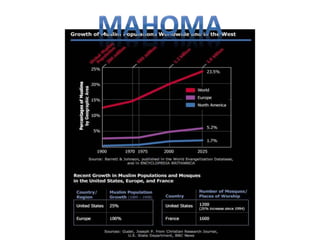
World Muslim population by percentage (Pew 
Research Center, 2014). 
Courtesy:Wikipedia Common.
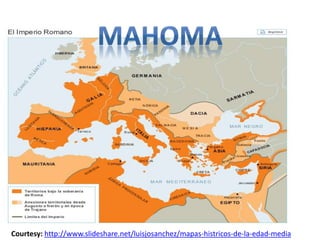
Courtesy: http://www.slideshare.net/luisjosanchez/mapas-histricos-de-la-edad-media
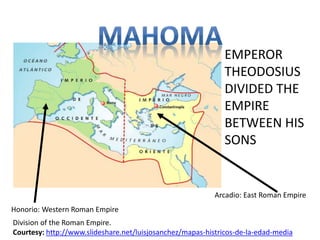
Arcadio: East Roman Empire 
Honorio: Western Roman Empire 
EMPEROR 
THEODOSIUS 
DIVIDED THE 
EMPIRE 
BETWEEN HIS 
SONS 
Division of the Roman Empire. 
Courtesy: http://www.slideshare.net/luisjosanchez/mapas-histricos-de-la-edad-media
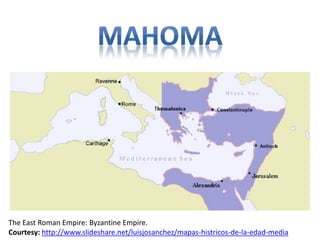
The East Roman Empire: Byzantine Empire. 
Courtesy: http://www.slideshare.net/luisjosanchez/mapas-histricos-de-la-edad-media
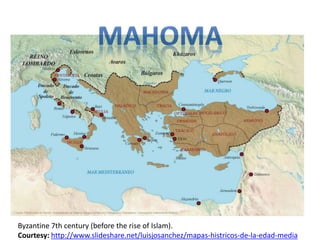
Byzantine 7th century (before the rise of Islam). 
Courtesy: http://www.slideshare.net/luisjosanchez/mapas-histricos-de-la-edad-media
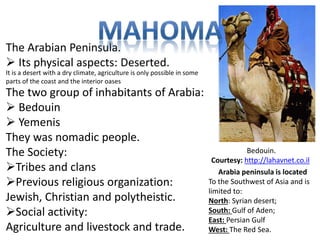
The Arabian Peninsula. 
 Its physical aspects: Deserted. 
The two group of inhabitants of Arabia: 
 Bedouin 
 Yemenis 
They was nomadic people. 
The Society: 
Tribes and clans 
Previous religious organization: 
Jewish, Christian and polytheistic. 
Social activity: 
Agriculture and livestock and trade. 
Bedouin. 
Courtesy: http://lahavnet.co.il 
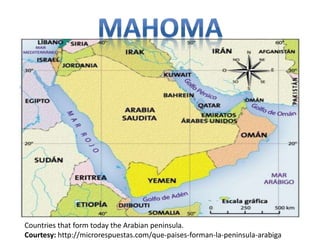
Arabia peninsula is located 
To the Southwest of Asia and is 
limited to: 
North: Syrian desert; 
South: Gulf of Aden; 
East: Persian Gulf 
West: The Red Sea. 
It is a desert with a dry climate, agriculture is only possible in some 
parts of the coast and the interior oases
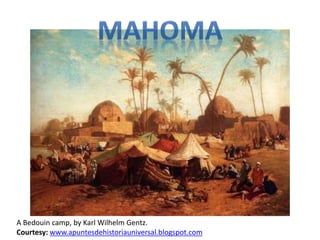
A Bedouin camp, by Karl Wilhelm Gentz. 
Courtesy: www.apuntesdehistoriauniversal.blogspot.com
Some Saudis were nomadic or sedentary bedouins and 
others. 
The Bedouins were goat herders and commercial traffic with 
camel caravans, being led by a sedentary jeque.los living 
from agriculture, crafts and trade. 
The rich owned large tracts of land, caravans, livestock, and 
businesses dedicated to the craft. 
Free men were engaged in crafts; and the slaves were 
prisoners of war. 
Religion: each tribe had their own beliefs (polytheistic)
Name: Abu l-Qāsim Muḥammad 
ibn ʿAbd Allāh al-Hāšimī al-Qurayšī 
o Mahoma. 
Date of born: Mecca, April 26 of 
569/570 DC.(Year of elephant) 
Date of died: Medina,June 8 of 632 
D.C. 
Biographical Data 
Weddings= 13 wifes 
o Jadiya bint Juwaylid (595-619) 
o Sawda bint Zamʿa (619-632) 
o Aisha bint Abi Bakr (619-632) 
o Ḥafṣa bint ʿUmar (624-632) 
o Zaynab bint Juzayma (625-627) 
o Hind bint Abi Umayya (629-632) 
o Zaynab bint Ŷahš (627-632) 
o Ŷuwayrīya bint al-Ḥāriṯ (628-632) 
o Ramla bint Abi Sufyān (628-632) 
o Rayḥana bint Zayd (629-631) 
o Ṣafīya bint Ḥuyayy (629-632) 
o Maymūna bint al-Ḥāriṯ (630-632) 
o Māriya al-Qibṭīya (630-632) 
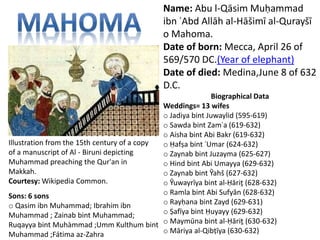
Illustration from the 15th century of a copy 
of a manuscript of Al - Biruni depicting 
Muhammad preaching the Qur'an in 
Makkah. 
Courtesy:Wikipedia Common. 
Sons: 6 sons 
o Qasim ibn Muhammad; Ibrahim ibn 
Muhammad ; Zainab bint Muhammad; 
Ruqayya bint Muhàmmad ;Umm Kulthum bint 
Muhammad ;Fátima az-Zahra
Etnia: Arabic (Quraysh). Semitic people. 
Tribal groups (families) that were part of 
the pre-Islamic States. 
Local problems with the Bedouin 
merchants caravan routes 
The revelation: 
Year 610 D.C. in cave of Hira on the 
Jabaal an Nur the " Mountain of Light" 
near Mecca. He saw visions of god and 
archangel Gabriel, who told him to write 
the Koran. 
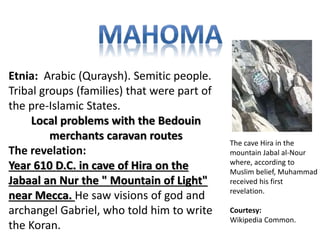
The cave Hira in the 
mountain Jabal al-Nour 
where, according to 
Muslim belief, Muhammad 
received his first 
revelation. 
Courtesy: 
Wikipedia Common.
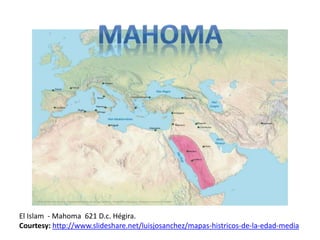
El Islam - Mahoma 621 D.c. Hégira. 
Courtesy: http://www.slideshare.net/luisjosanchez/mapas-histricos-de-la-edad-media
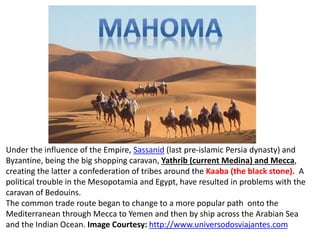
Under the influence of the Empire, Sassanid (last pre-islamic Persia dynasty) and 
Byzantine, being the big shopping caravan, Yathrib (current Medina) and Mecca, 
creating the latter a confederation of tribes around the Kaaba (the black stone). A 
political trouble in the Mesopotamia and Egypt, have resulted in problems with the 
caravan of Bedouins. 
The common trade route began to change to a more popular path onto the 
Mediterranean through Mecca to Yemen and then by ship across the Arabian Sea 
and the Indian Ocean. Image Courtesy: http://www.universodosviajantes.com
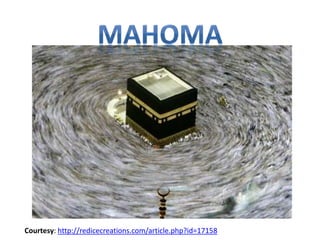
Courtesy: http://redicecreations.com/article.php?id=17158
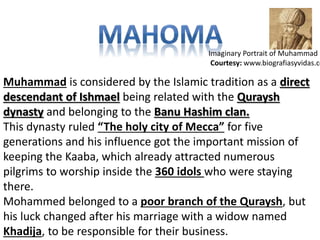
Imaginary Portrait of Muhammad 
Courtesy: www.biografiasyvidas.com 
Muhammad is considered by the Islamic tradition as a direct 
descendant of Ishmael being related with the Quraysh 
dynasty and belonging to the Banu Hashim clan. 
This dynasty ruled “The holy city of Mecca” for five 
generations and his influence got the important mission of 
keeping the Kaaba, which already attracted numerous 
pilgrims to worship inside the 360 idols who were staying 
there. 
Mohammed belonged to a poor branch of the Quraysh, but 
his luck changed after his marriage with a widow named 
Khadija, to be responsible for their business.
Countries that form today the Arabian peninsula. 
Courtesy: http://microrespuestas.com/que-paises-forman-la-peninsula-arabiga
The Archangel Gabriel and Muhammad. Courtesy: www.biografiasyvidas.com 
Sometimes the revelations produced it certain physical reactions: 
He felt pain and perceived a strong sound, like ringing of bells; 
Sometimes, on cold days, his disciples saw how thick drops of sweat 
fell from his front, while the revelation took place. Jadicha, his wife, 
was the first disciple and who supported him in moments of crisis to 
experience the first visions; she convinced him of the prophetic 
nature of such experiences[0] 
[0] http://www.biografiasyvidas.com/monografia/mahoma/
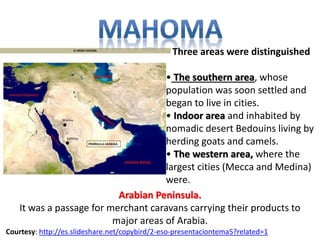
Three areas were distinguished 
• The southern area, whose 
population was soon settled and 
began to live in cities. 
• Indoor area and inhabited by 
nomadic desert Bedouins living by 
herding goats and camels. 
• The western area, where the 
largest cities (Mecca and Medina) 
were. 
Arabian Peninsula. 
It was a passage for merchant caravans carrying their products to 
major areas of Arabia. 
Courtesy: http://es.slideshare.net/copybird/2-eso-presentaciontema5?related=1
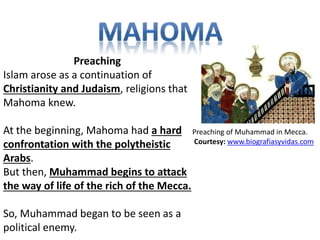
Preaching 
Islam arose as a continuation of 
Christianity and Judaism, religions that 
Mahoma knew. 
At the beginning, Mahoma had a hard 
confrontation with the polytheistic 
Arabs. 
But then, Muhammad begins to attack 
the way of life of the rich of the Mecca. 
So, Muhammad began to be seen as a 
political enemy. 
Preaching of Muhammad in Mecca. 
Courtesy: www.biografiasyvidas.com
His uncle and protector Abu Talib and 
his wife died in the year 619. His second 
wife was Sawda, a widow who was 
among the first disciples. Abu Lahab, 
successor of the uncle, removal 
protection to the Prophet. Mohammed 
escaped to Al - Ta'if it attempted to put 
its inhabitants against Mecca, but he 
can't, and was even stoned by the 
crowd. 
He returned to Mecca clandestinely 
obtained the protection of one of the 
clans, and their proselytizing was 
bound. Muhammad tried to made 
Pricing with various nomadic tribes near 
Mecca, but neither succeeded. 
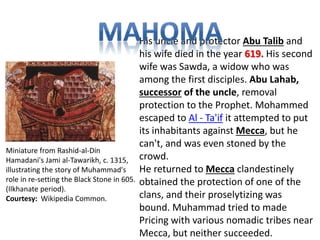
Miniature from Rashid-al-Din 
Hamadani's Jami al-Tawarikh, c. 1315, 
illustrating the story of Muhammad's 
role in re-setting the Black Stone in 605. 
(Ilkhanate period). 
Courtesy: Wikipedia Common.
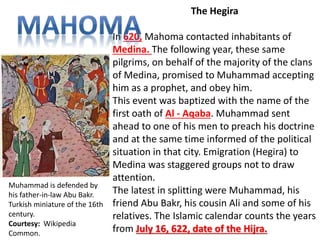
The Hegira 
In 620, Mahoma contacted inhabitants of 
Medina. The following year, these same 
pilgrims, on behalf of the majority of the clans 
of Medina, promised to Muhammad accepting 
him as a prophet, and obey him. 
This event was baptized with the name of the 
first oath of Al - Aqaba. Muhammad sent 
ahead to one of his men to preach his doctrine 
and at the same time informed of the political 
situation in that city. Emigration (Hegira) to 
Medina was staggered groups not to draw 
attention. 
The latest in splitting were Muhammad, his 
friend Abu Bakr, his cousin Ali and some of his 
relatives. The Islamic calendar counts the years 
from July 16, 622, date of the Hijra. 
Muhammad is defended by 
his father-in-law Abu Bakr. 
Turkish miniature of the 16th 
century. 
Courtesy: Wikipedia 
Common.
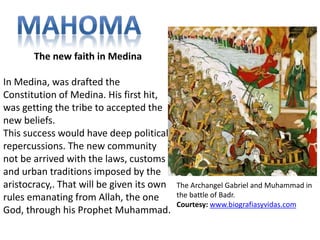
The Archangel Gabriel and Muhammad in 
the battle of Badr. 
Courtesy: www.biografiasyvidas.com 
The new faith in Medina 
In Medina, was drafted the 
Constitution of Medina. His first hit, 
was getting the tribe to accepted the 
new beliefs. 
This success would have deep political 
repercussions. The new community 
not be arrived with the laws, customs 
and urban traditions imposed by the 
aristocracy,. That will be given its own 
rules emanating from Allah, the one 
God, through his Prophet Muhammad.
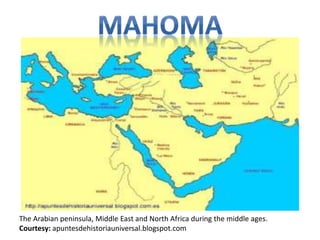
The Arabian peninsula, Middle East and North Africa during the middle ages. 
Courtesy: apuntesdehistoriauniversal.blogspot.com
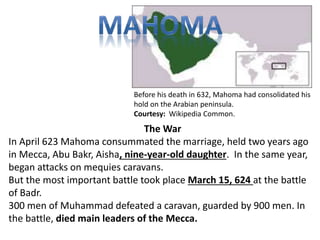
Before his death in 632, Mahoma had consolidated his 
hold on the Arabian peninsula. 
Courtesy: Wikipedia Common. 
The War 
In April 623 Mahoma consummated the marriage, held two years ago 
in Mecca, Abu Bakr, Aisha, nine-year-old daughter. In the same year, 
began attacks on mequies caravans. 
But the most important battle took place March 15, 624 at the battle 
of Badr. 
300 men of Muhammad defeated a caravan, guarded by 900 men. In 
the battle, died main leaders of the Mecca.
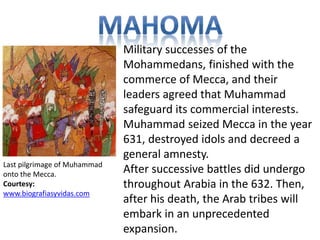
Military successes of the 
Mohammedans, finished with the 
commerce of Mecca, and their 
leaders agreed that Muhammad 
safeguard its commercial interests. 
Muhammad seized Mecca in the year 
631, destroyed idols and decreed a 
general amnesty. 
After successive battles did undergo 
throughout Arabia in the 632. Then, 
after his death, the Arab tribes will 
embark in an unprecedented 
expansion. 
Last pilgrimage of Muhammad 
onto the Mecca. 
Courtesy: 
www.biografiasyvidas.com
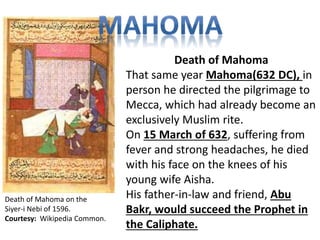
Death of Mahoma 
That same year Mahoma(632 DC), in 
person he directed the pilgrimage to 
Mecca, which had already become an 
exclusively Muslim rite. 
On 15 March of 632, suffering from 
fever and strong headaches, he died 
with his face on the knees of his 
young wife Aisha. 
His father-in-law and friend, Abu 
Bakr, would succeed the Prophet in 
the Caliphate. 
Death of Mahoma on the 
Siyer-i Nebi of 1596. 
Courtesy: Wikipedia Common.
Mohamed's death the Arabs had 
a common religion, had become 
accustomed to obey a sovereign 
and were able to start the 
conquest of an empire. They 
were the intermediaries 
between the Asian world and 
Western Europe. They were 
throwing at combat with 
irresistible push and, despite 
lacking military bases, lines of 
communication, supplies and 
equipment, their victories were 
so quick and decisive that fifteen 
years after the death of the 
Prophet, the Crescent banner 
waved on Damascus, Antioch, 
Jerusalem, Tripoli, Egypt and 
much of North Africa. 
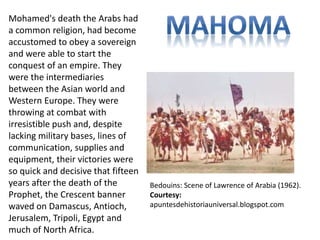
Bedouins: Scene of Lawrence of Arabia (1962). 
Courtesy: 
apuntesdehistoriauniversal.blogspot.com
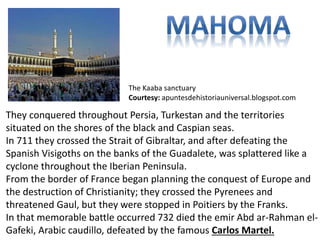
The Kaaba sanctuary 
Courtesy: apuntesdehistoriauniversal.blogspot.com 
They conquered throughout Persia, Turkestan and the territories 
situated on the shores of the black and Caspian seas. 
In 711 they crossed the Strait of Gibraltar, and after defeating the 
Spanish Visigoths on the banks of the Guadalete, was splattered like a 
cyclone throughout the Iberian Peninsula. 
From the border of France began planning the conquest of Europe and 
the destruction of Christianity; they crossed the Pyrenees and 
threatened Gaul, but they were stopped in Poitiers by the Franks. 
In that memorable battle occurred 732 died the emir Abd ar-Rahman el- 
Gafeki, Arabic caudillo, defeated by the famous Carlos Martel.
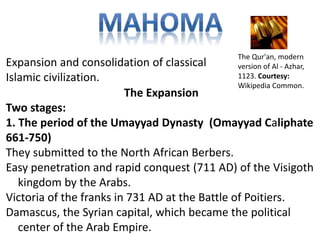
The Qur'an, modern 
version of Al - Azhar, 
1123. Courtesy: 
Wikipedia Common. 
Expansion and consolidation of classical 
Islamic civilization. 
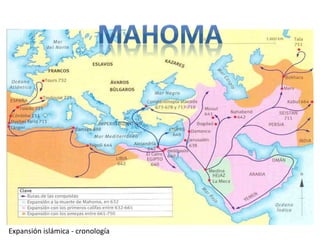
The Expansion 
Two stages: 
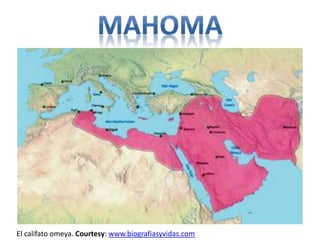
1. The period of the Umayyad Dynasty (Omayyad Caliphate 
661-750) 
They submitted to the North African Berbers. 
Easy penetration and rapid conquest (711 AD) of the Visigoth 
kingdom by the Arabs. 
Victoria of the franks in 731 AD at the Battle of Poitiers. 
Damascus, the Syrian capital, which became the political 
center of the Arab Empire.
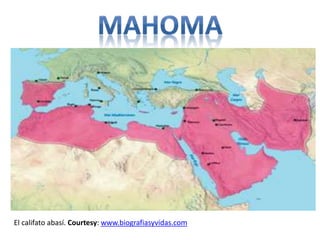
2. The period Abbasi (el Califato Abbasi 750-945) religious 
boundaries, as there are territories such as Al-Andalus, 
North Africa and the occupied areas of India, beyond the 
political authority of the caliph. 
The capital was moved from Damascus to Baghdad (the 
current capital of Iraq) and Persian influence grew 
considerably in culture and Islamic art. 
The subsequent political developments: 
Preponderance of the Turkish dynasties, have a profound 
influence on the cultural and artistic field. 
Geographically Islam expands to Eastern Indonesia, after 
entering the center of Asia and Africa. And still, even today, a 
religion in global expansion. 
Courtesy: Wikipedia Common 
Courtesy: Wikipedia Common
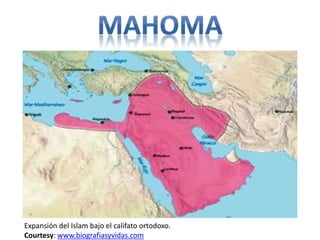
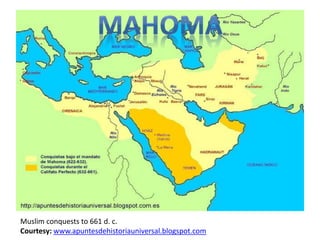
Expansión del Islam bajo el califato ortodoxo. 
Courtesy: www.biografiasyvidas.com
El califato omeya. Courtesy: www.biografiasyvidas.com
El califato abasí. Courtesy: www.biografiasyvidas.com
To the principle, they ruled 
without promoting radical changes 
in conquered societies. 
Initially, a massive conversion of 
Christians was not intended. [0] 
During the first 100 years of life of 
Islam, there is no really new art 
development. 
Map of fast the expansion. 
Courtesy: http://www.arteguias.com 
[0] http://www.arteguias.com/islam.htm
Expansión islámica - cronología
Muslim conquests to 661 d. c. 
Courtesy: www.apuntesdehistoriauniversal.blogspot.com
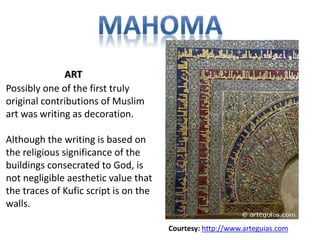
Possibly one of the first truly 
original contributions of Muslim 
art was writing as decoration. 
Although the writing is based on 
the religious significance of the 
buildings consecrated to God, is 
not negligible aesthetic value that 
the traces of Kufic script is on the 
walls. 
Courtesy: http://www.arteguias.com 
ART
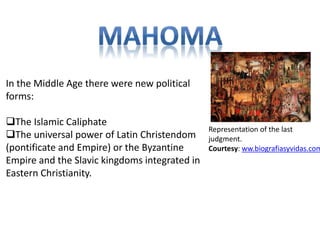
In the Middle Age there were new political 
forms: 
The Islamic Caliphate 
The universal power of Latin Christendom 
(pontificate and Empire) or the Byzantine 
Empire and the Slavic kingdoms integrated in 
Eastern Christianity. 
Representation of the last 
judgment. 
Courtesy: ww.biografiasyvidas.com
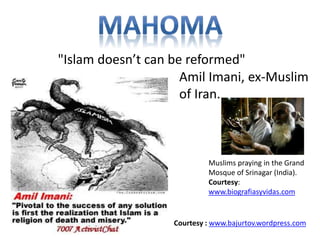
"Islam doesn’t can be reformed" 
Amil Imani, ex-Muslim 
of Iran. 
Muslims praying in the Grand 
Mosque of Srinagar (India). 
Courtesy: 
www.biografiasyvidas.com 
Courtesy : www.bajurtov.wordpress.com

Mahoma

  • 2.
  • 4.
    Islam is aword derived from the Arabic "salima" which can be translated as submission to the will of God, obedience, peace or salvation. Represents a Saudi-born religion promoted by the preaching of Muhammad in the early decades of the seventh century. [0] [0] http://www.arteguias.com/islam.htm World Muslim population by percentage (Pew Research Center, 2014). Courtesy:Wikipedia Common.
  • 5.
  • 6.
    Arcadio: East RomanEmpire Honorio: Western Roman Empire EMPEROR THEODOSIUS DIVIDED THE EMPIRE BETWEEN HIS SONS Division of the Roman Empire. Courtesy: http://www.slideshare.net/luisjosanchez/mapas-histricos-de-la-edad-media
  • 7.
    The East RomanEmpire: Byzantine Empire. Courtesy: http://www.slideshare.net/luisjosanchez/mapas-histricos-de-la-edad-media
  • 8.
    Byzantine 7th century(before the rise of Islam). Courtesy: http://www.slideshare.net/luisjosanchez/mapas-histricos-de-la-edad-media
  • 9.
    The Arabian Peninsula.  Its physical aspects: Deserted. The two group of inhabitants of Arabia:  Bedouin  Yemenis They was nomadic people. The Society: Tribes and clans Previous religious organization: Jewish, Christian and polytheistic. Social activity: Agriculture and livestock and trade. Bedouin. Courtesy: http://lahavnet.co.il Arabia peninsula is located To the Southwest of Asia and is limited to: North: Syrian desert; South: Gulf of Aden; East: Persian Gulf West: The Red Sea. It is a desert with a dry climate, agriculture is only possible in some parts of the coast and the interior oases
  • 10.
    A Bedouin camp,by Karl Wilhelm Gentz. Courtesy: www.apuntesdehistoriauniversal.blogspot.com
  • 11.
    Some Saudis werenomadic or sedentary bedouins and others. The Bedouins were goat herders and commercial traffic with camel caravans, being led by a sedentary jeque.los living from agriculture, crafts and trade. The rich owned large tracts of land, caravans, livestock, and businesses dedicated to the craft. Free men were engaged in crafts; and the slaves were prisoners of war. Religion: each tribe had their own beliefs (polytheistic)
  • 12.
    Name: Abu l-QāsimMuḥammad ibn ʿAbd Allāh al-Hāšimī al-Qurayšī o Mahoma. Date of born: Mecca, April 26 of 569/570 DC.(Year of elephant) Date of died: Medina,June 8 of 632 D.C. Biographical Data Weddings= 13 wifes o Jadiya bint Juwaylid (595-619) o Sawda bint Zamʿa (619-632) o Aisha bint Abi Bakr (619-632) o Ḥafṣa bint ʿUmar (624-632) o Zaynab bint Juzayma (625-627) o Hind bint Abi Umayya (629-632) o Zaynab bint Ŷahš (627-632) o Ŷuwayrīya bint al-Ḥāriṯ (628-632) o Ramla bint Abi Sufyān (628-632) o Rayḥana bint Zayd (629-631) o Ṣafīya bint Ḥuyayy (629-632) o Maymūna bint al-Ḥāriṯ (630-632) o Māriya al-Qibṭīya (630-632) Illustration from the 15th century of a copy of a manuscript of Al - Biruni depicting Muhammad preaching the Qur'an in Makkah. Courtesy:Wikipedia Common. Sons: 6 sons o Qasim ibn Muhammad; Ibrahim ibn Muhammad ; Zainab bint Muhammad; Ruqayya bint Muhàmmad ;Umm Kulthum bint Muhammad ;Fátima az-Zahra
  • 13.
    Etnia: Arabic (Quraysh).Semitic people. Tribal groups (families) that were part of the pre-Islamic States. Local problems with the Bedouin merchants caravan routes The revelation: Year 610 D.C. in cave of Hira on the Jabaal an Nur the " Mountain of Light" near Mecca. He saw visions of god and archangel Gabriel, who told him to write the Koran. The cave Hira in the mountain Jabal al-Nour where, according to Muslim belief, Muhammad received his first revelation. Courtesy: Wikipedia Common.
  • 14.
    El Islam -Mahoma 621 D.c. Hégira. Courtesy: http://www.slideshare.net/luisjosanchez/mapas-histricos-de-la-edad-media
  • 15.
    Under the influenceof the Empire, Sassanid (last pre-islamic Persia dynasty) and Byzantine, being the big shopping caravan, Yathrib (current Medina) and Mecca, creating the latter a confederation of tribes around the Kaaba (the black stone). A political trouble in the Mesopotamia and Egypt, have resulted in problems with the caravan of Bedouins. The common trade route began to change to a more popular path onto the Mediterranean through Mecca to Yemen and then by ship across the Arabian Sea and the Indian Ocean. Image Courtesy: http://www.universodosviajantes.com
  • 16.
  • 17.
    Imaginary Portrait ofMuhammad Courtesy: www.biografiasyvidas.com Muhammad is considered by the Islamic tradition as a direct descendant of Ishmael being related with the Quraysh dynasty and belonging to the Banu Hashim clan. This dynasty ruled “The holy city of Mecca” for five generations and his influence got the important mission of keeping the Kaaba, which already attracted numerous pilgrims to worship inside the 360 idols who were staying there. Mohammed belonged to a poor branch of the Quraysh, but his luck changed after his marriage with a widow named Khadija, to be responsible for their business.
  • 18.
    Countries that formtoday the Arabian peninsula. Courtesy: http://microrespuestas.com/que-paises-forman-la-peninsula-arabiga
  • 19.
    The Archangel Gabrieland Muhammad. Courtesy: www.biografiasyvidas.com Sometimes the revelations produced it certain physical reactions: He felt pain and perceived a strong sound, like ringing of bells; Sometimes, on cold days, his disciples saw how thick drops of sweat fell from his front, while the revelation took place. Jadicha, his wife, was the first disciple and who supported him in moments of crisis to experience the first visions; she convinced him of the prophetic nature of such experiences[0] [0] http://www.biografiasyvidas.com/monografia/mahoma/
  • 20.
    Three areas weredistinguished • The southern area, whose population was soon settled and began to live in cities. • Indoor area and inhabited by nomadic desert Bedouins living by herding goats and camels. • The western area, where the largest cities (Mecca and Medina) were. Arabian Peninsula. It was a passage for merchant caravans carrying their products to major areas of Arabia. Courtesy: http://es.slideshare.net/copybird/2-eso-presentaciontema5?related=1
  • 21.
    Preaching Islam aroseas a continuation of Christianity and Judaism, religions that Mahoma knew. At the beginning, Mahoma had a hard confrontation with the polytheistic Arabs. But then, Muhammad begins to attack the way of life of the rich of the Mecca. So, Muhammad began to be seen as a political enemy. Preaching of Muhammad in Mecca. Courtesy: www.biografiasyvidas.com
  • 22.
    His uncle andprotector Abu Talib and his wife died in the year 619. His second wife was Sawda, a widow who was among the first disciples. Abu Lahab, successor of the uncle, removal protection to the Prophet. Mohammed escaped to Al - Ta'if it attempted to put its inhabitants against Mecca, but he can't, and was even stoned by the crowd. He returned to Mecca clandestinely obtained the protection of one of the clans, and their proselytizing was bound. Muhammad tried to made Pricing with various nomadic tribes near Mecca, but neither succeeded. Miniature from Rashid-al-Din Hamadani's Jami al-Tawarikh, c. 1315, illustrating the story of Muhammad's role in re-setting the Black Stone in 605. (Ilkhanate period). Courtesy: Wikipedia Common.
  • 23.
    The Hegira In620, Mahoma contacted inhabitants of Medina. The following year, these same pilgrims, on behalf of the majority of the clans of Medina, promised to Muhammad accepting him as a prophet, and obey him. This event was baptized with the name of the first oath of Al - Aqaba. Muhammad sent ahead to one of his men to preach his doctrine and at the same time informed of the political situation in that city. Emigration (Hegira) to Medina was staggered groups not to draw attention. The latest in splitting were Muhammad, his friend Abu Bakr, his cousin Ali and some of his relatives. The Islamic calendar counts the years from July 16, 622, date of the Hijra. Muhammad is defended by his father-in-law Abu Bakr. Turkish miniature of the 16th century. Courtesy: Wikipedia Common.
  • 24.
    The Archangel Gabrieland Muhammad in the battle of Badr. Courtesy: www.biografiasyvidas.com The new faith in Medina In Medina, was drafted the Constitution of Medina. His first hit, was getting the tribe to accepted the new beliefs. This success would have deep political repercussions. The new community not be arrived with the laws, customs and urban traditions imposed by the aristocracy,. That will be given its own rules emanating from Allah, the one God, through his Prophet Muhammad.
  • 25.
    The Arabian peninsula,Middle East and North Africa during the middle ages. Courtesy: apuntesdehistoriauniversal.blogspot.com
  • 26.
    Before his deathin 632, Mahoma had consolidated his hold on the Arabian peninsula. Courtesy: Wikipedia Common. The War In April 623 Mahoma consummated the marriage, held two years ago in Mecca, Abu Bakr, Aisha, nine-year-old daughter. In the same year, began attacks on mequies caravans. But the most important battle took place March 15, 624 at the battle of Badr. 300 men of Muhammad defeated a caravan, guarded by 900 men. In the battle, died main leaders of the Mecca.
  • 27.
    Military successes ofthe Mohammedans, finished with the commerce of Mecca, and their leaders agreed that Muhammad safeguard its commercial interests. Muhammad seized Mecca in the year 631, destroyed idols and decreed a general amnesty. After successive battles did undergo throughout Arabia in the 632. Then, after his death, the Arab tribes will embark in an unprecedented expansion. Last pilgrimage of Muhammad onto the Mecca. Courtesy: www.biografiasyvidas.com
  • 28.
    Death of Mahoma That same year Mahoma(632 DC), in person he directed the pilgrimage to Mecca, which had already become an exclusively Muslim rite. On 15 March of 632, suffering from fever and strong headaches, he died with his face on the knees of his young wife Aisha. His father-in-law and friend, Abu Bakr, would succeed the Prophet in the Caliphate. Death of Mahoma on the Siyer-i Nebi of 1596. Courtesy: Wikipedia Common.
  • 29.
    Mohamed's death theArabs had a common religion, had become accustomed to obey a sovereign and were able to start the conquest of an empire. They were the intermediaries between the Asian world and Western Europe. They were throwing at combat with irresistible push and, despite lacking military bases, lines of communication, supplies and equipment, their victories were so quick and decisive that fifteen years after the death of the Prophet, the Crescent banner waved on Damascus, Antioch, Jerusalem, Tripoli, Egypt and much of North Africa. Bedouins: Scene of Lawrence of Arabia (1962). Courtesy: apuntesdehistoriauniversal.blogspot.com
  • 30.
    The Kaaba sanctuary Courtesy: apuntesdehistoriauniversal.blogspot.com They conquered throughout Persia, Turkestan and the territories situated on the shores of the black and Caspian seas. In 711 they crossed the Strait of Gibraltar, and after defeating the Spanish Visigoths on the banks of the Guadalete, was splattered like a cyclone throughout the Iberian Peninsula. From the border of France began planning the conquest of Europe and the destruction of Christianity; they crossed the Pyrenees and threatened Gaul, but they were stopped in Poitiers by the Franks. In that memorable battle occurred 732 died the emir Abd ar-Rahman el- Gafeki, Arabic caudillo, defeated by the famous Carlos Martel.
  • 31.
    The Qur'an, modern version of Al - Azhar, 1123. Courtesy: Wikipedia Common. Expansion and consolidation of classical Islamic civilization. The Expansion Two stages: 1. The period of the Umayyad Dynasty (Omayyad Caliphate 661-750) They submitted to the North African Berbers. Easy penetration and rapid conquest (711 AD) of the Visigoth kingdom by the Arabs. Victoria of the franks in 731 AD at the Battle of Poitiers. Damascus, the Syrian capital, which became the political center of the Arab Empire.
  • 32.
    2. The periodAbbasi (el Califato Abbasi 750-945) religious boundaries, as there are territories such as Al-Andalus, North Africa and the occupied areas of India, beyond the political authority of the caliph. The capital was moved from Damascus to Baghdad (the current capital of Iraq) and Persian influence grew considerably in culture and Islamic art. The subsequent political developments: Preponderance of the Turkish dynasties, have a profound influence on the cultural and artistic field. Geographically Islam expands to Eastern Indonesia, after entering the center of Asia and Africa. And still, even today, a religion in global expansion. Courtesy: Wikipedia Common Courtesy: Wikipedia Common
  • 33.
    Expansión del Islambajo el califato ortodoxo. Courtesy: www.biografiasyvidas.com
  • 34.
    El califato omeya.Courtesy: www.biografiasyvidas.com
  • 35.
    El califato abasí.Courtesy: www.biografiasyvidas.com
  • 36.
    To the principle,they ruled without promoting radical changes in conquered societies. Initially, a massive conversion of Christians was not intended. [0] During the first 100 years of life of Islam, there is no really new art development. Map of fast the expansion. Courtesy: http://www.arteguias.com [0] http://www.arteguias.com/islam.htm
  • 37.
  • 38.
    Muslim conquests to661 d. c. Courtesy: www.apuntesdehistoriauniversal.blogspot.com
  • 39.
    Possibly one ofthe first truly original contributions of Muslim art was writing as decoration. Although the writing is based on the religious significance of the buildings consecrated to God, is not negligible aesthetic value that the traces of Kufic script is on the walls. Courtesy: http://www.arteguias.com ART
  • 41.
    In the MiddleAge there were new political forms: The Islamic Caliphate The universal power of Latin Christendom (pontificate and Empire) or the Byzantine Empire and the Slavic kingdoms integrated in Eastern Christianity. Representation of the last judgment. Courtesy: ww.biografiasyvidas.com
  • 42.
    "Islam doesn’t canbe reformed" Amil Imani, ex-Muslim of Iran. Muslims praying in the Grand Mosque of Srinagar (India). Courtesy: www.biografiasyvidas.com Courtesy : www.bajurtov.wordpress.com