DIGITAL COMPARATOR
MAGNITUDE COMPARATOR
• The comparison of two numbers is an operation
that determines whether one number is greater
than, less than, or equal to the other number.
• A magnitude comparator is a combinational
circuit that compares two numbers A and B and
determines their relative magnitudes.
• The outcome of the comparison is specified by
three binary variables that indicate whether A <
B, A = B, or A > B.
• On the one hand, the circuit for comparing
two n -bit numbers has 22n
entries in the truth
table and becomes too cumbersome, even
with n = 3.
• On the other hand, as one may suspect, a
comparator circuit possesses a certain amount
of regularity.
• Digital functions that possess an inherent well-
defined regularity can usually be designed by
means of an algorithm—a procedure which
specifies a finite set of steps that, if followed,
give the solution to a problem.
• The algorithm is a direct application of the procedure a
person uses to compare the relative magnitudes of two
numbers.
• Consider two numbers, A and B , with four digits each.
• Write the coefficients of the numbers in descending order of
significance:
A = A3 A2 A1 A0
B = B3 B2 B1 B0
• Each subscripted letter represents one of the digits in the
number.
• The two numbers are equal if all pairs of significant digits are
equal: A3 = B3, A2 = B2, A1 = B1, and A0 = B0.
• When the numbers are binary, the digits are either 1 or 0, and
the equality of each pair of bits can be expressed logically
with an exclusive-NOR function as
xi = AiBi + Ai ‘Bi ‘ for i = 0, 1, 2, 3
• where xi = 1 only if the pair of bits in position i are
equal (i.e., if both are 1 or both are 0).
• The equality of the two numbers A and B is displayed
in a combinational circuit by an output binary variable
that we designate by the symbol (A = B).
• This binary variable is equal to 1 if the input
numbers, A and B , are equal, and is equal to 0
otherwise.
• For equality to exist, all xi variables must be equal to
1, a condition that dictates an AND operation of all
variables:
(A = B) = x3x2x1x0
• The binary variable (A = B) is equal to 1 only if all pairs
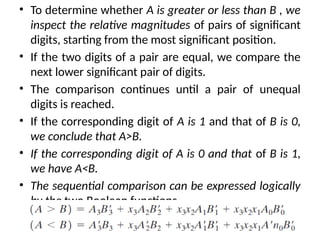
• To determine whether A is greater or less than B , we
inspect the relative magnitudes of pairs of significant
digits, starting from the most significant position.
• If the two digits of a pair are equal, we compare the
next lower significant pair of digits.
• The comparison continues until a pair of unequal
digits is reached.
• If the corresponding digit of A is 1 and that of B is 0,
we conclude that A>B.
• If the corresponding digit of A is 0 and that of B is 1,
we have A<B.
• The sequential comparison can be expressed logically
by the two Boolean functions
• The symbols (A > B) and (A < B) are binary
output variables that are equal to 1 when A >
B and A < B, respectively.
• The gate implementation of the three output
variables just derived is simpler than it seems
because it involves a certain amount of
repetition.
• The unequal outputs can use the same gates
that are needed to generate the equal output.
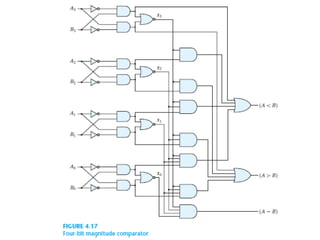
• The logic diagram of the four-bit magnitude
comparator is shown in Figure below.
• The four x outputs are generated with exclusive-
NOR circuits and are applied to an AND gate to
give the output binary variable (A = B) .
• The other two outputs use the x variables to
generate the Boolean functions listed previously.
• This is a multilevel implementation and has a
regular pattern.
• The procedure for obtaining magnitude
comparator circuits for binary numbers with
more than four bits is obvious from this
example.

Magnitude Comparator-DIPLOMA IN ELECTRONICSpptx

  • 1.
  • 2.
    MAGNITUDE COMPARATOR • Thecomparison of two numbers is an operation that determines whether one number is greater than, less than, or equal to the other number. • A magnitude comparator is a combinational circuit that compares two numbers A and B and determines their relative magnitudes. • The outcome of the comparison is specified by three binary variables that indicate whether A < B, A = B, or A > B.
  • 3.
    • On theone hand, the circuit for comparing two n -bit numbers has 22n entries in the truth table and becomes too cumbersome, even with n = 3. • On the other hand, as one may suspect, a comparator circuit possesses a certain amount of regularity. • Digital functions that possess an inherent well- defined regularity can usually be designed by means of an algorithm—a procedure which specifies a finite set of steps that, if followed, give the solution to a problem.
  • 4.
    • The algorithmis a direct application of the procedure a person uses to compare the relative magnitudes of two numbers. • Consider two numbers, A and B , with four digits each. • Write the coefficients of the numbers in descending order of significance: A = A3 A2 A1 A0 B = B3 B2 B1 B0 • Each subscripted letter represents one of the digits in the number. • The two numbers are equal if all pairs of significant digits are equal: A3 = B3, A2 = B2, A1 = B1, and A0 = B0. • When the numbers are binary, the digits are either 1 or 0, and the equality of each pair of bits can be expressed logically with an exclusive-NOR function as
  • 5.
    xi = AiBi+ Ai ‘Bi ‘ for i = 0, 1, 2, 3 • where xi = 1 only if the pair of bits in position i are equal (i.e., if both are 1 or both are 0). • The equality of the two numbers A and B is displayed in a combinational circuit by an output binary variable that we designate by the symbol (A = B). • This binary variable is equal to 1 if the input numbers, A and B , are equal, and is equal to 0 otherwise. • For equality to exist, all xi variables must be equal to 1, a condition that dictates an AND operation of all variables: (A = B) = x3x2x1x0 • The binary variable (A = B) is equal to 1 only if all pairs
  • 6.
    • To determinewhether A is greater or less than B , we inspect the relative magnitudes of pairs of significant digits, starting from the most significant position. • If the two digits of a pair are equal, we compare the next lower significant pair of digits. • The comparison continues until a pair of unequal digits is reached. • If the corresponding digit of A is 1 and that of B is 0, we conclude that A>B. • If the corresponding digit of A is 0 and that of B is 1, we have A<B. • The sequential comparison can be expressed logically by the two Boolean functions
  • 7.
    • The symbols(A > B) and (A < B) are binary output variables that are equal to 1 when A > B and A < B, respectively. • The gate implementation of the three output variables just derived is simpler than it seems because it involves a certain amount of repetition. • The unequal outputs can use the same gates that are needed to generate the equal output. • The logic diagram of the four-bit magnitude comparator is shown in Figure below.
  • 9.
    • The fourx outputs are generated with exclusive- NOR circuits and are applied to an AND gate to give the output binary variable (A = B) . • The other two outputs use the x variables to generate the Boolean functions listed previously. • This is a multilevel implementation and has a regular pattern. • The procedure for obtaining magnitude comparator circuits for binary numbers with more than four bits is obvious from this example.