Magnesium Sulfate  Neuroprotection For the Prevention  of  Cerebral Palsy APRIL 2011
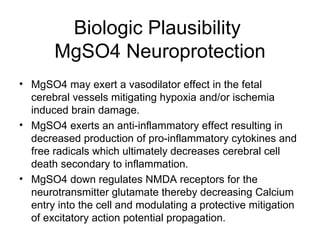
Biologic Plausibility  MgSO4 Neuroprotection MgSO4 may exert a vasodilator effect in the fetal cerebral vessels mitigating hypoxia and/or ischemia induced brain damage. MgSO4 exerts an anti-inflammatory effect resulting in decreased production of pro-inflammatory cytokines and free radicals which ultimately decreases cerebral cell death secondary to inflammation. MgSO4 down regulates NMDA receptors for the neurotransmitter glutamate thereby decreasing Calcium entry into the cell and modulating a protective mitigation of excitatory action potential propagation.
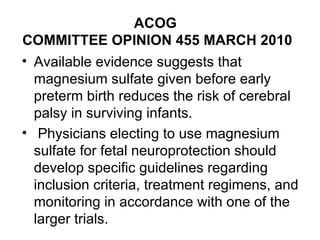
ACOG  COMMITTEE OPINION 455 MARCH 2010 Available evidence suggests that magnesium sulfate given before early preterm birth reduces the risk of cerebral palsy in surviving infants. Physicians electing to use magnesium sulfate for fetal neuroprotection should develop specific guidelines regarding inclusion criteria, treatment regimens, and monitoring in accordance with one of the larger trials.
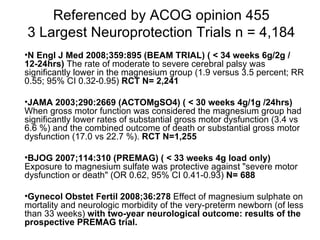
Referenced by ACOG opinion 455 3 Largest Neuroprotection Trials n = 4,184 N Engl J Med 2008;359:895 (BEAM TRIAL) ( < 34 weeks 6g/2g /12-24hrs)  The rate of moderate to severe cerebral palsy was significantly lower in the magnesium group (1.9 versus 3.5 percent; RR 0.55; 95% CI 0.32-0.95)  RCT   N= 2,241 JAMA 2003;290:2669 (ACTOMgSO4)   ( < 30 weeks 4g/1g /24hrs)  When gross motor function was considered the magnesium group had significantly lower rates of substantial gross motor dysfunction (3.4 vs 6.6 %) and the combined outcome of death or substantial gross motor dysfunction (17.0 vs 22.7 %).  RCT   N=1,255 BJOG 2007;114:310 (PREMAG) ( < 33 weeks 4g load only)  Exposure to magnesium sulfate was protective against &quot;severe motor dysfunction or death&quot; (OR 0.62, 95% CI 0.41-0.93)  N= 688 Gynecol Obstet Fertil 2008;36:278  Effect of magnesium sulphate on mortality and neurologic morbidity of the very-preterm newborn (of less than 33 weeks)  with two-year neurological outcome: results of the prospective PREMAG trial.
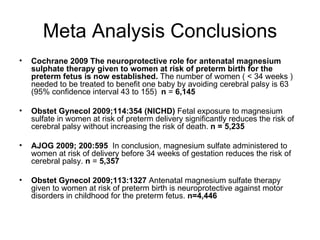
Meta Analysis Conclusions Cochrane 2009   The neuroprotective role for antenatal magnesium sulphate therapy given to women at risk of preterm birth for the preterm fetus is now established.  The number of women ( < 34 weeks ) needed to be treated to benefit one baby by avoiding cerebral palsy is 63 (95% confidence interval 43 to 155)  n  =  6,145 Obstet Gynecol 2009;114:354 (NICHD)  Fetal exposure to magnesium sulfate in women at risk of preterm delivery significantly reduces the risk of cerebral palsy without increasing the risk of death.  n = 5,235 AJOG 2009; 200:595  In conclusion, magnesium sulfate administered to women at risk of delivery before 34 weeks of gestation reduces the risk of cerebral palsy.  n  =  5,357 Obstet Gynecol 2009;113:1327  Antenatal magnesium sulfate therapy given to women at risk of preterm birth is neuroprotective against motor disorders in childhood for the preterm fetus.  n=4,446
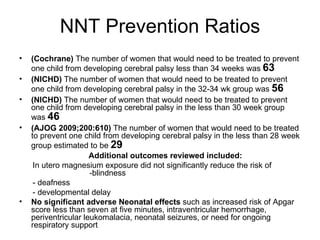
NNT Prevention Ratios (Cochrane)  The number of women that would need to be treated to prevent one child from developing cerebral palsy less than 34 weeks was  63 (NICHD)  The number of women that would need to be treated to prevent one child from developing cerebral palsy in the 32-34 wk group was  56 (NICHD)  The number of women that would need to be treated to prevent one child from developing cerebral palsy in the less than 30 week group was  46 (AJOG 2009;200:610)  The number of women that would need to be treated to prevent one child from developing cerebral palsy in the less than 28 week group estimated to be  29 Additional outcomes reviewed included: In utero magnesium exposure did not significantly reduce the risk of  -blindness  - deafness - developmental delay No significant adverse Neonatal effects  such as increased risk of Apgar score less than seven at five minutes, intraventricular hemorrhage, periventricular leukomalacia, neonatal seizures, or need for ongoing respiratory support
DATA SUMMARY Arch Pediatr. 2011 Mar;18(3):324-30. It was shown in the Cochrane database and in 3 meta-analyses of 5 randomized trials: (Magpie (PIH), MagNet (Tocolysis/Neuroprotect), ActoMgSO [neuroprotection], PreMag [neuroprotection], and Beam [neuroprotection]) that prenatal magnesium sulfate given to mothers at risk of pre-term birth does not increase pediatric mortality and decreases the risk of cerebral palsy.  Magnesium Sulfate exerts significant neuroprotective effects on the occurrence of cerebral palsy at 2 years of age (relative risk, 0.69; 95% CI, 0.54-0.87)  Magnesium Sulfate decreased the risk of pediatric mortality and cerebral palsy (relative risk: 0.85; 95% confidence interval: 0.74-0.98).  The number needed to treat (NTT) to prevent 1 case of cerebral palsy was 63 (95% CI, 39-172) and the NTT for an extra survivor free of cerebral palsy in the neuroprotection subgroup was 42 (95% CI, 22-357), justifying that magnesium sulfate should be justifying that magnesium sulfate should be discussed as a stand-alone treatment
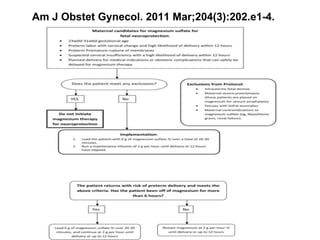
Am J Obstet Gynecol. 2011 Mar;204(3):202.e1-4.
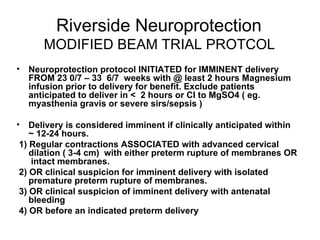
Riverside Neuroprotection  MODIFIED BEAM TRIAL PROTCOL  Neuroprotection protocol INITIATED for IMMINENT delivery FROM 23 0/7 – 33  6/7  weeks with @ least 2 hours Magnesium infusion prior to delivery for benefit. Exclude patients anticipated to deliver in <  2 hours or CI to MgSO4 ( eg. myasthenia gravis or severe sirs/sepsis ) Delivery is considered imminent if clinically anticipated within ~ 12-24 hours. 1) Regular contractions ASSOCIATED with advanced cervical dilation ( 3-4 cm)  with either preterm rupture of membranes OR  intact membranes.  2) OR clinical suspicion for imminent delivery with isolated premature preterm rupture of membranes.  3) OR clinical suspicion of imminent delivery with antenatal bleeding  4) OR before an indicated preterm delivery
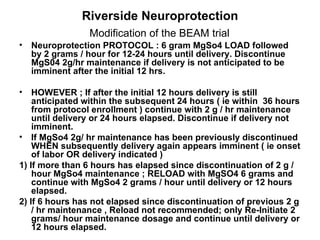
Riverside Neuroprotection  Modification of the BEAM trial   Neuroprotection   PROTOCOL : 6 gram MgSo4 LOAD followed by 2 grams / hour for 12-24 hours until delivery. Discontinue MgS04 2g/hr maintenance if delivery is not anticipated to be imminent after the initial 12 hrs. HOWEVER ; If after the initial 12 hours delivery is still anticipated within the subsequent 24 hours ( ie within  36 hours from protocol enrollment ) continue with 2 g / hr maintenance until delivery or 24 hours elapsed. Discontinue if delivery not imminent. If MgSo4 2g/ hr maintenance has been previously discontinued WHEN subsequently delivery again appears imminent ( ie onset of labor OR delivery indicated ) 1) If more than 6 hours has elapsed since discontinuation of 2 g / hour MgSo4 maintenance ; RELOAD with MgSO4 6 grams and continue with MgSo4 2 grams / hour until delivery or 12 hours elapsed. 2) If 6 hours has not elapsed since discontinuation of previous 2 g / hr maintenance , Reload not recommended; only Re-Initiate 2 grams/ hour maintenance dosage and continue until delivery or 12 hours elapsed.

Magnesium sulfate

  • 1.
    Magnesium Sulfate Neuroprotection For the Prevention of Cerebral Palsy APRIL 2011
  • 2.
    Biologic Plausibility MgSO4 Neuroprotection MgSO4 may exert a vasodilator effect in the fetal cerebral vessels mitigating hypoxia and/or ischemia induced brain damage. MgSO4 exerts an anti-inflammatory effect resulting in decreased production of pro-inflammatory cytokines and free radicals which ultimately decreases cerebral cell death secondary to inflammation. MgSO4 down regulates NMDA receptors for the neurotransmitter glutamate thereby decreasing Calcium entry into the cell and modulating a protective mitigation of excitatory action potential propagation.
  • 3.
    ACOG COMMITTEEOPINION 455 MARCH 2010 Available evidence suggests that magnesium sulfate given before early preterm birth reduces the risk of cerebral palsy in surviving infants. Physicians electing to use magnesium sulfate for fetal neuroprotection should develop specific guidelines regarding inclusion criteria, treatment regimens, and monitoring in accordance with one of the larger trials.
  • 4.
    Referenced by ACOGopinion 455 3 Largest Neuroprotection Trials n = 4,184 N Engl J Med 2008;359:895 (BEAM TRIAL) ( < 34 weeks 6g/2g /12-24hrs) The rate of moderate to severe cerebral palsy was significantly lower in the magnesium group (1.9 versus 3.5 percent; RR 0.55; 95% CI 0.32-0.95) RCT N= 2,241 JAMA 2003;290:2669 (ACTOMgSO4) ( < 30 weeks 4g/1g /24hrs) When gross motor function was considered the magnesium group had significantly lower rates of substantial gross motor dysfunction (3.4 vs 6.6 %) and the combined outcome of death or substantial gross motor dysfunction (17.0 vs 22.7 %). RCT N=1,255 BJOG 2007;114:310 (PREMAG) ( < 33 weeks 4g load only) Exposure to magnesium sulfate was protective against &quot;severe motor dysfunction or death&quot; (OR 0.62, 95% CI 0.41-0.93) N= 688 Gynecol Obstet Fertil 2008;36:278 Effect of magnesium sulphate on mortality and neurologic morbidity of the very-preterm newborn (of less than 33 weeks) with two-year neurological outcome: results of the prospective PREMAG trial.
  • 5.
    Meta Analysis ConclusionsCochrane 2009 The neuroprotective role for antenatal magnesium sulphate therapy given to women at risk of preterm birth for the preterm fetus is now established. The number of women ( < 34 weeks ) needed to be treated to benefit one baby by avoiding cerebral palsy is 63 (95% confidence interval 43 to 155) n = 6,145 Obstet Gynecol 2009;114:354 (NICHD) Fetal exposure to magnesium sulfate in women at risk of preterm delivery significantly reduces the risk of cerebral palsy without increasing the risk of death. n = 5,235 AJOG 2009; 200:595 In conclusion, magnesium sulfate administered to women at risk of delivery before 34 weeks of gestation reduces the risk of cerebral palsy. n = 5,357 Obstet Gynecol 2009;113:1327 Antenatal magnesium sulfate therapy given to women at risk of preterm birth is neuroprotective against motor disorders in childhood for the preterm fetus. n=4,446
  • 6.
    NNT Prevention Ratios(Cochrane) The number of women that would need to be treated to prevent one child from developing cerebral palsy less than 34 weeks was 63 (NICHD) The number of women that would need to be treated to prevent one child from developing cerebral palsy in the 32-34 wk group was 56 (NICHD) The number of women that would need to be treated to prevent one child from developing cerebral palsy in the less than 30 week group was 46 (AJOG 2009;200:610) The number of women that would need to be treated to prevent one child from developing cerebral palsy in the less than 28 week group estimated to be 29 Additional outcomes reviewed included: In utero magnesium exposure did not significantly reduce the risk of -blindness - deafness - developmental delay No significant adverse Neonatal effects such as increased risk of Apgar score less than seven at five minutes, intraventricular hemorrhage, periventricular leukomalacia, neonatal seizures, or need for ongoing respiratory support
  • 7.
    DATA SUMMARY ArchPediatr. 2011 Mar;18(3):324-30. It was shown in the Cochrane database and in 3 meta-analyses of 5 randomized trials: (Magpie (PIH), MagNet (Tocolysis/Neuroprotect), ActoMgSO [neuroprotection], PreMag [neuroprotection], and Beam [neuroprotection]) that prenatal magnesium sulfate given to mothers at risk of pre-term birth does not increase pediatric mortality and decreases the risk of cerebral palsy. Magnesium Sulfate exerts significant neuroprotective effects on the occurrence of cerebral palsy at 2 years of age (relative risk, 0.69; 95% CI, 0.54-0.87) Magnesium Sulfate decreased the risk of pediatric mortality and cerebral palsy (relative risk: 0.85; 95% confidence interval: 0.74-0.98). The number needed to treat (NTT) to prevent 1 case of cerebral palsy was 63 (95% CI, 39-172) and the NTT for an extra survivor free of cerebral palsy in the neuroprotection subgroup was 42 (95% CI, 22-357), justifying that magnesium sulfate should be justifying that magnesium sulfate should be discussed as a stand-alone treatment
  • 8.
    Am J ObstetGynecol. 2011 Mar;204(3):202.e1-4.
  • 9.
    Riverside Neuroprotection MODIFIED BEAM TRIAL PROTCOL Neuroprotection protocol INITIATED for IMMINENT delivery FROM 23 0/7 – 33 6/7 weeks with @ least 2 hours Magnesium infusion prior to delivery for benefit. Exclude patients anticipated to deliver in < 2 hours or CI to MgSO4 ( eg. myasthenia gravis or severe sirs/sepsis ) Delivery is considered imminent if clinically anticipated within ~ 12-24 hours. 1) Regular contractions ASSOCIATED with advanced cervical dilation ( 3-4 cm) with either preterm rupture of membranes OR intact membranes. 2) OR clinical suspicion for imminent delivery with isolated premature preterm rupture of membranes. 3) OR clinical suspicion of imminent delivery with antenatal bleeding 4) OR before an indicated preterm delivery
  • 10.
    Riverside Neuroprotection Modification of the BEAM trial Neuroprotection PROTOCOL : 6 gram MgSo4 LOAD followed by 2 grams / hour for 12-24 hours until delivery. Discontinue MgS04 2g/hr maintenance if delivery is not anticipated to be imminent after the initial 12 hrs. HOWEVER ; If after the initial 12 hours delivery is still anticipated within the subsequent 24 hours ( ie within 36 hours from protocol enrollment ) continue with 2 g / hr maintenance until delivery or 24 hours elapsed. Discontinue if delivery not imminent. If MgSo4 2g/ hr maintenance has been previously discontinued WHEN subsequently delivery again appears imminent ( ie onset of labor OR delivery indicated ) 1) If more than 6 hours has elapsed since discontinuation of 2 g / hour MgSo4 maintenance ; RELOAD with MgSO4 6 grams and continue with MgSo4 2 grams / hour until delivery or 12 hours elapsed. 2) If 6 hours has not elapsed since discontinuation of previous 2 g / hr maintenance , Reload not recommended; only Re-Initiate 2 grams/ hour maintenance dosage and continue until delivery or 12 hours elapsed.