Week 3

By: Jeevan Parameswaran, Spencer Petitti (VPs of
Editorial Content)

1
Undergraduate Economics
Association
Overview
1. Industrial Production & Capacity Utilization
2. Consumer Sentiment
3. Week in Review
–

Emerging Markets

2
Undergraduate Economics
Association
Data Release
• http://www.federalreserve.gov/econresdata/statisti
csdata.htm

3
Undergraduate Economics
Association
• Measure of industrial (real) output
●
Covers manufacturing, mining, electric, and gas
utilities
• Combined with Construction, hugely important
indicator for economic growth
●
Leading indicator (GDP)
• Measured in terms of real output, expressed as a
percentage of real output in a base year (2007)
●
Proportional (based on impact), chain-based index
from 1972
●
Preliminary, sub 90% data until 3rd month post
●
Classified in two ways:
●
Market Groups
●
Products & Materials
●
Industry Groups
●
Three-digit North American Industry Classification
System (NAICS) industries and aggregates of
these industries (durable and nondurable
manufacturing, mining, and utilities)

Industrial Production

Undergraduate Economics
Association

4
• Measure of industrial (estimated) output
●
Covers manufacturing, mining, electric, and
gas utilities
• Combined with Construction, hugely important
indicator for economic growth
●
Leading indicator (GDP)
• For a given industry, the capacity utilization rate
is equal to an output index (seasonally adjusted)
divided by a capacity index
●
Sustainable maximum output
●
The greatest level of output a plant can
maintain within the framework of a realistic
work schedule, after factoring in normal
downtime and assuming sufficient availability
of inputs to operate the capital in place
●
Classification:
●
89 detailed industries (71 in manufacturing,
16 in mining, and 2 in utilities), which mostly
correspond to industries at the three- and
four-digit NAICS level

Capacity Utilization

Undergraduate Economics
Association

5
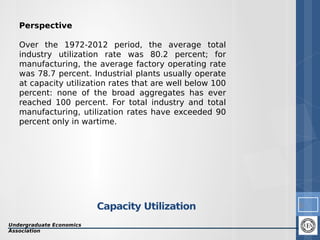
Perspective
Over the 1972-2012 period, the average total
industry utilization rate was 80.2 percent; for
manufacturing, the average factory operating rate
was 78.7 percent. Industrial plants usually operate
at capacity utilization rates that are well below 100
percent: none of the broad aggregates has ever
reached 100 percent. For total industry and total
manufacturing, utilization rates have exceeded 90
percent only in wartime.

Capacity Utilization
Undergraduate Economics
Association

6
Release Date: February 14, 2014

Industrial Production & Capacity Utilization
Undergraduate Economics
Association

7
Release Date: February 14, 2014

Industrial Production & Capacity Utilization
Undergraduate Economics
Association

8
Release Date: February 14, 2014
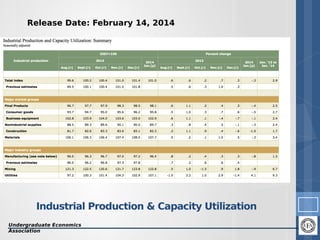
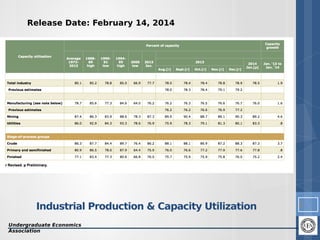
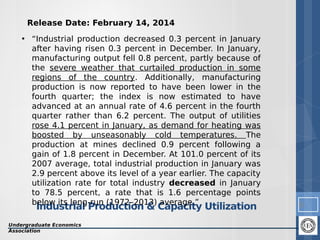
• “Industrial production decreased 0.3 percent in January
after having risen 0.3 percent in December. In January,
manufacturing output fell 0.8 percent, partly because of
the severe weather that curtailed production in some
regions of the country. Additionally, manufacturing
production is now reported to have been lower in the
fourth quarter; the index is now estimated to have
advanced at an annual rate of 4.6 percent in the fourth
quarter rather than 6.2 percent. The output of utilities
rose 4.1 percent in January, as demand for heating was
boosted by unseasonably cold temperatures. The
production at mines declined 0.9 percent following a
gain of 1.8 percent in December. At 101.0 percent of its
2007 average, total industrial production in January was
2.9 percent above its level of a year earlier. The capacity
utilization rate for total industry decreased in January
to 78.5 percent, a rate that is 1.6 percentage points
below its long-run (1972–2013) average.”

Industrial Production & Capacity Utilization

Undergraduate Economics
Association

9
Revision of Industrial Production and Capacity Utilization
“The Federal Reserve Board plans to issue its annual revision to
the index of industrial production (IP) and the related measures of
capacity utilization on March 28, 2014. The revised IP indexes will
incorporate data from the U.S. Geological Survey regarding metallic
and nonmetallic minerals (except fuels) for 2012. The update will also
include revisions to the monthly indicator (either product data or
input data) and to seasonal factors for each industry. In addition, the
estimation methods for some series may be changed. Any
modifications to the methods for estimating the output of an industry
will affect the index from 1972 to the present.”

Revision!
Undergraduate Economics
Association

10
• University of Michigan: Consumer Sentiment
●
Released twice a month
●
500 households – survey
●
Strength of consumer spending
●
Calculation:
●
1966 base period
●
Based off of 5 sample questions. Can / does
include may more

Consumer Sentiment
Undergraduate Economics
Association

11
●
●
●

http://www.sca.isr.umich.edu
http://www.bloomberg.com/quote/CONSSENT:IND
http://research.stlouisfed.org/fred2/series/UMCSENT

Consumer Sentiment
Undergraduate Economics
Association

12
Undergraduate Economics
Association
Undergraduate Economics
Association
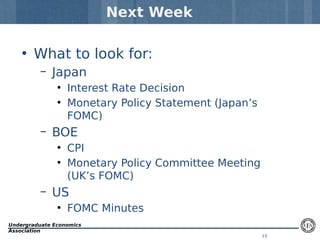
Next Week
• What to look for:
–

Japan
●
●

–

BOE
●
●

–

Interest Rate Decision
Monetary Policy Statement (Japan’s
FOMC)
CPI
Monetary Policy Committee Meeting
(UK’s FOMC)

US
●

FOMC Minutes

Undergraduate Economics
Association

15

MAG - 3rd Meeting

  • 1.
    Week 3 By: JeevanParameswaran, Spencer Petitti (VPs of Editorial Content) 1 Undergraduate Economics Association
  • 2.
    Overview 1. Industrial Production& Capacity Utilization 2. Consumer Sentiment 3. Week in Review – Emerging Markets 2 Undergraduate Economics Association
  • 3.
  • 4.
    • Measure ofindustrial (real) output ● Covers manufacturing, mining, electric, and gas utilities • Combined with Construction, hugely important indicator for economic growth ● Leading indicator (GDP) • Measured in terms of real output, expressed as a percentage of real output in a base year (2007) ● Proportional (based on impact), chain-based index from 1972 ● Preliminary, sub 90% data until 3rd month post ● Classified in two ways: ● Market Groups ● Products & Materials ● Industry Groups ● Three-digit North American Industry Classification System (NAICS) industries and aggregates of these industries (durable and nondurable manufacturing, mining, and utilities) Industrial Production Undergraduate Economics Association 4
  • 5.
    • Measure ofindustrial (estimated) output ● Covers manufacturing, mining, electric, and gas utilities • Combined with Construction, hugely important indicator for economic growth ● Leading indicator (GDP) • For a given industry, the capacity utilization rate is equal to an output index (seasonally adjusted) divided by a capacity index ● Sustainable maximum output ● The greatest level of output a plant can maintain within the framework of a realistic work schedule, after factoring in normal downtime and assuming sufficient availability of inputs to operate the capital in place ● Classification: ● 89 detailed industries (71 in manufacturing, 16 in mining, and 2 in utilities), which mostly correspond to industries at the three- and four-digit NAICS level Capacity Utilization Undergraduate Economics Association 5
  • 6.
    Perspective Over the 1972-2012period, the average total industry utilization rate was 80.2 percent; for manufacturing, the average factory operating rate was 78.7 percent. Industrial plants usually operate at capacity utilization rates that are well below 100 percent: none of the broad aggregates has ever reached 100 percent. For total industry and total manufacturing, utilization rates have exceeded 90 percent only in wartime. Capacity Utilization Undergraduate Economics Association 6
  • 7.
    Release Date: February14, 2014 Industrial Production & Capacity Utilization Undergraduate Economics Association 7
  • 8.
    Release Date: February14, 2014 Industrial Production & Capacity Utilization Undergraduate Economics Association 8
  • 9.
    Release Date: February14, 2014 • “Industrial production decreased 0.3 percent in January after having risen 0.3 percent in December. In January, manufacturing output fell 0.8 percent, partly because of the severe weather that curtailed production in some regions of the country. Additionally, manufacturing production is now reported to have been lower in the fourth quarter; the index is now estimated to have advanced at an annual rate of 4.6 percent in the fourth quarter rather than 6.2 percent. The output of utilities rose 4.1 percent in January, as demand for heating was boosted by unseasonably cold temperatures. The production at mines declined 0.9 percent following a gain of 1.8 percent in December. At 101.0 percent of its 2007 average, total industrial production in January was 2.9 percent above its level of a year earlier. The capacity utilization rate for total industry decreased in January to 78.5 percent, a rate that is 1.6 percentage points below its long-run (1972–2013) average.” Industrial Production & Capacity Utilization Undergraduate Economics Association 9
  • 10.
    Revision of IndustrialProduction and Capacity Utilization “The Federal Reserve Board plans to issue its annual revision to the index of industrial production (IP) and the related measures of capacity utilization on March 28, 2014. The revised IP indexes will incorporate data from the U.S. Geological Survey regarding metallic and nonmetallic minerals (except fuels) for 2012. The update will also include revisions to the monthly indicator (either product data or input data) and to seasonal factors for each industry. In addition, the estimation methods for some series may be changed. Any modifications to the methods for estimating the output of an industry will affect the index from 1972 to the present.” Revision! Undergraduate Economics Association 10
  • 11.
    • University ofMichigan: Consumer Sentiment ● Released twice a month ● 500 households – survey ● Strength of consumer spending ● Calculation: ● 1966 base period ● Based off of 5 sample questions. Can / does include may more Consumer Sentiment Undergraduate Economics Association 11
  • 12.
  • 13.
  • 14.
  • 15.
    Next Week • Whatto look for: – Japan ● ● – BOE ● ● – Interest Rate Decision Monetary Policy Statement (Japan’s FOMC) CPI Monetary Policy Committee Meeting (UK’s FOMC) US ● FOMC Minutes Undergraduate Economics Association 15