Composite Index of
Lagging Indicators
BUS 531- Managerial Economics
Presented by: Alin Sturek
April 23, 2013
Agenda
• Background
• Index Composition
• Overview of Index Components
• Index Historical Trend
• BCI Index Comparison
Background
• Lagging Economic Index (LAG) is the third
component of the Business Cycle Indicators used
to track changes in the direction of the economy
– Published monthly by The Conference Board
• Composite of seven economic measures that
historically registered a change in the business
cycle after the change has already taken place
• The index is the final confirmation for economists
that the business cycle has made a shift into a new
stage; indicates peak and trough turning points
Index Factors and Weights
• The avg. prime rate charged by banks (28.15%)
• The ratio of consumer installment credit
outstanding to personal income (21.01%)
• The change in the Consumer Price Index for
services (19.55%)
• The ratio of manufacturing and trade inventories to
sales (12.11%)
• The value of outstanding commercial and
industrial loans (9.7%)
• The change in labor cost per unit of output (5.87%)
• The average duration of unemployment (3.61%)
Average Prime Rate
(Index Weight = 28.15%)
• The prime interest rate is what banks charge their best
customers (least risky); also known as the prime lending
rate, it is based on the Federal funds rate (FOMC meets
every six weeks)
• The Wall Street Journal surveys the 30 largest banks; if
three-quarters of them (23) report a change then the rate is
effectively changed and the new rate is published on the
same day
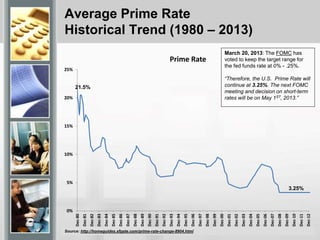
• The rate was first published in 1947, when it stood at 1.75
percent; the highest value was 21.5%, reached on
December 19, 1980
0%
5%
10%
15%
20%
25%
Dec-80
Dec-81
Dec-82
Dec-83
Dec-84
Dec-85
Dec-86
Dec-87
Dec-88
Dec-89
Dec-90
Dec-91
Dec-92
Dec-93
Dec-94
Dec-95
Dec-96
Dec-97
Dec-98
Dec-99
Dec-00
Dec-01
Dec-02
Dec-03
Dec-04
Dec-05
Dec-06
Dec-07
Dec-08
Dec-09
Dec-10
Dec-11
Dec-12
Prime Rate
Average Prime Rate
Historical Trend (1980 – 2013)
March 20, 2013: The FOMC has
voted to keep the target range for
the fed funds rate at 0% - .25%.
“Therefore, the U.S. Prime Rate will
continue at 3.25%. The next FOMC
meeting and decision on short-term
rates will be on May 1ST, 2013.”
Source: http://homeguides.sfgate.com/prime-rate-change-8904.html
21.5%
3.25%
Consumer Debt to Income Ratio
(Index Weight = 21.01%)
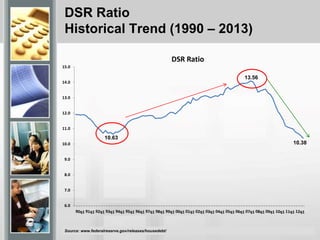
• The household debt service ratio (DSR) is an estimate of the
ratio of debt payments (outstanding mortgage and consumer
debt) to disposable personal income
• Data is collected in two parts:
– Consumer debt provided by the Federal Reserve
– Income reported by the Bureau of Economic Analysis
• After a recession, borrowing tends to lag improvements in
personal income because people are cautious to take on
new debt; during bad times debt levels typically increase in
order to continue supporting their lifestyle
DSR Ratio
Historical Trend (1990 – 2013)
Source: www.federalreserve.gov/releases/housedebt/
6.0
7.0
8.0
9.0
10.0
11.0
12.0
13.0
14.0
15.0
DSR Ratio
10.63
13.56
10.38
Change in CPI for Services
(Index Weight = 19.55%)
• Based on the Consumer Price Index but excludes
food and energy due to their volatility
– Measures the core rate of inflation (shelter,
used cars, medical care, personal care,
apparel, household furnishings, etc.)
• The CPI for Services measures inflation in
consumer prices for service products; it signifies
whether price increases have arrived
• Provided monthly by the Bureau of Labor
Statistics
CPI for Services
Historical Trend (1980-2013)
The index for all items less food and
energy increased 0.1 percent in
March following increases of 0.3
percent in January and 0.2 percent
in February. 1982-84=100
Source: http://research.stlouisfed.org/fred2/graph/?s[1][id]=CPILFESL
232.76
0.000
50.000
100.000
150.000
200.000
250.000
Jan-70
May-71
Sep-72
Jan-74
May-75
Sep-76
Jan-78
May-79
Sep-80
Jan-82
May-83
Sep-84
Jan-86
May-87
Sep-88
Jan-90
May-91
Sep-92
Jan-94
May-95
Sep-96
Jan-98
May-99
Sep-00
Jan-02
May-03
Sep-04
Jan-06
May-07
Sep-08
Jan-10
May-11
Sep-12
CPI for Services
Jan 79 – Dec 80
Average = .93%
Business Inventories to Sales Ratio
(Index Weight = 12.11%)
• Provides gauge on inventory levels compared to
current sales
• Provided monthly by the Bureau of Economic
Analysis (data collected by the Census Bureau)
• Inventories will rise if sales fail to meet
projections during an economic downturn. But
they decline as excess inventory is used to meet
initial demand during an expansion
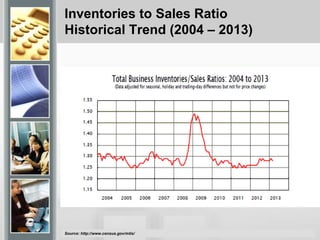
Inventories to Sales Ratio
Historical Trend (2004 – 2013)
Source: http://www.census.gov/mtis/
Commercial and Industrial Loans
(Index Weight = 9.7%)
• Volume of business loans held by banks and
commercial paper issued by nonfinancial
companies (total dollar value)
• Provided by the Federal Reserve
• If profits decline or liquidity impacts business
operations, firms will require additional loans or
increase their lines of credit; troughs are typically
seen more than a year after the recession ends
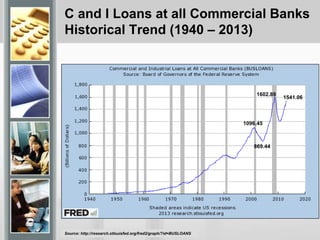
C and I Loans at all Commercial Banks
Historical Trend (1940 – 2013)
Source: http://research.stlouisfed.org/fred2/graph/?id=BUSLOANS
1541.06
1096.45
869.44
1602.89
Change in Labor Cost per Unit of Output
(Index Weight = 5.87%)
• Represents the rate of change in labor costs for
manufacturing firms compared to industrial output
• Cyclical peaks in the six-month annualized rate of
change typically occur during recessions, as
output declines faster than labor costs
• Data is collected in two parts:
– Industrial production in manufacturing
provided by the Federal Reserve
– Employee compensation in manufacturing
reported by the Bureau of Economic Analysis
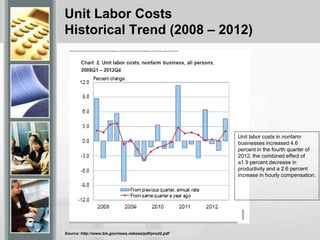
Unit Labor Costs
Historical Trend (2008 – 2012)
Source: http://www.bls.gov/news.release/pdf/prod2.pdf
Unit labor costs in nonfarm
businesses increased 4.6
percent in the fourth quarter of
2012, the combined effect of
a1.9 percent decrease in
productivity and a 2.6 percent
increase in hourly compensation.
Average Duration of Unemployment
(Index Weight = 3.61%)
• The number of weeks those counted as
unemployed have been out of work and looking for
a job
• Provided by the Bureau of Labor Statistics; data is
inverted since this measure is higher during
recessions (and vice-versa)
• During a recession, the number of long-term
unemployed will increase - how difficult is it for
these workers to find a job?
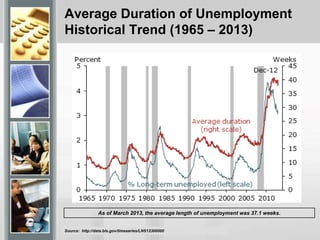
Average Duration of Unemployment
Historical Trend (1965 – 2013)
Source: http://data.bls.gov/timeseries/LNS12300000
As of March 2013, the average length of unemployment was 37.1 weeks.
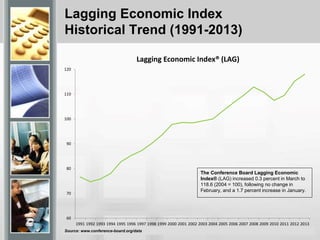
Lagging Economic Index
Historical Trend (1991-2013)
60
70
80
90
100
110
120
1991 1992 1993 1994 1995 1996 1997 1998 1999 2000 2001 2002 2003 2004 2005 2006 2007 2008 2009 2010 2011 2012 2013
Lagging Economic Index® (LAG)
The Conference Board Lagging Economic
Index® (LAG) increased 0.3 percent in March to
118.6 (2004 = 100), following no change in
February, and a 1.7 percent increase in January.
Source: www.conference-board.org/data
60
70
80
90
100
110
120
1991 1992 1993 1994 1995 1996 1997 1998 1999 2000 2001 2002 2003 2004 2005 2006 2007 2008 2009 2010
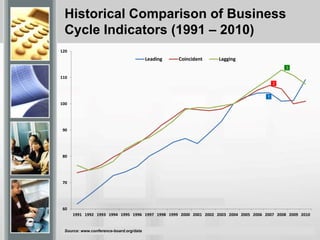
Leading Coincident Lagging
Historical Comparison of Business
Cycle Indicators (1991 – 2010)
1
2
3
Source: www.conference-board.org/data
Sources
• http://www.investopedia.com/university/conferenc
eboard/conferenceboard4.asp
• www.conference-board.org/data
• http://data.bls.gov/timeseries/LNS12300000
• http://research.stlouisfed.org/fred2/graph/?id=BU
SLOANS
• http://www.investopedia.com/terms/b/bci.asp

Lagging economic indicators

  • 1.
    Composite Index of LaggingIndicators BUS 531- Managerial Economics Presented by: Alin Sturek April 23, 2013
  • 2.
    Agenda • Background • IndexComposition • Overview of Index Components • Index Historical Trend • BCI Index Comparison
  • 3.
    Background • Lagging EconomicIndex (LAG) is the third component of the Business Cycle Indicators used to track changes in the direction of the economy – Published monthly by The Conference Board • Composite of seven economic measures that historically registered a change in the business cycle after the change has already taken place • The index is the final confirmation for economists that the business cycle has made a shift into a new stage; indicates peak and trough turning points
  • 4.
    Index Factors andWeights • The avg. prime rate charged by banks (28.15%) • The ratio of consumer installment credit outstanding to personal income (21.01%) • The change in the Consumer Price Index for services (19.55%) • The ratio of manufacturing and trade inventories to sales (12.11%) • The value of outstanding commercial and industrial loans (9.7%) • The change in labor cost per unit of output (5.87%) • The average duration of unemployment (3.61%)
  • 5.
    Average Prime Rate (IndexWeight = 28.15%) • The prime interest rate is what banks charge their best customers (least risky); also known as the prime lending rate, it is based on the Federal funds rate (FOMC meets every six weeks) • The Wall Street Journal surveys the 30 largest banks; if three-quarters of them (23) report a change then the rate is effectively changed and the new rate is published on the same day • The rate was first published in 1947, when it stood at 1.75 percent; the highest value was 21.5%, reached on December 19, 1980
  • 6.
    0% 5% 10% 15% 20% 25% Dec-80 Dec-81 Dec-82 Dec-83 Dec-84 Dec-85 Dec-86 Dec-87 Dec-88 Dec-89 Dec-90 Dec-91 Dec-92 Dec-93 Dec-94 Dec-95 Dec-96 Dec-97 Dec-98 Dec-99 Dec-00 Dec-01 Dec-02 Dec-03 Dec-04 Dec-05 Dec-06 Dec-07 Dec-08 Dec-09 Dec-10 Dec-11 Dec-12 Prime Rate Average PrimeRate Historical Trend (1980 – 2013) March 20, 2013: The FOMC has voted to keep the target range for the fed funds rate at 0% - .25%. “Therefore, the U.S. Prime Rate will continue at 3.25%. The next FOMC meeting and decision on short-term rates will be on May 1ST, 2013.” Source: http://homeguides.sfgate.com/prime-rate-change-8904.html 21.5% 3.25%
  • 7.
    Consumer Debt toIncome Ratio (Index Weight = 21.01%) • The household debt service ratio (DSR) is an estimate of the ratio of debt payments (outstanding mortgage and consumer debt) to disposable personal income • Data is collected in two parts: – Consumer debt provided by the Federal Reserve – Income reported by the Bureau of Economic Analysis • After a recession, borrowing tends to lag improvements in personal income because people are cautious to take on new debt; during bad times debt levels typically increase in order to continue supporting their lifestyle
  • 8.
    DSR Ratio Historical Trend(1990 – 2013) Source: www.federalreserve.gov/releases/housedebt/ 6.0 7.0 8.0 9.0 10.0 11.0 12.0 13.0 14.0 15.0 DSR Ratio 10.63 13.56 10.38
  • 9.
    Change in CPIfor Services (Index Weight = 19.55%) • Based on the Consumer Price Index but excludes food and energy due to their volatility – Measures the core rate of inflation (shelter, used cars, medical care, personal care, apparel, household furnishings, etc.) • The CPI for Services measures inflation in consumer prices for service products; it signifies whether price increases have arrived • Provided monthly by the Bureau of Labor Statistics
  • 10.
    CPI for Services HistoricalTrend (1980-2013) The index for all items less food and energy increased 0.1 percent in March following increases of 0.3 percent in January and 0.2 percent in February. 1982-84=100 Source: http://research.stlouisfed.org/fred2/graph/?s[1][id]=CPILFESL 232.76 0.000 50.000 100.000 150.000 200.000 250.000 Jan-70 May-71 Sep-72 Jan-74 May-75 Sep-76 Jan-78 May-79 Sep-80 Jan-82 May-83 Sep-84 Jan-86 May-87 Sep-88 Jan-90 May-91 Sep-92 Jan-94 May-95 Sep-96 Jan-98 May-99 Sep-00 Jan-02 May-03 Sep-04 Jan-06 May-07 Sep-08 Jan-10 May-11 Sep-12 CPI for Services Jan 79 – Dec 80 Average = .93%
  • 11.
    Business Inventories toSales Ratio (Index Weight = 12.11%) • Provides gauge on inventory levels compared to current sales • Provided monthly by the Bureau of Economic Analysis (data collected by the Census Bureau) • Inventories will rise if sales fail to meet projections during an economic downturn. But they decline as excess inventory is used to meet initial demand during an expansion
  • 12.
    Inventories to SalesRatio Historical Trend (2004 – 2013) Source: http://www.census.gov/mtis/
  • 13.
    Commercial and IndustrialLoans (Index Weight = 9.7%) • Volume of business loans held by banks and commercial paper issued by nonfinancial companies (total dollar value) • Provided by the Federal Reserve • If profits decline or liquidity impacts business operations, firms will require additional loans or increase their lines of credit; troughs are typically seen more than a year after the recession ends
  • 14.
    C and ILoans at all Commercial Banks Historical Trend (1940 – 2013) Source: http://research.stlouisfed.org/fred2/graph/?id=BUSLOANS 1541.06 1096.45 869.44 1602.89
  • 15.
    Change in LaborCost per Unit of Output (Index Weight = 5.87%) • Represents the rate of change in labor costs for manufacturing firms compared to industrial output • Cyclical peaks in the six-month annualized rate of change typically occur during recessions, as output declines faster than labor costs • Data is collected in two parts: – Industrial production in manufacturing provided by the Federal Reserve – Employee compensation in manufacturing reported by the Bureau of Economic Analysis
  • 16.
    Unit Labor Costs HistoricalTrend (2008 – 2012) Source: http://www.bls.gov/news.release/pdf/prod2.pdf Unit labor costs in nonfarm businesses increased 4.6 percent in the fourth quarter of 2012, the combined effect of a1.9 percent decrease in productivity and a 2.6 percent increase in hourly compensation.
  • 17.
    Average Duration ofUnemployment (Index Weight = 3.61%) • The number of weeks those counted as unemployed have been out of work and looking for a job • Provided by the Bureau of Labor Statistics; data is inverted since this measure is higher during recessions (and vice-versa) • During a recession, the number of long-term unemployed will increase - how difficult is it for these workers to find a job?
  • 18.
    Average Duration ofUnemployment Historical Trend (1965 – 2013) Source: http://data.bls.gov/timeseries/LNS12300000 As of March 2013, the average length of unemployment was 37.1 weeks.
  • 19.
    Lagging Economic Index HistoricalTrend (1991-2013) 60 70 80 90 100 110 120 1991 1992 1993 1994 1995 1996 1997 1998 1999 2000 2001 2002 2003 2004 2005 2006 2007 2008 2009 2010 2011 2012 2013 Lagging Economic Index® (LAG) The Conference Board Lagging Economic Index® (LAG) increased 0.3 percent in March to 118.6 (2004 = 100), following no change in February, and a 1.7 percent increase in January. Source: www.conference-board.org/data
  • 20.
    60 70 80 90 100 110 120 1991 1992 19931994 1995 1996 1997 1998 1999 2000 2001 2002 2003 2004 2005 2006 2007 2008 2009 2010 Leading Coincident Lagging Historical Comparison of Business Cycle Indicators (1991 – 2010) 1 2 3 Source: www.conference-board.org/data
  • 21.
    Sources • http://www.investopedia.com/university/conferenc eboard/conferenceboard4.asp • www.conference-board.org/data •http://data.bls.gov/timeseries/LNS12300000 • http://research.stlouisfed.org/fred2/graph/?id=BU SLOANS • http://www.investopedia.com/terms/b/bci.asp

Editor's Notes

  • #4 CB: Independent global business membership and research association founded in 1916 as a non-profit, non-partisan organization Using National Bureau of Economic Research (NBER) data in the 1930s, Arthur Burns and Wesley Mitchell, popularized the study of business cycles. Their early research led to the creation of the Business Cycle Indicators (BCI), which are now published by the Conference Board (CB) and composed of three indexes.
  • #5 The seven lagging components are averaged to smooth their results, and adjusted for volatility with a standardization factor.
  • #6 The prime rate will move up or down in lock step with changes by the Federal Reserve Board (FOMC - Federal Open Market Committee); When times are good, banks resist lowering rates (and their profits) even if business starts to slow. When times are bad, they resist raising rates until they are sure the demand supports it. Changes in the rate typically occur after economic activity improves or declines.
  • #7 The prime rate will move up or down in lock step with changes by the Federal Reserve Board (FOMC - Federal Open Market Committee); the prime rate generally tracks the fed funds rate at 3 percentage points above that rate
  • #8 Data is seasonally adjusted.
  • #9 This ratio usually shows a trough many months after the recession ends.
  • #15 2008-10-01 1602.8942 2004-05-01 869.4357 2001-01-01 1096.4505
  • #16 Because monthly percent changes in this series are extremely erratic, percent changes in labor costs are calculated over a six-month span.
  • #21 The Index of Lagging Indicators should be evaluated together with the other two BCI indexes. The next recession cannot start until the lagging indicators certify that the last one is over.