- Residential LifeSlideContent BoxMAD SkillsACUHO-I LLP ConferenceOctober 24, 2010
- Residential LifeMAD SkillsMetacognitive and Deep Learning Skills ModelStan DuraResidential Life CoordinatorDoctoral Student, Educational PsychologyUNLVMAD SkillsACUHO-I LLP ConferenceOctober 24, 2010
- Residential LifeOverviewEngaging residents in cognitive activity that better supports academic success Metacognition:  What is it, and why is it important?
 Metacognitive and Deep-Learning Skills Model
 Applications
Discussion
Wrap upMAD SkillsACUHO-I LLP ConferenceOctober 24, 2010
- Residential LifeStudying vs. LearningStudyingand Learning…What’s the difference?MAD SkillsACUHO-I LLP ConferenceOctober 24, 2010
- Residential LifeMeaningful LearningMAD SkillsACUHO-I LLP ConferenceOctober 24, 2010
- Residential LifeMetacognitionWhat is metacognition?The conscious awareness and control of one’s thinking and learningMAD SkillsACUHO-I LLP ConferenceOctober 24, 2010
- Residential LifeMetacognitionWhy is it important?It is quite possibly the most effective learning skill one can posses.MAD SkillsACUHO-I LLP ConferenceOctober 24, 2010
- Residential LifeBloom’s TaxonomyEvaluationSynthesisAnalysisApplicationComprehensionKnowledgeMAD SkillsACUHO-I LLP ConferenceOctober 24, 2010
- Residential LifeBloom’s TaxonomyCreateTypical in Grad SchoolIntegrateMeaningful LearningAnalyzeTypical in CollegeApplyReproduceRote LearningTypical in High SchoolRememberMAD SkillsACUHO-I LLP ConferenceOctober 24, 2010
- Residential LifeHave you ever wondered…Why staff don’t fill out forms correctly?
Why staff don’t follow procedures correctly after they were trained?
Why students don’t remember the list of rules they went over after check in?MAD SkillsACUHO-I LLP ConferenceOctober 24, 2010
- Residential LifeMeaningful LearningMAD SkillsACUHO-I LLP ConferenceOctober 24, 2010
- Residential LifeMetacognitionWhy is it important to us?It transforms academic experiences… MAD SkillsACUHO-I LLP ConferenceOctober 24, 2010
- Residential LifeMetacognitionIt transforms academic experiences…Travis, junior psychology student	Test scores: 47, 52,      82, 86Source: Dr. Saundra Y. McGuireDirector, Center for Academic SuccessAdj. Professor, Department of ChemistryLouisiana State UniversityMAD SkillsACUHO-I LLP ConferenceOctober 24, 2010
- Residential LifeMetacognitionIt transforms academic experiences…Robert, freshman chemistry student	Test scores: 42, 100,    100, 100Source: Dr. Saundra Y. McGuireDirector, Center for Academic SuccessAdj. Professor, Department of ChemistryLouisiana State UniversityMAD SkillsACUHO-I LLP ConferenceOctober 24, 2010
- Residential LifeMetacognitionIt transforms academic experiences…Michael, senior organic chemistry student	Test scores: 30, 28,     80, 91Source: Dr. Saundra Y. McGuireDirector, Center for Academic SuccessAdj. Professor, Department of ChemistryLouisiana State UniversityMAD SkillsACUHO-I LLP ConferenceOctober 24, 2010
- Residential LifeMetacognitionIt transforms academic experiences…Terrence, junior Bio Engineering student
Cumulative GPA (after four semesters) 1.67
  After intervention
3.54 (fall 2003),
3.80 (spring 2004)Source: Dr. Saundra Y. McGuireDirector, Center for Academic SuccessAdj. Professor, Department of ChemistryLouisiana State UniversityMAD SkillsACUHO-I LLP ConferenceOctober 24, 2010
- Residential LifeMetacogntionThere are an increasing number of studies demonstrating that metacognition predicts academic success and performance in a range of disciplines.MAD SkillsACUHO-I LLP ConferenceOctober 24, 2010
- Residential LifeMetacognitionOk, it’s important, but residents don’t come to study skills programs; how do we do this?Residents don’t come to traditional study skills programs because, ultimately, those programs do not impact them.Traditional style programming isn’t the best model of development or delivery.MAD SkillsACUHO-I LLP ConferenceOctober 24, 2010
- Residential LifeMetacognitionOk, it’s important, but residents don’t come to study skills programs; how do we do this?What’s needed is a cohesive, time-extended, individual based model, focusing on the aspect of learning that:possesses the most leverage, and
is the least taught skill in school.MAD SkillsACUHO-I LLP ConferenceOctober 24, 2010
- Residential LifeMetacognitionOk, it’s important, but residents don’t come to study skills programs; how do we do this?MetacognitionMAD SkillsACUHO-I LLP ConferenceOctober 24, 2010
- Residential LifeThe MAD Skills ModelThe Metacognition and Deep Learning Skills Model Offers assessment to identify strengths/weaknesses
Introduces the concept of metacognition
 Introduces the skills and behaviors involved in effective metacognition
 Encourages a specific study routine based on metacognitive skills
 Engages residents in recursive academic goal setting and evaluation MAD SkillsACUHO-I LLP ConferenceOctober 24, 2010
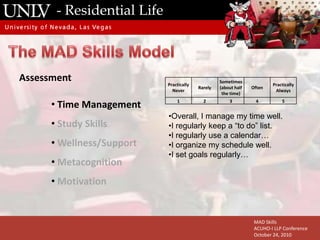
- Residential LifeThe MAD Skills ModelAssessmentTime Management
 Study Skills

Mad Skills

  • 1.
    - Residential LifeSlideContentBoxMAD SkillsACUHO-I LLP ConferenceOctober 24, 2010
  • 2.
    - Residential LifeMADSkillsMetacognitive and Deep Learning Skills ModelStan DuraResidential Life CoordinatorDoctoral Student, Educational PsychologyUNLVMAD SkillsACUHO-I LLP ConferenceOctober 24, 2010
  • 3.
    - Residential LifeOverviewEngagingresidents in cognitive activity that better supports academic success Metacognition: What is it, and why is it important?
  • 4.
    Metacognitive andDeep-Learning Skills Model
  • 5.
  • 6.
  • 7.
    Wrap upMAD SkillsACUHO-ILLP ConferenceOctober 24, 2010
  • 8.
    - Residential LifeStudyingvs. LearningStudyingand Learning…What’s the difference?MAD SkillsACUHO-I LLP ConferenceOctober 24, 2010
  • 9.
    - Residential LifeMeaningfulLearningMAD SkillsACUHO-I LLP ConferenceOctober 24, 2010
  • 10.
    - Residential LifeMetacognitionWhatis metacognition?The conscious awareness and control of one’s thinking and learningMAD SkillsACUHO-I LLP ConferenceOctober 24, 2010
  • 11.
    - Residential LifeMetacognitionWhyis it important?It is quite possibly the most effective learning skill one can posses.MAD SkillsACUHO-I LLP ConferenceOctober 24, 2010
  • 12.
    - Residential LifeBloom’sTaxonomyEvaluationSynthesisAnalysisApplicationComprehensionKnowledgeMAD SkillsACUHO-I LLP ConferenceOctober 24, 2010
  • 13.
    - Residential LifeBloom’sTaxonomyCreateTypical in Grad SchoolIntegrateMeaningful LearningAnalyzeTypical in CollegeApplyReproduceRote LearningTypical in High SchoolRememberMAD SkillsACUHO-I LLP ConferenceOctober 24, 2010
  • 14.
    - Residential LifeHaveyou ever wondered…Why staff don’t fill out forms correctly?
  • 15.
    Why staff don’tfollow procedures correctly after they were trained?
  • 16.
    Why students don’tremember the list of rules they went over after check in?MAD SkillsACUHO-I LLP ConferenceOctober 24, 2010
  • 17.
    - Residential LifeMeaningfulLearningMAD SkillsACUHO-I LLP ConferenceOctober 24, 2010
  • 18.
    - Residential LifeMetacognitionWhyis it important to us?It transforms academic experiences… MAD SkillsACUHO-I LLP ConferenceOctober 24, 2010
  • 19.
    - Residential LifeMetacognitionIttransforms academic experiences…Travis, junior psychology student Test scores: 47, 52, 82, 86Source: Dr. Saundra Y. McGuireDirector, Center for Academic SuccessAdj. Professor, Department of ChemistryLouisiana State UniversityMAD SkillsACUHO-I LLP ConferenceOctober 24, 2010
  • 20.
    - Residential LifeMetacognitionIttransforms academic experiences…Robert, freshman chemistry student Test scores: 42, 100, 100, 100Source: Dr. Saundra Y. McGuireDirector, Center for Academic SuccessAdj. Professor, Department of ChemistryLouisiana State UniversityMAD SkillsACUHO-I LLP ConferenceOctober 24, 2010
  • 21.
    - Residential LifeMetacognitionIttransforms academic experiences…Michael, senior organic chemistry student Test scores: 30, 28, 80, 91Source: Dr. Saundra Y. McGuireDirector, Center for Academic SuccessAdj. Professor, Department of ChemistryLouisiana State UniversityMAD SkillsACUHO-I LLP ConferenceOctober 24, 2010
  • 22.
    - Residential LifeMetacognitionIttransforms academic experiences…Terrence, junior Bio Engineering student
  • 23.
    Cumulative GPA (afterfour semesters) 1.67
  • 24.
    Afterintervention
  • 25.
  • 26.
    3.80 (spring 2004)Source:Dr. Saundra Y. McGuireDirector, Center for Academic SuccessAdj. Professor, Department of ChemistryLouisiana State UniversityMAD SkillsACUHO-I LLP ConferenceOctober 24, 2010
  • 27.
    - Residential LifeMetacogntionThereare an increasing number of studies demonstrating that metacognition predicts academic success and performance in a range of disciplines.MAD SkillsACUHO-I LLP ConferenceOctober 24, 2010
  • 28.
    - Residential LifeMetacognitionOk,it’s important, but residents don’t come to study skills programs; how do we do this?Residents don’t come to traditional study skills programs because, ultimately, those programs do not impact them.Traditional style programming isn’t the best model of development or delivery.MAD SkillsACUHO-I LLP ConferenceOctober 24, 2010
  • 29.
    - Residential LifeMetacognitionOk,it’s important, but residents don’t come to study skills programs; how do we do this?What’s needed is a cohesive, time-extended, individual based model, focusing on the aspect of learning that:possesses the most leverage, and
  • 30.
    is the leasttaught skill in school.MAD SkillsACUHO-I LLP ConferenceOctober 24, 2010
  • 31.
    - Residential LifeMetacognitionOk,it’s important, but residents don’t come to study skills programs; how do we do this?MetacognitionMAD SkillsACUHO-I LLP ConferenceOctober 24, 2010
  • 32.
    - Residential LifeTheMAD Skills ModelThe Metacognition and Deep Learning Skills Model Offers assessment to identify strengths/weaknesses
  • 33.
    Introduces the conceptof metacognition
  • 34.
    Introduces theskills and behaviors involved in effective metacognition
  • 35.
    Encourages aspecific study routine based on metacognitive skills
  • 36.
    Engages residentsin recursive academic goal setting and evaluation MAD SkillsACUHO-I LLP ConferenceOctober 24, 2010
  • 37.
    - Residential LifeTheMAD Skills ModelAssessmentTime Management
  • 38.

Editor's Notes

  • #7 It involves an individual being both aware of her or his thinking and learning and consciously controlling it.
  • #8 It involves an individual being both aware of her or his thinking and learning and consciously controlling it.
  • #13 It involves an individual being both aware of her or his thinking and learning and consciously controlling it.
  • #19 It involves an individual being both aware of her or his thinking and learning and consciously controlling it.
  • #20 It involves an individual being both aware of her or his thinking and learning and consciously controlling it.
  • #21 It involves an individual being both aware of her or his thinking and learning and consciously controlling it.
  • #40 Any questions?