Marketing-in-a-Box
STP Framework
Targeting the Right User
Copyright: Patrick "Mad" Mork 1
Contents
What is STP and why do marketers need it?
Who owns it?
When should you use it?
How does it work?
Examples
Appendix:
2
20 years experience in strategy, marketing
and sales
Large company / start-up experience
Multi-cultural working experience across 4
continents / languages
Expertise: Digital Content / Apps, Mobile
Games, Consumer Goods, Mobile Advertising
About Mad Mork
What is STP?
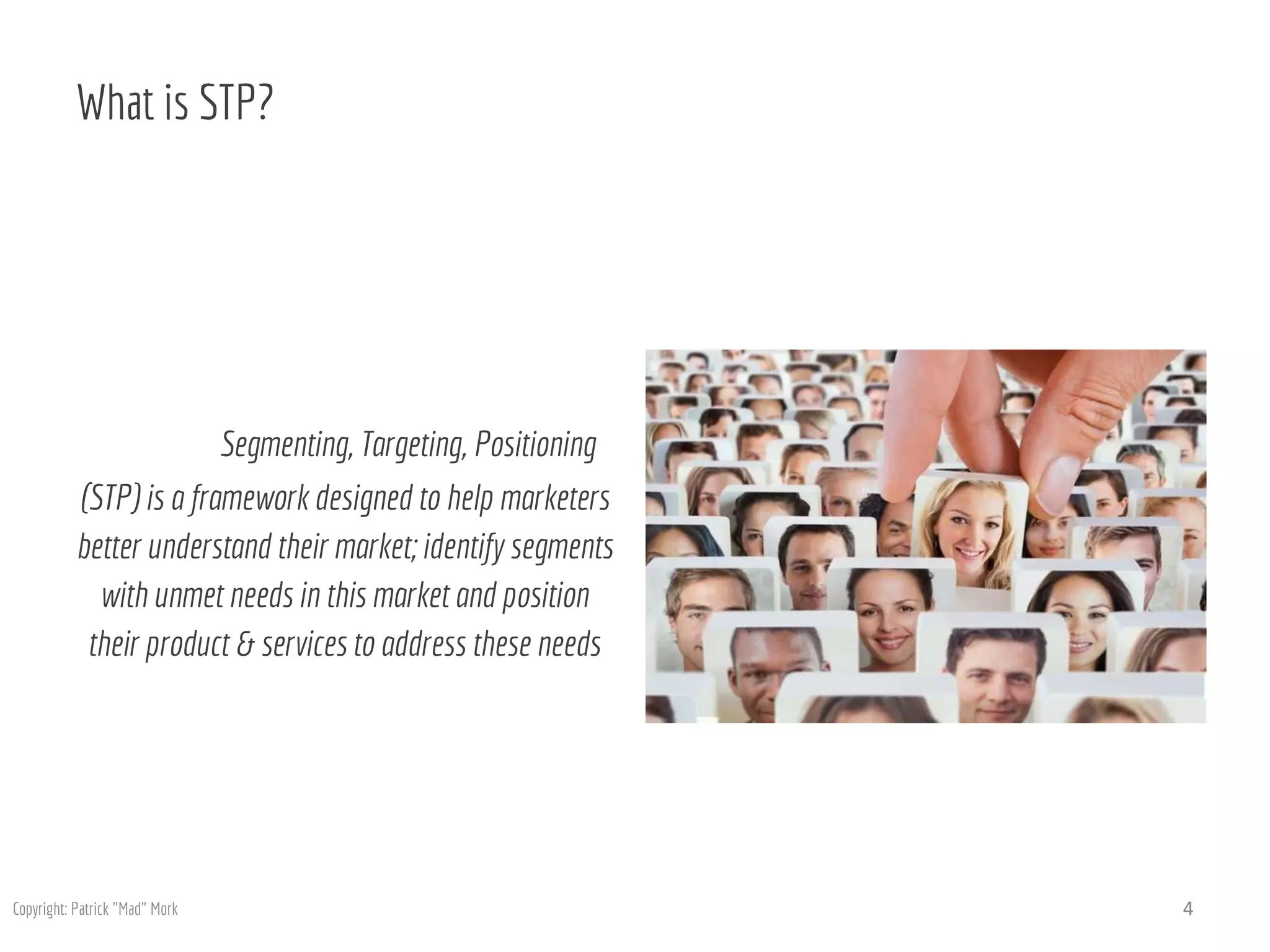
Segmenting, Targeting, Positioning
(STP) is a framework designed to help marketers
better understand their market; identify segments
with unmet needs in this market and position
their product & services to address these needs
4Copyright: Patrick "Mad" Mork
Why is STP important?
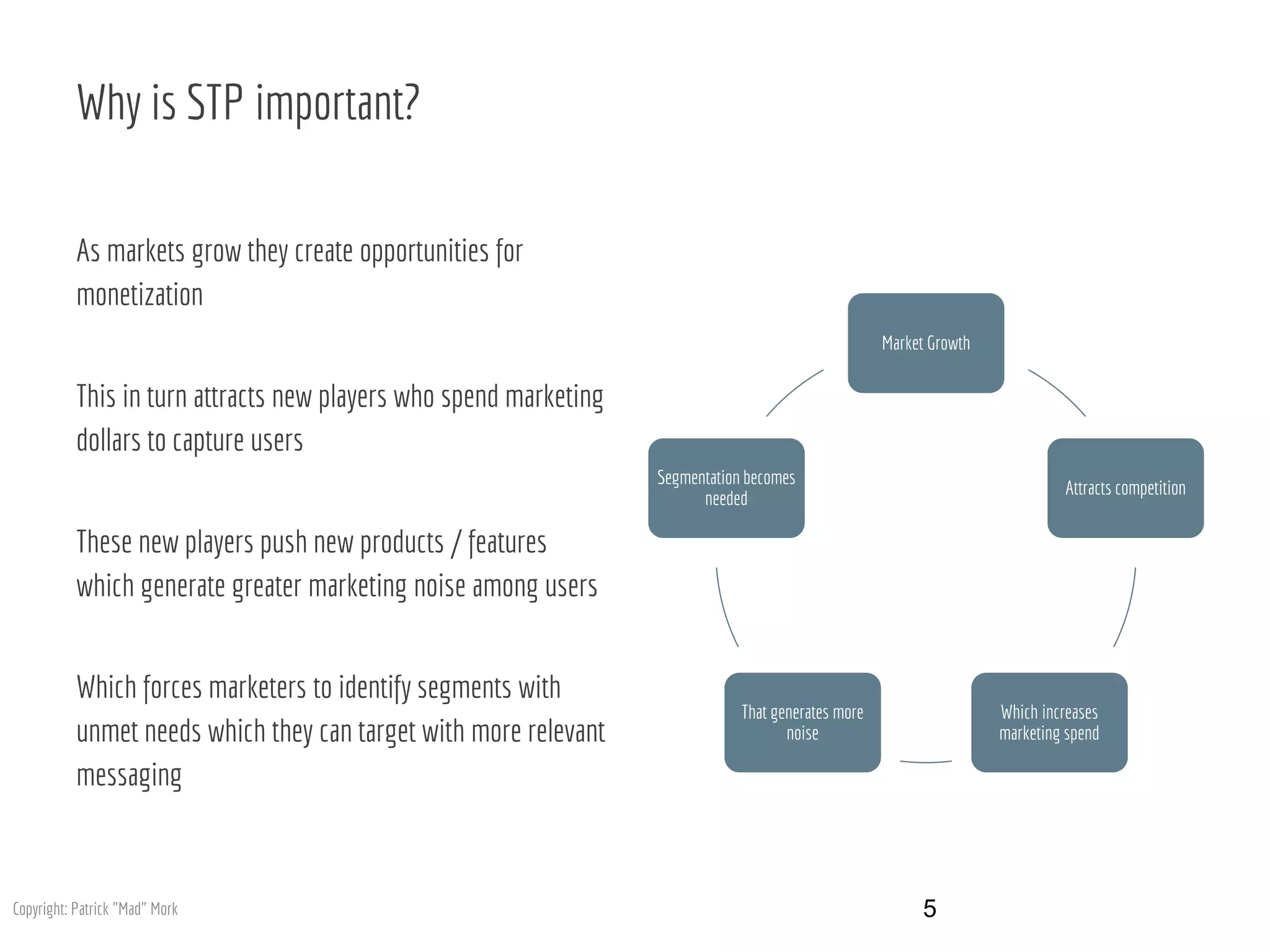
As markets grow they create opportunities for
monetization
This in turn attracts new players who spend marketing
dollars to capture users
These new players push new products / features
which generate greater marketing noise among users
Which forces marketers to identify segments with
unmet needs which they can target with more relevant
messaging
5
Market Growth
Attracts competition
Which increases
marketing spend
That generates more
noise
Segmentation becomes
needed
Copyright: Patrick "Mad" Mork
Who owns the framework?
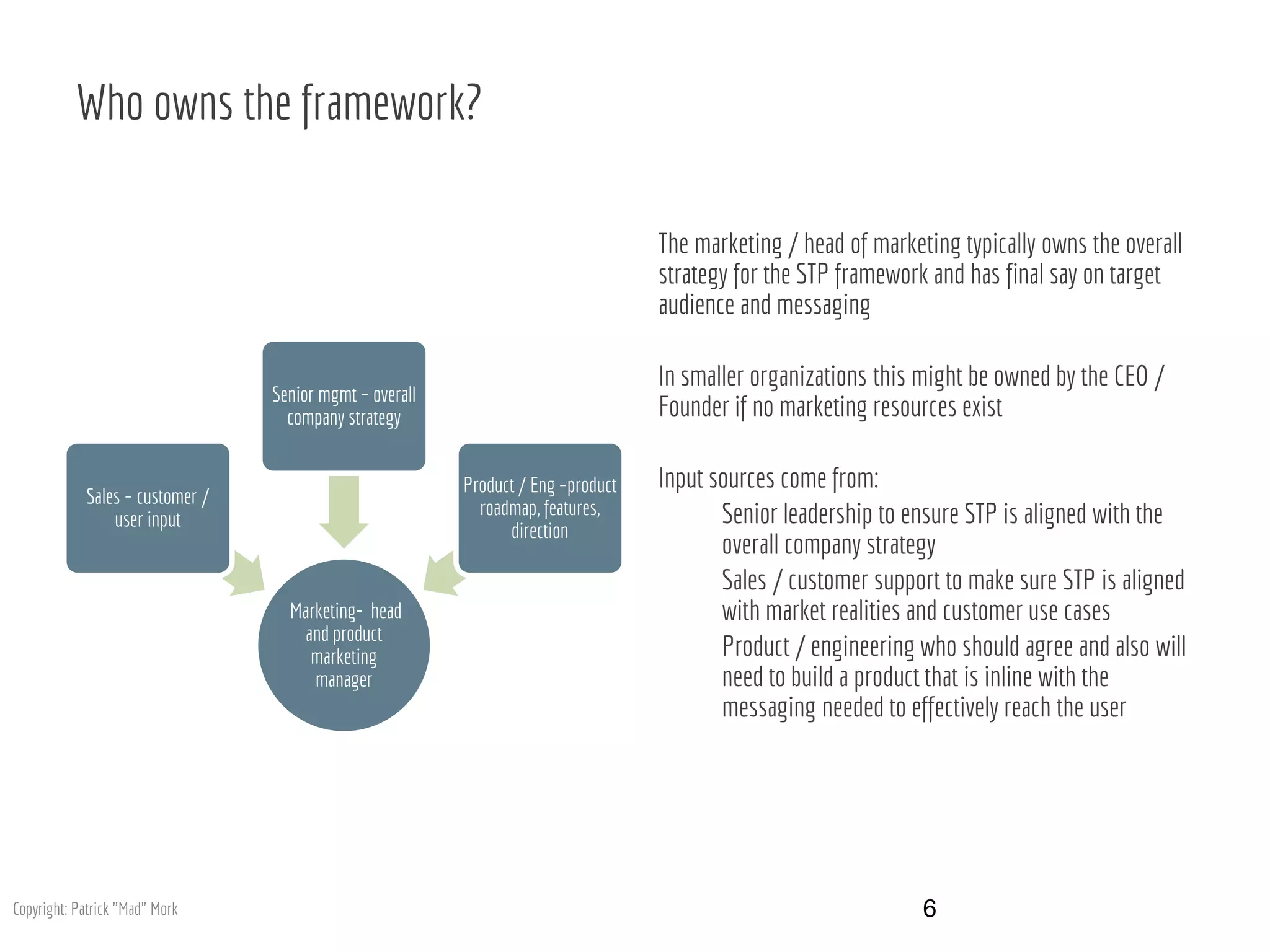
The marketing / head of marketing typically owns the overall
strategy for the STP framework and has final say on target
audience and messaging
In smaller organizations this might be owned by the CEO /
Founder if no marketing resources exist
Input sources come from:
Senior leadership to ensure STP is aligned with the
overall company strategy
Sales / customer support to make sure STP is aligned
with market realities and customer use cases
Product / engineering who should agree and also will
need to build a product that is inline with the
messaging needed to effectively reach the user
6
Marketing- head
and product
marketing
manager
Sales – customer /
user input
Senior mgmt – overall
company strategy
Product / Eng –product
roadmap, features,
direction
Copyright: Patrick "Mad" Mork
When should you use it?
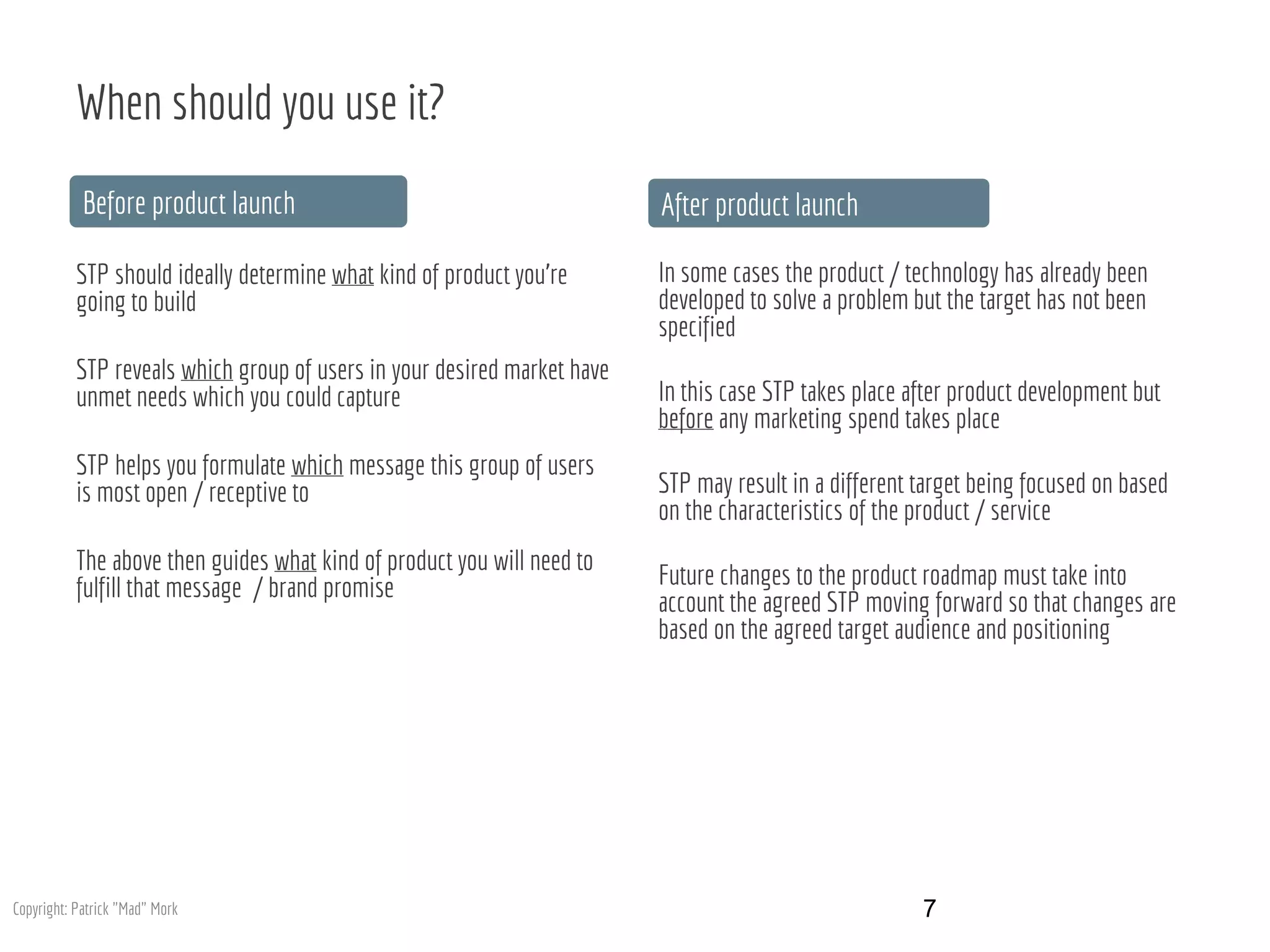
STP should ideally determine what kind of product you’re
going to build
STP reveals which group of users in your desired market have
unmet needs which you could capture
STP helps you formulate which message this group of users
is most open / receptive to
The above then guides what kind of product you will need to
fulfill that message / brand promise
In some cases the product / technology has already been
developed to solve a problem but the target has not been
specified
In this case STP takes place after product development but
before any marketing spend takes place
STP may result in a different target being focused on based
on the characteristics of the product / service
Future changes to the product roadmap must take into
account the agreed STP moving forward so that changes are
based on the agreed target audience and positioning
Before product launch After product launch
7Copyright: Patrick "Mad" Mork
Requirements and output
Segmentation Targeting Positioning
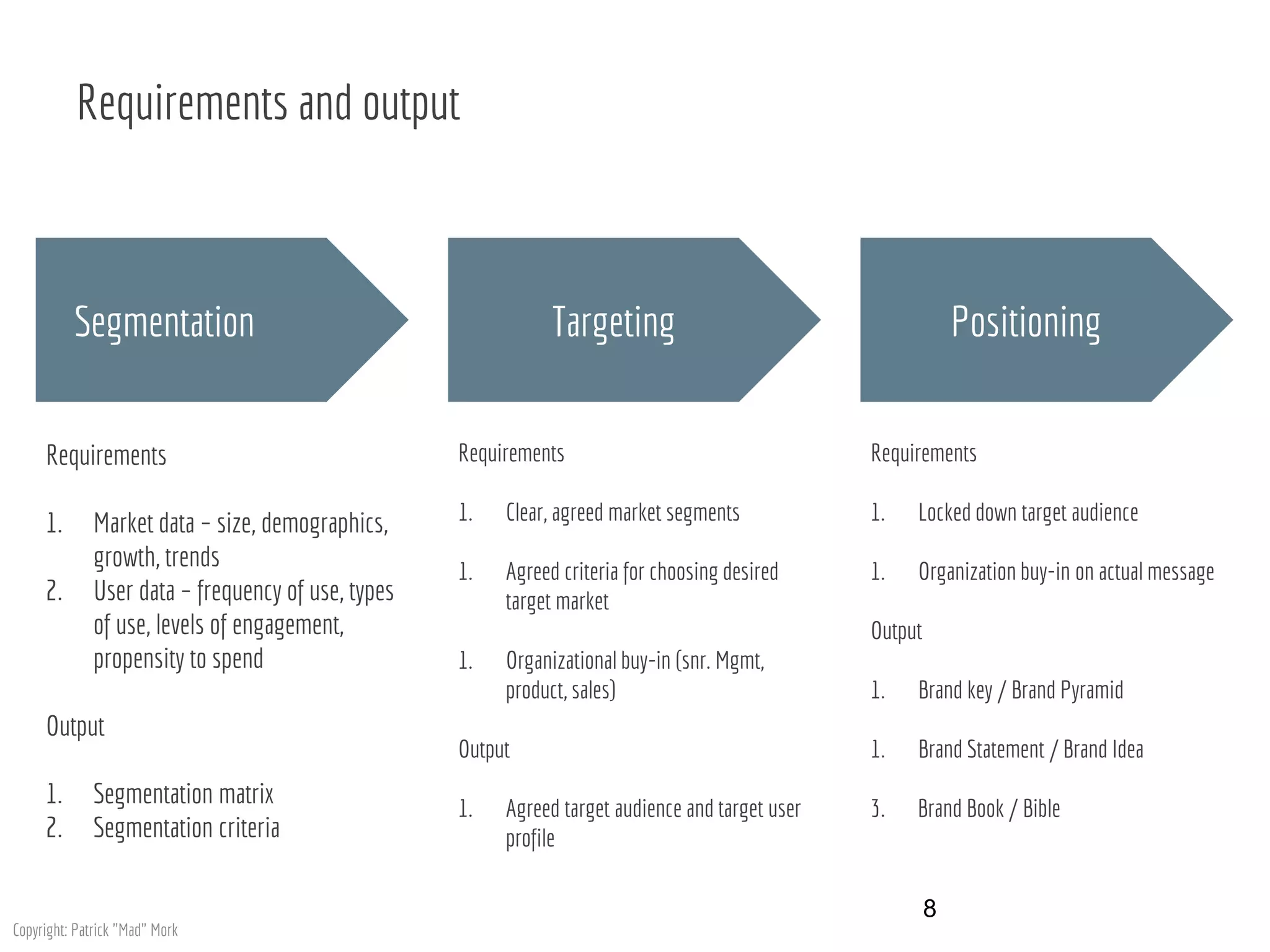
Requirements
1. Market data – size, demographics,
growth, trends
2. User data – frequency of use, types
of use, levels of engagement,
propensity to spend
Output
1. Segmentation matrix
2. Segmentation criteria
Requirements
1. Clear, agreed market segments
1. Agreed criteria for choosing desired
target market
1. Organizational buy-in (snr. Mgmt,
product, sales)
Output
1. Agreed target audience and target user
profile
Requirements
1. Locked down target audience
1. Organization buy-in on actual message
Output
1. Brand key / Brand Pyramid
1. Brand Statement / Brand Idea
3. Brand Book / Bible
8
Copyright: Patrick "Mad" Mork
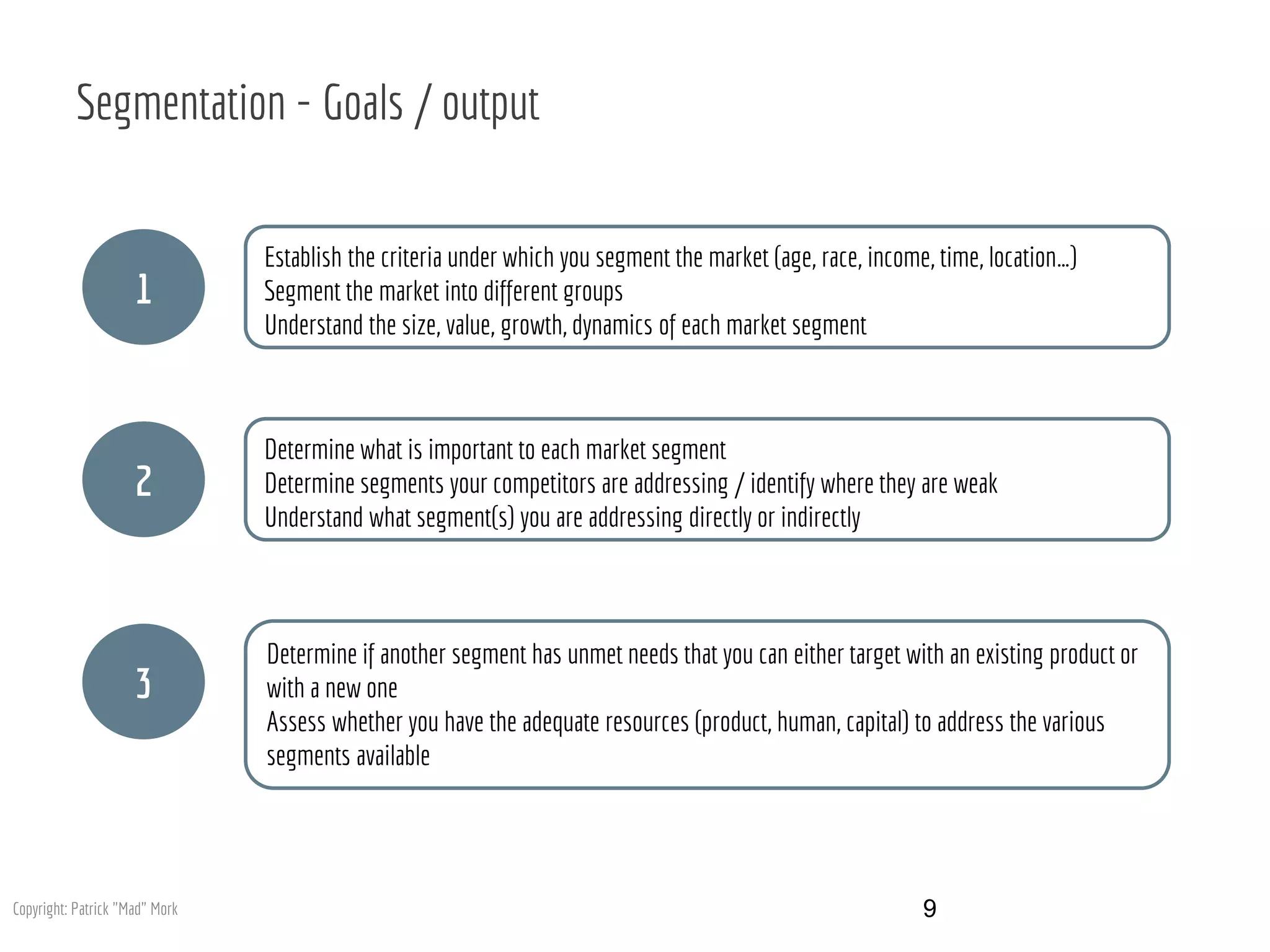
Segmentation - Goals / output
1
2
3
Establish the criteria under which you segment the market (age, race, income, time, location…)
Segment the market into different groups
Understand the size, value, growth, dynamics of each market segment
Determine what is important to each market segment
Determine segments your competitors are addressing / identify where they are weak
Understand what segment(s) you are addressing directly or indirectly
Determine if another segment has unmet needs that you can either target with an existing product or
with a new one
Assess whether you have the adequate resources (product, human, capital) to address the various
segments available
9Copyright: Patrick "Mad" Mork
Implementing STP - Segmenting
The first step is understanding who your users are and why they use your product
To this end you want to:
1. Do Quantitative research to understand your user base and how they see your product
2. Do Qualitative research (focus groups) to drill down and ask users more specifics around your
findings in #1
The Goal of your research is:
1. Understand how user behavior towards your product changes based on demographic factors (age,
race, sex, income, location)
2. Understand if there are areas where your consumers feel underserved by competitors and which
demographic is most underserved
10Copyright: Patrick "Mad" Mork
Segmentation – Quantitative Research
Questions types:
1. Filtering – filter out users who aren’t
meaningful to you
2. Satisfaction – how satisfied are users
with your product? With competitors?
3. Reason for being – how do users “feel”
about your product?
4. Functionality – why do users use your
product?
5. Features – which features do they use
and why?
6. Awareness – how did they hear about
you? From whom?
Things to keep in mind:
1. Keep questions neutral; avoid leading
2. Avoid open ended questions that can’t be
measured
3. Rotate the order of the answers to avoid bias
4. Provide multiple answers and, when
appropriate, the option to check multiple
answers
5. Ensure you have a large enough sample size to
be representative (N=?)
6. Keep your survey short (15-20 questions)
11Copyright: Patrick "Mad" Mork
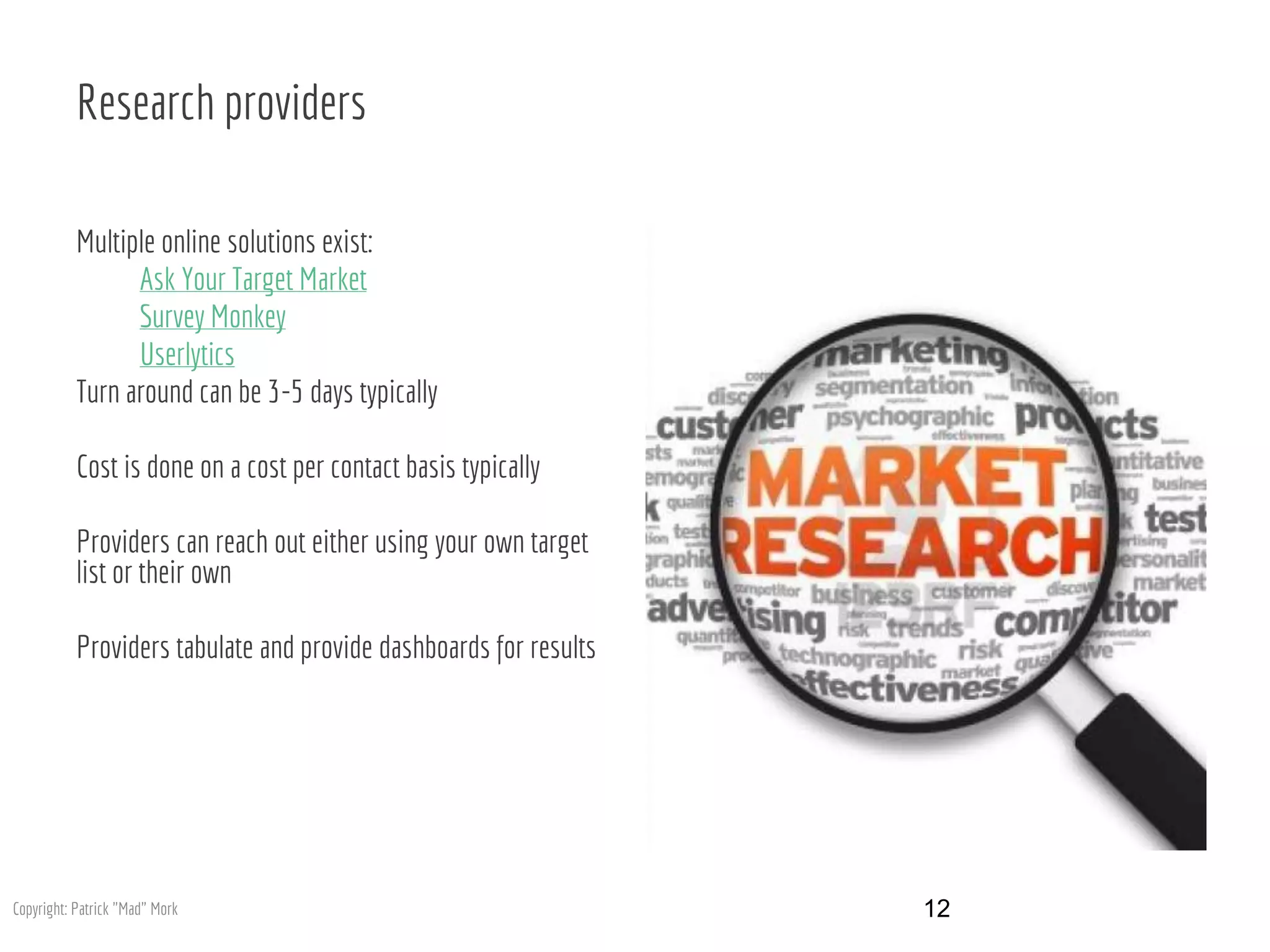
Research providers
Multiple online solutions exist:
Ask Your Target Market
Survey Monkey
Userlytics
Turn around can be 3-5 days typically
Cost is done on a cost per contact basis typically
Providers can reach out either using your own target
list or their own
Providers tabulate and provide dashboards for results
12Copyright: Patrick "Mad" Mork
Segmentation – Criteria definition
With the research done you should break your
users into groups / cohorts
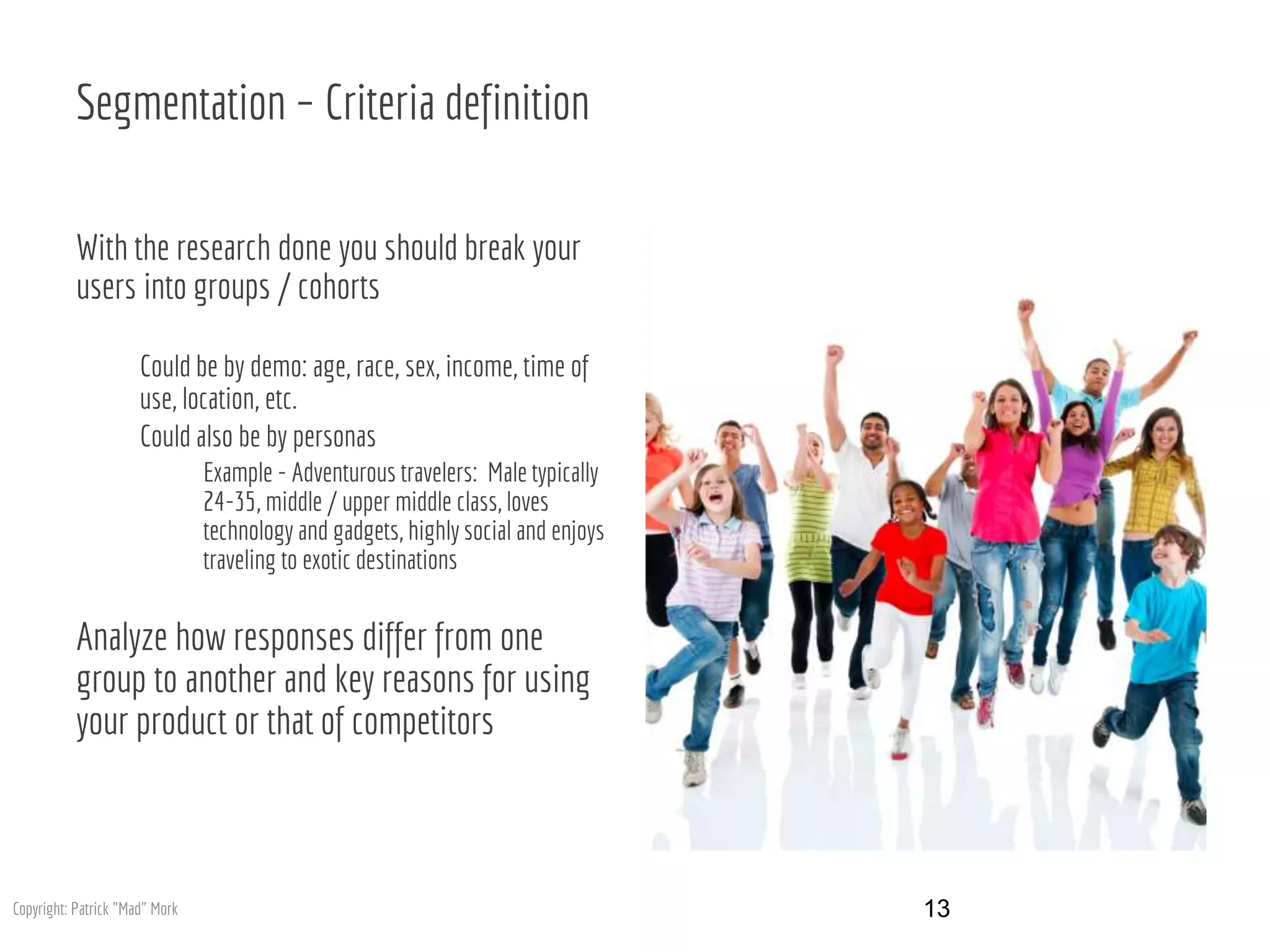
Could be by demo: age, race, sex, income, time of
use, location, etc.
Could also be by personas
Example - Adventurous travelers: Male typically
24-35, middle / upper middle class, loves
technology and gadgets, highly social and enjoys
traveling to exotic destinations
Analyze how responses differ from one
group to another and key reasons for using
your product or that of competitors
13Copyright: Patrick "Mad" Mork
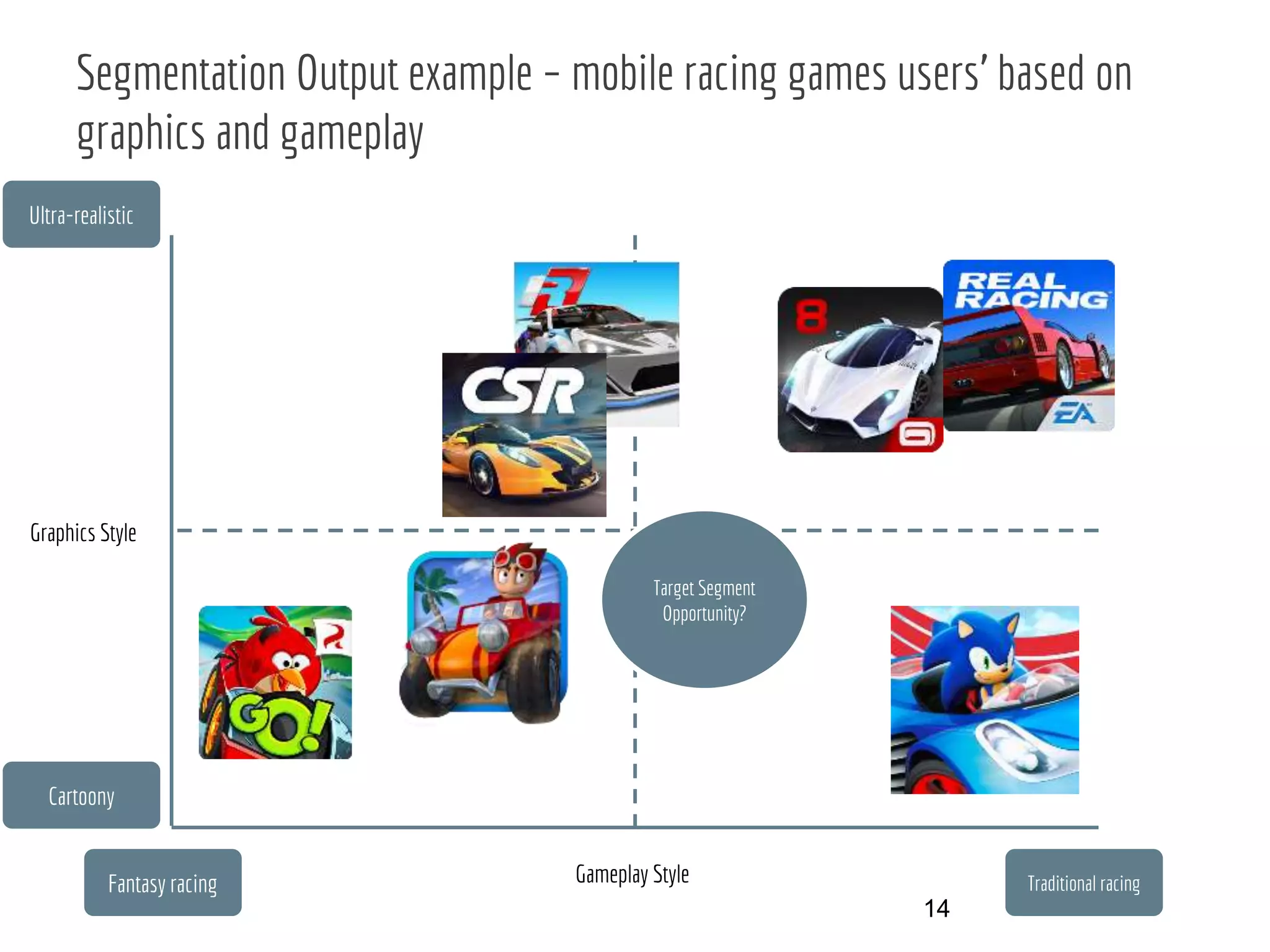
Segmentation Output example – mobile racing games users’ based on
graphics and gameplay
14
Ultra-realistic
Cartoony
Traditional racingFantasy racing
Graphics Style
Gameplay Style
Target Segment
Opportunity?
Segmentation – Key questions to ask
1. What criteria am I using to segment my market? (Age, Race, Sex, Household Income, Location, Lifestyle …)
2. Are these the right criteria?
3. Are there other criteria which could become relevant to users?
4. How likely are these criteria to change over time?
5. Do these criteria result in groups that are readily identifiable, targetable and monetizable?
6. Is this group actually meaningful enough for me to solicit data from them / perform research?
7. Can I actually make money from any of these segments?
15Copyright: Patrick "Mad" Mork
Targeting- Goals / output of
1
2
3
Identify a segment of the market that is underserved
Assess whether you have the right product and resources to properly address that market
Pick a target that is easily identifiable and who will likely consider your product if messaged properly
Chose an audience to whom you can craft a message that you can “own”
Ensure the target group is large enough to be commercially viable both today and in the immediate
future
Select a target audience that will be more challenging for competitors to target
16Copyright: Patrick "Mad" Mork
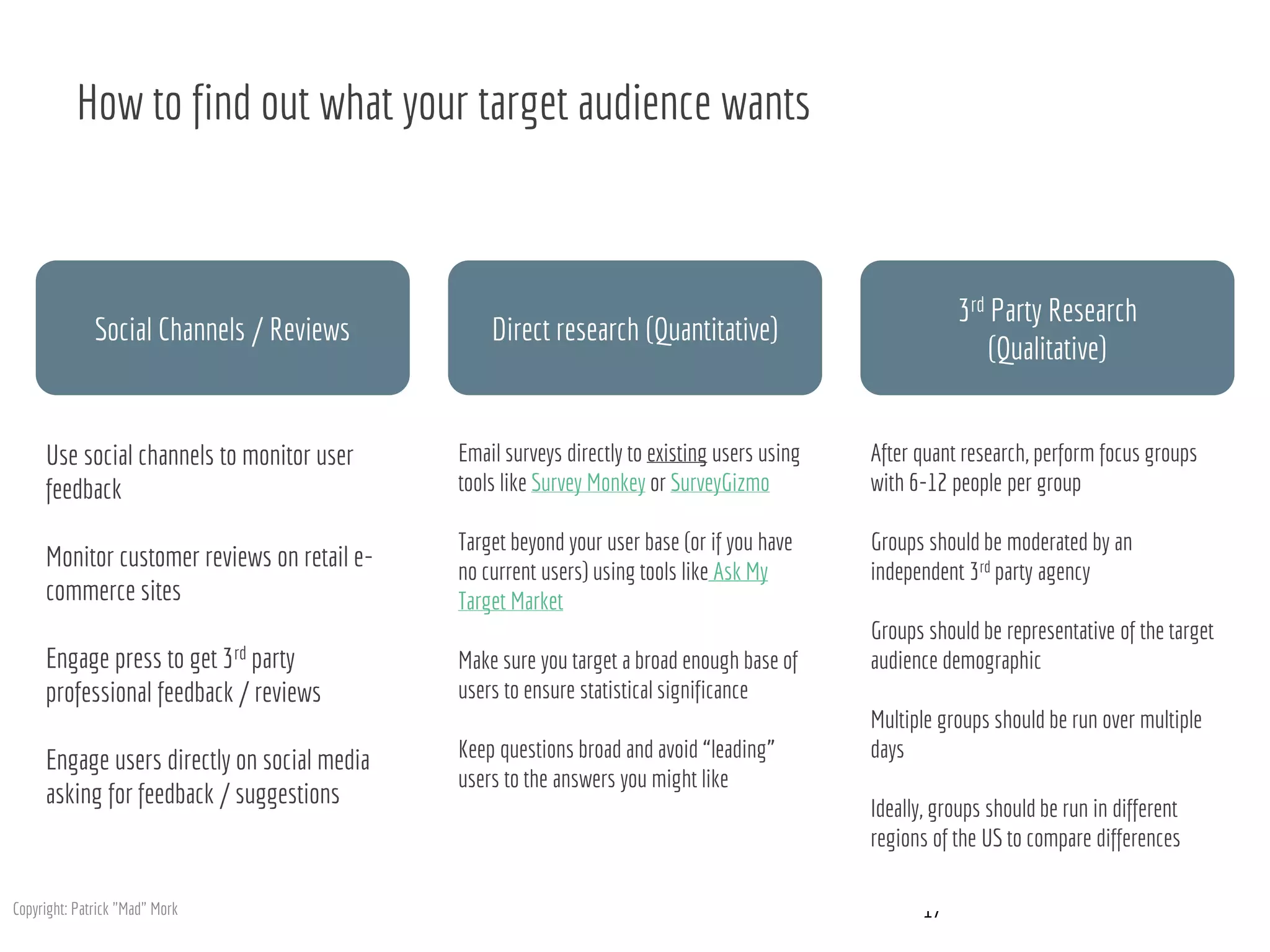
How to find out what your target audience wants
17
Use social channels to monitor user
feedback
Monitor customer reviews on retail e-
commerce sites
Engage press to get 3rd party
professional feedback / reviews
Engage users directly on social media
asking for feedback / suggestions
Email surveys directly to existing users using
tools like Survey Monkey or SurveyGizmo
Target beyond your user base (or if you have
no current users) using tools like Ask My
Target Market
Make sure you target a broad enough base of
users to ensure statistical significance
Keep questions broad and avoid “leading”
users to the answers you might like
After quant research, perform focus groups
with 6-12 people per group
Groups should be moderated by an
independent 3rd party agency
Groups should be representative of the target
audience demographic
Multiple groups should be run over multiple
days
Ideally, groups should be run in different
regions of the US to compare differences
Social Channels / Reviews Direct research (Quantitative)
3rd Party Research
(Qualitative)
Copyright: Patrick "Mad" Mork
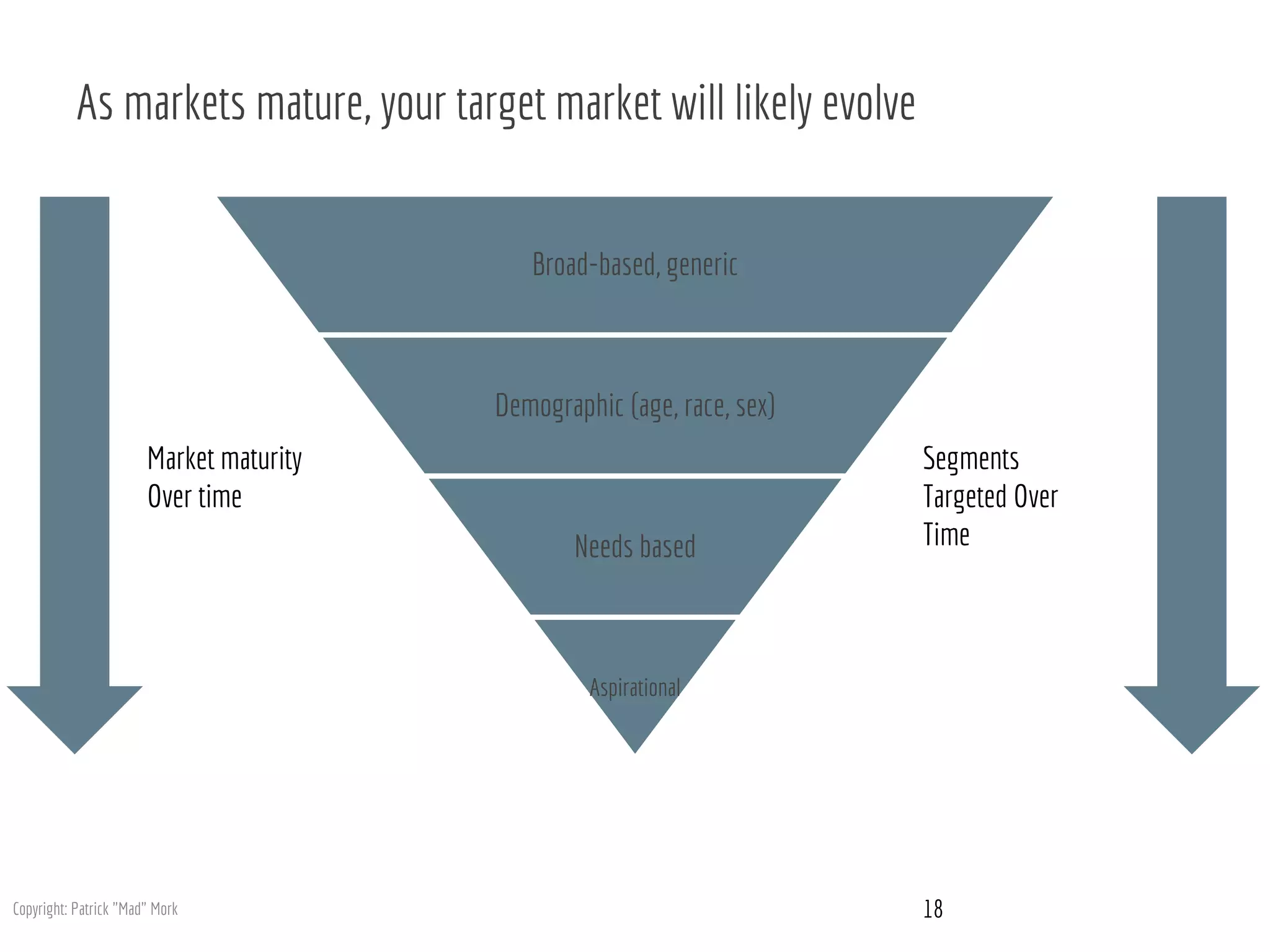
As markets mature, your target market will likely evolve
18
Broad-based, generic
Demographic (age, race, sex)
Needs based
Aspirational
Market maturity
Over time
Segments
Targeted Over
Time
Copyright: Patrick "Mad" Mork
Targeting output example – mobile racing games target group
19
Ultra-realistic
Cartoony
Traditional racingFantasy racing
Graphics Style
Gameplay Style
Target Segment
Women who want
traditional
gameplay with
good but not ultra
realistic visuals
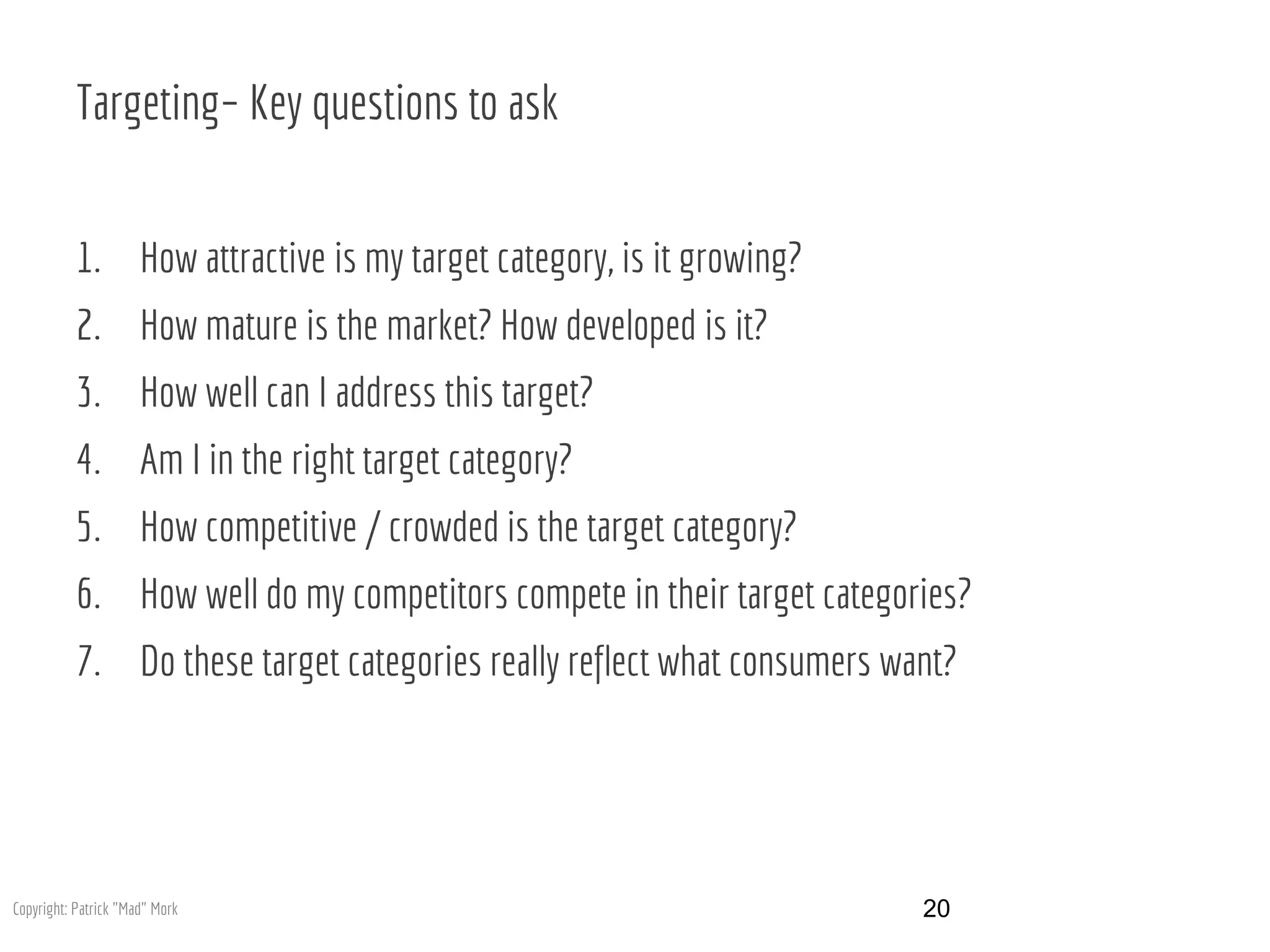
Targeting– Key questions to ask
1. How attractive is my target category, is it growing?
2. How mature is the market? How developed is it?
3. How well can I address this target?
4. Am I in the right target category?
5. How competitive / crowded is the target category?
6. How well do my competitors compete in their target categories?
7. Do these target categories really reflect what consumers want?
20Copyright: Patrick "Mad" Mork
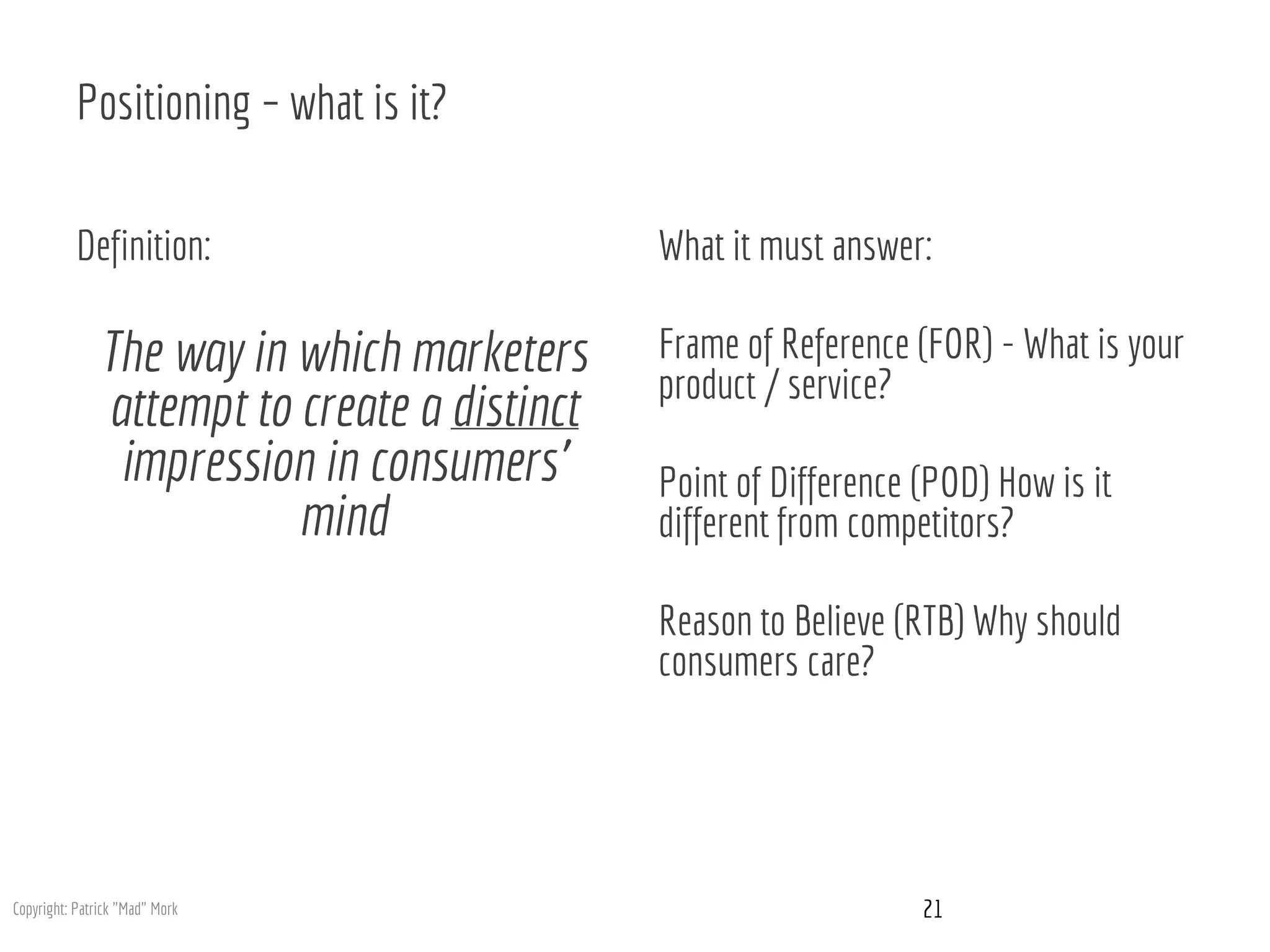
Positioning – what is it?
Definition:
The way in which marketers
attempt to create a distinct
impression in consumers’
mind
What it must answer:
Frame of Reference (FOR) - What is your
product / service?
Point of Difference (POD) How is it
different from competitors?
Reason to Believe (RTB) Why should
consumers care?
21Copyright: Patrick "Mad" Mork
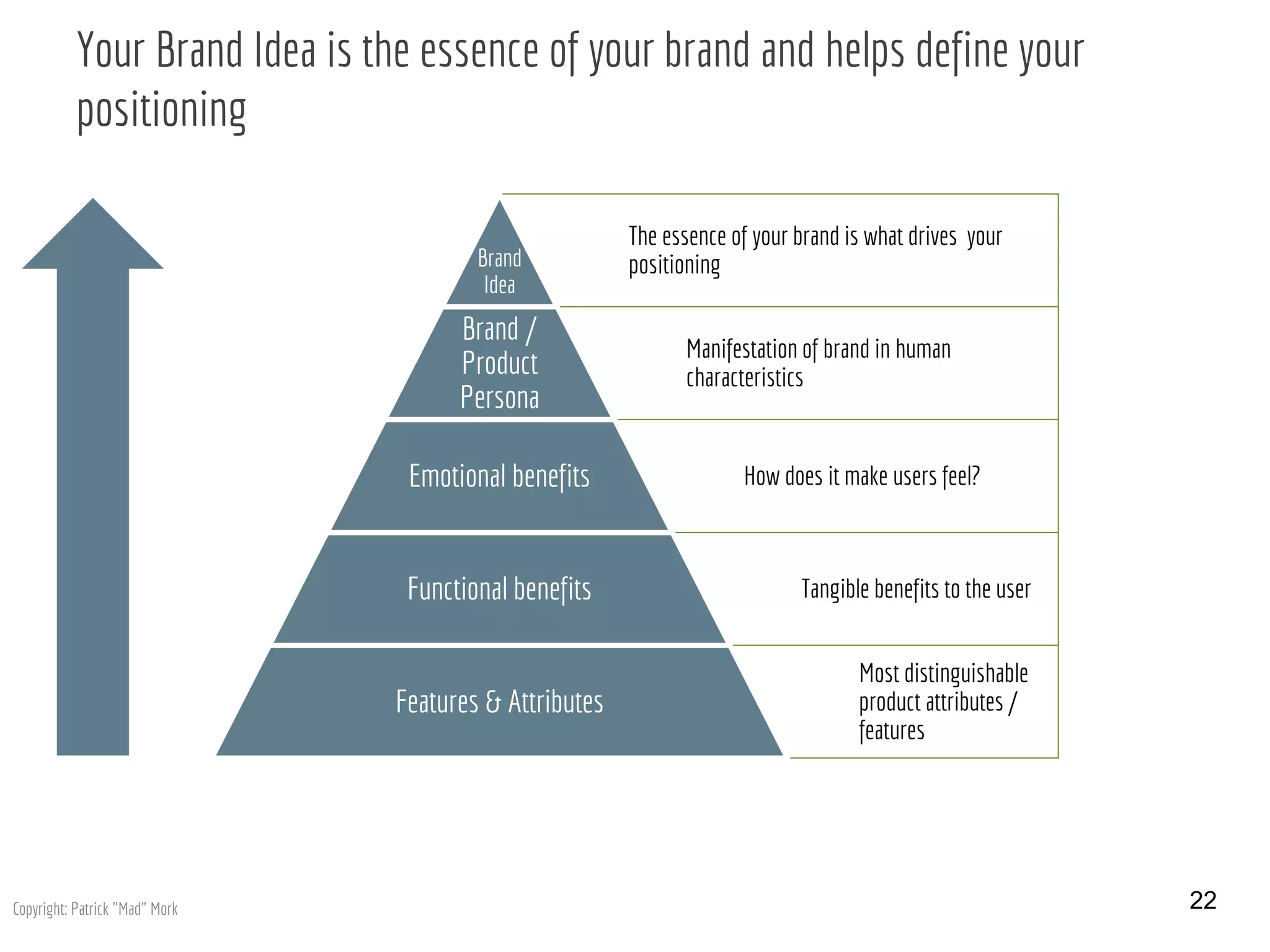
Your Brand Idea is the essence of your brand and helps define your
positioning
22
The essence of your brand is what drives your
positioningBrand
Idea
Manifestation of brand in human
characteristics
Brand /
Product
Persona
How does it make users feel?Emotional benefits
Tangible benefits to the userFunctional benefits
Most distinguishable
product attributes /
features
Features & Attributes
Copyright: Patrick "Mad" Mork
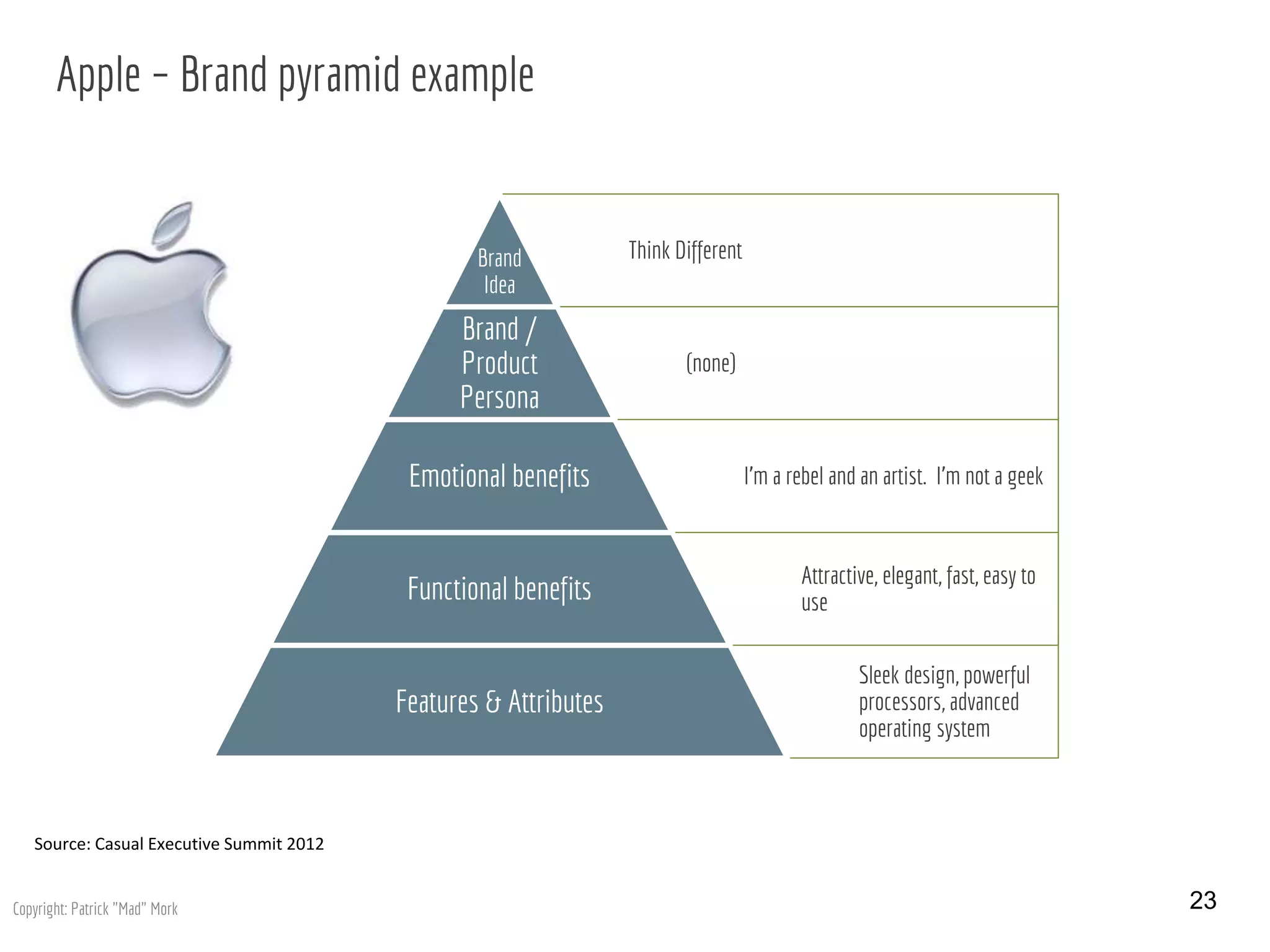
Apple – Brand pyramid example
23
Think DifferentBrand
Idea
(none)
Brand /
Product
Persona
I’m a rebel and an artist. I’m not a geekEmotional benefits
Attractive, elegant, fast, easy to
useFunctional benefits
Sleek design, powerful
processors, advanced
operating system
Features & Attributes
Source: Casual Executive Summit 2012
Copyright: Patrick "Mad" Mork
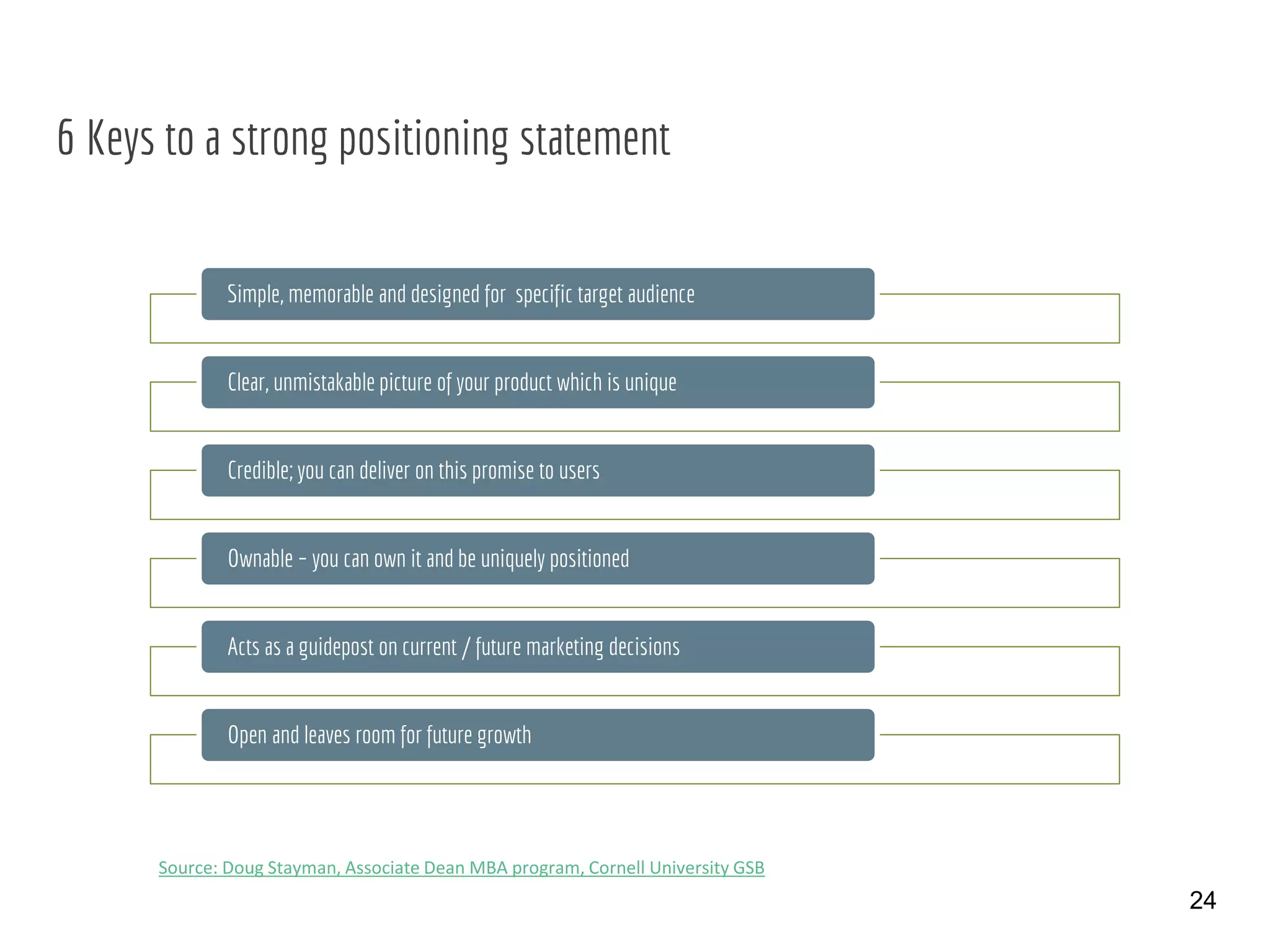
6 Keys to a strong positioning statement
24
Simple, memorable and designed for specific target audience
Clear, unmistakable picture of your product which is unique
Credible; you can deliver on this promise to users
Ownable – you can own it and be uniquely positioned
Acts as a guidepost on current / future marketing decisions
Open and leaves room for future growth
Source: Doug Stayman, Associate Dean MBA program, Cornell University GSB
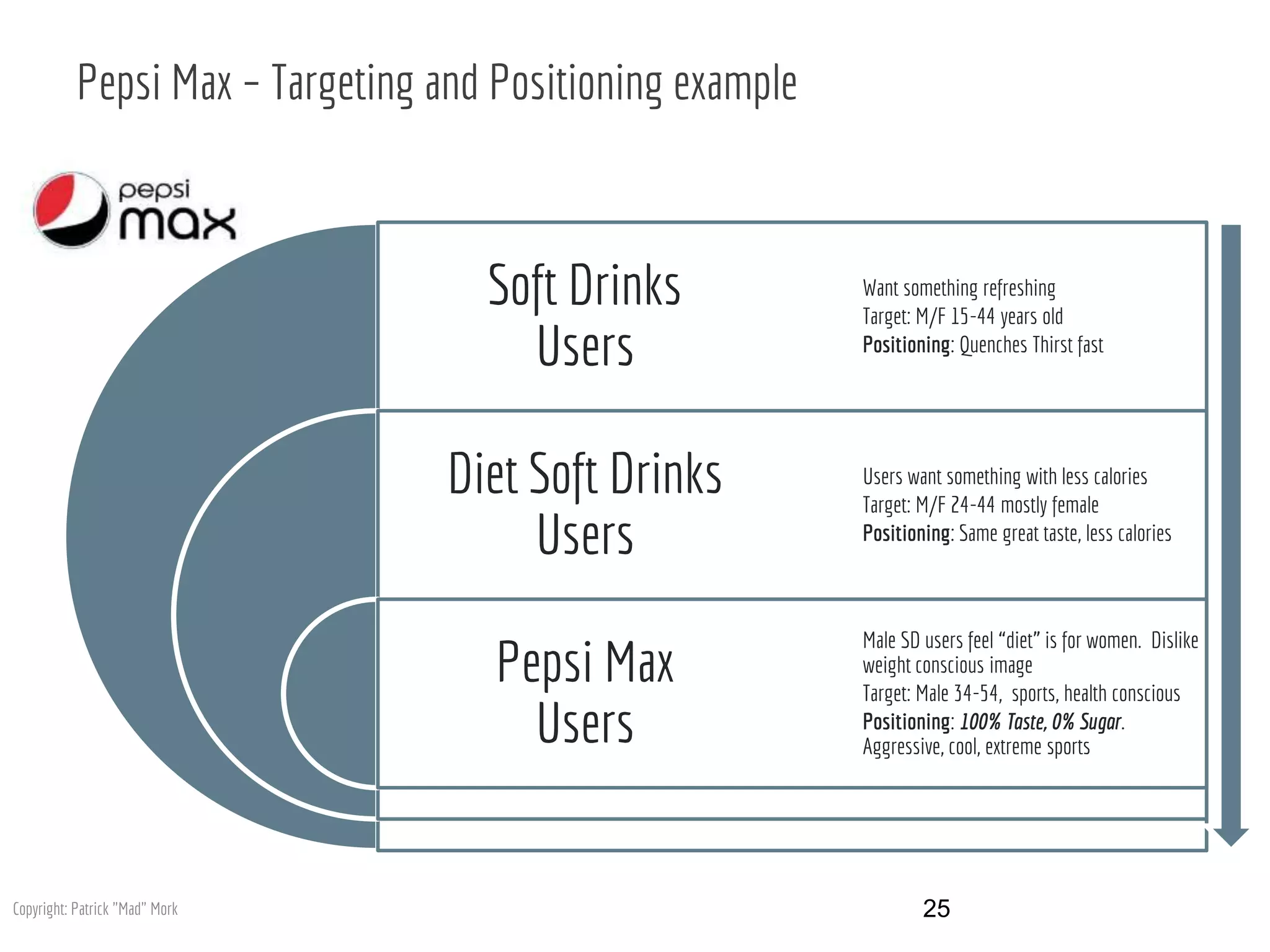
Pepsi Max – Targeting and Positioning example
Soft Drinks
Users
Diet Soft Drinks
Users
Pepsi Max
Users
Want something refreshing
Target: M/F 15-44 years old
Positioning: Quenches Thirst fast
Users want something with less calories
Target: M/F 24-44 mostly female
Positioning: Same great taste, less calories
Male SD users feel “diet” is for women. Dislike
weight conscious image
Target: Male 34-54, sports, health conscious
Positioning: 100% Taste, 0% Sugar.
Aggressive, cool, extreme sports
25Copyright: Patrick "Mad" Mork
Summary
STP is a framework designed to ensure the right message hits the right audience
Proper use of STP is key in hyper competitive markets with excessive “noise”
Segmenting involves breaking the market down into identifiable groups / cohorts
Targeting involves choosing an underserved market segment that can be captured by relevant messaging
Positioning involves developing messaging that is unique, defendable and relevant to the target audience
26
*View in presentation mode and click the icons
Thanks! Stay in Touch
APPENDIX
STP Framework – Reaching the Right User
28
References & sites
Books
Positioning: The Battle for your
Mind
The 22 immutable laws of Branding
Brand against the machine
Sites
Definition – Wikipedia
The Art of Brand Positioning
Cornell’s guide to writing
Positioning Statements
29

Mad Mork STP framework for reaching the right user.pptx

  • 1.
    Marketing-in-a-Box STP Framework Targeting theRight User Copyright: Patrick "Mad" Mork 1
  • 2.
    Contents What is STPand why do marketers need it? Who owns it? When should you use it? How does it work? Examples Appendix: 2
  • 3.
    20 years experiencein strategy, marketing and sales Large company / start-up experience Multi-cultural working experience across 4 continents / languages Expertise: Digital Content / Apps, Mobile Games, Consumer Goods, Mobile Advertising About Mad Mork
  • 4.
    What is STP? Segmenting,Targeting, Positioning (STP) is a framework designed to help marketers better understand their market; identify segments with unmet needs in this market and position their product & services to address these needs 4Copyright: Patrick "Mad" Mork
  • 5.
    Why is STPimportant? As markets grow they create opportunities for monetization This in turn attracts new players who spend marketing dollars to capture users These new players push new products / features which generate greater marketing noise among users Which forces marketers to identify segments with unmet needs which they can target with more relevant messaging 5 Market Growth Attracts competition Which increases marketing spend That generates more noise Segmentation becomes needed Copyright: Patrick "Mad" Mork
  • 6.
    Who owns theframework? The marketing / head of marketing typically owns the overall strategy for the STP framework and has final say on target audience and messaging In smaller organizations this might be owned by the CEO / Founder if no marketing resources exist Input sources come from: Senior leadership to ensure STP is aligned with the overall company strategy Sales / customer support to make sure STP is aligned with market realities and customer use cases Product / engineering who should agree and also will need to build a product that is inline with the messaging needed to effectively reach the user 6 Marketing- head and product marketing manager Sales – customer / user input Senior mgmt – overall company strategy Product / Eng –product roadmap, features, direction Copyright: Patrick "Mad" Mork
  • 7.
    When should youuse it? STP should ideally determine what kind of product you’re going to build STP reveals which group of users in your desired market have unmet needs which you could capture STP helps you formulate which message this group of users is most open / receptive to The above then guides what kind of product you will need to fulfill that message / brand promise In some cases the product / technology has already been developed to solve a problem but the target has not been specified In this case STP takes place after product development but before any marketing spend takes place STP may result in a different target being focused on based on the characteristics of the product / service Future changes to the product roadmap must take into account the agreed STP moving forward so that changes are based on the agreed target audience and positioning Before product launch After product launch 7Copyright: Patrick "Mad" Mork
  • 8.
    Requirements and output SegmentationTargeting Positioning Requirements 1. Market data – size, demographics, growth, trends 2. User data – frequency of use, types of use, levels of engagement, propensity to spend Output 1. Segmentation matrix 2. Segmentation criteria Requirements 1. Clear, agreed market segments 1. Agreed criteria for choosing desired target market 1. Organizational buy-in (snr. Mgmt, product, sales) Output 1. Agreed target audience and target user profile Requirements 1. Locked down target audience 1. Organization buy-in on actual message Output 1. Brand key / Brand Pyramid 1. Brand Statement / Brand Idea 3. Brand Book / Bible 8 Copyright: Patrick "Mad" Mork
  • 9.
    Segmentation - Goals/ output 1 2 3 Establish the criteria under which you segment the market (age, race, income, time, location…) Segment the market into different groups Understand the size, value, growth, dynamics of each market segment Determine what is important to each market segment Determine segments your competitors are addressing / identify where they are weak Understand what segment(s) you are addressing directly or indirectly Determine if another segment has unmet needs that you can either target with an existing product or with a new one Assess whether you have the adequate resources (product, human, capital) to address the various segments available 9Copyright: Patrick "Mad" Mork
  • 10.
    Implementing STP -Segmenting The first step is understanding who your users are and why they use your product To this end you want to: 1. Do Quantitative research to understand your user base and how they see your product 2. Do Qualitative research (focus groups) to drill down and ask users more specifics around your findings in #1 The Goal of your research is: 1. Understand how user behavior towards your product changes based on demographic factors (age, race, sex, income, location) 2. Understand if there are areas where your consumers feel underserved by competitors and which demographic is most underserved 10Copyright: Patrick "Mad" Mork
  • 11.
    Segmentation – QuantitativeResearch Questions types: 1. Filtering – filter out users who aren’t meaningful to you 2. Satisfaction – how satisfied are users with your product? With competitors? 3. Reason for being – how do users “feel” about your product? 4. Functionality – why do users use your product? 5. Features – which features do they use and why? 6. Awareness – how did they hear about you? From whom? Things to keep in mind: 1. Keep questions neutral; avoid leading 2. Avoid open ended questions that can’t be measured 3. Rotate the order of the answers to avoid bias 4. Provide multiple answers and, when appropriate, the option to check multiple answers 5. Ensure you have a large enough sample size to be representative (N=?) 6. Keep your survey short (15-20 questions) 11Copyright: Patrick "Mad" Mork
  • 12.
    Research providers Multiple onlinesolutions exist: Ask Your Target Market Survey Monkey Userlytics Turn around can be 3-5 days typically Cost is done on a cost per contact basis typically Providers can reach out either using your own target list or their own Providers tabulate and provide dashboards for results 12Copyright: Patrick "Mad" Mork
  • 13.
    Segmentation – Criteriadefinition With the research done you should break your users into groups / cohorts Could be by demo: age, race, sex, income, time of use, location, etc. Could also be by personas Example - Adventurous travelers: Male typically 24-35, middle / upper middle class, loves technology and gadgets, highly social and enjoys traveling to exotic destinations Analyze how responses differ from one group to another and key reasons for using your product or that of competitors 13Copyright: Patrick "Mad" Mork
  • 14.
    Segmentation Output example– mobile racing games users’ based on graphics and gameplay 14 Ultra-realistic Cartoony Traditional racingFantasy racing Graphics Style Gameplay Style Target Segment Opportunity?
  • 15.
    Segmentation – Keyquestions to ask 1. What criteria am I using to segment my market? (Age, Race, Sex, Household Income, Location, Lifestyle …) 2. Are these the right criteria? 3. Are there other criteria which could become relevant to users? 4. How likely are these criteria to change over time? 5. Do these criteria result in groups that are readily identifiable, targetable and monetizable? 6. Is this group actually meaningful enough for me to solicit data from them / perform research? 7. Can I actually make money from any of these segments? 15Copyright: Patrick "Mad" Mork
  • 16.
    Targeting- Goals /output of 1 2 3 Identify a segment of the market that is underserved Assess whether you have the right product and resources to properly address that market Pick a target that is easily identifiable and who will likely consider your product if messaged properly Chose an audience to whom you can craft a message that you can “own” Ensure the target group is large enough to be commercially viable both today and in the immediate future Select a target audience that will be more challenging for competitors to target 16Copyright: Patrick "Mad" Mork
  • 17.
    How to findout what your target audience wants 17 Use social channels to monitor user feedback Monitor customer reviews on retail e- commerce sites Engage press to get 3rd party professional feedback / reviews Engage users directly on social media asking for feedback / suggestions Email surveys directly to existing users using tools like Survey Monkey or SurveyGizmo Target beyond your user base (or if you have no current users) using tools like Ask My Target Market Make sure you target a broad enough base of users to ensure statistical significance Keep questions broad and avoid “leading” users to the answers you might like After quant research, perform focus groups with 6-12 people per group Groups should be moderated by an independent 3rd party agency Groups should be representative of the target audience demographic Multiple groups should be run over multiple days Ideally, groups should be run in different regions of the US to compare differences Social Channels / Reviews Direct research (Quantitative) 3rd Party Research (Qualitative) Copyright: Patrick "Mad" Mork
  • 18.
    As markets mature,your target market will likely evolve 18 Broad-based, generic Demographic (age, race, sex) Needs based Aspirational Market maturity Over time Segments Targeted Over Time Copyright: Patrick "Mad" Mork
  • 19.
    Targeting output example– mobile racing games target group 19 Ultra-realistic Cartoony Traditional racingFantasy racing Graphics Style Gameplay Style Target Segment Women who want traditional gameplay with good but not ultra realistic visuals
  • 20.
    Targeting– Key questionsto ask 1. How attractive is my target category, is it growing? 2. How mature is the market? How developed is it? 3. How well can I address this target? 4. Am I in the right target category? 5. How competitive / crowded is the target category? 6. How well do my competitors compete in their target categories? 7. Do these target categories really reflect what consumers want? 20Copyright: Patrick "Mad" Mork
  • 21.
    Positioning – whatis it? Definition: The way in which marketers attempt to create a distinct impression in consumers’ mind What it must answer: Frame of Reference (FOR) - What is your product / service? Point of Difference (POD) How is it different from competitors? Reason to Believe (RTB) Why should consumers care? 21Copyright: Patrick "Mad" Mork
  • 22.
    Your Brand Ideais the essence of your brand and helps define your positioning 22 The essence of your brand is what drives your positioningBrand Idea Manifestation of brand in human characteristics Brand / Product Persona How does it make users feel?Emotional benefits Tangible benefits to the userFunctional benefits Most distinguishable product attributes / features Features & Attributes Copyright: Patrick "Mad" Mork
  • 23.
    Apple – Brandpyramid example 23 Think DifferentBrand Idea (none) Brand / Product Persona I’m a rebel and an artist. I’m not a geekEmotional benefits Attractive, elegant, fast, easy to useFunctional benefits Sleek design, powerful processors, advanced operating system Features & Attributes Source: Casual Executive Summit 2012 Copyright: Patrick "Mad" Mork
  • 24.
    6 Keys toa strong positioning statement 24 Simple, memorable and designed for specific target audience Clear, unmistakable picture of your product which is unique Credible; you can deliver on this promise to users Ownable – you can own it and be uniquely positioned Acts as a guidepost on current / future marketing decisions Open and leaves room for future growth Source: Doug Stayman, Associate Dean MBA program, Cornell University GSB
  • 25.
    Pepsi Max –Targeting and Positioning example Soft Drinks Users Diet Soft Drinks Users Pepsi Max Users Want something refreshing Target: M/F 15-44 years old Positioning: Quenches Thirst fast Users want something with less calories Target: M/F 24-44 mostly female Positioning: Same great taste, less calories Male SD users feel “diet” is for women. Dislike weight conscious image Target: Male 34-54, sports, health conscious Positioning: 100% Taste, 0% Sugar. Aggressive, cool, extreme sports 25Copyright: Patrick "Mad" Mork
  • 26.
    Summary STP is aframework designed to ensure the right message hits the right audience Proper use of STP is key in hyper competitive markets with excessive “noise” Segmenting involves breaking the market down into identifiable groups / cohorts Targeting involves choosing an underserved market segment that can be captured by relevant messaging Positioning involves developing messaging that is unique, defendable and relevant to the target audience 26
  • 27.
    *View in presentationmode and click the icons Thanks! Stay in Touch
  • 28.
    APPENDIX STP Framework –Reaching the Right User 28
  • 29.
    References & sites Books Positioning:The Battle for your Mind The 22 immutable laws of Branding Brand against the machine Sites Definition – Wikipedia The Art of Brand Positioning Cornell’s guide to writing Positioning Statements 29