BRAND TRACKING 3.0
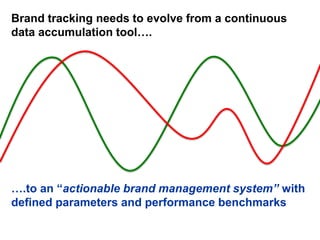
Brand tracking needs to evolve from a continuous
data accumulation tool….
….to an “actionable brand management system” with
defined parameters and performance benchmarks
The creators of brand tracking also believe that it is
time for the tool to change and evolve:
“Tracking needs to evolve from all encompassing single studies to
measuring a brand’s performance using a range of best-of-breed
tools to address multiple, and more complex, issues and objectives”
– Gordon Pincott, Chairman, Global Solutions
“Today, tracking is facing new challenges. The sheer complexity of
today’s competitive environment challenges its ability to cover the
plethora of brand extensions, media choices, retail channels and
target groups.”– Nigel Hollis, Chief Global Analyst
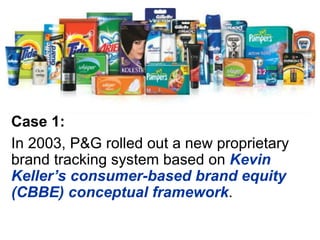
Case 1:
In 2003, P&G rolled out a new proprietary
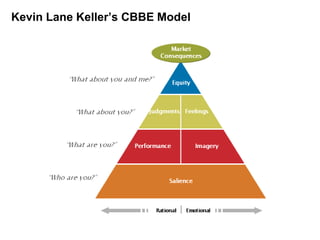
brand tracking system based on Kevin
Keller’s consumer-based brand equity
(CBBE) conceptual framework.
Kevin Lane Keller’s CBBE Model
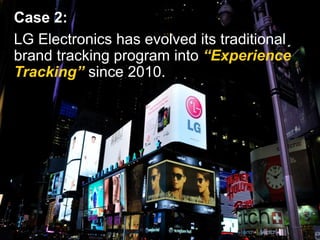
Case 2:
LG Electronics has evolved its traditional
brand tracking program into “Experience
Tracking” since 2010.
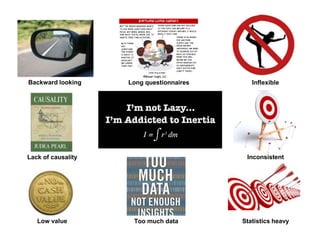
Traditional trackers at a glance…..
Backward looking Long questionnaires Inflexible
InconsistentLack of causality
Low value Too much data Statistics heavy
…..and what they should be.
• “We’re working with media agencies exploring influences across a variety of touchpoints and what we
are finding suggests there’s more going on here than we can capture in traditional GRP ad spend
measurement. It’s not the TV commercial that is dead but the traditional way of reporting recall and
measuring influence that needs some reviving.”
• “Clients are changing their way of thinking as well, some faster than others. Many are locked into an old
school kind of view about of what tracking used to be and what it always was. Others know more about
the value that newer approaches can actually bring them. These are the most open minded people who
are experimenting and innovating together with us. And they are seeing the best results in the end.”
• “A key for many of our clients is not delaying the delivery of insights until the scheduled quarterly deck,
but keeping the insight flow continuous, timely and proactive. Making the insights flow in real time, or
ideally, faster than that.”
• “Should we even still be calling it tracking? It is about continuous understanding of what is current and
relevant to the category and to the client at that time. What we do needs to be adaptive, flexible, and
nimble, because everything moves very quickly. You can source information from so many places. It’s
at our fingertips. We need to be really quick and responsive.”
Johnson & Johnson moved away from a
decentralized brand tracking system for
its power brands to a cross-company
holistic system in 2013.
Brenda Armstead, VP, Global Strategic Insights
“We have moved to one methodology to track some of our mega brands.”
“We intend to become more of a global organization with standards and
consistency in the way we track our brand equity across our entire consumer
group portfolio.”
“We have embraced the Millward Brown composite metric that captures
levels of engagement and commitment that brands inspire. Its composite
brand score is a tool that helps guide the every-day brand-equity evaluation.”
“For us, it's about doing activation sessions with our local markets – and with our
cross-functional teams – to make sure that we're actually putting plans against
addressing any outages in our equity. So, if we're off, we ought to be doing
something about that to close the gap.”
“By measuring meaningfulness, difference, and saliency – the three
components of the Millward Brown metric, the company would be able to really
pull the brand apart and discover what is driving the brand in different markets.”
Some fresh perspectives…..
Prof. Byron Sharp
Interviewer: But you don’t like these brand tracking services?
Prof. Sharp: There is an industry that provides special scores on brands,
based on surveying customers. These services mostly claim to be measures
of things like brand loyalty or brand equity. They usually have exotic names
like commitment model, brand esteem, brand voltage, brand asset
evaluator….Essentially they claim to be able to predict whether the brand is
about to gain or lose market share.
I think any claims made for these proprietary products should be
subject to independent examination. It’s the job of academics to do this
testing. Some of the claims are so extraordinary, and so important that
they deserve to be checked out. If they turn out to be true that would be
fabulous.
Interviewer: And do these proprietary brand health surveys, metrics work?
Prof. Sharp: Well that’s just the thing. No one knows.
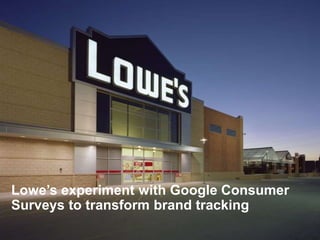
Lowe’s experiment with Google Consumer
Surveys to transform brand tracking
http://www.slideshare.net/BAQMaR/kyle
-nel-innovationlabsrethinking-the-
tracker-112313
“In a ‘Naturalist’s Voyage Around The World’, Charles
Darwin comments on a ‘most singular group of finches,
related to each other in the structure of their beaks, short
tails, form of body and plumage: there are thirteen
species, which Mr. Gould has divided into four sub-
groups.’ Just as with Darwin’s Galapagos finches, we
believe that tracking studies will continue to evolve, taking
on different but related forms to meet their specific
objectives.”
- Nigel Hollis, Global Strategic Planning Director
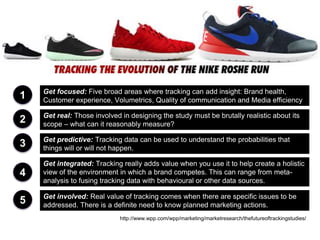
1 Get focused: Five broad areas where tracking can add insight: Brand health,
Customer experience, Volumetrics, Quality of communication and Media efficiency
2 Get real: Those involved in designing the study must be brutally realistic about its
scope – what can it reasonably measure?
3 Get predictive: Tracking data can be used to understand the probabilities that
things will or will not happen.
4
Get integrated: Tracking really adds value when you use it to help create a holistic
view of the environment in which a brand competes. This can range from meta-
analysis to fusing tracking data with behavioural or other data sources.
5 Get involved: Real value of tracking comes when there are specific issues to be
addressed. There is a definite need to know planned marketing actions.
http://www.wpp.com/wpp/marketing/marketresearch/thefutureoftrackingstudies/
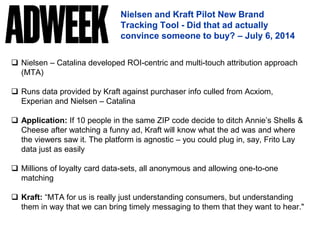
Nielsen and Kraft Pilot New Brand
Tracking Tool - Did that ad actually
convince someone to buy? – July 6, 2014
 Nielsen – Catalina developed ROI-centric and multi-touch attribution approach
(MTA)
 Runs data provided by Kraft against purchaser info culled from Acxiom,
Experian and Nielsen – Catalina
 Application: If 10 people in the same ZIP code decide to ditch Annie’s Shells &
Cheese after watching a funny ad, Kraft will know what the ad was and where
the viewers saw it. The platform is agnostic – you could plug in, say, Frito Lay
data just as easily
 Millions of loyalty card data-sets, all anonymous and allowing one-to-one
matching
 Kraft: “MTA for us is really just understanding consumers, but understanding
them in way that we can bring timely messaging to them that they want to hear."
…some more fresh perspectives
From virtual to augmented reality:
Augmented reality and the future of research
Richard Russo, VP, Consumer, Shopper &
Retail Insights
Augmented Reality is a live, direct or indirect, view of a
physical, real-world environment whose elements are
augmented by computer-generated sensory input such
as sound, video, graphics or GPS data.
Ability to expose shoppers and respondents to “what-if”
scenarios while they’re in-situation, effectively merging
real-life, augmented and virtual environments together
to achieve specific research objectives.
Integration of augmented reality research with GPS-
enabled location-based services will also gain
prominence as a research tool in the near future,
allowing both manufacturers and retailers alike to test
new products, category arrangements and in-store
marketing materials, and extending into adjacent
industries.
This holds promise in re-inventing brand
health tracking initiatives, replacing brand
recall with actual tracking of exposure
(including location) and truly understanding
both the incremental and cumulative value of
brand interactions on favorability, health and
purchase.
By integrating brand tracking and consumer survey data with predictive
modeling, MMA is helping some of the largest global brands balance
investments to drive both short-term sales and long-term brand equity,
while transforming the marketing planning process
 How does each marketing vehicle and campaign impact Brand KPIs and Sales?
 How to use predictive analytics to balance short-term and long-term investments in
marketing?
 What is the impact of all business drivers (marketing, economic, competition,
operations) on brand KPIs and sales?
 How does a change in brand KPIs lead to changes in other brand KPIs and consumer
behavior?
 Which metrics are the emerging leading indicators for the business?
 What is the financial value (ROI) of a change in Brand KPIs?
 What is the right mix of marketing investments to drive brand objectives?
 What will be the future impact of a change in the marketing and messaging strategy?
On Device Research powers Millward Brown's move to mobile in
AMAP region
in News
on Tuesday August 27, 2013 @ 4:12
On Device Research becomes a preferred provider for data
collection via the mobile internet in the AMAP region
Nestle first client to migrate brand and comms tracker onto mobile
in Malaysia
Khoo Kar Khoon, Communications Director for Nestle Products Malaysia, said “We were
really pleased with the results of the pilot study. The benefits in speed and data quality
were instrumental in our decision to move forward, and we expect even greater
efficiencies over time. We’re keen to explore mobile in more of our research where
relevant”.
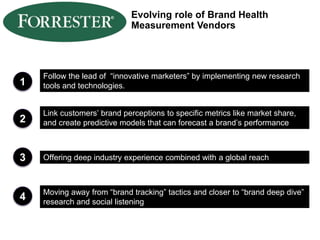
Evolving role of Brand Health
Measurement Vendors
1
Follow the lead of “innovative marketers” by implementing new research
tools and technologies.
2
Link customers’ brand perceptions to specific metrics like market share,
and create predictive models that can forecast a brand’s performance
3 Offering deep industry experience combined with a global reach
4 Moving away from “brand tracking” tactics and closer to “brand deep dive”
research and social listening
Beyond Brand Tracking: Measuring the Impact of Campaigns in a
Multi-Dimensional World
System 1 Brand Tracking measures the effectiveness
and contribution of each element of a campaign and
their impact on brand equity through an innovative
approach inspired by the latest advances in
behavioural science. Furthermore, it delivers where
traditional brand tracking cannot - by revealing the
emotionally charged relationship between a
consumer and a brand, and delivering key takeaways
to foster the emotional bond.
http://vimeo.com/101436361
“Mental availability is the propensity of the
brand to be noticed or come to mind in buying
situations.
So most brand perception tracking surveys can be
adapted to also measure Mental Availability. The
biggest fault we find with existing brand
tracking surveys is that they have an emphasis
on evaluation, so contain many attributes that
don't measure memory but rather measure
attitude (which means they measure past
usage). It also means they have a great deal of
redundancy. All of this can be fixed.
In addition to the group of attributes that are used
to measure mental availability, we encourage
adding some descriptive assets to track the
brand's distinctive assets (e.g. tone, colours, logos,
slogans, characters). There is value in measuring
these perceptions because they allow
communication to be branded (and therefore build
salience) and these cues are used by consumers
in noticing brands.”
- Byron Sharp, Director, Ehrenberg-Bass
Institute of Marketing Science (University of
South Australia)
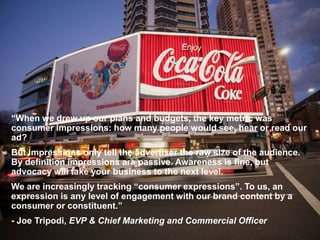
“When we drew up our plans and budgets, the key metric was
consumer impressions: how many people would see, hear or read our
ad?
But impressions only tell the advertiser the raw size of the audience.
By definition impressions are passive. Awareness is fine, but
advocacy will take your business to the next level.
We are increasingly tracking “consumer expressions”. To us, an
expression is any level of engagement with our brand content by a
consumer or constituent.”
- Joe Tripodi, EVP & Chief Marketing and Commercial Officer
Do Online Behavior Tracking or Attitude Survey
Metrics Drive Brand Sales? An Integrative Model
of Attitudes and Actions on the Consumer
Boulevard
http://www.msi.org/reports/do-online-behavior-
tracking-or-attitude-survey-metrics-drive-brand-
sales-an/
Sandeep Das
Brand strategy consultant
e: sandeep.das@hotmail.com
m: +44 750 3935 142
LinkedIn: https://uk.linkedin.com/in/sandeepdas1
© All rights reserved – Sandeep Das, Brand Strategy Consultant
Please attribute when sharing

Brand tracking 3.0

  • 1.
  • 2.
    Brand tracking needsto evolve from a continuous data accumulation tool…. ….to an “actionable brand management system” with defined parameters and performance benchmarks
  • 3.
    The creators ofbrand tracking also believe that it is time for the tool to change and evolve: “Tracking needs to evolve from all encompassing single studies to measuring a brand’s performance using a range of best-of-breed tools to address multiple, and more complex, issues and objectives” – Gordon Pincott, Chairman, Global Solutions “Today, tracking is facing new challenges. The sheer complexity of today’s competitive environment challenges its ability to cover the plethora of brand extensions, media choices, retail channels and target groups.”– Nigel Hollis, Chief Global Analyst
  • 4.
    Case 1: In 2003,P&G rolled out a new proprietary brand tracking system based on Kevin Keller’s consumer-based brand equity (CBBE) conceptual framework.
  • 5.
  • 6.
    Case 2: LG Electronicshas evolved its traditional brand tracking program into “Experience Tracking” since 2010.
  • 7.
  • 8.
    Backward looking Longquestionnaires Inflexible InconsistentLack of causality Low value Too much data Statistics heavy
  • 9.
  • 10.
    • “We’re workingwith media agencies exploring influences across a variety of touchpoints and what we are finding suggests there’s more going on here than we can capture in traditional GRP ad spend measurement. It’s not the TV commercial that is dead but the traditional way of reporting recall and measuring influence that needs some reviving.” • “Clients are changing their way of thinking as well, some faster than others. Many are locked into an old school kind of view about of what tracking used to be and what it always was. Others know more about the value that newer approaches can actually bring them. These are the most open minded people who are experimenting and innovating together with us. And they are seeing the best results in the end.” • “A key for many of our clients is not delaying the delivery of insights until the scheduled quarterly deck, but keeping the insight flow continuous, timely and proactive. Making the insights flow in real time, or ideally, faster than that.” • “Should we even still be calling it tracking? It is about continuous understanding of what is current and relevant to the category and to the client at that time. What we do needs to be adaptive, flexible, and nimble, because everything moves very quickly. You can source information from so many places. It’s at our fingertips. We need to be really quick and responsive.”
  • 11.
    Johnson & Johnsonmoved away from a decentralized brand tracking system for its power brands to a cross-company holistic system in 2013.
  • 12.
    Brenda Armstead, VP,Global Strategic Insights “We have moved to one methodology to track some of our mega brands.” “We intend to become more of a global organization with standards and consistency in the way we track our brand equity across our entire consumer group portfolio.” “We have embraced the Millward Brown composite metric that captures levels of engagement and commitment that brands inspire. Its composite brand score is a tool that helps guide the every-day brand-equity evaluation.” “For us, it's about doing activation sessions with our local markets – and with our cross-functional teams – to make sure that we're actually putting plans against addressing any outages in our equity. So, if we're off, we ought to be doing something about that to close the gap.” “By measuring meaningfulness, difference, and saliency – the three components of the Millward Brown metric, the company would be able to really pull the brand apart and discover what is driving the brand in different markets.”
  • 13.
  • 15.
    Prof. Byron Sharp Interviewer:But you don’t like these brand tracking services? Prof. Sharp: There is an industry that provides special scores on brands, based on surveying customers. These services mostly claim to be measures of things like brand loyalty or brand equity. They usually have exotic names like commitment model, brand esteem, brand voltage, brand asset evaluator….Essentially they claim to be able to predict whether the brand is about to gain or lose market share. I think any claims made for these proprietary products should be subject to independent examination. It’s the job of academics to do this testing. Some of the claims are so extraordinary, and so important that they deserve to be checked out. If they turn out to be true that would be fabulous. Interviewer: And do these proprietary brand health surveys, metrics work? Prof. Sharp: Well that’s just the thing. No one knows.
  • 16.
    Lowe’s experiment withGoogle Consumer Surveys to transform brand tracking
  • 17.
  • 18.
    “In a ‘Naturalist’sVoyage Around The World’, Charles Darwin comments on a ‘most singular group of finches, related to each other in the structure of their beaks, short tails, form of body and plumage: there are thirteen species, which Mr. Gould has divided into four sub- groups.’ Just as with Darwin’s Galapagos finches, we believe that tracking studies will continue to evolve, taking on different but related forms to meet their specific objectives.” - Nigel Hollis, Global Strategic Planning Director
  • 19.
    1 Get focused:Five broad areas where tracking can add insight: Brand health, Customer experience, Volumetrics, Quality of communication and Media efficiency 2 Get real: Those involved in designing the study must be brutally realistic about its scope – what can it reasonably measure? 3 Get predictive: Tracking data can be used to understand the probabilities that things will or will not happen. 4 Get integrated: Tracking really adds value when you use it to help create a holistic view of the environment in which a brand competes. This can range from meta- analysis to fusing tracking data with behavioural or other data sources. 5 Get involved: Real value of tracking comes when there are specific issues to be addressed. There is a definite need to know planned marketing actions. http://www.wpp.com/wpp/marketing/marketresearch/thefutureoftrackingstudies/
  • 20.
    Nielsen and KraftPilot New Brand Tracking Tool - Did that ad actually convince someone to buy? – July 6, 2014  Nielsen – Catalina developed ROI-centric and multi-touch attribution approach (MTA)  Runs data provided by Kraft against purchaser info culled from Acxiom, Experian and Nielsen – Catalina  Application: If 10 people in the same ZIP code decide to ditch Annie’s Shells & Cheese after watching a funny ad, Kraft will know what the ad was and where the viewers saw it. The platform is agnostic – you could plug in, say, Frito Lay data just as easily  Millions of loyalty card data-sets, all anonymous and allowing one-to-one matching  Kraft: “MTA for us is really just understanding consumers, but understanding them in way that we can bring timely messaging to them that they want to hear."
  • 21.
    …some more freshperspectives
  • 22.
    From virtual toaugmented reality: Augmented reality and the future of research Richard Russo, VP, Consumer, Shopper & Retail Insights
  • 23.
    Augmented Reality isa live, direct or indirect, view of a physical, real-world environment whose elements are augmented by computer-generated sensory input such as sound, video, graphics or GPS data. Ability to expose shoppers and respondents to “what-if” scenarios while they’re in-situation, effectively merging real-life, augmented and virtual environments together to achieve specific research objectives. Integration of augmented reality research with GPS- enabled location-based services will also gain prominence as a research tool in the near future, allowing both manufacturers and retailers alike to test new products, category arrangements and in-store marketing materials, and extending into adjacent industries. This holds promise in re-inventing brand health tracking initiatives, replacing brand recall with actual tracking of exposure (including location) and truly understanding both the incremental and cumulative value of brand interactions on favorability, health and purchase.
  • 24.
    By integrating brandtracking and consumer survey data with predictive modeling, MMA is helping some of the largest global brands balance investments to drive both short-term sales and long-term brand equity, while transforming the marketing planning process  How does each marketing vehicle and campaign impact Brand KPIs and Sales?  How to use predictive analytics to balance short-term and long-term investments in marketing?  What is the impact of all business drivers (marketing, economic, competition, operations) on brand KPIs and sales?  How does a change in brand KPIs lead to changes in other brand KPIs and consumer behavior?  Which metrics are the emerging leading indicators for the business?  What is the financial value (ROI) of a change in Brand KPIs?  What is the right mix of marketing investments to drive brand objectives?  What will be the future impact of a change in the marketing and messaging strategy?
  • 25.
    On Device Researchpowers Millward Brown's move to mobile in AMAP region in News on Tuesday August 27, 2013 @ 4:12 On Device Research becomes a preferred provider for data collection via the mobile internet in the AMAP region Nestle first client to migrate brand and comms tracker onto mobile in Malaysia Khoo Kar Khoon, Communications Director for Nestle Products Malaysia, said “We were really pleased with the results of the pilot study. The benefits in speed and data quality were instrumental in our decision to move forward, and we expect even greater efficiencies over time. We’re keen to explore mobile in more of our research where relevant”.
  • 26.
    Evolving role ofBrand Health Measurement Vendors 1 Follow the lead of “innovative marketers” by implementing new research tools and technologies. 2 Link customers’ brand perceptions to specific metrics like market share, and create predictive models that can forecast a brand’s performance 3 Offering deep industry experience combined with a global reach 4 Moving away from “brand tracking” tactics and closer to “brand deep dive” research and social listening
  • 27.
    Beyond Brand Tracking:Measuring the Impact of Campaigns in a Multi-Dimensional World
  • 28.
    System 1 BrandTracking measures the effectiveness and contribution of each element of a campaign and their impact on brand equity through an innovative approach inspired by the latest advances in behavioural science. Furthermore, it delivers where traditional brand tracking cannot - by revealing the emotionally charged relationship between a consumer and a brand, and delivering key takeaways to foster the emotional bond. http://vimeo.com/101436361
  • 29.
    “Mental availability isthe propensity of the brand to be noticed or come to mind in buying situations. So most brand perception tracking surveys can be adapted to also measure Mental Availability. The biggest fault we find with existing brand tracking surveys is that they have an emphasis on evaluation, so contain many attributes that don't measure memory but rather measure attitude (which means they measure past usage). It also means they have a great deal of redundancy. All of this can be fixed. In addition to the group of attributes that are used to measure mental availability, we encourage adding some descriptive assets to track the brand's distinctive assets (e.g. tone, colours, logos, slogans, characters). There is value in measuring these perceptions because they allow communication to be branded (and therefore build salience) and these cues are used by consumers in noticing brands.” - Byron Sharp, Director, Ehrenberg-Bass Institute of Marketing Science (University of South Australia)
  • 30.
    “When we drewup our plans and budgets, the key metric was consumer impressions: how many people would see, hear or read our ad? But impressions only tell the advertiser the raw size of the audience. By definition impressions are passive. Awareness is fine, but advocacy will take your business to the next level. We are increasingly tracking “consumer expressions”. To us, an expression is any level of engagement with our brand content by a consumer or constituent.” - Joe Tripodi, EVP & Chief Marketing and Commercial Officer
  • 31.
    Do Online BehaviorTracking or Attitude Survey Metrics Drive Brand Sales? An Integrative Model of Attitudes and Actions on the Consumer Boulevard http://www.msi.org/reports/do-online-behavior- tracking-or-attitude-survey-metrics-drive-brand- sales-an/
  • 32.
    Sandeep Das Brand strategyconsultant e: sandeep.das@hotmail.com m: +44 750 3935 142 LinkedIn: https://uk.linkedin.com/in/sandeepdas1 © All rights reserved – Sandeep Das, Brand Strategy Consultant Please attribute when sharing