Marketing Crasher
An Unfortunate Need
Purpose of this crasher
• Getting you placed
• Additionally this is a primer. There are a lot of gaps left by
MM1 (for the purpose of summers, otherwise they were
unquestionably perfect classes I am sure) which I am
hoping this would fill. You don’t need jargon. You need a
way to think
• All this may seem superficial but we will try to explain with
examples. This is purely from summers point of view
• It also gives you a method of preparation. There is enough
time for you to be prepared but not enough for you to slack
off.
• Any questions you have will be answered. Perhaps not
correctly. No guarantee
Need
• The gap between a state a person is in and
their desired state.
• “I want to relax”
Want
• When a need is directed at a specific object
• “I could go for a sutta(Ultra Milds©) right
about now”
Demand
• A want backed by the ability to pay for it
• “I can go get one right now, account pe dal
denge”
Why is this globe important?
• It is the basis of all marketing thought.
• How do you turn a need into demand is
basically asking how do you make money
using someone’s humanity(needs and desires)
• Sounds horribly opportunistic? Deal with it.
You’re an MBA this is your life now.
• All logic of STP 4P flows from this
For Example
• Sex is one of the most basic needs.
• Though the AXE ads are morally questionable
they are marketing genius
• The ads say that we satisfy your sexual urge by
making you irresistible.
• And it worked-They turned a NEED into
DEMAND
https://www.youtube.com/watch?v=p
nmjwr2P6Es
Another example
• “I want society to know how beautiful I am”-
need
• “I want my friends to see this awesome pic of
me”-Want
Demand: Facebook, Instagram, Camera phones, social media
enabled camera phones.
GTM: Go to Marketing Strategy
• Can be asked in interviews and GDs.
• This basically means that you should do an
STP 4P analysis.
• The STP 4P analysis should be treated like a
mental checklist. It is used to make sure you
don’t leave out anything in your strategy
• You should have this internalised. You will be
F*****g tired to think during the
interviews/gds.
• There are two ways to do it.
– With a product in mind(Selling Concept)
– Without a specific product in mind(Marketing
Concept)
• Ideally you should finish ST and then decide Your
positioning(product benefits) but this may not
always be the case in your GDs and Interviews.
• First case: Decide your STP based on which
segment will be the most receptive
• Second Case: Which segment will be your most
profitable and what is their NEED
GTM
Segmentation: The first step
• You are basically applying this to the whole population
• You’re NOT deciding the target group in this part of
your analysis.
• Segmentation is clustering people by various needs
• There are various methods of segmentation.
• When you use the different types of segmentation you
need to explain why you used it in the interview.
• The reason usually is: a particular type of segmentation
helps my identify customers’ differences in
need/behaviour
Types of Segmentation
• Geographic Segmentation-This is not the PLACE in 4p.
You just decide (north india/South india or rural urban
etc)
• Demographic Segmentation
– Age
– Gender
– Income
– SEC
• Behavioral Segmentation
• Psychographic Segmentation
Segmentation: When to use
behavioural and when to use
psychographic
• The difference between behavioural and
psychographic segmentation can be illustrated
thus.
• Consider people commuting in Mumbai
• There are people who travel by train and people
who travel by car
• The same people can be divided into people who
want to travel by car and want to travel by train
• There may be overlap of these people since they
are different kinds of segmentation
• A company selling tea may do a behavioural
segmentation. They will sell their products
along the stations as commuters of trains will
be their target segment. What the people
desire to travel by is irrelevant for the
company
• But a company which makes a ride sharing
app will need to look at what they want to
travel by.
Segmentation: When to use
behavioural and when to use
psychographic
Segmentation: Example of reasoning
• Say you get beverage as the product to do
GTM
• The easiest segmentation would be north
south segmentation(geographic)
• Very clearly there is a preference for tea in the
north and preference for coffee in the south.
• Your segmentation should give you differences
to work with.
HUL Segmentation
• HUL clearly segmented its shampoo market by
income
• It has three brands in clear well defined price
points
– Clinic-Lower Income Groups
– Sunsilk-Middle Income Groups
– Tresemme-Higher Income Group
SEC
• It is a shorthand for describing the different
kinds of people in india
• The new system is entirely based on what
these people possess. A basket of goods.
• It can be made easy to remember if you find
someone in your life belonging to each
classification
Targeting
• This is quite simple really.
• Target segment should be large enough or willing to pay
large amounts or both
• The company should have the capacity to serve the
segment
• Eg: L’oreal doesn’t go into mass brands because the
money/numbers is in rural india and they don’t have the
distribution capacity to serve there
• Again two cases:
– If the product is given to you choose the best matching target
segment based on the needs and benefits of the product
– If you can choose the product and its features choose the most
profitable segment and tailor the product to match its needs
Positioning
• This will define your product and its features.
• You need to ensure your products’ POP, POD
• Basically its how you want the consumer to
perceive your product
• Example: Fogg’s positioning is “no gas” giving the
benefit “more sprays per bottle”
• Axe Signature is trying out the no gas part now
• Positioning basically dictates your promotion
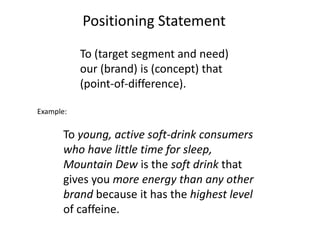
To (target segment and need)
our (brand) is (concept) that
(point-of-difference).
To young, active soft-drink consumers
who have little time for sleep,
Mountain Dew is the soft drink that
gives you more energy than any other
brand because it has the highest level
of caffeine.
Positioning Statement
Example:
How does STP connect to the globe at
the beginning.
• What does the consumer need?(Positioning)
• Who needs it?(Targeting-Segmentation)
4P
Intro
• 4P is product place promotion and price.
• The STP framework is an analogue to planning
whereas this one is closer to execution.
• How do you actually get the product to the right
consumer?(price/place-demand)
• How do you get consumers to want the
product?(promotions-want)
• How much will they pay for it(get price wrong
and your demand goes down)
Product
• What kind of SKU will be best suited for each market?
• For example: When are sachets sold as against
shampoo bottles?
• In which state are the biggest bottles of shampoos
sold?
• Basically you decide the kind of delivery of the product.
• Example tea: Tea bags, powder, leaf etc
• The evolution of soft drink: From glass bottles, to
plastic bottles to soda fountains to cans
• Shoe Sizes
Promotions
• You know the various kinds of promotions
• Just make sure that it matches your
positioning and reaches your target segment
• Hoardings, Posters, Digital media, TVC,
Innovative promotions, In-Store Demos,
Radio, Print Media
• You wouldn’t use facebook to promote Vicco
Vajradhanthi Tooth Powder would you?
Pricing
• Premium Pricing.E.g.: Bourneville
• Penetration Pricing. Eg: Sunfeast chocolate chip biscuits
• Economy Pricing. E.g.: Private labels by retailers like Big
Bazaar
• Price Skimming.E.g.: Most hi-tech products such as Tablets
by Apple
• Captive Product Pricing Eg Razors
• Product Bundle Pricing
• Loss Leader
• Geographical Pricing
Place
• The place is basically the channel/type of shop
you sell it in
• You decide this with the customer segment in
mind.
• Where would they buy? Would it be easy to
serve/distribute there?
• The next few slides are about sales. They
basically explain where you will be able to sell
Sales & Distribution Challenges In India
• Road network in India.
– Road density (Km/ 000 people) India: 2.75 World 6.7
– % Rural Population within 2 Kms of a motorable road: 60
– National Highways as % to Total roads : 2%
– % Traffic in National highways : 40 %
– % of National Highways which are 4 laned : 14%
– % of State highways which are 4 laned : 1%
• Supply Chain Story in India
Sales Hierarchy
Factory 1Factory 2 Factory 3
Central Warehouse
C& FA
1
C &FA
2
C & FA
3
Distributor
Retailer
Wholesaler
Buyer / Consumer
Flows:
1. Product /
Inventory
2. Money
3. Promotion
4. Service
5. Information
6. Title
7. Liability
Distribution
Layers
RoI is a Function of:
• Margin
• Frequency / Sales Cycle
• Volume
Place & RoI
Channels
Modern Trade
General
Store
Boutique
Hyper
market
Retail
Chains
General Trade
Stand Alone
Super
Market
Grocer Chemist Kirana
Outlet
Classification
Over The
Counter OTC
Look Touch
& Feel
Chemist Kirana General
Stores
High Street Boutique
Retail Chains- Spencers,
More, Reliance Fresh,
Trends & Croma
Channel Members
• Carry & Forward Agent:
– Title of goods stays with the Company & involves in logistics and warehousing
• Distributors:
– Holds the title of the goods and supplies to wholesale and large retailers
– Company has complete control of flow of goods at this point
– Distributor carry most of the portfolio of the Company
• Wholesale
– Mostly prefers to stock PULL based products, trade advocacy is considerably
less
– Margins is less and Sales Cycle / Frequency and Volume constitutes for RoI
• Retail:
– End point where Off take of products happens, to build a PUSH based product
this is the apt point
– Trade Advocacy is High depending on Margin
Retail - Snapshot
• 7.88 million outlets catering to A population of 1,210 million.
This data is for food & groceries – traditional.
• Or, 154 persons covered by an outlet.
• 80% of these retail outlets in india have a turnover of less than
Rs. 10,000 per month.
• Retail in India accounts for 95% of food & groceries sold in
India.
Variables to consider for Distribution
Network
• Consumer and Geographic Dispersion
– Larger the number and greater the dispersion, more is the necessity to
use intermediaries.
– The channel may, thus, have many layers.
– Transportation & logistics need to be well organised.
• Frequency of Purchase
– The higher the frequency of purchase, more is the transport intensity
in the “last mile”.
• Purchased on impulse.
– Importance of availability.
• Level of involvement
– Function of cost of the product.
• Identify the Basket of Goods
Contd....
• Perishablity
– Speed of Delivery
• Value to Volume Ratio
– Transportation, Shelf Space
Typical Career in Sales & Marketing
• Sales:
Distributor Management
BTL & Activation
Achieving Sales Targets
Starting Point - Area Sales Manager
• Marketing:
Marketing Budgets and Allocation
Media
Advertising & Creative Briefs
Assistant Brand Manager
Typical Interview/GD Knowledge
• What do the brand managers do
• What do the ASMs do.
• Sales Vs Marketing
• Preparing brand decks
• How to increase profits? 3 ways
• Ad Analysis
• How to approach GD
Whats your favourite Brand and why?
Sample GTM
• Pick any fmcg product
Ad Analysis
• Those in the audience who have discussed this ad
with me please let the others think.
• https://www.youtube.com/watch?v=L6JAPKJTl2k
• Try to work out the STP 4P the managers would
have followed
• Compare it with this ad
• https://www.youtube.com/watch?v=Xf_i_WZZye
s
Pick any ad
Social Media Marketing
Exposure
Customer
Endorser
Evangelist
Social media marketing warning
• People are not there to sell/buy your product
• Doesn’t mean that you can’t ;)
Roadmap of Digital marketing
• Web design & analytics
• Outbound marketing
• Inbound marketing
• Content marketing
• Social media marketing
You cannot leave out one trying to
compensate with another…
Small biz – trax farms
• Social media page – brings credibility
• Yelp- reviewing site- your friends reviewing the company
Big Biz – Old spice
• Change in personality of the brand (From old guys products)
• Live social media campaign ->+107% sales +20k comments
Brand impact – innocent smoothies
• Tell your story-> spreading the story -> Prove your story
• Smoothies covered with hat knit by charity organization
• Gave a positive personality to the brand
• Post pictures of caps on social media – free advertising
Engagement impact - Birchbox
• Find – reach – engage
• Customized high end samples of beauty products (waiting line-exclusivity)
• Blog reviews – social media posts –review videos – Pinterest conversations
about the products
• Sneak peak videos of products unlocked after certain number of comments!
Conversion impact – Smarty had a party
• Exposure + Credibility = Conversions
• Socialized conversion points , direct link access & content integration
• Party supplier with great blog following with posts about product ideas
• Conversion links with the posts and discounts coupons through social media
Impacts a social media campaign can make
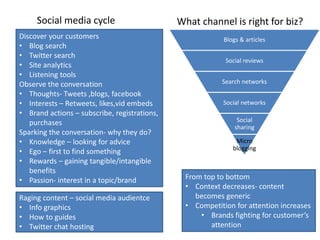
Social media cycle
Discover your customers
• Blog search
• Twitter search
• Site analytics
• Listening tools
Observe the conversation
• Thoughts- Tweets ,blogs, facebook
• Interests – Retweets, likes,vid embeds
• Brand actions – subscribe, registrations,
purchases
Sparking the conversation- why they do?
• Knowledge – looking for advice
• Ego – first to find something
• Rewards – gaining tangible/intangible
benefits
• Passion- interest in a topic/brand
Raging content – social media audientce
• Info graphics
• How to guides
• Twitter chat hosting
Blogs & articles
Social reviews
Search networks
Social networks
Social
sharing
Micro
blogging
What channel is right for biz?
From top to bottom
• Context decreases- content
becomes generic
• Competition for attention increases
• Brands fighting for customer’s
attention
Designing a social media campaign
Goals Micro goals Tactics Channels
Business Goal
• Bring students to yoga classes
Micro goals for this goal
1) Drive new referral traffic 2)Bring back past students 3)Reach out to new customers
Drive new referral
traffic
•Facebook sponsored stories
•Social sharing details
•Social reviews
•Blog Coverage
•Pins & Repins
Bring back past
students
•Test groupon
•Pitch local bloggers
•Social ads
•Guest blogging
Reach out to new
customers
•Social media driven offers
•Check in deals
•Email newsletter
•Social re marketing
•Send to friend offers
Awesome screw up !
• Thomas hawk a photography blogger
• Abused by the priceritephoto
• Blogged with 24 updates till now
• People added their own experience
• #no1 story of the year in Digg
• Shared to slashdot boing boing and
metafilter blogs topped there too !
• New york times coverage
• All powered by comments and shares
• Takeaway: You never know who you
are dealing with !
Now the opposite…
• Lady who lost her mom dealt with by
awesome zappos customer serveice
• She blogs, more comments & more
stories.
• 1000s of mentiones and mainstream
press attention
• Takeaway: if you did something good it
will show up on social media but make
sure everyone sees it.

Marketing crasher

  • 2.
  • 3.
    Purpose of thiscrasher • Getting you placed • Additionally this is a primer. There are a lot of gaps left by MM1 (for the purpose of summers, otherwise they were unquestionably perfect classes I am sure) which I am hoping this would fill. You don’t need jargon. You need a way to think • All this may seem superficial but we will try to explain with examples. This is purely from summers point of view • It also gives you a method of preparation. There is enough time for you to be prepared but not enough for you to slack off. • Any questions you have will be answered. Perhaps not correctly. No guarantee
  • 4.
    Need • The gapbetween a state a person is in and their desired state. • “I want to relax”
  • 5.
    Want • When aneed is directed at a specific object • “I could go for a sutta(Ultra Milds©) right about now”
  • 6.
    Demand • A wantbacked by the ability to pay for it • “I can go get one right now, account pe dal denge”
  • 7.
    Why is thisglobe important? • It is the basis of all marketing thought. • How do you turn a need into demand is basically asking how do you make money using someone’s humanity(needs and desires) • Sounds horribly opportunistic? Deal with it. You’re an MBA this is your life now. • All logic of STP 4P flows from this
  • 8.
    For Example • Sexis one of the most basic needs. • Though the AXE ads are morally questionable they are marketing genius • The ads say that we satisfy your sexual urge by making you irresistible. • And it worked-They turned a NEED into DEMAND
  • 9.
  • 10.
    Another example • “Iwant society to know how beautiful I am”- need • “I want my friends to see this awesome pic of me”-Want
  • 11.
    Demand: Facebook, Instagram,Camera phones, social media enabled camera phones.
  • 12.
    GTM: Go toMarketing Strategy • Can be asked in interviews and GDs. • This basically means that you should do an STP 4P analysis. • The STP 4P analysis should be treated like a mental checklist. It is used to make sure you don’t leave out anything in your strategy • You should have this internalised. You will be F*****g tired to think during the interviews/gds.
  • 13.
    • There aretwo ways to do it. – With a product in mind(Selling Concept) – Without a specific product in mind(Marketing Concept) • Ideally you should finish ST and then decide Your positioning(product benefits) but this may not always be the case in your GDs and Interviews. • First case: Decide your STP based on which segment will be the most receptive • Second Case: Which segment will be your most profitable and what is their NEED GTM
  • 14.
    Segmentation: The firststep • You are basically applying this to the whole population • You’re NOT deciding the target group in this part of your analysis. • Segmentation is clustering people by various needs • There are various methods of segmentation. • When you use the different types of segmentation you need to explain why you used it in the interview. • The reason usually is: a particular type of segmentation helps my identify customers’ differences in need/behaviour
  • 15.
    Types of Segmentation •Geographic Segmentation-This is not the PLACE in 4p. You just decide (north india/South india or rural urban etc) • Demographic Segmentation – Age – Gender – Income – SEC • Behavioral Segmentation • Psychographic Segmentation
  • 16.
    Segmentation: When touse behavioural and when to use psychographic • The difference between behavioural and psychographic segmentation can be illustrated thus. • Consider people commuting in Mumbai • There are people who travel by train and people who travel by car • The same people can be divided into people who want to travel by car and want to travel by train • There may be overlap of these people since they are different kinds of segmentation
  • 17.
    • A companyselling tea may do a behavioural segmentation. They will sell their products along the stations as commuters of trains will be their target segment. What the people desire to travel by is irrelevant for the company • But a company which makes a ride sharing app will need to look at what they want to travel by. Segmentation: When to use behavioural and when to use psychographic
  • 18.
    Segmentation: Example ofreasoning • Say you get beverage as the product to do GTM • The easiest segmentation would be north south segmentation(geographic) • Very clearly there is a preference for tea in the north and preference for coffee in the south. • Your segmentation should give you differences to work with.
  • 19.
    HUL Segmentation • HULclearly segmented its shampoo market by income • It has three brands in clear well defined price points – Clinic-Lower Income Groups – Sunsilk-Middle Income Groups – Tresemme-Higher Income Group
  • 20.
    SEC • It isa shorthand for describing the different kinds of people in india • The new system is entirely based on what these people possess. A basket of goods. • It can be made easy to remember if you find someone in your life belonging to each classification
  • 22.
    Targeting • This isquite simple really. • Target segment should be large enough or willing to pay large amounts or both • The company should have the capacity to serve the segment • Eg: L’oreal doesn’t go into mass brands because the money/numbers is in rural india and they don’t have the distribution capacity to serve there • Again two cases: – If the product is given to you choose the best matching target segment based on the needs and benefits of the product – If you can choose the product and its features choose the most profitable segment and tailor the product to match its needs
  • 23.
    Positioning • This willdefine your product and its features. • You need to ensure your products’ POP, POD • Basically its how you want the consumer to perceive your product • Example: Fogg’s positioning is “no gas” giving the benefit “more sprays per bottle” • Axe Signature is trying out the no gas part now • Positioning basically dictates your promotion
  • 24.
    To (target segmentand need) our (brand) is (concept) that (point-of-difference). To young, active soft-drink consumers who have little time for sleep, Mountain Dew is the soft drink that gives you more energy than any other brand because it has the highest level of caffeine. Positioning Statement Example:
  • 25.
    How does STPconnect to the globe at the beginning. • What does the consumer need?(Positioning) • Who needs it?(Targeting-Segmentation)
  • 26.
  • 27.
    Intro • 4P isproduct place promotion and price. • The STP framework is an analogue to planning whereas this one is closer to execution. • How do you actually get the product to the right consumer?(price/place-demand) • How do you get consumers to want the product?(promotions-want) • How much will they pay for it(get price wrong and your demand goes down)
  • 28.
    Product • What kindof SKU will be best suited for each market? • For example: When are sachets sold as against shampoo bottles? • In which state are the biggest bottles of shampoos sold? • Basically you decide the kind of delivery of the product. • Example tea: Tea bags, powder, leaf etc • The evolution of soft drink: From glass bottles, to plastic bottles to soda fountains to cans • Shoe Sizes
  • 29.
    Promotions • You knowthe various kinds of promotions • Just make sure that it matches your positioning and reaches your target segment • Hoardings, Posters, Digital media, TVC, Innovative promotions, In-Store Demos, Radio, Print Media • You wouldn’t use facebook to promote Vicco Vajradhanthi Tooth Powder would you?
  • 30.
    Pricing • Premium Pricing.E.g.:Bourneville • Penetration Pricing. Eg: Sunfeast chocolate chip biscuits • Economy Pricing. E.g.: Private labels by retailers like Big Bazaar • Price Skimming.E.g.: Most hi-tech products such as Tablets by Apple • Captive Product Pricing Eg Razors • Product Bundle Pricing • Loss Leader • Geographical Pricing
  • 31.
    Place • The placeis basically the channel/type of shop you sell it in • You decide this with the customer segment in mind. • Where would they buy? Would it be easy to serve/distribute there? • The next few slides are about sales. They basically explain where you will be able to sell
  • 32.
    Sales & DistributionChallenges In India • Road network in India. – Road density (Km/ 000 people) India: 2.75 World 6.7 – % Rural Population within 2 Kms of a motorable road: 60 – National Highways as % to Total roads : 2% – % Traffic in National highways : 40 % – % of National Highways which are 4 laned : 14% – % of State highways which are 4 laned : 1% • Supply Chain Story in India
  • 33.
  • 34.
    Factory 1Factory 2Factory 3 Central Warehouse C& FA 1 C &FA 2 C & FA 3 Distributor Retailer Wholesaler Buyer / Consumer Flows: 1. Product / Inventory 2. Money 3. Promotion 4. Service 5. Information 6. Title 7. Liability Distribution Layers RoI is a Function of: • Margin • Frequency / Sales Cycle • Volume
  • 35.
    Place & RoI Channels ModernTrade General Store Boutique Hyper market Retail Chains General Trade Stand Alone Super Market Grocer Chemist Kirana Outlet Classification Over The Counter OTC Look Touch & Feel Chemist Kirana General Stores High Street Boutique Retail Chains- Spencers, More, Reliance Fresh, Trends & Croma
  • 36.
    Channel Members • Carry& Forward Agent: – Title of goods stays with the Company & involves in logistics and warehousing • Distributors: – Holds the title of the goods and supplies to wholesale and large retailers – Company has complete control of flow of goods at this point – Distributor carry most of the portfolio of the Company • Wholesale – Mostly prefers to stock PULL based products, trade advocacy is considerably less – Margins is less and Sales Cycle / Frequency and Volume constitutes for RoI • Retail: – End point where Off take of products happens, to build a PUSH based product this is the apt point – Trade Advocacy is High depending on Margin
  • 37.
    Retail - Snapshot •7.88 million outlets catering to A population of 1,210 million. This data is for food & groceries – traditional. • Or, 154 persons covered by an outlet. • 80% of these retail outlets in india have a turnover of less than Rs. 10,000 per month. • Retail in India accounts for 95% of food & groceries sold in India.
  • 38.
    Variables to considerfor Distribution Network • Consumer and Geographic Dispersion – Larger the number and greater the dispersion, more is the necessity to use intermediaries. – The channel may, thus, have many layers. – Transportation & logistics need to be well organised. • Frequency of Purchase – The higher the frequency of purchase, more is the transport intensity in the “last mile”. • Purchased on impulse. – Importance of availability. • Level of involvement – Function of cost of the product. • Identify the Basket of Goods
  • 39.
    Contd.... • Perishablity – Speedof Delivery • Value to Volume Ratio – Transportation, Shelf Space
  • 40.
    Typical Career inSales & Marketing • Sales: Distributor Management BTL & Activation Achieving Sales Targets Starting Point - Area Sales Manager • Marketing: Marketing Budgets and Allocation Media Advertising & Creative Briefs Assistant Brand Manager
  • 41.
    Typical Interview/GD Knowledge •What do the brand managers do • What do the ASMs do. • Sales Vs Marketing • Preparing brand decks • How to increase profits? 3 ways • Ad Analysis • How to approach GD
  • 42.
    Whats your favouriteBrand and why?
  • 43.
    Sample GTM • Pickany fmcg product
  • 44.
    Ad Analysis • Thosein the audience who have discussed this ad with me please let the others think. • https://www.youtube.com/watch?v=L6JAPKJTl2k • Try to work out the STP 4P the managers would have followed • Compare it with this ad • https://www.youtube.com/watch?v=Xf_i_WZZye s
  • 45.
  • 46.
  • 47.
    Exposure Customer Endorser Evangelist Social media marketingwarning • People are not there to sell/buy your product • Doesn’t mean that you can’t ;) Roadmap of Digital marketing • Web design & analytics • Outbound marketing • Inbound marketing • Content marketing • Social media marketing You cannot leave out one trying to compensate with another… Small biz – trax farms • Social media page – brings credibility • Yelp- reviewing site- your friends reviewing the company Big Biz – Old spice • Change in personality of the brand (From old guys products) • Live social media campaign ->+107% sales +20k comments
  • 48.
    Brand impact –innocent smoothies • Tell your story-> spreading the story -> Prove your story • Smoothies covered with hat knit by charity organization • Gave a positive personality to the brand • Post pictures of caps on social media – free advertising Engagement impact - Birchbox • Find – reach – engage • Customized high end samples of beauty products (waiting line-exclusivity) • Blog reviews – social media posts –review videos – Pinterest conversations about the products • Sneak peak videos of products unlocked after certain number of comments! Conversion impact – Smarty had a party • Exposure + Credibility = Conversions • Socialized conversion points , direct link access & content integration • Party supplier with great blog following with posts about product ideas • Conversion links with the posts and discounts coupons through social media Impacts a social media campaign can make
  • 49.
    Social media cycle Discoveryour customers • Blog search • Twitter search • Site analytics • Listening tools Observe the conversation • Thoughts- Tweets ,blogs, facebook • Interests – Retweets, likes,vid embeds • Brand actions – subscribe, registrations, purchases Sparking the conversation- why they do? • Knowledge – looking for advice • Ego – first to find something • Rewards – gaining tangible/intangible benefits • Passion- interest in a topic/brand Raging content – social media audientce • Info graphics • How to guides • Twitter chat hosting Blogs & articles Social reviews Search networks Social networks Social sharing Micro blogging What channel is right for biz? From top to bottom • Context decreases- content becomes generic • Competition for attention increases • Brands fighting for customer’s attention
  • 50.
    Designing a socialmedia campaign Goals Micro goals Tactics Channels Business Goal • Bring students to yoga classes Micro goals for this goal 1) Drive new referral traffic 2)Bring back past students 3)Reach out to new customers Drive new referral traffic •Facebook sponsored stories •Social sharing details •Social reviews •Blog Coverage •Pins & Repins Bring back past students •Test groupon •Pitch local bloggers •Social ads •Guest blogging Reach out to new customers •Social media driven offers •Check in deals •Email newsletter •Social re marketing •Send to friend offers
  • 51.
    Awesome screw up! • Thomas hawk a photography blogger • Abused by the priceritephoto • Blogged with 24 updates till now • People added their own experience • #no1 story of the year in Digg • Shared to slashdot boing boing and metafilter blogs topped there too ! • New york times coverage • All powered by comments and shares • Takeaway: You never know who you are dealing with ! Now the opposite… • Lady who lost her mom dealt with by awesome zappos customer serveice • She blogs, more comments & more stories. • 1000s of mentiones and mainstream press attention • Takeaway: if you did something good it will show up on social media but make sure everyone sees it.