Machine learning, a branch of artificial intelligence, has revolutionized the way we
approach data analysis and predictive modeling. With Python, a versatile and
powerful programming language, you can unlock the potential of machine learning
algorithms and apply them to real-world problems.
Machine learning with Python refers to the process of using the Python programming
language to develop and implement machine learning algorithms. Machine learning
involves the study of computer algorithms that can learn and improve from data
without being explicitly programmed.
Machine learning with Python has become increasingly popular due to its flexibility,
ease of use, and wide range of applications across various domains, including data
science, artificial intelligence, finance, healthcare, and more.
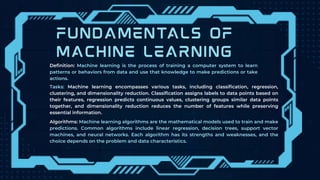
Definition: Machine learning is the process of training a computer system to learn
patterns or behaviors from data and use that knowledge to make predictions or take
actions.
Tasks: Machine learning encompasses various tasks, including classification, regression,
clustering, and dimensionality reduction. Classification assigns labels to data points based on
their features, regression predicts continuous values, clustering groups similar data points
together, and dimensionality reduction reduces the number of features while preserving
essential information.
Algorithms: Machine learning algorithms are the mathematical models used to train and make
predictions. Common algorithms include linear regression, decision trees, support vector
machines, and neural networks. Each algorithm has its strengths and weaknesses, and the
choice depends on the problem and data characteristics.
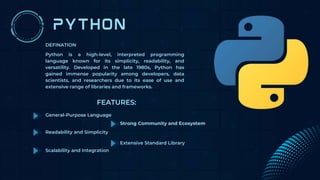
Python is a high-level, interpreted programming
language known for its simplicity, readability, and
versatility. Developed in the late 1980s, Python has
gained immense popularity among developers, data
scientists, and researchers due to its ease of use and
extensive range of libraries and frameworks.
DEFINATION
FEATURES:
General-Purpose Language
Readability and Simplicity
Scalability and Integration
Extensive Standard Library
Strong Community and Ecosystem
Scikit-learn, also known as sklearn, is a
popular open-source machine learning
library for Python. It is built on top of
NumPy, SciPy, and Matplotlib, and
provides a wide range of machine
learning algorithms and tools for data
preprocessing, model selection, and
evaluation.
It offers a consistent and intuitive
interface for working with various
machine learning tasks, including
classification, regression, clustering,
dimensionality reduction, and more.
NumPy, short for Numerical Python, is
a fundamental package for scientific
computing in Python. It is widely used
in various domains, including data
analysis, machine learning, and
numerical simulations. At the core of
NumPy is its ndarray (n-dimensional
array) object, which allows efficient
storage and manipulation of large
arrays of homogeneous data.
Pandas, short for "Python Data Analysis
Library," is a popular open-source library in
Python used for data manipulation, analysis,
and preprocessing.
At the core of Pandas are two primary data
structures: Series and DataFrame. A Series is a
one-dimensional array-like object that can hold
any data type, such as numbers, strings, or
even complex objects. A DataFrame, on the
other hand, is a two-dimensional table-like
data structure that consists of rows and
columns, where each column can hold
different types of data.
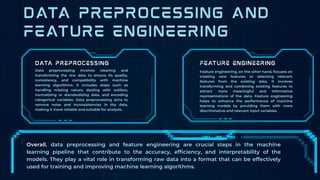
Overall, data preprocessing and feature engineering are crucial steps in the machine
learning pipeline that contribute to the accuracy, efficiency, and interpretability of the
models. They play a vital role in transforming raw data into a format that can be effectively
used for training and improving machine learning algorithms.
Data preprocessing involves cleaning and
transforming the raw data to ensure its quality,
consistency, and compatibility with machine
learning algorithms. It includes steps such as
handling missing values, dealing with outliers,
normalizing or standardizing data, and encoding
categorical variables. Data preprocessing aims to
remove noise and inconsistencies in the data,
making it more reliable and suitable for analysis.
Feature engineering, on the other hand, focuses on
creating new features or selecting relevant
features from the existing data. It involves
transforming and combining existing features to
extract more meaningful and informative
representations of the data. Feature engineering
helps to enhance the performance of machine
learning models by providing them with more
discriminative and relevant input variables.
Machine learning algorithms are
widely used to detect fraudulent
activities in financial transactions.
By analyzing patterns and
anomalies in large datasets,
machine learning models can
identify suspicious transactions
that deviate from normal behavior.
This helps financial institutions and
e-commerce platforms to prevent
fraud and protect their customers'
financial interests.
Machine learning has made
significant advancements in
medical diagnosis, enabling more
accurate and efficient detection of
diseases. For example, in the field
of radiology, machine learning
algorithms can analyze medical
images such as X-rays, MRIs, and
CT scans to assist doctors in
identifying abnormalities and
diagnosing diseases like cancer.
Machine learning algorithms
power recommendation systems
that personalize content and
product recommendations for
users. Platforms like Netflix,
Amazon, and Spotify use machine
learning models to analyze user
preferences, behavior, and
historical data to provide
personalized recommendations
Learn More about Machine Learning With Python
Visit : https://skillup.online/courses/machine-learning-
with-python-a-practical-introduction/

MACHINE LEARNING WITH PYTHON PPT.pptx

  • 2.
    Machine learning, abranch of artificial intelligence, has revolutionized the way we approach data analysis and predictive modeling. With Python, a versatile and powerful programming language, you can unlock the potential of machine learning algorithms and apply them to real-world problems. Machine learning with Python refers to the process of using the Python programming language to develop and implement machine learning algorithms. Machine learning involves the study of computer algorithms that can learn and improve from data without being explicitly programmed. Machine learning with Python has become increasingly popular due to its flexibility, ease of use, and wide range of applications across various domains, including data science, artificial intelligence, finance, healthcare, and more.
  • 3.
    Definition: Machine learningis the process of training a computer system to learn patterns or behaviors from data and use that knowledge to make predictions or take actions. Tasks: Machine learning encompasses various tasks, including classification, regression, clustering, and dimensionality reduction. Classification assigns labels to data points based on their features, regression predicts continuous values, clustering groups similar data points together, and dimensionality reduction reduces the number of features while preserving essential information. Algorithms: Machine learning algorithms are the mathematical models used to train and make predictions. Common algorithms include linear regression, decision trees, support vector machines, and neural networks. Each algorithm has its strengths and weaknesses, and the choice depends on the problem and data characteristics.
  • 4.
    Python is ahigh-level, interpreted programming language known for its simplicity, readability, and versatility. Developed in the late 1980s, Python has gained immense popularity among developers, data scientists, and researchers due to its ease of use and extensive range of libraries and frameworks. DEFINATION FEATURES: General-Purpose Language Readability and Simplicity Scalability and Integration Extensive Standard Library Strong Community and Ecosystem
  • 5.
    Scikit-learn, also knownas sklearn, is a popular open-source machine learning library for Python. It is built on top of NumPy, SciPy, and Matplotlib, and provides a wide range of machine learning algorithms and tools for data preprocessing, model selection, and evaluation. It offers a consistent and intuitive interface for working with various machine learning tasks, including classification, regression, clustering, dimensionality reduction, and more. NumPy, short for Numerical Python, is a fundamental package for scientific computing in Python. It is widely used in various domains, including data analysis, machine learning, and numerical simulations. At the core of NumPy is its ndarray (n-dimensional array) object, which allows efficient storage and manipulation of large arrays of homogeneous data. Pandas, short for "Python Data Analysis Library," is a popular open-source library in Python used for data manipulation, analysis, and preprocessing. At the core of Pandas are two primary data structures: Series and DataFrame. A Series is a one-dimensional array-like object that can hold any data type, such as numbers, strings, or even complex objects. A DataFrame, on the other hand, is a two-dimensional table-like data structure that consists of rows and columns, where each column can hold different types of data.
  • 6.
    Overall, data preprocessingand feature engineering are crucial steps in the machine learning pipeline that contribute to the accuracy, efficiency, and interpretability of the models. They play a vital role in transforming raw data into a format that can be effectively used for training and improving machine learning algorithms. Data preprocessing involves cleaning and transforming the raw data to ensure its quality, consistency, and compatibility with machine learning algorithms. It includes steps such as handling missing values, dealing with outliers, normalizing or standardizing data, and encoding categorical variables. Data preprocessing aims to remove noise and inconsistencies in the data, making it more reliable and suitable for analysis. Feature engineering, on the other hand, focuses on creating new features or selecting relevant features from the existing data. It involves transforming and combining existing features to extract more meaningful and informative representations of the data. Feature engineering helps to enhance the performance of machine learning models by providing them with more discriminative and relevant input variables.
  • 7.
    Machine learning algorithmsare widely used to detect fraudulent activities in financial transactions. By analyzing patterns and anomalies in large datasets, machine learning models can identify suspicious transactions that deviate from normal behavior. This helps financial institutions and e-commerce platforms to prevent fraud and protect their customers' financial interests. Machine learning has made significant advancements in medical diagnosis, enabling more accurate and efficient detection of diseases. For example, in the field of radiology, machine learning algorithms can analyze medical images such as X-rays, MRIs, and CT scans to assist doctors in identifying abnormalities and diagnosing diseases like cancer. Machine learning algorithms power recommendation systems that personalize content and product recommendations for users. Platforms like Netflix, Amazon, and Spotify use machine learning models to analyze user preferences, behavior, and historical data to provide personalized recommendations
  • 8.
    Learn More aboutMachine Learning With Python Visit : https://skillup.online/courses/machine-learning- with-python-a-practical-introduction/