MACHINE LEARNING
AND
DATA ANALYTICS USING
PYTHON
MMC201
Prerequisite
Basic Programming skills
Basic Mathematical concepts
Strong Motivation for Learning
Course Learning Objectives:
• Understand foundational concepts in machine learning and data
analytics.
• Gain proficiency in Python for data analysis and machine learning
tasks.
• Learn and apply various machine learning algorithms and
techniques.
• Develop skills in data preprocessing, visualization, and model
evaluation.
• Prepare students for industry roles involving data-driven decision
making and predictive modeling.
Hidden Objective is to clear the Exam
Syllabus
• Module-1 Introduction to Machine Learning and Python, Types of
machine learning: Supervised, unsupervised, and reinforcement
learning, Applications of machine learning in various domains, Python for
Data Analysis, Data Preprocessing.
• Module-2 Supervised Learning: Regression: Linear regression, Polynomial
regression, Model evaluation metrics, K-Nearest Neighbors (KNN),
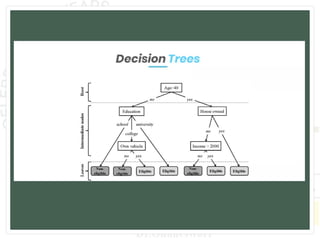
Decision Trees and Random Forests, Model evaluation metrics, Model
Training and Evaluation.
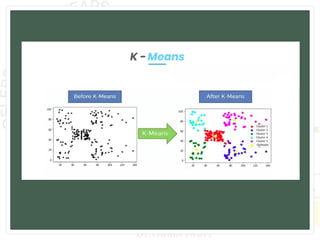
• Module-3 Unsupervised Learning: Clustering: K-Means clustering,
Hierarchical clustering, Evaluation of clustering results. Dimensionality
Reduction: PCA, LDA, t-SNE, Association Rule Learning.
• Module-4 Advanced Machine Learning Techniques: Ensemble Methods:
Bagging and Boosting,Support Vector Machines, Model evaluation and
tuning, Neural Networks and Deep Learning: CNN and RNN.
• Module-5 Data Analytics and Real-World Applications: Exploratory Data
Analysis, Time Series Analysis and Integrating Machine Learning Models:
Deployment of machine learning models, Building web applications with
Flask and Django.
Syllabus
• Module-1 Introduction to Machine Learning and Python, Types of
machine learning: Supervised, unsupervised, and reinforcement
learning, Applications of machine learning in various domains, Python for
Data Analysis, Data Preprocessing.
• Module-2 Supervised Learning: Regression: Linear regression, Polynomial
regression, Model evaluation metrics, K-Nearest Neighbors (KNN),
Decision Trees and Random Forests, Model evaluation metrics, Model
Training and Evaluation.
• Module-3 Unsupervised Learning: Clustering: K-Means clustering,
Hierarchical clustering, Evaluation of clustering results. Dimensionality
Reduction: PCA, LDA, t-SNE, Association Rule Learning.
• Module-4 Advanced Machine Learning Techniques: Ensemble Methods:
Bagging and Boosting,Support Vector Machines, Model evaluation and
tuning, Neural Networks and Deep Learning: CNN and RNN.
• Module-5 Data Analytics and Real-World Applications: Exploratory Data
Analysis, Time Series Analysis and Integrating Machine Learning Models:
Deployment of machine learning models, Building web applications with
Flask and Django.
Syllabus
• Module-1 Introduction to Machine Learning and Python, Types of
machine learning: Supervised, unsupervised, and reinforcement
learning, Applications of machine learning in various domains, Python for
Data Analysis, Data Preprocessing.
• Module-2 Supervised Learning: Regression: Linear regression, Polynomial
regression, Model evaluation metrics, K-Nearest Neighbors (KNN),
Decision Trees and Random Forests, Model evaluation metrics, Model
Training and Evaluation.
• Module-3 Unsupervised Learning: Clustering: K-Means clustering,
Hierarchical clustering, Evaluation of clustering results. Dimensionality
Reduction: PCA, LDA, t-SNE, Association Rule Learning.
• Module-4 Advanced Machine Learning Techniques: Ensemble Methods:
Bagging and Boosting,Support Vector Machines, Model evaluation and
tuning, Neural Networks and Deep Learning: CNN and RNN.
• Module-5 Data Analytics and Real-World Applications: Exploratory Data
Analysis, Time Series Analysis and Integrating Machine Learning Models:
Deployment of machine learning models, Building web applications with
Flask and Django.
Syllabus
• Module-1 Introduction to Machine Learning and Python, Types of
machine learning: Supervised, unsupervised, and reinforcement
learning, Applications of machine learning in various domains, Python for
Data Analysis, Data Preprocessing.
• Module-2 Supervised Learning: Regression: Linear regression, Polynomial
regression, Model evaluation metrics, K-Nearest Neighbors (KNN),
Decision Trees and Random Forests, Model evaluation metrics, Model
Training and Evaluation.
• Module-3 Unsupervised Learning: Clustering: K-Means clustering,
Hierarchical clustering, Evaluation of clustering results. Dimensionality
Reduction: PCA, LDA, t-SNE, Association Rule Learning.
• Module-4 Advanced Machine Learning Techniques: Ensemble Methods-
Bagging and Boosting,Support Vector Machines, Model evaluation and
tuning, Neural Networks and Deep Learning: CNN and RNN.
• Module-5 Data Analytics and Real-World Applications: Exploratory Data
Analysis, Time Series Analysis and Integrating Machine Learning Models:
Deployment of machine learning models, Building web applications with
Flask and Django.
Syllabus
• Module-1 Introduction to Machine Learning and Python, Types of
machine learning: Supervised, unsupervised, and reinforcement
learning, Applications of machine learning in various domains, Python for
Data Analysis, Data Preprocessing.
• Module-2 Supervised Learning: Regression: Linear regression, Polynomial
regression, Model evaluation metrics, K-Nearest Neighbors (KNN),
Decision Trees and Random Forests, Model evaluation metrics, Model
Training and Evaluation.
• Module-3 Unsupervised Learning: Clustering: K-Means clustering,
Hierarchical clustering, Evaluation of clustering results. Dimensionality
Reduction: PCA, LDA, t-SNE, Association Rule Learning.
• Module-4 Advanced Machine Learning Techniques: Ensemble Methods:
Bagging and Boosting,Support Vector Machines, Model evaluation and
tuning, Neural Networks and Deep Learning: CNN and RNN.
• Module-5 Data Analytics and Real-World Applications: Exploratory Data
Analysis, Time Series Analysis and Integrating Machine Learning Models:
Deployment of machine learning models, Building web applications with
Flask and Django.
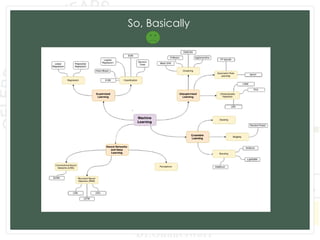
So, Basically
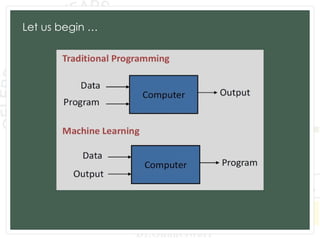
Let us begin …
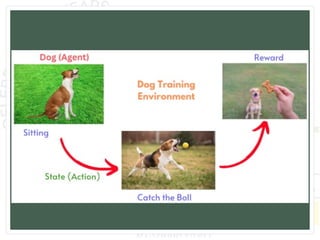
Reinforcement Learning
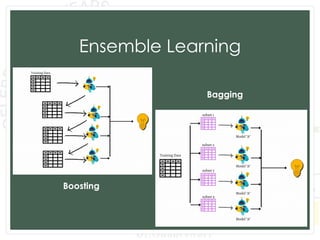
Ensemble Learning
Bagging
Boosting
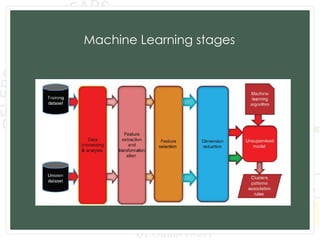
Machine Learning stages
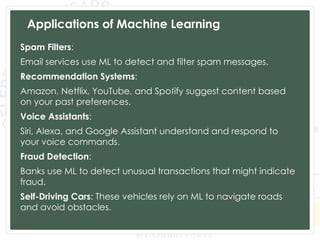
Applications of Machine Learning
Spam Filters:
Email services use ML to detect and filter spam messages.
Recommendation Systems:
Amazon, Netflix, YouTube, and Spotify suggest content based
on your past preferences.
Voice Assistants:
Siri, Alexa, and Google Assistant understand and respond to
your voice commands.
Fraud Detection:
Banks use ML to detect unusual transactions that might indicate
fraud.
Self-Driving Cars: These vehicles rely on ML to navigate roads
and avoid obstacles.
Machine Learning Algorithms
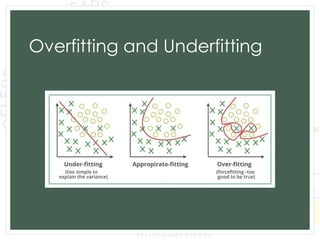
Overfitting and Underfitting
No written Assignments …
• Assignment – Infosys Springboard (Theory Internals-Individual)
https://infyspringboard.onwingspan.com/web/en/app/toc/lex_aut
h_01384356296957132841688_shared/overview
• Skill Development – Project(ML) – Demo of the project and a
report shall be evaluated for CIE marks. (Lab Internals-Team of 3)
IAT
• Two IATs will be given for 50 marks each
• Final Exam will for 100 marks and will be scaled
down to 50.
• Internal marks will be for 50.
• Theory (30 marks = Avg. of 2-IAT (20 marks) +
Assignment (10 marks)
• Lab (20 marks = Skill Development/Project)
Industry-Relevance
• Emphasis on coding standards and best practices.
• Integration of version control systems (e.g., Git) in project work.
• Exposure to industry-standard tools and frameworks.
• Real-world application development projects.
• Focus on collaborative development and agile methodologies.
Definitions (Activity)
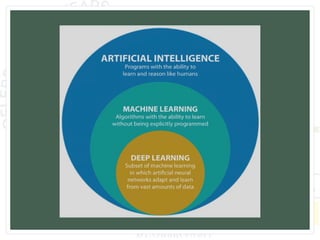
• Artificial intelligence (AI) is a broad field focused on
creating machines that can perform tasks
requiring human intelligence, such as learning and
problem-solving.
• Machine learning (ML) is a specific subset of AI
that focuses on enabling machines to learn from
data without being explicitly programmed.
Definitions (Activity)
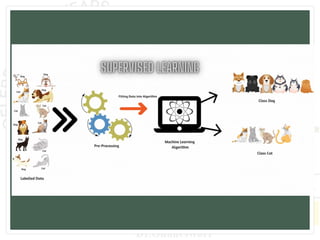
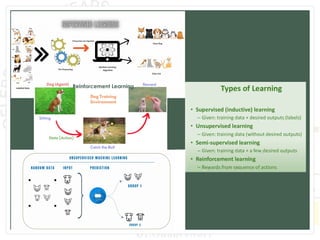
• Supervised learning uses labeled data, where the
input and desired output are known, to train a
model to make predictions on new, unseen data.
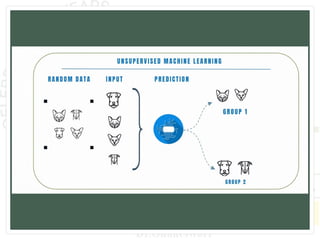
• Unsupervised learning, on the other hand,
operates on unlabeled data, aiming to discover
patterns, structures, or relationships within the
data without pre-defined outputs.
Definitions (Activity)
• Supervised learning uses labeled data, where the
input and desired output are known, to train a
model to make predictions on new, unseen data.
• Unsupervised learning, on the other hand,
operates on unlabeled data, aiming to discover
patterns, structures, or relationships within the
data without pre-defined outputs.
Definitions (Activity)
• Reinforcement learning (RL) is a machine learning
paradigm where an agent learns to make
decisions in an environment to maximize a
cumulative reward.
• It mimics how humans learn through trial and
error, interacting with their surroundings and
receiving feedback.
Definitions (Activity)
• Ensemble learning is a machine learning
technique where multiple models (often called
"weak learners" or "base models") are combined to
make a stronger prediction than any single model
could achieve.
Definitions (Activity)
• A neural network is a machine learning model
inspired by the human brain, consisting of
interconnected nodes (neurons) that process
information.
Machine Learning using python Expectation setting.pptx

  • 1.
  • 2.
    Prerequisite Basic Programming skills BasicMathematical concepts Strong Motivation for Learning
  • 3.
    Course Learning Objectives: •Understand foundational concepts in machine learning and data analytics. • Gain proficiency in Python for data analysis and machine learning tasks. • Learn and apply various machine learning algorithms and techniques. • Develop skills in data preprocessing, visualization, and model evaluation. • Prepare students for industry roles involving data-driven decision making and predictive modeling. Hidden Objective is to clear the Exam
  • 4.
    Syllabus • Module-1 Introductionto Machine Learning and Python, Types of machine learning: Supervised, unsupervised, and reinforcement learning, Applications of machine learning in various domains, Python for Data Analysis, Data Preprocessing. • Module-2 Supervised Learning: Regression: Linear regression, Polynomial regression, Model evaluation metrics, K-Nearest Neighbors (KNN), Decision Trees and Random Forests, Model evaluation metrics, Model Training and Evaluation. • Module-3 Unsupervised Learning: Clustering: K-Means clustering, Hierarchical clustering, Evaluation of clustering results. Dimensionality Reduction: PCA, LDA, t-SNE, Association Rule Learning. • Module-4 Advanced Machine Learning Techniques: Ensemble Methods: Bagging and Boosting,Support Vector Machines, Model evaluation and tuning, Neural Networks and Deep Learning: CNN and RNN. • Module-5 Data Analytics and Real-World Applications: Exploratory Data Analysis, Time Series Analysis and Integrating Machine Learning Models: Deployment of machine learning models, Building web applications with Flask and Django.
  • 5.
    Syllabus • Module-1 Introductionto Machine Learning and Python, Types of machine learning: Supervised, unsupervised, and reinforcement learning, Applications of machine learning in various domains, Python for Data Analysis, Data Preprocessing. • Module-2 Supervised Learning: Regression: Linear regression, Polynomial regression, Model evaluation metrics, K-Nearest Neighbors (KNN), Decision Trees and Random Forests, Model evaluation metrics, Model Training and Evaluation. • Module-3 Unsupervised Learning: Clustering: K-Means clustering, Hierarchical clustering, Evaluation of clustering results. Dimensionality Reduction: PCA, LDA, t-SNE, Association Rule Learning. • Module-4 Advanced Machine Learning Techniques: Ensemble Methods: Bagging and Boosting,Support Vector Machines, Model evaluation and tuning, Neural Networks and Deep Learning: CNN and RNN. • Module-5 Data Analytics and Real-World Applications: Exploratory Data Analysis, Time Series Analysis and Integrating Machine Learning Models: Deployment of machine learning models, Building web applications with Flask and Django.
  • 6.
    Syllabus • Module-1 Introductionto Machine Learning and Python, Types of machine learning: Supervised, unsupervised, and reinforcement learning, Applications of machine learning in various domains, Python for Data Analysis, Data Preprocessing. • Module-2 Supervised Learning: Regression: Linear regression, Polynomial regression, Model evaluation metrics, K-Nearest Neighbors (KNN), Decision Trees and Random Forests, Model evaluation metrics, Model Training and Evaluation. • Module-3 Unsupervised Learning: Clustering: K-Means clustering, Hierarchical clustering, Evaluation of clustering results. Dimensionality Reduction: PCA, LDA, t-SNE, Association Rule Learning. • Module-4 Advanced Machine Learning Techniques: Ensemble Methods: Bagging and Boosting,Support Vector Machines, Model evaluation and tuning, Neural Networks and Deep Learning: CNN and RNN. • Module-5 Data Analytics and Real-World Applications: Exploratory Data Analysis, Time Series Analysis and Integrating Machine Learning Models: Deployment of machine learning models, Building web applications with Flask and Django.
  • 7.
    Syllabus • Module-1 Introductionto Machine Learning and Python, Types of machine learning: Supervised, unsupervised, and reinforcement learning, Applications of machine learning in various domains, Python for Data Analysis, Data Preprocessing. • Module-2 Supervised Learning: Regression: Linear regression, Polynomial regression, Model evaluation metrics, K-Nearest Neighbors (KNN), Decision Trees and Random Forests, Model evaluation metrics, Model Training and Evaluation. • Module-3 Unsupervised Learning: Clustering: K-Means clustering, Hierarchical clustering, Evaluation of clustering results. Dimensionality Reduction: PCA, LDA, t-SNE, Association Rule Learning. • Module-4 Advanced Machine Learning Techniques: Ensemble Methods- Bagging and Boosting,Support Vector Machines, Model evaluation and tuning, Neural Networks and Deep Learning: CNN and RNN. • Module-5 Data Analytics and Real-World Applications: Exploratory Data Analysis, Time Series Analysis and Integrating Machine Learning Models: Deployment of machine learning models, Building web applications with Flask and Django.
  • 8.
    Syllabus • Module-1 Introductionto Machine Learning and Python, Types of machine learning: Supervised, unsupervised, and reinforcement learning, Applications of machine learning in various domains, Python for Data Analysis, Data Preprocessing. • Module-2 Supervised Learning: Regression: Linear regression, Polynomial regression, Model evaluation metrics, K-Nearest Neighbors (KNN), Decision Trees and Random Forests, Model evaluation metrics, Model Training and Evaluation. • Module-3 Unsupervised Learning: Clustering: K-Means clustering, Hierarchical clustering, Evaluation of clustering results. Dimensionality Reduction: PCA, LDA, t-SNE, Association Rule Learning. • Module-4 Advanced Machine Learning Techniques: Ensemble Methods: Bagging and Boosting,Support Vector Machines, Model evaluation and tuning, Neural Networks and Deep Learning: CNN and RNN. • Module-5 Data Analytics and Real-World Applications: Exploratory Data Analysis, Time Series Analysis and Integrating Machine Learning Models: Deployment of machine learning models, Building web applications with Flask and Django.
  • 9.
  • 10.
  • 15.
  • 16.
  • 17.
  • 18.
    Applications of MachineLearning Spam Filters: Email services use ML to detect and filter spam messages. Recommendation Systems: Amazon, Netflix, YouTube, and Spotify suggest content based on your past preferences. Voice Assistants: Siri, Alexa, and Google Assistant understand and respond to your voice commands. Fraud Detection: Banks use ML to detect unusual transactions that might indicate fraud. Self-Driving Cars: These vehicles rely on ML to navigate roads and avoid obstacles.
  • 19.
  • 22.
  • 25.
    No written Assignments… • Assignment – Infosys Springboard (Theory Internals-Individual) https://infyspringboard.onwingspan.com/web/en/app/toc/lex_aut h_01384356296957132841688_shared/overview • Skill Development – Project(ML) – Demo of the project and a report shall be evaluated for CIE marks. (Lab Internals-Team of 3)
  • 26.
    IAT • Two IATswill be given for 50 marks each • Final Exam will for 100 marks and will be scaled down to 50. • Internal marks will be for 50. • Theory (30 marks = Avg. of 2-IAT (20 marks) + Assignment (10 marks) • Lab (20 marks = Skill Development/Project)
  • 27.
    Industry-Relevance • Emphasis oncoding standards and best practices. • Integration of version control systems (e.g., Git) in project work. • Exposure to industry-standard tools and frameworks. • Real-world application development projects. • Focus on collaborative development and agile methodologies.
  • 28.
    Definitions (Activity) • Artificialintelligence (AI) is a broad field focused on creating machines that can perform tasks requiring human intelligence, such as learning and problem-solving. • Machine learning (ML) is a specific subset of AI that focuses on enabling machines to learn from data without being explicitly programmed.
  • 29.
    Definitions (Activity) • Supervisedlearning uses labeled data, where the input and desired output are known, to train a model to make predictions on new, unseen data. • Unsupervised learning, on the other hand, operates on unlabeled data, aiming to discover patterns, structures, or relationships within the data without pre-defined outputs.
  • 30.
    Definitions (Activity) • Supervisedlearning uses labeled data, where the input and desired output are known, to train a model to make predictions on new, unseen data. • Unsupervised learning, on the other hand, operates on unlabeled data, aiming to discover patterns, structures, or relationships within the data without pre-defined outputs.
  • 31.
    Definitions (Activity) • Reinforcementlearning (RL) is a machine learning paradigm where an agent learns to make decisions in an environment to maximize a cumulative reward. • It mimics how humans learn through trial and error, interacting with their surroundings and receiving feedback.
  • 32.
    Definitions (Activity) • Ensemblelearning is a machine learning technique where multiple models (often called "weak learners" or "base models") are combined to make a stronger prediction than any single model could achieve.
  • 33.
    Definitions (Activity) • Aneural network is a machine learning model inspired by the human brain, consisting of interconnected nodes (neurons) that process information.