MACHINE LEARNING
USING CLOUD SERVICES
Max Pagels, Data Science Specialist
max.pagels@sc5.io, @maxpagels
12.6.2016
A general overview
WHAT IS MACHINE LEARNING?
“… FIELD OF STUDY THAT GIVES COMPUTERS
THE ABILITY TO LEARN WITHOUT BEING
EXPLICITLY PROGRAMMED”
- Arthur Lee Samuel, 1959
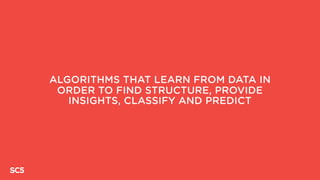
ALGORITHMS THAT LEARN FROM DATA IN
ORDER TO FIND STRUCTURE, PROVIDE
INSIGHTS, CLASSIFY AND PREDICT
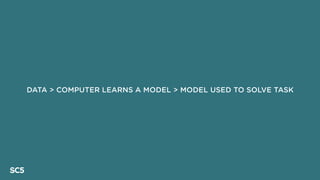
DATA > COMPUTER LEARNS A MODEL > MODEL USED TO SOLVE TASK
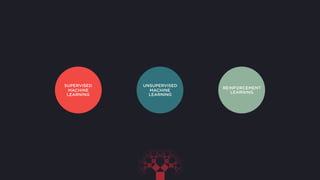
SUPERVISED
MACHINE
LEARNING
UNSUPERVISED
MACHINE
LEARNING
REINFORCEMENT
LEARNING
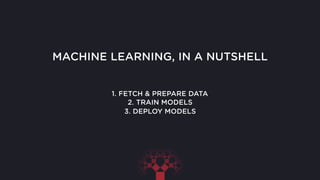
1. FETCH & PREPARE DATA
2. TRAIN MODELS
3. DEPLOY MODELS
MACHINE LEARNING, IN A NUTSHELL
HOW CAN CLOUD SERVICES HELP?
1. FETCHING & PREPARING DATA
90% of all time is spent on getting & cleaning data
TYPICAL PROBLEMS
• Data is stored in multiple DBs
• Data access is behind multiple systems
• Data is missing
• Data is in the incorrect format
• Data is only available in aggregated form
• Running queries takes a long time
SOLUTION: CLOUD DATA WAREHOUSING
• Data is stored in one logical, petabyte-scale DB
• Centralised user access management
• Usually much cheaper to run than in-house solutions
• Can save (and query) raw data
• Querying is typically much faster
2. TRAINING MODELS
Test, validate, rinse & repeat
Depending on the type of classifier and the problem at hand, training a model
can take ages on a normal laptop/desktop computer.
PROBLEM
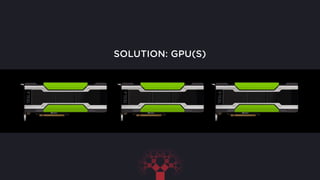
SOLUTION: GPU(S)
SOLUTION: CLOUD-BASED COMPUTATION
Example: on AWS EC2, a p2.8xlarge instance has:
• 32 vCPUs
• 488 GiB RAM
• 8 NVIDIA K80 GPUs, 2,496 PPCs and 12GiB of GPU memory per GPU
Cost of buying one K80 yourself: $5,000
Cost of buying the equivalent hardware yourself: $50,000
Cost of running the instance in AWS: about $8 per hour
3. DEPLOYING MODELS
Putting your machine learning models to good use
DEPLOYING MODELS
• ML models can take a long time to train, but the models themselves
usually don’t take much (disk/RAM) space
• Getting a prediction/result from an ML model typically doesn’t take
that much time, either (milliseconds)
• Building a REST API on top of your model allows other services to get
predictions on demand
• Use functions-as-a-service as your first choice
DEPLOYING MODELS
• ML models can take a long time to train, but the models themselves
usually don’t take much (disk/RAM) space
• Getting a prediction/result from an ML model typically doesn’t take
that much time, either (milliseconds)
• Building a REST API on top of your model allows other services to get
predictions on demand
• Use functions-as-a-service as your first choice
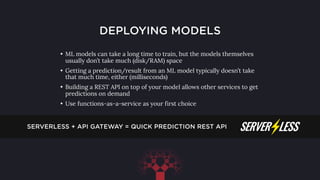
SERVERLESS + API GATEWAY = QUICK PREDICTION REST API
DON’T REINVENT THE WHEEL
Pre-made models and services may work well
SOME READY-MADE AI/ML SERVICES
IBM WATSON
• Natural language processing
• Language translation
• Sentiment analysis
• Speech-to-text
• Text-to-speech
• Personality insights
AWS AI
• AWS ML: linear/logistic
regression (classification & real-
number prediction)
• Amazon Lex: conversational
interfaces
• Amazon Rekognition: object
detection
• Amazon Polly: text-to-speech
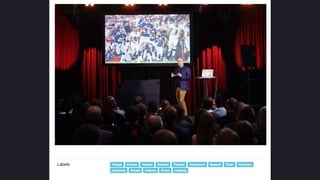
LET’S END WITH AN EXAMPLE
THANK YOU
Have a great evening!

Machine Learning Using Cloud Services

  • 1.
    MACHINE LEARNING USING CLOUDSERVICES Max Pagels, Data Science Specialist max.pagels@sc5.io, @maxpagels 12.6.2016 A general overview
  • 2.
    WHAT IS MACHINELEARNING?
  • 3.
    “… FIELD OFSTUDY THAT GIVES COMPUTERS THE ABILITY TO LEARN WITHOUT BEING EXPLICITLY PROGRAMMED” - Arthur Lee Samuel, 1959
  • 4.
    ALGORITHMS THAT LEARNFROM DATA IN ORDER TO FIND STRUCTURE, PROVIDE INSIGHTS, CLASSIFY AND PREDICT
  • 5.
    DATA > COMPUTERLEARNS A MODEL > MODEL USED TO SOLVE TASK
  • 6.
  • 7.
    1. FETCH &PREPARE DATA 2. TRAIN MODELS 3. DEPLOY MODELS MACHINE LEARNING, IN A NUTSHELL
  • 8.
    HOW CAN CLOUDSERVICES HELP?
  • 9.
    1. FETCHING &PREPARING DATA 90% of all time is spent on getting & cleaning data
  • 10.
    TYPICAL PROBLEMS • Datais stored in multiple DBs • Data access is behind multiple systems • Data is missing • Data is in the incorrect format • Data is only available in aggregated form • Running queries takes a long time
  • 11.
    SOLUTION: CLOUD DATAWAREHOUSING • Data is stored in one logical, petabyte-scale DB • Centralised user access management • Usually much cheaper to run than in-house solutions • Can save (and query) raw data • Querying is typically much faster
  • 12.
    2. TRAINING MODELS Test,validate, rinse & repeat
  • 13.
    Depending on thetype of classifier and the problem at hand, training a model can take ages on a normal laptop/desktop computer. PROBLEM
  • 14.
  • 15.
    SOLUTION: CLOUD-BASED COMPUTATION Example:on AWS EC2, a p2.8xlarge instance has: • 32 vCPUs • 488 GiB RAM • 8 NVIDIA K80 GPUs, 2,496 PPCs and 12GiB of GPU memory per GPU Cost of buying one K80 yourself: $5,000 Cost of buying the equivalent hardware yourself: $50,000 Cost of running the instance in AWS: about $8 per hour
  • 16.
    3. DEPLOYING MODELS Puttingyour machine learning models to good use
  • 17.
    DEPLOYING MODELS • MLmodels can take a long time to train, but the models themselves usually don’t take much (disk/RAM) space • Getting a prediction/result from an ML model typically doesn’t take that much time, either (milliseconds) • Building a REST API on top of your model allows other services to get predictions on demand • Use functions-as-a-service as your first choice
  • 18.
    DEPLOYING MODELS • MLmodels can take a long time to train, but the models themselves usually don’t take much (disk/RAM) space • Getting a prediction/result from an ML model typically doesn’t take that much time, either (milliseconds) • Building a REST API on top of your model allows other services to get predictions on demand • Use functions-as-a-service as your first choice SERVERLESS + API GATEWAY = QUICK PREDICTION REST API
  • 19.
    DON’T REINVENT THEWHEEL Pre-made models and services may work well
  • 20.
  • 21.
    IBM WATSON • Naturallanguage processing • Language translation • Sentiment analysis • Speech-to-text • Text-to-speech • Personality insights
  • 22.
    AWS AI • AWSML: linear/logistic regression (classification & real- number prediction) • Amazon Lex: conversational interfaces • Amazon Rekognition: object detection • Amazon Polly: text-to-speech
  • 23.
    LET’S END WITHAN EXAMPLE
  • 27.
    THANK YOU Have agreat evening!