Machine Learning ML Overview
Algorithms Use Cases
and Applications
Your C ompany N ame
2
Machine Learning
01
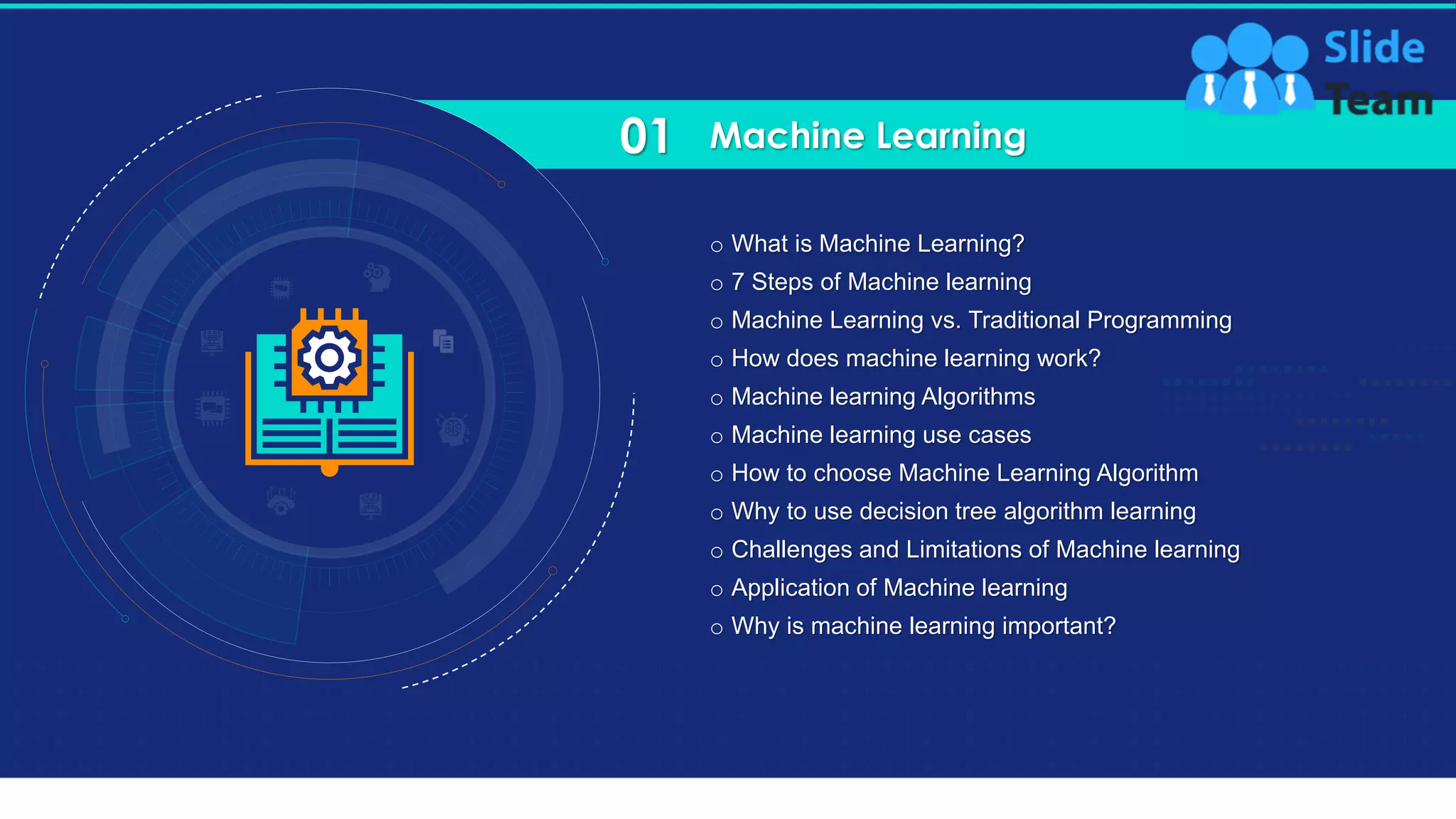
o What is Machine Learning?
o 7 Steps of Machine learning
o Machine Learning vs. Traditional Programming
o How does machine learning work?
o Machine learning Algorithms
o Machine learning use cases
o How to choose Machine Learning Algorithm
o Why to use decision tree algorithm learning
o Challenges and Limitations of Machine learning
o Application of Machine learning
o Why is machine learning important?
Machine Learning
3
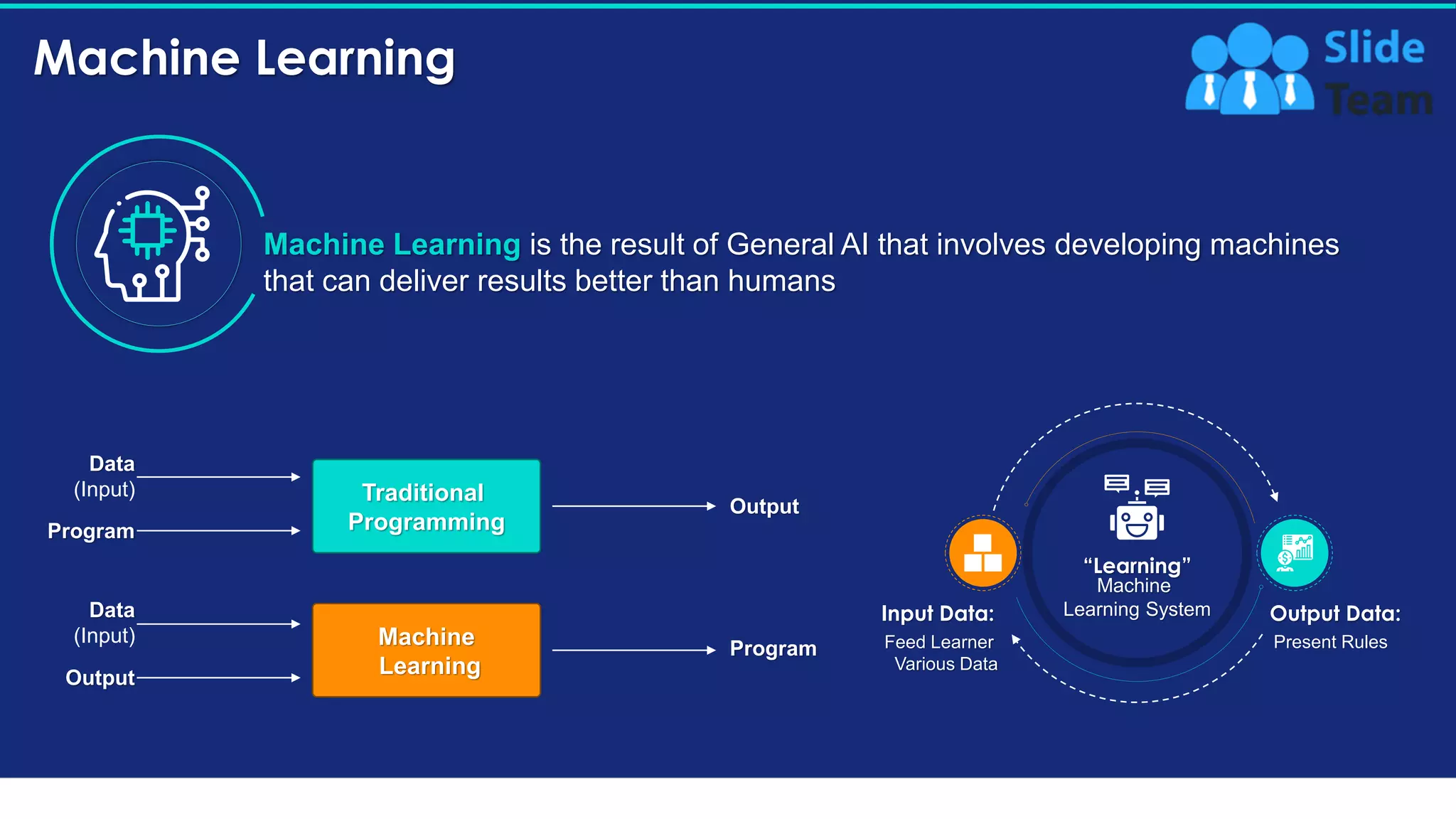
Machine Learning is the result of General AI that involves developing machines
that can deliver results better than humans
Traditional
Programming
Data
(Input)
Program
Output
Data
(Input)
Output
Machine
Learning
Program
This slide is 100% editable. Adapt it to your needs and capture your audience's attention.
“Learning”
Machine
Learning System
Input Data:
Feed Learner
Various Data
Output Data:
Present Rules
7 Steps of Machine Learning
4
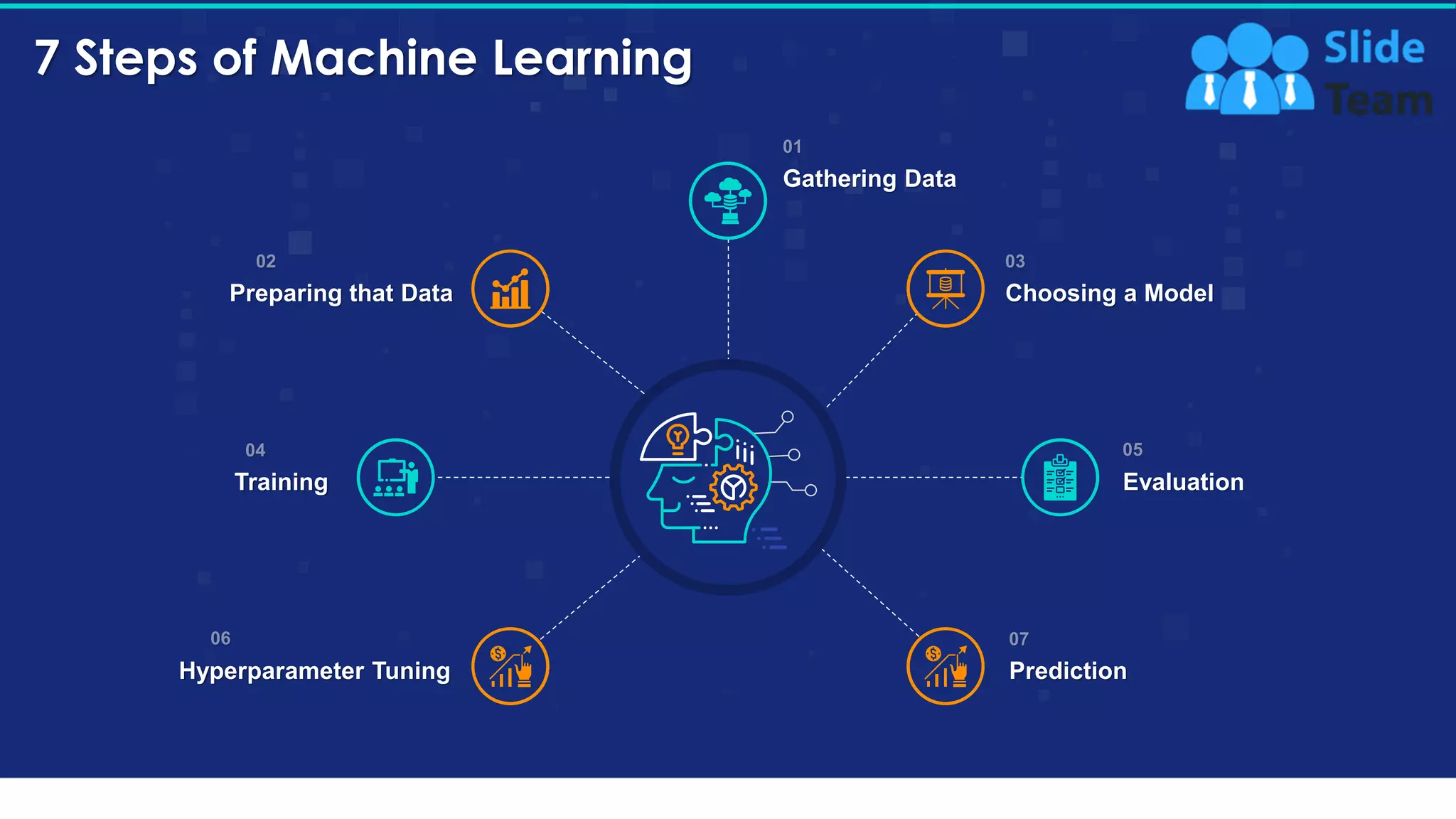
Gathering Data
Preparing that Data Choosing a Model
Training Evaluation
Hyperparameter Tuning Prediction
This slide is 100% editable. Adapt it to your needs and capture your audience's attention.
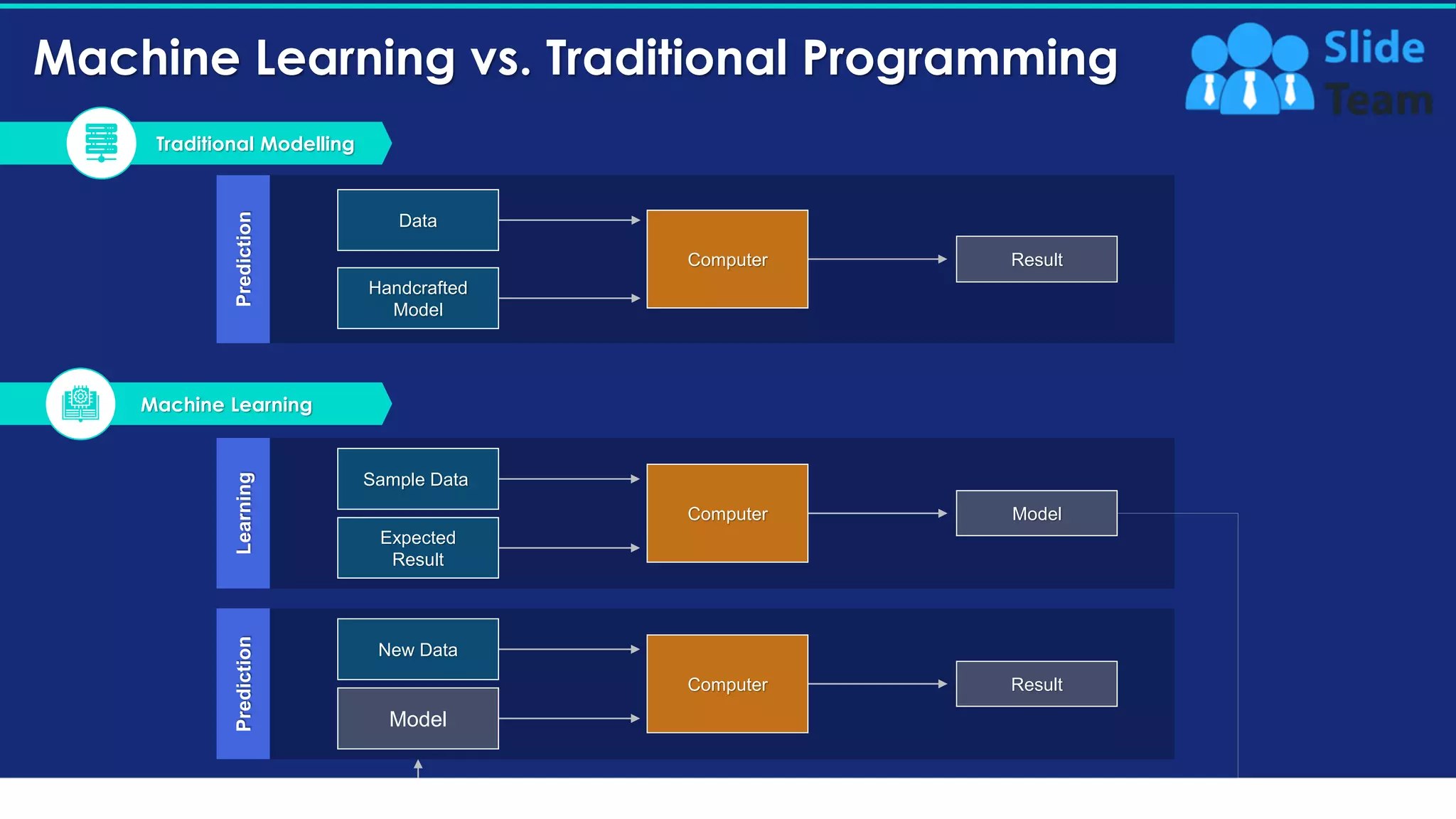
Machine Learning vs. Traditional Programming
5
Traditional Modelling
Prediction
Result
Machine Learning
Learning
Model
Prediction
Result
Computer
New Data
Model
Sample Data
Expected
Result
Data
Handcrafted
Model
Computer
Computer
This slide is 100% editable. Adapt it to your needs and capture your audience's attention.
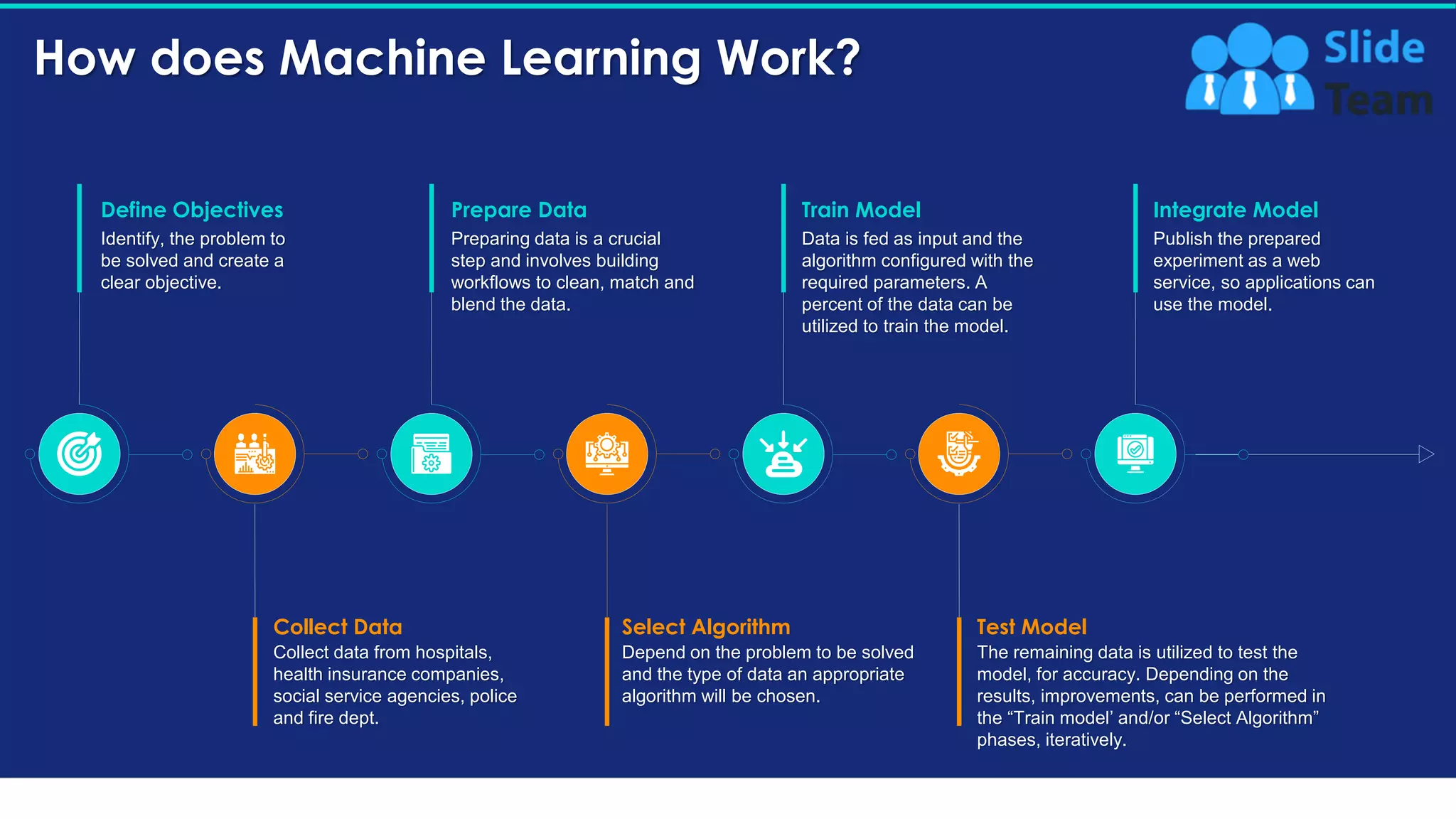
How does Machine Learning Work?
6
Identify, the problem to
be solved and create a
clear objective.
Define Objectives
Preparing data is a crucial
step and involves building
workflows to clean, match and
blend the data.
Prepare Data
Data is fed as input and the
algorithm configured with the
required parameters. A
percent of the data can be
utilized to train the model.
Train Model
Publish the prepared
experiment as a web
service, so applications can
use the model.
Integrate Model
Collect data from hospitals,
health insurance companies,
social service agencies, police
and fire dept.
Collect Data
Depend on the problem to be solved
and the type of data an appropriate
algorithm will be chosen.
Select Algorithm
The remaining data is utilized to test the
model, for accuracy. Depending on the
results, improvements, can be performed in
the “Train model’ and/or “Select Algorithm”
phases, iteratively.
Test Model
This slide is 100% editable. Adapt it to your needs and capture your audience's attention.
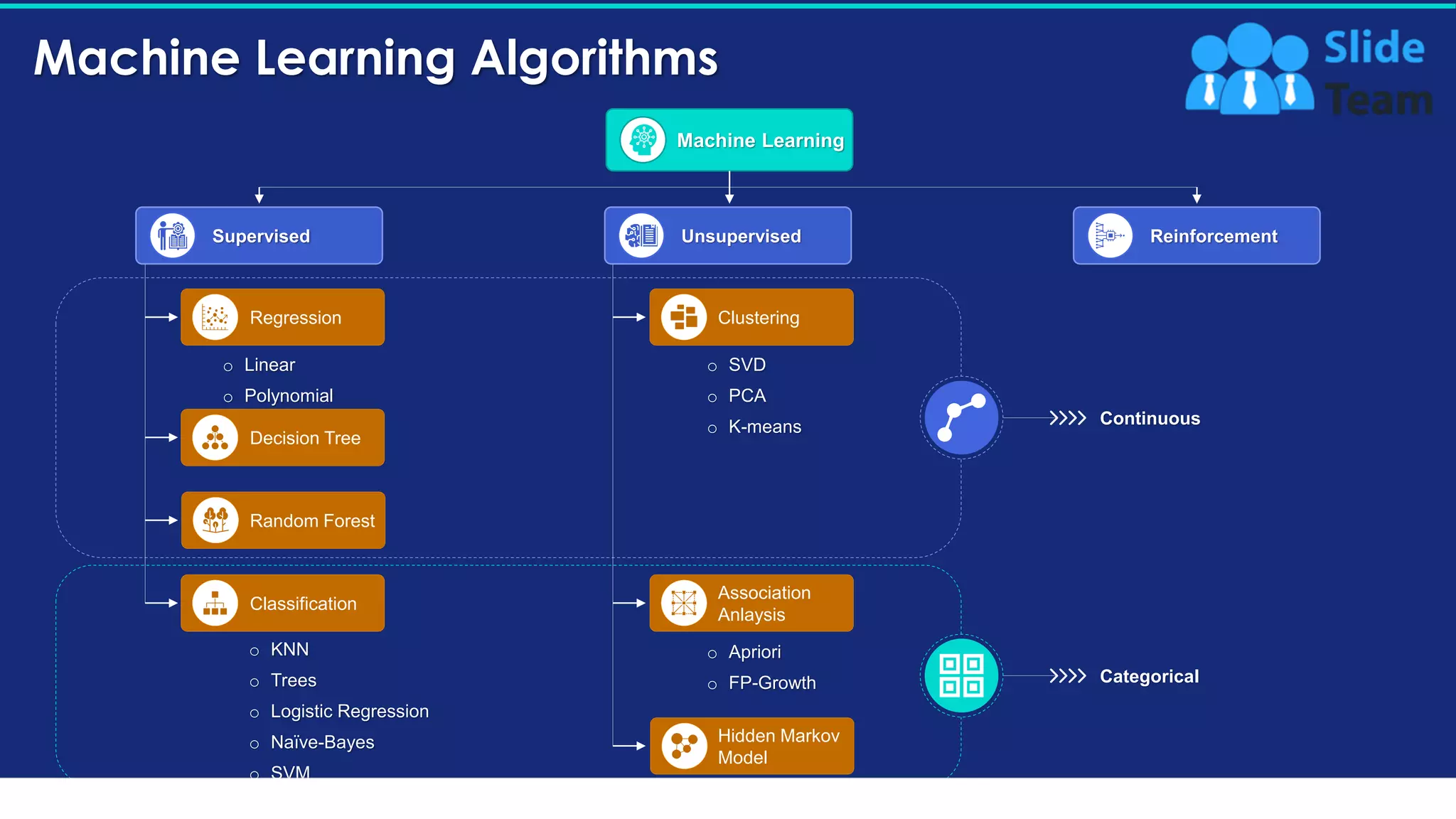
Machine Learning Algorithms
7
Machine Learning
o Linear
o Polynomial
o KNN
o Trees
o Logistic Regression
o Naïve-Bayes
o SVM
Regression
Decision Tree
Random Forest
Clustering
o SVD
o PCA
o K-means
o Apriori
o FP-Growth
Continuous
Categorical
Reinforcement
Classification
Association
Anlaysis
Hidden Markov
Model
Supervised Unsupervised
This slide is 100% editable. Adapt it to your needs and capture your audience's attention.
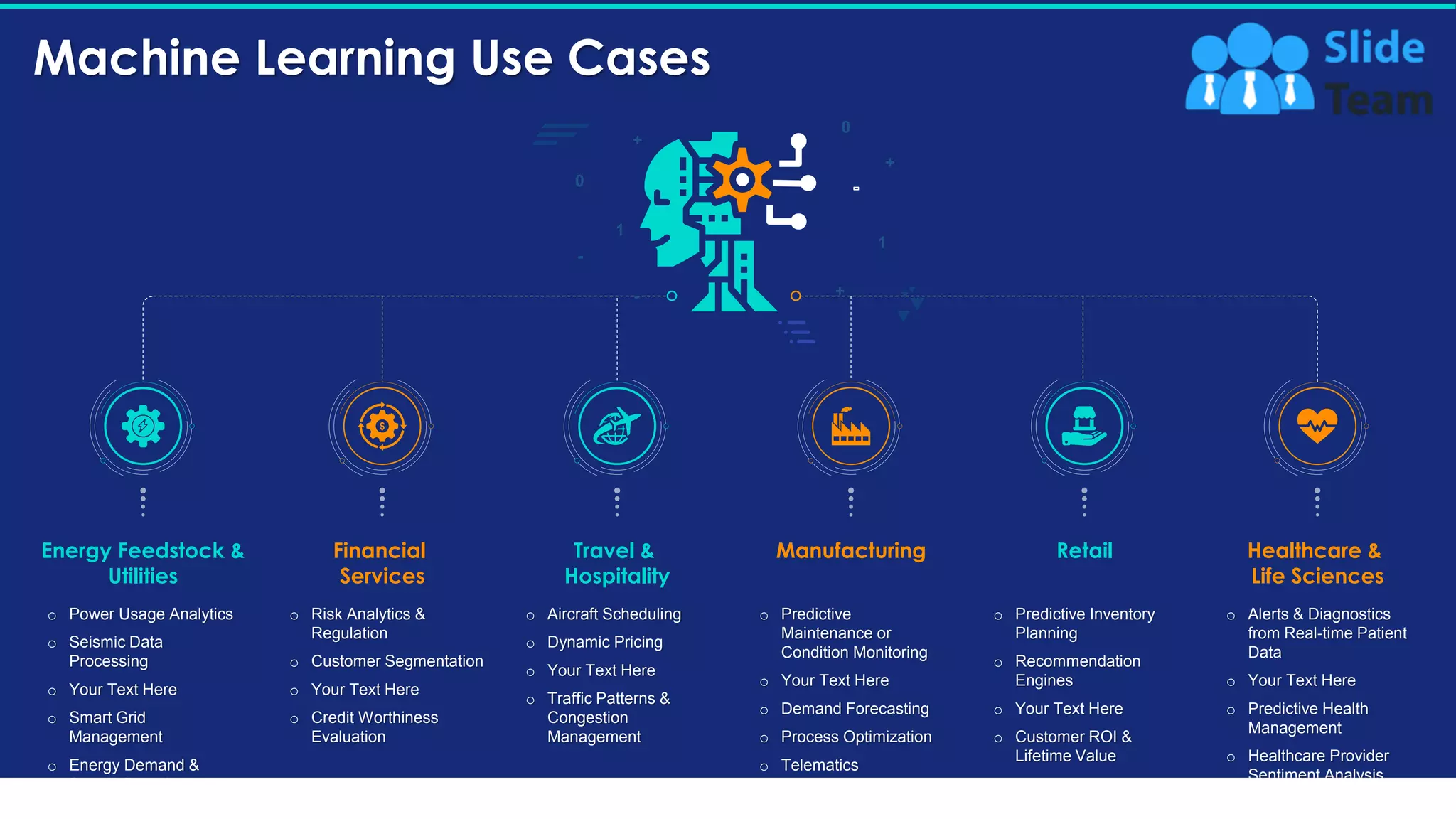
Machine Learning Use Cases
8
Energy Feedstock &
Utilities
o Power Usage Analytics
o Seismic Data
Processing
o Your Text Here
o Smart Grid
Management
o Energy Demand &
Supply Optimization
Financial
Services
o Risk Analytics &
Regulation
o Customer Segmentation
o Your Text Here
o Credit Worthiness
Evaluation
Travel &
Hospitality
o Aircraft Scheduling
o Dynamic Pricing
o Your Text Here
o Traffic Patterns &
Congestion
Management
Manufacturing
o Predictive
Maintenance or
Condition Monitoring
o Your Text Here
o Demand Forecasting
o Process Optimization
o Telematics
Retail
o Predictive Inventory
Planning
o Recommendation
Engines
o Your Text Here
o Customer ROI &
Lifetime Value
Healthcare &
Life Sciences
o Alerts & Diagnostics
from Real-time Patient
Data
o Your Text Here
o Predictive Health
Management
o Healthcare Provider
Sentiment Analysis
This slide is 100% editable. Adapt it to your needs and capture your audience's attention.
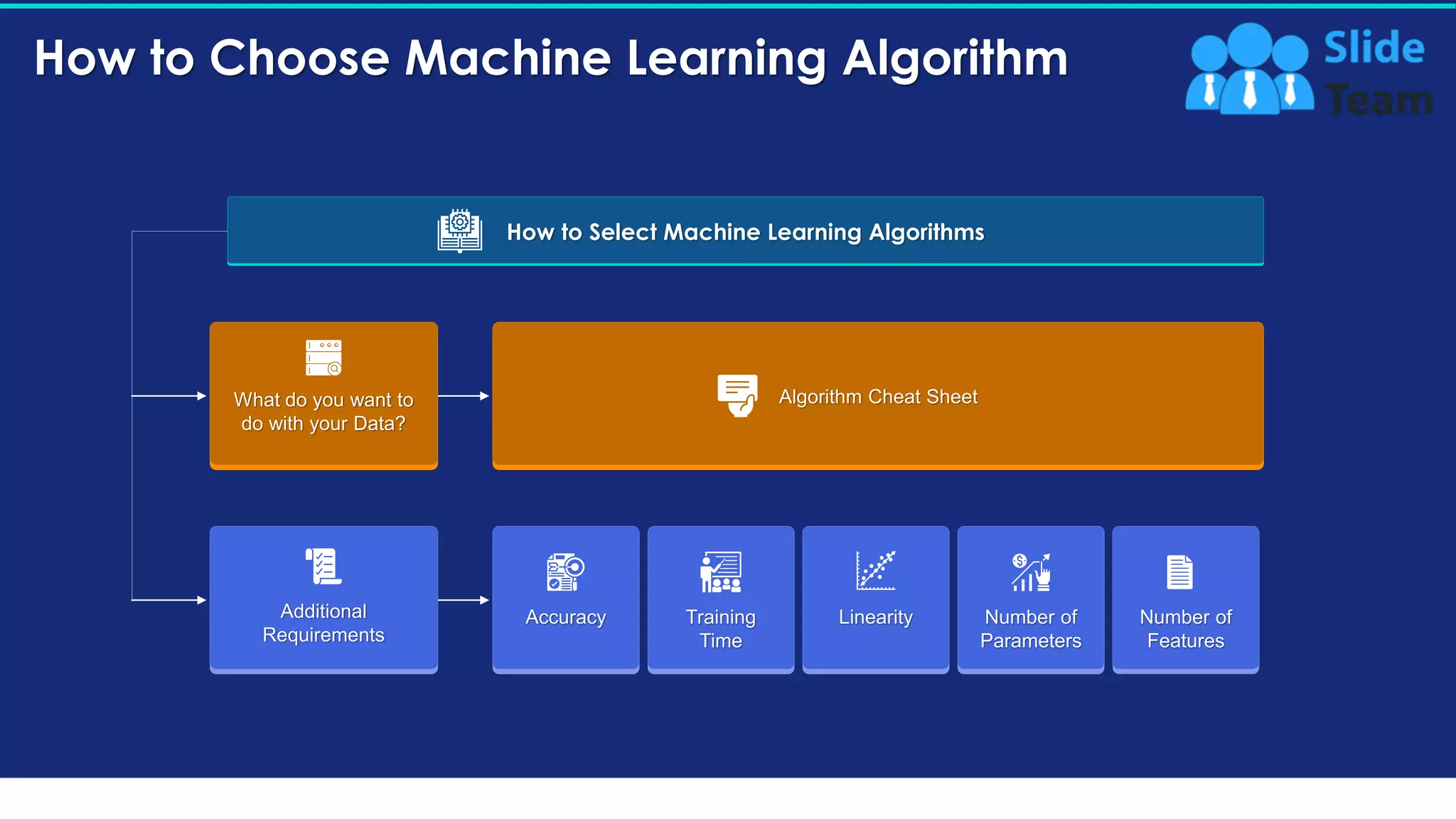
How to Choose Machine Learning Algorithm
9
How to Select Machine Learning Algorithms
What do you want to
do with your Data?
How to Select Machine Learning Algorithms
Algorithm Cheat Sheet
Additional
Requirements
Accuracy Linearity Number of
Parameters
Training
Time
Number of
Features
This slide is 100% editable. Adapt it to your needs and capture your audience's attention.
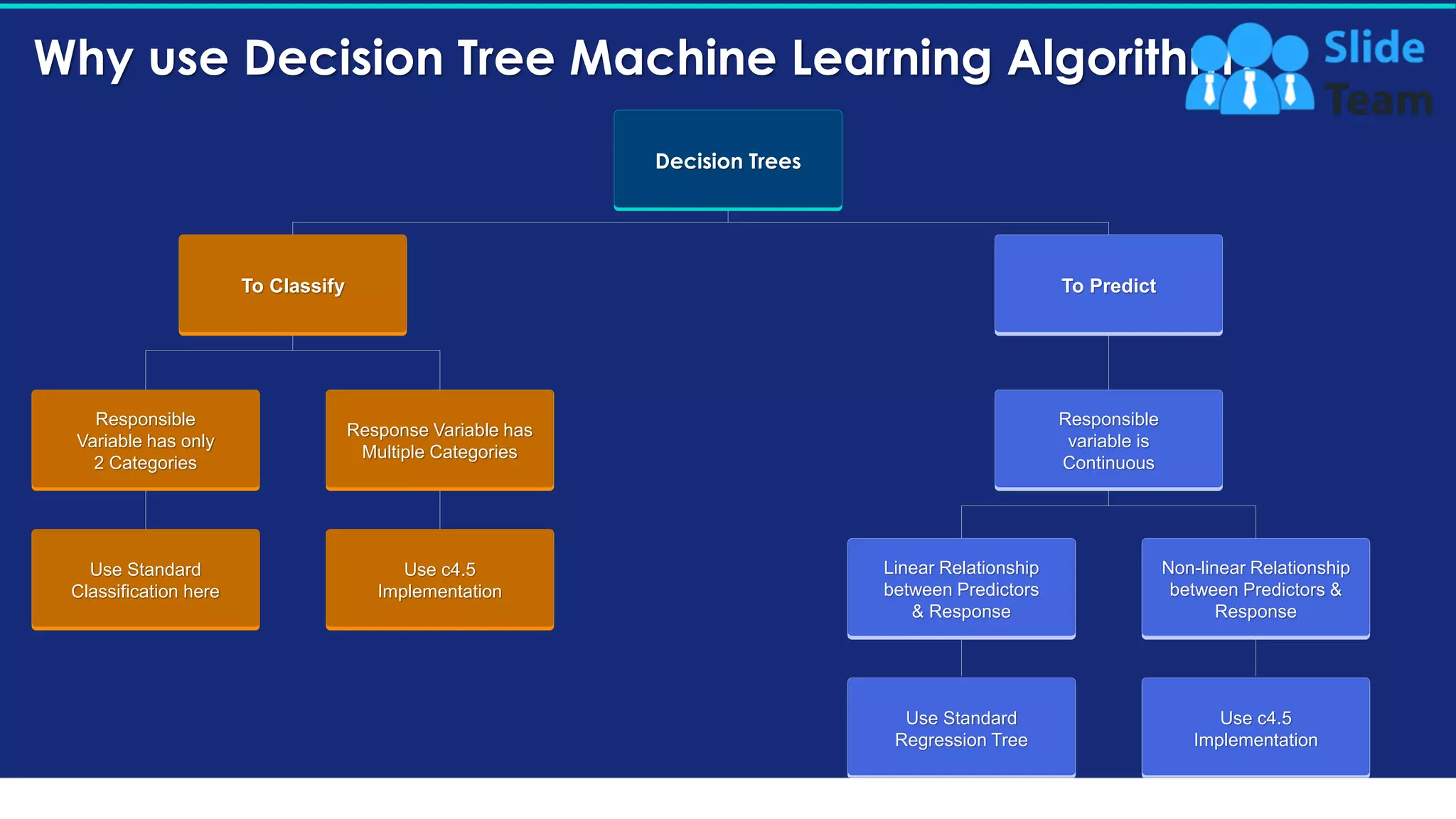
Why use Decision Tree Machine Learning Algorithm?
10
Decision Trees
To Classify
Decision Tree
Non-linear Relationship
between Predictors &
Response
Linear Relationship
between Predictors
& Response
Use c4.5
Implementation
Use Standard
Regression Tree
Responsible
Variable has only
2 Categories
Response Variable has
Multiple Categories
Use Standard
Classification here
Use c4.5
Implementation
To Predict
Responsible
variable is
Continuous
This slide is 100% editable. Adapt it to your needs and capture your audience's attention.
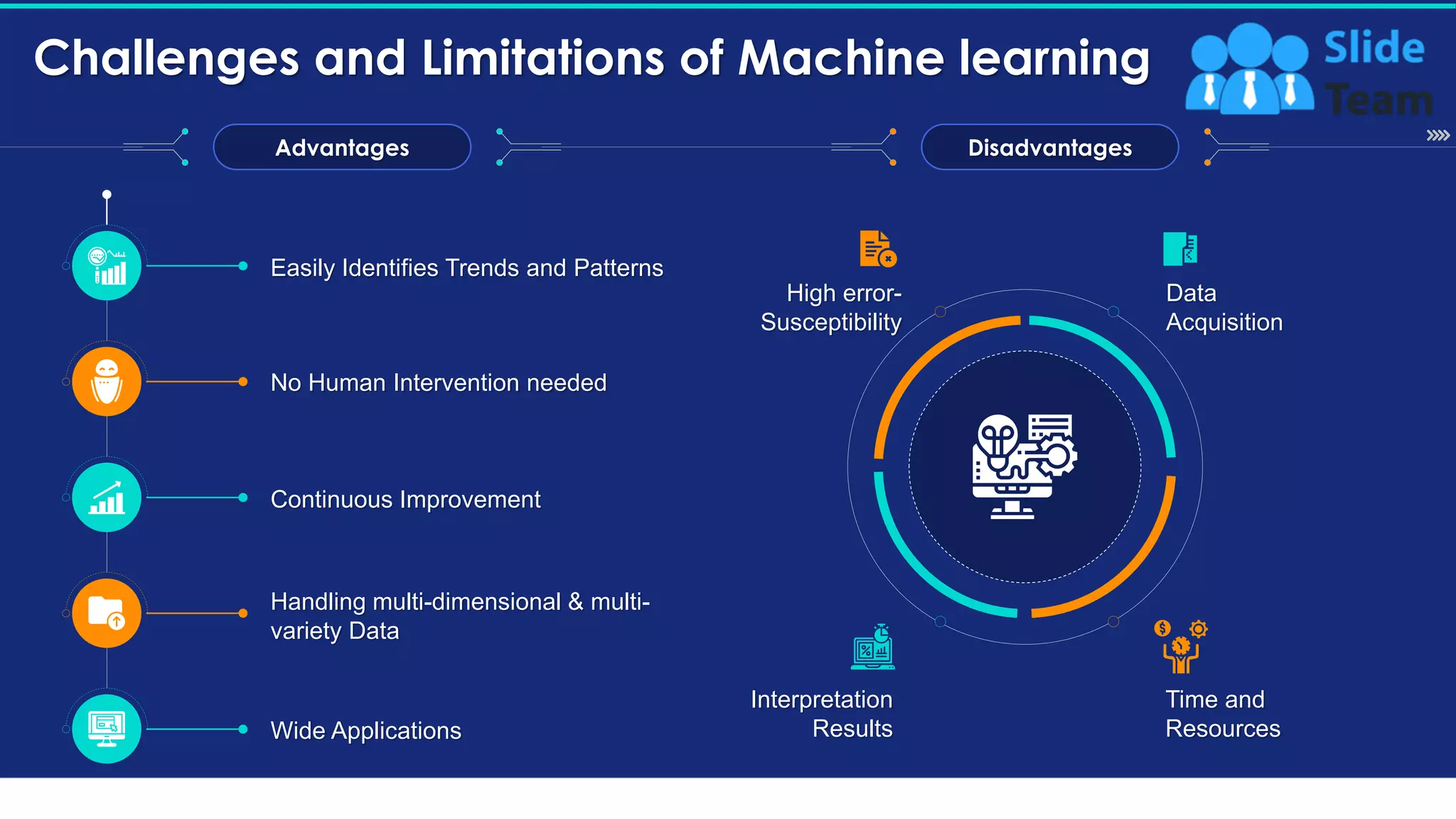
Challenges and Limitations of Machine learning
11
Advantages Disadvantages
Handling multi-dimensional & multi-
variety Data
Data
Acquisition
High error-
Susceptibility
Time and
Resources
Interpretation
Results
Easily Identifies Trends and Patterns
No Human Intervention needed
Continuous Improvement
Wide Applications
This slide is 100% editable. Adapt it to your needs and capture your audience's attention.
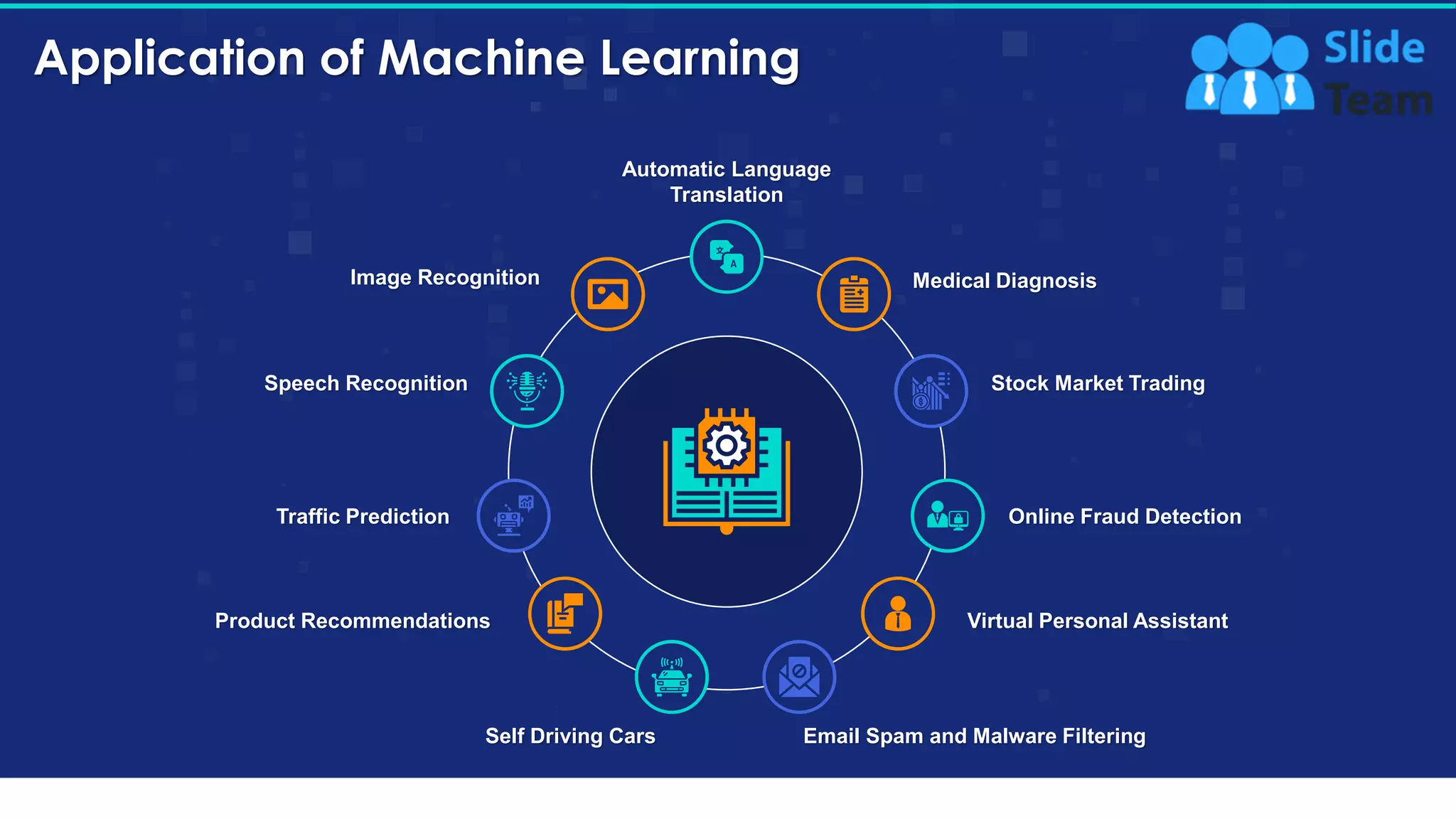
Application of Machine Learning
12
Automatic Language
Translation
Medical Diagnosis
Stock Market Trading
Online Fraud Detection
Virtual Personal Assistant
Email Spam and Malware Filtering
Self Driving Cars
Product Recommendations
Traffic Prediction
Speech Recognition
Image Recognition
This slide is 100% editable. Adapt it to your needs and capture your audience's attention.
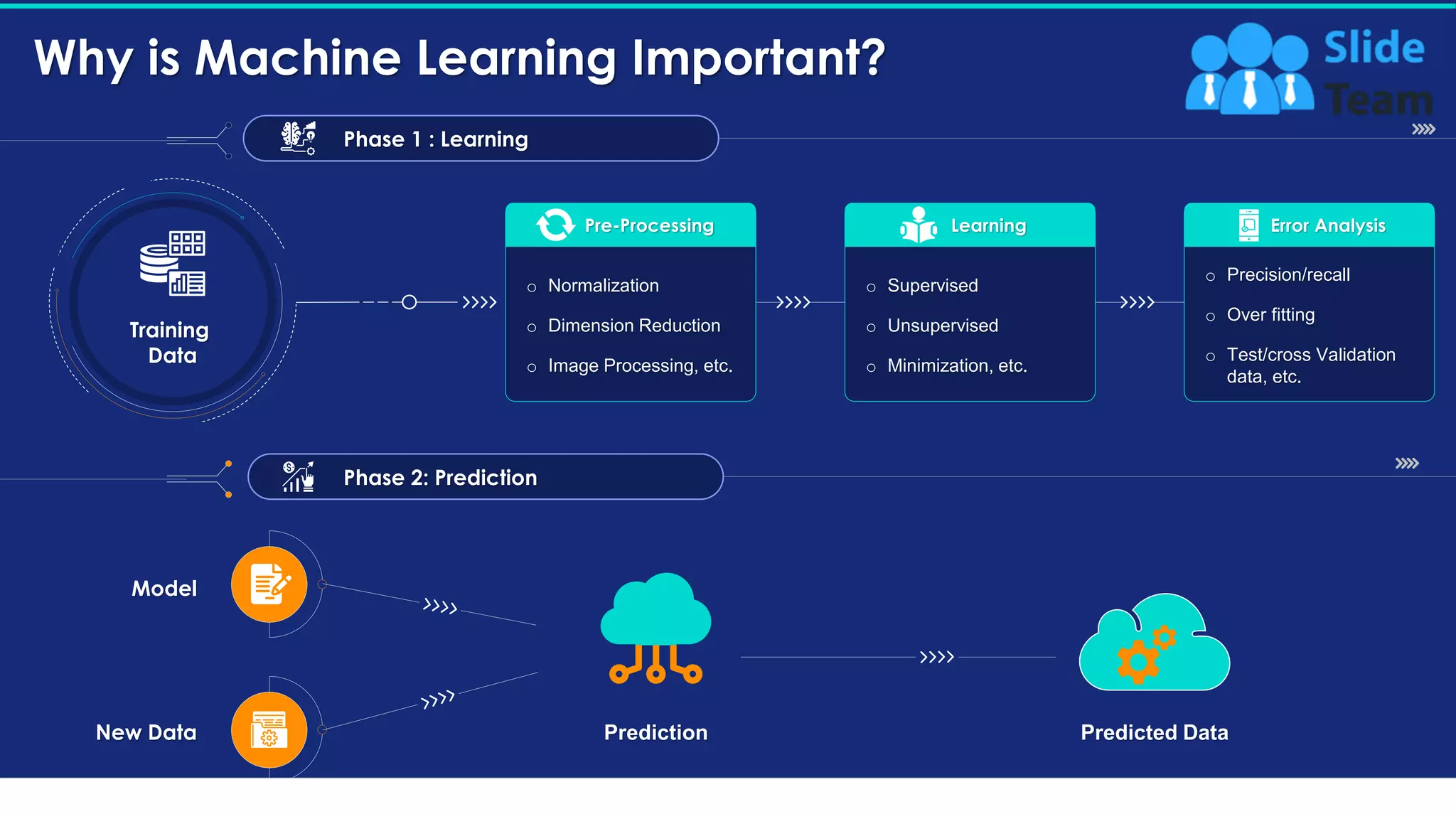
Why is Machine Learning Important?
13
Phase 1 : Learning
Training
Data
o Normalization
o Dimension Reduction
o Image Processing, etc.
Pre-Processing
o Supervised
o Unsupervised
o Minimization, etc.
o Precision/recall
o Over fitting
o Test/cross Validation
data, etc.
Error Analysis
Model
New Data
Learning
Predicted Data
Prediction
Phase 2: Prediction
This slide is 100% editable. Adapt it to your needs and capture your audience's attention.

Machine Learning Ml Overview Algorithms Use Cases And Applications

  • 1.
    Machine Learning MLOverview Algorithms Use Cases and Applications Your C ompany N ame
  • 2.
    2 Machine Learning 01 o Whatis Machine Learning? o 7 Steps of Machine learning o Machine Learning vs. Traditional Programming o How does machine learning work? o Machine learning Algorithms o Machine learning use cases o How to choose Machine Learning Algorithm o Why to use decision tree algorithm learning o Challenges and Limitations of Machine learning o Application of Machine learning o Why is machine learning important?
  • 3.
    Machine Learning 3 Machine Learningis the result of General AI that involves developing machines that can deliver results better than humans Traditional Programming Data (Input) Program Output Data (Input) Output Machine Learning Program This slide is 100% editable. Adapt it to your needs and capture your audience's attention. “Learning” Machine Learning System Input Data: Feed Learner Various Data Output Data: Present Rules
  • 4.
    7 Steps ofMachine Learning 4 Gathering Data Preparing that Data Choosing a Model Training Evaluation Hyperparameter Tuning Prediction This slide is 100% editable. Adapt it to your needs and capture your audience's attention.
  • 5.
    Machine Learning vs.Traditional Programming 5 Traditional Modelling Prediction Result Machine Learning Learning Model Prediction Result Computer New Data Model Sample Data Expected Result Data Handcrafted Model Computer Computer This slide is 100% editable. Adapt it to your needs and capture your audience's attention.
  • 6.
    How does MachineLearning Work? 6 Identify, the problem to be solved and create a clear objective. Define Objectives Preparing data is a crucial step and involves building workflows to clean, match and blend the data. Prepare Data Data is fed as input and the algorithm configured with the required parameters. A percent of the data can be utilized to train the model. Train Model Publish the prepared experiment as a web service, so applications can use the model. Integrate Model Collect data from hospitals, health insurance companies, social service agencies, police and fire dept. Collect Data Depend on the problem to be solved and the type of data an appropriate algorithm will be chosen. Select Algorithm The remaining data is utilized to test the model, for accuracy. Depending on the results, improvements, can be performed in the “Train model’ and/or “Select Algorithm” phases, iteratively. Test Model This slide is 100% editable. Adapt it to your needs and capture your audience's attention.
  • 7.
    Machine Learning Algorithms 7 MachineLearning o Linear o Polynomial o KNN o Trees o Logistic Regression o Naïve-Bayes o SVM Regression Decision Tree Random Forest Clustering o SVD o PCA o K-means o Apriori o FP-Growth Continuous Categorical Reinforcement Classification Association Anlaysis Hidden Markov Model Supervised Unsupervised This slide is 100% editable. Adapt it to your needs and capture your audience's attention.
  • 8.
    Machine Learning UseCases 8 Energy Feedstock & Utilities o Power Usage Analytics o Seismic Data Processing o Your Text Here o Smart Grid Management o Energy Demand & Supply Optimization Financial Services o Risk Analytics & Regulation o Customer Segmentation o Your Text Here o Credit Worthiness Evaluation Travel & Hospitality o Aircraft Scheduling o Dynamic Pricing o Your Text Here o Traffic Patterns & Congestion Management Manufacturing o Predictive Maintenance or Condition Monitoring o Your Text Here o Demand Forecasting o Process Optimization o Telematics Retail o Predictive Inventory Planning o Recommendation Engines o Your Text Here o Customer ROI & Lifetime Value Healthcare & Life Sciences o Alerts & Diagnostics from Real-time Patient Data o Your Text Here o Predictive Health Management o Healthcare Provider Sentiment Analysis This slide is 100% editable. Adapt it to your needs and capture your audience's attention.
  • 9.
    How to ChooseMachine Learning Algorithm 9 How to Select Machine Learning Algorithms What do you want to do with your Data? How to Select Machine Learning Algorithms Algorithm Cheat Sheet Additional Requirements Accuracy Linearity Number of Parameters Training Time Number of Features This slide is 100% editable. Adapt it to your needs and capture your audience's attention.
  • 10.
    Why use DecisionTree Machine Learning Algorithm? 10 Decision Trees To Classify Decision Tree Non-linear Relationship between Predictors & Response Linear Relationship between Predictors & Response Use c4.5 Implementation Use Standard Regression Tree Responsible Variable has only 2 Categories Response Variable has Multiple Categories Use Standard Classification here Use c4.5 Implementation To Predict Responsible variable is Continuous This slide is 100% editable. Adapt it to your needs and capture your audience's attention.
  • 11.
    Challenges and Limitationsof Machine learning 11 Advantages Disadvantages Handling multi-dimensional & multi- variety Data Data Acquisition High error- Susceptibility Time and Resources Interpretation Results Easily Identifies Trends and Patterns No Human Intervention needed Continuous Improvement Wide Applications This slide is 100% editable. Adapt it to your needs and capture your audience's attention.
  • 12.
    Application of MachineLearning 12 Automatic Language Translation Medical Diagnosis Stock Market Trading Online Fraud Detection Virtual Personal Assistant Email Spam and Malware Filtering Self Driving Cars Product Recommendations Traffic Prediction Speech Recognition Image Recognition This slide is 100% editable. Adapt it to your needs and capture your audience's attention.
  • 13.
    Why is MachineLearning Important? 13 Phase 1 : Learning Training Data o Normalization o Dimension Reduction o Image Processing, etc. Pre-Processing o Supervised o Unsupervised o Minimization, etc. o Precision/recall o Over fitting o Test/cross Validation data, etc. Error Analysis Model New Data Learning Predicted Data Prediction Phase 2: Prediction This slide is 100% editable. Adapt it to your needs and capture your audience's attention.