Overview
Problem Identification
Methods Adopted
 Color Segmentation
 Morphological Processing
 Template Matching
 EigenFaces
 Gender Classification
Color Segmentation
Use the color information
Two approaches:
 Global threshold in HSV and YCbCr space using set
of linear equations. Lot of overlap exists
(a) (b)
Clustering in (a) YCbCr and (b) V vs. H space. Red is non-face and
blue is face data
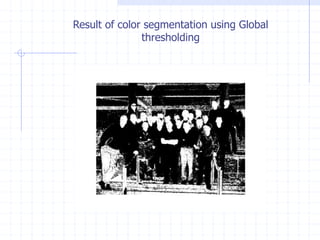
Result of color segmentation using Global
thresholding
Second approach involves RGB vector
quantization (Linde, Buzo, Gray)
 Use RGB as a 3-D vector and quantize the RGB
space for the face and non-face regions
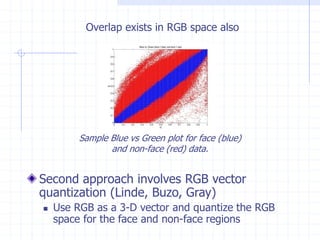
Overlap exists in RGB space also
Sample Blue vs Green plot for face (blue)
and non-face (red) data.
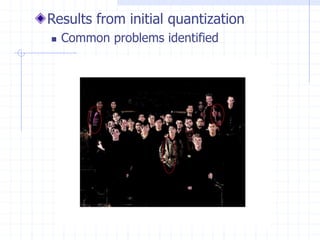
Results from initial quantization
 Common problems identified
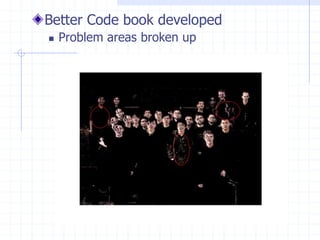
Better Code book developed
 Problem areas broken up
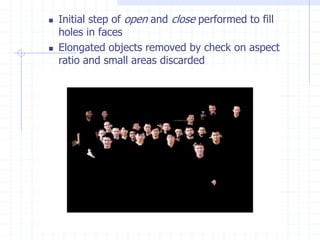
 Initial step of open and close performed to fill
holes in faces
 Elongated objects removed by check on aspect
ratio and small areas discarded
Morphological Processing
Segmented and processed Image
consists of all skin regions (face, arms
and fists)
Need to identify centers of all objects,
including individual faces among
connected faces
Repeated EROSION is done with
specific structuring element
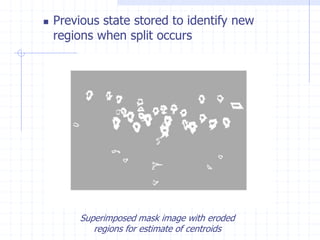
 Previous state stored to identify new
regions when split occurs
Superimposed mask image with eroded
regions for estimate of centroids
Template Matching
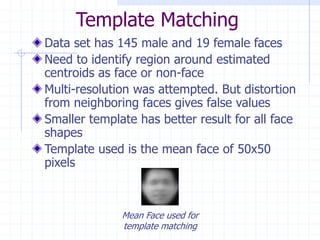
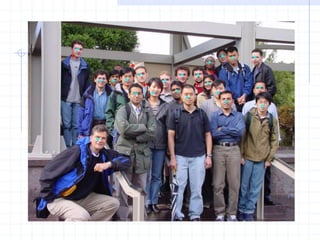
Data set has 145 male and 19 female faces
Need to identify region around estimated
centroids as face or non-face
Multi-resolution was attempted. But distortion
from neighboring faces gives false values
Smaller template has better result for all face
shapes
Template used is the mean face of 50x50
pixels
Mean Face used for
template matching
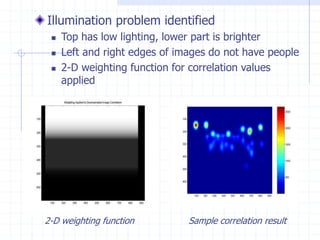
Illumination problem identified
 Top has low lighting, lower part is brighter
 Left and right edges of images do not have people
 2-D weighting function for correlation values
applied
2-D weighting function Sample correlation result
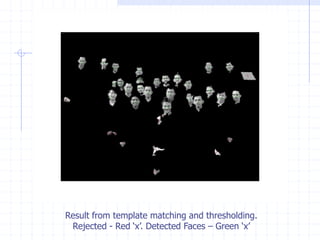
Result from template matching and thresholding.
Rejected - Red ‘x’. Detected Faces – Green ‘x’
EigenFace based detection
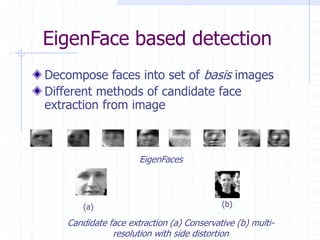
Decompose faces into set of basis images
Different methods of candidate face
extraction from image
EigenFaces
(a) (b)
Candidate face extraction (a) Conservative (b) multi-
resolution with side distortion
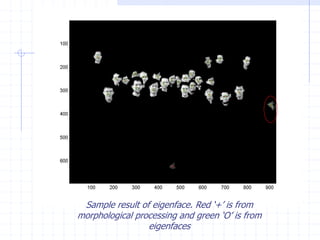
Sample result of eigenface. Red ‘+’ is from
morphological processing and green ‘O’ is from
eigenfaces
Minimum Distance between vector of
coefficients to that of the face dataset
was the metric.
It depends very much on spatial
similarity to trained dataset
Slight changes give incorrect results
Hence, only template matching was
used
Gender classification
 Eigenfaces and template matching for specific face features do
not yield good results
 Other features for specific females were used – the headband
 Template matching was performed for it
 Conservative estimate was done to prevent falsely identifying
males as a female
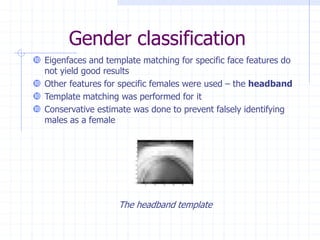
The headband template
Training
Image
Final
Score
Detect
Score
Number
Hits
Num
Repeat
Num
False
Positives
Distance Runtime Bonus
1 22 21 21 0 0 15.9311 71.91 1
2 22 21 23 0 2 13.6109 82.96 1
3 25 25 25 0 0 9.8625 80.48 0
4 22 22 24 0 2 11.3667 81.15 0
5 24 24 24 0 0 9.5960 69.59 0
6 23 23 23 0 0 11.5512 80.25 0
7 22 21 21 0 0 14.1537 71.52 1
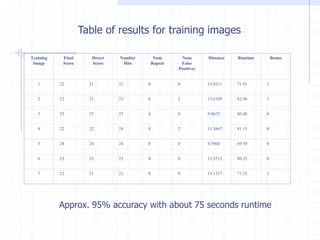
Table of results for training images
Approx. 95% accuracy with about 75 seconds runtime
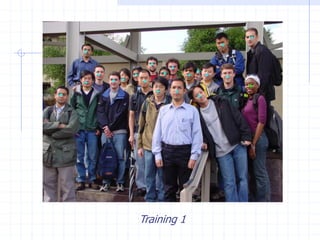
Training 1
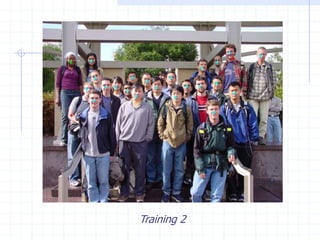
Training 2
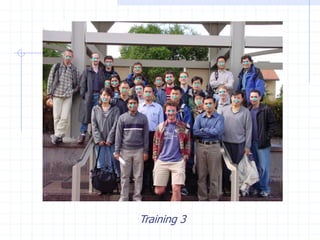
Training 3
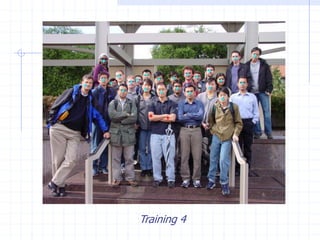
Training 4
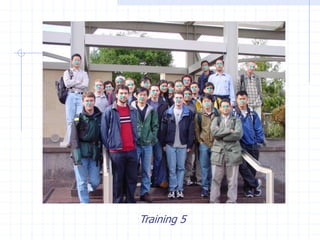
Training 5
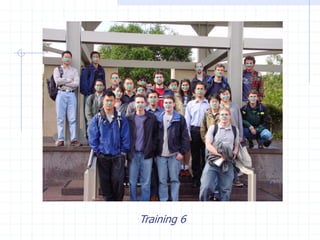
Training 6
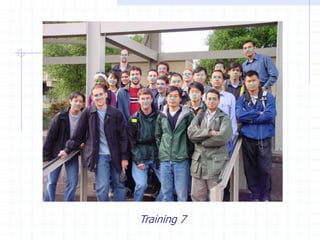
Training 7
Conclusion
RGB Vector Quantization gave excellent
segmentation
Morphological processing gave good
estimate of centroids
Template matching with illumination
correction gave near perfect results
Specific female was identified with
headband
Future Considerations
Edge detection to better separate the
connected faces
Preprocess the image in HSV space
before codebook comparison to improve
runtime
Improve rejection of highly correlated
non-face objects
Thank You
Questions ?
17
16
15
14
13
12
11
10
9
8
7
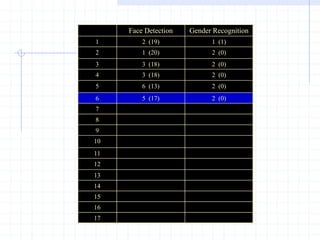
2 (0)
5 (17)
6
2 (0)
6 (13)
5
2 (0)
3 (18)
4
2 (0)
3 (18)
3
2 (0)
1 (20)
2
1 (1)
2 (19)
1
Gender Recognition
Face Detection
17
16
15
14
13
12
11
10
9
8
7
2 (0)
5 (17)
6
2 (0)
6 (13)
5
2 (0)
3 (18)
4
2 (0)
3 (18)
3
2 (0)
1 (20)
2
1 (1)
2 (19)
1
Gender Recognition
Face Detection

Machine learning Image classification for identification

  • 2.
    Overview Problem Identification Methods Adopted Color Segmentation  Morphological Processing  Template Matching  EigenFaces  Gender Classification
  • 3.
    Color Segmentation Use thecolor information Two approaches:  Global threshold in HSV and YCbCr space using set of linear equations. Lot of overlap exists (a) (b) Clustering in (a) YCbCr and (b) V vs. H space. Red is non-face and blue is face data
  • 4.
    Result of colorsegmentation using Global thresholding
  • 5.
    Second approach involvesRGB vector quantization (Linde, Buzo, Gray)  Use RGB as a 3-D vector and quantize the RGB space for the face and non-face regions Overlap exists in RGB space also Sample Blue vs Green plot for face (blue) and non-face (red) data.
  • 6.
    Results from initialquantization  Common problems identified
  • 7.
    Better Code bookdeveloped  Problem areas broken up
  • 8.
     Initial stepof open and close performed to fill holes in faces  Elongated objects removed by check on aspect ratio and small areas discarded
  • 9.
    Morphological Processing Segmented andprocessed Image consists of all skin regions (face, arms and fists) Need to identify centers of all objects, including individual faces among connected faces Repeated EROSION is done with specific structuring element
  • 10.
     Previous statestored to identify new regions when split occurs Superimposed mask image with eroded regions for estimate of centroids
  • 11.
    Template Matching Data sethas 145 male and 19 female faces Need to identify region around estimated centroids as face or non-face Multi-resolution was attempted. But distortion from neighboring faces gives false values Smaller template has better result for all face shapes Template used is the mean face of 50x50 pixels Mean Face used for template matching
  • 12.
    Illumination problem identified Top has low lighting, lower part is brighter  Left and right edges of images do not have people  2-D weighting function for correlation values applied 2-D weighting function Sample correlation result
  • 13.
    Result from templatematching and thresholding. Rejected - Red ‘x’. Detected Faces – Green ‘x’
  • 14.
    EigenFace based detection Decomposefaces into set of basis images Different methods of candidate face extraction from image EigenFaces (a) (b) Candidate face extraction (a) Conservative (b) multi- resolution with side distortion
  • 15.
    Sample result ofeigenface. Red ‘+’ is from morphological processing and green ‘O’ is from eigenfaces
  • 16.
    Minimum Distance betweenvector of coefficients to that of the face dataset was the metric. It depends very much on spatial similarity to trained dataset Slight changes give incorrect results Hence, only template matching was used
  • 17.
    Gender classification  Eigenfacesand template matching for specific face features do not yield good results  Other features for specific females were used – the headband  Template matching was performed for it  Conservative estimate was done to prevent falsely identifying males as a female The headband template
  • 18.
    Training Image Final Score Detect Score Number Hits Num Repeat Num False Positives Distance Runtime Bonus 122 21 21 0 0 15.9311 71.91 1 2 22 21 23 0 2 13.6109 82.96 1 3 25 25 25 0 0 9.8625 80.48 0 4 22 22 24 0 2 11.3667 81.15 0 5 24 24 24 0 0 9.5960 69.59 0 6 23 23 23 0 0 11.5512 80.25 0 7 22 21 21 0 0 14.1537 71.52 1 Table of results for training images Approx. 95% accuracy with about 75 seconds runtime
  • 19.
  • 20.
  • 21.
  • 22.
  • 23.
  • 24.
  • 25.
  • 26.
    Conclusion RGB Vector Quantizationgave excellent segmentation Morphological processing gave good estimate of centroids Template matching with illumination correction gave near perfect results Specific female was identified with headband
  • 27.
    Future Considerations Edge detectionto better separate the connected faces Preprocess the image in HSV space before codebook comparison to improve runtime Improve rejection of highly correlated non-face objects
  • 28.
  • 30.
    17 16 15 14 13 12 11 10 9 8 7 2 (0) 5 (17) 6 2(0) 6 (13) 5 2 (0) 3 (18) 4 2 (0) 3 (18) 3 2 (0) 1 (20) 2 1 (1) 2 (19) 1 Gender Recognition Face Detection 17 16 15 14 13 12 11 10 9 8 7 2 (0) 5 (17) 6 2 (0) 6 (13) 5 2 (0) 3 (18) 4 2 (0) 3 (18) 3 2 (0) 1 (20) 2 1 (1) 2 (19) 1 Gender Recognition Face Detection