Green Tech: How AI And Machine Learning Drive
Environmental Solutions
Our planet is in a severe condition. Disturbing figures provide a clear image:
during the past 170 years, humans have pushed an overwhelming amount of 2.4
trillion tons of carbon dioxide into our atmosphere. What’s even more worrying?
We have added half of this enormous amount in a short time span – from around
35 to 50 years ago. The effects are evident: the five warmest years ever measured
happened within the past 10 years. Scientists caution that if we do not reduce
greenhouse gas emissions, temperatures might increase by an alarming 10
degrees Fahrenheit before this century’s end.
Simple calculations may give us an understanding, but these numbers show a
different picture. The world’s climate is changing abruptly, and the outcomes for
our planet are grave. AI and its powerful subset ML offer hope as we deal with this
big problem. In this blog, “AI for Earth,” we will explore how individuals harness
cutting-edge technologies to tackle pressing environmental issues, offering hope
for a sustainable future.
How Machine Learning Can Help?
1. Monitoring And Prediction
● Supervised Learning: ML models can learn from supervised training using
annotated environmental data, such as satellite imagery demonstrating
deforestation or air quality measurements revealing pollution levels. This
enables the models to classify novel information and forecast
environmental transformations or recognize recurring trends.
● Unsupervised Learning: Methods such as grouping and anomaly finding
make it possible to study untagged environmental data. This helps identify
patterns, tendencies, and anomalies without any previous understanding of
them. Such methods might assist in finding fresh knowledge and revealing
hidden connections in complex ecological datasets.
● Time Series Analysis: To study time series data, we can use recurrent neural
networks (RNNs) and long short-term memory (LSTM) networks. These
methods are especially good at analyzing sequences of data. They are
suitable for making models and forecasts in many areas that involve
environmental time series data like climate patterns, weather patterns, and
emissions trends among others.
2. Optimization And Efficiency
● Reinforcement Learning: ML agents have the capability to be trained in
reinforcement learning, allowing them to enhance their decision-making
abilities by engaging in successive trials and errors within simulated or
actual environments. This technique can optimize vital systems such as
energy management, transportation networks, and resource allocation
strategies.
● Constraint Optimization: Constraint optimization can be applied using ML
techniques like genetic algorithms and simulated annealing. It helps in
finding the best solutions by taking into account different restrictions such
as available resources, emission limits, and cost factors.
● Predictive Modeling: ML models can be trained in predictive modeling,
allowing for anticipation of future outcomes by analyzing past data and
present conditions. This foresight can, in turn, inform optimization
strategies, such as forecasting consumer demand for energy systems or
predicting crop yield for sustainable agriculture practices.
3. Decision-Making And Solutions
● Explainable AI (XAI): XAI can enhance transparency and interpretability for
ML models, facilitating a deeper comprehension of complex trade-offs and
stakeholder interests inherent in environmental decision-making processes.
As a result, XAI techniques instill greater confidence and trust in the
proposed solutions.
● Ensemble Learning: Ensemble learning harnesses the capabilities of various
ML models to enhance the precision and resilience of anticipations or
determinations about ecological predicaments.
● Simulation And Scenario Modeling: By combining ML models with
simulation and scenario modeling tools, the ability to assess the effects of
various environmental policies, interventions, and events is enhanced. This
empowers evidence-based decision-making and risk evaluation.
Applications In Action
1. Predicting Wildfires
Annually, approximately 400 million hectares of wooded regions are engulfed by
wildfires across the globe. Humans ignite 90% of these devastating events, while
natural factors contribute to the remaining 10%. Experts use advanced ML
techniques to analyze climate conditions, flora arrangements, and past infernos to
predict future blazes.
These models use data from satellites, weather stations, and ground sensors in
real-time to support early warning systems and facilitate resource allocation for
firefighting operations and evacuation strategies.
2. Optimizing Energy Grids
It is estimated that, by 2032, the market for AI in renewable energy will cross
above $114.87 billion, growing with a CAGR of 27.70% from 2023. Techniques of
ML will be used to incorporate renewable energy sources into the power grid; it
does this by predicting energy demand, based on weather and forecasting
generation to make sure there is balanced load distribution across the grid. This is
optimization that can be a real help in maxing out the use of green energy
sources, ensuring grid stability, and cutting back on old-school fossil fuels.
3. Monitoring Deforestation
Sophisticated ML algorithms analyze satellite imagery and remote sensing data to
detect and monitor deforestation patterns. These models can identify illegal
logging, track changes in forest cover over time, and prioritize conservation
efforts. This is crucial because forests cover 31% of the Earth’s surface, house 80%
of terrestrial species, and support the livelihoods of 1.6 billion people. Moreover,
ML can be employed to forecast forthcoming perils of deforestation considering
variables such as population expansion, economic endeavors, and atmospheric
trends.
4. Tracking Wildlife Populations
Rainforest Connection, a Texas-based NGO, employs AI to combat wildlife
poaching in Africa. Through ML models, individuals actively train the technology
to identify and count various species from camera trap footage or aerial images.
This method enables scientists to closely monitor changes over time and identify
potential threats to endangered animals.
5. Optimizing Waste Collection
The US holds the title of global waste contributor, producing a staggering 1,609
pounds of trash per person each year. Astonishingly, only 5% of the world’s
population is responsible for discarding 40% of all garbage. Americans alone throw
away an astonishing 2 billion plastic razors, one and a half million tons of paper
towels, and an unbelievable 12 billion disposable diapers annually.
This level of wastefulness is truly mind-blowing! ML algorithms enable the
optimization of waste collection routes and schedules by analyzing sensor data,
historical trends, and current traffic information. This approach effectively reduces
fuel consumption, emissions, and operating expenses tied to waste collection
services.
6. AI-Powered Sorting Machines
In 2016, global data reported a staggering 2.1 billion tons of municipal solid waste
produced. Projections anticipate this to surge to 3.4 billion tons by 2050. AI
accurately detects and organizes waste with an estimation ranging from 72.8% to
almost perfect precision at 99.95%.
Recycling facilities now implement cutting-edge sorting technology powered by
ML algorithms that distinguish and classify materials like plastics, metals, and
paper precisely. These innovative machines utilize computer vision and
spectroscopy methodologies to scrutinize waste substances, enabling expedient
recycling procedures while reducing material sent to landfills.
Conclusion
The situation is grave, but there’s hope. ML is a powerful toolkit for battling
environmental challenges, from watching out for deforestation to smart energy
grids. ML applications are making a difference. This series has featured some of
the applications of ML in environmental sustainability – proof of what “AI for
Earth” is all about. As we continue to develop these technologies, we could unlock
a future where human ingenuity and AI work in harmony to heal our planet.
Unlock the power of ML for environmental sustainability with EnFuse Solutions.
Contact our team of specialists to discover how we can assist your organization in
utilizing cutting-edge ML techniques to monitor shifts in the environment,
enhance resource utilization, and devise groundbreaking solutions for urgent
environmental obstacles. Our ML-driven methods can bolster your sustainability
efforts, minimize your environmental impact, and contribute to an eco-friendlier
future.
Read More: Safeguarding Our Planet: The Role Of AI And ML In Climate
Resilience

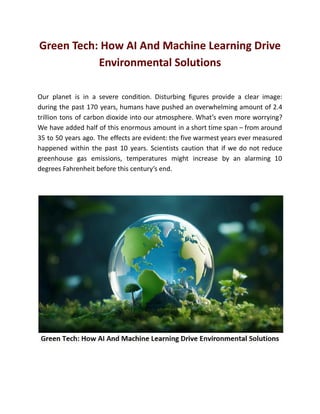
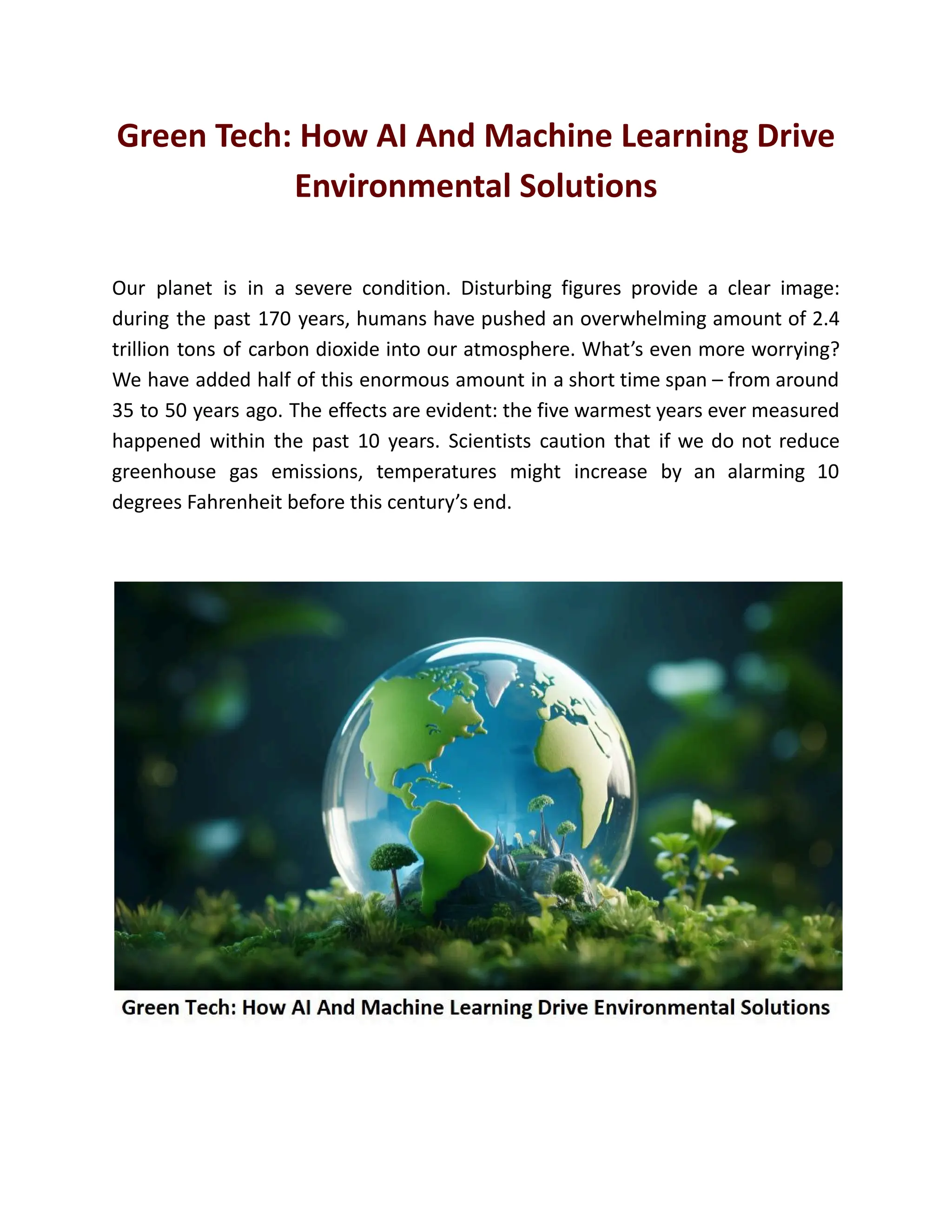
Green Tech: How AI And Machine Learning Drive Environmental Solutions

  • 1.
    Green Tech: HowAI And Machine Learning Drive Environmental Solutions Our planet is in a severe condition. Disturbing figures provide a clear image: during the past 170 years, humans have pushed an overwhelming amount of 2.4 trillion tons of carbon dioxide into our atmosphere. What’s even more worrying? We have added half of this enormous amount in a short time span – from around 35 to 50 years ago. The effects are evident: the five warmest years ever measured happened within the past 10 years. Scientists caution that if we do not reduce greenhouse gas emissions, temperatures might increase by an alarming 10 degrees Fahrenheit before this century’s end.
  • 2.
    Simple calculations maygive us an understanding, but these numbers show a different picture. The world’s climate is changing abruptly, and the outcomes for our planet are grave. AI and its powerful subset ML offer hope as we deal with this big problem. In this blog, “AI for Earth,” we will explore how individuals harness cutting-edge technologies to tackle pressing environmental issues, offering hope for a sustainable future. How Machine Learning Can Help? 1. Monitoring And Prediction ● Supervised Learning: ML models can learn from supervised training using annotated environmental data, such as satellite imagery demonstrating deforestation or air quality measurements revealing pollution levels. This enables the models to classify novel information and forecast environmental transformations or recognize recurring trends. ● Unsupervised Learning: Methods such as grouping and anomaly finding make it possible to study untagged environmental data. This helps identify patterns, tendencies, and anomalies without any previous understanding of them. Such methods might assist in finding fresh knowledge and revealing hidden connections in complex ecological datasets. ● Time Series Analysis: To study time series data, we can use recurrent neural networks (RNNs) and long short-term memory (LSTM) networks. These methods are especially good at analyzing sequences of data. They are suitable for making models and forecasts in many areas that involve environmental time series data like climate patterns, weather patterns, and emissions trends among others.
  • 3.
    2. Optimization AndEfficiency ● Reinforcement Learning: ML agents have the capability to be trained in reinforcement learning, allowing them to enhance their decision-making abilities by engaging in successive trials and errors within simulated or actual environments. This technique can optimize vital systems such as energy management, transportation networks, and resource allocation strategies. ● Constraint Optimization: Constraint optimization can be applied using ML techniques like genetic algorithms and simulated annealing. It helps in finding the best solutions by taking into account different restrictions such as available resources, emission limits, and cost factors. ● Predictive Modeling: ML models can be trained in predictive modeling, allowing for anticipation of future outcomes by analyzing past data and present conditions. This foresight can, in turn, inform optimization strategies, such as forecasting consumer demand for energy systems or predicting crop yield for sustainable agriculture practices. 3. Decision-Making And Solutions ● Explainable AI (XAI): XAI can enhance transparency and interpretability for ML models, facilitating a deeper comprehension of complex trade-offs and stakeholder interests inherent in environmental decision-making processes. As a result, XAI techniques instill greater confidence and trust in the proposed solutions. ● Ensemble Learning: Ensemble learning harnesses the capabilities of various ML models to enhance the precision and resilience of anticipations or determinations about ecological predicaments. ● Simulation And Scenario Modeling: By combining ML models with simulation and scenario modeling tools, the ability to assess the effects of various environmental policies, interventions, and events is enhanced. This empowers evidence-based decision-making and risk evaluation.
  • 4.
    Applications In Action 1.Predicting Wildfires Annually, approximately 400 million hectares of wooded regions are engulfed by wildfires across the globe. Humans ignite 90% of these devastating events, while natural factors contribute to the remaining 10%. Experts use advanced ML techniques to analyze climate conditions, flora arrangements, and past infernos to predict future blazes. These models use data from satellites, weather stations, and ground sensors in real-time to support early warning systems and facilitate resource allocation for firefighting operations and evacuation strategies. 2. Optimizing Energy Grids It is estimated that, by 2032, the market for AI in renewable energy will cross above $114.87 billion, growing with a CAGR of 27.70% from 2023. Techniques of ML will be used to incorporate renewable energy sources into the power grid; it does this by predicting energy demand, based on weather and forecasting generation to make sure there is balanced load distribution across the grid. This is optimization that can be a real help in maxing out the use of green energy sources, ensuring grid stability, and cutting back on old-school fossil fuels. 3. Monitoring Deforestation Sophisticated ML algorithms analyze satellite imagery and remote sensing data to detect and monitor deforestation patterns. These models can identify illegal logging, track changes in forest cover over time, and prioritize conservation efforts. This is crucial because forests cover 31% of the Earth’s surface, house 80% of terrestrial species, and support the livelihoods of 1.6 billion people. Moreover, ML can be employed to forecast forthcoming perils of deforestation considering variables such as population expansion, economic endeavors, and atmospheric trends.
  • 5.
    4. Tracking WildlifePopulations Rainforest Connection, a Texas-based NGO, employs AI to combat wildlife poaching in Africa. Through ML models, individuals actively train the technology to identify and count various species from camera trap footage or aerial images. This method enables scientists to closely monitor changes over time and identify potential threats to endangered animals. 5. Optimizing Waste Collection The US holds the title of global waste contributor, producing a staggering 1,609 pounds of trash per person each year. Astonishingly, only 5% of the world’s population is responsible for discarding 40% of all garbage. Americans alone throw away an astonishing 2 billion plastic razors, one and a half million tons of paper towels, and an unbelievable 12 billion disposable diapers annually. This level of wastefulness is truly mind-blowing! ML algorithms enable the optimization of waste collection routes and schedules by analyzing sensor data, historical trends, and current traffic information. This approach effectively reduces fuel consumption, emissions, and operating expenses tied to waste collection services. 6. AI-Powered Sorting Machines In 2016, global data reported a staggering 2.1 billion tons of municipal solid waste produced. Projections anticipate this to surge to 3.4 billion tons by 2050. AI accurately detects and organizes waste with an estimation ranging from 72.8% to almost perfect precision at 99.95%. Recycling facilities now implement cutting-edge sorting technology powered by ML algorithms that distinguish and classify materials like plastics, metals, and paper precisely. These innovative machines utilize computer vision and spectroscopy methodologies to scrutinize waste substances, enabling expedient recycling procedures while reducing material sent to landfills.
  • 6.
    Conclusion The situation isgrave, but there’s hope. ML is a powerful toolkit for battling environmental challenges, from watching out for deforestation to smart energy grids. ML applications are making a difference. This series has featured some of the applications of ML in environmental sustainability – proof of what “AI for Earth” is all about. As we continue to develop these technologies, we could unlock a future where human ingenuity and AI work in harmony to heal our planet. Unlock the power of ML for environmental sustainability with EnFuse Solutions. Contact our team of specialists to discover how we can assist your organization in utilizing cutting-edge ML techniques to monitor shifts in the environment, enhance resource utilization, and devise groundbreaking solutions for urgent environmental obstacles. Our ML-driven methods can bolster your sustainability efforts, minimize your environmental impact, and contribute to an eco-friendlier future. Read More: Safeguarding Our Planet: The Role Of AI And ML In Climate Resilience