Machine Learning Application:
Credit Scoring
Programming Techniques
Professor Carlos Costa
Master in Mathematical Finance
Federico Innocenti 53251
Miguel Albergaria 48547
Claudio Napoli 53358
Iacopo Fiorentino 53315 Lisbon, December 11th
2019
Context
► The data is collected from Thomson Reuters from firms
included in the main stock indexes.
► The goal is to set a score of a company to decide
whether to give a loan or not to that firm based on a
client’s probability of default.
► For that we compute many ratios and at the end we
want to “differentiate winners from losers”.
Data preparation
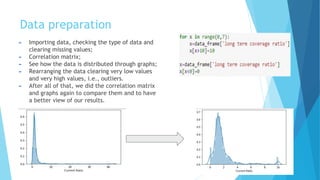
► Importing data, checking the type of data and
clearing missing values;
► Correlation matrix;
► See how the data is distributed through graphs;
► Rearranging the data clearing very low values
and very high values, i.e., outliers.
► After all of that, we did the correlation matrix
and graphs again to compare them and to have
a better view of our results.
Modelling data
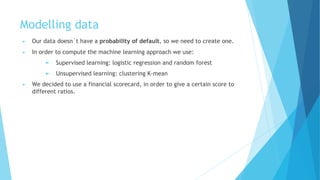
► Our data doesn´t have a probability of default, so we need to create one.
► In order to compute the machine learning approach we use:
► Supervised learning: logistic regression and random forest
► Unsupervised learning: clustering K-mean
► We decided to use a financial scorecard, in order to give a certain score to
different ratios.
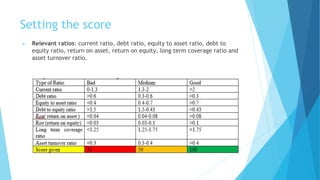
Setting the score
► Relevant ratios: current ratio, debt ratio, equity to asset ratio, debt to
equity ratio, return on asset, return on equity, long term coverage ratio and
asset turnover ratio.
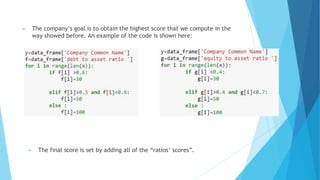
► The company’s goal is to obtain the highest score that we compute in the
way showed before. An example of the code is shown here:
► The final score is set by adding all of the “ratios’ scores”.
Evaluation
► For the evaluation of our model we compute a confusion matrix in order to
see the result and have an easier first parametre to compare the three
models.
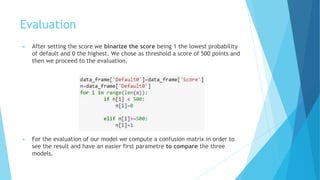
► After setting the score we binarize the score being 1 the lowest probability
of default and 0 the highest. We chose as threshold a score of 500 points and
then we proceed to the evaluation.
Logistic Regression
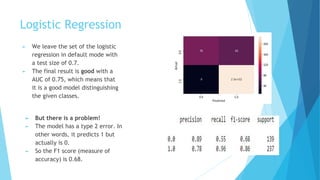
► We leave the set of the logistic
regression in default mode with
a test size of 0.7.
► The final result is good with a
AUC of 0.75, which means that
it is a good model distinguishing
the given classes.
► But there is a problem!
► The model has a type 2 error. In
other words, it predicts 1 but
actually is 0.
► So the F1 score (measure of
accuracy) is 0.68.
Random Forest
► In order to optimize the process we put the “number of jobs” 150 and the
“number of estimators” is 1 since it is a binomial classification.
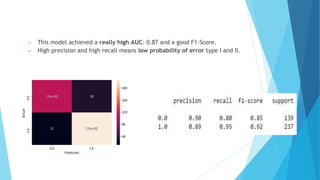
► This model achieved a really high AUC: 0.87 and a good F1-Score.
► High precision and high recall means low probability of error type I and II.
K-Mean
► We increased the number of iterations to 400 times in order to optimize this
model and to try to get more stable results.
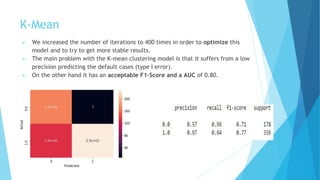
► The main problem with the K-mean clustering model is that it suffers from a low
precision predicting the default cases (type I error).
► On the other hand it has an acceptable F1-Score and a AUC of 0.80.
Conclusions
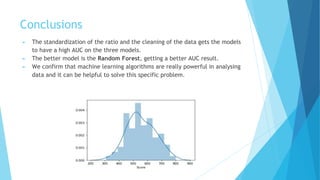
► The standardization of the ratio and the cleaning of the data gets the models
to have a high AUC on the three models.
► The better model is the Random Forest, getting a better AUC result.
► We confirm that machine learning algorithms are really powerful in analysing
data and it can be helpful to solve this specific problem.

Machine Learning Application: Credit Scoring

  • 1.
    Machine Learning Application: CreditScoring Programming Techniques Professor Carlos Costa Master in Mathematical Finance Federico Innocenti 53251 Miguel Albergaria 48547 Claudio Napoli 53358 Iacopo Fiorentino 53315 Lisbon, December 11th 2019
  • 2.
    Context ► The datais collected from Thomson Reuters from firms included in the main stock indexes. ► The goal is to set a score of a company to decide whether to give a loan or not to that firm based on a client’s probability of default. ► For that we compute many ratios and at the end we want to “differentiate winners from losers”.
  • 3.
    Data preparation ► Importingdata, checking the type of data and clearing missing values; ► Correlation matrix; ► See how the data is distributed through graphs; ► Rearranging the data clearing very low values and very high values, i.e., outliers. ► After all of that, we did the correlation matrix and graphs again to compare them and to have a better view of our results.
  • 4.
    Modelling data ► Ourdata doesn´t have a probability of default, so we need to create one. ► In order to compute the machine learning approach we use: ► Supervised learning: logistic regression and random forest ► Unsupervised learning: clustering K-mean ► We decided to use a financial scorecard, in order to give a certain score to different ratios.
  • 5.
    Setting the score ►Relevant ratios: current ratio, debt ratio, equity to asset ratio, debt to equity ratio, return on asset, return on equity, long term coverage ratio and asset turnover ratio.
  • 6.
    ► The company’sgoal is to obtain the highest score that we compute in the way showed before. An example of the code is shown here: ► The final score is set by adding all of the “ratios’ scores”.
  • 7.
    Evaluation ► For theevaluation of our model we compute a confusion matrix in order to see the result and have an easier first parametre to compare the three models. ► After setting the score we binarize the score being 1 the lowest probability of default and 0 the highest. We chose as threshold a score of 500 points and then we proceed to the evaluation.
  • 8.
    Logistic Regression ► Weleave the set of the logistic regression in default mode with a test size of 0.7. ► The final result is good with a AUC of 0.75, which means that it is a good model distinguishing the given classes. ► But there is a problem! ► The model has a type 2 error. In other words, it predicts 1 but actually is 0. ► So the F1 score (measure of accuracy) is 0.68.
  • 9.
    Random Forest ► Inorder to optimize the process we put the “number of jobs” 150 and the “number of estimators” is 1 since it is a binomial classification.
  • 10.
    ► This modelachieved a really high AUC: 0.87 and a good F1-Score. ► High precision and high recall means low probability of error type I and II.
  • 11.
    K-Mean ► We increasedthe number of iterations to 400 times in order to optimize this model and to try to get more stable results. ► The main problem with the K-mean clustering model is that it suffers from a low precision predicting the default cases (type I error). ► On the other hand it has an acceptable F1-Score and a AUC of 0.80.
  • 12.
    Conclusions ► The standardizationof the ratio and the cleaning of the data gets the models to have a high AUC on the three models. ► The better model is the Random Forest, getting a better AUC result. ► We confirm that machine learning algorithms are really powerful in analysing data and it can be helpful to solve this specific problem.