WEEK 4 - Beginning With Machine Learning_020418.pptx
1.
COMP 313 :DataMining and Warehouse
Beginning with Machine Learning
2.
LEARNING OBJECTIVES
• Tounderstand the concept of machine learning and its
applications.
• To understand what are supervised and unsupervised machine
learning strategies.
• To understand the concept of regression and classification.
• To identify the strategy to be applied to a given problem.
3.
Introduction to MachineLearning
• Machine Learning is the field of study that gives computers the ability to
learn without being explicitly programmed.
• Machine Learning (ML) has emerged as the most extensively used tool for
web-sites to classify surfers and address them appropriately.
• Machine learning is used by search engines such as Google and Bing to
rank web pages or to decide which advertisement to show to which user.
• The aim of machine learning is to build an Artificial Intelligence (AI)
platform that could be as intelligent as the human mind.
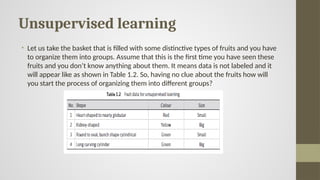
4.
Applications of MachineLearning
• Virtual Personal Assistants:
There are many Virtual Personal Assistants such as Siri, Alexa, or Google
Assistant that we interact with in our daily life. As the term suggests, they
help in discovering information, when asked by voice. You have to train them
before asking ‘What is my calendar for now?’, ‘How is climate today’, or
similar inquiries.
• Traffic predictions:
All of us are familiar with Google maps; it uses machine learning to predict
the expected time of arrival at the destination and also to model traffic
congestion on real time basis.
5.
Applications of MachineLearning
• Online transportation networks:
We all book cabs by using mobile apps like Ola and Uber. These apps estimate the price
of the ride by using machine learning.
• Video surveillance:
ML based video surveillance systems can even detect crime before it happens. It can
track unusual behavior in people such as standing motionless for an unnaturally long
time, hesitancy, or napping on benches and such-like. The system can thus alert human
attendants, for suitable response.
• Search engine result refining:
Google and other search engines use machine learning to improve search results for
you. Every time you execute a search, the algorithms at the backend keep a watch on
how you respond to the results.
ETC………
6.
Applications of MachineLearning
• Social media services
Machine learning is also playing a vital role in personalizing news feed in order to better
advertisement targeting over social media. Facebook uses machine learning to show news feed
to the user based on his or her interests by considering items clicked earlier by that user.
Facebook also continuously takes note of the friends that you connect with, the profiles that
you often visit, your interests, workplace, and such; and, on the basis of this continuous
learning, a list of Facebook users are suggested for you to become friends with.
• Email spam and malware filtering
Email spam and malware filters have inbuilt machine learning to identify spam emails. Based on
emails we earlier marked as spam or not, the system learns and identifies new mail as spam or
not, automatically.
Defining Machine Learning
•There are two commonly used definitions of machine learning.
1. Arthur Samuel (1959) coined the term machine learning and defined it as: ‘the field of
study that gives computers the ability to learn without being explicitly programmed.’
This is an informal and old definition of machine learning.
2. In 1998, Tom Mitchell redefined the concept of machine learning as ‘[A] computer
program is said to learn from experience E with respect to some class of tasks T and
performance measures P, if its performance at tasks in T, as measured by P, improves
with experience E.’
For instance, let’s say there is an email program which tracks the emails that a person marks
as spam or not spam and based on that learns how spam can be filtered in a better way.
3. Thus, Classification of emails as spam or not spam is the Task T.
4. Tracking the user and marking emails as spam or not spam becomes Experience E.
5. The number of emails correctly classified as spam or not spam is Performance P.
9.
Supervised Learning
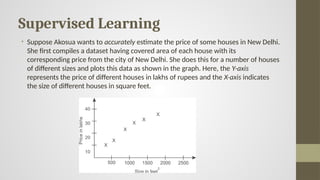
• SupposeAkosua wants to accurately estimate the price of some houses in New Delhi.
She first compiles a dataset having covered area of each house with its
corresponding price from the city of New Delhi. She does this for a number of houses
of different sizes and plots this data as shown in the graph. Here, the Y-axis
represents the price of different houses in lakhs of rupees and the X-axis indicates
the size of different houses in square feet.
10.
Now,
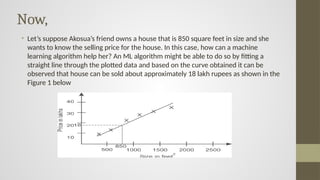
• Let’s supposeAkosua’s friend owns a house that is 850 square feet in size and she
wants to know the selling price for the house. In this case, how can a machine
learning algorithm help her? An ML algorithm might be able to do so by fitting a
straight line through the plotted data and based on the curve obtained it can be
observed that house can be sold about approximately 18 lakh rupees as shown in the
Figure 1 below
11.
So,
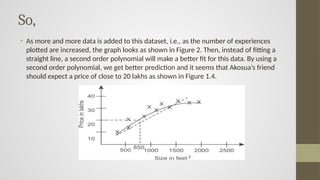
• As moreand more data is added to this dataset, i.e., as the number of experiences
plotted are increased, the graph looks as shown in Figure 2. Then, instead of fitting a
straight line, a second order polynomial will make a better fit for this data. By using a
second order polynomial, we get better prediction and it seems that Akosua’s friend
should expect a price of close to 20 lakhs as shown in Figure 1.4.
12.
NOTE
• It isimportant to note that, here, by increasing the dataset, i.e., the experience of
the machine, the performance of the system for the task ‘predicting house price’ has
improved. And thus, the machine has learnt how to better estimate or predict the
prices of houses.
• The example discussed above is an example of supervised machine learning and the
term ‘supervised’ signifies the fact that the dataset with the ‘right answers’ is given
to the algorithm.
• The example given above is also a case of regression problem. In a regression
problem, the system predicts a continuous–valued output (here, it is the price of the
house).
13.
Another example ofSupervised
learning
Is the task of learning a function that maps an input to an output based on examples input-
output pairs.
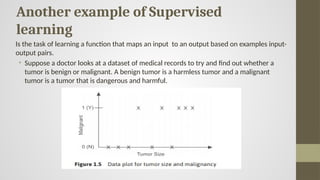
• Suppose a doctor looks at a dataset of medical records to try and find out whether a
tumor is benign or malignant. A benign tumor is a harmless tumor and a malignant
tumor is a tumor that is dangerous and harmful.
14.
Cont’d.
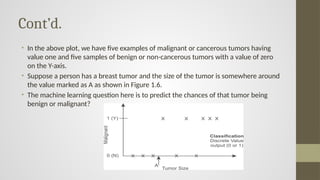
• In theabove plot, we have five examples of malignant or cancerous tumors having
value one and five samples of benign or non-cancerous tumors with a value of zero
on the Y-axis.
• Suppose a person has a breast tumor and the size of the tumor is somewhere around
the value marked as A as shown in Figure 1.6.
• The machine learning question here is to predict the chances of that tumor being
benign or malignant?
15.
•This then isa ‘Classification’ issue. The term
‘classification’ signifies that the system has to
predict the output as a discrete value, i.e., one or
zero (either benign or malignant in the above
example). It should be noted that in a classification
problem, the output can have more than two
possible values.
16.
Test your progress
•Imagine that you own a company and to address each of its problems, you wish to
develop a machine learning algorithm.
• Problem 1: For each customer account, you’d like to have a software to check the
account and decide if it has been compromised (hacked).
• Problem 2: You have a large stock of similar goods. You wish to know that in the next
three months how many of these goods will sell.
• You have the following options:
• (a) Option A: First problem is regression problem and second problem is a
classification problem.
• (b) Option B: Both are classification problems.
• (c) Option C: Both are regression problems.
• (d) Option D: First problem is a classification problem and second problem as a
regression problem.
17.
Unsupervised learning
• Unsupervisedlearning, on the other hand, allows us to approach problems with
little or no idea about what the results will look like.
• We can derive structure from data where we don’t necessarily know the effect of
the variables. In unsupervised learning data is not labeled, it means that there is
no output attribute. We only have input attributes and on the basis of values of
input attributes grouping or clustering is performed on the input data to group
them into similar classes.
• We can only construct the clusters of data based on relationships among the
variables in the data. With unsupervised learning, there is no feedback about the
results predicted, i.e., there is no teacher to correct you.
18.
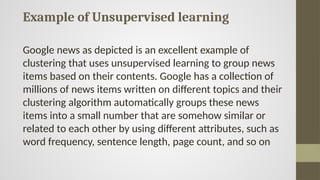
Example of Unsupervisedlearning
Google news as depicted is an excellent example of
clustering that uses unsupervised learning to group news
items based on their contents. Google has a collection of
millions of news items written on different topics and their
clustering algorithm automatically groups these news
items into a small number that are somehow similar or
related to each other by using different attributes, such as
word frequency, sentence length, page count, and so on
19.
Examples of unsupervisedlearning
• Social network analysis:
Social network analysis is conducted to create clusters of friends based on the frequency of
communication among them. Such analysis reveals the links among the users of any social
networking website
• Organize computing clusters:
The geographic location of servers is decided on the basis of clustering of web requests
received from a particular region of the world. The local server will then contain only the
data frequently accessed by people of that region.
• Astronomical data analysis:
Astronomers use large telescopes to study galaxies and stars. The patterns in light or
grouping of lights received from different parts of the sky help to identify different galaxies,
planets, and satellites.
20.
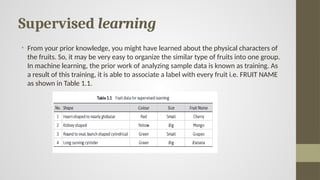
Supervised learning
• Fromyour prior knowledge, you might have learned about the physical characters of
the fruits. So, it may be very easy to organize the similar type of fruits into one group.
In machine learning, the prior work of analyzing sample data is known as training. As
a result of this training, it is able to associate a label with every fruit i.e. FRUIT NAME
as shown in Table 1.1.
21.
• Assume fromthe basket of fruits, you picked a new fruit and observed the shape,
size, and color of that particular fruit. If the fruit is kidney-shaped, bigger in size and
yellow in color, then the fruit is classified as mango. Similarly, this process is repeated
for other fruits present in the basket.
• This is a case of the classification problem. If any prior knowledge acquired by
analyzing training data is then used for making predictions about unseen data then it
is known as supervised machine learning.
22.
Unsupervised learning
• Letus take the basket that is filled with some distinctive types of fruits and you have
to organize them into groups. Assume that this is the first time you have seen these
fruits and you don’t know anything about them. It means data is not labeled and it
will appear like as shown in Table 1.2. So, having no clue about the fruits how will
you start the process of organizing them into different groups?
23.
Reinforcement learning
• Reinforcementlearning is used in applications like computer games (where the
machine plays with a human), driverless cars, robot navigation, etc. It works through
trial and error, and the machine selects those actions that yield the greatest rewards.
These algorithms have three major components mentioned as follows.
• Agent: It is used for learning and decision making. The agent chooses actions that
maximize some specified reward metric over a given amount of time.
• Environment: It defines the outer world with which the agent interacts.
• Actions: It defines the tasks to be performed by the agent.
• Thus, reinforcement learning allows machines and software agents to automatically
determine the ideal behavior within a specific context, in order to maximize its
performance. Simple reward feedback is required for the agent to learn its behavior
and this is known as the reinforcement signal.
24.
REVIEW QUESTONS
• Acomputer program is said to learn from experience E with respect to
some performance measure P and some task T, if this improves with
experience E when its performance on T is measured by P. Let us feed a
machine learning algorithm to predict the weather by providing a lot of
historical weather data. What would be a reasonable choice for P in this
case?
• Suppose you are working on weather prediction and your weather station
makes one of given three predictions for each day’s weather: Cloudy,
Rainy or Sunny. You’d like to use a machine learning algorithm to predict
tomorrow’s weather. Would you treat this as a regression or a
classification problem?
![Defining Machine Learning
• There are two commonly used definitions of machine learning.
1. Arthur Samuel (1959) coined the term machine learning and defined it as: ‘the field of
study that gives computers the ability to learn without being explicitly programmed.’
This is an informal and old definition of machine learning.
2. In 1998, Tom Mitchell redefined the concept of machine learning as ‘[A] computer
program is said to learn from experience E with respect to some class of tasks T and
performance measures P, if its performance at tasks in T, as measured by P, improves
with experience E.’
For instance, let’s say there is an email program which tracks the emails that a person marks
as spam or not spam and based on that learns how spam can be filtered in a better way.
3. Thus, Classification of emails as spam or not spam is the Task T.
4. Tracking the user and marking emails as spam or not spam becomes Experience E.
5. The number of emails correctly classified as spam or not spam is Performance P.](https://image.slidesharecdn.com/week4-beginningwithmachinelearning020418-250213101701-70b415d8/85/WEEK-4-Beginning-With-Machine-Learning_020418-pptx-8-320.jpg)