
MCWP 3-15.1
Machine Guns and
Machine Gun Gunnery
U.S. Marine Corps
PCN 143 000014 00
MCWP 3-15.1 Machine Guns and Machine Gun Gunnery
DEPARTMENT OF THE NAVY
Headquarters United States Marine Corps
Washington, D.C. 20380-0001
1 September 1996
Foreword
1. PURPOSE
Marine Corps Warfighting Publication (MCWP) 3-15.1, Machine Guns and Machine Gun
Gunnery, describes how various machine guns are maintained and employed by the U.S.
Marine Corps' machine gun crews. It also provides the principles and techniques for their
use in engaging and destroying enemy targets.
2. SCOPE
This reference publication is designed for machine gunners, platoon commanders, platoon
sergeants, S-3 officers and chiefs, armorers, and ammunition technicians. It outlines a stan-
dardized way to train Marine machine gunners through the use of gunnery tables.
3. SUPERSESSION
FMFRP 6-15, Machineguns and Machinegun Gunnery, dated 17 August 1988.
4. CHANGES
Recommendations for improving this manual are invited from commands as well as directly
from individuals. Forward suggestions, using the User Suggestion Form format, to—
Commanding General
Doctrine Division (C 42)
Marine Corps Combat Development Command
3300 Russell Road Suite 318A
Quantico, Virginia 22134-5021
5. CERTIFICATION
Reviewed and approved this date.
BY DIRECTION OF THE COMMANDANT OF THE MARINE CORPS
PAUL K. VAN RIPER
Lieutenant General, U.S. Marine Corps
Commanding General
Marine Corps Combat Development Command
Quantico, Virginia
DISTRIBUTION: 143 000014 00
User Suggestion Form
From:
To: Commanding General, Doctrine Division (C 42), Marine Corps Combat Development Command,
3300 Russell Road Suite 318A, Quantico, Virginia 22134-5021
Subj: RECOMMENDATIONS CONCERNING MCWP 3-15.1,MACHINE GUNS AND MACHINE GUN
GUNNERY
1. In accordance with the foreword to MCWP 3-15.1, which invites individuals to submit suggestions concern-
ing this FMFM directly to the above addressee, the following unclassified recommendation is forwarded:
____ __________________ _______ ______________
Page Article/Paragraph No. Line No. Figure/Table No.
Nature of Change: Add
Delete
Change
Correct
2. Proposed new verbatim text: (Verbatim, double-spaced; continue on additional pages as necessary.)
3. Justification/source: (Need not be double-spaced.)
Note: Only one recommendation per page.
iii (reverse blank)
Record of Changes
Change
No.
Date of
Change
Date of
Entry Organization Signature
MCWP 3-15.1
(reverse blank)v
Machine Guns and Machine Gun Gunnery
Table of Contents
Page
Chapter 1. Introduction to Machine Guns
Chapter 2. Machine Gun, Light, Squad Automatic Weapon, M249
Section 1. Introduction 2-5
Section 2. Disassembly and Assembly 2-8
Section 3. Functioning 2-20
Section 4. Malfunctions and Stoppages 2-24
Section 5. Mounts and Accessories 2-27
Section 6. Maintenance 2-29
Section 7. Ammunition 2-37
Section 8. Operation and Firing 2-40
Section 9. Qualification Firing 2-45
Chapter 3. Machine Gun, 7.62mm, M240G
Section 1. Introduction 3-5
Section 2. Disassembly, Assembly, and Nomenclature 3-7
Section 3. Functioning 3-19
Section 4. Malfunctions and Stoppages 3-23
Section 5. Mounts and Accessories 3-27
Section 6. Maintenance 3-38
Section 7. Ammunition 3-41
Section 8. Operation and Firing 3-45
Section 9. Gun Drill 3-50
Section 10. Qualification Firing 3-56
Section 11. Firing with Blank Ammunition 3-62
Chapter 4. Machine Gun, Caliber .50, Browning, M2HB
Section 1. Introduction 4-5
Section 2. Disassembly, Assembly, and Nomenclature 4-7
Section 3. Headspace and Timing 4-26
Section 4. Functioning 4-29
Section 5. Malfunctions and Stoppages 4-35
Section 6. Mounts and Accessories 4-39
Section 7. Maintenance 4-43
Section 8. Ammunition 4-47
Section 9. Operation and Firing 4-53
Section 10. Gun Drill 4-56
Section 11. Qualification Firing 4-64
MCWP 3-15.1
vii
Chapter 5. Machine Gun, 40mm, MK-19 MOD 3
Section 1. Introduction 5-5
Section 2. Disassembly, Assembly, and Nomenclature 5-7
Section 3. Functioning 5-15
Section 4. Malfunctions and Stoppages 5-20
Section 5. Mounts and Accessories 5-22
Section 6. Maintenance 5-30
Section 7. Ammunition 5-32
Section 8. Operation and Firing 5-36
Section 9. Gun Drill 5-40
Chapter 6. Employment and Gunnery
Section 1. Introduction 6-5
Section 2. Characteristics of Fire 6-9
Section 3. Classes of Fire 6-12
Section 4. Range Determination 6-16
Section 5. Traversing and Elevating Mechanism 6-18
Section 6. Fire Control 6-21
Section 7. Methods of Target Engagement 6-25
Section 8. Overhead Fires 6-36
Section 9 Techniques of Predetermined Fire 6-42
Section 10. Final Protective Lines 6-46
Section 11. Range Cards 6-49
Section 12. Firing From Defilade Position 6-53
Section 13. Machine Gunner's Mathematics 6-60
Section 14. Antiaircraft Gunnery 6-64
Section 15. Firing Positions 6-72
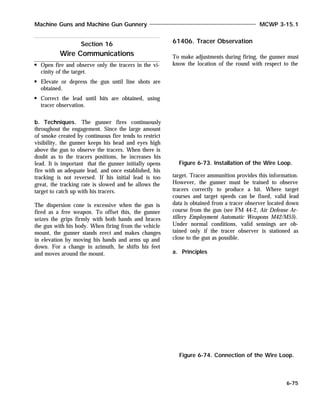
Section 16. Wire Communications 6-75
Appendices
Appendix A. M60E3/M240G Firing Tables A-1
Appendix B. M2 .50 Cal Firing Tables B-1
Appendix C. MK-19 MOD 3 Firing Tables C-1
Appendix D.Destruction of Machine Guns D-1
Appendix E. Infantry Plotting Board M17 E-1
Appendix F. Adjustment of Indirect Machine Gun Fire F-1
Appendix G. Final Protective Lines G-1
Appendix H.Acronyms and Abbreviations H-1
Appendix I. References and Related Publications I-1
Notes Note-1
MCWP 3-15.1
viii
1001. History
Despite their post-Civil War development, modern
machine guns didn’t begin to exhibit their full poten-
tial in battle until World War I. The effects on em-
ployment of these new weapons systems altered the
doctrinal way of waging war for both Allied and
Axis powers. Properly employed machine guns
proved to be devastating to massed infantry forma-
tions and paved the way for the creation of a whole
new methodology of warfighting. The machine gun
became the keystone of the infantry defense and a
major supplier of organic firepower in the offense.
New tactics were being developed by both sides to
not only exploit the effects of the machine gun, but
to counter the enemy’s machine gun employment
capabilities.
The machine gun changed the face of modern war-
fare just as surely as the development of aircraft and
precision indirect fire artillery. The impact of this
weapon can be seen not only in military writings of
that period, but in the principles of employment still
in use today. FMFRP 12-2, Infantry in Battle, a
compilation of lessons learned from World War I,
provides a wealth of knowledge concerning the em-
ployment of machine guns. These lessons remain ap-
plicable and are still studied today, almost 70 years
later. The proper employment of machine guns has
won many a battle at the company and platoon level,
and a well rehearsed, proficient machine gun team
can sometimes make the difference between success
and failure on the battlefield. Military history is
filled with examples of the impact that machine guns
and their gunners have had in turning the tide of
battle:
“Machine guns affect the outcome of battle
by fire power alone. Guns that have not fired have
not attacked, no matter how many times they have
been placed in position.”3
“The machine gun acts by fire alone; move-
ment of this weapon has no other purpose than to
secure positions from which more effective fire can
be delivered. Maximum usefulness is obtained only
when every gun within range of the enemy is firing
effectively against him.”4
“Although machine guns lend themselves
more readily to the defense than to the attack, this is
no excuse for a failure to exact the utmost from them
in support of advancing troops. The handicaps to
their effective employment in the attack can be and
must be overcome.”5
Though the weapons themselves have changed over
the years and will continue to do so, the basic con-
siderations for their employment remain constant.
The excerpts from FMFRP 12-2, listed above,
serve as reminders of this fact, and the lessons con-
tained in them are just as applicable today as when
they were first written.
1002. Types of Machine Guns
Machine guns are classified as light, medium, or
heavy. Classifications are determined by a combi-
nation of weapon caliber, weapon system weight,
crew size, and the primary type of intended target.
a. Light Machine Guns/Automatic Rifles. The
light machine gun (LMG) classification generally in-
cludes .22 to .250 caliber (5.45mm to 6mm) auto-
matic weapons. An LMG typically weighs between
15 and 30 pounds, complete. An LMG is normally
manned by a crew of one or two individuals depend-
ing on the accessories being used. Neither a tripod
nor a spare barrel is normally used with an LMG
when it is manned by a single individual. Bullet
weights for LMGs normally range from 45 to 72
grains. They are optimally employed against ex-
posed and lightly protected personnel at ranges less
Chapter 1
Introduction to Machine Guns
than 1,000 meters. In this category, the Marine
Corps employs the squad automatic weapon, M249,
5.56mm. Figure 1-1 provides an example of a Ma-
rine using an LMG.
b. Medium Machine Guns. This medium ma-
chine gun (MMG) classification generally includes
.264 to .33 caliber (6.5mm to 8mm) automatic
weapons. Typical MMG weights are 25 pounds or
more when loaded with 50 rounds of ammunition.
Remaining ammunition, ground tripod, spare barrel,
and other accessories can add another 25 pounds or
more to the overall weight of MMG systems. The
MMG is generally employed by a crew of three. A
MMG generally uses bullets that weigh between 140
and 220 grains. Optimally, they are employed
against personnel and light materials ( e.g., motor
vehicles) at ranges of 1500 meters or less. In this
category, the Marine Corps employs several variants
of the 7.62mm, M240G machine gun. Figure 1-2
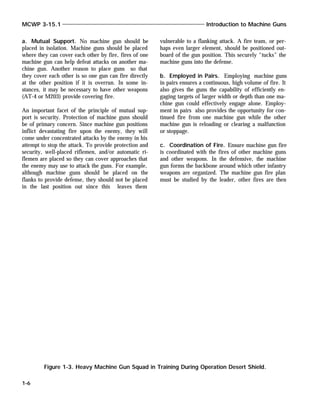
show Marines training with a MMG.
c. Heavy Machine Guns. The heavy machine
gun (HMG) classification generally includes .50
caliber or larger (12.7mm to 15mm) automatic
weapons. The system weight of a heavy machine
gun is substantial. In a ready to fire configuration
using a ground tripod, an HMG without ammunition
can weigh more than 125 pounds. An HMG is nor-
mally manned by a crew of four or more personnel
(although a crew of three may be sufficient if motor
vehicles or draft animals are employed for trans-
portation over distance). The common bullet weight
of an HMG is 700 grains or larger. HMGs are pri-
marily employed against field fortifications, vehi-
cles, and aircraft. They are generally effective
against these types of targets at ranges of 1,000 me-
ters or greater. The machine guns from this category
currently employed by the Marine Corps are the
caliber .50, Browning, M2HB, machine gun and the
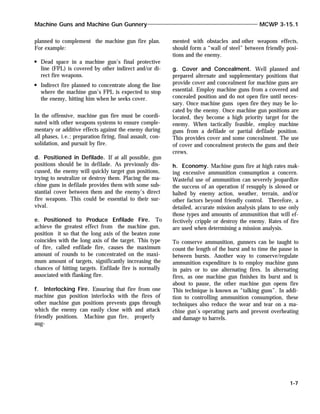
40mm, MK-19 MOD 3 machine gun. Figure 1-3
portrays a HMG squadron during Operation Desert
Shield.
MCWP 3-15.1 Introduction to Machine Guns
1-4
Figure 1-1. Marine Automatic Rifleman, Operation Desert Shield.
1003. Machine Gun Employment
Properly employed, the machine gun provides a high
volume of accurate fire in support of the infantry in
both the offense and defense. In the offense, the ma-
chine gun can add firepower to the assault, but it is
often best employed to suppress or neutralize the ob-
jective from a base of fire. The long-range, close de-
fensive, and final protective fires of the machine
gun provide an integral part of the defense against
infantry attack. HMGs may also be used to destroy
lightly armored vehicles or as defense against slow-
moving, low-flying aircraft. In addition, the machine
gun is used effectively in convoy security, point de-
fense of rear area facilities, and other rear-area secu-
rity missions.
1004. Principles of Machine Gun
Employment
Maximum efficiency in the tactical employment of
all types of machine guns can be reached by ap-
plying the following principles during planning.
Most tactical situations would benefit from the em-
ployment of all eight principles simultaneously.
However, in actuality, these principles are priori-
tized according to the tactical situation and some
may be abandoned in favor of others that are more
crucial. These principles are not meant to serve as
absolutes. They are, however, sound ideas, proven
in combat, that should be understood and considered
by all personnel involved in the operation and em-
ployment of machine guns. Chapter 6 addresses de-
tailed employment of today’s weapons.
Machine Guns and Machine Gun Gunnery MCWP 3-15.1
1-5
Figure 1-2. Marines From the Enlisted Instructor Company Train
New Lieutenants in the Field, The Basic School, Quantico, Virginia.
a. Mutual Support. No machine gun should be
placed in isolation. Machine guns should be placed
where they can cover each other by fire, fires of one
machine gun can help defeat attacks on another ma-
chine gun. Another reason to place guns so that
they cover each other is so one gun can fire directly
at the other position if it is overrun. In some in-
stances, it may be necessary to have other weapons
(AT-4 or M203) provide covering fire.
An important facet of the principle of mutual sup-
port is security. Protection of machine guns should
be of primary concern. Since machine gun positions
inflict devastating fire upon the enemy, they will
come under concentrated attacks by the enemy in his
attempt to stop the attack. To provide protection and
security, well-placed riflemen, and/or automatic ri-
flemen are placed so they can cover approaches that
the enemy may use to attack the guns. For example,
although machine guns should be placed on the
flanks to provide defense, they should not be placed
in the last position out since this leaves them
vulnerable to a flanking attack. A fire team, or per-
haps even larger element, should be positioned out-
board of the gun position. This securely “tucks” the
machine guns into the defense.
b. Employed in Pairs. Employing machine guns
in pairs ensures a continuous, high volume of fire. It
also gives the guns the capability of efficiently en-
gaging targets of larger width or depth than one ma-
chine gun could effectively engage alone. Employ-
ment in pairs also provides the opportunity for con-
tinued fire from one machine gun while the other
machine gun is reloading or clearing a malfunction
or stoppage.
c. Coordination of Fire. Ensure machine gun fire
is coordinated with the fires of other machine guns
and other weapons. In the defensive, the machine
gun forms the backbone around which other infantry
weapons are organized. The machine gun fire plan
must be studied by the leader, other fires are then
MCWP 3-15.1 Introduction to Machine Guns
1-6
Figure 1-3. Heavy Machine Gun Squad in Training During Operation Desert Shield.
planned to complement the machine gun fire plan.
For example:
Dead space in a machine gun’s final protective
line (FPL) is covered by other indirect and/or di-
rect fire weapons.
Indirect fire planned to concentrate along the line
where the machine gun’s FPL is expected to stop
the enemy, hitting him when he seeks cover.
In the offensive, machine gun fire must be coordi-
nated with other weapons systems to ensure comple-
mentary or additive effects against the enemy during
all phases, i.e.; preparation firing, final assault, con-
solidation, and pursuit by fire.
d. Positioned in Defilade. If at all possible, gun
positions should be in defilade. As previously dis-
cussed, the enemy will quickly target gun positions,
trying to neutralize or destroy them. Placing the ma-
chine guns in defilade provides them with some sub-
stantial cover between them and the enemy’s direct
fire weapons. This could be essential to their sur-
vival.
e. Positioned to Produce Enfilade Fire. To
achieve the greatest effect from the machine gun,
position it so that the long axis of the beaten zone
coincides with the long axis of the target. This type
of fire, called enfilade fire, causes the maximum
amount of rounds to be concentrated on the maxi-
mum amount of targets, significantly increasing the
chances of hitting targets. Enfilade fire is normally
associated with flanking fire.
f. Interlocking Fire. Ensuring that fire from one
machine gun position interlocks with the fires of
other machine gun positions prevents gaps through
which the enemy can easily close with and attack
friendly positions. Machine gun fire, properly
aug-
mented with obstacles and other weapons effects,
should form a “wall of steel” between friendly posi-
tions and the enemy.
g. Cover and Concealment. Well planned and
prepared alternate and supplementary positions that
provide cover and concealment for machine guns are
essential. Employ machine guns from a covered and
concealed position and do not open fire until neces-
sary. Once machine guns open fire they may be lo-
cated by the enemy. Once machine gun positions are
located, they become a high priority target for the
enemy. When tactically feasible, employ machine
guns from a defilade or partial defilade position.
This provides cover and some concealment. The use
of cover and concealment protects the guns and their
crews.
h. Economy. Machine guns fire at high rates mak-
ing excessive ammunition consumption a concern.
Wasteful use of ammunition can severely jeopardize
the success of an operation if resupply is slowed or
halted by enemy action, weather, terrain, and/or
other factors beyond friendly control. Therefore, a
detailed, accurate mission analysis plans to use only
those types and amounts of ammunition that will ef-
fectively cripple or destroy the enemy. Rates of fire
are used when determining a mission analysis.
To conserve ammunition, gunners can be taught to
count the length of the burst and to time the pause in
between bursts. Another way to conserve/regulate
ammunition expenditure is to employ machine guns
in pairs or to use alternating fires. In alternating
fires, as one machine gun finishes its burst and is
about to pause, the other machine gun opens fire
This technique is known as “talking guns”. In addi-
tion to controlling ammunition consumption, these
techniques also reduce the wear and tear on a ma-
chine gun’s operating parts and prevent overheating
and damage to barrels.
Machine Guns and Machine Gun Gunnery MCWP 3-15.1
1-7
The machine gun, light, squad automatic weapon,
M249 (SAW) is a gas-operated, air-cooled, belt or
magazine-fed, automatic weapon that fires from the
open-bolt position (see figure 2-1). It has a maxi-
mum rate of fire of 850 rounds per minute. Primar-
ily, ammunition is fed into the weapon from a
200-round ammunition box containing a disintegrat-
ing metallic split-link belt. As an emergency means
of feeding, the SAW can use a 20 or 30 round M16
rifle magazine, but this will increase the chance of
stoppages.
The SAW can be fired from the hip, or underarm
using assault fire techniques; however, the preferred
method of employment is to fire from the bipod-
steadied position. The bipod gives the weapon the
stability needed to engage targets at its maximum ef-
fective range. The SAW has a spare barrel to allow
quick barrel changes during employment; however,
barrels must not be interchanged with those from
other SAW’s unless the headspace has been set for
Chapter 2
Machine Gun, Light, Squad Automatic Weapon, M249
Section 1
Introduction
Figure 2-1. The SAW (Left and Right Sides).
that weapon by ordnance personnel. Each automatic
rifleman and assistant automatic rifleman should
have ready access to TM 08671A-10/1A, a detailed,
pocket-sized reference manual for operators of the
SAW.
2101. General Data
Weight of SAW:
With bipod and tools ......................... 17 pounds
With 200 round drum ...................... 23.92 pounds
Measurements:
Length ................................... 40.87 inches
Muzzle velocity
Ball ammunition ............... 3,025 feet per second
Tracer ammunition ............. 2,870 feet per second
Rifling ........................ Standard right hand twist
one turn in 7 inches
Ranges:
Maximum ................................. 3,600 meters
Maximum effective
Point targets ............................. 800 meters
Area targets ............................ 1,000 meters
Grazing fire ................................. 600 meters
Ammunition:
Caliber .................................. 5.56 millimeter
Types in use ............. Ball, tracer, blank, and dummy
Basic allowance ........ 600 rounds per SAW, carried by
the automatic rifleman and
assistant automatic rifleman
Weight of full 200 round drum .............. 6.92 pounds
Rates of fire:
Sustained ......................... 85 rounds per minute,
fired in 3 to 5 round bursts,
4 to 5 seconds between bursts,
no barrel changes
Rapid ........................... 200 rounds per minute,
fired in 6 to 8 round bursts,
2 to 3 seconds between bursts,
barrel change every 2 minutes
Cyclic ........................... 850 rounds per minute,
continuous burst,
barrel change every minute
2102. Sights
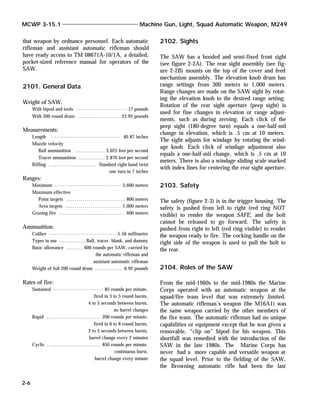
The SAW has a hooded and semi-fixed front sight
(see figure 2-2A). The rear sight assembly (see fig-
ure 2-2B) mounts on the top of the cover and feed
mechanism assembly. The elevation knob drum has
range settings from 300 meters to 1,000 meters.
Range changes are made on the SAW sight by rotat-
ing the elevation knob to the desired range setting.
Rotation of the rear sight aperture (peep sight) is
used for fine changes in elevation or range adjust-
ments, such as during zeroing. Each click of the
peep sight (180-degree turn) equals a one-half-mil
change in elevation, which is .5 cm at 10 meters.
The sight adjusts for windage by rotating the wind-
age knob. Each click of windage adjustment also
equals a one-half-mil change, which is .5 cm at 10
meters. There is also a windage sliding scale marked
with index lines for centering the rear sight aperture.
2103. Safety
The safety (figure 2-3) is in the trigger housing. The
safety is pushed from left to right (red ring NOT
visible) to render the weapon SAFE, and the bolt
cannot be released to go forward. The safety is
pushed from right to left (red ring visible) to render
the weapon ready to fire. The cocking handle on the
right side of the weapon is used to pull the bolt to
the rear.
2104. Roles of the SAW
From the mid-1960s to the mid-1980s the Marine
Corps operated with an automatic weapon at the
squad/fire team level that was extremely limited.
The automatic rifleman’s weapon (the M16A1) was
the same weapon carried by the other members of
the fire team. The automatic rifleman had no unique
capabilities or equipment except that he was given a
removable, “clip on” bipod for his weapon. This
shortfall was remedied with the introduction of the
SAW in the late 1980s. The Marine Corps has
never had a more capable and versatile weapon at
the squad level. Prior to the fielding of the SAW,
the Browning automatic rifle had been the last
MCWP 3-15.1 Machine Gun, Light, Squad Automatic Weapon, M249
2-6
Machine Guns and Machine Gun Gunnery MCWP 3-15.1
2-7
Figure 2-2. Front and Rear Sights.
Figure 2-3. Safety.
automatic weapon used by the Corps that provided
significant fire power to the rifle squad beyond the
capabilities of the other small arms carried within it.
Various models of the Browning automatic rifle
were used by Marine units from World War I to the
early 1960s. Even the much respected Browning
automatic rifle, that served the Corps so well for
over 40 years, had limitations that the design of the
SAW has overcome. The Browning was an auto-
matic rifle and it had some design limitations com-
mon to other rifles of its day. These included a
limited ammunition supply (only a 20 round box
magazine), problems with overheating during con-
tinuous firing (because of a fixed barrel that could
not be changed by the operator), and a limited maxi-
mum effective range.
Although employed as an automatic rifle by the
Marine Corps, the SAW is designed like a medium
machine gun. As such it has design features that
make it a more versatile weapon, such as; it can be
belt or magazine fed thus providing more continuous
fire before reloading and it has a quick change barrel
feature which allows barrel changes during periods
of continuous firing without taking the weapon out
of action for more than a few seconds. The SAW
also has greater effective range and a higher rate of
fire than any other weapon in the present rifle squad.
The SAW can provide a heavy volume of continu-
ous, accurate fire in support of offensive or defen-
sive operations. Its presence in large numbers (e.g.,
nine per rifle platoon) at the small unit level has sig-
nificantly increased the combat power of those units.
In the past, medium machine guns were often at-
tached to platoons or squads, more out of concern
over the lack of fire power in those small units than
for sound tactical reasons. The introduction of the
SAW into those units has changed that. The SAW
provides the platoons with significant fire power
against enemy personnel and light equipment. Be-
cause of this, more times than not, the company’s
machine gun section can now be employed as a sec-
tion, in a general or direct support role, rather than
attached out. The SAW’s presence, in any type of
unit, increases the available fire power and provides
additional flexibility to the unit leader in terms of
weapons employment options.
Section 2
Disassembly and Assembly
The SAW is designed for easy disassembly and as-
sembly; the use of force is not necessary and no spe-
cial tools are required. As the weapon is dis-
assembled, place the parts (in the order in which
they are removed) on a clean, flat surface. This re-
duces the possibility of losing a part and aids in as-
sembly, as all parts are replaced in reverse order. To
prevent unnecessary wear, disassembly should be
kept to the minimum, consistent with maintenance
and training requirements.
Disassembly and assembly may be divided into two
categories; general and detailed. General disassem-
bly involves separation of the weapon into main
groups. This is also known as field stripping and is a
practice that stems from past experience in combat
situations. The intent behind designating main
groups for a weapon and the practice of field strip-
ping is to allow the operator to quickly break the
weapon down into a set of major components that
can be hastily cleaned to keep the weapon ready for
action. The idea is to disassemble the weapon just
far enough to conduct basic cleaning without having
to contend with numerous assemblies and parts.
Detailed disassembly, for the operator, involves the
removal of some of the component parts and assem-
blies from the main groups. The idea here is that,
when the situation and conditions permit, the opera-
tor can then take the time to more fully disassemble
and thoroughly clean the weapon. Complete general
and detailed disassembly is normally the expected
routine in garrison after the completion of firing
and/or field training, but this may also be conducted
in a field environment when necessary, to ensure the
proper functioning and maintenance of the weapon.
Disassembly of the weapon beyond that described in
this publication is not authorized, except by qualified
ordnance personnel.
MCWP 3-15.1 Machine Gun, Light, Squad Automatic Weapon, M249
2-8
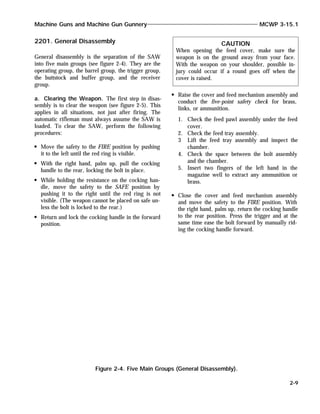
2201. General Disassembly
General disassembly is the separation of the SAW
into five main groups (see figure 2-4). They are the
operating group, the barrel group, the trigger group,
the buttstock and buffer group, and the receiver
group.
a. Clearing the Weapon. The first step in disas-
sembly is to clear the weapon (see figure 2-5). This
applies in all situations, not just after firing. The
automatic rifleman must always assume the SAW is
loaded. To clear the SAW, perform the following
procedures:
Move the safety to the FIRE position by pushing
it to the left until the red ring is visible.
With the right hand, palm up, pull the cocking
handle to the rear, locking the bolt in place.
While holding the resistance on the cocking han-
dle, move the safety to the SAFE position by
pushing it to the right until the red ring is not
visible. (The weapon cannot be placed on safe un-
less the bolt is locked to the rear.)
Return and lock the cocking handle in the forward
position.
Raise the cover and feed mechanism assembly and
conduct the five-point safety check for brass,
links, or ammunition.
1. Check the feed pawl assembly under the feed
cover.
2. Check the feed tray assembly.
3 Lift the feed tray assembly and inspect the
chamber.
4. Check the space between the bolt assembly
and the chamber.
5. Insert two fingers of the left hand in the
magazine well to extract any ammunition or
brass.
Close the cover and feed mechanism assembly
and move the safety to the FIRE position. With
the right hand, palm up, return the cocking handle
to the rear position. Press the trigger and at the
same time ease the bolt forward by manually rid-
ing the cocking handle forward.
Machine Guns and Machine Gun Gunnery MCWP 3-15.1
2-9
Figure 2-4. Five Main Groups (General Disassembly).
CAUTION
When opening the feed cover, make sure the
weapon is on the ground away from your face.
With the weapon on your shoulder, possible in-
jury could occur if a round goes off when the
cover is raised.
MCWP 3-15.1 Machine Gun, Light, Squad Automatic Weapon, M249
2-10
Figure 2-5. Clearing Procedures.
Machine Guns and Machine Gun Gunnery MCWP 3-15.1
2-11
Figure 2-5. Clearing Procedures–Continued.
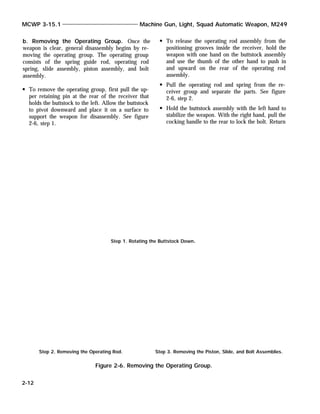
b. Removing the Operating Group. Once the
weapon is clear, general disassembly begins by re-
moving the operating group. The operating group
consists of the spring guide rod, operating rod
spring, slide assembly, piston assembly, and bolt
assembly.
To remove the operating group, first pull the up-
per retaining pin at the rear of the receiver that
holds the buttstock to the left. Allow the buttstock
to pivot downward and place it on a surface to
support the weapon for disassembly. See figure
2-6, step 1.
To release the operating rod assembly from the
positioning grooves inside the receiver, hold the
weapon with one hand on the buttstock assembly
and use the thumb of the other hand to push in
and upward on the rear of the operating rod
assembly.
Pull the operating rod and spring from the re-
ceiver group and separate the parts. See figure
2-6, step 2.
Hold the buttstock assembly with the left hand to
stabilize the weapon. With the right hand, pull the
cocking handle to the rear to lock the bolt. Return
MCWP 3-15.1 Machine Gun, Light, Squad Automatic Weapon, M249
2-12
Step 1. Rotating the Buttstock Down.
Step 2. Removing the Operating Rod. Step 3. Removing the Piston, Slide, and Bolt Assemblies.
Figure 2-6. Removing the Operating Group.
the cocking handle to the forward position. Place
a finger on the face of the bolt and push until the
finger makes contact with the bridge at the end of
the receiver. This leaves the piston, slide, and
bolt assemblies exposed.
Hold the slide assembly while pulling the moving
parts out the rear of the receiver. See figure 2-6,
step 3.
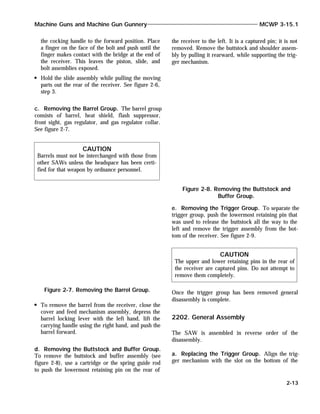
c. Removing the Barrel Group. The barrel group
consists of barrel, heat shield, flash suppressor,
front sight, gas regulator, and gas regulator collar.
See figure 2-7.
To remove the barrel from the receiver, close the
cover and feed mechanism assembly, depress the
barrel locking lever with the left hand, lift the
carrying handle using the right hand, and push the
barrel forward.
d. Removing the Buttstock and Buffer Group.
To remove the buttstock and buffer assembly (see
figure 2-8), use a cartridge or the spring guide rod
to push the lowermost retaining pin on the rear of
the receiver to the left. It is a captured pin; it is not
removed. Remove the buttstock and shoulder assem-
bly by pulling it rearward, while supporting the trig-
ger mechanism.
e. Removing the Trigger Group. To separate the
trigger group, push the lowermost retaining pin that
was used to release the buttstock all the way to the
left and remove the trigger assembly from the bot-
tom of the receiver. See figure 2-9.
Once the trigger group has been removed general
disassembly is complete.
2202. General Assembly
The SAW is assembled in reverse order of the
disassembly.
a. Replacing the Trigger Group. Align the trig-
ger mechanism with the slot on the bottom of the
Machine Guns and Machine Gun Gunnery MCWP 3-15.1
2-13
CAUTION
Barrels must not be interchanged with those from
other SAWs unless the headspace has been certi-
fied for that weapon by ordnance personnel.
Figure 2-7. Removing the Barrel Group.
Figure 2-8. Removing the Buttstock and
Buffer Group.
CAUTION
The upper and lower retaining pins in the rear of
the receiver are captured pins. Do not attempt to
remove them completely.
receiver. Hold the trigger mechanism in position to
accomplish the next step. See figure 2-10.
b. Replacing the Buttstock and Buffer Group.
Align the lower hole in the buttstock and buffer
group with the rear hole in the trigger mechanism,
then push the lower retaining pin to the right. See
figure 2-11.
c. Replacing the Barrel Group. Depress the
barrel locking lever to the rear with the left hand,
while holding the carrying handle with the right
hand. Pull the barrel rearward and push downward;
align the gas regulator with the gas cylinder and lock
it by releasing the barrel locking lever. Check the
barrel to ensure it is locked into the receiver by pull-
ing or lifting on the carrying handle. See figure
2-12.
d. Replacing the Operating Group
Open the cover assembly on the receiver. Insert
the face of the piston into the receiver, aligning
the bolt lugs onto the receiver rails. Pull the trig-
ger and push the moving parts forward until the
bolt is seated into the chamber.
MCWP 3-15.1 Machine Gun, Light, Squad Automatic Weapon, M249
2-14
Figure 2-9. Removing the Trigger Group.
Figure 2-10. Replacing the Trigger Group.
Figure 2-11. Replacing the Buttstock and
Buffer Group.
Place the operating rod tip into the operating rod
spring. Then, insert the free end of the operating
rod and spring into the rear of the piston. Depress
the rear of the operating rod assembly until the
two lugs on the buffer are positioned in the re-
ceiver grooves. See figure 2-13.
Pivot the buttstock upward into position and push
the upper retaining pin to the right, locking the
buttstock to the receiver.
e. Conducting a Function Check. A function
check must be performed to ensure that the SAW
has been assembled correctly. The procedures, in or-
der, are—
Grasp the cocking handle with the right hand,
palm up, and pull the bolt to the rear locking it in
place.
While continuing to hold the resistance on the
cocking handle, use the left hand to move the
safety to the SAFE position.
Push the cocking handle forward into the forward
lock position.
Pull the trigger. (The weapon should not fire.)
Grasp the cocking handle with the right hand,
palm up, and pull and hold it to the rear.
Move the safety to the FIRE position.
While continuing to hold resistance on the cock-
ing handle, use the left hand to pull the trigger
and ease the bolt forward to prevent it from slam-
ming into the chamber area and damaging the face
of the bolt.
If the weapon fails the function check, check for
missing parts or the reassembly procedures.
Machine Guns and Machine Gun Gunnery MCWP 3-15.1
2-15
Figure 2-12. Replacing the Barrel Group.
Figure 2-13. Replacing the Operating Group.
(Before disassembling the weapon, make sure it is
positioned where the guide rod and spring cannot
cause bodily harm if the bolt is locked to the
rear.)
NOTE
The cover and feed mechanism assembly can
be closed with the bolt in either the forward or
the rearward position.
2203. Detailed Disassembly and Assembly
The term detailed disassembly, as it is used in this
manual, refers only to those disassembly procedures
authorized for the operator level. This is not to
be
confused with procedures authorized for 2d echelon
maintenance (unit armorers) or above. Detailed dis-
assembly of any of the groups beyond that described
in this document is NOT AUTHORIZED except by
qualified ordnance personnel.
The operator is not authorized to detail disassemble
the trigger group or the buttstock and buffer group.
The other three groups can be further disassembled
by the operator as described below:
a. Operating Group
(1) Detailed disassembly
To separate the operating group (see figure 2-14),
hold the piston assembly in one hand, place the
other hand on the bolt assembly, and rotate the
bolt to disengage the bolt from the slide
assembly.
MCWP 3-15.1 Machine Gun, Light, Squad Automatic Weapon, M249
2-16
CAUTION
The bolt must be eased forward to prevent dam-
age to the cover and feed mechanism assembly
and operating rod group. This is known as “rid-
ing” the bolt forward.
Step 1. Separating the Slide Assembly From the Piston.
Step 2. Removing the Bolt from the Slide.
Figure 2-14. Separating the Operating Group.
To separate the slide assembly from the piston,
press the retaining pin at the rear of the slide as-
sembly to the left and lift the slide assembly. This
completes detailed disassembly of the operating
group. See figure 2-15.
(2) Detailed assembly
Hold the piston in one hand with the face of the
piston facing outward and the sear notches down-
ward. With the other hand, place the slide assem-
bly onto the rear of the piston with the firing pin
toward the front of the piston. (Check the slide
assembly retaining pin to make sure it is out.)
Push the slide assembly retaining pin to the right.
This locks the piston assembly and the slide as-
sembly together.
Place the bolt on the slide assembly, aligning the
driving lug of the bolt with the slot of the slide
assembly. Apply pressure to the face of the bolt
to compress the firing pin spring. Then, rotate the
bolt to hook the driving lug into the slide
assembly.
b. Barrel Group
(1) Detailed disassembly
To remove the heat shield, place the barrel with
the muzzle end on a hard, flat surface with the
Machine Guns and Machine Gun Gunnery MCWP 3-15.1
2-17
Figure 2-15. Operating Group, Detailed Disassembled.
Figure 2-16. Removing the Heat Shield.
heat shield facing away from the body. Place the
index fingers of each hand inside the chamber.
Use the thumbs to push up on the top clip. See
figure 2-16.
To remove the gas regulator and collar, rotate the
gas collar pin out of the notch. Place the tip of the
scraper with the concave side facing the pin of the
collar inside the notch. (Be careful not to use too
much pressure, so as not to break the tip of the
scraper.) Rotate the collar counterclockwise over
the concave portion of the tip on the scraper
and
MCWP 3-15.1 Machine Gun, Light, Squad Automatic Weapon, M249
2-18
Step 1. Placement of the Scraper Tool.
Step 2. Rotating the Collar.
Figure 2-17. Removing the Collar.
past the notch until the collar slides off. See fig-
ure 2-17.
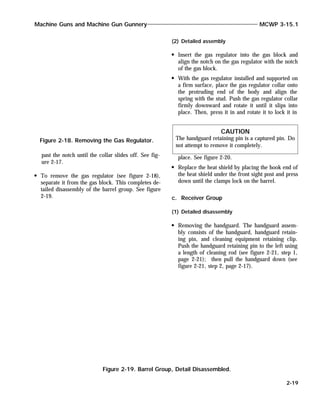
To remove the gas regulator (see figure 2-18),
separate it from the gas block. This completes de-
tailed disassembly of the barrel group. See figure
2-19.
(2) Detailed assembly
Insert the gas regulator into the gas block and
align the notch on the gas regulator with the notch
of the gas block.
With the gas regulator installed and supported on
a firm surface, place the gas regulator collar onto
the protruding end of the body and align the
spring with the stud. Push the gas regulator collar
firmly downward and rotate it until it slips into
place. Then, press it in and rotate it to lock it in
place. See figure 2-20.
Replace the heat shield by placing the hook end of
the heat shield under the front sight post and press
down until the clamps lock on the barrel.
c. Receiver Group
(1) Detailed disassembly
Removing the handguard. The handguard assem-
bly consists of the handguard, handguard retain-
ing pin, and cleaning equipment retaining clip.
Push the handguard retaining pin to the left using
a length of cleaning rod (see figure 2-21, step 1,
page 2-21); then pull the handguard down (see
figure 2-21, step 2, page 2-17).
Machine Guns and Machine Gun Gunnery MCWP 3-15.1
2-19
CAUTION
The handguard retaining pin is a captured pin. Do
not attempt to remove it completely.
Figure 2-18. Removing the Gas Regulator.
Figure 2-19. Barrel Group, Detail Disassembled.
Removing the gas cylinder. To remove the gas
cylinder from the receiver (see figure 2-22, page
2-22), grasp the gas cylinder at the top of the bi-
pod legs, turn it to the left or right to release the
locking spring, and then pull it away from
receiver.
Removing the bipod. Once the gas cylinder is re-
moved, remove the bipod (see figure 2-23, page
2-18) by pulling it away from the receiver. This
completes detailed disassembly of the receiver.
See figure 2-24, page 2-22.
(2) Detailed assembly
Replacing the bipod. Place the bipod on the re-
ceiver group with the bipod legs open and pointed
downward. See figure 2-23, page 2-22.
Replacing the gas cylinder. Push the gas cylinder
through the bipod yoke into the receiver. Push the
cylinder to the rear while countering the pressure
of the locking spring and guiding the end of the
cylinder into the receiver with the other hand ap-
plying downward pressure. Position the recess in
the cylinder near the spring. Turn the cylinder un-
til the spring clicks into the recess at the rear of
the gas cylinder. See figure 2-25.
Replacing the handguard. To replace the hand-
guard, place it on the receiver from the bottom
and push it to the rear until it stops. Using the
guide rod, push the handguard retaining pin to the
right, which locks the handguard into position.
Push the handguard down to make sure it is
locked. See figure 2-21.
MCWP 3-15.1 Machine Gun, Light, Squad Automatic Weapon, M249
2-20
Figure 2-20. Replacing the Collar.
Section 3
Functioning
The cycle of functioning is broken down into eight
basic steps. These steps are feeding, chambering,
locking, firing, unlocking, extracting, ejection, and
cocking. More than one step may occur simultane-
ously during the cycle of functioning. By under-
standing how the SAW functions, it will be easier to
recognize and correct malfunctions and stoppages
which occur during firing.
The cycle is started by putting the first round of the
belt in the tray groove or by inserting the magazine
into the magazine well. Then the trigger is pulled,
releasing the sear from the sear notch. When the
trigger is pulled to the rear, the rear of the sear is
lowered and disengaged from the sear notch. This
allows the piston and bolt to be driven forward by
the expansion of the operating rod spring. The cycle
Machine Guns and Machine Gun Gunnery MCWP 3-15.1
2-21
Step 1. Handguard Retaining Pin.
Step 2. Removing the Handguard.
Figure 2-21. Removing the Handguard.
stops when the trigger is released and the sear again
engages the sear notch on the piston. The sequence
of functioning is as follows:
2301. Feeding
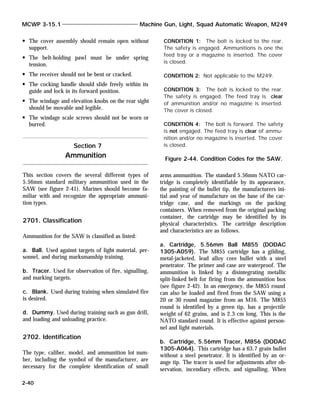
As the bolt starts its forward movement, the feed
lever is forced to the right, causing the feed-pawl as-
sembly to turn in the opposite direction. This forces
the feed-pawl assembly over the next round in the
belt, and it is ready to place the next round into the
tray groove when the rearward action occurs again.
As the bolt moves to the rear after firing, the feed
roller forces the feed lever to the left. The feed lever
is forced to turn, moving the feed pawl to the right.
This places a round in the tray groove.
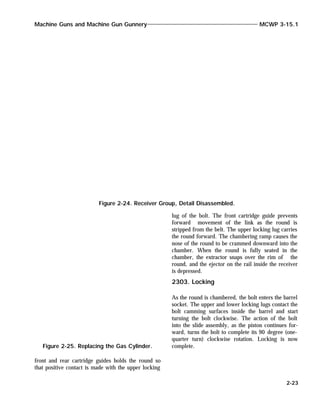
2302. Chambering
As the bolt travels forward, the upper locking lug
engages the rim of the round. The pressure of the
MCWP 3-15.1 Machine Gun, Light, Squad Automatic Weapon, M249
2-22
Figure 2-22. Removing the Gas Cylinder.
Figure 2-23. Removing the Bipod.
front and rear cartridge guides holds the round so
that positive contact is made with the upper locking
lug of the bolt. The front cartridge guide prevents
forward movement of the link as the round is
stripped from the belt. The upper locking lug carries
the round forward. The chambering ramp causes the
nose of the round to be crammed downward into the
chamber. When the round is fully seated in the
chamber, the extractor snaps over the rim of the
round, and the ejector on the rail inside the receiver
is depressed.
2303. Locking
As the round is chambered, the bolt enters the barrel
socket. The upper and lower locking lugs contact the
bolt camming surfaces inside the barrel and start
turning the bolt clockwise. The action of the bolt
into the slide assembly, as the piston continues for-
ward, turns the bolt to complete its 90 degree (one-
quarter turn) clockwise rotation. Locking is now
complete.
Machine Guns and Machine Gun Gunnery MCWP 3-15.1
2-23
Figure 2-24. Receiver Group, Detail Disassembled.
Figure 2-25. Replacing the Gas Cylinder.
2304. Firing
After the bolt is fully forward and locked, the piston
continues to go forward, independent of the bolt, for
a short distance. The slide assembly carries the fir-
ing pin through the face of the bolt. The firing pin
strikes the primer of the round and the primer fires
the round.
2305. Unlocking
After the round is fired and the bullet passes the gas
port, part of the expanding gases go through the gas
plug into the gas regulator. The rapidly expanding
gases enter into the gas cylinder from the gas regula-
tor, forcing the piston to the rear. As the piston con-
tinues to the rear, the slide assembly, also moving to
the rear, causes the bolt to begin its counterclock-
wise rotation. The upper and lower locking lugs of
the bolt contact the bolt camming surfaces inside the
barrel socket and, as the bolt continues toward the
rear, it completes a one-quarter turn counterclock-
wise. The rotation and movement to the rear unlocks
the bolt from the barrel socket.
2306. Extracting
Extracting begins during the unlocking cycle. The
rotation of the bolt loosens the cartridge case in the
chamber. As the piston and bolt move to the rear,
the extractor pulls the cartridge case from the
chamber.
2307. Ejecting
As the cartridge case is pulled from the chamber, the
bolt passes by the ejector. This causes the ejector
clip to expand, forcing the ejector to push the ex-
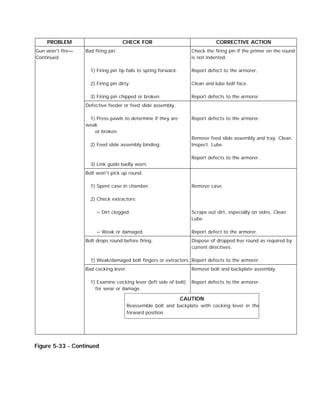
pended cartridge. The extractor grips the right side
of the cartridge and causes it to spin from the
weapon as it reaches the ejection port. The empty
belt links are forced out the link ejection port as the
rearward movement of the bolt causes the next
round to be positioned in the tray groove.
2308. Cocking
The piston assembly acts against the firing pin, pull-
ing the firing pin from the primer of the spent car-
tridge case. The action of the piston assembly,
continuing to the rear with the firing pin, releases
the compression of the firing pin spring. As long as
the trigger is held to the rear, the SAW will continue
to complete the eight steps of functioning automati-
cally. When the trigger is released and the sear again
engages the sear notch, the cycle of functioning is
stopped and the weapon is cocked. To prevent undue
wear to the sear and sear notch, the automatic rifle-
man must hold the trigger firmly to the rear during
firing.
MCWP 3-15.1 Machine Gun, Light, Squad Automatic Weapon, M249
2-24
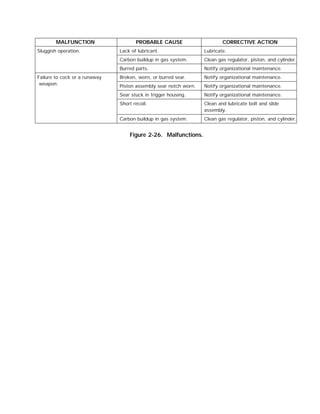
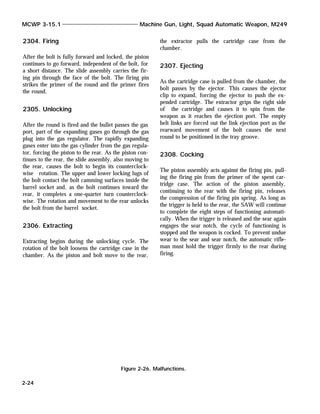
Figure 2-26. Malfunctions.
Machine Guns and Machine Gun Gunnery MCWP 3-15.1
2-25
Figure 2-27. Stoppages.
Section 4
Malfunctions and Stoppages
Automatic riflemen must have a detailed understand-
ing of the many component parts of their weapon,
what those parts do during functioning, and what
mechanical problems may be encountered during fir-
ing. This knowledge ensures that those problems can
be assessed quickly and corrective action taken.
2401. Malfunctions
A malfunction is a failure of the gun to function sat-
isfactorily; the gun will fire, but fires improperly.
Defective ammunition or improper operation of the
gun by a crew member is not considered a malfunc-
tion. Two of the more common malfunctions are
sluggish operation and runaway gun.
a. Sluggish Operation. Instead of firing at its
normal rate, a sluggish gun fires very slowly. It can
be due to excessive friction or loss of gas. Excessive
friction is usually due to lack of lubrication or
excessive dirt/carbon in the gas system or on the
bolt and receiver rails. Excessive loss of gas is usu-
ally due to loose connections in the gas system. The
action taken to reduce sluggish operation is to move
the regulator setting to the high position. The rem-
edy for continued sluggish operation is to clean, lu-
bricate, tighten, or replace parts as required.
b. Runaway Gun. This is the case when a gun
continues to fire after you have released the trigger;
firing is uncontrolled. A runaway gun is usually
caused by a worn, broken, or burred sear; the sear
shoulder is unable to grab the operating rod and hold
it to the rear. An excessively worn sear notch on the
operating rod could also be responsible. To stop a
runaway gun, the automatic rifleman or the assistant
automatic rifleman twist and break the belt of am-
munition. The remedy for runaway gun is to replace
worn parts.
Further information on these two malfunctions is
listed in figure 2-26.
2402. Stoppages
A stoppage is any interruption in the cycle of func-
tioning caused by faulty action of the weapon or de-
fective ammunition. Stoppages are classified by their
relationship to the cycle of functioning. Figure 2-27
shows types of interruptions or stoppages, their
probable causes, and the corrective actions. Stop-
pages must be reduced quickly and the weapon re-
turned to action. Apply immediate action. (See para-
graph 2403 below.)
2403. Immediate Action
Immediate action is that action taken by the auto-
matic rifleman to reduce a stoppage, without investi-
gating its cause, and quickly return the weapon to
action. Two terms used to describe ammunition con-
dition should be understood in conjunction with im-
mediate action procedures.
A hang fire occurs when the cartridge primer has
detonated after being struck by the firing pin but
some problem with the propellant powder causes it
to burn too slowly and this delays the firing of the
projectile. Time (5 seconds) is allotted for this mal-
function before investigating a stoppage further be-
cause injury to personnel and damage to equipment
could occur if the round went off with the cover of
the weapon open.
A cook off occurs when the heat of the barrel is
high enough to cause the propellant powder inside
the round to ignite even though the primer has not
been struck. Immediate action is completed in a total
of 10 seconds to ensure that the round is extracted
prior to the heat of the barrel effecting it. When the
round fails to extract/eject, further action is delayed
MCWP 3-15.1 Machine Gun, Light, Squad Automatic Weapon, M249
2-26
WARNING
If nothing is ejected and the barrel is hot (200
or more rounds fired in 2 minutes or less), do
not open the cover. Push the safety to the right
(red ring not visible), which places the weapon
on SAFE. Keep the weapon pointed downrange
and remain clear for 15 minutes, then clear the
weapon.
(15 minutes) if the barrel is hot because the gunner
must assume that a round is still in the chamber and
could cook off at any time prior to the barrel cooling
off.
The immediate action procedures for the SAW are—
Wait 5 seconds after the misfire to guard against a
hang fire.
Within the next 5 seconds (to guard against a
cook off) pull and lock the cocking handle to the
rear while observing the ejection port to see if a
cartridge case, belt link, or round is ejected. En-
sure that the bolt remains to the rear to prevent
double feeding if a round or cartridge case is not
ejected.
If a cartridge case, belt link, or a round is ejected,
push the cocking handle to its forward position,
take aim on the target, and press the trigger. If
the weapon does not fire, take remedial action. If
a cartridge case, belt link, or round is not ejected,
take remedial action.
2404. Remedial Action
Remedial action is any action taken to determine the
cause of a stoppage and to restore the weapon to an
operational condition. This action is taken only after
immediate action did not remedy the problem. See
figure 2-27.
a. Cold Weapon Procedures. When a stoppage
occurs with a cold weapon and immediate action has
failed, use the following procedures:
While the weapon is on the shoulder, grasp the
cocking handle with the right hand, palm up, pull
the cocking handle to the rear locking the bolt.
While holding the resistance on the cocking han-
dle, move the safety to SAFE and return the cock-
ing handle forward.
Place the weapon on the ground or away from the
face, open the feed cover, and perform the five-
point safety check (page 2-9). Reload and con-
tinue to fire.
If it does not fire, clear the weapon and inspect it
and the ammunition.
b. Hot Weapon Procedures. If the stoppage oc-
curs with a hot weapon (200 or more rounds in 2
minutes or less), move the safety to SAFE, let the
weapon cool for 15 minutes, and use the same pro-
cedures as outlined for cold weapon procedures.
Section 5
Mounts and Accessories
The SAW is best employed using the bipod for sup-
port. The bipod provides a stable platform that best
enables the automatic rifleman to accurately engage
targets at the maximum effective range of the
Machine Guns and Machine Gun Gunnery MCWP 3-15.1
2-27
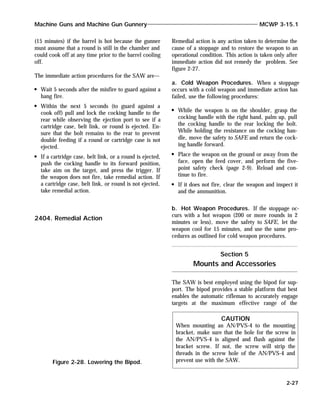
Figure 2-28. Lowering the Bipod.
CAUTION
When mounting an AN/PVS-4 to the mounting
bracket, make sure that the hole for the screw in
the AN/PVS-4 is aligned and flush against the
bracket screw. If not, the screw will strip the
threads in the screw hole of the AN/PVS-4 and
prevent use with the SAW.
weapon. In some situations, however, it may be nec-
essary to employ the weapon using assault fire tech-
niques. See section 8, Operation and Firing, of this
chapter for more detail.
2501. Bipod
The bipod is used to fire from the prone position or
from a fighting hole. The shoulder rest on the butt-
stock provides support for the SAW when fired in
the bipod mode. The gas cylinder holds the bipod in
place. Once the gas cylinder is removed, the bipod
can also be removed from the receiver.
To lower the bipod legs, hold the legs together
and pull down and away from the handguard. Re-
lease the legs so that they lock in the vertical
position. To extend the bipod legs, grasp the foot
of each leg and pull down. See figure 2-28.
To retract the bipod legs, push in the latches and
push in the legs.
Fold the bipod legs when transporting the
weapon. Hold the two legs together, pull back un-
der the handguard, and release so that the hooks
on the legs grip the handguard. The bipod can be
folded only when the legs are in the closed posi-
tion. See figure 2-29.
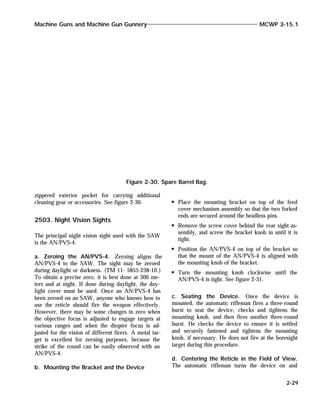
2502. Spare Barrel Bag
The spare barrel bag is used to carry a spare barrel
for each SAW. It has an attached carrying strap and
MCWP 3-15.1 Machine Gun, Light, Squad Automatic Weapon, M249
2-28
Figure 2-29. Folding of Bipod Under the Handguard.
zippered exterior pocket for carrying additional
cleaning gear or accessories. See figure 2-30.
2503. Night Vision Sights
The principal night vision sight used with the SAW
is the AN/PVS-4.
a. Zeroing the AN/PVS-4. Zeroing aligns the
AN/PVS-4 to the SAW. The sight may be zeroed
during daylight or darkness. (TM 11- 5855-238-10.)
To obtain a precise zero, it is best done at 300 me-
ters and at night. If done during daylight, the day-
light cover must be used. Once an AN/PVS-4 has
been zeroed on an SAW, anyone who knows how to
use the reticle should fire the weapon effectively.
However, there may be some changes in zero when
the objective focus is adjusted to engage targets at
various ranges and when the diopter focus is ad-
justed for the vision of different firers. A metal tar-
get is excellent for zeroing purposes, because the
strike of the round can be easily observed with an
AN/PVS-4.
b. Mounting the Bracket and the Device
Place the mounting bracket on top of the feed
cover mechanism assembly so that the two forked
ends are secured around the headless pins.
Remove the screw cover behind the rear sight as-
sembly, and screw the bracket knob in until it is
tight.
Position the AN/PVS-4 on top of the bracket so
that the mount of the AN/PVS-4 is aligned with
the mounting knob of the bracket.
Turn the mounting knob clockwise until the
AN/PVS-4 is tight. See figure 2-31.
c. Seating the Device. Once the device is
mounted, the automatic rifleman fires a three-round
burst to seat the device, checks and tightens the
mounting knob, and then fires another three-round
burst. He checks the device to ensure it is settled
and securely fastened and tightens the mounting
knob, if necessary. He does not fire at the boresight
target during this procedure.
d. Centering the Reticle in the Field of View.
The automatic rifleman turns the device on and
Machine Guns and Machine Gun Gunnery MCWP 3-15.1
2-29
Figure 2-30. Spare Barrel Bag.
MCWP 3-15.1 Machine Gun, Light, Squad Automatic Weapon, M249
2-30
Figure 2-31. Mounting the Bracket and the Device.
centers the reticle pattern in the field of view by us-
ing the azimuth and elevation actuators. To be accu-
rate, he does this by rotating the elevation and
azimuth actuators from one side to the other and
from top to bottom while counting the number of
clicks. (The elevation actuator has the down direc-
tion marked DN with an arrow. This moves the
strike of the round. The azimuth actuator has the
right direction marked with RT with an arrow. This
also moves the strike of the round. He divides the
number of clicks for each by two and moves the ele-
vation and azimuth actuators that number of clicks.
This manually centers the reticle in the field of view
horizontally and vertically. This enables the auto-
matic rifleman to reach an accurate boresight be-
tween the point of aim (reticle) and the center of the
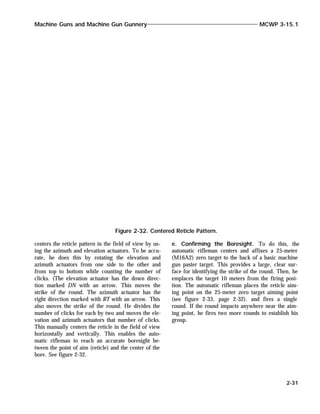
bore. See figure 2-32.
e. Confirming the Boresight. To do this, the
automatic rifleman centers and affixes a 25-meter
(M16A2) zero target to the back of a basic machine
gun paster target. This provides a large, clear sur-
face for identifying the strike of the round. Then, he
emplaces the target 10 meters from the firing posi-
tion. The automatic rifleman places the reticle aim-
ing point on the 25-meter zero target aiming point
(see figure 2-33, page 2-32). and fires a single
round. If the round impacts anywhere near the aim-
ing point, he fires two more rounds to establish his
group.
Machine Guns and Machine Gun Gunnery MCWP 3-15.1
2-31
Figure 2-32. Centered Reticle Pattern.
Section 6
Maintenance
Proper maintenance, care, cleaning, and inspection
of a weapon and its accessories determine whether
or not it will function correctly when needed. The
bore and chamber must be properly maintained to
preserve accuracy. Because of the close fit of work-
ing surfaces and the high speed at which the gun op-
erates, the receiver and all moving parts must be
kept clean, correctly lubricated, and free from burrs,
rust, and dirt to ensure proper, efficient functioning.
There are certain actions that must be taken before,
during, and after firing to properly maintain the
SAW.
MCWP 3-15.1 Machine Gun, Light, Squad Automatic Weapon, M249
2-32
Figure 2-33. Reticle Aiming Point and the Target Aiming Point.
2601. Care and Cleaning Before, During,
and After Firing
a. Before Firing
Wipe the bore dry.
Inspect the weapon as outlined in the operator’s
technical manual.
Lubricate the weapon.
b. During Firing
Inspect the weapon periodically to ensure that it
remains lubricated.
When malfunctions or stoppages occur, follow the
procedures in section 4.
c. After Firing
Immediately clear and clean the weapon.
Every 90 days during inactivity, clean and lubri-
cate the weapon unless inspection reveals more
frequent servicing is necessary.
2602. Normal Maintenance Procedures
The SAW should be cleaned immediately after fir-
ing. It should be detail disassembled before clean-
ing. After it has been cleaned and wiped dry, a thin
coat of CLP is applied by rubbing with a cloth. This
lubricates and preserves the exposed metal parts dur-
ing all normal temperature ranges. When not in use,
the SAW should be inspected daily and cleaned and
lubricated when necessary.
a. Cleaning. Cleaning material authorized for use
on the SAW by the operator is CLP, RBC, and dry
cleaning solvent. Use CLP or RBC for daily mainte-
nance and to remove minor carbon buildup after fir-
ing. Dry cleaning solvent will dry out the metal and
Machine Guns and Machine Gun Gunnery MCWP 3-15.1
2-33
Figure 2-34. SAW Tool Storage.
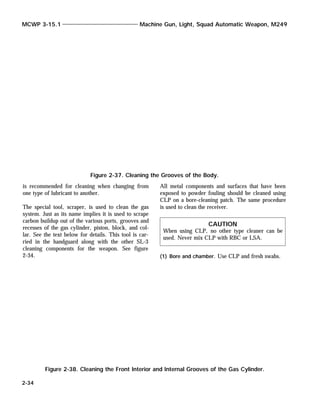
Figure 2-35. Cleaning the Gas Vent Hole. Figure 2-36. Cleaning the Central Hole.
is recommended for cleaning when changing from
one type of lubricant to another.
The special tool, scraper, is used to clean the gas
system. Just as its name implies it is used to scrape
carbon buildup out of the various ports, grooves and
recesses of the gas cylinder, piston, block, and col-
lar. See the text below for details. This tool is car-
ried in the handguard along with the other SL-3
cleaning components for the weapon. See figure
2-34.
All metal components and surfaces that have been
exposed to powder fouling should be cleaned using
CLP on a bore-cleaning patch. The same procedure
is used to clean the receiver.
CAUTION
When using CLP, no other type cleaner can be
used. Never mix CLP with RBC or LSA.
(1) Bore and chamber. Use CLP and fresh swabs.
MCWP 3-15.1 Machine Gun, Light, Squad Automatic Weapon, M249
2-34
Figure 2-37. Cleaning the Grooves of the Body.
Figure 2-38. Cleaning the Front Interior and Internal Grooves of the Gas Cylinder.
(2) Gas regulator. Use the special tool (scraper).
Remove all carbon dust. Do not use CLP on the col-
lar, gas block, or body.
Clean the gas vent hole. See figure 2-35.
Clean the central hole with the appropriate part of
the scraper by turning it clockwise and pushing it
inward toward the bottom of the housing. See fig-
ure 2-36.
Use the protruding tips of the scraper to clean the
two grooves of the body. See figure 2-37.
(3) Gas cylinder and piston. Use the special tool
(scraper). Do not use CLP on the gas cylinder or
piston.
Clean the front interior of the gas cylinder (repo-
sitioned in receiver with bipod in place) by insert-
ing and turning the flat side of the scraper in a
360 degree circular motion. See figure 2-38.
Clean the internal grooves of the front side of the
gas cylinder the same as described in the preced-
ing bullet, except insert the scraper farther into
the gas cylinder. See figure 2-38.
Clean the three grooves of the piston using a 360
degree circular motion (see figure 2-39). Remove
all carbon dust from the piston inside and out.
Clean the hole in the front of the piston by insert-
ing and turning the flat side of the scraper in a
360 degree circular motion. See figure 2-40.
(4) All other parts. Clean carbon and dirt from all
other parts of the weapon.
NOTE
A cloth saturated in CLP is used on exterior surfaces
to prevent corrosion.
b. Lubricating. The lubricants authorized for field
use on the SAW are CLP and LAW. They are used
to lubricate certain parts of the weapon before, dur-
ing, and after firing (see paragraph 2601). Each type
is best used in specific climatic and environmental
conditions (see paragraph 2602).
Machine Guns and Machine Gun Gunnery MCWP 3-15.1
2-35
Figure 2-39. Cleaning the Grooves of the
Piston.
Figure 2-40. Cleaning the Hole in the Front of the Piston.
After the SAW is cleaned and wiped dry, a thin coat
of CLP is applied by rubbing it with a cloth. This
lubricates and preserves the exposed metal parts dur-
ing all normal temperature ranges. The moving parts
are lubricated with CLP. After lubricating, rub the
components by hand to spread the CLP.
(1) Operating rod group. Use CLP on the operating
rod and spring, the slide assembly, the feed roller,
and the bolt-locking lug.
(2) Barrel group. Use CLP on the cam surfaces of
the bolt-locking lugs, the heat shield, and along the
outer surfaces of the barrel clamp.
(3) Receiver group. Use CLP on all moving parts
on the cover assembly and the receiver rails.
2603. Special Maintenance Procedures
a. Climatic Conditions
(1) Cold climates. In cold climates, the SAW must
be kept free of excess lubricants, cleaners, and mois-
ture, all of which can freeze and cause the weapon to
operate sluggishly. If brought indoors, allow the
SAW to come to room temperature, wipe completely
dry, and lubricate with a light coat of CLP. In tem-
peratures between 10 degrees Fahrenheit (-12 de-
grees centigrade) and -10 degrees Fahrenheit (-23
degrees centigrade), the SAW should be lubricated
with CLP, or LAW. In sustained temperatures be-
low -10 degrees Fahrenheit (-23 degrees centigrade)
use LAW only.
MCWP 3-15.1 Machine Gun, Light, Squad Automatic Weapon, M249
2-36
(2) Hot, humid climates. In hot, humid climates,
inspect more frequently for rust and keep free of
moisture. Ensure that the SAW is lubricated prop-
erly with CLP. Generally a heavier application of
lubricant is required.
(3) Hot, dry climates. In hot, dry climates, sand
and dust must be kept from collecting in working
parts. Clean the weapon daily with CLP. Wipe dry.
The Teflon coating left by the CLP will be sufficient
to keep the parts working smoothly.
b. Nuclear, Biological, and Chemical (NBC)
Conditions. If contamination is anticipated, apply
lubricant to all outer surfaces of the weapon (do not
lubricate ammunition). Keep the weapon covered as
much as possible. If the weapon is contaminated, de-
contaminate by following the procedures outlined in
FM 3-5, NBC Decontamination, then clean and
lubricate.
2604. Inspection
Inspection begins with the weapon disassembled in
its major groups. Shiny surfaces do not mean the
parts are unserviceable. The following parts of the
weapon and related equipment are inspected for the
conditions indicated. Any broken or missing parts
should be repaired or replaced according to TM
9-1005-201-10.
a. Operating Rod Group
The operating rod should not be bent, broken, or
cracked.
The buffer spring should not have breaks.
Lug pins should protrude equally on both sides of
the buffer spacer.
The operating rod spring should not have kinks or
separated strands or broken strands. It can have a
maximum of one break on any one strand.
The bolt assembly is checked for visible damage.
The cartridge extractor should not be cracked or
chipped.
The slide assembly is checked for visible damage.
The feed roller is checked for spring tension when
compressed and that the pivot slide is locked onto
the slide assembly.
The firing pin is checked for straightness and
cracks and that the tip is completely rounded.
The firing pin spring should not be crushed or
bent. The beveled end should not be stretched.
The sear notch on the piston assembly is checked
for signs of excessive wear or burring. Slight ro-
tation of the piston on its housing is normal and is
not cause for rejection.
b. Barrel Group
The flash suppressor should not be cracked, and it
should be fastened securely.
The front sight post and front sight base must not
be bent, cracked, or broken.
Weapons already zeroed should not be adjusted.
The heat shield assembly is inspected for damage,
cracks, or broken retaining clamps.
The gas regulator and collar are checked for
cracks or burrs.
The barrel is checked for bulges, cracks, bends,
obstructions, or pits in the chamber or bore.
The gas plug is checked for obstructions, cracks,
and bulges.
Machine Guns and Machine Gun Gunnery MCWP 3-15.1
2-37
The carrying handle is checked to ensure it is not
cracked, broken, or missing; that it can be folded
under spring pressure to the right and left; and
that it remains locked in an upright position.
c. Handguard Group
The handguard should not be cracked or broken.
The retaining clip must be attached to the hand-
guard retaining pin.
d. Buttstock and Buffer Assembly Group
MCWP 3-15.1 Machine Gun, Light, Squad Automatic Weapon, M249
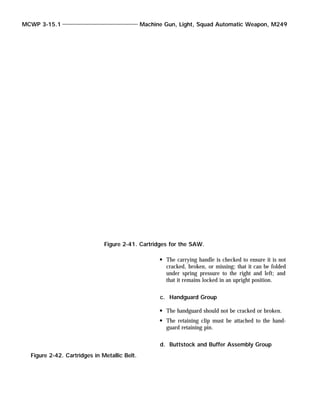
Figure 2-41. Cartridges for the SAW.
Figure 2-42. Cartridges in Metallic Belt.
The buttstock is checked for cracks, bends, or
breaks; and for missing components. It is checked
for linkage and tension on the buffer rod.
The shoulder rest is checked to ensure it is not
bent or broken and that it locks in both positions.
e. Trigger Mechanism Group
The shoulder of the sear should not show exces-
sive wear.
The safety should function properly. (The sear
should move only slightly when the safety is on
SAFE, and freely when the safety is on FIRE).
The sear pin should not protrude from the trigger
mechanism, because the trigger mechanism will
not go back in place.
f. Gas Cylinder Group. The gas cylinder should
not be cracked, bent, or broken.
g. Bipod Group
The bipod group should not be cracked, bent, or
broken.
The bipod legs should extend and collapse easily.
h. Receiver Group
The cover latch should work properly.
All parts inside the cover assembly should move
under spring tension.
All spot welds are checked for cracks.
Machine Guns and Machine Gun Gunnery MCWP 3-15.1
2-39
WARNING
Do not fire blank ammunition at any person
within 20 feet, because fragments of a closure
wad or particles of unburned propellant can
cause injury.
Figure 2-43. Ballistic Data for 5.56mm Ammunition.
The cover assembly should remain open without
support.
The belt-holding pawl must be under spring
tension.
The receiver should not be bent or cracked.
The cocking handle should slide freely within its
guide and lock in its forward position.
The windage and elevation knobs on the rear sight
should be movable and legible.
The windage scale screws should not be worn or
burred.
Section 7
Ammunition
This section covers the several different types of
5.56mm standard military ammunition used in the
SAW (see figure 2-41). Marines should become fa-
miliar with and recognize the appropriate ammuni-
tion types.
2701. Classification
Ammunition for the SAW is classified as listed:
a. Ball. Used against targets of light material, per-
sonnel, and during marksmanship training.
b. Tracer. Used for observation of fire, signalling,
and marking targets.
c. Blank. Used during training when simulated fire
is desired.
d. Dummy. Used during training such as gun drill,
and loading and unloading practice.
2702. Identification
The type, caliber, model, and ammunition lot num-
ber, including the symbol of the manufacturer, are
necessary for the complete identification of small
arms ammunition. The standard 5.56mm NATO car-
tridge is completely identifiable by its appearance,
the painting of the bullet tip, the manufacturers ini-
tial and year of manufacture on the base of the car-
tridge case, and the markings on the packing
containers. When removed from the original packing
container, the cartridge may be identified by its
physical characteristics. The cartridge description
and characteristics are as follows.
a. Cartridge, 5.56mm Ball M855 (DODAC
1305-A059). The M855 cartridge has a gilding,
metal-jacketed, lead alloy core bullet with a steel
penetrator. The primer and case are waterproof. The
ammunition is linked by a disintegrating metallic
split-linked belt for firing from the ammunition box
(see figure 2-42). In an emergency, the M855 round
can also be loaded and fired from the SAW using a
20 or 30 round magazine from an M16. The M855
round is identified by a green tip, has a projectile
weight of 62 grains, and is 2.3 cm long. This is the
NATO standard round. It is effective against person-
nel and light materials.
b. Cartridge, 5.56mm Tracer, M856 (DODAC
1305-A064). This cartridge has a 63.7 grain bullet
without a steel penetrator. It is identified by an or-
ange tip. The tracer is used for adjustments after ob-
servation, incendiary effects, and signalling. When
MCWP 3-15.1 Machine Gun, Light, Squad Automatic Weapon, M249
2-40
CONDITION 1: The bolt is locked to the rear.
The safety is engaged. Ammunitions is one the
feed tray or a magazine is inserted. The cover
is closed.
CONDITION 2: Not applicable to the M249.
CONDITION 3: The bolt is locked to the rear.
The safety is engaged. The feed tray is clear
of ammunition and/or no magazine is inserted.
The cover is closed.
CONDITION 4: The bolt is forward. The safety
is not engaged. The feed tray is clear of ammu-
nition and/or no magazine is inserted. The cover
is closed.
Figure 2-44. Condition Codes for the SAW.
tracer rounds are fired, they are mixed with ball am-
munition in a ratio of four ball rounds to one tracer
round. The DODAC for ball and tracer mix is
A064.
c. Cartridge, 5.56mm Dummy M199 (DO-
DAC 1305-A060). This cartridge can be identified
by the six grooves along the side of the case begin-
ning about one-half inch from its head. It contains
no propellant or primer. The primer well is open to
prevent damage to the firing pin. The dummy round
is used during mechanical training, dry-fire exer-
cises, and function checks.
NOTE
The older issue M193 (ball) and M196 (tracer)
5.56mm cartridges can be fired with the SAW, but
accuracy is degraded; therefore, it should only be
used in emergency situations when the new M855 or
M856 ammunition described on page 2-33 is not a-
vailable.
d. Cartridge, 5.56mm blank M200 (M2 link,
DODAC 1305-A075). The blank cartridge has no
projectile. The case mouth is closed with a seven-
petal rosette crimp and has a violet tip. The original
M200 blank cartridge had a white tip. Field use of
this cartridge resulted in residue buildup, which
caused malfunctions. Only the violet-tipped M200
cartridge should be used. The blank round is used
during training when simulated live fire is desired.
An M15A2 blank-firing attachment must be used to
fire this ammunition.
Machine Guns and Machine Gun Gunnery MCWP 3-15.1
2-41
Figure 2-45. Loading.
CAUTION
Before raising the feed cover, move the weapon
away from your face so that you are not exposed
to the open chamber.
2703. Ballistic Data
Figure 2-43 shows some examples of the penetration
capability and other ballistic data for the M855
5.56mm ball round when fired from the SAW.
2704. Ammunition Packaging
The ammunition can contains two plastic ammuni-
tion boxes. Each box contains 200 rounds and
weighs 6.92 pounds. Dummy ammunition (M199) is
packed in boxes of 20 rounds each.
2705. Storage
Store ammunition of all classes away form heat
sources such as; open flame, radiators, heaters, and
hot water pipes. Ammunition is stored under cover.
If ammunition is in the open, it must be kept at least
6 inches above the ground and covered with a dou-
ble thickness of tarpaulin. The cover must be placed
so that it protects the ammunition yet allows ventila-
tion. Trenches are dug to divert water from flowing
under the ammunition.
2706. Care, Handling, and Preservation of
Ammunition
Ammunition should not be removed from the air-
tight containers until ready for use. Ammunition re-
moved from the airtight containers, particularly in
damp climates, may corrode.
Ammunition must be protected from mud, dirt, and
moisture. If it gets wet or dirty, the ammunition
must be wiped off before using. Lightly corroded
cartridges are wiped off as soon as the corrosion is
discovered. Heavily corroded, dented, or loose pro-
jectiles should not be fired.
MCWP 3-15.1 Machine Gun, Light, Squad Automatic Weapon, M249
2-42
Figure 2-46. Loading an Ammunition Belt.
Ammunition must also be protected from the direct
rays of the sun. Excessive pressure from the heat
may cause premature detonation.
Oil should never be used on ammunition. Oil col-
lects dust and other abrasives that may possibly
damage the operating parts of the weapon.
Section 8
Operation and Firing
The SAW squad automatic weapon fires from the
open bolt position to facilitate cooling. When the
trigger is pulled, the bolt and operating rod start for-
ward initiating the firing sequence. The weapon will
continue to fire as long as the trigger is held to the
rear and it is supplied with ammunition. The firing
operation works on gas pressure created as a fired
round passes through the barrel. Whenever the bolt
is to the rear the weapon is ready to fire so the
weapon must be placed on SAFE to prevent firing.
The safety is not designed to be engaged when the
bolt is forward. The SAW is loaded, fired, un-
loaded, and cleared from the open- bolt position. As
with other small arms, Condition Codes are applied
when carrying the SAW. In Condition 1 the weapon
is ready to fire when taken off SAFE, while Condi-
tions 3 and 4 place the weapon in a less ready status.
They are described in figure 2-44.
NOTE
The ammunition box, if used, should be attached to
the underside of the weapon in all three applicable
conditions to allow faster transition from one condi-
tion to another.
2801. Loading
To load the SAW, make sure the weapon is cleared,
as described in Section 2. (With the feed cover
Machine Guns and Machine Gun Gunnery MCWP 3-15.1
2-43
Figure 2-47. Loading a Magazine.
raised, make sure your face is not exposed to the
open chamber area when loading.) See figure 2-45.
a. Belt-Fed. When loading belted ammunition, al-
ways cant the weapon to the right. The ammunition
box, if used, is attached to the weapon by sliding the
flanges on the top of the box into the grooved tracks
on the bottom of the receiver until the holding lever
on the box snaps into place. A loose belt of ammuni-
tion, without the ammunition box, can also be used
but care must be taken to keep the ammunition as
clean as possible during firing to ensure smooth
feeding of the rounds. Make sure the open side of
the links are facing down, and place the lead link tab
or first round of the belt in the tray groove against
the cartridge stop (see figure 2-46). The rounds
should be placed flat across the feed tray. With the
left hand, count five to six rounds down to hold am-
munition in place on the feed tray, and at the same
time close the feed cover with the right hand. When
closing the feed cover, always place your hand in
front of the rear sight to prevent accidentally chang-
ing the sight adjustment.
b. Magazine-Fed. Load the 20 or 30 round maga-
zine by inserting it into the magazine well on the left
side of the receiver. Push the magazine firmly into
the well until it seats and the release tab clicks into
the recess on the magazine. See figure 2-47.
NOTE
The 20 or 30 round magazine is for emergency use
only when linked ammunition is not available.
MCWP 3-15.1 Machine Gun, Light, Squad Automatic Weapon, M249
2-44
Figure 2-48. Prone Position, Bipod-Supported.
Figure 2-49. Firing From the Hip.
(Preferred Assault FireTechnique.)
2802. Unloading
To unload the weapon, pull the bolt and lock it in
the rear position if it is not already there. Place the
safety on SAFE. Depending on whether belt-fed or
magazine-fed ammunition is used, use the following
procedures.
a. Belt-Fed. Raise the feed cover and remove any
ammunition or links from the feed tray. Perform the
five-point safety check.
b. Magazine-Fed. Push the magazine release tab
down and pull the magazine from the magazine well.
Raise the feed cover and perform the five-point
safety check.
2803. Operation of the Safety
When the safety is on, the cutaway portion of the
safety bar is not aligned with the safety lug of the
sear. When the trigger is pulled, the sear cannot ro-
tate downward and the operating group cannot move
forward. When the safety is placed in the FIRE posi-
tion, the cutaway portion of the safety bar is aligned
with the safety lug on the sear, allowing the sear to
move downward when the trigger is pulled, releas-
ing the operating group and initiating the cycle of
function. The weapon is not designed to be placed
on SAFE with the bolt forward.
2804. Firing the SAW
a. Trigger Manipulation. The trigger is pulled to
the rear and then released. This gives the rifleman
control of the number of rounds fired in each burst.
The sustained rate of fire (100 rounds per minute) is
delivered in bursts of 3 to 5 rounds which are fired
4 to 5 seconds apart. The rapid rate of fire (200
rounds per minute) is delivered in bursts of 6 to 8
rounds which are fired 2 to 3 seconds apart.
b. Traverse and Search
To make minor changes in direction, or traverse,
the rifleman shifts his shoulders to the right or left
to select successive aiming points in the target area.
Major changes require him to redistribute his weight
to his elbows and toes and raise his body off the
ground. Using his toes, he shifts his body to the
right or left to be in the opposite direction of the tar-
get, and pivots on his elbows until he is once again
aligned with the target. He rapidly assumes a steady
Machine Guns and Machine Gun Gunnery MCWP 3-15.1
2-45
Figure 2-50. Firing From Under the Arm.
position, obtains the proper sight picture, and en-
gages the target.
A search is movement of the weapon’s muzzle up or
down to distribute fire in depth. To make changes in
elevation, the rifleman moves his elbows closer to-
gether to lower the muzzle or farther apart to raise
the muzzle. Gross errors in range are corrected by
adjusting the range setting with the elevation knob.
c. Prone Position, Bipod-Supported. This is the
preferred position for employment of the SAW. This
position provides the most stable platform for firing
the weapon and affords the automatic rifleman the
best opportunity to provide the most accurate fire
possible out to the maximum effective range of the
weapon. See figure 2-48.
Assume a prone position to the rear of the
weapon and place the shoulder rest on the firing
shoulder. An imaginary line drawn through the
weapon should bisect the firing shoulder and but-
tock and continue through the heel of the foot.
Spread the legs a comfortable distance apart with
heels as close to the ground as possible and yet
still be comfortable.
Grasp the pistol grip with the firing hand with the
fleshy end of the index finger resting lightly on
the trigger. Place the non-firing hand on the small
of the stock with the thumb curled underneath.
Slide the non-firing hand forward until the little
finger touches the receiver, so the aiming point
will always be the same.
Place the cheek against the forefinger of the non-
firing hand to form a stock weld. Try to position
the non-firing hand and cheek at the same spot on
the stock each time the weapon is fired. The stock
weld should provide for a natural line of sight
through the center of the rear sight aperture to the
front sight post and to the target. Relax the neck
so that the cheek rests on the forefinger naturally.
Apply a firm, steady pressure rearward and
down, holding the weapon tightly into the hollow
of the shoulder while aiming and firing.
Keep the shoulders level and elbows about an
equal distance from the receiver of the weapon.
d. Assault Fire Techniques. The bipod sup-
ported prone position is the preferred firing position
for the SAW; however, it may sometimes be neces-
sary to employ the weapon from more hasty posi-
tions. This should only be done when absolutely
necessary because the accuracy of the fire is greatly
diminished. For example, assault fire techniques
may be used for initial bursts of suppression fire
prior to assuming the prone position, in a chance en-
counter with the enemy, or for suppression fire as
the automatic rifleman moves quickly through an ob-
jective toward consolidation.
(1) Firing from the hip. In the preferred assault fire
technique, the automatic rifleman grasps the bipod
legs close to the receiver, squeezes them together,
and maintains pressure on them downward and to
the left as he fires. Another technique is to grasp the
handguard assembly, maintaining pressure down and
to the left. With either technique he places the butt-
stock firmly against his hip and holds it there by
steady inward pressure from his right forearm while
firmly gripping the trigger assembly with his right
hand. He leans forward at the waist and bends his
MCWP 3-15.1 Machine Gun, Light, Squad Automatic Weapon, M249
2-46
Figure 2-51. Sight Picture.
knees slightly as he fires. His feet should be kept
shoulder width apart when firing. See figure 2-49.
(2) Firing from under the arm. The automatic rifle-
man grasps the handguard maintaining pressure
downward and to the left during firing. He places
the buttstock firmly under his arm and holds it in
place with steady inward pressure from his upper
arm while firmly gripping the trigger assembly
with his
right hand. He leans forward at the waist and bends
his knees slightly as he fires. His feet should be kept
shoulder width apart when firing. See figure 2-50.
2805. Change Barrel Procedures
The ability to change the barrels of the SAW quickly
provides a great advantage. It allows one barrel to
be used while the other is cooling. Barrels should
be changed when they are beginning to overheat.
Changing a barrel only takes a few seconds and sig-
nificantly improves rate of fire and accuracy, in-
creases the life of each barrel, and ensures a
continuous rapid rate of accurate fire. As a guide,
change barrels after firing the rapid rate for 2
minutes.
The barrel can be changed with the bolt forward or
to the rear. The weapon does not necessarily need to
be unloaded; however, it must be placed on SAFE
when the bolt is to the rear. The automatic rifleman
depresses the barrel release latch and holds it down.
The assistant automatic rifleman grasps the barrel
changing handle, pulls forward and up and removes
the barrel from the receiver. While the automatic ri-
fleman continues to hold down on the barrel release
latch the assistant inserts the new barrel into the re-
ceiver, ensures that the gas system is aligned, and
pulls to the rear on the barrel changing handle to
fully seat the new barrel. The automatic rifleman re-
leases the barrel release latch and the assistant gives
a quick tug on the barrel to verify that it is locked in
place. The automatic rifleman can now relay on tar-
get and continue to fire. The automatic rifleman can
easily change barrels by himself if the situation pre-
cludes the assistant from helping him.
Section 9
Qualification Firing
2901. Fundamentals of Marksmanship
a. Accurate Initial Burst. Obtaining an accurate
initial burst of fire on the target is essential to good
marksmanship. This requires the automatic rifleman
to estimate range to the target, set the sights, and ap-
ply the fundamentals of marksmanship while engag-
ing targets.
b. Adjustment of Fire. The automatic rifleman
must observe the strike of the rounds when the ini-
tial burst is fired. If not on target, he manipulates
the SAW until the rounds do strike the target. He
must be proficient in observing the strike of rounds,
in observing and using tracers, and in rapidly laying
the SAW on the target during firing.
c. Speed. Speed is also essential to good marks-
manship; it is attained by practice in both dry-fire
and live-fire exercises. It is an acquired skill gained
through extensive training that combines other skills
Machine Guns and Machine Gun Gunnery MCWP 3-15.1
2-47
Figure 2-52. Sliding Scale on Sight.
when delivering fire. Speed should not be stressed to
the detriment of accuracy.
d. Steady Position. In automatic fire, position is
the most important aspect of marksmanship. If the
automatic rifleman has a good zero, aims his
weapon correctly, and properly applies a steady hold
in firing a burst of three rounds, the first round of
that burst will hit the target at the point of aim.
However, this is not necessarily true of the second
and third rounds. The first round hits the aiming
point the same as when a round is fired singularly.
The recoil from the first and subsequent rounds will
progressively disturb the lay of the weapon with
each round of the burst.
The relationship between the point of impact of the
first and subsequent rounds of the burst depends on
the stability of the automatic rifleman’s position. His
body, directly behind the weapon, serves as the
foundation, and his grip serves as a lock to hold the
weapon against the foundation. The better the body
alignment and the steadier the grip, the less dis-
persed the rounds of a burst of automatic fire will
be.
e. Aim. To aim the SAW, the automatic rifleman
must align the sights, focus his eye, obtain a correct
sight picture, control his breathing, and maintain
trigger control.
(1) Sight alignment. Align the rear sight aperture
(peep sight) with the sight post of the hooded front
sight. Then, align the front sight post in the center
of the rear peep sight. An imaginary horizontal line
drawn through the center of the peep sight should
touch the top of the front sight post, while an imagi-
nary vertical line through the center of the rear peep
sight should bisect the front sight post.
(2) Focus of the eye. A good firing position places
the eye directly on line with the center of the rear
sight. Focus on the tip of the front sight post. The
natural ability of the eye to center objects in a circle
and to seek the point of greatest light (center of peep
sight) aids in providing correct sight alignment.
(3) Sight picture. A correct sight picture has the
target, front sight post, and rear sight aligned. The
sight picture consists of sight alignment and place-
ment of the aiming point on the target. Align the tip
of the front sight post in the center (see figure 2-51)
of the rear peep sight and then align the sights with
the target. Align the top of the front sight post on
the center base of the target.
f. Breath Control. Two types of breath control
are used. When firing single shots, as in zeroing, the
automatic rifleman stops breathing after most of the
air has been exhaled during the normal breathing cy-
cle. He fires before he feels any discomfort. During
automatic fire, ideally, the automatic rifleman ex-
hales and stops his breath when pressing the trigger.
He does not have time to take deep breaths between
bursts. He must hold his breath before each burst or
adapt his breathing by taking quick shallow breaths
or taking deeper breaths between several bursts.
g. Trigger Control. Pressing the trigger straight to
the rear and releasing it helps control the number of
rounds in each burst and prevents disturbing the lay
of the weapon. For a three-round burst, the auto-
matic rifleman presses the trigger to the rear, says
PRESS, RELEASE, and releases the trigger.
2902. Position and Grip
The rifleman is in a prone position to the rear of the
gun with his right shoulder against the buttstock
group. A straight line extending through the barrel
and receiver passes through his right shoulder and
hip. His legs are comfortably spread and his heels
are down (if possible).
The rifleman’s left hand grasps the top of the butt-
stock or the hand guard assembly. His right hand is
on the trigger assembly with his index finger on the
trigger. He exerts a firm pressure to the rear with
both hands while aiming and firing. His cheek rests
against the buttstock directly or on his hand as it
grips the buttstock. Breath control is practiced dur-
ing aiming and firing.
MCWP 3-15.1 Machine Gun, Light, Squad Automatic Weapon, M249
2-48
2903. Sight Settings and BZO Procedures
This paragraph provides information on how to set
the sights for elevation and windage for the SAW. It
also includes information on how to make correc-
tions if the initial setting on the windage knob or
peep sight is not accurate. At a 10-meter target, each
paster is 1 cm. Therefore, two clicks on the windage
knob in either direction moves the strike of the
round left or right 1 cm and two turns on the peep
sight moves the strike of the round up or down 1
cm. For example: If the shot group was 2 cm above
and 1 cm to the right of the paster, sight corrections
are made by correcting windage first. In this case,
rotate the windage knob two clicks toward the butt-
stock (clockwise). Rotate elevation knob four turns
toward the buttstock (clockwise) to lower the strike
of the round. See figure 2-52.
a. Elevation. Adjustments for elevation (range) re-
quire the automatic rifleman to turn the elevation
knob (closest to the buttstock) on the rear sight to
the desired range setting. Range settings are gradu-
ated increments from 300 to 1,000 meters. Even
numbered settings are on the left side of the scale
wheel and are numbered 4, 6, 8, 10 which represent
400, 600, 800, and 1,000 meters, respectively. Odd
numbered settings are on the right side of the scale
wheel and marked with the number 3 and three in-
dex lines, which represent 300, 500, 700, 900
meters, respectively. Rotation of the elevation
knob toward the
muzzle (counterclockwise) increases the range, while
rotation toward the buttstock (clockwise) decreases
the range.
Fine adjustments, like zeroing, are made by adjust-
ing the peep sight. Each 180-degree turn equals a
1/2-mil change in elevation which equals a 1/2-cm
change in impact at a range of 10 meters. Clockwise
(to the right) rotations decrease elevation, while
counterclockwise (to the left) rotations increase ele-
vation. The peep sight can be turned nine
180-degree turns from top to bottom. To make the
peep sight easier to grasp, the elevation knob is
turned to its highest point (1,000 meters). The ap-
propriate adjustment is made for the peep sight, and
then the sight is returned to the desired range.
Whenever readjusting the range, the point of aim is
never changed. The point of aim is the center base
of the target.
b. Windage. Adjustments for windage are made
by traversing the rear sight right and left along the
sliding scale. The sliding scale is marked or gradu-
ated with index lines. Each index line is equal to
1/2-mil change in direction or 1/2-cm change of im-
pact at 10 meters. Rotation of the windage knob
(closest to the muzzle end) toward the muzzle
Machine Guns and Machine Gun Gunnery MCWP 3-15.1
2-49
Figure 2-54. Zero Group Size.
(counterclockwise) moves the rear sight aperture
right, which moves the strike of the rounds right;
while rotation toward the buttstock (clockwise)
moves the aperture left, which moves the strike of
the rounds left.
c. Corrections. One click of the windage knob or
peep sight moves the strike of the round 1/2 cm at a
range of 10 meters or 1/2 meter at 1,000 meters. To
make corrections, figure 2-53 is used as a reference.
Range
(Meters) Sight Adjustment
100 One click moves strike 5 cm (2 inches)
200 One click moves strike 10 cm (4 inches)
300 One click moves strike 15 cm (6 inches)
400 One click moves strike 20 cm (8 inches)
500 One click moves strike 25 cm (10
inches)
600 One click moves strike 30 cm (12
inches)
700 One click moves strike 35 cm (14
inches)
800 One click moves strike 40 cm (16
inches)
900 One click moves strike 45 cm (18
inches)
Figure 2-53. Windage and Elevation
(Peep Sight) Correction Chart.
d. Zeroing. Zeroing aligns the sights with the bar-
rel so that the point of aim equals the point of im-
pact. Ten-meter zeroing is for conducting 10-meter
fire only and has no further application. (Zeroing at
range or field zeroing is the automatic rifleman’s
battlesight zero and must be recorded.)
(1) 10-meter zeroing, set the sights (mechanical
zero). The automatic rifleman indexes or places the
elevation knob on a range of 700 meters. He centers
the rear peep sight by rotating it clockwise (right) as
far as it will go, then rotating counterclockwise (left)
5 clicks or half-turns. He rotates the windage knob
toward the muzzle until the peep sight is completely
to the right, then rotates the windage knob toward
the buttstock 12 clicks to the left. This places the
peep sight in the approximate center of the sight.
Each sight may vary as to how many clicks are
needed. To check the sight, the automatic rifleman
starts with the sight all the way to the right and,
while counting the clicks, rotates the windage knob
until it stops on the left side. He divides the clicks
by two. If it is an uneven number, he rounds it up.
To center the sight, he rotates the windage knob to-
ward the center (right) while counting the appropri-
ate number of clicks. He adjusts the sliding scale at
the rear of the sight to center the large index line un-
der the zeroed windage mark on the sight. Two
threads should be showing on the front sight post. If
more or less are showing, the automatic rifleman
turns in the weapon for maintenance.
(2) Three-round group. The automatic rifleman fires
three single rounds loaded individually at the center
base of the aiming points on the basic machine gun
marksmanship target. He fires the three rounds with-
out making any adjustments to the sights. The shot
group must be about a 4-cm circle or smaller to es-
tablish the center of the group in relation to the cen-
ter base of the aiming paster. Establishing a smaller
shot group is difficult, because the SAW is an open-
bolt weapon. Sight alignment is disturbed somewhat
as the bolt moves forward during firing.
(3) Grid square overlay. For a more accurate adjust-
ment, the automatic rifleman moves downrange and
places the grid square overlay over pasters 1 and 2.
He ensures that he aligns the overlay with the pas-
ters and squares.
Count the number of squares it will take to move
the shot group to the aiming paster.
Upon completion, return to the firing line to make
corrections to the weapon. Figure 2-54 illustrates
a zero group size on which adjustments can be
made and a group that is too loose for adjust-
ments. If a group is too loose, check your posi-
tion and grip.
(4) Windage correction. If the center of the group
is to the left or right of the black aiming paster, the
automatic rifleman must correct for windage. To do
MCWP 3-15.1 Machine Gun, Light, Squad Automatic Weapon, M249
2-50
Machine Guns and Machine Gun Gunnery MCWP 3-15.1
2-51
Figure 2-55. Basic Machine Gun Target.
Figure 2-56. Grid Square Overlay.
MCWP 3-15.1 Machine Gun, Light, Squad Automatic Weapon, M249
2-52
Figure 2-57. Shot Group on Basic Machine
Gun Target.
Figure 2-59. Common Errors of Marksmanship.
Figure 2-58. Overlay Placed Over Pasters.
this, he must rotate the windage knob to move the
peep sight in the direction of the desired change (ro-
tate windage knob toward the muzzle [counterclock-
wise] to move the strike of the round to the right;
rotate the windage knob toward the buttstock [clock-
wise] to move the strike of the round to the left).
One click in either direction moves the strike of the
round 1/2 cm at 10 meters.
For example, if the automatic rifleman sees that the
center of the shot group is 2 cm (two black aiming
pasters) to the left of the aiming point, he adjusts the
point of impact four clicks in the direction of the
aiming point (to the right) by rotating the windage
knob toward the muzzle.
(5) Elevation correction. Before making elevation
adjustments, the range knob must be at its highest
setting. If the center of the shot group is above or
below the aiming point, the automatic rifleman ro-
tates the peep sight clockwise to lower the strike of
the round or rotates the peep sight counterclockwise
to raise the strike of the round. One 180-degree turn
in either direction moves the strike of the round 1/2
cm at 10 meters.
(6) Confirmation. The automatic rifleman fires an-
other three-shot group (loaded singly) after making
his corrections for windage and elevation. If the cen-
ter of the group is still off the aiming point, he ad-
justs further until the group is centered on the point
of aim.
(7) Recording. There is no reason to record the
10-meter zero, because it applies only to firing at the
10-meter basic machine gun target.
e. Field Zeroing. Automatic riflemen must know
how to zero the SAW at distance. He should select a
known distance target between 300 and 700 meters.
It is difficult to determine fully where the center of
the beaten zone is in relation to the target as range
increases. Therefore, the 300-meter target on the
transition range is recommended because of the ease
of determining adjustments.
(1) Set the sights. The automatic rifleman uses the
same procedures as for 10-meter zeroing are used
Machine Guns and Machine Gun Gunnery MCWP 3-15.1
2-53
Figure 2-60. Firing Table I.
except he places the elevation knob on the range to
the target. The recommended range is 300 meters.
(2) Fire a three-round burst. The automatic rifle-
man assumes a good stable position and fires a
three-round burst at the center base of the target and
notes where the burst strikes.
(3) Correct for windage. If the center of the beaten
zone is to the left or right of the target, he corrects
for windage. Each click moves the strike of the
rounds 1/2 mil or 6 inches at 300 meters. He adjusts
the windage knob accordingly.
(4) Correct for elevation. If the center of the beaten
zone is high or low in relation to the target, he cor-
rects for elevation. Because determining that rela-
tionship is difficult, automatic riflemen rely on trial
and error to gain sufficient experience in making re-
liable estimates. He makes corrections in the same
manner as 10-meter zeroing.
(5) Confirm. After making corrections for windage
and elevation, he fires a confirming burst of three
rounds. If the target is not hit, he repeats the
procedures.
(6) Record zero. Upon confirming the zero, he re-
cords it by counting the number of clicks (half-turns)
he moved the peep sight for elevation in relation to
the initial setting of 5. For example, if he made two
half-turns up, he records UP 2. If he made two half-
turns down, he records DOWN 2. Adjustments for
the windage scale are not recorded; instead, he loos-
ens the windage sliding scale screws and aligns the
scale so that the large index line is under the wind-
age mark on the sight. Then, he tightens the screws.
2904. 10-Meter Firing
a. Targets and Scoring. The basic machine gun
target (FSN 6920-078-5128) is used for the 10-meter
firing exercise (see figure 2-55). The following ex-
planation of the target, including the size of the aim-
ing pasters and scoring spaces, aids in zeroing the
M249s and facilitates control during the 10-meter
firing exercises. The target consists of four sections
lettered A, B, C, and D. Each section has four point
targets numbered 1, 2, 3, and 4; and two sets of area
targets numbered 5 through 6 and 7 through 8. Each
space is 4 cm wide and 5 cm high. The black aiming
paster within the numbered scoring spaces is 1 cm
square. The target is used to score two automatic ri-
flemen—one uses sections A and B, and the other
automatic rifleman uses sections C and D.
(1) Point targets. Point targets on the basic machine
gun target are pasters 1 through 4 of sections A, B,
C, and D. Firing at point targets exposes the auto-
matic rifleman to zeroing techniques and controlled-
burst fire techniques. Targets 1 through 4 can also
be used for qualification.
(2) Area targets. Area targets on the basic machine
gun target consist of pasters 5 through 6, and 7
through 8 of sections A, B, C, and D. Target group
5 through 6 provides the automatic rifleman with
targets in depth and allows him to use a series of
aiming points to disburse fire across the target by
using body position changes. Target group 7 through
8 provides the automatic rifleman with linear targets
with depth. This series of targets uses a series of
aiming points to disburse fire across the target and
in depth by using body position changes.
(3) Grid square overlay. This device assists the
automatic rifleman in zeroing his weapon at 10 me-
ters, while using the basic machine gun target (see
figure 2-56). The grid square overlay is used the
same as an M16A2 25-meter zero target, except the
material can be made of plastic or view graph trans-
parency. Each square is equal to 1 cm.
Set the sights for 10-meter zeroing, then fire a
three-round shot group.
After firing the second three-round shot group
(see figure 2-57), place the grid square overlay
over the pasters 1 and 2 (see figure 2-58), and
count the number of clicks it will take for rounds
to impact on the black aiming paster. (Corrections
for figure 2-57 would be turn the windage knob
toward the muzzle (clockwise) two clicks.)
MCWP 3-15.1 Machine Gun, Light, Squad Automatic Weapon, M249
2-54
(4) Target analysis. Targets are analyzed and
scored to determine the automatic rifleman’s profi-
ciency and to reinforce the fundamentals of marks-
manship. During firing with a zeroed weapon, a
target is best analyzed by considering the common
errors of SAW marksmanship. See figure 2-59.
(5) Scoring procedures. When scoring the 10-meter
target, the trainer scores all scoring spaces (1
through 4, 5 through 6, and 7 through 8). One point
is given for each round impacting within each scor-
ing space. The maximum point value is 3 points for
each scoring space. Rounds touching the line on the
paster are considered a HIT. When firing at 1
through 4 with a belt of 12 rounds, the maximum
score the automatic rifleman can receive is 12
points. When firing at pasters 5 through 6, he en-
gages the five scoring spaces with a 15-round belt.
The maximum score possible is 15 points. When fir-
ing at pasters 7 through 8, the automatic rifleman
engages the eight scoring spaces with 24 rounds with
a maximum score of 24 points.
The total possible score is 51 points. A minimum of
35 points is required to qualify on the 10-meter
course of fire.
b. Conduct of Fire. The 10-meter firing trains
automatic riflemen to apply the fundamentals of
automatic rifle marksmanship in live-fire exercises.
It familiarizes the Marine with the weapon’s charac-
teristics, noise, and recoil. It instills in the automatic
rifleman confidence in his weapon. Each automatic
rifleman learns to zero his SAW, conducts
controlled-burst fire at point targets, and uses trav-
erse and search techniques of fire at area targets.
The 10-meter firing is conducted on a 10-meter
range or a multipurpose range using the basic ma-
chine gun target. These exercises are fired with the
bipod from the prone position. The 10-meter firing
exercises are for practice as well as part of record
qualification. All 10-meter firing exercises are re-
corded and scored to provide the automatic rifleman
an assessment on his performance. The 10-meter fir-
ing is conducted in accordance with Firing Table I
(figure 2-60). The automatic riflemen are instructed
on the objectives and fundamentals of firing from
the bipod-supported prone position, on fire
commands used on the basic range, on the basic ma-
chine gun marksmanship target, and on analyzing
and scoring the target. The unit is organized in fir-
ing orders based on range constraints. The seven
tasks are fired in the following manner.
NOTE
Throughout all firing exercises, the automatic rifle-
man performs the appropriate tasks during each ele-
ment of the fire command. The number of rounds
fired is used instead of the rate for METHOD OF
FIRE. This is for control. (Omitting the rate speci-
fies RAPID fire which is not desirable for the tasks.)
(1) Task 1, zeroing
Prepare the rear sight for zeroing and check the
front sight.
Assume a good position.
Prepare a single round.
When the following fire command is given, repeat
each element of the fire command as it is given.
AUTOMATIC RIFLEMAN (Load and move safety
to FIRE)
FRONT (Focus on target or target area)
PASTER ONE (Locate target)
SEVEN HUNDRED (Adjust sights and acquire
sight picture)
FIXED, ONE ROUND(Method of fire)
COMMENCE FIRING (Fire on command but
when ready)
Load one round, obtain the proper sight picture,
and give an UP to safety personnel.
The command COMMENCE FIRING is given.
When ready, engage paster 1 with 3 single shots.
Move downrange to observe, mark, and triangu-
late the shot group. Sight adjustments using the
rear peep sight and windage knob are made at this
time if the shot group is tight enough. If not, fire
another 3 rounds to ensure the fundamentals are
mastered before adjusting the sights.
Machine Guns and Machine Gun Gunnery MCWP 3-15.1
2-55
Repeat the steps above, but fire at paster 2.
NOTE
If the automatic rifleman zeros his weapon using 9
rounds, he uses the remaining 3 to confirm his zero.
If he is unable to zero with 12 rounds, he is re-
moved from the firing line for remedial training.
(2) Task 2, controlled-burst firing
Prepare a 6-round belt.
When the following fire command is given, repeat
each element as it is given.
AUTOMATIC RIFLEMAN
FRONT
PASTER THREE
SEVEN HUNDRED
FIXED, THREE-ROUND BURSTS
AT MY COMMAND
Acquire the proper sight picture and give an UP
to safety personnel.
The command to FIRE is given.
Fire the first burst of 3 rounds at paster 3.
Repeat the steps above, but fire at paster 4.
(3) Task 3, NBC traverse and search fire
Prepare a 15-round belt.
The order to mask is given by stating GAS. Once the
shooters are masked, the fire command is given.
When the following fire command is given, repeat
each element as it is given:
AUTOMATIC RIFLEMAN
FRONT
PASTERS FIVE THROUGH SIX
SEVEN HUNDRED
TRAVERSE AND SEARCH, THREE-ROUND BURSTS
AT MY COMMAND
Acquire the proper sight picture and give an UP
to safety personnel.
The command to FIRE is given.
Using the traverse and search technique, engage
pasters 5 through 6, firing a 3-round burst for
each paster.
Once complete, the shooters are given the orderALL
CLEAR.
Restore mask to the carrier and move down range
to observe and analyze the targets.
(4) Task 4, traverse and search fire
Prepare a 24-round belt.
When the following fire command is given, repeat
each element as it is given.
AUTOMATIC RIFLEMAN
FRONT
PASTERS SEVEN THROUGH EIGHT
SEVEN HUNDRED
TRAVERSE AND SEARCH, THREE-ROUND BURSTS
AT MY COMMAND
Acquire the proper sight picture and give an UP
to safety personnel.
Engages pasters 7 through 8, firing a 3-round
burst at each paster, using the traverse and search
technique.
Move downrange to observe and analyze the
targets.
(5) Task 5, traverse and search fire
Prepare a 12-round belt.
When the following fire command is given, repeat
each element as it is given.
AUTOMATIC RIFLEMAN
FRONT
PASTERS ONE THROUGH FOUR
SEVEN HUNDRED
FIXED, THREE-ROUND BURSTS
AT MY COMMAND
MCWP 3-15.1 Machine Gun, Light, Squad Automatic Weapon, M249
2-56
Acquires the proper sight picture and give an UP
to safety personnel.
The command to FIRE is given.
Engage pasters 1 through 4 in 20 seconds, firing a
three-round burst at each paster.
Move downrange to observe and analyze the
targets.
(6) Task 6, NBC traverse and search fire
Prepare a 24-round belt.
The order to mask is given by stating GAS. Once the
shooters are masked the fire command is given.
When the following fire command is given, repeat
each element of as it is given.
AUTOMATIC RIFLEMAN
FRONT
PASTERS SEVEN THROUGH EIGHT
SEVEN HUNDRED
TRAVERSE AND SEARCH, THREE-ROUND BURSTS
AT MY COMMAND
Machine Guns and Machine Gun Gunnery MCWP 3-15.1
2-57
Figure 2-61. Firing Table II.
Figure 2-62. Single E-Type and Double E-
Type Silhouette Targets.
Acquire the proper sight picture and give an UP
to safety personnel.
The command to FIRE is given.
Using the traverse and search technique, engage
pasters 7 through 8 in 40 seconds, firing a
3-round burst at each paster.
Once complete, the shooters are given the order ALL
CLEAR.
Restore the mask to the carrier and move down-
range to observe and analyze the targets.
(7) Task 7, traverse and search fire
Prepare a 15-round belt.
When the following fire command is given, repeat
each element as it is given.
AUTOMATIC RIFLEMAN
FRONT
PASTERS FIVE THROUGH SIX
SEVEN HUNDRED
TRAVERSE AND SEARCH, THREE-ROUND BURSTS
AT MY COMMAND
Acquire the proper sight picture and give an UP
to safety personnel.
Using the traverse and search technique, the en-
gage pasters 5 through 6 in 40 seconds, firing a
3-round burst at each paster.
Move downrange to observe, analyze and score
the target.
c. 10-Meter Qualification Firing. Qualification
consists of firing tasks 2 through 4 of Firing Table I
for practice, and tasks 5 through 7 of Firing Table I
for record (Firing Table I, page 2-53). Before firing,
all automatic riflemen must be familiar with the
tasks, the time allowed, the ammunition allowances,
the procedures to follow in the event of a stoppage,
and the penalties imposed.
(1) Time and ammunition. Each automatic rifleman
completes zeroing before record firing. Individual
fire commands are given for each task. Task 5 is
fired in 20 seconds; task 6 in 40 seconds; and task 7
in 40 seconds.
(2) Stoppages. If a stoppage occurs, the automatic
rifleman must apply immediate action. If the stop-
page is reduced, he continues to fire the course.
If a stoppage occurs that cannot be reduced by
immediate action, raise hand and await assistance.
Once the stoppage is reduced, complete firing be-
ginning with the next task.
If a stoppage is caused by an error, additional
time is not permitted. The score will be the one
earned before the stoppage occurred.
If it is necessary to replace the SAW, zero the
new weapon and refire the exercise.
Automatic riflemen who cannot fire a task or cannot
complete firing in the time allowed (because of mal-
functions) can finish the exercise in an “alibi run”
after all other automatic riflemen complete firing.
They fire only those tasks they failed to engage be-
cause of the malfunction.
(3) Scoring. Automatic riflemen do not score their
own targets when firing for qualification. During
qualification firing, at least 35 points must be
achieved on Firing Table I, page 2-53.
2905. Transition Firing
a. Targets and Scoring. Transition firing pro-
vides the automatic rifleman the experience neces-
sary to progress from the 10-meter firing to field
firing at various types of targets at longer distances.
The automatic rifleman experiences and learns the
characteristics of fire, field zeroing, and range deter-
mination. He uses the adjusted aiming point method
of fire adjustment. Transition firing should take
place on available field firing ranges. These firing
exercises are conducted from the bipod in the prone
position, or from the bipod in a fighting position.
Transition firing is conducted and scored for
MCWP 3-15.1 Machine Gun, Light, Squad Automatic Weapon, M249
2-58
practice and qualification. Firing Table II is used
(see figure 2-61). It consists of eight tasks. Targets
should be placed at various ranges that an automatic
rifleman might engage. Two “E” type target con-
figurations should be used; either the single or dou-
ble (see figure 2-62). All targets should be clearly
visible from the firing positions. Electrical targets
that provide feed back to the shooter and range per-
sonnel are desirable.
(1) Stoppages. The same procedures used in Firing
Table I (page 2-53) qualification firing apply to tran-
sition firing.
(2) Scoring. Five points are given for each target
hit, whether hit with the first or second burst. The
total possible points is 55. The automatic rifleman
must hit at least 7 (35 points) targets out of 11 expo-
sures to qualify. DA Form 7304-R is used to record
scores.
b. Conduct of Fire. The unit is organized in firing
orders based on range constraints. One coach per
automatic rifleman is desirable. The coach assists
the automatic rifleman, as needed, in all aspects of
the transition course except during qualification. The
eight tasks are fired in the following manner:
(1) Task 1, field zeroing the 300-meter, single E-
type silhouette
Prepares the rear sight for field zeroing and check
the front sight post. Sets the range to the zero tar-
get on the elevation knob. The preferred range is
300 meters.
Assume a good position.
On command, prepare a 12-round belt.
When the following firing command is given, re-
peat each element as it is given:
AUTOMATIC RIFLEMAN
FRONT
TROOPS IN THE OPEN
THREE HUNDRED
FIXED, THREE ROUND BURSTS
COMMENCE FIRING
Load one 12-round belt of ammunition, obtain the
proper sight picture, and announce “up” to the
coach.
The coach relays the READY signal to safety person-
nel controlling the range.
The COMMENCE FIRING command is given.
Fire a 3-round burst at the target when ready.
Observe the beaten zone. If the rounds miss the
target, make adjustments for windage and
elevation.
After adjustments have been made, repeat steps 8
through 9 with the remaining rounds until the
rounds are impacting on the target. Record the
zero.
Machine Guns and Machine Gun Gunnery MCWP 3-15.1
2-59
(2) Task 2, 200-meter, single E-type silhouette.
On command, load one 66-round belt.
When the following fire command is given, repeat
each element as it is given. It is only given once
for tasks 2 through 8.
AUTOMATIC RIFLEMAN
FRONT
TROOPS IN THE OPEN
ONE HUNDRED TO FOUR HUNDRED METERS
FIXED, THREE ROUND BURSTS
AT MY COMMAND
Announce “up” to the coach.
The coach gives the READY signal to the person
controlling the line.
The command to FIRE is given.
Scan the sector.
A 200 meter single E-type target is exposed for 5
seconds.
Determine the range, place the proper setting on
the rear sight, assume the proper position, obtain
the correct sight alignment and sight picture, and
fire a 3-round burst
If the target is not hit, fire another 3-round burst
using the adjusted aiming point method of fire
adjustment.
(3) Task 3, 400-meter, double E-type silhouette
Continue to scan the sector.
A 400 meter, double E-type target is exposed for 10
seconds.
Determine the range, place the proper setting on
the rear sight, assume the proper position, obtain
the correct sight alignment and sight picture, and
fire a 3-round burst.
If the target is not hit, fire another 3-round burst
using the adjusted aiming point method of fire
adjustment.
(4) Task 4, 100-meter, single E-type silhouette
Range personnel give the order to mask by sounding
off, GAS.
Don field protective mask and gloves.
Continue to scan the sector.
A 100 meter, single E-type target is exposed for 10
seconds.
Determine the range, place the proper setting on
the rear sight, assume the proper position, obtain
the correct sight alignment and sight picture, and
fire a 3-round burst.
If the target is not hit, fire another 3-round burst
using the adjusted aiming point method of fire
adjustment.
(5) Task 5, 300-meter, single E-type silhouette
Continue to scan the sector, while in field protec-
tive mask and gloves.
A 300 meter, single E-type target is exposed for 15
seconds.
Determine the range, place the proper setting on
the rear sight, assume the proper position, obtain
the correct sight alignment and sight picture, and
fire a 3-round burst.
If the target is not hit, fire another 3-round burst
using the adjusted aiming point method of fire
adjustment.
(6) Task 6, 100-meter and 300-meter, single E-
type silhouettes
Continue to scan the sector, while in field protec-
tive mask and gloves.
A 100 meter and 300 meter, single E-type target are
exposed for 20 seconds.
MCWP 3-15.1 Machine Gun, Light, Squad Automatic Weapon, M249
2-60
Determine the range, place the proper setting on
the rear sight, assume the proper position, obtain
the correct sight alignment and sight picture, and
fire a 3-round burst at each
If the target is not hit, fire another 3-round burst
using the adjusted aiming point method of fire ad-
justment at each target.
Range personnel give the ALL CLEAR order.
Return field protective mask to its carrier and re-
move gloves.
(7) Task 7, 200-meter single E-type and
400-meter double E-type silhouettes
Continue to scan the sector.
The 200 meter single E-type and the 400 meter dou-
ble E-type targets are exposed for 20 seconds.
Determine the range, place the proper setting on
the rear sight, assume the proper position,
obtain
correct sight alignment and sight picture, and fire
a 3 round burst at each target.
If the target is not hit, fire another 3-round burst
using the adjusted aiming point method of fire
adjustment.
(8) Task 8, 100- and 200-meter, single, E-type
and 400-meter double E-type silhouettes
Continue to scan the sector.
The 100 meter and 200 meter single E-type and 400
meter double E-type targets are exposed for 25
seconds.
Determine the range, place the proper setting on
the rear sight, assume the proper position, obtain
correct sight alignment and sight picture, and fire
a 3-round burst at each target,
If the target is not hit, fire another 3-round burst
using the adjusted aiming point method of fire ad-
justment at each target.
Machine Guns and Machine Gun Gunnery MCWP 3-15.1
2-61
The M240G machine gun (see figures 3-1 and 3-2)
is an air-cooled, belt-fed, gas-operated automatic
weapon. It is able to provide a heavy, controlled
volume of accurate, long-range fire that is beyond
the capabilities of individual small arms. The
weapon fires from the open-bolt position and is fed
by a disintegrating belt of metal links. The gas from
firing one round provides the energy for firing the
next. Thus, the gun functions automatically as long
as it is supplied with ammunition and the trigger is
held to the rear. It can be fired utilizing either the
attached bipod mount or by mounting the M240G on
the tripod. The tripod provides the most stable base
for the weapon, enabling the gunner to maximize its
range capabilities and deliver a high degree of accu-
rate fire on target. The traversing and elevating
(T&E) mechanism permits controlled manipulation
in both direction and elevation and makes it possible
to engage predetermined targets during darkness or
periods of reduced visibility. Each member of the
gun crew should have access to TM 08670A-10/1A
Chapter 3
Machine Gun, 7.62mm, M240G
Section 1
Introduction
Figure 3-1. Left Side, Bipod Mounted.
Figure 3-2. Right Side, Bipod Mounted.
and TM 08670B-23&P/2 SUPPLEMENT 01 which
are detailed, pocket-sized reference manuals for op-
erators of the M240G, M240, M240E1, and
M240C.
3101. General Data
Weights/Measurements
Total system weight (gun and
tripod complete) .......................... 45.6 pounds
Weight of machine gun ..................... 25.6 pounds
Weight of barrel ............................. 6.6 pounds
Weight of spare barrel case,
complete with spare barrel
and all SL-3 components ................. 12.90 pounds
Weight of tripod, complete
with flex-mount including
T&E mechanism ........................... 20 pounds
Length of machine gun ........................ 49 inches
Height of machine gun
on tripod .................................... 17 inches
Muzzle velocity .................. 2,800 feet per second
Rifling .................... Four grooves with a uniform
right hand twist,
one turn in 12 inches
Ranges
Maximum ................................. 3,725 meters
Maximum effective ........................ 1,800 meters
Grazing fire ................................. 600 meters
Ammunition
Caliber .................................. 7.62 millimeter
Types in use ......................... Ball, tracer, blank,
dummy, and armor-piercing
Basic allowance per gun ..................... 400 rounds
Weight of a 100 round
assault pack (2 per can) ...................... 7 pounds
Rates of fire
Sustained ......................... 100 rounds per minute
fired in 6 to 8 round bursts
4 to 5 seconds between bursts
barrel change every 10 minutes
Rapid ............................ 200 rounds per minute
fired in 10 to 12 round bursts
2 to 3 seconds between bursts
barrel change every 2 minutes
Cyclic .................... 650 to 950 rounds per minute
continuous burst barrel
change every minute
(depending on gas setting)
Manipulation (tripod mount):
Limits of elevation
with T&E mechanism ....................... 247 mils
Free gun ...................................... 996 mils
Limits of depression with
T&E mechanism ............................ 200 mils
Free gun ...................................... 996 mils
Limits of traverse (tripod mount):
Using traversing bar ................ 875 mils (425 left,
450 right)
On the traversing handwheel ................. 100 mils
Free gun ................................... 6400 mils
3102. Sights
The M240G has a front sight post which can be ad-
justed using the tool, combination, front sight ad-
justing. This is normally only done to zero the
weapon (see paragraph 31003). The rear sight con-
sists of a peep sight aperture on an adjustable sight
leaf slide. This sight leaf slide rides on a range plate
with a graduated scale which is attached to the
weapon by a hinged mount. See figure 3-3. The gun
is normally carried with the sight in its horizontal
position. The gun can be used with the sight in this
position to engage close in targets (800 meters or be-
low) from the bipod or tripod. It can also be raised
to a vertical position for sighting on targets at
greater ranges (more than 800 meters). These set-
tings are normally used only when the gun is em-
ployed on the tripod, which provides the stable
platform necessary to accurately engage targets at
these greater ranges. The range plate scale, located
on both sides of the range plate, is marked at 100
meter intervals from 200 meters to the maximum ef-
fective range of 1,800 meters. Range changes can be
made by moving the rear sight slide horizontally
along its graduated steps for range settings from 200
meters to 800 meters, or range changes can be made
by raising the sight to its upright position and
MCWP 3-15.1 Machine Gun, 7.62mm, M240G
3-6
moving the rear sight slide vertically for range set-
tings from 800 meters to 1,800 meters.
3103. Safety
The M240G safety is located on the trigger housing
assembly. It is set on SAFE (S) by pushing it to the
right and to FIRE (F) by pushing it to the left. In the
F position a red ring is visible around the safety.
The weapon cannot be set on S unless it is cocked
(bolt to the rear). To test the safety, first make sure
the weapon is clear, then pull the bolt to the rear us-
ing the cocking handle. Place the weapon on S, and
while holding the cocking handle to the rear, pull
the trigger. The bolt should not move forward. If it
moves, the safety is defective and should be in-
spected by ordnance personnel. Finally, place the
weapon on F, and while holding the cocking handle
to the rear, pull the trigger. The bolt should move
forward. Slowly release rearward tension on the
cocking handle and allow the bolt to move all the
way forward. (This is known as riding the bolt
home. This is done to minimize the wear and tear on
parts that would result from repeatedly allowing the
bolt to spring forward completely during non-firing
function testing.)
3104. Roles of the M240G
The M240G is a versatile weapon that can support
both offensive and defensive operations. It can pro-
vide a heavy volume of close, accurate, and continu-
ous fire support to suppress and destroy enemy
personnel in support of an attack. That same heavy
volume of fire, when employed as final protective
fires, forms an integral part of a unit’s defensive fire
plan and can effectively break up and stop an enemy
assault. The M240G can be found in combat, com-
bat support, and combat service support units.
Machine Guns and Machine Gun Gunnery MCWP 3-15.1
3-7
Figure 3-3 Rear Sight Assembly.
Section 2
Disassembly, Assembly, and
Nomenclature
The M240G is designed for easy disassembly and
assembly; the use of force is not necessary. No spe-
cial tools are required. As the weapon is disassem-
bled, place the parts (in the order in which they are
removed) on a clean, flat surface. This reduces the
possibility of losing a part and aids in assembly, as
all parts are replaced in reverse order. To prevent
unnecessary wear, disassembly should be kept to a
minimum, consistent with maintenance and training
requirements. See figure 3-4.
Disassembly and assembly are divided into two cate-
gories—general and detailed. General disassembly
involves separating the weapon into main groups,
which is also known as field stripping. This is a
practice that stems from past experience in combat
situations. It allows the operator to quickly break the
weapon down into a set of major components that
can be hastily cleaned to keep the weapon ready for
action. Detailed disassembly, for the operator, in-
volves the removal of some of the component parts
and assemblies from the main groups. When the
situation and conditions permit, the operator can
then take the time to more fully disassemble and
thoroughly clean the weapon. Complete general and
detailed disassembly is normally the expected rou-
tine in garrison after the completion of firing and/or
field training, but it can also be conducted in a field
environment when necessary, to ensure the proper
functioning and maintenance of the weapon. Disas-
sembly of the weapon beyond that described in this
publication is not authorized, except by qualified
ordnance personnel.
3201. General Disassembly
General disassembly (field stripping) is the separa-
tion of the M240G into five main groups. They are
the buttstock group, operating group, trigger hous-
ing group, barrel group, and receiver group. See
figure 3-5.
a. Clearing Procedures. Before the weapon is
disassembled, it must be cleared:
Grasp the cocking handle and pull the bolt to the
rear.
Place the gun on S.
Open the cover, raise the feed tray, and inspect
the chamber both visually and physically.
Place the gun on F.
Grasp the cocking handle, squeeze the trigger,
and slowly allow the bolt to return to its forward
position.
b. Removing the Buttstock Group
Bring the bolt forward and raise the cover.
Depress the buttstock latch located on the under-
side of the buttstock where it joins the receiver.
See figure 3-6, step 1.
Slide the buttstock upward and remove it from the
receiver. See figure 3-6, step 2.
c. Removing the Operating Group. The operat-
ing group consists of the operating rod, bolt, and
drive spring rod assembly.
MCWP 3-15.1 Machine Gun, 7.62mm, M240G
3-8
Figure 3-4. Cutaway View.
Machine Guns and Machine Gun Gunnery MCWP 3-15.1
3-9
Figure 3-5. Five Main Groups.
Step 1. Depressing the Buttstock Latch. Step 2. Sliding the Buttstock Off the Receiver.
Figure 3-6. Removing the Buttstock Group.
To remove the drive spring rod assembly, first
push in against its base, then lift up and outward
so that it clears its retaining studs inside the re-
ceiver. Then remove it from the rear of the re-
ceiver. See figure 3-7, steps 1 and 2.
Pull the cocking handle to the rear to start the
rearward movement of the bolt and operating as-
sembly inside the receiver. With the index finger,
reach inside the top of the receiver and push rear-
ward on the face of the bolt until the bolt and op-
erating rod assembly are exposed at the rear of
the receiver. See figure 3-8, steps 1 and 2.
Grasp the bolt and operating rod assembly and re-
move them from the rear of the receiver. See fig-
ure 3-8, step 3.
d. Removing the Trigger Housing Group. The
trigger housing group consists of the trigger housing
assembly and the trigger housing assembly spring
pin.
Remove the trigger housing assembly spring pin.
See figure 3-9, step 1.
Rotate the rear of the trigger housing assembly
down, disengage the holding notch at the front of
the assembly from its recess on the bottom of the
receiver, and remove the assembly from the re-
ceiver. See figure 3-9, step 2.
e. Removing the Barrel Group. The barrel group
consists of the barrel with attached gas system, ad-
justable front sight assembly, flash suppressor, and
barrel changing handle.
Depress the barrel locking latch located on the left
side of the receiver where the barrel joins the re-
ceiver. See figure 3-10, step 1.
Grasp the barrel changing handle and rotate it to
an upright position. Then push forward and pull
up, separating the barrel from the receiver. See
figure 3-10, step 2.
f. Receiver Group. The receiver group consists
of the receiver with rear sight, cover, feedtray, and
bipod assembly. General disassembly is completed
after the removal of the other main groups from the
receiver group.
3202. General Assembly
MCWP 3-15.1 Machine Gun, 7.62mm, M240G
3-10
Step 1. Pushing In and Up on the Base
of the Driving Spring Guide.
Step 2. Pulling the Driving Spring Guide
From the Receiver.
Figure 3-7. Removing the Drive
Spring Rod Assembly.
Machine Guns and Machine Gun Gunnery MCWP 3-15.1
3-11
Step 3. Grasping the Operating Group and
Removing it From the Receiver.
Step 2. Disengage the Holding Notch
from the Receiver.
Figure 3-8. Removing the Bolt and Operating Assembly.
Step 1. Remove the Trigger Housing
Assembly Spring Pin.
Figure 3-9. Removing the Trigger Housing Group.
Step 2. Pushing Against the Face of the Bolt.
Step 1. Pulling the Cocking Handle to the Rear.
General assembly involves replacing the buttstock,
operating, trigger housing, and barrel groups on the
receiver group. It is done in reverse order of
disassembly.
a. Replacing the Barrel Group
Insert the barrel socket into the receiver forward
of the cover and align the rear of the gas plug
with the gas cylinder tube in front of the bipod.
Depress the barrel locking latch and fully seat the
barrel in the receiver. Release the barrel locking
latch and rotate the barrel changing handle down
to its lowered position to lock the barrel in place.
b. Replacing the Trigger Housing Group
Insert the holding notch on the front of the trigger
housing into its recess on the bottom of the
MCWP 3-15.1 Machine Gun, 7.62mm, M240G
3-12
Step 1. Depressing the Barrel Locking Latch.
Step 2. Rotating Barrel Changing Handle Upright and Pulling Forward to Remove Barrel From Receiver.
Figure 3-10. Removing the Barrel Group.
receiver. Rotate the rear of the trigger housing
upward and align the hole of the trigger housing
with the mounting bracket on the receiver. See
figure 3-11.
Insert the trigger housing assembly spring pin
into the hole, securing the assembly to the re-
ceiver. It can be inserted from the left or right.
c. Replacing the Operating Group
Insert the bolt and operating rod into the receiver,
aligning the slots along their sides with the rails
inside the receiver. Extend the bolt to the un-
locked (forward) position and then push the entire
bolt and operating rod assembly inside the re-
ceiver. See figure 3-12.
Pull the trigger so that the assembly can slide all
the way into the receiver.
Insert the drive spring rod assembly into the re-
ceiver, sliding it all the way forward against the
recess in the rear of the operating rod. Then
lower it so that its base seats against the retaining
studs inside the receiver that holds it into place.
Machine Guns and Machine Gun Gunnery MCWP 3-15.1
3-13
Figure 3-12. Replacing the Bolt and Operating Rod Assembly.
Figure 3-11. Replacing the Trigger
Housing Group.
d. Replacing the Buttstock Group
Align the recessed grooves at the front of the
buttstock with the vertical rails at the rear of the
receiver.
Slide the buttstock downward until it locks in
place on the receiver.
e. Conducting a Function Check. To check for
correct assembly—
Pull the cocking handle to the rear and return it to
its forward position and close the cover.
Pull the cocking handle to the rear.
Pull the trigger, with the safety on F and ride the
bolt home by maintaining rearward pressure on
the cocking handle as the bolt goes forward.
3203. Detailed Disassembly and Assembly
The term detailed disassembly, as it is used in this
manual, refers only to those disassembly procedures
authorized for the OPERATOR level. This is not to
be confused with procedures authorized for 2D eche-
lon maintenance (unit armorers) or above. Detailed
disassembly of ANY of the groups beyond that de-
scribed in this document is NOT AUTHORIZED
except by qualified ordnance personnel.
MCWP 3-15.1 Machine Gun, 7.62mm, M240G
3-14
Step 1. Removing the Spring Loaded Pin.
Step 2. Sliding the Bolt Forward Off Firing Pin.
Figure 3-13. Separating the Bolt and Operating Rod.
Detailed disassembly and assembly involves remov-
ing and replacing component parts of some of the
main groups. Although further disassembly of the
operating, barrel, and receiver groups is authorized
at the unit level, it should be kept to a minimum to
reduce the possibility of damaging or losing parts.
The buttstock and trigger housing groups will not
have a detailed disassembly performed by the
operator.
a. Operating Group
(1) Detailed disassembly. To separate the operating
rod and bolt, remove the spring-loaded pin that
holds them together. Then, pull the bolt forward un-
til it is clear of the firing pin, thus disengaging the
bolt from the operating rod (see figure 3-13, steps 1
and 2). This completes detailed disassembly of the
operating group. The firing pin remains affixed to
the operating rod and the ejector and extractor re-
main affixed to the bolt. These parts are removed by
ordnance personnel only (see figures 3-14 and 3-15).
(2) Detailed assembly
To join the bolt and operating rod, hold the rod in
one hand, then position the rear of the bolt and
slide it over the firing pin. See figure 3-16, step
1.
Align the holes on the bolt with those on the op-
erating rod and push the spring-loaded pin
through them to secure the two assemblies to-
gether. The pin can be inserted from the left or
right. See figure 3-16, step 2.
b. Barrel Group
(1) Detailed disassembly
Hold the barrel at the point where the gas system
attaches to it. Grasp and rotate the collar clock-
wise until it releases from the gas plug. Remove
Machine Guns and Machine Gun Gunnery MCWP 3-15.1
3-15
Figure 3-14. Bolt Face.
Figure 3-15. Operating Group, Detailed Disassembly.
the collar from the gas plug. See figure 3-17,
steps 1 and 2.
Slide the gas plug to the rear out of the gas regu-
lator (see figure 3-17, step 3).
This completes detailed disassembly of the barrel
group (see figure 3-18).
(2) Detailed assembly
Insert the gas plug into the gas regulator.
Place the collar over the forward end of the plug.
Push against face of the collar while rotating
counterclockwise until it locks into place. Pull on
the collar to ensure it is in the locked position.
c. Receiver Group
(1) Detailed disassembly. To remove the cover and
feedtray, first raise the cover straight up. Then pull
the hinge spring pin out and lift the cover and feed-
tray from the receiver. See figures 3-19, steps 1 and
2. This completes detailed disassembly of the re-
ceiver group. See figure 3-20.
(2) Detailed assembly. To replace the feedtray, lay
the feedtray on the receiver so that the feedtray
guides are aligned with the receiver brackets. See
figure 3-21. To replace the cover, place the cover
onto the receiver aligning its mounting holes with
the mounting brackets on the receiver, and push it
down into its closed position. Then, insert the cover
hinge
MCWP 3-15.1 Machine Gun, 7.62mm, M240G
3-16
Step 1. Sliding the Bolt Over Firing Pin.
Step 2. Inserting the Spring Loaded Pin.
Figure 3-16. Assembling the Bolt and Operating Rod.
Machine Guns and Machine Gun Gunnery MCWP 3-15.1
3-17
Step 3. Sliding Gas Plug Out of Gas Regulator.
Figure 3-17. Disassembly of the Gas System.
Step 2. Removinng Collar From Gas Plug.Step 1. Rotating Collar Clockwise.
Figure 3-18. Barrel Group, Detailed Disassembly.
MCWP 3-15.1 Machine Gun, 7.62mm, M240G
3-18
Figure 3-19. Removing the Cover and Feed Tray.
Figure 3-20. Receiver Group, Detailed Disassembly.
Step 2. Removing the Cover and Feed Tray.Step 1. Removing the Hinge Spring Pin.
spring pin into the holes to affix the cover and feed
tray to the receiver.
The cycle of functioning is broken down into eight
basic steps. More than one step can occur simultane-
ously during the cycle of functioning. These steps
are feeding, chambering, locking, firing, unlocking,
extracting, ejection, and cocking. By understanding
how the M240G functions, it will be easier to recog-
nize and correct malfunctions and stoppages which
occur during firing.
The cycle begins by loading a round in the feedtray
groove and then pulling the trigger. The sear is
pulled down by the trigger, disengaging it from the
sear notch on the bottom of the operating rod, and
initiating forward movement of the operating group
under the force of the expanding drive spring. It
ends when the trigger is released and the rear of the
sear raises up reengaging the sear notch, which then
holds the bolt to the rear in its open or ready to fire
position. See figure 3-22.
3301. Feeding
When the bolt is to the rear, the outer feed pawls are
outside the first round of ammunition. (See figure
Machine Guns and Machine Gun Gunnery MCWP 3-15.1
3-19
Figure 3-21. Aligning the Feed Tray Guides.
Figure 3-22. Trigger Pull Releasing the Operating Group.
Section 3
Functioning
3-23.) The inner feed pawls are between the first
and second rounds (see figure 3-21).
As the bolt moves forward to fire the round in the
feedtray groove, the belt feed pawl moves to the
left. It moves up and over the second round in the
belt of ammunition and is now in position to drag
the second round into the feedtray groove (see figure
3-22).
As the bolt moves to the rear after firing, the belt
feed pawl moves to the right, dragging the second
round into the feedtray groove. Inside the cover the
cam roller, feed arm with control spring, feed arm
fork, and pivot arm exist only so the feed pawls can
move back and forth, dragging rounds into position
to be chambered (see figure 3-24).
3302. Chambering
This is the process of stripping a round from the belt
and seating it in the chamber. As the bolt travels
forward, the upper locking lug of the bolt contacts
the base of the cartridge. The bolt strips the round
from the belt link. The chambering ramp angles
downward and forces the round toward the chamber
along with the spring tension of the cartridge guide
MCWP 3-15.1 Machine Gun, 7.62mm, M240G
3-20
Figure 3-23. Feeding.
Figure 3-24. Cover Parts.
pawl (see figure 3-25). The cartridge guide pawl
also holds back the belt link. When the round is
fully seated in the chamber, the extractor snaps over
the extractor rim of the cartridge, and the ejector is
depressed.
3303. Locking
During chambering, the bolt enters the barrel socket
as the operating rod is driven forward by the drive
spring and the locking lever, which the bolt is riding
on, swings forward pushing the bolt forward and
locking it to the barrel socket. Although the term
locking is used here, it should be noted that in the
M240G the bolt and barrel do not physically inter-
lock. This is why the barrel can be removed even
when the bolt is forward (see figure 3-26).
3304. Firing
After the bolt reaches its locked position, the operat-
ing rod moves forward, independent of the bolt (see
figure 3-25). It carries the striker of the fixed firing
pin through the aperture in the face of the bolt,
striking and detonating the primer of the cartridge.
See figure 3-27.
Machine Guns and Machine Gun Gunnery MCWP 3-15.1
3-21
Figure 3-25. Chambering. Figure 3-26. Locking.
Figure 3-27. Firing.
3305. Unlocking
After the cartridge ignites and the projectile passes
the gas port, part of the gases enter the gas cylinder.
The rapidly expanding gases enter the hollow end
cap of the gas piston and force the operating assem-
bly to the rear, providing the power for the last four
steps in the cycle of functioning (see figure 3-28).
The operating rod now moves rearward, independent
of the bolt, for a short distance. At this point, the
locking lever begins to swing toward the rear, carry-
ing the bolt with it into its unlocked position, and
clears the barrel socket (see figure 3- 29).
3306. Extracting
The extractor grips the rim of the cartridge as the
bolt and operating rod pull the case from the cham-
ber. See figure 3-30.
3307. Ejecting
As the case is withdrawn from the chamber, the
ejector exerts a push from the top, and the extractor
exerts a pull from the bottom. The casing falls from
the gun as soon as it reaches the cartridge ejection
port (see figure 3-30). At approximately the same
time, the empty link is forced out of the link ejection
port between the cartridge stops on the feedtray by
the next round moving into the feedtray groove.
Figure 3-30. Extraction and Ejection.
MCWP 3-15.1 Machine Gun, 7.62mm, M240G
3-22
Figure 3-28. Action of the Gas.
Figure 3-29. Unlocking.
3308. Cocking
This is the process of placing the parts of the gun in
position to fire the next round. During the rearward
independent movement of the operating rod, the fir-
ing pin striker is withdrawn from the face of the
bolt. When the bolt has moved far enough to the
rear to pick up the next round for chambering, cock-
ing is completed. (See figure 3-31.)
Machine gunners must have a detailed understanding
of the many component parts of their weapon, what
those parts do during functioning, and what me-
chanical problems may be encountered during firing.
This knowledge ensures that those problems can be
quickly assessed and corrective action taken.
3401. Malfunctions
A malfunction is a failure of the gun to function sat-
isfactorily; the gun will fire, but fires improperly.
Defective ammunition or improper operation of the
gun by a crew member is not considered a malfunc-
tion. Two of the more common malfunctions are
sluggish operation and runaway gun.
a. Sluggish Operation. Instead of firing at its
normal rate (approximately 9 to 10 rounds per sec-
ond), a sluggish gun fires very slowly. It can be due
to excessive friction or loss of gas. Excessive fric-
tion is usually due to lack of lubrication or excessive
dirt/carbon in the gas system or on the bolt and re-
ceiver rails. Excessive loss of gas is usually due to
loose connections in the gas system. To reduce slug-
gish operation, move the regulator setting to the
number 2 or 3 position (see figure 3-32). To remedy
continued sluggish operation, clean, lubricate,
tighten, or replace parts as required.
b. Runaway Gun. This is when a gun continues
to fire after the trigger is released; firing is uncon-
trolled. A runaway gun is usually caused by a worn,
broken, or burred sear; the sear shoulder is unable
to grab the operating rod and hold it to the rear. An
excessively worn sear notch on the operating rod
could also be responsible. The action taken to stop a
runaway gun, for both tripod and bipod mounted
guns, is for the team leader to twist and break the
Machine Guns and Machine Gun Gunnery MCWP 3-15.1
3-23
Figure 3-31. Cocking.
Section 4
Malfunctions and Stoppages
Figure 3-32. Gas Regulator Settings.
belt of ammunition. The remedy for runaway gun is
to replace worn parts.
3402. Stoppages
A stoppage is any interruption in the cycle of func-
tioning caused by faulty action of the gun or defec-
tive ammunition; in short, the gun stops firing.
Stoppages must be cleared quickly and firing re-
sumed. Apply immediate action (see paragraph
3403).
3403. Immediate Action
Immediate action is that action taken by the gunner/
crew to reduce a stoppage, without investigating its
cause, and quickly return the gun to action. Hang
fire and cook off are two terms that describe ammu-
nition condition and should be understood in con-
junction with immediate action procedures.
A hang fire occurs when the cartridge primer deto-
nates after being struck by the firing pin but some
problem with the propellant powder causes it to burn
too slowly and delays the firing of the projectile.
Time (5 seconds) is allotted for this malfunction be-
fore investigating a stoppage further because injury
to personnel and damage to equipment could occur if
the round goes off with the cover of the weapon
open.
A cook off occurs when the heat of the barrel is high
enough to cause the propellant powder inside the
round to ignite even though the primer is not
struck. Immediate action is completed in a total of
10 seconds to ensure that the round is extracted be-
fore the heat of the barrel affects it. When the round
fails to extract/eject, further action is delayed (15
minutes) if the barrel is hot because the gunner must
assume that a round is still in the chamber and could
cook off before the barrel cools down.
Immediate action procedures for the M240G are as
follows:
Wait 5 seconds after the misfire to guard against a
hang fire.
Within the next 5 seconds (to guard against a
cook off), pull the charging handle to the rear,
observe the ejection port, and, if brass was seen
ejecting, attempt to fire again. If brass did not
eject, place the weapon on S, determine if the bar-
rel is hot (200 rounds or more fired in the last 2
minutes) or cold, and take the appropriate steps as
outlined in figure 3-33.
3404. Remedial Action
When immediate action fails to reduce the stoppage,
remedial action must be taken. This involves investi-
gating the cause of the stoppage and may involve
some disassembly of the weapon and replacement of
parts to correct the problem. Two common causes of
a stoppage that may require remedial action are fail-
ure to extract due to a stuck or ruptured cartridge.
See figure 3-34.
a. Stuck Cartridge. Some swelling of the car-
tridge occurs when it fires. If the swelling is exces-
sive, the cartridge will be fixed tightly in the
chamber. If the extractor spring has weakened and
does not tightly grip the base of the cartridge, it may
fail to extract the round when the bolt moves to the
rear. Once the bolt is locked to the rear, the weapon
is placed on S, and the barrel has been allowed to
cool, a length of cleaning rod should be inserted into
the muzzle to push the round out through the
chamber.
b. Ruptured Cartridge. Sometimes a cartridge is
in a weakened condition after firing. In addition, it
may swell as described above. In this case, a prop-
erly functioning extractor may sometimes tear
the
MCWP 3-15.1 Machine Gun, 7.62mm, M240G
3-24
Machine Guns and Machine Gun Gunnery MCWP 3-15.1
3-25
Figure 3-33. Immediate Action.
MCWP 3-15.1 Machine Gun, 7.62mm, M240G
3-26
Figure 3-34. Chamber Condition During Immediate Action.
base of the cartridge off as the bolt moves to the
rear, leaving the rest of the cartridge wedged inside
the chamber. The ruptured cartridge extractor must
be used in this instance to remove it. The barrel
must be removed and the extractor inserted into the
chamber where it can grip and remove the remains
of the cartridge.
In most cases, the M240G can be best utilized when
fired from a tripod mount. In this configuration, the
M240G’s potential for continuous, accurate fire and
controlled manipulation can be maximized. In some
situations, however, the gunner can use the bipod
mount. Proper utilization of the bipod and the tripod
are discussed in this section.
3501. Bipod
The bipod mount is part of the receiver group. It
cannot be removed by the operator. The bipod is
held in position by the ball joint that joins it to the
bottom of the receiver. See figure 3-35.
a. Lowering. To lower the bipod legs, push in on
the bipod latch and rotate the legs down and forward
(see figure 3-36). Release the legs and they will
automatically spring outward into their open and
locked position.
b. Raising. To raise the bipod legs, squeeze them
together and rotate the legs rearward and upward
into the slot on the bottom of the receiver until the
bipod latch engages, locking them in position.
c. Lateral Movement. The M240G’s bipod pivots
on the ball joint, allowing quick and easy right or
left lateral movement of the weapon by the gunner.
3502. Tripod Mount, M122
The M122 tripod mount consists of the tripod as-
sembly and flex-mount with the T&E mechanism.
See figure 3-37. The tripod assembly provides a sta-
ble and relatively lightweight base that is far supe-
rior to the bipod. The tripod may be extended and
collapsed easily. It consists of a tripod head, one
front and two rear legs, and a traversing bar (see
figure 3-38). The traversing bar connects the two
rear legs. It is hinged on one side with a sleeve and
on the other side with a sleeve latch. This allows the
tripod to collapse to a closed position for carrying or
storage or to lock in an open extended position for
use. The traversing bar also supports the T&E
mechanism. Engraved on the bar is a scale that
measures direction in mils. It is graduated in 5-mil
increments. It is numbered every 100 mils from 0
in the center to 450 mils on the left side and 425
mils on the right side (see figure 3-39).
3503. Flex-mount
The flex-mount consists of the mount itself and the
(T&E) mechanism. It joins the gun and T&E to the
tripod. The flex-mount enhances the stability of the
tripod platform and dampens the recoil of the
weapon (see figure 3-40). The purpose of the T&E
mechanism is to provide controlled manipulation and
the ability to engage predetermined targets (see fig-
ure 3-41). Detailed instructions for its employment
are contained in chapter 6.
The traversing portion of the mechanism consists of
the traversing handwheel, traversing screw, offset
head, and traversing slide with lock lever. As the
handwheel is turned, the offset head will appear to
Machine Guns and Machine Gun Gunnery MCWP 3-15.1
3-27
Section 5
Mounts and Accessories
Figure 3-35. Bipod Assembly.
MCWP 3-15.1 Machine Gun, 7.62mm, M240G
3-28
Figure 3-36. Lowering the Bipod.
Machine Guns and Machine Gun Gunnery MCWP 3-15.1
3-29
Figure 3-38. Tripod.
Figure 3-37. M122 Tripod and Flex-mount.
MCWP 3-15.1 Machine Gun, 7.62mm, M240G
3-30
Figure 3-40. Flex-mount.
Figure 3-39. Traversing Bar.
move along the traversing screw, and the muzzle of
the weapon will move to the right or left. Each click
of the handwheel indicates a 1 mil change in direc-
tion of the muzzle: 1 click = 1 mil. There is a total
of 100 mils traverse on the traversing screw. Notice
that the traversing slide is a U-shaped projection
near the bottom of the T&E mechanism. This slide
is locked to the traversing bar by the slide locking
lever while firing.
The elevating portion of the mechanism consists of
the upper elevating screw with scale, elevating hand-
wheel, and lower elevating screw. The scale on the
upper elevating screw is graduated in 50-mil incre-
ments from 0 to +200 and 0 to -200, for a total of
400 mils of elevation change. The elevating hand-
wheel also has a scale. It is marked in 1 mil incre-
ments from 0 to 50. One click on the elevating
handwheel indicates a 1 mil change in elevation of
the barrel: 1 click = 1 mil. Beneath the elevating
handwheel is the lower elevating screw.
a. Mounting the Gun. The preferred method of
mounting the gun is to first attach the flex-mount to
the tripod and then mount the gun on the
flex-mount.
Prepare the tripod, extend its legs until the sleeve
latch engages, locking them open. See figure
3-38.
Prepare the T&E mechanism for mounting: ro-
tate the elevating handwheel until approximately 1
1/2 inches (two fingers) are visible on the upper
elevating screw, rotate the traversing slide until
approximately two fingers are visible on the
lower elevating screw, and rotate the traversing
handwheel until the offset head is centered on the
traversing screw. The T&E is now roughly
centered.
Insert the flex-mount’s pintle into the tripod’s pin-
tle bushing and then engage the pintle locking
lever to hold it in place. See figure 3-42, steps 1
and 2.
Machine Guns and Machine Gun Gunnery MCWP 3-15.1
3-31
Figure 3-41. T&E Mechanism.
MCWP 3-15.1 Machine Gun, 7.62mm, M240G
3-32
Figure 3-42. Attaching the Flex-mount to the Tripod.
Step 1.
Inserting the Pintle into Pintle Bushing.
Step 3.
Lowering the Traversing Slide
Over Traversing Bar.
Machine Guns and Machine Gun Gunnery MCWP 3-15.1
3-33
Figure 3-42. Attaching the Flex-mount to the Tripod—Continued.
Step 2.
Engaging the Pintle Lock.
Step 4.
Locking Down the T&E.
Lower the traversing slide over the traversing bar
with the traversing slide to the rear and the trav-
ersing wheel to the left. Secure it by turning the
locking lever clockwise. See figure 3-42, steps 3
and 4.
Attach the gun to the flex-mount by pushing the
recesses on the forward portion of the receiver on
the bottom of the receiver against the forward
bushings on the flex-mount (see figure 3-43, step
1). Rotate the rear of the gun down to the mount
and insert the retaining pin forward of the trigger
housing assembly to lock the weapon in place (see
figure 3-43, step 2). This completes mounting
(see figure 3-44).
b. Dismounting the Gun. The preferred method
of dismounting the gun is to first remove the flex-
mount’s rear retaining pin, raise up on the rear of
the gun, and then pull the gun back, disengaging it
from the mount’s forward bushing.
To remove the flex-mount from the tripod, first un-
lock the traversing slide lock (turn the lever counter-
clockwise). Then disengage the pintle lock and raise
the pintle and entire mount up and off the tripod.
3504. Gun Bag
The gun bag is used to carry and protect the M240G
machine gun system, complete. It consists of a large
outer bag and a smaller, removable spare barrel bag
inside. The complete gun bag is used to carry the
machine gun, tripod, flex-mount, spare barrel, and
all user maintenance equipment and other accesso-
ries (SL-3 components) (see figure 3-45). This will
keep the gun and all its components together and
protected during events such as unit movements for
embarkation on ships or aircraft. The removable
spare barrel bag is designed for field use and will
carry the spare barrel, and a complete set of user
maintenance equipment and accessories (SL-3
MCWP 3-15.1 Machine Gun, 7.62mm, M240G
3-34
Step 1. Affixing the Gun to the Flex-mount’s Forward Bushing.
Figure 3-43. Attaching the Gun to the Flex-mount.
components) (see figure 3-46). The spare barrel bag
has adjustable shoulder straps and can be worn like a
pack. It can also be carried by a fixed carrying
strap.
3505. Night Vision Equipment
Mounting hardware required to mount night vision
equipment (NVE) on the M240G is under develop-
ment. In the interim, existing NVE can be redistrib-
uted or its use modified to meet mission needs in
regard to M240G employment at night. AN/PVS-5
night vision goggle (NVG), AN/PVS-4 individual
served weapon sight (ISWS), AN/PVS-7B NVG,
and AN/PAQ-4B infrared aim light (IAL) provide
the M240G with the required night vision capability.
The first three are passive image intensifiers, and the
last one is a device that will place an aim point on a
target out to 600M. The IAL is visible only with an
image intensification device, so it is invisible to the
naked eye. Until a sight mounting system is fielded
for the M240G, use of these devices in any combi-
nation deemed appropriate by the unit commander
will ensure adequate night vision capabilities within
M240G squads and teams. Procurement of thermal
sights for the medium machine gun is a high prior-
ity. The overall NVE concept of employment is for
thermal sights, image intensified night vision de-
vices, and infrared aim lights to be employed in a
complimentary manner, allowing Marines to operate
effectively at night. This will improve their mobility
and ability to detect and engage the enemy.
a. Night Vision Goggles, AN/PVS-7B. The ma-
chine gun squad leader can use the AN/PVS-7B
NVG to detect, identify, and adjust his guns onto
targets. The machine gun team leader can also use
the AN/PVS-7B NVG in the same manner to aide in
the employment of his machine gun team. The team
leader spots and adjusts for the gunner at night just
as he does during daylight engagements. The gunner
could also be equipped with the AN/PVS-7B, either
instead of or in addition to the squad leader or team
Machine Guns and Machine Gun Gunnery MCWP 3-15.1
3-35
Step 2. Locking the Gun in Place with the Flex-mount’s Rear Retaining Pin.
Figure 3-43. Attaching the Gun to the Flex-mount—Continued.
MCWP 3-15.1 Machine Gun, 7.62mm, M240G
3-36
Figure 3-44. The Tripod-Mounted Gun.
Figure 3-45. Gun Bag.
leader. This would enable the gunner to detect, iden-
tify, and adjust his own fire onto targets. The
AN/PVS-7Bs are lightweight (1.5 lbs.), small, and
easy to carry and use. This is important when con-
sidering the load already carried by machine gun
teams. The AN/PVS-7B NVG can be hand-held or
worn with a head mount. This is important if issued
to the gunners because gunners need both hands free
to operate the weapon and manipulate the T&E. The
AN/PVS-7Bs have a range of 250 meters in moon-
light and 200 meters in starlight. See figure 3-47.
b. Individual Served Weapon Sight,
AN/PVS-4. The AN/PVS-4 is the currently fielded
Machine Guns and Machine Gun Gunnery MCWP 3-15.1
3-37
Figure 3-46. Spare Barrel Bag.
Figure 3-47. AN/PVS-7B, NVG.
night sight used with various weapons, including the
medium machine gun. There is no mount to attach
the AN/PVS-4 to the gun; however, the AN/PVS-4
can be hand-held and would serve more as a mo-
nocular night vision device than as a sight in this
configuration. The AN/PVS-4 can be used in this
manner by the machine gun squad leader and/or the
team leader. The AN/PVS-4 could also be mounted
on the squad leader’s or team leader’s M16 rifle;
however, the team leader must ensure employment
in this manner does not interfere with his duties as
the assistant gunner. The AN/PVS-4 ISWS weighs
3.5 lbs and has a range of 600 meters in moonlight
and 400 meters in starlight. See figure 3- 48.
c. Night Vision Goggles, AN/PVS-5. The
AN/PVS-5 NVG is the currently fielded NVG; how-
ever, the AN/PVS-7B NVG will begin to
augment/replace it in the future. The NVG functions
and is used in basically the same way as the
AN/PVS-7B NVG although the range is less, 150 M
moonlight and 50 M starlight. See figure 3-49.
d. Infrared Aim Light, AN/PAQ-4B. The
AN/PAQ-4B IAL is a small, lightweight device that
boresights to the M240G and emits a beam of infra-
red light that is used in conjunction with a night vi-
sion device to acquire and engage targets at night.
The IAL is visible only when viewed with image in-
tensified NVE such as the AN/PVS-4 ISWS,
AN/PVS-5 NVG, and AN/PVS-7B NVG. The IAL
allows the gunner to aim and maintain fire on the
target without the sighting process being disturbed
by the recoil of the weapon system. The gunner puts
the aim point on the target, fires, and adjusts the
point of impact. He can readily see the impact of the
rounds because his view is not being disrupted by
the flash and recoil of the weapon. See figure 3-50.
Proper maintenance, care, cleaning, and inspection
of a weapon and its accessories determine whether
or not it will function correctly when needed. The
bore and chamber must be properly maintained to
preserve accuracy. Because of the close fit of work-
ing surfaces and the high speed at which the gun op-
erates, the receiver and all moving parts must be
kept clean; correctly lubricated; and free from burrs,
rust, and dirt to ensure proper, efficient functioning.
Maintenance of the mount used with the weapon is
no less important. The functioning of the gun and
mount together as a weapons system determines its
overall effectiveness. Finally, all accessories and
MCWP 3-15.1 Machine Gun, 7.62mm, M240G
3-38
Figure 3-48. AN/PVS-4, ISWS.
Figure 3-49. AN/PVS-5, NVG.
Figure 3-50. AN/PAQ-4B, IAL.
Section 6
Maintenance
equipment used with the gun and mount, including
ammunition, must be properly maintained.
3601. Cleaning Materials and Lubricants
a. Cleaning Materials. The only authorized clean-
ing materials for use at the unit level are CLP,
RBC, and dry cleaning solvent. Use CLP or bore
cleaner for daily maintenance and to remove minor
carbon buildup after firing. Dry cleaning solvent
will dry out the metal and it is recommended for
cleaning during change from one lubricant to
another.
b. Lubricants. The lubricants authorized for field
use on the M240G are CLP, LAW, LSA, and LSA-
T. They are used to lubricate certain operating parts
before, during, and after firing. Each type is best
used in specific climatic and environmental condi-
tions. See paragraph 3604.
3602. Care and Cleaning Before, During,
and After Firing
a. Before Firing. Inspect for cleanliness, proper
mechanical condition, and missing or broken parts.
Remove excess oil from the bore, chamber, barrel
socket, and face of the bolt. Lubricate the gun by
placing a light coat of CLP on the following parts:
(1) Operating rod. Apply CLP on those recesses
along the side that make contact with the receiver
rails.
(2) Bolt. A very small amount of CLP should be
placed on the spring pin, the roller, and other mov-
ing parts.
(3) Receiver. With the bolt to the rear, apply a line
of CLP on either side of the bolt. Manually pull the
bolt back and forth, so that CLP is spread over the
bolt and receiver rails. Headspace should also be
checked before firing. To do this, rotate the barrel
changing handle and count the number of clicks
heard. There must be a minimum of two clicks, but
not more than seven. If this is not the case, the
weapon should not be fired. It should be turned in
for higher echelon maintenance/inspection.
Machine Guns and Machine Gun Gunnery MCWP 3-15.1
3-39
b. During Firing. During firing, maintain a light
coat of CLP on the parts listed in paragraph 3602a,
and ensure that the gas system's connections remain
tight. Change barrels when necessary.
c. After Firing. After firing, clean the gun with
CLP, RBC, or dry cleaning solvent. Even the most
careful initial cleaning will not remove all carbon
deposits; therefore, it is necessary to clean the gun
for 3 consecutive days after firing. After cleaning
each day, wipe off all cleaning materials and place a
light coat of CLP on all metal parts.
If the gun is fired daily, remember that repeated de-
tailed disassembly will cause unnecessary wear.
Adequate cleaning can be performed on a gun that
has been disassembled into its five main groups. It is
essential to perform detailed disassembly only after
prolonged firing. Ensure that cleaning materials such
as CLP and RBC are not used on the nonmetallic
portions of the gun, such as the buttstock. Hot wa-
ter, rags, and nonabrasive brushes can be used to re-
move dirt from the nonmetallic portions of the gun.
The M122 tripod should be cleaned to remove all
dirt, then a light coat of CLP should be applied, es-
pecially to the sleeve and sleeve latch.
3603. Normal Maintenance Procedures
Each gun should be cleaned as soon after firing as
possible and each time it is exposed to field condi-
tions. In combat conditions the gun should be
cleaned and lubricated daily, whether or not it has
been fired. If possible, keep the gun covered with a
canvas, tarpaulin, or poncho when not in use. Dur-
ing normal training conditions, inspect the gun daily
for rust and maintain a light coat of CLP on all
metal parts. In ideal conditions, when the gun is not
used and is kept in a clean place, it may only be nec-
essary to disassemble and clean it every 3 to 5 days.
The gun should be disassembled, cleaned, and lubri-
cated in a clean, dry location where it is least ex-
posed to dirt and moisture.
3604. Special Maintenance Procedures
a. Climatic Conditions
(1) Cold climates. In cold climates, the M240G
must be kept free of excess lubricants, cleaners, and
moisture; all of which can freeze and cause the gun
to operate sluggishly. If brought indoors, allow the
gun to come to room temperature, wipe completely
dry, and lubricate with a light coat of CLP. In tem-
peratures between 10 degrees Fahrenheit (-12 de-
grees Centigrade) and -10 degrees Fahrenheit (-23
degrees Centigrade), the M240G should be lubri-
cated with CLP, LSA, or LAW. In sustained tem-
peratures below -10 degrees Fahrenheit (-23 degrees
Centigrade) use LAW only.
(2) Hot, humid climates. In hot, humid climates,
inspect more frequently for rust and keep free of
moisture. Ensure that the gun is lubricated properly
with LSA, LSA-T, or CLP. Generally a heavier ap-
plication of lubricant is required.
(3) Hot, dry climates. In hot, dry climates, sand
and dust must be kept from collecting in working
parts. Clean the gun daily with CLP. Wipe dry. The
teflon coating left by the CLP or LSA-T will be suf-
ficient to keep the parts working smoothly.
b. Nuclear, Biological, and Chemical Condi-
tions. If contamination is anticipated, apply lubri-
cant to all outer surfaces of the machine gun (do not
lubricate ammunition). Keep the gun covered as
much as possible. If the gun is contaminated, decon-
taminate by following the procedures outlined in FM
3-5, NBC Decontamination, then clean and
lubricate.
3605. Inspection
The gun should be mounted on the M122 tripod and
placed on a poncho with the spare barrel case. The
exact position of the gun and contents of the spare
barrel case may be specified by the inspecting offi-
cer or, in his absence, by the unit leader. The T&E
mechanism should be centered. The bolt should be
forward and the cover raised. Always check for
MCWP 3-15.1 Machine Gun, 7.62mm, M240G
3-40
cleanliness, but also look for broken, missing, or
burred parts. Test the spring tension of appropriate
parts, and perform appropriate checks to determine
if the gun functions properly. The gun should be in-
spected in an orderly, set sequence so no part is
overlooked and no time is wasted. Each inspector
will develop the exact sequence, but it may be con-
venient to first inspect the gun, then the mount. The
following is a suggested sequence (only the main
points are outlined):
a. Inspection of the M240G
Start with the cover. Always look for cleanliness,
but also carefully check parts and components for
serviceability and proper functioning. Pull the
feed arm back and forth to make sure that the fork
and pivot arm freely move along with the outer
and inner feed pawls. Check for tight spring ten-
sion on the feed arm control spring. Push the feed
pawls up against the plate to test their spring
tension.
Run your finger over the receiver rails to check
for carbon. See if the drive spring is rusted.
Ensure the weapon is on F, pull the bolt all the
way to the rear, and release the cocking handle. If
the bolt did not remain to the rear, the sear shoul-
der or sear notch is excessively worn. Next in-
spect the forward portion of the receiver rails, the
face of the bolt, and the chambering ramp in the
receiver. Verify that the extractor and ejector are
present. Ensure that the bolt moves freely be-
tween its locked and unlocked positions.
Inspect one side of the receiver, then remove the
barrel. Examine the barrel socket, chamber, and
bore for cleanliness, burrs, and cracks. Make sure
the gas plug and collar fit together tightly. To see
if the gas system is relatively free of carbon, take
it apart and inspect the gas portals on the plug to
ensure that they are clear. Inspect the bipod as-
sembly by lowering and raising the legs. Replace
the barrel, examine the rear sight, and inspect the
other side of the receiver.
Test the mechanical condition of the trigger hous-
ing group, specifically the safety. With the
weapon on S and bolt to the rear, pull the trigger;
the bolt should remain to the rear. If the bolt went
forward, the safety is defective.
With the weapon on F and the cover closed, pull
the trigger and ride the bolt home slowly by hold-
ing the cocking handle. Riding the bolt home
slowly will prevent damage to the cam roller and
feedtray. Return the gun to its original position
(bolt forward, cover raised).
b. Inspection of the Mount
Check the pintle to see that it is attached prop-
erly, that the tripod is extended fully, and that the
T&E mechanism is not positioned backwards.
Examine the T&E mechanism. Determine if the
scales can be read without difficulty. Manipulate
the T&E handwheel to examine the cleanliness of
the far ends of the T&E screws. At the same
time, perform a function check by testing for dead
Machine Guns and Machine Gun Gunnery MCWP 3-15.1
3-41
Section 7
Ammunition
Figure 3-51. Belt of Disintegrating
Link Ammunition.
clicks. Dead clicks are present when, while turn-
ing either handwheel, the barrel does not move. It
means the gears inside the T&E are excessively
worn, and the T&E should be replaced. Also,
grasp the stock, and gently pull the gun back and
forth to test for inordinate play in the M122
mount. Determine if the slide lock lever firmly
holds the T&E to the traversing bar.
Examine the tripod and flex-mount for rust. One
particular spot to check is inside the shoes of the
tripod legs.
Inspect the gun bag and spare barrel bag for signs
of deterioration and wear. Ensure that the spare
barrel bag contains all required SL-3 components,
and examine the spare barrel as described above.
Before moving to another display, make sure the
gun is displayed as you found it.
This section describes the ammunition used with the
M240G. Ammunition is issued as complete rounds
consisting of the projectiles (bullets), cartridge
cases, propellant powder, and primers. Ammunition
is issued in a disintegrating metallic split linked belt
(see figure 3-51). The members of machine gun
teams must be able to recognize the types of ammu-
nition and know how to care for them.
3701. Classification
Ammunition for the M240G is classified as listed:
a. Tracer Cartridge. Used for observation of fire,
incendiary effect, signaling, and marking targets.
b. Ball Cartridge. Used against targets of light
material, personnel, and during marksmanship
training.
c. Blank Cartridge. Used during training when
simulated fire is desired.
d. Dummy Cartridge. Used during training, such
as gun a drill. It is completely inert, but simulates
service ammunition for practice in loading the gun.
e. Armor-Piercing Cartridge. Used against
lightly armored targets where armor-piercing effects
are desired. This ammunition is not authorized for
training purposes.
3702. Identification
The type, caliber, model, and ammunition lot num-
ber, including the symbol of the manufacturer, are
necessary for complete identification of small arms
ammunition. The 7.62mm NATO cartridge is com-
pletely identifiable by its appearance; the painting of
the bullet tip, the manufacturer’s initial and year of
manufacture on the base of the cartridge case, and
the markings on the packing containers. When re-
moved from their original packing containers, the
cartridges may be identified by the following physi-
cal characteristics (also see figure 3-52):
Tracer (M62) .................Tip of bullet is painted orange.
Tracer (M62 Overhead Fire) ...... Tip of bullet is painted red.
Ball (M80) ................................... Plain bullet tip.
Full metal jacket on bullet.
Blank (M82) .............. Double tapered neck and no bullet.
One-piece metal cartridge from
its base to its nose.
Dummy (M63) ........ Six longitudinal corrugations (flutings)
on the cartridge. Also, there is no
primer or vent hole in the primer pocket.
Armor-Piercing (M61) ......... Tip of bullet is painted black.
3703. Ballistic Data
Figure 3-53 shows the armor penetration capability
and other ballistic data for the M80 ball round and
the M61 armor piercing round. Also see appendix A
for further ballistic data.
MCWP 3-15.1 Machine Gun, 7.62mm, M240G
3-42
Machine Guns and Machine Gun Gunnery MCWP 3-15.1
3-43
Figure 3-52. Ammunition for the M240G.
3704. Ammunition Packaging
Ammunition is packaged in a metal box containing
two bandoleers. Each box weighs approximately 16
pounds. Each bandoleer contains 100 linked rounds
and weighs approximately 7 pounds (see figure
3-54). The bandoleer is made up of a cardboard car-
ton held inside a cloth bag with a carrying strap.
Ammunition in the bandoleers may be hooked to-
gether and fired from the metal containers, or the
bandoleers may be removed for firing.
3705. Storage
Store ammunition of all classes away from heat
sources; such as open flame, radiators, heaters, and
hot water pipes. Ammunition should be stored under
cover. If it is necessary to leave ammunition in the
open, keep it at least 6 inches from the ground and
covered with a double thickness of tarpaulin. Place
the tarpaulin so it gives maximum protection and al-
lows free circulation of air. Dig suitable trenches to
MCWP 3-15.1 Machine Gun, 7.62mm, M240G
3-44
Figure 3-53 Ballistic Data for 7.62mm Ammunition.
Figure 3-54. Issue 100-Round Bandolier.
prevent water from flowing under the ammunition
pile.
3706. Care, Handling, and Preservation of
Ammunition
Ammunition containers should not be opened until
the ammunition is to be used. Ammunition removed
from the airtight containers, particularly in damp cli-
mates, is likely to corrode. Protect ammunition from
mud, dirt, and water. If the ammunition gets wet or
dirty, wipe it off prior to use. Wipe off light corro-
sion as soon as it is discovered. Heavily corroded
cartridges should be replaced. Use caution during
firing to ensure that ammunition is kept out of the
dirt. Dirt picked up during firing will act as an abra-
sive in the chamber and could cause a malfunction
that can result in injury to personnel and/or damage
to equipment.
Machine Guns and Machine Gun Gunnery MCWP 3-15.1
3-45
Section 8
Operation and Firing
Figure 3-55. Firing From the
Open Bolt Position.
Figure 3-56. Opening the Cover. Figure 3-57. Feed Tray.
DO NOT expose ammunition to direct rays of the
sun. If the powder is hot, excessive pressure may be
developed when the gun is fired.
DO NOT oil or grease ammunition. Dust and other
abrasives will collect on it and could damage the op-
erating parts of the gun.
DO NOT fire dented cartridges, cartridges with
loose projectiles, or other defective rounds.
DO NOT fire over friendly troops any ammunition
graded and marked FOR TRAINING USE ONLY.
Only specially approved lots of ammunition can be
used for overhead fire. The packaging of this ammu-
nition is clearly stamped FOR OVERHEAD FIRE.
DO NOT fire ammunition (other than blank ammu-
nition) until it has been positively identified by am-
munition and grade.
MCWP 3-15.1 Machine Gun, 7.62mm, M240G
3-46
Step 1. Aligning the First Round Against
the Cartridge Stop.
Step 2. Closing the Cover.
Figure 3-58. Loading, Cover Open.
Figure 3-59. Loading, Cover Closed.
The M240G fires from the open bolt position to fa-
cilitate cooling (see figure 3-55). When the trigger is
pulled, the bolt and operating rod start forward. A
round is chambered, locked, and fired, all without
another action by the gunner. Whenever the bolt is
to the rear, the weapon is ready to fire, so ensure
the safety is on S.
3801. Loading
a. Raised Cover. To load with the cover raised,
the bolt must be to the rear and the safety lever on
S. See figure 3-56.
The team leader, who is the assistant gunner, takes a
belt of ammunition with the open side of the links
down and places the first round against the cartridge
stops, aligning it with the feed aperture. See figures
3-57 and 3-58, step 1.
The gunner closes the cover (while the team leader
holds the belt to ensure that the first round does not
slip away from the cartridge stops) (see figure 3-58,
step 2) and places the safety on F. The gun is loaded
and ready to fire.
b. Closed Cover. To load with the cover closed
and the bolt forward, the safety must be on F.
The team leader takes a belt of ammunition with the
open side of the links down and forces the first
round into the feedway until the holding pawl en-
gages it and holds it in place. See figure 3-59.
The gunner pulls the cocking handle to the rear and
returns the handle forward. The gun is loaded and
ready to fire.
3802. Unloading and Clearing the Gun
a. Unloading. Whether or not the belt is ex-
pended, unloading procedures are essentially the
same: all ammunition must be removed, and the
chamber must be checked. The gunner pulls the bolt
to the rear (in case all rounds in the belt have been
expended), places the weapon on S, raises the cover,
and the team leader clears the feedtray of ammuni-
tion and links. The gunner inspects the chamber by
lifting the feedtray (see figure 3-60). If the chamber
is clear, unloading is completed.
b. Clear Gun Procedure. To ensure the gun is
safe, perform the clear gun procedure. This is done
after the gun has been unloaded properly and is
similar to the unloading procedure.
Machine Guns and Machine Gun Gunnery MCWP 3-15.1
3-47
Figure 3-60. Inspecting the Chamber.
CAUTION
The weapon should NOT be half-cocked. Half-
cocking is pulling the bolt to the rear just far
enough to engage the safety, then returning the
bolt forward. If the bolt is pulled to the rear while
the gun is on S, the safety will prevent the bolt
from being pulled back far enough to lock it to the
rear. If the operator inadvertently lets it slip for-
ward again, the drive spring has the strength to
send the operating group forward to feed, and
then to chamber and fire the next round, even
though the bolt was not all the way to the rear.
The weapon must be on F, the bolt pulled and
LOCKED to the rear, and then the safety engaged
in order to prevent inadvertent discharge of the
weapon.
After the gun is properly cleared, the gunner puts
the safety on F, pulls the cocking handle to the rear,
pulls the trigger, and rides the bolt home. Then the
gunner pulls the bolt to the rear and returns the
safety to S.
The team leader runs a cleaning rod down the bore.
When the gunner sees the tip of the cleaning rod in
the chamber, he sounds off “gun clear,” and the
team leader removes the cleaning rod. The gunner
then places the gun in a safe position; bolt forward,
safety on S, and cover raised. The result of properly
executing the clear gun procedure is a safe gun.
3803. Operation of the Safety
When the safety is on, the cutaway portion of the
safety bar is not aligned with the safety lug of the
sear. When the trigger is pulled, the sear cannot ro-
tate downward and the operating group cannot move
forward. See figure 3-61.
MCWP 3-15.1 Machine Gun, 7.62mm, M240G
3-48
Figure 3-61. Operation of the Safety.
When the safety is placed in the F position, the cuta-
way portion of the safety bar is aligned with the
safety lug on the sear. This allows the sear to move
downward when the trigger is pulled.
3804. Firing the M240G
a. Trigger Manipulation. The trigger is not
squeezed as with other small arms; it is pulled to the
rear and then released. This enables the gunner to
control the number of rounds in each burst and pre-
vents excessive wear to the sear and sear notch.
Bursts of less than six rounds should not be fired.
The rapid rate of fire of 200 rounds per minute is
delivered in bursts of 10 to 12 rounds, which are
fired 2 to 3 seconds apart. The sustained rate of fire
of 100 rounds per minute is delivered in bursts of
six to eight rounds, which are fired 4 to 5 seconds
apart.
b. Firing From the Bipod. When firing from the
bipod, the rear sight is raised. Assume a prone posi-
tion behind the gun with the right shoulder into the
weapon. The right hand grasps the pistol grip and
manipulates the trigger. Place the left hand on the
comb of the stock, palm down, with the cheek rest-
ing lightly against the cover and/or the left hand (see
figure 3-62). Both hands exert a firm, steady pres-
sure to the rear during aiming and firing. Unlike the
tripod, the bipod mount is relatively unstable (el-
bows and upper torso may move). A good sight pic-
ture must be regained before firing each burst.
(1) Changing direction. To manipulate the gun for
minor changes in direction (moving the muzzle to
the right or left), shift the shoulders and upper torso
slightly. The weapon’s bipod is mounted on a ball
joint, allowing relatively easy minor changes in di-
rection through approximately 45 degrees. To make
a major change in direction, the entire body must be
moved until it is realigned directly behind the
weapon. Thus, rapid, major changes in direction are
difficult with the bipod.
(2) Changing elevation. To manipulate the gun in
elevation (moving the muzzle up or down), move the
elbows closer together or farther apart.
c. Firing From the Tripod. When firing from the
tripod, the rear sight is lowered. Assume a prone
position behind the gun with the right shoulder into
the weapon. Manipulate the trigger with the right
hand and the T&E with the left. Exert a steady
Machine Guns and Machine Gun Gunnery MCWP 3-15.1
3-49
Figure 3-62. Bipod Position.
rearward pressure during firing with both hands (left
hand on the elevating handwheel, palm down).
(1) Firing. Point the muzzle of the gun in the general
direction of the target by releasing the slide lock
lever and pulling the T&E along the traversing bar.
Secure the slide lock lever and raise the rear sight.
Place the estimated range on the rear sight, and ma-
nipulate the gun until there is a good sight picture.
The assistant gunner then lowers the rear sight and
begins firing. Unlike the bipod, the M122 tripod
provides a stable base and controlled manipulation,
making the use of the sight not only redudant, but it
also blocks the gunner’s view of the target and im-
pacting rounds.
(2) Manipulation. All manipulation is accomplished
by turning the two handwheels with the left hand. If
both direction and elevation changes are required to
engage a target, manipulate direction first, then
ele-
vation.
To traverse, place the left hand on the traversing
handwheel, thumb up. To move the muzzle to the
right, the gunner pushes away with the thumb:
PUSH RIGHT. To move the muzzle to the left,
the gunner pulls to the rear with the thumb:
PULL LEFT.
To search, rest the left hand on the elevating
handwheel. To move the muzzle up, the gunner
pushes away with the thumb: PUSH UP. To
move the muzzle down, the gunner pulls to the
rear with the thumb: PULL DOWN.
MCWP 3-15.1 Machine Gun, 7.62mm, M240G
3-50
Figure 3-63. Changing Barrels.
Section 9
Gun Drill
NOTE
The key words, or thumb rule, are similar to those
used in reading map coordinates. They are PUSH
RIGHT UP. Push on the traversing handwheel to go
right, and push on the elevating handwheel to go up.
3805. Change Barrel Procedures
The ability to change the barrels of the M240G
quickly provides a great advantage. It allows one
barrel to be used while the other is cooling. This in-
creases the life of each barrel and ensures a continu-
ous rapid rate of accurate fire. Barrels should be
changed when they are beginning to overheat.
Changing a barrel only takes a few seconds and sig-
nificantly improves the rate of fire and accuracy. As
a guide, a barrel change is required after firing the
sustained rate for 10 minutes and after firing the
rapid rate for 2 minutes. The procedures outlined
below are for a tripod-mounted gun; however, they
are very similar to those for a bipod-mounted gun.
The barrel can be changed with the bolt forward or
to the rear. The weapon does not necessarily need to
be unloaded; however, it must be placed on S when
the bolt is to the rear. The gunner depresses the bar-
rel locking latch with his left hand and keeps his
hand at that position (see figure 3-63). The team
leader grasps the barrel by the changing handle, ro-
tates it to its upright position, pushes forward and
pulls up, separating the barrel from the receiver. He
then grasps the spare barrel by the changing handle,
and with the gunner again depressing the barrel
locking latch, inserts the barrel socket into the re-
ceiver, aligns the gas plug with the gas cylinder, and
pulls to the rear until the barrel is fully seated. The
gunner then releases the barrel release latch. Once
the barrel is fully seated, the team leader lowers the
barrel changing handle, counting the clicks (mini-
mum two, maximum seven) to ensure proper
headspace.
A gun drill gives team members training in machine
gun operation and can help develop confidence in
their ability to put the machine gun into action with
precision and speed. Rotation of duties during train-
ing ensures that every member becomes well trained
in each position. Precision is obtained by strict ad-
herence to prescribed procedures. Speed is acquired
after precision has been developed. Leaders must re-
member that a gun drill is simply a means of im-
proving crew functioning. It is not an end in itself.
Machine Guns and Machine Gun Gunnery MCWP 3-15.1
3-51
Figure 3-64. Team Formed on Line With Equipment.
The machine gun squad consists of a squad leader
and two 3-man machine gun teams. Each team oper-
ates one M240G and is composed of a team leader, a
gunner, and an ammunition bearer.
A gun drill, as discussed here, is limited to the
squad leader and one machine gun team (team
leader, gunner, and ammunition bearer). Of course,
the squad leader may conduct a gun drill for both of
his teams simultaneously and the section leader may
do likewise for two or all three squads.
3901. Crew Equipment
In addition to their individual arms and equipment,
machine gun team members carry the following:
The squad leader carries the binoculars and
compass.
The team leader carries the tripod and one box of
ammunition.
The gunner carries the machine gun with one ban-
doleer of ammunition.
The ammunition bearer carries the spare barrel
case, flex-mount with T&E mechanism, and one
box of ammunition.
3902. Form for Gun Drill
The squad leader commands FALL IN, and the team
forms on line with five paces between team mem-
bers (see figure 3-64). The team leader repeats all
commands. The squad leader then gives the com-
mand TAKE EQUIPMENT. Team members take one
step forward and pick up their equipment. The squad
leader commands FORM FOR GUN DRILL. The team
forms in a column with five paces between men.
The team leader is five paces from, and facing, the
MCWP 3-15.1 Machine Gun, 7.62mm, M240G
3-52
Figure 3-65. Team in Prone Position.
squad leader. Team members assume the prone posi-
tion. See figure 3-65.
3903. Examination of Equipment Before
Firing
A thorough examination of equipment is made be-
fore each exercise. After the team is formed, the
squad leader commands EXAMINE EQUIPMENT. At
this command, each team member examines his
equipment as explained in the following paragraphs:
a. Team Leader Examination. The team leader
examines his ammunition first. (Linked dummy am-
munition should be used for this training.) To do
so, he opens the can, releases the cloth flaps, and
pulls out the cardboard flaps of the bandoleer. He
ensures that the ammunition is properly linked, free
of dirt and corrosion, and that the double link is up
and ready for loading. Ammunition belts should not
be removed from the bandoleer for examination. Af-
ter he examines the ammunition, he reinserts the
cardboard flaps in the bandoleer, closes the cloth
cover, puts it back in the ammunition can and closes
its cover. He places the ammunition to his left. He
then examines the tripod. He assures that the legs
are folded closely together and, with his right hand,
checks the sleeve latch to ensure that it has tension
and will function. This completes his examination of
equipment.
b. Gunner Examination. Remaining in the prone
position, the gunner first examines his ammunition
as did the team leader. The gunner then examines
his gun. He pulls the bolt to the rear, places the
safety on S, raises the cover, and checks the cham-
ber to ensure that the gun is clear. He crawls for-
ward to the front of the gun and looks through the
barrel to ensure that the bore is clean. The gunner
then checks the flash suppressor for cracks and the
front sight for tightness and damage to the blade.
Next, he checks the gas system, ensuring the collar
is properly affixed to the plug. He checks to ensure
that the barrel changing handle moves freely. He en-
sures that the feed arm, pivot arm, and feed arm
fork move freely and are properly lubricated. He
pushes on the feed pawls to ensure they have spring
tension. He lowers and latches the cover, places the
safety on F, and pulls the trigger, riding the bolt for-
ward. He sets the rear sight on 500 meters. This
Machine Guns and Machine Gun Gunnery MCWP 3-15.1
3-53
Figure 3-66. Team Leader Moving to Position.
completes the gunner’s examination of equipment.
He resumes his position parallel to the gun with his
head in line with the feedway.
c. Ammunition Bearer Examination. Remaining
in the prone position, the ammunition bearer begins
by examining the ammunition as did the team
leader. He then removes the flex-mount from the
spare barrel case and inspects the T&E mechanism.
He centers the elevating handwheel so that about 1
1/2 inches of thread are exposed above and below
the handwheel. He then centers the offset head. He
checks the locking lever on the traversing slide to
ensure that it moves freely. He also inspects the rest
of the flex-mount ensuring that the locking pin is
present and that the pintle is clean and free of burrs.
The ammunition bearer removes the spare barrel
from its case and performs the same checks listed
for the gunner. He also checks the barrel socket to
ensure its cleanliness. The ammunition bearer has
completed his examination of equipment when he re-
turns the spare barrel and flex-mount to the spare
barrel case. He checks the accessory pocket to en-
sure the required SL-3 components are present.
d. Report of Examination. Upon completion of
the examination of equipment, discrepancies that
cannot be corrected by the individual team member
will be reported to the squad leader. If there are no
discrepancies, each team member reports as follows:
The ammunition bearer reports AMMUNITION
BEARER CORRECT.
MCWP 3-15.1 Machine Gun, 7.62mm, M240G
3-54
Figure 3-67. Extending the Tripod.
Figure 3-68. Team Leader Mounting the Flex-mount.
Machine Guns and Machine Gun Gunnery MCWP 3-15.1
3-55
Figure 3-69. Gunner Mounting Gun.
Figure 3-70. Gun Team Ready to Fire.
The gunner reports AMMUNITION BEARER AND
GUNNER CORRECT.
The team leader reports ALL CORRECT.
3904. Placing the Gun into Action
To place the gun in action, the squad leader gives
the command GUN TO BE MOUNTED HERE, FRONT,
ACTION.
The team leader rises to his feet, grasps the right leg
of the tripod near the tripod head with his right
hand, and grasps the ammunition box with his left
hand. He rotates the tripod onto his right hip, left
leg up, and moves forward to the gun position. See
figure 3-66.
On arrival at the gun position, the team leader places
his ammunition to his front so that it will be ap-
proximately on line with the tripod head when the
tripod is opened. He kneels on his right knee and
rests the shoes of both tripod legs on the ground
with the mount in a vertical position. Steadying the
mount with his right hand near the tripod head, he
raises the front leg with his left hand. He grasps the
right leg shoe with his right hand, the left leg shoe
with his left hand, and raises the tripod to a vertical
position, chest high. He separates the tripod legs
with a quick jerk, ensuring the sleeve latch engages,
locking the tripod in its open position (see figure
3-67). He then places the tripod on the ground with
the front leg pointing in the direction of fire. He
rises to his feet and stamps the rear legs into the
ground. He then assumes a prone position on his left
hip at the left of the tripod.
The ammunition bearer times himself to arrive at the
gun position at the time the team leader assumes his
position. He rises, takes the spare barrel case by the
handle with his right hand and the ammunition box
with his left hand, and moves up to the gun position.
On arrival at the gun position, he removes the flex-
mount from the spare barrel case and hands it to the
team leader, who immediately inserts the pintle into
the pintle bushing and locks it down (see figure
3-68). The team leader then lowers the traversing
slide over the traversing bar of the tripod, centers it
on the 0 graduation line of the traversing bar, and
locks it down. While the team leader is affixing the
flex-mount to the tripod, the ammunition bearer
places the spare barrel case approximately on line
with where the muzzle of the gun will be when it is
mounted, and places the ammunition box one pace
to the left and on line with the spare barrel case. He
then opens the spare barrel case, takes the spare bar-
rel out, and places it on top of the case with the
muzzle pointing down range and the sight toward the
gun. Then the ammunition bearer turns and moves
to the flank to provide security.
The gunner times himself to arrive at the gun posi-
tion as the team leader receives the flex-mount from
the ammunition bearer. He rises to his feet, grasps
the barrel changing handle in his right hand and his
bandoleer of ammunition in his left hand. He moves
forward to the gun position and places his ammuni-
tion to the left of the tripod. He slides the recesses
in the receiver into the mount’s forward bushings,
rotates the gun down into position on the rear of the
mount and inserts the locking pin to secure the gun
to the mount (see figure 3-69). The gunner assumes
the prone position and, when ready to fire, reports
UP to the team leader who reports UP to the squad
leader (see figure 3-70).
NOTE
Live ammunition is never used while conducting the
gun drill.
3905. Barrel Change
When the team leader has reported UP, the squad
leader commands CHANGE BARREL.
If the bolt is to the rear, the gunner places the
weapon on S. The gunner depresses the barrel lock-
ing latch, keeping his hand on the barrel release
latch throughout the barrel change.
MCWP 3-15.1 Machine Gun, 7.62mm, M240G
3-56
Section 10
Qualification Firing
The team leader grasps the barrel changing handle
and removes the barrel from the machine gun. He
places it on the deck to the left of the spare barrel
case. The team leader grasps the spare barrel by the
changing handle and inserts it into the gun. The gun-
ner depresses the barrel locking latch to assist the
team leader in securely seating the barrel. He then
places the safety on F, and resumes his firing posi-
tion. The team leader reports UP to the squad leader.
3906 Taking the Gun Out of Action
At the squad leader’s command OUT OF ACTION—
The gunner raises the cover and inspects the re-
ceiver and chamber to ensure they are clear,
closes the cover, pulls the trigger, and places the
safety on S. The team leader secures his
ammunition.
The gunner removes the locking pin from the
flex-mount, elevates the rear of the gun, and re-
moves it from the mount. He lowers the rear
sight, grasps the carrying handle with his right
hand, raises the gun, and rises to his feet. Grasp-
ing the ammunition with his left hand, he pivots
to his right, and he returns to his original posi-
tion. The team leader unlocks the traversing slide,
unlocks the pintle latch, and removes the flex-
mount from the tripod. The ammunition bearer
times himself to arrive at the gun position before
the team leader removes the flex-mount. The am-
munition bearer places the spare barrel in its case,
receives the flex-mount from the team leader, and
places it in the spare barrel case. He closes the
spare barrel case, grasps it with his right
hand,
grasps the ammunition box with his left, and re-
turns to his original position.
The team leader rises, grasps the tripod near its
head, and rotates it up onto his right hip so that
the left tripod leg is uppermost. He grasps his
ammunition with his left hand, turns to his left,
and returns to his original position. He places his
ammunition on the deck and drops to his right
knee. He places the tripod in a vertical position
with the rear shoes on the deck, supporting the
tripod with his right hand near its head. He
reaches up with his left hand and lowers the front
leg. Sliding his right hand down the right leg of
the tripod, he releases the sleeve latch. He grasps
the left leg near the shoe with his left hand and
closes it to the right. He lowers the tripod to the
deck with its head to the front, and he assumes
the prone position and reports UP.
3907. Rotation
Duties are rotated during a gun drill to ensure that
all members of the team can perform all duties
within the team. To rotate duties, the squad leader
commands FALL OUT SQUAD LEADER. At this com-
mand the team members rise and move up one posi-
tion. When the team members move, the members
assume their new positions and call out their new
duties in order: AMMUNITION BEARER, GUNNER,
TEAM LEADER, SQUAD LEADER.
After machine gunners become proficient in me-
chanical training and gun drill, they fire the
12.7-meter qualification course. Machine gunners
learn the fundamentals of marksmanship, their posi-
tion and grip, and 12.7-meter zeroing. They become
familiar with the operation and noise of the M240G
during firing. Qualifying on the 12.7-meter course
instills confidence in the gunner's ability to effec-
tively operate their machine guns.
Machine Guns and Machine Gun Gunnery MCWP 3-15.1
3-57
31001. Fundamentals of Marksmanship
a. Accurate Initial Burst. Obtaining an accurate
initial burst of fire on the target is fundamental to
good marksmanship. This is accomplished by cor-
rectly estimating the range to the target, by correctly
setting the sights on the machine gun, and by prop-
erly laying the gun with the T&E mechanism. After
the estimated range has been set on the rear sight,
the machine gun is manipulated until the line of aim
intersects the target at its center base.
b. Adjustment of Fire. Adjustment of fire is an-
other fundamental of good marksmanship. The team
leader and the gunner observe the strike of the bul-
lets when the initial burst is being fired. If it is not
on target, the gun is manipulated until the bullets hit
the target.
c. Mechanical Skill in Manipulation. Mechani-
cal skill in manipulation is required to engage targets
that have depth or width. Skill in the use of the T&E
mechanism will be gained from practice. When
both traverse and search are necessary, the traverse
is accomplished first. One click of either the travers-
ing or elevating handwheel moves the muzzle of the
gun 1 mil. To traverse the weapon, the gunner
places his left hand on the traversing handwheel with
his thumb uppermost. To move the barrel of the ma-
chine gun to the right, the gunner pushes his thumb
up and away from himself. To move the gun to the
left, he pulls his hand down. Having traversed the
gun, the gunner moves his left hand to the elevating
MCWP 3-15.1 Machine Gun, 7.62mm, M240G
3-58
Figure 3-71. Basic Machine Gun Qualification Target.
Figure 3-72. Combination Front Sight
Adjusting Tool.
handwheel, placing it on top of the handwheel with
his thumb to the rear. In order to elevate the
weapon, the gunner turns the handwheel counter-
clockwise, moving his thumb to the right. To de-
press the gun, the gunner turns the handwheel
clockwise, pulling his thumb back toward himself.
Proper mechanical manipulation of the machine gun
can be remembered by the phrases PUSH RIGHT UP,
PULL LEFT DOWN.
d. Speed. Speed is a basic fundamental of good
marksmanship. It is attained by practice and a thor-
ough understanding of the other fundamentals of
machine gun marksmanship. Speed should not be
stressed to the detriment of accuracy, adjustment, or
skill in manipulation.
31002. Position and Grip
a. Gunner. The gunner is in a prone position to
the rear of the gun with his right shoulder against
the butt stock group. A straight line extending
through the barrel and receiver passes through his
right shoulder and hip. His legs are comfortably
spread, and his heels are down (if possible). The
gunner’s left hand grasps the elevating handwheel,
palm down. His right hand is on the grip with his
index finger on the trigger. The gunner exerts a
firm pressure to the rear with both hands while aim-
ing and firing. His cheek rests against the cover.
Breath control is practiced during aiming and firing.
b. Team Leader. The team leader assumes a
prone position on his left side to the left of the gun.
His head and eyes are even with the feedway. He
Machine Guns and Machine Gun Gunnery MCWP 3-15.1
3-59
Figure 3-73. Correct Sight Alignment. Figure 3-74. Correct Sight Picture.
Figure 3-75. Unlocking the Front Sight Retaining Strap.
loads, unloads, and changes barrels from this
position.
31003. Sight Setting and Battlesight Zero
Procedures.
The sights of the M240G are rugged and reliable.
When setting battlesight zero (BZO), all adjustments
(windage and elevation) are made to the front sight
assembly. The advantage of this system is that it al-
lows each spare barrel to be individually zeroed to
the machine gun and then locked down with the ad-
justment tools. This avoids accidental loss of zero
through inadvertent manipulation during cleaning or
inspections. BZO is normally established at 12.7
meters in preparation for qualification firing as de-
scribed in this reference (see paragraph 31104). The
upper row of aiming points (A-D) on the qualifica-
tion target is designed for this purpose (see figure
3-71). However, any point of aim–point of impact
type of target can be used as a field expedient,
(e.g., the M16A2 BZO target).
The combination front sight adjusting tool is used
for elevation and windage adjustments (see figure
3-72). This tool unlocks the front sight blade retain-
ing strap and has a special slotted end piece to turn
the front sight blade for elevation changes. In addi-
tion, a hex wrench is included on another section of
the tool. This hex wrench is designed to turn the
socket head windage adjustment screws; however, it
should not be used for this unless it fits the socket
heads of the windage screws tightly.
a. Adjusting for Elevation BZO. For the initial
firing groups, do not unlock or change the elevation
setting of the front sight post. Begin with the front
sight post set at the position in which it is delivered.
Set the rear sight elevation at 500 meters. With a
target at 12.7 meters, first correctly align the sights
(see figure 3-73), then hold a tight/well-supported
point of aim, point of impact sight picture (see
figure 3-74) and fire three rounds, one round at a
time, taking time to realign the sight picture between
shots.
If the shot group is above or below the aim point,
the front sight needs adjustment. The combination
tool is used to unlock the front sight retaining strap
(see figure 3-75). Unlock the retaining strap and ro-
tate it upward. The front sight post is now free to
rotate. Apply two to three drops of lubricant (CLP,
LSA, or LSA-T) around the base of the front sight
to lubricate the threaded shaft of the front sight post.
This will make it easier to rotate.
NOTE
The following sight adjustments are given from the
gunner's perspective at the rear of the machine gun
with the individual in a normal firing position or po-
sitioned above the gun.
If the shot group is above the aim point, rotate the
sight post counterclockwise as if it were being un-
screwed. If the group is below the aim point, rotate
the sight post clockwise as if it were being screwed
in or down.
NOTE
Rotating the front sight post counterclockwise brings
the point of impact down on the target, while rotat-
ing the front sight post clockwise brings the point of
impact up on the target.
At a range of 12.7 meters, one half turn of the post
blade, will move the strike of the bullet by approxi-
mately 1/5 of an inch (5mm). One full turn of the
post blade will move the strike of the bullet by ap-
proximately 3/8 of an inch (10mm). After rotating
the post blade the required amount, lower the retain-
ing strap, but do not lock it down until the BZO ele-
vation is confirmed. Continue the above procedure
until the elevation BZO is confirmed. If the post
blade is required to be rotated counterclockwise to a
point where its base is more than half way out of the
assembly, it should be replaced with a Number 2
front sight blade which is taller than the Number 1
or normal sight. Once BZO elevation is confirmed,
lock the retaining strap down to its detent.
b. Adjusting for Windage BZO
MCWP 3-15.1 Machine Gun, 7.62mm, M240G
3-60
CAUTION
The windage adjustment screws will break with
the slightest over torquing. Be careful not to over
tighten the adjustment screws.
As above, fire a group(s) to determine if a windage
adjustment is required. If the group is to the left of
the point of aim, the front sight protector assembly
must be moved to the left to shift the point of impact
to the right (towards the point of aim). If the group
is to the right of the point of aim, the front sight
protector must be moved to the right to shift the
point of impact to the left (towards the point of
aim).
NOTE
Moving the front sight post to the right moves the
strike of the projectile to the left on the target. Mov-
ing the front sight post to the left moves the strike of
the projectile to the right on the target.
To move the group to the left, use a tight fitting hex
wrench to loosen (turn counterclockwise) the adjust-
ing screw on the right side of the front sight assem-
bly the desired amount. Then tighten (turn
clockwise) the opposite side screw (the one on the
left side) exactly the same amount. At a range of
12.7 meters, one complete rotation (360 degrees) of
the adjusting screws will move the point of impact
approximately 1/3 inch (8mm). As the adjusting
screws are turned, noticeable clicks (eight per revo-
lution) should be detected. If this is not the case, an
armorer should replace the protector assembly or the
detente spring.
To move the group to the right, loosen (turn
counter- clockwise) the adjusting screw on the left
side of the front sight assembly the desired amount.
Then tighten (turn clockwise) the opposite side
screw (the one on the right side) exactly the same
amount. At a range of 12.7 meters, complete rota-
tion (360 degrees) of the adjusting screws will move
the point of impact approximately 1/3 inch (8mm).
NOTE
The front sight windage adjustment procedure is the
combination of creating slack on one side, and then
taking up that slack from the opposite side. There-
fore, the front sight protector assembly should al-
ways be clamped tight between the heads of the two
opposing screws. Each time one screw is loosened,
the opposite one must be tightened exactly the same
amount.
Once the shot group is confirmed to be centered,
check for play in the front sight assembly by lightly
clamping between finger and thumb and attempting
to move the sight assembly laterally. If there is no
play evident, the windage adjustment is completed.
If play is evident, carefully check both screws for
looseness.
The 12.7-meter qualification course is fired with the
BZO established as above with the rear sight set for
500 meters. Since the BZO procedure above cali-
brates the rear sight for all targets within the effec-
tive range of the machine gun, the estimated range
to any other target should be placed on the rear sight
and a good sight picture obtained before firing.
If confirmation of the BZO is desired, this is easily
done from the 200- or 300-meter line at a rifle range
to disk the target shot group once it is fired. When
firing, set the range on the rear sight and mount the
weapon on the tripod or use a good field firing posi-
tion with the bipod. If the dispersion of the shot
group is too large to calculate the mean center of
impact, load and fire one ball round at a time. Note
that wearing a flak jacket or gas mask by the gunner
may change the mean point of impact.
If firing confirmation zero on a range laid out in
yards, do not be overly concerned if the point of im-
pact is slightly above the point of aim, as the beaten
zone of a normal burst will cover most targets. If a
large number of very distant targets is to be at-
tacked, using ranges estimated in meters taken from
a map or range finder, add yards to meters elevation
change to the front sight in, or clockwise, one-half
turn. This is especially true if shot groups are just
slightly low on a target at 200 or 300 yards. If this
is the case always add the one-half turn yards to me-
ters elevation change.
At 200 meters, one-half turn of the front sight blade,
in either direction, moves the point of impact up or
down approximately 4 1/4 inches (108mm). At 200
meters, one-half turn (four clicks) of the windage
Machine Guns and Machine Gun Gunnery MCWP 3-15.1
3-61
screws will move the point of impact left or right
approximately 3 1/8 inches (80mm).
31004. 12.7 Meter (500 Inch) Firing
In 12.7 meter firing, the gunner familiarizes himself
with the weapon. These firing exercises teach the
gunner the fundamentals required to achieve the pri-
mary goal of every machine gun team, which is an
accurate initial burst on target each time they open
fire. These fundamentals include position and grip,
sight alignment and sight picture, and proper trigger
manipulation. The exercises also teach the impor-
tance of proper zeroing techniques, and the tech-
niques required to properly manipulate the T&E
mechanism for accurate searching and traversing
fire. Finally, after completion of practice firing
exercises, gunners are given the opportunity to qual-
ify with the M240G. These exercises/qualification
firings will only be conducted upon completion of
all non-live fire training/exercises.
a. Practice Firing. This exercise familiarizes the
gunner with the firing characteristics of the machine
gun, manipulation of the T&E, and introduces him
to the strings of fire that will be utilized for qualifi-
cation. There are no time limits on any of the strings
of fire during practice.
(1) Conduct of fire. The unit is organized based on
the constraints of the range to be used. The follow-
ing actions are accomplished prior to commencing
the practice firing exercise:
After the conduct of a safety brief applicable to
the range to be used, a gunner and assistant gun-
ner are assigned to each firing position to be
used. They then set up their guns and perform
pre-firing checks.
Next, each gunner is issued 3 single rounds, 1
belt of 3 rounds, 4 belts of 6 rounds each, 2 belts
of 48 rounds, and 1 belt of 30 rounds, for a total
of 156 rounds.
The gunner then zeroes his machine gun, using
the three single rounds, firing three rounds on
paster 1 to establish his zero and a three round
burst on paster 2 to confirm his zero. Section A
of the target is normally used for zeroing. The
gunner will not continue until zeroing has been
mastered.
Once zeroing is complete, the gunner is ready to
commence practice firing.
(2) First string. The first string of fire will utilize
pasters 1 through 4 in sections B, C, or D. These
are fixed-fire pasters, with no manipulation of the
T&E conducted other than to obtain proper sight
alignment and picture before firing the 6-round
burst. A 6-round belt is loaded and fired at each
fixed-fire paster. To engage these pasters, the fol-
lowing commands are given:
WITH A 6-ROUND BELT, LOAD, PASTER NUMBER 1
(2, 3, OR 4), 500, FIXED, 6-ROUND BURST, AT MY
COMMAND, FIRE.
(3) Second string. The second string of fire utilizes
pasters 7 to 8 and requires proper mechanical ma-
nipulation of the machine gun. A 48-round belt is
loaded and fired at these pasters. The gunner aims at
paster 7 and fires his initial 6-round burst; he then
traverses two clicks right, and fires another 6-round
burst, repeating this traversing action four times.
The next three squares require traverse and search
manipulation, two clicks right and one click up, af-
ter each 6-round burst, ending the string of fire on
paster number 8. To engage pasters 7 to 8, the fol-
lowing fire command is given:
WITH A 48-ROUND BELT, LOAD, PASTER NUMBER 7,
500, TRAVERSE AND SEARCH, 6-ROUND BURSTS, AT
MY COMMAND, FIRE.
(4) Third string. A 30-round belt is loaded and fired
at pasters 6 through 5. The gunner aims at paster 6
MCWP 3-15.1 Machine Gun, 7.62mm, M240G
3-62
Section 11
Firing with Blank Ammunition
CAUTION
Live ammunition or any other type of ammunition
different from the M82 blank should NEVER be
used when the weapon is equipped with the BFA.
and fires his initial 6-round burst; traversing and
searching manipulation is then required for subse-
quent bursts, one click left and two clicks down after
each 6-round burst. He repeats this action four
times, ending the string of fire on paster 5. The fire
command is—
WITH A 30-ROUND BELT, LOAD, PASTER NUMBER 6,
500, TRAVERSE AND SEARCH, 6-ROUND BURSTS, AT
MY COMMAND, FIRE.
b. Timed Firing Practice. This is a timed exercise
to practice operating the weapon with greater speed
and to prepare for the timed strings of fire that will
be encountered in qualification. It should be fired
immediately following the practice firing exercise. A
time limit of 30 seconds per square is allotted for
each string of fire to engage pasters 1 through 4. A
total time of 60 seconds is alloted to engage pasters
6 through 5, and a total time of 60 seconds is allot-
ted to engage pasters 7 through 8. The gunner fires a
total of 150 rounds for this exercise (24 rounds for
1-4, 96 rounds for 7-8, and 30 rounds for 6-5).
c. Qualification Firing. Qualification utilizes the
same strings of fire outlined above in practice firing,
with the additional requirement to zero the weapon.
There are a total of 156 rounds fired in the 12.7
meter qualification course, including zeroing. The 1
through 4, 7 through 8, and 6 through 5 strings of
fire are scored for qualification. One point is scored
for each bullet hole in a scoring square up to a total
of six holes per square. A bonus of two points is
awarded for hitting any scoring square. Thus, a gun-
ner may receive a maximum of eight points per
square, (six points for six hits plus two bonus
points). A bullet hole on the line between two
squares may be counted in either square, but not in
both squares. It should be scored in the square
which will give the higher score. Pasters 1 through 4
may receive a total of 24 points (4 scoring squares
Machine Guns and Machine Gun Gunnery MCWP 3-15.1
3-63
3-76. Blank Firing Adapter Assembly.
Figure 3-77. Installing the Blank Firing Adapter.
with a total possible point value of 8 points per
square). Pasters 7 to 8 may receive a total of 64
points (8 scoring squares with a possible total point
value of 8 points per square each). Pasters 6 to 5
may receive a total of 40 points (5 scoring squares
with a possible total point value of 8 points per
square). The total possible score for the 12.7 meter
qualification course is 200 points (counting 6 zero-
ing rounds).
The following classifications may be achieved by
machine gunners:
SCORE CLASSIFICATION
150 and over Expert gunner
130 through 149 First class gunner
105 through 129 Second class gunner
104 and below Unqualified
The ability to fire blank ammunition adds realism to
nonlive fire training. The M240G can be configured
to fire standard M82, 7.62 mm, NATO, blank-
linked cartridges. An MK 164 MOD 1 blank firing
adapter (BFA) must also be installed before using
M82 blank ammunition. When the M240G is fired
without a BFA, propellant gases exit out of the muz-
zle. Unlike live rounds, which can allow high pres-
sures to build behind the exiting round, blank
rounds use a reduced powder charge and will exit
quickly through an open barrel. When the M240G
loses propellant gas, it will fail to properly cycle and
chamber the next round, and it will not fire more
than one blank without the operator manually cy-
cling the weapon. The BFA captures the propellant
gases released by the blank cartridge’s firing and use
them to cycle and fire the follow-on rounds until
pressure is released from the trigger.
31101. Safety
Prior to installing a BFA on an M240G, the operator
must ensure that he has cleared the weapon and that
there are no live rounds present. See paragraph
3201a for clearing procedures. Once it is established
that the weapon is safe, the BFA can be installed.
31102. Inspection
Before installing the BFA, it must be inspected for
cleanliness and serviceability (see figure 3-76). The
BFA should be free from cracks or damage and that
the locking bolt is present and turns freely within the
threads. The locking bolt head is serviceable and ca-
pable of being hand tightened with a 3/4” wrench.
The discriminator assembly is free of cracks or
warpage. The wire lead is not frayed or detached
from either the discriminator assembly or the BFA.
31103. Assembly
Install the BFA over the flash hider on the M240G
barrel. Hand tighten the locking bolt until a snug fit
is achieved, then tighten securely with a 3/4”
MCWP 3-15.1 Machine Gun, 7.62mm, M240G
3-64
wrench. Next, insert the discriminator assembly into
the feed tray. Ensure that the wire lead from the dis-
criminator assembly is securely attached to the BFA.
See figure 3-77.
31104. Operation
Once the BFA is properly installed, the M240G can
be loaded and operated with M82 blank ammunition.
Do not use the M240G’s regulator setting #3 once
the BFA is installed. If regulator setting #3 is used,
the M240G jams. Also, since propellant gases can
injure other personnel, do not operate the M240G if
personnel are within 12.7 meters of the M240G. Pe-
riodically check to ensure that the locking bolt is
tight, as it may loosen during firing and cause the
M240G to jam.
Machine Guns and Machine Gun Gunnery MCWP 3-15.1
3-65
The machine gun, caliber .50, Browning, M2HB
(M2 .50 cal), is a belt-fed, recoil-operated, air-
cooled, crew-served machine gun. The gun is capa-
ble of single shot as well as automatic fire (see fig-
ure 4-1).
Each member of the gun crew should have ready ac-
cess to TM-9-1005-213-10, a detailed, pocket- sized
reference manual for operators of the M2 .50 cal.
a. Belt Feed. By repositioning some of the com-
ponent parts, the gun is capable of alternate feed
(am-
Chapter 4
Machine Gun, Caliber .50, Browning, M2HB
Section 1
Introduction
Figure 4-1. M2 .50 Cal on Tripod Mount, M3.
munition can be fed into the weapon from the right
or the left side of the receiver); however, the infan-
try generally uses only left side feed. A disintegrat-
ing metallic link belt is used in feeding.
b. Recoil Operation. The force for recoil opera-
tion is furnished by expanding powder gases which
are controlled by various springs, cams, and levers.
c. Air Cooling. Maximum surface of the barrel
and receiver is exposed to permit air cooling. Perfo-
rations in the barrel support allow air to circulate
around the breach end of the barrel and help in cool-
ing the parts. The heavy barrel is used to retard
early overheating.
4101. General Data
Weights/measurements:
Total system weight (gun, and
tripod complete) ....................... 128 pounds
Weight of receiver .......................... 60 pounds
Weight of barrel ............................ 24 pounds
Weight of tripod mount M3
(w/traversing and elevating mechanism
and pintle w/bolt) ........................ 44 pounds
Length of gun ............................... 65 inches
MCWP 3-15.1 Machine Gun, Cal .50, Browning, M2HB
4-6
Figure 4-2. Leaf Sight.
Length of barrel ............................. 45 inches
Muzzle velocity (M2 ball) ........ 3,050 feet per second
Rifling .................. Eight lands and grooves with a
right hand twist,
one turn in 15 inches
Ranges:
Maximum (M2 ball) ....... 7,400 meters (approximate)
Maximum effective ...................... 1,830 meters
Grazing fire ............................... 700 meters
Ammunition:
Caliber ..................................... 50 caliber
Types in use .............. Ball, tracer, armor-piercing,
incendiary, armor-piercing-incendiary,
armor-piercing-incendiary-tracer,
sabot light armor penetrator, sabot
light armor penetrator-tracer, blank,
dummy, and plastic practice (ball and tracer)
Basic load of ammunition
per gun (vehicle mount) .................. 400 rounds
Weight of 100 rounds in
ammunition can ........... approximately 35 pounds
Rates of fire:
Sustained ................. 40 rounds or less per minute
Rapid ................. More than 40 rounds per minute
Cyclic ...................... 450-550 rounds per minute
Manipulation (tripod mount, tripod controlled):
Elevation ..................................... 100 mils
Depression ................................... 250 mils
Traverse .................. 800 mils (400 left/400 right)
Machine Guns and Machine Gun Gunner MCWP 3-15.1
4-7
Figure 4-3. Front Sight, Cover, and Blade.
Section 2
Disassembly, Assembly, and
Nomenclature
4102. Sights
The gun has a leaf-type rear sight, graduated in both
yards and mils for ranges from 100 to 2600 yards,
and from 0 to 62 mils. A windage knob permits de-
flection changes of 5 mils right or left of center (see
figure 4-2). The front sight is a semi-fixed blade
type with cover (see figure 4-3).
4103. Safety
The M2 .50 cal does not have a mechanical safety.
Once the weapon has been loaded and charged (bolt
to the rear with a round on its face) caution must be
MCWP 3-15.1 Machine Gun, Cal .50, Browning, M2HB
4-8
Figure 4-4. Raising the Cover.
Figure 4-5. Aligning Barrel Locking Spring
Lug With the 3/8-inch Hole.
Figure 4-6. M2 .50 Cal Link.
CAUTION
Care must be taken to prevent the bolt from slam-
ming forward with the barrel removed.
Machine Guns and Machine Gun Gunner MCWP 3-15.1
4-9
Figure 4-7. Removing the Barrel.
Figure 4-8. Bolt Latch Release Free of the
Bolt Latch Release Lock. Figure 4-9. Removing the Back Plate.
observed by the gunner as the weapon is ready to
fire once the trigger is depressed.
4104. Role of the M2 .50 Cal
This machine gun supports both the offense and de-
fense. It provides the heavy volume of close, accu-
rate, and continuous fire support necessary to
suppress and destroy enemy fortifications, vehicles
and personnel in support of an attack. The long
range, close defensive, and final protective fires de-
livered by this gun form an integral part of the unit’s
defensive fires.
The M2 .50 cal is also used to—
Provide protection for motor movements, vehicle
parks, and train bivouacs.
Defend against low-flying hostile aircraft.
Destroy lightly armored vehicles.
Provide reconnaissance by fire on suspected en-
emy positions.
Provide final protective fires.
Disassembly and assembly may be divided into two
categories; general and detailed. General disassem-
bly involves separation of the weapon into main
groups. This is also known as field stripping and is a
practice that stems from past experience in combat
situations. The intent behind designating main
groups for a weapon and the practice of field strip-
ping is to allow the operator to quickly break the
weapon down into a set of major components that
can be hastily cleaned to keep the weapon ready for
action. The idea is to disassemble the weapon just
far enough to conduct basic cleaning without having
to contend with numerous assemblies and parts. De-
tailed disassembly, for the operator, involves the re-
moval of some of the component parts and
assemblies from the main groups. The idea here is
that, when the situation and conditions permit, the
operator can then take the time to more fully disas-
semble and thoroughly clean the weapon. Complete
general and detailed disassembly is normally the ex-
pected routine in garrison after the completion of fir-
ing and/or field training, but this may also be
conducted in a field environment when necessary, to
MCWP 3-15.1 Machine Gun, Cal .50, Browning, M2HB
4-10
CAUTION
Never attempt to cock the gun while the back
plate is off and the driving spring assembly is in
place.
Figure 4-10. Driving Spring Rod Assembly.
WARNING
If the back plate is off and the driving spring assem-
bly is compressed, the retaining pin on the driving
spring rod can slip from its seat in the side plate and
cause serious injury to anyone behind the gun.
Figure 4-11. Removing the Bolt Stud.
ensure the proper functioning and maintenance of
the weapon. Disassembly of the weapon beyond that
described in this publication is not authorized, ex-
cept by qualified ordnance personnel.
4201. General Disassembly
General disassembly for the M2 .50 cal consists of
removing groups and assemblies for inspection or
cleaning.
a. Clearing the Gun. Before disassembly can be
conducted, the gun must be cleared as prescribed in
paragraph 4903.
b. Barrel Group. Turn the cover latch and raise
the cover (see figure 4-4). Grasp the retracting slide
handle with the right hand, palm up, and pull the re-
coiling parts to the rear until the lug on the barrel
locking spring aligns with the 3/8-inch hole in the
right side plate of the receiver (just below the feed
way exit). The barrel can be turned only when the
lug is aligned with the 3/8-inch hole. Place the
smallest link of the M2 .50 caliber link, or suitable
spacer, between the trunnion block and the barrel
extension (see figures 4-5 and 4-6). This holds the
barrel locking spring lug aligned with the 3/8-inch
hole in the right side plate. Unscrew the barrel from
the receiver (see figure 4-7). Be careful not to dam-
age the threads or barrel locking notches when set-
ting the barrel down. Pull back slightly on the
retracting slide handle and remove the link or spacer
from the receiver.
c. Back Plate Group. Ensure that the bolt latch
release is in the upright position, free of the bolt
latch release lock. If it is not in an upright position,
Machine Guns and Machine Gun Gunner MCWP 3-15.1
4-11
Figure 4-12. Freeing the Bolt.
Figure 4-13. Removing the Bolt from the
Receiver.
Figure 4-14. Removing the Barrel Buffer
Group and Barrel Extension Group.
MCWP 3-15.1 Machine Gun, Cal .50, Browning, M2HB
4-12
Figure 4-15. Separating the Groups.
Figure 4-16. Separating the Barrel Buffer
Assembly From the Barrel Buffer Body
Figure 4-17. The Eight Major Groups and Assemblies.
push down on the bolt latch release and turn the
buffer tube sleeve to the right to free it (see figure
4-8). The bolt must be forward before the back
plate
is removed. If the bolt is to the rear, push down on
the bolt latch release allowing the bolt to go
forward.
Machine Guns and Machine Gun Gunner MCWP 3-15.1
4-13
Figure 4-18. Joining the Barrel Extension Group and Barrel Buffer Group.
Use the retracting slide handle to ease the bolt for-
ward after the bolt latch is released. The back plate
latch lock and latch are below the buffer tube. Pull
out on the lock and up on the latch; remove the back
plate by lifting straight up (see figure 4-9).
d. Driving Spring Rod Assembly. The inner and
outer driving springs and driving spring rod are lo-
cated inside the receiver next to the right side plate
(see figure 4-10). Push in and to the left on the head
of the driving spring rod to remove it. Push to the
left to remove the driving spring rod retaining pin
from its seat in the right side plate. Pull the driving
spring assembly to the rear and out of the receiver.
e. Bolt Stud. Grasp the retracting slide handle and
give it a quick jerk, freeing the bolt from the barrel
extension. Align the shoulder on the bolt stud with
the clearance hole in the bolt slot on the right side
plate, and remove the bolt stud (see figure 4-11).
NOTE
If the bolt is accidentally moved all the way to the
rear, the bolt latch will engage in the bolt latch
notches in the top of the bolt. If this occurs, raise
the bolt latch (left of the trigger lever) and push the
bolt forward to align the bolt stud with the clearance
hole (see figure 4-12).
f. Bolt Group. After freeing the bolt, slide it to
the rear and out of the receiver (see figure 4-13).
Place the bolt down on its right side (with the ex-
tractor arm up), so that the extractor will not fall
from the bolt.
MCWP 3-15.1 Machine Gun, Cal .50, Browning, M2HB
4-14
Figure 4-19. Bolt Group, Exploded View.
g. Barrel Buffer Group and Barrel Extension
Group. Insert the drift of a combination tool, or
other pointed instrument, through the hole in the
lower rear corner of the right side plate. Push in on
the buffer body lock. At the same time, place one
hand in the receiver and push the barrel extension
group and barrel buffer group to the rear (see figure
4-14). Remove the barrel buffer group and the barrel
Machine Guns and Machine Gun Gunner MCWP 3-15.1
4-15
Figure 4-20. Removing the Extractor.
Figure 4-21. Removing the Bolt Switch and Bolt Switch Stud.
MCWP 3-15.1 Machine Gun, Cal .50, Browning, M2HB
4-16
Figure 4-22. Removing the Cocking Lever
and Cocking Lever Pin.
Figure 4-24. Prying the Accelerator Stop
Lock into the Center Recess.
Figure 4-23. Prying the Sear Stop into the
Center Recess.
Figure 4-25. Drifting the Sear Stop Pin Free
From Engagement with the Firing Pin Spring.
Machine Guns and Machine Gun Gunner MCWP 3-15.1
4-17
Figure 4-26. Removing the Accelerator Stop
Lock.
Figure 4-27. Removing the Accelerator
Figure 4-28. Removing and Replacing the
Sear Slide.
Figure 4-30. Removing the Firing Pin
Extension Assembly and Firing Pin.
Figure 4-29. Removing and Replacing the
Sear and Sear Spring.
extension group through the rear of the receiver.
Separate the two groups by pushing forward on the
tips of the accelerator (see figure 4-15).
h. Barrel Buffer Assembly. Pull the barrel buffer
assembly from the rear of the barrel buffer body
group. The barrel buffer assembly will not be disas-
sembled (see figure 4-16). This completes general
disassembly (see figure 4-17).
4202. General Assembly
To assemble the gun, replace the groups and assem-
blies in reverse order from disassembly.
a. Barrel Buffer Assembly and Barrel Buffer
Body Group. Replace the barrel buffer assembly in
the barrel buffer body group with the key on the
spring guide to the right. This key must fit in its slot
in the right side of the barrel buffer body. Turn the
barrel buffer tube until the screwdriver slot (in the
rear of the tube) is vertical, arrow pointing to the
right. The stud on the tube lock will now engage the
serrations in the barrel buffer tube to keep the tube
from turning. Push the barrel buffer assembly fully
forward.
b. Barrel Buffer Group and Barrel Extension
Group. To join the two groups together, hold the
barrel buffer group in the right hand, with the index
finger supporting the accelerator. Join the notch on
the shank of the barrel extension group with the
cross groove in the piston rod of the barrel buffer
assembly. At the same time, align the breech lock
depressors with their guideways in the sides of the
barrel extension, ensuring that the tips of the accel-
erator are against the rear end of the barrel exten-
sion; claws against the shank (see figure 4-18). Push
the groups together. As the accelerator rotates to the
rear, press down its tips to ensure positive locking
of groups. Place the groups in the receiver, and push
them forward until the barrel buffer body spring
lock snaps into position. When the parts are prop-
erly locked in place, the barrel buffer tube should
protrude about 1 1/8 inches from the rear of the bar-
rel buffer body group.
c. Bolt Group. Place the bolt in the receiver with
the top of the cocking lever forward and the extrac-
tor down. Push the bolt forward into the receiver.
As the front end of the bolt approaches the tips of
the accelerator, look into the side plate of the re-
ceiver, and press down on the rear end of the bolt to
MCWP 3-15.1 Machine Gun, Cal .50, Browning, M2HB
4-18
Figure 4-31. Replacing the Firing Pin and Extension Assembly.
Figure 4-32. Replacing the Sear Stop and Pin.
ensure the front end of the bolt clears the accelerator
tips. Raise the rear of the bolt and continue to push
it forward until the bolt latch release engages the
notches in the top of the receiver.
NOTE
The barrel extension, barrel buffer, and bolt groups
may be assembled and returned to the receiver
together
d. Bolt Stud. Align the stud hole with the clear-
ance hole and replace the bolt stud, ensuring that the
shoulder of the stud is inside the side plate.
e. Driving Spring Rod Assembly. Press up on
the bolt latch and push the bolt all the way forward
by pushing on the bolt and stud only. Place the end
of the driving spring rod in its hole in the rear of the
bolt, and push forward on the driving spring group
and the barrel buffer tube. Press in and to the right
on the head of the driving spring rod and place the
retaining head in its seat in the right side plate.
NOTE
At this time, the barrel buffer should be completely
inside the receiver. If not, the barrel buffer body
spring is not properly seated.
f. Back Plate Group. Hold the back plate with
the latch down and the trigger up; place the back
plate guides in their guideways. Hold out on the
latch lock and tap the back plate into position until
the latch snaps into place. Release the latch lock,
and pull up on the back plate group to ensure it is
firmly seated.
g. Barrel Group. Pull the retracting slide handle to
the rear until the lug on the barrel locking spring is
Machine Guns and Machine Gun Gunner MCWP 3-15.1
4-19
Figure 4-33. Replacing the Bolt Switch and
Stud.
Figure 4-34. Barrel Buffer Body Group, Exploded View.
visible through the 3/8-inch hole in the right side
plate. Place the smallest loop of a caliber .50 link,
or suitable spacer, between the trunnion block and
the barrel extension. Screw the barrel all the way
into the barrel extension; then unscrew the barrel
two notches. Remove the link and close the cover.
This completes general assembly.
h. Function Check. To check for correct assem-
bly, the gunner ensures that the bolt is forward and
the cover is closed. With the bolt latch release lock
engaged (up position), the gunner pulls the retracting
slide handle to the rear. The bolt will be engaged by
the latch assembly and held to the rear. The gunner
returns the retracting slide handle to the forward po-
sition and releases the firing pin. The gunner then
disengages the bolt latch release lock (down posi-
tion), pulls the retracting slide handle to the rear,
and returns it to the forward position. This com-
pletes the function check and indicates that the gun
is correctly assembled.
4203. Detailed Disassembly and Assembly
The term detailed disassembly, as it is used in this
manual, refers only to those disassembly procedures
authorized for the operator level. This is not to be
confused with procedures authorized for 2d echelon
maintenance (unit armorers) or above. Detailed dis-
assembly of any of the groups beyond that described
in this document IS NOT AUTHORIZED except by
qualified ordnance personnel.
To replace damaged or broken parts within major
groups or assemblies, knowledge of detailed disas-
sembly and assembly is required. Detailed disassem-
bly and assembly involves the bolt, barrel buffer,
barrel extension, cover, receiver, and back plate
groups.
MCWP 3-15.1 Machine Gun, Cal .50, Browning, M2HB
4-20
Figure 4-35. Barrel Extension Group with New Type Breech Lock.
Machine Guns and Machine Gun Gunner MCWP 3-15.1
4-21
Figure 4-36. The Cover Group, Exploded View.
Figure 4-37. Removing the Cover Group. Figure 4-38. Removing the Belt Feed Lever.
a. Bolt Group. Figure 4-19 shows a detailed disas-
sembled bolt group.
(1) Detailed Disassembly
(a) Extractor. Rotate the extractor upward, and re-
move it from the bolt, freeing the bolt switch. The
ejector and ejector spring are not removed from the
extractor. See figure 20.
(b) Bolt Switch and Bolt Switch Stud. Lift out the
bolt switch and pull out the bolt switch stud. See
figure 4-21. On some models the bolt switch stud
may be staked so that it cannot be removed.
(c) Cocking Lever Pin and Cocking Lever. Rotate
the top of the cocking lever toward the rear of the
bolt and remove the cocking lever pin. Lift out the
cocking lever. See figure 4-22.
NOTE
The rounded nose of the cocking lever is down and
to the rear of the bolt
MCWP 3-15.1 Machine Gun, Cal .50, Browning, M2HB
4-22
Figure 4-39. Removing the Shoulder
Headless Pin and Spring.
Figure 4-40. Belt Feed Slide.
(d) Sear Stop and Pin. Before removing the sear
stop and pin (on some models the accelerator stop
and lock), press down on the top of the sear to re-
lease the firing pin. Use the thin end of the cocking
lever to pry the sear stop (accelerator stop lock) out
of its groove in the bolt, and into the center recess
(see figures 4-23 and 4-24). Turn the bolt over and
drift the sear stop pin free from engagement with the
firing pin spring (shake out the accelerator stop lock)
(see figures 4-25 and 4-26). Turn the bolt over and
lift the sear stop and pin from the bolt (see figure
4-27). If the pin does not come out freely, place the
thin end of the cocking lever under the sear stop,
against the pin, and pry it out of the bolt.
(e) Sear Slide. Press down on the sear and withdraw
the sear slide. Withdraw the square end first. See
figure 4-28.
(f) Sear and Sear Spring. To prevent loss of the
sear spring, insert the thin end of the cocking lever
between the coils of the sear spring. Lift out the sear
and remove the sear spring. Leave the spring on the
cocking lever. See figure 4-29.
(g) Firing Pin Extension Assembly and Firing Pin.
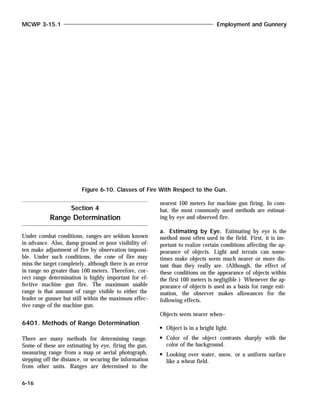
Raise the front end of the bolt and allow the firing
pin extension assembly and firing pin to fall into
Machine Guns and Machine Gun Gunner MCWP 3-15.1
4-23
Figure 4-41. Drifting Out the Belt
Feed Pawl Pin.
Figure 4-42. Removing the Belt Feed Pawl
and Arm.
Figure 4-43. Disengaging the Belt Feed
Pawl Arm From the Belt Feed Pawl.
Figure 4-44. Removing the Cover Extractor
Spring.
your hand (see figure 4-30). Separate the firing pin
from its extension. This completes detailed disas-
sembly of the bolt.
(2) Detailed assembly
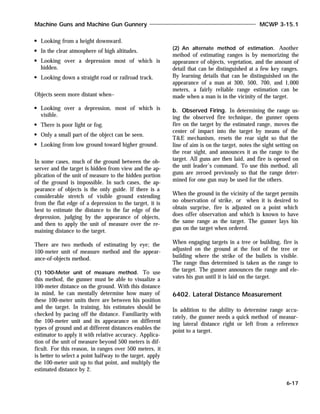
(a) Firing Pin and Extension Assembly. Engage the
rear end of the firing pin in its seating groove in the
front end of the firing pin extension assembly. Insert
the firing pin and extension assembly in the bolt,
striker first, sear notch down (see figure 4-31). Push
the extension assembly into the bolt, and tilt the
front
end down until the striker protrudes through its ap-
erture in the face of the bolt.
(b) Sear Spring and Sear. With the sear spring still
wedged on the cocking lever, replace the spring, and
insert the sear in its slot, stud up, and notch to the
front. Make sure the sear spring is properly seated
in its recess in the bolt and the bottom of the sear.
(c) Sear Slide. Press down on the sear and replace
the sear slide in its guideways. The slide may be in-
serted from either side, unless the gun is to be fired
by the side plate trigger. In that case, the square end
must be to the left.
(d) Sear Stop and Pin. Replace the sear stop and pin
(accelerator stop and lock). Press down on the head
of the pin (base of the accelerator stop) to force it
into place (see figure 4-32). Swing the sear stop into
its groove in the bolt.
(e) Cocking Lever and Pin. Replace the cocking
lever, the rounded nose down and to the rear, the
top of the cocking lever to the rear. Replace the
cocking lever pin from the left side of the bolt.
To
MCWP 3-15.1 Machine Gun, Cal .50, Browning, M2HB
4-24
Figure 4-45. Replacing the Cover
Latch Spring.
Figure 4-46. Seating the Belt Feed Pawl
Spring (Left-Hand Feed).
Figure 4-47. Replacing the Belt Feed Slide in
its Guideways (Left-Hand Feed).
test for correct assembly, cock the firing pin by ro-
tating the top of the cocking lever toward the front
of the bolt; then rotate it to the rear and depress the
sear. This should release the firing pin.
(f) Bolt Switch Stud and Bolt Switch. Replace the
bolt switch and stud with the smaller end up. Place
the bolt switch over the bolt switch stud, so that the
groove marked L is continuous from the left-hand
feed (see figure 4-33). The wider portion of the bolt
switch will be to the front.
(g) Extractor. With the extractor arm vertical, re-
place the extractor stud in the extractor pivot hoe of
the bolt. Rotate the extractor forward; ensure that
the collar is engaged in its slot in the bolt.
b. Barrel Buffer Body Group. See figure 4-34.
(1) Detailed disassembly
(a) Barrel Buffer Tube Lock Assembly. Turn the
barrel buffer body group upside down. Pry up on
the barrel buffer tube lock latch to disengage the
latch before moving the lock body to the rear. Pry
up the latch end of the assembly, so that the lug will
clear the barrel buffer body. At the same time, press
down on the front of the lock body to keep it from
springing out. Turn the accelerator back to push the
barrel buffer tube assembly out of its slot.
(b) Barrel Buffer Body Spring Lock. In most cases,
the barrel buffer body spring lock is staked and will
not be removed.
(c) Accelerator Pin and Accelerator. Drift the accel-
erator pin out and remove the accelerator. This com-
pletes detailed disassembly of the barrel buffer body
group.
(2) Detailed assembly
(a) Accelerator and Accelerator Pin. Replace the ac-
celerators with the tips up and the claws to the rear.
Replace the accelerator pin so that the ends are flush
with the sides of the barrel buffer body group.
(b) Barrel Buffer Tube Lock Assembly. Turn the
barrel buffer body upside down. Hold the assembly
against the barrel buffer body, lug down. With the
thumb of one hand press the forward winged part
into the circular opening in the slot. With the other
hand, raise the rear of the assembly enough to lift
Machine Guns and Machine Gun Gunner MCWP 3-15.1
4-25
Figure 4-48. Snapping the Belt Feed Lever
Lug to Seat the Shoulder Headless Pin.
Figure 4-49. Removing the Trigger Lever Pin
Assembly.
the lug over the buffer body. Push the assembly for-
ward until the rear winged part (barrel buffer tube
lock latch) snaps into the circular opening in the
slot. This completes assembly of the barrel buffer
body group.
c. Barrel Extension Group
(1) Detailed disassembly. See figure 4-35.
(a) Breech Lock Pin and Breech Lock. Drift the lock
pin out and remove the breech lock from the bottom
of the barrel extension group. The top of the breech
lock may have a wide, single beveled edge, or a
double beveled edge. In earlier models the top may
be flat; the newer models may have a large slot.
Guns currently manufactured have the breech lock
with the slot on top for use with the accelerator stop
and lock. When the accelerator stop and lock re-
places the sear stop and pin, the breech lock with the
slot will be used.
(b) Barrel Locking Spring. The barrel locking
spring should already be staked to the barrel exten-
sion; it should not be removed. This completes de-
tailed disassembly of the barrel extension group.
(2) Detailed assembly of breech lock and breech
lock pin. Replace the breech lock from the bottom of
the barrel extension. Make sure that the wide, single
beveled edge (double beveled edge) is up and to the
front. The breech lock will be correctly positioned
in its slot when the beveled edge is up and to the
front and the hole for the breech lock pin is toward
the bottom of the barrel extension. Replace the
breech lock pin so that the ends of the pin are flush
with the sides of the barrel extension. This com-
pletes assembly of the barrel extension group.
d. Cover Group
(1) Detailed disassembly. See figure 4-36.
(a) Cover Pin. With the cover closed, remove the
cotter pin and drift the cover pin out of the receiver.
Unlatch the cover and rotate it up and forward to re-
move the cover from the trunnion block (see figure
4-37). Place the cover group (top up) on a flat,
MCWP 3-15.1 Machine Gun, Cal .50, Browning, M2HB
4-26
Figure 4-50. Trigger Lever and Trigger
Lever Pin Assemblies.
Figure 4-51. Trigger Lever Replaced
(Rear View).
Section 3
Headspace and Timing
sturdy surface, with the latch end to the front and
the hinged end toward you.
(b) Belt Feed Lever and Lock Pin. Remove the belt
feed lever pin (cotter pin). Push the belt feed lever
to the right, until the toe end of the belt feed lever
(engaging the slide) is in line with the slot in the
cover. Lift the belt feed lever off its pivot stud. En-
sure the shoulder headless pin and spring do not fly
out. See figure 4-38.
(c) Shoulder Headless Pin and Spring. Remove
these from their seat in the side of the belt feed
lever. See figure 4-39.
(d) Belt Feed Slide. To remove the belt feed slide:
Remove the belt feed slide from either side. See
figure 4-40.
Drift the belt feed pawl out, maintaining pressure
on the belt feed pawl to prevent the spring from
flying out. Use any available punch or M2 .50
cal combination as shown in figure 4-41.
Slowly release pressure and remove the belt feed-
pawl and arm. See figure 4-42.
Disengage the belt feed pawl arm from the belt
feed pawl. See figure 4-43.
Remove the belt feed pawl spring.
(e) Cover Latch Spring. Pry the hooked end of the
spring out of its groove in the cover, and shift it to
the left until it rests on the cover extractor spring.
Press down on the cover latch spring and slide it
away from the cover latch. Make sure that it rides
on the top of the cover extractor spring. When the
enlarged hole in the spring meshes with the cover
latch spring stud, remove the spring from its stud.
(f) Cover Extractor Spring. Press down on the
cover extractor spring and pry the end of the spring
out of its recess in the cover extractor cam (see
figure 4-44). This spring, if not handled carefully,
can cause injury. Disengage the opposite end of the
spring from the cover extractor spring stud. This
completes detailed disassembly of the cover spring.
(2) Detailed assembly
(a) Cover Extractor Spring. Place the cover in the
same position as for detailed disassembly. Hook the
slotted end of the spring under the cover extractor
stud with the projection pointing in the direction of
its recess. Exercising caution, press down, and seat
the projection of the spring in its recess in the cover
extractor cam.
(b) Cover Latch Spring. Place the cover latch spring
inside the cover with the enlarged hole meshing with
the cover latch spring stud, the hooked end down
(resting on the cover extractor spring). Press down
on the cover latch spring and slide it toward the
latch. Pry up on the latch end of the spring so that it
rides up over the projecting wing of the cover latch.
Snap the hooked end of the spring into its groove in
the cover. See figure 4-45.
(c) Belt Feed Slide. To reassemble the belt feed
slide:
Machine Guns and Machine Gun Gunner MCWP 3-15.1
4-27
CAUTION
The firing pin should never be released with the
gage in the T-slot as this could damage the firing
pin and gage
Figure 4-52. Inserting the Headspace Gage.
Replace the belt feed pawl arm on the belt feed
pawl.
NOTE
There are two pins on each side of the belt feed
pawl. The larger is the belt feed pawl arm pin; the
smaller is the belt feed pawl arm locating pin. See
figure 4-43. For a left-hand feed, the belt feed pawl
arm must be placed over the pins so that the belt
feed pawl arm is toward the latch end of the cover,
when the assembled slide is returned to the cover.
Place the small end of the belt feed pawl spring
over the belt feed pawl spring stud (inside the belt
feed slide). Place the assembled pawl and arm
over the spring so that the large end of the spring
is seated in the recess in the pawl, with the pro-
jecting oval (loop) of the spring away from the
belt feed pawl arm. See figure 4-46.
Align the pinholes in the pawl, arm, and slide; re-
place the belt feed pawl pin. Make sure that the
pin is flush with the sides of the slide.
Replace the belt feed slide in its guideways, with
the belt feed pawl to the left, arm toward the
latch. See figure 4-47.
(d) Shoulder Headless Pin and Spring. Replace
these in their seats in the side of the belt feed lever.
For left-hand feed, the spring and pin are seated in
the hole nearest the belt feed lever lug. See figure
4-46.
(e) Belt Feed Lever and Lock Pin. Place the belt
feed lever over the pivot stud, lug up and to the left.
With a thumb at either end of the lever, press down
and turn the lever until the shoulder headless pin is
against the inside of the cover. Pivot the lever until
it is aligned with the slots of the cover and slide.
Press the lever down as far as it will go. Move the
lug end all the way to the right. Maintain a down-
ward pressure, and snap the lug end all the way to
the left so that the shoulder headless pin is properly
positioned in the cover (see figure 4-48). Replace
the lock pin (cotter pin) in the pivot stud. Make sure
MCWP 3-15.1 Machine Gun, Cal .50, Browning, M2HB
4-28
Figure 4-53. Inserting the Timing Gage.
CAUTION
Do not attempt to cock the gun with the back plate
off.
Figure 4-54. Rotating the Timing Adjustment
Nut to the Left.
that the toe end of the lever moves laterally in its
slot
without binding.
(f) Cover Pin. To replace the cover group on the re-
ceiver, place the latch end of the cover in position,
with the latch engaging the top plate. With the heel
of your hand, tap the hinged end downward into po-
sition. Align the pin holes and replace the cover pin.
Insert the cotter pin in the cover pin and spread the
ends. This completes assembly of the cover group.
e. Receiver Group
(1) Detailed disassembly
(a) Belt Holding Pawl, Spring(s), and Pin. Press
down on the spring belt holding pawl and withdraw
the belt holding pawl pin to the rear. Remove the
belt holding pawl and springs, being careful not to
loose the springs. The split belt holding pawl assem-
bly includes a left-hand and a right-hand holding
pawl, connected by a belt holding pawl sleeve; two
belt holding pawl springs are used. Guns of earlier
manufacture use a single belt holding pawl adapted
for either one or two springs.
(b) Cartridge Stop Assembly, Front Cartridge Stop,
and Belt Holding Pawl Pin. Withdraw the belt hold-
ing pawl pin from the right side of the receiver. Re-
move the cartridge stop assembly (or rear cartridge
stop and link stripper on guns of earlier manufac-
ture) and front cartridge stop from the right side of
the receiver.
Machine Guns and Machine Gun Gunner MCWP 3-15.1
4-29
Figure 4-55. Depressing the Trigger.
Section 4
Functioning
Figure 4-56. Feeding (Rear View).
MCWP 3-15.1 Machine Gun, Cal .50, Browning, M2HB
4-30
Figure 4-57. Feeding (Top View).
Figure 4-58. Belt Feed Slide Moving Out of the Side of the Cover.
Figure 4-59. Belt Feed Pawl Riding
Over the First Round.
Figure 4-60. Belt Feed Pawl Behind the First
Round.
(c) Trigger Lever Pin Assembly and Trigger Lever.
Release the hinged lock from the left side plate.
Turn the pin clockwise and withdraw the pin to the
left. Remove the trigger lever from inside the re-
ceiver. Guns of earlier manufacture may have a trig-
ger lever pin assembly without the hinged lock. In
this case, lift the lock of the pin out of the small
hole in the left side plate and rotate the lock end
downward 90 degrees until it is just forward of a
vertical position. Withdraw the pin to the left (see
figures 4-49 and 4-50). This completes detailed dis-
assembly of the receiver group.
(2) Detailed assembly
(a) Trigger Lever and Trigger Lever Pin Assembly.
Replace the trigger lever in the receiver, with the
long end forward and the bowed surface upward, be-
tween the top plate bracket and the bolt latch bracket
(see figure 4-51). The trigger lever should project
about 1/8 inch beyond the timing adjustment nut.
Align the hole in the trigger lever with the holes in
the receiver. Position the trigger lever pin assembly
so that the key on the pin will pass through the key-
way in the left side plate. Push the trigger lever pin
assembly all the way in and turn the pin 90 degrees
to the left, or counterclockwise. Turn the lock flat
against the side of the receiver (with the lock with-
out the hinge, turn the lock counterclockwise until
the lock fits in the small hole in the side plate).
(b) Cartridge Stop Assembly, Front Cartridge Stop,
and Belt Holding Pawl Pin. Install the cartridge stop
assembly (or rear cartridge stop and link stripper)
and front cartridge stop, on the right side of the re-
ceiver. Replace the belt holding pawl pin.
(c) Belt Holding Pawl, Spring(s), and Pin. Place the
belt holding pawl in position on the left side of the
receiver, first seating the springs. Depress the pawl
and insert the belt holding pawl pin. This completes
assembly of the receiver group.
f. Back Plate Assembly. The back plate assem-
bly is not disassembled by the operator.
Machine Guns and Machine Gun Gunner MCWP 3-15.1
4-31
Figure 4-61. Belt Feed Slide Moving
Inside the Cover.
Figure 4-62. Chambering.
The M2 .50 cal’s headspace and timing must be set
manually by the operator. Correctly set headspace
and timing is essential for the safe and effective op-
eration of the weapon. This section describes the
procedures required for proper adjustment of head-
space and timing.
4301. Headspace
Headspace is the distance between the face of the
bolt and the base of the cartridge case fully seated in
the chamber. Headspace adjustment is correct when
the recoiling groups are fully forward and there is
no independent rearward movement between the
bolt, barrel, and barrel extension.
Correct headspace is important because improper ad-
justment can cause improper functioning of the gun
and, frequently, injury to personnel and/or damage
to parts. Headspace is checked and set prior to firing
when the gun is assembled, when the barrel or any
major group or assembly within the receiver is re-
placed, and when there is any doubt that correct
headspace is set.
The headspace and timing gage consists of a head-
space gage and two timing gages. These gages pro-
vide an accurate means of checking the adjustment
of headspace and timing.
NOTE
The headspace and timing gage should be kept with
the gun at all times.
Using the gage, the distance between the face of the
bolt and the chamber end of the barrel can be accu-
rately determined by following these procedures:
Raise the cover, retract the recoiling parts (de-
scribed in para. 4403), and screw the barrel all
the way into the barrel extension. Then unscrew
the barrel two notches.
Cock the gun. Pull the retracting slide handle all
the way to the rear and then return it to its most
forward position.
NOTE
Be careful not to depress the trigger because this
will cause the firing pin to be released. If the pin is
forward the gage cannot be inserted in the T-slot far
enough to give an accurate determination.
Pull the retracting slide handle back until the bar-
rel extension is about 1/16 inch from the trunnion
block. This will ensure that the locking surfaces
of the breach lock and the bolt are in proper con-
tact. This prevents the driving spring group and
weight of the parts from giving a false determina-
tion. See figure 4-52.
Insert the GO end of the headspace gage in the T-
slot, between the face of the bolt and the rear end.
of the barrel. If the GO end of the gage enters
MCWP 3-15.1 Machine Gun, Cal .50, Browning, M2HB
4-32
Figure 4-63. Locking.
freely down to the center ring of the gage, then
attempt to insert the NO GO end of the gage. If
the GO end enters, and the NO GO end does not
enter, correct headspace is set.
If the GO end of the gage does not enter freely,
headspace is too tight. When this condition exists
the barrel must be unscrewed one click (notch) at
a time (checking with the gage after every click),
until the GO end of the gage enters freely. To
complete the adjustment, attempt to insert the NO
GO end of the gage; if it does not enter correctly,
headspace is set. Remember to screw the barrel or
to unscrew it from the barrel extension. The lug
on the barrel locking spring must be aligned with
the 3/8-inch hole in the right side plate. See para-
graph 4302b.
If the NO GO end of the gage enters the T-slot,
headspace is too loose. The barrel must be
screwed into the barrel extension (one click at a
time) checking with the gage after each click, un-
til the GO end enters and the NO GO end does
not.
Remove the gage.
4302. Timing
Timing is the adjustment of the weapon so that fir-
ing takes place when the recoiling parts are between
.020 and .116 inches out of battery to prevent con-
tact between the front end of the barrel extension
and the trunnion block. Timing is correctly set when
the recoiling parts are locked together, firing takes
place just before the parts are in battery (fully for-
ward), and when the gun fires on the FIRE gage and
does not fire on the NO FIRE gage. Timing must be
checked and/or set each time headspace is set, or
whenever timing is questionable.
Machine Guns and Machine Gun Gunner MCWP 3-15.1
4-33
Figure 4-64. Firing.
The following procedures are used to check and/or
set the timing:
Ensure that the gun has correct headspace adjust-
ment.
Cock the gun. Pull the retracting slide handle all
the way to the rear and return it to its most for-
ward position. Press the bolt latch release and al-
low the bolt to go forward.
NOTE
Do not depress the trigger.
Raise the extractor and pull the retracting slide
handle back until the front end of the barrel
extension is about 1/4 inch from the trunnion
block.
Insert the NO FIRE timing gage between the bar-
rel extension and the trunnion block, placing the
beveled edge of the gage on the barrel notches.
See figure 4-53.
Let the barrel extension close slowly on the gage.
Depress the trigger firmly, attempting to release
the firing pin. The firing pin should not release. If
the firing pin does release, the gun is timed to fire
too early.
To correct this, pull the retracting slide handle to
the rear and allow the bolt to go forward. Insert
the first gage, remove the back plate, and screw
the timing adjustment nut to the left until it rests
on the trigger lever (see figure 4-54). Press firmly
UP on the trigger lever, attempting to fire. Rotate
the timing adjustment nut to the right, one notch
at a time, firmly pressing up on the trigger lever
after each notch, attempting to fire the weapon.
When the firing pin is released, turn the timing
adjustment nut two additional notches to the right
and replace the back plate.
MCWP 3-15.1 Machine Gun, Cal .50, Browning, M2HB
4-34
Step 1. Barrel and Barrel Extension Stopped By the Barrel Buffer.
Step 2. Recoil Movement Complete.
Figure 4-65. Unlocking.
Cock the weapon and allow the bolt to go for-
ward. Insert the NO FIRE gage between the re-
ceiver block and the barrel extension and attempt
to fire the weapon by depressing the trigger (see
figure 4-55). The weapon should not fire. If the
weapon does not fire, a mechanical defect exists
and the gunner should notify his organizational
ordnance personnel.
Replace the NO FIRE gage with the FIRE gage
and attempt to fire. The weapon should fire.
When all of the above procedures have been com-
pleted, the weapon is correctly timed.
The cycle of functioning is broken down into eight
basic steps. More than one step may occur simulta-
neously during the cycle of functioning. These steps
are feeding, chambering, locking, firing, unlocking,
extracting, ejection, and cocking. By understanding
how the M2 .50 cal functions, you will more easily
be able to recognize and correct malfunctions and
stoppages which occur during firing.
With the M2 .50 cal, the recoiling groups must be
manually operated to place the first round in the
chamber. The cycle of operation begins with the
first round positioned over the belt holding pawl.
The recoiling groups are in their forward position.
4401. Feeding
When the bolt is fully forward, the belt feed slide is
in the cover and the ammunition belt is held in the
feedway by the belt holding pawl. Figures 4-56
shows the bolt fully forward, belt feed slide in the
cover, and the ammunition belt held in the feedway
by the belt holding pawl. Figure 4-57 shows the
bolt fully forward, belt feed slide in the cover, and
the ammunition belt held in the feedway by the belt
holding pawl .
As the bolt moves to the rear, the cam grooves
guide the belt feed lever, pivoting the lever and
moving the slide out the side of the cover (see figure
4-58). The belt is held stationary by the belt holding
pawl, while the belt feed pawl pivots, compressing
its spring, and rides up over the link holding the
first round (see figure 4-59).
When the bolt is all the way to the rear, the belt feed
slide moves out far enough to allow the belt feed
pawl spring to force the pawl down behind the first
round. See figure 4-60.
As the bolt moves forward, the belt feed lever
moves the slide back into the receiver. The belt is
pulled in by the belt feed pawl. The next round rides
over the belt holding pawl, compressing its spring
and forcing the pawl down until the round has
passed over the pawl. See figure 4-61.
When the bolt is fully forward, the slide is back in
the cover; the first round is engaged by the extrac-
tor. The extractor grips the first round in the feed-
way and, as the recoiling parts move to the rear,
withdraws it from the ammunition belt. Initially, the
grip of the extractor is held secure by the downward
pressure of the cover extractor spring.
NOTE
If for any reason a round is not extracted from the
belt, the belt feed pawl arm will ride up over the
round, holding up the belt feed pawl to prevent dou-
ble feeding.
As the bolt continues its movement to the rear, the
cover extractor cam forces the extractor down, caus-
ing the cartridge to enter the T-slot in the bolt. As
the extractor is forced down, the extractor lug, rid-
ing along the top of the extractor switch, forces the
rear end of the extractor switch downward. Near the
end of the rearward movement, the extractor lug
overrides the end of the switch and the switch snaps
back up into position.
4402. Chambering
As the bolt moves forward, the round is held by the
T-slot and the extractor assembly. The extractor
Machine Guns and Machine Gun Gunner MCWP 3-15.1
4-35
Section 5
Malfunctions and Stoppages
stop pin (on the left side of the bolt) permits the ex-
tractor assembly to go down only far enough to
align the round with the chamber. As the bolt con-
tinues forward, the round is chambered. As this ac-
tion takes place, the extractor lug rides up the
extractor cam, compressing the cover extractor
spring and snaps into the groove in the next car-
tridge base through the pressure of the spring. See
figure 4-62.
4403. Locking
Initially, the bolt is forced forward in counterrecoil
by the energy stored in the driving spring assembly
and the compressed buffer disks. At the start of
counterrecoil, the barrel buffer body tube lock keeps
the accelerator tips from bouncing up too soon and
catching in the breech lock recess in the bolt. After
the bolt travels forward about 5 inches, the lower
rear projection of the bolt strikes the tips of the ac-
celerator, turning the accelerator forward. This un-
locks the barrel extension from the barrel buffer
body group and releases the barrel buffer spring.
The barrel buffer spring expands, forcing the piston
rod forward.
Since the cross groove in the piston rod engages the
notch on the barrel extension shank, the barrel ex-
tension and barrel are also forced forward by the ac-
tion of the barrel buffer spring. Some of the forward
motion of the bolt is transmitted to the barrel exten-
sion through the accelerator. As the accelerator ro-
tates forward, the front of the accelerator speeds up
the barrel extension; at the same time, the accelera-
tor tips slow down the bolt.
Locking begins 1 1/8 inches before the recoiling
groups (bolt, barrel extension, and barrel) are fully
forward. The breech lock in the barrel extension
rides up the breech lock cam in the bottom of the re-
ceiver into the breech lock recess in the bottom of
the bolt, locking the recoiling groups together. The
recoiling groups are completely locked together
three-fourths of an inch before the groups are fully
forward. See figure 4-63.
MCWP 3-15.1 Machine Gun, Cal .50, Browning, M2HB
4-36
Figure 4-66. Causes of Stoppages.
Machine Guns and Machine Gun Gunner MCWP 3-15.1
4-37
Figure 4-67. Immediate Action.
4404. Firing
As the trigger is pressed down, it pivots on the trig-
ger pin so that the trigger cam on the inside of the
back plate engages and raises the rear end of the
trigger lever. That, in turn, pivots on the trigger
lever pin assembly, causing the front end of the trig-
ger lever to press down on the top of the sear stud.
The sear is forced down until the hooked notch of
the firing pin extension is disengaged from the sear
notch. The firing pin and firing pin extension are
driven forward by the firing pin spring. The striker
of the firing pin hits the primer of the cartridge, fir-
ing the round. See figure 4-64.
For automatic firing, the bolt latch release must be
locked, or held depressed, so that the bolt latch will
not engage the notches in top of the bolt. Hold the
bolt to the rear, as in single shot firing. The trigger
is pressed and held down. Each time the bolt travels
forward in counter-recoil, the trigger lever depresses
the sear, releasing the firing pin extension assembly.
The firing pin automatically fires the next round
when the forward movement of the recoiling groups
is nearly completed. The gun should fire about 1/16
inch before the recoiling groups are fully forward.
At the instant of firing, the parts are in battery; i.e.,
the proper position for firing. Only the first round
should be fired with the parts fully forward. The gun
fires automatically as long as the trigger and bolt
latch are held down, and ammunition is fed into the
gun.
4405. Unlocking
At the instant of firing, the bolt is locked to the bar-
rel extension and against the rear end of the barrel
by the breech lock, which is on top of the breech
lock cam and in the breech lock recess in the bottom
of the bolt.
When the cartridge explodes, the bullet travels out
of the barrel. The force of recoil drives the recoil-
ing groups rearward. During the first 3/4 inch, the
recoiling groups are locked together. As this move-
ment takes place, the breech lock is moved off the
breech lock cam stop, allowing the breech lock de-
pressors (acting on the breech lock pin) to force the
breech lock down, out of its recess from the bottom
of the bolt. At the end of the first 3/4 inch of recoil,
the bolt is unlocked, free to move to the rear, inde-
pendent of the barrel and barrel extension.
As the recoiling groups move to the rear, the barrel
extension causes the tips of the accelerator to rotate
rearward. The accelerator tips strike the lower rear
projection of the bolt, accelerating the movement of
the bolt to the rear. The barrel and barrel extension
continue to travel to the rear an additional 3/8 inch
or an approximate total distance of 1 1/8 inches, un-
til they are stopped by the barrel buffer assembly.
See figure 4-65, step 1.
During the recoil of 1 1/8 inches, the barrel buffer
spring is compressed by the barrel extension shank
since the notch on the shank is engaged in the cross
groove in the piston rod head. The spring is locked
in the compressed position by the claws of the
MCWP 3-15.1 Machine Gun, Cal .50, Browning, M2HB
4-38
Figure 4-68. Ruptured Cartridge Case Extractor.
accelerator, which engage the shoulders of the barrel
extension shank. After its initial travel of 3/4 of an
inch, the bolt travels an additional 6 3/8 inches to
the rear after it is unlocked from the barrel and bar-
rel extension, for a total of 7 1/8 inches. During this
movement, the driving springs are compressed. The
rearward movement of the bolt is stopped as the bolt
strikes the buffer plate. Part of the recoil energy of
the bolt is stored by the driving spring rod assem-
bly, and part is absorbed by the buffer disks in the
back plate. See figure 4-65, step 2.
4406. Extracting
The empty case, held by the T-slot, has been ex-
panded by the force of the explosion; therefore, it
fits snugly in the chamber. If the case is withdrawn
from the chamber too rapidly, it may be torn. To
prevent this, and to ensure slow initial extraction of
the case, the top forward edge of the breech lock and
the forward edge of the lock recess in the bolt are
beveled. As the breech lock is unlocked, the initial
movement of the bolt away from the barrel and bar-
rel extension is gradual. The slope of the locking
faces facilitates locking and unlocking and prevents
sticking. The leverage of the accelerator tips on the
bolt speeds extraction, after it is started, by kicking
the bolt to the rear to extract the empty case from
the chamber.
4407. Ejecting
As the bolt starts its forward movement (counterre-
coil) the extractor lug rides below the extractor
switch, forcing the extractor assembly farther down,
until the round is in the center of the T-slot. The
Machine Guns and Machine Gun Gunner MCWP 3-15.1
4-39
Section 6
Mounts and Accessories
Figure 4-69. Tripod Mount, M3.
round, still gripped by the extractor, ejects the
empty case from the T-slot. The last empty case of
an ammunition belt is pushed out by the ejector.
4408. Cocking
When the recoiling groups are fully forward, the top
of the cocking lever rests on the rear half of the V-
slot in the top plate bracket. As the bolt moves to
the rear, the top of the cocking lever is forced for-
ward. The lower end pivots to the rear on the cock-
ing lever pin. The rounded nose of the cocking
lever, which fits through the slot in the firing pin ex-
tension, forces the extension to the rear, compress-
ing the firing pin spring against the sear stop pin
(accelerator stop). As the firing pin extension is
pressed to the rear, the hooked notch of the exten-
sion rides over the sear notch, forcing the sear
down. The sear spring forces the sear back up after
the hooked notch of the firing pin extension has en-
tered the sear notch. The pressure of the sear and
firing pin springs hold the two notches locked to-
gether. There is a slight overtravel of the firing pin
extension in its movement to the rear, to ensure
proper engagement with sear. As the bolt starts for-
ward, the overtravel is taken up and completed when
the cocking lever enters the V-slot of the top plate
bracket, and is cammed towards the rear. Pressure
on the cocking lever is relieved as the bolt starts
forward.
MCWP 3-15.1 Machine Gun, Cal .50, Browning, M2HB
4-40
Figure 4-70. T&E Mechanism and Pintle.
Machine gunners must have a detailed understanding
of the many component parts of their weapon, what
those parts do during functioning, and what me-
chanical problems may be encountered during firing.
This knowledge ensures that those problems can be
quickly assessed and corrective action taken.
4501. Malfunctions
A malfunction is any failure of the gun to function
satisfactorily.
a. Sluggish Operation. Instead of firing at its
normal rate, a sluggish gun fires very slowly. Slug-
gish operation is usually due to human failure to
eliminate
excessive friction caused by dirt, lack of proper lu-
brication, and burred parts, or by tight headspace
adjustment or incorrect timing.
b. Runaway Gun. A runaway gun is when a gun
continues to fire after the trigger is released; firing
is uncontrolled. If the cause is present before the
gun is fired, the gun will start to fire when the re-
coiling groups move into battery the second time. If
the defect occurs during firing, the gun will continue
firing when the trigger control mechanism is
released.
A runaway gun may be caused by the following:
Bent trigger lever, forward end of the trigger
lever sprung downward.
Burred beveled contacting surfaces of the trigger
lever and sear.
Jammed or broken side plate trigger.
To remedy uncontrolled automatic fire—
Keep the gun laid on target and let the gun fire
out all remaining ammunition.
In an emergency, twist the ammunition belt. This
causes the gun to jam, and may damage the feed-
ing mechanism.
Replace broken, worn, or burred parts. Check the
side plate trigger and trigger control mechanism,
when applicable.
Machine Guns and Machine Gun Gunner MCWP 3-15.1
4-41
Figure 4-71. HMMWV Mount With MK64
MOD 5 Cradle.
Figure 4-72. M4 Pedestal Mount With MK64
MOD 5 Cradle.
4502. Stoppages
A stoppage is any interruption in the cycle of opera-
tion caused by the faulty action of the gun or ammu-
nition. Immediate action is required by the gunner to
reduce a stoppage (see paragraph 4503). The most
common stoppages with M2 .50 cals are failure to
feed, failure to chamber, or failure to fire. The pro-
cedures outlined in figure 4-66 will assist in trouble-
shooting and reducing most stoppages without ana-
lyzing their cause in detail.
4503. Immediate Action
Immediate action is that action taken by the gunner
and/or crew to reduce a stoppage, without investi-
gating its cause, and quickly return the gun to ac-
tion. Immediate action is performed by the gunner;
however, every crew member must be trained to ap-
ply immediate action. Hang fire and cook off are
two terms used to describe ammunition conditions
that should be understood in conjunction with imme-
diate actions.
A hang fire occurs when the cartridge primer has
detonated after being struck by the firing pin but
there is some problem with the propellant powder
that causes it to burn too slowly creating a delay in
firing.
A cook off occurs when the intense heat of the bar-
rel, as a result of prolonged or rapid firing, causes
the unintended firing of a cartridge if it remains in
the chamber exposed to that heat for too long.
Both a hang fire and cook off can cause injury to
personnel or damage to the weapon. To avoid these,
always keep the round locked in the chamber with
the cover closed in the first 5 seconds after a misfire
occurs. This prevents an explosion outside of the
gun in the event of a hang fire.
If the barrel is hot, the round must be extracted
within the next 5 seconds to prevent a cook off.
When more than 150 rounds have been fired in a
2-minute period, the barrel is hot enough to produce
a cook off.
If the barrel is hot and the round cannot be extracted
within the 10 second total, it must remain locked in
the chamber, with the cover closed, for at least 5
minutes to allow cooling of the barrel. This guards
against a cook off occurring with the cover open. If
the cook off did occur with the cover open, injury to
personnel and damage to the weapon could result.
The immediate action procedures for the M2 .50 cal
are as follows (see figure 4-67):
If gun fails to fire, wait 5 seconds, a hang fire
may be causing the misfire. In the next 5 seconds,
pull the bolt to the rear (check for ejection and
feeding of belt), release it, relay on the target and
attempt to fire.
NOTE
MCWP 3-15.1 Machine Gun, Cal .50, Browning, M2HB
4-42
Figure 4-73. M66 Truck Ring Mount.
Figure 4-74. Pintle Adapter.
When the bolt latch engages the bolt and holds it to
the rear, the gunner must return the retracting slide
handle to its forward position. If the bolt latch re-
lease and trigger are depressed at the same time, the
bolt goes forward and the weapon should fire
automatically.
If the gun again fails to fire, wait 5 seconds, pull the
bolt to the rear (engage with bolt latch if applicable),
and return the retracting slide handle to its forward
position.
Determine if the barrel is hot or cold before
continuing.
If the barrel is cold, open the cover, remove the
belted ammunition and inspect the weapon.
If the barrel is hot, take action as described
above.
4504. Remedial Action
When immediate action fails to reduce a stoppage,
its cause must be investigated, usually by disassem-
bling the weapon and inspecting the appropriate
parts (see figure 4-66). Parts may have to be re-
placed before the gun can be returned to action. Two
other problems may be detected and corrected with-
out the need for disassembly. They are:
a. Removal of a Cartridge From the T-Slot. If
the cartridge does not fall out, hold the bolt to the
rear, and with the extractor raised, use a length of
cleaning rod to push the cartridge out the bottom of
the receiver.
b. Removal of a Ruptured Cartridge. A rup-
tured (separated) cartridge case may be removed
with a cleaning rod or ruptured cartridge extractor.
To remove a ruptured cartridge with the ruptured
cartridge extractor (caliber .50, 41-E-557-50,
7160041), raise the cover and pull the bolt to the
rear. Place the ruptured cartridge extractor in the
T-slot of the bolt in the same manner as that of a
cartridge, so that it is held in line with the bore by
the ejector of the extractor assembly of the gun.
With
Machine Guns and Machine Gun Gunner MCWP 3-15.1
4-43
Figure 4-75. T&E Mechanism
Mount Assembly.
Section 7
Maintenance
the ruptured cartridge extractor aligned with the
bore and held firmly in the T-slot, let the bolt go
forward into battery. This forces the extractor
through the ruptured case, and the shoulders will
spring out in front of the case. Pull the bolt to the
rear and remove the ruptured case and extractor. See
figure 4-68. Always check headspace and timing af-
ter a ruptured cartridge occurs, and set if necessary.
The principal ground mount used with the M2 .50
cal is the tripod mount, M3. The tripod mount, M3
is designed for use against ground targets. The three
principal vehicular mounts used with the M2 .50 cal
are the HMMWV mount; the M66 truck ring
mount; and M4 pedestal mount. The M2 .50 cal is
also mounted in the up-gunned weapons station on
the AAVP-7A1 and externally mounted on the
M1A1 tank. The principal night vision sight used
with the M2 .50 cal is the AN/TVS-5.
4601. Tripod Mount, M3
MCWP 3-15.1 Machine Gun, Cal .50, Browning, M2HB
4-44
Figure 4-76. M2 .50 cal and M85 Reticle Pattern.
Figure 4-77. Use of Ranging Symbols M2
and M85.
The M3 mount is the standard ground mount of the
M2 .50 cal (see figure 4-69). It is a folding tripod
with three telescopic, tubular legs connected at the
tripod head. The total weight of the M3 is 44
pounds, which includes the traversing and elevating
(T&E) mechanism and pintle. Each leg ends in a
metal shoe that can be stamped into the ground for
greater stability. The two trail legs are joined to-
gether by the traversing bar. The traversing bar
serves as a support for the T&E mechanism, which
in turn supports the rear of the gun. The tripod head
furnishes a front support for the mounted gun which
is further supported by the short front leg.
When the tripod is emplaced on flat terrain, with all
extensions closed, the adjustable front leg should
form an angle of about 60 degrees with the ground.
This places the gun on a low mount, about 12 inches
above the ground. To raise the tripod farther off the
ground, extend the telescopic front and trail legs
(enough to keep the tripod level and maintain the
stability of the mount). To adjust the front leg, turn
the front leg clamp screw handle counterclockwise
to loosen the front leg clamp screw nut. Adjust the
leg to the desired angle, and tighten the front leg
clamp. To extend any of the tripod legs, unscrew the
leg clamping handle, press down on the indexing
lever, and extend the leg to the desired length. Align
the stud on the indexing lever with one of the holes
in the tripod leg extension. Release pressure on the
indexing lever, allowing the stud to fit the desired
hole. Tighten the leg clamping handle.
a. Traversing and Elevating Mechanism . See
figure 4-70.
(1) Traversing mechanism. The traversing mecha-
nism consists of a traversing bar, slide, and screw
assembly. The traversing bar, graduated in 5-mil in-
crements and fits between the trail legs of the tripod.
The traversing slide and screw assembly are
clamped in place on the traversing bar by the trav-
ersing slide lock lever. When the traversing slide is
locked to the traversing bar, the traversing hand-
wheel should be centered. The traversing slide is
properly mounted when the lock lever is to the rear
and the traversing handwheel is positioned to the
left.
To make changes in direction, loosen the traversing
slide lock lever and move the slide along the travers-
ing bar. This permits traverse of 400 mils left or
right of the 0 index in the center of the traversing
bar. Readings on the traversing bar are taken from
the left side of the traversing slide. Changes of 50
mils or less in deflection, can be made by turning
the traversing handwheel of the screw assembly. The
Machine Guns and Machine Gun Gunner MCWP 3-15.1
4-45
Figure 4-78. Dual-Purpose Sight (Under Development).
handwheel allows a traverse of 50 mils left or right
of center. One click in the traversing handwheel sig-
nifies 1-mil change in direction.
(2) Elevating mechanism. The elevating mechanism
consists of an upper and lower elevating screw and
is connected to the gun by inserting the quick release
pin assembly through the holes in the upper
elevating
screw yoke and the rear mounting lugs of the re-
ceiver. A scale, graduated in mils, is fitted to the
upper screw to indicate elevation. This scale is
marked to show 250 mils in depression and 100 mils
in elevation from the 0 setting.
The elevating handwheel is graduated in 1-mil incre-
ments up to 50 mils and is fastened to the elevating
screw by a screw lock. This synchronizes the hand-
wheel graduations with those on the upper elevating
screw. A spring actuated index device produces a
clicking sound when the handwheel is turned. Each
click equals a 1-mil change in elevation. The hand-
wheel is turned clockwise to depress the barrel and
counterclockwise to elevate.
b. Pintle. The gun is connected to the tripod mount,
M3 by a pintle (see figure 4-70). This pintle is at-
tached to the machine gun by a pintle bolt through
the front mounting hole in the receiver. The tapered
stem of the pintle seats in the tripod head and is held
secure by a pintle lock and spring. To release the
pintle, raise the pintle lock, releasing the cam.
4602. Vehicle Mounts
a. Types. The M2 .50 cal can be mounted on the
HMMWV armament carrier, M4 pedestal mount,
and M66 ring mount. It is also found in the turret of
the AAVP-7A1, and on the M1A1 tank.
The MK64, MOD 5 cradle is used to mount the
M2 .50 cal and the MK-19 on the HMMWV arma-
ment carrier (see figure 4-71) and on the M4 pedes-
tal mount on M151 series vehicles (see figure 4-72).
MCWP 3-15.1 Machine Gun, Cal .50, Browning, M2HB
4-46
Figure 4-79. Care and Cleaning Procedures Before, During, and After Firing.
More information concerning mounting the
M2 .50 cal on these vehicles is contained in
TM 08686A-13&P/1.
The M66 truck ring mount also uses the MK64 cra-
dle to mount the gun onto the mounts roller carriage
which is on a circular track (see figure 4-73). The
cradle can be rotated in the pintle sleeve of the car-
riage and can be adjusted for elevation. The carriage
is guided on the track by rollers. The track is se-
cured to the vehicle by supports.
b. Accessories. There are two accessories needed
to mount the M2 .50 cal on vehicles: the pintle
adaptor and the traversing and elevating mechanism
mount assembly.
(1) Pintle adapter. The upper end of the pintle
adapter has a hole that is shaped to accept the M4
cradle’s pintle. The adapter is equipped with a
quick-release pintle that secures the carriage and cra-
dle. The lower end of the adapter is shaped to fit the
mounting hold in the upper end of the M4 pedestal,
HMMWV weapons platform, and the M66 ring
mount. It is secured by the pintle lock on the vehicle
pedestal. See figure 4-74.
(2) T&E mechanism mount assembly. This as-
sembly adapts the T&E so that it secures the car-
riage and cradle to the M4 pedestal or HMMWV
weapons platform pedestal and provides fire control
adjustments (see figure 4-75). The lower end of the
assembly is attached to the pedestal by a train lock
clamp. It may be released for traverse or locked in
position by a train lock handle. Two positioning
clamps are provided to prevent up or down move-
ment of the traversing lock clamp on the M4 pedes-
tal. When used on the HMMWV weapons platform
Machine Guns and Machine Gun Gunner MCWP 3-15.1
4-47
Figure 4-80. Inspection Checklist.
Section 8
Ammunition
pedestal, only one clamp is required above the trav-
ersing lock clamp. A standard M2 .50 cal traversing
mechanism composes the upper end of the T&E as-
sembly. It is attached to the lower rear holes in
the M4 cradle by a retaining pin. For more on the
T&E mechanism, see chapter 5, section 5.
4603. Night Vision Sight, AN/TVS-5
The AN/TVS-5 is a portable, battery-operated
electro-optical instrument used for passive night ob-
servation and fire. It amplifies natural light such as
moonlight, starlight, and skyglow. The sight does
not emit visible infrared light that can be detected by
the enemy. The AN/TVS-5 may also be used with
the MK19. For more on the AN/TVS-5, see TM
11-5855-214-10.
a. Installation. To install the AN/TVS-5—
Release the catch at the left side of the cartridge
cover and raise the cover to the UP position.
Position the M2 mounting bracket assembly over
the breech of the machine gun and slide it to the
rear until it stops.
Swing the three locking cams to the rear to secure
the bracket to the weapon side cam first, followed
by the two top locking cams.
Close the cartridge and secure it with the catch.
Install the sight on the mounting bracket assembly
by positioning it in the groove at the top rear of
the bracket so that the scribe line on the bracket is
aligned with the scribe line in the sight mounting
adaptor. Tighten the lever screw to secure the
sight to the bracket. It will be easier to tighten the
lever screw if you place an empty cartridge case
over the lever arm to increase the amount of lev-
erage applied.
b. Use of the Reticle Cell. The proper reticle cell
must be installed in the AN/TVS-5 before the sight
can be used for aimed fire of the M2 .50 cal. The
AN/TVS-5 is normally equipped with a reticle for
the M2 .50 cal and M85. If not, installation of the
proper reticle must be performed by direct support
of higher category maintenance.
(1) M2 .50 cal/M85 reticle pattern. The vertical
lines at the top of the reticle indicate range in hun-
dreds of meter to a 6-foot tall standing person.
Measurement is made from the horizontal line to the
top or bottom of the vertical line (see figures 4-76
and 4-77).
The horizontal line of the range scale indicates the
range in hundreds of meters to a 20-foot wide target
(such as a tank viewed from the side). Place the left
edge of the target at the left side of the horizontal
line. The range to the target is read at the right edge
of the target. The M2 .50 cal aiming points for
ranges from 400 to 1,200 meters are shown as small
dots in a vertical line through the center of the reti-
cle. Use the center of the horizontal lines for ranges
of 0-250 meters. Locate the target, estimate the
range, and adjust the weapon to place the proper
aiming point on the target.
(2) MK-19/M2 .50 cal reticle pattern. See figure
4-78. Aiming points are the same as the M2 .50
cal/M85 reticle. The stadia lines are used to deter-
mine range to a 20-foot wide target. Manipulate the
sight picture so that the target fills the space between
the stadia lines in order to determine the correspond-
ing range to the target. MK-19 aiming points for sta-
tionary targets are aligned vertically in the center of
the reticle. Aiming points for a target moving 10
mph are located vertically to the left and right of the
stadia lines.
c. Field Zeroing. The AN/TVS-5 may be zeroed
during daylight or darkness. For the zeroing proce-
dure, see paragraph 2505.c.
Care, cleaning, and maintenance determine whether
or not the gun will function properly when needed.
The bore and chamber must be properly maintained
to preserve accuracy. Because of the close fit of
working surfaces and the high speed at which the
gun operates, the receiver and moving parts must be
kept clean, correctly lubricated, and free from burrs,
rust, dirt, or grease to ensure proper, efficient
MCWP 3-15.1 Machine Gun, Cal .50, Browning, M2HB
4-48
functioning. The care, cleaning, lubrication, and ad-
justment of the mounts used with the gun are no less
important. The functioning of the gun and mount to-
gether determine overall effectiveness. All accesso-
ries and equipment used with the gun and mount,
including ammunition, must be properly maintained.
4701. Cleaning Materials and Lubricants
a. Cleaning Materials. CLP is a special cleaning
solution and lubricant containing teflon that can be
used to clean and preserve all the metal parts of the
weapons system. It may be used as a lubricant dur-
ing normal operation of the gun also. RBC can be
used to clean the bore of the machine gun barrel af-
ter firing. Immediately after using bore cleaner, dry
the bore and any parts of the gun exposed to the
bore cleaner; then apply a thin coat of CLP or lubri-
cating oil. Dry cleaning solvent can also be used to
clean all metal parts of the weapons system. This
material dries out the metal severely so a thin coat
of CLP or lubricating oil should be applied after-
wards. This cleaning material is especially useful
when cleaning the gun in preparation for changing
the type of lubricant used.
If RBC and CLP are not available, hot or cold water
can be used; however, warm or hot, soapy water is
recommended. After using soap and water, dry the
parts immediately and apply a thin coat of CLP.
b. Lubricants. LSA is the preferred lubricant for
use on all friction producing parts during operation
of the gun in normal conditions. It will not burn off
the gun as it heats up during operation nor will rain
or excess moisture wash it off. LAW should be used
during operation of the gun in sustained tempera-
tures below 0 degrees Fahrenheit (-18 degrees
Machine Guns and Machine Gun Gunner MCWP 3-15.1
4-49
Figure 4-81. Characteristics and Tip Colors of M2 .50 Cal Ammunition.
Celsius). See the cold climate conditions in para-
graph. 4704.
MCWP 3-15.1 Machine Gun, Cal .50, Browning, M2HB
4-50
Figure 4-82. M2 .50 Cal Ammunition.
4702. Care and Cleaning Before, During, and After Firing
Machine Guns and Machine Gun Gunner MCWP 3-15.1
4-51
Figure 4-82. M2 .50 Cal Ammunition—Continued.
Gun crews must conduct procedures for the care and
cleaning of their weapons system before, during,
and after firing. These procedures are outlined in
figure 4-79.
4703. Normal Maintenance Procedures
Each gun should be cleaned as soon after firing as
possible and each time it is exposed to field condi-
tions. In combat conditions the gun should be
cleaned and lubricated daily whether or not it has
been fired. If possible, keep the gun covered with a
canvas, tarpaulin, or poncho when not in use. Dur-
ing normal training conditions, inspect the gun daily
for rust, and maintain a light coat of CLP on all
metal parts. In ideal conditions, when the gun is not
used and is kept in a clean place, it may only be nec-
essary to disassemble and clean it every three to five
days. The gun should be disassembled, cleaned, and
lubricated in a clean, dry location where it is least
exposed to dirt and moisture.
4704. Special Maintenance Procedures
a. Climatic Conditions. Extremely cold, hot, dry,
and tropical climates affect the gun and its function-
ing. Care should be taken under these climatic con-
ditions to ensure that the gun is cleaned daily with
the prescribed lubricants and protected from the ele-
ments by some sort of cover if possible.
(1) Cold climates. The weapon must be kept free of
excess lubrication and moisture. If the weapon is
brought indoors, allow it to come to room tempera-
ture, and then wipe it dry and proceed with cleaning
and lubrication. Lubricate the gun with LSA or CLP
and keep it covered outdoors as much as possible. In
sustained temperatures below 0 degrees Fahrenheit
(-18 degrees Celsius), the weapon should be lubri-
cated with LAW.
MCWP 3-15.1 Machine Gun, Cal .50, Browning, M2HB
4-52
Figure 4-83. Ballistic Data.
Figure 4-86. Ammunition Box.
(2) Hot, humid climates. Inspect the gun more fre-
quently for signs of rust. Keep the gun free of mois-
ture and lightly lubricated with CLP.
(3) Hot, dry climates. Inspect and clean the weapon
daily. Avoid excess lubrication as this will attract
dust, grit and sand.
b. Nuclear, Biological, and Chemical Condi-
tions. If contamination is anticipated, apply lubri
cant to all outer surfaces of the machine gun (do not
lubricate ammunition). Keep the gun covered as
much as possible. If the gun is contaminated, decon-
taminate by following the procedures outlined in FM
3-5, Nuclear, Biological, and Chemical Decontami-
nation, then clean and lubricate.
4705. Inspection
When inspected, the machine gun should be com-
pletely assembled and mounted with headspace and
timing properly set. Inspecting personnel should
look for dirt, cracks, burrs, and rust. Operate the
gun manually to ensure that it is functioning prop-
erly. The inspection procedures shown in figure
4-80 can be used as a guide for crew members or in-
specting personnel to ensure that the gun and equip-
ment are properly maintained.
Machine Guns and Machine Gun Gunner MCWP 3-15.1
4-53
Section 9
Operation and Firing
This section describes the ammunition used in the
M2 .50 cal. All machine gunners must be able to
recognize the types of ammunition available and
know how to care for that ammunition.
The M2 .50 cal cartridge consists of a cartridge
case, primer, propelling charge, and bullet. The
term bullet refers only to the small arms projectile.
The term ball ammunition refers to a cartridge hav-
ing a bullet that has a metallic jacket and lead core.
4801. Classification
Based on use, the principal classification of the sev-
eral types of ammunition used with the machine gun
are as follows:
a. Ball. For use in marksmanship training and
against personnel and light material targets.
b. Tracer. To aid in observing fire. Secondary
purposes are for incendiary effect and for signaling.
c. Armor Piercing. For use against armored air-
craft and lightly armored vehicles, concrete shelters,
and other bullet-resisting targets.
MCWP 3-15.1 Machine Gun, Cal .50, Browning, M2HB
4-54
Figure 4-87. Clearing the Gun.
CAUTION
During any temporary cessation of fire, where it is
not necessary to unload to clear the gun, the bolt
should be latched to the rear to prevent accidental
firing.
d. Incendiary. For incendiary effect, especially
against aircraft.
e. Armor-Piercing Incendiary. For combined ar-
mor-piercing and incendiary effect.
f. Armor-Piercing Incendiary Tracer. For com-
bined armor-piercing and incendiary effect with the
additional tracer feature.
g. Sabot Light Armor Penetrator. For use
against light armored vehicles and aircraft. Also
called SLAP.
h. Sabot Light Armor Penetrator-Tracer. For
use against light armor vehicles and aircraft with the
additional tracer feature. Also called SLAP-T
i. Blank. For simulated fire (contains no bullet).
j. Ball, Plastic Practice. For use in scaled range
training. For example, where range restrictions limit
Machine Guns and Machine Gun Gunner MCWP 3-15.1
4-55
Figure 4-88. Prone Position.
Figure 4-89. Sitting Position, Legs Crossed.
or prohibit use of one of the other types of live
ammunition.
k. Tracer, Plastic Practice. For use with the
SLAP-T in scaled range training.
l. Dummy. A dummy is completely inert. For use
in nonfiring training such as gun drill and to practice
loading and unloading procedures.
4802. Identification
a. Marking. The contents of original boxes or con-
tainers may be readily identified by markings on the
box. They indicate, by stencil, the number of rounds
in the box or container, the caliber, the code sym-
bol, and the lot number.
b. Code Symbol. The code symbols for machine
gun ammunition indicate the grade as well as con-
tents and type of inner packing. To provide proper
identification, the abbreviated markings are stenciled
in yellow on each metal ammunition container, to-
gether with the re-packed lot number.
c. Ammunition Marking. Ammunition can be
identified by its physical characteristics. Colors
painted on the tips of the bullet aid in this identifica-
tion. The physical characteristics and tip colors used
to identify M2 .50 cal ammunition types can be
found in figure 4-81.
d. Ammunition Grades. The grades for caliber
.50 cal ammunition are as follows:
AC aircraft and antiaircraft machine guns.
MG Ground machine guns.
MCWP 3-15.1 Machine Gun, Cal .50, Browning, M2HB
4-56
Figure 4-90. Sitting Position, Legs Extended.
Section 10
Gun Drill
3 Unserviceable, not to be issued or used.
More than one grade may be authorized for
ammunition. As an example, AC or MG ammuni-
tion may be used for both aircraft and antiaircraft
machine guns and ground machine guns. Ammuni-
tion that cannot be identified is considered grade 3,
but is not classified unserviceable until every effort
has been made to establish its identity. Ammunition
placed in grade 3 (due to loss of lot number) and
identification as having been in serviceable lots is-
sued to a specific organization, may be reissued after
visual inspection for local training purposes (graded
for training purposes only) in ground machine guns.
It will not be used for overhead fire. See figure 4-82
on pages 50 and 51.
4803. Ballistic Data
The approximate maximum range and average muz-
zle velocity of some of the different types of M2 .50
cal ammunition authorized for use in the machine
gun are as shown in figure 4-83.
Figure 4-84 lists the maximum penetration in inches
for armor-piercing cartridge, caliber .50, M2, fired
Machine Guns and Machine Gun Gunner MCWP 3-15.1
4-57
Figure 4-91. Crew Formed in Column.
from the 45-inch barrel (muzzle velocity 2935 feet
per second).
Figure 4-85 lists the maximum penetration in inches
for ball cartridge, caliber .50, M2, fired from the
45-inch barrel (muzzle velocity 2,935 feet per
second).
MCWP 3-15.1 Machine Gun, Cal .50, Browning, M2HB
4-58
Figure 4-92. Screwing the Barrel Into the Barrel Extension.
Machine Guns and Machine Gun Gunner MCWP 3-15.1
4-59
Figure 4-93. Crew Ready to Place the Gun Into Action.
MATERIAL
INCHES AT:
200 M 600 M 1500
M
Armor plate (homogeneous)
Armor plate (face-hardened)
Sand (100 lb dry w/cu ft)
Clay (100 lb dry w/cu ft)
1.0
0.9
14
28
0.7
0.5
12
27
0.3
0.2
16
21
Figure 4-84. Maximum Penetration for Armor-
Piercing Cartridge, M2 .50 Cal.
MATERIAL
INCHES AT:
200 M 600 M 1500 M
Sand (100 lb dry w/cu ft)
Clay (100 lb dry w/cu ft)
Concrete
14
28
2
12
26
1
6
21
1
Figure 4-85. Maximum Penetration for Ball
Cartridge, M2 .50 Cal.
4804. Ammunition Packaging
M2 .50 cal ammunition is packaged in a metal box
containing 100 linked rounds. Each box of 100
rounds weighs approximately 35 pounds. See figure
4-86.
MCWP 3-15.1 Machine Gun, Cal .50, Browning, M2HB
4-60
Figure 4-94. Squad Leader Moving the
Tripod Into Position.
Figure 4-95. Emplacing the Mount.
4805. Storage
Store ammunition of all classes away from heat
sources; i.e., open flame, radiators, heaters, and hot
water pipes. Ammunition should be stored under
cover. If it is necessary to leave ammunition in the
open, keep it at least 6 inches from the ground
and covered with a double thickness of tarpaulin.
Place the tarpaulin so it gives maximum protection
and allows free circulation of air. Dig suitable
trenches to prevent water from flowing under the
ammunition pile.
Machine Guns and Machine Gun Gunner MCWP 3-15.1
4-61
Figure 4-96. Mounting the Gun.
Figure 4-97. Half Loading the Gun.
4806. Care, Handling, and Preservation of
Ammunition
Ammunition containers should not be opened until
the ammunition is to be used. Ammunition removed
from the airtight containers, particularly in damp cli-
mates, is likely to corrode.
Protect ammunition from mud, dirt, and water. If
the ammunition gets wet or dirty, wipe it off prior to
MCWP 3-15.1 Machine Gun, Cal .50, Browning, M2HB
4-62
Figure 4-98. Crew Ready for Action.
Figure 4-99. Taking the Gun Out of Action.
use. Wipe off light corrosion as soon as it is discov-
ered. Heavily corroded cartridges should be
replaced.
Use caution during firing to ensure that ammunition
is kept out of the dirt. Dirt picked up during firing
will act as an abrasive in the chamber and could
cause a malfunction that may result in injury to per-
sonnel and/or damage to equipment.
DO NOT expose ammunition to direct rays of the
sun. If the powder is hot, excessive pressure may be
developed when the gun is fired.
DO NOT oil or grease ammunition. Dust and other
abrasives will collect on it and could damage the op-
erating parts of the gun.
DO NOT fire dented cartridges, cartridges with
loose projectiles, or other defective rounds.
DO NOT fire over friendly troops any ammunition
graded and marked FOR TRAINING USE ONLY.
Only specially approved lots of ammunition can be
used for overhead fire. The packaging of this ammu-
nition is clearly stamped FOR OVERHEAD FIRE.
DO NOT fire ammunition (other than blank ammu-
nition) until it has been positively identified by am-
munition and grade.
Machine Guns and Machine Gun Gunner MCWP 3-15.1
4-63
Figure 4-100. Folding the Trail Legs.
Operation includes loading and unloading the gun,
clearing the gun, and allowing the bolt to go
forward.
4901. Half Loading and Loading
To half load the gun, the gunner ensures the bolt is
forward and the cover is closed. The squad leader
inserts the double loop end of the ammunition belt in
the feedway until the first round is engaged by the
belt holding pawl. The gunner grasps the retracting
slide handle with the right hand, palm up, and vigor-
ously jerks the bolt to the rear and releases the re-
tracting slide handle. If the bolt latch release lock is
engaging the bolt latch release, the bolt and retract-
ing slide handle will move forward under pressure
of the driving spring group, half loading the gun.
However, if the bolt latch release is up and free of
the bolt latch release lock, the bolt latch will hold
the bolt and the retracting slide handle to the rear.
The retracting slide handle must be returned to its
most forward position prior to releasing the bolt. To
complete half loading, press the bolt latch release,
allowing the bolt to go forward.
To fully load the gun, the procedure is the same as
in half loading, except it requires the gunner to pull
and release the bolt twice.
4902. Single Shot Operation
To fire the gun single shot, the bolt latch release
must be in the up position. The latch engages the
notches on top of the bolt when the bolt is to the
MCWP 3-15.1 Machine Gun, Cal .50, Browning, M2HB
4-64
Figure 4-101. Dragging the Gun Into Position.
Figure 4-102. Two-Man Carry.
CAUTION
Carrying the gun by the barrel may cause damage
to the barrel support and the barrel extension.
Section 11
Qualification Firing
rear after each round is fired. When the bolt latch
release
is depressed the latch assembly is raised, allowing
the bolt to be driven forward into battery. The gun
may then be fired by pressing the trigger. When the
bolt latch release is locked down by the bolt latch re-
lease lock on the buffer tube sleeve, the gun func-
tions as an automatic weapon.
4903. Precautions During Operation
Ensure that the cover, once raised, remains in the
raised position, with the barrel remaining in the gun,
before allowing the bolt to go forward. If the cover
is lowered when the bolt is to the rear, the belt feed
lever lug will not fit into its proper groove in the
bolt. Thus, parts may be damaged as the bolt goes
forward. In the cover assembly, the belt feed lever
lug is held to the left by the action of the shoulder
headless pin and spring, just above the pivot.
If the bolt is allowed to go forward with the barrel
out of the gun, parts may be damaged when the bolt
slams forward. The added weight and cushioning
Machine Guns and Machine Gun Gunner MCWP 3-15.1
4-65
Figure 4-103. Three-Man Carry—Hot Barrel.
Figure 4-104. Three-Man Carry—
Cold Barrel.
effect of the barrel act as a buffer and protect the
parts from damage.
To allow the bolt to go forward with the barrel out
of the gun, pull the retracting slide handle all the
way to the rear, engaging the bolt stud in the notch
in the rear of the retracting slide. Maintain a steady
pressure to the rear on the retracting slide handle.
Press the bolt latch release and allow the bolt to ride
slowly forward.
4904. Unloading and Clearing the Gun
a. Unloading. To unload the gun, the gunner un-
locks the bolt latch release (if applicable) and then
pulls the retracting slide handle to the rear and holds
it there. The squad leader then removes the round
that was ejected out of the bottom of the gun. The
gunner then raises the cover and the squad leader re-
moves the ammunition belt from the feedway. The
gunner then examines the chamber and T-slot. If
there is a round on the T-slot the gunner pulls the
bolt an additional 1/16 inch to the rear and pushes
the round up and out of the T-slot by reaching under
the gun and forcing the round up the face of the
bolt. In darkness, the gunner must feel the chamber
and T-slot to see if it is clear.
b. Clearing. To clear the gun, additional precau-
tions are taken. After the steps above have been ac-
complished, a wooden block, extending above and
below the receiver approximately 1 inch, is inserted
in the receiver between the bolt and the rear of the
barrel. A cleaning rod is then inserted in the muzzle
end of the barrel, pushed through the bore until it
can be seen in the receiver, and immediately re-
moved. See figure 4-87.
4905. Positions for Firing
The M2 .50 cal can be fired from the prone or sit-
ting position with the gun mounted on the tripod in
low position, or from a sitting position with the gun
mounted on the tripod in high position.
a. Prone Position. In the prone position, the gun-
ner is between the trail legs with his body extending
directly to the rear of the gun (see figure 4-88). The
inside of his feet are as flat as possible on the
ground, legs well spread, toes turned outward. His
left elbow rests on the ground with the left hand
placed on the elevating handwheel, palm down. The
gunner lightly grasps the right spade grip with his
right hand, thumb in position to press the trigger.
The position of the body varies according to the
physique of the individual so that the eye is in the
proper position to align the sights.
b. Sitting Position. In the sitting position, the
gunner sits directly between the trail legs of the tri-
pod. Depending on his physique the gunner can sit
with his legs crossed right over left (see figure
4-89), or extended. With his legs crossed, his right
foot can be placed on the traversing slide locking
lever to ensure that the T&E stays locked down dur-
ing firing. With his legs extended, he can place them
under the rear legs of the tripod or over the top of
them (see figure 4-90). He grasps the elevating
handwheel with his left hand, palm down. He lightly
grasps the right spade grip with his right hand,
thumb in position to press the trigger. His right arm
will be placed on the outside of his right leg pushing
to the right to take up slack in the T&E.
c. HMMWV, Pedestal or Truck Mount. With
the HMMWV, pedestal or truck mounts, the gunner
places both hands on the spade grips, locks his el-
bows into the sides of his body with his body for-
ward and chest against his hands, thumbs in position
to press the trigger. Brace the body and arms firmly
during firing.
The M2 .50 caliber machine gun, employed on the
M3 tripod, requires a crew of three to put it into act-
MCWP 3-15.1 Machine Gun, Cal .50, Browning, M2HB
4-66
ion and keep it operating. Gun drill gives the gun
crew fundamental training in the operations of the
machine gun and the confidence in their ability to
put the gun into action with precision and speed.
Precision is attained by learning and practicing cor-
rect procedures, to include inspecting the gun before
firing and observing safety procedures. Once preci-
sion is attained, speed and teamwork can be devel-
oped. Rotation of duties during training is essential
so that every crew member becomes familiar with
the duties of each position in the gun crew.
NOTE
Live ammunition is never used for a gun drill. Only
dummy ammunition should be used for this type of
training.
41001. Crew Equipment
In addition to their individual arms and equipment,
machine gun crewmen carry the following:
Squad Leader Tripod
One box of ammuntion
Gunner Binoculars
M2 compass
Receiver w/T&E mechanism and
pintle attached
Headspace and timing gauge
Ammunition
Bearer
Barrel
Barrel cover
One box of ammunition
41002. Form for Gun Drill
The squad leader gives all commands from the posi-
tion of attention. The squad members repeat all
commands from the squad leader.
The first command given by the squad leader is
FALL IN. At this time the squad members form up
on line with five paces between each person and
Machine Guns and Machine Gun Gunner MCWP 3-15.1
4-67
Figure 4-105. Manipulation. Figure 4-106. Correct Sight Picture.
MCWP 3-15.1 Machine Gun, Cal .50, Browning, M2HB
4-68
Figure 4-107. Sighting Bar.
their equipment and ammunition one pace to their
front.
The next command given is TAKE EQUIPMENT. The
squad members now take one step forward and pick
up their equipment with both hands.
The final command is FORM FOR GUN DRILL. At
this time the squad will face to the right in this or-
der: squad leader, gunner, and ammunition bearer.
The squad then assumes the prone position. Once in
position, the squad places the equipment in the fol-
lowing order (see figure 4-91):
The squad leader places the tripod to his left (trail
legs to the rear, front leg uppermost), ammunition
to his right, and latch to the front.
The gunner places the receiver across his front,
back plate to the right, and retracting slide handle
upward.
The ammunition bearer places the barrel to his
right, muzzle to the rear and ammunition box to
his left front with latch to the right front.
If other members are assigned, they place ammu-
nition boxes in front, one foot apart, latches to the
right front.
41003. Examination of Equipment Before
Firing
Once the squad is in the prone position, the squad
leader gives the command EXAMINE EQUIPMENT
BEFORE FIRING.
a. Squad Leader. The squad leader inspects the
M3 tripod to ensure that—
Machine Guns and Machine Gun Gunner MCWP 3-15.1
4-69
Figure 4-108. M2 .50 Cal Targets.
The indexing levers and clamps on the front and
trail legs function properly, and the legs are in the
short (low) position.
Front legs and trail legs are closely folded; front
leg clamp is hand tight.
Sleeve lock latch and pintle lock release cam are
in working order; pintle lock release cam is
down.
Pintle bushing is free of dirt and burrs.
Metallic links of the ammunition are clean (open
the ammunition box).
Ammunition belt is properly loaded and placed in
the box, the double loop end up.
Ammunition box is closed and locked after am-
munition is inspected.
b. Gunner. The gunner inspects the receiver group
to ensure that—
Barrel support and breech bearing are free of dirt.
Pintle is free of dirt.
Feed mechanism and bolt switch are properly as-
sembled to feed from left (raises the cover for
proper inspection).
Striker projects through the aperture in the face of
the bolt (now closes the cover).
Rear sight is set at 1,000 yards (900 meters); win-
dage is zero.
T&E mechanism is securely attached to the
receiver.
Traversing handwheel is centered.
Elevating screws are equally exposed (about 2
inches) above and below the elevating handwheel.
Back plate is latched and locked in place.
Bolt latch release is locked in the down position
by the bolt latch release lock.
Gunner pulls the bolt to the rear and rides the bolt
home.
c. Ammunition Bearer. The ammunition bearer
inspects the barrel and ammunition box to ensure
that—
Barrel is clear.
Barrel carrier assembly is securely attached to the
barrel.
Barrel bearing is free of dirt.
Metallic links of the ammunition are clean (open
the ammunition box).
Ammunition belt is properly loaded and placed in
the box, double loop end up.
The ammunition box is closed and latched after
the ammunition is inspected.
When the ammunition bearer completes his inspec-
tion, he moves to the gunners position with the bar-
rel in his right hand and ammunition in his left
hand. With the aid of the gunner the ammunition
bearer screws the barrel into the barrel extension.
See figure 4-92. The headspace and timing adjust-
ment is now made by the gunner. The ammunition
bearer remains on the left and on line with the gun-
ner. See figure 4-93.
d. Reporting. At the completion of the inspection,
a report is rendered to the squad leader as follows:
The ammunition bearer reports: AMMUNITION
BEARER CORRECT (or he states any deficiencies).
The gunner reports: GUNNER AND AMMUNITION
BEARER CORRECT (or he states any deficiencies).
The squad leader would report: SQUAD ALL COR-
RECT (or he states any deficiencies) if he has to
report to a senior.
41004. Placing the Gun into Action
To place the gun into action, the squad leader com-
mands and signals GUN TO BE MOUNTED (pointing
to the position where the gun is to be mounted);
FRONT (pointing in the direction of fire); and AC-
TION (vigorously pumping his fist in the direction of
the designated gun position).
At the command/signal ACTION, the squad leader
grasps the left trail leg near the center with his left
MCWP 3-15.1 Machine Gun, Cal .50, Browning, M2HB
4-70
hand. Jumping to his feet and grasping the tripod
head with his right hand, he lifts the tripod across
the front of his body with the front leg up, and car-
ries the tripod to the desired location (see figure
4-94). Upon arrival at the position, he places the
trail leg shoes on the ground with the front leg
pointing upward. With his right hand on the tripod
head, he slides his left hand down on the left trail
leg and, with a snapping motion, pulls the left leg to
the left, engaging the sleeve latch. Steadying the tri-
pod with his left hand on the front leg, he loosens
the front leg clamp with his right hand (see figure
4-95), positions the front leg with his left hand, and
tightens the front leg clamp with his right hand. He
then aligns the tripod for direction, drops the mount
to the ground, stamps the right and left trail shoes
with his right or left foot, and assumes the prone po-
sition behind the mount.
The gunner and ammunition bearer move together.
When the tripod is nearly mounted, the gunner and
ammunition bearer jump to their feet. The gunner
places both hands on the spade grips; the ammuni-
tion bearer grasps the ammunition box with his left
hand and the gun carrying handle with his right
hand. Both men lift the gun off the ground and move
rapidly to the gun position. At the gun position, the
ammunition bearer places the ammunition box on
the line and two feet to the left of the tripod head,
latch facing the tripod. The gunner, assisted by the
ammunition bearer, inserts the pintle into the pintle
bushing. The ammunition bearer stamps the front
shoe into the ground with his left foot, releases the
carrying handle, lowers his right hand, and lifts the
gun pintle lock release cam. See figure 4-96. The
squad leader can assist if required. When the gun
pintle is fully seated, he presses the pintle lock re-
lease cam down with his right hand, then turns to
his left and retrieves the ammunition box which the
squad leader left in his original location. The ammu-
nition bearer places this ammunition box to the rear
of the ammunition box that he previously placed
next to the tripod head, latch facing the tripod. He
then turns to the left and returns to his original
position.
The gunner holds the spade grip with the right hand,
and with his left hand, lowers the T&E mechanism
to the traversing bar, ensuring that the
traversing
Machine Guns and Machine Gun Gunner MCWP 3-15.1
4-71
handwheel is to the left and the lock lever is to the
rear. The squad leader moves into position to the
left of the gun with his feet to the rear, and his head
on line with the feedway. He unlatches and raises
the cover of the ammunition box, removes the am-
munition belt, and inserts the double looped end into
the feedway and taps the cover with his right hand to
ensure that it is closed.
With his right hand, palm up, the gunner grasps the
retracting slide handle, and vigorously jerks it to the
rear and releases it. The gun is half loaded (see fig-
ure 4-97). He then assumes the correct gunner’s po-
sition directly behind the gun, legs spread and heels
down. His right hand lightly grasps the right spade
grip with the thumb in position to depress the trig-
ger. His left hand is on the elevating handwheel,
palm down, with his thumb near the slide lock lever.
He rests on his left elbow, head as close to the rear
sight as possible. He then tells the squad leader UP
(see figure 4-98).
41005. Taking the Gun Out of Action
After the report UP is given, the squad leader then
gives the command OUT OF ACTION. The gunner
then raises the top cover with his left hand. The
squad leader lifts the ammunition out of the
feedway,
replaces the ammunition in the box, and closes and
latches the box. The gunner closes the cover, pulls
the retracting slide handle to the rear with the right
hand, palm up, releases it, presses the trigger with
his right thumb, and loosens the traversing slide
lock
lever with his left hand. He then rises to his feet,
grasping both spade handles. At this time the ammu-
nition bearer arrives at the gun position. With his
left hand on the ammunition box, he places his right
foot on the front leg shoe. With his right hand, he
reaches down and lifts up the pintle lock release cam
and grasps the carrying handle. See figure 4-99.
The gunner and ammunition bearer lift the gun from
the tripod, turn right, and carry the gun back to their
original position. They put the gun down, muzzle to
the left, retracting slide handle up. The gunner
MCWP 3-15.1 Machine Gun, Cal .50, Browning, M2HB
4-72
Figure 4-109. Sight Picture With One Tar-
get Length Lead.
Figure 4-110. Aiming Target Used in Track-
ing and Leading Exercises.
kneels down, then pulls the retracting slide handle to
the rear, and aligns the lug on the barrel locking
spring with the 3/8 inch hole in the right side of the
receiver. The ammunition bearer unscrews the barrel
from the receiver, picks up the ammunition box and
barrel, moves five paces to the rear, and remains in
a standing position with the ammunition box to his
left, latch to the front.
The gunner rotates the bolt latch release lock to the
right and releases the bolt latch. He checks his sights
to ensure that they are properly set (1,000 yards),
then assumes the prone position.
The squad leader assumes a kneeling position behind
the tripod and releases the sleeve lock latch with his
right hand, rises to his feet, grasps the front leg with
his left hand, and rotates the tripod to its vertical po-
sition on the trail legs. With his right hand he loos-
ens the front leg clamp, folds the front leg down and
tightens the clamp. With his right hand on the tripod
head, he rotates the tripod on its right trail leg, re-
leases the sleeve latch, and folds the left trail leg
against the right with his left hand (see figure
4-100). Holding the tripod head with his right hand,
trail legs with his left, he lifts the tripod across the
front of his body, with the front leg up. He turns to
the right and returns to his original position.
At this time the ammunition bearer comes forward,
picks up the remaining ammunition box, and places
it to the right of the squad leader, latch to the front.
The ammunition bearer returns to his original posi-
tion and assumes the prone position. The squad
leader places the tripod on the ground, assumes a
prone position to the right of the tripod and an-
nounces UP.
41006. Duties of Crew
To hand-carry gun and equipment, the squad leader
commands SECURE EQUIPMENT, FOLLOW ME. At
this command—
The gunner moves forward toward the new posi-
tion carrying the receiver on either shoulder,
spade grips to the front.
The squad leader carries the tripod over either
shoulder and the ammunition box in one of his
hands.
The ammunition bearer carries his ammunition
box in his left hand, and the barrel in his right
hand, muzzle to the rear, or on his right shoulder,
muzzle to the front.
41006. Carrying the Tripod-Mounted Gun
When a gun is mounted on the tripod it can be
moved over short distances by dragging it, or with
two or three men carrying it in step.
a. Dragging. The gun is dragged when limited
cover or the situation requires the gun to be moved
in this manner. The gunner and squad leader will
drag the gun to the desired position. See figure
4-101.
b. Two-Man Carry. With the gunner on the right
and squad leader on the left, each one grasps the
front leg of the tripod with their forward hand and
trail legs with the other hand just above the travers-
ing bar. See figure 4-102.
c. Three-Man Carry
(1) Hot barrel. The gunner is in the rear grasping
the trail legs of the tripod. The squad leader, on the
left, and ammunition bearer, on the right, each grasp
the carrying handle. They also each carry an ammu-
nition can in their free hand. See figure 4-103.
(2) Cold barrel. As with a hot barrel, the gunner re-
mains to the rear grasping the trail legs of the
tripod.
The squad leader and ammunition bearer, however,
now grasp the front leg of the tripod. See figure
4-104.)
In the hands of a properly trained Marine, the M2
.50 cal can provide a unit with decisive firepower.
Proper training of M2 .50 cal crew members to
Machine Guns and Machine Gun Gunner MCWP 3-15.1
4-73
deliver accurate and responsive fires takes time, at-
tention to detail, and hard work. In the hands of an
untrained person, this machine gun is a hazard to
friendly personnel and units.
Prior to being assigned as a M2 .50 cal crewman, a
Marine should already be qualified on the M60 ma-
chine gun.
It is essential that instructors and demonstration per-
sonnel be thoroughly trained and rehearsed in their
duties before group instruction commences.
Each exercise is first explained and demonstrated.
Each man is then given practical work in the exer-
cise and supervised by coaches. Finally, the men are
given an examination in order to determine their
progress and proficiency.
If a sufficient number of machine guns are available,
it is preferable to assign a coach and four men to
one gun.
Training prescribed herein, including courses to be
fired, should be conducted on the M60 machine gun
prior to training with the M2 .50 cal. This method
permits the M2 .50 cal gunners to receive the maxi-
mum machine gun training without excessive expen-
diture of M2 .50 cal ammunitions.
MCWP 3-15.1 Machine Gun, Cal .50, Browning, M2HB
4-74
41101. Phases of Training
Marksmanship training is divided into two major
phases:
Preparatory marksmanship training.
Range firing.
These phases are further broken down into progres-
sive steps, and should be taught in the order outlined
herein.
The following must be observed during marksman-
ship training:
Each student will be proficient in mechanical
training and crew drill before he receives instruc-
tion in machine gun marksmanship.
No man will be allowed to fire on the range until
he has received thorough training in preparatory
marksmanship, regardless of previous qualifica-
tions.
41102. Fundamentals of Marksmanship
To become accurate and proficient in machine gun
marksmanship, a Marine must be thoroughly trained
in the following fundamentals:
Accurate delivery of initial round (burst) of fire
on either stationary or moving targets.
Mechanical skill in manipulating the gun and
rapid shifting of fire to new targets.
Adjustment of fire by the following methods:
Observation of strike.
Observation of flight of tracer.
Frequent relaying of the gun during firing.
Speed in combining these fundamentals when
delivering fire.
Speed in combining these fundamentals when de-
livering fire.
41103. Preparatory Exercises
a. Purpose. The purpose of the preparatory exer-
cises in marksmanship training is to teach the essen-
tials of marksmanship. A thorough, carefully
supervised course in the preparatory exercises con-
serves time and ammunition during range practice.
The preparatory exercises consists of the following
steps:
Positions for firing and introductory manipulation
with both the tripod- and vehicular-mounted ma-
chine gun.
Sighting and aiming exercises.
Machine Guns and Machine Gun Gunner MCWP 3-15.1
4-75
Sight setting and laying exercises.
Manipulation exercises.
Fire adjustment.
Range determination.
Tracking and leading exercises.
Examination before range firing.
b. Order of Instruction. The first five steps are
listed in the order of instruction. They must be
taught in that order. Since range determination is not
based on the material covered in any of the other
steps, it may be taught any time before the examina-
tion. Tracking and leading will be conducted after
10-meter firing, but before firing on moving targets.
Every man who is to fire on the range, including
those who have previously qualified, will receive
complete instructions in the preparatory exercises.
The instructor ensures that each man is tested thor-
oughly and graded in the exercises before he is al-
lowed to fire. Men with an unsatisfactory rating will
be given additional instruction until a satisfactory
rating is obtained.
41104. Equipment for Training
One sighting bar.
One M2 .50 cal and mount complete (tripod and
vehicular mounts).
One 1/2-inch aiming paster per gun.
One vehicle silhouette aiming target per gun.
One target frame per gun, covered with blank pa-
per and equipped with braces for mounting.
One 10-meter machine gun target per gun.
Material for blackening sights.
41105. Positions for Firing
The M2 .50 cal can be fired from the prone or sit-
ting position as described in paragraph 4806.
41106. Introductory Manipulation
To give the gunner practice in manipulation, the fol-
lowing procedure is used: the coach stands about 10
paces in front of the gun and uses hand signals to in-
dicate the direction in which the gunner is to move
the muzzle. The gunner manipulates the handwheels,
observed by the coach who makes necessary correc-
tions. When the gunner reacts quickly, and can ma-
nipulate the gun as indicated, he is ready to continue
his instructions. See figure 4-105.
41107. Sighting and Aiming Exercises
a. First Sighting and Aiming Exercise (Sight-
ing Bar). The purpose of the first sighting and aim-
ing exercises is to teach the correct sight alignment
and sight picture. When the top center of the front
sight blade is in the center of the peep sight, the
sights are correctly aligned. A correct sight picture
is one in which the sights are correctly aligned, with
the top of the front sight blade just touching the bot-
tom center of the target (see figure 4-106). All men
will be required to demonstrate proficiency in ob-
taining the correct sight alignment and a correct
sight picture with a sighting bar (see figure 4-107).
b. Second Sighting and Aiming Exercise (With
Gun). The purpose of the second sighting and aim-
ing exercise is to apply the preceding lesson to sight
alignment of the machine gun sights on a target. A
M2 .50 cal target is placed 10 meters from the pintle
(see figure 4-108).
The coach uses a demonstration crew of two assis-
tants who are placed at the gun. One acts as the
coach and the other as the pupil during the demon-
stration. The exercise is first explained and then
demonstrated. The coach shows the gunner the cor-
rect sight picture. The coach then moves the gun off
the target and requires the gunner to move the gun
back on the correct sight picture using the hand-
wheels.
The coach checks and critiques the alignment made
by the gunner. Practical work is then conducted us-
ing the method demonstrated.
MCWP 3-15.1 Machine Gun, Cal .50, Browning, M2HB
4-76
41108. Sight Setting and Laying Exercises
a. Sight Setting Exercise. The purpose of this
exercise is to teach the method of setting the rear
sight, and to develop accuracy and speed in its use.
The exercise is first explained and demonstrated.
The sight slide is set at the desired range by turning
the elevating screw knob. The hair line through the
peep sight is used as an index in setting the sight at
the desired graduation.
To demonstrate the exercise, the instructor has one
demonstrator take the gunner’s position at the gun
and another at the coach’s position. The exercise is
demonstrated as follows:
The instructor announces the range: e.g., EIGHT
HUNDRED.
The pupil repeats the range, sets the sight at the
announced range, then assumes the correct gun-
ner’s position and reports UP. The coach checks
the setting of the slide and points out any errors.
All men go to their groups, work in pairs, and go
through the exercise until each man has become pro-
ficient in accurate and rapid sight setting.
b. Sight Setting and Layout. The purpose of the
sight setting and laying exercise is to develop accu-
racy and speed in laying the gun on an aiming point,
and to give additional practice in sight setting.
The instructor explains that the exercise starts with
the sight leaf down and the slide at 1,000 yards, that
ranges less than 1,000 or greater than 1,800 will not
be announced.
To demonstrate the exercise, the instructor has one
demonstrator take the gunner’s position at the gun
and another the coach’s position. The exercise is
demonstrated as follows:
The coach announces an aiming point and range.
(For example: 1) PASTER NUMBER 5. 2) ONE TWO
HUNDRED.)
After giving the first element, the coach pauses long
enough to permit the gunner to repeat it and then
gives the second element.
The gunner repeats both elements, raises the sight
leaf, and sets the sights. Upon completing the
sight setting, he manipulates the gun by turning
the T&E handwheels until the sights are accu-
rately aligned on the designated aiming point. He
then assumes the correct gunner’s position and
announces UP.
The coach checks the sight setting and lay at the
completion of the exercise.
All men go to their groups, and instruction is
continued.
41109. Manipulation Exercises
Manipulation is the process of shifting the direction
of the gun from one definite point to another definite
point. After the gunner understands the principles of
sighting and aiming, and can assume a satisfactory
firing position, he is given instruction in manipulat-
ing the gun to obtain an accurate initial lay, then to
shift the direction of the gun to successive points
with proficiency.
a. Manipulation Exercise. The coach ensures that
the following instructions are understood and
followed:
(1) A machine gun target is placed out 10 meters
from the pintle for this manipulation exercise.
(2) Manipulation of the gun for great shifts in direc-
tion is obtained by releasing the traversing slide lock
lever and moving the slide to the right (left). Small
changes in direction are made by turning the travers-
ing handwheel with the left hand. One click on the
T&E handwheel moves the strike 1 mil, or 1 centi-
meter on the target. See section 5 of chapter 5 for
detailed information on the T&E mechanism.
(3) Manipulate for elevation by rotating the elevat-
ing handwheel with the left hand.
Machine Guns and Machine Gun Gunner MCWP 3-15.1
4-77
(4) Traversing and searching the target is accom-
plished by laying on the initial aiming paster (num-
ber 5 or 6) and then shifting to each of the other
numbered pasters in order (5 through 10 or its re-
verse). All major shifts in traverse (e.g., 5 to 10; 6
to 9; or the reverse) are done by loosening the trav-
ersing slide lock lever. When shifting from pasters
number 5 to 6, 7 to 8, or the reverse, use the T&E
handwheels.
(5) Upon receiving the command, the gunner re-
peats the instruction, sets the sight, lays the gun on
the designated paster, assumes the correct gunner’s
position, and reports UP.
(6) At the command FIRE, the pupil repeats the
command, simulates firing two single shots, then
shifts to the next paster and simulates firing until the
exercise is completed. The gunner aims at each
paster.
(7) While the gunner is performing these operations,
the coach:
Checks the sight setting and initial lay.
Checks the gunner’s position.
Sees that the gunner simulates firing a shot(s) be-
fore manipulating the gun.
Checks for proper manipulation.
Checks the lay and critiques the exercise at
completion.
b. Announcement of Instructions (Example)
PASTER NUMBER 5 (6) TO PASTER NUMBER 6 (5).
ONE THOUSAND.
TRAVERSE AND SEARCH. At the command FIRE,
the instruction proceeds as described in 41109a,
bullets 4, 5, and 6.
41110. Observation and Adjustment of
Fire
The purpose of observation and adjustment practice
is to teach the adjustment of fire by observing the
strike of the bullets, the flight of tracers, or by fre-
quent relaying on the target using the sights.
a. Observation. When firing on the 10-meter
range, the strike of the bullet is visible on the target.
When firing at greater distances, the strike of the
bullet on the ground may cause dust to rise which is
visible to the gunner; however, during wet weather,
the strike cannot always be seen. In this event, the
tracers will allow the gunner or crew to note the
strike of the burst in relation to the target.
b. Adjustment. Using the mil relation, one click
of the traversing handwheel or elevating handwheel
moves the strike of the bullet one half an inch on the
target at a range of 10 meters.
When firing on the 10-meter range, adjust, moving
the shot group a required number of centimeters ver-
tically or horizontally until the center of the group is
on the aiming paster. Should the gunner’s initial
burst strike the target 2 centimeters (approximately
3/4 inch) to the left and 3 centimeters (approxi-
mately 1 1/8 inch) below the aiming paster, he ad-
justs his fire by traversing right four clicks, and
elevating six clicks before firing again.
When firing on field targets, adjustment is made by
moving the burst into the target. One click (mil) on
the traversing handwheel will move the strike one
half meter at 500 meters, or 1 meter at 1,000 me-
ters; however, the distance one click (mil) in the ele-
vating handwheel will move the strike depends on
the range to the target and the slope of the ground.
The gunner determines the number of mils necessary
to move the center of the strike into the target and
he manipulates the gun the required number of mils.
This does not require the use of sights. For example,
should the gunner fire on a target at 500 meters and
observe the strike 10 meters to the right of the target
and short about 50 meters, he would traverse the
gun to the left 20 clicks (mils) and add one or more
clicks (mils) depending on the slope of the ground.
The gunner may use the adjusted aiming point
method to adjust the fire. In this method the gunner
must use his sights. He selects an aiming point
MCWP 3-15.1 Machine Gun, Cal .50, Browning, M2HB
4-78
which will place the next burst on the target. For ex-
ample, should the gunner fire on a target at 500 me-
ters and estimate that the strike is 20 meters short
and 10 meters to the right of the target, he would
rapidly select an aiming point approximately 20 me-
ters beyond the target and 10 meters to the left of
the target, lay on that aiming point, and fire.
41111. Range Determination and Windage
Corrections
Range determination is the process of determining
distance between two points. There are two methods
of estimating range by eye—mental unit of measure
(yardstick) and the appearance of objects. The gun-
ner needs training and practice in both methods over
varied terrain and under varied conditions of light
and weather. A definite system of range determina-
tion, frequently practiced, is the only way to make
estimation by eye reliable. For information on range
estimation by eye, see section IV, chapter 5.
41112. Tracking and Leading Exercises
The gunner normally completes a course of instruc-
tion in firing a machine gun at stationary targets be-
fore instruction is given in firing at moving targets.
Battlefield targets may be either moving or station-
ary. The technique of engaging a moving target dif-
fers from that of engaging a stationary target. The
gun must be aimed ahead of the target a sufficient
distance to cause the bullet and target to arrive si-
multaneously at the same point. This distance is
measured in target lengths. One target length as seen
by the gunner is one lead. Leads are measured from
the center of mass. (See figure 4-109.) The lead
necessary depends upon range, speed, and direction
of movement of the target. To hit the target, the
gunner aims at a point ahead of the target equal to
the estimated number of leads, maintains this lead
by tracking the target (manipulating the gun at the
same angular speed as that of the target), and then
fires. Fire is adjusted by observation of strike and/or
tracer.
a. Target Construction. In order to perform
tracking and leading exercises, a target must be fab-
ricated. The target must consist of a light colored
background and a movable dark colored vehicle sil-
houette. The light colored background can be fabri-
cated by tacking cardboard or paper to a standard
12.7-meter target frame. The movable vehicle sil-
houette is fabricated from cardboard as shown in fig-
ure 4-110. A Marine designated as a target handler
moves the vehicle silhouette in front of the light col-
ored background by means of the 18-inch silhouette
extension tab.
b. Tracking. Tracking consists of maintaining cor-
rect alignment of the sights (with or without a lead)
on a moving target by moving the gun at the same
angular speed as that of the target.
The gunner is required to aim at a prescribed point
(center of mass) on the target and maintain that aim
during uniform movement of the target. As instruc-
tion progresses, speeds used should differ from suc-
cessive runs of the target. Speeds, at which 10-meter
targets should be run to represent speeds at various
ranges, are shown in figure 4-111.
TARGET SPEEDS
IN MPH
TARGET SPEEDS IN
INCHES PER SECOND
CORRESPONDING TO—
300 M 500 M 900 M
7½
15
30
6
12
24
4
8
15
2
4
9
Figure 4-111. Target Speeds, 10-Meter
Moving Targets.
The target handler must have practice in moving the
target silhouette across the blank target at the vary-
ing speeds.
Machine Guns and Machine Gun Gunner MCWP 3-15.1
4-79
c. Leads
(1) Lead table. Mathematical computation or use of
voluminous lead tables to obtain exact leads to be
used on a moving target are impractical in combat.
The simple lead table shown below gives amount of
lead necessary to hit a target moving at right angles
(0 degrees) to direction to hit at speed and ranges in-
dicated. See figure 4-112.
SPEED IN
MPH
RANGE OF TARGET
300M 500M 900M
15 ½ target
length
1 target
length
2 target
lengths
Figure 4-112. Lead Table.
(2) Correction changes. The gunner must make
corrections as conditions change. If the target speed
is 7 1/2 mph, the amount of lead is half that shown
in the table; at 30 mph, double that shown. The an-
gle at which the target is moving also alters the
amount of lead taken. (If the angle between line of
fire and line of travel of the target is less than 45 de-
grees, use half of the lead shown in the table.) For
a target moving directly toward the gun, the line of
aim is placed on the center of the lower edge of the
target, depending on range and slope of the ground.
The lower edge is used for longer ranges and for
broken ground. For a target moving directly away
from the gun, the line of aim is placed similarly on
the center or upper edge of the target. Too much
lead is better than too little because the target runs
into the fire, also the observation of a strike is eas-
ier. Intelligent use of the lead table includes immedi-
ate application of fire with estimated lead followed
by necessary corrections based upon observation of
strike and/or tracer.
(3) Lead exercises (10 meter). The target handler
places his marking silhouette on the blank target,
traces around it, and holds it in place for the gunner
to aim.
The gunner is required to take a position at the gun.
The coach designates a direction (right or left),
speed, and range for the vehicle. The gunner moves
the point of aim through the target silhouette and
aims at a point ahead of target equal to the pre-
scribed lead from the center of mass.
The gunner then directs the target handler to move
the marking silhouette until the center of the target
is at the point of aim. He then repeats this procedure
three times for each target lead announced.
Following the gunner’s instructions, he moves the
marking silhouette until the gunner commands
HOLD. He then places a pencil dot at this point and
returns the silhouette to the original position. This
procedure is followed until the gunner has completed
three tries for each target announced by the coach.
The three pencil dots for each target should be en-
closed in a circle 1 centimeter in diameter.
The exercise should be conducted for varying right
and left leads.
d. Tracking and leading. Combine tracking and
leading exercises at 10 meters. After the gunner has
gained proficiency in tracking the target, he is re-
quired to repeat the tracking exercises while using
the proper lead to simulate firing when his sights are
properly aligned.
As a further exercise in tracking and leading, the
gunner may be required to track and lead moving
targets at greater range. A vehicle can be run at
right angles to the line of aim at ranges between 500
and 1,000 yards, and at varying speeds that average
15 mph.
41113. Preliminary Gunner’s Test
Preliminary gunner’s tests should be held periodi-
cally in order to ensure that proficiency with the M2
.50 cal is maintained by all crewmen. Preliminary
gunner’s test, if given, should be given prior to
range firing. The recommended preliminary gun-
ner’s test has a possible score of 100 points. A score
of 80 should be required for satisfactory completion
of the test. See figure 4-113.
MCWP 3-15.1 Machine Gun, Cal .50, Browning, M2HB
4-80
41114. Range Firing
The purpose of range firing is to teach the Marine to
apply the fundamentals of marksmanship as stated in
paragraph 41102. Range firing is conducted upon
completion of preparatory marksmanship training.
Range firing begins with instruction firing. Each
student completes instruction firing before firing for
record. Once record firing is begun, the table is
completed before additional instructional firing is
undertaken.
Instructional firing is practice firing on a marksman-
ship range with the help of an instructor. The coach
and pupil method may be used. Instruction firing
teaches the accurate delivery of fire, mechanical skill
in manipulating the gun to engage various types of
targets, and observation and adjustment of fire
within the time prescribed.
Record firing records results and is used as a basis
for a Marine’s classification in marksmanship. Re-
cord firing is a test of the gunner’s proficiency in all
phases of instruction in machine gun marksmanship
and furnishes the means for classification according
to the proficiency attained.
Information on the course to be fired, procedures to
be used, range configuration, and the duties of range
personnel are contained in FM 23-65, Browning Ma-
chinegun, Caliber .50 HB, M2. Information on field
target firing and familiarization firing can also be
found in FM 23-65.
ACTION POINTS
Remove the groups from the receiver. 5
Disassemble and assemble the bolt. 5
Disassemble and assemble the oil buffer
body group. 5
Assemble the machine gun. 5
Demonstrate and explain the setting of cor-
rect headspace. 10
Demonstrate and explain setting the correct
timing. 10
Demonstrate application of the first phase of
immediate action. 5
Explain one phase of functioning (as directed
by the examining officer). 5
Explain why the machine gun will not fire
automatically with the cover unlatched. 5
Inspect a loaded belt and make any correc-
tions necessary to prepare it for firing (belt
has at least one of each of the following:
short round, bent round, loose bullet, broken
link, and round not pushed fully into the
link).
5
Explain and demonstrate checks to be made
before firing. 5
Explain the full care and cleaning of the gun
after firing. 15
Explain how gun is targeted at 10 meters 10
Demonstrate and explain care, adjustment,
and lubrication of the M3 mount. 10
TOTAL 100
Figure 4-113. Preliminary Gunner’s Test.
Machine Guns and Machine Gun Gunner MCWP 3-15.1
4-81
The MK-19 is an air cooled, blowback-operated,
fully automatic weapon (see figure 5-1). The ammu-
nition is fed into the gun by a disintegrating metallic
link belt. The weapon features a barrel which pre-
vents cookoff even after prolonged firing. A flash
suppressor is fixed to the muzzle of the barrel. The
slotted configuration suppresses vibration during fir-
ing and dissipates flash and smoke. The MK-19 is
employed from a tripod or from a variety of vehi-
cles. Each MK-19 machine gun crewman should
have ready access to TM 08521A-10/1A, a detailed,
pocket-size, operators reference manual.
5101. General Data
Weights/measurements:
Total system weight (gun, cradle,
and tripod) ............................ 140.6 pounds
Weight of gun .............................. 75.6 pounds
Weight of gun cradle (MK64 MOD5) ......... 21 pounds
Weight of M3 tripod .......................... 44 pounds
Length of gun ............................... 43.1 inches
Muzzle velocity ..................... 790 feet per second
Rifling ....................... Right hand, uniform twist,
one turn in 48 inches
Ranges:
Maximum ................................. 2,212 meters
Maximum effective
Point target ............................ 1,500 meters
Area target ............................. 2,212 meters
Chapter 5
Machine Gun, 40mm, MK-19 MOD 3
Section 1
Introduction
Figure 5-1. The MK-19 MOD 3 Machine Gun.
Ammunition:
Caliber .................................... 40 millimeter
Types in use .............. High explosive, dual purpose;
high explosive, target
practice; and dummy
Basic load of
ammunition per gun
(vehicle mount) .......................... 400 rounds
Weight of 48 rounds
(HE or HEDP) in container ................ 62 pounds
Rates of fire:
Sustained .......................... 40 rounds per minute
Rapid ............................. 60 rounds per minute
Cyclic ........................325-375 rounds per minute
Manipulation (tripod mount, tripod controlled):
Elevation ...................................... 100 mils
Depression .................................... 250 mils
Traverse ................... 800 mils (400 left/400 right)
5102. Sights
The front sight on the MK-19 is a fixed sight (see
figure 5-2). The rear leaf sight is mounted on a
spring-type dovetail base (see figure 5-3). It can be
folded forward to the horizontal when the gun is to
be moved or when utilizing the battle sight. The
range plate on the rear sight leaf is marked at each
100 meters, beginning at 300 meters through 1,500
meters. Range changes may be made by either the
elevation wheel or the slide release. Generally, ma-
jor changes in elevation are made with the slide re-
lease while minor adjustments are made with the
elevation wheel. When utilizing the elevation wheel,
two clicks equal 1 mil. In addition, the rear sight
may be adjusted for windage. By turning the win-
dage screw two clicks for each mil, windage may be
adjusted up to 10 mils either side of zero. The battle
sight enables the gunner to look down the barrel
when the leaf sight is in the horizontal position. The
night vision sight AN/TVS-5 can be mounted on the
rear sight housing.
MCWP 3-15.1 Machine Gun, 40mm, MK-19 MOD 3
5-6
Figure 5-2. Front Sight.
Figure 5-3. Rear Sight.
5103. Safety
The safety is located on the sear assembly (see fig-
ure 5-4). It has an S (SAFE) and an F (FIRE) posi-
tion. To ensure the safety functions properly, first
ensure the gun is clear. With the feedtray cover
closed, pull the bolt to the rear, place the safety on S
and attempt to fire. The bolt should not go forward.
Put the safety on F and attempt to fire. The bolt
should spring forward.
5104. Role of the MK-19
The MK-19 provides support in both the offense and
defense. Its capability for a heavy volume of close,
accurate, and continuous fire support makes it a
highly responsive weapon with which to suppress
and destroy enemy personnel, fortifications, and ve-
hicles in support of an attack. Its capability for both
long range and close defensive fires make it an ideal
weapon in the defense. Its fragmentation producing
effects are devastating against attacking dismounted
infantry. Its ability to effectively penetrate lightly ar-
mored vehicles prevents the enemy from remaining
mounted and rapidly closing with friendly defensive
positions.
The MK-19 can be disassembled and assembled
without the use of force. Disassembly and assembly
can be accomplished by utilizing only an expended
casing and a cartridge link. As the weapon is disas-
sembled, place the parts (in the order in which they
are removed) on a clean, flat surface to facilitate
ease in assembly.
Disassembly and assembly may be divided into two
categories; general and detailed. General disassem-
bly involves separation of the weapon into main
groups. This is also known as field stripping and is a
practice that stems from past experience in combat
situations. The intent behind designating main
groups for a weapon and the practice of field strip-
ping is to allow the operator to quickly break the
weapon down into a set of major components that
can be hastily cleaned to keep the weapon ready for
action. The idea is to disassemble the weapon just
far enough to conduct basic cleaning without having
to contend with numerous assemblies and parts. De-
tailed disassembly involves the removal of some of
the component parts and assemblies from the main
groups. When the situation and conditions permit,
the operator can take the time to completely disas-
semble and thoroughly clean the weapon. Complete
general and detailed disassembly is normally the ex-
pected routine in garrison after the completion of fir-
ing and/or field training, but this may also be
conducted in a field environment when necessary to
ensure the proper functioning and maintenance of
the weapon. Only qualified ordnance personnel are
authorized to disassemble the weapon beyond that
described in this publication.
Machine Guns and Machine Gun Gunnery MCWP 3-15.1
5-7
Figure 5-4. Safety.
Section 2
Disassembly, Assembly, and
Nomenclature
5201. General Disassembly
General disassembly separates the MK-19 into five
main groups. These groups include the receiver
(with chargers, sight, barrel, and flash suppressor
assembly), feed slide assembly and tray, feed tray
cover (top cover), sear, and the bolt and backplate
with grips attached. See figures 5-5 and 5-6.
a. Removing the Bolt and Backplate
Assembly
Ensure the gun is clear and ride the bolt forward.
Pull straight out on the bolt and backplate pin
utilizing a spent casing. See figure 5-7.
Pull out the assembly until it clicks.
Place the gun on F.
Depress the sear, support the assembly with both
hands, and pull rearward to remove. See figure
5-8.
b. Removing the Feed Slide Assembly and
Feed Tray
Hold the top cover straight up.
Remove the secondary drive lever by pushing
down on the point post from outside the feed tray
cover and pulling the lever to the rear until it dis-
engages. See figure 5-9.
Fold down the feed tray with feed slide assembly.
Pull the retaining pins straight out from both
sides.
Lift off the cover. See figure 5-10.
Lift off the feed tray and feed slide assembly. See
figure 5-11.
NOTE
It is permissible to separate the feed slide assembly
from the feed tray. Move the feed slide assembly to
line up the tabs with slots in the tray, then lift off
the feed slide assembly.
c. Removing the Sear Assembly
MCWP 3-15.1 Machine Gun, 40mm, MK-19 MOD 3
5-8
Figure 5-5. Five Main Groups, Exploded View.
Machine Guns and Machine Gun Gunnery MCWP 3-15.1
5-9
Figure 5-6. Five Main Groups.
Figure 5-7. Removing the Bolt
and Backplate Pin.
Figure 5-8. Removing the Bolt
and Backplate Assembly.
Turn the receiver on its side and place the safety
on F.
Lift the lockpin with cartridge link. See figure
5-12.
Press the receiver sear (located under the safety)
and rotate the sear housing assembly 90 degrees
in either direction. See figure 5-13.
Put the safety in the S position and lift out the
sear housing assembly.
5202. General Assembly
To properly assemble the five major groups of the
gun, replace the groups in reverse order of their
removal.
a. Attaching the Sear Housing Assembly
Ensure that the sear spring is held in position and
line up the assembly at a 90-degree angle to the
barrel centerline.
Turn the assembly 90 degrees toward the barrel
centerline until the assembly locks into position.
b. Attaching the Feed Slide Assembly and the
Feed Tray
Lower the feed slide assembly and tray into posi-
tion.
MCWP 3-15.1 Machine Gun, 40mm, MK-19 MOD 3
5-10
Figure 5-9. Removing the Secondary Drive Lever.
Figure 5-10. Removing the Feed Tray
Cover Retaining Pin.
c. Attaching the Feed Tray Cover (Top Cover)
Align pinholes in feed tray cover with pinholes in
feed tray assembly.
Hold the cover straight up and insert the feed tray
cover retainer pins into both sides of the cover.
d. Replacing the Secondary Drive Lever
Lift the feed slide assembly and the feed tray.
Insert the forked end of the secondary drive lever
between the feed slide assembly and the feed tray.
Press the raised pivot post through the hole in the
feed tray cover. Press the feed tray firmly against
the feed tray cover.
e. Insert the Bolt and Backplate Assembly
Ensure the cocking lever is forward.
Insert the bolt and backplate assembly into the re-
ceiver. See figure 5-14.
Machine Guns and Machine Gun Gunnery MCWP 3-15.1
5-11
Figure 5-11. Removing the Feed Slide Assembly.
Figure 5-12. Lifting the Locking Pin.
CAUTION
Before inserting assembly, put cocking lever in
forward position.
Press the receiver sear and slide the bolt assembly
forward until the retainer pin holes in the back-
plate and receiver are aligned. See figure 5-15.
Insert the backplate retainer pin to lock the assem-
bly in position.
5203. Detailed Disassembly and Assembly
The term detailed disassembly, as it is used in this
manual, refers only to those disassembly procedures
authorized for the operator level. This is not to be
confused with procedures authorized for 2d echelon
maintenance (unit armorers) or above. Detailed dis-
assembly of any of the groups beyond that described
in this manual is NOT AUTHORIZED except by
qualified ordnance personnel. Detailed disassembly
of the receiver assembly is authorized by operators
to the degree shown in this section. See figure 5-16.
a. Disassembling the Receiver Group
(1) Removing the primary drive lever and vertical
cam
Reach under the top of the receiver and locate the
drive lever lock. Slide the lock 1/4 inch to the
rear. See figure 5-17.
MCWP 3-15.1 Machine Gun, 40mm, MK-19 MOD 3
5-12
Figure 5-13. Rotation of Sear Housing Assembly.
Figure 5-14. Inserting the Bolt and Back-
plate Assembly Into Receiver.
Figure 5-15. Depressing the Sear While Slid-
ing the Bolt Assembly Forward.
Press down on the primary drive lever pivot post
which releases both the primary drive and the
vertical cam.
Pull out the lever and cam from their respective
ends of the receiver. See figure 5-18.
(2) Removing the alignment guide
Depress the alignment guide spring. Insert the
cartridge link into the slot in the feeder mouth.
Slide the alignment guide toward the feeder
mouth.
Pull back and lift out the alignment guide. See
figure 5-19.
(3) Removing the ogive plunger. After removing
alignment guide, remove ogive plunger by pushing
rearward on the forward edge. See figure 5-20.
Machine Guns and Machine Gun Gunnery MCWP 3-15.1
5-13
Figure 5-16. Receiver Assembly, Detailed Disassembled.
Figure 5-17. Retracting the Drive Lever Lock.
(4) Removing the round positioning block
Depress the round positioning block and slide it
toward the muzzle end of the gun.
Pull the round positioning block away from the
receiver. See figure 5-21.
(5) Removing the charger assemblies (both sides).
See figure 5-22.
Retract lock plunger with link or spent case.
Slide charger all the way rearward.
Pull charger away from receiver.
MCWP 3-15.1 Machine Gun, 40mm, MK-19 MOD 3
5-14
Figure 5-18. Removing the Primary Drive Lever and Vertical Cam.
Figure 5-19. Removing the Alignment Guide
Assembly.
Figure 5-20. Removing the Ogive Plunger.
b. Detailed Assembly of the Receiver Group
(1) Attaching the charger assembly (both sides)
Rotate charger handle to the straight up position.
Line up lugs on charger with slots in receiver
rails and insert charger lugs into slots.
Hold charger tightly against rail and slide charger
forward until it locks in place.
(2) Attaching the round positioning block
Insert block locks into slots (tang end forward).
Push against block and slide it toward the rear un-
til block locks in place.
(3) Inserting the ogive plunger assembly. With the
round positioning block in place, slide the ogive
plunger assembly in the slot.
(4) Inserting the alignment guide assembly. Once
the ogive plunger is in position—
Insert alignment guide into slot at mount.
Engage lug on the guide to slot in receiver.
Slide the guide toward the ogive plunger until it
locks in place.
(5) Replacing the vertical cam and primary drive
lever
Slide the vertical cam assembly through the rear
of the receiver.
Engage forked end in the notch.
Hold vertical cam in position and insert primary
drive lever from the opposite end of receiver.
Engage pivot post of lever through holes in re-
ceiver and vertical cam.
Slide the drive lever lock forward.
The cycle of functioning is broken down into eight
basic steps. More than one step may occur simulta-
neously during the cycle of functioning. These steps
are feeding, chambering, locking, firing, unlocking,
extracting, ejection, and cocking. By understanding
Machine Guns and Machine Gun Gunnery MCWP 3-15.1
5-15
Figure 5-21. Removal of Round
Positioning Block.
Figure 5-22. Removal of Lock Plunger.
Section 3
Functioning
how the MK-19 functions, it will be easier to recog-
nize and correct malfunctions and stoppages which
occur during firing.
5301. Feeding
Feeding is the action of placing the round into posi-
tion on the face of the bolt in preparation for cham-
bering. When the bolt moves forward, it forces the
primary drive lever to move to the right. The pri-
mary drive lever pulls the secondary drive lever
with it. The secondary drive lever, which pivots in
the feed tray cover, pushes the feed slide assembly
to the
left along the rails of the feed tray (see figure 5-23).
This causes the pawls of the feed slide assembly to
be positioned onto a new round in the feeder. After
the gun is fired, the bolt moves to the rear, stripping
the round from the feeder. It is cammed downward
into the extractors on the face of the bolt where it is
in position for chambering. See figures 5-24, 5-25,
and 5-26. Simultaneously, the primary drive lever is
pulled to the left and the secondary drive lever is
pulled with it. The feed assembly moves to the right
and the pawls force the new round against the round
positioning block in a position ready for feeding
(see figure 5-27).
MCWP 3-15.1 Machine Gun, 40mm, MK-19 MOD 3
5-16
Figure 5-23. Position of Drive Levers, Bolt to Rear.
Figure 5-24. Round Positioned In Feeder, Bolt to Rear.
Machine Guns and Machine Gun Gunnery MCWP 3-15.1
5-17
Figure 5-26. Round Cammed Down Onto Face of Bolt.
Figure 5-25. Round Picked Up by Extractors.
Figure 5-27. Round Positioned Against Round Positioning Block, Bolt Forward.
5302. Chambering
Figure 5-28 shows the round positioned on the face
of the bolt ready to be chambered. By depressing the
trigger, the sear is depressed, permitting the recoil
springs to drive the bolt forward on the rails. As the
bolt nears the forward end of the rail, the nose of the
round enters the rear of the chamber. The round is
fully chambered when the leading edge of the casing
comes into contact with the rear of the chamber and
the bolt is in the forward-most position (see figure
5-29).
5303. Locking
Locking is accomplished when the bolt reaches the
forward end of the rail and the round is momentarily
held in the forward-most position by the recoil
springs. This is not locking as found in the gas or
recoil operated weapons. In blowback operation, the
only force which holds the bolt and round in posi-
tion is the spring tension and weight of the bolt. The
bolt and round are held in this position until the
pressure of the recoil springs is overcome by the
MCWP 3-15.1 Machine Gun, 40mm, MK-19 MOD 3
5-18
Figure 5-28. Round Positioned on Face of Bolt, Ready to Chamber.
Figure 5-29. Chambering/Locking.
rearward movement of the bolt caused by the expan-
sion of gas during firing.
5304. Firing
As locking occurs, the cocking lever is indexed to
the rear. This allows the firing pin mechanism to re-
lease the firing pin on the face of the bolt. As the
bolt’s forward motion is arrested, the firing pin is
driven by the firing pin spring into the primer of the
round. See figure 5-30.
5305. Unlocking
As the round fires, the pressure of the burning pow-
der overcomes the tension of the recoil spring and
the bolt moves to the rear.
5306. Extraction
The initial rearward movement of the bolt along the
rails pulls the casing out of contact with the re-
ceiver, then the extraction of the spent casing is ac-
complished. See figure 5-31.
5307. Ejection
The vertical cam forces a new round into position
on the face of the bolt and ejects the spent casing out
through the ejection port. See figure 5-31.
5308. Cocking
Simultaneously with ejection, the cocking lever is
cammed forward by the rail, cocking the firing pin.
Machine Guns and Machine Gun Gunnery MCWP 3-15.1
5-19
Figure 5-31. Extracting/Ejecting/Feeding/Cocking.
Figure 5-30. Firing/Unlocking.
Machine gunners must have a detailed understanding
of the many component parts of their weapon, what
those parts do during functioning, and what me-
chanical problems may be encountered during firing.
This knowledge ensures that those problems can be
quickly assessed and corrective action taken.
5401. Malfunctions
A malfunction is a failure of the gun to function sat-
isfactorily. Defective ammunition or improper op-
eration of the gun by a crew member is not
considered a malfunction of the gun.
a. Sluggish Operation. Sluggish operation of the
gun is usually due to excessive friction caused by
dirt, carbon buildup, lack of proper lubrication, or
burred parts. To correct the problems, the gunner
should inspect the gun for worn and damaged parts
and replace them as required. Keep the gun clean,
and lubricate as required.
b. Runaway Gun. A runaway gun is a gun that
continues to fire after the trigger has been released.
It may be caused by worn parts or short recoil of the
bolt assembly. To correct the problem, hold the fire
on the target until feeding is stopped or the ammuni-
tion is expended. The best method of stopping the
gun depends on several factors such as the amount
of ammunition remaining on the belt and how the
gun is mounted. If ammunition is not a factor and
the gun is employed in the free gun mode, the gun-
ner keeps the rounds on target until the rounds on
the belt have been fired.
NOTE
Do not twist or attempt to break the ammunition
belt.
If the gun is mounted on either the M3 or vehicle
mount with the traversing and elevating (T&E)
mechanism attached, the gunner holds the grip
with
one hand. With the other hand, he presses the
charger handle and locks and lowers one charger
handle. This interrupts the cycle of function and the
weapon ceases to fire (see figure 5-32). Lowering
the charger handle to interrupt the cycle of operation
can damage the gun.
c. Firing Out of Battery. This is a serious mal-
function. A round is being fired before it is fully
seated in the chamber. If this occurs, the gunner
should see smoke, a flash, or powder blowback from
the bottom of the gun. The following safety proce-
dure should be used:
Cease fire immediately.
Place weapon on S.
Clear the area around the gun of all personnel and
ammunition.
Notify safety and ordnance personnel.
Do not attempt to fire the weapon again until it
has been inspected and fixed by higher echelon
maintenance personnel.
5402. Stoppages
A stoppage is any interruption in the cycle of func-
tioning caused by faulty action of the gun or ammu-
nition. Stoppages must be reduced quickly and firing
resumed. This is accomplished by immediate action.
MCWP 3-15.1 Machine Gun, 40mm, MK-19 MOD 3
5-20
Section 4
Malfunctions and Stoppages
Figure 5-32. Lowering Charger to Stop
Runaway Gun.
5403. Immediate Action
Immediate action is that action taken by the
gunner/crew to reduce the stoppage, without investi-
gating the cause, and quickly return the gun to
action.
a. During Peacetime and Training
Clear the area of personnel.
Wait 10 seconds.
Pull bolt to the rear. (Catch the round as it is
ejected.)
Push charger handles forward and up.
Attempt to fire.
If nothing happens:
Put gun on S.
Wait 10 seconds.
Pull bolt to the rear. (Catch round as it is
ejected.)
Open the cover, unload, and clear the weapon.
b. During Extreme Combat Situations.
Press charger handle locks and rotate charger han-
dles down.
Pull and lock the bolt to the rear.
Push the charger handles forward and up to their
locked position.
Relay the gun on target and attempt to fire.
c. Subsequent Action. Two potentially serious
stoppages may occur with the MK-19 that require
different procedures from those described above.
(1) Bore Obstruction. This means that part of the
previous round may be lodged in the barrel and
could possibly prevent the next warhead from pass-
ing safely through it. The gunner/crew should be
alert for a muffled report from the gun when it fires,
smoke and debris from the bottom of the receiver,
and/or the failure of the warhead to leave the muz-
zle. The safety procedures are as follows:
Cease fire immediately.
Place the weapon on S.
Clear the area around the gun of personnel and
ammunition.
Notify safety, explosive ordnance disposal, and
ordnance personnel.
(2) Jammed Bolt. The bolt may jam as the gunner
is attempting to pull it to the rear. He will not be
able to pull and lock it to the rear or release rear-
ward tension and ride it forward.
Put the gun on S.
Press the charger handle locks and rotate the
charger handles down.
Pull the charger handles to the rear as far as pos-
sible and maintain rearward pressure on the han-
dles while the squad leader/assistant gunner lifts
the top cover.
Pull the charger handles to the rear until the bolt
locks to the rear. Ensure the bolt will stay to the
Machine Guns and Machine Gun Gunnery MCWP 3-15.1
5-21
WARNING
If immediate action of a stoppage (bolt forward) re-
sults in the extraction of a spent cartridge, the crew
will initiate subsequent action for a suspected ob-
struction in the barrel before attempting to fire again.
(See paragraph 5403C[1]).
WARNING
Do not open the top cover This could allow the bolt
to spring forward suddenly with a round on the face
of the bolt. If that round fires while the cover is open,
serious injury to personnel and damage to equipment
could occur. The following safety procedure should
be used:
rear before releasing rearward tension on the
charger handles. Rotate them to their upright
position.
Remove the round from the face of the bolt using
a length of cleaning rod.
Press the charger handle locks and rotate the
charger handles down.
Place the weapon on F, depress the trigger, and
ride the bolt home.
Ensure the feed slide assembly is to the left and
that the secondary drive lever is engaged with the
feed slide pin.
Close the top cover.
5404. Remedial Action
When immediate action fails to reduce a stoppage,
remedial action must be applied. This involves in-
vestigating the cause of the stoppage and may re-
quire disassembly of the weapon and replacement of
parts to correct the problem. See figure 5-33, pages
5-23 through 5-25.
The MK-19 can be fired from either a ground or ve-
hicle mount. A set of maintenance equipment and a
mount and gun record book are issued with each
MK-19 to help care for and operate the weapons
system.
5501. Tripod Mount, M3
The M3 tripod provides a stable and durable mount
for the MK-19. (The M3 tripod is also used for the
M2 .50 cal.) Firing the gun from the tripod permits
a high degree of accuracy and control (see figure
5-34, page 5-26). For more information, see chapter
4, section VI, paragraph 4602.
5502. Gun Cradle
The MK64 MOD 5 cradle is used to support the
MK-19, connecting it to either the M3 tripod or to
vehicle mounts. The gun is connected to these
mounts by the cradle’s pintle. The pintle seats in the
tripod head and is held secure by a pintle lock
and
spring. The pintle is released by raising the pintle
lock which releases the cam. The cradle also fea-
tures a stow bracket to hold the weapon in position
during movement (when vehicle mounted) and has a
mounting plate on the left side for inserting an am-
munition canister mounting bracket (for use when
vehicle mounted). As a safety device, the cradle has
a safety stop that prevents the gun muzzle from go-
ing too low. The T&E mechanism is attached to the
cradle and permits accurate delivery of fire. See fig-
ures 5-35 and 5-36, page 5-26.
5503. Vehicle Mounts
a. Types. The MK-19 mounts on the M4 pedestal
mount, the M66 ring mount, and the HMMWV
weapons station.
(1) Pedestal mount, M4. This is designated for in-
stallation on M151 series vehicles; e.g., the fast at-
tack vehicle (see figure 5-37, page 5-27). The mount
is composed of a pintle socket, pintle clamping
screw, column, and braces. See TM 9-1005-245-14
for information on the pedestal. For information on
mounting the MK-19, see TM 9-1010-231-13&P.
(2) M66 ring mount. This mount is designed for in-
stallation on 2-, 5-, and 10-ton trucks or on combat
vehicles (see figure 5-38, page 5-27). It consists of a
machine gun mount, pintle socket, pintle clamping
screw, ring assembly, brake assembly, and backrest
assembly. The multiple-type ring assembly has a
fixed ring for mounting to the vehicle. It also has a
revolving ring that carries the pintle socket for the
stepped type machine gun mount, the pintle shanks,
a brake assembly, and the backrest assembly. See
TM 9-1003-245-14 for additional M66 ring mount
information and TM 9-1010-231-13&P for informa-
tion on mounting the MK-19.
MCWP 3-15.1 Machine Gun, 40mm, MK-19 MOD 3
5-22
Section 5
Mounts and Accessories
Machine Guns and Machine Gun Gunnery MCWP 3-15.1
5-23
Figure 5-33. Corrective Action for Stoppages.
MCWP 3-15.1 Machine Gun, 40mm, MK-19 MOD 3
5-24
Figure 5-33. Corrective Action for Stoppages—Continued.
Machine Guns and Machine Gun Gunnery MCWP 3-15.1
5-25
Figure 5-33. Corrective Action for Stoppages—Continued.
MCWP 3-15.1 Machine Gun, 40mm, MK-19 MOD 3
5-26
Figure 5-34. M3 Tripod.
Figure 5-35. MK64 MOD 5 Cradle.
Figure 5-36. MK64 MOD 5 Cradle
Mounted on the M3 Tripod.
Machine Guns and Machine Gun Gunnery MCWP 3-15.1
5-27
Figure 5-37. Pedestal Mount M4.
Figure 5-38. M66 Ring Mount.
(3) HMMWV weapons station. This consists of a
rotating platform with a pedestal that accepts the
MK64 MOD 5 cradle (see figure 5-39). The pedestal
is detachable with a quick release pin. For informa-
tion on weapons stations, see TM 9-1010-231-13&P.
b. Accessories. There are two accessories needed
to mount the MK-19 on vehicles.
(1) Pintle adapter. The upper end of the pintle
adapter has a hole that is shaped to accept the M4
cradle’s pintle. The adapter is equipped with a
quick-release pintle that secures the carriage and cra-
dle. The lower end of the adapter is shaped to fit the
mounting hold in the upper end of the M4 pedestal,
HMMWV weapons platform, and the M66 ring
mount. It is secured by the pintle lock on the vehicle
pedestal (see figure 5-40).
(2) T&E mechanism mount assembly. This assem-
bly adapts the T&E so that it secures the carriage
and cradle to the M4 pedestal or HMMWV weapons
platform pedestal and provides fire control adjust-
ments (see figure 5-41). The lower end of the assem-
bly is attached to the pedestal by a train lock clamp.
It may be released for traverse or locked in position
by a train lock handle. Two positioning clamps are
provided to prevent up or down movement of the
traversing lock clamp on the M4 pedestal.
When
MCWP 3-15.1 Machine Gun, 40mm, MK-19 MOD 3
5-28
Figure 5-39. HMMWV Weapons Station.
Figure 5-40. Pintle Adapter.
used on the HMMWV weapons platform pedestal,
only one clamp is required above the traversing lock
clamp. A standard caliber .50 traversing mechanism
composes the upper end of the T&E assembly. It is
attached to the lower rear holes in the M4 cradle by
a retaining pin.
5504. Night Vision Sight, AN/TVS-5
The AN/TVS-5 is a portable, battery-operated,
electro-optical instrument used for passive night ob-
servation and fire. It amplifies natural light such as
moonlight, starlight, and skyglow. The sight does
not emit visible infrared light that can be detected by
the enemy. The AN/TVS-5 may also be used with
the M2. See TM 11-5855-214-10 for more informa-
tion on the AN/TVS-5.
a. Installation. The M2 mounting bracket is used
to install the AN/TVS-5 on the MK-19. With the
MK-19 mounted on the tripod—
Slide the mounting bracket over the rear sight
housing of the gun. The bracket slides from the
muzzle end of the weapon.
Lock down the locking cams of the mounting
bracket in the following sequence: side cam, left
top cam, right top cam.
Machine Guns and Machine Gun Gunnery MCWP 3-15.1
5-29
Figure 5-41. T&E Mechanism Mount Assembly.
Place the AN/TVS-5 on the mounting bracket by
positioning it in the groove at the top rear of the
bracket so that the scribe line on the bracket is
aligned with the scribe line in the sight mounting
adapter.
Insert the lever screw from the bottom of the
mounting bracket into the sight mounting adapter.
Tighten the lever screw.
b. Use of the Reticle Cell
(1) Proper reticle cell. The proper reticle cell must
be installed in the AN/TVS-5 before the sight can be
used for aimed fire of the MK-19. The AN/TVS-5
should be equipped with a dual-purpose reticle pat-
tern for both the M2 and MK-19. Installation of the
proper reticle must be performed by authorized
maintenance personnel.
(2) Dual-purpose reticle pattern. The M2 aiming
points are as on the M2/M85 reticle. The stadia
lines are used to determine range to a 20-foot wide
target. Manipulate the sight picture so that the target
fills the space between the stadia lines in order to
determine the corresponding range to the target.
MK-19 aiming points for stationary targets are
aligned vertically in the center of the reticle. Aiming
points to lead a target moving 10 mi/h are located
vertically to the left and right of the stadia lines.
c. Field Zeroing. To field zero—
Select a suitable target of known range in the hun-
dreds of meters from 500 to 700.
Sight in on the target with the weapon's zeroed
daylight sights. Use the proper range setting.
Lower the daylight sight without disturbing the
alignment of the weapon.
MCWP 3-15.1 Machine Gun, 40mm, MK-19 MOD 3
5-30
Section 6
Maintenance
Mount the AN/TVS-5. Place the sight into
operation.
Adjust the azimuth and elevation actuators until
the proper range mark comes to bear on the
target.
Fire one or two rounds to settle the sight on the
weapon.
Tighten the sight mounting bracket and the lever
screw.
Refire on the target, making any necessary adjust-
ments to the sight, until the target can be hit using
the proper range mark.
Care, cleaning, and maintenance determine whether
or not the gun will function properly when needed.
The bore and chamber must be properly maintained
to preserve accuracy. Because of the close fit of
working surfaces and the high speed at which the
gun operates, the receiver and moving parts must be
kept clean; correctly lubricated; and free from burrs,
rust, dirt, or grease to ensure proper, efficient func-
tioning. The care, cleaning, lubrication, and adjust-
ment of the mounts used with the gun are no less
important. The functioning of the gun and mount
together determine overall effectiveness. All acces-
sories and equipment used with the gun and mount,
including ammunition, must be properly maintained.
5601. Cleaning Materials and Lubricants
a. Cleaning Materials. CLP is a special cleaning
solution and lubricant containing Teflon™ that can
be used to clean and preserve all the metal parts of
the weapons system. It may be used as a lubricant
during normal operation of the gun also.
RBC can be used to clean the bore of the machine
gun barrel after firing. Immediately after using bore
cleaner, dry the bore and any parts of the gun ex-
posed to the bore cleaner and then apply a thin coat
of CLP or lubricating oil.
Dry cleaning solvent can also be used to clean all
metal parts of the weapons system. This material
dries out the metal severely so a thin coat of CLP or
lubricating oil should be applied afterwards. This
cleaning material is especially useful when cleaning
the gun in preparation for changing the type of lubri-
cant used.
Machine Guns and Machine Gun Gunnery MCWP 3-15.1
5-31
Figure 5-42. Procedures Before, During, and After Firing.
When RBC and CLP are not available, hot or cold
water can be used; however, warm or hot, soapy
water is recommended. After using soap and water,
dry the parts immediately and apply a thin coat of
CLP.
b. Lubricants. LSA-T is the preferred lubricant
for use on all friction producing parts during opera-
tion of the gun in normal conditions. Lubricate the
weapon with LSA-T in temperatures between 0 de-
grees Fahrenheit and 215 degrees Fahrenheit. It will
not burn off the gun as it heats up during operation
nor will rain or excess moisture wash it off.
LAW should be used during operation of the gun in
sustained temperatures below 0 degrees Fahrenheit
(-18 degrees Celsius). See cold climate conditions in
paragraph 5604.
5602. Care and Cleaning Before, During,
and After Firing
Figure 5-42 is an operational checklist for proce-
dures to be followed before, during, and after firing
the MK-19. At no time should the bolt and backplate
assembly be immersed in cleaning solvent, as it di-
lutes the grease in the packed bearings.
5603. Normal Maintenance Procedures
Each gun should be cleaned as soon after firing as
possible and each time it is exposed to field condi-
tions. In combat conditions the gun should be
cleaned and lubricated daily, whether it has been
fired or not. If possible, keep the gun covered with a
canvas, tarpaulin, or poncho when not in use. Dur-
ing normal training conditions, inspect the gun daily
for rust and maintain a light coat of CLP on all
metal parts. In ideal conditions, when the gun is not
used and is kept in a clean place, it may only be nec-
essary to disassemble and clean it every 3 to 5 days.
The gun should be disassembled, cleaned, and lubri-
cated in a clean, dry location where it is least ex-
posed to dirt and moisture.
5604. Special Maintenance Procedures
a. Climatic Conditions. Extremely cold, hot, dry,
and tropical climates affect the gun and its function-
ing. Care should be taken under these climatic con-
ditions to ensure that the gun is cleaned daily with
the prescribed lubricants and protected from the ele-
ments by some sort of cover if possible.
(1) Cold climates. The weapon must be kept free of
excess lubrication and moisture. If the weapon is
brought indoors, allow it to come to room tempera-
ture, wipe it dry, and proceed with cleaning and lu-
brication. Lubricate the gun with LSA or CLP and
keep it covered outdoors as much as possible. In
sustained temperatures below 0 degrees Fahrenheit
(-18 degrees Celsius), the weapon should be lubri-
cated with LAW.
(2) Hot, humid climates. Inspect the gun more fre-
quently for signs of rust. Keep the gun free of mois-
ture and lightly lubricated with CLP.
(3) Hot, dry climates. Inspect and clean the weapon
daily. Avoid excess lubrication, as this will attract
dust, grit, and sand.
b. Nuclear, Biological, and Chemical (NBC)
Conditions. If contamination is anticipated, apply
lubricant to all outer surfaces of the machine gun (do
not lubricate ammunition). Keep the gun covered as
much as possible. If the gun is contaminated, use
the procedures outlined in FM 3-5, NBC Decon-
tamination, to decontaminate. Once decontaminated,
clean and lubricate.
5605. Inspection
Ensure there are no signs of dirt or corrosion during
the inspection and examine each part for serviceabil-
ity. Inspection begins with the weapon disassembled
into its five main groups.
MCWP 3-15.1 Machine Gun, 40mm, MK-19 MOD 3
5-32
Section 7
Ammunition
a. Receiver Assembly
Housing must not show any cracks.
Receiver rails must not be cracked, bent, or
burred.
Feed pawls must not exhibit weak spring action
or burrs.
Barrel must be free from carbon and not show
any deformity in the lands or grooves.
Flash suppressor must not be dented or cracked.
Rear sight must move to the horizontal position
without difficulty. The dove tail portion must not
be dented and the number on the range scale must
be visible.
Ogive plunger head and round positioning block
springs must not be weak.
Charger assemblies must not be burred on
grooved edges.
Vertical cam must not be burred or scratched on
the chromed edge.
Primary drive lever must not be burred, espe-
cially around pivot posts.
Secondary drive lever must not be burred on the
pivot post or forked end. Retaining ring must be
on pivot post.
Aluminum buildup must be removed from vertical
cam. If present, armorer can remove it with fine
steel wool.
b. Feed Slide Assembly
Feed pawls and feed tray pawls must not be
burred or binding.
Guide rails on tray must not be burred.
c. Feed Tray Cover (Top Cover)
Housing must not be cracked.
Latch must not be binding or loose.
d. Bolt and Backplate Assembly
Cocking lever must not be broken or be worn on
the rear tip.
Guide rods must not be bent or binding.
Recoil springs must not be weak.
Backplate pin must have retaining ring.
Safety wire must be attached to pin.
e. Sear Housing Assembly. Inspect for burrs on
any part, especially on the rear shoulder of the sear.
f. Mounts and T&E Mechanism
Clicks should be clearly heard and felt as the
T&E mechanism is manipulated. The numbers on
the scale should be easily visible.
Cradle should fit snugly onto the M3 or M4
mount.
Sleeve latch should function and the traversing
bar should be tight and all numbers should be eas-
ily visible.
5701. Identification
Machine Guns and Machine Gun Gunnery MCWP 3-15.1
5-33
Figure 5-44. 40mm Ammunition Box.
MCWP 3-15.1 Machine Gun, 40mm, MK-19 MOD 3
5-34
Figure 5-43. MK-19 40mm Ammunition.
Machine Guns and Machine Gun Gunnery MCWP 3-15.1
5-35
Figure 5-43. MK-19 40mm Ammunition—Continued.
Forty millimeter ammunition for the MK-19 can be
identified by markings on its packaging and by the
physical characteristics of the rounds, such as color
and markings (see text below and figure 5-43, pages
34 and 35). Ammunition for the MK-19 is linked
with M16A2 links. These links can be identified by
four, finger-like tabs holding the rotating band.
5702. Types
a. High Explosive. High explosive (HE) projec-
tiles are used for fragmentation effect against light
materials and fortifications and personnel. There are
two types of HE rounds: M383 (DODAC
1310-B571) and M384 (DODAC 1310-B470). Their
fillers and body materials differ, although perform-
ance traits are the same. The casings are olive drab
with a yellow ogive and yellow markings.
b. High Explosive Dual Purpose. High explosive
dual purpose (HEDP) ammunition has a high explo-
sive projectile with an internally shaped charge capa-
ble of armor penetration as well as fragmentation
effect. They are used against lightly armored vehi-
cles, medium and light materials and fortifications,
and personnel. The M430 HEDP round (DODAC
1310-B542) is the standard round for the MK-19.
The casings are olive drab with a yellow ogive and
yellow markings.
c. Practice. Practice rounds have a solid, nonex-
plosive projectile. One type contains a flash charge
inside to simulate explosion upon impact. They are
used in range gunnery practice. There are two types
of practice rounds: the M918 with a flash charge in-
side the projectile (DODAC 1310-B584) and the
M385 with a solid projectile (DODAC 1310-B480).
The M918 is blue with a blue ogive and brown band
and black markings. The M385 is blue with a blue
ogive and black markings.
d. Dummy. Dummy rounds are completely inert.
They are used in training; e.g., a gun drill or load-
ing, unloading, and cleaning procedures. The M922
dummy round (DODAC 1310-B472) is green with a
gold ogive and black markings.
5703. Ballistic Data
a. HE Rounds: M383 and M384. These rounds
inflict personnel casualties in the target area with
ground burst effects. Their effective casualty radius
is 15 meters. Their arming distance is from 18 to 36
meters.
b. HEDP Round: M430. This round penetrates 2
inches of steel armor at 0 degrees obliquity and in-
flicts personnel casualties in the target area with
ground burst effects. Its effective casualty radius is
15 meters. Its arming distance is from 18 to 40
meters.
c. Practice Rounds. Upon impact, the M918 pro-
duces a flash, smoke, and a loud report to simulate
the explosion of the HEDP round. Its arming dis-
tance is 18 to 30 meters. The M385 duplicates the
trajectory and time of flight of the HE rounds but is
inert and has no blast effect in the target area.
NOTE
In training, targets should not be engaged at less
than 200 meters with HE or HEDP ammunition. In
combat, the minimum safe distance for target en-
gagement is 75 meters.
5704. Packaging
HE and HEDP ammunition is packaged in metal
cans. The HE ammunition can contains 48 linked
rounds (M383 and M430) per can and the HEDP
ammunition can contains 50 rounds (M384) per can.
A full can weighs approximately 60 pounds (see fig-
ure 5-44).
Practice ammunition is packaged in metal cans. The
M918 can contains 40 linked rounds. The M385 can
contains 50 rounds. A full can weighs approximately
60 pounds.
MCWP 3-15.1 Machine Gun, 40mm, MK-19 MOD 3
5-36
Section 8
Operation and Firing
Dummy ammunition is packaged in small metal cans
with 10 linked rounds in each.
5705. Storage
Store ammunition of all classes away from heat
sources; e.g., open flames, radiators, heaters, hot
water pipes. Ammunition should be stored under
cover. If it is necessary to leave ammunition in the
open, keep it at least 6 inches from the ground and
covered with a double thickness of tarpaulin. Place
the tarpaulin so it gives maximum protection and al-
lows free circulation of air. Dig suitable trenches to
prevent water from flowing under the ammunition
pile.
5706. Care, Handling, and Preservation
Ammunition containers should not be opened until
the ammunition is to be used. Ammunition removed
from the airtight containers, particularly in damp cli-
mates, is likely to corrode. Protect ammunition from
mud, dirt, and water. If the ammunition gets wet or
dirty, wipe it off prior to use. Wipe off light corro-
sion as soon as it is discovered. Heavily corroded
cartridges should be replaced.
Use caution during firing to ensure that ammunition
is kept out of the dirt. Dirt picked up during firing
will act as an abrasive in the chamber and could
cause a malfunction that may result in injury to per-
sonnel and/or damage to equipment.
DO NOT expose ammunition to direct rays of the
sun. If the powder is hot, excessive pressure may be
developed when the gun is fired.
DO NOT oil or grease ammunition. Dust and other
abrasives will collect on it and could damage the op-
erating parts of the gun.
DO NOT fire dented cartridges, cartridges with
loose projectiles, or other defective rounds.
DO NOT fire over friendly troops any ammunition
graded and marked FOR TRAINING USE ONLY.
Only specially approved lots of ammunition can be
used for overhead fire. The packaging of this ammu-
nition is clearly stamped FOR OVERHEAD FIRE.
Machine Guns and Machine Gun Gunnery MCWP 3-15.1
5-37
Figure 5-45. Ammunition Belt With Female Link on First Round.
Figure 5-46. Placement of Round Across
Primary Feed Pawls.
DO NOT fire ammunition (other than blank ammu-
nition) until it has been positively identified by am-
munition and grade.
Operation of the MK-19 includes loading, unload-
ing, clearing, and charging the gun.
5801. Functioning Check
Prior to operating the gun, the gunner should con-
duct a functioning check which includes the follow-
ing steps:
a. Inspecting the Feed Tray Assembly and
Chamber. Open feed tray cover and inspect the feed
MCWP 3-15.1 Machine Gun, 40mm, MK-19 MOD 3
5-38
Figure 5-47. Moving Primary Drive Lever to the Right.
Figure 5-48. Attach Feed Throat to Feeder.
tray assembly and chamber to ensure the gun is
clear.
b. Checking the Safety. With the cover closed
and the bolt to rear:
Place the safety on S.
Pull the trigger. The bolt should not go forward.
Place the safety on F.
Pull the trigger. The bolt should spring forward.
c. Checking Under the Feed Tray Cover. With
the bolt forward:
Open the feed tray cover.
Inspect the firing pin and bolt face for signs of
worn or damaged parts.
Move the secondary drive lever back and forth to
ensure that it moves freely.
Press the feed pawls to check for spring pressure.
d. Closing the Cover. Ensure that the secondary
drive lever is to the right and engaged under the feed
tray. Slide the feed slide to the left and ensure that
the bolt is forward before closing the cover.
5802. Loading
When the gun is mounted on the M3 tripod, ammu-
nition is fed directly from the can. When mounted
on the vehicle mount, first attach the ammunition
can bracket to the slots on the gun cradle and set the
ammunition can on the bracket, securing with the re-
taining pin.
To feed the ammunition into the gun, start by attach-
ing the feed throat to the feeder. The gunner then
squeezes the spring loaded pins on the feed throat
and inserts it into the slots on both sides of the
feeder. With the bolt forward, and the cover
raised—
Insert the first round into the feeder, female link
first (see figure 5-45).
Push the round across the first feed pawl (see fig-
ure 5-46).
Machine Guns and Machine Gun Gunnery MCWP 3-15.1
5-39
Figure 5-49. Rotating Charger Handles Down and Pulling to Rear.
Figure 5-50. Clearing Rounds From Gun.
Move the feed slide assembly to the left (see fig-
ure 5-47).
Close the cover.
5803. Charging the Gun
Charging the gun places the first round in position
so it may be fired. Charging the initial round into
the gun begins by attaching the feed throat to the
feeder (see figure 5-48). With the bolt forward and
the weapon on F.
Insert the first round, female link first.
Push the round across the first pawl until it clicks
and move the feed slide assembly to the left.
Close the feed cover. If it does not close easily,
manipulate the feed slide assembly.
Grasp the charger handles and press the charger
handle locks up and in.
Rotate the charger handles down and pull them to
the rear (see figure 5-49).
Press the locks and push the charger handles for-
ward and up to the original position.
Place the safety on F and press the trigger, the
bolt will spring forward, loading the first round
on to the face of the bolt.
Pull the charger handles to the rear which places
the bolt and round in position to fire.
Press the charger handle locks and return the han-
dles to the forward and up position.
The weapon is prepared to fire. Put the safety on
S until ready to fire.
5804. Firing
To fire the MK-19—
Place the safety on F.
Place the charger handles in the forward and up
position.
Place hands on the control grips, thumb(s) on the
trigger.
Press the trigger to F.
Fire in 3 to 5 round bursts.
5805. Clearing and Unloading the Gun
a. Clearing. Observe the following procedures:
Put the weapon on S and keep it pointed down
range.
Charge the weapon and leave the charger handles
to the rear and down. DO NOT open the cover.
Insert a length of cleaning rod through the right
hand receiver rail as close to the face of the bolt
as possible.
Push down on the casing (the round may be live
or spent) forcing it off the face of the bolt and out
the bottom of the gun. The squad leader/assistant
gunner should catch the round as it falls out.
Dispose of the live round per applicable direc-
tives.
b. Unloading. To unload the gun: open the cover,
reach beneath the feeder, and press the primary and
secondary positioning pawls (see figure 5-50). At the
same time, slide the linked rounds out of the feeder
and feed tray.
5806. Positions for Firing
The MK-19, like the M2 .50 cal, can be fired from
the tripod mount or vehicle mount. On the tripod
mount, it can be fired with the gunner in the prone
or sitting position. When fired from the vehicle
MCWP 3-15.1 Machine Gun, 40mm, MK-19 MOD 3
5-40
Section 9
Gun Drill
mount, the gunner is in the standing position. The
details of the various firing positions are the same
as
for the M2 .50 cal and can be found in paragraph
4906. The only difference between the weapons rela-
tive to the firing position is one of terminology.
What are called spade grips on the M2 .50 cal are
called control grips on the MK-19. Both the spade
and control grips look alike and serve the same
function.
The MK-19 machine gun, employed on the ground
on the M3 tripod, requires a crew of three to put the
gun into action and keep the weapon supplied with
ammunition. The purpose of a gun drill is to de-
velop precision, speed, skill, and teamwork in the
procedures for examining equipment, putting the
gun into action, and taking the gun out of action.
Generally, crew duties in a gun drill with the MK-19
are the same as those for the M2 .50 cal, therefore
figures from that chapter will be referred to in this
section. Precision is stressed. Once precision is at-
tained, speed and teamwork can be developed. Du-
ties should be rotated during a gun drill to allow
each member of the crew to become familiar with
the duties of the other members.
5901. Crew Equipment
In addition to individual arms and equipment, crew
members carry the following equipment for the
tripod-mounted MK-19:
The squad leader carries the M3 tripod and one
box of ammunition.
The gunner carries the MK-19, M2 compass, and
binoculars.
The ammunition bearer carries the MK64 MOD5
cradle with attached T&E mechanism and one box
of ammunition.
Machine Guns and Machine Gun Gunnery MCWP 3-15.1
5-41
5902. Form for Gun Drill
The section or squad leader commands, FORM FOR
GUN DRILL. The crew forms in column, one man in
front of the gunner, one behind. There are five paces
between men, in the following order: squad leader,
gunner, and ammunition bearer. When the crew
members reach their correct positions, they assume
the prone position with equipment arranged as fol-
lows (see figure 4-91):
The squad leader places the tripod to his left, trail
legs to the rear, front leg uppermost; ammunition
box to his right, latch to the front.
The gunner places the MK-19 across his front,
flash suppressor to the left, top cover up.
The ammunition bearer places the cradle to his
right, pintle and T&E mechanism outboard, am-
munition box to his left front, latch to the front.
If other members are present, ammunition boxes
are placed in front, one foot apart, latches to the
right (front).
Duties are rotated to ensure that each member learns
and is capable of performing the duties of the other
members.
5903. Examination of Equipment Before
Firing
When the crew is formed and equipped, the squad
leader commands, INSPECT EQUIPMENT BEFORE
MCWP 3-15.1 Machine Gun, 40mm, MK-19 MOD 3
5-42
Figure 5-51. Mounting the Cradle
on the Tripod.
Figure 5-53. Gunner Moving into Position.
Figure 5-52. Attaching the T&E
to the Tripod.
FIRING. At this command, the crew proceeds as
follows:
a. Squad Leader. The squad leader inspects the
M3 tripod to ensure that—
Indexing levers and clamps on the front and trail
legs function properly, and the legs are in the
short (low) position.
Front leg and trail legs are closely folded. Front
leg clamp is hand tight.
Sleeve lock latch and pintle lock release cam are
in working order. Pintle lock release cam is
down.
Pintle bushing is free from dirt and burrs.
Ammunition is clean, serviceable, and placed in
the box correctly (female link first).
Ammunition box is closed and locked.
b. Gunner. The gunner inspects the MK-19 to en-
sure that—
Machine Guns and Machine Gun Gunnery MCWP 3-15.1
5-43
Figure 5-54. Placing and Securing the MK-19 into the Cradle.
The chamber is clean by inspecting the feed tray
assembly and the chamber.
The cover is closed, the bolt is forward, and the
safety is on F.
The charger assemblies are forward and locked in
the up position.
c. Ammunition Bearer. The ammunition bearer
inspects the cradle and ammunition box to ensure
that—
The cradle is properly prepared by checking that
the pintle swings freely and is free of dirt, and all
pins and bolts are properly seated on the cradle.
The T&E mechanism is properly prepared by en-
suring that the traversing handwheel is centered
and the elevating screws are equally exposed
(about 2 inches) above and below the elevating
handwheel.
The ammunition is clean, serviceable, and placed
in the box correctly (female link first).
The ammunition box is closed and locked.
d. Reporting. At the completion of the inspection,
a report is rendered as follows:
The ammunition bearer reports: AMMUNITION
CORRECT (or any deficiencies).
The gunner reports: GUN AND AMMUNITION COR-
RECT (or any deficiencies).
The squad leader reports: ALL CORRECT (or any
deficiencies).
5904. Placing the Gun into Action
To place the gun into action, the section leader or
squad leader commands and signals, GUN TO BE
MOUNTED (pointing to the position where the gun is
to be mounted), FRONT (pointing in the direction of
fire), ACTION (vigorously pumping his fist in the di-
rection of the designated gun position).
At the command or signal ACTION, the squad leader
grasps the left trail leg near the center with his left
hand. Springing to his feet and grasping the tripod
head with his right hand, he lifts the tripod across
the front of his body with the front leg up, and car-
ries the tripod to the desired location (see figure
4-94). Upon arrival at the position, he places the
trail leg shoes on the ground with the front leg
pointing upward. With his right hand on the tripod
head, he slides his left hand down on the left trail
leg and, with a snapping motion, pulls the left leg
(to the left) to engage the sleeve latch. Steadying the
tripod with his left hand on the front leg, he loosens
the front leg clamp with his right hand, positions the
front leg with his left hand, and tightens the front
leg clamp with his right hand (see figure 4-95). He
then aligns the tripod for direction, drops the mount
to the ground, stamps the right and left trail shoes
with his right or left foot, and assumes the prone po-
sition behind the mount.
When the tripod is nearly mounted, the ammunition
bearer jumps to his feet and grasps the ammunition
box in his left hand and the cradle with his right
hand. At the gun position, the ammunition bearer
places the ammunition box on line with and 2 feet to
the left of the tripod head, latch facing the tripod.
MCWP 3-15.1 Machine Gun, 40mm, MK-19 MOD 3
5-44
Figure 5-55. Inserting the First Round
into the Feeder.
The ammunition bearer hands the cradle to the squad
leader. The squad leader inserts the pintle into the
pintle bushing (see figure 5-51). The ammunition
bearer stamps the front shoe of the tripod into the
ground with his left foot. The squad leader lifts the
gun pintle lock release cam, and when the gun pintle
is fully seated, he presses down the pintle lock re-
lease cam with his right hand. The squad leader at-
taches the T&E mechanism to the traversing bar on
the tripod (see figure 5-52). After he gives the cradle
to the squad leader and stamps the front shoe of the
tripod, the ammunition bearer turns to his left and
retrieves the ammunition box which the squad leader
left in his original location. The ammunition bearer
places this ammunition box to the rear of the ammu-
nition box he previously placed next to the tripod
head, latch facing the tripod. He then turns to the
left and returns to his original position.
When the squad leader has completed placing the
cradle on the mount, the gunner grasps the gun with
his left hand on the barrel and his right hand on ei-
ther grip. He lifts the gun from the ground and
moves rapidly to the gun position (see figure 5-53).
Upon arrival, the squad leader assists in mounting
the gun by positioning the cradle and steadying the
gun as it is lowered into the cradle. Then the gun is
secured to the cradle (see figure 5-54).
With his right hand, the gunner opens the top cover.
The squad leader inserts the first round into the
feeder, female link first (see figure 5-55). He then
pushes the first round across the feed pawl and
moves the feeder slide assembly to the left; the gun-
ner closes the top cover. The gunner pulls the
charger handles to the rear and returns them to the
upright position. He presses the trigger, thus
Machine Guns and Machine Gun Gunnery MCWP 3-15.1
5-45
positioning the round on the face of the bolt. The
gunner pulls the charger handles to the rear a second
time and returns them to the upright position. He
then places the safety on S. The squad leader raises
the rear sight and the gunner announces UP.
5905. Taking the Gun Out of Action
To take the gun out of action, the squad leader com-
mands OUT OF ACTION.
The gunner raises the top cover with his right hand;
the squad leader lifts the ammunition out of the feed
tray and places it in the ammunition box. He then
removes the round from the face of the bolt, attaches
it to the ammunition belt, and closes the ammunition
box. The gunner closes the top cover.
The squad leader releases the gun from the cradle.
The gunner lifts the gun off the mount and moves to
a position 10 paces to the rear of the tripod, placing
the gun on the ground across his front, flash sup-
pressor to the left and top cover up. He then as-
sumes the prone position.
Once the gunner has moved away from the tripod,
the ammunition bearer, moves forward and kneels to
the left of the tripod. The squad leader removes the
cradle and gives it to the ammunition bearer. The
ammunition bearer takes the cradle in his right hand,
picks up the front ammunition box with his left
hand, and moves to his original position. He lays the
cradle on the ground to his right, the front of the
cradle forward, pintle and T&E mechanism out-
board; he places the ammunition can on the ground
to his left, latch to the front. He remains standing.
The squad leader assumes a kneeling position behind
the tripod and releases the sleeve lock latch with his
right hand. He rises to his feet, grasps the front leg
with his left hand, and rotates the tripod to a vertical
position on the trail legs. With his right hand, he
loosens the front leg clamp, folds down the front
leg, and then tightens the clamp. With his right hand
on the tripod head, he rotates the tripod on the right
trail leg, releases the sleeve latch, and folds the left
trail leg against the right with his left hand (see
figure 4-100). Holding the tripod head with his right
hand, trail legs with his left, he lifts the tripod
across the front of his body with the front leg up.
He turns to the right and returns to his original
position.
At this time, the ammunition bearer comes forward,
picks up the remaining ammunition box, and places
it to the right of the assistant gunner, latch to the
front. The ammunition bearer returns to his original
position and assumes the prone position. The assis-
tant gunner places the tripod on the ground, assumes
a prone position to the right of the tripod, and an-
nounces UP.
5906. Duties of Crew
To hand carry the gun and equipment, the squad
leader commands SECURE EQUIPMENT, FOLLOW
ME. At this command, the gunner moves forward
toward the new position carrying the receiver on ei-
ther shoulder, spade grips to the front. The squad
leader carries the tripod over either shoulder and the
ammunition box in one of his hands. The ammuni-
tion bearer carries his ammunition box in his left
hand and the cradle in his right hand.
5907. Carrying the Tripod-Mounted Gun
When the gun is mounted on the tripod, it can be
moved for short distances by dragging, or by a two-
or three-man carry. (In the two- or three-man carry,
men should move in step to make carrying easier.)
These procedures are similar to those used with the
M2 .50 cal.
a. Dragging. The gun is dragged when limited
cover or the situation requires the gun to be moved
in this manner. The team gunner and squad leader
drag the mounted gun to the desired position. See
figure 4-101.
b. Two-Man Carry. With the gunner on the right
and squad leader on the left, each grasps the front
leg with his forward hand and a trail leg with the
MCWP 3-15.1 Machine Gun, 40mm, MK-19 MOD 3
5-46
other hand, just above the traversing bar. See figure
4-102.
c. Three-Man Carry. The gunner is behind the
tripod with a trail leg in each hand. The squad
leader is on the left and the ammunition bearer on
the right. Each grasps the front leg. In addition, the
squad leader and ammunition bearer each carry an
ammunition box in their free hand. See figure 4-103.
5908. Marksmanship Training and
Qualification Firing
The principles discussed in chapter 4, section 10,
Qualification Firing, are applicable to the MK-19 as
well as the M2 .50 cal. The exercises and other in-
formation provided there should be used in training
Marines with either weapon.
Machine Guns and Machine Gun Gunnery MCWP 3-15.1
5-47
Technique of fire is the method of delivering and
controlling effective fire. Each member of the ma-
chine gun crew must be trained in the standard
methods of applying fire, both as a crew member
and as a gunner, and he must perform his assigned
task automatically and effectively.
The simplest and most effective technique of deliver-
ing fire with the machine gun, mounted on its
ground or vehicular mounts, is to align the sights of
the gun on the target and properly apply fire. This
technique of fire is called direct laying. At times,
techniques of fire other than direct laying are more
appropriate and effective. When delivering overhead
fire and fire from position defilade, the gunner must
use the appropriate techniques described in sections
7 and 11 of this chapter.
Before the machine gun can be employed to the best
advantage using any firing technique, certain funda-
mentals must be understood and applied. These
include—
Characteristics of fire.
Classes of fire.
Range determination.
Fire control and fire commands.
Target designation.
Methods of engaging targets.
Overhead fire.
Predetermined fire.
Final protective fires.
Range cards.
Firing from position defilade.
Machine gunner’s mathematics.
Firing positions.
This chapter discusses the above subjects, which ap-
ply to all phases of techniques of fire and all ma-
chine guns.
6101. Employment Considerations
To be most effective, a machine gun should be em-
ployed from a tripod mount on the ground, using a
traversing and elevating (T&E) mechanism. While a
machine gun may be employed from a vehicle mount
while on the move, this lessens the accuracy of fire
and generally decreases the survivability of the vehi-
cle and personnel. When the gun must be employed
from a vehicle, the leader seeks a firing position that
provides the greatest possible degree of cover for the
vehicle and crew. Crews should be trained to re-
move the gun from the vehicle mount and employ it
from a tripod even during temporary halts. Mount-
ing and dismounting drills should be standardized
and practiced regularly. Machine guns have capabili-
ties and limitations just as any weapon system does.
Machine guns, though powerful weapons, do not
stand alone. They are most effectively employed in
concert with other weapons in an attempt to achieve
a synergistic effect where the fires of one weapon
compliment or augment the fires of another. The ca-
pabilities and limitations of every available weapon
must be considered in order to achieve this in a tac-
tical plan.
a. The Squad Automatic Weapon. Some exam-
ples of employment options using the squad auto-
matic weapon (SAW) are as follows:
Chapter 6
Employment and Gunnery
Section 1
Introduction
(1) Offense. In the offense, the SAW can augment a
base of fire, adding their high volume of fire to help
suppress and destroy enemy personnel on an objec-
tive. The SAW can also move with assault elements
adding considerable firepower in the assault and im-
mediately upon consolidation on the objective. This
frees the medium machine gun teams/squads to be
more effectively employed in a base of fire rather
than trying to keep up with the assault, which can
severely limit their ability to effectively engage
targets.
(2) Defense. In the defense, the SAW can augment
the final protective line (FPL) and principal direction
of fire (PDF) of machine guns, or they can cover
dead space in those FPLs with direct fire. SAWs can
also be assigned their own PDFs to cover likely ave-
nues of approach or other priority targets areas. The
SAW’s lighter weight and easier portability (in com-
parison to medium or heavy machine guns) make it
well suited for ambush patrols because of the need
for speed of movement and stealth in those opera-
tions. More important, however, is the weapon’s ca-
pability for a high volume of accurate fire. The fire
power provided by two or three SAWs can be devas-
tating against personnel caught in an ambush’s kill
zone.
In the past, when small units lacked a weapon with
the capabilities of the SAW, medium machine guns
were considered essential to the conduct of a squad-
or platoon-sized ambush, ensuring success through
their high volume of accurate fire. In some cases
machine guns may still be critical to success in an
ambush, but unit leaders should carefully consider
the mission of the ambush patrol before arbitrarily
assigning machine guns to it. Medium machine guns
have to be pulled out of the defense to go along on
ambush patrols. This can weaken part of the defense
for the duration that the patrol is out. Even if guns
for ambush patrols can be obtained from units in the
reserve or elsewhere, someone’s fire power in the
main defense is usually diminished to accommodate
the patrol. Medium or even heavy machine guns
may be needed for an ambush in situations such as
when fixed fire from a tripod-mounted weapon using
a T&E is considered crucial to the successful en-
gagement of targets in the ambush, or when vehicles
or other equipment is to be engaged as well as per-
sonnel, or for some other compelling reason which
the commander or unit leader decides is critical to
the success of the mission. Short of situations such
as those, SAWs may provide all the fire power to a
squad or platoon sized ambush patrol that is needed.
b. The M240G. The M240G, as the Corps’ me-
dium machine gun, provides a high volume of accu-
rate fire beyond the range capabilities of other small
arms found in the rifle company. It is best employed
tripod mounted. Tripod mounting the gun provides
the most accurate means of delivering fire, espe-
cially at maximum effective range, and use of the
T&E mechanism allows precision manipulation of
that fire. It can be employed from the bipod but this
should be done only in hasty situations, such as
chance contact, or as a last resort when some signifi-
cant problem prevents the use of the tripod. Other
employment considerations include—
(1) Offense. In the offense the preferred method for
employing the M240G is by section from a base(s)
of fire from which the guns can mass their fires in a
continuous, accurate, heavy volume that will pro-
duce a telling effect against enemy personnel and
equipment. The weight of massed medium machine
gun fire is significant and must not be underesti-
mated. The goal is to mass the fires of the guns, not
the guns themselves. The principles of dispersion,
employment in pairs, and cover and concealment
need not be violated to achieve the massing of ma-
chine gun fire. An observer(s) should be used to di-
rect and adjust the fires whenever possible so that
the guns can be positioned in defilade for greater
protection. Although employing medium machine
guns in smaller elements down to squad size is an
option in the offense (primarily through attachment
to subordinate elements), employing them in this
manner should be carefully considered and used re-
luctantly. Used in this manner their fires tend to be
added in a more piecemeal fashion, with reduced ef-
fect, as compared to the weight of fire that can be
introduced by the section as a whole. During move-
ment to contact, the guns can be used to over watch
a unit’s movement especially when negotiating ter-
rain that impedes mobility such as crossing streams
or steep draws. In difficult terrain guns can also
MCWP 3-15.1 Employment and Gunnery
6-6
over watch from a moving unit’s flanks, advancing
by bounds with one squad always in position to fire.
Security for the guns must be a matter of priority in
these instances. In chance contact, the force that es-
tablishes fire superiority first and then exploits it
with a rapid assault, most often prevails. When con-
tact is initiated, machine gunners must move rapidly
in the direction of enemy contact, searching for
positions that will allow them to quickly add the
weight of their fires against the enemy.
(2) Defense. In the defense, once again, the ma-
chine gun section should be employed as a whole in
general support of the overall unit. The fires of the
machine gun section are controlled by the unit
leader, such as the rifle company commander, who
is advised by the machine gun section leader and
weapons platoon commander. Whenever grazing fire
can be attained, the M240G should be assigned the
mission of firing an FPL. The guns should generally
be positioned on the flanks with interlocking FPLs
and sectors of fire across the unit’s front. All dead
space in an FPL should be covered by other weap-
ons systems. When terrain or mission prevent the ef-
fective use of an FPL then a PDF will be assigned to
M240Gs. PDFs are typically designed to cover
likely avenues of approach or areas where the enemy
may mass. Often a mix of FPLs and PDFs will be
assigned to a section of guns in the defense in order
to best cover the frontage; however, only one mis-
sion, either an FPL or PDF, should be assigned per
gun squad. The M240G can be employed from de-
filade firing positions and can effectively engage in
indirect fire. See section 13, in this chapter, for in-
formation on firing from position defilade, appendix
A for the pertinent firing tables and appendix H for
information on firing and adjusting indirect machine
gun fires.
c. The M2 .50 Cal and MK-19. These heavy
machine guns provide high volumes of accurate fire
at ranges beyond the capabilities of small arms, and
medium machine guns. The lethality of their ammu-
nition make them ideal for engaging troop concen-
trations, lightly armored vehicles, other vehicles,
fortified positions, aircraft, and other equipment.
The MK-19 and the M2 .50 cal are often located in
the same organization, as in the heavy machine gun
platoon, weapons company of the infantry battalion.
Tables of organization do not dedicate sufficient per-
sonnel to simultaneously operate both weapons pro-
vided by tables of equipment. Consequently, the
commander must decide what mix of heavy machine
guns to employ. The commander considers the fol-
lowing issues when making his decision.
(1) Effect against armor. The MK-19, with its high
explosive dual-purpose round, is effective against
light armor. It will penetrate 2 inches of homogene-
ous steel with 0 degrees obliquity out to 2,200 me-
ters. It should be noted, however, that it is difficult
to effectively engage moving vehicles with the
MK-19 because its 40mm ammunition has a high an-
gle of trajectory, slow time of flight, and can suffer
adverse aerodynamics (drift), that becomes espe-
cially pronounced at ranges greater than 1,000 me-
ters (see table 1 in appendix C). The M2 .50 cal,
when firing the sabot light armor penetrator (SLAP)
round, is highly effective against light armor targets
out to ranges up to 1,500 meters. At that range the
SLAP round will penetrate 3/4 of an inch of steel ar-
mor at 0 degrees obliquity. The M2 .50 cal can be
effectively employed against moving vehicles.
(2) Effect against personnel. The MK-19’s high ex-
plosive or high explosive, dual-purpose round make
it very effective against personnel, with an effective
casualty radius of 15 meters. The M2 .50 cal is also
an effective weapon against personnel because of its
high volume of fire and 700 meters of grazing fire.
These characteristics make the M2 .50 cal well
suited for the assignment of an in the defense
against infantry attack.
(3) In the defense. The MK-19, with its high tra-
jectory, is not suitable for an FPL in the defense and
should normally be assigned a PDF to cover an ave-
nue of approach, an obstacle, a defile, a choke point,
or dead space in the FPL of a flatter trajectory
weapon. The M2 .50 cal, however, can be assigned
either an FPL or PDF to good effect. Depending on
the protection and mobility of the enemy, vehicle-
mounted heavy machine guns may be included in a
counter attack force. Heavy machine guns may be
Machine Guns and Machine Gun Gunnery MCWP 3-15.1
6-7
employed with anti-armor weapons and other ele-
ments in task organized combined antiarmor teams
(CAAT) with missions assigned such as; conducting
anti-armor ambushes forward of the forward edge of
the battle area (FEBA), supporting a combat out-
post, or reinforcing a counter attack force.
(4) In the offense. The mix of heavy machine guns
employed in the offense depends on the nature of the
enemy—especially the type and degree of protec-
tion—and the terrain and vegetation. Some guns may
need to remain mounted in order to keep up with an
attack, such as with a mechanized unit, or if mobil-
ity is not an issue the unit leader may want to dis-
mount them in a base of fire in order to take
advantage of the added accuracy of tripod-mounted
guns. The CAATs mentioned above can be very use-
ful in the offense also. In this role they can act as a
motorized scout element that seeks to find and main-
tain contact with the enemy while the unit’s main
body maneuvers to engage, or they can conduct a
route reconnaissance and provide reports about the
trafficability of a unit’s planned route of march. A
CAAT, creatively task organized with a mix of
heavy machine guns, anti-armor weapons, engineers,
forward observers, etc., can be an effective inde-
pendent maneuver element whose capabilities add
flexibility to an offensive plan.
(5) Effect against aircraft. The M2 .50 cal has lim-
ited effectiveness against aircraft. The most effective
caliber .50 ammunition to engage aircraft with are:
armor piercing, armor piercing incendiary, and
SLAP. While the MK-19’s fragmentation producing
ammunition could be effective against stationary air-
craft, such as helicopters in a landing zone, the am-
munition’s slow time of flight make the weapon
ineffective against moving aircraft.
(6) Effect of firing through vegetation. The M2 .50
cal can be employed effectively through light vegeta-
tion, while the 40mm round fired from the MK-19
may detonate prematurely when fired through the
same vegetation.
(7) Indirect firing and fire from defilade. Because
of its high trajectory compared to most machine
guns, the MK-19 can effectively employ indirect fire
against some defilade enemy positions. It can also be
employed very effectively from defilade firing posi-
tions. Indirect firing requires that the guns be laid
for deflection on some reference point other than the
target and that there be an observer in communica-
tion with the guns who can adjust rounds on the tar-
get. For example, using observation posts on the
military crest to adjust rounds, the MK-19 can be
employed effectively in a reverse-slope defense to
engage the advancing enemy on the forward slope.
The M2 .50 cal can also be employed from defilade
firing positions and can effectively engage in indirect
fire. With the M2 .50 cal, proper use of firing tables
and indirect fire techniques can yield effective fire
against targets at considerably greater distances than
the listed maximum effective range of the weapon.
(See section 13 of this chapter, for information on
firing from position defilade, appendices B and C
for the pertinent firing tables, and appendix H for
information on firing and adjusting indirect machine
gun fires.)
(8) Complementary effects. The high angle of fire
of the MK-19 and the flatter trajectory of the M2
can be employed effectively in tandem in many
situations, the characteristics of one complementing
the other. For example, the M2 .50 cal can be used
to pin the enemy down while the MK-19 is used to
drop high explosive (HE) or high explosive dual
purpose (HEDP) on top of the enemy.
6102. Sequence of Training
Mechanical training, gun drill, and marksmanship
are completed before training in technique of fire.
Some training in range estimation by eye and char-
acteristics of machine gun fire are necessary before
conducting range practice; however, training in ma-
chine gun marksmanship is a prerequisite to instruc-
tion in technique of fire.
MCWP 3-15.1 Employment and Gunnery
6-8
The gunner’s knowledge of the machine gun cannot
be complete until he learns something of the action
and effect of the projectiles when fired. This section
discusses various characteristics of machine gun fire,
including trajectory, cone of fire, and beaten zone.
6201. Trajectory
The trajectory, or path of a projectile through the
air, is influenced by several factors. The major fac-
tors influencing the trajectory are the velocity of the
bullet, the gravity of the earth, the rotation of the
bullet, and the resistance of the air. To overcome the
influence of these factors, it is necessary to elevate
the bore above a straight line from the muzzle of the
gun to the target. The amount of elevation for any
given range is automatically provided by the gradua-
tions on the rear sight of a rifle or machine gun.
Because of this elevation of the axis of the bore,
the projectile, when it leaves the muzzle, does not
travel in a straight line to the target. It starts on the
prolongation of the axis of the bore and rises above
the line of aim. Then, under the influence of gravity,
and the resistance of the air, the projectile begins
to
fall, following a curved path until it intersects the
line of aim again at the target. The curved path fol-
lowed by the projectile is called the trajectory (see
figure 6-1). The farther the bullet travels, the greater
the curvature of this path. The highest point on the
trajectory (maximum ordinate) is a point approxi-
mately two-thirds of the range from the gun to the
target.
6202. Burst of Fire
The number of shots in a burst of fire is limited by
several factors, including the size and shape of the
target, ground formation, and ammunition supply.
For normal ground targets, the number of rounds
in each burst varies from about 6 to 20 for the heavy
machine gun, and from 6 to 12 for the medium ma-
chine gun.
6203. Cone of Fire
When a burst is fired, the vibrations of the gun and
tripod, variations in ammunition, and conditions of
the atmosphere give each bullet a trajectory differing
slightly from that of the others. The resulting group
of trajectories is known as the cone of fire (see fig-
ure 6-2). For the M240G, at ranges up to 700 me-
ters over level or uniformly sloping ground, the
lower
Machine Guns and Machine Gun Gunnery MCWP 3-15.1
6-9
Figure 6-1. Trajectory.
Section 2
Characteristics of Fire
bound of the cone of fire does not rise above the
height of a standing man (1.8 meters). With each in-
crease in elevation of the gun, there is a further rise
of the cone above the ground.
6204. Beaten Zone
The beaten zone is the area on the ground upon
which the cone of fire falls.
a. Effect of Slope of Ground. When the cone of
fire falls on level ground which is at the same height
as the gun, the lengths of the beaten zone are as
shown in figure 6-3. The maximum length is ob-
tained when the slope of the ground approximates
the angle of fall of the bursts. On rising ground, the
length of the pattern is shortened. The minimum
length occurs where the slope of the ground is per-
pendicular to the cone of fire at the point of impact.
See figure 6-4.
b. Effect of Range. As the range increases, the
beaten zone becomes shorter and wider. The beaten
zone remains 2 mils wide at any range. See figure
6-5.
c. Center of Impact. The center of the beaten
zone is called the center of impact (see figure 6-3).
It has been found that 82 percent of the shots are
uni- formly grouped around the center of impact.
These comprise the effective beaten zone. The
remaining
MCWP 3-15.1 Employment and Gunnery
6-10
Figure 6-2. Cone of Fire.
Figure 6-3. Effective Beaten Zone.
Machine Guns and Machine Gun Gunnery MCWP 3-15.1
6-11
Figure 6-4. Effect of Ground Slopes on the Beaten Zone.
Figure 6-5. Effect of Range on Beaten Zone (Example Shown for the M240G).
18 percent of the shots are so scattered that they are
considered to be outside of the effective beaten zone.
6205. Dead Space
Dead space is an area within the maximum range of
a weapon which cannot be covered by fire or obser-
vation from a particular position because of inter-
vening obstacles, the nature of the ground, the
characteristics of the trajectory, or the limitations of
the pointing capabilities of the weapon. The identifi-
cation of dead space in the FPL, a mission assigned
to machine guns in the defense, is particularly criti-
cal. Dead space in the FPL that is not covered by
other weapons systems could provide the enemy the
opportunity to penetrate friendly lines. See figure
6-6, paragraphs 6206 and 6301 and appendix G for
more detail.
6206. Danger Space
This is the area from the muzzle of the gun, out to
and including the beaten zone, where a standing man
(measured as 1.8 meters tall) will be hit, somewhere
on his body, by some part of the cone of fire (see
figure 6-6). When firing over flat or uniformly slop-
ping terrain at ranges less than 850 meters, the
M240G’s trajectory does not rise above 1.8 meters.
Beyond 850 meters the gun’s trajectory does rise
more than 1.8 meters. This figure of 1.8 meters is
used as an estimate of the height of a standing man
in tactical planning. Danger space is an important
tactical consideration when planning the employment
of machine guns. The likelihood of enemy casualties
can be estimated at various ranges by using the con-
cept of danger space and the appropriate firing ta-
bles. See appendix A, M240G Firing Tables or
appendix B, M2 .50 Cal Firing Tables.
Danger space should be considered along with graz-
ing fire in assigning an FPL mission to a gun. It
must be remembered, however, that effective danger
space is based on the height of an average man
standing upright. Even over uniformly sloping ter-
rain sufficient dead space can exist along the line of
fire, because of the characteristics of the trajectory,
for the enemy to exploit by crouching down or
crawling in order to move under the fire. For exam-
ple; for the M240G, the maximum dead space, in
ideal conditions on uniformly sloping ground, is 55
inches with the weapon sighted at 700 meters. This
maximum dead space occurs at approximately 1/2
the range; 350 meters. A man running in a low
crouch could get lower than 55 inches and therefore
quickly move underneath the cone of fire in this
example.
Machine gun fire is classified with respect to–
The ground.
The target.
The gun.
MCWP 3-15.1 Employment and Gunnery
6-12
Figure 6-6. Danger Space and Dead Space.
Section 3
Classes of Fire
6301. Classes of Fire with Respect to the
Ground
a. Grazing Fire. Fire approximately parallel to the
ground where the center of the cone of fire does not
rise above 1 meter. When firing over level or uni-
formly sloping terrain, the maximum extent of graz-
ing fire obtainable for the M240G is approximately
580 meters. This figure is rounded to 600 meters to
simplify calculations in tactical planning and to ac-
commodate the rear sights of the M240G which are
graduated in 100 meter increments. The maximum
extent of grazing fire obtainable for the M2 .50 cal
is approximately 680 meters, rounded to 700 meters
for the same reasons given for the M240G. On level
or uniformly sloping ground danger space exists
along the entire range of grazing fire. Grazing fire is
the primary consideration when assigning the mis-
sion of an FPL to a machine gun, because it ensures
a minimal amount of dead space in the
trajectory
of the cone of fire. For example; For the M240G,
the maximum dead space, in ideal conditions on uni-
formly sloping ground, is 31 inches for a weapon
sighted at 600 meters. This maximum dead space
occurs at approximately 1/2 that range; 300 meters.
A man would have to crawl in order to move under-
neath the cone of fire in this example, significantly
hampering the speed of his advance. See figures 6-7
and 6-8 and appendix G for more details.
b. Plunging Fire. Fire in which the angle of fall of
the rounds, with reference to the slope of the
ground, is such that the danger space is practically
confined to the beaten zone, and the length of the
beaten zone is materially shortened. Plunging fire is
obtained when firing from high ground into low
ground, when firing from low ground into high
ground, and when firing at long ranges. See figure
6-8.
Machine Guns and Machine Gun Gunnery MCWP 3-15.1
6-13
Figure 6-7. Grazing Fire.
6302. Classes of Fire with Respect to the
Target
a. Frontal Fire. The long axis of the beaten zone is
at a right angle to the long axis of the target. See
figure 6-9.
b. Flanking Fire. Delivered against the flank of a
target. See figure 6-9.
c. Oblique Fire. The long axis of the beaten zone
is at an angle, but not a right angle, to the long axis
of the target. See figure 6-9.
d. Enfilade Fire. The long axis of the beaten zone
coincides or nearly coincides with the long axis of
the target. This class of fire is either frontal or
flanking and is the most desirable class of fire with
respect to the target, because it makes maximum use
of the beaten zone. See figure 6-9.
6303. Classes of Fire with Respect to the
Gun
a. Fixed Fire. Fire delivered on a point target. Lit-
tle or no manipulation is required. After the initial
burst the gunner will follow any change or move-
ment of the target without command. See figure
6-10.
b. Traversing Fire. Fire distributed against a wide
target requiring successive changes in the direction
of the gun. When engaging a wide target requiring
traversing fire, the gunner should select successive
aiming points throughout the target area. These aim-
ing points should be close enough together to ensure
adequate target coverage, but not so close as to be
wasteful of ammunition by concentrating a heavy
volume of fire in a small area. See figure 6-10.
c. Searching Fire. Fire distributed in depth by
successive changes in the elevation of the gun. The
amount of elevation change depends upon the range
and slope of the ground. See figure 6-10.
d. Traversing and Searching Fire. Fire delivered
both in width and depth by changes in direction and
elevation. It is employed against a target whose long
axis is oblique to the direction of the fire. See figure
6-10.
e. Swinging Traverse. Employed against targets
which require major changes in direction but little or
no change in elevation. Targets may be dense, of
considerable width, in relatively close formations
moving slowly toward or away from the gun, or ve-
hicles or mounted troops moving across the front.
The traversing slide lock lever is loosened enough to
permit the gunner to swing the gun laterally. See
figure 6-10.
MCWP 3-15.1 Employment and Gunnery
6-14
Figure 6-8. Plunging and Grazing Fire.
f. Free Gun. Fire delivered against moving targets
which must be quickly engaged and which require
rapid changes in both direction and elevation. Exam-
ples are aerial targets, vehicles, mounted troops, or
infantry in close formation moving rapidly toward or
away from the gun position.
Machine Guns and Machine Gun Gunnery MCWP 3-15.1
6-15
Figure 6-9. Classes of Fire With Respect to the Target.
Under combat conditions, ranges are seldom known
in advance. Also, damp ground or poor visibility of-
ten make adjustment of fire by observation impossi-
ble. Under such conditions, the cone of fire may
miss the target completely, although there is an error
in range no greater than 100 meters. Therefore, cor-
rect range determination is highly important for ef-
fective machine gun fire. The maximum usable
range is that amount of range visible to either the
leader or gunner but still within the maximum effec-
tive range of the machine gun.
6401. Methods of Range Determination
There are many methods for determining range.
Some of these are estimating by eye, firing the gun,
measuring range from a map or aerial photograph,
stepping off the distance, or securing the information
from other units. Ranges are determined to the
nearest 100 meters for machine gun firing. In com-
bat, the most commonly used methods are estimat-
ing by eye and observed fire.
a. Estimating by Eye. Estimating by eye is the
method most often used in the field. First, it is im-
portant to realize certain conditions affecting the ap-
pearance of objects. Light and terrain can some-
times make objects seem much nearer or more dis-
tant than they really are. (Although, the effect of
these conditions on the appearance of objects within
the first 100 meters is negligible.) Whenever the ap-
pearance of objects is used as a basis for range esti-
mation, the observer makes allowances for the
following effects.
Objects seem nearer when–
Object is in a bright light.
Color of the object contrasts sharply with the
color of the background.
Looking over water, snow, or a uniform surface
like a wheat field.
MCWP 3-15.1 Employment and Gunnery
6-16
Figure 6-10. Classes of Fire With Respect to the Gun.
Section 4
Range Determination
Looking from a height downward.
In the clear atmosphere of high altitudes.
Looking over a depression most of which is
hidden.
Looking down a straight road or railroad track.
Objects seem more distant when–
Looking over a depression, most of which is
visible.
There is poor light or fog.
Only a small part of the object can be seen.
Looking from low ground toward higher ground.
In some cases, much of the ground between the ob-
server and the target is hidden from view and the ap-
plication of the unit of measure to the hidden portion
of the ground is impossible. In such cases, the ap-
pearance of objects is the only guide. If there is a
considerable stretch of visible ground extending
from the flat edge of a depression to the target, it is
best to estimate the distance to the far edge of the
depression, judging by the appearance of objects,
and then to apply the unit of measure over the re-
maining distance to the target.
There are two methods of estimating by eye; the
100-meter unit of measure method and the appear-
ance-of-objects method.
(1) 100-Meter unit of measure method. To use
this method, the gunner must be able to visualize a
100-meter distance on the ground. With this distance
in mind, he can mentally determine how many of
these 100-meter units there are between his position
and the target. In training, his estimates should be
checked by pacing off the distance. Familiarity with
the 100-meter unit and its appearance on different
types of ground and at different distances enables the
estimator to apply it with relative accuracy. Applica-
tion of the unit of measure beyond 500 meters is dif-
ficult. For this reason, in ranges over 500 meters, it
is better to select a point halfway to the target, apply
the 100-meter unit up to that point, and multiply the
estimated distance by 2.
(2) An alternate method of estimation. Another
method of estimating ranges is by memorizing the
appearance of objects, vegetation, and the amount of
detail that can be distinguished at a few key ranges.
By learning details that can be distinguished on the
appearance of a man at 300, 500, 700, and 1,000
meters, a fairly reliable range estimation can be
made when a man is in the vicinity of the target.
b. Observed Firing. In determining the range us-
ing the observed fire technique, the gunner opens
fire on the target by the estimated range, moves the
center of impact into the target by means of the
T&E mechanism, resets the rear sight so that the
line of aim is on the target, notes the sight setting on
the rear sight, and announces it as the range to the
target. All guns are then laid, and fire is opened on
the unit leader’s command. To use this method, all
guns are zeroed previously so that the range deter-
mined for one gun may be used for the others.
When the ground in the vicinity of the target permits
no observation of strike, or when it is desired to
obtain surprise, fire is adjusted on a point which
does offer observation and which is known to have
the same range as the target. The gunner lays his
gun on the target when ordered.
When engaging targets in a tree or building, fire is
adjusted on the ground at the foot of the tree or
building where the strike of the bullets is visible.
The range thus determined is taken as the range to
the target. The gunner announces the range and ele-
vates his gun until it is laid on the target.
6402. Lateral Distance Measurement
In addition to the ability to determine range accu-
rately, the gunner needs a quick method of measur-
ing lateral distance right or left from a reference
point to a target.
Machine Guns and Machine Gun Gunnery MCWP 3-15.1
6-17
When the gun is mounted on the tripod, width can
be measured by aiming on a point and manipulating
the traversing handwheel, counting the clicks from
one point of aim to another point of aim. Each click
equals 1 meter at 1,000 meters, or 1/2 meter at 500
meters. This method is accurate but time consuming.
The finger measurement method is not a method of
range determination but only a method of measuring
the lateral distance (in fingers) between two points.
To measure the distance in fingers between a refer-
ence point and a target, extend the arm with the
palm outward, the fingers cupped, and the elbow
locked. Close one eye, raise the index finger, and
sight along its edge, placing the edge of the finger
along the flank of the target or reference point. Note
the space remaining between the two points, and
then fill this space by raising fingers until the space
is covered. The measurement from the reference
point to the target is then stated as being one or
more fingers, depending on how many fingers are
raised to cover this distance. General guidelines for
mil equivalent can be found in figure 6-11.
The T&E mechanism, when properly employed, en-
ables the gunner to accurately engage targets during
periods of reduced visibility and fire from defilade
positions, as well as to engage enemy positions lo-
cated on reverse slopes. By utilizing the T&E
mechanism, the machine gun is firmly locked into
the desired position. The gunner can apply the data
necessary to engage a desired target, shift to other
targets, and by reapplying the original data, the gun-
ner can rapidly and accurately reengage the original
target. In addition, by calculating and applying the
quadrant elevation, the gunner can engage targets
from a defilade position and fire on enemy positions
on reverse slopes (see section 12, chapter 6). The
MCWP 3-15.1 Employment and Gunnery
6-18
Figure 6-11. Estimating Angles in Mils With the Hand.
Section 5
Traversing and Elevating Mechanism
information contained in this section pertains to the
use of the T&E mechanism for all of the machine
guns discussed in this manual.
6501. Traversing Bar and T&E Mechanism
Method
Direction and elevation readings constitute the data
necessary to engage preselected target areas during
periods of limited visibility. These readings are
measured by and recorded from the traversing bar
and T&E mechanism. All measurements are re-
corded in mils.
a. Preliminary Steps
(1) Positioning the traversing mechanism. Turn the
traversing handwheel toward your body as far as it
will go, then turn it away two complete revolutions.
Check the traversing handwheel scale to ensure the 0
on the scale is lined up with the 0 index line before
and after the two revolutions. The traversing mecha-
nism can be positioned at night by turning the trav-
ersing handwheel toward your body as far as it will
go, and then turning it away 50 clicks (two revol-
utions).
(2) Laying the gun for direction. To lay the gun for
direction when an FPL has been assigned, lock the
traversing slide on that end of the traversing bar
which is opposite to the direction of the FPL. Pick
up the rear legs of the tripod and shift the tripod un-
til the muzzle of the gun points along the FPL. If an
FPL has not been assigned, the gun will be laid for
direction on the center of the primary sector. In this
case, lock the left edge of the traversing slide on the
0 graduation on the traversing bar. The left edge of
the traversing bar slide is always used as the index.
Pick up the rear legs of the tripod and shift the tri-
pod until the muzzle of the gun is laid on the center
of sector. Once the gun is laid for direction, emplace
the tripod firmly by digging in the tripod shoes or
by placing sandbags on the tripod legs. This is done
to ensure greater stability and prevent accidental
movement of the tripod.
b. Direction Readings. Direction readings are ob-
tained and recorded to all targets within the primary
sector of fire with the exception of the FPL. The
FPL needs no direction reading since the traversing
slide is positioned to the extreme right or left of the
traversing bar. To obtain direction readings to tar-
gets other than the FPL, loosen the traversing slide
lock lever and slide the traversing bar slide along the
traversing bar until the gun is laid on the center of a
point target and on either flank of a linear target.
Lock the traversing bar and read the direction read-
ing from the scale on the traversing bar (see figure
6-12). If the left edge of the traversing slide does not
fall exactly on a 5-mil graduation (tickmark), move
the left edge of the traversing bar slide back to the
next smaller graduation, and use the traversing
handwheel to complete the initial lay. This technique
will keep the muzzle of the gun moving in the same
direction when laying on a target.
For example, in laying the gun on target, the gunner
finds that the left edge of the traversing bar slide
falls between the LEFT 300 and LEFT 305 gradua-
tions on the traversing bar. He moves the left edge
of the traversing bar slide back to the LEFT 300
graduations and pulls on the traversing handwheel to
center the gun on target. Assuming he traversed
LEFT 3 mils (clicks) with the traversing handwheel,
his direction reading is LEFT 303 (LEFT 300 on the
traversing bar plus LEFT 3 on the traversing hand-
wheel). Had he initially moved the traversing bar
slide to the LEFT 305 graduation, he would have
had to push the traversing handwheel (i.e., move the
muzzle to the right) 2 mils to center on the same tar-
get. In this case he would have to subtract the hand-
wheel reading of RIGHT 2 from his traversing bar
reading of LEFT 305 in order to obtain the proper
direction reading of LEFT 303. The technique of
moving the traversing bar slide to the next smaller
graduation provides for greater simplicity and
consistency.
NOTE
When the traversing handwheel is used to lay on a
target, it must be reset to zero before laying on an-
other target.
Machine Guns and Machine Gun Gunnery MCWP 3-15.1
6-19
When the left edge of the traversing slide is on a
graduation to the left of 0 graduation on the travers-
ing bar, the direction reading is recorded as LEFT
that number of mils (the muzzle of the weapon
moves to the left). After taking a direction reading
of a linear target, the width of the target is measured
in mils by traversing across the target using the trav-
ersing handwheel. The traversing mechanism must
be repositioned before moving to another target.
c. Elevation Readings. After obtaining the direc-
tion reading to a target, an elevation reading is ob-
tained before moving to another target. To obtain
this reading, the gun is laid on the base of the target.
The elevation reading is obtained from two scales.
The first portion of the reading is taken from the en-
graved scale on the upper elevating screw plate. The
second portion is taken from the engraved scale on
the top of the elevating handwheel, using the indica-
tor as the index (see figure 6-12). The two portions
of the elevation reading are separated by a slash (/)
when they are recorded.
MCWP 3-15.1 Employment and Gunnery
6-20
Figure 6-12. Traversing Bar and T&E Mechanism (T&E Reading of L5-50/3).
The engraved scale on the upper elevating screw
plate is graduated in 50-mil increments from -200
mils to +200 mils. There is an index line below
each number and a PLUS or MINUS sign above
each number, with the exception of the 0 (see figure
6-12). The zero reading has no sign. In obtaining the
elevation reading, the gunner should lower his head
until his eyes are on line with the top of the elevat-
ing handwheel. The first portion of the reading is
the number and plus or minus sign above the first
visible index line. As in figure 6-10, this would be a
-50 reading. The scale on the elevating handwheel is
graduated in 1-mil increments for a total of 50 mils.
Locate the graduation on line with the indicator (see
figure 6-10). The entire reading is recorded as -50/3.
An elevation reading is valid on only one mecha-
nism. If data are placed on another mechanism using
the same mount and gun, the data could be inaccu-
rate. The number of threads exposed on the lower
elevation screw must remain the same both when ob-
taining and using data (see figure 6-12). If the num-
ber of threads is increased or decreased after the
data are recorded, accurate fire cannot be placed on
the target. For example, when a gun is freed to en-
gage a secondary sector, should the base of the T&E
mechanism rotate, the data are only correct if the
gunner ensures that the same number of exposed
threads is replaced on the mechanism. To replace the
elevation reading of -50/3 on the T&E mechanism,
manipulate the elevating handwheel until the hori-
zontal line below -50 is visible at eye level, with the
handwheel indicator on 3.
(1) Elevation reading by firing. To ensure a correct
elevation reading to a target, the gunner should fire
and adjust on this target.
(2) Elevation reading without firing. Data may be
obtained on targets without firing and adjusting as
mentioned in the preceding paragraph. This is ac-
complished using the dry-fire method of laying the
gun. In using this method, the range to the target is
determined by eye; this range is placed on the rear
sight and the gun is laid on the center base of the
target. The direction and elevation readings are then
taken. Range determination is critical, because any
discrepancy will cause an error in the elevation
when the target is engaged. The dry-fire method of
obtaining data is used only when firing is not possi-
ble or when the situation is such that firing would
disclose the position of the gun. To check the eleva-
tion, refer to the appropriate firing tables. See ap-
pendices A, B, and C.
Fire control of machine guns includes all operations
connected with the preparation and actual application
of fire to a target. It implies the ability of the leader
to open fire at the instant he desires, adjust the fire
of his guns upon the target, regulate the rate of fire,
shift fire from one target to another, and cease fir-
ing. The ability to exercise correct fire control de-
pends primarily on the discipline and correct
technical training of the gun crew. Failure to exer-
cise correct fire control results in danger to friendly
troops, loss of surprise effect, premature disclosure
of position, misapplication of fire on unimportant
targets, loss of time in securing adjustments, and
waste of ammunition.
6601. Chain of Fire Control
The chain of fire control follows the chain of com-
mand. Fire control of the machine gun fire unit is
executed by the section and squad leaders.
a. Weapons Platoon Leader. Usually the platoon
leaders give their instructions orally and directly to
the section leaders. These orders assign a mission to
the section (or squad), or give the firing position
area the section (or squad) occupies and the targets it
engages, or the sector of fire it covers, and the exact
location of friendly troops that may be endangered
by the fire of the section. Frequently, the technique
used in engaging targets is prescribed. The section
leaders (or squad leaders) may be assembled for this
purpose, or the platoon leader may go to the section
leader (or squad leaders) and give them individual
orders. With the section (or squads) widely sepa-
rated as they may be in a defensive situation, the
Machine Guns and Machine Gun Gunnery MCWP 3-15.1
6-21
Section 6
Fire Control
platoon leader may send written instructions to the
section (or squad) leaders. He is rarely able to issue
fire commands orally, especially after firing has
begun.
b. Section Leader. The machine gun section
leader in the weapons platoon is responsible for both
the tactical and technical employment of his section.
It is his responsibility to pass on to his squads the
information received from the platoon leader as to
the firing position area, targets to be engaged, sector
of fire, friendly troops who may be endangered by
fire of the section, and fire adjustment of the
section.
c. Squad Leader. The squad leader carries out the
instructions of the section or platoon leader. He is
responsible for fire control and fire discipline within
his squad. The squad leader concentrates on the ob-
servation and adjustment of fire. Besides assisting in
the service of the gun, the number 2 man (ammo
man) watches the squad, section, or platoon leader
for signals; he cannot do this if he observes the fire.
The number 2 man transmits all commands to the
gunner or the squad leader. The squad leader is re-
sponsible for picking the exact firing position.
6602. Sectors of Fire
A sector of fire is a section of terrain designated by
specific boundaries and covered by fire by the unit
to which it is assigned. Sectors of fire vary in size
but are generally limited to the area which can be
engaged without moving the tripod, when the ma-
chine gun is so mounted.
6603. Rates of Fire
The greatest surprise and shock effect is obtained by
combining the maximum rate of fire with the simul-
taneous opening of fire of all guns for at least the
first few bursts. Fleeting targets are engaged as soon
as possible and with the maximum fire available.
The initial delivery of fire using the rapid rate facili-
tates adjustment of fire. When the rate of fire is not
specified, the rapid rate is used. In all cases, unless
otherwise ordered, the first few bursts are at the
rapid rate; thereafter, the prescribed rate is used.
6604. Adjustment of Fire
Fire is adjusted by observation of strike, observation
of tracers, and frequently relaying or checking the
aim.
a. Initial Adjustment of Fire. The gunner sets his
sights with the range to the target, lays on the target,
fires an aimed burst, and observes the strike or
tracer. When the initial burst is correct, he continues
to fire (manipulating if necessary) until the target is
covered.
(1) Firing from the tripod. When the initial burst is
not correctly placed, the gunner determines from the
strike or tracer the amount of traverse and search re-
quired to place the next burst on the target and ma-
nipulates the gun accordingly with the T&E hand-
wheels. He makes large range corrections by reset-
ting the sights and relaying on the target.
(2) Firing from the bipod. When the initial burst is
not correctly placed, the gunner may either change
the elevation and windage on the sights, or he may
select a new aiming point to place the next burst on
the target. He adjusts body position for small correc-
tion in elevation and deflection. He makes larger
range corrections by resetting the sights and relaying
on the target.
b. Subsequent Corrections and Adjustments.
Observation and adjustment of fire is the most im-
portant element of fire control. It is continuous
throughout the action. The gunner is trained to ob-
serve and adjust his own fire without command and
to check his laying frequently. He is trained to an-
ticipate the action of the enemy after fire is open,
and to shift his fire to cover any changes in the for-
mation or location of his target. If the gunner fails to
do these things, the squad leader promptly corrects
him by announcing or signaling subsequent fire
commands. This responsibility to adjust fire contin-
ues through the chain of command to the platoon
leader. When subsequent fire commands are issued,
the gunner makes the required corrections or
MCWP 3-15.1 Employment and Gunnery
6-22
adjustments and continues to engage the target with-
out further command to fire.
(1) Firing from the tripod. When firing the gun on
the tripod, subsequent commands are given as cor-
rections in elevation and/or deflection at which the
last burst was fired. These corrections are habitually
given in mils and are announced or signaled as:
ADD, DROP, RIGHT, or LEFT so many mils.
Changes in deflection and elevation such as: RIGHT
2; ADD 5, are made with the T&E handwheels.
(2) Firing from the bipod. When firing a machine
gun on the bipod, subsequent commands should be
given relative to the impact of the previous burst.
These corrections should be announced as: ADD,
DROP, LEFT, or RIGHT so many meters. The
word meters is omitted as it is the standard unit of
measure.
6605. Fire Commands
Fire commands are the means by which fire control
is exercised. Fire commands are the instructions is-
sued to the gun crews that enable them to properly
engage the desired targets. There are two types of
fire commands–initial and subsequent. Initial fire
commands are issued to engage targets and to shift
fire to new targets. Subsequent fire commands are
issued to adjust fire, change the rate of fire, and
cease fire. The following explanation is based on
employment of the guns by squad (two machine gun
teams). A good fire command is as brief as clarity
will permit. It contains all necessary elements given
in proper sequence. It is given clearly and at a rate
that can be easily understood by the gunners. The
gunner repeats each element to ensure understand-
ing. It is most improbable that a complete initial fire
command would ever be issued during a fire fight.
The leader determines which elements of a fire com-
mand are obvious to the gunners and which ele-
ments must be given to them. Some targets may ne-
cessitate including all elements. Others may be en-
gaged with only the alert, range, and command to
fire. For example: FIRE MISSION, SEVEN HUN-
DRED, FIRE. The procedures outlined are used to
accustom machine gunners to issue and execute
instructions in a definite, logical sequence. The use
of complete fire commands in training makes
this
sequence second nature for machine gunners, pre-
paring them for fragmentary fire commands in
combat.
a. Initial Fire Commands. The elements con-
tained in the initial fire command are identical to
those utilized for the infantry unit leader. The acro-
nym ADDRAC can be utilized to remember the
elements.
A LERT
D IRECTION (ONLY WHEN NOT OBVIOUS)
D ESCRIPTION (ONLY WHEN NOT OBVIOUS)
R ANGE
A SSIGNMENT/METHOD (DIVISION,
MANIPULATION,
RATE; ALL ONLY AS REQUIRED)
C ONTROL
(1) Alert. The alert is the first element of the initial
fire command. Its purpose is to designate the gun
crews and ready them to receive and execute the fire
command. FIRE MISSION is announced for all tar-
gets. When both guns of a squad are to fire, the
squad leader announces FIRE MISSION. If only one
gun is to fire, then NUMBER ONE, FIRE MISSION or
NUMBER TWO, FIRE MISSION is given. When the
squad leader desires to alert both guns, but only
wants one gun of the squad to fire, he announces
FIRE MISSION, NUMBER ONE or FIRE MISSION,
NUMBER TWO.
(2) Direction. When the target is not obvious, the
gunners must be told to look in a particular direction
to see it. Direction is given as FRONT, RIGHT (LEFT)
FRONT, RIGHT (LEFT) FLANK, etc. An indistinct tar-
get may be indicated by the use of a reference point.
The selected reference point must be an easily recog-
nizable terrain feature or object which is in or near
the target area. When a reference point is used, it is
announced as REFERENCE. For clarity, the word
TARGET always precedes the target description when
a reference point is used. When the selected refer-
ence point is within the target area, the target may
Machine Guns and Machine Gun Gunnery MCWP 3-15.1
6-23
be indicated as extending so many mils, meters, or
fingers from the reference point. When using this
method, the words mils and meters are always im-
plied for bipod-mounted guns. Examples of the use
of reference points within the target area are:
REFERENCE: BUNKER; TARGET: TROOPS EXTEND-
ING RIGHT TWO FIVE, LEFT TWO FIVE; AND REFER-
ENCE: TANK; TARGET: TROOPS EXTENDING SHORT
ONE ZERO, OVER TWO ZERO.
If the selected reference point is not within the target
area, a typical command would be:
REFERENCE: LONE TREE, RIGHT FIVE ZERO; TAR-
GET: MACHINE GUN IN EDGE OF WOODS.
When a reference point within the target area is used
to designate the target, the range announced is that
to the reference point. When the reference point is
outside the target area, the range to the target is an-
nounced. An obscure target may be identified by
first designating an obvious feature (reference point)
and then leading the gunner, step by step, to the tar-
get by naming successive reference points until his
attention is directed to the target itself. For example,
REFERENCE: RED ROOFED HOUSE, RIGHT OF
HOUSE, HEDGE, CENTER OF HEDGE, GATE, ABOVE
GATE; TARGET: MACHINE GUN.
With a tripod-mounted gun, the interval between the
reference point and the target is measured by laying
the gun on the reference point and manipulating the
designated number of mils to the target. With the
gun on the bipod, the gunner must measure this in-
terval in meters or fingers.
In addition to designating targets orally, the follow-
ing methods may be used, depending on the sit-
uation:
(a) Firing. Designating an indistinct target by firing
a machine gun is a simple, rapid, and accurate
method. However, it may cause loss of surprise and
premature disclosure of the gun position. The leader
designating the target announces the general direc-
tion of fire if it is not obvious. He then lays one gun
on the target and commands WATCH MY BURSTS.
He fires one or more bursts on the target and com-
pletes the designation orally; for example, MID-
POINT, RIGHT (LEFT) FLANK or NEAR (FAR) END.
He designates midpoint and flanks or ends. The
minimum number of bursts necessary will be used.
A similar procedure may be accomplished by firing
MCWP 3-15.1 Employment and Gunnery
6-24
a rifle from the gun positions. The use of tracer am-
munition will facilitate observation of fire.
(b) Laying the Gun. Laying the gun on a target is a
simple and accurate method and does not sacrifice
surprise. To use this method, the leader goes to each
gun, lays it on the target, and requires the gunners
to check the lay. The gunners open fire simultane-
ously on command of the leader.
(3) Description. A target description is a word or
two used to inform the gunner of the nature of his
target. The following words are examples of target
descriptions: troops (any dismounted enemy person-
nel); machine gun (any automatic weapon); tank
(any armored vehicle); if several targets are in view,
the particular target, or part of a target, which is to
be engaged may be described as leading truck, right
building, far end, halted column, etc. If the target is
obvious, no description is necessary.
(4) Range. This element follows the target descrip-
tion and is announced in meters. The words range
and meters are not used. The range is announced in
even digits, hundreds, or thousands. For example:
FOUR FIVE ZERO, THREE HUNDRED, ONE HUN-
DRED, ONE THOUSAND.
(5) Assignment/Method. This element is utilized
only when specific assignments are required to di-
vide the target, assign class of fire, or to designate a
rate of fire.
(a) Division. This element is given only when re-
quired and is discussed in detail under engagement
of targets.
NOTE
It is announced as: NUMBER ONE RIGHT HALF,
NUMBER TWO LEFT HALF; or NUMBER ONE RIGHT
TWO-THIRDS, NUMBER TWO LEFT TWO-THIRDS; or
NUMBER ONE RIGHT TWO-THIRDS, NUMBER TWO
LEFT ONE-THIRD.
(b) Manipulation. This element prescribes the class
of fire with respect to the gun which is required to
effectively engage the target. It is announced as:
FIXED, TRAVERSE, SEARCH, TRAVERSE AND
SEARCH, SWINGING TRAVERSE, or FREE GUN. This
is only given when the required manipulation is not
obvious.
(c) Rate. The greatest surprise and effect is obtained
by a pair of guns opening fire simultaneously at the
rapid rate of fire. Regardless of the rate of fire an-
nounced, gunners always open and adjust their fire
at the rapid rate. They use the prescribed rate there-
after. The rate of fire to be used may be sustained,
rapid, or cyclic. The factors influencing the selection
of the rate of fire are the size and nature of the tar-
get and ammunition supply.
The sustained rate of fire is measured in rounds per
minute and is the rate at which a machine gun may
be fired indefinitely without damage from overheat-
ing. The sustained rate is directed by announcing
SUSTAINED. The rapid rate of fire is measured in
rounds per minute and is the rate at which a machine
gun may be fired for a limited period of time with-
out danger of damage from overheating. The rapid
rate permits a high volume of fire to be delivered for
a fixed and relatively short period of time. Gunners
will automatically employ the rapid rate unless an-
other rate is announced.
(6) Control. For immediate engagement of the tar-
get, the command FIRE or the arm-and-hand signal
to fire is given without pause. It is often of great im-
portance that machine gun fire be withheld for sur-
prise and maximum effect, and that both guns of a
pair open fire at the same time. To ensure this, the
leader may preface the command or signal to com-
mence firing with the words AT MY COMMAND or
ON MY SIGNAL. When the gunners are ready to en-
gage the target, they report UP to the team leaders
who signal READY to the squad leader, or they may
announce NUMBER ONE (TWO) UP. The squad leader
then gives the command or signal to fire.
NOTE
Fire commands should be as brief and concise as
possible; therefore, obvious information is omitted
Machine Guns and Machine Gun Gunnery MCWP 3-15.1
6-25
Section 7
Methods of Target Engagement
when possible. All initial fire commands must con-
tain ALERT, RANGE, and COMMAND. The remaining
elements may be omitted only if they are obvious.
b. Repeating and Correcting Initial Fire Com-
mands. If the gunner fails to understand any ele-
ment of the fire command, he may request a
repetition of the element by announcing the misun-
derstood element with a rising inflection in his voice
to denote a question. When repeating any portion of
the fire command, the leader will preface it with the
words, THE COMMAND WAS . . . .In fire com-
mands, an incorrect portion is corrected by announc-
ing CORRECTION and then giving the correct
command. For example, to correct a wrong range
command of 500 meters to 600 meters, the com-
mand would be CORRECTION, SIX HUNDRED.
c. Subsequent Fire Commands. When adjusting
fire, the deflection correction must always be given
first.
CEASE FIRE is announced when the leader wishes to
interrupt fire for any reason. It indicates that the gun
crew will remain on the alert and that additional in-
structions will follow. Firing is renewed by an-
nouncing a subsequent fire command or by
announcing a new fire command. Firing is resumed
with the same data by using the command FIRE.
To allow the gun crew to relax between fire mis-
sions, the termination of the alert is announced. It is
CEASE FIRING, END OF MISSION.
6701. Distribution of Fire
Fire, to be effective, is distributed over the entire
target. Improper distribution results in gaps between
beaten zones and allows a part of the enemy to es-
cape or to use his weapons without effective
opposition.
a. Factors Affecting Distribution. There is no
fixed rule as to the maximum width of a target that
may profitably be engaged by a single machine gun,
although it is preferable that targets be 100 mils or
less in width in the case of the heavy gun on the tri-
pod, and 50 mils or less in width in the case of the
medium gun on the tripod or bipod mounts. When
possible, targets exceeding the above widths are not
assigned to a single gun. This is because the travers-
ing screw on the elevating mechanism of the tripod
limits the amount of traverse that can be secured
without readjusting the traversing slide lock lever.
Major shifts in the gunner’s body position are re-
quired when firing the gun on the bipod mount.
Also, wider targets require appreciable time to trav-
erse and a continuous volume of fire is not placed
over the entire target. Finally, the amount of ammu-
nition required for a wider target is excessive for a
single gun.
b. Machine Gun Fire Unit. A squad of guns is
the machine gun fire unit. Whenever practical, at
least two guns are assigned the same mission, al-
though occasions may arise when single guns may
profitably be employed. The assignment of a squad
of guns to a single mission ensures continuous fire
should either gun be put out of action, provides a
greater volume of fire on the target, and reduces the
time required to cover the target.
c. Manipulation. Manipulation is the process of
moving the machine gun between bursts so that fire
is distributed over a wide, deep, or oblique target.
(1) Bipod. Manipulation is done by selecting a series
of aiming points along the path of the target and fir-
ing a succession of aimed bursts until the assigned
portion of the target is covered. The gunner ob-
serves the width and length of the beaten zone of the
initial burst and each succeeding aiming point is se-
lected far enough from the preceding burst to allow
an overlap of the beaten zones as the target is
covered.
(2) Tripod. Traversing fire is accomplished in 2-mil
increments, firing after each manipulation, to ensure
overlap of the beaten zones. On level or uniformly
sloping ground, searching fire is usually accom-
plished in 2-mil increments, firing after each ma-
nipulation; however, when the ground is irregular,
the beaten zone is observed on the ground to
MCWP 3-15.1 Employment and Gunnery
6-26
determine the amount of search to apply between
bursts to ensure overlap of the beaten zones.
6702. Point Targets
Targets having a width or depth no greater than the
beaten zone for the ground on which they are located
are considered as point targets and are engaged by
fixed fire. The command for this type of fire is
FIXED. Gun crews are trained to follow any move-
ment or change in formation by the enemy after the
initial burst of fire.
6703. Wide Targets
a. Using a Squad of Guns. When a pair of guns
engage frontal targets which are 100 mils or less in
width for the heavy gun and 50 mils or less in width
for the medium gun, and are also less than the
length of the beaten zone in depth, the normal trav-
ersing method is used. Each gun delivers the initial
burst of fire 2 mils outside its corresponding flank
of the target; its fire is adjusted on that point, and it
is tra- versed across the target to a point 2 mils out-
side the other flank. Each gun is traversed back and
forth between these two points, covering the entire
target until CEASE FIRING is given (see figure 6-13).
The command for this type of fire is TRAVERSE. An
example of a fire command used to engage the type
target just described is as follows:
FIRE MISSION
RIGHT FRONT
TROOPS
EXTENDING FROM DEAD
TREE RIGHT TO CLEARING SEVEN
FIVE ZERO TRAVERSE AT MY SIGNAL
(The signal to fire is given after the gunner an-
nounces UP.)
When the target measures more than 100 mils for
the heavy guns and 50 mils for the medium guns in
width, and is less than the length of the beaten zone
in depth, the leader assigns half (or any other
Machine Guns and Machine Gun Gunnery MCWP 3-15.1
6-27
Figure 6-13. Traversing Method, Using a
Squad of Guns, Both Flanks Visible to the
Gunners.
Figure 6-14. Traversing Method, Using a
Squad of Guns. Target for Heavy Machine
Gun More than 100 Mils in Width (Medium
Machine Gun More Than 50 Mils).
portion) of the target to one gun and the remaining
half (portion) to the other gun. One portion may be
much less than the other for purposes of increasing
the density of fire on the smaller portion. In either
case, each gun fires the initial burst 2 mils outside
its respective flank and covers its portion as de-
scribed in subparagraph (1) and as shown in figure
6-14. The command would be, for example, NUM-
BER 1, RIGHT HALF; NUMBER 2, LEFT HALF;
TRAVERSE.
Another example for a fire command used to engage
this type of target is as follows:
FIRE MISSION
RIGHT FRONT
TROOPS, EXTENDING
FROM DEAD TREE RIGHT TO CLEARING
EIGHT HUNDRED
NUMBER 1, RIGHT ONE-THIRD; NUMBER 2, LEFT
TWO-THIRDS
TRAVERSE AT MY COMMAND
(The command to fire is given when both gunners
announce UP.)
b. By Section (Minus) Using Four Machine
Guns. Each squad (pair of guns) engages the entire
target as prescribed except when engaging extremely
wide targets (see figure 6-15). In engaging ex-
tremely wide targets, each squad may be assigned
one-half (or any other portion) of the target. Each
portion is assigned and designated separately as an
individual target. Each squad covers its assigned
portion of the target by either of the methods previ-
ously described, depending upon the width of the
target.
c. Engaging Wide Targets, Flanks of Which
are Not Readily Identifiable by the Gunner.
When the flanks of a target are not easily identifiable
to the gunner, the target may be identified by firing
a gun or rifle, laying the guns, or by using a
reference
MCWP 3-15.1 Employment and Gunnery
6-28
Figure 6-15. Traversing Method Using a
Section (Minus) of Guns. Target More Than
100 Mils in Width (Each Squad of Guns
Covers the Entire Target).
Figure 6-16. Traversing Method, Using a
Squad of Guns; Both Flanks Invisible
to the Gunners.
point which is visible to the gunner and in the vi-
cinity of the target. The first two methods are simple
and accurate, and once the flanks of the target are
identified, the target is engaged in the same manner
as described for a squad of guns. The reference
point method of designating an indistinct target may
also be used as described below.
When the selected reference point is outside the tar-
get area, the gunner may be directed to the target by
announcing the interval to the right or left (over or
short) between the reference point and the target.
With either the medium or the heavy gun on a tripod
mount, the gunner measures the interval between the
reference point and the flank of the target by laying
on the reference point, with the sights set at the
range to the target, and shifting the gun the desig-
nated number of mils. The interval over or short be-
tween the reference point and the target must be
measured with the gun in mils (using computed
search method) or by estimating the interval in
meters.
With a bipod mount, the gunner lays directly on the
designated flank of the target by first measuring the
interval between the reference point and that flank of
the target (in sights or fingers) and, if necessary, by
estimating the interval over or short between the ref-
erence point and the target (in meters).
When each gun (on bipod or tripod mount) is laid on
the right or left flank respectively, its fire is adjusted
on the flank, and the target is engaged in the same
manner as described for either the medium or heavy
gun on a tripod mount.
The flanks of an indistinct target may be identified
to the gunner as extending so many mils (or so
many sights, fingers, or yards with the medium gun
on bipod mount) from a reference point within the
target area. In this method, each gun is laid initially
on the announced reference point (initial aiming
point), its fire adjusted on this point, and traversed
to the right or left respectively, the prescribed dis-
tance to its corresponding flank and then back across
the target the total prescribed distance to the other
flank, firing after each manipulation (see figure
6-16). Each gun is traversed back and forth across
the entire target until cease firing is given. The lay
of each gun is checked as it passes the reference
point (initial aiming point). Examples of fire com-
mands that may be used when the flanks of the tar-
get are not easily identifiable to the gunner are as
follows:
Machine Guns and Machine Gun Gunnery MCWP 3-15.1
6-29
The leader designates the target by firing one gun:
FIRE MISSION
LEFT FLANK
WATCH MY BURSTS (or TRACERS)
(Lays and fires gun at left flank.) LEFT FLANK
(Lays and fires gun at right flank.) RIGHT FLANK
TROOPS
NINE HUNDRED
TRAVERSE AT MY COMMAND
FIRE (Given after gunners announce UP.)
The leader designates the target by using a reference
point outside the target area (machine guns are on
tripod mounts):
FIRE MISSION
RIGHT FRONT
REFERENCE: DEAD TREE
RIGHT SIX ZERO MILS; DROP THREE FIVE ZERO
METERS
(or drop so many mils using computed search)
TARGET: TROOPS EXTENDING
RIGHT FIVE ZERO MILS
SIX HUNDRED
TRAVERSE AT MY COMMAND
FIRE (Given after gunners announce UP.)
The leader designates the target by using a reference
point outside the target area (machine gun on tripod
mounts):
FIRE MISSION
RIGHT FRONT
REFERENCE: DEAD TREE
RIGHT ONE SIGHT (FINGER); DROP THREE FIVE
ZERO
METERS
TARGET: TROOPS EXTENDING, RIGHT ONE SIGHT
(FINGER)
SIX HUNDRED
TRAVERSE AT MY COMMAND
FIRE (Given after gunners announce UP.)
MCWP 3-15.1 Employment and Gunnery
6-30
Figure 6-17. Engaging a Deep Enfilade Target With a Pair of Guns, Ends Visible to Gunners.
The leader designates the target by using a reference
point within the target area (machine gun on tripod
mounts):
FIRE MISSION
FRONT
REFERENCE: LONE TREE
TARGET: TROOPS EXTENDING
RIGHT TWO ZERO MILS; LEFT, THREE ZERO MILS
SEVEN HUNDRED
TRAVERSE AT MY COMMAND
FIRE (Given after gunners announce UP.)
d. Using a Single Gun. The single gun is laid just
outside either flank (or on a reference point with the
target area), its fire adjusted on the flank (or refer-
ence point), and traversed back and forth, covering
the entire target until cease firing is given. In other
words, it engages the target in the same manner as
either gun of a squad as previously described. The
leader may designate the flank on which he desires
fire to be placed initially. An example of a fire com-
mand for a wide target which is to be engaged by a
single medium machine gun on a bipod mount is as
follows:
FIRE MISSION
FRONT
TROOPS EXTENDING FROM DEAD TREE
RIGHT ONE SIGHT (OR FINGER)
FIVE HUNDRED
TRAVERSE AT MY COMMAND(The signal to fire is
given after the gunner announces UP.)
e. Swinging Traverse. The swinging traverse
method used against massed or rapidly moving tar-
gets at short ranges is described earlier in this chap-
ter. An example of a fire command for a swinging
traverse is as follows:
FIRE MISSION
LEFT FRONT
TRUCKS
SWINGING TRAVERSE
FIRE
6704. DEEP TARGETS
a. Using a Pair of Guns
(1) Stationary deep target, ends visible to gunner.
See figure 6-17. Deep targets which are stationary or
have limited mobility require only searching fire to
cover them effectively. When the ends are visible to
the gunners, the number 1 gun is laid initially on the
near end of the target; and the number 2 gun is laid
initially on the far end. The fires on each gun are
adjusted on these initial aiming points and searched
to the far and near ends of the target, respectively.
After searching the full extent of the target, the di-
rection of search of each gun is reversed, and both
guns are searched up and down between these two
limits, covering the entire target until cease firing is
given. In determining the sight setting to be placed
on the guns, the depth of the target is considered
when firing a squad of guns. If the depth of the tar-
get is estimated to be 200 meters or less, the range
announced for both guns is that to the midpoint of
the target, thus taking advantage of the length of the
beaten zones to ensure fire on the target with the ini-
tial bursts.
If the target extends over 200 meters in depth, the
range to the near end is announced for number 1
gun, and that to the far end for the number 2 gun.
The command for this type of fire is SEARCH.
When the target is 200 meters or less in depth and is
to be engaged by a squad of guns (or by a single
gun), the fire command may be as follows:
FIRE MISSION
FRONT
HALTED COLUMN
SEVEN HUNDRED(midrange)
SEARCH
AT MY COMMAND
FIRE (Given after gunner announces UP.)
When the target is over 200 meters in depth and is
to be engaged by a squad of guns, the fire command
may be as follows:
FIRE MISSION
LEFT FRONT
Machine Guns and Machine Gun Gunnery MCWP 3-15.1
6-31
TROOPS ALONG RIGHT EDGE OF WOODS
NUMBER 1, SIX HUNDRED; NUMBER 2, NINE
HUNDRED
SEARCH AT MY COMMAND
FIRE (Given after gunners announce UP.)
(2) Stationary deep target, ends invisible to gun-
ner. If the ends of the target are not visible to the
gunner, the target may be identified by firing a gun
or rifle (tracer), laying the guns, or by using a refer-
ence point which is visible to the gunner and in the
vicinity of the target. The first method (firing the
gun) is the quickest and simplest method of designat-
ing an indistinct target. Once the limits of the target
are identified, the target is engaged in the same man-
ner as described in subparagraph (1). When designa-
tion by tracer (firing a gun or rifle) is likely to
disclose the gun position, or otherwise destroy the
element of surprise, the reference point method may
be used.
When the selected reference point is outside the tar-
get area, the gunner may be directed to the target by
announcing the interval over or short (right or left)
between the reference point and the target.
With either the medium or the heavy gun on a tripod
mount, the gunner measures the interval right or left
between the reference point and the target by laying
on the reference point, with the sights set at the
range to the midpoint of the target and shifting the
gun the designated number of mils. The interval
over or short between the reference point and the
end of the target may be measured with the gun in
mils (using computed search method) or by estimat-
ing the interval in meters.
With the bipod mount, the gunner lays directly on
the designated end of the target by first estimating
the interval over or short between the reference
point and the end of the target (in meters) and, if
necessary, by measuring the interval right or left be-
tween the reference point and the target (in sights or
fingers).
When the number 1 and number 2 guns (on the bi-
pod or the tripod mount) are laid on the near or far
end, respectively, their fires are adjusted individu-
ally on those ends, and the target is engaged in the
same manner as described for either the medium or
heavy gun on a tripod mount in subparagraph (1).
The limits of an indistinct deep target are identified
to the gunners as extending so many meters (or
mils) from a reference point within the target area.
In this method, both guns are laid initially on the an-
nounced reference point (initial aiming point), with
their sights set at the range to the reference point,
and their fire adjusted on this point. The number 1
gun is searched down, firing after each manipula-
tion, until it has reach the near end of the target as
designated in meters (or mils); the number 2 gun is
searched up, firing after each manipulation, until it
has reached the far end of the target. When each gun
has reached the near and far end, respectively, the
direction of search is reversed, and both guns are
searched up and down between these two limits,
covering the entire target until cease firing is given.
(3) Computed search method. When it is desired
to describe the depth of a target in mils, the leader
computes the amount of search from the reference
point in mils by the following method:
Determine the ranges to the near or far ends of
the target.
From the firing tables, find the required angles of
elevation (AE) in mils for both ranges and deter-
mine the difference.
The difference between the angle of elevation is
the amount of search required on level ground
with the gun and target at the same elevation. (If
the fire is plunging, the amount of search is in-
creased.) If the computed amount of search is an
odd number of mils, it is increased to an even to-
tal so that the search can be made in 2-mil
increments.
For example, (computed from firing tables for 7.62
ball ammunition, appendix A) a deep target has been
sighted, the ends of which are not visible to the gun-
ners. A suitable reference point within the target at
1,100 meters distance is visible. The depth of the
target is estimated as 200 meters and the reference
point appears to be midway between the ends. Thus,
the range to the near end is 1,000 meters and to the
MCWP 3-15.1 Employment and Gunnery
6-32
far end is 1,200 meters. The angle of elevation for a
range of 1,000 meters is 16.2 mils; for 1,200 me-
ters, 24.1 mils; the difference being 8 mils. This tar-
get extends 4 mils over and 4 mils short of the
reference point. Searching in 2-mil increments, the
gunners cover the target by searching 4 mils over
and 4 mils short of the reference point. This target is
described to the gunners as follows:
TARGET,
TROOPS EXTENDING
OVER 4 MILS; SHORT 4 MILS.
When the ends of the target are not visible to the
gunners (using a reference point within the target
area), the fire command would be as follows:
FIRE MISSION
RIGHT FRONT
REFERENCE: LONE BUSH
TARGET: TROOPS EXTENDING
SHORT TWO MILS, OVER FOUR MILS
SIX HUNDRED (range to reference point)
SEARCH
AT MY COMMAND
FIRE (Given after gunners announce UP.)
The leader designates the target by using a reference
point outside the target area (machine guns on tripod
mounts). An example of this type fire command is
as follows:
FIRE MISSION
LEFT FRONT
REFERENCE: DEAD TREE
RIGHT THREE ZERO MILS; ADD SIX MILS
TARGET: TROOPS EXTENDING OVER TWO MILS
NINE HUNDRED
SEARCH
AT MY COMMAND
FIRE (Given after gunners announce UP.)
(4) Target moving away from the gun position.
When the target is moving rapidly away from the
Machine Guns and Machine Gun Gunnery MCWP 3-15.1
6-33
Figure 6-18. Squad of Guns Engaging a Shallow or Oblique Target.
guns, both guns are laid on the far end with the
range to that point and searched down.
(5) Target moving toward the gun position. If the
target is moving rapidly toward the gun positions,
both guns are laid on the near end with the range to
that point and searched up. The element of the fire
command for covering a rapidly approaching or re-
ceding target is BOTH GUNS: NEAR (FAR) END;
SEARCH.
b. By Section (Minus) Using Four Machine
Guns. A section (minus) of four guns uses the same
method as a pair of guns, each squad (pair of guns)
engaging the target as if it were acting alone. In case
it becomes necessary to switch the fire of one squad
of guns to another target, the original target is still
covered by the remaining squad.
c. Subdivision of a Deep Target. A deep target
need never be subdivided since the elevating mecha-
nism of either the medium or heavy gun allows
enough search to cover any deep target within the
maximum usable range for direct laying (2,000
meters).
d. Using a Single Gun. The single gun is laid on
the near end of the target with a range to the mid-
point, its fire adjusted on the near end, and then
searched up and down covering the entire target.
When a reference point within the target area is
used, the single gun is laid on the announced refer-
ence point with the range to the reference point, its
fire adjusted on this point, searched down to the
near end, and then searched up and down covering
the entire target, until cease firing is given.
6705. Oblique Targets
Using a squad of guns, oblique targets are engaged
with combined traversing and searching fire (see fig-
ure 6-18). The gunner employs enough search while
firing to keep the center of impact of the beaten zone
on the target. The range announced in the initial fire
command is determined in the same manner as for a
deep target.
(1) Flanks invisible. If the flanks of the target are
not easily identifiable by the gunner, the target may
be designated in the same manner as described ear-
lier in this chapter. A reference point within the tar-
get area; however, is not used as an initial aiming
point
because of the difficulty in describing the obliquity
of the target.
(2) By section (minus) using four guns. A section
(minus) of four guns uses the same method as a
squad of guns, each squad engaging the target as if it
were acting alone. In case it becomes necessary to
switch the fire of one squad of guns to another tar-
get, the original target is still covered by the remain-
ing squad.
(3) Using a single gun. The single gun is laid ini-
tially on the near flank, and then traversed and
searched back and forth, covering the entire target
until cease firing is given.
b. Fire Commands. Examples of fire commands
used for oblique targets are:
When the target is not wide enough to necessitate
subdivision, is 200 meters or less in depth, and is to
be engaged by a squad of guns (or by a single gun):
MCWP 3-15.1 Employment and Gunnery
6-34
Figure 6-19. Sample Fire Command.
FIRE MISSION
RIGHT FRONT
TROOPS EXTENDING FROM BLACK STUMP - RIGHT
TO LONE
PINE
SEVEN HUNDRED(midrange)
TRAVERSE AND SEARCH
AT MY SIGNAL
(Signal to fire given after gunners announce UP.)
When the target measures 100 mils or less in width,
is 200 meters or less in depth, and is to be engaged
by a section (minus) of four guns:
SQUAD 1, SQUAD 2
FIRE MISSION
FRONT
TROOPS TO THE RIGHT OF RED BANK
SEVEN HUNDRED(midrange)
TRAVERSE AND SEARCH
AT MY SIGNAL
(Signal to fire given after gunners announce UP.)
When the target is wide enough to necessitate subdi-
viding, is over 200 meters in depth, and is to be en-
gaged by a squad of guns or by a section (minus) of
four guns:
FIRE MISSION
FRONT
TROOPS EXTENDING FROM TRUCK - RIGHT TO
BRIDGE
NUMBER 1 (and 3 if section [minus] of four guns is
engaging the target),
SEVEN HUNDRED
NUMBER 2 (and 4 if section [minus] of four guns is
engaging the target),
ONE THOUSAND
NUMBER 1 (and 3),
RIGHT HALF NUMBER 2 (and 4),
LEFT HALF TRAVERSE AND SEARCH
AT MY SIGNAL
(Signal to fire given after gunners announce UP.)
6706. Area Targets
Targets which cannot be covered by either traversing
fire or searching fire alone, or by combined
traversing and searching fire (as in the case of
oblique targets) are called area targets. The area
which can be covered effectively by a squad of guns
or by a section (minus) of four guns is small because
of the time and ammunition required for this type.
a. Using a Squad of Guns
(1) Flanks visible. When the flanks of the target are
visible to the gunners, the guns are laid just outside
their corresponding flanks. Each gun then fires trav-
ersing fire across its assigned portion of the target,
changes elevation the total amount prescribed in the
initial fire command, traverses back to the flank
from which traversing fire was started, and ceases
firing. A typical manipulation element of the fire
command would be TRAVERSE, SEARCH UP 4 (MILS)
or SEARCH UP 100 (METERS). Further firing over the
area is on the leader’s orders.
Machine Guns and Machine Gun Gunnery MCWP 3-15.1
6-35
Figure 6-21. Moving Target Aiming Points.
(2) Flanks invisible. When the flanks of the target
are invisible to the gunners, the leader indicates their
location and the point at which each gun fires its ini-
tial burst, either by firing one gun, by laying both
guns, by firing a gun or rifle, or by use of a refer-
ence point. When the location of the flanks or the
reference point (which may be the initial aiming
point) have been announced, the procedure to cover
the area is the same as when the flanks are visible.
b. By Section (Minus) Using Four Guns. A sec-
tion (minus) of four guns uses the same method as a
squad of guns, with each squad of guns within the
section (minus) engaging the target as if it were act-
ing alone.
c. Using a Single Gun. The single gun uses the
same method of engaging an area target as described
previously for either gun of a squad.
d. Fire Commands. Figure 6-19 is a sample fire
command. Examples of fire commands used for area
targets are:
When there is no reference point along the near or
far edge of the target, the leader must lay the guns
for the initial burst and complete the fire command
orally.
FIRE MISSION
FRONT
(Lays each gun on the right and left flank,
respectively)
AREA: TROOPS IN GREEN PATCH
NINE HUNDRED
TRAVERSE
SEARCH UP THREE MILS (or up so many meters)
AT MY COMMAND
FIRE (Given after gunners announce UP.)
Using a reference point at the far edge of the target:
FIRE MISSION
FRONT
REFERENCE: BLACK STUMP
TARGET: TROOPS IN AREA
EXTENDING RIGHT TWO ZERO MILS;
LEFT THREE ZERO MILS
EIGHT HUNDRED (range to reference point)
TRAVERSE: SEARCH DOWN THREE MILS (or down
so many meters)
AT MY COMMAND
FIRE (Given after gunners announce UP.)
6707. Moving Targets
The engagement of moving targets with the MK-19
poses special problems because of the slow velocity
of the round compared to most machine guns. In
general, leads must be increased by four times when
using the MK-19 as opposed to the M2 .50 cal. For
additional information on tracking and leading mov-
ing targets see paragraph 41113 in chapter 4.
The fundamentals used to hit moving targets are the
same as those needed to hit stationary targets. How-
ever, the procedures to engage moving targets vary
as the angle, speed, and range of the target vary.
Targets moving directly at the gunner are engaged
the same as a stationary target; there is no change in
the application of the fundamentals. But fast-moving
targets at varying ranges and angles do require
MCWP 3-15.1 Employment and Gunnery
6-36
Section 8
Overhead Fires
changes in the application of steady position and
aiming. For aerial target engagement, see section 14
in this chapter.
a. Leads. To hit a moving target, the gun must be
aimed ahead of the target a sufficient distance to
cause the bullet and target to arrive at the same time
at the same point. This distance is measured in tar-
get lengths. One target length as seen by the gunner
is one lead. Leads are measured from the center of
mass. The sample lead table in Figure 6-20 gives the
amount of lead needed to hit a moving target moving
at right angles to the gunner at speed and ranges in-
dicated. The gunner makes adjustments as conditions
change. If target speed is 7 1/2 miles per hour, the
amount of lead is half that shown on the table; at 30
miles per hour, double that shown. The angle the
target moves also changes the lead. If the target is
moving on an oblique angle, only half the lead is re-
quired. For a target moving directly at the gunner,
the aiming point is below the center base of the tar-
get depending on range and slope of the ground. For
a target moving directly away from a gunner, the
aiming point is above the center base of the target
(see figure 6-21). Too much lead is better than too
little because the target moves into the beaten zone,
and observation of the strike of the rounds is easier
in relation to the target.
SPEED IN
MPH
RANGE OF TARGET
300 M 500 M 900 M
15 ½ target
length
1 target
length
2 target
lengths
Figure 6-20. Vehicle Lead Table.
NOTE
An individual with a combat load can run as fast as
8 miles per hour for short periods on the battlefield.
b. Tracking Techniques. The gunner aims at a
point ahead of the target equal to the estimated num-
ber of leads, maintains this lead by tracking the tar-
get (manipulates the weapon at the same angular
speed as that of the target), and then fires. Tracking
puts the gunner in position for a second burst if the
first one misses.
c. Trapping Techniques. The gunner establishes
an aiming point forward of the target and along the
target path. He presses the trigger as the target
reaches the appropriate point in regard to lead.
d. Bipod Techniques. For targets moving directly
away or at the gunner using a bipod, the same pro-
cedures are used. From a prone position, the gunner
may be required to adjust his position quickly de-
pending on range, angle, and speed of the target.
(1) Steady position. If appropriate lead cannot be
achieved by shifting your shoulders right or left
(traverse) or by moving your elbows closer or far-
ther apart (search), redistribute your weight to your
elbows and toes and raise your body off the ground.
Using your toes, shift your body right or left in the
opposite direction of the target and pivot on your el-
bows until you are well ahead of the target. Rapidly
assume a steady position, obtain the sight picture,
lead and engage the target. Trapping is the preferred
technique. In order to apply this method, the bipod
legs must move freely. When firing from a fighting
position, you must be flexible enough to track any
target in your sector. If lead cannot be achieved,
slide the bipod legs in the appropriate direction (left
Machine Guns and Machine Gun Gunnery MCWP 3-15.1
6-37
Figure 6-22. Components of Minimum Clearance.
or right) ahead of the target and continue as in the
prone position. Trapping is still the preferred tech-
nique. If the terrain does not permit sliding the
weapon left or right, lift the bipod legs off the
ground and place them where you can aim ahead of
the target, reestablish a steady position, and continue
as before.
(2) Aim. You must determine angle, speed, and
range quickly; acquire the appropriate lead; and en-
gage the target. Align the front sight post in the
proper relationship to lead the target. For targets
moving directly away, place the front sight post
above center of mass. For targets moving directly at
you, align the front sight post below center of mass.
For all other targets, align the front sight post with
center base of the target with the appropriate lead.
(3) Breath control. There are no changes except that
you must hold your breath quickly because of the
fleeting nature of moving targets.
(4) Trigger control. There is no change in the appli-
cation of this fundamental.
MCWP 3-15.1 Employment and Gunnery
6-38
Figure 6-23. Theory Behind the Gunner’s and Leader’s Rule.
Figure 6-24. Application of the Gunner’s and Leader’s Rules.
Overhead fire is fire delivered over the heads of
friendly troops. A machine gun on a tripod is capa-
ble of delivering this type of fire because of the
small and uniform dispersion of the cone of fire. In
the attack, the use of overhead fire permits the ma-
chine gun to support the advance of rifle units.
NOTE
Overhead fire is not delivered when the gun is
mounted on the bipod, unless the vertical interval of
the troops below the gun target line is such as to
make safety obvious.
The center of the cone of fire must clear the heads of
the friendly troops by a prescribed distance. See fig-
ure 6-22. This distance, known as minimum clear-
ance, is found by adding together the following
elements:
The height of a man, standing, taken as 1.8
meters.
Half the vertical dimension of the 100 percent
cone of fire at the range to the troops.
A margin of safety equal to the vertical distance
which extends a 5-mil angle at the gun or 3 me-
ters, whichever is greater.
An additional allowance to compensate for a
15-percent error in range determination.
To obtain this minimum clearance, the gun is ele-
vated so that the center of the cone of fire is raised
from the feet of the friendly troops, to minimum
clearance above their heads. The amount of the ele-
vation change to give this minimum clearance is
known as the safety angle and is the difference be-
tween the angle of elevation to hit the troops and the
angle of elevation for troop safety.
6801. Rules
a. Corresponding Range on Level or Uniformly
Sloping Ground. When the gun is fired from the
tripod with the required safety angle, the center of
impact determines the shortest range at which fire
can be delivered over the heads of friendly troops.
The range from the gun to the point of strike is
called the corresponding range. When the ground
Machine Guns and Machine Gun Gunnery MCWP 3-15.1
6-39
Figure 6-25. Gunner's Rule.
is level or uniformly sloping between the gun and
the target, the corresponding range for the safety an-
gle used is obtained by converting the angle of ele-
vation for troop safety, which is expressed in mils,
into range. For example, with the M240G, the angle
of elevation for troop safety for troops at a range of
600 meters, with 7.62 ball ammunition, is 23.2 mils
(see appendix A, firing tables for 7.62 ball ammuni-
tion, table II). In table II (firing table for 7.62 ball
ammunition), the range for 23.2 mils is 1,175 me-
ters (even figure to the nearest 25 above the exact
figure of 1,162 meters), which is the corresponding
range when troops are 600 meters in front of the
gun. Thus, no target at a closer range than 1,175
meters can be engaged over level or uniformly slop-
ing ground when the troops are 600 meters from the
gun. The same data can be determined for the M2
machine gun by using table II of appendix B.
b. Uneven Terrain. Level or uniformly sloping
ground between the gun and target will seldom be
found in the field. This prevents the use of standard
overhead firing tables in all but a few cases. The
problem presented to the gunner or leader planning
the fires of guns is the determination of the exact
point on the ground to which it is safe for friendly
troops to advance without being hit by friendly over-
head fire. The exact point on the ground where the
lowest bullet hits in any given burst depends on the
terrain, the gun position, and the target location.
This exact point is impossible to practically calculate
because of the infinite number of combinations pos-
sible. So, in order to fire over the heads of friendly
troops in these instances, calculations must be based
on other criteria. In figure 6-23 a line is shown that
extends from the gun position to a point lower than
the target by one half of the vertical cone height and
the height of a standing man. A man could safely
stand anywhere on or below the line between points
“A” and “B.” Point “A” is the point where the
man’s head touches the line of sight and point “B” is
the point underneath the target. If a safety distance is
added by drawing the line to point “C,” as shown in
figure 6-24, clearance is provided above the troop’s
heads even if they are standing directly under the
target. Safety can be guaranteed at any point on or
below that line regardless of the terrain profile. The
line between “A” and “C” in figure 6-24 is the
safety line. The line angle between the line of sight
and the safety line is the safety angle. The point
where the line intersects the terrain is the safety
limit. When friendly troops reach the safety limit
they begin to rise above the safety line because the
terrain slopes upward toward the target.
MCWP 3-15.1 Employment and Gunnery
6-40
Figure 6-26. Leader's Rule.
The gunner’s and leader’s rules allow the determina-
tion of the safety limit by setting the safety angle on
the gun and looking across the gun’s sights. The
safety limit is determined by the intersection of the
new line of aim and the ground. When the feet of
the friendly troops reach this point the fire must be
lifted or shifted.
(1) Gunner’s rule. The gunner’s rule is used to de-
termine the safety limit when the range to the target
is 850 meters or less and friendly troops are at least
350 meters in front of the gun position (see figure
6-25). The gunner applies this rule unless the safety
limit has been determined and announced by the pla-
toon or section leader. The rule is as follows:
Lay the gun on the target with the sights set to hit
the target. The range to target must be determined
with the most accurate means available.
Without disturbing the lay of the gun, set the line
of aim. For the M240G, set the sight on 1,500
meters. For the M2 .50 cal, set the sight on 1,600
meters.
Look through the sights and note the point where
this new line of aim strikes the ground. This point
is the safety limit. When the feet of the friendly
troops pass this point, overhead fire must be
ceased or shifted. It is not safe to continue firing
when friendly troops have passed this point.
Machine Guns and Machine Gun Gunnery MCWP 3-15.1
6-41
Figure 6-27. M240G Gunner's and Leader's Rule Data.
Gunners report SAFE (friendly troops are not past
the safety limit) or NOT CLEAR (friendly troops
are past the safety limit) to indicate whether or
not it is safe to fire. The gunner will report the
location of the safety limit to the squad leader.
Relay the gun back on to the target ensuring that
the proper range to the target has been reset on
the sights.
(2) Leader’s Rule. The leader may want to orient his
gunners on the safety limit using an identifiable
terrain feature. The leader’s rule is used to deter-
mine if that terrain feature selected by the leader can
be used as the safety limit. The rule is as follows:
The leader selects an easily identifiable terrain
feature to which he believes friendly troops can
advance safely.
The gunner(s) lays the gun on the target with the
sights set to hit the target. The range to the target
must be determined with the most accurate means
available.
Set the line of aim for the M240G. Leave the
sight set to the target range. Using the T&E de-
press the muzzle of the gun by a number of mils
equal to the range to target in hundreds of meters,
plus an extra 20 mils. Example: Target range =
1,100 meters. Depress the muzzle by 11 mils (one
mil equals one click on the elevating hand wheel)
and then depress the muzzle another 20 mils for a
total of 31 mils.
Set the line of aim for the M2 .50 cal. Set the
sight on 1,600 meters or the range to the target
plus 500 meters, whichever is greater. Under no
conditions should the sight be set less than 1,400
meters.
Note the point where the new line of aim strikes
the ground.
If the line of aim intersects the selected terrain
feature, the selected feature is safe to use as the
safety limit. Example: If the unit leader se-
lected the center of the open area between the
clumps of trees (A and B) in figure 6-26 as the
terrain feature that he wanted to use as the
safety limit then he could use that feature
because the line of aim intersects the ground at
that point and is, therefore, the “actual safety
limit.”
If the line of aim intersects the ground above
the selected terrain feature then the selected
feature is safe to use as a safety limit. The
leader may want to identify a new terrain fea-
ture if one is closer to the line of aim than the
first feature selected. Example: If the unit
leader had selected the pair of trees (B) in fig-
ure 6-26 as the terrain feature that he wanted to
use for a safety limit then he could use them
because they are located below the point where
the line of aim intersects the ground. Friendly
troops could advance to those trees without ris-
ing above the safety line.
If the line of aim is below the selected terrain
feature, then a new terrain feature must be se-
lected that is on or above the line of aim. Ex-
ample: If the unit leader had selected the single
tree (A) in figure 6-26 as the terrain feature he
wanted to use for a safety limit he would see
that it cannot be used because the line of aim
intersects the ground below it. If friendly
troops did advance to (A) they would be well
above the safety line and could possibly be hit
by the machine gun’s fire.
At ranges under 850 meters the leader’s rule can be
used to override the gunner’s rule, if the application
of the gunner’s rule results in a safety limit that, in
the leader’s opinion, is too restrictive. For example,
a terrain feature may be below the line of aim on the
gunner’s rule and deemed unsafe as a safety limit.
When the leader’s rule is applied that same terrain
feature may be on or above the line of aim and
therefore would be safe to use as the safety limit.
The gunner’s rule, using sight settings to determine
the safety angle, is quick and simple. It provides a
very large margin of safety for friendly troops. The
leader’s rule is more complicated and allows the
leader to “fine tune” the safety margin, giving his
machine guns more time to engage the enemy, while
MCWP 3-15.1 Employment and Gunnery
6-42
Section 9
Techniques of Predetermined Fire
still affording a high degree of safety to friendly
troops. Figure 6-27 illustrates the M240G’s safety
margins allowed by both rules and demonstrates the
safety of the leader’s rule at ranges under 850
meters.
c. Procedure Before Friendly Troops Reach
the Limit of Safety
(1) Safety limit identified on the ground. After the
safety limit has been determined, the gunners and all
leaders note some terrain feature by means of which
the limit may be identified on the ground. In case
safety has been determined by the platoon or section
leader, he announces the limit of safety so that the
gunners and squad leaders are able to identify it.
When necessary, the limit is indicated with the rear
sight of each gun, care being taken not to change the
laying of the gun on the target.
(2) Report by gunners. When the gunner’s rule is
applied, the gunners report SAFE or NOT CLEAR to
indicate whether or not it is safe to fire.
(3) Checking laying while firing. After determining
or noting the safety limits, the gunner moves the
sight back to the range to the target in order to
check, while firing, the laying on the target.
6802. Use of Binocular in Applying Safety
Rules
Machine Guns and Machine Gun Gunnery MCWP 3-15.1
6-43
Figure 6-28. Direction Reading.
Figure 6-29. Elevation Reading.
Figure 6-30. Firing for Effect on
a Predetermined Target.
It is frequently desirable to determine safety for
overhead fires before guns are placed in position.
Safety may be approximately determined by means
of the inverted sight leaf in the binocular. The gun-
ner’s and leader’s rules are applied with the inverted
sight leaf in the binocular in a manner similar to that
with the rear sight on the gun. After the guns are
emplaced, the safety is checked with the gun sights.
6803. Troop Safety Zones
At times it may be imperative to deliver overhead
fire even though the gunner’s or the leader’s rule in-
dicates that it is not safe to fire. Such conditions will
usually exist when the target is at a long range and
the guns, troops, and target are about the same ele-
vation. To cover such cases, refer to the appropriate
overhead fire table. Observe the following additional
precautions when firing overhead fires with the
M240G and the M2 .50 cal:
Use depression stops to prevent the muzzle of the
gun from being accidentally lowered below the
limit of safety.
Do not fire overhead fire through trees which are
likely to deflect bullets into friendly troops.
Do not use worn barrels or barrels that show evi-
dence of previous overheating.
Do not deliver overhead fires without use of tri-
pod and T&E mechanism; tripod must be firmly
emplaced.
Unless the terrain or firing tables provide obvious
safety, do not deliver overhead fire if the range
MCWP 3-15.1 Employment and Gunnery
6-44
Figure 6-31. Field Expedient–Base Stake
Method.
Figure 6-32. Field Expedient–Aiming Stake Method.
from the gun to target is less than 350 meters or
exceeds 850 meters.
The commanders of troops required to move be-
neath overhead fires must be informed that such
fires are planned.
Ensure that all members of the gun crew are
aware of the safety limit.
Do not allow cones of fire to cross over the heads
of friendly troops.
Application of gunner’s and leader’s rules re-
quires that the guns be accurately zeroed.
Since the trajectories of the M240G tracer ammu-
nition are unpredictable beyond 750 meters
(which results from the round becoming unstable
as the tracer material burns out), do not use tracer
ammunition for overhead fires beyond this range.
When the friendly troops reach the safety limit,
firing ceases.
6901. Methods of Laying the Machine
Gun
Mounting the machine gun on the tripod provides a
stable platform from which the gun can be fired and
enables the crew to engage targets utilizing both di-
rect and indirect fire. These capabilities provide the
means by which accurate data can be collected to en-
able the gunner to engage targets under all condi-
tions of visibility. In all cases, care must be taken
not to disturb the mount once initial readings have
been taken from the T&E mechanism, as this will
Machine Guns and Machine Gun Gunnery MCWP 3-15.1
6-45
Figure 6-33. Field Expedient–Horizontal
Log Method.
Figure 6-34. Field Expedient–Notched
Stake Method.
provide inaccurate data and may endanger friendly
troops.
6902. M2 Compass Method
The most accurate method of engaging targets is to
utilize the M2 compass method. This method en-
ables the gunner to measure the horizontal and verti-
cal angles and thereby place the proper elevation on
the T&E mechanism to engage the desired target
without adjusting onto the target and revealing the
gun position.
In order to engage the desired target, the section or
squad leader determines the quadrant elevation angle
(see section 11), and by placing the M2 compass on
the flat portion of the feed tray cover, he duplicates
that angle prior to firing.
6903. Using the T&E Mechanism
Proper utilization of the T&E mechanism is what
principally distinguishes the machine gun from
the
automatic rifle. In order to engage targets, the gun-
ner must be able to lay the machine gun on predeter-
mined targets. This can be accomplished either by
use of the T&E mechanism or one of the field expe-
dient methods.
a. T&E Method. Direction and elevation readings
constitute the data necessary to engage a predeter-
mined target. These readings are taken from the
traversing bar and the T&E mechanism. When pos-
sible, this data should be determined to the nearest
mil.
Determine direction to the nearest mil is deter-
mined by reading the mil setting on the traversing
bar and either adding or subtracting the mil set-
ting on the traversing handwheel. See figure 6-28
and paragraph 6501.
Determine elevation by reading the upper elevat-
ing screw and the elevating handwheel. See figure
6-29.
MCWP 3-15.1 Employment and Gunnery
6-46
Figure 6-35. View Through Binocular; Use of Auxiliary Aiming Point.
Section 10
Final Protective Lines
After the direction and elevation has been deter-
mined, record it on the range card for future use.
When firing, the guns are allowed 2 mils of trav-
erse in each direction (see figure 6-30). After fir-
ing the first burst, traverse 2 mils in one direction
and fire, then 4 mils in the other direction (firing
a burst after each 2 mil change); thus, bursts are
fired 2 mils to the right and left of center. Nor-
mally, searching fire will not be necessary be-
cause of the length of the beaten zone, unless the
target is being engaged with plunging fire.
b. Field Expedients. Field expedients include the
use of stakes and other devices to engage predeter-
mined targets. The T&E method is more accurate,
but it requires some light at the gun position; there-
fore, field expedients are used to supplement the
T&E method.
(1) Base stake method. The base stake method is
the simplest and most useful field expedient. Stakes
are used to define the sector limits and the FPL. A
stake is driven into the ground under the gas cylin-
der to pick up the elevation needed to fire the FPL
(see figure 6-31). Note that the T&E mechanism is
still in use. This field expedient in particular will se-
riously limit the ability to quickly and effectively en-
gage targets outside the sector.
(2) Aiming stake method. Luminous tape, luminous
paint, or some other suitable material is needed to
use this technique. After the gun has been laid to hit
the target, the following procedure is used. See fig-
ure 6-32.
Place a strip of luminous tape or paint at least
halfway up the rear of the front sight post and on
the top of a stake.
Raise the rear sight slide to its uppermost
position.
Move the head slightly to the right so that the
front sight post appears in the left corner of the
rectangle formed by the rear sight slide and the
rear sight lead. Maintaining the same positions
and grip, direct the assistant gunner to drive the
stake into the ground about 1 meter in front of the
gun. Align the stake so that the two pieces of lu-
minous material are adjacent (aligned for direc-
tion) and the top edges of both pieces of material
are level (aligned for elevation). One stake is set
out for each target.
To hit a target when it cannot be seen, raise the
rear sight slide to its uppermost position and ma-
nipulate the gun until the correct sight picture is
obtained.
(3) Horizontal log method. This technique is used
to define sector limits and fields of grazing fire. The
FPL would be located along one of the sector stakes.
A log or board is placed between the sector stakes in
such a way that the barrel will be at the proper ele-
vation to obtain grazing fire across the front. In this
case, the tripod is used, but not the T&E mecha-
nism. See figure 6-33.
(4) Notched stake method. If, for some reason, the
bipod mount is being used instead of the tripod, tar-
gets can be made predetermined by the use of
notched or forked stakes. The stakes are driven into
the ground so that the butt stock rests in the notches
Machine Guns and Machine Gun Gunnery MCWP 3-15.1
6-47
Figure 6-36. Method of Laying When the Ground is Level or Uniformly Sloping.
when the gun is laid to hit the target. Shallow
trenches or grooves are dug for the bipod feet. See
figure 6-34.
(5) Auxiliary aiming point method. When the target
is invisible to the gunner or is exceptionally difficult
to see, fire may often be directed by use of an auxil-
iary aiming point, securing data by one of the two
methods given below. The heavy machine gun may
be laid by using an auxiliary aiming point that is not
more than 20 mils off the gun-target line (10 mils
with the medium machine gun).
(6) Binocular method. The leader selects a clearly
defined object in the vicinity of the target (see figure
6-35). Using the inverted sight leaf, he aligns on the
target that graduation which corresponds with the
range to the target (1.050). Keeping the binocular in
that position, he reads the graduation on the scale
opposite the auxiliary aiming point. When the auxil-
iary aiming point is not on the gun-target line, the
deflection is read on the horizontal mil scale of the
binocular. Using these readings as the sight setting
and deflection, for example, range 1,350 sight right
20, the gunner lays on the object selected as the aux-
iliary aiming point and fires, distributing the fire as
ordered by the unit leader. See figure 6-35.
(7) Gun method. Data for auxiliary aiming points
may be determined by means of the rear sight slide
and windage scale on the gun. The gun is first laid
on the target with the correct sight setting to hit the
target, and when the tactical situation permits, the
initial lay is verified by firing. Then, without dis-
turbing the lay of the gun, the rear sight is manipu-
lated so that the line of aim is directed at some
clearly defined object (stump, bush, or aiming stake)
which the gunner is always able to see, no matter
what the visibility conditions may be. The settings
on the rear sight and the windage gauge are re-
corded. Then, when fire is to be placed on the tar-
get, the leader announces these settings in his fire
command and orders the gunner to lay on the auxil-
iary aiming point. An example of a fire command is:
FIRE MISSION
FRONT
AUXILIARY AIMING POINT
BLACK STUMP
1,350 SIGHT
RIGHT 20
FIXED
AT MY COMMAND
FIRE
MCWP 3-15.1 Employment and Gunnery
6-48
Figure 6-37. Method of Laying When There is a Break in the Uniform Slope
(For Ranges Less Than 600 Meters).
Figure 6-38. Dead Space.
An FPL is a predetermined line along which grazing
fire is placed to stop an enemy assault. The fire is
usually fixed as to direction and elevation and can be
fired under all conditions of visibility. When fixed
fire is incapable of producing the maximum effective
grazing fire, because of irregularities in the terrain,
some searching fire may be used in conjunction with
the fire of other weapons to ensure that all of the
FPL is covered. Except when targets are being en-
gaged, the gun is laid on the FPL.
61001. Sectors of Fire
In the defense, machine gun squads are assigned sec-
tors of fire, the inner limits of which are usually,
but not always, the bands of grazing fire placed
along the FPL. The sector of fire should not exceed
800 mils (45 degrees). The machine gun fire unit is
responsible for engaging the enemy within its sector,
subjecting him to fire as he approaches, and finally
forcing him to pass through coordinated bands of
grazing fire before he can make his assault. When
the sector of fire does not include an FPL, a zero
line is used. It is desirable that the zero line approxi-
mately bisect the sector, and that it points toward a
clearly defined landmark in the area.
61002. Methods of Laying Final
Protective Lines
On level or uniformly sloping ground up to a range
of 600 meters, (7.62mm, with the M240G) the cen-
ter of the cone of fire does not rise above 1 meter.
The entire cone of fire does not rise more than 1.8
meters. The length of the forward half of the beaten
zone (50 meters) is added to the range (600 meters)
in computing the total possible danger space on level
or uniformly sloping ground; approximately 650
meters. However, level ground or ground that slopes
uniformly for 600 meters is not often available. Two
cases are given in the following paragraphs to
illustrate the different types of terrain on which
FPLs may be placed and the methods of laying the
gun for elevation and direction to get the maximum
amount of grazing fire in each case.
a. Level or Uniformly Sloping Ground
(1) Heavy gun
(a) Direction. The gunner lays the gun in the direc-
tion of the FPL or zero line and zeroes the dial.
(b) Elevation. The gunner selects an aiming point on
the FPL or zero line at a range of approximately 600
meters (see figure 6-36). The assistant gunner meas-
ures the angle of quadrant elevation by means of an
M2 compass or gunner’s quadrant.
(2) Medium machine guns on tripods
(a) Direction. The gunner centers the traversing
handwheel mechanism and zeroes the traversing mi-
crometer. Upon determining along which limit of
the sector the FPL is to lie, the gunner sets the trav-
ersing slide toward that end of the traversing bar
which is opposite the direction of the FPL. He then
lifts the rear legs of the tripod and aligns the muzzle
in the approximate direction of the line. By doing
this, he obtains the maximum angle of traverse away
from the FPL in the direction of the targets in his
sector.
NOTE
Directional laying of the gun to the left requires that
the traversing slide be set to the right of the zero
mark on the traversing bar, and vice versa. For all
readings of the traversing bar scale, the left edge of
the traversing slide is used as an index.
If a zero line is used instead of an FPL, the gunner
centers the traversing slide at zero on the traversing
bar scale. He then lifts the rear legs of the tripod
and aligns the gun on the designated line. The trav-
ersing bar reading of zero is indicated on the range
card.
(b) Elevation. The gunner lays the gun on an aiming
point on the FPL or zero line at a range of
Machine Guns and Machine Gun Gunnery MCWP 3-15.1
6-49
Section 11
Range Cards
MCWP 3-15.1 Employment and Gunnery
6-50
Blank Form
Figure 6-39. Standard Range Card Form.
Machine Guns and Machine Gun Gunnery MCWP 3-15.1
6-51
Sample With a Final Protective Line
Figure 6-39. Standard Range Card Form—Continued.
MCWP 3-15.1 Employment and Gunnery
6-52
Figure 6-40. Range Card With a Principal Direction of Fire.
approximately 600 meters. He notes the sign and the
first number whose graduation is visible above the
elevating handwheel on the elevating screw scale,
then obtains the number on the elevating micrometer
dial toward which the indicator is pointing. A com-
bination of these numbers, when replaced on the
gun, allows the gun to be laid for the same
elevation.
b. Irregularly Sloping Ground
(1) Direction. The gunner lays the gun by sighting
in the desired direction, as previously described.
(2) Elevation. The gunner selects an aiming point on
the ground and near the break in the uniform slope,
and with a sight setting of the range to the selected
point, lays the gun on that point and elevates it 2
mils by means of the elevating handwheel. See fig-
ure 6-37.
c. Dead Space. Dead space, as discussed in this
section, is that portion of the FPL that cannot be
covered by grazing fire. Streams, ravines, and small
depressions in the ground may allow passage under
the grazing fire along the FPL. This dead space
must be covered by other weapons (see figure 6-38).
The location of dead space along the FPL should be
accurately determined. This can be done by walking
the trace of the FPL. Dead space exists any time the
center mass of a man’s chest drops below the line of
aim. If personnel are unable to move beyond the gun
position, observation of fire both from behind the
gun and from the flank will assist in the location of
dead space. (See appendix G for more detail.)
d. Laying in the FPL. Specific details concerning
laying in an FPL are contained in appendix G.
61003. Rates of Fire on the Final
Protective Line
When the signal to fire the FPL is received, the gun-
ner immediately begins firing on the FPL at the
rapid rate for 2 minutes. From the 2-minute mark
until the signal to cease fire is given, the gunner
fires at the sustained rate of fire, unless otherwise
directed.
Machine Guns and Machine Gun Gunnery MCWP 3-15.1
6-53
Figure 6-41. Minimum and Maximum Position Defilade, Partial Defilade, and Direct Lay Areas.
61004. Laying the Gun for a Principal
Direction of Fire
To engage a PDF, you are allowed to traverse and
search over the entire dangerous avenue of ap-
proach, so the PDF is generally in the center of the
sector. Lay the gun on the near end of the PDF and
take the direction reading. Laying for elevation is
accomplished by firing the PDF and adjusting the
center of impact onto the near end of the avenue of
approach. The gun is then fired employing traverse
and search to cover the entire target. The number of
mils of traverse and search necessary to cover the
target should be recorded on the range card and a
firing sequence established.
A range card is a rough sketch or drawing which
serves as both a record of firing data and a docu-
ment for defensive fire planning. Each gun makes a
range card in duplicate using the available Standard
Range Card form (DA Form 5517-R). See figure
6-39. In the event that a gun crew does not have this
standard form, the range card should be drawn on
any material available. One copy remains at the gun
position as a record of firing data. The gunner uses
the card to recall the data to fire on predetermined
targets and as an aid in estimating ranges to other
targets during good visibility. The other copy is sent
to the next higher headquarters (usually the com-
pany), who use it to organize the defense and pre-
pare a fire plan sketch. Regardless of the length of
time the gun crew expects to occupy a position,
preparation of a range card begins immediately. Re-
visions and improvements are made later as neces-
sary. To construct a range card, the sketch first must
be oriented, then the data obtained must be
recorded.
61101. Orientation
A dot is drawn to signify the position of the gun. In
order that higher headquarters can determine where
the gun is located on the ground, the sketch is ori-
ented (see figures 6-39 and 6-40). The gun position
can be positively located by an 8-digit grid coordi-
nate. Finally, the range card is signed by writing
down the gun number, unit designation, and date.
For security reasons, no higher unit designation than
the company is shown. A separate range card is
made for an alternate position. The cards are clearly
marked, indicating either primary or alternate
position.
61102. Recording Information
As the firing data is obtained, using any combination
of the methods previously described, it is recorded
on the range card. Particular attention is paid to the
final protective fires, either the FPL or the PDF,
whichever is assigned. This is the single most im-
portant piece of information of concern to superi-
ors. Figure 6-39 shows a range card with an FPL
and firing data recorded using the T&E method
only. Figure 6-40 depicts a range card with a PDF
and data recorded using a combination of traversing
and elevating and field expedient methods (stakes).
An FPL is drawn as a heavy line, shaded to sig-
nify grazing fire (see figure 6-39). Gaps are left in
the heavy line to indicate dead space. The range
is recorded to the near and far ends of the dead
space and to the maximum extent of graze along
the FPL. The firing data needed to engage this
target and the magnetic azimuth (measured with a
compass) is written on the range card. Although
the range cards are not required to be drawn to
scale, the magnetic azimuth will aid the higher
headquarters to do so if necessary.
The PDF is drawn as a solid line with an arrow,
and the range is recorded to the near end of the
avenue of approach. The firing data and a mag-
netic azimuth are also written in. See figure 6-40.
Sector limits are designated by dashed lines and
named either the right or left sector limit. The fir-
ing data is recorded. The elevation reading from
the T&E is recorded when using the T&E
method. It is shown in figure 6-34. The elevation
data for the field expedient method is based on the
placement of the stakes and is not recorded on the
card. The sector limits in this example are also
based on the limiting stakes.
MCWP 3-15.1 Employment and Gunnery
6-54
Other targets of tactical significance are predeter-
mined, then sketched and recorded on the range
card.
The targets are numbered consecutively from the
FPL. The FPL is always target number 1. When a
principal direction of fire is assigned, targets are
numbered starting from either side.
To achieve maximum accuracy and effective fire, a
machine gun must be employed using direct lay.
However, at times the tactical situation may make it
desirable to employ a machine gun from a defilade
position. A defilade position is one in which the gun
and crew are hidden from enemy observation by an
intervening land mass called a mask. A position of-
fers partial defilade when the mask offers some pro-
tection against direct fire but the gunner can engage
targets using direct lay. Partial defilade positions are
desirable when the mission cannot be accomplished
from a defilade position. See figure 6-41.
The physical factors that effect the ability to bring
fire to bear on a target from a defilade position are
the range to the target, the trajectory of the round,
and the height of the mask between the gun and tar-
get. The MK-19, with its relatively high trajectory,
Section 12
Firing From Defilade Position
Machine Guns and Machine Gun Gunnery MCWP 3-15.1
6-55
Figure 6-42. Aiming Point Method.
is the best-suited machine gun for employment from
a defilade position.
To engage a target from defilade positions, the tar-
get must be identified and the fire adjusted by an ob-
server who sees the target. The gun crew must know
direction, elevation, and mask clearance.
Firing from a defilade position is often most effec-
tive in a defensive situation in which the gun or guns
can be carefully laid and fires registered on likely
targets. In this manner, the MK-19 can be employed
effectively in a reverse-slope defense.
61201. Defilade Position
a. Advantages. A defilade position offers the fol-
lowing advantages:
The gun and crew have cover and concealment.
The crew has some freedom of movement in and
around the position.
Control and supply are facilitated.
The smoke and flash of the gun may be con-
cealed.
b. Disadvantages. A defilade position has the fol-
lowing disadvantages:
Rapidly moving ground targets are not easily en-
gaged because adjustment of fire must be made
through an observer.
Targets close to the mask often cannot be en-
gaged.
61202. Selecting a Firing Position
The platoon or section leader indicates the approxi-
mate location of the gun. The squad leader selects
the exact position. To select a position in minimum
position defilade, the squad leader, knowing the ap-
proximate height above the ground of the gunner’s
eyes when the gunner is in position behind the gun,
moves up the slope until, sighting from that height,
he has the target in view above the mask. He then
moves down the slope, sighting from the same
height, to the point at which the target is again
masked. He marks this point as the gun position. He
may use a cleaning rod, on which the correct sight-
ing height has been noted, as an aid in selecting the
position and to make the selected position.
While the squad leader selects the position, the gun
crew examines equipment and mounts the gun under
cover. Upon the squad leader’s signal, the crews
move the guns to the selected firing positions.
61203. Laying the Gun for Direction
a. Direct Alignment Method. The observer posts
himself on the gun-target line and in a position
where he can see the target. He aligns the gun ap-
proximately by having the gunner shift the tripod.
The gunner then loosens the traversing slide and, di-
rected by the observer, moves the gun right or left
until it is aligned on the target.
b. Use of an Aiming Point. A prominent land-
mark visible to the gunner through his sights is se-
lected as an aiming point (see figure 6-42). An aim-
ing point on the gun-target line and at an equal or
MCWP 3-15.1 Employment and Gunnery
6-56
Figure 6-43. Map and Compass Method.
Machine Guns and Machine Gun Gunnery MCWP 3-15.1
6-57
Figure 6-44. Angles of Elevation, Angle of Site, and Quadrant Elevation.
greater range than the target is desirable; however,
an aiming point on the mask can be used.
When the aiming point is on the gun-target line, lay
the gun on the aiming point, thereby aligning it on
the target.
When the aiming point is not on the gun-target line,
measure the deflection by means of binocular or
compass. This measured deflection is laid off with
the gun.
c. Aiming Stake Method. When no natural aim-
ing point is available, an aiming stake may be set
out, and the gun aligned on the target as described in
the preceding paragraph.
d. Map and Compass Method. Locate the gun
position and target on a map and draw a line be-
tween the two points. Orient the map to the terrain
and place the line of sight of the compass along the
gun-target line drawn on the map. The magnetic azi-
muth indicated by the compass index is announced
to the guns as the direction of lay (see figure 6-43).
Employing this method in conjunction with the in-
fantry plotting board and terrain profiling techniques
permits the machine gun to be employed from maxi-
mum defilade positions delivering indirect fire and
allows the observer to move off the gun-target line.
See appendices E and H and paragraph 61207 in this
chapter for detailed instructions.
61204. Laying the Gun for Elevation
The gun can be laid for elevation using the aiming
point method or by using the appropriate firing ta-
bles, which includes the computed and measured
quadrant elevation methods.
a. Aiming Point Method. An aiming point from
the gun position is selected, preferably at a point at a
greater range and higher elevation than the target.
The range to the target is determined. The leader,
using binoculars, measures the vertical angle in mils
from the aiming point to the base of the target. He
then lays the gun on the aiming point with the sight
setting to hit the target, and directs the gunner to
manipulate the gun through the number of mils
measured. For example: The range to a target is
1,300 meters. The angle read from the aiming point
down to the base of the target is 12 mils. The sight
is set at 1,300 meters and the gun is laid on the aim-
ing point. The muzzle is then depressed 12 mils.
b. Using the Firing Tables
(1) Angle of elevation (A&E). A straight line be-
tween the chamber of the gun and the target is called
the line of sight (see figure 6-44). The bullet begins
its flight in prolongation of the axis of the bore.
However, because of the action of gravity and air re-
sistance, it falls in a gradual curve. As a result, it is
necessary to elevate the axis of the bore above the
line of site to hit a target at a given range. The verti-
cal angle above the line of site through which the
axis of the bore is raised so that the bullet will carry
to the target is called the angle of elevation. Thus,
the angle of elevation is always positive (plus), is
constant for any given range, and increases as the
range increases. For example: to hit a target at a
range of 1,000 meters with the M240G, elevate the
gun so that the bore forms an angle of +17 mils
with the line of site.
(2) Angle of site (AS). When the gun and target are
not at the same elevation, an additional angle must
be taken into consideration. This angle is the vertical
angle formed by the line of site and a horizontal line
through the chamber of the gun. It is called the an-
gle of site. When the target is at a higher elevation
than the gun, the angle of site is positive (plus).
When the target is lower than the gun, the angle of
site is negative (minus). See figure 6-44.
(3) Quadrant elevation (QE). The angle of quadrant
elevation is the angle formed by the line extending
through the axis of the bore toward the target and a
horizontal line through the gun (see figure 6-44).
The quadrant elevation is positive (plus) whenever
the gun is aimed above the horizontal, and negative
(minus) whenever the gun is aimed below the hori-
zontal. The quadrant elevation is the algebraic sum
of the angle of elevation and angle of site; that is, if
the angle of site is positive, it is added to the angle
MCWP 3-15.1 Employment and Gunnery
6-58
of elevation; if the angle of site is negative, it is sub-
tracted from the angle of elevation.
(a) Quadrant of Elevation When Gun and Target are
on the Same Horizontal Plane. The target is a range
of 1,000 meters and on the same horizontal plane as
the gun. Therefore, elevate the gun to form an angle
of 16 mils with the line of site (since +16 mils is
the angle of elevation for a range of 1,000 meters).
(See fig. 6-44 [1].) The angle of sight is 0, because
the line of site coincides with the horizontal; there-
fore, the quadrant elevation is +16 mils (the alge-
braic sum of the angle of elevation [+16] and the
angle of site [0]).
(b) Quadrant of Elevation When the Target is
Higher Than the Gun. The target is at a range of
1,000 meters and at greater elevation than the gun
Machine Guns and Machine Gun Gunnery MCWP 3-15.1
6-59
Figure 6-46. Profile Line (Map Contour Interval is 10 Feet).
Figure 6-45. Profile Example.
(see figure 6-44 [2]). To hit the target, fire the gun
at an angle equal to the angle of elevation for the
range (+ 16 mils) plus the angle of site. The angle
of site is +5 mils; therefore, lay the gun with a
quadrant elevation of +16 and +5, or a total of
+21 mils.
(c) Quadrant of Elevation When the Target is Lower
Than the Gun. The target is at a range of 1,000 me-
ters but at a lesser elevation than the gun (see figure
6-44 [3]). To hit the target, fire the gun at an angle
equal to the angle of elevation for the range (+ 16
mils) minus the angle of site. The angle of site is -5
mils; therefore, lay the gun with a quadrant eleva-
tion of +16 and -5, or a total of +11 mils. Figure
6-44 illustrates a case where the target is at a range
of 1,000 meters and the angle of site is -20 mils.
Since the angle of elevation is +16 mils, the quad-
rant elevation is the combination of +16 mils and
-20, or an algebraic sum of -4 mils. Negative or mi-
nus angles of quadrant elevation are not common,
but may be encountered on certain types of terrain.
c. Computed Quadrant Elevation Method
(Heavy Gun)
Determine the range to the target by the most accu-
rate means available and obtain the corresponding
angle of elevation from the firing tables. Determine
the angle of site by use of the aiming circle or the
binocular. When the binocular is used, determine the
angle of site by measuring in mils the vertical inter-
val between the target and the estimated horizontal.
In estimating the horizontal, assume the distant hori-
zon to be at an angle of site of zero, or at the same
elevation as the gun position. Determine the angle of
quadrant elevation by algebraically adding this data.
Place the quadrant elevation on the gun with the M2
compass.
d. Measured Quadrant Elevation Method
(Heavy Gun)
NOTE
MCWP 3-15.1 Employment and Gunnery
6-60
Figure 6-47. Marking of Elevation.
These methods may also be used with the medium
and general purpose machine guns with slight
variation.
Locate the gun in partial defilade and lay it on the
target by direct laying methods. Then measure the
quadrant elevation with the M2 compass.
Move the gun into position defilade and place the
measured quadrant elevation on the gun. For each
meter difference in elevation between the position in
partial defilade and the firing position, add 1 mil to
the quadrant elevation when firing at a range of
1,000 meters, 1/2 mil when firing at 2,000 meters,
etc.
61205. Determining Mask Clearance
After the gun has been laid, it is necessary to deter-
mine whether or not the entire cone of fire will clear
the mask, if mask clearance is not obvious.
a. Visual Method. When the range to the mask is
not more than 300 meters, mask clearance will exist
when the axis of the bore is elevated 2 mils or more
above the gun-mask line. Mask clearance can be
checked after the gun has been laid on the target by
depressing the muzzle of the gun 2 mils and sighting
along the lower edge of the barrel in line with the
axis of the bore. If the sight taken clears the mask,
mask clearance exists.
b. By Use of Firing Tables. The range to the
mask is determined and the corresponding angle of
Machine Guns and Machine Gun Gunnery MCWP 3-15.1
6-61
Figure 6-48. Terrain Profiling.
elevation for mask clearance is found in the firing
tables. The range corresponding to this angle of ele-
vation is set on the gun sight. If the line of aim
through the sights clears the mask, mask clearance
exists.
61206. Adjustment of Fire
Under field conditions, even the most practical
methods of quickly laying the gun on the target will
not normally result in an initial burst on target.
Rapid adjustment of fire on target is essential. When
possible, the gun or guns are registered on one or
more likely targets and the data from the T&E
mechanism recorded. In adjusting fires, the observer
can shift from one of these known targets.
By locating himself on or near the gun-target line,
the observer simplifies adjustments. When not lo-
cated on the gun-target line, the observer uses the
visual method, making all corrections as if he were
on the gun-target line. The observer makes all cor-
rections in mils, using the WERM formula as neces-
sary (see paragraph 61302). Lateral adjustments for
the gun are simple, since one click on the T&E
mechanism equals 1 mil of adjustment. Range ad-
justments for the guns are more difficult, requiring
experience to know the proper mil corrections.
Adjustment of fire must be bold, aggressive, and
continuous. Creeping fire should be avoided. The
initial burst of fire should be long enough to ensure
that the observer sees it. When time permits, fires
can be adjusted using a plotting board and the firing
tables contained in appendices A, B, and C. See ap-
pendices E and F for more on the use of the M17
plotting board and its use for adjusting machine gun
fire.
MCWP 3-15.1 Employment and Gunnery
6-62
Figure 6-49. Sample Terrain Profile.
Figure 6-50. The Mil.
61207. Constructing a Terrain Profile
A profile or side view (cross section) of the ground
along a selected line or direction can be used to de-
termine where friendly and enemy forces can see
each other. It can also be used to plan fires; i.e.,
where to place the guns to obtain grazing fire, where
dead space is located, etc. In short, constructing a
terrain profile will enable the gunner to obtain that
fixed, flanking enfilade, grazing fire. A terrain pro-
file is also useful when employing machine guns to
deliver indirect fire on a target (see figure 6-45). To
construct a terrain profile, first locate your position
on the map, and determine the direction of fire, or
profile line. See figure 6-46.
Place the edge of a lined piece of paper along the
profile line (direction of fire). All points of known
elevation are tick marked on the edge of the paper;
the points of known elevation are the contour lines.
(Any paper with evenly spaced horizontal lines, such
Machine Guns and Machine Gun Gunnery MCWP 3-15.1
6-63
Figure 6-51. Estimating Distance Between Two Objects.
Figure 6-52. Estimating Mask Clearance.
Figure 6-53. Estimating Range Using Known Width.
as graph or notebook paper, may be used. The wider
the spacing of the line the greater the vertical exag-
geration in the profile; however, this does not affect
the information.) See figure 6-47.
Draw perpendiculars down across the horizontal
lines for each marked point, and identify the high
and low points along the profile. See figure 6-47.
The last step is to connect all the points with a
smooth curve. See figure 6-48.
Based on the terrain profile in figure 6-49, it is pos-
sible to obtain fixed, flanking-enfilade, grazing fire
out to maximum effective range by placing a ma-
chine gun squad at about 80 meters of elevation. The
rest of the defense can now be laid in on this anchor
point. Profiles for the other guns are constructed in
the same manner. If a profile of the entire frontage
is required, take several profile lines and apply the
data to the map.
61301. The Mil (A Unit of Angular
Measure)
The machine gunner bases much of his work on the
measurement and application of angles. The width of
a target, for example, is measured by constructing
an angle which has imaginary lines from the flanks
of the target to the gunner’s position (observer’s
position).
Angles can be measured in degrees, mils, and other
units. In most cases, the mil is used for calculating
firing data. The mil is a subdivision of a complete
circle. There are 6,400 mils in a circle or approxi-
mately 17.8 mils in 1 degree. Conversely, 1 mil
equals .05625 degrees.
Section 13
Machine Gunner's Mathematics
MCWP 3-15.1 Employment and Gunnery
6-64
Machine Guns and Machine Gun Gunnery MCWP 3-15.1
6-65
Figure 6-55. Diagram Showing Midpoint, Approaching Leg, and Receding Leg.
Figure 6-54. March Column with Four M2 .50 Cals (Added).
Because a constant mathematical relationship exists
between angles and sides in a right-angled triangle,
the mil is particularly useful in determining lateral
distance when range is known and in
61406determining
range when the lateral distance is known. For exam-
ple, in figure 6-50, the distance from B to C meas-
ures 1 mil. If the range from A to B and C is 1,000
units (meters, yards, feet, etc.), the distance between
B and C will be 1 unit (meters, yards, feet, etc.).
While the mil is not an exact mathematical calcula-
tion, the degree of error involved, in angles less
than 350 mils, is considered negligible. For exam-
ple, if the range to an enemy position is 1,000 me-
ters and the position measures 25 mils wide, it
follows that the enemy position is 25 meters wide.
It should be remembered that the number of mils in
an angle can be determined in several ways. As pre-
viously discussed in chapter 5, section 4, the gunner
may use binoculars, a compass, the traversing and
deviating mechanism, or by using the hand/finger
method.
61302. The Mil Formula (WERM Formula)
Combining the above principles, a useful equation
called the WERM formula has been developed.
Width = Range x Mils
MCWP 3-15.1 Employment and Gunnery
6-66
Figure 6-56. Target Course Names.
Machine Guns and Machine Gun Gunnery MCWP 3-15.1
6-67
Figure 6-57. Lead Angle, Moving Ground Target.
Figure 6-58. Lead Angle, Aerial Target.
This may be expressed in several different ways
mathematically. The most useful are:
W = R x M
R= W/M
where:
W = Width in meters
R = Range in thousands of meters
M = Mils
Any one of the elements of the formula can be deter-
mined knowing the other two. For example, in fig-
ure 6-51, an observer desires to know the distance
between two objects (A and B). He estimates the
range to be 1,200 meters, and he reads the angle
AOB with his binocular to be 40 mils. We know the
following:
R = 1,200/1,000=1.2 (thousands of meters)
M = 40 mils;
W = ?
Substituting in the formula: W = 1.2 x 40
or
W = 48
meters
As stated previously, by knowing any two of the
three variables in the WERM formula, the third may
be calculated. In figure 6-52, an object is on the line
of fire between the gun and the target. To determine
if there is mask clearance, the gunner would esti-
mate the range to the obstacle, measure the height of
the obstacle in mils, and determine the height in me-
ters by using the formula W = R x M.
In figure 6-53, an observer desires to determine the
range to a target without the use of a map. The tar-
get is an armored personnel carrier known to be 10
meters long. The gunner measures the width of the
vehicle to be 4 mils and determines the range by us-
ing the formula, R = W/M.
Individual M2 .50 cals can provide units with a self-
defense capability against hostile low-flying, low-
performance aircraft. These guns are employed in
the air defense role as part of the unit’s local de-
fense. The machine guns are not components of an
integrated and coordinated air defense system. Nor-
mally, the following rules for engagement apply:
Attack aircraft identified as hostile.
Attack aircraft committing a hostile act.
Section 14
Antiaircraft Gunnery
MCWP 3-15.1 Employment and Gunnery
6-68
Unless otherwise directed, hostile aircraft within
range of the gun (approximately 800 meters maxi-
mum effective range) should be engaged. Surveil-
lance, reconnaissance, and liaison aircraft; troop
carriers; helicopters and drones are typical targets.
61401. Employment
Employment of machine guns used for air defense is
guided by the following defense design factors:
The mission of air defense machine gun defense is
to impose maximum attrition upon the attacking
enemy.
Machine gun defenses are designed to combat
low-flying, low-performance aircraft.
Defense design should produce an equally bal-
anced defense that is effective in all directions,
unless a forced route of aircraft approach exists.
Defense design should weigh those routes of ap-
proach which are likely to be used.
Machine guns should be sited so that the maxi-
mum number of targets can be engaged,
continuous fire can be delivered, and the most
likely routes of approach are covered.
Machine guns used to defend march columns should
be interspersed in the convoy, with emphasis on the
lead and rear elements. See figure 6-54.
Target selection and engagement control depend
upon visual means. The sites selected for the guns
must provide maximum observation and unob-
structed sectors of fire. Units furnished M2 .50 cals
in sufficient numbers should site them within mutual
support distances of 90 to 360 meters. Each gun is
assigned a primary and secondary sector of fire.
Weapon crews maintain constant vigilance in their
primary sectors of fire, regardless of the sector in
which the guns are actually engaged. For detailed
coverage of aircraft recognition and identification,
see FM 44-80, Visual Aircraft Recognition.
The M2 .50 cal is provided to forward area units on
a table of allowance basis. Issue is determined by
tactical considerations and type of unit (artillery, ar-
mor, engineer, infantry) concerned.
Machine Guns and Machine Gun Gunnery MCWP 3-15.1
6-69
Figure 6-59. Midpoint Leads.
61402. Target Course Definitions
a. General. See figure. 6-55.
(1) Course line. The line along the course in which
the target is flying.
(2) Midpoint. The point along the course of any tar-
get at which the target is nearest the gun position.
(3) Approaching leg. That part of the course in
which the target is flying toward midpoint.
(4) Receding leg. That part of the course in which
the target is flying away from midpoint.
(5) Angle of approach. The angle formed by the
gun, present position of the target, and the course
line. The angle of approach at midpoint is always
1,600 mils.
b. Target Course Names. Aircraft may fly any
of the following types of courses (see figure 6-56):
(1) Level. In a level course, the target is flying at a
constant altitude.
(2) Diving. In a diving course, the target is flying
with altitude decreasing.
(3) Climbing. In a climbing course, the target is fly-
ing with altitude increasing.
(4) Incoming. An incoming course is one in which
the target will fly directly over the gun.
(5) Outgoing. An outgoing course is one in which
the target is flying away from the gun.
(6) Crossing. A crossing course is any course not
incoming or outgoing.
(7) Directly at the gun. This type of course is one
in which the target is flying toward the pintle center
of the gun.
61403. Requirements for a Hit
To engage enemy aircraft effectively, the gunner
must accurately estimate the future position of the
target and point his gun in such a manner that the
fired rounds and the aircraft will arrive at the esti-
mated point at the same time. The problem can be
compared to that of a machine gun firing up a hill.
Laying the gun in elevation is accomplished by
tracking the target. In figure 6-57, despite the fact
MCWP 3-15.1 Employment and Gunnery
6-70
Figure 6-61. Superimposition.
Figure 6-62. Illusion of Curvature.
that the vehicle is moving along the side of a hill,
the machine gunner concerns himself with only a
one-lead angle measured along the slope of the hill.
If the vehicle is replaced by air space (see figure
6-58), it is apparent that the gunner’s problem in
figure 6-58 is identical to that in figure 6-57. (There
is a faster speed in the case of the aircraft.) To hit
the target, the gunner must fulfill two requirement-
s–line and lead.
a. Line Requirement for a Hit. The line require-
ment demands that the gunner cause the round to in-
tersect the target course line. The vertical mass of
the target affords the gunner a small angular (eleva-
tion) tolerance in fulfilling the line requirement. The
size of this angle varies directly with the diameter of
the fuselage and inversely with the range to the
target.
b. Lead Requirement for a Hit. The lead re-
quirement demands that the gunner cause the round
to intersect the target. Angular tolerance in fulfilling
the lead requirement is provided by the horizontal
mass of the target. The magnitude of this angle
Machine Guns and Machine Gun Gunnery MCWP 3-15.1
6-71
Figure 6-63. Localized Vision.
Figure 6-64. Line and Lead Information, Based on Tracer Sensings.
varies directly with the length of the target fuselage
and the sine of the angle of approach. It varies in-
versely with the range to the target.
61404. Lead
The gunner has no sighting devices for setting initial
leads on the M2 .50 cal on the M3 or vehicle
mount. The discussion in this paragraph presents the
magnitude of leads in antiaircraft firing.
Prior to opening fire, the gunner estimates the
amount his gun will lead the target. This estimate is
based upon an understanding of the magnitude of the
lead required under varying conditions of target
speed, target range, and angle of approach. For ex-
ample, a target, traveling 600 miles per hour, flies a
crossing course that causes it to pass at a midpoint
range of 460 meters from the gun position. To hit
the aircraft at this midpoint, the gunner aims
and fires his weapon at a point on the target course
line 165 meters ahead of the target. (The time of
flight for a caliber .50 round for a range of 460
meters is 0.6 second. A speed of 600 miles per hour
is approximately 275 meters per second. During the
time of flight of the projectile, the target will have
traveled 0.6 x 275 or 165 meters.) Using the mil re-
lation rule, with a range of 460 meters and 165 me-
ters as the distance traveled by the aircraft, the lead
required to hit the target at midpoint is 360 mils.
MCWP 3-15.1 Employment and Gunnery
6-72
Figure 6-65. Off-Line Tracer Sensings for Incoming, Outgoing,
Directly at the Gun, and Very Steep Diving Course.
Lead for specific midpoint ranges may be calculated
on the basis of target speed. For a midpoint range of
460 meters, the midpoint lead required is 60 mils or
27 meters for each 100 miles per hour of target
speed. The length of the target is a convenient unit
of measure in establishing initial leads. The esti-
mated lead is divided by the length of the target to
determine the number of apparent target lengths
which the gunner will lead the target. Midpoint
leads expressed in meters, mils, and apparent target
lengths for selected targets, target speeds, and mid-
As the angle of approach increases up to midpoint,
the amount of lead necessary also increases. When
the target passes midpoint and continues on the re-
ceding leg, the amount of lead decreases, while the
angle of approach continues to increase. The amount
of lead necessary at midpoint is called full lead. Fig-
ure 6-59 is based on targets at or near midpoint.
Figure 6-60 gives the fraction of full lead necessary
for various angles of approach.
To simplify the lead problem, the following rules
may be used as a guide in determining initial leads:
Machine Guns and Machine Gun Gunnery MCWP 3-15.1
6-73
Figure 6-66. A Hit.
Figure 6-67. T-Shaped Position;
Firing Primary Sector.
Figure 6-68. Firing Secondary Sector.
Figure 6-69. Digging T-Shaped Position.
Crossing courses:
When the target is on the approaching or reced-
ing leg, open fire with a three-fourths full esti-
mated lead.
When the target is at midpoint, open fire with a
full estimated lead.
Directly at the gun course: Open fire with no
lead.
All courses: Observe tracers and make corrections
accordingly.
61405. Target Engagement
a. Sequence of Events. The following are the
gunner’s actions to bring the target under fire:
Estimate the necessary lead.
ANGLE OF APPROACH IN MILS LEAD
0 – 100 (Approaching Leg) 0
100 – 500 (Approaching Leg) ½
500 – 800 (Approaching Leg) ¾
800 – 1600 (Approaching Leg) Full
1600 – 2400 (Approaching Leg) ½
Figure 6-60. Amount of Lead Necessary
for Various Angles of Approach.
Elevate the weapon until the axis of the bore is
aligned with the target-course line and apply the
estimated lead.
MCWP 3-15.1 Employment and Gunnery
6-74
Figure 6-70. No Secondary Section
(L-Shaped Position).
Figure 6-72. Two-Hole Machine Gun
Position.
Figure 6-71. Horseshoe-Shaped Machine
Gun Position.
Open fire and observe only the tracers in the vi-
cinity of the target.
Elevate or depress the gun until line shots are
obtained.
Correct the lead until hits are obtained, using
tracer observation.
b. Techniques. The gunner fires continuously
throughout the engagement. Since the large amount
of smoke created by continuous fire tends to restrict
visibility, the gunner keeps his head and eyes high
above the gun to observe the tracers. When there is
doubt as to the tracers positions, he increases his
lead. It is important that the gunner initially opens
fire with an adequate lead, and once established, his
tracking is not reversed. If his initial lead is too
great, the tracking rate is slowed and he allows the
target to catch up with his tracers.
The dispersion cone is excessive when the gun is
fired as a free weapon. To offset this, the gunner
seizes the grips firmly with both hands and braces
the gun with his body. When firing from the vehicle
mount, the gunner stands erect and makes changes
in elevation by moving his hands and arms up and
down. For a change in azimuth, he shifts his feet
and moves around the mount.
61406. Tracer Observation
To make adjustments during firing, the gunner must
know the location of the round with respect to the
target. Tracer ammunition provides this information.
However, the gunner must be trained to observe
tracers correctly to produce a hit. Where target
courses and target speeds can be fixed, valid lead
data is obtained from a tracer observer located down
course from the gun (see FM 44-2, Air Defense Ar-
tillery Employment Automatic Weapons M42/M55).
Under normal conditions, valid sensings are ob-
tained only if the tracer observer is stationed as
close to the gun as possible.
a. Principles
Machine Guns and Machine Gun Gunnery MCWP 3-15.1
6-75
Figure 6-73. Installation of the Wire Loop.
Section 16
Wire Communications
Figure 6-74. Connection of the Wire Loop.
(1) Superimposition. In observing tracers, the gun-
ner utilizes the principle of superimposition. By
aligning the tracer with the target, the gunner com-
pares the range from his eye to the target and from
his eye to the tracer. In figure 6-60, it can be seen
that regardless of the range to the target, he can
compare the range to the tracer and the range to the
target as long as the two are superimposed. Lead can
be judged on the basis of these comparisons. Be-
cause of the common tendency of gunners to attempt
to judge lead when tracers are not aligned with the
target, the first basic principle of tracer observation
must be stressed. Fulfill the line requirement before
attempting to judge lead.
(2) Localized vision. In figure 6-61, the tracer is
shown as a single spot in the sky, moving directly
away from the gunner’s eye. In actual practice, the
tracer does not appear as a fixed spot, but rather as a
curved path (see figure 6-62). This apparent curva-
ture of the tracer path is called the illusion of curva-
ture. Once a round is fired, it moves in a straight
line directly away from the gun. Gravity causes the
trajectory to curve down toward the earth; but under
no conditions, other than wind or drift, does the
round move to the left or right. The illusion of cur-
vature occurs because the gunner is concentrating
upon a moving reference point, the target. As the
tracer moves along its path, the distance between the
target and the tracer is reduced to the point that the
eye relates the two separate motions. The illusion of
curvature then takes place. The point of maximum
apparent curvature is referred to as the tracer hump.
Here, the tracer path appears to curve sharply into a
direction opposite from that in which the target is
moving. The gunner must focus his attention on the
immediate vicinity of the target, just as if he were
looking through a telescope with a restricted field of
view (see figure 6-63). The gunner’s (observer’s) vi-
sion must be localized to the immediate vicinity of
the target.
(3) Read nose-to-tail. In certain types of target
courses, particularly incoming and outgoing, the
tracer may intersect the gunner’s line of vision to the
MCWP 3-15.1 Employment and Gunnery
6-76
Figure 6-75. Connection of Other Tele-
phones to the Wire Loop.
target in two places. Here, the gunner first sees the
tracer passing the target in a tail-to-nose direction.
Lead information, based upon a sensing of a tracer
that appears to pass the target in this direction, is in-
valid. The target actually crosses the tracer path only
once, entering the path nose first and leaving tail
last. Because of the illusion of curvature, the gunner
sees this passage when the tracer appears to float by
the target in a nose-to-tail direction. Lead when the
tracer passes the target nose-to-tail.
b. Line Information
(1) Level and nonlevel crossing courses
(a) High. When the tracer is above the target course
line. See figure 6-64A.
(b) Low. When the tracer is below the target course
line. See figure 6-64B.
(c) Line. When the tracer intersects a line from the
gunner’s eyes, through the target to infinity. This
line might be described as the gunner’s line of vision
through the target to infinity (see figures 6-64C and
6-64D). In referring to a tracer that is aligned with
the target, the term line is omitted, and only the lead
sensing is mentioned. (The tracer must be aligned
with the target before a lead sensing can be made.)
(2) Other Courses. For incoming, outgoing, di-
rectly at the gun, and very steep diving courses, off-
line sensings change from high or low to left and
right. See figure 6-65.
c. Lead Information
(1) Ahead. If the tracer intersects the gunner’s line
of vision beyond the target; i.e., if a portion of the
tracer’s path is hidden by the target the round is
ahead, the lead is too great. See figure 6-64C.
(2) Astern. If the tracer passes between the gunner’s
eye and the target, the sensing is astern or too little
lead. See figure 6-64D.
(3) Hit. If the tracer path terminates in the target it-
self, the sensing is lead correct, a hit. See figure
6-66.
As time permits, machine gun crews prepare pri-
mary, alternate, and supplementary firing positions
that provide cover and concealment without restrict-
ing effective fire.
In any of the positions described in this section, the
gun is lowered by digging firing platforms where the
gun will be placed. The platforms must not be so
low that the gun cannot be traversed across its sec-
tors of fire. Lowering the gun reduces the height of
frontal cover needed.
In a 3-man crew, the ammunition bearer digs a
1-man fighting position to the flank where he can
provide security for the gun, observe and fire into
the crew’s primary and alternate sectors of fire, and
also see the gunner and assistant gunner. The ammu-
nition bearer’s position must be close enough to the
gun position to allow him to bring ammunition or
replace one of the gunners. When possible, the two
positions are connected by a crawl trench.
61501. T-Shaped Position
The T-shaped position is the preferred type of firing
position. This position provides primary and alter-
nate sectors of fire and cover to the front. The pri-
mary sector of fire is usually to the oblique so the
gun can fire lengthwise across the unit’s front. See
figures 6-67, 6-68, and 6-69.
With the M240G, the tripod is used on the side that
covers the primary sector of fire and the bipod legs
are used on the side that covers the secondary sector
of fire. When changing from primary to secondary
sectors, the machine gun is moved but the tripod
stays in place.
Section 15
Firing Positions
Machine Guns and Machine Gun Gunnery MCWP 3-15.1
6-77
The hole is dug about armpit deep. When frontal
cover is high and thick enough, the spoilage is used
to build flank and rear cover. Grenade sumps should
be located at the end of each leg of the position.
When only one sector of fire is assigned, only half
the position is dug. See figure 6-70.
61502. Horseshoe-Shaped Position
The open end of the horseshoe is toward the enemy.
This type of position allows for easy 180-degree tra-
verse across the front but provides less frontal cover
than the T-shaped position and less protection
against indirect fire than the 2-hole position. The fir-
ing platform is located within the horseshoe. Spoil-
age is used to provide cover all around the position.
See figure 6-71.
61503. Two-Hole Position
This position uses two one-man fighting holes at
90-degree angles. This position provides excellent
protection for the gunner and assistant gunner but al-
lows for only limited traverse of the gun. Each hole
is dug as a standard one-man hole. When switching
from the primary to the alternate sector of fire, the
gunner and the assistant gunner switch roles. See
figure 6-72.
In the defense, wire communication is preferred
over the use of radios in controlling defensive fires
because it is more secure and less vulnerable to the
problems associated with the electro-magnetic spec-
trum such as interruption or degradation as a result
of weather conditions. Machine gun positions, as
key elements in the defense, should be connected to
leaders in the chain of command, especially with the
individual with authority to order the firing of the
final protective fires. While wiremen and/or other
communications personnel may be available to assist
in wiring the gun positions, machine gunners should
know how to conduct this task on their own. Once
the defense has been set and the guns positioned, the
gun section should be wired in immediately.
61601. Equipment
The following is a list of the gear and equipment
normally required to do this:
WD-1/TT or WD-1A on reel, one each.
Operational 2-wire tactical field telephone, four
each.
Tool equipment, TE-33.
Site where field wire can be laid.
Reel unit (RL-31E or CE-11), one each (as
required).
Tag, four each, pre-prepared.
Stake, four each (as required).
Hammer, one each (as required).
61602. Installing a Field Wire Loop
Perform the following steps to install a field wire
loop:
Lay out the field wire from position A to each po-
sition in turn, until all positions are connected;
complete the loop by returning to position A. See
figure 6-73.
Keep the wire behind the individual positions.
Tie the wire to a fixed object, or stake, near each
position and leave enough slack in the wire for
connections.
Connect the two-wire tactical telephone at posi-
tion A to the wire loop. First, strip 1/2 inch of in-
sulation off the two wires at each end of the wire
loop. Then, connect one of the wires from each
end of the wire loop to one binding post of this
telephone and the other wire from each end of the
loop to the other binding post. See figure 6-74.
Connect the other telephones to the wire loop. Go
to each position and pick up the wire. Cut the in-
sulation on one conductor without cutting the wire
MCWP 3-15.1 Employment and Gunnery
6-78
strands. Use the TL-13-A pliers or TL-29 knife.
Grasp the insulation on either side of the cut and
pull the insulation apart to expose 1/2 inch of
wire strands on each conductor. See figure. 6-75.
Repeat these steps on the other conductor. Slide
an exposed 1/2 inch section of one conductor into
one binding post of the telephone. Slide the ex-
posed 1/2 inch section of the other conductor into
the other binding post of the telephone. Repeat
these steps until each telephone is connected in
the wire loop.
Conduct a communications check. Use any tele-
phone connected to the wire loop to ring down the
circuit. If all positions ring, and are able to an-
swer and be heard, the wire loop is installed cor-
rectly. If any position does not then the
connections need to be checked and the line tried
again.
Machine Guns and Machine Gun Gunnery MCWP 3-15.1
6-79
The angle of elevation required to engage a target on
flat or uniformly sloping ground is listed for the in-
dicated ranges.
The mil difference between two successive angles of
elevation has been calculated to permit subsequent
changes in the quadrant elevation without recalcu-
lation.
The vertical 100 percent cone, effective 82 percent
beaten zone, angle of fall, and time of flight are
listed to assist in determining effect on target.
For ranges not in even hundreds and for ranges not
tabulated, the desired information must be deter-
mined by interpolation.
Example: the range to the target is 1,000 meters.
The angle of elevation is 16.2 mils. The difference
between the AE of 900 meters and 1,000 meters is
3.1 mils. The vertical 100 percent cone is 3.3 mils
or 3.2 meters. The effective 82 percent beaten zone
is 2 mils and 2 meters wide as well as 50 meters
long. The angle of fall is 33 mils and the time of
flight to the target is 2.11 seconds.
Appendix A
M60E3/M240G Firing Tables
Table I
Angles of Elevation, Dimension of Cone and Beaten Zone,
Angles of Fall, Times of Flight, and Drift—How to Use
MCWP 3-15.1 M60E3/M240G Firing Tables
A-2
Table I
Angles of Elevation, Dimension of Cone and Beaten Zone,
Angles of Fall, Time of Flight, and Drift
Troop distance in column 1 is the distance in meters
from the gun to the friendly troops over whose
heads it is desired to fire.
The quadrant elevation required to strike the ground
upon which the troops stand, plus a definite angle of
safety gives the minimum quadrant elevation which
can be fired, without danger, over the troops.
The safety angle varies with the range. The mini-
mum quadrant elevation which can be fired with
safety over the heads of friendly troops comprises
the following factors:
Safety angle (corresponding to troop distance).
Angle of elevation (corresponding to troop dis-
tance).
Angle of site.
The safety angle plus the angle of elevation consti-
tutes the minimum angle of elevation which can
be
fired over the heads of troops at the given troop dis-
tance. Minimum angles of elevation are listed in col-
umn 2.
Corresponding range in column 3 is the minimum
range expressed in graduations on the rear sight that
will give the required clearance. Both the exact and
even figures to the nearest 25 meters above are
given. When troops to be fired over are visible, the
safety angle can be measured by setting the corre-
sponding range (even figures should be used).
Example: Friendly troops are visible and at a dis-
tance of 700 meters from the gun. The gun is laid to
hit the target. Without disturbing the lay of the gun,
the rear sight is set at 1,225 meters. In order that it
be safe to fire, the line of aim must clear the troops.
Note: The current sight only displays a range up to
1,800 meters. For ranges beyond 1,800 meters, the
procedures outlined in appendix F should be
utilized.
Machine Guns and Machine Gun Gunnery MCWP 3-15.1
A-3
Table II
Overhead Fire—How to Use
MCWP 3-15.1 M60E3/M240G Firing Tables
A-4
Table II
Overhead Fire
Mask distance in column 1 is the distance in meters
from the gun to the highest point of the mask. The
minimum quadrant elevation which will clear a mask
is such that the lowest shot in the cone will just
graze the highest point on the mask. Such a quadrant
elevation comprises the following factors:
Angle of clearance (corresponding to mask dis-
tance).
Angle of elevation (corresponding to mask dis-
tance).
Angle of site to mask.
The angle of clearance is based on the lower one-
half of the verticle dimension of the cone. The angle
of clearance plus the angle of elevation constitute the
minimum angle of elevation which will afford clear-
ance at any given mask distance.
Minimum angles of elevation are listed in column 2.
If the quadrant elevation to the target equals
or exceeds the minimum quadrant elevation, clear-
ance exists.
Corresponding range in column 3 is the mil angle of
required mask clearance expressed in graduations on
the rear sight. When the mask is visible, the re-
quired mask clearance can be measured by setting
the corresponding range on the rear sight.
Example: The mask is visible and is
at a distance of 700 meters from the
gun. The gun is laid to hit the target;
without disturbing the lay of the
gun, the rear sight is set at 810. If
the line of aim clears the mask, it is
practicable to fire.
Note: The current sight only displays a range up to
1,800 meters. A new sight is currently under devel-
opment. For ranges beyond 1,800 meters, the proce-
dures outlined in appendix F should be utilized.
Machine Guns and Machine Gun Gunnery MCWP 3-15.1
A-5
Table III
Mask Clearance—How to Use
MCWP 3-15.1 M60E3/M240G Firing Tables
A-6
Table III
Mask Clearance
Machine Guns and Machine Gun Gunnery MCWP 3-15.1
A-7
Table IVa
Target Above Gun—How to Use
MCWP 3-15.1 M60E3/M240G Firing Tables
A-8
Table IVa
Quadrant Elevation in Mils, Knowing Range, and Vertical
Interval in Meters—Target Above Gun
Machine Guns and Machine Gun Gunnery MCWP 3-15.1
A-9
Table IVb
Target Below Gun—How to Use
MCWP 3-15.1 M60E3/M240G Firing Tables
A-10
Table IVb
Quadrant Elevation in Mils, Knowing Range, and Vertical
Interval in Meters—Target Below Gun
Machine Guns and Machine Gun Gunnery MCWP 3-15.1
A-11
Table V
Ordinates in Meters—How to Use
MCWP 3-15.1 M60E3/M240G Firing Tables
A-12
Table V—Part 1
Ordinates in Meters
Machine Guns and Machine Gun Gunnery MCWP 3-15.1
A-13
Table V—Part 1
Ordinates in Meters (Continued)
Appendix B
M2 .50 Cal Firing Tables
Table I
Angles of Elevation, Dimension of Cone and Beaten Zone,
Angles of Fall, Times of Flight, and Drift—How to Use
MCWP 3-15.1 M2 .50 Cal FiringTables
B-2
Table I
Angles of Elevation, Dimension of Cone and Beaten Zone,
Angles of Fall, Time of Flight, and Drift
Machine Guns and Machine Gun Gunnery MCWP 3-15.1
B-3
Table II
Overhead Fire—How to Use
MCWP 3-15.1 M2 .50 Cal FiringTables
B-4
Table II
Overhead Fire
Machine Guns and Machine Gun Gunnery MCWP 3-15.1
B-5
Table II
Overhead Fire (Continued)
MCWP 3-15.1 M2 .50 Cal FiringTables
B-6
Table III
Mask Clearance—How to Use
Machine Guns and Machine Gun Gunnery MCWP 3-15.1
B-7
Table III
Mask Clearance
MCWP 3-15.1 M2 .50 Cal FiringTables
B-8
Table III
Mask Clearance (Continued)
Machine Guns and Machine Gun Gunnery MCWP 3-15.1
B-9
Table IVa
Target Above Gun—How to Use
MCWP 3-15.1 M2 .50 Cal FiringTables
B-10
Table IVa
Quadrant Elevation in Mils, Knowing Range, and Vertical
Interval in Meters—Target Above Gun
Machine Guns and Machine Gun Gunnery MCWP 3-15.1
B-11
Table IVb
Target Below Gun—How to Use
MCWP 3-15.1 M2 .50 Cal FiringTables
B-12
Table IVb
Quadrant Elevation in Mils, Knowing Range, and Vertical
Interval in Meters—Target Below Gun
Machine Guns and Machine Gun Gunnery MCWP 3-15.1
B-13
Table V
Ordinates—How to Use
MCWP 3-15.1 M2 .50 Cal FiringTables
B-14
Table V—Part 1
Ordinates in Meters
Machine Guns and Machine Gun Gunnery MCWP 3-15.1
B-15
Table V—Part 2
Ordinates in Meters
MCWP 3-15.1 M2 .50 Cal FiringTables
B-16
Table V—Part 3
Ordinates in Meters
Machine Guns and Machine Gun Gunnery MCWP 3-15.1
B-17
Table V—Part 4
Ordinates in Meters
MCWP 3-15.1 M2 .50 Cal FiringTables
B-18
Table V—Part 5
Ordinates in Meters
Machine Guns and Machine Gun Gunnery MCWP 3-15.1
B-19
Table V—Part 6
Ordinates in Meters
MCWP 3-15.1 M2 .50 Cal FiringTables
B-20
Table VI
Searching Reverse Slopes—How to Use
Machine Guns and Machine Gun Gunnery MCWP 3-15.1
B-21
Table VI
Searching Reverse Slopes
MCWP 3-15.1 M2 .50 Cal FiringTables
B-22
Table II
M2 .50 Cal Trajectory Chart—How to Use
Machine Guns and Machine Gun Gunnery MCWP 3-15.1
B-23
Appendix C
MK-19 MOD 3 Firing Tables
Table I
Angles of Elevation, Dimensions of Cone and Beaten Zone,
Angles of Fall, Times of Flight, and Drift—How to Use
MCWP 3-15.1 MK-19 MOD 3 Firing Tables
C-2
Table I
Angles of Elevation, Dimension of Cone and Beaten Zone,
Angles of Fall, Time of Flight, and Drift
Machine Guns and Machine Gun Gunnery MCWP 3-15.1
C-3
Table II
Overhead Fire—How to Use
MCWP 3-15.1 MK-19 MOD 3 Firing Tables
C-4
Table II
MK-19 MOD 3 Direct Fire Table (Provisional Data)
Machine Guns and Machine Gun Gunnery MCWP 3-15.1
C-5
Table III
Indirect Overhead—How to Use
MCWP 3-15.1 MK-19 MOD 3 Firing Tables
C-6
Table III
MK-19 MOD 3 M430 Indirect Fire Table (Provisional Data)
Machine Guns and Machine Gun Gunnery MCWP 3-15.1
C-7
Table IVa
Target Above Gun—How to Use
MCWP 3-15.1 MK-19 MOD 3 Firing Tables
C-8
Table IVa
Quadrant Elevation in Mils, Knowing Range, and Vertical
Interval in Meters—Target Above Gun
Machine Guns and Machine Gun Gunnery MCWP 3-15.1
C-9
Table IVb
Target Below Gun—How to Use
MCWP 3-15.1 MK-19 MOD 3 Firing Tables
C-10
Table IVb
Quadrant Elevation in Mils, Knowing Range, and Vertical
Interval in Meters—Target Below Gun
Machine Guns and Machine Gun Gunnery MCWP 3-15.1
C-11
Table V
Trajectory Charts—How to Use
1. General
The decision to destroy the gun to prevent its cap-
ture and use by the enemy is a command decision
and will be ordered and carried out only on author-
ity delegated by the major unit (battalion and above)
commander.
The machine gun and mount are destroyed only
when they are subject to capture or abandonment.
Destruction must be as complete as circumstances
permit.
Lacking time for complete destruction, only those
parts essential to operation of the gun are destroyed,
beginning with those parts most difficult for the en-
emy to duplicate. The same parts of each gun are de-
stroyed to prevent the reconstruction of a complete
gun from several damaged guns.
2. Methods of Destruction
a. Disassembly and Smashing
(1) M2. Disassemble as completely as time permits.
Use the barrel as a sledge. Raise the cover and
smash the cover forward and down, toward the bar-
rel support. Smash the backplate group. Remove the
firing pin from the bolt; place the striker in the hole
in the face of the bolt and bend it until broken. Re-
move the barrel buffer tube lock assembly from the
barrel buffer body group and bend and deform it.
Smash and bend the breech lock depressors. Place
the barrel extension in the rear of the receiver. With
the barrel extension shank protruding, knock off the
shank by striking it with the barrel at the sideplate
corners nearest the feedway. Smash the extractor.
(2) M240G. Disassemble as completely as time per-
mits. Using the barrel or some other heavy equip-
ment, smash the cover, feedtray, receiver group,
operating group, buffer, stock, and gas cylinder.
(3) MK-19. Disassemble as completely as time per-
mits. Remove the bolt and backplate assembly and
smash it against the receiver assembly, disfiguring
the bolt and backplate assembly to a point where it
will no longer fit into the receiver assembly. Smash
the top cover assembly using the bolt and backplate
assembly or some other heavy object.
(4) Disposal of parts. Bury the disassembled weap-
on in suitable holes or dump parts into streams,
mud, snow, sumps, or latrines.
(5) Mounts and traversing mechanism. The mount
and traversing and elevating mechanism can be de-
stroyed by smashing them with the machine gun bar-
rel or other heavy objects. Bend the tripod legs.
b. Thermite Grenade. By placing a thermite gre-
nade on the cover assembly, cover group, or top
cover, as appropriate, with the gun material on the
tripod, the gun and mount will be destroyed. Com-
ponent parts should be placed near the grenade to
ensure their destruction.
c. Demolitions. Composition 4 (C4) molded in-
side the receiver and around the mount, when ex-
ploded, will render the machine gun inoperable.
Appendix D
Destruction of Machine Guns
1. Description
The M17 plotting board is a fire-control instrument
designed to help the operator in computing and plot-
ting firing data. It consists of a transparent, rotatable
plotting disk attached to a flat base. (See figure E-1.)
It is sturdy, simple to operate, accurate, and easily
adaptable to use in the field. It is carried in a dura-
ble canvas case. In addition to the M17 plotting
board, there are still many M10 infantry plotting
boards in use. The M10 and the M17 are almost
identical; the only difference being that the triple
map scale displayed on the bottom right of the base
is in meters on the M17 and in yards on the M10.
Both the M17 and M10 plotting boards can be used
in executing the procedures outlined in this appendix
and in appendix F.
a. Base. The base (see figure E-2) is square on one
side and semicircular on the other. Printed on the
base and directly under the disk is a circular area
marked with a rectangular grid printed in red. Note
the red base index line with the arrow. The index
line is graduated outward from the center (pivot
point) from 0 to 20 in hundreds of meters. These
numbers are spaced at every second horizontal fine
line. Each small grid square is, therefore, 50 meters
on a side. To the left of the index line are figures
Appendix E
Infantry Plotting Board M17
Figure E-1. M17 Plotting Board.
giving double values for the grid squares. At this
scale, each small grid scale is 100 meters on a side.
However, any value may be assigned to the small
grid square which best suits the problem at hand.
The red arrow of the base index line points to a red
“0” and a fine red line which extends to the edge of
the plotting board (through the center of the vernier
scale). This fine red line is the index mark on the
base at which all deflections or azimuths are read.
The base is oriented when the red arrow of the in-
dex line is at the top (pointing away from the opera-
tor) and the square side is to the operator’s right.
The pivot point, designated by the letters OP, repre-
sents the location of the observation post, or of a fir-
ing position, as desired.
Besides the grid scales, there are printed on the base
three scales for measuring and a vernier scale for
greater accuracy in using the mil scale on the disk.
These scales are:
At the bottom of the base is a triple map scale in
meters (yards with the M10) with its legend above
it, with representative fractions of 1/50,000;
1/25,000; and 1/5,000. These representative frac-
tions refer respectively to the top, middle, and
lower scales. Use these scales to transfer data to
or from a map or firing chart which has one of
these scales.
At the right side is a scale of inches in 10ths,
numbered from 0 to 7 inches and having an exten-
sion divided into 20ths.
MCWP 3-15.1 Infantry Plotting Board M17
E-2
Figure E-2. Base.
At the top is a scale in centimeters, divided into
millimeters, and numbered from 1 to 9.
Opposite the red arrow of the index line is a vern-
ier scale for use with the mil scale on the disk.
By means of this scale, it is possible to lay off an
azimuth reading with great accuracy by using the
method illustrated below. For example, to lay off
an azimuth of 6,263 mils:
Set the graduation on the mil scale which rep-
resents 6,260 mils opposite the 0 line of the
vernier scale. (See figure E-3A.)
To add the final 3 mils, count, on the vernier
scale, three lines to the left from the 0 line.
Note the line on the mil scale which lies next
inside it (toward the 0 line of the vernier
scale), and rotate the top disk until the two
lines coincide. The desired azimuth is now di-
rectly opposite the point of the index line as
shown in figure E-3B.
b. Plotting Disk. The plotting disk (see figure E-4)
is made of a plastic material that is roughened on the
upper surface to receive pencil marks. Four scales
and a fine black line are printed on the disk.
A complete mil scale (referred to later as the mil
scale) in printed in black, running around the outer
edge in a clockwise direction to conform to the com-
pass for plotting azimuth angles. This scale is di-
vided in 10-mil increments and numbered in
hundreds of mils from 0 to 6400.
Machine Guns and Machine Gun Gunnery MCWP 3-15.1
E-3 (reverse blank)
Figure E-3. Example of Use of Vernier Scale.
A supplementary scale (the middle scale) is printed
in red, running counterclockwise from 0 to 3200 and
3200 to 500. This middle scale is numbered in hun-
dreds of mils. It is used in computing angles of site
for weapons other than mortars.
A second supplementary mil scale (the inner scale)
is printed in black and runs clockwise. The 0 of this
scale appears under the 3200 on the mil scale. This
scale is numbered in hundreds of mils from 0 to
3200. It is used in computing angles of site for
weapons other than mortars.
2. Operations With Plotting Board
a. General. The theory of operation of the plotting
board is basically simple, and the accuracy of the
results obtained is limited by the exactness of the
operator. The plotting board is used to plot accu-
rately the relative positions of the machine guns,
registration points, and targets, and to determine the
direction and distance between these points. Since
the size of the dots placed on the board affects the
accuracy of the data determined, dots must be made
as small as possible. To make it easier to locate
these small dots, they may be encircled. In comput-
ing the data, be careful to use the dot and not the
circle.
Any arbitrary point on the disk may be selected as
the machine gun position or the OP. Whenever pos-
sible, the center (pivot point) of the board is used to
represent the machine gun position.
MCWP 3-15.1 Infantry Plotting Board M17
E-4
Figure E-4. Rotatable Plotting Disk.
To plot a point with a given azimuth and distance
from another point, proceed as follows:
Use the pivot as the first point.
Rotate the disk until the stated azimuth is indi-
cated over the index line.
To determine the distance on the plotting board
from the first point to the second point, divide the
stated distance by 50 or 100, depending on which
scale on the base is used. The result is the number
of squares on the base between the two points.
Count off the number of squares or fractions of
squares thus determining from the first point to-
ward the top of the plotting board, and plot the
second point. The second point may be plotted
also by measuring off the stated distance from the
first point toward the top of the plotting board us-
ing the range scales on the base.
When two or more points have been placed on the
plotting board in this manner, it is possible to deter-
mine the distance between any two given points and
the azimuth from one point to the other.
To determine the azimuth between two plotted
points, the operator must remember that all parallel
lines have the same azimuth. Therefore, when a par-
ticular azimuth is rotated over the index, every verti-
cal line on the grid is pointing along the same
azimuth. This means also that the azimuth of any of
the vertical lines of the grid is read at the index
mark. To find the azimuth of a given point with re-
spect to another, rotate the disk until the two pencil
dots lie along one of the vertical lines on the grid
base or until they are the same distance from the
same vertical line with the given dot (target) toward
the top of the plotting board. The azimuth may then
be read on the mil scale at the index on the base.
Determine the range between the dots in meters by
counting the number of small grid graduations sepa-
rating them when in this position and multiplying
this number by 50 or 100, depending on which scale
on the base is used. The range can also be deter-
mined by measuring the distance, using one of the
range scales on the base.
b. Sample Problem One. This problem deter-
mines the azimuth and range from a new machine
gun firing position to the target:
(1) Given. Machine gun position at the center (pivot
point) of the disk.
Machine gun position to new position: Azimuth
4,150 mils; distance 550 meters.
Machine gun position to target: Azimuth 5,750
mils; distance 1,500 meters.
(2) Procedure. To determine the azimuth and range
from the new machine gun position to the target, us-
ing the range scale along the index line (where the
smallest grid graduation represents 50 meters), pro-
ceed as follows:
Rotate the disk until 4150 mils is read over the
index on the base. Mark the disk with a pencil dot
over the index line at the 550-meter graduation.
This dot represents the location of the new mortar
position.
Rotate the disk until 5750 mils is read over the
index on the base. Mark the disk with a pencil dot
over the index line at the 1500-meter graduation.
This dot represents the location of the target.
Rotate the disk until an imaginary line connecting
the two pencil dots becomes parallel with the in-
dex line. Rotate it in such a direction that the dot
representing the location of the target (TGT) is
toward the top of the board.
The azimuth GUN-TGT is then read at the index
mark on the base as 6110 mils. The total number
of meters between the pencil dots when in the
parallel position (1,400 meters above the horizon-
tal grid line passing through the pivot plus 200
meters below) is the range GUN-TGT: 1,600
meters.
c. Sample Problem Two. This problem involves
the solving of survey notes:
Machine Guns and Machine Gun Gunnery MCWP 3-15.1
E-5 (reverse blank)
(1) Given. A machine gun squad is placed in posi-
tion by team, each team in a different location. The
first team is plotted at the pivot point of the plotting
board. The second team is located (surveyed) with
reference to the first team by compass and pacing. A
traverse of two legs is made to the second team from
the first team as follows:
First leg: Azimuth 4,800; distance 200 meters.
Second leg: Azimuth 5,400, distance 250 meters.
(2) Procedure. To plot the location of the second
team with reference to the first team, proceed as
follows:
Use the range scale along the index line.
Rotate the disk until azimuth 4800 is at the index.
Count up 200 meters along the red index line and
make a pencil dot.
Rotate the disk until azimuth 5400 is at the index.
From the pencil dot just plotted, count up to 250
meters and make a pencil dot. This is the location
of the second team. The same procedure would be
used to locate the other machine gun teams of the
section.
To determine the azimuth and direction from the
first team to the second team, rotate the disk until
the plotted location of the second team is toward
the top of the plotting board and is on the same
vertical line or the same distance from the same
vertical line as the first team plot (in this case on
the red index line). The azimuth is 5,120 mils and
the distance is 425 meters.
d. Other Uses for Plotting Board. In addition to
the examples illustrated above, the plotting board
can be used to compare angles of size, to make sim-
ple sketches which require azimuths and pacing, to
follow azimuths for various paced distances, to indi-
cate the friendly frontline, and as a firing chart to
compute firing data for one or more indirect fire
weapons.
3. Plotting Board Used as an Observed
Firing Chart
The plotting board is used as an observed firing
chart on which the locations of the registration
points are plotted in relation to the firing position
from data obtained by registration firing (fire
adjustment).
The pivot point of the plotting board is arbitrarily
selected as the location of the base machine gun
(usually left flank gun) in the firing position. The
registration data (GUN-TGT range and corrected
magnetic azimuth) determined by adjusting on the
registration point are then used to plot the location
of the registration point with respect the firing posi-
tion. New targets reported by OPs are plotted on the
firing chart with respect to the registration points or
other reference points (such as targets previously ad-
justed upon, or OP locations) whose chart locations
are known. An observed firing chart permits accu-
rate firing at night or under conditions of poor visi-
bility on any target whose chart location is known.
The observed firing chart is used to:
Plot the location of the registration point with re-
spect to the firing position (base machine gun).
Plot the location of OPs when their location is
known or desired.
Plot new targets reported by OPs with respect to
reference points (such as reference points, or pre-
viously fired targets) whose chart locations are
known.
Plot new targets by polar coordinates when the
observer’s location is known.
Plot new targets by grid coordinates when the ob-
server has a map.
Determine the GUN-TGT range and direction.
Determine special corrections for each machine
gun to fit a target of special shape.
MCWP 3-15.1 Infantry Plotting Board M17
E-6
Mass fires of the section on any target whose
chart location is known.
Plot the location of friendly forward elements
(front line troops).
Frequently the observer requesting indirect machine
gun fire support does not have a map to determine
coordinates. His target designation is usually made
with reference to a point whose chart location is
known. When a new target is reported with refer-
ence to a target previously fired upon and plotted on
the firing chart, the firing data (range and direction)
is determined with the plotting board. When the fire
mission is completed, the target is replotted using
the adjusted fire data (data for replot). However, if
too many targets are plotted on the plotting board,
the chart (plotting board) becomes so cluttered with
detail that it hampers the conduct of subsequent fire
adjustments. Therefore, it is desirable to plot on the
plotting board only those targets that are likely to be
used by observers as reference points for reporting
the location of new targets.
If a new target is reported with reference to a previ-
ous target whose chart location is known and whose
plot has been removed from the plotting board, the
latter target (reference point) is replotted on the plot-
ting board for this particular fire mission. The data
for replotting this target (reference point) on the
plotting board is obtained from the target data
worksheet.
Maps and photomaps may be used to plot targets on
the firing chart which are located and reported by
map or photomap coordinates.
Firing data (range and deflection) is determined on
the plotting board with respect to the previously
plotted point. A protractor and ruler or a compass
are used in determining initial firing data from a
map.
4. Plotting Board Used for Indirect Fire
For detailed information concerning utilization of
the infantry plotting board in computing data for in-
direct fire, see appendix F.
Machine Guns and Machine Gun Gunnery MCWP 3-15.1
E-7 (reverse blank)
1. General
a. Accuracy. Since indirect machine gun fire is
very difficult to adjust, it is imperative that firing
data be obtained and computed accurately. To do
this requires a knowledge of the characteristics of
fire, machine gun drill, control instruments, mil for-
mula, and firing tables. The computation of firing
data demands exactness and close attention to detail.
Proficiency in this is acquired by practice in solving
indirect laying problems.
b. Source of Firing Data. These data are obtained
from a map, terrain measurement, or by the terrain-
observer-gun (TOG) method. The TOG method is
the more accurate but is more complex to compute.
It is explained in greater detail in paragraph 2. The
map method is more practical and is more applicable
to rapid field utilization. The map method is also ex-
plained in paragraph 2.
2. Fundamentals
a. Essential Factors of Indirect Laying. Four
essential factors must be considered in indirect lay-
ing. These are direction, elevation, mask clearance,
and troop safety.
b. TOG Method. The observer occupies an obser-
vation post (OP) from which he can see the gun po-
sition (if possible), the mask, friendly troops if
present, and the targets. The observer draws a dia-
gram to scale of these various positions in relation to
the OP, using a compass to determine their magnetic
azimuths and a map to determine their distance from
the OP. He also measures the angle of site to tar-
gets, guns, and mask. The data obtained are re-
corded. The M17 plotting board provides a rapid
and convenient means of calculating and plotting
TOG data.
c. Map Method. Plot accurately on the map the
positions of single guns or of the flank guns of a
battery, target flanks, friendly troops, and the initial
aiming point (IAP). Draw lines connecting the gun
positions with the appropriate target and from the
single gun or base gun of the squad or section to the
IAP. Locate the probable mask by inspection or as
described in chapter 6, section XII. Obtain ranges by
applying the map scale and vertical intervals (VIs)
by means of the map contour lines. Quadrant eleva-
tion (QE) for target, clearance, and safety are ex-
tracted from the appropriate table IVa or IVb. The
section leader/fire direction noncommissioned offi-
cer (NCO) computes direction changes from the
plotting board and then conducts a map inspection.
This technique is further explained in paragraph 3b.
3. Technique
a. General. Adjustment of indirect machine gun
fire can be accommodated by a combination of data
from both the M10/M17 plotting board and informa-
tion extracted from the appropriate firing tables con-
tained herein.
The plotting board will usually be maintained by the
machine gun section leader (fire direction NCO) or
other personnel as designated by the weapons com-
pany commander. The fire direction NCO should be
located at the gun position and have positive com-
munications (radio or wire) with the observer.
b. Procedure
(1) Adjustment or Correction to Machine Gun Indi-
rect Fire. Adjustment or correction to machine gun
indirect fire is a factor of both deflection or direction
(traverse right or left) and elevation (range). The ad-
justment or correction for deflection is taken
from
Appendix F
Adjustment of Indirect Machine Gun Fire
the plotting board, regardless of machine gun type.
Corrections or adjustment to range are dependent
upon the specific ballistics characteristics of the type
round and must be extracted from the appropriate
firing table.
(2) Use of Plotting Board. The pivot point of the
plotting board becomes the location of the base gun.
The base gun (all guns) are laid on the gun-target
(GUN-TGT) azimuth. All guns set zero deflection to
correspond to the GUN-TGT azimuth. (Machine
guns are normally positioned 50 meters apart.) The
beaten zone for four machine guns, each laid on the
GUN-TGT line with a range to target of 1,400 me-
ters, is as depicted in figure F-1.
The fire direction NCO rotates the disk until the azi-
muth read over the index on the base is the same as
the azimuth on which the guns are laid. A mark
( 1
) is then made on this line, The GUN-TGT line
at the appropriate range. Figure F-3 shows a GUN-
TGT direction of 1400 mils at a range of 1,400 me-
ters.
MCWP 3-15.1 Adjustment of Indirect Machine Gun Fire
F-2
F-1. Parallel Sheaf.
Note: Only gun #1 (base gun) is laid on the true GUN-TGT
line, the other three guns are laid on the same GUN-TGT
azimuth which result in four parallel sheafs. In order to
maximize the effects of indirect fire, guns #2, #3, and #4
must be adjusted so their beaten zone will correspond to
that of gun #1. Once adjusted, further corrections on
searching-traversing will be in unison. A single, four-gun
sheaf as depicted in figure F-2 is accomplished through ap-
plication of the width equals range times mils (WERM) rule.
Example: A reconciliation of the problem depicted in figure
F-1 to that shown in figure F-2 is accomplished as follows:
1. Gun #1 is laid on the true GUN-TGT line. All guns laid on
GUN-TGT azimuth. Guns 50 meters apart. Range to target
is 1,400 meters.
2. Adjustment for gun #2:
R = 1,400 meters or 1.4 meters = 70 mils
WM 50 meters
Command: Gun #2, left 70.
3. Adjustment for gun #3:
R = 1.4 meters = 140 mils
WM *100 meters
*Gun #3 is 100 meters from gun #1.
Command: Gun #3, left 140.
Figure F-2. Single Sheaf (After Application of
the WERM Rule).
4. Adjustment for gun #4:
R = 1.4 meters = 210 mils
WM 150
Command: Gun #4, left 210.
5. The beaten zone for the four guns now correspondsto that
depicted in figure F-2. The searching andtraversing commands
will now be the same for all guns.
As soon as the observer reports the observer-target
(O-T) direction, the fire direction NCO marks with
an OP symbol ( ) the graduation on the mil scale
of the plotting board which corresponds to the O-T
direction reported by the observer. Figure F-3
shows an O-T direction of 950 mils.
After orienting the plotting board on the O-T direc-
tion, the machine gun section leader alerts the ob-
server that they are prepared to fire an initial burst.
A 40- to 50-round burst is fired by gun #1 and the
observer is informed that the rounds are on the
way. The fire direction NCO plots subsequent cor-
rections reported by the forward observer (FO) by
moving right or left as directed by the observer from
the previous plot along a grid line perpendicular to
the index line on the base and adding or dropping
as directed by the observer along the index line or
one of the grid lines parallel to it. Figure F-4 shows
the plot of the observer’s subsequent correction of:
RIGHT TWO HUNDRED, ADD TWO HUNDRED. Subse-
quent corrections throughout an adjustment are plot-
ted in a similar manner for each volley fired,
moving from the location of the previously plot-
ted point (target location).
After plotting the forward observer’s corrections,
the fire direction NCO rotates the disk of the plot-
ting board until the pencil dot representing the last
correction from the observer is directly over the
index line on the base. The direction is then read on
the base, and a deflection correction announced to
the guns. The range at which the next volley is fired
is determined by referring to the range scale along
the index line. (See figure F-5.)
Machine Guns and Machine Gun Gunnery MCWP 3-15.1
F-3
Figure F-3. GUN-TGT Azimuth
(GUN-TGT Azimuth of 1400 Mils; Range 1,400 Meters).
After the deflection change is given, the correction
in elevation to account for the new range must be
determined. Evaluation or target distance data is
computed in accordance with the instructions con-
tained in the following paragraphs.
(3) Correction for Range. The correction for range
is dependent upon the specific weapon system
and must be extracted from the various tables con-
tained in appendix A (M240G), appendix B (M2 .50
cal), or appendix C (MK-19). Regardless of the
weapon, three requirements must be considered.
These requirements include:
Quadrant elevation (always required).
Mask clearance (may not be a factor). Mask is
any terrain feature or object that screens the target
from the gun.
Overhead fire (troop safety; may not be a factor).
(4) Elevation Data. To obtain the quadrant eleva-
tion of the guns to the target, it is necessary to know
ranges and the vertical interval (relative vertical lo-
cation of the target in relation to the gun; i.e., target
located above or below gun location) of the guns to
the target. By means of a map, plot the locations of
both the guns and target. Determine the elevation of
both and the distance (height) the target is above or
below the guns. Once height relationship of the gun
MCWP 3-15.1 Adjustment of Indirect Machine Gun Fire
F-4
Figure F-4. Observer’s Corrections.
Correction: RIGHT 200 METERS, ADD 200 METERS.
Plotter moves from initial plotted point (#1) right four small grid graduations (200 meters),
up four small grid graduations, and marks initial registration point with a pencil dot ( 1
).
to target has been established, table IVa or table IVb
(in appropriate appendix A, B, or C) is used to de-
termine QE. For example, the target is located on an
elevation that is 10 meters higher than the gun, and
the range to target is 1,200 meters. The wea-
pon being utilized is the caliber .50 machine
gun. Table IVa (target above gun), appendix B
(M2 .50 cal Firing Tables) is used. The table is en-
tered at the appropriate VI, in this case 10, and is
read across until the horizontal distance corresponds
to target range. The resulting figure is the QE in
mils. The correct QE for the above example is 22
mils. (See figure F-6). The elevation is placed on the
machine gun by utilizing the clinometer contained in
the M2 compass. Set the announced elevation on the
clinometer; place the M2 compass on a flat surface
on the feed cover; then raise or lower the gun using
the elevation handwheel on the traversing and
elevating mechanism.
(5) Mask Clearance and Troop Safety . Once the
QE to target is determined, requirements for the
rounds clearing any terrain elevation (mask) between
the guns and target and friendly troop safety must be
considered and calculations made to determine if the
current QE will provide sufficient height to accom-
modate mask clearance and troop safety. The QE’s
for mask and/or troop safety may be obtained
by determining VI and range to mask and/or troops
from a map, and using the appropriate table IVa or
IVb, substituting range to mask and/or troops for
range to target, and moving across until the corre-
sponding QE is obtained. (See figure F-6.)
Machine Guns and Machine Gun Gunnery MCWP 3-15.1
F-5
Figure F-5. Deflection Correction.
Corrections show a deflection of 1,460 mils and a range of 1,650 meters.
Command for deflection change: RIGHT 60 MILS.
The QE gun to target, minus the QE gun to mask
and/or troops, equals the angle of mask or troop
clearance. Obtain required mask clearance for the
range (gun to mask) from the appropriate table III
(mask clearance), and the required safety angle for
the range gun to troop from the appropriate table II
(overhead fire). If the angles of mask or troop clear-
ance equal or exceed the required mask clearance or
troop safety, respectively, the mask will be cleared
and the troops will be safe.
The following examples of the map method are pro-
vided as sample problems and offer opportunity
to gain proficiency in working with the various ta-
bles. Each example (figures F-7 through F-15) con-
tains a schematic of the problem to include type
weapon, VI’s to target, mask, and troops; appropri-
ate ranges; and a worksheet explaining data
computation.
For shorter ranges, and when the troops and/or
mask can easily be identified, clearance can be deter-
mined by use of the rear sight as explained as
follows:
Lay the gun to hit the target. Without moving the
piece, set the sight at the corresponding range for
troop safety or mask clearance as given in tables
II and III. If the line of sighting thus established
clears the mask (or troops), it is practicable to
fire.
If no tables are available, the procedure is as fol-
lows: If the range to the mask is less than 500 me-
ters, set the sight at the range to the mask plus 425.
If the line of sighting thus established clears the
mask, the cone of fire will clear. If the range to
mask is 500 meters or greater, set the sight at the
range to mask plus 300, and see if this line of sight-
ing clears the mask. If there are friendly troops, the
procedure is similar. The sight is set at the range to
the troops plus 650, or at 1,525, whichever is the
greater. This gives results which are sufficiently ac-
curate for all practical purposes.
MCWP 3-15.1 Adjustment of Indirect Machine Gun Fire
F-6
Figure F-6. Quadrant Elevation, Table IVa, Target Above Gun.
Machine Guns and Machine Gun Gunnery MCWP 3-15.1
F-7
Figure F-7. Example 1.
MCWP 3-15.1 Adjustment of Indirect Machine Gun Fire
F-8
Figure F-8. Example 2.
Machine Guns and Machine Gun Gunnery MCWP 3-15.1
F-9
Figure F-9. Example 3.
MCWP 3-15.1 Adjustment of Indirect Machine Gun Fire
F-10
Figure F-10. Example 4.
Machine Guns and Machine Gun Gunnery MCWP 3-15.1
F-11
Figure F-11. Example 5.
MCWP 3-15.1 Adjustment of Indirect Machine Gun Fire
F-12
Figure F-12. Example 6.
Machine Guns and Machine Gun Gunnery MCWP 3-15.1
F-13
Figure F-13. Example 7.
MCWP 3-15.1 Adjustment of Indirect Machine Gun Fire
F-14
Figure F-14. Example 8.
Machine Guns and Machine Gun Gunnery MCWP 3-15.1
F-15
Figure F-15. Example 9.
1. General
Machine gun final protective lines (FPLs) are usu-
ally fired at a rapid rate for the first 2 minutes and a
sustained rate thereafter. In order to keep the enemy
beyond hand grenade range, these fires should be lo-
cated at least 50 meters forward of the battle
position.
2. Characteristics
Effective FPLs are characterized by three major
features:
Flanking fire
Interlocking fire
Grazing fire
FPLs should provide as much flanking fire as possi-
ble (see figure G-1). Flanking, enfilade fire is highly
desirable for the FPL. Terrain and obstacles should
be used to force enemy formations into positions
where the fires of the FPL will be flanking and en-
filade. For example, every attempt should be made
to position guns toward the flank of the defense and
align FPLs along the enemy side of tactical wire (see
figure G-2). When the attacking enemy encounters
the wire and slows or stops to negotiate it, flanking,
enfilade fire from machine guns effectively engages
them.
FPLs should also be interlocking (see figure G-3).
This adds to the effectiveness of the fire plan by
eliminating gaps in the FPLs and maximizing the
coverage by fire across as much of the frontage as
possible. Additionally, it provides mutual support
between adjacent units.
Appendix G
Final Protective Lines
Figure G-1. Example of the Increased
Effect of Flanking Fire.
Figure G-2. Using Obstacles to Enhance
the Effectiveness of the FPL.
FPLs should also be located to obtain maximum
grazing fire (see figure G-4). The concept of grazing
fire is to place a wall of bullets, in the form of the
cone of fire, between an advancing enemy and
friendly positions. This is done by sighting the
weapon on the farthest range possible where the cen-
ter of the cone of fire will remain approximately 1
meter above the ground. This ensures that the lower
bound of the cone of fire is as close to the ground as
possible to minimize the enemy’s opportunity to
move underneath it without being hit. Six hundred
meters is the maximum range whereby grazing fire
can be maintained with the M240G.
Identification of gaps in the FPL, called dead space,
is critical. Dead space indicates areas on the FPL
that cannot be adequately engaged by the machine
gun’s fires, and it requires the assignment of other
weapons systems to cover the space. In perfect con-
ditions, on uniformly sloping ground, and with the
gun sighted at 600 meters, the maximum dead space
on an FPL would be .8 meters (31 inches) (it would
occur at approximately 300 meters). See figure G-5.
This space would be difficult to move under without
resorting to a low crawl, which would seriously im-
pede the enemy’s momentum in the attack. Since
terrain is seldom uniformly sloping, any depressions
in the ground along the FPL will aid the enemy in
moving underneath it more quickly. This is why
dead space in the FPL must be identified and
marked. The FPL is indicated on maps, fire plan
sketches, or overlays by drawing a wide black line
to indicate grazing fire and effective danger space. A
thin line is drawn whenever grazing fire is lost, the
danger space is diminished, and dead space occurs
(see figure G-6). Sections of dead space are drawn to
scale showing the exact width of the gap on the
FPL. This is important in determining the type of
weapon that will be used to cover the dead space.
It should be noted that the effectiveness of a machine
gun’s fire may not be completely cancelled by sec-
tions of dead space. First, continuous firing of the
FPL will keep the enemy confined to the areas of
dead space, impede his movement, and allow other
weapons systems time to engage him. Secondly, it
must be remembered that while we lay the gun for
600 meters, with grazing fire in mind, another con-
sideration is that a danger space exists along that en-
tire distance. Danger space takes the entire cone of
fire into consideration, not just the center as with
grazing fire. Danger space is essentially a measure
of the entire “kill zone” created by the cone of fire
which will hit a standing man at a prescribed range.
The M240G’s cone of fire does not rise above the
height of a standing man (1.8 meters) out to a range
of 700 meters. At this range, on uniformly sloping
ground, the maximum dead space would be 1.4 me-
ters (55 inches) and would occur at half of that range
(350 meters). Although this dead space could allow
the enemy to move under the FPL, enemy personnel
who try to advance standing upright could still be hit
at any point along the 700 meter long line of fire.
The grazing fire measurement of 600 meters is used
as the maximum range for a FPL instead of the 700
meter measurement of effective danger space since
the 31 inch maximum dead space encountered when
sighted at 600 meters is far more restrictive to en-
emy movement than the 55 inch maximum dead
space encountered when sighted at 700 meters. Fi-
nally, although the FPL is a “fixed” firing mission,
two clicks of elevation (either up or down) of
searching manipulation with the traversing and
MCWP 3-15.1 Final Protective Lines
G-2
Figure G-3. Interlocking Machine Gun Fires. Figure G-4. Grazing Fire Plotted to Scale.
elevating mechanism is permitted and encouraged
during firing. This technique maintains a fixed line
of fire while continually changing the height of the
cone of fire and the location of the beaten zone, bet-
ter covering the area along the line, including any
sections of dead space.
3. Walking the FPL
Once the machine gun unit leader has ensured that
positions are occupied properly, machine guns are
immediately set in firing positions to cover assigned
sectors of fire and principal direction of fire (PDF)
or FPLs. The squad leader points out definitive ter-
rain features to each machine gun team when pre-
scribing sectors of fire, PDFs and FPLs. When a
FPL is assigned, it should be walked whenever prac-
ticable. Walking the FPL allows the team to
determine the extent of the grazing fire and danger
space available, and to locate and mark any dead
space in the FPL. Prior to walking the FPL, the
gunner ensures that the gun is positioned correctly
and locked into place on the tripod as it will be
when firing the FPL. He then gets into a good firing
Machine Guns and Machine Gun Gunnery MCWP 3-15.1
G-3
Figure G-5. Considerations in Measuring Dead Space.
Figure G-6. Dead Space in FPL.
position behind the gun, sets 600 meters on the rear
sight, and aims in on a point along the FPL that he
estimates to be 600 meters away. The team leader or
ammunition bearer then walks out along the FPL us-
ing a standard pace. (For accuracy the length of the
individual’s pace must be measured.) When the
gunner can no longer observe the walker below the
center mass of his chest, he shouts out MARK. The
person walking the FPL then records the number of
paces that he took to that point on a pace card. The
individual then continues to walk the FPL. Once the
gunner sees the walker’s body below the center mass
of his chest, he shouts out MARK again. The walker
once again records the number of paces that he took
to reach that spot. This procedure is continued until
the walker reaches the limits of grazing fire (600
meters). Pace counts recorded in this manner show
how far away each section of dead space is from the
gun position and how wide the dead space is from
near side to far side (see figure G-7).
NOTE
Using the center mass of the chest as the point
where dead space begins to take into consideration
the measure of grazing fire, danger space, maximum
ordinate, and maximum dead space. Using the gun-
ner’s view of a person’s waist (an approximate
measure of the 1 meter height of grazing fire) as the
point at which dead space begins is too limiting as a
tactical measurement of fire over actual terrain and
disregards the effective danger space created by the
lower portion of the cone of fire. If, however, dead
space is not marked until only a person’s head is
visible to the gunner, then a significant amount of
dead space would have been overlooked and un-
marked prior to that point (based on the measure of
maximum dead space at 600 meters). The use of the
center mass of the chest as the measuring point for
dead space is a compromise between these two
considerations.
4. Preparation of Range Cards
Each team leader prepares two range cards contain-
ing information on the extent of dead space and
grazing fire along the FPL and location of likely tar-
gets (see figure 6-39). Both teams of the machine
gun squad normally are assigned the same sector of
fire, and they fire the same FPL. Thus, each FPL is
a double band of machine gun fire. If both teams of
the squad are positioned properly, approximately 35
to 50 meters apart, both team range cards will be
similar, but not exactly alike. One copy of the range
card, along with the pace card, is given to the squad
leader who, from the information provided, deter-
mines the amount of dead space within each team
FPL. The squad leader, in conjunction with the sec-
tion leader, determines the number and position of
mortar barrages required to cover the dead space in
the squad FPL.
5. Positioning of Mortar Barrages
Each rifle company contains three 60mm mortars,
each of which can fire one barrage. The infantry bat-
talion weapons company contains eight 81mm mor-
tars, each of which can fire one barrage. Each
81mm and 60mm mortar barrage covers an area 50
meters wide by 50 meters deep. Within the infantry
battalion, there is the capability to fire nine 60mm
and eight 81mm mortar barrages for a total of 17
barrages. A rifle company will be allocated 81mm
mortar barrages by the battalion commander. The
number allocated depends on the terrain in front of
each company, the enemy avenues of approach into
each company’s battle position, and the number of
companies assigned forward battle positions. Nor-
mally, a rifle company is allocated two to three
81mm mortar barrages; thus, when added to its
three organic 60mm mortar barrages, a company
normally has five to six mortar barrages at its
disposal.
Barrages should only be positioned where they are
required to fill in gaps in the FPL of the machine
gun squad. The squad FPL is the combined effect of
both machine gun teams. In positioning the bar-
rages, the maximum effect must be obtained from all
weapons of the rifle company to fill in gaps on the
FPL. In some instances, it may be impractical to use
a barrage to cover dead space. In figure G-7, there
are three areas of dead space in the FPL; MARK 1
to MARK 2 equals 38 meters; MARK 3 to MARK 4
equals 76 meters; MARK 5 to MARK 6 equals 84
MCWP 3-15.1 Final Protective Lines
G-4
Machine Guns and Machine Gun Gunnery MCWP 3-15.1
G-5
1
The distance in meters to the MARKS is arrived at by multiplying the paces at that
MARK by the length of the pacer’s stride.
For example, to find the distance to MARK 1, multiply 12 paces by .76 meters.
LCpl Smith’s average pace is 30 inches.
30 ÷ 39.37 (inches per meter) equals .76 meters.
The table below is provided for quick reference.
2
To determine the length of each area of dead space along the FPL, subtract the dis-
tance (in meters) between the machine gun and the near edge of the dead space from
the distance (in meters) between the machine gun and the far edge of the dead space.
For example, the distance between the machine gun and MARK 5 is 357 meters; the
distance between the machine gun and MARK 6 is 441 meters. Thus the length of the
dead space between MARK 5 and MARK 6 is 84 meters (441 meters – 357 meters =
84 meters).
Figure G-7. Walking the FPL.
meters. These areas of dead space are shown in fig-
ure G-8 as A, B, and C of the first team, first
squad’s FPL, respectively. To cover these three ar-
eas with 50-meter by 50-meter barrages would take
five barrages (A=1 barrage; B=2 barrages; C=2
barrages). This would use all or most of the bar-
rages at the company’s disposal.
In discussing the mortar barrage requirements with
the first squad leader, the section leader sees that
dead space area C is covered by the FPL of the sec-
ond squad (see figure G-9), reducing the first
squad’s mortar barrage requirement to two. The sec-
tion leader then discusses the barrage requirements
of all three squads with the platoon commander
who, after reviewing the first squad’s range and pace
cards, decides that dead space A, because of the cov-
erage provided by the second team of the first
squad, its proximity to friendly troops, and its rela-
tively small size, can be covered adequately by a fire
team sector of fire with the automatic rifle PDF fir-
ing into the dead space. (See figure G-10). The
coverage of dead space area B by the second team,
first squad is better than that provided by the first
squad. This dead space, although also covered by an
automatic rifle PDF, is wide enough (76 meters) to
warrant coverage by two mortar barrages. The pla-
toon commander will submit the first squad’s FPL
barrage recommendation to the company commander
for approval.
MCWP 3-15.1 Final Protective Lines
G-6
Figure G-8. Determining Dead Space.
Figure G-9. Dead Space Covered by Direct Fire.
Machine Guns and Machine Gun Gunnery MCWP 3-15.1
G-7
Figure G-10. Positioning of Mortar Barrages.
MCWP 3-15.1 Final Protective Lines
G-8
AE ..............................angle of elevation
AS ................................... angle of site
BFA ...........................blank firing adapter
BZO ............................... battlesight zero
CAAT .................. combined antiarmor teams
cal. .........................................caliber
CLP ........... cleaner, lubricant, and preservative
cm ...................................... centimeter
C4 .................................. composition 4
DODAC ................... Department of Defense
Ammunition Code
FEBA .............. forward edge of the battle area
FO .............................. forward observer
FPL ........................... final protective line
GUN-TGT .............................. gun-target
HE ................................. high explosive
HEDP ................ high explosive dual purpose
HMG .......................... heavy machine gun
HMMWV ............ high mobility, multipurpose
wheeled vehicle
IAL ............................. infrared aim light
IAP ............................ initial aiming point
ISWS ...............individual served weapon sight
LMG ........................... light machine gun
LSA ........................... liquid solvent agent
LSA ............. lubricant oil, weapons, semi-fluid
LSA-T ..........liquid solvent agent with TeflonTM
LAW ................ lubricating oil arctic weapons
m ............................................meter
mm ..................................... millimeter
MMG ....................... medium machine gun
mph ................................miles per hour
NATO ......... North Atlantic Treaty Organization
NBC ............ nuclear, biological, and chemical
NCO .................... noncommissioned officer
NVE .......................night vision equipment
NVG .......................... night vision goggle
OP ............................... observation post
OT ................................ observer-target
PDF ..................... principal direction of fire
QE .......................... quadrant of elevation
RBC ............................. rifle bore cleaner
SAW ..................... squad automatic weapon
SLAP ................. sabot light armor penetrator
SLAP-T ........ sabot light armor penetrator-tracer
Appendix H
Acronyms and Abbreviations
T&E .......................traversing and elevating
TGT .........................................target
TOG ......................... terrain-observer-gun
VI .................................vertical interval
WERM .........................width equals range
times mils
MCWP 3-15.1 Acronyms and Abbreviations
H-2
Field Manuals (FMs)
23-14 M249 Light Machine Gun in the Automatic Rifle Role.
23-27 MK19, 40-MM Grenade Machine Gun MOD 3
23-65 Browning Machine Gun, Caliber .50 HB, M2
3-5 NBC Decontamination
44-2 Air Defense Artillery Employment Automatic Weapons M42/M55
44-80 Visual Aircraft Recognition
Technical Manuals (TMs)
08521A-10/1A Machine Gun 40mm MK19 MOD 3
08670A-10/1A M240 Machine Gun 7.62 mm (with change 1-3)
08670B-23&P/2 M240G Machine Gun 7.62mm (1005-01-359-2714)
Supplement _1
08686A-13&P/1 Machine Gun Mount MK64
9-1005-201-10 Operator's Manual for Machine Gun, 5.56MM, M249 W/Equipment (NSN
1005-01-127-7510) (EIC: 4BG) (TM-08671A-10/1)
9-1005-213-10 Operator's Manual for Machine Guns, Caliber .50; Browning, M2, Heavy Barrel Flexible,
W/E (NSN 1005-00-322-9715) (EIC: 4AG) M48 Turret Type (1005-00-957-3893) (EIC:
4BB) Soft Mount (1005-LL-H11-5877) (Navy) Fixed Type Right Hand Feed
(1005-00-122-9339) (Navy) Fixed Type Left Hand Feed (1005-00-122-9368) (Navy)
Mounts, Machine Gun, Caliber .50, M3 Tripod W/E (1005-00-322-9716) (EIC: 4EA) M63
Antiaircraft W/E (1005-00-673-3246) (EIC: 4EC) (TM 02498A-10/1; TO 11W2-6-3-161;
SW361-AB-MMO-010)
9-1005-245-14 Operator, Organizational, Direct Support and General Support Maintenance Manual Includ-
ing Repair Parts and Special Tools Lists (Including Depot Maintenance Repair Parts and
Special Tools) Various Machine Gun Mounts and Combinations Used on Tactical and Ar-
mored Vehicle Mounts, Machine Gun 1005-774-6861, 1005-854-4463 (M142),
Appendix I
References and Related Publications
1005-704-6650, 1005-836-7286, 1005-706-8880, 1005-654-0733, 1005-659-0045, Mounts,
Machine Gun M48 Tank Cupola 1005-736-4875, 1005-834-6119; Pedestal, Gun Mounts
1005-419-7041 (m4), 1005-736-0400 (M31A1), 1005-706-9767 (M31C); Mounts, Gun Ring
Machine Gun 1005-317-2425 (M36), 1005-317-2427 (M36A1), 1005-317-2428 (M66),
1005-702-8676 (M68), 1005-797-6451 (M68E1), 1005-797-6450 (M68E1 w/supports),
1005-219-8135 (M81), 1005-783-5494 (M548 Carrier), 1005-774-6836 (M548 Carrier) (Re-
printed w/Basic Incl C1)
9-1010-231-13&P (O) Operator's, Organization and Intermediate Maintenance with Repair Parts List and
Components List Mount, Machine Gun, MK 64; MOD 4 (NSN 1010-01-128-4934); MOD 5
(1010-01-126-9063); MOD 6 (1010-01-179-7616); MOD 7 (1010-01-179-7616); MOD 8
(1010-01-179-7615); Used with Machine Gun, MK19 MOD 3, 40MM Machine Gun, M2,
Caliber .50 Machine Gun, M60, 7.62MM Machine Gun, M60E3 7.62MM (TO
11W2-8-32-4; SW 363-D4-MMM-010/MK 64 TM 08686A-13&P1)
11-5855-214-10 Operator's Manual for Night Vision Sight, Crew Served Weapon, AN/TVS-5 (NSN
5855-00-629-5327)
11-5855-238-10 Operator's Manual for Night Vision Goggles Ground Use: AN/PVS-5 and AN/PVS-5A
(NSN 5855-00-150-1820) (EIC: IPD) AN/PVS-5B (5855-01-228-0938) (EIC: IPV)
AN/PVS-5C (5855-01-288-0936) (EIC: IPU) Aviation Use
Fleet Marine Force Reference Publications (FMFRPs)
12-2 Infantry in Battle
12-6 Infantry Operations and Weapons Usage in Korea, Winter of 1950-51
12-34-I History of the U.S. Marine Corps Operations in Word War II: Pearl Harbor to Guadalcanal,
Volume I
12-34-III History of the U.S. Marine Corps Operations in Word War II: Pearl Harbor to Guadalcanal,
Volume III
Miscellaneous
Berry, Henry, Hey Mac, Where Ya Been? Living Memories of the U.S. Marines in the Korean War, St. Mar-
tin's Press, New York, 1988
Heinl, Robert Debs, Jr., Victory at High Tide: The Inchon-Seoul Campagin, J.B. Lippincott Company, Phila-
delphia and New York, 1968
Shaw, Henry I., First Offensive: The Marine Campaign for Guadalcanal, Marines in World War II Com-
memorative Series, Marine Corps Historical Center, Washington D.C., 1992
MCWP 3-15.1 References and Related Publications
I-2
MALFUNCTION PROBABLE CAUSE CORRECTIVE ACTION
Sluggish operation. Lack of lubricant. Lubricate.
Carbon buildup in gas system. Clean gas regulator, piston, and cylinder.
Burred parts. Notify organizational maintenance.
Failure to cock or a runaway
weapon.
Broken, worn, or burred sear. Notify organizational maintenance.
Piston assembly sear notch worn. Notify organizational maintenance.
Sear stuck in trigger housing. Notify organizational maintenance.
Short recoil. Clean and lubricate bolt and slide
assembly.
Carbon buildup in gas system. Clean gas regulator, piston, and cylinder.
Figure 2-26. Malfunctions.
STOPPAGE PROBABLE CAUSE CORRECTIVE ACTION
Failure to feed. Insufficient lubrication. Lubricate as required.
Defective ammunition link. Remove and replace ammunition.
Obstruction in receiver. Remove obstruction.
Insufficient gas pressure. Clean gas regulator, piston, and cylinder.
Unlatched cover. Latch cover.
Long or short rounds. Align rounds in link belt.
Inverted link belt. Reinstall link belt with open end of link facing
down.
Damaged, weak, or worn operating
parts.
Notify organizational maintenance.
Failure to fire. Safety on. Push safety to left, exposing red ring.
Link belt improperly loaded. Remove and reinstall link belt properly.
Defective ammunition. Eject round.
Faulty ammunition. Replace ammunition.
Broken or damaged firing pin. Notify organizational maintenance.
Broken or weak driving spring. Notify organizational maintenance.
Failure to extract. Dirty chamber or bolt and slide
assembly.
Clean chamber or bolt and slide assembly. If
problem continues, notify organizational
maintenance.
Carbon buildup in gas system. Clean gas regulator, cylinder, and piston.
Damaged extractor or spring. Notify organizational maintenance.
Failure to chamber. Dirty ammunition Clean ammunition.
Carbon buildup in gas cylinder. Clean gas cylinder.
Carbon buildup in receiver. Clean receiver.
Damaged round. Remove round and recock weapon.
Damaged or weak driving spring. Notify organizational maintenance.
Dirty chamber. Clean chamber.
Damaged gas regulator. Notify organizational maintenance.
Failure to eject. Short recoil. Clean and lubricate slide and bolt assembly. If
problem still exists, notify organizational
maintenance.
Damaged ejector or spring. Notify organizational maintenance.
Carbon buildup in gas system. Clean gas regulator, piston and cylinder.
Figure 2-27. Stoppages.
AMMO WEAPON
R50 RANGES FOR SPECIFIED ARMOR
PENETRATION
ARMOR PENETRATION AT SOME
R50 RANGES
7.0 mm 7.4 mm 9.9 mm 18.7 mm 50 meters 300 meters 500 meters
B M16A2/
M249
-0- -0- -0- -0- 5.5 mm 4.0 mm 3.0 mm
A M16A2/
M249
325 meters 300 meters 150 meters -0- 12.0 mm 7.5 mm 4.75 mm
WEAPON UNITS
HORIZONTAL RANGE
0 Meters
100
Meters
200
Meters
300
Meters
400
Meters
500
Meters
600
Meters
700
Meters
800
Meters
M249
SAW
Energy
(ft) 1245.7 1004.8 798.2 621.7 474.6 354.2 256.8 183.5 140.4
Energy
(joules) 1689.1 1362.5 1082.3 843.0 643.6 480.3 348.3 248.8 190.3
Velocity
(ft/sec) 3013.0 2706.0 2411.8 2128.5 1859.8 1606.7 1368.1 1156.4 1011.4
Bullet Drop
(ft) 0 -0.205 -0.886 -2.165 -4.215 -7.275 -11.690 -17.976 -28.859
Figure 2-43. .
Range
(Meters) Sight Adjustment
100 One click moves strike 5 cm (2 inches)
200 One click moves strike 10 cm (4 inches)
300 One click moves strike 15 cm (6 inches)
400 One click moves strike 20 cm (8 inches)
500 One click moves strike 25 cm (10
inches)
600 One click moves strike 30 cm (12
inches)
700 One click moves strike 35 cm (14
inches)
800 One click moves strike 40 cm (16
inches)
900 One click moves strike 45 cm (18
inches)
Figure 2-53. Windage and Elevation Correction Chart.
Basic (10-Meter) Firing
Prone Position and Fighting Position, Bipod-Supported
Practice and Qualification
TASK TIME RDS TYPE TARGET TYPE FIRE
1 No limit 12 Ball Pasters 1 and 2 3 single-round shot group
2 No limit 6 Ball Pasters 3 and 4 3-round burst each paster
3X No limit 15 Ball Pasters 5 through 6 3-round burst each paster
traverse and search
4 No limit 24 Ball Pasters 7 through 8 3-round burst each paster
traverse and search
*5 20 sec 12 Ball Pasters 1 through 4 3-round burst each paster
traverse and search
*6X 40 sec 24 Ball Pasters 7 through 8 3-round burst each paster
traverse and search
*7 40 sec 15 Ball Pasters 5 through 6 3-round burst each paster
traverse and search
NOTE:
X Indicates tasks fired with protective mask and gloves as a minimum.
* Indicates qualification tasks.
Figure 2-60. Firing Table I.
Transition Firing
Prone Position and Fighting Position, Bipod-Supported
Practice and Qualification
TASK TIME RDS TYPE TARGET RANGE TYPE FIRE
1 No limit 12 X 4:1 Single E 300 Fixed, 3-round burst
(field zero)
*2 5 sec 6 X 4:1 Single E 200 Fixed, 3-round burst
*3 10 sec 6 X 4:1 Double E 400 Fixed, 3-round burst
*4 10 sec 6 X 4:1 Single E 100 Fixed, 3-round burst
*5 15 sec 6 X 4:1 Single E 300 Fixed, 3-round burst
*6 20 sec 12 X 4:1 Single E 100, 300 Fixed, 3-round burst
*7 20 sec 12 X 4:1
X 4:1
Single E
Double E
200
400
Fixed, 3-round burst
*8 25 sec 18 X 4:1
X 4:1
X 4:1
Single E
Single E
Double E
100
200
400
Fixed, 3-round burst
NOTE: Unit commander determines the firing position. Tasks 4, 5, and 6 are fired with protective masks and
gloves at a minimum.
X Indicates ball and tracer 4:1 mix.
* Indicates qualification tasks.
Figure 2-61. Firing Table II.
PROJ
TYPE
PROJ
DIA(MM)
PROJ
WT(GM)
M.V.
(FPS)
TOF(S)
300M
TOF(S)
500M
TGT
MEAN
RAD(MIL)
ARMOR
PENETRATION
(MM)
CARTRIDGE
DIMENSIONS
300M 500M
L
(MM)
D
(MM)
WT
(GM)
M80 Ball 7.6 9.7 2810 0.42 0.7 0.3 4 3 70 12 25
M61 AP 7.6 9.7 2750 0.42 0.7 0.3 7 5 70 12 25
Maximum range : 4400 meters.
Figure 3-53. 7.62MM Cartridge Performance Data.
CARTRIDGE
NATURE OF STOPPAGE USUAL CAUSES OTHERS CAUSES
Failure to feed. Defective ammunition belt.
Defective feed mechanism.
Defective extractor.
Improperly loaded belt.
Short round.
Failure to chamber. Broken part or obstruction in T-slot or
chamber. Separated (ruptured) case.
Thick or thin rim, bulged round,
set back primer.
Failure to lock. Incorrect headspace. Broken parts.
Battered breech lock.
Barrel breech lock cam.
Faulty breech lock cam adjustment.
Failure to fire. Defective parts in firing mechanism.
Defective ammunition. Incorrect timing.
Failure to unlock. Broken parts in receiver. Worn or faulty breech lock cam, or
adjustment.
Failure to extract. Dirty chamber. Defective cartridge case.
Failure to eject. Defective ejector. Burred T-slot.
Failure to cock. Broken sear.
Worn sear notch.
Weak sear spring.
Worn hooked notch on firing pin
extension.
Broken cocking lever.
Figure 4-66. Causes of Stoppages.
UNIT INSPECTION
1. GUN
a. Barrel Inspect the bore and chamber for rust. See that they are clean and
lightly oiled.
b. Moving parts See that they are clean and lightly oiled. Operate the retracting slide
handle and bolt latch release several times to see that the parts
function without excessive friction.
c. Headspace and timing Check with the gauges to ensure that headspace and timing are
correct.
d. Rear sight and windage knob Ensure that the sight is in good condition, clean, free of grease or dirt,
and lightly oiled. Elevation should be set at 1000, windage zero, and
the sight should be down.
2. MOUNT (M3, MK64, M66, or M4) See that it is cleaned, lightly lubricated, and that all clamps are
securely tightened. It should function properly and be complete.
3. SPARE PARTS AND TOOLS Inspect to see that they are clean and lightly oiled. See that spare
parts kits are complete and in good condition. Replacement parts
should be requisitioned and newly drawn parts examined.
4. T&E See that it is clean, lightly lubricated, and that both handwheels work
properly.
5. AMMUNITION See that ammunition is properly stored and that boxes and
ammunition are in good condition and not oiled.
Figure 4-80.
WEAPON
PART
BEFORE DURING FIRING OR
TEMPORARY CESSATION
AFTER
Bore. Make sure it is clear and clean. Clean and lightly oil.
Moving parts. Oil lightly and test for worn or
broken parts. They should function
without excessive friction.
Lubricate working parts. Observe the
function of the gun to anticipate
failures.
Check adjustment.
Headspace and
timing.
Check adjustment by guage and
correct if necessary.
Watch for bulged cases to prevent a
ruptured (separated) case. If a
separated case occurs, remove it and
readjust headspace.
Check adjustment.
Rear sight and
windage knob.
See that the sight is clean and
functions properly. Set sight at
1000, windage at zero.
Keep properly set. Clean and oil. Set at
1000, windage at zero.
Spare parts
and tools.
Clean and oil spare parts and tools.
Check kits for completeness.
Examine newly drawn parts.
Keep available. Clean and oil. Check
and replace damaged
or missing parts.
Ammunition. Have an adequate supply; clean,
correctly loaded, and in good
condition. DO NOT OIL.
Keep correctly aligned with the
feedway. Check resupply. Protect
from sun, moisture, and dirt. Watch
for link stoppage.
Clean, store carefully,
and replenish supply.
Figure 4-79
CARTRIDGE TYPE DODAC NO. IDENTIFICATION
Ball (M2) 1305-A552 Plain metal bullet.
Ball (M33) 1305-A555 Plain metal bullet.
Tracer (M1) 1305-A591 Tip is painted red.
Tracer (M17) 1305-A571 Tip is painted brown.
Armor Piercing (M2) 1305-A526 Tip is painted black.
Incendiary (M1) 1305-A562 Tip is painted blue.
Armor-Piercing Incendiary (M8) 1305-A531 Tip is aluminum or tip is painted blue with an
aluminum ring.
Armor-Piercing Incendiary
Tracer (M20)
1305-A542 Tip is painted red with an aluminum ring.
Saboted Light Armor Penetrator
(M903)
1305-A518 Round is a Tungsten penetrator in an amber-
tinted sabot.
Saboted Light Armor
Penetrator-Tracer (M962)
N/A Round is a Tungsten penetrator in a red-
tinted sabot.
Blank (M1A1) 1305-A598 No bullet.
Ball, Plastic Practice (M858) 1305-A603 Blue plastic bullet and case.
Tracer, Plastic Practice (M680) 1305-A595 Blue plastic bullet with red tip and plastic case.
Dummy (M2) 1305-A560 Three holes are drilled in the cartridge case and
there is no primer.
4-81.
PROJ
TYPE
PROJ
DIA
(MM)
PROJ
WT(GM)
M.V.
(FPS)
TOF(S)
1200M
TOF(S)
2500M
TGT
MEAN
RAD(MIL)
ARMOR
PENETRATION
(MM)
CARTRIDGE
DIMENSIONS
500M 1200M
L
(MM)
D
(MM)
WT
(GM)
M33 Ball 12.7 45.8 2810 2.6 7.7 0.4 8 4 137 21 119
M2 AP 12.7 45.8 2810 2.6 7.7 0.4 19 10 137 21 119
M8 API 12.7 42.9 2910 2.5 6.9 0.4 16 8 137 21 114
M20 APIT 12.7 41.3 2910 2.7 7.8 0.5 21 11 137 21 111
M903
(SLAP) APDS 7.7 22.6 4000 1.2 3.2 0.7 34 23 137 21 98
Maximum Range : 7600 Meters.
Figure 4-83. Caliber .50 Cartridge Performance Data.
CARTRIDGE
MATERIAL
INCHES AT:
200 M 600 M 1500
M
Armor plate (homogeneous)
Armor plate (face-hardened)
Sand (100 lb dry wt/cu ft)
Clay (100 lb dry wt/cu ft)
1.0
0.9
14
28
0.7
0.5
12
27
0.3
0.2
16
21
Figure 4-83.
MATERIAL
INCHES AT:
200 M 600 M 1500 M
Sand (100 lb dry wt/cu ft)
Clay (100 lb dry wt/cu ft)
Concrete
14
28
2
12
26
1
6
21
1
Figure 4-84.
TARGET SPEEDS
IN MPH
TARGET SPEEDS IN INCHES
PER SECOND
CORRESPONDING TO—
300 M 500 M 900 M
7½
15
30
6
12
24
4
8
15
2
4
9
Figure 4-110.
WEAPON PART BEFORE FIRING DURING FIRING AFTER FIRING
Bore Ensure it is clear and clean. Clean and oil lightly.
Moving parts Oil lightly and test for worn or
broken parts. They should
function without excessive
friction.
Lubricate working parts. Observe
the functioning of the gun to
anticipate failures.
Inspect, clean, and oil
lightly.
Ammunition Ensure correct type is used
and that it is clean and dent
free. Ensure all ogives are
tight. Have an adequate
supply on hand.
Keep correctly aligned in the feed
tray. Check resupply. Protect from
sun, moisture, and dirt. Watch for
link stoppage.
Clean, store carefully,
and replenish supply.
Top cover Inspect for dents or damage. Keep closed and locked down. Lube properly after
cleaning.
Line of fire Ensure line of fire is clear of all
obstructions.
Cease fire if any obstruction
appearts in the line of fire.
Figure 5-42.
SPEED IN
MPH
RANGE OF TARGET
300 M 500 M 900 M
15 ½ target
length
1 target
length
2 target
lengths
Figure 6-20.
RANGE (M)
GUNNER'S RULE LEADER'S RULE
Sight Set@
(mils)
Safety Angle
(mils)
Safety
Distance
(meters)
Heigth Over a
Man (meters)
Safety Angle
(mils)
Safety
Distance
(meters)
Heigth Over a
Man (meters)
400
500
600
700
800
900
1000
1100
1200
1300
1400
1500
1600
1700
1800
40.3
40.3
40.3
40.3
40.3
36.6
35.3
33.7
31.8
29.5
13.6
16.5
18.7
20.5
21.2
11.8
14.7
16.9
18.7
19.4
24
25
26
27
28
29
30
31
32
33
34
35
36
37
38
9.1
11.9
14.9
18.0
21.2
24.6
28.3
32.0
35.9
40.0
44.2
48.5
52.9
57.5
62.1
7.3
10.1
13.1
16.2
19.4
22.8
26.5
30.2
34.1
38.2
42.4
46.7
51.1
55.7
60.3
Figure 6-27. M240 Gunner's and Leader's Rules Data.
MIDPOINT LEADS (BASED UPON FTA 0.50—H—1)
AIRCRAFT
(TYPE)
AVERAGE LENGTH
AIRCRAFT (METERS) SPEED (MPH)
MIDPOINT RANGE
(METERS)
MIDPOINT LEAD
Meters Mils
Apparent Target
Lengths*
Fighter
Fighter
Fighter
Fighter
Fighter
Fighter
Transport
Transport
Liaison
Liaison
7
7
7
7
7
7
21
21
7
7
600
600
400
400
200
200
200
200
100
100
920
460
920
460
920
460
920
460
920
460
378
165
252
109
126
54
126
54
62
27
414
360
276
240
138
120
138
120
69
60
414
18
27.6
12
13.8
6
6
2.6
7.7
3.3
* Drop all fractions in estimating lead in target lengths.
Figure 6-59. Midpoint Leads.
ANGLE OF APPROACH IN MILS LEAD
0 – 100 (Approaching Leg) 0
100 – 500 (Approaching Leg) ½
500 – 800 (Approaching Leg) ¾
800 – 1600 (Approaching Leg) Full
1600 – 2400 (Approaching Leg) ½
Figure 6-60.
TYPE OF CARTRIDGE DODAC CHARACTERISTICS/TIP COLOR
Ball (M2) 1305-A552 Plain metal bullet.
Ball (M33) 1305-A555 Plain metal bullet.
Tracer (M1) 1305-A591 Tip is painted red.
Tracer (M17) 1305-A571 Tip is painted brown.
Armor Piercing (M2) 1305-A526 Tip is painted black.
Incendiary (M1) 1305-A562 Tip is painted blue.
Armor-Piercing-Incendiary (M8) 1305-A531 Tip is aluminum, or tip is painted blue with
an aluminum ring.
Armor-Piercing-Incendiary-Tracer (M20) 1305-A542 Tip is painted red with an aluminum ring.
Saboted Light Armor Penetrator (M903) 1305-A518 Round is a tungsten penetrator in an
amber tinted sabot.
Saboted Light Armor Penetrator-Tracer (M962) No DODAC issued yet. Round is a tungsten penetrator in a red
tinted sabot.
Blank (M1A1) 1305-A598 No bullet.
Ball, Plastic Practice (M858) 1305-A603 Blue plastic bullet and case.
Tracer, Plastic Practice (M860) 1305-A595 Blue plastic bullet with red tip and plastic
case.
Dummy (M2) 1305-A560 3 holes are drilled in the cartridge case.
There is no primer.
Caliber .50 Ammunition Markings
PROBLEM CHECK FOR CORRECTIVE ACTION
Gun won't fire. Misfire.
Ammunition jammed.
Rounds aligned straight.
Follow instructions for immediate action.
Clear jam.
Align rounds.
Female link first. If male-end of link is first, remove link rounds.
Replace ammunition with other end of belt,
female link first.
Broken links. If links are broken, replace with new linked
ammunition.
Bad ammunition.
1) Examine the round. The round is
defective if the primer is deeply indented.
2) If primer is not indented, firing pin could
be defective.
Remove round from bolt face. (If bolt is
forward, pull back slightly on one charging
handle as the round is removed from the bolt.)
Dispose of bad round as directed by current
procedures and attempt to fire next round. If
same problem occurs, replace ammunition
belt.
Pin must be replaced by armorer.
Short recoil. Round is deformed and/or
partially chambered. Perform immediate
action, then check for—
1) Carbon buildup in the chamber.
2) Dry or obstructed receiver rails.
3) Dirty gun.
IMMEDIATE ACTION: Slide belted rounds out
of feeder. Remove deformed round from
chamber. Pull bolt to rear.
Clean bore and chamber with bore cleaner and
brush.
Lubricate or clear obstruction.
Field strip gun. Clean. Inspect. Lube.
4) Loose, broken, or burred feeder or feed
slide assembly parts.
5) Loose, broken, or burred bolt assembly
parts after removal of the bolt and
backplate assembly.
6) Bad timing.
All worn, burred, or defective parts must be
repaired by the armorer.
All worn, burred, or defective parts must be
repaired by the armorer.
Armorer must adjust timing.
Figure 5-33.
CAUTION
Before proceeding, slowly release bolt to forward position.
PROBLEM CHECK FOR CORRECTIVE ACTION
Gun won't fire—
Continued.
Bad firing pin.
1) Firing pin tip fails to spring forward.
2) Firing pin dirty.
3) Firing pin chipped or broken.
Check the firing pin if the primer on the round
is not indented.
Report defect to the armorer.
Clean and lube bolt face.
Report defects to the armorer.
Defective feeder or feed slide assembly.
1) Press pawls to determine if they are
weak
or broken.
2) Feed slide assembly binding.
3) Link guide badly worn.
Report defects to the armorer.
Remove feed slide assembly and tray. Clean.
Inspect. Lube.
Report defects to the armorer.
Bolt won't pick up round.
1) Spent case in chamber.
2) Check extractors:
– Dirt clogged.
– Weak or damaged.
Remove case.
Scrape out dirt, especially on sides. Clean.
Lube.
Report defect to the armorer.
Bolt drops round before firing.
1) Weak/damaged bolt fingers or extractors.
Dispose of dropped live round as required by
current directives.
Report defects to the armorer.
Bad cocking lever.
1) Examine cocking lever (left side of bolt)
for wear or damage.
Remove bolt and backplate assembly.
Report defects to the armorer.
Figure 5-33 - Continued
CAUTION
Reassemble bolt and backplate with cocking lever in the
forward position.
PROBLEM CHECK FOR CORRECTIVE ACTION
Gun won't fire—
Continued.
Receiver rails binding. Test by pulling the bolt to the rear. Ease it
forward (hold on to one charging handle while
you press the trigger).
Binding rails. Remove chargers. Inspect receiver rails for dirt
or burrs. Clean and lube rails. Report burns or
bent rails to the armorer.
Sluggish or erratic
firing.
Dirty bore or chamber.
Weak recoil springs.
Clean bore and chamber.
Report weak spring to the armorer.
Bent guide rods.
1) Pull out bolt and backplate assembly
until it clicks.
2) Push against springs to test for
weakness.
Note if rods are bent.
Report bent guide rods to the armorer.
Timing needs adjustment. Report defect to armorer.
Runaway gun
(uncontrolled
automatic fire).
IMMEDIATE ACTION: Keep gun (when
operated as free gun) pointed down range
until ammunition is exhausted. If gun is
mounted on tripod, hold weapon on target
while lowering one charging handle. Gun will
stop firing.
Damaged sear. Remove receiver sear housing
and check sear components.
The armorer must repair defects.
Defective trigger.Trigger feels loose or doesn't
operate.
Have the armorer check the trigger
mechanism.
Gun fires too soon
out of battery.
Gun ceases to fire. Recharge and attempt to fire one time. Go to stoppage table.
Figure 5-33. Continued
WARNING
Do not operate weapon until it has been checked out and
repaired by an armorer. The weapon could be dangerous.
Sighted
Range (m)
Maximum
Ordinate (m)
Maximum
Dead Space (m)
Maximum
Coverage (m)
500 0.75 .4 (15") 560
600 1.2 .8 (31") 680
700 1.8 1.4 (55") 760
figure G-5.
DEAD SPACE CARD
LCpl SMITH 1 Pace = 30 Inches = .76
Meters
Mark Paces Meters
1 125 951
382
2 175 133
3 210 160 76
4 310 236
5 470 357 84
6 580 441
PACE CONVERSION FROM INCHES TO METERS
Inches Meters Inches Meters Inches Meters Inches Meters Inches Meters
24 0.61 30 0.76 36 0.91 42 1.07 48 1.22
25 0.64 31 0.7 37 0.94 43 1.09 49 1.25
26 0.66 32 0.81 38 0.96 44 1.12 50 1.27
27 0.69 33 0.84 39 0.99 45 1.14 51 1.3
28 0.71 34 0.86 40 1.02 46 1.17 52 1.32
29 0.74 35 0.89 41 1.04 47 1.19 53 1.35
appendix G figure G-7

Machine Gun and Machine Gunnery

  • 1.
    MCWP 3-15.1 Machine Gunsand Machine Gun Gunnery U.S. Marine Corps PCN 143 000014 00 MCWP 3-15.1 Machine Guns and Machine Gun Gunnery
  • 2.
    DEPARTMENT OF THENAVY Headquarters United States Marine Corps Washington, D.C. 20380-0001 1 September 1996 Foreword 1. PURPOSE Marine Corps Warfighting Publication (MCWP) 3-15.1, Machine Guns and Machine Gun Gunnery, describes how various machine guns are maintained and employed by the U.S. Marine Corps' machine gun crews. It also provides the principles and techniques for their use in engaging and destroying enemy targets. 2. SCOPE This reference publication is designed for machine gunners, platoon commanders, platoon sergeants, S-3 officers and chiefs, armorers, and ammunition technicians. It outlines a stan- dardized way to train Marine machine gunners through the use of gunnery tables. 3. SUPERSESSION FMFRP 6-15, Machineguns and Machinegun Gunnery, dated 17 August 1988. 4. CHANGES Recommendations for improving this manual are invited from commands as well as directly from individuals. Forward suggestions, using the User Suggestion Form format, to— Commanding General Doctrine Division (C 42) Marine Corps Combat Development Command 3300 Russell Road Suite 318A Quantico, Virginia 22134-5021
  • 3.
    5. CERTIFICATION Reviewed andapproved this date. BY DIRECTION OF THE COMMANDANT OF THE MARINE CORPS PAUL K. VAN RIPER Lieutenant General, U.S. Marine Corps Commanding General Marine Corps Combat Development Command Quantico, Virginia DISTRIBUTION: 143 000014 00
  • 4.
    User Suggestion Form From: To:Commanding General, Doctrine Division (C 42), Marine Corps Combat Development Command, 3300 Russell Road Suite 318A, Quantico, Virginia 22134-5021 Subj: RECOMMENDATIONS CONCERNING MCWP 3-15.1,MACHINE GUNS AND MACHINE GUN GUNNERY 1. In accordance with the foreword to MCWP 3-15.1, which invites individuals to submit suggestions concern- ing this FMFM directly to the above addressee, the following unclassified recommendation is forwarded: ____ __________________ _______ ______________ Page Article/Paragraph No. Line No. Figure/Table No. Nature of Change: Add Delete Change Correct 2. Proposed new verbatim text: (Verbatim, double-spaced; continue on additional pages as necessary.) 3. Justification/source: (Need not be double-spaced.) Note: Only one recommendation per page. iii (reverse blank)
  • 6.
    Record of Changes Change No. Dateof Change Date of Entry Organization Signature MCWP 3-15.1 (reverse blank)v
  • 7.
    Machine Guns andMachine Gun Gunnery Table of Contents Page Chapter 1. Introduction to Machine Guns Chapter 2. Machine Gun, Light, Squad Automatic Weapon, M249 Section 1. Introduction 2-5 Section 2. Disassembly and Assembly 2-8 Section 3. Functioning 2-20 Section 4. Malfunctions and Stoppages 2-24 Section 5. Mounts and Accessories 2-27 Section 6. Maintenance 2-29 Section 7. Ammunition 2-37 Section 8. Operation and Firing 2-40 Section 9. Qualification Firing 2-45 Chapter 3. Machine Gun, 7.62mm, M240G Section 1. Introduction 3-5 Section 2. Disassembly, Assembly, and Nomenclature 3-7 Section 3. Functioning 3-19 Section 4. Malfunctions and Stoppages 3-23 Section 5. Mounts and Accessories 3-27 Section 6. Maintenance 3-38 Section 7. Ammunition 3-41 Section 8. Operation and Firing 3-45 Section 9. Gun Drill 3-50 Section 10. Qualification Firing 3-56 Section 11. Firing with Blank Ammunition 3-62 Chapter 4. Machine Gun, Caliber .50, Browning, M2HB Section 1. Introduction 4-5 Section 2. Disassembly, Assembly, and Nomenclature 4-7 Section 3. Headspace and Timing 4-26 Section 4. Functioning 4-29 Section 5. Malfunctions and Stoppages 4-35 Section 6. Mounts and Accessories 4-39 Section 7. Maintenance 4-43 Section 8. Ammunition 4-47 Section 9. Operation and Firing 4-53 Section 10. Gun Drill 4-56 Section 11. Qualification Firing 4-64 MCWP 3-15.1 vii
  • 8.
    Chapter 5. MachineGun, 40mm, MK-19 MOD 3 Section 1. Introduction 5-5 Section 2. Disassembly, Assembly, and Nomenclature 5-7 Section 3. Functioning 5-15 Section 4. Malfunctions and Stoppages 5-20 Section 5. Mounts and Accessories 5-22 Section 6. Maintenance 5-30 Section 7. Ammunition 5-32 Section 8. Operation and Firing 5-36 Section 9. Gun Drill 5-40 Chapter 6. Employment and Gunnery Section 1. Introduction 6-5 Section 2. Characteristics of Fire 6-9 Section 3. Classes of Fire 6-12 Section 4. Range Determination 6-16 Section 5. Traversing and Elevating Mechanism 6-18 Section 6. Fire Control 6-21 Section 7. Methods of Target Engagement 6-25 Section 8. Overhead Fires 6-36 Section 9 Techniques of Predetermined Fire 6-42 Section 10. Final Protective Lines 6-46 Section 11. Range Cards 6-49 Section 12. Firing From Defilade Position 6-53 Section 13. Machine Gunner's Mathematics 6-60 Section 14. Antiaircraft Gunnery 6-64 Section 15. Firing Positions 6-72 Section 16. Wire Communications 6-75 Appendices Appendix A. M60E3/M240G Firing Tables A-1 Appendix B. M2 .50 Cal Firing Tables B-1 Appendix C. MK-19 MOD 3 Firing Tables C-1 Appendix D.Destruction of Machine Guns D-1 Appendix E. Infantry Plotting Board M17 E-1 Appendix F. Adjustment of Indirect Machine Gun Fire F-1 Appendix G. Final Protective Lines G-1 Appendix H.Acronyms and Abbreviations H-1 Appendix I. References and Related Publications I-1 Notes Note-1 MCWP 3-15.1 viii
  • 9.
    1001. History Despite theirpost-Civil War development, modern machine guns didn’t begin to exhibit their full poten- tial in battle until World War I. The effects on em- ployment of these new weapons systems altered the doctrinal way of waging war for both Allied and Axis powers. Properly employed machine guns proved to be devastating to massed infantry forma- tions and paved the way for the creation of a whole new methodology of warfighting. The machine gun became the keystone of the infantry defense and a major supplier of organic firepower in the offense. New tactics were being developed by both sides to not only exploit the effects of the machine gun, but to counter the enemy’s machine gun employment capabilities. The machine gun changed the face of modern war- fare just as surely as the development of aircraft and precision indirect fire artillery. The impact of this weapon can be seen not only in military writings of that period, but in the principles of employment still in use today. FMFRP 12-2, Infantry in Battle, a compilation of lessons learned from World War I, provides a wealth of knowledge concerning the em- ployment of machine guns. These lessons remain ap- plicable and are still studied today, almost 70 years later. The proper employment of machine guns has won many a battle at the company and platoon level, and a well rehearsed, proficient machine gun team can sometimes make the difference between success and failure on the battlefield. Military history is filled with examples of the impact that machine guns and their gunners have had in turning the tide of battle: “Machine guns affect the outcome of battle by fire power alone. Guns that have not fired have not attacked, no matter how many times they have been placed in position.”3 “The machine gun acts by fire alone; move- ment of this weapon has no other purpose than to secure positions from which more effective fire can be delivered. Maximum usefulness is obtained only when every gun within range of the enemy is firing effectively against him.”4 “Although machine guns lend themselves more readily to the defense than to the attack, this is no excuse for a failure to exact the utmost from them in support of advancing troops. The handicaps to their effective employment in the attack can be and must be overcome.”5 Though the weapons themselves have changed over the years and will continue to do so, the basic con- siderations for their employment remain constant. The excerpts from FMFRP 12-2, listed above, serve as reminders of this fact, and the lessons con- tained in them are just as applicable today as when they were first written. 1002. Types of Machine Guns Machine guns are classified as light, medium, or heavy. Classifications are determined by a combi- nation of weapon caliber, weapon system weight, crew size, and the primary type of intended target. a. Light Machine Guns/Automatic Rifles. The light machine gun (LMG) classification generally in- cludes .22 to .250 caliber (5.45mm to 6mm) auto- matic weapons. An LMG typically weighs between 15 and 30 pounds, complete. An LMG is normally manned by a crew of one or two individuals depend- ing on the accessories being used. Neither a tripod nor a spare barrel is normally used with an LMG when it is manned by a single individual. Bullet weights for LMGs normally range from 45 to 72 grains. They are optimally employed against ex- posed and lightly protected personnel at ranges less Chapter 1 Introduction to Machine Guns
  • 10.
    than 1,000 meters.In this category, the Marine Corps employs the squad automatic weapon, M249, 5.56mm. Figure 1-1 provides an example of a Ma- rine using an LMG. b. Medium Machine Guns. This medium ma- chine gun (MMG) classification generally includes .264 to .33 caliber (6.5mm to 8mm) automatic weapons. Typical MMG weights are 25 pounds or more when loaded with 50 rounds of ammunition. Remaining ammunition, ground tripod, spare barrel, and other accessories can add another 25 pounds or more to the overall weight of MMG systems. The MMG is generally employed by a crew of three. A MMG generally uses bullets that weigh between 140 and 220 grains. Optimally, they are employed against personnel and light materials ( e.g., motor vehicles) at ranges of 1500 meters or less. In this category, the Marine Corps employs several variants of the 7.62mm, M240G machine gun. Figure 1-2 show Marines training with a MMG. c. Heavy Machine Guns. The heavy machine gun (HMG) classification generally includes .50 caliber or larger (12.7mm to 15mm) automatic weapons. The system weight of a heavy machine gun is substantial. In a ready to fire configuration using a ground tripod, an HMG without ammunition can weigh more than 125 pounds. An HMG is nor- mally manned by a crew of four or more personnel (although a crew of three may be sufficient if motor vehicles or draft animals are employed for trans- portation over distance). The common bullet weight of an HMG is 700 grains or larger. HMGs are pri- marily employed against field fortifications, vehi- cles, and aircraft. They are generally effective against these types of targets at ranges of 1,000 me- ters or greater. The machine guns from this category currently employed by the Marine Corps are the caliber .50, Browning, M2HB, machine gun and the 40mm, MK-19 MOD 3 machine gun. Figure 1-3 portrays a HMG squadron during Operation Desert Shield. MCWP 3-15.1 Introduction to Machine Guns 1-4 Figure 1-1. Marine Automatic Rifleman, Operation Desert Shield.
  • 11.
    1003. Machine GunEmployment Properly employed, the machine gun provides a high volume of accurate fire in support of the infantry in both the offense and defense. In the offense, the ma- chine gun can add firepower to the assault, but it is often best employed to suppress or neutralize the ob- jective from a base of fire. The long-range, close de- fensive, and final protective fires of the machine gun provide an integral part of the defense against infantry attack. HMGs may also be used to destroy lightly armored vehicles or as defense against slow- moving, low-flying aircraft. In addition, the machine gun is used effectively in convoy security, point de- fense of rear area facilities, and other rear-area secu- rity missions. 1004. Principles of Machine Gun Employment Maximum efficiency in the tactical employment of all types of machine guns can be reached by ap- plying the following principles during planning. Most tactical situations would benefit from the em- ployment of all eight principles simultaneously. However, in actuality, these principles are priori- tized according to the tactical situation and some may be abandoned in favor of others that are more crucial. These principles are not meant to serve as absolutes. They are, however, sound ideas, proven in combat, that should be understood and considered by all personnel involved in the operation and em- ployment of machine guns. Chapter 6 addresses de- tailed employment of today’s weapons. Machine Guns and Machine Gun Gunnery MCWP 3-15.1 1-5 Figure 1-2. Marines From the Enlisted Instructor Company Train New Lieutenants in the Field, The Basic School, Quantico, Virginia.
  • 12.
    a. Mutual Support.No machine gun should be placed in isolation. Machine guns should be placed where they can cover each other by fire, fires of one machine gun can help defeat attacks on another ma- chine gun. Another reason to place guns so that they cover each other is so one gun can fire directly at the other position if it is overrun. In some in- stances, it may be necessary to have other weapons (AT-4 or M203) provide covering fire. An important facet of the principle of mutual sup- port is security. Protection of machine guns should be of primary concern. Since machine gun positions inflict devastating fire upon the enemy, they will come under concentrated attacks by the enemy in his attempt to stop the attack. To provide protection and security, well-placed riflemen, and/or automatic ri- flemen are placed so they can cover approaches that the enemy may use to attack the guns. For example, although machine guns should be placed on the flanks to provide defense, they should not be placed in the last position out since this leaves them vulnerable to a flanking attack. A fire team, or per- haps even larger element, should be positioned out- board of the gun position. This securely “tucks” the machine guns into the defense. b. Employed in Pairs. Employing machine guns in pairs ensures a continuous, high volume of fire. It also gives the guns the capability of efficiently en- gaging targets of larger width or depth than one ma- chine gun could effectively engage alone. Employ- ment in pairs also provides the opportunity for con- tinued fire from one machine gun while the other machine gun is reloading or clearing a malfunction or stoppage. c. Coordination of Fire. Ensure machine gun fire is coordinated with the fires of other machine guns and other weapons. In the defensive, the machine gun forms the backbone around which other infantry weapons are organized. The machine gun fire plan must be studied by the leader, other fires are then MCWP 3-15.1 Introduction to Machine Guns 1-6 Figure 1-3. Heavy Machine Gun Squad in Training During Operation Desert Shield.
  • 13.
    planned to complementthe machine gun fire plan. For example: Dead space in a machine gun’s final protective line (FPL) is covered by other indirect and/or di- rect fire weapons. Indirect fire planned to concentrate along the line where the machine gun’s FPL is expected to stop the enemy, hitting him when he seeks cover. In the offensive, machine gun fire must be coordi- nated with other weapons systems to ensure comple- mentary or additive effects against the enemy during all phases, i.e.; preparation firing, final assault, con- solidation, and pursuit by fire. d. Positioned in Defilade. If at all possible, gun positions should be in defilade. As previously dis- cussed, the enemy will quickly target gun positions, trying to neutralize or destroy them. Placing the ma- chine guns in defilade provides them with some sub- stantial cover between them and the enemy’s direct fire weapons. This could be essential to their sur- vival. e. Positioned to Produce Enfilade Fire. To achieve the greatest effect from the machine gun, position it so that the long axis of the beaten zone coincides with the long axis of the target. This type of fire, called enfilade fire, causes the maximum amount of rounds to be concentrated on the maxi- mum amount of targets, significantly increasing the chances of hitting targets. Enfilade fire is normally associated with flanking fire. f. Interlocking Fire. Ensuring that fire from one machine gun position interlocks with the fires of other machine gun positions prevents gaps through which the enemy can easily close with and attack friendly positions. Machine gun fire, properly aug- mented with obstacles and other weapons effects, should form a “wall of steel” between friendly posi- tions and the enemy. g. Cover and Concealment. Well planned and prepared alternate and supplementary positions that provide cover and concealment for machine guns are essential. Employ machine guns from a covered and concealed position and do not open fire until neces- sary. Once machine guns open fire they may be lo- cated by the enemy. Once machine gun positions are located, they become a high priority target for the enemy. When tactically feasible, employ machine guns from a defilade or partial defilade position. This provides cover and some concealment. The use of cover and concealment protects the guns and their crews. h. Economy. Machine guns fire at high rates mak- ing excessive ammunition consumption a concern. Wasteful use of ammunition can severely jeopardize the success of an operation if resupply is slowed or halted by enemy action, weather, terrain, and/or other factors beyond friendly control. Therefore, a detailed, accurate mission analysis plans to use only those types and amounts of ammunition that will ef- fectively cripple or destroy the enemy. Rates of fire are used when determining a mission analysis. To conserve ammunition, gunners can be taught to count the length of the burst and to time the pause in between bursts. Another way to conserve/regulate ammunition expenditure is to employ machine guns in pairs or to use alternating fires. In alternating fires, as one machine gun finishes its burst and is about to pause, the other machine gun opens fire This technique is known as “talking guns”. In addi- tion to controlling ammunition consumption, these techniques also reduce the wear and tear on a ma- chine gun’s operating parts and prevent overheating and damage to barrels. Machine Guns and Machine Gun Gunnery MCWP 3-15.1 1-7
  • 14.
    The machine gun,light, squad automatic weapon, M249 (SAW) is a gas-operated, air-cooled, belt or magazine-fed, automatic weapon that fires from the open-bolt position (see figure 2-1). It has a maxi- mum rate of fire of 850 rounds per minute. Primar- ily, ammunition is fed into the weapon from a 200-round ammunition box containing a disintegrat- ing metallic split-link belt. As an emergency means of feeding, the SAW can use a 20 or 30 round M16 rifle magazine, but this will increase the chance of stoppages. The SAW can be fired from the hip, or underarm using assault fire techniques; however, the preferred method of employment is to fire from the bipod- steadied position. The bipod gives the weapon the stability needed to engage targets at its maximum ef- fective range. The SAW has a spare barrel to allow quick barrel changes during employment; however, barrels must not be interchanged with those from other SAW’s unless the headspace has been set for Chapter 2 Machine Gun, Light, Squad Automatic Weapon, M249 Section 1 Introduction Figure 2-1. The SAW (Left and Right Sides).
  • 15.
    that weapon byordnance personnel. Each automatic rifleman and assistant automatic rifleman should have ready access to TM 08671A-10/1A, a detailed, pocket-sized reference manual for operators of the SAW. 2101. General Data Weight of SAW: With bipod and tools ......................... 17 pounds With 200 round drum ...................... 23.92 pounds Measurements: Length ................................... 40.87 inches Muzzle velocity Ball ammunition ............... 3,025 feet per second Tracer ammunition ............. 2,870 feet per second Rifling ........................ Standard right hand twist one turn in 7 inches Ranges: Maximum ................................. 3,600 meters Maximum effective Point targets ............................. 800 meters Area targets ............................ 1,000 meters Grazing fire ................................. 600 meters Ammunition: Caliber .................................. 5.56 millimeter Types in use ............. Ball, tracer, blank, and dummy Basic allowance ........ 600 rounds per SAW, carried by the automatic rifleman and assistant automatic rifleman Weight of full 200 round drum .............. 6.92 pounds Rates of fire: Sustained ......................... 85 rounds per minute, fired in 3 to 5 round bursts, 4 to 5 seconds between bursts, no barrel changes Rapid ........................... 200 rounds per minute, fired in 6 to 8 round bursts, 2 to 3 seconds between bursts, barrel change every 2 minutes Cyclic ........................... 850 rounds per minute, continuous burst, barrel change every minute 2102. Sights The SAW has a hooded and semi-fixed front sight (see figure 2-2A). The rear sight assembly (see fig- ure 2-2B) mounts on the top of the cover and feed mechanism assembly. The elevation knob drum has range settings from 300 meters to 1,000 meters. Range changes are made on the SAW sight by rotat- ing the elevation knob to the desired range setting. Rotation of the rear sight aperture (peep sight) is used for fine changes in elevation or range adjust- ments, such as during zeroing. Each click of the peep sight (180-degree turn) equals a one-half-mil change in elevation, which is .5 cm at 10 meters. The sight adjusts for windage by rotating the wind- age knob. Each click of windage adjustment also equals a one-half-mil change, which is .5 cm at 10 meters. There is also a windage sliding scale marked with index lines for centering the rear sight aperture. 2103. Safety The safety (figure 2-3) is in the trigger housing. The safety is pushed from left to right (red ring NOT visible) to render the weapon SAFE, and the bolt cannot be released to go forward. The safety is pushed from right to left (red ring visible) to render the weapon ready to fire. The cocking handle on the right side of the weapon is used to pull the bolt to the rear. 2104. Roles of the SAW From the mid-1960s to the mid-1980s the Marine Corps operated with an automatic weapon at the squad/fire team level that was extremely limited. The automatic rifleman’s weapon (the M16A1) was the same weapon carried by the other members of the fire team. The automatic rifleman had no unique capabilities or equipment except that he was given a removable, “clip on” bipod for his weapon. This shortfall was remedied with the introduction of the SAW in the late 1980s. The Marine Corps has never had a more capable and versatile weapon at the squad level. Prior to the fielding of the SAW, the Browning automatic rifle had been the last MCWP 3-15.1 Machine Gun, Light, Squad Automatic Weapon, M249 2-6
  • 16.
    Machine Guns andMachine Gun Gunnery MCWP 3-15.1 2-7 Figure 2-2. Front and Rear Sights. Figure 2-3. Safety.
  • 17.
    automatic weapon usedby the Corps that provided significant fire power to the rifle squad beyond the capabilities of the other small arms carried within it. Various models of the Browning automatic rifle were used by Marine units from World War I to the early 1960s. Even the much respected Browning automatic rifle, that served the Corps so well for over 40 years, had limitations that the design of the SAW has overcome. The Browning was an auto- matic rifle and it had some design limitations com- mon to other rifles of its day. These included a limited ammunition supply (only a 20 round box magazine), problems with overheating during con- tinuous firing (because of a fixed barrel that could not be changed by the operator), and a limited maxi- mum effective range. Although employed as an automatic rifle by the Marine Corps, the SAW is designed like a medium machine gun. As such it has design features that make it a more versatile weapon, such as; it can be belt or magazine fed thus providing more continuous fire before reloading and it has a quick change barrel feature which allows barrel changes during periods of continuous firing without taking the weapon out of action for more than a few seconds. The SAW also has greater effective range and a higher rate of fire than any other weapon in the present rifle squad. The SAW can provide a heavy volume of continu- ous, accurate fire in support of offensive or defen- sive operations. Its presence in large numbers (e.g., nine per rifle platoon) at the small unit level has sig- nificantly increased the combat power of those units. In the past, medium machine guns were often at- tached to platoons or squads, more out of concern over the lack of fire power in those small units than for sound tactical reasons. The introduction of the SAW into those units has changed that. The SAW provides the platoons with significant fire power against enemy personnel and light equipment. Be- cause of this, more times than not, the company’s machine gun section can now be employed as a sec- tion, in a general or direct support role, rather than attached out. The SAW’s presence, in any type of unit, increases the available fire power and provides additional flexibility to the unit leader in terms of weapons employment options. Section 2 Disassembly and Assembly The SAW is designed for easy disassembly and as- sembly; the use of force is not necessary and no spe- cial tools are required. As the weapon is dis- assembled, place the parts (in the order in which they are removed) on a clean, flat surface. This re- duces the possibility of losing a part and aids in as- sembly, as all parts are replaced in reverse order. To prevent unnecessary wear, disassembly should be kept to the minimum, consistent with maintenance and training requirements. Disassembly and assembly may be divided into two categories; general and detailed. General disassem- bly involves separation of the weapon into main groups. This is also known as field stripping and is a practice that stems from past experience in combat situations. The intent behind designating main groups for a weapon and the practice of field strip- ping is to allow the operator to quickly break the weapon down into a set of major components that can be hastily cleaned to keep the weapon ready for action. The idea is to disassemble the weapon just far enough to conduct basic cleaning without having to contend with numerous assemblies and parts. Detailed disassembly, for the operator, involves the removal of some of the component parts and assem- blies from the main groups. The idea here is that, when the situation and conditions permit, the opera- tor can then take the time to more fully disassemble and thoroughly clean the weapon. Complete general and detailed disassembly is normally the expected routine in garrison after the completion of firing and/or field training, but this may also be conducted in a field environment when necessary, to ensure the proper functioning and maintenance of the weapon. Disassembly of the weapon beyond that described in this publication is not authorized, except by qualified ordnance personnel. MCWP 3-15.1 Machine Gun, Light, Squad Automatic Weapon, M249 2-8
  • 18.
    2201. General Disassembly Generaldisassembly is the separation of the SAW into five main groups (see figure 2-4). They are the operating group, the barrel group, the trigger group, the buttstock and buffer group, and the receiver group. a. Clearing the Weapon. The first step in disas- sembly is to clear the weapon (see figure 2-5). This applies in all situations, not just after firing. The automatic rifleman must always assume the SAW is loaded. To clear the SAW, perform the following procedures: Move the safety to the FIRE position by pushing it to the left until the red ring is visible. With the right hand, palm up, pull the cocking handle to the rear, locking the bolt in place. While holding the resistance on the cocking han- dle, move the safety to the SAFE position by pushing it to the right until the red ring is not visible. (The weapon cannot be placed on safe un- less the bolt is locked to the rear.) Return and lock the cocking handle in the forward position. Raise the cover and feed mechanism assembly and conduct the five-point safety check for brass, links, or ammunition. 1. Check the feed pawl assembly under the feed cover. 2. Check the feed tray assembly. 3 Lift the feed tray assembly and inspect the chamber. 4. Check the space between the bolt assembly and the chamber. 5. Insert two fingers of the left hand in the magazine well to extract any ammunition or brass. Close the cover and feed mechanism assembly and move the safety to the FIRE position. With the right hand, palm up, return the cocking handle to the rear position. Press the trigger and at the same time ease the bolt forward by manually rid- ing the cocking handle forward. Machine Guns and Machine Gun Gunnery MCWP 3-15.1 2-9 Figure 2-4. Five Main Groups (General Disassembly). CAUTION When opening the feed cover, make sure the weapon is on the ground away from your face. With the weapon on your shoulder, possible in- jury could occur if a round goes off when the cover is raised.
  • 19.
    MCWP 3-15.1 MachineGun, Light, Squad Automatic Weapon, M249 2-10 Figure 2-5. Clearing Procedures.
  • 20.
    Machine Guns andMachine Gun Gunnery MCWP 3-15.1 2-11 Figure 2-5. Clearing Procedures–Continued.
  • 21.
    b. Removing theOperating Group. Once the weapon is clear, general disassembly begins by re- moving the operating group. The operating group consists of the spring guide rod, operating rod spring, slide assembly, piston assembly, and bolt assembly. To remove the operating group, first pull the up- per retaining pin at the rear of the receiver that holds the buttstock to the left. Allow the buttstock to pivot downward and place it on a surface to support the weapon for disassembly. See figure 2-6, step 1. To release the operating rod assembly from the positioning grooves inside the receiver, hold the weapon with one hand on the buttstock assembly and use the thumb of the other hand to push in and upward on the rear of the operating rod assembly. Pull the operating rod and spring from the re- ceiver group and separate the parts. See figure 2-6, step 2. Hold the buttstock assembly with the left hand to stabilize the weapon. With the right hand, pull the cocking handle to the rear to lock the bolt. Return MCWP 3-15.1 Machine Gun, Light, Squad Automatic Weapon, M249 2-12 Step 1. Rotating the Buttstock Down. Step 2. Removing the Operating Rod. Step 3. Removing the Piston, Slide, and Bolt Assemblies. Figure 2-6. Removing the Operating Group.
  • 22.
    the cocking handleto the forward position. Place a finger on the face of the bolt and push until the finger makes contact with the bridge at the end of the receiver. This leaves the piston, slide, and bolt assemblies exposed. Hold the slide assembly while pulling the moving parts out the rear of the receiver. See figure 2-6, step 3. c. Removing the Barrel Group. The barrel group consists of barrel, heat shield, flash suppressor, front sight, gas regulator, and gas regulator collar. See figure 2-7. To remove the barrel from the receiver, close the cover and feed mechanism assembly, depress the barrel locking lever with the left hand, lift the carrying handle using the right hand, and push the barrel forward. d. Removing the Buttstock and Buffer Group. To remove the buttstock and buffer assembly (see figure 2-8), use a cartridge or the spring guide rod to push the lowermost retaining pin on the rear of the receiver to the left. It is a captured pin; it is not removed. Remove the buttstock and shoulder assem- bly by pulling it rearward, while supporting the trig- ger mechanism. e. Removing the Trigger Group. To separate the trigger group, push the lowermost retaining pin that was used to release the buttstock all the way to the left and remove the trigger assembly from the bot- tom of the receiver. See figure 2-9. Once the trigger group has been removed general disassembly is complete. 2202. General Assembly The SAW is assembled in reverse order of the disassembly. a. Replacing the Trigger Group. Align the trig- ger mechanism with the slot on the bottom of the Machine Guns and Machine Gun Gunnery MCWP 3-15.1 2-13 CAUTION Barrels must not be interchanged with those from other SAWs unless the headspace has been certi- fied for that weapon by ordnance personnel. Figure 2-7. Removing the Barrel Group. Figure 2-8. Removing the Buttstock and Buffer Group. CAUTION The upper and lower retaining pins in the rear of the receiver are captured pins. Do not attempt to remove them completely.
  • 23.
    receiver. Hold thetrigger mechanism in position to accomplish the next step. See figure 2-10. b. Replacing the Buttstock and Buffer Group. Align the lower hole in the buttstock and buffer group with the rear hole in the trigger mechanism, then push the lower retaining pin to the right. See figure 2-11. c. Replacing the Barrel Group. Depress the barrel locking lever to the rear with the left hand, while holding the carrying handle with the right hand. Pull the barrel rearward and push downward; align the gas regulator with the gas cylinder and lock it by releasing the barrel locking lever. Check the barrel to ensure it is locked into the receiver by pull- ing or lifting on the carrying handle. See figure 2-12. d. Replacing the Operating Group Open the cover assembly on the receiver. Insert the face of the piston into the receiver, aligning the bolt lugs onto the receiver rails. Pull the trig- ger and push the moving parts forward until the bolt is seated into the chamber. MCWP 3-15.1 Machine Gun, Light, Squad Automatic Weapon, M249 2-14 Figure 2-9. Removing the Trigger Group. Figure 2-10. Replacing the Trigger Group. Figure 2-11. Replacing the Buttstock and Buffer Group.
  • 24.
    Place the operatingrod tip into the operating rod spring. Then, insert the free end of the operating rod and spring into the rear of the piston. Depress the rear of the operating rod assembly until the two lugs on the buffer are positioned in the re- ceiver grooves. See figure 2-13. Pivot the buttstock upward into position and push the upper retaining pin to the right, locking the buttstock to the receiver. e. Conducting a Function Check. A function check must be performed to ensure that the SAW has been assembled correctly. The procedures, in or- der, are— Grasp the cocking handle with the right hand, palm up, and pull the bolt to the rear locking it in place. While continuing to hold the resistance on the cocking handle, use the left hand to move the safety to the SAFE position. Push the cocking handle forward into the forward lock position. Pull the trigger. (The weapon should not fire.) Grasp the cocking handle with the right hand, palm up, and pull and hold it to the rear. Move the safety to the FIRE position. While continuing to hold resistance on the cock- ing handle, use the left hand to pull the trigger and ease the bolt forward to prevent it from slam- ming into the chamber area and damaging the face of the bolt. If the weapon fails the function check, check for missing parts or the reassembly procedures. Machine Guns and Machine Gun Gunnery MCWP 3-15.1 2-15 Figure 2-12. Replacing the Barrel Group. Figure 2-13. Replacing the Operating Group.
  • 25.
    (Before disassembling theweapon, make sure it is positioned where the guide rod and spring cannot cause bodily harm if the bolt is locked to the rear.) NOTE The cover and feed mechanism assembly can be closed with the bolt in either the forward or the rearward position. 2203. Detailed Disassembly and Assembly The term detailed disassembly, as it is used in this manual, refers only to those disassembly procedures authorized for the operator level. This is not to be confused with procedures authorized for 2d echelon maintenance (unit armorers) or above. Detailed dis- assembly of any of the groups beyond that described in this document is NOT AUTHORIZED except by qualified ordnance personnel. The operator is not authorized to detail disassemble the trigger group or the buttstock and buffer group. The other three groups can be further disassembled by the operator as described below: a. Operating Group (1) Detailed disassembly To separate the operating group (see figure 2-14), hold the piston assembly in one hand, place the other hand on the bolt assembly, and rotate the bolt to disengage the bolt from the slide assembly. MCWP 3-15.1 Machine Gun, Light, Squad Automatic Weapon, M249 2-16 CAUTION The bolt must be eased forward to prevent dam- age to the cover and feed mechanism assembly and operating rod group. This is known as “rid- ing” the bolt forward. Step 1. Separating the Slide Assembly From the Piston. Step 2. Removing the Bolt from the Slide. Figure 2-14. Separating the Operating Group.
  • 26.
    To separate theslide assembly from the piston, press the retaining pin at the rear of the slide as- sembly to the left and lift the slide assembly. This completes detailed disassembly of the operating group. See figure 2-15. (2) Detailed assembly Hold the piston in one hand with the face of the piston facing outward and the sear notches down- ward. With the other hand, place the slide assem- bly onto the rear of the piston with the firing pin toward the front of the piston. (Check the slide assembly retaining pin to make sure it is out.) Push the slide assembly retaining pin to the right. This locks the piston assembly and the slide as- sembly together. Place the bolt on the slide assembly, aligning the driving lug of the bolt with the slot of the slide assembly. Apply pressure to the face of the bolt to compress the firing pin spring. Then, rotate the bolt to hook the driving lug into the slide assembly. b. Barrel Group (1) Detailed disassembly To remove the heat shield, place the barrel with the muzzle end on a hard, flat surface with the Machine Guns and Machine Gun Gunnery MCWP 3-15.1 2-17 Figure 2-15. Operating Group, Detailed Disassembled. Figure 2-16. Removing the Heat Shield.
  • 27.
    heat shield facingaway from the body. Place the index fingers of each hand inside the chamber. Use the thumbs to push up on the top clip. See figure 2-16. To remove the gas regulator and collar, rotate the gas collar pin out of the notch. Place the tip of the scraper with the concave side facing the pin of the collar inside the notch. (Be careful not to use too much pressure, so as not to break the tip of the scraper.) Rotate the collar counterclockwise over the concave portion of the tip on the scraper and MCWP 3-15.1 Machine Gun, Light, Squad Automatic Weapon, M249 2-18 Step 1. Placement of the Scraper Tool. Step 2. Rotating the Collar. Figure 2-17. Removing the Collar.
  • 28.
    past the notchuntil the collar slides off. See fig- ure 2-17. To remove the gas regulator (see figure 2-18), separate it from the gas block. This completes de- tailed disassembly of the barrel group. See figure 2-19. (2) Detailed assembly Insert the gas regulator into the gas block and align the notch on the gas regulator with the notch of the gas block. With the gas regulator installed and supported on a firm surface, place the gas regulator collar onto the protruding end of the body and align the spring with the stud. Push the gas regulator collar firmly downward and rotate it until it slips into place. Then, press it in and rotate it to lock it in place. See figure 2-20. Replace the heat shield by placing the hook end of the heat shield under the front sight post and press down until the clamps lock on the barrel. c. Receiver Group (1) Detailed disassembly Removing the handguard. The handguard assem- bly consists of the handguard, handguard retain- ing pin, and cleaning equipment retaining clip. Push the handguard retaining pin to the left using a length of cleaning rod (see figure 2-21, step 1, page 2-21); then pull the handguard down (see figure 2-21, step 2, page 2-17). Machine Guns and Machine Gun Gunnery MCWP 3-15.1 2-19 CAUTION The handguard retaining pin is a captured pin. Do not attempt to remove it completely. Figure 2-18. Removing the Gas Regulator. Figure 2-19. Barrel Group, Detail Disassembled.
  • 29.
    Removing the gascylinder. To remove the gas cylinder from the receiver (see figure 2-22, page 2-22), grasp the gas cylinder at the top of the bi- pod legs, turn it to the left or right to release the locking spring, and then pull it away from receiver. Removing the bipod. Once the gas cylinder is re- moved, remove the bipod (see figure 2-23, page 2-18) by pulling it away from the receiver. This completes detailed disassembly of the receiver. See figure 2-24, page 2-22. (2) Detailed assembly Replacing the bipod. Place the bipod on the re- ceiver group with the bipod legs open and pointed downward. See figure 2-23, page 2-22. Replacing the gas cylinder. Push the gas cylinder through the bipod yoke into the receiver. Push the cylinder to the rear while countering the pressure of the locking spring and guiding the end of the cylinder into the receiver with the other hand ap- plying downward pressure. Position the recess in the cylinder near the spring. Turn the cylinder un- til the spring clicks into the recess at the rear of the gas cylinder. See figure 2-25. Replacing the handguard. To replace the hand- guard, place it on the receiver from the bottom and push it to the rear until it stops. Using the guide rod, push the handguard retaining pin to the right, which locks the handguard into position. Push the handguard down to make sure it is locked. See figure 2-21. MCWP 3-15.1 Machine Gun, Light, Squad Automatic Weapon, M249 2-20 Figure 2-20. Replacing the Collar.
  • 30.
    Section 3 Functioning The cycleof functioning is broken down into eight basic steps. These steps are feeding, chambering, locking, firing, unlocking, extracting, ejection, and cocking. More than one step may occur simultane- ously during the cycle of functioning. By under- standing how the SAW functions, it will be easier to recognize and correct malfunctions and stoppages which occur during firing. The cycle is started by putting the first round of the belt in the tray groove or by inserting the magazine into the magazine well. Then the trigger is pulled, releasing the sear from the sear notch. When the trigger is pulled to the rear, the rear of the sear is lowered and disengaged from the sear notch. This allows the piston and bolt to be driven forward by the expansion of the operating rod spring. The cycle Machine Guns and Machine Gun Gunnery MCWP 3-15.1 2-21 Step 1. Handguard Retaining Pin. Step 2. Removing the Handguard. Figure 2-21. Removing the Handguard.
  • 31.
    stops when thetrigger is released and the sear again engages the sear notch on the piston. The sequence of functioning is as follows: 2301. Feeding As the bolt starts its forward movement, the feed lever is forced to the right, causing the feed-pawl as- sembly to turn in the opposite direction. This forces the feed-pawl assembly over the next round in the belt, and it is ready to place the next round into the tray groove when the rearward action occurs again. As the bolt moves to the rear after firing, the feed roller forces the feed lever to the left. The feed lever is forced to turn, moving the feed pawl to the right. This places a round in the tray groove. 2302. Chambering As the bolt travels forward, the upper locking lug engages the rim of the round. The pressure of the MCWP 3-15.1 Machine Gun, Light, Squad Automatic Weapon, M249 2-22 Figure 2-22. Removing the Gas Cylinder. Figure 2-23. Removing the Bipod.
  • 32.
    front and rearcartridge guides holds the round so that positive contact is made with the upper locking lug of the bolt. The front cartridge guide prevents forward movement of the link as the round is stripped from the belt. The upper locking lug carries the round forward. The chambering ramp causes the nose of the round to be crammed downward into the chamber. When the round is fully seated in the chamber, the extractor snaps over the rim of the round, and the ejector on the rail inside the receiver is depressed. 2303. Locking As the round is chambered, the bolt enters the barrel socket. The upper and lower locking lugs contact the bolt camming surfaces inside the barrel and start turning the bolt clockwise. The action of the bolt into the slide assembly, as the piston continues for- ward, turns the bolt to complete its 90 degree (one- quarter turn) clockwise rotation. Locking is now complete. Machine Guns and Machine Gun Gunnery MCWP 3-15.1 2-23 Figure 2-24. Receiver Group, Detail Disassembled. Figure 2-25. Replacing the Gas Cylinder.
  • 33.
    2304. Firing After thebolt is fully forward and locked, the piston continues to go forward, independent of the bolt, for a short distance. The slide assembly carries the fir- ing pin through the face of the bolt. The firing pin strikes the primer of the round and the primer fires the round. 2305. Unlocking After the round is fired and the bullet passes the gas port, part of the expanding gases go through the gas plug into the gas regulator. The rapidly expanding gases enter into the gas cylinder from the gas regula- tor, forcing the piston to the rear. As the piston con- tinues to the rear, the slide assembly, also moving to the rear, causes the bolt to begin its counterclock- wise rotation. The upper and lower locking lugs of the bolt contact the bolt camming surfaces inside the barrel socket and, as the bolt continues toward the rear, it completes a one-quarter turn counterclock- wise. The rotation and movement to the rear unlocks the bolt from the barrel socket. 2306. Extracting Extracting begins during the unlocking cycle. The rotation of the bolt loosens the cartridge case in the chamber. As the piston and bolt move to the rear, the extractor pulls the cartridge case from the chamber. 2307. Ejecting As the cartridge case is pulled from the chamber, the bolt passes by the ejector. This causes the ejector clip to expand, forcing the ejector to push the ex- pended cartridge. The extractor grips the right side of the cartridge and causes it to spin from the weapon as it reaches the ejection port. The empty belt links are forced out the link ejection port as the rearward movement of the bolt causes the next round to be positioned in the tray groove. 2308. Cocking The piston assembly acts against the firing pin, pull- ing the firing pin from the primer of the spent car- tridge case. The action of the piston assembly, continuing to the rear with the firing pin, releases the compression of the firing pin spring. As long as the trigger is held to the rear, the SAW will continue to complete the eight steps of functioning automati- cally. When the trigger is released and the sear again engages the sear notch, the cycle of functioning is stopped and the weapon is cocked. To prevent undue wear to the sear and sear notch, the automatic rifle- man must hold the trigger firmly to the rear during firing. MCWP 3-15.1 Machine Gun, Light, Squad Automatic Weapon, M249 2-24 Figure 2-26. Malfunctions.
  • 34.
    Machine Guns andMachine Gun Gunnery MCWP 3-15.1 2-25 Figure 2-27. Stoppages.
  • 35.
    Section 4 Malfunctions andStoppages Automatic riflemen must have a detailed understand- ing of the many component parts of their weapon, what those parts do during functioning, and what mechanical problems may be encountered during fir- ing. This knowledge ensures that those problems can be assessed quickly and corrective action taken. 2401. Malfunctions A malfunction is a failure of the gun to function sat- isfactorily; the gun will fire, but fires improperly. Defective ammunition or improper operation of the gun by a crew member is not considered a malfunc- tion. Two of the more common malfunctions are sluggish operation and runaway gun. a. Sluggish Operation. Instead of firing at its normal rate, a sluggish gun fires very slowly. It can be due to excessive friction or loss of gas. Excessive friction is usually due to lack of lubrication or excessive dirt/carbon in the gas system or on the bolt and receiver rails. Excessive loss of gas is usu- ally due to loose connections in the gas system. The action taken to reduce sluggish operation is to move the regulator setting to the high position. The rem- edy for continued sluggish operation is to clean, lu- bricate, tighten, or replace parts as required. b. Runaway Gun. This is the case when a gun continues to fire after you have released the trigger; firing is uncontrolled. A runaway gun is usually caused by a worn, broken, or burred sear; the sear shoulder is unable to grab the operating rod and hold it to the rear. An excessively worn sear notch on the operating rod could also be responsible. To stop a runaway gun, the automatic rifleman or the assistant automatic rifleman twist and break the belt of am- munition. The remedy for runaway gun is to replace worn parts. Further information on these two malfunctions is listed in figure 2-26. 2402. Stoppages A stoppage is any interruption in the cycle of func- tioning caused by faulty action of the weapon or de- fective ammunition. Stoppages are classified by their relationship to the cycle of functioning. Figure 2-27 shows types of interruptions or stoppages, their probable causes, and the corrective actions. Stop- pages must be reduced quickly and the weapon re- turned to action. Apply immediate action. (See para- graph 2403 below.) 2403. Immediate Action Immediate action is that action taken by the auto- matic rifleman to reduce a stoppage, without investi- gating its cause, and quickly return the weapon to action. Two terms used to describe ammunition con- dition should be understood in conjunction with im- mediate action procedures. A hang fire occurs when the cartridge primer has detonated after being struck by the firing pin but some problem with the propellant powder causes it to burn too slowly and this delays the firing of the projectile. Time (5 seconds) is allotted for this mal- function before investigating a stoppage further be- cause injury to personnel and damage to equipment could occur if the round went off with the cover of the weapon open. A cook off occurs when the heat of the barrel is high enough to cause the propellant powder inside the round to ignite even though the primer has not been struck. Immediate action is completed in a total of 10 seconds to ensure that the round is extracted prior to the heat of the barrel effecting it. When the round fails to extract/eject, further action is delayed MCWP 3-15.1 Machine Gun, Light, Squad Automatic Weapon, M249 2-26 WARNING If nothing is ejected and the barrel is hot (200 or more rounds fired in 2 minutes or less), do not open the cover. Push the safety to the right (red ring not visible), which places the weapon on SAFE. Keep the weapon pointed downrange and remain clear for 15 minutes, then clear the weapon.
  • 36.
    (15 minutes) ifthe barrel is hot because the gunner must assume that a round is still in the chamber and could cook off at any time prior to the barrel cooling off. The immediate action procedures for the SAW are— Wait 5 seconds after the misfire to guard against a hang fire. Within the next 5 seconds (to guard against a cook off) pull and lock the cocking handle to the rear while observing the ejection port to see if a cartridge case, belt link, or round is ejected. En- sure that the bolt remains to the rear to prevent double feeding if a round or cartridge case is not ejected. If a cartridge case, belt link, or a round is ejected, push the cocking handle to its forward position, take aim on the target, and press the trigger. If the weapon does not fire, take remedial action. If a cartridge case, belt link, or round is not ejected, take remedial action. 2404. Remedial Action Remedial action is any action taken to determine the cause of a stoppage and to restore the weapon to an operational condition. This action is taken only after immediate action did not remedy the problem. See figure 2-27. a. Cold Weapon Procedures. When a stoppage occurs with a cold weapon and immediate action has failed, use the following procedures: While the weapon is on the shoulder, grasp the cocking handle with the right hand, palm up, pull the cocking handle to the rear locking the bolt. While holding the resistance on the cocking han- dle, move the safety to SAFE and return the cock- ing handle forward. Place the weapon on the ground or away from the face, open the feed cover, and perform the five- point safety check (page 2-9). Reload and con- tinue to fire. If it does not fire, clear the weapon and inspect it and the ammunition. b. Hot Weapon Procedures. If the stoppage oc- curs with a hot weapon (200 or more rounds in 2 minutes or less), move the safety to SAFE, let the weapon cool for 15 minutes, and use the same pro- cedures as outlined for cold weapon procedures. Section 5 Mounts and Accessories The SAW is best employed using the bipod for sup- port. The bipod provides a stable platform that best enables the automatic rifleman to accurately engage targets at the maximum effective range of the Machine Guns and Machine Gun Gunnery MCWP 3-15.1 2-27 Figure 2-28. Lowering the Bipod. CAUTION When mounting an AN/PVS-4 to the mounting bracket, make sure that the hole for the screw in the AN/PVS-4 is aligned and flush against the bracket screw. If not, the screw will strip the threads in the screw hole of the AN/PVS-4 and prevent use with the SAW.
  • 37.
    weapon. In somesituations, however, it may be nec- essary to employ the weapon using assault fire tech- niques. See section 8, Operation and Firing, of this chapter for more detail. 2501. Bipod The bipod is used to fire from the prone position or from a fighting hole. The shoulder rest on the butt- stock provides support for the SAW when fired in the bipod mode. The gas cylinder holds the bipod in place. Once the gas cylinder is removed, the bipod can also be removed from the receiver. To lower the bipod legs, hold the legs together and pull down and away from the handguard. Re- lease the legs so that they lock in the vertical position. To extend the bipod legs, grasp the foot of each leg and pull down. See figure 2-28. To retract the bipod legs, push in the latches and push in the legs. Fold the bipod legs when transporting the weapon. Hold the two legs together, pull back un- der the handguard, and release so that the hooks on the legs grip the handguard. The bipod can be folded only when the legs are in the closed posi- tion. See figure 2-29. 2502. Spare Barrel Bag The spare barrel bag is used to carry a spare barrel for each SAW. It has an attached carrying strap and MCWP 3-15.1 Machine Gun, Light, Squad Automatic Weapon, M249 2-28 Figure 2-29. Folding of Bipod Under the Handguard.
  • 38.
    zippered exterior pocketfor carrying additional cleaning gear or accessories. See figure 2-30. 2503. Night Vision Sights The principal night vision sight used with the SAW is the AN/PVS-4. a. Zeroing the AN/PVS-4. Zeroing aligns the AN/PVS-4 to the SAW. The sight may be zeroed during daylight or darkness. (TM 11- 5855-238-10.) To obtain a precise zero, it is best done at 300 me- ters and at night. If done during daylight, the day- light cover must be used. Once an AN/PVS-4 has been zeroed on an SAW, anyone who knows how to use the reticle should fire the weapon effectively. However, there may be some changes in zero when the objective focus is adjusted to engage targets at various ranges and when the diopter focus is ad- justed for the vision of different firers. A metal tar- get is excellent for zeroing purposes, because the strike of the round can be easily observed with an AN/PVS-4. b. Mounting the Bracket and the Device Place the mounting bracket on top of the feed cover mechanism assembly so that the two forked ends are secured around the headless pins. Remove the screw cover behind the rear sight as- sembly, and screw the bracket knob in until it is tight. Position the AN/PVS-4 on top of the bracket so that the mount of the AN/PVS-4 is aligned with the mounting knob of the bracket. Turn the mounting knob clockwise until the AN/PVS-4 is tight. See figure 2-31. c. Seating the Device. Once the device is mounted, the automatic rifleman fires a three-round burst to seat the device, checks and tightens the mounting knob, and then fires another three-round burst. He checks the device to ensure it is settled and securely fastened and tightens the mounting knob, if necessary. He does not fire at the boresight target during this procedure. d. Centering the Reticle in the Field of View. The automatic rifleman turns the device on and Machine Guns and Machine Gun Gunnery MCWP 3-15.1 2-29 Figure 2-30. Spare Barrel Bag.
  • 39.
    MCWP 3-15.1 MachineGun, Light, Squad Automatic Weapon, M249 2-30 Figure 2-31. Mounting the Bracket and the Device.
  • 40.
    centers the reticlepattern in the field of view by us- ing the azimuth and elevation actuators. To be accu- rate, he does this by rotating the elevation and azimuth actuators from one side to the other and from top to bottom while counting the number of clicks. (The elevation actuator has the down direc- tion marked DN with an arrow. This moves the strike of the round. The azimuth actuator has the right direction marked with RT with an arrow. This also moves the strike of the round. He divides the number of clicks for each by two and moves the ele- vation and azimuth actuators that number of clicks. This manually centers the reticle in the field of view horizontally and vertically. This enables the auto- matic rifleman to reach an accurate boresight be- tween the point of aim (reticle) and the center of the bore. See figure 2-32. e. Confirming the Boresight. To do this, the automatic rifleman centers and affixes a 25-meter (M16A2) zero target to the back of a basic machine gun paster target. This provides a large, clear sur- face for identifying the strike of the round. Then, he emplaces the target 10 meters from the firing posi- tion. The automatic rifleman places the reticle aim- ing point on the 25-meter zero target aiming point (see figure 2-33, page 2-32). and fires a single round. If the round impacts anywhere near the aim- ing point, he fires two more rounds to establish his group. Machine Guns and Machine Gun Gunnery MCWP 3-15.1 2-31 Figure 2-32. Centered Reticle Pattern.
  • 41.
    Section 6 Maintenance Proper maintenance,care, cleaning, and inspection of a weapon and its accessories determine whether or not it will function correctly when needed. The bore and chamber must be properly maintained to preserve accuracy. Because of the close fit of work- ing surfaces and the high speed at which the gun op- erates, the receiver and all moving parts must be kept clean, correctly lubricated, and free from burrs, rust, and dirt to ensure proper, efficient functioning. There are certain actions that must be taken before, during, and after firing to properly maintain the SAW. MCWP 3-15.1 Machine Gun, Light, Squad Automatic Weapon, M249 2-32 Figure 2-33. Reticle Aiming Point and the Target Aiming Point.
  • 42.
    2601. Care andCleaning Before, During, and After Firing a. Before Firing Wipe the bore dry. Inspect the weapon as outlined in the operator’s technical manual. Lubricate the weapon. b. During Firing Inspect the weapon periodically to ensure that it remains lubricated. When malfunctions or stoppages occur, follow the procedures in section 4. c. After Firing Immediately clear and clean the weapon. Every 90 days during inactivity, clean and lubri- cate the weapon unless inspection reveals more frequent servicing is necessary. 2602. Normal Maintenance Procedures The SAW should be cleaned immediately after fir- ing. It should be detail disassembled before clean- ing. After it has been cleaned and wiped dry, a thin coat of CLP is applied by rubbing with a cloth. This lubricates and preserves the exposed metal parts dur- ing all normal temperature ranges. When not in use, the SAW should be inspected daily and cleaned and lubricated when necessary. a. Cleaning. Cleaning material authorized for use on the SAW by the operator is CLP, RBC, and dry cleaning solvent. Use CLP or RBC for daily mainte- nance and to remove minor carbon buildup after fir- ing. Dry cleaning solvent will dry out the metal and Machine Guns and Machine Gun Gunnery MCWP 3-15.1 2-33 Figure 2-34. SAW Tool Storage. Figure 2-35. Cleaning the Gas Vent Hole. Figure 2-36. Cleaning the Central Hole.
  • 43.
    is recommended forcleaning when changing from one type of lubricant to another. The special tool, scraper, is used to clean the gas system. Just as its name implies it is used to scrape carbon buildup out of the various ports, grooves and recesses of the gas cylinder, piston, block, and col- lar. See the text below for details. This tool is car- ried in the handguard along with the other SL-3 cleaning components for the weapon. See figure 2-34. All metal components and surfaces that have been exposed to powder fouling should be cleaned using CLP on a bore-cleaning patch. The same procedure is used to clean the receiver. CAUTION When using CLP, no other type cleaner can be used. Never mix CLP with RBC or LSA. (1) Bore and chamber. Use CLP and fresh swabs. MCWP 3-15.1 Machine Gun, Light, Squad Automatic Weapon, M249 2-34 Figure 2-37. Cleaning the Grooves of the Body. Figure 2-38. Cleaning the Front Interior and Internal Grooves of the Gas Cylinder.
  • 44.
    (2) Gas regulator.Use the special tool (scraper). Remove all carbon dust. Do not use CLP on the col- lar, gas block, or body. Clean the gas vent hole. See figure 2-35. Clean the central hole with the appropriate part of the scraper by turning it clockwise and pushing it inward toward the bottom of the housing. See fig- ure 2-36. Use the protruding tips of the scraper to clean the two grooves of the body. See figure 2-37. (3) Gas cylinder and piston. Use the special tool (scraper). Do not use CLP on the gas cylinder or piston. Clean the front interior of the gas cylinder (repo- sitioned in receiver with bipod in place) by insert- ing and turning the flat side of the scraper in a 360 degree circular motion. See figure 2-38. Clean the internal grooves of the front side of the gas cylinder the same as described in the preced- ing bullet, except insert the scraper farther into the gas cylinder. See figure 2-38. Clean the three grooves of the piston using a 360 degree circular motion (see figure 2-39). Remove all carbon dust from the piston inside and out. Clean the hole in the front of the piston by insert- ing and turning the flat side of the scraper in a 360 degree circular motion. See figure 2-40. (4) All other parts. Clean carbon and dirt from all other parts of the weapon. NOTE A cloth saturated in CLP is used on exterior surfaces to prevent corrosion. b. Lubricating. The lubricants authorized for field use on the SAW are CLP and LAW. They are used to lubricate certain parts of the weapon before, dur- ing, and after firing (see paragraph 2601). Each type is best used in specific climatic and environmental conditions (see paragraph 2602). Machine Guns and Machine Gun Gunnery MCWP 3-15.1 2-35 Figure 2-39. Cleaning the Grooves of the Piston. Figure 2-40. Cleaning the Hole in the Front of the Piston.
  • 45.
    After the SAWis cleaned and wiped dry, a thin coat of CLP is applied by rubbing it with a cloth. This lubricates and preserves the exposed metal parts dur- ing all normal temperature ranges. The moving parts are lubricated with CLP. After lubricating, rub the components by hand to spread the CLP. (1) Operating rod group. Use CLP on the operating rod and spring, the slide assembly, the feed roller, and the bolt-locking lug. (2) Barrel group. Use CLP on the cam surfaces of the bolt-locking lugs, the heat shield, and along the outer surfaces of the barrel clamp. (3) Receiver group. Use CLP on all moving parts on the cover assembly and the receiver rails. 2603. Special Maintenance Procedures a. Climatic Conditions (1) Cold climates. In cold climates, the SAW must be kept free of excess lubricants, cleaners, and mois- ture, all of which can freeze and cause the weapon to operate sluggishly. If brought indoors, allow the SAW to come to room temperature, wipe completely dry, and lubricate with a light coat of CLP. In tem- peratures between 10 degrees Fahrenheit (-12 de- grees centigrade) and -10 degrees Fahrenheit (-23 degrees centigrade), the SAW should be lubricated with CLP, or LAW. In sustained temperatures be- low -10 degrees Fahrenheit (-23 degrees centigrade) use LAW only. MCWP 3-15.1 Machine Gun, Light, Squad Automatic Weapon, M249 2-36
  • 46.
    (2) Hot, humidclimates. In hot, humid climates, inspect more frequently for rust and keep free of moisture. Ensure that the SAW is lubricated prop- erly with CLP. Generally a heavier application of lubricant is required. (3) Hot, dry climates. In hot, dry climates, sand and dust must be kept from collecting in working parts. Clean the weapon daily with CLP. Wipe dry. The Teflon coating left by the CLP will be sufficient to keep the parts working smoothly. b. Nuclear, Biological, and Chemical (NBC) Conditions. If contamination is anticipated, apply lubricant to all outer surfaces of the weapon (do not lubricate ammunition). Keep the weapon covered as much as possible. If the weapon is contaminated, de- contaminate by following the procedures outlined in FM 3-5, NBC Decontamination, then clean and lubricate. 2604. Inspection Inspection begins with the weapon disassembled in its major groups. Shiny surfaces do not mean the parts are unserviceable. The following parts of the weapon and related equipment are inspected for the conditions indicated. Any broken or missing parts should be repaired or replaced according to TM 9-1005-201-10. a. Operating Rod Group The operating rod should not be bent, broken, or cracked. The buffer spring should not have breaks. Lug pins should protrude equally on both sides of the buffer spacer. The operating rod spring should not have kinks or separated strands or broken strands. It can have a maximum of one break on any one strand. The bolt assembly is checked for visible damage. The cartridge extractor should not be cracked or chipped. The slide assembly is checked for visible damage. The feed roller is checked for spring tension when compressed and that the pivot slide is locked onto the slide assembly. The firing pin is checked for straightness and cracks and that the tip is completely rounded. The firing pin spring should not be crushed or bent. The beveled end should not be stretched. The sear notch on the piston assembly is checked for signs of excessive wear or burring. Slight ro- tation of the piston on its housing is normal and is not cause for rejection. b. Barrel Group The flash suppressor should not be cracked, and it should be fastened securely. The front sight post and front sight base must not be bent, cracked, or broken. Weapons already zeroed should not be adjusted. The heat shield assembly is inspected for damage, cracks, or broken retaining clamps. The gas regulator and collar are checked for cracks or burrs. The barrel is checked for bulges, cracks, bends, obstructions, or pits in the chamber or bore. The gas plug is checked for obstructions, cracks, and bulges. Machine Guns and Machine Gun Gunnery MCWP 3-15.1 2-37
  • 47.
    The carrying handleis checked to ensure it is not cracked, broken, or missing; that it can be folded under spring pressure to the right and left; and that it remains locked in an upright position. c. Handguard Group The handguard should not be cracked or broken. The retaining clip must be attached to the hand- guard retaining pin. d. Buttstock and Buffer Assembly Group MCWP 3-15.1 Machine Gun, Light, Squad Automatic Weapon, M249 Figure 2-41. Cartridges for the SAW. Figure 2-42. Cartridges in Metallic Belt.
  • 48.
    The buttstock ischecked for cracks, bends, or breaks; and for missing components. It is checked for linkage and tension on the buffer rod. The shoulder rest is checked to ensure it is not bent or broken and that it locks in both positions. e. Trigger Mechanism Group The shoulder of the sear should not show exces- sive wear. The safety should function properly. (The sear should move only slightly when the safety is on SAFE, and freely when the safety is on FIRE). The sear pin should not protrude from the trigger mechanism, because the trigger mechanism will not go back in place. f. Gas Cylinder Group. The gas cylinder should not be cracked, bent, or broken. g. Bipod Group The bipod group should not be cracked, bent, or broken. The bipod legs should extend and collapse easily. h. Receiver Group The cover latch should work properly. All parts inside the cover assembly should move under spring tension. All spot welds are checked for cracks. Machine Guns and Machine Gun Gunnery MCWP 3-15.1 2-39 WARNING Do not fire blank ammunition at any person within 20 feet, because fragments of a closure wad or particles of unburned propellant can cause injury. Figure 2-43. Ballistic Data for 5.56mm Ammunition.
  • 49.
    The cover assemblyshould remain open without support. The belt-holding pawl must be under spring tension. The receiver should not be bent or cracked. The cocking handle should slide freely within its guide and lock in its forward position. The windage and elevation knobs on the rear sight should be movable and legible. The windage scale screws should not be worn or burred. Section 7 Ammunition This section covers the several different types of 5.56mm standard military ammunition used in the SAW (see figure 2-41). Marines should become fa- miliar with and recognize the appropriate ammuni- tion types. 2701. Classification Ammunition for the SAW is classified as listed: a. Ball. Used against targets of light material, per- sonnel, and during marksmanship training. b. Tracer. Used for observation of fire, signalling, and marking targets. c. Blank. Used during training when simulated fire is desired. d. Dummy. Used during training such as gun drill, and loading and unloading practice. 2702. Identification The type, caliber, model, and ammunition lot num- ber, including the symbol of the manufacturer, are necessary for the complete identification of small arms ammunition. The standard 5.56mm NATO car- tridge is completely identifiable by its appearance, the painting of the bullet tip, the manufacturers ini- tial and year of manufacture on the base of the car- tridge case, and the markings on the packing containers. When removed from the original packing container, the cartridge may be identified by its physical characteristics. The cartridge description and characteristics are as follows. a. Cartridge, 5.56mm Ball M855 (DODAC 1305-A059). The M855 cartridge has a gilding, metal-jacketed, lead alloy core bullet with a steel penetrator. The primer and case are waterproof. The ammunition is linked by a disintegrating metallic split-linked belt for firing from the ammunition box (see figure 2-42). In an emergency, the M855 round can also be loaded and fired from the SAW using a 20 or 30 round magazine from an M16. The M855 round is identified by a green tip, has a projectile weight of 62 grains, and is 2.3 cm long. This is the NATO standard round. It is effective against person- nel and light materials. b. Cartridge, 5.56mm Tracer, M856 (DODAC 1305-A064). This cartridge has a 63.7 grain bullet without a steel penetrator. It is identified by an or- ange tip. The tracer is used for adjustments after ob- servation, incendiary effects, and signalling. When MCWP 3-15.1 Machine Gun, Light, Squad Automatic Weapon, M249 2-40 CONDITION 1: The bolt is locked to the rear. The safety is engaged. Ammunitions is one the feed tray or a magazine is inserted. The cover is closed. CONDITION 2: Not applicable to the M249. CONDITION 3: The bolt is locked to the rear. The safety is engaged. The feed tray is clear of ammunition and/or no magazine is inserted. The cover is closed. CONDITION 4: The bolt is forward. The safety is not engaged. The feed tray is clear of ammu- nition and/or no magazine is inserted. The cover is closed. Figure 2-44. Condition Codes for the SAW.
  • 50.
    tracer rounds arefired, they are mixed with ball am- munition in a ratio of four ball rounds to one tracer round. The DODAC for ball and tracer mix is A064. c. Cartridge, 5.56mm Dummy M199 (DO- DAC 1305-A060). This cartridge can be identified by the six grooves along the side of the case begin- ning about one-half inch from its head. It contains no propellant or primer. The primer well is open to prevent damage to the firing pin. The dummy round is used during mechanical training, dry-fire exer- cises, and function checks. NOTE The older issue M193 (ball) and M196 (tracer) 5.56mm cartridges can be fired with the SAW, but accuracy is degraded; therefore, it should only be used in emergency situations when the new M855 or M856 ammunition described on page 2-33 is not a- vailable. d. Cartridge, 5.56mm blank M200 (M2 link, DODAC 1305-A075). The blank cartridge has no projectile. The case mouth is closed with a seven- petal rosette crimp and has a violet tip. The original M200 blank cartridge had a white tip. Field use of this cartridge resulted in residue buildup, which caused malfunctions. Only the violet-tipped M200 cartridge should be used. The blank round is used during training when simulated live fire is desired. An M15A2 blank-firing attachment must be used to fire this ammunition. Machine Guns and Machine Gun Gunnery MCWP 3-15.1 2-41 Figure 2-45. Loading. CAUTION Before raising the feed cover, move the weapon away from your face so that you are not exposed to the open chamber.
  • 51.
    2703. Ballistic Data Figure2-43 shows some examples of the penetration capability and other ballistic data for the M855 5.56mm ball round when fired from the SAW. 2704. Ammunition Packaging The ammunition can contains two plastic ammuni- tion boxes. Each box contains 200 rounds and weighs 6.92 pounds. Dummy ammunition (M199) is packed in boxes of 20 rounds each. 2705. Storage Store ammunition of all classes away form heat sources such as; open flame, radiators, heaters, and hot water pipes. Ammunition is stored under cover. If ammunition is in the open, it must be kept at least 6 inches above the ground and covered with a dou- ble thickness of tarpaulin. The cover must be placed so that it protects the ammunition yet allows ventila- tion. Trenches are dug to divert water from flowing under the ammunition. 2706. Care, Handling, and Preservation of Ammunition Ammunition should not be removed from the air- tight containers until ready for use. Ammunition re- moved from the airtight containers, particularly in damp climates, may corrode. Ammunition must be protected from mud, dirt, and moisture. If it gets wet or dirty, the ammunition must be wiped off before using. Lightly corroded cartridges are wiped off as soon as the corrosion is discovered. Heavily corroded, dented, or loose pro- jectiles should not be fired. MCWP 3-15.1 Machine Gun, Light, Squad Automatic Weapon, M249 2-42 Figure 2-46. Loading an Ammunition Belt.
  • 52.
    Ammunition must alsobe protected from the direct rays of the sun. Excessive pressure from the heat may cause premature detonation. Oil should never be used on ammunition. Oil col- lects dust and other abrasives that may possibly damage the operating parts of the weapon. Section 8 Operation and Firing The SAW squad automatic weapon fires from the open bolt position to facilitate cooling. When the trigger is pulled, the bolt and operating rod start for- ward initiating the firing sequence. The weapon will continue to fire as long as the trigger is held to the rear and it is supplied with ammunition. The firing operation works on gas pressure created as a fired round passes through the barrel. Whenever the bolt is to the rear the weapon is ready to fire so the weapon must be placed on SAFE to prevent firing. The safety is not designed to be engaged when the bolt is forward. The SAW is loaded, fired, un- loaded, and cleared from the open- bolt position. As with other small arms, Condition Codes are applied when carrying the SAW. In Condition 1 the weapon is ready to fire when taken off SAFE, while Condi- tions 3 and 4 place the weapon in a less ready status. They are described in figure 2-44. NOTE The ammunition box, if used, should be attached to the underside of the weapon in all three applicable conditions to allow faster transition from one condi- tion to another. 2801. Loading To load the SAW, make sure the weapon is cleared, as described in Section 2. (With the feed cover Machine Guns and Machine Gun Gunnery MCWP 3-15.1 2-43 Figure 2-47. Loading a Magazine.
  • 53.
    raised, make sureyour face is not exposed to the open chamber area when loading.) See figure 2-45. a. Belt-Fed. When loading belted ammunition, al- ways cant the weapon to the right. The ammunition box, if used, is attached to the weapon by sliding the flanges on the top of the box into the grooved tracks on the bottom of the receiver until the holding lever on the box snaps into place. A loose belt of ammuni- tion, without the ammunition box, can also be used but care must be taken to keep the ammunition as clean as possible during firing to ensure smooth feeding of the rounds. Make sure the open side of the links are facing down, and place the lead link tab or first round of the belt in the tray groove against the cartridge stop (see figure 2-46). The rounds should be placed flat across the feed tray. With the left hand, count five to six rounds down to hold am- munition in place on the feed tray, and at the same time close the feed cover with the right hand. When closing the feed cover, always place your hand in front of the rear sight to prevent accidentally chang- ing the sight adjustment. b. Magazine-Fed. Load the 20 or 30 round maga- zine by inserting it into the magazine well on the left side of the receiver. Push the magazine firmly into the well until it seats and the release tab clicks into the recess on the magazine. See figure 2-47. NOTE The 20 or 30 round magazine is for emergency use only when linked ammunition is not available. MCWP 3-15.1 Machine Gun, Light, Squad Automatic Weapon, M249 2-44 Figure 2-48. Prone Position, Bipod-Supported. Figure 2-49. Firing From the Hip. (Preferred Assault FireTechnique.)
  • 54.
    2802. Unloading To unloadthe weapon, pull the bolt and lock it in the rear position if it is not already there. Place the safety on SAFE. Depending on whether belt-fed or magazine-fed ammunition is used, use the following procedures. a. Belt-Fed. Raise the feed cover and remove any ammunition or links from the feed tray. Perform the five-point safety check. b. Magazine-Fed. Push the magazine release tab down and pull the magazine from the magazine well. Raise the feed cover and perform the five-point safety check. 2803. Operation of the Safety When the safety is on, the cutaway portion of the safety bar is not aligned with the safety lug of the sear. When the trigger is pulled, the sear cannot ro- tate downward and the operating group cannot move forward. When the safety is placed in the FIRE posi- tion, the cutaway portion of the safety bar is aligned with the safety lug on the sear, allowing the sear to move downward when the trigger is pulled, releas- ing the operating group and initiating the cycle of function. The weapon is not designed to be placed on SAFE with the bolt forward. 2804. Firing the SAW a. Trigger Manipulation. The trigger is pulled to the rear and then released. This gives the rifleman control of the number of rounds fired in each burst. The sustained rate of fire (100 rounds per minute) is delivered in bursts of 3 to 5 rounds which are fired 4 to 5 seconds apart. The rapid rate of fire (200 rounds per minute) is delivered in bursts of 6 to 8 rounds which are fired 2 to 3 seconds apart. b. Traverse and Search To make minor changes in direction, or traverse, the rifleman shifts his shoulders to the right or left to select successive aiming points in the target area. Major changes require him to redistribute his weight to his elbows and toes and raise his body off the ground. Using his toes, he shifts his body to the right or left to be in the opposite direction of the tar- get, and pivots on his elbows until he is once again aligned with the target. He rapidly assumes a steady Machine Guns and Machine Gun Gunnery MCWP 3-15.1 2-45 Figure 2-50. Firing From Under the Arm.
  • 55.
    position, obtains theproper sight picture, and en- gages the target. A search is movement of the weapon’s muzzle up or down to distribute fire in depth. To make changes in elevation, the rifleman moves his elbows closer to- gether to lower the muzzle or farther apart to raise the muzzle. Gross errors in range are corrected by adjusting the range setting with the elevation knob. c. Prone Position, Bipod-Supported. This is the preferred position for employment of the SAW. This position provides the most stable platform for firing the weapon and affords the automatic rifleman the best opportunity to provide the most accurate fire possible out to the maximum effective range of the weapon. See figure 2-48. Assume a prone position to the rear of the weapon and place the shoulder rest on the firing shoulder. An imaginary line drawn through the weapon should bisect the firing shoulder and but- tock and continue through the heel of the foot. Spread the legs a comfortable distance apart with heels as close to the ground as possible and yet still be comfortable. Grasp the pistol grip with the firing hand with the fleshy end of the index finger resting lightly on the trigger. Place the non-firing hand on the small of the stock with the thumb curled underneath. Slide the non-firing hand forward until the little finger touches the receiver, so the aiming point will always be the same. Place the cheek against the forefinger of the non- firing hand to form a stock weld. Try to position the non-firing hand and cheek at the same spot on the stock each time the weapon is fired. The stock weld should provide for a natural line of sight through the center of the rear sight aperture to the front sight post and to the target. Relax the neck so that the cheek rests on the forefinger naturally. Apply a firm, steady pressure rearward and down, holding the weapon tightly into the hollow of the shoulder while aiming and firing. Keep the shoulders level and elbows about an equal distance from the receiver of the weapon. d. Assault Fire Techniques. The bipod sup- ported prone position is the preferred firing position for the SAW; however, it may sometimes be neces- sary to employ the weapon from more hasty posi- tions. This should only be done when absolutely necessary because the accuracy of the fire is greatly diminished. For example, assault fire techniques may be used for initial bursts of suppression fire prior to assuming the prone position, in a chance en- counter with the enemy, or for suppression fire as the automatic rifleman moves quickly through an ob- jective toward consolidation. (1) Firing from the hip. In the preferred assault fire technique, the automatic rifleman grasps the bipod legs close to the receiver, squeezes them together, and maintains pressure on them downward and to the left as he fires. Another technique is to grasp the handguard assembly, maintaining pressure down and to the left. With either technique he places the butt- stock firmly against his hip and holds it there by steady inward pressure from his right forearm while firmly gripping the trigger assembly with his right hand. He leans forward at the waist and bends his MCWP 3-15.1 Machine Gun, Light, Squad Automatic Weapon, M249 2-46 Figure 2-51. Sight Picture.
  • 56.
    knees slightly ashe fires. His feet should be kept shoulder width apart when firing. See figure 2-49. (2) Firing from under the arm. The automatic rifle- man grasps the handguard maintaining pressure downward and to the left during firing. He places the buttstock firmly under his arm and holds it in place with steady inward pressure from his upper arm while firmly gripping the trigger assembly with his right hand. He leans forward at the waist and bends his knees slightly as he fires. His feet should be kept shoulder width apart when firing. See figure 2-50. 2805. Change Barrel Procedures The ability to change the barrels of the SAW quickly provides a great advantage. It allows one barrel to be used while the other is cooling. Barrels should be changed when they are beginning to overheat. Changing a barrel only takes a few seconds and sig- nificantly improves rate of fire and accuracy, in- creases the life of each barrel, and ensures a continuous rapid rate of accurate fire. As a guide, change barrels after firing the rapid rate for 2 minutes. The barrel can be changed with the bolt forward or to the rear. The weapon does not necessarily need to be unloaded; however, it must be placed on SAFE when the bolt is to the rear. The automatic rifleman depresses the barrel release latch and holds it down. The assistant automatic rifleman grasps the barrel changing handle, pulls forward and up and removes the barrel from the receiver. While the automatic ri- fleman continues to hold down on the barrel release latch the assistant inserts the new barrel into the re- ceiver, ensures that the gas system is aligned, and pulls to the rear on the barrel changing handle to fully seat the new barrel. The automatic rifleman re- leases the barrel release latch and the assistant gives a quick tug on the barrel to verify that it is locked in place. The automatic rifleman can now relay on tar- get and continue to fire. The automatic rifleman can easily change barrels by himself if the situation pre- cludes the assistant from helping him. Section 9 Qualification Firing 2901. Fundamentals of Marksmanship a. Accurate Initial Burst. Obtaining an accurate initial burst of fire on the target is essential to good marksmanship. This requires the automatic rifleman to estimate range to the target, set the sights, and ap- ply the fundamentals of marksmanship while engag- ing targets. b. Adjustment of Fire. The automatic rifleman must observe the strike of the rounds when the ini- tial burst is fired. If not on target, he manipulates the SAW until the rounds do strike the target. He must be proficient in observing the strike of rounds, in observing and using tracers, and in rapidly laying the SAW on the target during firing. c. Speed. Speed is also essential to good marks- manship; it is attained by practice in both dry-fire and live-fire exercises. It is an acquired skill gained through extensive training that combines other skills Machine Guns and Machine Gun Gunnery MCWP 3-15.1 2-47 Figure 2-52. Sliding Scale on Sight.
  • 57.
    when delivering fire.Speed should not be stressed to the detriment of accuracy. d. Steady Position. In automatic fire, position is the most important aspect of marksmanship. If the automatic rifleman has a good zero, aims his weapon correctly, and properly applies a steady hold in firing a burst of three rounds, the first round of that burst will hit the target at the point of aim. However, this is not necessarily true of the second and third rounds. The first round hits the aiming point the same as when a round is fired singularly. The recoil from the first and subsequent rounds will progressively disturb the lay of the weapon with each round of the burst. The relationship between the point of impact of the first and subsequent rounds of the burst depends on the stability of the automatic rifleman’s position. His body, directly behind the weapon, serves as the foundation, and his grip serves as a lock to hold the weapon against the foundation. The better the body alignment and the steadier the grip, the less dis- persed the rounds of a burst of automatic fire will be. e. Aim. To aim the SAW, the automatic rifleman must align the sights, focus his eye, obtain a correct sight picture, control his breathing, and maintain trigger control. (1) Sight alignment. Align the rear sight aperture (peep sight) with the sight post of the hooded front sight. Then, align the front sight post in the center of the rear peep sight. An imaginary horizontal line drawn through the center of the peep sight should touch the top of the front sight post, while an imagi- nary vertical line through the center of the rear peep sight should bisect the front sight post. (2) Focus of the eye. A good firing position places the eye directly on line with the center of the rear sight. Focus on the tip of the front sight post. The natural ability of the eye to center objects in a circle and to seek the point of greatest light (center of peep sight) aids in providing correct sight alignment. (3) Sight picture. A correct sight picture has the target, front sight post, and rear sight aligned. The sight picture consists of sight alignment and place- ment of the aiming point on the target. Align the tip of the front sight post in the center (see figure 2-51) of the rear peep sight and then align the sights with the target. Align the top of the front sight post on the center base of the target. f. Breath Control. Two types of breath control are used. When firing single shots, as in zeroing, the automatic rifleman stops breathing after most of the air has been exhaled during the normal breathing cy- cle. He fires before he feels any discomfort. During automatic fire, ideally, the automatic rifleman ex- hales and stops his breath when pressing the trigger. He does not have time to take deep breaths between bursts. He must hold his breath before each burst or adapt his breathing by taking quick shallow breaths or taking deeper breaths between several bursts. g. Trigger Control. Pressing the trigger straight to the rear and releasing it helps control the number of rounds in each burst and prevents disturbing the lay of the weapon. For a three-round burst, the auto- matic rifleman presses the trigger to the rear, says PRESS, RELEASE, and releases the trigger. 2902. Position and Grip The rifleman is in a prone position to the rear of the gun with his right shoulder against the buttstock group. A straight line extending through the barrel and receiver passes through his right shoulder and hip. His legs are comfortably spread and his heels are down (if possible). The rifleman’s left hand grasps the top of the butt- stock or the hand guard assembly. His right hand is on the trigger assembly with his index finger on the trigger. He exerts a firm pressure to the rear with both hands while aiming and firing. His cheek rests against the buttstock directly or on his hand as it grips the buttstock. Breath control is practiced dur- ing aiming and firing. MCWP 3-15.1 Machine Gun, Light, Squad Automatic Weapon, M249 2-48
  • 58.
    2903. Sight Settingsand BZO Procedures This paragraph provides information on how to set the sights for elevation and windage for the SAW. It also includes information on how to make correc- tions if the initial setting on the windage knob or peep sight is not accurate. At a 10-meter target, each paster is 1 cm. Therefore, two clicks on the windage knob in either direction moves the strike of the round left or right 1 cm and two turns on the peep sight moves the strike of the round up or down 1 cm. For example: If the shot group was 2 cm above and 1 cm to the right of the paster, sight corrections are made by correcting windage first. In this case, rotate the windage knob two clicks toward the butt- stock (clockwise). Rotate elevation knob four turns toward the buttstock (clockwise) to lower the strike of the round. See figure 2-52. a. Elevation. Adjustments for elevation (range) re- quire the automatic rifleman to turn the elevation knob (closest to the buttstock) on the rear sight to the desired range setting. Range settings are gradu- ated increments from 300 to 1,000 meters. Even numbered settings are on the left side of the scale wheel and are numbered 4, 6, 8, 10 which represent 400, 600, 800, and 1,000 meters, respectively. Odd numbered settings are on the right side of the scale wheel and marked with the number 3 and three in- dex lines, which represent 300, 500, 700, 900 meters, respectively. Rotation of the elevation knob toward the muzzle (counterclockwise) increases the range, while rotation toward the buttstock (clockwise) decreases the range. Fine adjustments, like zeroing, are made by adjust- ing the peep sight. Each 180-degree turn equals a 1/2-mil change in elevation which equals a 1/2-cm change in impact at a range of 10 meters. Clockwise (to the right) rotations decrease elevation, while counterclockwise (to the left) rotations increase ele- vation. The peep sight can be turned nine 180-degree turns from top to bottom. To make the peep sight easier to grasp, the elevation knob is turned to its highest point (1,000 meters). The ap- propriate adjustment is made for the peep sight, and then the sight is returned to the desired range. Whenever readjusting the range, the point of aim is never changed. The point of aim is the center base of the target. b. Windage. Adjustments for windage are made by traversing the rear sight right and left along the sliding scale. The sliding scale is marked or gradu- ated with index lines. Each index line is equal to 1/2-mil change in direction or 1/2-cm change of im- pact at 10 meters. Rotation of the windage knob (closest to the muzzle end) toward the muzzle Machine Guns and Machine Gun Gunnery MCWP 3-15.1 2-49 Figure 2-54. Zero Group Size.
  • 59.
    (counterclockwise) moves therear sight aperture right, which moves the strike of the rounds right; while rotation toward the buttstock (clockwise) moves the aperture left, which moves the strike of the rounds left. c. Corrections. One click of the windage knob or peep sight moves the strike of the round 1/2 cm at a range of 10 meters or 1/2 meter at 1,000 meters. To make corrections, figure 2-53 is used as a reference. Range (Meters) Sight Adjustment 100 One click moves strike 5 cm (2 inches) 200 One click moves strike 10 cm (4 inches) 300 One click moves strike 15 cm (6 inches) 400 One click moves strike 20 cm (8 inches) 500 One click moves strike 25 cm (10 inches) 600 One click moves strike 30 cm (12 inches) 700 One click moves strike 35 cm (14 inches) 800 One click moves strike 40 cm (16 inches) 900 One click moves strike 45 cm (18 inches) Figure 2-53. Windage and Elevation (Peep Sight) Correction Chart. d. Zeroing. Zeroing aligns the sights with the bar- rel so that the point of aim equals the point of im- pact. Ten-meter zeroing is for conducting 10-meter fire only and has no further application. (Zeroing at range or field zeroing is the automatic rifleman’s battlesight zero and must be recorded.) (1) 10-meter zeroing, set the sights (mechanical zero). The automatic rifleman indexes or places the elevation knob on a range of 700 meters. He centers the rear peep sight by rotating it clockwise (right) as far as it will go, then rotating counterclockwise (left) 5 clicks or half-turns. He rotates the windage knob toward the muzzle until the peep sight is completely to the right, then rotates the windage knob toward the buttstock 12 clicks to the left. This places the peep sight in the approximate center of the sight. Each sight may vary as to how many clicks are needed. To check the sight, the automatic rifleman starts with the sight all the way to the right and, while counting the clicks, rotates the windage knob until it stops on the left side. He divides the clicks by two. If it is an uneven number, he rounds it up. To center the sight, he rotates the windage knob to- ward the center (right) while counting the appropri- ate number of clicks. He adjusts the sliding scale at the rear of the sight to center the large index line un- der the zeroed windage mark on the sight. Two threads should be showing on the front sight post. If more or less are showing, the automatic rifleman turns in the weapon for maintenance. (2) Three-round group. The automatic rifleman fires three single rounds loaded individually at the center base of the aiming points on the basic machine gun marksmanship target. He fires the three rounds with- out making any adjustments to the sights. The shot group must be about a 4-cm circle or smaller to es- tablish the center of the group in relation to the cen- ter base of the aiming paster. Establishing a smaller shot group is difficult, because the SAW is an open- bolt weapon. Sight alignment is disturbed somewhat as the bolt moves forward during firing. (3) Grid square overlay. For a more accurate adjust- ment, the automatic rifleman moves downrange and places the grid square overlay over pasters 1 and 2. He ensures that he aligns the overlay with the pas- ters and squares. Count the number of squares it will take to move the shot group to the aiming paster. Upon completion, return to the firing line to make corrections to the weapon. Figure 2-54 illustrates a zero group size on which adjustments can be made and a group that is too loose for adjust- ments. If a group is too loose, check your posi- tion and grip. (4) Windage correction. If the center of the group is to the left or right of the black aiming paster, the automatic rifleman must correct for windage. To do MCWP 3-15.1 Machine Gun, Light, Squad Automatic Weapon, M249 2-50
  • 60.
    Machine Guns andMachine Gun Gunnery MCWP 3-15.1 2-51 Figure 2-55. Basic Machine Gun Target. Figure 2-56. Grid Square Overlay.
  • 61.
    MCWP 3-15.1 MachineGun, Light, Squad Automatic Weapon, M249 2-52 Figure 2-57. Shot Group on Basic Machine Gun Target. Figure 2-59. Common Errors of Marksmanship. Figure 2-58. Overlay Placed Over Pasters.
  • 62.
    this, he mustrotate the windage knob to move the peep sight in the direction of the desired change (ro- tate windage knob toward the muzzle [counterclock- wise] to move the strike of the round to the right; rotate the windage knob toward the buttstock [clock- wise] to move the strike of the round to the left). One click in either direction moves the strike of the round 1/2 cm at 10 meters. For example, if the automatic rifleman sees that the center of the shot group is 2 cm (two black aiming pasters) to the left of the aiming point, he adjusts the point of impact four clicks in the direction of the aiming point (to the right) by rotating the windage knob toward the muzzle. (5) Elevation correction. Before making elevation adjustments, the range knob must be at its highest setting. If the center of the shot group is above or below the aiming point, the automatic rifleman ro- tates the peep sight clockwise to lower the strike of the round or rotates the peep sight counterclockwise to raise the strike of the round. One 180-degree turn in either direction moves the strike of the round 1/2 cm at 10 meters. (6) Confirmation. The automatic rifleman fires an- other three-shot group (loaded singly) after making his corrections for windage and elevation. If the cen- ter of the group is still off the aiming point, he ad- justs further until the group is centered on the point of aim. (7) Recording. There is no reason to record the 10-meter zero, because it applies only to firing at the 10-meter basic machine gun target. e. Field Zeroing. Automatic riflemen must know how to zero the SAW at distance. He should select a known distance target between 300 and 700 meters. It is difficult to determine fully where the center of the beaten zone is in relation to the target as range increases. Therefore, the 300-meter target on the transition range is recommended because of the ease of determining adjustments. (1) Set the sights. The automatic rifleman uses the same procedures as for 10-meter zeroing are used Machine Guns and Machine Gun Gunnery MCWP 3-15.1 2-53 Figure 2-60. Firing Table I.
  • 63.
    except he placesthe elevation knob on the range to the target. The recommended range is 300 meters. (2) Fire a three-round burst. The automatic rifle- man assumes a good stable position and fires a three-round burst at the center base of the target and notes where the burst strikes. (3) Correct for windage. If the center of the beaten zone is to the left or right of the target, he corrects for windage. Each click moves the strike of the rounds 1/2 mil or 6 inches at 300 meters. He adjusts the windage knob accordingly. (4) Correct for elevation. If the center of the beaten zone is high or low in relation to the target, he cor- rects for elevation. Because determining that rela- tionship is difficult, automatic riflemen rely on trial and error to gain sufficient experience in making re- liable estimates. He makes corrections in the same manner as 10-meter zeroing. (5) Confirm. After making corrections for windage and elevation, he fires a confirming burst of three rounds. If the target is not hit, he repeats the procedures. (6) Record zero. Upon confirming the zero, he re- cords it by counting the number of clicks (half-turns) he moved the peep sight for elevation in relation to the initial setting of 5. For example, if he made two half-turns up, he records UP 2. If he made two half- turns down, he records DOWN 2. Adjustments for the windage scale are not recorded; instead, he loos- ens the windage sliding scale screws and aligns the scale so that the large index line is under the wind- age mark on the sight. Then, he tightens the screws. 2904. 10-Meter Firing a. Targets and Scoring. The basic machine gun target (FSN 6920-078-5128) is used for the 10-meter firing exercise (see figure 2-55). The following ex- planation of the target, including the size of the aim- ing pasters and scoring spaces, aids in zeroing the M249s and facilitates control during the 10-meter firing exercises. The target consists of four sections lettered A, B, C, and D. Each section has four point targets numbered 1, 2, 3, and 4; and two sets of area targets numbered 5 through 6 and 7 through 8. Each space is 4 cm wide and 5 cm high. The black aiming paster within the numbered scoring spaces is 1 cm square. The target is used to score two automatic ri- flemen—one uses sections A and B, and the other automatic rifleman uses sections C and D. (1) Point targets. Point targets on the basic machine gun target are pasters 1 through 4 of sections A, B, C, and D. Firing at point targets exposes the auto- matic rifleman to zeroing techniques and controlled- burst fire techniques. Targets 1 through 4 can also be used for qualification. (2) Area targets. Area targets on the basic machine gun target consist of pasters 5 through 6, and 7 through 8 of sections A, B, C, and D. Target group 5 through 6 provides the automatic rifleman with targets in depth and allows him to use a series of aiming points to disburse fire across the target by using body position changes. Target group 7 through 8 provides the automatic rifleman with linear targets with depth. This series of targets uses a series of aiming points to disburse fire across the target and in depth by using body position changes. (3) Grid square overlay. This device assists the automatic rifleman in zeroing his weapon at 10 me- ters, while using the basic machine gun target (see figure 2-56). The grid square overlay is used the same as an M16A2 25-meter zero target, except the material can be made of plastic or view graph trans- parency. Each square is equal to 1 cm. Set the sights for 10-meter zeroing, then fire a three-round shot group. After firing the second three-round shot group (see figure 2-57), place the grid square overlay over the pasters 1 and 2 (see figure 2-58), and count the number of clicks it will take for rounds to impact on the black aiming paster. (Corrections for figure 2-57 would be turn the windage knob toward the muzzle (clockwise) two clicks.) MCWP 3-15.1 Machine Gun, Light, Squad Automatic Weapon, M249 2-54
  • 64.
    (4) Target analysis.Targets are analyzed and scored to determine the automatic rifleman’s profi- ciency and to reinforce the fundamentals of marks- manship. During firing with a zeroed weapon, a target is best analyzed by considering the common errors of SAW marksmanship. See figure 2-59. (5) Scoring procedures. When scoring the 10-meter target, the trainer scores all scoring spaces (1 through 4, 5 through 6, and 7 through 8). One point is given for each round impacting within each scor- ing space. The maximum point value is 3 points for each scoring space. Rounds touching the line on the paster are considered a HIT. When firing at 1 through 4 with a belt of 12 rounds, the maximum score the automatic rifleman can receive is 12 points. When firing at pasters 5 through 6, he en- gages the five scoring spaces with a 15-round belt. The maximum score possible is 15 points. When fir- ing at pasters 7 through 8, the automatic rifleman engages the eight scoring spaces with 24 rounds with a maximum score of 24 points. The total possible score is 51 points. A minimum of 35 points is required to qualify on the 10-meter course of fire. b. Conduct of Fire. The 10-meter firing trains automatic riflemen to apply the fundamentals of automatic rifle marksmanship in live-fire exercises. It familiarizes the Marine with the weapon’s charac- teristics, noise, and recoil. It instills in the automatic rifleman confidence in his weapon. Each automatic rifleman learns to zero his SAW, conducts controlled-burst fire at point targets, and uses trav- erse and search techniques of fire at area targets. The 10-meter firing is conducted on a 10-meter range or a multipurpose range using the basic ma- chine gun target. These exercises are fired with the bipod from the prone position. The 10-meter firing exercises are for practice as well as part of record qualification. All 10-meter firing exercises are re- corded and scored to provide the automatic rifleman an assessment on his performance. The 10-meter fir- ing is conducted in accordance with Firing Table I (figure 2-60). The automatic riflemen are instructed on the objectives and fundamentals of firing from the bipod-supported prone position, on fire commands used on the basic range, on the basic ma- chine gun marksmanship target, and on analyzing and scoring the target. The unit is organized in fir- ing orders based on range constraints. The seven tasks are fired in the following manner. NOTE Throughout all firing exercises, the automatic rifle- man performs the appropriate tasks during each ele- ment of the fire command. The number of rounds fired is used instead of the rate for METHOD OF FIRE. This is for control. (Omitting the rate speci- fies RAPID fire which is not desirable for the tasks.) (1) Task 1, zeroing Prepare the rear sight for zeroing and check the front sight. Assume a good position. Prepare a single round. When the following fire command is given, repeat each element of the fire command as it is given. AUTOMATIC RIFLEMAN (Load and move safety to FIRE) FRONT (Focus on target or target area) PASTER ONE (Locate target) SEVEN HUNDRED (Adjust sights and acquire sight picture) FIXED, ONE ROUND(Method of fire) COMMENCE FIRING (Fire on command but when ready) Load one round, obtain the proper sight picture, and give an UP to safety personnel. The command COMMENCE FIRING is given. When ready, engage paster 1 with 3 single shots. Move downrange to observe, mark, and triangu- late the shot group. Sight adjustments using the rear peep sight and windage knob are made at this time if the shot group is tight enough. If not, fire another 3 rounds to ensure the fundamentals are mastered before adjusting the sights. Machine Guns and Machine Gun Gunnery MCWP 3-15.1 2-55
  • 65.
    Repeat the stepsabove, but fire at paster 2. NOTE If the automatic rifleman zeros his weapon using 9 rounds, he uses the remaining 3 to confirm his zero. If he is unable to zero with 12 rounds, he is re- moved from the firing line for remedial training. (2) Task 2, controlled-burst firing Prepare a 6-round belt. When the following fire command is given, repeat each element as it is given. AUTOMATIC RIFLEMAN FRONT PASTER THREE SEVEN HUNDRED FIXED, THREE-ROUND BURSTS AT MY COMMAND Acquire the proper sight picture and give an UP to safety personnel. The command to FIRE is given. Fire the first burst of 3 rounds at paster 3. Repeat the steps above, but fire at paster 4. (3) Task 3, NBC traverse and search fire Prepare a 15-round belt. The order to mask is given by stating GAS. Once the shooters are masked, the fire command is given. When the following fire command is given, repeat each element as it is given: AUTOMATIC RIFLEMAN FRONT PASTERS FIVE THROUGH SIX SEVEN HUNDRED TRAVERSE AND SEARCH, THREE-ROUND BURSTS AT MY COMMAND Acquire the proper sight picture and give an UP to safety personnel. The command to FIRE is given. Using the traverse and search technique, engage pasters 5 through 6, firing a 3-round burst for each paster. Once complete, the shooters are given the orderALL CLEAR. Restore mask to the carrier and move down range to observe and analyze the targets. (4) Task 4, traverse and search fire Prepare a 24-round belt. When the following fire command is given, repeat each element as it is given. AUTOMATIC RIFLEMAN FRONT PASTERS SEVEN THROUGH EIGHT SEVEN HUNDRED TRAVERSE AND SEARCH, THREE-ROUND BURSTS AT MY COMMAND Acquire the proper sight picture and give an UP to safety personnel. Engages pasters 7 through 8, firing a 3-round burst at each paster, using the traverse and search technique. Move downrange to observe and analyze the targets. (5) Task 5, traverse and search fire Prepare a 12-round belt. When the following fire command is given, repeat each element as it is given. AUTOMATIC RIFLEMAN FRONT PASTERS ONE THROUGH FOUR SEVEN HUNDRED FIXED, THREE-ROUND BURSTS AT MY COMMAND MCWP 3-15.1 Machine Gun, Light, Squad Automatic Weapon, M249 2-56
  • 66.
    Acquires the propersight picture and give an UP to safety personnel. The command to FIRE is given. Engage pasters 1 through 4 in 20 seconds, firing a three-round burst at each paster. Move downrange to observe and analyze the targets. (6) Task 6, NBC traverse and search fire Prepare a 24-round belt. The order to mask is given by stating GAS. Once the shooters are masked the fire command is given. When the following fire command is given, repeat each element of as it is given. AUTOMATIC RIFLEMAN FRONT PASTERS SEVEN THROUGH EIGHT SEVEN HUNDRED TRAVERSE AND SEARCH, THREE-ROUND BURSTS AT MY COMMAND Machine Guns and Machine Gun Gunnery MCWP 3-15.1 2-57 Figure 2-61. Firing Table II. Figure 2-62. Single E-Type and Double E- Type Silhouette Targets.
  • 67.
    Acquire the propersight picture and give an UP to safety personnel. The command to FIRE is given. Using the traverse and search technique, engage pasters 7 through 8 in 40 seconds, firing a 3-round burst at each paster. Once complete, the shooters are given the order ALL CLEAR. Restore the mask to the carrier and move down- range to observe and analyze the targets. (7) Task 7, traverse and search fire Prepare a 15-round belt. When the following fire command is given, repeat each element as it is given. AUTOMATIC RIFLEMAN FRONT PASTERS FIVE THROUGH SIX SEVEN HUNDRED TRAVERSE AND SEARCH, THREE-ROUND BURSTS AT MY COMMAND Acquire the proper sight picture and give an UP to safety personnel. Using the traverse and search technique, the en- gage pasters 5 through 6 in 40 seconds, firing a 3-round burst at each paster. Move downrange to observe, analyze and score the target. c. 10-Meter Qualification Firing. Qualification consists of firing tasks 2 through 4 of Firing Table I for practice, and tasks 5 through 7 of Firing Table I for record (Firing Table I, page 2-53). Before firing, all automatic riflemen must be familiar with the tasks, the time allowed, the ammunition allowances, the procedures to follow in the event of a stoppage, and the penalties imposed. (1) Time and ammunition. Each automatic rifleman completes zeroing before record firing. Individual fire commands are given for each task. Task 5 is fired in 20 seconds; task 6 in 40 seconds; and task 7 in 40 seconds. (2) Stoppages. If a stoppage occurs, the automatic rifleman must apply immediate action. If the stop- page is reduced, he continues to fire the course. If a stoppage occurs that cannot be reduced by immediate action, raise hand and await assistance. Once the stoppage is reduced, complete firing be- ginning with the next task. If a stoppage is caused by an error, additional time is not permitted. The score will be the one earned before the stoppage occurred. If it is necessary to replace the SAW, zero the new weapon and refire the exercise. Automatic riflemen who cannot fire a task or cannot complete firing in the time allowed (because of mal- functions) can finish the exercise in an “alibi run” after all other automatic riflemen complete firing. They fire only those tasks they failed to engage be- cause of the malfunction. (3) Scoring. Automatic riflemen do not score their own targets when firing for qualification. During qualification firing, at least 35 points must be achieved on Firing Table I, page 2-53. 2905. Transition Firing a. Targets and Scoring. Transition firing pro- vides the automatic rifleman the experience neces- sary to progress from the 10-meter firing to field firing at various types of targets at longer distances. The automatic rifleman experiences and learns the characteristics of fire, field zeroing, and range deter- mination. He uses the adjusted aiming point method of fire adjustment. Transition firing should take place on available field firing ranges. These firing exercises are conducted from the bipod in the prone position, or from the bipod in a fighting position. Transition firing is conducted and scored for MCWP 3-15.1 Machine Gun, Light, Squad Automatic Weapon, M249 2-58
  • 68.
    practice and qualification.Firing Table II is used (see figure 2-61). It consists of eight tasks. Targets should be placed at various ranges that an automatic rifleman might engage. Two “E” type target con- figurations should be used; either the single or dou- ble (see figure 2-62). All targets should be clearly visible from the firing positions. Electrical targets that provide feed back to the shooter and range per- sonnel are desirable. (1) Stoppages. The same procedures used in Firing Table I (page 2-53) qualification firing apply to tran- sition firing. (2) Scoring. Five points are given for each target hit, whether hit with the first or second burst. The total possible points is 55. The automatic rifleman must hit at least 7 (35 points) targets out of 11 expo- sures to qualify. DA Form 7304-R is used to record scores. b. Conduct of Fire. The unit is organized in firing orders based on range constraints. One coach per automatic rifleman is desirable. The coach assists the automatic rifleman, as needed, in all aspects of the transition course except during qualification. The eight tasks are fired in the following manner: (1) Task 1, field zeroing the 300-meter, single E- type silhouette Prepares the rear sight for field zeroing and check the front sight post. Sets the range to the zero tar- get on the elevation knob. The preferred range is 300 meters. Assume a good position. On command, prepare a 12-round belt. When the following firing command is given, re- peat each element as it is given: AUTOMATIC RIFLEMAN FRONT TROOPS IN THE OPEN THREE HUNDRED FIXED, THREE ROUND BURSTS COMMENCE FIRING Load one 12-round belt of ammunition, obtain the proper sight picture, and announce “up” to the coach. The coach relays the READY signal to safety person- nel controlling the range. The COMMENCE FIRING command is given. Fire a 3-round burst at the target when ready. Observe the beaten zone. If the rounds miss the target, make adjustments for windage and elevation. After adjustments have been made, repeat steps 8 through 9 with the remaining rounds until the rounds are impacting on the target. Record the zero. Machine Guns and Machine Gun Gunnery MCWP 3-15.1 2-59
  • 69.
    (2) Task 2,200-meter, single E-type silhouette. On command, load one 66-round belt. When the following fire command is given, repeat each element as it is given. It is only given once for tasks 2 through 8. AUTOMATIC RIFLEMAN FRONT TROOPS IN THE OPEN ONE HUNDRED TO FOUR HUNDRED METERS FIXED, THREE ROUND BURSTS AT MY COMMAND Announce “up” to the coach. The coach gives the READY signal to the person controlling the line. The command to FIRE is given. Scan the sector. A 200 meter single E-type target is exposed for 5 seconds. Determine the range, place the proper setting on the rear sight, assume the proper position, obtain the correct sight alignment and sight picture, and fire a 3-round burst If the target is not hit, fire another 3-round burst using the adjusted aiming point method of fire adjustment. (3) Task 3, 400-meter, double E-type silhouette Continue to scan the sector. A 400 meter, double E-type target is exposed for 10 seconds. Determine the range, place the proper setting on the rear sight, assume the proper position, obtain the correct sight alignment and sight picture, and fire a 3-round burst. If the target is not hit, fire another 3-round burst using the adjusted aiming point method of fire adjustment. (4) Task 4, 100-meter, single E-type silhouette Range personnel give the order to mask by sounding off, GAS. Don field protective mask and gloves. Continue to scan the sector. A 100 meter, single E-type target is exposed for 10 seconds. Determine the range, place the proper setting on the rear sight, assume the proper position, obtain the correct sight alignment and sight picture, and fire a 3-round burst. If the target is not hit, fire another 3-round burst using the adjusted aiming point method of fire adjustment. (5) Task 5, 300-meter, single E-type silhouette Continue to scan the sector, while in field protec- tive mask and gloves. A 300 meter, single E-type target is exposed for 15 seconds. Determine the range, place the proper setting on the rear sight, assume the proper position, obtain the correct sight alignment and sight picture, and fire a 3-round burst. If the target is not hit, fire another 3-round burst using the adjusted aiming point method of fire adjustment. (6) Task 6, 100-meter and 300-meter, single E- type silhouettes Continue to scan the sector, while in field protec- tive mask and gloves. A 100 meter and 300 meter, single E-type target are exposed for 20 seconds. MCWP 3-15.1 Machine Gun, Light, Squad Automatic Weapon, M249 2-60
  • 70.
    Determine the range,place the proper setting on the rear sight, assume the proper position, obtain the correct sight alignment and sight picture, and fire a 3-round burst at each If the target is not hit, fire another 3-round burst using the adjusted aiming point method of fire ad- justment at each target. Range personnel give the ALL CLEAR order. Return field protective mask to its carrier and re- move gloves. (7) Task 7, 200-meter single E-type and 400-meter double E-type silhouettes Continue to scan the sector. The 200 meter single E-type and the 400 meter dou- ble E-type targets are exposed for 20 seconds. Determine the range, place the proper setting on the rear sight, assume the proper position, obtain correct sight alignment and sight picture, and fire a 3 round burst at each target. If the target is not hit, fire another 3-round burst using the adjusted aiming point method of fire adjustment. (8) Task 8, 100- and 200-meter, single, E-type and 400-meter double E-type silhouettes Continue to scan the sector. The 100 meter and 200 meter single E-type and 400 meter double E-type targets are exposed for 25 seconds. Determine the range, place the proper setting on the rear sight, assume the proper position, obtain correct sight alignment and sight picture, and fire a 3-round burst at each target, If the target is not hit, fire another 3-round burst using the adjusted aiming point method of fire ad- justment at each target. Machine Guns and Machine Gun Gunnery MCWP 3-15.1 2-61
  • 71.
    The M240G machinegun (see figures 3-1 and 3-2) is an air-cooled, belt-fed, gas-operated automatic weapon. It is able to provide a heavy, controlled volume of accurate, long-range fire that is beyond the capabilities of individual small arms. The weapon fires from the open-bolt position and is fed by a disintegrating belt of metal links. The gas from firing one round provides the energy for firing the next. Thus, the gun functions automatically as long as it is supplied with ammunition and the trigger is held to the rear. It can be fired utilizing either the attached bipod mount or by mounting the M240G on the tripod. The tripod provides the most stable base for the weapon, enabling the gunner to maximize its range capabilities and deliver a high degree of accu- rate fire on target. The traversing and elevating (T&E) mechanism permits controlled manipulation in both direction and elevation and makes it possible to engage predetermined targets during darkness or periods of reduced visibility. Each member of the gun crew should have access to TM 08670A-10/1A Chapter 3 Machine Gun, 7.62mm, M240G Section 1 Introduction Figure 3-1. Left Side, Bipod Mounted. Figure 3-2. Right Side, Bipod Mounted.
  • 72.
    and TM 08670B-23&P/2SUPPLEMENT 01 which are detailed, pocket-sized reference manuals for op- erators of the M240G, M240, M240E1, and M240C. 3101. General Data Weights/Measurements Total system weight (gun and tripod complete) .......................... 45.6 pounds Weight of machine gun ..................... 25.6 pounds Weight of barrel ............................. 6.6 pounds Weight of spare barrel case, complete with spare barrel and all SL-3 components ................. 12.90 pounds Weight of tripod, complete with flex-mount including T&E mechanism ........................... 20 pounds Length of machine gun ........................ 49 inches Height of machine gun on tripod .................................... 17 inches Muzzle velocity .................. 2,800 feet per second Rifling .................... Four grooves with a uniform right hand twist, one turn in 12 inches Ranges Maximum ................................. 3,725 meters Maximum effective ........................ 1,800 meters Grazing fire ................................. 600 meters Ammunition Caliber .................................. 7.62 millimeter Types in use ......................... Ball, tracer, blank, dummy, and armor-piercing Basic allowance per gun ..................... 400 rounds Weight of a 100 round assault pack (2 per can) ...................... 7 pounds Rates of fire Sustained ......................... 100 rounds per minute fired in 6 to 8 round bursts 4 to 5 seconds between bursts barrel change every 10 minutes Rapid ............................ 200 rounds per minute fired in 10 to 12 round bursts 2 to 3 seconds between bursts barrel change every 2 minutes Cyclic .................... 650 to 950 rounds per minute continuous burst barrel change every minute (depending on gas setting) Manipulation (tripod mount): Limits of elevation with T&E mechanism ....................... 247 mils Free gun ...................................... 996 mils Limits of depression with T&E mechanism ............................ 200 mils Free gun ...................................... 996 mils Limits of traverse (tripod mount): Using traversing bar ................ 875 mils (425 left, 450 right) On the traversing handwheel ................. 100 mils Free gun ................................... 6400 mils 3102. Sights The M240G has a front sight post which can be ad- justed using the tool, combination, front sight ad- justing. This is normally only done to zero the weapon (see paragraph 31003). The rear sight con- sists of a peep sight aperture on an adjustable sight leaf slide. This sight leaf slide rides on a range plate with a graduated scale which is attached to the weapon by a hinged mount. See figure 3-3. The gun is normally carried with the sight in its horizontal position. The gun can be used with the sight in this position to engage close in targets (800 meters or be- low) from the bipod or tripod. It can also be raised to a vertical position for sighting on targets at greater ranges (more than 800 meters). These set- tings are normally used only when the gun is em- ployed on the tripod, which provides the stable platform necessary to accurately engage targets at these greater ranges. The range plate scale, located on both sides of the range plate, is marked at 100 meter intervals from 200 meters to the maximum ef- fective range of 1,800 meters. Range changes can be made by moving the rear sight slide horizontally along its graduated steps for range settings from 200 meters to 800 meters, or range changes can be made by raising the sight to its upright position and MCWP 3-15.1 Machine Gun, 7.62mm, M240G 3-6
  • 73.
    moving the rearsight slide vertically for range set- tings from 800 meters to 1,800 meters. 3103. Safety The M240G safety is located on the trigger housing assembly. It is set on SAFE (S) by pushing it to the right and to FIRE (F) by pushing it to the left. In the F position a red ring is visible around the safety. The weapon cannot be set on S unless it is cocked (bolt to the rear). To test the safety, first make sure the weapon is clear, then pull the bolt to the rear us- ing the cocking handle. Place the weapon on S, and while holding the cocking handle to the rear, pull the trigger. The bolt should not move forward. If it moves, the safety is defective and should be in- spected by ordnance personnel. Finally, place the weapon on F, and while holding the cocking handle to the rear, pull the trigger. The bolt should move forward. Slowly release rearward tension on the cocking handle and allow the bolt to move all the way forward. (This is known as riding the bolt home. This is done to minimize the wear and tear on parts that would result from repeatedly allowing the bolt to spring forward completely during non-firing function testing.) 3104. Roles of the M240G The M240G is a versatile weapon that can support both offensive and defensive operations. It can pro- vide a heavy volume of close, accurate, and continu- ous fire support to suppress and destroy enemy personnel in support of an attack. That same heavy volume of fire, when employed as final protective fires, forms an integral part of a unit’s defensive fire plan and can effectively break up and stop an enemy assault. The M240G can be found in combat, com- bat support, and combat service support units. Machine Guns and Machine Gun Gunnery MCWP 3-15.1 3-7 Figure 3-3 Rear Sight Assembly. Section 2 Disassembly, Assembly, and Nomenclature
  • 74.
    The M240G isdesigned for easy disassembly and assembly; the use of force is not necessary. No spe- cial tools are required. As the weapon is disassem- bled, place the parts (in the order in which they are removed) on a clean, flat surface. This reduces the possibility of losing a part and aids in assembly, as all parts are replaced in reverse order. To prevent unnecessary wear, disassembly should be kept to a minimum, consistent with maintenance and training requirements. See figure 3-4. Disassembly and assembly are divided into two cate- gories—general and detailed. General disassembly involves separating the weapon into main groups, which is also known as field stripping. This is a practice that stems from past experience in combat situations. It allows the operator to quickly break the weapon down into a set of major components that can be hastily cleaned to keep the weapon ready for action. Detailed disassembly, for the operator, in- volves the removal of some of the component parts and assemblies from the main groups. When the situation and conditions permit, the operator can then take the time to more fully disassemble and thoroughly clean the weapon. Complete general and detailed disassembly is normally the expected rou- tine in garrison after the completion of firing and/or field training, but it can also be conducted in a field environment when necessary, to ensure the proper functioning and maintenance of the weapon. Disas- sembly of the weapon beyond that described in this publication is not authorized, except by qualified ordnance personnel. 3201. General Disassembly General disassembly (field stripping) is the separa- tion of the M240G into five main groups. They are the buttstock group, operating group, trigger hous- ing group, barrel group, and receiver group. See figure 3-5. a. Clearing Procedures. Before the weapon is disassembled, it must be cleared: Grasp the cocking handle and pull the bolt to the rear. Place the gun on S. Open the cover, raise the feed tray, and inspect the chamber both visually and physically. Place the gun on F. Grasp the cocking handle, squeeze the trigger, and slowly allow the bolt to return to its forward position. b. Removing the Buttstock Group Bring the bolt forward and raise the cover. Depress the buttstock latch located on the under- side of the buttstock where it joins the receiver. See figure 3-6, step 1. Slide the buttstock upward and remove it from the receiver. See figure 3-6, step 2. c. Removing the Operating Group. The operat- ing group consists of the operating rod, bolt, and drive spring rod assembly. MCWP 3-15.1 Machine Gun, 7.62mm, M240G 3-8 Figure 3-4. Cutaway View.
  • 75.
    Machine Guns andMachine Gun Gunnery MCWP 3-15.1 3-9 Figure 3-5. Five Main Groups. Step 1. Depressing the Buttstock Latch. Step 2. Sliding the Buttstock Off the Receiver. Figure 3-6. Removing the Buttstock Group.
  • 76.
    To remove thedrive spring rod assembly, first push in against its base, then lift up and outward so that it clears its retaining studs inside the re- ceiver. Then remove it from the rear of the re- ceiver. See figure 3-7, steps 1 and 2. Pull the cocking handle to the rear to start the rearward movement of the bolt and operating as- sembly inside the receiver. With the index finger, reach inside the top of the receiver and push rear- ward on the face of the bolt until the bolt and op- erating rod assembly are exposed at the rear of the receiver. See figure 3-8, steps 1 and 2. Grasp the bolt and operating rod assembly and re- move them from the rear of the receiver. See fig- ure 3-8, step 3. d. Removing the Trigger Housing Group. The trigger housing group consists of the trigger housing assembly and the trigger housing assembly spring pin. Remove the trigger housing assembly spring pin. See figure 3-9, step 1. Rotate the rear of the trigger housing assembly down, disengage the holding notch at the front of the assembly from its recess on the bottom of the receiver, and remove the assembly from the re- ceiver. See figure 3-9, step 2. e. Removing the Barrel Group. The barrel group consists of the barrel with attached gas system, ad- justable front sight assembly, flash suppressor, and barrel changing handle. Depress the barrel locking latch located on the left side of the receiver where the barrel joins the re- ceiver. See figure 3-10, step 1. Grasp the barrel changing handle and rotate it to an upright position. Then push forward and pull up, separating the barrel from the receiver. See figure 3-10, step 2. f. Receiver Group. The receiver group consists of the receiver with rear sight, cover, feedtray, and bipod assembly. General disassembly is completed after the removal of the other main groups from the receiver group. 3202. General Assembly MCWP 3-15.1 Machine Gun, 7.62mm, M240G 3-10 Step 1. Pushing In and Up on the Base of the Driving Spring Guide. Step 2. Pulling the Driving Spring Guide From the Receiver. Figure 3-7. Removing the Drive Spring Rod Assembly.
  • 77.
    Machine Guns andMachine Gun Gunnery MCWP 3-15.1 3-11 Step 3. Grasping the Operating Group and Removing it From the Receiver. Step 2. Disengage the Holding Notch from the Receiver. Figure 3-8. Removing the Bolt and Operating Assembly. Step 1. Remove the Trigger Housing Assembly Spring Pin. Figure 3-9. Removing the Trigger Housing Group. Step 2. Pushing Against the Face of the Bolt. Step 1. Pulling the Cocking Handle to the Rear.
  • 78.
    General assembly involvesreplacing the buttstock, operating, trigger housing, and barrel groups on the receiver group. It is done in reverse order of disassembly. a. Replacing the Barrel Group Insert the barrel socket into the receiver forward of the cover and align the rear of the gas plug with the gas cylinder tube in front of the bipod. Depress the barrel locking latch and fully seat the barrel in the receiver. Release the barrel locking latch and rotate the barrel changing handle down to its lowered position to lock the barrel in place. b. Replacing the Trigger Housing Group Insert the holding notch on the front of the trigger housing into its recess on the bottom of the MCWP 3-15.1 Machine Gun, 7.62mm, M240G 3-12 Step 1. Depressing the Barrel Locking Latch. Step 2. Rotating Barrel Changing Handle Upright and Pulling Forward to Remove Barrel From Receiver. Figure 3-10. Removing the Barrel Group.
  • 79.
    receiver. Rotate therear of the trigger housing upward and align the hole of the trigger housing with the mounting bracket on the receiver. See figure 3-11. Insert the trigger housing assembly spring pin into the hole, securing the assembly to the re- ceiver. It can be inserted from the left or right. c. Replacing the Operating Group Insert the bolt and operating rod into the receiver, aligning the slots along their sides with the rails inside the receiver. Extend the bolt to the un- locked (forward) position and then push the entire bolt and operating rod assembly inside the re- ceiver. See figure 3-12. Pull the trigger so that the assembly can slide all the way into the receiver. Insert the drive spring rod assembly into the re- ceiver, sliding it all the way forward against the recess in the rear of the operating rod. Then lower it so that its base seats against the retaining studs inside the receiver that holds it into place. Machine Guns and Machine Gun Gunnery MCWP 3-15.1 3-13 Figure 3-12. Replacing the Bolt and Operating Rod Assembly. Figure 3-11. Replacing the Trigger Housing Group.
  • 80.
    d. Replacing theButtstock Group Align the recessed grooves at the front of the buttstock with the vertical rails at the rear of the receiver. Slide the buttstock downward until it locks in place on the receiver. e. Conducting a Function Check. To check for correct assembly— Pull the cocking handle to the rear and return it to its forward position and close the cover. Pull the cocking handle to the rear. Pull the trigger, with the safety on F and ride the bolt home by maintaining rearward pressure on the cocking handle as the bolt goes forward. 3203. Detailed Disassembly and Assembly The term detailed disassembly, as it is used in this manual, refers only to those disassembly procedures authorized for the OPERATOR level. This is not to be confused with procedures authorized for 2D eche- lon maintenance (unit armorers) or above. Detailed disassembly of ANY of the groups beyond that de- scribed in this document is NOT AUTHORIZED except by qualified ordnance personnel. MCWP 3-15.1 Machine Gun, 7.62mm, M240G 3-14 Step 1. Removing the Spring Loaded Pin. Step 2. Sliding the Bolt Forward Off Firing Pin. Figure 3-13. Separating the Bolt and Operating Rod.
  • 81.
    Detailed disassembly andassembly involves remov- ing and replacing component parts of some of the main groups. Although further disassembly of the operating, barrel, and receiver groups is authorized at the unit level, it should be kept to a minimum to reduce the possibility of damaging or losing parts. The buttstock and trigger housing groups will not have a detailed disassembly performed by the operator. a. Operating Group (1) Detailed disassembly. To separate the operating rod and bolt, remove the spring-loaded pin that holds them together. Then, pull the bolt forward un- til it is clear of the firing pin, thus disengaging the bolt from the operating rod (see figure 3-13, steps 1 and 2). This completes detailed disassembly of the operating group. The firing pin remains affixed to the operating rod and the ejector and extractor re- main affixed to the bolt. These parts are removed by ordnance personnel only (see figures 3-14 and 3-15). (2) Detailed assembly To join the bolt and operating rod, hold the rod in one hand, then position the rear of the bolt and slide it over the firing pin. See figure 3-16, step 1. Align the holes on the bolt with those on the op- erating rod and push the spring-loaded pin through them to secure the two assemblies to- gether. The pin can be inserted from the left or right. See figure 3-16, step 2. b. Barrel Group (1) Detailed disassembly Hold the barrel at the point where the gas system attaches to it. Grasp and rotate the collar clock- wise until it releases from the gas plug. Remove Machine Guns and Machine Gun Gunnery MCWP 3-15.1 3-15 Figure 3-14. Bolt Face. Figure 3-15. Operating Group, Detailed Disassembly.
  • 82.
    the collar fromthe gas plug. See figure 3-17, steps 1 and 2. Slide the gas plug to the rear out of the gas regu- lator (see figure 3-17, step 3). This completes detailed disassembly of the barrel group (see figure 3-18). (2) Detailed assembly Insert the gas plug into the gas regulator. Place the collar over the forward end of the plug. Push against face of the collar while rotating counterclockwise until it locks into place. Pull on the collar to ensure it is in the locked position. c. Receiver Group (1) Detailed disassembly. To remove the cover and feedtray, first raise the cover straight up. Then pull the hinge spring pin out and lift the cover and feed- tray from the receiver. See figures 3-19, steps 1 and 2. This completes detailed disassembly of the re- ceiver group. See figure 3-20. (2) Detailed assembly. To replace the feedtray, lay the feedtray on the receiver so that the feedtray guides are aligned with the receiver brackets. See figure 3-21. To replace the cover, place the cover onto the receiver aligning its mounting holes with the mounting brackets on the receiver, and push it down into its closed position. Then, insert the cover hinge MCWP 3-15.1 Machine Gun, 7.62mm, M240G 3-16 Step 1. Sliding the Bolt Over Firing Pin. Step 2. Inserting the Spring Loaded Pin. Figure 3-16. Assembling the Bolt and Operating Rod.
  • 83.
    Machine Guns andMachine Gun Gunnery MCWP 3-15.1 3-17 Step 3. Sliding Gas Plug Out of Gas Regulator. Figure 3-17. Disassembly of the Gas System. Step 2. Removinng Collar From Gas Plug.Step 1. Rotating Collar Clockwise. Figure 3-18. Barrel Group, Detailed Disassembly.
  • 84.
    MCWP 3-15.1 MachineGun, 7.62mm, M240G 3-18 Figure 3-19. Removing the Cover and Feed Tray. Figure 3-20. Receiver Group, Detailed Disassembly. Step 2. Removing the Cover and Feed Tray.Step 1. Removing the Hinge Spring Pin.
  • 85.
    spring pin intothe holes to affix the cover and feed tray to the receiver. The cycle of functioning is broken down into eight basic steps. More than one step can occur simultane- ously during the cycle of functioning. These steps are feeding, chambering, locking, firing, unlocking, extracting, ejection, and cocking. By understanding how the M240G functions, it will be easier to recog- nize and correct malfunctions and stoppages which occur during firing. The cycle begins by loading a round in the feedtray groove and then pulling the trigger. The sear is pulled down by the trigger, disengaging it from the sear notch on the bottom of the operating rod, and initiating forward movement of the operating group under the force of the expanding drive spring. It ends when the trigger is released and the rear of the sear raises up reengaging the sear notch, which then holds the bolt to the rear in its open or ready to fire position. See figure 3-22. 3301. Feeding When the bolt is to the rear, the outer feed pawls are outside the first round of ammunition. (See figure Machine Guns and Machine Gun Gunnery MCWP 3-15.1 3-19 Figure 3-21. Aligning the Feed Tray Guides. Figure 3-22. Trigger Pull Releasing the Operating Group. Section 3 Functioning
  • 86.
    3-23.) The innerfeed pawls are between the first and second rounds (see figure 3-21). As the bolt moves forward to fire the round in the feedtray groove, the belt feed pawl moves to the left. It moves up and over the second round in the belt of ammunition and is now in position to drag the second round into the feedtray groove (see figure 3-22). As the bolt moves to the rear after firing, the belt feed pawl moves to the right, dragging the second round into the feedtray groove. Inside the cover the cam roller, feed arm with control spring, feed arm fork, and pivot arm exist only so the feed pawls can move back and forth, dragging rounds into position to be chambered (see figure 3-24). 3302. Chambering This is the process of stripping a round from the belt and seating it in the chamber. As the bolt travels forward, the upper locking lug of the bolt contacts the base of the cartridge. The bolt strips the round from the belt link. The chambering ramp angles downward and forces the round toward the chamber along with the spring tension of the cartridge guide MCWP 3-15.1 Machine Gun, 7.62mm, M240G 3-20 Figure 3-23. Feeding. Figure 3-24. Cover Parts.
  • 87.
    pawl (see figure3-25). The cartridge guide pawl also holds back the belt link. When the round is fully seated in the chamber, the extractor snaps over the extractor rim of the cartridge, and the ejector is depressed. 3303. Locking During chambering, the bolt enters the barrel socket as the operating rod is driven forward by the drive spring and the locking lever, which the bolt is riding on, swings forward pushing the bolt forward and locking it to the barrel socket. Although the term locking is used here, it should be noted that in the M240G the bolt and barrel do not physically inter- lock. This is why the barrel can be removed even when the bolt is forward (see figure 3-26). 3304. Firing After the bolt reaches its locked position, the operat- ing rod moves forward, independent of the bolt (see figure 3-25). It carries the striker of the fixed firing pin through the aperture in the face of the bolt, striking and detonating the primer of the cartridge. See figure 3-27. Machine Guns and Machine Gun Gunnery MCWP 3-15.1 3-21 Figure 3-25. Chambering. Figure 3-26. Locking. Figure 3-27. Firing.
  • 88.
    3305. Unlocking After thecartridge ignites and the projectile passes the gas port, part of the gases enter the gas cylinder. The rapidly expanding gases enter the hollow end cap of the gas piston and force the operating assem- bly to the rear, providing the power for the last four steps in the cycle of functioning (see figure 3-28). The operating rod now moves rearward, independent of the bolt, for a short distance. At this point, the locking lever begins to swing toward the rear, carry- ing the bolt with it into its unlocked position, and clears the barrel socket (see figure 3- 29). 3306. Extracting The extractor grips the rim of the cartridge as the bolt and operating rod pull the case from the cham- ber. See figure 3-30. 3307. Ejecting As the case is withdrawn from the chamber, the ejector exerts a push from the top, and the extractor exerts a pull from the bottom. The casing falls from the gun as soon as it reaches the cartridge ejection port (see figure 3-30). At approximately the same time, the empty link is forced out of the link ejection port between the cartridge stops on the feedtray by the next round moving into the feedtray groove. Figure 3-30. Extraction and Ejection. MCWP 3-15.1 Machine Gun, 7.62mm, M240G 3-22 Figure 3-28. Action of the Gas. Figure 3-29. Unlocking.
  • 89.
    3308. Cocking This isthe process of placing the parts of the gun in position to fire the next round. During the rearward independent movement of the operating rod, the fir- ing pin striker is withdrawn from the face of the bolt. When the bolt has moved far enough to the rear to pick up the next round for chambering, cock- ing is completed. (See figure 3-31.) Machine gunners must have a detailed understanding of the many component parts of their weapon, what those parts do during functioning, and what me- chanical problems may be encountered during firing. This knowledge ensures that those problems can be quickly assessed and corrective action taken. 3401. Malfunctions A malfunction is a failure of the gun to function sat- isfactorily; the gun will fire, but fires improperly. Defective ammunition or improper operation of the gun by a crew member is not considered a malfunc- tion. Two of the more common malfunctions are sluggish operation and runaway gun. a. Sluggish Operation. Instead of firing at its normal rate (approximately 9 to 10 rounds per sec- ond), a sluggish gun fires very slowly. It can be due to excessive friction or loss of gas. Excessive fric- tion is usually due to lack of lubrication or excessive dirt/carbon in the gas system or on the bolt and re- ceiver rails. Excessive loss of gas is usually due to loose connections in the gas system. To reduce slug- gish operation, move the regulator setting to the number 2 or 3 position (see figure 3-32). To remedy continued sluggish operation, clean, lubricate, tighten, or replace parts as required. b. Runaway Gun. This is when a gun continues to fire after the trigger is released; firing is uncon- trolled. A runaway gun is usually caused by a worn, broken, or burred sear; the sear shoulder is unable to grab the operating rod and hold it to the rear. An excessively worn sear notch on the operating rod could also be responsible. The action taken to stop a runaway gun, for both tripod and bipod mounted guns, is for the team leader to twist and break the Machine Guns and Machine Gun Gunnery MCWP 3-15.1 3-23 Figure 3-31. Cocking. Section 4 Malfunctions and Stoppages Figure 3-32. Gas Regulator Settings.
  • 90.
    belt of ammunition.The remedy for runaway gun is to replace worn parts. 3402. Stoppages A stoppage is any interruption in the cycle of func- tioning caused by faulty action of the gun or defec- tive ammunition; in short, the gun stops firing. Stoppages must be cleared quickly and firing re- sumed. Apply immediate action (see paragraph 3403). 3403. Immediate Action Immediate action is that action taken by the gunner/ crew to reduce a stoppage, without investigating its cause, and quickly return the gun to action. Hang fire and cook off are two terms that describe ammu- nition condition and should be understood in con- junction with immediate action procedures. A hang fire occurs when the cartridge primer deto- nates after being struck by the firing pin but some problem with the propellant powder causes it to burn too slowly and delays the firing of the projectile. Time (5 seconds) is allotted for this malfunction be- fore investigating a stoppage further because injury to personnel and damage to equipment could occur if the round goes off with the cover of the weapon open. A cook off occurs when the heat of the barrel is high enough to cause the propellant powder inside the round to ignite even though the primer is not struck. Immediate action is completed in a total of 10 seconds to ensure that the round is extracted be- fore the heat of the barrel affects it. When the round fails to extract/eject, further action is delayed (15 minutes) if the barrel is hot because the gunner must assume that a round is still in the chamber and could cook off before the barrel cools down. Immediate action procedures for the M240G are as follows: Wait 5 seconds after the misfire to guard against a hang fire. Within the next 5 seconds (to guard against a cook off), pull the charging handle to the rear, observe the ejection port, and, if brass was seen ejecting, attempt to fire again. If brass did not eject, place the weapon on S, determine if the bar- rel is hot (200 rounds or more fired in the last 2 minutes) or cold, and take the appropriate steps as outlined in figure 3-33. 3404. Remedial Action When immediate action fails to reduce the stoppage, remedial action must be taken. This involves investi- gating the cause of the stoppage and may involve some disassembly of the weapon and replacement of parts to correct the problem. Two common causes of a stoppage that may require remedial action are fail- ure to extract due to a stuck or ruptured cartridge. See figure 3-34. a. Stuck Cartridge. Some swelling of the car- tridge occurs when it fires. If the swelling is exces- sive, the cartridge will be fixed tightly in the chamber. If the extractor spring has weakened and does not tightly grip the base of the cartridge, it may fail to extract the round when the bolt moves to the rear. Once the bolt is locked to the rear, the weapon is placed on S, and the barrel has been allowed to cool, a length of cleaning rod should be inserted into the muzzle to push the round out through the chamber. b. Ruptured Cartridge. Sometimes a cartridge is in a weakened condition after firing. In addition, it may swell as described above. In this case, a prop- erly functioning extractor may sometimes tear the MCWP 3-15.1 Machine Gun, 7.62mm, M240G 3-24
  • 91.
    Machine Guns andMachine Gun Gunnery MCWP 3-15.1 3-25 Figure 3-33. Immediate Action.
  • 92.
    MCWP 3-15.1 MachineGun, 7.62mm, M240G 3-26 Figure 3-34. Chamber Condition During Immediate Action.
  • 93.
    base of thecartridge off as the bolt moves to the rear, leaving the rest of the cartridge wedged inside the chamber. The ruptured cartridge extractor must be used in this instance to remove it. The barrel must be removed and the extractor inserted into the chamber where it can grip and remove the remains of the cartridge. In most cases, the M240G can be best utilized when fired from a tripod mount. In this configuration, the M240G’s potential for continuous, accurate fire and controlled manipulation can be maximized. In some situations, however, the gunner can use the bipod mount. Proper utilization of the bipod and the tripod are discussed in this section. 3501. Bipod The bipod mount is part of the receiver group. It cannot be removed by the operator. The bipod is held in position by the ball joint that joins it to the bottom of the receiver. See figure 3-35. a. Lowering. To lower the bipod legs, push in on the bipod latch and rotate the legs down and forward (see figure 3-36). Release the legs and they will automatically spring outward into their open and locked position. b. Raising. To raise the bipod legs, squeeze them together and rotate the legs rearward and upward into the slot on the bottom of the receiver until the bipod latch engages, locking them in position. c. Lateral Movement. The M240G’s bipod pivots on the ball joint, allowing quick and easy right or left lateral movement of the weapon by the gunner. 3502. Tripod Mount, M122 The M122 tripod mount consists of the tripod as- sembly and flex-mount with the T&E mechanism. See figure 3-37. The tripod assembly provides a sta- ble and relatively lightweight base that is far supe- rior to the bipod. The tripod may be extended and collapsed easily. It consists of a tripod head, one front and two rear legs, and a traversing bar (see figure 3-38). The traversing bar connects the two rear legs. It is hinged on one side with a sleeve and on the other side with a sleeve latch. This allows the tripod to collapse to a closed position for carrying or storage or to lock in an open extended position for use. The traversing bar also supports the T&E mechanism. Engraved on the bar is a scale that measures direction in mils. It is graduated in 5-mil increments. It is numbered every 100 mils from 0 in the center to 450 mils on the left side and 425 mils on the right side (see figure 3-39). 3503. Flex-mount The flex-mount consists of the mount itself and the (T&E) mechanism. It joins the gun and T&E to the tripod. The flex-mount enhances the stability of the tripod platform and dampens the recoil of the weapon (see figure 3-40). The purpose of the T&E mechanism is to provide controlled manipulation and the ability to engage predetermined targets (see fig- ure 3-41). Detailed instructions for its employment are contained in chapter 6. The traversing portion of the mechanism consists of the traversing handwheel, traversing screw, offset head, and traversing slide with lock lever. As the handwheel is turned, the offset head will appear to Machine Guns and Machine Gun Gunnery MCWP 3-15.1 3-27 Section 5 Mounts and Accessories Figure 3-35. Bipod Assembly.
  • 94.
    MCWP 3-15.1 MachineGun, 7.62mm, M240G 3-28 Figure 3-36. Lowering the Bipod.
  • 95.
    Machine Guns andMachine Gun Gunnery MCWP 3-15.1 3-29 Figure 3-38. Tripod. Figure 3-37. M122 Tripod and Flex-mount.
  • 96.
    MCWP 3-15.1 MachineGun, 7.62mm, M240G 3-30 Figure 3-40. Flex-mount. Figure 3-39. Traversing Bar.
  • 97.
    move along thetraversing screw, and the muzzle of the weapon will move to the right or left. Each click of the handwheel indicates a 1 mil change in direc- tion of the muzzle: 1 click = 1 mil. There is a total of 100 mils traverse on the traversing screw. Notice that the traversing slide is a U-shaped projection near the bottom of the T&E mechanism. This slide is locked to the traversing bar by the slide locking lever while firing. The elevating portion of the mechanism consists of the upper elevating screw with scale, elevating hand- wheel, and lower elevating screw. The scale on the upper elevating screw is graduated in 50-mil incre- ments from 0 to +200 and 0 to -200, for a total of 400 mils of elevation change. The elevating hand- wheel also has a scale. It is marked in 1 mil incre- ments from 0 to 50. One click on the elevating handwheel indicates a 1 mil change in elevation of the barrel: 1 click = 1 mil. Beneath the elevating handwheel is the lower elevating screw. a. Mounting the Gun. The preferred method of mounting the gun is to first attach the flex-mount to the tripod and then mount the gun on the flex-mount. Prepare the tripod, extend its legs until the sleeve latch engages, locking them open. See figure 3-38. Prepare the T&E mechanism for mounting: ro- tate the elevating handwheel until approximately 1 1/2 inches (two fingers) are visible on the upper elevating screw, rotate the traversing slide until approximately two fingers are visible on the lower elevating screw, and rotate the traversing handwheel until the offset head is centered on the traversing screw. The T&E is now roughly centered. Insert the flex-mount’s pintle into the tripod’s pin- tle bushing and then engage the pintle locking lever to hold it in place. See figure 3-42, steps 1 and 2. Machine Guns and Machine Gun Gunnery MCWP 3-15.1 3-31 Figure 3-41. T&E Mechanism.
  • 98.
    MCWP 3-15.1 MachineGun, 7.62mm, M240G 3-32 Figure 3-42. Attaching the Flex-mount to the Tripod. Step 1. Inserting the Pintle into Pintle Bushing. Step 3. Lowering the Traversing Slide Over Traversing Bar.
  • 99.
    Machine Guns andMachine Gun Gunnery MCWP 3-15.1 3-33 Figure 3-42. Attaching the Flex-mount to the Tripod—Continued. Step 2. Engaging the Pintle Lock. Step 4. Locking Down the T&E.
  • 100.
    Lower the traversingslide over the traversing bar with the traversing slide to the rear and the trav- ersing wheel to the left. Secure it by turning the locking lever clockwise. See figure 3-42, steps 3 and 4. Attach the gun to the flex-mount by pushing the recesses on the forward portion of the receiver on the bottom of the receiver against the forward bushings on the flex-mount (see figure 3-43, step 1). Rotate the rear of the gun down to the mount and insert the retaining pin forward of the trigger housing assembly to lock the weapon in place (see figure 3-43, step 2). This completes mounting (see figure 3-44). b. Dismounting the Gun. The preferred method of dismounting the gun is to first remove the flex- mount’s rear retaining pin, raise up on the rear of the gun, and then pull the gun back, disengaging it from the mount’s forward bushing. To remove the flex-mount from the tripod, first un- lock the traversing slide lock (turn the lever counter- clockwise). Then disengage the pintle lock and raise the pintle and entire mount up and off the tripod. 3504. Gun Bag The gun bag is used to carry and protect the M240G machine gun system, complete. It consists of a large outer bag and a smaller, removable spare barrel bag inside. The complete gun bag is used to carry the machine gun, tripod, flex-mount, spare barrel, and all user maintenance equipment and other accesso- ries (SL-3 components) (see figure 3-45). This will keep the gun and all its components together and protected during events such as unit movements for embarkation on ships or aircraft. The removable spare barrel bag is designed for field use and will carry the spare barrel, and a complete set of user maintenance equipment and accessories (SL-3 MCWP 3-15.1 Machine Gun, 7.62mm, M240G 3-34 Step 1. Affixing the Gun to the Flex-mount’s Forward Bushing. Figure 3-43. Attaching the Gun to the Flex-mount.
  • 101.
    components) (see figure3-46). The spare barrel bag has adjustable shoulder straps and can be worn like a pack. It can also be carried by a fixed carrying strap. 3505. Night Vision Equipment Mounting hardware required to mount night vision equipment (NVE) on the M240G is under develop- ment. In the interim, existing NVE can be redistrib- uted or its use modified to meet mission needs in regard to M240G employment at night. AN/PVS-5 night vision goggle (NVG), AN/PVS-4 individual served weapon sight (ISWS), AN/PVS-7B NVG, and AN/PAQ-4B infrared aim light (IAL) provide the M240G with the required night vision capability. The first three are passive image intensifiers, and the last one is a device that will place an aim point on a target out to 600M. The IAL is visible only with an image intensification device, so it is invisible to the naked eye. Until a sight mounting system is fielded for the M240G, use of these devices in any combi- nation deemed appropriate by the unit commander will ensure adequate night vision capabilities within M240G squads and teams. Procurement of thermal sights for the medium machine gun is a high prior- ity. The overall NVE concept of employment is for thermal sights, image intensified night vision de- vices, and infrared aim lights to be employed in a complimentary manner, allowing Marines to operate effectively at night. This will improve their mobility and ability to detect and engage the enemy. a. Night Vision Goggles, AN/PVS-7B. The ma- chine gun squad leader can use the AN/PVS-7B NVG to detect, identify, and adjust his guns onto targets. The machine gun team leader can also use the AN/PVS-7B NVG in the same manner to aide in the employment of his machine gun team. The team leader spots and adjusts for the gunner at night just as he does during daylight engagements. The gunner could also be equipped with the AN/PVS-7B, either instead of or in addition to the squad leader or team Machine Guns and Machine Gun Gunnery MCWP 3-15.1 3-35 Step 2. Locking the Gun in Place with the Flex-mount’s Rear Retaining Pin. Figure 3-43. Attaching the Gun to the Flex-mount—Continued.
  • 102.
    MCWP 3-15.1 MachineGun, 7.62mm, M240G 3-36 Figure 3-44. The Tripod-Mounted Gun. Figure 3-45. Gun Bag.
  • 103.
    leader. This wouldenable the gunner to detect, iden- tify, and adjust his own fire onto targets. The AN/PVS-7Bs are lightweight (1.5 lbs.), small, and easy to carry and use. This is important when con- sidering the load already carried by machine gun teams. The AN/PVS-7B NVG can be hand-held or worn with a head mount. This is important if issued to the gunners because gunners need both hands free to operate the weapon and manipulate the T&E. The AN/PVS-7Bs have a range of 250 meters in moon- light and 200 meters in starlight. See figure 3-47. b. Individual Served Weapon Sight, AN/PVS-4. The AN/PVS-4 is the currently fielded Machine Guns and Machine Gun Gunnery MCWP 3-15.1 3-37 Figure 3-46. Spare Barrel Bag. Figure 3-47. AN/PVS-7B, NVG.
  • 104.
    night sight usedwith various weapons, including the medium machine gun. There is no mount to attach the AN/PVS-4 to the gun; however, the AN/PVS-4 can be hand-held and would serve more as a mo- nocular night vision device than as a sight in this configuration. The AN/PVS-4 can be used in this manner by the machine gun squad leader and/or the team leader. The AN/PVS-4 could also be mounted on the squad leader’s or team leader’s M16 rifle; however, the team leader must ensure employment in this manner does not interfere with his duties as the assistant gunner. The AN/PVS-4 ISWS weighs 3.5 lbs and has a range of 600 meters in moonlight and 400 meters in starlight. See figure 3- 48. c. Night Vision Goggles, AN/PVS-5. The AN/PVS-5 NVG is the currently fielded NVG; how- ever, the AN/PVS-7B NVG will begin to augment/replace it in the future. The NVG functions and is used in basically the same way as the AN/PVS-7B NVG although the range is less, 150 M moonlight and 50 M starlight. See figure 3-49. d. Infrared Aim Light, AN/PAQ-4B. The AN/PAQ-4B IAL is a small, lightweight device that boresights to the M240G and emits a beam of infra- red light that is used in conjunction with a night vi- sion device to acquire and engage targets at night. The IAL is visible only when viewed with image in- tensified NVE such as the AN/PVS-4 ISWS, AN/PVS-5 NVG, and AN/PVS-7B NVG. The IAL allows the gunner to aim and maintain fire on the target without the sighting process being disturbed by the recoil of the weapon system. The gunner puts the aim point on the target, fires, and adjusts the point of impact. He can readily see the impact of the rounds because his view is not being disrupted by the flash and recoil of the weapon. See figure 3-50. Proper maintenance, care, cleaning, and inspection of a weapon and its accessories determine whether or not it will function correctly when needed. The bore and chamber must be properly maintained to preserve accuracy. Because of the close fit of work- ing surfaces and the high speed at which the gun op- erates, the receiver and all moving parts must be kept clean; correctly lubricated; and free from burrs, rust, and dirt to ensure proper, efficient functioning. Maintenance of the mount used with the weapon is no less important. The functioning of the gun and mount together as a weapons system determines its overall effectiveness. Finally, all accessories and MCWP 3-15.1 Machine Gun, 7.62mm, M240G 3-38 Figure 3-48. AN/PVS-4, ISWS. Figure 3-49. AN/PVS-5, NVG. Figure 3-50. AN/PAQ-4B, IAL. Section 6 Maintenance
  • 105.
    equipment used withthe gun and mount, including ammunition, must be properly maintained. 3601. Cleaning Materials and Lubricants a. Cleaning Materials. The only authorized clean- ing materials for use at the unit level are CLP, RBC, and dry cleaning solvent. Use CLP or bore cleaner for daily maintenance and to remove minor carbon buildup after firing. Dry cleaning solvent will dry out the metal and it is recommended for cleaning during change from one lubricant to another. b. Lubricants. The lubricants authorized for field use on the M240G are CLP, LAW, LSA, and LSA- T. They are used to lubricate certain operating parts before, during, and after firing. Each type is best used in specific climatic and environmental condi- tions. See paragraph 3604. 3602. Care and Cleaning Before, During, and After Firing a. Before Firing. Inspect for cleanliness, proper mechanical condition, and missing or broken parts. Remove excess oil from the bore, chamber, barrel socket, and face of the bolt. Lubricate the gun by placing a light coat of CLP on the following parts: (1) Operating rod. Apply CLP on those recesses along the side that make contact with the receiver rails. (2) Bolt. A very small amount of CLP should be placed on the spring pin, the roller, and other mov- ing parts. (3) Receiver. With the bolt to the rear, apply a line of CLP on either side of the bolt. Manually pull the bolt back and forth, so that CLP is spread over the bolt and receiver rails. Headspace should also be checked before firing. To do this, rotate the barrel changing handle and count the number of clicks heard. There must be a minimum of two clicks, but not more than seven. If this is not the case, the weapon should not be fired. It should be turned in for higher echelon maintenance/inspection. Machine Guns and Machine Gun Gunnery MCWP 3-15.1 3-39
  • 106.
    b. During Firing.During firing, maintain a light coat of CLP on the parts listed in paragraph 3602a, and ensure that the gas system's connections remain tight. Change barrels when necessary. c. After Firing. After firing, clean the gun with CLP, RBC, or dry cleaning solvent. Even the most careful initial cleaning will not remove all carbon deposits; therefore, it is necessary to clean the gun for 3 consecutive days after firing. After cleaning each day, wipe off all cleaning materials and place a light coat of CLP on all metal parts. If the gun is fired daily, remember that repeated de- tailed disassembly will cause unnecessary wear. Adequate cleaning can be performed on a gun that has been disassembled into its five main groups. It is essential to perform detailed disassembly only after prolonged firing. Ensure that cleaning materials such as CLP and RBC are not used on the nonmetallic portions of the gun, such as the buttstock. Hot wa- ter, rags, and nonabrasive brushes can be used to re- move dirt from the nonmetallic portions of the gun. The M122 tripod should be cleaned to remove all dirt, then a light coat of CLP should be applied, es- pecially to the sleeve and sleeve latch. 3603. Normal Maintenance Procedures Each gun should be cleaned as soon after firing as possible and each time it is exposed to field condi- tions. In combat conditions the gun should be cleaned and lubricated daily, whether or not it has been fired. If possible, keep the gun covered with a canvas, tarpaulin, or poncho when not in use. Dur- ing normal training conditions, inspect the gun daily for rust and maintain a light coat of CLP on all metal parts. In ideal conditions, when the gun is not used and is kept in a clean place, it may only be nec- essary to disassemble and clean it every 3 to 5 days. The gun should be disassembled, cleaned, and lubri- cated in a clean, dry location where it is least ex- posed to dirt and moisture. 3604. Special Maintenance Procedures a. Climatic Conditions (1) Cold climates. In cold climates, the M240G must be kept free of excess lubricants, cleaners, and moisture; all of which can freeze and cause the gun to operate sluggishly. If brought indoors, allow the gun to come to room temperature, wipe completely dry, and lubricate with a light coat of CLP. In tem- peratures between 10 degrees Fahrenheit (-12 de- grees Centigrade) and -10 degrees Fahrenheit (-23 degrees Centigrade), the M240G should be lubri- cated with CLP, LSA, or LAW. In sustained tem- peratures below -10 degrees Fahrenheit (-23 degrees Centigrade) use LAW only. (2) Hot, humid climates. In hot, humid climates, inspect more frequently for rust and keep free of moisture. Ensure that the gun is lubricated properly with LSA, LSA-T, or CLP. Generally a heavier ap- plication of lubricant is required. (3) Hot, dry climates. In hot, dry climates, sand and dust must be kept from collecting in working parts. Clean the gun daily with CLP. Wipe dry. The teflon coating left by the CLP or LSA-T will be suf- ficient to keep the parts working smoothly. b. Nuclear, Biological, and Chemical Condi- tions. If contamination is anticipated, apply lubri- cant to all outer surfaces of the machine gun (do not lubricate ammunition). Keep the gun covered as much as possible. If the gun is contaminated, decon- taminate by following the procedures outlined in FM 3-5, NBC Decontamination, then clean and lubricate. 3605. Inspection The gun should be mounted on the M122 tripod and placed on a poncho with the spare barrel case. The exact position of the gun and contents of the spare barrel case may be specified by the inspecting offi- cer or, in his absence, by the unit leader. The T&E mechanism should be centered. The bolt should be forward and the cover raised. Always check for MCWP 3-15.1 Machine Gun, 7.62mm, M240G 3-40
  • 107.
    cleanliness, but alsolook for broken, missing, or burred parts. Test the spring tension of appropriate parts, and perform appropriate checks to determine if the gun functions properly. The gun should be in- spected in an orderly, set sequence so no part is overlooked and no time is wasted. Each inspector will develop the exact sequence, but it may be con- venient to first inspect the gun, then the mount. The following is a suggested sequence (only the main points are outlined): a. Inspection of the M240G Start with the cover. Always look for cleanliness, but also carefully check parts and components for serviceability and proper functioning. Pull the feed arm back and forth to make sure that the fork and pivot arm freely move along with the outer and inner feed pawls. Check for tight spring ten- sion on the feed arm control spring. Push the feed pawls up against the plate to test their spring tension. Run your finger over the receiver rails to check for carbon. See if the drive spring is rusted. Ensure the weapon is on F, pull the bolt all the way to the rear, and release the cocking handle. If the bolt did not remain to the rear, the sear shoul- der or sear notch is excessively worn. Next in- spect the forward portion of the receiver rails, the face of the bolt, and the chambering ramp in the receiver. Verify that the extractor and ejector are present. Ensure that the bolt moves freely be- tween its locked and unlocked positions. Inspect one side of the receiver, then remove the barrel. Examine the barrel socket, chamber, and bore for cleanliness, burrs, and cracks. Make sure the gas plug and collar fit together tightly. To see if the gas system is relatively free of carbon, take it apart and inspect the gas portals on the plug to ensure that they are clear. Inspect the bipod as- sembly by lowering and raising the legs. Replace the barrel, examine the rear sight, and inspect the other side of the receiver. Test the mechanical condition of the trigger hous- ing group, specifically the safety. With the weapon on S and bolt to the rear, pull the trigger; the bolt should remain to the rear. If the bolt went forward, the safety is defective. With the weapon on F and the cover closed, pull the trigger and ride the bolt home slowly by hold- ing the cocking handle. Riding the bolt home slowly will prevent damage to the cam roller and feedtray. Return the gun to its original position (bolt forward, cover raised). b. Inspection of the Mount Check the pintle to see that it is attached prop- erly, that the tripod is extended fully, and that the T&E mechanism is not positioned backwards. Examine the T&E mechanism. Determine if the scales can be read without difficulty. Manipulate the T&E handwheel to examine the cleanliness of the far ends of the T&E screws. At the same time, perform a function check by testing for dead Machine Guns and Machine Gun Gunnery MCWP 3-15.1 3-41 Section 7 Ammunition Figure 3-51. Belt of Disintegrating Link Ammunition.
  • 108.
    clicks. Dead clicksare present when, while turn- ing either handwheel, the barrel does not move. It means the gears inside the T&E are excessively worn, and the T&E should be replaced. Also, grasp the stock, and gently pull the gun back and forth to test for inordinate play in the M122 mount. Determine if the slide lock lever firmly holds the T&E to the traversing bar. Examine the tripod and flex-mount for rust. One particular spot to check is inside the shoes of the tripod legs. Inspect the gun bag and spare barrel bag for signs of deterioration and wear. Ensure that the spare barrel bag contains all required SL-3 components, and examine the spare barrel as described above. Before moving to another display, make sure the gun is displayed as you found it. This section describes the ammunition used with the M240G. Ammunition is issued as complete rounds consisting of the projectiles (bullets), cartridge cases, propellant powder, and primers. Ammunition is issued in a disintegrating metallic split linked belt (see figure 3-51). The members of machine gun teams must be able to recognize the types of ammu- nition and know how to care for them. 3701. Classification Ammunition for the M240G is classified as listed: a. Tracer Cartridge. Used for observation of fire, incendiary effect, signaling, and marking targets. b. Ball Cartridge. Used against targets of light material, personnel, and during marksmanship training. c. Blank Cartridge. Used during training when simulated fire is desired. d. Dummy Cartridge. Used during training, such as gun a drill. It is completely inert, but simulates service ammunition for practice in loading the gun. e. Armor-Piercing Cartridge. Used against lightly armored targets where armor-piercing effects are desired. This ammunition is not authorized for training purposes. 3702. Identification The type, caliber, model, and ammunition lot num- ber, including the symbol of the manufacturer, are necessary for complete identification of small arms ammunition. The 7.62mm NATO cartridge is com- pletely identifiable by its appearance; the painting of the bullet tip, the manufacturer’s initial and year of manufacture on the base of the cartridge case, and the markings on the packing containers. When re- moved from their original packing containers, the cartridges may be identified by the following physi- cal characteristics (also see figure 3-52): Tracer (M62) .................Tip of bullet is painted orange. Tracer (M62 Overhead Fire) ...... Tip of bullet is painted red. Ball (M80) ................................... Plain bullet tip. Full metal jacket on bullet. Blank (M82) .............. Double tapered neck and no bullet. One-piece metal cartridge from its base to its nose. Dummy (M63) ........ Six longitudinal corrugations (flutings) on the cartridge. Also, there is no primer or vent hole in the primer pocket. Armor-Piercing (M61) ......... Tip of bullet is painted black. 3703. Ballistic Data Figure 3-53 shows the armor penetration capability and other ballistic data for the M80 ball round and the M61 armor piercing round. Also see appendix A for further ballistic data. MCWP 3-15.1 Machine Gun, 7.62mm, M240G 3-42
  • 109.
    Machine Guns andMachine Gun Gunnery MCWP 3-15.1 3-43 Figure 3-52. Ammunition for the M240G.
  • 110.
    3704. Ammunition Packaging Ammunitionis packaged in a metal box containing two bandoleers. Each box weighs approximately 16 pounds. Each bandoleer contains 100 linked rounds and weighs approximately 7 pounds (see figure 3-54). The bandoleer is made up of a cardboard car- ton held inside a cloth bag with a carrying strap. Ammunition in the bandoleers may be hooked to- gether and fired from the metal containers, or the bandoleers may be removed for firing. 3705. Storage Store ammunition of all classes away from heat sources; such as open flame, radiators, heaters, and hot water pipes. Ammunition should be stored under cover. If it is necessary to leave ammunition in the open, keep it at least 6 inches from the ground and covered with a double thickness of tarpaulin. Place the tarpaulin so it gives maximum protection and al- lows free circulation of air. Dig suitable trenches to MCWP 3-15.1 Machine Gun, 7.62mm, M240G 3-44 Figure 3-53 Ballistic Data for 7.62mm Ammunition. Figure 3-54. Issue 100-Round Bandolier.
  • 111.
    prevent water fromflowing under the ammunition pile. 3706. Care, Handling, and Preservation of Ammunition Ammunition containers should not be opened until the ammunition is to be used. Ammunition removed from the airtight containers, particularly in damp cli- mates, is likely to corrode. Protect ammunition from mud, dirt, and water. If the ammunition gets wet or dirty, wipe it off prior to use. Wipe off light corro- sion as soon as it is discovered. Heavily corroded cartridges should be replaced. Use caution during firing to ensure that ammunition is kept out of the dirt. Dirt picked up during firing will act as an abra- sive in the chamber and could cause a malfunction that can result in injury to personnel and/or damage to equipment. Machine Guns and Machine Gun Gunnery MCWP 3-15.1 3-45 Section 8 Operation and Firing Figure 3-55. Firing From the Open Bolt Position. Figure 3-56. Opening the Cover. Figure 3-57. Feed Tray.
  • 112.
    DO NOT exposeammunition to direct rays of the sun. If the powder is hot, excessive pressure may be developed when the gun is fired. DO NOT oil or grease ammunition. Dust and other abrasives will collect on it and could damage the op- erating parts of the gun. DO NOT fire dented cartridges, cartridges with loose projectiles, or other defective rounds. DO NOT fire over friendly troops any ammunition graded and marked FOR TRAINING USE ONLY. Only specially approved lots of ammunition can be used for overhead fire. The packaging of this ammu- nition is clearly stamped FOR OVERHEAD FIRE. DO NOT fire ammunition (other than blank ammu- nition) until it has been positively identified by am- munition and grade. MCWP 3-15.1 Machine Gun, 7.62mm, M240G 3-46 Step 1. Aligning the First Round Against the Cartridge Stop. Step 2. Closing the Cover. Figure 3-58. Loading, Cover Open. Figure 3-59. Loading, Cover Closed.
  • 113.
    The M240G firesfrom the open bolt position to fa- cilitate cooling (see figure 3-55). When the trigger is pulled, the bolt and operating rod start forward. A round is chambered, locked, and fired, all without another action by the gunner. Whenever the bolt is to the rear, the weapon is ready to fire, so ensure the safety is on S. 3801. Loading a. Raised Cover. To load with the cover raised, the bolt must be to the rear and the safety lever on S. See figure 3-56. The team leader, who is the assistant gunner, takes a belt of ammunition with the open side of the links down and places the first round against the cartridge stops, aligning it with the feed aperture. See figures 3-57 and 3-58, step 1. The gunner closes the cover (while the team leader holds the belt to ensure that the first round does not slip away from the cartridge stops) (see figure 3-58, step 2) and places the safety on F. The gun is loaded and ready to fire. b. Closed Cover. To load with the cover closed and the bolt forward, the safety must be on F. The team leader takes a belt of ammunition with the open side of the links down and forces the first round into the feedway until the holding pawl en- gages it and holds it in place. See figure 3-59. The gunner pulls the cocking handle to the rear and returns the handle forward. The gun is loaded and ready to fire. 3802. Unloading and Clearing the Gun a. Unloading. Whether or not the belt is ex- pended, unloading procedures are essentially the same: all ammunition must be removed, and the chamber must be checked. The gunner pulls the bolt to the rear (in case all rounds in the belt have been expended), places the weapon on S, raises the cover, and the team leader clears the feedtray of ammuni- tion and links. The gunner inspects the chamber by lifting the feedtray (see figure 3-60). If the chamber is clear, unloading is completed. b. Clear Gun Procedure. To ensure the gun is safe, perform the clear gun procedure. This is done after the gun has been unloaded properly and is similar to the unloading procedure. Machine Guns and Machine Gun Gunnery MCWP 3-15.1 3-47 Figure 3-60. Inspecting the Chamber. CAUTION The weapon should NOT be half-cocked. Half- cocking is pulling the bolt to the rear just far enough to engage the safety, then returning the bolt forward. If the bolt is pulled to the rear while the gun is on S, the safety will prevent the bolt from being pulled back far enough to lock it to the rear. If the operator inadvertently lets it slip for- ward again, the drive spring has the strength to send the operating group forward to feed, and then to chamber and fire the next round, even though the bolt was not all the way to the rear. The weapon must be on F, the bolt pulled and LOCKED to the rear, and then the safety engaged in order to prevent inadvertent discharge of the weapon.
  • 114.
    After the gunis properly cleared, the gunner puts the safety on F, pulls the cocking handle to the rear, pulls the trigger, and rides the bolt home. Then the gunner pulls the bolt to the rear and returns the safety to S. The team leader runs a cleaning rod down the bore. When the gunner sees the tip of the cleaning rod in the chamber, he sounds off “gun clear,” and the team leader removes the cleaning rod. The gunner then places the gun in a safe position; bolt forward, safety on S, and cover raised. The result of properly executing the clear gun procedure is a safe gun. 3803. Operation of the Safety When the safety is on, the cutaway portion of the safety bar is not aligned with the safety lug of the sear. When the trigger is pulled, the sear cannot ro- tate downward and the operating group cannot move forward. See figure 3-61. MCWP 3-15.1 Machine Gun, 7.62mm, M240G 3-48 Figure 3-61. Operation of the Safety.
  • 115.
    When the safetyis placed in the F position, the cuta- way portion of the safety bar is aligned with the safety lug on the sear. This allows the sear to move downward when the trigger is pulled. 3804. Firing the M240G a. Trigger Manipulation. The trigger is not squeezed as with other small arms; it is pulled to the rear and then released. This enables the gunner to control the number of rounds in each burst and pre- vents excessive wear to the sear and sear notch. Bursts of less than six rounds should not be fired. The rapid rate of fire of 200 rounds per minute is delivered in bursts of 10 to 12 rounds, which are fired 2 to 3 seconds apart. The sustained rate of fire of 100 rounds per minute is delivered in bursts of six to eight rounds, which are fired 4 to 5 seconds apart. b. Firing From the Bipod. When firing from the bipod, the rear sight is raised. Assume a prone posi- tion behind the gun with the right shoulder into the weapon. The right hand grasps the pistol grip and manipulates the trigger. Place the left hand on the comb of the stock, palm down, with the cheek rest- ing lightly against the cover and/or the left hand (see figure 3-62). Both hands exert a firm, steady pres- sure to the rear during aiming and firing. Unlike the tripod, the bipod mount is relatively unstable (el- bows and upper torso may move). A good sight pic- ture must be regained before firing each burst. (1) Changing direction. To manipulate the gun for minor changes in direction (moving the muzzle to the right or left), shift the shoulders and upper torso slightly. The weapon’s bipod is mounted on a ball joint, allowing relatively easy minor changes in di- rection through approximately 45 degrees. To make a major change in direction, the entire body must be moved until it is realigned directly behind the weapon. Thus, rapid, major changes in direction are difficult with the bipod. (2) Changing elevation. To manipulate the gun in elevation (moving the muzzle up or down), move the elbows closer together or farther apart. c. Firing From the Tripod. When firing from the tripod, the rear sight is lowered. Assume a prone position behind the gun with the right shoulder into the weapon. Manipulate the trigger with the right hand and the T&E with the left. Exert a steady Machine Guns and Machine Gun Gunnery MCWP 3-15.1 3-49 Figure 3-62. Bipod Position.
  • 116.
    rearward pressure duringfiring with both hands (left hand on the elevating handwheel, palm down). (1) Firing. Point the muzzle of the gun in the general direction of the target by releasing the slide lock lever and pulling the T&E along the traversing bar. Secure the slide lock lever and raise the rear sight. Place the estimated range on the rear sight, and ma- nipulate the gun until there is a good sight picture. The assistant gunner then lowers the rear sight and begins firing. Unlike the bipod, the M122 tripod provides a stable base and controlled manipulation, making the use of the sight not only redudant, but it also blocks the gunner’s view of the target and im- pacting rounds. (2) Manipulation. All manipulation is accomplished by turning the two handwheels with the left hand. If both direction and elevation changes are required to engage a target, manipulate direction first, then ele- vation. To traverse, place the left hand on the traversing handwheel, thumb up. To move the muzzle to the right, the gunner pushes away with the thumb: PUSH RIGHT. To move the muzzle to the left, the gunner pulls to the rear with the thumb: PULL LEFT. To search, rest the left hand on the elevating handwheel. To move the muzzle up, the gunner pushes away with the thumb: PUSH UP. To move the muzzle down, the gunner pulls to the rear with the thumb: PULL DOWN. MCWP 3-15.1 Machine Gun, 7.62mm, M240G 3-50 Figure 3-63. Changing Barrels. Section 9 Gun Drill
  • 117.
    NOTE The key words,or thumb rule, are similar to those used in reading map coordinates. They are PUSH RIGHT UP. Push on the traversing handwheel to go right, and push on the elevating handwheel to go up. 3805. Change Barrel Procedures The ability to change the barrels of the M240G quickly provides a great advantage. It allows one barrel to be used while the other is cooling. This in- creases the life of each barrel and ensures a continu- ous rapid rate of accurate fire. Barrels should be changed when they are beginning to overheat. Changing a barrel only takes a few seconds and sig- nificantly improves the rate of fire and accuracy. As a guide, a barrel change is required after firing the sustained rate for 10 minutes and after firing the rapid rate for 2 minutes. The procedures outlined below are for a tripod-mounted gun; however, they are very similar to those for a bipod-mounted gun. The barrel can be changed with the bolt forward or to the rear. The weapon does not necessarily need to be unloaded; however, it must be placed on S when the bolt is to the rear. The gunner depresses the bar- rel locking latch with his left hand and keeps his hand at that position (see figure 3-63). The team leader grasps the barrel by the changing handle, ro- tates it to its upright position, pushes forward and pulls up, separating the barrel from the receiver. He then grasps the spare barrel by the changing handle, and with the gunner again depressing the barrel locking latch, inserts the barrel socket into the re- ceiver, aligns the gas plug with the gas cylinder, and pulls to the rear until the barrel is fully seated. The gunner then releases the barrel release latch. Once the barrel is fully seated, the team leader lowers the barrel changing handle, counting the clicks (mini- mum two, maximum seven) to ensure proper headspace. A gun drill gives team members training in machine gun operation and can help develop confidence in their ability to put the machine gun into action with precision and speed. Rotation of duties during train- ing ensures that every member becomes well trained in each position. Precision is obtained by strict ad- herence to prescribed procedures. Speed is acquired after precision has been developed. Leaders must re- member that a gun drill is simply a means of im- proving crew functioning. It is not an end in itself. Machine Guns and Machine Gun Gunnery MCWP 3-15.1 3-51 Figure 3-64. Team Formed on Line With Equipment.
  • 118.
    The machine gunsquad consists of a squad leader and two 3-man machine gun teams. Each team oper- ates one M240G and is composed of a team leader, a gunner, and an ammunition bearer. A gun drill, as discussed here, is limited to the squad leader and one machine gun team (team leader, gunner, and ammunition bearer). Of course, the squad leader may conduct a gun drill for both of his teams simultaneously and the section leader may do likewise for two or all three squads. 3901. Crew Equipment In addition to their individual arms and equipment, machine gun team members carry the following: The squad leader carries the binoculars and compass. The team leader carries the tripod and one box of ammunition. The gunner carries the machine gun with one ban- doleer of ammunition. The ammunition bearer carries the spare barrel case, flex-mount with T&E mechanism, and one box of ammunition. 3902. Form for Gun Drill The squad leader commands FALL IN, and the team forms on line with five paces between team mem- bers (see figure 3-64). The team leader repeats all commands. The squad leader then gives the com- mand TAKE EQUIPMENT. Team members take one step forward and pick up their equipment. The squad leader commands FORM FOR GUN DRILL. The team forms in a column with five paces between men. The team leader is five paces from, and facing, the MCWP 3-15.1 Machine Gun, 7.62mm, M240G 3-52 Figure 3-65. Team in Prone Position.
  • 119.
    squad leader. Teammembers assume the prone posi- tion. See figure 3-65. 3903. Examination of Equipment Before Firing A thorough examination of equipment is made be- fore each exercise. After the team is formed, the squad leader commands EXAMINE EQUIPMENT. At this command, each team member examines his equipment as explained in the following paragraphs: a. Team Leader Examination. The team leader examines his ammunition first. (Linked dummy am- munition should be used for this training.) To do so, he opens the can, releases the cloth flaps, and pulls out the cardboard flaps of the bandoleer. He ensures that the ammunition is properly linked, free of dirt and corrosion, and that the double link is up and ready for loading. Ammunition belts should not be removed from the bandoleer for examination. Af- ter he examines the ammunition, he reinserts the cardboard flaps in the bandoleer, closes the cloth cover, puts it back in the ammunition can and closes its cover. He places the ammunition to his left. He then examines the tripod. He assures that the legs are folded closely together and, with his right hand, checks the sleeve latch to ensure that it has tension and will function. This completes his examination of equipment. b. Gunner Examination. Remaining in the prone position, the gunner first examines his ammunition as did the team leader. The gunner then examines his gun. He pulls the bolt to the rear, places the safety on S, raises the cover, and checks the cham- ber to ensure that the gun is clear. He crawls for- ward to the front of the gun and looks through the barrel to ensure that the bore is clean. The gunner then checks the flash suppressor for cracks and the front sight for tightness and damage to the blade. Next, he checks the gas system, ensuring the collar is properly affixed to the plug. He checks to ensure that the barrel changing handle moves freely. He en- sures that the feed arm, pivot arm, and feed arm fork move freely and are properly lubricated. He pushes on the feed pawls to ensure they have spring tension. He lowers and latches the cover, places the safety on F, and pulls the trigger, riding the bolt for- ward. He sets the rear sight on 500 meters. This Machine Guns and Machine Gun Gunnery MCWP 3-15.1 3-53 Figure 3-66. Team Leader Moving to Position.
  • 120.
    completes the gunner’sexamination of equipment. He resumes his position parallel to the gun with his head in line with the feedway. c. Ammunition Bearer Examination. Remaining in the prone position, the ammunition bearer begins by examining the ammunition as did the team leader. He then removes the flex-mount from the spare barrel case and inspects the T&E mechanism. He centers the elevating handwheel so that about 1 1/2 inches of thread are exposed above and below the handwheel. He then centers the offset head. He checks the locking lever on the traversing slide to ensure that it moves freely. He also inspects the rest of the flex-mount ensuring that the locking pin is present and that the pintle is clean and free of burrs. The ammunition bearer removes the spare barrel from its case and performs the same checks listed for the gunner. He also checks the barrel socket to ensure its cleanliness. The ammunition bearer has completed his examination of equipment when he re- turns the spare barrel and flex-mount to the spare barrel case. He checks the accessory pocket to en- sure the required SL-3 components are present. d. Report of Examination. Upon completion of the examination of equipment, discrepancies that cannot be corrected by the individual team member will be reported to the squad leader. If there are no discrepancies, each team member reports as follows: The ammunition bearer reports AMMUNITION BEARER CORRECT. MCWP 3-15.1 Machine Gun, 7.62mm, M240G 3-54 Figure 3-67. Extending the Tripod. Figure 3-68. Team Leader Mounting the Flex-mount.
  • 121.
    Machine Guns andMachine Gun Gunnery MCWP 3-15.1 3-55 Figure 3-69. Gunner Mounting Gun. Figure 3-70. Gun Team Ready to Fire.
  • 122.
    The gunner reportsAMMUNITION BEARER AND GUNNER CORRECT. The team leader reports ALL CORRECT. 3904. Placing the Gun into Action To place the gun in action, the squad leader gives the command GUN TO BE MOUNTED HERE, FRONT, ACTION. The team leader rises to his feet, grasps the right leg of the tripod near the tripod head with his right hand, and grasps the ammunition box with his left hand. He rotates the tripod onto his right hip, left leg up, and moves forward to the gun position. See figure 3-66. On arrival at the gun position, the team leader places his ammunition to his front so that it will be ap- proximately on line with the tripod head when the tripod is opened. He kneels on his right knee and rests the shoes of both tripod legs on the ground with the mount in a vertical position. Steadying the mount with his right hand near the tripod head, he raises the front leg with his left hand. He grasps the right leg shoe with his right hand, the left leg shoe with his left hand, and raises the tripod to a vertical position, chest high. He separates the tripod legs with a quick jerk, ensuring the sleeve latch engages, locking the tripod in its open position (see figure 3-67). He then places the tripod on the ground with the front leg pointing in the direction of fire. He rises to his feet and stamps the rear legs into the ground. He then assumes a prone position on his left hip at the left of the tripod. The ammunition bearer times himself to arrive at the gun position at the time the team leader assumes his position. He rises, takes the spare barrel case by the handle with his right hand and the ammunition box with his left hand, and moves up to the gun position. On arrival at the gun position, he removes the flex- mount from the spare barrel case and hands it to the team leader, who immediately inserts the pintle into the pintle bushing and locks it down (see figure 3-68). The team leader then lowers the traversing slide over the traversing bar of the tripod, centers it on the 0 graduation line of the traversing bar, and locks it down. While the team leader is affixing the flex-mount to the tripod, the ammunition bearer places the spare barrel case approximately on line with where the muzzle of the gun will be when it is mounted, and places the ammunition box one pace to the left and on line with the spare barrel case. He then opens the spare barrel case, takes the spare bar- rel out, and places it on top of the case with the muzzle pointing down range and the sight toward the gun. Then the ammunition bearer turns and moves to the flank to provide security. The gunner times himself to arrive at the gun posi- tion as the team leader receives the flex-mount from the ammunition bearer. He rises to his feet, grasps the barrel changing handle in his right hand and his bandoleer of ammunition in his left hand. He moves forward to the gun position and places his ammuni- tion to the left of the tripod. He slides the recesses in the receiver into the mount’s forward bushings, rotates the gun down into position on the rear of the mount and inserts the locking pin to secure the gun to the mount (see figure 3-69). The gunner assumes the prone position and, when ready to fire, reports UP to the team leader who reports UP to the squad leader (see figure 3-70). NOTE Live ammunition is never used while conducting the gun drill. 3905. Barrel Change When the team leader has reported UP, the squad leader commands CHANGE BARREL. If the bolt is to the rear, the gunner places the weapon on S. The gunner depresses the barrel lock- ing latch, keeping his hand on the barrel release latch throughout the barrel change. MCWP 3-15.1 Machine Gun, 7.62mm, M240G 3-56 Section 10 Qualification Firing
  • 123.
    The team leadergrasps the barrel changing handle and removes the barrel from the machine gun. He places it on the deck to the left of the spare barrel case. The team leader grasps the spare barrel by the changing handle and inserts it into the gun. The gun- ner depresses the barrel locking latch to assist the team leader in securely seating the barrel. He then places the safety on F, and resumes his firing posi- tion. The team leader reports UP to the squad leader. 3906 Taking the Gun Out of Action At the squad leader’s command OUT OF ACTION— The gunner raises the cover and inspects the re- ceiver and chamber to ensure they are clear, closes the cover, pulls the trigger, and places the safety on S. The team leader secures his ammunition. The gunner removes the locking pin from the flex-mount, elevates the rear of the gun, and re- moves it from the mount. He lowers the rear sight, grasps the carrying handle with his right hand, raises the gun, and rises to his feet. Grasp- ing the ammunition with his left hand, he pivots to his right, and he returns to his original posi- tion. The team leader unlocks the traversing slide, unlocks the pintle latch, and removes the flex- mount from the tripod. The ammunition bearer times himself to arrive at the gun position before the team leader removes the flex-mount. The am- munition bearer places the spare barrel in its case, receives the flex-mount from the team leader, and places it in the spare barrel case. He closes the spare barrel case, grasps it with his right hand, grasps the ammunition box with his left, and re- turns to his original position. The team leader rises, grasps the tripod near its head, and rotates it up onto his right hip so that the left tripod leg is uppermost. He grasps his ammunition with his left hand, turns to his left, and returns to his original position. He places his ammunition on the deck and drops to his right knee. He places the tripod in a vertical position with the rear shoes on the deck, supporting the tripod with his right hand near its head. He reaches up with his left hand and lowers the front leg. Sliding his right hand down the right leg of the tripod, he releases the sleeve latch. He grasps the left leg near the shoe with his left hand and closes it to the right. He lowers the tripod to the deck with its head to the front, and he assumes the prone position and reports UP. 3907. Rotation Duties are rotated during a gun drill to ensure that all members of the team can perform all duties within the team. To rotate duties, the squad leader commands FALL OUT SQUAD LEADER. At this com- mand the team members rise and move up one posi- tion. When the team members move, the members assume their new positions and call out their new duties in order: AMMUNITION BEARER, GUNNER, TEAM LEADER, SQUAD LEADER. After machine gunners become proficient in me- chanical training and gun drill, they fire the 12.7-meter qualification course. Machine gunners learn the fundamentals of marksmanship, their posi- tion and grip, and 12.7-meter zeroing. They become familiar with the operation and noise of the M240G during firing. Qualifying on the 12.7-meter course instills confidence in the gunner's ability to effec- tively operate their machine guns. Machine Guns and Machine Gun Gunnery MCWP 3-15.1 3-57
  • 124.
    31001. Fundamentals ofMarksmanship a. Accurate Initial Burst. Obtaining an accurate initial burst of fire on the target is fundamental to good marksmanship. This is accomplished by cor- rectly estimating the range to the target, by correctly setting the sights on the machine gun, and by prop- erly laying the gun with the T&E mechanism. After the estimated range has been set on the rear sight, the machine gun is manipulated until the line of aim intersects the target at its center base. b. Adjustment of Fire. Adjustment of fire is an- other fundamental of good marksmanship. The team leader and the gunner observe the strike of the bul- lets when the initial burst is being fired. If it is not on target, the gun is manipulated until the bullets hit the target. c. Mechanical Skill in Manipulation. Mechani- cal skill in manipulation is required to engage targets that have depth or width. Skill in the use of the T&E mechanism will be gained from practice. When both traverse and search are necessary, the traverse is accomplished first. One click of either the travers- ing or elevating handwheel moves the muzzle of the gun 1 mil. To traverse the weapon, the gunner places his left hand on the traversing handwheel with his thumb uppermost. To move the barrel of the ma- chine gun to the right, the gunner pushes his thumb up and away from himself. To move the gun to the left, he pulls his hand down. Having traversed the gun, the gunner moves his left hand to the elevating MCWP 3-15.1 Machine Gun, 7.62mm, M240G 3-58 Figure 3-71. Basic Machine Gun Qualification Target. Figure 3-72. Combination Front Sight Adjusting Tool.
  • 125.
    handwheel, placing iton top of the handwheel with his thumb to the rear. In order to elevate the weapon, the gunner turns the handwheel counter- clockwise, moving his thumb to the right. To de- press the gun, the gunner turns the handwheel clockwise, pulling his thumb back toward himself. Proper mechanical manipulation of the machine gun can be remembered by the phrases PUSH RIGHT UP, PULL LEFT DOWN. d. Speed. Speed is a basic fundamental of good marksmanship. It is attained by practice and a thor- ough understanding of the other fundamentals of machine gun marksmanship. Speed should not be stressed to the detriment of accuracy, adjustment, or skill in manipulation. 31002. Position and Grip a. Gunner. The gunner is in a prone position to the rear of the gun with his right shoulder against the butt stock group. A straight line extending through the barrel and receiver passes through his right shoulder and hip. His legs are comfortably spread, and his heels are down (if possible). The gunner’s left hand grasps the elevating handwheel, palm down. His right hand is on the grip with his index finger on the trigger. The gunner exerts a firm pressure to the rear with both hands while aim- ing and firing. His cheek rests against the cover. Breath control is practiced during aiming and firing. b. Team Leader. The team leader assumes a prone position on his left side to the left of the gun. His head and eyes are even with the feedway. He Machine Guns and Machine Gun Gunnery MCWP 3-15.1 3-59 Figure 3-73. Correct Sight Alignment. Figure 3-74. Correct Sight Picture. Figure 3-75. Unlocking the Front Sight Retaining Strap.
  • 126.
    loads, unloads, andchanges barrels from this position. 31003. Sight Setting and Battlesight Zero Procedures. The sights of the M240G are rugged and reliable. When setting battlesight zero (BZO), all adjustments (windage and elevation) are made to the front sight assembly. The advantage of this system is that it al- lows each spare barrel to be individually zeroed to the machine gun and then locked down with the ad- justment tools. This avoids accidental loss of zero through inadvertent manipulation during cleaning or inspections. BZO is normally established at 12.7 meters in preparation for qualification firing as de- scribed in this reference (see paragraph 31104). The upper row of aiming points (A-D) on the qualifica- tion target is designed for this purpose (see figure 3-71). However, any point of aim–point of impact type of target can be used as a field expedient, (e.g., the M16A2 BZO target). The combination front sight adjusting tool is used for elevation and windage adjustments (see figure 3-72). This tool unlocks the front sight blade retain- ing strap and has a special slotted end piece to turn the front sight blade for elevation changes. In addi- tion, a hex wrench is included on another section of the tool. This hex wrench is designed to turn the socket head windage adjustment screws; however, it should not be used for this unless it fits the socket heads of the windage screws tightly. a. Adjusting for Elevation BZO. For the initial firing groups, do not unlock or change the elevation setting of the front sight post. Begin with the front sight post set at the position in which it is delivered. Set the rear sight elevation at 500 meters. With a target at 12.7 meters, first correctly align the sights (see figure 3-73), then hold a tight/well-supported point of aim, point of impact sight picture (see figure 3-74) and fire three rounds, one round at a time, taking time to realign the sight picture between shots. If the shot group is above or below the aim point, the front sight needs adjustment. The combination tool is used to unlock the front sight retaining strap (see figure 3-75). Unlock the retaining strap and ro- tate it upward. The front sight post is now free to rotate. Apply two to three drops of lubricant (CLP, LSA, or LSA-T) around the base of the front sight to lubricate the threaded shaft of the front sight post. This will make it easier to rotate. NOTE The following sight adjustments are given from the gunner's perspective at the rear of the machine gun with the individual in a normal firing position or po- sitioned above the gun. If the shot group is above the aim point, rotate the sight post counterclockwise as if it were being un- screwed. If the group is below the aim point, rotate the sight post clockwise as if it were being screwed in or down. NOTE Rotating the front sight post counterclockwise brings the point of impact down on the target, while rotat- ing the front sight post clockwise brings the point of impact up on the target. At a range of 12.7 meters, one half turn of the post blade, will move the strike of the bullet by approxi- mately 1/5 of an inch (5mm). One full turn of the post blade will move the strike of the bullet by ap- proximately 3/8 of an inch (10mm). After rotating the post blade the required amount, lower the retain- ing strap, but do not lock it down until the BZO ele- vation is confirmed. Continue the above procedure until the elevation BZO is confirmed. If the post blade is required to be rotated counterclockwise to a point where its base is more than half way out of the assembly, it should be replaced with a Number 2 front sight blade which is taller than the Number 1 or normal sight. Once BZO elevation is confirmed, lock the retaining strap down to its detent. b. Adjusting for Windage BZO MCWP 3-15.1 Machine Gun, 7.62mm, M240G 3-60 CAUTION The windage adjustment screws will break with the slightest over torquing. Be careful not to over tighten the adjustment screws.
  • 127.
    As above, firea group(s) to determine if a windage adjustment is required. If the group is to the left of the point of aim, the front sight protector assembly must be moved to the left to shift the point of impact to the right (towards the point of aim). If the group is to the right of the point of aim, the front sight protector must be moved to the right to shift the point of impact to the left (towards the point of aim). NOTE Moving the front sight post to the right moves the strike of the projectile to the left on the target. Mov- ing the front sight post to the left moves the strike of the projectile to the right on the target. To move the group to the left, use a tight fitting hex wrench to loosen (turn counterclockwise) the adjust- ing screw on the right side of the front sight assem- bly the desired amount. Then tighten (turn clockwise) the opposite side screw (the one on the left side) exactly the same amount. At a range of 12.7 meters, one complete rotation (360 degrees) of the adjusting screws will move the point of impact approximately 1/3 inch (8mm). As the adjusting screws are turned, noticeable clicks (eight per revo- lution) should be detected. If this is not the case, an armorer should replace the protector assembly or the detente spring. To move the group to the right, loosen (turn counter- clockwise) the adjusting screw on the left side of the front sight assembly the desired amount. Then tighten (turn clockwise) the opposite side screw (the one on the right side) exactly the same amount. At a range of 12.7 meters, complete rota- tion (360 degrees) of the adjusting screws will move the point of impact approximately 1/3 inch (8mm). NOTE The front sight windage adjustment procedure is the combination of creating slack on one side, and then taking up that slack from the opposite side. There- fore, the front sight protector assembly should al- ways be clamped tight between the heads of the two opposing screws. Each time one screw is loosened, the opposite one must be tightened exactly the same amount. Once the shot group is confirmed to be centered, check for play in the front sight assembly by lightly clamping between finger and thumb and attempting to move the sight assembly laterally. If there is no play evident, the windage adjustment is completed. If play is evident, carefully check both screws for looseness. The 12.7-meter qualification course is fired with the BZO established as above with the rear sight set for 500 meters. Since the BZO procedure above cali- brates the rear sight for all targets within the effec- tive range of the machine gun, the estimated range to any other target should be placed on the rear sight and a good sight picture obtained before firing. If confirmation of the BZO is desired, this is easily done from the 200- or 300-meter line at a rifle range to disk the target shot group once it is fired. When firing, set the range on the rear sight and mount the weapon on the tripod or use a good field firing posi- tion with the bipod. If the dispersion of the shot group is too large to calculate the mean center of impact, load and fire one ball round at a time. Note that wearing a flak jacket or gas mask by the gunner may change the mean point of impact. If firing confirmation zero on a range laid out in yards, do not be overly concerned if the point of im- pact is slightly above the point of aim, as the beaten zone of a normal burst will cover most targets. If a large number of very distant targets is to be at- tacked, using ranges estimated in meters taken from a map or range finder, add yards to meters elevation change to the front sight in, or clockwise, one-half turn. This is especially true if shot groups are just slightly low on a target at 200 or 300 yards. If this is the case always add the one-half turn yards to me- ters elevation change. At 200 meters, one-half turn of the front sight blade, in either direction, moves the point of impact up or down approximately 4 1/4 inches (108mm). At 200 meters, one-half turn (four clicks) of the windage Machine Guns and Machine Gun Gunnery MCWP 3-15.1 3-61
  • 128.
    screws will movethe point of impact left or right approximately 3 1/8 inches (80mm). 31004. 12.7 Meter (500 Inch) Firing In 12.7 meter firing, the gunner familiarizes himself with the weapon. These firing exercises teach the gunner the fundamentals required to achieve the pri- mary goal of every machine gun team, which is an accurate initial burst on target each time they open fire. These fundamentals include position and grip, sight alignment and sight picture, and proper trigger manipulation. The exercises also teach the impor- tance of proper zeroing techniques, and the tech- niques required to properly manipulate the T&E mechanism for accurate searching and traversing fire. Finally, after completion of practice firing exercises, gunners are given the opportunity to qual- ify with the M240G. These exercises/qualification firings will only be conducted upon completion of all non-live fire training/exercises. a. Practice Firing. This exercise familiarizes the gunner with the firing characteristics of the machine gun, manipulation of the T&E, and introduces him to the strings of fire that will be utilized for qualifi- cation. There are no time limits on any of the strings of fire during practice. (1) Conduct of fire. The unit is organized based on the constraints of the range to be used. The follow- ing actions are accomplished prior to commencing the practice firing exercise: After the conduct of a safety brief applicable to the range to be used, a gunner and assistant gun- ner are assigned to each firing position to be used. They then set up their guns and perform pre-firing checks. Next, each gunner is issued 3 single rounds, 1 belt of 3 rounds, 4 belts of 6 rounds each, 2 belts of 48 rounds, and 1 belt of 30 rounds, for a total of 156 rounds. The gunner then zeroes his machine gun, using the three single rounds, firing three rounds on paster 1 to establish his zero and a three round burst on paster 2 to confirm his zero. Section A of the target is normally used for zeroing. The gunner will not continue until zeroing has been mastered. Once zeroing is complete, the gunner is ready to commence practice firing. (2) First string. The first string of fire will utilize pasters 1 through 4 in sections B, C, or D. These are fixed-fire pasters, with no manipulation of the T&E conducted other than to obtain proper sight alignment and picture before firing the 6-round burst. A 6-round belt is loaded and fired at each fixed-fire paster. To engage these pasters, the fol- lowing commands are given: WITH A 6-ROUND BELT, LOAD, PASTER NUMBER 1 (2, 3, OR 4), 500, FIXED, 6-ROUND BURST, AT MY COMMAND, FIRE. (3) Second string. The second string of fire utilizes pasters 7 to 8 and requires proper mechanical ma- nipulation of the machine gun. A 48-round belt is loaded and fired at these pasters. The gunner aims at paster 7 and fires his initial 6-round burst; he then traverses two clicks right, and fires another 6-round burst, repeating this traversing action four times. The next three squares require traverse and search manipulation, two clicks right and one click up, af- ter each 6-round burst, ending the string of fire on paster number 8. To engage pasters 7 to 8, the fol- lowing fire command is given: WITH A 48-ROUND BELT, LOAD, PASTER NUMBER 7, 500, TRAVERSE AND SEARCH, 6-ROUND BURSTS, AT MY COMMAND, FIRE. (4) Third string. A 30-round belt is loaded and fired at pasters 6 through 5. The gunner aims at paster 6 MCWP 3-15.1 Machine Gun, 7.62mm, M240G 3-62 Section 11 Firing with Blank Ammunition CAUTION Live ammunition or any other type of ammunition different from the M82 blank should NEVER be used when the weapon is equipped with the BFA.
  • 129.
    and fires hisinitial 6-round burst; traversing and searching manipulation is then required for subse- quent bursts, one click left and two clicks down after each 6-round burst. He repeats this action four times, ending the string of fire on paster 5. The fire command is— WITH A 30-ROUND BELT, LOAD, PASTER NUMBER 6, 500, TRAVERSE AND SEARCH, 6-ROUND BURSTS, AT MY COMMAND, FIRE. b. Timed Firing Practice. This is a timed exercise to practice operating the weapon with greater speed and to prepare for the timed strings of fire that will be encountered in qualification. It should be fired immediately following the practice firing exercise. A time limit of 30 seconds per square is allotted for each string of fire to engage pasters 1 through 4. A total time of 60 seconds is alloted to engage pasters 6 through 5, and a total time of 60 seconds is allot- ted to engage pasters 7 through 8. The gunner fires a total of 150 rounds for this exercise (24 rounds for 1-4, 96 rounds for 7-8, and 30 rounds for 6-5). c. Qualification Firing. Qualification utilizes the same strings of fire outlined above in practice firing, with the additional requirement to zero the weapon. There are a total of 156 rounds fired in the 12.7 meter qualification course, including zeroing. The 1 through 4, 7 through 8, and 6 through 5 strings of fire are scored for qualification. One point is scored for each bullet hole in a scoring square up to a total of six holes per square. A bonus of two points is awarded for hitting any scoring square. Thus, a gun- ner may receive a maximum of eight points per square, (six points for six hits plus two bonus points). A bullet hole on the line between two squares may be counted in either square, but not in both squares. It should be scored in the square which will give the higher score. Pasters 1 through 4 may receive a total of 24 points (4 scoring squares Machine Guns and Machine Gun Gunnery MCWP 3-15.1 3-63 3-76. Blank Firing Adapter Assembly. Figure 3-77. Installing the Blank Firing Adapter.
  • 130.
    with a totalpossible point value of 8 points per square). Pasters 7 to 8 may receive a total of 64 points (8 scoring squares with a possible total point value of 8 points per square each). Pasters 6 to 5 may receive a total of 40 points (5 scoring squares with a possible total point value of 8 points per square). The total possible score for the 12.7 meter qualification course is 200 points (counting 6 zero- ing rounds). The following classifications may be achieved by machine gunners: SCORE CLASSIFICATION 150 and over Expert gunner 130 through 149 First class gunner 105 through 129 Second class gunner 104 and below Unqualified The ability to fire blank ammunition adds realism to nonlive fire training. The M240G can be configured to fire standard M82, 7.62 mm, NATO, blank- linked cartridges. An MK 164 MOD 1 blank firing adapter (BFA) must also be installed before using M82 blank ammunition. When the M240G is fired without a BFA, propellant gases exit out of the muz- zle. Unlike live rounds, which can allow high pres- sures to build behind the exiting round, blank rounds use a reduced powder charge and will exit quickly through an open barrel. When the M240G loses propellant gas, it will fail to properly cycle and chamber the next round, and it will not fire more than one blank without the operator manually cy- cling the weapon. The BFA captures the propellant gases released by the blank cartridge’s firing and use them to cycle and fire the follow-on rounds until pressure is released from the trigger. 31101. Safety Prior to installing a BFA on an M240G, the operator must ensure that he has cleared the weapon and that there are no live rounds present. See paragraph 3201a for clearing procedures. Once it is established that the weapon is safe, the BFA can be installed. 31102. Inspection Before installing the BFA, it must be inspected for cleanliness and serviceability (see figure 3-76). The BFA should be free from cracks or damage and that the locking bolt is present and turns freely within the threads. The locking bolt head is serviceable and ca- pable of being hand tightened with a 3/4” wrench. The discriminator assembly is free of cracks or warpage. The wire lead is not frayed or detached from either the discriminator assembly or the BFA. 31103. Assembly Install the BFA over the flash hider on the M240G barrel. Hand tighten the locking bolt until a snug fit is achieved, then tighten securely with a 3/4” MCWP 3-15.1 Machine Gun, 7.62mm, M240G 3-64
  • 131.
    wrench. Next, insertthe discriminator assembly into the feed tray. Ensure that the wire lead from the dis- criminator assembly is securely attached to the BFA. See figure 3-77. 31104. Operation Once the BFA is properly installed, the M240G can be loaded and operated with M82 blank ammunition. Do not use the M240G’s regulator setting #3 once the BFA is installed. If regulator setting #3 is used, the M240G jams. Also, since propellant gases can injure other personnel, do not operate the M240G if personnel are within 12.7 meters of the M240G. Pe- riodically check to ensure that the locking bolt is tight, as it may loosen during firing and cause the M240G to jam. Machine Guns and Machine Gun Gunnery MCWP 3-15.1 3-65
  • 132.
    The machine gun,caliber .50, Browning, M2HB (M2 .50 cal), is a belt-fed, recoil-operated, air- cooled, crew-served machine gun. The gun is capa- ble of single shot as well as automatic fire (see fig- ure 4-1). Each member of the gun crew should have ready ac- cess to TM-9-1005-213-10, a detailed, pocket- sized reference manual for operators of the M2 .50 cal. a. Belt Feed. By repositioning some of the com- ponent parts, the gun is capable of alternate feed (am- Chapter 4 Machine Gun, Caliber .50, Browning, M2HB Section 1 Introduction Figure 4-1. M2 .50 Cal on Tripod Mount, M3.
  • 133.
    munition can befed into the weapon from the right or the left side of the receiver); however, the infan- try generally uses only left side feed. A disintegrat- ing metallic link belt is used in feeding. b. Recoil Operation. The force for recoil opera- tion is furnished by expanding powder gases which are controlled by various springs, cams, and levers. c. Air Cooling. Maximum surface of the barrel and receiver is exposed to permit air cooling. Perfo- rations in the barrel support allow air to circulate around the breach end of the barrel and help in cool- ing the parts. The heavy barrel is used to retard early overheating. 4101. General Data Weights/measurements: Total system weight (gun, and tripod complete) ....................... 128 pounds Weight of receiver .......................... 60 pounds Weight of barrel ............................ 24 pounds Weight of tripod mount M3 (w/traversing and elevating mechanism and pintle w/bolt) ........................ 44 pounds Length of gun ............................... 65 inches MCWP 3-15.1 Machine Gun, Cal .50, Browning, M2HB 4-6 Figure 4-2. Leaf Sight.
  • 134.
    Length of barrel............................. 45 inches Muzzle velocity (M2 ball) ........ 3,050 feet per second Rifling .................. Eight lands and grooves with a right hand twist, one turn in 15 inches Ranges: Maximum (M2 ball) ....... 7,400 meters (approximate) Maximum effective ...................... 1,830 meters Grazing fire ............................... 700 meters Ammunition: Caliber ..................................... 50 caliber Types in use .............. Ball, tracer, armor-piercing, incendiary, armor-piercing-incendiary, armor-piercing-incendiary-tracer, sabot light armor penetrator, sabot light armor penetrator-tracer, blank, dummy, and plastic practice (ball and tracer) Basic load of ammunition per gun (vehicle mount) .................. 400 rounds Weight of 100 rounds in ammunition can ........... approximately 35 pounds Rates of fire: Sustained ................. 40 rounds or less per minute Rapid ................. More than 40 rounds per minute Cyclic ...................... 450-550 rounds per minute Manipulation (tripod mount, tripod controlled): Elevation ..................................... 100 mils Depression ................................... 250 mils Traverse .................. 800 mils (400 left/400 right) Machine Guns and Machine Gun Gunner MCWP 3-15.1 4-7 Figure 4-3. Front Sight, Cover, and Blade. Section 2 Disassembly, Assembly, and Nomenclature
  • 135.
    4102. Sights The gunhas a leaf-type rear sight, graduated in both yards and mils for ranges from 100 to 2600 yards, and from 0 to 62 mils. A windage knob permits de- flection changes of 5 mils right or left of center (see figure 4-2). The front sight is a semi-fixed blade type with cover (see figure 4-3). 4103. Safety The M2 .50 cal does not have a mechanical safety. Once the weapon has been loaded and charged (bolt to the rear with a round on its face) caution must be MCWP 3-15.1 Machine Gun, Cal .50, Browning, M2HB 4-8 Figure 4-4. Raising the Cover. Figure 4-5. Aligning Barrel Locking Spring Lug With the 3/8-inch Hole. Figure 4-6. M2 .50 Cal Link. CAUTION Care must be taken to prevent the bolt from slam- ming forward with the barrel removed.
  • 136.
    Machine Guns andMachine Gun Gunner MCWP 3-15.1 4-9 Figure 4-7. Removing the Barrel. Figure 4-8. Bolt Latch Release Free of the Bolt Latch Release Lock. Figure 4-9. Removing the Back Plate.
  • 137.
    observed by thegunner as the weapon is ready to fire once the trigger is depressed. 4104. Role of the M2 .50 Cal This machine gun supports both the offense and de- fense. It provides the heavy volume of close, accu- rate, and continuous fire support necessary to suppress and destroy enemy fortifications, vehicles and personnel in support of an attack. The long range, close defensive, and final protective fires de- livered by this gun form an integral part of the unit’s defensive fires. The M2 .50 cal is also used to— Provide protection for motor movements, vehicle parks, and train bivouacs. Defend against low-flying hostile aircraft. Destroy lightly armored vehicles. Provide reconnaissance by fire on suspected en- emy positions. Provide final protective fires. Disassembly and assembly may be divided into two categories; general and detailed. General disassem- bly involves separation of the weapon into main groups. This is also known as field stripping and is a practice that stems from past experience in combat situations. The intent behind designating main groups for a weapon and the practice of field strip- ping is to allow the operator to quickly break the weapon down into a set of major components that can be hastily cleaned to keep the weapon ready for action. The idea is to disassemble the weapon just far enough to conduct basic cleaning without having to contend with numerous assemblies and parts. De- tailed disassembly, for the operator, involves the re- moval of some of the component parts and assemblies from the main groups. The idea here is that, when the situation and conditions permit, the operator can then take the time to more fully disas- semble and thoroughly clean the weapon. Complete general and detailed disassembly is normally the ex- pected routine in garrison after the completion of fir- ing and/or field training, but this may also be conducted in a field environment when necessary, to MCWP 3-15.1 Machine Gun, Cal .50, Browning, M2HB 4-10 CAUTION Never attempt to cock the gun while the back plate is off and the driving spring assembly is in place. Figure 4-10. Driving Spring Rod Assembly. WARNING If the back plate is off and the driving spring assem- bly is compressed, the retaining pin on the driving spring rod can slip from its seat in the side plate and cause serious injury to anyone behind the gun. Figure 4-11. Removing the Bolt Stud.
  • 138.
    ensure the properfunctioning and maintenance of the weapon. Disassembly of the weapon beyond that described in this publication is not authorized, ex- cept by qualified ordnance personnel. 4201. General Disassembly General disassembly for the M2 .50 cal consists of removing groups and assemblies for inspection or cleaning. a. Clearing the Gun. Before disassembly can be conducted, the gun must be cleared as prescribed in paragraph 4903. b. Barrel Group. Turn the cover latch and raise the cover (see figure 4-4). Grasp the retracting slide handle with the right hand, palm up, and pull the re- coiling parts to the rear until the lug on the barrel locking spring aligns with the 3/8-inch hole in the right side plate of the receiver (just below the feed way exit). The barrel can be turned only when the lug is aligned with the 3/8-inch hole. Place the smallest link of the M2 .50 caliber link, or suitable spacer, between the trunnion block and the barrel extension (see figures 4-5 and 4-6). This holds the barrel locking spring lug aligned with the 3/8-inch hole in the right side plate. Unscrew the barrel from the receiver (see figure 4-7). Be careful not to dam- age the threads or barrel locking notches when set- ting the barrel down. Pull back slightly on the retracting slide handle and remove the link or spacer from the receiver. c. Back Plate Group. Ensure that the bolt latch release is in the upright position, free of the bolt latch release lock. If it is not in an upright position, Machine Guns and Machine Gun Gunner MCWP 3-15.1 4-11 Figure 4-12. Freeing the Bolt. Figure 4-13. Removing the Bolt from the Receiver. Figure 4-14. Removing the Barrel Buffer Group and Barrel Extension Group.
  • 139.
    MCWP 3-15.1 MachineGun, Cal .50, Browning, M2HB 4-12 Figure 4-15. Separating the Groups. Figure 4-16. Separating the Barrel Buffer Assembly From the Barrel Buffer Body Figure 4-17. The Eight Major Groups and Assemblies.
  • 140.
    push down onthe bolt latch release and turn the buffer tube sleeve to the right to free it (see figure 4-8). The bolt must be forward before the back plate is removed. If the bolt is to the rear, push down on the bolt latch release allowing the bolt to go forward. Machine Guns and Machine Gun Gunner MCWP 3-15.1 4-13 Figure 4-18. Joining the Barrel Extension Group and Barrel Buffer Group.
  • 141.
    Use the retractingslide handle to ease the bolt for- ward after the bolt latch is released. The back plate latch lock and latch are below the buffer tube. Pull out on the lock and up on the latch; remove the back plate by lifting straight up (see figure 4-9). d. Driving Spring Rod Assembly. The inner and outer driving springs and driving spring rod are lo- cated inside the receiver next to the right side plate (see figure 4-10). Push in and to the left on the head of the driving spring rod to remove it. Push to the left to remove the driving spring rod retaining pin from its seat in the right side plate. Pull the driving spring assembly to the rear and out of the receiver. e. Bolt Stud. Grasp the retracting slide handle and give it a quick jerk, freeing the bolt from the barrel extension. Align the shoulder on the bolt stud with the clearance hole in the bolt slot on the right side plate, and remove the bolt stud (see figure 4-11). NOTE If the bolt is accidentally moved all the way to the rear, the bolt latch will engage in the bolt latch notches in the top of the bolt. If this occurs, raise the bolt latch (left of the trigger lever) and push the bolt forward to align the bolt stud with the clearance hole (see figure 4-12). f. Bolt Group. After freeing the bolt, slide it to the rear and out of the receiver (see figure 4-13). Place the bolt down on its right side (with the ex- tractor arm up), so that the extractor will not fall from the bolt. MCWP 3-15.1 Machine Gun, Cal .50, Browning, M2HB 4-14 Figure 4-19. Bolt Group, Exploded View.
  • 142.
    g. Barrel BufferGroup and Barrel Extension Group. Insert the drift of a combination tool, or other pointed instrument, through the hole in the lower rear corner of the right side plate. Push in on the buffer body lock. At the same time, place one hand in the receiver and push the barrel extension group and barrel buffer group to the rear (see figure 4-14). Remove the barrel buffer group and the barrel Machine Guns and Machine Gun Gunner MCWP 3-15.1 4-15 Figure 4-20. Removing the Extractor. Figure 4-21. Removing the Bolt Switch and Bolt Switch Stud.
  • 143.
    MCWP 3-15.1 MachineGun, Cal .50, Browning, M2HB 4-16 Figure 4-22. Removing the Cocking Lever and Cocking Lever Pin. Figure 4-24. Prying the Accelerator Stop Lock into the Center Recess. Figure 4-23. Prying the Sear Stop into the Center Recess. Figure 4-25. Drifting the Sear Stop Pin Free From Engagement with the Firing Pin Spring.
  • 144.
    Machine Guns andMachine Gun Gunner MCWP 3-15.1 4-17 Figure 4-26. Removing the Accelerator Stop Lock. Figure 4-27. Removing the Accelerator Figure 4-28. Removing and Replacing the Sear Slide. Figure 4-30. Removing the Firing Pin Extension Assembly and Firing Pin. Figure 4-29. Removing and Replacing the Sear and Sear Spring.
  • 145.
    extension group throughthe rear of the receiver. Separate the two groups by pushing forward on the tips of the accelerator (see figure 4-15). h. Barrel Buffer Assembly. Pull the barrel buffer assembly from the rear of the barrel buffer body group. The barrel buffer assembly will not be disas- sembled (see figure 4-16). This completes general disassembly (see figure 4-17). 4202. General Assembly To assemble the gun, replace the groups and assem- blies in reverse order from disassembly. a. Barrel Buffer Assembly and Barrel Buffer Body Group. Replace the barrel buffer assembly in the barrel buffer body group with the key on the spring guide to the right. This key must fit in its slot in the right side of the barrel buffer body. Turn the barrel buffer tube until the screwdriver slot (in the rear of the tube) is vertical, arrow pointing to the right. The stud on the tube lock will now engage the serrations in the barrel buffer tube to keep the tube from turning. Push the barrel buffer assembly fully forward. b. Barrel Buffer Group and Barrel Extension Group. To join the two groups together, hold the barrel buffer group in the right hand, with the index finger supporting the accelerator. Join the notch on the shank of the barrel extension group with the cross groove in the piston rod of the barrel buffer assembly. At the same time, align the breech lock depressors with their guideways in the sides of the barrel extension, ensuring that the tips of the accel- erator are against the rear end of the barrel exten- sion; claws against the shank (see figure 4-18). Push the groups together. As the accelerator rotates to the rear, press down its tips to ensure positive locking of groups. Place the groups in the receiver, and push them forward until the barrel buffer body spring lock snaps into position. When the parts are prop- erly locked in place, the barrel buffer tube should protrude about 1 1/8 inches from the rear of the bar- rel buffer body group. c. Bolt Group. Place the bolt in the receiver with the top of the cocking lever forward and the extrac- tor down. Push the bolt forward into the receiver. As the front end of the bolt approaches the tips of the accelerator, look into the side plate of the re- ceiver, and press down on the rear end of the bolt to MCWP 3-15.1 Machine Gun, Cal .50, Browning, M2HB 4-18 Figure 4-31. Replacing the Firing Pin and Extension Assembly. Figure 4-32. Replacing the Sear Stop and Pin.
  • 146.
    ensure the frontend of the bolt clears the accelerator tips. Raise the rear of the bolt and continue to push it forward until the bolt latch release engages the notches in the top of the receiver. NOTE The barrel extension, barrel buffer, and bolt groups may be assembled and returned to the receiver together d. Bolt Stud. Align the stud hole with the clear- ance hole and replace the bolt stud, ensuring that the shoulder of the stud is inside the side plate. e. Driving Spring Rod Assembly. Press up on the bolt latch and push the bolt all the way forward by pushing on the bolt and stud only. Place the end of the driving spring rod in its hole in the rear of the bolt, and push forward on the driving spring group and the barrel buffer tube. Press in and to the right on the head of the driving spring rod and place the retaining head in its seat in the right side plate. NOTE At this time, the barrel buffer should be completely inside the receiver. If not, the barrel buffer body spring is not properly seated. f. Back Plate Group. Hold the back plate with the latch down and the trigger up; place the back plate guides in their guideways. Hold out on the latch lock and tap the back plate into position until the latch snaps into place. Release the latch lock, and pull up on the back plate group to ensure it is firmly seated. g. Barrel Group. Pull the retracting slide handle to the rear until the lug on the barrel locking spring is Machine Guns and Machine Gun Gunner MCWP 3-15.1 4-19 Figure 4-33. Replacing the Bolt Switch and Stud. Figure 4-34. Barrel Buffer Body Group, Exploded View.
  • 147.
    visible through the3/8-inch hole in the right side plate. Place the smallest loop of a caliber .50 link, or suitable spacer, between the trunnion block and the barrel extension. Screw the barrel all the way into the barrel extension; then unscrew the barrel two notches. Remove the link and close the cover. This completes general assembly. h. Function Check. To check for correct assem- bly, the gunner ensures that the bolt is forward and the cover is closed. With the bolt latch release lock engaged (up position), the gunner pulls the retracting slide handle to the rear. The bolt will be engaged by the latch assembly and held to the rear. The gunner returns the retracting slide handle to the forward po- sition and releases the firing pin. The gunner then disengages the bolt latch release lock (down posi- tion), pulls the retracting slide handle to the rear, and returns it to the forward position. This com- pletes the function check and indicates that the gun is correctly assembled. 4203. Detailed Disassembly and Assembly The term detailed disassembly, as it is used in this manual, refers only to those disassembly procedures authorized for the operator level. This is not to be confused with procedures authorized for 2d echelon maintenance (unit armorers) or above. Detailed dis- assembly of any of the groups beyond that described in this document IS NOT AUTHORIZED except by qualified ordnance personnel. To replace damaged or broken parts within major groups or assemblies, knowledge of detailed disas- sembly and assembly is required. Detailed disassem- bly and assembly involves the bolt, barrel buffer, barrel extension, cover, receiver, and back plate groups. MCWP 3-15.1 Machine Gun, Cal .50, Browning, M2HB 4-20 Figure 4-35. Barrel Extension Group with New Type Breech Lock.
  • 148.
    Machine Guns andMachine Gun Gunner MCWP 3-15.1 4-21 Figure 4-36. The Cover Group, Exploded View. Figure 4-37. Removing the Cover Group. Figure 4-38. Removing the Belt Feed Lever.
  • 149.
    a. Bolt Group.Figure 4-19 shows a detailed disas- sembled bolt group. (1) Detailed Disassembly (a) Extractor. Rotate the extractor upward, and re- move it from the bolt, freeing the bolt switch. The ejector and ejector spring are not removed from the extractor. See figure 20. (b) Bolt Switch and Bolt Switch Stud. Lift out the bolt switch and pull out the bolt switch stud. See figure 4-21. On some models the bolt switch stud may be staked so that it cannot be removed. (c) Cocking Lever Pin and Cocking Lever. Rotate the top of the cocking lever toward the rear of the bolt and remove the cocking lever pin. Lift out the cocking lever. See figure 4-22. NOTE The rounded nose of the cocking lever is down and to the rear of the bolt MCWP 3-15.1 Machine Gun, Cal .50, Browning, M2HB 4-22 Figure 4-39. Removing the Shoulder Headless Pin and Spring. Figure 4-40. Belt Feed Slide.
  • 150.
    (d) Sear Stopand Pin. Before removing the sear stop and pin (on some models the accelerator stop and lock), press down on the top of the sear to re- lease the firing pin. Use the thin end of the cocking lever to pry the sear stop (accelerator stop lock) out of its groove in the bolt, and into the center recess (see figures 4-23 and 4-24). Turn the bolt over and drift the sear stop pin free from engagement with the firing pin spring (shake out the accelerator stop lock) (see figures 4-25 and 4-26). Turn the bolt over and lift the sear stop and pin from the bolt (see figure 4-27). If the pin does not come out freely, place the thin end of the cocking lever under the sear stop, against the pin, and pry it out of the bolt. (e) Sear Slide. Press down on the sear and withdraw the sear slide. Withdraw the square end first. See figure 4-28. (f) Sear and Sear Spring. To prevent loss of the sear spring, insert the thin end of the cocking lever between the coils of the sear spring. Lift out the sear and remove the sear spring. Leave the spring on the cocking lever. See figure 4-29. (g) Firing Pin Extension Assembly and Firing Pin. Raise the front end of the bolt and allow the firing pin extension assembly and firing pin to fall into Machine Guns and Machine Gun Gunner MCWP 3-15.1 4-23 Figure 4-41. Drifting Out the Belt Feed Pawl Pin. Figure 4-42. Removing the Belt Feed Pawl and Arm. Figure 4-43. Disengaging the Belt Feed Pawl Arm From the Belt Feed Pawl. Figure 4-44. Removing the Cover Extractor Spring.
  • 151.
    your hand (seefigure 4-30). Separate the firing pin from its extension. This completes detailed disas- sembly of the bolt. (2) Detailed assembly (a) Firing Pin and Extension Assembly. Engage the rear end of the firing pin in its seating groove in the front end of the firing pin extension assembly. Insert the firing pin and extension assembly in the bolt, striker first, sear notch down (see figure 4-31). Push the extension assembly into the bolt, and tilt the front end down until the striker protrudes through its ap- erture in the face of the bolt. (b) Sear Spring and Sear. With the sear spring still wedged on the cocking lever, replace the spring, and insert the sear in its slot, stud up, and notch to the front. Make sure the sear spring is properly seated in its recess in the bolt and the bottom of the sear. (c) Sear Slide. Press down on the sear and replace the sear slide in its guideways. The slide may be in- serted from either side, unless the gun is to be fired by the side plate trigger. In that case, the square end must be to the left. (d) Sear Stop and Pin. Replace the sear stop and pin (accelerator stop and lock). Press down on the head of the pin (base of the accelerator stop) to force it into place (see figure 4-32). Swing the sear stop into its groove in the bolt. (e) Cocking Lever and Pin. Replace the cocking lever, the rounded nose down and to the rear, the top of the cocking lever to the rear. Replace the cocking lever pin from the left side of the bolt. To MCWP 3-15.1 Machine Gun, Cal .50, Browning, M2HB 4-24 Figure 4-45. Replacing the Cover Latch Spring. Figure 4-46. Seating the Belt Feed Pawl Spring (Left-Hand Feed). Figure 4-47. Replacing the Belt Feed Slide in its Guideways (Left-Hand Feed).
  • 152.
    test for correctassembly, cock the firing pin by ro- tating the top of the cocking lever toward the front of the bolt; then rotate it to the rear and depress the sear. This should release the firing pin. (f) Bolt Switch Stud and Bolt Switch. Replace the bolt switch and stud with the smaller end up. Place the bolt switch over the bolt switch stud, so that the groove marked L is continuous from the left-hand feed (see figure 4-33). The wider portion of the bolt switch will be to the front. (g) Extractor. With the extractor arm vertical, re- place the extractor stud in the extractor pivot hoe of the bolt. Rotate the extractor forward; ensure that the collar is engaged in its slot in the bolt. b. Barrel Buffer Body Group. See figure 4-34. (1) Detailed disassembly (a) Barrel Buffer Tube Lock Assembly. Turn the barrel buffer body group upside down. Pry up on the barrel buffer tube lock latch to disengage the latch before moving the lock body to the rear. Pry up the latch end of the assembly, so that the lug will clear the barrel buffer body. At the same time, press down on the front of the lock body to keep it from springing out. Turn the accelerator back to push the barrel buffer tube assembly out of its slot. (b) Barrel Buffer Body Spring Lock. In most cases, the barrel buffer body spring lock is staked and will not be removed. (c) Accelerator Pin and Accelerator. Drift the accel- erator pin out and remove the accelerator. This com- pletes detailed disassembly of the barrel buffer body group. (2) Detailed assembly (a) Accelerator and Accelerator Pin. Replace the ac- celerators with the tips up and the claws to the rear. Replace the accelerator pin so that the ends are flush with the sides of the barrel buffer body group. (b) Barrel Buffer Tube Lock Assembly. Turn the barrel buffer body upside down. Hold the assembly against the barrel buffer body, lug down. With the thumb of one hand press the forward winged part into the circular opening in the slot. With the other hand, raise the rear of the assembly enough to lift Machine Guns and Machine Gun Gunner MCWP 3-15.1 4-25 Figure 4-48. Snapping the Belt Feed Lever Lug to Seat the Shoulder Headless Pin. Figure 4-49. Removing the Trigger Lever Pin Assembly.
  • 153.
    the lug overthe buffer body. Push the assembly for- ward until the rear winged part (barrel buffer tube lock latch) snaps into the circular opening in the slot. This completes assembly of the barrel buffer body group. c. Barrel Extension Group (1) Detailed disassembly. See figure 4-35. (a) Breech Lock Pin and Breech Lock. Drift the lock pin out and remove the breech lock from the bottom of the barrel extension group. The top of the breech lock may have a wide, single beveled edge, or a double beveled edge. In earlier models the top may be flat; the newer models may have a large slot. Guns currently manufactured have the breech lock with the slot on top for use with the accelerator stop and lock. When the accelerator stop and lock re- places the sear stop and pin, the breech lock with the slot will be used. (b) Barrel Locking Spring. The barrel locking spring should already be staked to the barrel exten- sion; it should not be removed. This completes de- tailed disassembly of the barrel extension group. (2) Detailed assembly of breech lock and breech lock pin. Replace the breech lock from the bottom of the barrel extension. Make sure that the wide, single beveled edge (double beveled edge) is up and to the front. The breech lock will be correctly positioned in its slot when the beveled edge is up and to the front and the hole for the breech lock pin is toward the bottom of the barrel extension. Replace the breech lock pin so that the ends of the pin are flush with the sides of the barrel extension. This com- pletes assembly of the barrel extension group. d. Cover Group (1) Detailed disassembly. See figure 4-36. (a) Cover Pin. With the cover closed, remove the cotter pin and drift the cover pin out of the receiver. Unlatch the cover and rotate it up and forward to re- move the cover from the trunnion block (see figure 4-37). Place the cover group (top up) on a flat, MCWP 3-15.1 Machine Gun, Cal .50, Browning, M2HB 4-26 Figure 4-50. Trigger Lever and Trigger Lever Pin Assemblies. Figure 4-51. Trigger Lever Replaced (Rear View). Section 3 Headspace and Timing
  • 154.
    sturdy surface, withthe latch end to the front and the hinged end toward you. (b) Belt Feed Lever and Lock Pin. Remove the belt feed lever pin (cotter pin). Push the belt feed lever to the right, until the toe end of the belt feed lever (engaging the slide) is in line with the slot in the cover. Lift the belt feed lever off its pivot stud. En- sure the shoulder headless pin and spring do not fly out. See figure 4-38. (c) Shoulder Headless Pin and Spring. Remove these from their seat in the side of the belt feed lever. See figure 4-39. (d) Belt Feed Slide. To remove the belt feed slide: Remove the belt feed slide from either side. See figure 4-40. Drift the belt feed pawl out, maintaining pressure on the belt feed pawl to prevent the spring from flying out. Use any available punch or M2 .50 cal combination as shown in figure 4-41. Slowly release pressure and remove the belt feed- pawl and arm. See figure 4-42. Disengage the belt feed pawl arm from the belt feed pawl. See figure 4-43. Remove the belt feed pawl spring. (e) Cover Latch Spring. Pry the hooked end of the spring out of its groove in the cover, and shift it to the left until it rests on the cover extractor spring. Press down on the cover latch spring and slide it away from the cover latch. Make sure that it rides on the top of the cover extractor spring. When the enlarged hole in the spring meshes with the cover latch spring stud, remove the spring from its stud. (f) Cover Extractor Spring. Press down on the cover extractor spring and pry the end of the spring out of its recess in the cover extractor cam (see figure 4-44). This spring, if not handled carefully, can cause injury. Disengage the opposite end of the spring from the cover extractor spring stud. This completes detailed disassembly of the cover spring. (2) Detailed assembly (a) Cover Extractor Spring. Place the cover in the same position as for detailed disassembly. Hook the slotted end of the spring under the cover extractor stud with the projection pointing in the direction of its recess. Exercising caution, press down, and seat the projection of the spring in its recess in the cover extractor cam. (b) Cover Latch Spring. Place the cover latch spring inside the cover with the enlarged hole meshing with the cover latch spring stud, the hooked end down (resting on the cover extractor spring). Press down on the cover latch spring and slide it toward the latch. Pry up on the latch end of the spring so that it rides up over the projecting wing of the cover latch. Snap the hooked end of the spring into its groove in the cover. See figure 4-45. (c) Belt Feed Slide. To reassemble the belt feed slide: Machine Guns and Machine Gun Gunner MCWP 3-15.1 4-27 CAUTION The firing pin should never be released with the gage in the T-slot as this could damage the firing pin and gage Figure 4-52. Inserting the Headspace Gage.
  • 155.
    Replace the beltfeed pawl arm on the belt feed pawl. NOTE There are two pins on each side of the belt feed pawl. The larger is the belt feed pawl arm pin; the smaller is the belt feed pawl arm locating pin. See figure 4-43. For a left-hand feed, the belt feed pawl arm must be placed over the pins so that the belt feed pawl arm is toward the latch end of the cover, when the assembled slide is returned to the cover. Place the small end of the belt feed pawl spring over the belt feed pawl spring stud (inside the belt feed slide). Place the assembled pawl and arm over the spring so that the large end of the spring is seated in the recess in the pawl, with the pro- jecting oval (loop) of the spring away from the belt feed pawl arm. See figure 4-46. Align the pinholes in the pawl, arm, and slide; re- place the belt feed pawl pin. Make sure that the pin is flush with the sides of the slide. Replace the belt feed slide in its guideways, with the belt feed pawl to the left, arm toward the latch. See figure 4-47. (d) Shoulder Headless Pin and Spring. Replace these in their seats in the side of the belt feed lever. For left-hand feed, the spring and pin are seated in the hole nearest the belt feed lever lug. See figure 4-46. (e) Belt Feed Lever and Lock Pin. Place the belt feed lever over the pivot stud, lug up and to the left. With a thumb at either end of the lever, press down and turn the lever until the shoulder headless pin is against the inside of the cover. Pivot the lever until it is aligned with the slots of the cover and slide. Press the lever down as far as it will go. Move the lug end all the way to the right. Maintain a down- ward pressure, and snap the lug end all the way to the left so that the shoulder headless pin is properly positioned in the cover (see figure 4-48). Replace the lock pin (cotter pin) in the pivot stud. Make sure MCWP 3-15.1 Machine Gun, Cal .50, Browning, M2HB 4-28 Figure 4-53. Inserting the Timing Gage. CAUTION Do not attempt to cock the gun with the back plate off. Figure 4-54. Rotating the Timing Adjustment Nut to the Left.
  • 156.
    that the toeend of the lever moves laterally in its slot without binding. (f) Cover Pin. To replace the cover group on the re- ceiver, place the latch end of the cover in position, with the latch engaging the top plate. With the heel of your hand, tap the hinged end downward into po- sition. Align the pin holes and replace the cover pin. Insert the cotter pin in the cover pin and spread the ends. This completes assembly of the cover group. e. Receiver Group (1) Detailed disassembly (a) Belt Holding Pawl, Spring(s), and Pin. Press down on the spring belt holding pawl and withdraw the belt holding pawl pin to the rear. Remove the belt holding pawl and springs, being careful not to loose the springs. The split belt holding pawl assem- bly includes a left-hand and a right-hand holding pawl, connected by a belt holding pawl sleeve; two belt holding pawl springs are used. Guns of earlier manufacture use a single belt holding pawl adapted for either one or two springs. (b) Cartridge Stop Assembly, Front Cartridge Stop, and Belt Holding Pawl Pin. Withdraw the belt hold- ing pawl pin from the right side of the receiver. Re- move the cartridge stop assembly (or rear cartridge stop and link stripper on guns of earlier manufac- ture) and front cartridge stop from the right side of the receiver. Machine Guns and Machine Gun Gunner MCWP 3-15.1 4-29 Figure 4-55. Depressing the Trigger. Section 4 Functioning Figure 4-56. Feeding (Rear View).
  • 157.
    MCWP 3-15.1 MachineGun, Cal .50, Browning, M2HB 4-30 Figure 4-57. Feeding (Top View). Figure 4-58. Belt Feed Slide Moving Out of the Side of the Cover. Figure 4-59. Belt Feed Pawl Riding Over the First Round. Figure 4-60. Belt Feed Pawl Behind the First Round.
  • 158.
    (c) Trigger LeverPin Assembly and Trigger Lever. Release the hinged lock from the left side plate. Turn the pin clockwise and withdraw the pin to the left. Remove the trigger lever from inside the re- ceiver. Guns of earlier manufacture may have a trig- ger lever pin assembly without the hinged lock. In this case, lift the lock of the pin out of the small hole in the left side plate and rotate the lock end downward 90 degrees until it is just forward of a vertical position. Withdraw the pin to the left (see figures 4-49 and 4-50). This completes detailed dis- assembly of the receiver group. (2) Detailed assembly (a) Trigger Lever and Trigger Lever Pin Assembly. Replace the trigger lever in the receiver, with the long end forward and the bowed surface upward, be- tween the top plate bracket and the bolt latch bracket (see figure 4-51). The trigger lever should project about 1/8 inch beyond the timing adjustment nut. Align the hole in the trigger lever with the holes in the receiver. Position the trigger lever pin assembly so that the key on the pin will pass through the key- way in the left side plate. Push the trigger lever pin assembly all the way in and turn the pin 90 degrees to the left, or counterclockwise. Turn the lock flat against the side of the receiver (with the lock with- out the hinge, turn the lock counterclockwise until the lock fits in the small hole in the side plate). (b) Cartridge Stop Assembly, Front Cartridge Stop, and Belt Holding Pawl Pin. Install the cartridge stop assembly (or rear cartridge stop and link stripper) and front cartridge stop, on the right side of the re- ceiver. Replace the belt holding pawl pin. (c) Belt Holding Pawl, Spring(s), and Pin. Place the belt holding pawl in position on the left side of the receiver, first seating the springs. Depress the pawl and insert the belt holding pawl pin. This completes assembly of the receiver group. f. Back Plate Assembly. The back plate assem- bly is not disassembled by the operator. Machine Guns and Machine Gun Gunner MCWP 3-15.1 4-31 Figure 4-61. Belt Feed Slide Moving Inside the Cover. Figure 4-62. Chambering.
  • 159.
    The M2 .50cal’s headspace and timing must be set manually by the operator. Correctly set headspace and timing is essential for the safe and effective op- eration of the weapon. This section describes the procedures required for proper adjustment of head- space and timing. 4301. Headspace Headspace is the distance between the face of the bolt and the base of the cartridge case fully seated in the chamber. Headspace adjustment is correct when the recoiling groups are fully forward and there is no independent rearward movement between the bolt, barrel, and barrel extension. Correct headspace is important because improper ad- justment can cause improper functioning of the gun and, frequently, injury to personnel and/or damage to parts. Headspace is checked and set prior to firing when the gun is assembled, when the barrel or any major group or assembly within the receiver is re- placed, and when there is any doubt that correct headspace is set. The headspace and timing gage consists of a head- space gage and two timing gages. These gages pro- vide an accurate means of checking the adjustment of headspace and timing. NOTE The headspace and timing gage should be kept with the gun at all times. Using the gage, the distance between the face of the bolt and the chamber end of the barrel can be accu- rately determined by following these procedures: Raise the cover, retract the recoiling parts (de- scribed in para. 4403), and screw the barrel all the way into the barrel extension. Then unscrew the barrel two notches. Cock the gun. Pull the retracting slide handle all the way to the rear and then return it to its most forward position. NOTE Be careful not to depress the trigger because this will cause the firing pin to be released. If the pin is forward the gage cannot be inserted in the T-slot far enough to give an accurate determination. Pull the retracting slide handle back until the bar- rel extension is about 1/16 inch from the trunnion block. This will ensure that the locking surfaces of the breach lock and the bolt are in proper con- tact. This prevents the driving spring group and weight of the parts from giving a false determina- tion. See figure 4-52. Insert the GO end of the headspace gage in the T- slot, between the face of the bolt and the rear end. of the barrel. If the GO end of the gage enters MCWP 3-15.1 Machine Gun, Cal .50, Browning, M2HB 4-32 Figure 4-63. Locking.
  • 160.
    freely down tothe center ring of the gage, then attempt to insert the NO GO end of the gage. If the GO end enters, and the NO GO end does not enter, correct headspace is set. If the GO end of the gage does not enter freely, headspace is too tight. When this condition exists the barrel must be unscrewed one click (notch) at a time (checking with the gage after every click), until the GO end of the gage enters freely. To complete the adjustment, attempt to insert the NO GO end of the gage; if it does not enter correctly, headspace is set. Remember to screw the barrel or to unscrew it from the barrel extension. The lug on the barrel locking spring must be aligned with the 3/8-inch hole in the right side plate. See para- graph 4302b. If the NO GO end of the gage enters the T-slot, headspace is too loose. The barrel must be screwed into the barrel extension (one click at a time) checking with the gage after each click, un- til the GO end enters and the NO GO end does not. Remove the gage. 4302. Timing Timing is the adjustment of the weapon so that fir- ing takes place when the recoiling parts are between .020 and .116 inches out of battery to prevent con- tact between the front end of the barrel extension and the trunnion block. Timing is correctly set when the recoiling parts are locked together, firing takes place just before the parts are in battery (fully for- ward), and when the gun fires on the FIRE gage and does not fire on the NO FIRE gage. Timing must be checked and/or set each time headspace is set, or whenever timing is questionable. Machine Guns and Machine Gun Gunner MCWP 3-15.1 4-33 Figure 4-64. Firing.
  • 161.
    The following proceduresare used to check and/or set the timing: Ensure that the gun has correct headspace adjust- ment. Cock the gun. Pull the retracting slide handle all the way to the rear and return it to its most for- ward position. Press the bolt latch release and al- low the bolt to go forward. NOTE Do not depress the trigger. Raise the extractor and pull the retracting slide handle back until the front end of the barrel extension is about 1/4 inch from the trunnion block. Insert the NO FIRE timing gage between the bar- rel extension and the trunnion block, placing the beveled edge of the gage on the barrel notches. See figure 4-53. Let the barrel extension close slowly on the gage. Depress the trigger firmly, attempting to release the firing pin. The firing pin should not release. If the firing pin does release, the gun is timed to fire too early. To correct this, pull the retracting slide handle to the rear and allow the bolt to go forward. Insert the first gage, remove the back plate, and screw the timing adjustment nut to the left until it rests on the trigger lever (see figure 4-54). Press firmly UP on the trigger lever, attempting to fire. Rotate the timing adjustment nut to the right, one notch at a time, firmly pressing up on the trigger lever after each notch, attempting to fire the weapon. When the firing pin is released, turn the timing adjustment nut two additional notches to the right and replace the back plate. MCWP 3-15.1 Machine Gun, Cal .50, Browning, M2HB 4-34 Step 1. Barrel and Barrel Extension Stopped By the Barrel Buffer. Step 2. Recoil Movement Complete. Figure 4-65. Unlocking.
  • 162.
    Cock the weaponand allow the bolt to go for- ward. Insert the NO FIRE gage between the re- ceiver block and the barrel extension and attempt to fire the weapon by depressing the trigger (see figure 4-55). The weapon should not fire. If the weapon does not fire, a mechanical defect exists and the gunner should notify his organizational ordnance personnel. Replace the NO FIRE gage with the FIRE gage and attempt to fire. The weapon should fire. When all of the above procedures have been com- pleted, the weapon is correctly timed. The cycle of functioning is broken down into eight basic steps. More than one step may occur simulta- neously during the cycle of functioning. These steps are feeding, chambering, locking, firing, unlocking, extracting, ejection, and cocking. By understanding how the M2 .50 cal functions, you will more easily be able to recognize and correct malfunctions and stoppages which occur during firing. With the M2 .50 cal, the recoiling groups must be manually operated to place the first round in the chamber. The cycle of operation begins with the first round positioned over the belt holding pawl. The recoiling groups are in their forward position. 4401. Feeding When the bolt is fully forward, the belt feed slide is in the cover and the ammunition belt is held in the feedway by the belt holding pawl. Figures 4-56 shows the bolt fully forward, belt feed slide in the cover, and the ammunition belt held in the feedway by the belt holding pawl. Figure 4-57 shows the bolt fully forward, belt feed slide in the cover, and the ammunition belt held in the feedway by the belt holding pawl . As the bolt moves to the rear, the cam grooves guide the belt feed lever, pivoting the lever and moving the slide out the side of the cover (see figure 4-58). The belt is held stationary by the belt holding pawl, while the belt feed pawl pivots, compressing its spring, and rides up over the link holding the first round (see figure 4-59). When the bolt is all the way to the rear, the belt feed slide moves out far enough to allow the belt feed pawl spring to force the pawl down behind the first round. See figure 4-60. As the bolt moves forward, the belt feed lever moves the slide back into the receiver. The belt is pulled in by the belt feed pawl. The next round rides over the belt holding pawl, compressing its spring and forcing the pawl down until the round has passed over the pawl. See figure 4-61. When the bolt is fully forward, the slide is back in the cover; the first round is engaged by the extrac- tor. The extractor grips the first round in the feed- way and, as the recoiling parts move to the rear, withdraws it from the ammunition belt. Initially, the grip of the extractor is held secure by the downward pressure of the cover extractor spring. NOTE If for any reason a round is not extracted from the belt, the belt feed pawl arm will ride up over the round, holding up the belt feed pawl to prevent dou- ble feeding. As the bolt continues its movement to the rear, the cover extractor cam forces the extractor down, caus- ing the cartridge to enter the T-slot in the bolt. As the extractor is forced down, the extractor lug, rid- ing along the top of the extractor switch, forces the rear end of the extractor switch downward. Near the end of the rearward movement, the extractor lug overrides the end of the switch and the switch snaps back up into position. 4402. Chambering As the bolt moves forward, the round is held by the T-slot and the extractor assembly. The extractor Machine Guns and Machine Gun Gunner MCWP 3-15.1 4-35 Section 5 Malfunctions and Stoppages
  • 163.
    stop pin (onthe left side of the bolt) permits the ex- tractor assembly to go down only far enough to align the round with the chamber. As the bolt con- tinues forward, the round is chambered. As this ac- tion takes place, the extractor lug rides up the extractor cam, compressing the cover extractor spring and snaps into the groove in the next car- tridge base through the pressure of the spring. See figure 4-62. 4403. Locking Initially, the bolt is forced forward in counterrecoil by the energy stored in the driving spring assembly and the compressed buffer disks. At the start of counterrecoil, the barrel buffer body tube lock keeps the accelerator tips from bouncing up too soon and catching in the breech lock recess in the bolt. After the bolt travels forward about 5 inches, the lower rear projection of the bolt strikes the tips of the ac- celerator, turning the accelerator forward. This un- locks the barrel extension from the barrel buffer body group and releases the barrel buffer spring. The barrel buffer spring expands, forcing the piston rod forward. Since the cross groove in the piston rod engages the notch on the barrel extension shank, the barrel ex- tension and barrel are also forced forward by the ac- tion of the barrel buffer spring. Some of the forward motion of the bolt is transmitted to the barrel exten- sion through the accelerator. As the accelerator ro- tates forward, the front of the accelerator speeds up the barrel extension; at the same time, the accelera- tor tips slow down the bolt. Locking begins 1 1/8 inches before the recoiling groups (bolt, barrel extension, and barrel) are fully forward. The breech lock in the barrel extension rides up the breech lock cam in the bottom of the re- ceiver into the breech lock recess in the bottom of the bolt, locking the recoiling groups together. The recoiling groups are completely locked together three-fourths of an inch before the groups are fully forward. See figure 4-63. MCWP 3-15.1 Machine Gun, Cal .50, Browning, M2HB 4-36 Figure 4-66. Causes of Stoppages.
  • 164.
    Machine Guns andMachine Gun Gunner MCWP 3-15.1 4-37 Figure 4-67. Immediate Action.
  • 165.
    4404. Firing As thetrigger is pressed down, it pivots on the trig- ger pin so that the trigger cam on the inside of the back plate engages and raises the rear end of the trigger lever. That, in turn, pivots on the trigger lever pin assembly, causing the front end of the trig- ger lever to press down on the top of the sear stud. The sear is forced down until the hooked notch of the firing pin extension is disengaged from the sear notch. The firing pin and firing pin extension are driven forward by the firing pin spring. The striker of the firing pin hits the primer of the cartridge, fir- ing the round. See figure 4-64. For automatic firing, the bolt latch release must be locked, or held depressed, so that the bolt latch will not engage the notches in top of the bolt. Hold the bolt to the rear, as in single shot firing. The trigger is pressed and held down. Each time the bolt travels forward in counter-recoil, the trigger lever depresses the sear, releasing the firing pin extension assembly. The firing pin automatically fires the next round when the forward movement of the recoiling groups is nearly completed. The gun should fire about 1/16 inch before the recoiling groups are fully forward. At the instant of firing, the parts are in battery; i.e., the proper position for firing. Only the first round should be fired with the parts fully forward. The gun fires automatically as long as the trigger and bolt latch are held down, and ammunition is fed into the gun. 4405. Unlocking At the instant of firing, the bolt is locked to the bar- rel extension and against the rear end of the barrel by the breech lock, which is on top of the breech lock cam and in the breech lock recess in the bottom of the bolt. When the cartridge explodes, the bullet travels out of the barrel. The force of recoil drives the recoil- ing groups rearward. During the first 3/4 inch, the recoiling groups are locked together. As this move- ment takes place, the breech lock is moved off the breech lock cam stop, allowing the breech lock de- pressors (acting on the breech lock pin) to force the breech lock down, out of its recess from the bottom of the bolt. At the end of the first 3/4 inch of recoil, the bolt is unlocked, free to move to the rear, inde- pendent of the barrel and barrel extension. As the recoiling groups move to the rear, the barrel extension causes the tips of the accelerator to rotate rearward. The accelerator tips strike the lower rear projection of the bolt, accelerating the movement of the bolt to the rear. The barrel and barrel extension continue to travel to the rear an additional 3/8 inch or an approximate total distance of 1 1/8 inches, un- til they are stopped by the barrel buffer assembly. See figure 4-65, step 1. During the recoil of 1 1/8 inches, the barrel buffer spring is compressed by the barrel extension shank since the notch on the shank is engaged in the cross groove in the piston rod head. The spring is locked in the compressed position by the claws of the MCWP 3-15.1 Machine Gun, Cal .50, Browning, M2HB 4-38 Figure 4-68. Ruptured Cartridge Case Extractor.
  • 166.
    accelerator, which engagethe shoulders of the barrel extension shank. After its initial travel of 3/4 of an inch, the bolt travels an additional 6 3/8 inches to the rear after it is unlocked from the barrel and bar- rel extension, for a total of 7 1/8 inches. During this movement, the driving springs are compressed. The rearward movement of the bolt is stopped as the bolt strikes the buffer plate. Part of the recoil energy of the bolt is stored by the driving spring rod assem- bly, and part is absorbed by the buffer disks in the back plate. See figure 4-65, step 2. 4406. Extracting The empty case, held by the T-slot, has been ex- panded by the force of the explosion; therefore, it fits snugly in the chamber. If the case is withdrawn from the chamber too rapidly, it may be torn. To prevent this, and to ensure slow initial extraction of the case, the top forward edge of the breech lock and the forward edge of the lock recess in the bolt are beveled. As the breech lock is unlocked, the initial movement of the bolt away from the barrel and bar- rel extension is gradual. The slope of the locking faces facilitates locking and unlocking and prevents sticking. The leverage of the accelerator tips on the bolt speeds extraction, after it is started, by kicking the bolt to the rear to extract the empty case from the chamber. 4407. Ejecting As the bolt starts its forward movement (counterre- coil) the extractor lug rides below the extractor switch, forcing the extractor assembly farther down, until the round is in the center of the T-slot. The Machine Guns and Machine Gun Gunner MCWP 3-15.1 4-39 Section 6 Mounts and Accessories Figure 4-69. Tripod Mount, M3.
  • 167.
    round, still grippedby the extractor, ejects the empty case from the T-slot. The last empty case of an ammunition belt is pushed out by the ejector. 4408. Cocking When the recoiling groups are fully forward, the top of the cocking lever rests on the rear half of the V- slot in the top plate bracket. As the bolt moves to the rear, the top of the cocking lever is forced for- ward. The lower end pivots to the rear on the cock- ing lever pin. The rounded nose of the cocking lever, which fits through the slot in the firing pin ex- tension, forces the extension to the rear, compress- ing the firing pin spring against the sear stop pin (accelerator stop). As the firing pin extension is pressed to the rear, the hooked notch of the exten- sion rides over the sear notch, forcing the sear down. The sear spring forces the sear back up after the hooked notch of the firing pin extension has en- tered the sear notch. The pressure of the sear and firing pin springs hold the two notches locked to- gether. There is a slight overtravel of the firing pin extension in its movement to the rear, to ensure proper engagement with sear. As the bolt starts for- ward, the overtravel is taken up and completed when the cocking lever enters the V-slot of the top plate bracket, and is cammed towards the rear. Pressure on the cocking lever is relieved as the bolt starts forward. MCWP 3-15.1 Machine Gun, Cal .50, Browning, M2HB 4-40 Figure 4-70. T&E Mechanism and Pintle.
  • 168.
    Machine gunners musthave a detailed understanding of the many component parts of their weapon, what those parts do during functioning, and what me- chanical problems may be encountered during firing. This knowledge ensures that those problems can be quickly assessed and corrective action taken. 4501. Malfunctions A malfunction is any failure of the gun to function satisfactorily. a. Sluggish Operation. Instead of firing at its normal rate, a sluggish gun fires very slowly. Slug- gish operation is usually due to human failure to eliminate excessive friction caused by dirt, lack of proper lu- brication, and burred parts, or by tight headspace adjustment or incorrect timing. b. Runaway Gun. A runaway gun is when a gun continues to fire after the trigger is released; firing is uncontrolled. If the cause is present before the gun is fired, the gun will start to fire when the re- coiling groups move into battery the second time. If the defect occurs during firing, the gun will continue firing when the trigger control mechanism is released. A runaway gun may be caused by the following: Bent trigger lever, forward end of the trigger lever sprung downward. Burred beveled contacting surfaces of the trigger lever and sear. Jammed or broken side plate trigger. To remedy uncontrolled automatic fire— Keep the gun laid on target and let the gun fire out all remaining ammunition. In an emergency, twist the ammunition belt. This causes the gun to jam, and may damage the feed- ing mechanism. Replace broken, worn, or burred parts. Check the side plate trigger and trigger control mechanism, when applicable. Machine Guns and Machine Gun Gunner MCWP 3-15.1 4-41 Figure 4-71. HMMWV Mount With MK64 MOD 5 Cradle. Figure 4-72. M4 Pedestal Mount With MK64 MOD 5 Cradle.
  • 169.
    4502. Stoppages A stoppageis any interruption in the cycle of opera- tion caused by the faulty action of the gun or ammu- nition. Immediate action is required by the gunner to reduce a stoppage (see paragraph 4503). The most common stoppages with M2 .50 cals are failure to feed, failure to chamber, or failure to fire. The pro- cedures outlined in figure 4-66 will assist in trouble- shooting and reducing most stoppages without ana- lyzing their cause in detail. 4503. Immediate Action Immediate action is that action taken by the gunner and/or crew to reduce a stoppage, without investi- gating its cause, and quickly return the gun to ac- tion. Immediate action is performed by the gunner; however, every crew member must be trained to ap- ply immediate action. Hang fire and cook off are two terms used to describe ammunition conditions that should be understood in conjunction with imme- diate actions. A hang fire occurs when the cartridge primer has detonated after being struck by the firing pin but there is some problem with the propellant powder that causes it to burn too slowly creating a delay in firing. A cook off occurs when the intense heat of the bar- rel, as a result of prolonged or rapid firing, causes the unintended firing of a cartridge if it remains in the chamber exposed to that heat for too long. Both a hang fire and cook off can cause injury to personnel or damage to the weapon. To avoid these, always keep the round locked in the chamber with the cover closed in the first 5 seconds after a misfire occurs. This prevents an explosion outside of the gun in the event of a hang fire. If the barrel is hot, the round must be extracted within the next 5 seconds to prevent a cook off. When more than 150 rounds have been fired in a 2-minute period, the barrel is hot enough to produce a cook off. If the barrel is hot and the round cannot be extracted within the 10 second total, it must remain locked in the chamber, with the cover closed, for at least 5 minutes to allow cooling of the barrel. This guards against a cook off occurring with the cover open. If the cook off did occur with the cover open, injury to personnel and damage to the weapon could result. The immediate action procedures for the M2 .50 cal are as follows (see figure 4-67): If gun fails to fire, wait 5 seconds, a hang fire may be causing the misfire. In the next 5 seconds, pull the bolt to the rear (check for ejection and feeding of belt), release it, relay on the target and attempt to fire. NOTE MCWP 3-15.1 Machine Gun, Cal .50, Browning, M2HB 4-42 Figure 4-73. M66 Truck Ring Mount. Figure 4-74. Pintle Adapter.
  • 170.
    When the boltlatch engages the bolt and holds it to the rear, the gunner must return the retracting slide handle to its forward position. If the bolt latch re- lease and trigger are depressed at the same time, the bolt goes forward and the weapon should fire automatically. If the gun again fails to fire, wait 5 seconds, pull the bolt to the rear (engage with bolt latch if applicable), and return the retracting slide handle to its forward position. Determine if the barrel is hot or cold before continuing. If the barrel is cold, open the cover, remove the belted ammunition and inspect the weapon. If the barrel is hot, take action as described above. 4504. Remedial Action When immediate action fails to reduce a stoppage, its cause must be investigated, usually by disassem- bling the weapon and inspecting the appropriate parts (see figure 4-66). Parts may have to be re- placed before the gun can be returned to action. Two other problems may be detected and corrected with- out the need for disassembly. They are: a. Removal of a Cartridge From the T-Slot. If the cartridge does not fall out, hold the bolt to the rear, and with the extractor raised, use a length of cleaning rod to push the cartridge out the bottom of the receiver. b. Removal of a Ruptured Cartridge. A rup- tured (separated) cartridge case may be removed with a cleaning rod or ruptured cartridge extractor. To remove a ruptured cartridge with the ruptured cartridge extractor (caliber .50, 41-E-557-50, 7160041), raise the cover and pull the bolt to the rear. Place the ruptured cartridge extractor in the T-slot of the bolt in the same manner as that of a cartridge, so that it is held in line with the bore by the ejector of the extractor assembly of the gun. With Machine Guns and Machine Gun Gunner MCWP 3-15.1 4-43 Figure 4-75. T&E Mechanism Mount Assembly. Section 7 Maintenance
  • 171.
    the ruptured cartridgeextractor aligned with the bore and held firmly in the T-slot, let the bolt go forward into battery. This forces the extractor through the ruptured case, and the shoulders will spring out in front of the case. Pull the bolt to the rear and remove the ruptured case and extractor. See figure 4-68. Always check headspace and timing af- ter a ruptured cartridge occurs, and set if necessary. The principal ground mount used with the M2 .50 cal is the tripod mount, M3. The tripod mount, M3 is designed for use against ground targets. The three principal vehicular mounts used with the M2 .50 cal are the HMMWV mount; the M66 truck ring mount; and M4 pedestal mount. The M2 .50 cal is also mounted in the up-gunned weapons station on the AAVP-7A1 and externally mounted on the M1A1 tank. The principal night vision sight used with the M2 .50 cal is the AN/TVS-5. 4601. Tripod Mount, M3 MCWP 3-15.1 Machine Gun, Cal .50, Browning, M2HB 4-44 Figure 4-76. M2 .50 cal and M85 Reticle Pattern. Figure 4-77. Use of Ranging Symbols M2 and M85.
  • 172.
    The M3 mountis the standard ground mount of the M2 .50 cal (see figure 4-69). It is a folding tripod with three telescopic, tubular legs connected at the tripod head. The total weight of the M3 is 44 pounds, which includes the traversing and elevating (T&E) mechanism and pintle. Each leg ends in a metal shoe that can be stamped into the ground for greater stability. The two trail legs are joined to- gether by the traversing bar. The traversing bar serves as a support for the T&E mechanism, which in turn supports the rear of the gun. The tripod head furnishes a front support for the mounted gun which is further supported by the short front leg. When the tripod is emplaced on flat terrain, with all extensions closed, the adjustable front leg should form an angle of about 60 degrees with the ground. This places the gun on a low mount, about 12 inches above the ground. To raise the tripod farther off the ground, extend the telescopic front and trail legs (enough to keep the tripod level and maintain the stability of the mount). To adjust the front leg, turn the front leg clamp screw handle counterclockwise to loosen the front leg clamp screw nut. Adjust the leg to the desired angle, and tighten the front leg clamp. To extend any of the tripod legs, unscrew the leg clamping handle, press down on the indexing lever, and extend the leg to the desired length. Align the stud on the indexing lever with one of the holes in the tripod leg extension. Release pressure on the indexing lever, allowing the stud to fit the desired hole. Tighten the leg clamping handle. a. Traversing and Elevating Mechanism . See figure 4-70. (1) Traversing mechanism. The traversing mecha- nism consists of a traversing bar, slide, and screw assembly. The traversing bar, graduated in 5-mil in- crements and fits between the trail legs of the tripod. The traversing slide and screw assembly are clamped in place on the traversing bar by the trav- ersing slide lock lever. When the traversing slide is locked to the traversing bar, the traversing hand- wheel should be centered. The traversing slide is properly mounted when the lock lever is to the rear and the traversing handwheel is positioned to the left. To make changes in direction, loosen the traversing slide lock lever and move the slide along the travers- ing bar. This permits traverse of 400 mils left or right of the 0 index in the center of the traversing bar. Readings on the traversing bar are taken from the left side of the traversing slide. Changes of 50 mils or less in deflection, can be made by turning the traversing handwheel of the screw assembly. The Machine Guns and Machine Gun Gunner MCWP 3-15.1 4-45 Figure 4-78. Dual-Purpose Sight (Under Development).
  • 173.
    handwheel allows atraverse of 50 mils left or right of center. One click in the traversing handwheel sig- nifies 1-mil change in direction. (2) Elevating mechanism. The elevating mechanism consists of an upper and lower elevating screw and is connected to the gun by inserting the quick release pin assembly through the holes in the upper elevating screw yoke and the rear mounting lugs of the re- ceiver. A scale, graduated in mils, is fitted to the upper screw to indicate elevation. This scale is marked to show 250 mils in depression and 100 mils in elevation from the 0 setting. The elevating handwheel is graduated in 1-mil incre- ments up to 50 mils and is fastened to the elevating screw by a screw lock. This synchronizes the hand- wheel graduations with those on the upper elevating screw. A spring actuated index device produces a clicking sound when the handwheel is turned. Each click equals a 1-mil change in elevation. The hand- wheel is turned clockwise to depress the barrel and counterclockwise to elevate. b. Pintle. The gun is connected to the tripod mount, M3 by a pintle (see figure 4-70). This pintle is at- tached to the machine gun by a pintle bolt through the front mounting hole in the receiver. The tapered stem of the pintle seats in the tripod head and is held secure by a pintle lock and spring. To release the pintle, raise the pintle lock, releasing the cam. 4602. Vehicle Mounts a. Types. The M2 .50 cal can be mounted on the HMMWV armament carrier, M4 pedestal mount, and M66 ring mount. It is also found in the turret of the AAVP-7A1, and on the M1A1 tank. The MK64, MOD 5 cradle is used to mount the M2 .50 cal and the MK-19 on the HMMWV arma- ment carrier (see figure 4-71) and on the M4 pedes- tal mount on M151 series vehicles (see figure 4-72). MCWP 3-15.1 Machine Gun, Cal .50, Browning, M2HB 4-46 Figure 4-79. Care and Cleaning Procedures Before, During, and After Firing.
  • 174.
    More information concerningmounting the M2 .50 cal on these vehicles is contained in TM 08686A-13&P/1. The M66 truck ring mount also uses the MK64 cra- dle to mount the gun onto the mounts roller carriage which is on a circular track (see figure 4-73). The cradle can be rotated in the pintle sleeve of the car- riage and can be adjusted for elevation. The carriage is guided on the track by rollers. The track is se- cured to the vehicle by supports. b. Accessories. There are two accessories needed to mount the M2 .50 cal on vehicles: the pintle adaptor and the traversing and elevating mechanism mount assembly. (1) Pintle adapter. The upper end of the pintle adapter has a hole that is shaped to accept the M4 cradle’s pintle. The adapter is equipped with a quick-release pintle that secures the carriage and cra- dle. The lower end of the adapter is shaped to fit the mounting hold in the upper end of the M4 pedestal, HMMWV weapons platform, and the M66 ring mount. It is secured by the pintle lock on the vehicle pedestal. See figure 4-74. (2) T&E mechanism mount assembly. This as- sembly adapts the T&E so that it secures the car- riage and cradle to the M4 pedestal or HMMWV weapons platform pedestal and provides fire control adjustments (see figure 4-75). The lower end of the assembly is attached to the pedestal by a train lock clamp. It may be released for traverse or locked in position by a train lock handle. Two positioning clamps are provided to prevent up or down move- ment of the traversing lock clamp on the M4 pedes- tal. When used on the HMMWV weapons platform Machine Guns and Machine Gun Gunner MCWP 3-15.1 4-47 Figure 4-80. Inspection Checklist. Section 8 Ammunition
  • 175.
    pedestal, only oneclamp is required above the trav- ersing lock clamp. A standard M2 .50 cal traversing mechanism composes the upper end of the T&E as- sembly. It is attached to the lower rear holes in the M4 cradle by a retaining pin. For more on the T&E mechanism, see chapter 5, section 5. 4603. Night Vision Sight, AN/TVS-5 The AN/TVS-5 is a portable, battery-operated electro-optical instrument used for passive night ob- servation and fire. It amplifies natural light such as moonlight, starlight, and skyglow. The sight does not emit visible infrared light that can be detected by the enemy. The AN/TVS-5 may also be used with the MK19. For more on the AN/TVS-5, see TM 11-5855-214-10. a. Installation. To install the AN/TVS-5— Release the catch at the left side of the cartridge cover and raise the cover to the UP position. Position the M2 mounting bracket assembly over the breech of the machine gun and slide it to the rear until it stops. Swing the three locking cams to the rear to secure the bracket to the weapon side cam first, followed by the two top locking cams. Close the cartridge and secure it with the catch. Install the sight on the mounting bracket assembly by positioning it in the groove at the top rear of the bracket so that the scribe line on the bracket is aligned with the scribe line in the sight mounting adaptor. Tighten the lever screw to secure the sight to the bracket. It will be easier to tighten the lever screw if you place an empty cartridge case over the lever arm to increase the amount of lev- erage applied. b. Use of the Reticle Cell. The proper reticle cell must be installed in the AN/TVS-5 before the sight can be used for aimed fire of the M2 .50 cal. The AN/TVS-5 is normally equipped with a reticle for the M2 .50 cal and M85. If not, installation of the proper reticle must be performed by direct support of higher category maintenance. (1) M2 .50 cal/M85 reticle pattern. The vertical lines at the top of the reticle indicate range in hun- dreds of meter to a 6-foot tall standing person. Measurement is made from the horizontal line to the top or bottom of the vertical line (see figures 4-76 and 4-77). The horizontal line of the range scale indicates the range in hundreds of meters to a 20-foot wide target (such as a tank viewed from the side). Place the left edge of the target at the left side of the horizontal line. The range to the target is read at the right edge of the target. The M2 .50 cal aiming points for ranges from 400 to 1,200 meters are shown as small dots in a vertical line through the center of the reti- cle. Use the center of the horizontal lines for ranges of 0-250 meters. Locate the target, estimate the range, and adjust the weapon to place the proper aiming point on the target. (2) MK-19/M2 .50 cal reticle pattern. See figure 4-78. Aiming points are the same as the M2 .50 cal/M85 reticle. The stadia lines are used to deter- mine range to a 20-foot wide target. Manipulate the sight picture so that the target fills the space between the stadia lines in order to determine the correspond- ing range to the target. MK-19 aiming points for sta- tionary targets are aligned vertically in the center of the reticle. Aiming points for a target moving 10 mph are located vertically to the left and right of the stadia lines. c. Field Zeroing. The AN/TVS-5 may be zeroed during daylight or darkness. For the zeroing proce- dure, see paragraph 2505.c. Care, cleaning, and maintenance determine whether or not the gun will function properly when needed. The bore and chamber must be properly maintained to preserve accuracy. Because of the close fit of working surfaces and the high speed at which the gun operates, the receiver and moving parts must be kept clean, correctly lubricated, and free from burrs, rust, dirt, or grease to ensure proper, efficient MCWP 3-15.1 Machine Gun, Cal .50, Browning, M2HB 4-48
  • 176.
    functioning. The care,cleaning, lubrication, and ad- justment of the mounts used with the gun are no less important. The functioning of the gun and mount to- gether determine overall effectiveness. All accesso- ries and equipment used with the gun and mount, including ammunition, must be properly maintained. 4701. Cleaning Materials and Lubricants a. Cleaning Materials. CLP is a special cleaning solution and lubricant containing teflon that can be used to clean and preserve all the metal parts of the weapons system. It may be used as a lubricant dur- ing normal operation of the gun also. RBC can be used to clean the bore of the machine gun barrel af- ter firing. Immediately after using bore cleaner, dry the bore and any parts of the gun exposed to the bore cleaner; then apply a thin coat of CLP or lubri- cating oil. Dry cleaning solvent can also be used to clean all metal parts of the weapons system. This material dries out the metal severely so a thin coat of CLP or lubricating oil should be applied after- wards. This cleaning material is especially useful when cleaning the gun in preparation for changing the type of lubricant used. If RBC and CLP are not available, hot or cold water can be used; however, warm or hot, soapy water is recommended. After using soap and water, dry the parts immediately and apply a thin coat of CLP. b. Lubricants. LSA is the preferred lubricant for use on all friction producing parts during operation of the gun in normal conditions. It will not burn off the gun as it heats up during operation nor will rain or excess moisture wash it off. LAW should be used during operation of the gun in sustained tempera- tures below 0 degrees Fahrenheit (-18 degrees Machine Guns and Machine Gun Gunner MCWP 3-15.1 4-49 Figure 4-81. Characteristics and Tip Colors of M2 .50 Cal Ammunition.
  • 177.
    Celsius). See thecold climate conditions in para- graph. 4704. MCWP 3-15.1 Machine Gun, Cal .50, Browning, M2HB 4-50 Figure 4-82. M2 .50 Cal Ammunition.
  • 178.
    4702. Care andCleaning Before, During, and After Firing Machine Guns and Machine Gun Gunner MCWP 3-15.1 4-51 Figure 4-82. M2 .50 Cal Ammunition—Continued.
  • 179.
    Gun crews mustconduct procedures for the care and cleaning of their weapons system before, during, and after firing. These procedures are outlined in figure 4-79. 4703. Normal Maintenance Procedures Each gun should be cleaned as soon after firing as possible and each time it is exposed to field condi- tions. In combat conditions the gun should be cleaned and lubricated daily whether or not it has been fired. If possible, keep the gun covered with a canvas, tarpaulin, or poncho when not in use. Dur- ing normal training conditions, inspect the gun daily for rust, and maintain a light coat of CLP on all metal parts. In ideal conditions, when the gun is not used and is kept in a clean place, it may only be nec- essary to disassemble and clean it every three to five days. The gun should be disassembled, cleaned, and lubricated in a clean, dry location where it is least exposed to dirt and moisture. 4704. Special Maintenance Procedures a. Climatic Conditions. Extremely cold, hot, dry, and tropical climates affect the gun and its function- ing. Care should be taken under these climatic con- ditions to ensure that the gun is cleaned daily with the prescribed lubricants and protected from the ele- ments by some sort of cover if possible. (1) Cold climates. The weapon must be kept free of excess lubrication and moisture. If the weapon is brought indoors, allow it to come to room tempera- ture, and then wipe it dry and proceed with cleaning and lubrication. Lubricate the gun with LSA or CLP and keep it covered outdoors as much as possible. In sustained temperatures below 0 degrees Fahrenheit (-18 degrees Celsius), the weapon should be lubri- cated with LAW. MCWP 3-15.1 Machine Gun, Cal .50, Browning, M2HB 4-52 Figure 4-83. Ballistic Data. Figure 4-86. Ammunition Box.
  • 180.
    (2) Hot, humidclimates. Inspect the gun more fre- quently for signs of rust. Keep the gun free of mois- ture and lightly lubricated with CLP. (3) Hot, dry climates. Inspect and clean the weapon daily. Avoid excess lubrication as this will attract dust, grit and sand. b. Nuclear, Biological, and Chemical Condi- tions. If contamination is anticipated, apply lubri cant to all outer surfaces of the machine gun (do not lubricate ammunition). Keep the gun covered as much as possible. If the gun is contaminated, decon- taminate by following the procedures outlined in FM 3-5, Nuclear, Biological, and Chemical Decontami- nation, then clean and lubricate. 4705. Inspection When inspected, the machine gun should be com- pletely assembled and mounted with headspace and timing properly set. Inspecting personnel should look for dirt, cracks, burrs, and rust. Operate the gun manually to ensure that it is functioning prop- erly. The inspection procedures shown in figure 4-80 can be used as a guide for crew members or in- specting personnel to ensure that the gun and equip- ment are properly maintained. Machine Guns and Machine Gun Gunner MCWP 3-15.1 4-53 Section 9 Operation and Firing
  • 181.
    This section describesthe ammunition used in the M2 .50 cal. All machine gunners must be able to recognize the types of ammunition available and know how to care for that ammunition. The M2 .50 cal cartridge consists of a cartridge case, primer, propelling charge, and bullet. The term bullet refers only to the small arms projectile. The term ball ammunition refers to a cartridge hav- ing a bullet that has a metallic jacket and lead core. 4801. Classification Based on use, the principal classification of the sev- eral types of ammunition used with the machine gun are as follows: a. Ball. For use in marksmanship training and against personnel and light material targets. b. Tracer. To aid in observing fire. Secondary purposes are for incendiary effect and for signaling. c. Armor Piercing. For use against armored air- craft and lightly armored vehicles, concrete shelters, and other bullet-resisting targets. MCWP 3-15.1 Machine Gun, Cal .50, Browning, M2HB 4-54 Figure 4-87. Clearing the Gun. CAUTION During any temporary cessation of fire, where it is not necessary to unload to clear the gun, the bolt should be latched to the rear to prevent accidental firing.
  • 182.
    d. Incendiary. Forincendiary effect, especially against aircraft. e. Armor-Piercing Incendiary. For combined ar- mor-piercing and incendiary effect. f. Armor-Piercing Incendiary Tracer. For com- bined armor-piercing and incendiary effect with the additional tracer feature. g. Sabot Light Armor Penetrator. For use against light armored vehicles and aircraft. Also called SLAP. h. Sabot Light Armor Penetrator-Tracer. For use against light armor vehicles and aircraft with the additional tracer feature. Also called SLAP-T i. Blank. For simulated fire (contains no bullet). j. Ball, Plastic Practice. For use in scaled range training. For example, where range restrictions limit Machine Guns and Machine Gun Gunner MCWP 3-15.1 4-55 Figure 4-88. Prone Position. Figure 4-89. Sitting Position, Legs Crossed.
  • 183.
    or prohibit useof one of the other types of live ammunition. k. Tracer, Plastic Practice. For use with the SLAP-T in scaled range training. l. Dummy. A dummy is completely inert. For use in nonfiring training such as gun drill and to practice loading and unloading procedures. 4802. Identification a. Marking. The contents of original boxes or con- tainers may be readily identified by markings on the box. They indicate, by stencil, the number of rounds in the box or container, the caliber, the code sym- bol, and the lot number. b. Code Symbol. The code symbols for machine gun ammunition indicate the grade as well as con- tents and type of inner packing. To provide proper identification, the abbreviated markings are stenciled in yellow on each metal ammunition container, to- gether with the re-packed lot number. c. Ammunition Marking. Ammunition can be identified by its physical characteristics. Colors painted on the tips of the bullet aid in this identifica- tion. The physical characteristics and tip colors used to identify M2 .50 cal ammunition types can be found in figure 4-81. d. Ammunition Grades. The grades for caliber .50 cal ammunition are as follows: AC aircraft and antiaircraft machine guns. MG Ground machine guns. MCWP 3-15.1 Machine Gun, Cal .50, Browning, M2HB 4-56 Figure 4-90. Sitting Position, Legs Extended. Section 10 Gun Drill
  • 184.
    3 Unserviceable, notto be issued or used. More than one grade may be authorized for ammunition. As an example, AC or MG ammuni- tion may be used for both aircraft and antiaircraft machine guns and ground machine guns. Ammuni- tion that cannot be identified is considered grade 3, but is not classified unserviceable until every effort has been made to establish its identity. Ammunition placed in grade 3 (due to loss of lot number) and identification as having been in serviceable lots is- sued to a specific organization, may be reissued after visual inspection for local training purposes (graded for training purposes only) in ground machine guns. It will not be used for overhead fire. See figure 4-82 on pages 50 and 51. 4803. Ballistic Data The approximate maximum range and average muz- zle velocity of some of the different types of M2 .50 cal ammunition authorized for use in the machine gun are as shown in figure 4-83. Figure 4-84 lists the maximum penetration in inches for armor-piercing cartridge, caliber .50, M2, fired Machine Guns and Machine Gun Gunner MCWP 3-15.1 4-57 Figure 4-91. Crew Formed in Column.
  • 185.
    from the 45-inchbarrel (muzzle velocity 2935 feet per second). Figure 4-85 lists the maximum penetration in inches for ball cartridge, caliber .50, M2, fired from the 45-inch barrel (muzzle velocity 2,935 feet per second). MCWP 3-15.1 Machine Gun, Cal .50, Browning, M2HB 4-58 Figure 4-92. Screwing the Barrel Into the Barrel Extension.
  • 186.
    Machine Guns andMachine Gun Gunner MCWP 3-15.1 4-59 Figure 4-93. Crew Ready to Place the Gun Into Action.
  • 187.
    MATERIAL INCHES AT: 200 M600 M 1500 M Armor plate (homogeneous) Armor plate (face-hardened) Sand (100 lb dry w/cu ft) Clay (100 lb dry w/cu ft) 1.0 0.9 14 28 0.7 0.5 12 27 0.3 0.2 16 21 Figure 4-84. Maximum Penetration for Armor- Piercing Cartridge, M2 .50 Cal. MATERIAL INCHES AT: 200 M 600 M 1500 M Sand (100 lb dry w/cu ft) Clay (100 lb dry w/cu ft) Concrete 14 28 2 12 26 1 6 21 1 Figure 4-85. Maximum Penetration for Ball Cartridge, M2 .50 Cal. 4804. Ammunition Packaging M2 .50 cal ammunition is packaged in a metal box containing 100 linked rounds. Each box of 100 rounds weighs approximately 35 pounds. See figure 4-86. MCWP 3-15.1 Machine Gun, Cal .50, Browning, M2HB 4-60 Figure 4-94. Squad Leader Moving the Tripod Into Position. Figure 4-95. Emplacing the Mount.
  • 188.
    4805. Storage Store ammunitionof all classes away from heat sources; i.e., open flame, radiators, heaters, and hot water pipes. Ammunition should be stored under cover. If it is necessary to leave ammunition in the open, keep it at least 6 inches from the ground and covered with a double thickness of tarpaulin. Place the tarpaulin so it gives maximum protection and allows free circulation of air. Dig suitable trenches to prevent water from flowing under the ammunition pile. Machine Guns and Machine Gun Gunner MCWP 3-15.1 4-61 Figure 4-96. Mounting the Gun. Figure 4-97. Half Loading the Gun.
  • 189.
    4806. Care, Handling,and Preservation of Ammunition Ammunition containers should not be opened until the ammunition is to be used. Ammunition removed from the airtight containers, particularly in damp cli- mates, is likely to corrode. Protect ammunition from mud, dirt, and water. If the ammunition gets wet or dirty, wipe it off prior to MCWP 3-15.1 Machine Gun, Cal .50, Browning, M2HB 4-62 Figure 4-98. Crew Ready for Action. Figure 4-99. Taking the Gun Out of Action.
  • 190.
    use. Wipe offlight corrosion as soon as it is discov- ered. Heavily corroded cartridges should be replaced. Use caution during firing to ensure that ammunition is kept out of the dirt. Dirt picked up during firing will act as an abrasive in the chamber and could cause a malfunction that may result in injury to per- sonnel and/or damage to equipment. DO NOT expose ammunition to direct rays of the sun. If the powder is hot, excessive pressure may be developed when the gun is fired. DO NOT oil or grease ammunition. Dust and other abrasives will collect on it and could damage the op- erating parts of the gun. DO NOT fire dented cartridges, cartridges with loose projectiles, or other defective rounds. DO NOT fire over friendly troops any ammunition graded and marked FOR TRAINING USE ONLY. Only specially approved lots of ammunition can be used for overhead fire. The packaging of this ammu- nition is clearly stamped FOR OVERHEAD FIRE. DO NOT fire ammunition (other than blank ammu- nition) until it has been positively identified by am- munition and grade. Machine Guns and Machine Gun Gunner MCWP 3-15.1 4-63 Figure 4-100. Folding the Trail Legs.
  • 191.
    Operation includes loadingand unloading the gun, clearing the gun, and allowing the bolt to go forward. 4901. Half Loading and Loading To half load the gun, the gunner ensures the bolt is forward and the cover is closed. The squad leader inserts the double loop end of the ammunition belt in the feedway until the first round is engaged by the belt holding pawl. The gunner grasps the retracting slide handle with the right hand, palm up, and vigor- ously jerks the bolt to the rear and releases the re- tracting slide handle. If the bolt latch release lock is engaging the bolt latch release, the bolt and retract- ing slide handle will move forward under pressure of the driving spring group, half loading the gun. However, if the bolt latch release is up and free of the bolt latch release lock, the bolt latch will hold the bolt and the retracting slide handle to the rear. The retracting slide handle must be returned to its most forward position prior to releasing the bolt. To complete half loading, press the bolt latch release, allowing the bolt to go forward. To fully load the gun, the procedure is the same as in half loading, except it requires the gunner to pull and release the bolt twice. 4902. Single Shot Operation To fire the gun single shot, the bolt latch release must be in the up position. The latch engages the notches on top of the bolt when the bolt is to the MCWP 3-15.1 Machine Gun, Cal .50, Browning, M2HB 4-64 Figure 4-101. Dragging the Gun Into Position. Figure 4-102. Two-Man Carry. CAUTION Carrying the gun by the barrel may cause damage to the barrel support and the barrel extension. Section 11 Qualification Firing
  • 192.
    rear after eachround is fired. When the bolt latch release is depressed the latch assembly is raised, allowing the bolt to be driven forward into battery. The gun may then be fired by pressing the trigger. When the bolt latch release is locked down by the bolt latch re- lease lock on the buffer tube sleeve, the gun func- tions as an automatic weapon. 4903. Precautions During Operation Ensure that the cover, once raised, remains in the raised position, with the barrel remaining in the gun, before allowing the bolt to go forward. If the cover is lowered when the bolt is to the rear, the belt feed lever lug will not fit into its proper groove in the bolt. Thus, parts may be damaged as the bolt goes forward. In the cover assembly, the belt feed lever lug is held to the left by the action of the shoulder headless pin and spring, just above the pivot. If the bolt is allowed to go forward with the barrel out of the gun, parts may be damaged when the bolt slams forward. The added weight and cushioning Machine Guns and Machine Gun Gunner MCWP 3-15.1 4-65 Figure 4-103. Three-Man Carry—Hot Barrel. Figure 4-104. Three-Man Carry— Cold Barrel.
  • 193.
    effect of thebarrel act as a buffer and protect the parts from damage. To allow the bolt to go forward with the barrel out of the gun, pull the retracting slide handle all the way to the rear, engaging the bolt stud in the notch in the rear of the retracting slide. Maintain a steady pressure to the rear on the retracting slide handle. Press the bolt latch release and allow the bolt to ride slowly forward. 4904. Unloading and Clearing the Gun a. Unloading. To unload the gun, the gunner un- locks the bolt latch release (if applicable) and then pulls the retracting slide handle to the rear and holds it there. The squad leader then removes the round that was ejected out of the bottom of the gun. The gunner then raises the cover and the squad leader re- moves the ammunition belt from the feedway. The gunner then examines the chamber and T-slot. If there is a round on the T-slot the gunner pulls the bolt an additional 1/16 inch to the rear and pushes the round up and out of the T-slot by reaching under the gun and forcing the round up the face of the bolt. In darkness, the gunner must feel the chamber and T-slot to see if it is clear. b. Clearing. To clear the gun, additional precau- tions are taken. After the steps above have been ac- complished, a wooden block, extending above and below the receiver approximately 1 inch, is inserted in the receiver between the bolt and the rear of the barrel. A cleaning rod is then inserted in the muzzle end of the barrel, pushed through the bore until it can be seen in the receiver, and immediately re- moved. See figure 4-87. 4905. Positions for Firing The M2 .50 cal can be fired from the prone or sit- ting position with the gun mounted on the tripod in low position, or from a sitting position with the gun mounted on the tripod in high position. a. Prone Position. In the prone position, the gun- ner is between the trail legs with his body extending directly to the rear of the gun (see figure 4-88). The inside of his feet are as flat as possible on the ground, legs well spread, toes turned outward. His left elbow rests on the ground with the left hand placed on the elevating handwheel, palm down. The gunner lightly grasps the right spade grip with his right hand, thumb in position to press the trigger. The position of the body varies according to the physique of the individual so that the eye is in the proper position to align the sights. b. Sitting Position. In the sitting position, the gunner sits directly between the trail legs of the tri- pod. Depending on his physique the gunner can sit with his legs crossed right over left (see figure 4-89), or extended. With his legs crossed, his right foot can be placed on the traversing slide locking lever to ensure that the T&E stays locked down dur- ing firing. With his legs extended, he can place them under the rear legs of the tripod or over the top of them (see figure 4-90). He grasps the elevating handwheel with his left hand, palm down. He lightly grasps the right spade grip with his right hand, thumb in position to press the trigger. His right arm will be placed on the outside of his right leg pushing to the right to take up slack in the T&E. c. HMMWV, Pedestal or Truck Mount. With the HMMWV, pedestal or truck mounts, the gunner places both hands on the spade grips, locks his el- bows into the sides of his body with his body for- ward and chest against his hands, thumbs in position to press the trigger. Brace the body and arms firmly during firing. The M2 .50 caliber machine gun, employed on the M3 tripod, requires a crew of three to put it into act- MCWP 3-15.1 Machine Gun, Cal .50, Browning, M2HB 4-66
  • 194.
    ion and keepit operating. Gun drill gives the gun crew fundamental training in the operations of the machine gun and the confidence in their ability to put the gun into action with precision and speed. Precision is attained by learning and practicing cor- rect procedures, to include inspecting the gun before firing and observing safety procedures. Once preci- sion is attained, speed and teamwork can be devel- oped. Rotation of duties during training is essential so that every crew member becomes familiar with the duties of each position in the gun crew. NOTE Live ammunition is never used for a gun drill. Only dummy ammunition should be used for this type of training. 41001. Crew Equipment In addition to their individual arms and equipment, machine gun crewmen carry the following: Squad Leader Tripod One box of ammuntion Gunner Binoculars M2 compass Receiver w/T&E mechanism and pintle attached Headspace and timing gauge Ammunition Bearer Barrel Barrel cover One box of ammunition 41002. Form for Gun Drill The squad leader gives all commands from the posi- tion of attention. The squad members repeat all commands from the squad leader. The first command given by the squad leader is FALL IN. At this time the squad members form up on line with five paces between each person and Machine Guns and Machine Gun Gunner MCWP 3-15.1 4-67 Figure 4-105. Manipulation. Figure 4-106. Correct Sight Picture.
  • 195.
    MCWP 3-15.1 MachineGun, Cal .50, Browning, M2HB 4-68 Figure 4-107. Sighting Bar.
  • 196.
    their equipment andammunition one pace to their front. The next command given is TAKE EQUIPMENT. The squad members now take one step forward and pick up their equipment with both hands. The final command is FORM FOR GUN DRILL. At this time the squad will face to the right in this or- der: squad leader, gunner, and ammunition bearer. The squad then assumes the prone position. Once in position, the squad places the equipment in the fol- lowing order (see figure 4-91): The squad leader places the tripod to his left (trail legs to the rear, front leg uppermost), ammunition to his right, and latch to the front. The gunner places the receiver across his front, back plate to the right, and retracting slide handle upward. The ammunition bearer places the barrel to his right, muzzle to the rear and ammunition box to his left front with latch to the right front. If other members are assigned, they place ammu- nition boxes in front, one foot apart, latches to the right front. 41003. Examination of Equipment Before Firing Once the squad is in the prone position, the squad leader gives the command EXAMINE EQUIPMENT BEFORE FIRING. a. Squad Leader. The squad leader inspects the M3 tripod to ensure that— Machine Guns and Machine Gun Gunner MCWP 3-15.1 4-69 Figure 4-108. M2 .50 Cal Targets.
  • 197.
    The indexing leversand clamps on the front and trail legs function properly, and the legs are in the short (low) position. Front legs and trail legs are closely folded; front leg clamp is hand tight. Sleeve lock latch and pintle lock release cam are in working order; pintle lock release cam is down. Pintle bushing is free of dirt and burrs. Metallic links of the ammunition are clean (open the ammunition box). Ammunition belt is properly loaded and placed in the box, the double loop end up. Ammunition box is closed and locked after am- munition is inspected. b. Gunner. The gunner inspects the receiver group to ensure that— Barrel support and breech bearing are free of dirt. Pintle is free of dirt. Feed mechanism and bolt switch are properly as- sembled to feed from left (raises the cover for proper inspection). Striker projects through the aperture in the face of the bolt (now closes the cover). Rear sight is set at 1,000 yards (900 meters); win- dage is zero. T&E mechanism is securely attached to the receiver. Traversing handwheel is centered. Elevating screws are equally exposed (about 2 inches) above and below the elevating handwheel. Back plate is latched and locked in place. Bolt latch release is locked in the down position by the bolt latch release lock. Gunner pulls the bolt to the rear and rides the bolt home. c. Ammunition Bearer. The ammunition bearer inspects the barrel and ammunition box to ensure that— Barrel is clear. Barrel carrier assembly is securely attached to the barrel. Barrel bearing is free of dirt. Metallic links of the ammunition are clean (open the ammunition box). Ammunition belt is properly loaded and placed in the box, double loop end up. The ammunition box is closed and latched after the ammunition is inspected. When the ammunition bearer completes his inspec- tion, he moves to the gunners position with the bar- rel in his right hand and ammunition in his left hand. With the aid of the gunner the ammunition bearer screws the barrel into the barrel extension. See figure 4-92. The headspace and timing adjust- ment is now made by the gunner. The ammunition bearer remains on the left and on line with the gun- ner. See figure 4-93. d. Reporting. At the completion of the inspection, a report is rendered to the squad leader as follows: The ammunition bearer reports: AMMUNITION BEARER CORRECT (or he states any deficiencies). The gunner reports: GUNNER AND AMMUNITION BEARER CORRECT (or he states any deficiencies). The squad leader would report: SQUAD ALL COR- RECT (or he states any deficiencies) if he has to report to a senior. 41004. Placing the Gun into Action To place the gun into action, the squad leader com- mands and signals GUN TO BE MOUNTED (pointing to the position where the gun is to be mounted); FRONT (pointing in the direction of fire); and AC- TION (vigorously pumping his fist in the direction of the designated gun position). At the command/signal ACTION, the squad leader grasps the left trail leg near the center with his left MCWP 3-15.1 Machine Gun, Cal .50, Browning, M2HB 4-70
  • 198.
    hand. Jumping tohis feet and grasping the tripod head with his right hand, he lifts the tripod across the front of his body with the front leg up, and car- ries the tripod to the desired location (see figure 4-94). Upon arrival at the position, he places the trail leg shoes on the ground with the front leg pointing upward. With his right hand on the tripod head, he slides his left hand down on the left trail leg and, with a snapping motion, pulls the left leg to the left, engaging the sleeve latch. Steadying the tri- pod with his left hand on the front leg, he loosens the front leg clamp with his right hand (see figure 4-95), positions the front leg with his left hand, and tightens the front leg clamp with his right hand. He then aligns the tripod for direction, drops the mount to the ground, stamps the right and left trail shoes with his right or left foot, and assumes the prone po- sition behind the mount. The gunner and ammunition bearer move together. When the tripod is nearly mounted, the gunner and ammunition bearer jump to their feet. The gunner places both hands on the spade grips; the ammuni- tion bearer grasps the ammunition box with his left hand and the gun carrying handle with his right hand. Both men lift the gun off the ground and move rapidly to the gun position. At the gun position, the ammunition bearer places the ammunition box on the line and two feet to the left of the tripod head, latch facing the tripod. The gunner, assisted by the ammunition bearer, inserts the pintle into the pintle bushing. The ammunition bearer stamps the front shoe into the ground with his left foot, releases the carrying handle, lowers his right hand, and lifts the gun pintle lock release cam. See figure 4-96. The squad leader can assist if required. When the gun pintle is fully seated, he presses the pintle lock re- lease cam down with his right hand, then turns to his left and retrieves the ammunition box which the squad leader left in his original location. The ammu- nition bearer places this ammunition box to the rear of the ammunition box that he previously placed next to the tripod head, latch facing the tripod. He then turns to the left and returns to his original position. The gunner holds the spade grip with the right hand, and with his left hand, lowers the T&E mechanism to the traversing bar, ensuring that the traversing Machine Guns and Machine Gun Gunner MCWP 3-15.1 4-71
  • 199.
    handwheel is tothe left and the lock lever is to the rear. The squad leader moves into position to the left of the gun with his feet to the rear, and his head on line with the feedway. He unlatches and raises the cover of the ammunition box, removes the am- munition belt, and inserts the double looped end into the feedway and taps the cover with his right hand to ensure that it is closed. With his right hand, palm up, the gunner grasps the retracting slide handle, and vigorously jerks it to the rear and releases it. The gun is half loaded (see fig- ure 4-97). He then assumes the correct gunner’s po- sition directly behind the gun, legs spread and heels down. His right hand lightly grasps the right spade grip with the thumb in position to depress the trig- ger. His left hand is on the elevating handwheel, palm down, with his thumb near the slide lock lever. He rests on his left elbow, head as close to the rear sight as possible. He then tells the squad leader UP (see figure 4-98). 41005. Taking the Gun Out of Action After the report UP is given, the squad leader then gives the command OUT OF ACTION. The gunner then raises the top cover with his left hand. The squad leader lifts the ammunition out of the feedway, replaces the ammunition in the box, and closes and latches the box. The gunner closes the cover, pulls the retracting slide handle to the rear with the right hand, palm up, releases it, presses the trigger with his right thumb, and loosens the traversing slide lock lever with his left hand. He then rises to his feet, grasping both spade handles. At this time the ammu- nition bearer arrives at the gun position. With his left hand on the ammunition box, he places his right foot on the front leg shoe. With his right hand, he reaches down and lifts up the pintle lock release cam and grasps the carrying handle. See figure 4-99. The gunner and ammunition bearer lift the gun from the tripod, turn right, and carry the gun back to their original position. They put the gun down, muzzle to the left, retracting slide handle up. The gunner MCWP 3-15.1 Machine Gun, Cal .50, Browning, M2HB 4-72 Figure 4-109. Sight Picture With One Tar- get Length Lead. Figure 4-110. Aiming Target Used in Track- ing and Leading Exercises.
  • 200.
    kneels down, thenpulls the retracting slide handle to the rear, and aligns the lug on the barrel locking spring with the 3/8 inch hole in the right side of the receiver. The ammunition bearer unscrews the barrel from the receiver, picks up the ammunition box and barrel, moves five paces to the rear, and remains in a standing position with the ammunition box to his left, latch to the front. The gunner rotates the bolt latch release lock to the right and releases the bolt latch. He checks his sights to ensure that they are properly set (1,000 yards), then assumes the prone position. The squad leader assumes a kneeling position behind the tripod and releases the sleeve lock latch with his right hand, rises to his feet, grasps the front leg with his left hand, and rotates the tripod to its vertical po- sition on the trail legs. With his right hand he loos- ens the front leg clamp, folds the front leg down and tightens the clamp. With his right hand on the tripod head, he rotates the tripod on its right trail leg, re- leases the sleeve latch, and folds the left trail leg against the right with his left hand (see figure 4-100). Holding the tripod head with his right hand, trail legs with his left, he lifts the tripod across the front of his body, with the front leg up. He turns to the right and returns to his original position. At this time the ammunition bearer comes forward, picks up the remaining ammunition box, and places it to the right of the squad leader, latch to the front. The ammunition bearer returns to his original posi- tion and assumes the prone position. The squad leader places the tripod on the ground, assumes a prone position to the right of the tripod and an- nounces UP. 41006. Duties of Crew To hand-carry gun and equipment, the squad leader commands SECURE EQUIPMENT, FOLLOW ME. At this command— The gunner moves forward toward the new posi- tion carrying the receiver on either shoulder, spade grips to the front. The squad leader carries the tripod over either shoulder and the ammunition box in one of his hands. The ammunition bearer carries his ammunition box in his left hand, and the barrel in his right hand, muzzle to the rear, or on his right shoulder, muzzle to the front. 41006. Carrying the Tripod-Mounted Gun When a gun is mounted on the tripod it can be moved over short distances by dragging it, or with two or three men carrying it in step. a. Dragging. The gun is dragged when limited cover or the situation requires the gun to be moved in this manner. The gunner and squad leader will drag the gun to the desired position. See figure 4-101. b. Two-Man Carry. With the gunner on the right and squad leader on the left, each one grasps the front leg of the tripod with their forward hand and trail legs with the other hand just above the travers- ing bar. See figure 4-102. c. Three-Man Carry (1) Hot barrel. The gunner is in the rear grasping the trail legs of the tripod. The squad leader, on the left, and ammunition bearer, on the right, each grasp the carrying handle. They also each carry an ammu- nition can in their free hand. See figure 4-103. (2) Cold barrel. As with a hot barrel, the gunner re- mains to the rear grasping the trail legs of the tripod. The squad leader and ammunition bearer, however, now grasp the front leg of the tripod. See figure 4-104.) In the hands of a properly trained Marine, the M2 .50 cal can provide a unit with decisive firepower. Proper training of M2 .50 cal crew members to Machine Guns and Machine Gun Gunner MCWP 3-15.1 4-73
  • 201.
    deliver accurate andresponsive fires takes time, at- tention to detail, and hard work. In the hands of an untrained person, this machine gun is a hazard to friendly personnel and units. Prior to being assigned as a M2 .50 cal crewman, a Marine should already be qualified on the M60 ma- chine gun. It is essential that instructors and demonstration per- sonnel be thoroughly trained and rehearsed in their duties before group instruction commences. Each exercise is first explained and demonstrated. Each man is then given practical work in the exer- cise and supervised by coaches. Finally, the men are given an examination in order to determine their progress and proficiency. If a sufficient number of machine guns are available, it is preferable to assign a coach and four men to one gun. Training prescribed herein, including courses to be fired, should be conducted on the M60 machine gun prior to training with the M2 .50 cal. This method permits the M2 .50 cal gunners to receive the maxi- mum machine gun training without excessive expen- diture of M2 .50 cal ammunitions. MCWP 3-15.1 Machine Gun, Cal .50, Browning, M2HB 4-74
  • 202.
    41101. Phases ofTraining Marksmanship training is divided into two major phases: Preparatory marksmanship training. Range firing. These phases are further broken down into progres- sive steps, and should be taught in the order outlined herein. The following must be observed during marksman- ship training: Each student will be proficient in mechanical training and crew drill before he receives instruc- tion in machine gun marksmanship. No man will be allowed to fire on the range until he has received thorough training in preparatory marksmanship, regardless of previous qualifica- tions. 41102. Fundamentals of Marksmanship To become accurate and proficient in machine gun marksmanship, a Marine must be thoroughly trained in the following fundamentals: Accurate delivery of initial round (burst) of fire on either stationary or moving targets. Mechanical skill in manipulating the gun and rapid shifting of fire to new targets. Adjustment of fire by the following methods: Observation of strike. Observation of flight of tracer. Frequent relaying of the gun during firing. Speed in combining these fundamentals when delivering fire. Speed in combining these fundamentals when de- livering fire. 41103. Preparatory Exercises a. Purpose. The purpose of the preparatory exer- cises in marksmanship training is to teach the essen- tials of marksmanship. A thorough, carefully supervised course in the preparatory exercises con- serves time and ammunition during range practice. The preparatory exercises consists of the following steps: Positions for firing and introductory manipulation with both the tripod- and vehicular-mounted ma- chine gun. Sighting and aiming exercises. Machine Guns and Machine Gun Gunner MCWP 3-15.1 4-75
  • 203.
    Sight setting andlaying exercises. Manipulation exercises. Fire adjustment. Range determination. Tracking and leading exercises. Examination before range firing. b. Order of Instruction. The first five steps are listed in the order of instruction. They must be taught in that order. Since range determination is not based on the material covered in any of the other steps, it may be taught any time before the examina- tion. Tracking and leading will be conducted after 10-meter firing, but before firing on moving targets. Every man who is to fire on the range, including those who have previously qualified, will receive complete instructions in the preparatory exercises. The instructor ensures that each man is tested thor- oughly and graded in the exercises before he is al- lowed to fire. Men with an unsatisfactory rating will be given additional instruction until a satisfactory rating is obtained. 41104. Equipment for Training One sighting bar. One M2 .50 cal and mount complete (tripod and vehicular mounts). One 1/2-inch aiming paster per gun. One vehicle silhouette aiming target per gun. One target frame per gun, covered with blank pa- per and equipped with braces for mounting. One 10-meter machine gun target per gun. Material for blackening sights. 41105. Positions for Firing The M2 .50 cal can be fired from the prone or sit- ting position as described in paragraph 4806. 41106. Introductory Manipulation To give the gunner practice in manipulation, the fol- lowing procedure is used: the coach stands about 10 paces in front of the gun and uses hand signals to in- dicate the direction in which the gunner is to move the muzzle. The gunner manipulates the handwheels, observed by the coach who makes necessary correc- tions. When the gunner reacts quickly, and can ma- nipulate the gun as indicated, he is ready to continue his instructions. See figure 4-105. 41107. Sighting and Aiming Exercises a. First Sighting and Aiming Exercise (Sight- ing Bar). The purpose of the first sighting and aim- ing exercises is to teach the correct sight alignment and sight picture. When the top center of the front sight blade is in the center of the peep sight, the sights are correctly aligned. A correct sight picture is one in which the sights are correctly aligned, with the top of the front sight blade just touching the bot- tom center of the target (see figure 4-106). All men will be required to demonstrate proficiency in ob- taining the correct sight alignment and a correct sight picture with a sighting bar (see figure 4-107). b. Second Sighting and Aiming Exercise (With Gun). The purpose of the second sighting and aim- ing exercise is to apply the preceding lesson to sight alignment of the machine gun sights on a target. A M2 .50 cal target is placed 10 meters from the pintle (see figure 4-108). The coach uses a demonstration crew of two assis- tants who are placed at the gun. One acts as the coach and the other as the pupil during the demon- stration. The exercise is first explained and then demonstrated. The coach shows the gunner the cor- rect sight picture. The coach then moves the gun off the target and requires the gunner to move the gun back on the correct sight picture using the hand- wheels. The coach checks and critiques the alignment made by the gunner. Practical work is then conducted us- ing the method demonstrated. MCWP 3-15.1 Machine Gun, Cal .50, Browning, M2HB 4-76
  • 204.
    41108. Sight Settingand Laying Exercises a. Sight Setting Exercise. The purpose of this exercise is to teach the method of setting the rear sight, and to develop accuracy and speed in its use. The exercise is first explained and demonstrated. The sight slide is set at the desired range by turning the elevating screw knob. The hair line through the peep sight is used as an index in setting the sight at the desired graduation. To demonstrate the exercise, the instructor has one demonstrator take the gunner’s position at the gun and another at the coach’s position. The exercise is demonstrated as follows: The instructor announces the range: e.g., EIGHT HUNDRED. The pupil repeats the range, sets the sight at the announced range, then assumes the correct gun- ner’s position and reports UP. The coach checks the setting of the slide and points out any errors. All men go to their groups, work in pairs, and go through the exercise until each man has become pro- ficient in accurate and rapid sight setting. b. Sight Setting and Layout. The purpose of the sight setting and laying exercise is to develop accu- racy and speed in laying the gun on an aiming point, and to give additional practice in sight setting. The instructor explains that the exercise starts with the sight leaf down and the slide at 1,000 yards, that ranges less than 1,000 or greater than 1,800 will not be announced. To demonstrate the exercise, the instructor has one demonstrator take the gunner’s position at the gun and another the coach’s position. The exercise is demonstrated as follows: The coach announces an aiming point and range. (For example: 1) PASTER NUMBER 5. 2) ONE TWO HUNDRED.) After giving the first element, the coach pauses long enough to permit the gunner to repeat it and then gives the second element. The gunner repeats both elements, raises the sight leaf, and sets the sights. Upon completing the sight setting, he manipulates the gun by turning the T&E handwheels until the sights are accu- rately aligned on the designated aiming point. He then assumes the correct gunner’s position and announces UP. The coach checks the sight setting and lay at the completion of the exercise. All men go to their groups, and instruction is continued. 41109. Manipulation Exercises Manipulation is the process of shifting the direction of the gun from one definite point to another definite point. After the gunner understands the principles of sighting and aiming, and can assume a satisfactory firing position, he is given instruction in manipulat- ing the gun to obtain an accurate initial lay, then to shift the direction of the gun to successive points with proficiency. a. Manipulation Exercise. The coach ensures that the following instructions are understood and followed: (1) A machine gun target is placed out 10 meters from the pintle for this manipulation exercise. (2) Manipulation of the gun for great shifts in direc- tion is obtained by releasing the traversing slide lock lever and moving the slide to the right (left). Small changes in direction are made by turning the travers- ing handwheel with the left hand. One click on the T&E handwheel moves the strike 1 mil, or 1 centi- meter on the target. See section 5 of chapter 5 for detailed information on the T&E mechanism. (3) Manipulate for elevation by rotating the elevat- ing handwheel with the left hand. Machine Guns and Machine Gun Gunner MCWP 3-15.1 4-77
  • 205.
    (4) Traversing andsearching the target is accom- plished by laying on the initial aiming paster (num- ber 5 or 6) and then shifting to each of the other numbered pasters in order (5 through 10 or its re- verse). All major shifts in traverse (e.g., 5 to 10; 6 to 9; or the reverse) are done by loosening the trav- ersing slide lock lever. When shifting from pasters number 5 to 6, 7 to 8, or the reverse, use the T&E handwheels. (5) Upon receiving the command, the gunner re- peats the instruction, sets the sight, lays the gun on the designated paster, assumes the correct gunner’s position, and reports UP. (6) At the command FIRE, the pupil repeats the command, simulates firing two single shots, then shifts to the next paster and simulates firing until the exercise is completed. The gunner aims at each paster. (7) While the gunner is performing these operations, the coach: Checks the sight setting and initial lay. Checks the gunner’s position. Sees that the gunner simulates firing a shot(s) be- fore manipulating the gun. Checks for proper manipulation. Checks the lay and critiques the exercise at completion. b. Announcement of Instructions (Example) PASTER NUMBER 5 (6) TO PASTER NUMBER 6 (5). ONE THOUSAND. TRAVERSE AND SEARCH. At the command FIRE, the instruction proceeds as described in 41109a, bullets 4, 5, and 6. 41110. Observation and Adjustment of Fire The purpose of observation and adjustment practice is to teach the adjustment of fire by observing the strike of the bullets, the flight of tracers, or by fre- quent relaying on the target using the sights. a. Observation. When firing on the 10-meter range, the strike of the bullet is visible on the target. When firing at greater distances, the strike of the bullet on the ground may cause dust to rise which is visible to the gunner; however, during wet weather, the strike cannot always be seen. In this event, the tracers will allow the gunner or crew to note the strike of the burst in relation to the target. b. Adjustment. Using the mil relation, one click of the traversing handwheel or elevating handwheel moves the strike of the bullet one half an inch on the target at a range of 10 meters. When firing on the 10-meter range, adjust, moving the shot group a required number of centimeters ver- tically or horizontally until the center of the group is on the aiming paster. Should the gunner’s initial burst strike the target 2 centimeters (approximately 3/4 inch) to the left and 3 centimeters (approxi- mately 1 1/8 inch) below the aiming paster, he ad- justs his fire by traversing right four clicks, and elevating six clicks before firing again. When firing on field targets, adjustment is made by moving the burst into the target. One click (mil) on the traversing handwheel will move the strike one half meter at 500 meters, or 1 meter at 1,000 me- ters; however, the distance one click (mil) in the ele- vating handwheel will move the strike depends on the range to the target and the slope of the ground. The gunner determines the number of mils necessary to move the center of the strike into the target and he manipulates the gun the required number of mils. This does not require the use of sights. For example, should the gunner fire on a target at 500 meters and observe the strike 10 meters to the right of the target and short about 50 meters, he would traverse the gun to the left 20 clicks (mils) and add one or more clicks (mils) depending on the slope of the ground. The gunner may use the adjusted aiming point method to adjust the fire. In this method the gunner must use his sights. He selects an aiming point MCWP 3-15.1 Machine Gun, Cal .50, Browning, M2HB 4-78
  • 206.
    which will placethe next burst on the target. For ex- ample, should the gunner fire on a target at 500 me- ters and estimate that the strike is 20 meters short and 10 meters to the right of the target, he would rapidly select an aiming point approximately 20 me- ters beyond the target and 10 meters to the left of the target, lay on that aiming point, and fire. 41111. Range Determination and Windage Corrections Range determination is the process of determining distance between two points. There are two methods of estimating range by eye—mental unit of measure (yardstick) and the appearance of objects. The gun- ner needs training and practice in both methods over varied terrain and under varied conditions of light and weather. A definite system of range determina- tion, frequently practiced, is the only way to make estimation by eye reliable. For information on range estimation by eye, see section IV, chapter 5. 41112. Tracking and Leading Exercises The gunner normally completes a course of instruc- tion in firing a machine gun at stationary targets be- fore instruction is given in firing at moving targets. Battlefield targets may be either moving or station- ary. The technique of engaging a moving target dif- fers from that of engaging a stationary target. The gun must be aimed ahead of the target a sufficient distance to cause the bullet and target to arrive si- multaneously at the same point. This distance is measured in target lengths. One target length as seen by the gunner is one lead. Leads are measured from the center of mass. (See figure 4-109.) The lead necessary depends upon range, speed, and direction of movement of the target. To hit the target, the gunner aims at a point ahead of the target equal to the estimated number of leads, maintains this lead by tracking the target (manipulating the gun at the same angular speed as that of the target), and then fires. Fire is adjusted by observation of strike and/or tracer. a. Target Construction. In order to perform tracking and leading exercises, a target must be fab- ricated. The target must consist of a light colored background and a movable dark colored vehicle sil- houette. The light colored background can be fabri- cated by tacking cardboard or paper to a standard 12.7-meter target frame. The movable vehicle sil- houette is fabricated from cardboard as shown in fig- ure 4-110. A Marine designated as a target handler moves the vehicle silhouette in front of the light col- ored background by means of the 18-inch silhouette extension tab. b. Tracking. Tracking consists of maintaining cor- rect alignment of the sights (with or without a lead) on a moving target by moving the gun at the same angular speed as that of the target. The gunner is required to aim at a prescribed point (center of mass) on the target and maintain that aim during uniform movement of the target. As instruc- tion progresses, speeds used should differ from suc- cessive runs of the target. Speeds, at which 10-meter targets should be run to represent speeds at various ranges, are shown in figure 4-111. TARGET SPEEDS IN MPH TARGET SPEEDS IN INCHES PER SECOND CORRESPONDING TO— 300 M 500 M 900 M 7½ 15 30 6 12 24 4 8 15 2 4 9 Figure 4-111. Target Speeds, 10-Meter Moving Targets. The target handler must have practice in moving the target silhouette across the blank target at the vary- ing speeds. Machine Guns and Machine Gun Gunner MCWP 3-15.1 4-79
  • 207.
    c. Leads (1) Leadtable. Mathematical computation or use of voluminous lead tables to obtain exact leads to be used on a moving target are impractical in combat. The simple lead table shown below gives amount of lead necessary to hit a target moving at right angles (0 degrees) to direction to hit at speed and ranges in- dicated. See figure 4-112. SPEED IN MPH RANGE OF TARGET 300M 500M 900M 15 ½ target length 1 target length 2 target lengths Figure 4-112. Lead Table. (2) Correction changes. The gunner must make corrections as conditions change. If the target speed is 7 1/2 mph, the amount of lead is half that shown in the table; at 30 mph, double that shown. The an- gle at which the target is moving also alters the amount of lead taken. (If the angle between line of fire and line of travel of the target is less than 45 de- grees, use half of the lead shown in the table.) For a target moving directly toward the gun, the line of aim is placed on the center of the lower edge of the target, depending on range and slope of the ground. The lower edge is used for longer ranges and for broken ground. For a target moving directly away from the gun, the line of aim is placed similarly on the center or upper edge of the target. Too much lead is better than too little because the target runs into the fire, also the observation of a strike is eas- ier. Intelligent use of the lead table includes immedi- ate application of fire with estimated lead followed by necessary corrections based upon observation of strike and/or tracer. (3) Lead exercises (10 meter). The target handler places his marking silhouette on the blank target, traces around it, and holds it in place for the gunner to aim. The gunner is required to take a position at the gun. The coach designates a direction (right or left), speed, and range for the vehicle. The gunner moves the point of aim through the target silhouette and aims at a point ahead of target equal to the pre- scribed lead from the center of mass. The gunner then directs the target handler to move the marking silhouette until the center of the target is at the point of aim. He then repeats this procedure three times for each target lead announced. Following the gunner’s instructions, he moves the marking silhouette until the gunner commands HOLD. He then places a pencil dot at this point and returns the silhouette to the original position. This procedure is followed until the gunner has completed three tries for each target announced by the coach. The three pencil dots for each target should be en- closed in a circle 1 centimeter in diameter. The exercise should be conducted for varying right and left leads. d. Tracking and leading. Combine tracking and leading exercises at 10 meters. After the gunner has gained proficiency in tracking the target, he is re- quired to repeat the tracking exercises while using the proper lead to simulate firing when his sights are properly aligned. As a further exercise in tracking and leading, the gunner may be required to track and lead moving targets at greater range. A vehicle can be run at right angles to the line of aim at ranges between 500 and 1,000 yards, and at varying speeds that average 15 mph. 41113. Preliminary Gunner’s Test Preliminary gunner’s tests should be held periodi- cally in order to ensure that proficiency with the M2 .50 cal is maintained by all crewmen. Preliminary gunner’s test, if given, should be given prior to range firing. The recommended preliminary gun- ner’s test has a possible score of 100 points. A score of 80 should be required for satisfactory completion of the test. See figure 4-113. MCWP 3-15.1 Machine Gun, Cal .50, Browning, M2HB 4-80
  • 208.
    41114. Range Firing Thepurpose of range firing is to teach the Marine to apply the fundamentals of marksmanship as stated in paragraph 41102. Range firing is conducted upon completion of preparatory marksmanship training. Range firing begins with instruction firing. Each student completes instruction firing before firing for record. Once record firing is begun, the table is completed before additional instructional firing is undertaken. Instructional firing is practice firing on a marksman- ship range with the help of an instructor. The coach and pupil method may be used. Instruction firing teaches the accurate delivery of fire, mechanical skill in manipulating the gun to engage various types of targets, and observation and adjustment of fire within the time prescribed. Record firing records results and is used as a basis for a Marine’s classification in marksmanship. Re- cord firing is a test of the gunner’s proficiency in all phases of instruction in machine gun marksmanship and furnishes the means for classification according to the proficiency attained. Information on the course to be fired, procedures to be used, range configuration, and the duties of range personnel are contained in FM 23-65, Browning Ma- chinegun, Caliber .50 HB, M2. Information on field target firing and familiarization firing can also be found in FM 23-65. ACTION POINTS Remove the groups from the receiver. 5 Disassemble and assemble the bolt. 5 Disassemble and assemble the oil buffer body group. 5 Assemble the machine gun. 5 Demonstrate and explain the setting of cor- rect headspace. 10 Demonstrate and explain setting the correct timing. 10 Demonstrate application of the first phase of immediate action. 5 Explain one phase of functioning (as directed by the examining officer). 5 Explain why the machine gun will not fire automatically with the cover unlatched. 5 Inspect a loaded belt and make any correc- tions necessary to prepare it for firing (belt has at least one of each of the following: short round, bent round, loose bullet, broken link, and round not pushed fully into the link). 5 Explain and demonstrate checks to be made before firing. 5 Explain the full care and cleaning of the gun after firing. 15 Explain how gun is targeted at 10 meters 10 Demonstrate and explain care, adjustment, and lubrication of the M3 mount. 10 TOTAL 100 Figure 4-113. Preliminary Gunner’s Test. Machine Guns and Machine Gun Gunner MCWP 3-15.1 4-81
  • 209.
    The MK-19 isan air cooled, blowback-operated, fully automatic weapon (see figure 5-1). The ammu- nition is fed into the gun by a disintegrating metallic link belt. The weapon features a barrel which pre- vents cookoff even after prolonged firing. A flash suppressor is fixed to the muzzle of the barrel. The slotted configuration suppresses vibration during fir- ing and dissipates flash and smoke. The MK-19 is employed from a tripod or from a variety of vehi- cles. Each MK-19 machine gun crewman should have ready access to TM 08521A-10/1A, a detailed, pocket-size, operators reference manual. 5101. General Data Weights/measurements: Total system weight (gun, cradle, and tripod) ............................ 140.6 pounds Weight of gun .............................. 75.6 pounds Weight of gun cradle (MK64 MOD5) ......... 21 pounds Weight of M3 tripod .......................... 44 pounds Length of gun ............................... 43.1 inches Muzzle velocity ..................... 790 feet per second Rifling ....................... Right hand, uniform twist, one turn in 48 inches Ranges: Maximum ................................. 2,212 meters Maximum effective Point target ............................ 1,500 meters Area target ............................. 2,212 meters Chapter 5 Machine Gun, 40mm, MK-19 MOD 3 Section 1 Introduction Figure 5-1. The MK-19 MOD 3 Machine Gun.
  • 210.
    Ammunition: Caliber .................................... 40millimeter Types in use .............. High explosive, dual purpose; high explosive, target practice; and dummy Basic load of ammunition per gun (vehicle mount) .......................... 400 rounds Weight of 48 rounds (HE or HEDP) in container ................ 62 pounds Rates of fire: Sustained .......................... 40 rounds per minute Rapid ............................. 60 rounds per minute Cyclic ........................325-375 rounds per minute Manipulation (tripod mount, tripod controlled): Elevation ...................................... 100 mils Depression .................................... 250 mils Traverse ................... 800 mils (400 left/400 right) 5102. Sights The front sight on the MK-19 is a fixed sight (see figure 5-2). The rear leaf sight is mounted on a spring-type dovetail base (see figure 5-3). It can be folded forward to the horizontal when the gun is to be moved or when utilizing the battle sight. The range plate on the rear sight leaf is marked at each 100 meters, beginning at 300 meters through 1,500 meters. Range changes may be made by either the elevation wheel or the slide release. Generally, ma- jor changes in elevation are made with the slide re- lease while minor adjustments are made with the elevation wheel. When utilizing the elevation wheel, two clicks equal 1 mil. In addition, the rear sight may be adjusted for windage. By turning the win- dage screw two clicks for each mil, windage may be adjusted up to 10 mils either side of zero. The battle sight enables the gunner to look down the barrel when the leaf sight is in the horizontal position. The night vision sight AN/TVS-5 can be mounted on the rear sight housing. MCWP 3-15.1 Machine Gun, 40mm, MK-19 MOD 3 5-6 Figure 5-2. Front Sight. Figure 5-3. Rear Sight.
  • 211.
    5103. Safety The safetyis located on the sear assembly (see fig- ure 5-4). It has an S (SAFE) and an F (FIRE) posi- tion. To ensure the safety functions properly, first ensure the gun is clear. With the feedtray cover closed, pull the bolt to the rear, place the safety on S and attempt to fire. The bolt should not go forward. Put the safety on F and attempt to fire. The bolt should spring forward. 5104. Role of the MK-19 The MK-19 provides support in both the offense and defense. Its capability for a heavy volume of close, accurate, and continuous fire support makes it a highly responsive weapon with which to suppress and destroy enemy personnel, fortifications, and ve- hicles in support of an attack. Its capability for both long range and close defensive fires make it an ideal weapon in the defense. Its fragmentation producing effects are devastating against attacking dismounted infantry. Its ability to effectively penetrate lightly ar- mored vehicles prevents the enemy from remaining mounted and rapidly closing with friendly defensive positions. The MK-19 can be disassembled and assembled without the use of force. Disassembly and assembly can be accomplished by utilizing only an expended casing and a cartridge link. As the weapon is disas- sembled, place the parts (in the order in which they are removed) on a clean, flat surface to facilitate ease in assembly. Disassembly and assembly may be divided into two categories; general and detailed. General disassem- bly involves separation of the weapon into main groups. This is also known as field stripping and is a practice that stems from past experience in combat situations. The intent behind designating main groups for a weapon and the practice of field strip- ping is to allow the operator to quickly break the weapon down into a set of major components that can be hastily cleaned to keep the weapon ready for action. The idea is to disassemble the weapon just far enough to conduct basic cleaning without having to contend with numerous assemblies and parts. De- tailed disassembly involves the removal of some of the component parts and assemblies from the main groups. When the situation and conditions permit, the operator can take the time to completely disas- semble and thoroughly clean the weapon. Complete general and detailed disassembly is normally the ex- pected routine in garrison after the completion of fir- ing and/or field training, but this may also be conducted in a field environment when necessary to ensure the proper functioning and maintenance of the weapon. Only qualified ordnance personnel are authorized to disassemble the weapon beyond that described in this publication. Machine Guns and Machine Gun Gunnery MCWP 3-15.1 5-7 Figure 5-4. Safety. Section 2 Disassembly, Assembly, and Nomenclature
  • 212.
    5201. General Disassembly Generaldisassembly separates the MK-19 into five main groups. These groups include the receiver (with chargers, sight, barrel, and flash suppressor assembly), feed slide assembly and tray, feed tray cover (top cover), sear, and the bolt and backplate with grips attached. See figures 5-5 and 5-6. a. Removing the Bolt and Backplate Assembly Ensure the gun is clear and ride the bolt forward. Pull straight out on the bolt and backplate pin utilizing a spent casing. See figure 5-7. Pull out the assembly until it clicks. Place the gun on F. Depress the sear, support the assembly with both hands, and pull rearward to remove. See figure 5-8. b. Removing the Feed Slide Assembly and Feed Tray Hold the top cover straight up. Remove the secondary drive lever by pushing down on the point post from outside the feed tray cover and pulling the lever to the rear until it dis- engages. See figure 5-9. Fold down the feed tray with feed slide assembly. Pull the retaining pins straight out from both sides. Lift off the cover. See figure 5-10. Lift off the feed tray and feed slide assembly. See figure 5-11. NOTE It is permissible to separate the feed slide assembly from the feed tray. Move the feed slide assembly to line up the tabs with slots in the tray, then lift off the feed slide assembly. c. Removing the Sear Assembly MCWP 3-15.1 Machine Gun, 40mm, MK-19 MOD 3 5-8 Figure 5-5. Five Main Groups, Exploded View.
  • 213.
    Machine Guns andMachine Gun Gunnery MCWP 3-15.1 5-9 Figure 5-6. Five Main Groups. Figure 5-7. Removing the Bolt and Backplate Pin. Figure 5-8. Removing the Bolt and Backplate Assembly.
  • 214.
    Turn the receiveron its side and place the safety on F. Lift the lockpin with cartridge link. See figure 5-12. Press the receiver sear (located under the safety) and rotate the sear housing assembly 90 degrees in either direction. See figure 5-13. Put the safety in the S position and lift out the sear housing assembly. 5202. General Assembly To properly assemble the five major groups of the gun, replace the groups in reverse order of their removal. a. Attaching the Sear Housing Assembly Ensure that the sear spring is held in position and line up the assembly at a 90-degree angle to the barrel centerline. Turn the assembly 90 degrees toward the barrel centerline until the assembly locks into position. b. Attaching the Feed Slide Assembly and the Feed Tray Lower the feed slide assembly and tray into posi- tion. MCWP 3-15.1 Machine Gun, 40mm, MK-19 MOD 3 5-10 Figure 5-9. Removing the Secondary Drive Lever. Figure 5-10. Removing the Feed Tray Cover Retaining Pin.
  • 215.
    c. Attaching theFeed Tray Cover (Top Cover) Align pinholes in feed tray cover with pinholes in feed tray assembly. Hold the cover straight up and insert the feed tray cover retainer pins into both sides of the cover. d. Replacing the Secondary Drive Lever Lift the feed slide assembly and the feed tray. Insert the forked end of the secondary drive lever between the feed slide assembly and the feed tray. Press the raised pivot post through the hole in the feed tray cover. Press the feed tray firmly against the feed tray cover. e. Insert the Bolt and Backplate Assembly Ensure the cocking lever is forward. Insert the bolt and backplate assembly into the re- ceiver. See figure 5-14. Machine Guns and Machine Gun Gunnery MCWP 3-15.1 5-11 Figure 5-11. Removing the Feed Slide Assembly. Figure 5-12. Lifting the Locking Pin. CAUTION Before inserting assembly, put cocking lever in forward position.
  • 216.
    Press the receiversear and slide the bolt assembly forward until the retainer pin holes in the back- plate and receiver are aligned. See figure 5-15. Insert the backplate retainer pin to lock the assem- bly in position. 5203. Detailed Disassembly and Assembly The term detailed disassembly, as it is used in this manual, refers only to those disassembly procedures authorized for the operator level. This is not to be confused with procedures authorized for 2d echelon maintenance (unit armorers) or above. Detailed dis- assembly of any of the groups beyond that described in this manual is NOT AUTHORIZED except by qualified ordnance personnel. Detailed disassembly of the receiver assembly is authorized by operators to the degree shown in this section. See figure 5-16. a. Disassembling the Receiver Group (1) Removing the primary drive lever and vertical cam Reach under the top of the receiver and locate the drive lever lock. Slide the lock 1/4 inch to the rear. See figure 5-17. MCWP 3-15.1 Machine Gun, 40mm, MK-19 MOD 3 5-12 Figure 5-13. Rotation of Sear Housing Assembly. Figure 5-14. Inserting the Bolt and Back- plate Assembly Into Receiver. Figure 5-15. Depressing the Sear While Slid- ing the Bolt Assembly Forward.
  • 217.
    Press down onthe primary drive lever pivot post which releases both the primary drive and the vertical cam. Pull out the lever and cam from their respective ends of the receiver. See figure 5-18. (2) Removing the alignment guide Depress the alignment guide spring. Insert the cartridge link into the slot in the feeder mouth. Slide the alignment guide toward the feeder mouth. Pull back and lift out the alignment guide. See figure 5-19. (3) Removing the ogive plunger. After removing alignment guide, remove ogive plunger by pushing rearward on the forward edge. See figure 5-20. Machine Guns and Machine Gun Gunnery MCWP 3-15.1 5-13 Figure 5-16. Receiver Assembly, Detailed Disassembled. Figure 5-17. Retracting the Drive Lever Lock.
  • 218.
    (4) Removing theround positioning block Depress the round positioning block and slide it toward the muzzle end of the gun. Pull the round positioning block away from the receiver. See figure 5-21. (5) Removing the charger assemblies (both sides). See figure 5-22. Retract lock plunger with link or spent case. Slide charger all the way rearward. Pull charger away from receiver. MCWP 3-15.1 Machine Gun, 40mm, MK-19 MOD 3 5-14 Figure 5-18. Removing the Primary Drive Lever and Vertical Cam. Figure 5-19. Removing the Alignment Guide Assembly. Figure 5-20. Removing the Ogive Plunger.
  • 219.
    b. Detailed Assemblyof the Receiver Group (1) Attaching the charger assembly (both sides) Rotate charger handle to the straight up position. Line up lugs on charger with slots in receiver rails and insert charger lugs into slots. Hold charger tightly against rail and slide charger forward until it locks in place. (2) Attaching the round positioning block Insert block locks into slots (tang end forward). Push against block and slide it toward the rear un- til block locks in place. (3) Inserting the ogive plunger assembly. With the round positioning block in place, slide the ogive plunger assembly in the slot. (4) Inserting the alignment guide assembly. Once the ogive plunger is in position— Insert alignment guide into slot at mount. Engage lug on the guide to slot in receiver. Slide the guide toward the ogive plunger until it locks in place. (5) Replacing the vertical cam and primary drive lever Slide the vertical cam assembly through the rear of the receiver. Engage forked end in the notch. Hold vertical cam in position and insert primary drive lever from the opposite end of receiver. Engage pivot post of lever through holes in re- ceiver and vertical cam. Slide the drive lever lock forward. The cycle of functioning is broken down into eight basic steps. More than one step may occur simulta- neously during the cycle of functioning. These steps are feeding, chambering, locking, firing, unlocking, extracting, ejection, and cocking. By understanding Machine Guns and Machine Gun Gunnery MCWP 3-15.1 5-15 Figure 5-21. Removal of Round Positioning Block. Figure 5-22. Removal of Lock Plunger. Section 3 Functioning
  • 220.
    how the MK-19functions, it will be easier to recog- nize and correct malfunctions and stoppages which occur during firing. 5301. Feeding Feeding is the action of placing the round into posi- tion on the face of the bolt in preparation for cham- bering. When the bolt moves forward, it forces the primary drive lever to move to the right. The pri- mary drive lever pulls the secondary drive lever with it. The secondary drive lever, which pivots in the feed tray cover, pushes the feed slide assembly to the left along the rails of the feed tray (see figure 5-23). This causes the pawls of the feed slide assembly to be positioned onto a new round in the feeder. After the gun is fired, the bolt moves to the rear, stripping the round from the feeder. It is cammed downward into the extractors on the face of the bolt where it is in position for chambering. See figures 5-24, 5-25, and 5-26. Simultaneously, the primary drive lever is pulled to the left and the secondary drive lever is pulled with it. The feed assembly moves to the right and the pawls force the new round against the round positioning block in a position ready for feeding (see figure 5-27). MCWP 3-15.1 Machine Gun, 40mm, MK-19 MOD 3 5-16 Figure 5-23. Position of Drive Levers, Bolt to Rear. Figure 5-24. Round Positioned In Feeder, Bolt to Rear.
  • 221.
    Machine Guns andMachine Gun Gunnery MCWP 3-15.1 5-17 Figure 5-26. Round Cammed Down Onto Face of Bolt. Figure 5-25. Round Picked Up by Extractors. Figure 5-27. Round Positioned Against Round Positioning Block, Bolt Forward.
  • 222.
    5302. Chambering Figure 5-28shows the round positioned on the face of the bolt ready to be chambered. By depressing the trigger, the sear is depressed, permitting the recoil springs to drive the bolt forward on the rails. As the bolt nears the forward end of the rail, the nose of the round enters the rear of the chamber. The round is fully chambered when the leading edge of the casing comes into contact with the rear of the chamber and the bolt is in the forward-most position (see figure 5-29). 5303. Locking Locking is accomplished when the bolt reaches the forward end of the rail and the round is momentarily held in the forward-most position by the recoil springs. This is not locking as found in the gas or recoil operated weapons. In blowback operation, the only force which holds the bolt and round in posi- tion is the spring tension and weight of the bolt. The bolt and round are held in this position until the pressure of the recoil springs is overcome by the MCWP 3-15.1 Machine Gun, 40mm, MK-19 MOD 3 5-18 Figure 5-28. Round Positioned on Face of Bolt, Ready to Chamber. Figure 5-29. Chambering/Locking.
  • 223.
    rearward movement ofthe bolt caused by the expan- sion of gas during firing. 5304. Firing As locking occurs, the cocking lever is indexed to the rear. This allows the firing pin mechanism to re- lease the firing pin on the face of the bolt. As the bolt’s forward motion is arrested, the firing pin is driven by the firing pin spring into the primer of the round. See figure 5-30. 5305. Unlocking As the round fires, the pressure of the burning pow- der overcomes the tension of the recoil spring and the bolt moves to the rear. 5306. Extraction The initial rearward movement of the bolt along the rails pulls the casing out of contact with the re- ceiver, then the extraction of the spent casing is ac- complished. See figure 5-31. 5307. Ejection The vertical cam forces a new round into position on the face of the bolt and ejects the spent casing out through the ejection port. See figure 5-31. 5308. Cocking Simultaneously with ejection, the cocking lever is cammed forward by the rail, cocking the firing pin. Machine Guns and Machine Gun Gunnery MCWP 3-15.1 5-19 Figure 5-31. Extracting/Ejecting/Feeding/Cocking. Figure 5-30. Firing/Unlocking.
  • 224.
    Machine gunners musthave a detailed understanding of the many component parts of their weapon, what those parts do during functioning, and what me- chanical problems may be encountered during firing. This knowledge ensures that those problems can be quickly assessed and corrective action taken. 5401. Malfunctions A malfunction is a failure of the gun to function sat- isfactorily. Defective ammunition or improper op- eration of the gun by a crew member is not considered a malfunction of the gun. a. Sluggish Operation. Sluggish operation of the gun is usually due to excessive friction caused by dirt, carbon buildup, lack of proper lubrication, or burred parts. To correct the problems, the gunner should inspect the gun for worn and damaged parts and replace them as required. Keep the gun clean, and lubricate as required. b. Runaway Gun. A runaway gun is a gun that continues to fire after the trigger has been released. It may be caused by worn parts or short recoil of the bolt assembly. To correct the problem, hold the fire on the target until feeding is stopped or the ammuni- tion is expended. The best method of stopping the gun depends on several factors such as the amount of ammunition remaining on the belt and how the gun is mounted. If ammunition is not a factor and the gun is employed in the free gun mode, the gun- ner keeps the rounds on target until the rounds on the belt have been fired. NOTE Do not twist or attempt to break the ammunition belt. If the gun is mounted on either the M3 or vehicle mount with the traversing and elevating (T&E) mechanism attached, the gunner holds the grip with one hand. With the other hand, he presses the charger handle and locks and lowers one charger handle. This interrupts the cycle of function and the weapon ceases to fire (see figure 5-32). Lowering the charger handle to interrupt the cycle of operation can damage the gun. c. Firing Out of Battery. This is a serious mal- function. A round is being fired before it is fully seated in the chamber. If this occurs, the gunner should see smoke, a flash, or powder blowback from the bottom of the gun. The following safety proce- dure should be used: Cease fire immediately. Place weapon on S. Clear the area around the gun of all personnel and ammunition. Notify safety and ordnance personnel. Do not attempt to fire the weapon again until it has been inspected and fixed by higher echelon maintenance personnel. 5402. Stoppages A stoppage is any interruption in the cycle of func- tioning caused by faulty action of the gun or ammu- nition. Stoppages must be reduced quickly and firing resumed. This is accomplished by immediate action. MCWP 3-15.1 Machine Gun, 40mm, MK-19 MOD 3 5-20 Section 4 Malfunctions and Stoppages Figure 5-32. Lowering Charger to Stop Runaway Gun.
  • 225.
    5403. Immediate Action Immediateaction is that action taken by the gunner/crew to reduce the stoppage, without investi- gating the cause, and quickly return the gun to action. a. During Peacetime and Training Clear the area of personnel. Wait 10 seconds. Pull bolt to the rear. (Catch the round as it is ejected.) Push charger handles forward and up. Attempt to fire. If nothing happens: Put gun on S. Wait 10 seconds. Pull bolt to the rear. (Catch round as it is ejected.) Open the cover, unload, and clear the weapon. b. During Extreme Combat Situations. Press charger handle locks and rotate charger han- dles down. Pull and lock the bolt to the rear. Push the charger handles forward and up to their locked position. Relay the gun on target and attempt to fire. c. Subsequent Action. Two potentially serious stoppages may occur with the MK-19 that require different procedures from those described above. (1) Bore Obstruction. This means that part of the previous round may be lodged in the barrel and could possibly prevent the next warhead from pass- ing safely through it. The gunner/crew should be alert for a muffled report from the gun when it fires, smoke and debris from the bottom of the receiver, and/or the failure of the warhead to leave the muz- zle. The safety procedures are as follows: Cease fire immediately. Place the weapon on S. Clear the area around the gun of personnel and ammunition. Notify safety, explosive ordnance disposal, and ordnance personnel. (2) Jammed Bolt. The bolt may jam as the gunner is attempting to pull it to the rear. He will not be able to pull and lock it to the rear or release rear- ward tension and ride it forward. Put the gun on S. Press the charger handle locks and rotate the charger handles down. Pull the charger handles to the rear as far as pos- sible and maintain rearward pressure on the han- dles while the squad leader/assistant gunner lifts the top cover. Pull the charger handles to the rear until the bolt locks to the rear. Ensure the bolt will stay to the Machine Guns and Machine Gun Gunnery MCWP 3-15.1 5-21 WARNING If immediate action of a stoppage (bolt forward) re- sults in the extraction of a spent cartridge, the crew will initiate subsequent action for a suspected ob- struction in the barrel before attempting to fire again. (See paragraph 5403C[1]). WARNING Do not open the top cover This could allow the bolt to spring forward suddenly with a round on the face of the bolt. If that round fires while the cover is open, serious injury to personnel and damage to equipment could occur. The following safety procedure should be used:
  • 226.
    rear before releasingrearward tension on the charger handles. Rotate them to their upright position. Remove the round from the face of the bolt using a length of cleaning rod. Press the charger handle locks and rotate the charger handles down. Place the weapon on F, depress the trigger, and ride the bolt home. Ensure the feed slide assembly is to the left and that the secondary drive lever is engaged with the feed slide pin. Close the top cover. 5404. Remedial Action When immediate action fails to reduce a stoppage, remedial action must be applied. This involves in- vestigating the cause of the stoppage and may re- quire disassembly of the weapon and replacement of parts to correct the problem. See figure 5-33, pages 5-23 through 5-25. The MK-19 can be fired from either a ground or ve- hicle mount. A set of maintenance equipment and a mount and gun record book are issued with each MK-19 to help care for and operate the weapons system. 5501. Tripod Mount, M3 The M3 tripod provides a stable and durable mount for the MK-19. (The M3 tripod is also used for the M2 .50 cal.) Firing the gun from the tripod permits a high degree of accuracy and control (see figure 5-34, page 5-26). For more information, see chapter 4, section VI, paragraph 4602. 5502. Gun Cradle The MK64 MOD 5 cradle is used to support the MK-19, connecting it to either the M3 tripod or to vehicle mounts. The gun is connected to these mounts by the cradle’s pintle. The pintle seats in the tripod head and is held secure by a pintle lock and spring. The pintle is released by raising the pintle lock which releases the cam. The cradle also fea- tures a stow bracket to hold the weapon in position during movement (when vehicle mounted) and has a mounting plate on the left side for inserting an am- munition canister mounting bracket (for use when vehicle mounted). As a safety device, the cradle has a safety stop that prevents the gun muzzle from go- ing too low. The T&E mechanism is attached to the cradle and permits accurate delivery of fire. See fig- ures 5-35 and 5-36, page 5-26. 5503. Vehicle Mounts a. Types. The MK-19 mounts on the M4 pedestal mount, the M66 ring mount, and the HMMWV weapons station. (1) Pedestal mount, M4. This is designated for in- stallation on M151 series vehicles; e.g., the fast at- tack vehicle (see figure 5-37, page 5-27). The mount is composed of a pintle socket, pintle clamping screw, column, and braces. See TM 9-1005-245-14 for information on the pedestal. For information on mounting the MK-19, see TM 9-1010-231-13&P. (2) M66 ring mount. This mount is designed for in- stallation on 2-, 5-, and 10-ton trucks or on combat vehicles (see figure 5-38, page 5-27). It consists of a machine gun mount, pintle socket, pintle clamping screw, ring assembly, brake assembly, and backrest assembly. The multiple-type ring assembly has a fixed ring for mounting to the vehicle. It also has a revolving ring that carries the pintle socket for the stepped type machine gun mount, the pintle shanks, a brake assembly, and the backrest assembly. See TM 9-1003-245-14 for additional M66 ring mount information and TM 9-1010-231-13&P for informa- tion on mounting the MK-19. MCWP 3-15.1 Machine Gun, 40mm, MK-19 MOD 3 5-22 Section 5 Mounts and Accessories
  • 227.
    Machine Guns andMachine Gun Gunnery MCWP 3-15.1 5-23 Figure 5-33. Corrective Action for Stoppages.
  • 228.
    MCWP 3-15.1 MachineGun, 40mm, MK-19 MOD 3 5-24 Figure 5-33. Corrective Action for Stoppages—Continued.
  • 229.
    Machine Guns andMachine Gun Gunnery MCWP 3-15.1 5-25 Figure 5-33. Corrective Action for Stoppages—Continued.
  • 230.
    MCWP 3-15.1 MachineGun, 40mm, MK-19 MOD 3 5-26 Figure 5-34. M3 Tripod. Figure 5-35. MK64 MOD 5 Cradle. Figure 5-36. MK64 MOD 5 Cradle Mounted on the M3 Tripod.
  • 231.
    Machine Guns andMachine Gun Gunnery MCWP 3-15.1 5-27 Figure 5-37. Pedestal Mount M4. Figure 5-38. M66 Ring Mount.
  • 232.
    (3) HMMWV weaponsstation. This consists of a rotating platform with a pedestal that accepts the MK64 MOD 5 cradle (see figure 5-39). The pedestal is detachable with a quick release pin. For informa- tion on weapons stations, see TM 9-1010-231-13&P. b. Accessories. There are two accessories needed to mount the MK-19 on vehicles. (1) Pintle adapter. The upper end of the pintle adapter has a hole that is shaped to accept the M4 cradle’s pintle. The adapter is equipped with a quick-release pintle that secures the carriage and cra- dle. The lower end of the adapter is shaped to fit the mounting hold in the upper end of the M4 pedestal, HMMWV weapons platform, and the M66 ring mount. It is secured by the pintle lock on the vehicle pedestal (see figure 5-40). (2) T&E mechanism mount assembly. This assem- bly adapts the T&E so that it secures the carriage and cradle to the M4 pedestal or HMMWV weapons platform pedestal and provides fire control adjust- ments (see figure 5-41). The lower end of the assem- bly is attached to the pedestal by a train lock clamp. It may be released for traverse or locked in position by a train lock handle. Two positioning clamps are provided to prevent up or down movement of the traversing lock clamp on the M4 pedestal. When MCWP 3-15.1 Machine Gun, 40mm, MK-19 MOD 3 5-28 Figure 5-39. HMMWV Weapons Station. Figure 5-40. Pintle Adapter.
  • 233.
    used on theHMMWV weapons platform pedestal, only one clamp is required above the traversing lock clamp. A standard caliber .50 traversing mechanism composes the upper end of the T&E assembly. It is attached to the lower rear holes in the M4 cradle by a retaining pin. 5504. Night Vision Sight, AN/TVS-5 The AN/TVS-5 is a portable, battery-operated, electro-optical instrument used for passive night ob- servation and fire. It amplifies natural light such as moonlight, starlight, and skyglow. The sight does not emit visible infrared light that can be detected by the enemy. The AN/TVS-5 may also be used with the M2. See TM 11-5855-214-10 for more informa- tion on the AN/TVS-5. a. Installation. The M2 mounting bracket is used to install the AN/TVS-5 on the MK-19. With the MK-19 mounted on the tripod— Slide the mounting bracket over the rear sight housing of the gun. The bracket slides from the muzzle end of the weapon. Lock down the locking cams of the mounting bracket in the following sequence: side cam, left top cam, right top cam. Machine Guns and Machine Gun Gunnery MCWP 3-15.1 5-29 Figure 5-41. T&E Mechanism Mount Assembly.
  • 234.
    Place the AN/TVS-5on the mounting bracket by positioning it in the groove at the top rear of the bracket so that the scribe line on the bracket is aligned with the scribe line in the sight mounting adapter. Insert the lever screw from the bottom of the mounting bracket into the sight mounting adapter. Tighten the lever screw. b. Use of the Reticle Cell (1) Proper reticle cell. The proper reticle cell must be installed in the AN/TVS-5 before the sight can be used for aimed fire of the MK-19. The AN/TVS-5 should be equipped with a dual-purpose reticle pat- tern for both the M2 and MK-19. Installation of the proper reticle must be performed by authorized maintenance personnel. (2) Dual-purpose reticle pattern. The M2 aiming points are as on the M2/M85 reticle. The stadia lines are used to determine range to a 20-foot wide target. Manipulate the sight picture so that the target fills the space between the stadia lines in order to determine the corresponding range to the target. MK-19 aiming points for stationary targets are aligned vertically in the center of the reticle. Aiming points to lead a target moving 10 mi/h are located vertically to the left and right of the stadia lines. c. Field Zeroing. To field zero— Select a suitable target of known range in the hun- dreds of meters from 500 to 700. Sight in on the target with the weapon's zeroed daylight sights. Use the proper range setting. Lower the daylight sight without disturbing the alignment of the weapon. MCWP 3-15.1 Machine Gun, 40mm, MK-19 MOD 3 5-30 Section 6 Maintenance
  • 235.
    Mount the AN/TVS-5.Place the sight into operation. Adjust the azimuth and elevation actuators until the proper range mark comes to bear on the target. Fire one or two rounds to settle the sight on the weapon. Tighten the sight mounting bracket and the lever screw. Refire on the target, making any necessary adjust- ments to the sight, until the target can be hit using the proper range mark. Care, cleaning, and maintenance determine whether or not the gun will function properly when needed. The bore and chamber must be properly maintained to preserve accuracy. Because of the close fit of working surfaces and the high speed at which the gun operates, the receiver and moving parts must be kept clean; correctly lubricated; and free from burrs, rust, dirt, or grease to ensure proper, efficient func- tioning. The care, cleaning, lubrication, and adjust- ment of the mounts used with the gun are no less important. The functioning of the gun and mount together determine overall effectiveness. All acces- sories and equipment used with the gun and mount, including ammunition, must be properly maintained. 5601. Cleaning Materials and Lubricants a. Cleaning Materials. CLP is a special cleaning solution and lubricant containing Teflon™ that can be used to clean and preserve all the metal parts of the weapons system. It may be used as a lubricant during normal operation of the gun also. RBC can be used to clean the bore of the machine gun barrel after firing. Immediately after using bore cleaner, dry the bore and any parts of the gun ex- posed to the bore cleaner and then apply a thin coat of CLP or lubricating oil. Dry cleaning solvent can also be used to clean all metal parts of the weapons system. This material dries out the metal severely so a thin coat of CLP or lubricating oil should be applied afterwards. This cleaning material is especially useful when cleaning the gun in preparation for changing the type of lubri- cant used. Machine Guns and Machine Gun Gunnery MCWP 3-15.1 5-31 Figure 5-42. Procedures Before, During, and After Firing.
  • 236.
    When RBC andCLP are not available, hot or cold water can be used; however, warm or hot, soapy water is recommended. After using soap and water, dry the parts immediately and apply a thin coat of CLP. b. Lubricants. LSA-T is the preferred lubricant for use on all friction producing parts during opera- tion of the gun in normal conditions. Lubricate the weapon with LSA-T in temperatures between 0 de- grees Fahrenheit and 215 degrees Fahrenheit. It will not burn off the gun as it heats up during operation nor will rain or excess moisture wash it off. LAW should be used during operation of the gun in sustained temperatures below 0 degrees Fahrenheit (-18 degrees Celsius). See cold climate conditions in paragraph 5604. 5602. Care and Cleaning Before, During, and After Firing Figure 5-42 is an operational checklist for proce- dures to be followed before, during, and after firing the MK-19. At no time should the bolt and backplate assembly be immersed in cleaning solvent, as it di- lutes the grease in the packed bearings. 5603. Normal Maintenance Procedures Each gun should be cleaned as soon after firing as possible and each time it is exposed to field condi- tions. In combat conditions the gun should be cleaned and lubricated daily, whether it has been fired or not. If possible, keep the gun covered with a canvas, tarpaulin, or poncho when not in use. Dur- ing normal training conditions, inspect the gun daily for rust and maintain a light coat of CLP on all metal parts. In ideal conditions, when the gun is not used and is kept in a clean place, it may only be nec- essary to disassemble and clean it every 3 to 5 days. The gun should be disassembled, cleaned, and lubri- cated in a clean, dry location where it is least ex- posed to dirt and moisture. 5604. Special Maintenance Procedures a. Climatic Conditions. Extremely cold, hot, dry, and tropical climates affect the gun and its function- ing. Care should be taken under these climatic con- ditions to ensure that the gun is cleaned daily with the prescribed lubricants and protected from the ele- ments by some sort of cover if possible. (1) Cold climates. The weapon must be kept free of excess lubrication and moisture. If the weapon is brought indoors, allow it to come to room tempera- ture, wipe it dry, and proceed with cleaning and lu- brication. Lubricate the gun with LSA or CLP and keep it covered outdoors as much as possible. In sustained temperatures below 0 degrees Fahrenheit (-18 degrees Celsius), the weapon should be lubri- cated with LAW. (2) Hot, humid climates. Inspect the gun more fre- quently for signs of rust. Keep the gun free of mois- ture and lightly lubricated with CLP. (3) Hot, dry climates. Inspect and clean the weapon daily. Avoid excess lubrication, as this will attract dust, grit, and sand. b. Nuclear, Biological, and Chemical (NBC) Conditions. If contamination is anticipated, apply lubricant to all outer surfaces of the machine gun (do not lubricate ammunition). Keep the gun covered as much as possible. If the gun is contaminated, use the procedures outlined in FM 3-5, NBC Decon- tamination, to decontaminate. Once decontaminated, clean and lubricate. 5605. Inspection Ensure there are no signs of dirt or corrosion during the inspection and examine each part for serviceabil- ity. Inspection begins with the weapon disassembled into its five main groups. MCWP 3-15.1 Machine Gun, 40mm, MK-19 MOD 3 5-32 Section 7 Ammunition
  • 237.
    a. Receiver Assembly Housingmust not show any cracks. Receiver rails must not be cracked, bent, or burred. Feed pawls must not exhibit weak spring action or burrs. Barrel must be free from carbon and not show any deformity in the lands or grooves. Flash suppressor must not be dented or cracked. Rear sight must move to the horizontal position without difficulty. The dove tail portion must not be dented and the number on the range scale must be visible. Ogive plunger head and round positioning block springs must not be weak. Charger assemblies must not be burred on grooved edges. Vertical cam must not be burred or scratched on the chromed edge. Primary drive lever must not be burred, espe- cially around pivot posts. Secondary drive lever must not be burred on the pivot post or forked end. Retaining ring must be on pivot post. Aluminum buildup must be removed from vertical cam. If present, armorer can remove it with fine steel wool. b. Feed Slide Assembly Feed pawls and feed tray pawls must not be burred or binding. Guide rails on tray must not be burred. c. Feed Tray Cover (Top Cover) Housing must not be cracked. Latch must not be binding or loose. d. Bolt and Backplate Assembly Cocking lever must not be broken or be worn on the rear tip. Guide rods must not be bent or binding. Recoil springs must not be weak. Backplate pin must have retaining ring. Safety wire must be attached to pin. e. Sear Housing Assembly. Inspect for burrs on any part, especially on the rear shoulder of the sear. f. Mounts and T&E Mechanism Clicks should be clearly heard and felt as the T&E mechanism is manipulated. The numbers on the scale should be easily visible. Cradle should fit snugly onto the M3 or M4 mount. Sleeve latch should function and the traversing bar should be tight and all numbers should be eas- ily visible. 5701. Identification Machine Guns and Machine Gun Gunnery MCWP 3-15.1 5-33 Figure 5-44. 40mm Ammunition Box.
  • 238.
    MCWP 3-15.1 MachineGun, 40mm, MK-19 MOD 3 5-34 Figure 5-43. MK-19 40mm Ammunition.
  • 239.
    Machine Guns andMachine Gun Gunnery MCWP 3-15.1 5-35 Figure 5-43. MK-19 40mm Ammunition—Continued.
  • 240.
    Forty millimeter ammunitionfor the MK-19 can be identified by markings on its packaging and by the physical characteristics of the rounds, such as color and markings (see text below and figure 5-43, pages 34 and 35). Ammunition for the MK-19 is linked with M16A2 links. These links can be identified by four, finger-like tabs holding the rotating band. 5702. Types a. High Explosive. High explosive (HE) projec- tiles are used for fragmentation effect against light materials and fortifications and personnel. There are two types of HE rounds: M383 (DODAC 1310-B571) and M384 (DODAC 1310-B470). Their fillers and body materials differ, although perform- ance traits are the same. The casings are olive drab with a yellow ogive and yellow markings. b. High Explosive Dual Purpose. High explosive dual purpose (HEDP) ammunition has a high explo- sive projectile with an internally shaped charge capa- ble of armor penetration as well as fragmentation effect. They are used against lightly armored vehi- cles, medium and light materials and fortifications, and personnel. The M430 HEDP round (DODAC 1310-B542) is the standard round for the MK-19. The casings are olive drab with a yellow ogive and yellow markings. c. Practice. Practice rounds have a solid, nonex- plosive projectile. One type contains a flash charge inside to simulate explosion upon impact. They are used in range gunnery practice. There are two types of practice rounds: the M918 with a flash charge in- side the projectile (DODAC 1310-B584) and the M385 with a solid projectile (DODAC 1310-B480). The M918 is blue with a blue ogive and brown band and black markings. The M385 is blue with a blue ogive and black markings. d. Dummy. Dummy rounds are completely inert. They are used in training; e.g., a gun drill or load- ing, unloading, and cleaning procedures. The M922 dummy round (DODAC 1310-B472) is green with a gold ogive and black markings. 5703. Ballistic Data a. HE Rounds: M383 and M384. These rounds inflict personnel casualties in the target area with ground burst effects. Their effective casualty radius is 15 meters. Their arming distance is from 18 to 36 meters. b. HEDP Round: M430. This round penetrates 2 inches of steel armor at 0 degrees obliquity and in- flicts personnel casualties in the target area with ground burst effects. Its effective casualty radius is 15 meters. Its arming distance is from 18 to 40 meters. c. Practice Rounds. Upon impact, the M918 pro- duces a flash, smoke, and a loud report to simulate the explosion of the HEDP round. Its arming dis- tance is 18 to 30 meters. The M385 duplicates the trajectory and time of flight of the HE rounds but is inert and has no blast effect in the target area. NOTE In training, targets should not be engaged at less than 200 meters with HE or HEDP ammunition. In combat, the minimum safe distance for target en- gagement is 75 meters. 5704. Packaging HE and HEDP ammunition is packaged in metal cans. The HE ammunition can contains 48 linked rounds (M383 and M430) per can and the HEDP ammunition can contains 50 rounds (M384) per can. A full can weighs approximately 60 pounds (see fig- ure 5-44). Practice ammunition is packaged in metal cans. The M918 can contains 40 linked rounds. The M385 can contains 50 rounds. A full can weighs approximately 60 pounds. MCWP 3-15.1 Machine Gun, 40mm, MK-19 MOD 3 5-36 Section 8 Operation and Firing
  • 241.
    Dummy ammunition ispackaged in small metal cans with 10 linked rounds in each. 5705. Storage Store ammunition of all classes away from heat sources; e.g., open flames, radiators, heaters, hot water pipes. Ammunition should be stored under cover. If it is necessary to leave ammunition in the open, keep it at least 6 inches from the ground and covered with a double thickness of tarpaulin. Place the tarpaulin so it gives maximum protection and al- lows free circulation of air. Dig suitable trenches to prevent water from flowing under the ammunition pile. 5706. Care, Handling, and Preservation Ammunition containers should not be opened until the ammunition is to be used. Ammunition removed from the airtight containers, particularly in damp cli- mates, is likely to corrode. Protect ammunition from mud, dirt, and water. If the ammunition gets wet or dirty, wipe it off prior to use. Wipe off light corro- sion as soon as it is discovered. Heavily corroded cartridges should be replaced. Use caution during firing to ensure that ammunition is kept out of the dirt. Dirt picked up during firing will act as an abrasive in the chamber and could cause a malfunction that may result in injury to per- sonnel and/or damage to equipment. DO NOT expose ammunition to direct rays of the sun. If the powder is hot, excessive pressure may be developed when the gun is fired. DO NOT oil or grease ammunition. Dust and other abrasives will collect on it and could damage the op- erating parts of the gun. DO NOT fire dented cartridges, cartridges with loose projectiles, or other defective rounds. DO NOT fire over friendly troops any ammunition graded and marked FOR TRAINING USE ONLY. Only specially approved lots of ammunition can be used for overhead fire. The packaging of this ammu- nition is clearly stamped FOR OVERHEAD FIRE. Machine Guns and Machine Gun Gunnery MCWP 3-15.1 5-37 Figure 5-45. Ammunition Belt With Female Link on First Round. Figure 5-46. Placement of Round Across Primary Feed Pawls.
  • 242.
    DO NOT fireammunition (other than blank ammu- nition) until it has been positively identified by am- munition and grade. Operation of the MK-19 includes loading, unload- ing, clearing, and charging the gun. 5801. Functioning Check Prior to operating the gun, the gunner should con- duct a functioning check which includes the follow- ing steps: a. Inspecting the Feed Tray Assembly and Chamber. Open feed tray cover and inspect the feed MCWP 3-15.1 Machine Gun, 40mm, MK-19 MOD 3 5-38 Figure 5-47. Moving Primary Drive Lever to the Right. Figure 5-48. Attach Feed Throat to Feeder.
  • 243.
    tray assembly andchamber to ensure the gun is clear. b. Checking the Safety. With the cover closed and the bolt to rear: Place the safety on S. Pull the trigger. The bolt should not go forward. Place the safety on F. Pull the trigger. The bolt should spring forward. c. Checking Under the Feed Tray Cover. With the bolt forward: Open the feed tray cover. Inspect the firing pin and bolt face for signs of worn or damaged parts. Move the secondary drive lever back and forth to ensure that it moves freely. Press the feed pawls to check for spring pressure. d. Closing the Cover. Ensure that the secondary drive lever is to the right and engaged under the feed tray. Slide the feed slide to the left and ensure that the bolt is forward before closing the cover. 5802. Loading When the gun is mounted on the M3 tripod, ammu- nition is fed directly from the can. When mounted on the vehicle mount, first attach the ammunition can bracket to the slots on the gun cradle and set the ammunition can on the bracket, securing with the re- taining pin. To feed the ammunition into the gun, start by attach- ing the feed throat to the feeder. The gunner then squeezes the spring loaded pins on the feed throat and inserts it into the slots on both sides of the feeder. With the bolt forward, and the cover raised— Insert the first round into the feeder, female link first (see figure 5-45). Push the round across the first feed pawl (see fig- ure 5-46). Machine Guns and Machine Gun Gunnery MCWP 3-15.1 5-39 Figure 5-49. Rotating Charger Handles Down and Pulling to Rear. Figure 5-50. Clearing Rounds From Gun.
  • 244.
    Move the feedslide assembly to the left (see fig- ure 5-47). Close the cover. 5803. Charging the Gun Charging the gun places the first round in position so it may be fired. Charging the initial round into the gun begins by attaching the feed throat to the feeder (see figure 5-48). With the bolt forward and the weapon on F. Insert the first round, female link first. Push the round across the first pawl until it clicks and move the feed slide assembly to the left. Close the feed cover. If it does not close easily, manipulate the feed slide assembly. Grasp the charger handles and press the charger handle locks up and in. Rotate the charger handles down and pull them to the rear (see figure 5-49). Press the locks and push the charger handles for- ward and up to the original position. Place the safety on F and press the trigger, the bolt will spring forward, loading the first round on to the face of the bolt. Pull the charger handles to the rear which places the bolt and round in position to fire. Press the charger handle locks and return the han- dles to the forward and up position. The weapon is prepared to fire. Put the safety on S until ready to fire. 5804. Firing To fire the MK-19— Place the safety on F. Place the charger handles in the forward and up position. Place hands on the control grips, thumb(s) on the trigger. Press the trigger to F. Fire in 3 to 5 round bursts. 5805. Clearing and Unloading the Gun a. Clearing. Observe the following procedures: Put the weapon on S and keep it pointed down range. Charge the weapon and leave the charger handles to the rear and down. DO NOT open the cover. Insert a length of cleaning rod through the right hand receiver rail as close to the face of the bolt as possible. Push down on the casing (the round may be live or spent) forcing it off the face of the bolt and out the bottom of the gun. The squad leader/assistant gunner should catch the round as it falls out. Dispose of the live round per applicable direc- tives. b. Unloading. To unload the gun: open the cover, reach beneath the feeder, and press the primary and secondary positioning pawls (see figure 5-50). At the same time, slide the linked rounds out of the feeder and feed tray. 5806. Positions for Firing The MK-19, like the M2 .50 cal, can be fired from the tripod mount or vehicle mount. On the tripod mount, it can be fired with the gunner in the prone or sitting position. When fired from the vehicle MCWP 3-15.1 Machine Gun, 40mm, MK-19 MOD 3 5-40 Section 9 Gun Drill
  • 245.
    mount, the gunneris in the standing position. The details of the various firing positions are the same as for the M2 .50 cal and can be found in paragraph 4906. The only difference between the weapons rela- tive to the firing position is one of terminology. What are called spade grips on the M2 .50 cal are called control grips on the MK-19. Both the spade and control grips look alike and serve the same function. The MK-19 machine gun, employed on the ground on the M3 tripod, requires a crew of three to put the gun into action and keep the weapon supplied with ammunition. The purpose of a gun drill is to de- velop precision, speed, skill, and teamwork in the procedures for examining equipment, putting the gun into action, and taking the gun out of action. Generally, crew duties in a gun drill with the MK-19 are the same as those for the M2 .50 cal, therefore figures from that chapter will be referred to in this section. Precision is stressed. Once precision is at- tained, speed and teamwork can be developed. Du- ties should be rotated during a gun drill to allow each member of the crew to become familiar with the duties of the other members. 5901. Crew Equipment In addition to individual arms and equipment, crew members carry the following equipment for the tripod-mounted MK-19: The squad leader carries the M3 tripod and one box of ammunition. The gunner carries the MK-19, M2 compass, and binoculars. The ammunition bearer carries the MK64 MOD5 cradle with attached T&E mechanism and one box of ammunition. Machine Guns and Machine Gun Gunnery MCWP 3-15.1 5-41
  • 246.
    5902. Form forGun Drill The section or squad leader commands, FORM FOR GUN DRILL. The crew forms in column, one man in front of the gunner, one behind. There are five paces between men, in the following order: squad leader, gunner, and ammunition bearer. When the crew members reach their correct positions, they assume the prone position with equipment arranged as fol- lows (see figure 4-91): The squad leader places the tripod to his left, trail legs to the rear, front leg uppermost; ammunition box to his right, latch to the front. The gunner places the MK-19 across his front, flash suppressor to the left, top cover up. The ammunition bearer places the cradle to his right, pintle and T&E mechanism outboard, am- munition box to his left front, latch to the front. If other members are present, ammunition boxes are placed in front, one foot apart, latches to the right (front). Duties are rotated to ensure that each member learns and is capable of performing the duties of the other members. 5903. Examination of Equipment Before Firing When the crew is formed and equipped, the squad leader commands, INSPECT EQUIPMENT BEFORE MCWP 3-15.1 Machine Gun, 40mm, MK-19 MOD 3 5-42 Figure 5-51. Mounting the Cradle on the Tripod. Figure 5-53. Gunner Moving into Position. Figure 5-52. Attaching the T&E to the Tripod.
  • 247.
    FIRING. At thiscommand, the crew proceeds as follows: a. Squad Leader. The squad leader inspects the M3 tripod to ensure that— Indexing levers and clamps on the front and trail legs function properly, and the legs are in the short (low) position. Front leg and trail legs are closely folded. Front leg clamp is hand tight. Sleeve lock latch and pintle lock release cam are in working order. Pintle lock release cam is down. Pintle bushing is free from dirt and burrs. Ammunition is clean, serviceable, and placed in the box correctly (female link first). Ammunition box is closed and locked. b. Gunner. The gunner inspects the MK-19 to en- sure that— Machine Guns and Machine Gun Gunnery MCWP 3-15.1 5-43 Figure 5-54. Placing and Securing the MK-19 into the Cradle.
  • 248.
    The chamber isclean by inspecting the feed tray assembly and the chamber. The cover is closed, the bolt is forward, and the safety is on F. The charger assemblies are forward and locked in the up position. c. Ammunition Bearer. The ammunition bearer inspects the cradle and ammunition box to ensure that— The cradle is properly prepared by checking that the pintle swings freely and is free of dirt, and all pins and bolts are properly seated on the cradle. The T&E mechanism is properly prepared by en- suring that the traversing handwheel is centered and the elevating screws are equally exposed (about 2 inches) above and below the elevating handwheel. The ammunition is clean, serviceable, and placed in the box correctly (female link first). The ammunition box is closed and locked. d. Reporting. At the completion of the inspection, a report is rendered as follows: The ammunition bearer reports: AMMUNITION CORRECT (or any deficiencies). The gunner reports: GUN AND AMMUNITION COR- RECT (or any deficiencies). The squad leader reports: ALL CORRECT (or any deficiencies). 5904. Placing the Gun into Action To place the gun into action, the section leader or squad leader commands and signals, GUN TO BE MOUNTED (pointing to the position where the gun is to be mounted), FRONT (pointing in the direction of fire), ACTION (vigorously pumping his fist in the di- rection of the designated gun position). At the command or signal ACTION, the squad leader grasps the left trail leg near the center with his left hand. Springing to his feet and grasping the tripod head with his right hand, he lifts the tripod across the front of his body with the front leg up, and car- ries the tripod to the desired location (see figure 4-94). Upon arrival at the position, he places the trail leg shoes on the ground with the front leg pointing upward. With his right hand on the tripod head, he slides his left hand down on the left trail leg and, with a snapping motion, pulls the left leg (to the left) to engage the sleeve latch. Steadying the tripod with his left hand on the front leg, he loosens the front leg clamp with his right hand, positions the front leg with his left hand, and tightens the front leg clamp with his right hand (see figure 4-95). He then aligns the tripod for direction, drops the mount to the ground, stamps the right and left trail shoes with his right or left foot, and assumes the prone po- sition behind the mount. When the tripod is nearly mounted, the ammunition bearer jumps to his feet and grasps the ammunition box in his left hand and the cradle with his right hand. At the gun position, the ammunition bearer places the ammunition box on line with and 2 feet to the left of the tripod head, latch facing the tripod. MCWP 3-15.1 Machine Gun, 40mm, MK-19 MOD 3 5-44 Figure 5-55. Inserting the First Round into the Feeder.
  • 249.
    The ammunition bearerhands the cradle to the squad leader. The squad leader inserts the pintle into the pintle bushing (see figure 5-51). The ammunition bearer stamps the front shoe of the tripod into the ground with his left foot. The squad leader lifts the gun pintle lock release cam, and when the gun pintle is fully seated, he presses down the pintle lock re- lease cam with his right hand. The squad leader at- taches the T&E mechanism to the traversing bar on the tripod (see figure 5-52). After he gives the cradle to the squad leader and stamps the front shoe of the tripod, the ammunition bearer turns to his left and retrieves the ammunition box which the squad leader left in his original location. The ammunition bearer places this ammunition box to the rear of the ammu- nition box he previously placed next to the tripod head, latch facing the tripod. He then turns to the left and returns to his original position. When the squad leader has completed placing the cradle on the mount, the gunner grasps the gun with his left hand on the barrel and his right hand on ei- ther grip. He lifts the gun from the ground and moves rapidly to the gun position (see figure 5-53). Upon arrival, the squad leader assists in mounting the gun by positioning the cradle and steadying the gun as it is lowered into the cradle. Then the gun is secured to the cradle (see figure 5-54). With his right hand, the gunner opens the top cover. The squad leader inserts the first round into the feeder, female link first (see figure 5-55). He then pushes the first round across the feed pawl and moves the feeder slide assembly to the left; the gun- ner closes the top cover. The gunner pulls the charger handles to the rear and returns them to the upright position. He presses the trigger, thus Machine Guns and Machine Gun Gunnery MCWP 3-15.1 5-45
  • 250.
    positioning the roundon the face of the bolt. The gunner pulls the charger handles to the rear a second time and returns them to the upright position. He then places the safety on S. The squad leader raises the rear sight and the gunner announces UP. 5905. Taking the Gun Out of Action To take the gun out of action, the squad leader com- mands OUT OF ACTION. The gunner raises the top cover with his right hand; the squad leader lifts the ammunition out of the feed tray and places it in the ammunition box. He then removes the round from the face of the bolt, attaches it to the ammunition belt, and closes the ammunition box. The gunner closes the top cover. The squad leader releases the gun from the cradle. The gunner lifts the gun off the mount and moves to a position 10 paces to the rear of the tripod, placing the gun on the ground across his front, flash sup- pressor to the left and top cover up. He then as- sumes the prone position. Once the gunner has moved away from the tripod, the ammunition bearer, moves forward and kneels to the left of the tripod. The squad leader removes the cradle and gives it to the ammunition bearer. The ammunition bearer takes the cradle in his right hand, picks up the front ammunition box with his left hand, and moves to his original position. He lays the cradle on the ground to his right, the front of the cradle forward, pintle and T&E mechanism out- board; he places the ammunition can on the ground to his left, latch to the front. He remains standing. The squad leader assumes a kneeling position behind the tripod and releases the sleeve lock latch with his right hand. He rises to his feet, grasps the front leg with his left hand, and rotates the tripod to a vertical position on the trail legs. With his right hand, he loosens the front leg clamp, folds down the front leg, and then tightens the clamp. With his right hand on the tripod head, he rotates the tripod on the right trail leg, releases the sleeve latch, and folds the left trail leg against the right with his left hand (see figure 4-100). Holding the tripod head with his right hand, trail legs with his left, he lifts the tripod across the front of his body with the front leg up. He turns to the right and returns to his original position. At this time, the ammunition bearer comes forward, picks up the remaining ammunition box, and places it to the right of the assistant gunner, latch to the front. The ammunition bearer returns to his original position and assumes the prone position. The assis- tant gunner places the tripod on the ground, assumes a prone position to the right of the tripod, and an- nounces UP. 5906. Duties of Crew To hand carry the gun and equipment, the squad leader commands SECURE EQUIPMENT, FOLLOW ME. At this command, the gunner moves forward toward the new position carrying the receiver on ei- ther shoulder, spade grips to the front. The squad leader carries the tripod over either shoulder and the ammunition box in one of his hands. The ammuni- tion bearer carries his ammunition box in his left hand and the cradle in his right hand. 5907. Carrying the Tripod-Mounted Gun When the gun is mounted on the tripod, it can be moved for short distances by dragging, or by a two- or three-man carry. (In the two- or three-man carry, men should move in step to make carrying easier.) These procedures are similar to those used with the M2 .50 cal. a. Dragging. The gun is dragged when limited cover or the situation requires the gun to be moved in this manner. The team gunner and squad leader drag the mounted gun to the desired position. See figure 4-101. b. Two-Man Carry. With the gunner on the right and squad leader on the left, each grasps the front leg with his forward hand and a trail leg with the MCWP 3-15.1 Machine Gun, 40mm, MK-19 MOD 3 5-46
  • 251.
    other hand, justabove the traversing bar. See figure 4-102. c. Three-Man Carry. The gunner is behind the tripod with a trail leg in each hand. The squad leader is on the left and the ammunition bearer on the right. Each grasps the front leg. In addition, the squad leader and ammunition bearer each carry an ammunition box in their free hand. See figure 4-103. 5908. Marksmanship Training and Qualification Firing The principles discussed in chapter 4, section 10, Qualification Firing, are applicable to the MK-19 as well as the M2 .50 cal. The exercises and other in- formation provided there should be used in training Marines with either weapon. Machine Guns and Machine Gun Gunnery MCWP 3-15.1 5-47
  • 252.
    Technique of fireis the method of delivering and controlling effective fire. Each member of the ma- chine gun crew must be trained in the standard methods of applying fire, both as a crew member and as a gunner, and he must perform his assigned task automatically and effectively. The simplest and most effective technique of deliver- ing fire with the machine gun, mounted on its ground or vehicular mounts, is to align the sights of the gun on the target and properly apply fire. This technique of fire is called direct laying. At times, techniques of fire other than direct laying are more appropriate and effective. When delivering overhead fire and fire from position defilade, the gunner must use the appropriate techniques described in sections 7 and 11 of this chapter. Before the machine gun can be employed to the best advantage using any firing technique, certain funda- mentals must be understood and applied. These include— Characteristics of fire. Classes of fire. Range determination. Fire control and fire commands. Target designation. Methods of engaging targets. Overhead fire. Predetermined fire. Final protective fires. Range cards. Firing from position defilade. Machine gunner’s mathematics. Firing positions. This chapter discusses the above subjects, which ap- ply to all phases of techniques of fire and all ma- chine guns. 6101. Employment Considerations To be most effective, a machine gun should be em- ployed from a tripod mount on the ground, using a traversing and elevating (T&E) mechanism. While a machine gun may be employed from a vehicle mount while on the move, this lessens the accuracy of fire and generally decreases the survivability of the vehi- cle and personnel. When the gun must be employed from a vehicle, the leader seeks a firing position that provides the greatest possible degree of cover for the vehicle and crew. Crews should be trained to re- move the gun from the vehicle mount and employ it from a tripod even during temporary halts. Mount- ing and dismounting drills should be standardized and practiced regularly. Machine guns have capabili- ties and limitations just as any weapon system does. Machine guns, though powerful weapons, do not stand alone. They are most effectively employed in concert with other weapons in an attempt to achieve a synergistic effect where the fires of one weapon compliment or augment the fires of another. The ca- pabilities and limitations of every available weapon must be considered in order to achieve this in a tac- tical plan. a. The Squad Automatic Weapon. Some exam- ples of employment options using the squad auto- matic weapon (SAW) are as follows: Chapter 6 Employment and Gunnery Section 1 Introduction
  • 253.
    (1) Offense. Inthe offense, the SAW can augment a base of fire, adding their high volume of fire to help suppress and destroy enemy personnel on an objec- tive. The SAW can also move with assault elements adding considerable firepower in the assault and im- mediately upon consolidation on the objective. This frees the medium machine gun teams/squads to be more effectively employed in a base of fire rather than trying to keep up with the assault, which can severely limit their ability to effectively engage targets. (2) Defense. In the defense, the SAW can augment the final protective line (FPL) and principal direction of fire (PDF) of machine guns, or they can cover dead space in those FPLs with direct fire. SAWs can also be assigned their own PDFs to cover likely ave- nues of approach or other priority targets areas. The SAW’s lighter weight and easier portability (in com- parison to medium or heavy machine guns) make it well suited for ambush patrols because of the need for speed of movement and stealth in those opera- tions. More important, however, is the weapon’s ca- pability for a high volume of accurate fire. The fire power provided by two or three SAWs can be devas- tating against personnel caught in an ambush’s kill zone. In the past, when small units lacked a weapon with the capabilities of the SAW, medium machine guns were considered essential to the conduct of a squad- or platoon-sized ambush, ensuring success through their high volume of accurate fire. In some cases machine guns may still be critical to success in an ambush, but unit leaders should carefully consider the mission of the ambush patrol before arbitrarily assigning machine guns to it. Medium machine guns have to be pulled out of the defense to go along on ambush patrols. This can weaken part of the defense for the duration that the patrol is out. Even if guns for ambush patrols can be obtained from units in the reserve or elsewhere, someone’s fire power in the main defense is usually diminished to accommodate the patrol. Medium or even heavy machine guns may be needed for an ambush in situations such as when fixed fire from a tripod-mounted weapon using a T&E is considered crucial to the successful en- gagement of targets in the ambush, or when vehicles or other equipment is to be engaged as well as per- sonnel, or for some other compelling reason which the commander or unit leader decides is critical to the success of the mission. Short of situations such as those, SAWs may provide all the fire power to a squad or platoon sized ambush patrol that is needed. b. The M240G. The M240G, as the Corps’ me- dium machine gun, provides a high volume of accu- rate fire beyond the range capabilities of other small arms found in the rifle company. It is best employed tripod mounted. Tripod mounting the gun provides the most accurate means of delivering fire, espe- cially at maximum effective range, and use of the T&E mechanism allows precision manipulation of that fire. It can be employed from the bipod but this should be done only in hasty situations, such as chance contact, or as a last resort when some signifi- cant problem prevents the use of the tripod. Other employment considerations include— (1) Offense. In the offense the preferred method for employing the M240G is by section from a base(s) of fire from which the guns can mass their fires in a continuous, accurate, heavy volume that will pro- duce a telling effect against enemy personnel and equipment. The weight of massed medium machine gun fire is significant and must not be underesti- mated. The goal is to mass the fires of the guns, not the guns themselves. The principles of dispersion, employment in pairs, and cover and concealment need not be violated to achieve the massing of ma- chine gun fire. An observer(s) should be used to di- rect and adjust the fires whenever possible so that the guns can be positioned in defilade for greater protection. Although employing medium machine guns in smaller elements down to squad size is an option in the offense (primarily through attachment to subordinate elements), employing them in this manner should be carefully considered and used re- luctantly. Used in this manner their fires tend to be added in a more piecemeal fashion, with reduced ef- fect, as compared to the weight of fire that can be introduced by the section as a whole. During move- ment to contact, the guns can be used to over watch a unit’s movement especially when negotiating ter- rain that impedes mobility such as crossing streams or steep draws. In difficult terrain guns can also MCWP 3-15.1 Employment and Gunnery 6-6
  • 254.
    over watch froma moving unit’s flanks, advancing by bounds with one squad always in position to fire. Security for the guns must be a matter of priority in these instances. In chance contact, the force that es- tablishes fire superiority first and then exploits it with a rapid assault, most often prevails. When con- tact is initiated, machine gunners must move rapidly in the direction of enemy contact, searching for positions that will allow them to quickly add the weight of their fires against the enemy. (2) Defense. In the defense, once again, the ma- chine gun section should be employed as a whole in general support of the overall unit. The fires of the machine gun section are controlled by the unit leader, such as the rifle company commander, who is advised by the machine gun section leader and weapons platoon commander. Whenever grazing fire can be attained, the M240G should be assigned the mission of firing an FPL. The guns should generally be positioned on the flanks with interlocking FPLs and sectors of fire across the unit’s front. All dead space in an FPL should be covered by other weap- ons systems. When terrain or mission prevent the ef- fective use of an FPL then a PDF will be assigned to M240Gs. PDFs are typically designed to cover likely avenues of approach or areas where the enemy may mass. Often a mix of FPLs and PDFs will be assigned to a section of guns in the defense in order to best cover the frontage; however, only one mis- sion, either an FPL or PDF, should be assigned per gun squad. The M240G can be employed from de- filade firing positions and can effectively engage in indirect fire. See section 13, in this chapter, for in- formation on firing from position defilade, appendix A for the pertinent firing tables and appendix H for information on firing and adjusting indirect machine gun fires. c. The M2 .50 Cal and MK-19. These heavy machine guns provide high volumes of accurate fire at ranges beyond the capabilities of small arms, and medium machine guns. The lethality of their ammu- nition make them ideal for engaging troop concen- trations, lightly armored vehicles, other vehicles, fortified positions, aircraft, and other equipment. The MK-19 and the M2 .50 cal are often located in the same organization, as in the heavy machine gun platoon, weapons company of the infantry battalion. Tables of organization do not dedicate sufficient per- sonnel to simultaneously operate both weapons pro- vided by tables of equipment. Consequently, the commander must decide what mix of heavy machine guns to employ. The commander considers the fol- lowing issues when making his decision. (1) Effect against armor. The MK-19, with its high explosive dual-purpose round, is effective against light armor. It will penetrate 2 inches of homogene- ous steel with 0 degrees obliquity out to 2,200 me- ters. It should be noted, however, that it is difficult to effectively engage moving vehicles with the MK-19 because its 40mm ammunition has a high an- gle of trajectory, slow time of flight, and can suffer adverse aerodynamics (drift), that becomes espe- cially pronounced at ranges greater than 1,000 me- ters (see table 1 in appendix C). The M2 .50 cal, when firing the sabot light armor penetrator (SLAP) round, is highly effective against light armor targets out to ranges up to 1,500 meters. At that range the SLAP round will penetrate 3/4 of an inch of steel ar- mor at 0 degrees obliquity. The M2 .50 cal can be effectively employed against moving vehicles. (2) Effect against personnel. The MK-19’s high ex- plosive or high explosive, dual-purpose round make it very effective against personnel, with an effective casualty radius of 15 meters. The M2 .50 cal is also an effective weapon against personnel because of its high volume of fire and 700 meters of grazing fire. These characteristics make the M2 .50 cal well suited for the assignment of an in the defense against infantry attack. (3) In the defense. The MK-19, with its high tra- jectory, is not suitable for an FPL in the defense and should normally be assigned a PDF to cover an ave- nue of approach, an obstacle, a defile, a choke point, or dead space in the FPL of a flatter trajectory weapon. The M2 .50 cal, however, can be assigned either an FPL or PDF to good effect. Depending on the protection and mobility of the enemy, vehicle- mounted heavy machine guns may be included in a counter attack force. Heavy machine guns may be Machine Guns and Machine Gun Gunnery MCWP 3-15.1 6-7
  • 255.
    employed with anti-armorweapons and other ele- ments in task organized combined antiarmor teams (CAAT) with missions assigned such as; conducting anti-armor ambushes forward of the forward edge of the battle area (FEBA), supporting a combat out- post, or reinforcing a counter attack force. (4) In the offense. The mix of heavy machine guns employed in the offense depends on the nature of the enemy—especially the type and degree of protec- tion—and the terrain and vegetation. Some guns may need to remain mounted in order to keep up with an attack, such as with a mechanized unit, or if mobil- ity is not an issue the unit leader may want to dis- mount them in a base of fire in order to take advantage of the added accuracy of tripod-mounted guns. The CAATs mentioned above can be very use- ful in the offense also. In this role they can act as a motorized scout element that seeks to find and main- tain contact with the enemy while the unit’s main body maneuvers to engage, or they can conduct a route reconnaissance and provide reports about the trafficability of a unit’s planned route of march. A CAAT, creatively task organized with a mix of heavy machine guns, anti-armor weapons, engineers, forward observers, etc., can be an effective inde- pendent maneuver element whose capabilities add flexibility to an offensive plan. (5) Effect against aircraft. The M2 .50 cal has lim- ited effectiveness against aircraft. The most effective caliber .50 ammunition to engage aircraft with are: armor piercing, armor piercing incendiary, and SLAP. While the MK-19’s fragmentation producing ammunition could be effective against stationary air- craft, such as helicopters in a landing zone, the am- munition’s slow time of flight make the weapon ineffective against moving aircraft. (6) Effect of firing through vegetation. The M2 .50 cal can be employed effectively through light vegeta- tion, while the 40mm round fired from the MK-19 may detonate prematurely when fired through the same vegetation. (7) Indirect firing and fire from defilade. Because of its high trajectory compared to most machine guns, the MK-19 can effectively employ indirect fire against some defilade enemy positions. It can also be employed very effectively from defilade firing posi- tions. Indirect firing requires that the guns be laid for deflection on some reference point other than the target and that there be an observer in communica- tion with the guns who can adjust rounds on the tar- get. For example, using observation posts on the military crest to adjust rounds, the MK-19 can be employed effectively in a reverse-slope defense to engage the advancing enemy on the forward slope. The M2 .50 cal can also be employed from defilade firing positions and can effectively engage in indirect fire. With the M2 .50 cal, proper use of firing tables and indirect fire techniques can yield effective fire against targets at considerably greater distances than the listed maximum effective range of the weapon. (See section 13 of this chapter, for information on firing from position defilade, appendices B and C for the pertinent firing tables, and appendix H for information on firing and adjusting indirect machine gun fires.) (8) Complementary effects. The high angle of fire of the MK-19 and the flatter trajectory of the M2 can be employed effectively in tandem in many situations, the characteristics of one complementing the other. For example, the M2 .50 cal can be used to pin the enemy down while the MK-19 is used to drop high explosive (HE) or high explosive dual purpose (HEDP) on top of the enemy. 6102. Sequence of Training Mechanical training, gun drill, and marksmanship are completed before training in technique of fire. Some training in range estimation by eye and char- acteristics of machine gun fire are necessary before conducting range practice; however, training in ma- chine gun marksmanship is a prerequisite to instruc- tion in technique of fire. MCWP 3-15.1 Employment and Gunnery 6-8
  • 256.
    The gunner’s knowledgeof the machine gun cannot be complete until he learns something of the action and effect of the projectiles when fired. This section discusses various characteristics of machine gun fire, including trajectory, cone of fire, and beaten zone. 6201. Trajectory The trajectory, or path of a projectile through the air, is influenced by several factors. The major fac- tors influencing the trajectory are the velocity of the bullet, the gravity of the earth, the rotation of the bullet, and the resistance of the air. To overcome the influence of these factors, it is necessary to elevate the bore above a straight line from the muzzle of the gun to the target. The amount of elevation for any given range is automatically provided by the gradua- tions on the rear sight of a rifle or machine gun. Because of this elevation of the axis of the bore, the projectile, when it leaves the muzzle, does not travel in a straight line to the target. It starts on the prolongation of the axis of the bore and rises above the line of aim. Then, under the influence of gravity, and the resistance of the air, the projectile begins to fall, following a curved path until it intersects the line of aim again at the target. The curved path fol- lowed by the projectile is called the trajectory (see figure 6-1). The farther the bullet travels, the greater the curvature of this path. The highest point on the trajectory (maximum ordinate) is a point approxi- mately two-thirds of the range from the gun to the target. 6202. Burst of Fire The number of shots in a burst of fire is limited by several factors, including the size and shape of the target, ground formation, and ammunition supply. For normal ground targets, the number of rounds in each burst varies from about 6 to 20 for the heavy machine gun, and from 6 to 12 for the medium ma- chine gun. 6203. Cone of Fire When a burst is fired, the vibrations of the gun and tripod, variations in ammunition, and conditions of the atmosphere give each bullet a trajectory differing slightly from that of the others. The resulting group of trajectories is known as the cone of fire (see fig- ure 6-2). For the M240G, at ranges up to 700 me- ters over level or uniformly sloping ground, the lower Machine Guns and Machine Gun Gunnery MCWP 3-15.1 6-9 Figure 6-1. Trajectory. Section 2 Characteristics of Fire
  • 257.
    bound of thecone of fire does not rise above the height of a standing man (1.8 meters). With each in- crease in elevation of the gun, there is a further rise of the cone above the ground. 6204. Beaten Zone The beaten zone is the area on the ground upon which the cone of fire falls. a. Effect of Slope of Ground. When the cone of fire falls on level ground which is at the same height as the gun, the lengths of the beaten zone are as shown in figure 6-3. The maximum length is ob- tained when the slope of the ground approximates the angle of fall of the bursts. On rising ground, the length of the pattern is shortened. The minimum length occurs where the slope of the ground is per- pendicular to the cone of fire at the point of impact. See figure 6-4. b. Effect of Range. As the range increases, the beaten zone becomes shorter and wider. The beaten zone remains 2 mils wide at any range. See figure 6-5. c. Center of Impact. The center of the beaten zone is called the center of impact (see figure 6-3). It has been found that 82 percent of the shots are uni- formly grouped around the center of impact. These comprise the effective beaten zone. The remaining MCWP 3-15.1 Employment and Gunnery 6-10 Figure 6-2. Cone of Fire. Figure 6-3. Effective Beaten Zone.
  • 258.
    Machine Guns andMachine Gun Gunnery MCWP 3-15.1 6-11 Figure 6-4. Effect of Ground Slopes on the Beaten Zone. Figure 6-5. Effect of Range on Beaten Zone (Example Shown for the M240G).
  • 259.
    18 percent ofthe shots are so scattered that they are considered to be outside of the effective beaten zone. 6205. Dead Space Dead space is an area within the maximum range of a weapon which cannot be covered by fire or obser- vation from a particular position because of inter- vening obstacles, the nature of the ground, the characteristics of the trajectory, or the limitations of the pointing capabilities of the weapon. The identifi- cation of dead space in the FPL, a mission assigned to machine guns in the defense, is particularly criti- cal. Dead space in the FPL that is not covered by other weapons systems could provide the enemy the opportunity to penetrate friendly lines. See figure 6-6, paragraphs 6206 and 6301 and appendix G for more detail. 6206. Danger Space This is the area from the muzzle of the gun, out to and including the beaten zone, where a standing man (measured as 1.8 meters tall) will be hit, somewhere on his body, by some part of the cone of fire (see figure 6-6). When firing over flat or uniformly slop- ping terrain at ranges less than 850 meters, the M240G’s trajectory does not rise above 1.8 meters. Beyond 850 meters the gun’s trajectory does rise more than 1.8 meters. This figure of 1.8 meters is used as an estimate of the height of a standing man in tactical planning. Danger space is an important tactical consideration when planning the employment of machine guns. The likelihood of enemy casualties can be estimated at various ranges by using the con- cept of danger space and the appropriate firing ta- bles. See appendix A, M240G Firing Tables or appendix B, M2 .50 Cal Firing Tables. Danger space should be considered along with graz- ing fire in assigning an FPL mission to a gun. It must be remembered, however, that effective danger space is based on the height of an average man standing upright. Even over uniformly sloping ter- rain sufficient dead space can exist along the line of fire, because of the characteristics of the trajectory, for the enemy to exploit by crouching down or crawling in order to move under the fire. For exam- ple; for the M240G, the maximum dead space, in ideal conditions on uniformly sloping ground, is 55 inches with the weapon sighted at 700 meters. This maximum dead space occurs at approximately 1/2 the range; 350 meters. A man running in a low crouch could get lower than 55 inches and therefore quickly move underneath the cone of fire in this example. Machine gun fire is classified with respect to– The ground. The target. The gun. MCWP 3-15.1 Employment and Gunnery 6-12 Figure 6-6. Danger Space and Dead Space. Section 3 Classes of Fire
  • 260.
    6301. Classes ofFire with Respect to the Ground a. Grazing Fire. Fire approximately parallel to the ground where the center of the cone of fire does not rise above 1 meter. When firing over level or uni- formly sloping terrain, the maximum extent of graz- ing fire obtainable for the M240G is approximately 580 meters. This figure is rounded to 600 meters to simplify calculations in tactical planning and to ac- commodate the rear sights of the M240G which are graduated in 100 meter increments. The maximum extent of grazing fire obtainable for the M2 .50 cal is approximately 680 meters, rounded to 700 meters for the same reasons given for the M240G. On level or uniformly sloping ground danger space exists along the entire range of grazing fire. Grazing fire is the primary consideration when assigning the mis- sion of an FPL to a machine gun, because it ensures a minimal amount of dead space in the trajectory of the cone of fire. For example; For the M240G, the maximum dead space, in ideal conditions on uni- formly sloping ground, is 31 inches for a weapon sighted at 600 meters. This maximum dead space occurs at approximately 1/2 that range; 300 meters. A man would have to crawl in order to move under- neath the cone of fire in this example, significantly hampering the speed of his advance. See figures 6-7 and 6-8 and appendix G for more details. b. Plunging Fire. Fire in which the angle of fall of the rounds, with reference to the slope of the ground, is such that the danger space is practically confined to the beaten zone, and the length of the beaten zone is materially shortened. Plunging fire is obtained when firing from high ground into low ground, when firing from low ground into high ground, and when firing at long ranges. See figure 6-8. Machine Guns and Machine Gun Gunnery MCWP 3-15.1 6-13 Figure 6-7. Grazing Fire.
  • 261.
    6302. Classes ofFire with Respect to the Target a. Frontal Fire. The long axis of the beaten zone is at a right angle to the long axis of the target. See figure 6-9. b. Flanking Fire. Delivered against the flank of a target. See figure 6-9. c. Oblique Fire. The long axis of the beaten zone is at an angle, but not a right angle, to the long axis of the target. See figure 6-9. d. Enfilade Fire. The long axis of the beaten zone coincides or nearly coincides with the long axis of the target. This class of fire is either frontal or flanking and is the most desirable class of fire with respect to the target, because it makes maximum use of the beaten zone. See figure 6-9. 6303. Classes of Fire with Respect to the Gun a. Fixed Fire. Fire delivered on a point target. Lit- tle or no manipulation is required. After the initial burst the gunner will follow any change or move- ment of the target without command. See figure 6-10. b. Traversing Fire. Fire distributed against a wide target requiring successive changes in the direction of the gun. When engaging a wide target requiring traversing fire, the gunner should select successive aiming points throughout the target area. These aim- ing points should be close enough together to ensure adequate target coverage, but not so close as to be wasteful of ammunition by concentrating a heavy volume of fire in a small area. See figure 6-10. c. Searching Fire. Fire distributed in depth by successive changes in the elevation of the gun. The amount of elevation change depends upon the range and slope of the ground. See figure 6-10. d. Traversing and Searching Fire. Fire delivered both in width and depth by changes in direction and elevation. It is employed against a target whose long axis is oblique to the direction of the fire. See figure 6-10. e. Swinging Traverse. Employed against targets which require major changes in direction but little or no change in elevation. Targets may be dense, of considerable width, in relatively close formations moving slowly toward or away from the gun, or ve- hicles or mounted troops moving across the front. The traversing slide lock lever is loosened enough to permit the gunner to swing the gun laterally. See figure 6-10. MCWP 3-15.1 Employment and Gunnery 6-14 Figure 6-8. Plunging and Grazing Fire.
  • 262.
    f. Free Gun.Fire delivered against moving targets which must be quickly engaged and which require rapid changes in both direction and elevation. Exam- ples are aerial targets, vehicles, mounted troops, or infantry in close formation moving rapidly toward or away from the gun position. Machine Guns and Machine Gun Gunnery MCWP 3-15.1 6-15 Figure 6-9. Classes of Fire With Respect to the Target.
  • 263.
    Under combat conditions,ranges are seldom known in advance. Also, damp ground or poor visibility of- ten make adjustment of fire by observation impossi- ble. Under such conditions, the cone of fire may miss the target completely, although there is an error in range no greater than 100 meters. Therefore, cor- rect range determination is highly important for ef- fective machine gun fire. The maximum usable range is that amount of range visible to either the leader or gunner but still within the maximum effec- tive range of the machine gun. 6401. Methods of Range Determination There are many methods for determining range. Some of these are estimating by eye, firing the gun, measuring range from a map or aerial photograph, stepping off the distance, or securing the information from other units. Ranges are determined to the nearest 100 meters for machine gun firing. In com- bat, the most commonly used methods are estimat- ing by eye and observed fire. a. Estimating by Eye. Estimating by eye is the method most often used in the field. First, it is im- portant to realize certain conditions affecting the ap- pearance of objects. Light and terrain can some- times make objects seem much nearer or more dis- tant than they really are. (Although, the effect of these conditions on the appearance of objects within the first 100 meters is negligible.) Whenever the ap- pearance of objects is used as a basis for range esti- mation, the observer makes allowances for the following effects. Objects seem nearer when– Object is in a bright light. Color of the object contrasts sharply with the color of the background. Looking over water, snow, or a uniform surface like a wheat field. MCWP 3-15.1 Employment and Gunnery 6-16 Figure 6-10. Classes of Fire With Respect to the Gun. Section 4 Range Determination
  • 264.
    Looking from aheight downward. In the clear atmosphere of high altitudes. Looking over a depression most of which is hidden. Looking down a straight road or railroad track. Objects seem more distant when– Looking over a depression, most of which is visible. There is poor light or fog. Only a small part of the object can be seen. Looking from low ground toward higher ground. In some cases, much of the ground between the ob- server and the target is hidden from view and the ap- plication of the unit of measure to the hidden portion of the ground is impossible. In such cases, the ap- pearance of objects is the only guide. If there is a considerable stretch of visible ground extending from the flat edge of a depression to the target, it is best to estimate the distance to the far edge of the depression, judging by the appearance of objects, and then to apply the unit of measure over the re- maining distance to the target. There are two methods of estimating by eye; the 100-meter unit of measure method and the appear- ance-of-objects method. (1) 100-Meter unit of measure method. To use this method, the gunner must be able to visualize a 100-meter distance on the ground. With this distance in mind, he can mentally determine how many of these 100-meter units there are between his position and the target. In training, his estimates should be checked by pacing off the distance. Familiarity with the 100-meter unit and its appearance on different types of ground and at different distances enables the estimator to apply it with relative accuracy. Applica- tion of the unit of measure beyond 500 meters is dif- ficult. For this reason, in ranges over 500 meters, it is better to select a point halfway to the target, apply the 100-meter unit up to that point, and multiply the estimated distance by 2. (2) An alternate method of estimation. Another method of estimating ranges is by memorizing the appearance of objects, vegetation, and the amount of detail that can be distinguished at a few key ranges. By learning details that can be distinguished on the appearance of a man at 300, 500, 700, and 1,000 meters, a fairly reliable range estimation can be made when a man is in the vicinity of the target. b. Observed Firing. In determining the range us- ing the observed fire technique, the gunner opens fire on the target by the estimated range, moves the center of impact into the target by means of the T&E mechanism, resets the rear sight so that the line of aim is on the target, notes the sight setting on the rear sight, and announces it as the range to the target. All guns are then laid, and fire is opened on the unit leader’s command. To use this method, all guns are zeroed previously so that the range deter- mined for one gun may be used for the others. When the ground in the vicinity of the target permits no observation of strike, or when it is desired to obtain surprise, fire is adjusted on a point which does offer observation and which is known to have the same range as the target. The gunner lays his gun on the target when ordered. When engaging targets in a tree or building, fire is adjusted on the ground at the foot of the tree or building where the strike of the bullets is visible. The range thus determined is taken as the range to the target. The gunner announces the range and ele- vates his gun until it is laid on the target. 6402. Lateral Distance Measurement In addition to the ability to determine range accu- rately, the gunner needs a quick method of measur- ing lateral distance right or left from a reference point to a target. Machine Guns and Machine Gun Gunnery MCWP 3-15.1 6-17
  • 265.
    When the gunis mounted on the tripod, width can be measured by aiming on a point and manipulating the traversing handwheel, counting the clicks from one point of aim to another point of aim. Each click equals 1 meter at 1,000 meters, or 1/2 meter at 500 meters. This method is accurate but time consuming. The finger measurement method is not a method of range determination but only a method of measuring the lateral distance (in fingers) between two points. To measure the distance in fingers between a refer- ence point and a target, extend the arm with the palm outward, the fingers cupped, and the elbow locked. Close one eye, raise the index finger, and sight along its edge, placing the edge of the finger along the flank of the target or reference point. Note the space remaining between the two points, and then fill this space by raising fingers until the space is covered. The measurement from the reference point to the target is then stated as being one or more fingers, depending on how many fingers are raised to cover this distance. General guidelines for mil equivalent can be found in figure 6-11. The T&E mechanism, when properly employed, en- ables the gunner to accurately engage targets during periods of reduced visibility and fire from defilade positions, as well as to engage enemy positions lo- cated on reverse slopes. By utilizing the T&E mechanism, the machine gun is firmly locked into the desired position. The gunner can apply the data necessary to engage a desired target, shift to other targets, and by reapplying the original data, the gun- ner can rapidly and accurately reengage the original target. In addition, by calculating and applying the quadrant elevation, the gunner can engage targets from a defilade position and fire on enemy positions on reverse slopes (see section 12, chapter 6). The MCWP 3-15.1 Employment and Gunnery 6-18 Figure 6-11. Estimating Angles in Mils With the Hand. Section 5 Traversing and Elevating Mechanism
  • 266.
    information contained inthis section pertains to the use of the T&E mechanism for all of the machine guns discussed in this manual. 6501. Traversing Bar and T&E Mechanism Method Direction and elevation readings constitute the data necessary to engage preselected target areas during periods of limited visibility. These readings are measured by and recorded from the traversing bar and T&E mechanism. All measurements are re- corded in mils. a. Preliminary Steps (1) Positioning the traversing mechanism. Turn the traversing handwheel toward your body as far as it will go, then turn it away two complete revolutions. Check the traversing handwheel scale to ensure the 0 on the scale is lined up with the 0 index line before and after the two revolutions. The traversing mecha- nism can be positioned at night by turning the trav- ersing handwheel toward your body as far as it will go, and then turning it away 50 clicks (two revol- utions). (2) Laying the gun for direction. To lay the gun for direction when an FPL has been assigned, lock the traversing slide on that end of the traversing bar which is opposite to the direction of the FPL. Pick up the rear legs of the tripod and shift the tripod un- til the muzzle of the gun points along the FPL. If an FPL has not been assigned, the gun will be laid for direction on the center of the primary sector. In this case, lock the left edge of the traversing slide on the 0 graduation on the traversing bar. The left edge of the traversing bar slide is always used as the index. Pick up the rear legs of the tripod and shift the tri- pod until the muzzle of the gun is laid on the center of sector. Once the gun is laid for direction, emplace the tripod firmly by digging in the tripod shoes or by placing sandbags on the tripod legs. This is done to ensure greater stability and prevent accidental movement of the tripod. b. Direction Readings. Direction readings are ob- tained and recorded to all targets within the primary sector of fire with the exception of the FPL. The FPL needs no direction reading since the traversing slide is positioned to the extreme right or left of the traversing bar. To obtain direction readings to tar- gets other than the FPL, loosen the traversing slide lock lever and slide the traversing bar slide along the traversing bar until the gun is laid on the center of a point target and on either flank of a linear target. Lock the traversing bar and read the direction read- ing from the scale on the traversing bar (see figure 6-12). If the left edge of the traversing slide does not fall exactly on a 5-mil graduation (tickmark), move the left edge of the traversing bar slide back to the next smaller graduation, and use the traversing handwheel to complete the initial lay. This technique will keep the muzzle of the gun moving in the same direction when laying on a target. For example, in laying the gun on target, the gunner finds that the left edge of the traversing bar slide falls between the LEFT 300 and LEFT 305 gradua- tions on the traversing bar. He moves the left edge of the traversing bar slide back to the LEFT 300 graduations and pulls on the traversing handwheel to center the gun on target. Assuming he traversed LEFT 3 mils (clicks) with the traversing handwheel, his direction reading is LEFT 303 (LEFT 300 on the traversing bar plus LEFT 3 on the traversing hand- wheel). Had he initially moved the traversing bar slide to the LEFT 305 graduation, he would have had to push the traversing handwheel (i.e., move the muzzle to the right) 2 mils to center on the same tar- get. In this case he would have to subtract the hand- wheel reading of RIGHT 2 from his traversing bar reading of LEFT 305 in order to obtain the proper direction reading of LEFT 303. The technique of moving the traversing bar slide to the next smaller graduation provides for greater simplicity and consistency. NOTE When the traversing handwheel is used to lay on a target, it must be reset to zero before laying on an- other target. Machine Guns and Machine Gun Gunnery MCWP 3-15.1 6-19
  • 267.
    When the leftedge of the traversing slide is on a graduation to the left of 0 graduation on the travers- ing bar, the direction reading is recorded as LEFT that number of mils (the muzzle of the weapon moves to the left). After taking a direction reading of a linear target, the width of the target is measured in mils by traversing across the target using the trav- ersing handwheel. The traversing mechanism must be repositioned before moving to another target. c. Elevation Readings. After obtaining the direc- tion reading to a target, an elevation reading is ob- tained before moving to another target. To obtain this reading, the gun is laid on the base of the target. The elevation reading is obtained from two scales. The first portion of the reading is taken from the en- graved scale on the upper elevating screw plate. The second portion is taken from the engraved scale on the top of the elevating handwheel, using the indica- tor as the index (see figure 6-12). The two portions of the elevation reading are separated by a slash (/) when they are recorded. MCWP 3-15.1 Employment and Gunnery 6-20 Figure 6-12. Traversing Bar and T&E Mechanism (T&E Reading of L5-50/3).
  • 268.
    The engraved scaleon the upper elevating screw plate is graduated in 50-mil increments from -200 mils to +200 mils. There is an index line below each number and a PLUS or MINUS sign above each number, with the exception of the 0 (see figure 6-12). The zero reading has no sign. In obtaining the elevation reading, the gunner should lower his head until his eyes are on line with the top of the elevat- ing handwheel. The first portion of the reading is the number and plus or minus sign above the first visible index line. As in figure 6-10, this would be a -50 reading. The scale on the elevating handwheel is graduated in 1-mil increments for a total of 50 mils. Locate the graduation on line with the indicator (see figure 6-10). The entire reading is recorded as -50/3. An elevation reading is valid on only one mecha- nism. If data are placed on another mechanism using the same mount and gun, the data could be inaccu- rate. The number of threads exposed on the lower elevation screw must remain the same both when ob- taining and using data (see figure 6-12). If the num- ber of threads is increased or decreased after the data are recorded, accurate fire cannot be placed on the target. For example, when a gun is freed to en- gage a secondary sector, should the base of the T&E mechanism rotate, the data are only correct if the gunner ensures that the same number of exposed threads is replaced on the mechanism. To replace the elevation reading of -50/3 on the T&E mechanism, manipulate the elevating handwheel until the hori- zontal line below -50 is visible at eye level, with the handwheel indicator on 3. (1) Elevation reading by firing. To ensure a correct elevation reading to a target, the gunner should fire and adjust on this target. (2) Elevation reading without firing. Data may be obtained on targets without firing and adjusting as mentioned in the preceding paragraph. This is ac- complished using the dry-fire method of laying the gun. In using this method, the range to the target is determined by eye; this range is placed on the rear sight and the gun is laid on the center base of the target. The direction and elevation readings are then taken. Range determination is critical, because any discrepancy will cause an error in the elevation when the target is engaged. The dry-fire method of obtaining data is used only when firing is not possi- ble or when the situation is such that firing would disclose the position of the gun. To check the eleva- tion, refer to the appropriate firing tables. See ap- pendices A, B, and C. Fire control of machine guns includes all operations connected with the preparation and actual application of fire to a target. It implies the ability of the leader to open fire at the instant he desires, adjust the fire of his guns upon the target, regulate the rate of fire, shift fire from one target to another, and cease fir- ing. The ability to exercise correct fire control de- pends primarily on the discipline and correct technical training of the gun crew. Failure to exer- cise correct fire control results in danger to friendly troops, loss of surprise effect, premature disclosure of position, misapplication of fire on unimportant targets, loss of time in securing adjustments, and waste of ammunition. 6601. Chain of Fire Control The chain of fire control follows the chain of com- mand. Fire control of the machine gun fire unit is executed by the section and squad leaders. a. Weapons Platoon Leader. Usually the platoon leaders give their instructions orally and directly to the section leaders. These orders assign a mission to the section (or squad), or give the firing position area the section (or squad) occupies and the targets it engages, or the sector of fire it covers, and the exact location of friendly troops that may be endangered by the fire of the section. Frequently, the technique used in engaging targets is prescribed. The section leaders (or squad leaders) may be assembled for this purpose, or the platoon leader may go to the section leader (or squad leaders) and give them individual orders. With the section (or squads) widely sepa- rated as they may be in a defensive situation, the Machine Guns and Machine Gun Gunnery MCWP 3-15.1 6-21 Section 6 Fire Control
  • 269.
    platoon leader maysend written instructions to the section (or squad) leaders. He is rarely able to issue fire commands orally, especially after firing has begun. b. Section Leader. The machine gun section leader in the weapons platoon is responsible for both the tactical and technical employment of his section. It is his responsibility to pass on to his squads the information received from the platoon leader as to the firing position area, targets to be engaged, sector of fire, friendly troops who may be endangered by fire of the section, and fire adjustment of the section. c. Squad Leader. The squad leader carries out the instructions of the section or platoon leader. He is responsible for fire control and fire discipline within his squad. The squad leader concentrates on the ob- servation and adjustment of fire. Besides assisting in the service of the gun, the number 2 man (ammo man) watches the squad, section, or platoon leader for signals; he cannot do this if he observes the fire. The number 2 man transmits all commands to the gunner or the squad leader. The squad leader is re- sponsible for picking the exact firing position. 6602. Sectors of Fire A sector of fire is a section of terrain designated by specific boundaries and covered by fire by the unit to which it is assigned. Sectors of fire vary in size but are generally limited to the area which can be engaged without moving the tripod, when the ma- chine gun is so mounted. 6603. Rates of Fire The greatest surprise and shock effect is obtained by combining the maximum rate of fire with the simul- taneous opening of fire of all guns for at least the first few bursts. Fleeting targets are engaged as soon as possible and with the maximum fire available. The initial delivery of fire using the rapid rate facili- tates adjustment of fire. When the rate of fire is not specified, the rapid rate is used. In all cases, unless otherwise ordered, the first few bursts are at the rapid rate; thereafter, the prescribed rate is used. 6604. Adjustment of Fire Fire is adjusted by observation of strike, observation of tracers, and frequently relaying or checking the aim. a. Initial Adjustment of Fire. The gunner sets his sights with the range to the target, lays on the target, fires an aimed burst, and observes the strike or tracer. When the initial burst is correct, he continues to fire (manipulating if necessary) until the target is covered. (1) Firing from the tripod. When the initial burst is not correctly placed, the gunner determines from the strike or tracer the amount of traverse and search re- quired to place the next burst on the target and ma- nipulates the gun accordingly with the T&E hand- wheels. He makes large range corrections by reset- ting the sights and relaying on the target. (2) Firing from the bipod. When the initial burst is not correctly placed, the gunner may either change the elevation and windage on the sights, or he may select a new aiming point to place the next burst on the target. He adjusts body position for small correc- tion in elevation and deflection. He makes larger range corrections by resetting the sights and relaying on the target. b. Subsequent Corrections and Adjustments. Observation and adjustment of fire is the most im- portant element of fire control. It is continuous throughout the action. The gunner is trained to ob- serve and adjust his own fire without command and to check his laying frequently. He is trained to an- ticipate the action of the enemy after fire is open, and to shift his fire to cover any changes in the for- mation or location of his target. If the gunner fails to do these things, the squad leader promptly corrects him by announcing or signaling subsequent fire commands. This responsibility to adjust fire contin- ues through the chain of command to the platoon leader. When subsequent fire commands are issued, the gunner makes the required corrections or MCWP 3-15.1 Employment and Gunnery 6-22
  • 270.
    adjustments and continuesto engage the target with- out further command to fire. (1) Firing from the tripod. When firing the gun on the tripod, subsequent commands are given as cor- rections in elevation and/or deflection at which the last burst was fired. These corrections are habitually given in mils and are announced or signaled as: ADD, DROP, RIGHT, or LEFT so many mils. Changes in deflection and elevation such as: RIGHT 2; ADD 5, are made with the T&E handwheels. (2) Firing from the bipod. When firing a machine gun on the bipod, subsequent commands should be given relative to the impact of the previous burst. These corrections should be announced as: ADD, DROP, LEFT, or RIGHT so many meters. The word meters is omitted as it is the standard unit of measure. 6605. Fire Commands Fire commands are the means by which fire control is exercised. Fire commands are the instructions is- sued to the gun crews that enable them to properly engage the desired targets. There are two types of fire commands–initial and subsequent. Initial fire commands are issued to engage targets and to shift fire to new targets. Subsequent fire commands are issued to adjust fire, change the rate of fire, and cease fire. The following explanation is based on employment of the guns by squad (two machine gun teams). A good fire command is as brief as clarity will permit. It contains all necessary elements given in proper sequence. It is given clearly and at a rate that can be easily understood by the gunners. The gunner repeats each element to ensure understand- ing. It is most improbable that a complete initial fire command would ever be issued during a fire fight. The leader determines which elements of a fire com- mand are obvious to the gunners and which ele- ments must be given to them. Some targets may ne- cessitate including all elements. Others may be en- gaged with only the alert, range, and command to fire. For example: FIRE MISSION, SEVEN HUN- DRED, FIRE. The procedures outlined are used to accustom machine gunners to issue and execute instructions in a definite, logical sequence. The use of complete fire commands in training makes this sequence second nature for machine gunners, pre- paring them for fragmentary fire commands in combat. a. Initial Fire Commands. The elements con- tained in the initial fire command are identical to those utilized for the infantry unit leader. The acro- nym ADDRAC can be utilized to remember the elements. A LERT D IRECTION (ONLY WHEN NOT OBVIOUS) D ESCRIPTION (ONLY WHEN NOT OBVIOUS) R ANGE A SSIGNMENT/METHOD (DIVISION, MANIPULATION, RATE; ALL ONLY AS REQUIRED) C ONTROL (1) Alert. The alert is the first element of the initial fire command. Its purpose is to designate the gun crews and ready them to receive and execute the fire command. FIRE MISSION is announced for all tar- gets. When both guns of a squad are to fire, the squad leader announces FIRE MISSION. If only one gun is to fire, then NUMBER ONE, FIRE MISSION or NUMBER TWO, FIRE MISSION is given. When the squad leader desires to alert both guns, but only wants one gun of the squad to fire, he announces FIRE MISSION, NUMBER ONE or FIRE MISSION, NUMBER TWO. (2) Direction. When the target is not obvious, the gunners must be told to look in a particular direction to see it. Direction is given as FRONT, RIGHT (LEFT) FRONT, RIGHT (LEFT) FLANK, etc. An indistinct tar- get may be indicated by the use of a reference point. The selected reference point must be an easily recog- nizable terrain feature or object which is in or near the target area. When a reference point is used, it is announced as REFERENCE. For clarity, the word TARGET always precedes the target description when a reference point is used. When the selected refer- ence point is within the target area, the target may Machine Guns and Machine Gun Gunnery MCWP 3-15.1 6-23
  • 271.
    be indicated asextending so many mils, meters, or fingers from the reference point. When using this method, the words mils and meters are always im- plied for bipod-mounted guns. Examples of the use of reference points within the target area are: REFERENCE: BUNKER; TARGET: TROOPS EXTEND- ING RIGHT TWO FIVE, LEFT TWO FIVE; AND REFER- ENCE: TANK; TARGET: TROOPS EXTENDING SHORT ONE ZERO, OVER TWO ZERO. If the selected reference point is not within the target area, a typical command would be: REFERENCE: LONE TREE, RIGHT FIVE ZERO; TAR- GET: MACHINE GUN IN EDGE OF WOODS. When a reference point within the target area is used to designate the target, the range announced is that to the reference point. When the reference point is outside the target area, the range to the target is an- nounced. An obscure target may be identified by first designating an obvious feature (reference point) and then leading the gunner, step by step, to the tar- get by naming successive reference points until his attention is directed to the target itself. For example, REFERENCE: RED ROOFED HOUSE, RIGHT OF HOUSE, HEDGE, CENTER OF HEDGE, GATE, ABOVE GATE; TARGET: MACHINE GUN. With a tripod-mounted gun, the interval between the reference point and the target is measured by laying the gun on the reference point and manipulating the designated number of mils to the target. With the gun on the bipod, the gunner must measure this in- terval in meters or fingers. In addition to designating targets orally, the follow- ing methods may be used, depending on the sit- uation: (a) Firing. Designating an indistinct target by firing a machine gun is a simple, rapid, and accurate method. However, it may cause loss of surprise and premature disclosure of the gun position. The leader designating the target announces the general direc- tion of fire if it is not obvious. He then lays one gun on the target and commands WATCH MY BURSTS. He fires one or more bursts on the target and com- pletes the designation orally; for example, MID- POINT, RIGHT (LEFT) FLANK or NEAR (FAR) END. He designates midpoint and flanks or ends. The minimum number of bursts necessary will be used. A similar procedure may be accomplished by firing MCWP 3-15.1 Employment and Gunnery 6-24
  • 272.
    a rifle fromthe gun positions. The use of tracer am- munition will facilitate observation of fire. (b) Laying the Gun. Laying the gun on a target is a simple and accurate method and does not sacrifice surprise. To use this method, the leader goes to each gun, lays it on the target, and requires the gunners to check the lay. The gunners open fire simultane- ously on command of the leader. (3) Description. A target description is a word or two used to inform the gunner of the nature of his target. The following words are examples of target descriptions: troops (any dismounted enemy person- nel); machine gun (any automatic weapon); tank (any armored vehicle); if several targets are in view, the particular target, or part of a target, which is to be engaged may be described as leading truck, right building, far end, halted column, etc. If the target is obvious, no description is necessary. (4) Range. This element follows the target descrip- tion and is announced in meters. The words range and meters are not used. The range is announced in even digits, hundreds, or thousands. For example: FOUR FIVE ZERO, THREE HUNDRED, ONE HUN- DRED, ONE THOUSAND. (5) Assignment/Method. This element is utilized only when specific assignments are required to di- vide the target, assign class of fire, or to designate a rate of fire. (a) Division. This element is given only when re- quired and is discussed in detail under engagement of targets. NOTE It is announced as: NUMBER ONE RIGHT HALF, NUMBER TWO LEFT HALF; or NUMBER ONE RIGHT TWO-THIRDS, NUMBER TWO LEFT TWO-THIRDS; or NUMBER ONE RIGHT TWO-THIRDS, NUMBER TWO LEFT ONE-THIRD. (b) Manipulation. This element prescribes the class of fire with respect to the gun which is required to effectively engage the target. It is announced as: FIXED, TRAVERSE, SEARCH, TRAVERSE AND SEARCH, SWINGING TRAVERSE, or FREE GUN. This is only given when the required manipulation is not obvious. (c) Rate. The greatest surprise and effect is obtained by a pair of guns opening fire simultaneously at the rapid rate of fire. Regardless of the rate of fire an- nounced, gunners always open and adjust their fire at the rapid rate. They use the prescribed rate there- after. The rate of fire to be used may be sustained, rapid, or cyclic. The factors influencing the selection of the rate of fire are the size and nature of the tar- get and ammunition supply. The sustained rate of fire is measured in rounds per minute and is the rate at which a machine gun may be fired indefinitely without damage from overheat- ing. The sustained rate is directed by announcing SUSTAINED. The rapid rate of fire is measured in rounds per minute and is the rate at which a machine gun may be fired for a limited period of time with- out danger of damage from overheating. The rapid rate permits a high volume of fire to be delivered for a fixed and relatively short period of time. Gunners will automatically employ the rapid rate unless an- other rate is announced. (6) Control. For immediate engagement of the tar- get, the command FIRE or the arm-and-hand signal to fire is given without pause. It is often of great im- portance that machine gun fire be withheld for sur- prise and maximum effect, and that both guns of a pair open fire at the same time. To ensure this, the leader may preface the command or signal to com- mence firing with the words AT MY COMMAND or ON MY SIGNAL. When the gunners are ready to en- gage the target, they report UP to the team leaders who signal READY to the squad leader, or they may announce NUMBER ONE (TWO) UP. The squad leader then gives the command or signal to fire. NOTE Fire commands should be as brief and concise as possible; therefore, obvious information is omitted Machine Guns and Machine Gun Gunnery MCWP 3-15.1 6-25 Section 7 Methods of Target Engagement
  • 273.
    when possible. Allinitial fire commands must con- tain ALERT, RANGE, and COMMAND. The remaining elements may be omitted only if they are obvious. b. Repeating and Correcting Initial Fire Com- mands. If the gunner fails to understand any ele- ment of the fire command, he may request a repetition of the element by announcing the misun- derstood element with a rising inflection in his voice to denote a question. When repeating any portion of the fire command, the leader will preface it with the words, THE COMMAND WAS . . . .In fire com- mands, an incorrect portion is corrected by announc- ing CORRECTION and then giving the correct command. For example, to correct a wrong range command of 500 meters to 600 meters, the com- mand would be CORRECTION, SIX HUNDRED. c. Subsequent Fire Commands. When adjusting fire, the deflection correction must always be given first. CEASE FIRE is announced when the leader wishes to interrupt fire for any reason. It indicates that the gun crew will remain on the alert and that additional in- structions will follow. Firing is renewed by an- nouncing a subsequent fire command or by announcing a new fire command. Firing is resumed with the same data by using the command FIRE. To allow the gun crew to relax between fire mis- sions, the termination of the alert is announced. It is CEASE FIRING, END OF MISSION. 6701. Distribution of Fire Fire, to be effective, is distributed over the entire target. Improper distribution results in gaps between beaten zones and allows a part of the enemy to es- cape or to use his weapons without effective opposition. a. Factors Affecting Distribution. There is no fixed rule as to the maximum width of a target that may profitably be engaged by a single machine gun, although it is preferable that targets be 100 mils or less in width in the case of the heavy gun on the tri- pod, and 50 mils or less in width in the case of the medium gun on the tripod or bipod mounts. When possible, targets exceeding the above widths are not assigned to a single gun. This is because the travers- ing screw on the elevating mechanism of the tripod limits the amount of traverse that can be secured without readjusting the traversing slide lock lever. Major shifts in the gunner’s body position are re- quired when firing the gun on the bipod mount. Also, wider targets require appreciable time to trav- erse and a continuous volume of fire is not placed over the entire target. Finally, the amount of ammu- nition required for a wider target is excessive for a single gun. b. Machine Gun Fire Unit. A squad of guns is the machine gun fire unit. Whenever practical, at least two guns are assigned the same mission, al- though occasions may arise when single guns may profitably be employed. The assignment of a squad of guns to a single mission ensures continuous fire should either gun be put out of action, provides a greater volume of fire on the target, and reduces the time required to cover the target. c. Manipulation. Manipulation is the process of moving the machine gun between bursts so that fire is distributed over a wide, deep, or oblique target. (1) Bipod. Manipulation is done by selecting a series of aiming points along the path of the target and fir- ing a succession of aimed bursts until the assigned portion of the target is covered. The gunner ob- serves the width and length of the beaten zone of the initial burst and each succeeding aiming point is se- lected far enough from the preceding burst to allow an overlap of the beaten zones as the target is covered. (2) Tripod. Traversing fire is accomplished in 2-mil increments, firing after each manipulation, to ensure overlap of the beaten zones. On level or uniformly sloping ground, searching fire is usually accom- plished in 2-mil increments, firing after each ma- nipulation; however, when the ground is irregular, the beaten zone is observed on the ground to MCWP 3-15.1 Employment and Gunnery 6-26
  • 274.
    determine the amountof search to apply between bursts to ensure overlap of the beaten zones. 6702. Point Targets Targets having a width or depth no greater than the beaten zone for the ground on which they are located are considered as point targets and are engaged by fixed fire. The command for this type of fire is FIXED. Gun crews are trained to follow any move- ment or change in formation by the enemy after the initial burst of fire. 6703. Wide Targets a. Using a Squad of Guns. When a pair of guns engage frontal targets which are 100 mils or less in width for the heavy gun and 50 mils or less in width for the medium gun, and are also less than the length of the beaten zone in depth, the normal trav- ersing method is used. Each gun delivers the initial burst of fire 2 mils outside its corresponding flank of the target; its fire is adjusted on that point, and it is tra- versed across the target to a point 2 mils out- side the other flank. Each gun is traversed back and forth between these two points, covering the entire target until CEASE FIRING is given (see figure 6-13). The command for this type of fire is TRAVERSE. An example of a fire command used to engage the type target just described is as follows: FIRE MISSION RIGHT FRONT TROOPS EXTENDING FROM DEAD TREE RIGHT TO CLEARING SEVEN FIVE ZERO TRAVERSE AT MY SIGNAL (The signal to fire is given after the gunner an- nounces UP.) When the target measures more than 100 mils for the heavy guns and 50 mils for the medium guns in width, and is less than the length of the beaten zone in depth, the leader assigns half (or any other Machine Guns and Machine Gun Gunnery MCWP 3-15.1 6-27 Figure 6-13. Traversing Method, Using a Squad of Guns, Both Flanks Visible to the Gunners. Figure 6-14. Traversing Method, Using a Squad of Guns. Target for Heavy Machine Gun More than 100 Mils in Width (Medium Machine Gun More Than 50 Mils).
  • 275.
    portion) of thetarget to one gun and the remaining half (portion) to the other gun. One portion may be much less than the other for purposes of increasing the density of fire on the smaller portion. In either case, each gun fires the initial burst 2 mils outside its respective flank and covers its portion as de- scribed in subparagraph (1) and as shown in figure 6-14. The command would be, for example, NUM- BER 1, RIGHT HALF; NUMBER 2, LEFT HALF; TRAVERSE. Another example for a fire command used to engage this type of target is as follows: FIRE MISSION RIGHT FRONT TROOPS, EXTENDING FROM DEAD TREE RIGHT TO CLEARING EIGHT HUNDRED NUMBER 1, RIGHT ONE-THIRD; NUMBER 2, LEFT TWO-THIRDS TRAVERSE AT MY COMMAND (The command to fire is given when both gunners announce UP.) b. By Section (Minus) Using Four Machine Guns. Each squad (pair of guns) engages the entire target as prescribed except when engaging extremely wide targets (see figure 6-15). In engaging ex- tremely wide targets, each squad may be assigned one-half (or any other portion) of the target. Each portion is assigned and designated separately as an individual target. Each squad covers its assigned portion of the target by either of the methods previ- ously described, depending upon the width of the target. c. Engaging Wide Targets, Flanks of Which are Not Readily Identifiable by the Gunner. When the flanks of a target are not easily identifiable to the gunner, the target may be identified by firing a gun or rifle, laying the guns, or by using a reference MCWP 3-15.1 Employment and Gunnery 6-28 Figure 6-15. Traversing Method Using a Section (Minus) of Guns. Target More Than 100 Mils in Width (Each Squad of Guns Covers the Entire Target). Figure 6-16. Traversing Method, Using a Squad of Guns; Both Flanks Invisible to the Gunners.
  • 276.
    point which isvisible to the gunner and in the vi- cinity of the target. The first two methods are simple and accurate, and once the flanks of the target are identified, the target is engaged in the same manner as described for a squad of guns. The reference point method of designating an indistinct target may also be used as described below. When the selected reference point is outside the tar- get area, the gunner may be directed to the target by announcing the interval to the right or left (over or short) between the reference point and the target. With either the medium or the heavy gun on a tripod mount, the gunner measures the interval between the reference point and the flank of the target by laying on the reference point, with the sights set at the range to the target, and shifting the gun the desig- nated number of mils. The interval over or short be- tween the reference point and the target must be measured with the gun in mils (using computed search method) or by estimating the interval in meters. With a bipod mount, the gunner lays directly on the designated flank of the target by first measuring the interval between the reference point and that flank of the target (in sights or fingers) and, if necessary, by estimating the interval over or short between the ref- erence point and the target (in meters). When each gun (on bipod or tripod mount) is laid on the right or left flank respectively, its fire is adjusted on the flank, and the target is engaged in the same manner as described for either the medium or heavy gun on a tripod mount. The flanks of an indistinct target may be identified to the gunner as extending so many mils (or so many sights, fingers, or yards with the medium gun on bipod mount) from a reference point within the target area. In this method, each gun is laid initially on the announced reference point (initial aiming point), its fire adjusted on this point, and traversed to the right or left respectively, the prescribed dis- tance to its corresponding flank and then back across the target the total prescribed distance to the other flank, firing after each manipulation (see figure 6-16). Each gun is traversed back and forth across the entire target until cease firing is given. The lay of each gun is checked as it passes the reference point (initial aiming point). Examples of fire com- mands that may be used when the flanks of the tar- get are not easily identifiable to the gunner are as follows: Machine Guns and Machine Gun Gunnery MCWP 3-15.1 6-29
  • 277.
    The leader designatesthe target by firing one gun: FIRE MISSION LEFT FLANK WATCH MY BURSTS (or TRACERS) (Lays and fires gun at left flank.) LEFT FLANK (Lays and fires gun at right flank.) RIGHT FLANK TROOPS NINE HUNDRED TRAVERSE AT MY COMMAND FIRE (Given after gunners announce UP.) The leader designates the target by using a reference point outside the target area (machine guns are on tripod mounts): FIRE MISSION RIGHT FRONT REFERENCE: DEAD TREE RIGHT SIX ZERO MILS; DROP THREE FIVE ZERO METERS (or drop so many mils using computed search) TARGET: TROOPS EXTENDING RIGHT FIVE ZERO MILS SIX HUNDRED TRAVERSE AT MY COMMAND FIRE (Given after gunners announce UP.) The leader designates the target by using a reference point outside the target area (machine gun on tripod mounts): FIRE MISSION RIGHT FRONT REFERENCE: DEAD TREE RIGHT ONE SIGHT (FINGER); DROP THREE FIVE ZERO METERS TARGET: TROOPS EXTENDING, RIGHT ONE SIGHT (FINGER) SIX HUNDRED TRAVERSE AT MY COMMAND FIRE (Given after gunners announce UP.) MCWP 3-15.1 Employment and Gunnery 6-30 Figure 6-17. Engaging a Deep Enfilade Target With a Pair of Guns, Ends Visible to Gunners.
  • 278.
    The leader designatesthe target by using a reference point within the target area (machine gun on tripod mounts): FIRE MISSION FRONT REFERENCE: LONE TREE TARGET: TROOPS EXTENDING RIGHT TWO ZERO MILS; LEFT, THREE ZERO MILS SEVEN HUNDRED TRAVERSE AT MY COMMAND FIRE (Given after gunners announce UP.) d. Using a Single Gun. The single gun is laid just outside either flank (or on a reference point with the target area), its fire adjusted on the flank (or refer- ence point), and traversed back and forth, covering the entire target until cease firing is given. In other words, it engages the target in the same manner as either gun of a squad as previously described. The leader may designate the flank on which he desires fire to be placed initially. An example of a fire com- mand for a wide target which is to be engaged by a single medium machine gun on a bipod mount is as follows: FIRE MISSION FRONT TROOPS EXTENDING FROM DEAD TREE RIGHT ONE SIGHT (OR FINGER) FIVE HUNDRED TRAVERSE AT MY COMMAND(The signal to fire is given after the gunner announces UP.) e. Swinging Traverse. The swinging traverse method used against massed or rapidly moving tar- gets at short ranges is described earlier in this chap- ter. An example of a fire command for a swinging traverse is as follows: FIRE MISSION LEFT FRONT TRUCKS SWINGING TRAVERSE FIRE 6704. DEEP TARGETS a. Using a Pair of Guns (1) Stationary deep target, ends visible to gunner. See figure 6-17. Deep targets which are stationary or have limited mobility require only searching fire to cover them effectively. When the ends are visible to the gunners, the number 1 gun is laid initially on the near end of the target; and the number 2 gun is laid initially on the far end. The fires on each gun are adjusted on these initial aiming points and searched to the far and near ends of the target, respectively. After searching the full extent of the target, the di- rection of search of each gun is reversed, and both guns are searched up and down between these two limits, covering the entire target until cease firing is given. In determining the sight setting to be placed on the guns, the depth of the target is considered when firing a squad of guns. If the depth of the tar- get is estimated to be 200 meters or less, the range announced for both guns is that to the midpoint of the target, thus taking advantage of the length of the beaten zones to ensure fire on the target with the ini- tial bursts. If the target extends over 200 meters in depth, the range to the near end is announced for number 1 gun, and that to the far end for the number 2 gun. The command for this type of fire is SEARCH. When the target is 200 meters or less in depth and is to be engaged by a squad of guns (or by a single gun), the fire command may be as follows: FIRE MISSION FRONT HALTED COLUMN SEVEN HUNDRED(midrange) SEARCH AT MY COMMAND FIRE (Given after gunner announces UP.) When the target is over 200 meters in depth and is to be engaged by a squad of guns, the fire command may be as follows: FIRE MISSION LEFT FRONT Machine Guns and Machine Gun Gunnery MCWP 3-15.1 6-31
  • 279.
    TROOPS ALONG RIGHTEDGE OF WOODS NUMBER 1, SIX HUNDRED; NUMBER 2, NINE HUNDRED SEARCH AT MY COMMAND FIRE (Given after gunners announce UP.) (2) Stationary deep target, ends invisible to gun- ner. If the ends of the target are not visible to the gunner, the target may be identified by firing a gun or rifle (tracer), laying the guns, or by using a refer- ence point which is visible to the gunner and in the vicinity of the target. The first method (firing the gun) is the quickest and simplest method of designat- ing an indistinct target. Once the limits of the target are identified, the target is engaged in the same man- ner as described in subparagraph (1). When designa- tion by tracer (firing a gun or rifle) is likely to disclose the gun position, or otherwise destroy the element of surprise, the reference point method may be used. When the selected reference point is outside the tar- get area, the gunner may be directed to the target by announcing the interval over or short (right or left) between the reference point and the target. With either the medium or the heavy gun on a tripod mount, the gunner measures the interval right or left between the reference point and the target by laying on the reference point, with the sights set at the range to the midpoint of the target and shifting the gun the designated number of mils. The interval over or short between the reference point and the end of the target may be measured with the gun in mils (using computed search method) or by estimat- ing the interval in meters. With the bipod mount, the gunner lays directly on the designated end of the target by first estimating the interval over or short between the reference point and the end of the target (in meters) and, if necessary, by measuring the interval right or left be- tween the reference point and the target (in sights or fingers). When the number 1 and number 2 guns (on the bi- pod or the tripod mount) are laid on the near or far end, respectively, their fires are adjusted individu- ally on those ends, and the target is engaged in the same manner as described for either the medium or heavy gun on a tripod mount in subparagraph (1). The limits of an indistinct deep target are identified to the gunners as extending so many meters (or mils) from a reference point within the target area. In this method, both guns are laid initially on the an- nounced reference point (initial aiming point), with their sights set at the range to the reference point, and their fire adjusted on this point. The number 1 gun is searched down, firing after each manipula- tion, until it has reach the near end of the target as designated in meters (or mils); the number 2 gun is searched up, firing after each manipulation, until it has reached the far end of the target. When each gun has reached the near and far end, respectively, the direction of search is reversed, and both guns are searched up and down between these two limits, covering the entire target until cease firing is given. (3) Computed search method. When it is desired to describe the depth of a target in mils, the leader computes the amount of search from the reference point in mils by the following method: Determine the ranges to the near or far ends of the target. From the firing tables, find the required angles of elevation (AE) in mils for both ranges and deter- mine the difference. The difference between the angle of elevation is the amount of search required on level ground with the gun and target at the same elevation. (If the fire is plunging, the amount of search is in- creased.) If the computed amount of search is an odd number of mils, it is increased to an even to- tal so that the search can be made in 2-mil increments. For example, (computed from firing tables for 7.62 ball ammunition, appendix A) a deep target has been sighted, the ends of which are not visible to the gun- ners. A suitable reference point within the target at 1,100 meters distance is visible. The depth of the target is estimated as 200 meters and the reference point appears to be midway between the ends. Thus, the range to the near end is 1,000 meters and to the MCWP 3-15.1 Employment and Gunnery 6-32
  • 280.
    far end is1,200 meters. The angle of elevation for a range of 1,000 meters is 16.2 mils; for 1,200 me- ters, 24.1 mils; the difference being 8 mils. This tar- get extends 4 mils over and 4 mils short of the reference point. Searching in 2-mil increments, the gunners cover the target by searching 4 mils over and 4 mils short of the reference point. This target is described to the gunners as follows: TARGET, TROOPS EXTENDING OVER 4 MILS; SHORT 4 MILS. When the ends of the target are not visible to the gunners (using a reference point within the target area), the fire command would be as follows: FIRE MISSION RIGHT FRONT REFERENCE: LONE BUSH TARGET: TROOPS EXTENDING SHORT TWO MILS, OVER FOUR MILS SIX HUNDRED (range to reference point) SEARCH AT MY COMMAND FIRE (Given after gunners announce UP.) The leader designates the target by using a reference point outside the target area (machine guns on tripod mounts). An example of this type fire command is as follows: FIRE MISSION LEFT FRONT REFERENCE: DEAD TREE RIGHT THREE ZERO MILS; ADD SIX MILS TARGET: TROOPS EXTENDING OVER TWO MILS NINE HUNDRED SEARCH AT MY COMMAND FIRE (Given after gunners announce UP.) (4) Target moving away from the gun position. When the target is moving rapidly away from the Machine Guns and Machine Gun Gunnery MCWP 3-15.1 6-33 Figure 6-18. Squad of Guns Engaging a Shallow or Oblique Target.
  • 281.
    guns, both gunsare laid on the far end with the range to that point and searched down. (5) Target moving toward the gun position. If the target is moving rapidly toward the gun positions, both guns are laid on the near end with the range to that point and searched up. The element of the fire command for covering a rapidly approaching or re- ceding target is BOTH GUNS: NEAR (FAR) END; SEARCH. b. By Section (Minus) Using Four Machine Guns. A section (minus) of four guns uses the same method as a pair of guns, each squad (pair of guns) engaging the target as if it were acting alone. In case it becomes necessary to switch the fire of one squad of guns to another target, the original target is still covered by the remaining squad. c. Subdivision of a Deep Target. A deep target need never be subdivided since the elevating mecha- nism of either the medium or heavy gun allows enough search to cover any deep target within the maximum usable range for direct laying (2,000 meters). d. Using a Single Gun. The single gun is laid on the near end of the target with a range to the mid- point, its fire adjusted on the near end, and then searched up and down covering the entire target. When a reference point within the target area is used, the single gun is laid on the announced refer- ence point with the range to the reference point, its fire adjusted on this point, searched down to the near end, and then searched up and down covering the entire target, until cease firing is given. 6705. Oblique Targets Using a squad of guns, oblique targets are engaged with combined traversing and searching fire (see fig- ure 6-18). The gunner employs enough search while firing to keep the center of impact of the beaten zone on the target. The range announced in the initial fire command is determined in the same manner as for a deep target. (1) Flanks invisible. If the flanks of the target are not easily identifiable by the gunner, the target may be designated in the same manner as described ear- lier in this chapter. A reference point within the tar- get area; however, is not used as an initial aiming point because of the difficulty in describing the obliquity of the target. (2) By section (minus) using four guns. A section (minus) of four guns uses the same method as a squad of guns, each squad engaging the target as if it were acting alone. In case it becomes necessary to switch the fire of one squad of guns to another tar- get, the original target is still covered by the remain- ing squad. (3) Using a single gun. The single gun is laid ini- tially on the near flank, and then traversed and searched back and forth, covering the entire target until cease firing is given. b. Fire Commands. Examples of fire commands used for oblique targets are: When the target is not wide enough to necessitate subdivision, is 200 meters or less in depth, and is to be engaged by a squad of guns (or by a single gun): MCWP 3-15.1 Employment and Gunnery 6-34 Figure 6-19. Sample Fire Command.
  • 282.
    FIRE MISSION RIGHT FRONT TROOPSEXTENDING FROM BLACK STUMP - RIGHT TO LONE PINE SEVEN HUNDRED(midrange) TRAVERSE AND SEARCH AT MY SIGNAL (Signal to fire given after gunners announce UP.) When the target measures 100 mils or less in width, is 200 meters or less in depth, and is to be engaged by a section (minus) of four guns: SQUAD 1, SQUAD 2 FIRE MISSION FRONT TROOPS TO THE RIGHT OF RED BANK SEVEN HUNDRED(midrange) TRAVERSE AND SEARCH AT MY SIGNAL (Signal to fire given after gunners announce UP.) When the target is wide enough to necessitate subdi- viding, is over 200 meters in depth, and is to be en- gaged by a squad of guns or by a section (minus) of four guns: FIRE MISSION FRONT TROOPS EXTENDING FROM TRUCK - RIGHT TO BRIDGE NUMBER 1 (and 3 if section [minus] of four guns is engaging the target), SEVEN HUNDRED NUMBER 2 (and 4 if section [minus] of four guns is engaging the target), ONE THOUSAND NUMBER 1 (and 3), RIGHT HALF NUMBER 2 (and 4), LEFT HALF TRAVERSE AND SEARCH AT MY SIGNAL (Signal to fire given after gunners announce UP.) 6706. Area Targets Targets which cannot be covered by either traversing fire or searching fire alone, or by combined traversing and searching fire (as in the case of oblique targets) are called area targets. The area which can be covered effectively by a squad of guns or by a section (minus) of four guns is small because of the time and ammunition required for this type. a. Using a Squad of Guns (1) Flanks visible. When the flanks of the target are visible to the gunners, the guns are laid just outside their corresponding flanks. Each gun then fires trav- ersing fire across its assigned portion of the target, changes elevation the total amount prescribed in the initial fire command, traverses back to the flank from which traversing fire was started, and ceases firing. A typical manipulation element of the fire command would be TRAVERSE, SEARCH UP 4 (MILS) or SEARCH UP 100 (METERS). Further firing over the area is on the leader’s orders. Machine Guns and Machine Gun Gunnery MCWP 3-15.1 6-35 Figure 6-21. Moving Target Aiming Points.
  • 283.
    (2) Flanks invisible.When the flanks of the target are invisible to the gunners, the leader indicates their location and the point at which each gun fires its ini- tial burst, either by firing one gun, by laying both guns, by firing a gun or rifle, or by use of a refer- ence point. When the location of the flanks or the reference point (which may be the initial aiming point) have been announced, the procedure to cover the area is the same as when the flanks are visible. b. By Section (Minus) Using Four Guns. A sec- tion (minus) of four guns uses the same method as a squad of guns, with each squad of guns within the section (minus) engaging the target as if it were act- ing alone. c. Using a Single Gun. The single gun uses the same method of engaging an area target as described previously for either gun of a squad. d. Fire Commands. Figure 6-19 is a sample fire command. Examples of fire commands used for area targets are: When there is no reference point along the near or far edge of the target, the leader must lay the guns for the initial burst and complete the fire command orally. FIRE MISSION FRONT (Lays each gun on the right and left flank, respectively) AREA: TROOPS IN GREEN PATCH NINE HUNDRED TRAVERSE SEARCH UP THREE MILS (or up so many meters) AT MY COMMAND FIRE (Given after gunners announce UP.) Using a reference point at the far edge of the target: FIRE MISSION FRONT REFERENCE: BLACK STUMP TARGET: TROOPS IN AREA EXTENDING RIGHT TWO ZERO MILS; LEFT THREE ZERO MILS EIGHT HUNDRED (range to reference point) TRAVERSE: SEARCH DOWN THREE MILS (or down so many meters) AT MY COMMAND FIRE (Given after gunners announce UP.) 6707. Moving Targets The engagement of moving targets with the MK-19 poses special problems because of the slow velocity of the round compared to most machine guns. In general, leads must be increased by four times when using the MK-19 as opposed to the M2 .50 cal. For additional information on tracking and leading mov- ing targets see paragraph 41113 in chapter 4. The fundamentals used to hit moving targets are the same as those needed to hit stationary targets. How- ever, the procedures to engage moving targets vary as the angle, speed, and range of the target vary. Targets moving directly at the gunner are engaged the same as a stationary target; there is no change in the application of the fundamentals. But fast-moving targets at varying ranges and angles do require MCWP 3-15.1 Employment and Gunnery 6-36 Section 8 Overhead Fires
  • 284.
    changes in theapplication of steady position and aiming. For aerial target engagement, see section 14 in this chapter. a. Leads. To hit a moving target, the gun must be aimed ahead of the target a sufficient distance to cause the bullet and target to arrive at the same time at the same point. This distance is measured in tar- get lengths. One target length as seen by the gunner is one lead. Leads are measured from the center of mass. The sample lead table in Figure 6-20 gives the amount of lead needed to hit a moving target moving at right angles to the gunner at speed and ranges in- dicated. The gunner makes adjustments as conditions change. If target speed is 7 1/2 miles per hour, the amount of lead is half that shown on the table; at 30 miles per hour, double that shown. The angle the target moves also changes the lead. If the target is moving on an oblique angle, only half the lead is re- quired. For a target moving directly at the gunner, the aiming point is below the center base of the tar- get depending on range and slope of the ground. For a target moving directly away from a gunner, the aiming point is above the center base of the target (see figure 6-21). Too much lead is better than too little because the target moves into the beaten zone, and observation of the strike of the rounds is easier in relation to the target. SPEED IN MPH RANGE OF TARGET 300 M 500 M 900 M 15 ½ target length 1 target length 2 target lengths Figure 6-20. Vehicle Lead Table. NOTE An individual with a combat load can run as fast as 8 miles per hour for short periods on the battlefield. b. Tracking Techniques. The gunner aims at a point ahead of the target equal to the estimated num- ber of leads, maintains this lead by tracking the tar- get (manipulates the weapon at the same angular speed as that of the target), and then fires. Tracking puts the gunner in position for a second burst if the first one misses. c. Trapping Techniques. The gunner establishes an aiming point forward of the target and along the target path. He presses the trigger as the target reaches the appropriate point in regard to lead. d. Bipod Techniques. For targets moving directly away or at the gunner using a bipod, the same pro- cedures are used. From a prone position, the gunner may be required to adjust his position quickly de- pending on range, angle, and speed of the target. (1) Steady position. If appropriate lead cannot be achieved by shifting your shoulders right or left (traverse) or by moving your elbows closer or far- ther apart (search), redistribute your weight to your elbows and toes and raise your body off the ground. Using your toes, shift your body right or left in the opposite direction of the target and pivot on your el- bows until you are well ahead of the target. Rapidly assume a steady position, obtain the sight picture, lead and engage the target. Trapping is the preferred technique. In order to apply this method, the bipod legs must move freely. When firing from a fighting position, you must be flexible enough to track any target in your sector. If lead cannot be achieved, slide the bipod legs in the appropriate direction (left Machine Guns and Machine Gun Gunnery MCWP 3-15.1 6-37 Figure 6-22. Components of Minimum Clearance.
  • 285.
    or right) aheadof the target and continue as in the prone position. Trapping is still the preferred tech- nique. If the terrain does not permit sliding the weapon left or right, lift the bipod legs off the ground and place them where you can aim ahead of the target, reestablish a steady position, and continue as before. (2) Aim. You must determine angle, speed, and range quickly; acquire the appropriate lead; and en- gage the target. Align the front sight post in the proper relationship to lead the target. For targets moving directly away, place the front sight post above center of mass. For targets moving directly at you, align the front sight post below center of mass. For all other targets, align the front sight post with center base of the target with the appropriate lead. (3) Breath control. There are no changes except that you must hold your breath quickly because of the fleeting nature of moving targets. (4) Trigger control. There is no change in the appli- cation of this fundamental. MCWP 3-15.1 Employment and Gunnery 6-38 Figure 6-23. Theory Behind the Gunner’s and Leader’s Rule. Figure 6-24. Application of the Gunner’s and Leader’s Rules.
  • 286.
    Overhead fire isfire delivered over the heads of friendly troops. A machine gun on a tripod is capa- ble of delivering this type of fire because of the small and uniform dispersion of the cone of fire. In the attack, the use of overhead fire permits the ma- chine gun to support the advance of rifle units. NOTE Overhead fire is not delivered when the gun is mounted on the bipod, unless the vertical interval of the troops below the gun target line is such as to make safety obvious. The center of the cone of fire must clear the heads of the friendly troops by a prescribed distance. See fig- ure 6-22. This distance, known as minimum clear- ance, is found by adding together the following elements: The height of a man, standing, taken as 1.8 meters. Half the vertical dimension of the 100 percent cone of fire at the range to the troops. A margin of safety equal to the vertical distance which extends a 5-mil angle at the gun or 3 me- ters, whichever is greater. An additional allowance to compensate for a 15-percent error in range determination. To obtain this minimum clearance, the gun is ele- vated so that the center of the cone of fire is raised from the feet of the friendly troops, to minimum clearance above their heads. The amount of the ele- vation change to give this minimum clearance is known as the safety angle and is the difference be- tween the angle of elevation to hit the troops and the angle of elevation for troop safety. 6801. Rules a. Corresponding Range on Level or Uniformly Sloping Ground. When the gun is fired from the tripod with the required safety angle, the center of impact determines the shortest range at which fire can be delivered over the heads of friendly troops. The range from the gun to the point of strike is called the corresponding range. When the ground Machine Guns and Machine Gun Gunnery MCWP 3-15.1 6-39 Figure 6-25. Gunner's Rule.
  • 287.
    is level oruniformly sloping between the gun and the target, the corresponding range for the safety an- gle used is obtained by converting the angle of ele- vation for troop safety, which is expressed in mils, into range. For example, with the M240G, the angle of elevation for troop safety for troops at a range of 600 meters, with 7.62 ball ammunition, is 23.2 mils (see appendix A, firing tables for 7.62 ball ammuni- tion, table II). In table II (firing table for 7.62 ball ammunition), the range for 23.2 mils is 1,175 me- ters (even figure to the nearest 25 above the exact figure of 1,162 meters), which is the corresponding range when troops are 600 meters in front of the gun. Thus, no target at a closer range than 1,175 meters can be engaged over level or uniformly slop- ing ground when the troops are 600 meters from the gun. The same data can be determined for the M2 machine gun by using table II of appendix B. b. Uneven Terrain. Level or uniformly sloping ground between the gun and target will seldom be found in the field. This prevents the use of standard overhead firing tables in all but a few cases. The problem presented to the gunner or leader planning the fires of guns is the determination of the exact point on the ground to which it is safe for friendly troops to advance without being hit by friendly over- head fire. The exact point on the ground where the lowest bullet hits in any given burst depends on the terrain, the gun position, and the target location. This exact point is impossible to practically calculate because of the infinite number of combinations pos- sible. So, in order to fire over the heads of friendly troops in these instances, calculations must be based on other criteria. In figure 6-23 a line is shown that extends from the gun position to a point lower than the target by one half of the vertical cone height and the height of a standing man. A man could safely stand anywhere on or below the line between points “A” and “B.” Point “A” is the point where the man’s head touches the line of sight and point “B” is the point underneath the target. If a safety distance is added by drawing the line to point “C,” as shown in figure 6-24, clearance is provided above the troop’s heads even if they are standing directly under the target. Safety can be guaranteed at any point on or below that line regardless of the terrain profile. The line between “A” and “C” in figure 6-24 is the safety line. The line angle between the line of sight and the safety line is the safety angle. The point where the line intersects the terrain is the safety limit. When friendly troops reach the safety limit they begin to rise above the safety line because the terrain slopes upward toward the target. MCWP 3-15.1 Employment and Gunnery 6-40 Figure 6-26. Leader's Rule.
  • 288.
    The gunner’s andleader’s rules allow the determina- tion of the safety limit by setting the safety angle on the gun and looking across the gun’s sights. The safety limit is determined by the intersection of the new line of aim and the ground. When the feet of the friendly troops reach this point the fire must be lifted or shifted. (1) Gunner’s rule. The gunner’s rule is used to de- termine the safety limit when the range to the target is 850 meters or less and friendly troops are at least 350 meters in front of the gun position (see figure 6-25). The gunner applies this rule unless the safety limit has been determined and announced by the pla- toon or section leader. The rule is as follows: Lay the gun on the target with the sights set to hit the target. The range to target must be determined with the most accurate means available. Without disturbing the lay of the gun, set the line of aim. For the M240G, set the sight on 1,500 meters. For the M2 .50 cal, set the sight on 1,600 meters. Look through the sights and note the point where this new line of aim strikes the ground. This point is the safety limit. When the feet of the friendly troops pass this point, overhead fire must be ceased or shifted. It is not safe to continue firing when friendly troops have passed this point. Machine Guns and Machine Gun Gunnery MCWP 3-15.1 6-41 Figure 6-27. M240G Gunner's and Leader's Rule Data.
  • 289.
    Gunners report SAFE(friendly troops are not past the safety limit) or NOT CLEAR (friendly troops are past the safety limit) to indicate whether or not it is safe to fire. The gunner will report the location of the safety limit to the squad leader. Relay the gun back on to the target ensuring that the proper range to the target has been reset on the sights. (2) Leader’s Rule. The leader may want to orient his gunners on the safety limit using an identifiable terrain feature. The leader’s rule is used to deter- mine if that terrain feature selected by the leader can be used as the safety limit. The rule is as follows: The leader selects an easily identifiable terrain feature to which he believes friendly troops can advance safely. The gunner(s) lays the gun on the target with the sights set to hit the target. The range to the target must be determined with the most accurate means available. Set the line of aim for the M240G. Leave the sight set to the target range. Using the T&E de- press the muzzle of the gun by a number of mils equal to the range to target in hundreds of meters, plus an extra 20 mils. Example: Target range = 1,100 meters. Depress the muzzle by 11 mils (one mil equals one click on the elevating hand wheel) and then depress the muzzle another 20 mils for a total of 31 mils. Set the line of aim for the M2 .50 cal. Set the sight on 1,600 meters or the range to the target plus 500 meters, whichever is greater. Under no conditions should the sight be set less than 1,400 meters. Note the point where the new line of aim strikes the ground. If the line of aim intersects the selected terrain feature, the selected feature is safe to use as the safety limit. Example: If the unit leader se- lected the center of the open area between the clumps of trees (A and B) in figure 6-26 as the terrain feature that he wanted to use as the safety limit then he could use that feature because the line of aim intersects the ground at that point and is, therefore, the “actual safety limit.” If the line of aim intersects the ground above the selected terrain feature then the selected feature is safe to use as a safety limit. The leader may want to identify a new terrain fea- ture if one is closer to the line of aim than the first feature selected. Example: If the unit leader had selected the pair of trees (B) in fig- ure 6-26 as the terrain feature that he wanted to use for a safety limit then he could use them because they are located below the point where the line of aim intersects the ground. Friendly troops could advance to those trees without ris- ing above the safety line. If the line of aim is below the selected terrain feature, then a new terrain feature must be se- lected that is on or above the line of aim. Ex- ample: If the unit leader had selected the single tree (A) in figure 6-26 as the terrain feature he wanted to use for a safety limit he would see that it cannot be used because the line of aim intersects the ground below it. If friendly troops did advance to (A) they would be well above the safety line and could possibly be hit by the machine gun’s fire. At ranges under 850 meters the leader’s rule can be used to override the gunner’s rule, if the application of the gunner’s rule results in a safety limit that, in the leader’s opinion, is too restrictive. For example, a terrain feature may be below the line of aim on the gunner’s rule and deemed unsafe as a safety limit. When the leader’s rule is applied that same terrain feature may be on or above the line of aim and therefore would be safe to use as the safety limit. The gunner’s rule, using sight settings to determine the safety angle, is quick and simple. It provides a very large margin of safety for friendly troops. The leader’s rule is more complicated and allows the leader to “fine tune” the safety margin, giving his machine guns more time to engage the enemy, while MCWP 3-15.1 Employment and Gunnery 6-42 Section 9 Techniques of Predetermined Fire
  • 290.
    still affording ahigh degree of safety to friendly troops. Figure 6-27 illustrates the M240G’s safety margins allowed by both rules and demonstrates the safety of the leader’s rule at ranges under 850 meters. c. Procedure Before Friendly Troops Reach the Limit of Safety (1) Safety limit identified on the ground. After the safety limit has been determined, the gunners and all leaders note some terrain feature by means of which the limit may be identified on the ground. In case safety has been determined by the platoon or section leader, he announces the limit of safety so that the gunners and squad leaders are able to identify it. When necessary, the limit is indicated with the rear sight of each gun, care being taken not to change the laying of the gun on the target. (2) Report by gunners. When the gunner’s rule is applied, the gunners report SAFE or NOT CLEAR to indicate whether or not it is safe to fire. (3) Checking laying while firing. After determining or noting the safety limits, the gunner moves the sight back to the range to the target in order to check, while firing, the laying on the target. 6802. Use of Binocular in Applying Safety Rules Machine Guns and Machine Gun Gunnery MCWP 3-15.1 6-43 Figure 6-28. Direction Reading. Figure 6-29. Elevation Reading. Figure 6-30. Firing for Effect on a Predetermined Target.
  • 291.
    It is frequentlydesirable to determine safety for overhead fires before guns are placed in position. Safety may be approximately determined by means of the inverted sight leaf in the binocular. The gun- ner’s and leader’s rules are applied with the inverted sight leaf in the binocular in a manner similar to that with the rear sight on the gun. After the guns are emplaced, the safety is checked with the gun sights. 6803. Troop Safety Zones At times it may be imperative to deliver overhead fire even though the gunner’s or the leader’s rule in- dicates that it is not safe to fire. Such conditions will usually exist when the target is at a long range and the guns, troops, and target are about the same ele- vation. To cover such cases, refer to the appropriate overhead fire table. Observe the following additional precautions when firing overhead fires with the M240G and the M2 .50 cal: Use depression stops to prevent the muzzle of the gun from being accidentally lowered below the limit of safety. Do not fire overhead fire through trees which are likely to deflect bullets into friendly troops. Do not use worn barrels or barrels that show evi- dence of previous overheating. Do not deliver overhead fires without use of tri- pod and T&E mechanism; tripod must be firmly emplaced. Unless the terrain or firing tables provide obvious safety, do not deliver overhead fire if the range MCWP 3-15.1 Employment and Gunnery 6-44 Figure 6-31. Field Expedient–Base Stake Method. Figure 6-32. Field Expedient–Aiming Stake Method.
  • 292.
    from the gunto target is less than 350 meters or exceeds 850 meters. The commanders of troops required to move be- neath overhead fires must be informed that such fires are planned. Ensure that all members of the gun crew are aware of the safety limit. Do not allow cones of fire to cross over the heads of friendly troops. Application of gunner’s and leader’s rules re- quires that the guns be accurately zeroed. Since the trajectories of the M240G tracer ammu- nition are unpredictable beyond 750 meters (which results from the round becoming unstable as the tracer material burns out), do not use tracer ammunition for overhead fires beyond this range. When the friendly troops reach the safety limit, firing ceases. 6901. Methods of Laying the Machine Gun Mounting the machine gun on the tripod provides a stable platform from which the gun can be fired and enables the crew to engage targets utilizing both di- rect and indirect fire. These capabilities provide the means by which accurate data can be collected to en- able the gunner to engage targets under all condi- tions of visibility. In all cases, care must be taken not to disturb the mount once initial readings have been taken from the T&E mechanism, as this will Machine Guns and Machine Gun Gunnery MCWP 3-15.1 6-45 Figure 6-33. Field Expedient–Horizontal Log Method. Figure 6-34. Field Expedient–Notched Stake Method.
  • 293.
    provide inaccurate dataand may endanger friendly troops. 6902. M2 Compass Method The most accurate method of engaging targets is to utilize the M2 compass method. This method en- ables the gunner to measure the horizontal and verti- cal angles and thereby place the proper elevation on the T&E mechanism to engage the desired target without adjusting onto the target and revealing the gun position. In order to engage the desired target, the section or squad leader determines the quadrant elevation angle (see section 11), and by placing the M2 compass on the flat portion of the feed tray cover, he duplicates that angle prior to firing. 6903. Using the T&E Mechanism Proper utilization of the T&E mechanism is what principally distinguishes the machine gun from the automatic rifle. In order to engage targets, the gun- ner must be able to lay the machine gun on predeter- mined targets. This can be accomplished either by use of the T&E mechanism or one of the field expe- dient methods. a. T&E Method. Direction and elevation readings constitute the data necessary to engage a predeter- mined target. These readings are taken from the traversing bar and the T&E mechanism. When pos- sible, this data should be determined to the nearest mil. Determine direction to the nearest mil is deter- mined by reading the mil setting on the traversing bar and either adding or subtracting the mil set- ting on the traversing handwheel. See figure 6-28 and paragraph 6501. Determine elevation by reading the upper elevat- ing screw and the elevating handwheel. See figure 6-29. MCWP 3-15.1 Employment and Gunnery 6-46 Figure 6-35. View Through Binocular; Use of Auxiliary Aiming Point. Section 10 Final Protective Lines
  • 294.
    After the directionand elevation has been deter- mined, record it on the range card for future use. When firing, the guns are allowed 2 mils of trav- erse in each direction (see figure 6-30). After fir- ing the first burst, traverse 2 mils in one direction and fire, then 4 mils in the other direction (firing a burst after each 2 mil change); thus, bursts are fired 2 mils to the right and left of center. Nor- mally, searching fire will not be necessary be- cause of the length of the beaten zone, unless the target is being engaged with plunging fire. b. Field Expedients. Field expedients include the use of stakes and other devices to engage predeter- mined targets. The T&E method is more accurate, but it requires some light at the gun position; there- fore, field expedients are used to supplement the T&E method. (1) Base stake method. The base stake method is the simplest and most useful field expedient. Stakes are used to define the sector limits and the FPL. A stake is driven into the ground under the gas cylin- der to pick up the elevation needed to fire the FPL (see figure 6-31). Note that the T&E mechanism is still in use. This field expedient in particular will se- riously limit the ability to quickly and effectively en- gage targets outside the sector. (2) Aiming stake method. Luminous tape, luminous paint, or some other suitable material is needed to use this technique. After the gun has been laid to hit the target, the following procedure is used. See fig- ure 6-32. Place a strip of luminous tape or paint at least halfway up the rear of the front sight post and on the top of a stake. Raise the rear sight slide to its uppermost position. Move the head slightly to the right so that the front sight post appears in the left corner of the rectangle formed by the rear sight slide and the rear sight lead. Maintaining the same positions and grip, direct the assistant gunner to drive the stake into the ground about 1 meter in front of the gun. Align the stake so that the two pieces of lu- minous material are adjacent (aligned for direc- tion) and the top edges of both pieces of material are level (aligned for elevation). One stake is set out for each target. To hit a target when it cannot be seen, raise the rear sight slide to its uppermost position and ma- nipulate the gun until the correct sight picture is obtained. (3) Horizontal log method. This technique is used to define sector limits and fields of grazing fire. The FPL would be located along one of the sector stakes. A log or board is placed between the sector stakes in such a way that the barrel will be at the proper ele- vation to obtain grazing fire across the front. In this case, the tripod is used, but not the T&E mecha- nism. See figure 6-33. (4) Notched stake method. If, for some reason, the bipod mount is being used instead of the tripod, tar- gets can be made predetermined by the use of notched or forked stakes. The stakes are driven into the ground so that the butt stock rests in the notches Machine Guns and Machine Gun Gunnery MCWP 3-15.1 6-47 Figure 6-36. Method of Laying When the Ground is Level or Uniformly Sloping.
  • 295.
    when the gunis laid to hit the target. Shallow trenches or grooves are dug for the bipod feet. See figure 6-34. (5) Auxiliary aiming point method. When the target is invisible to the gunner or is exceptionally difficult to see, fire may often be directed by use of an auxil- iary aiming point, securing data by one of the two methods given below. The heavy machine gun may be laid by using an auxiliary aiming point that is not more than 20 mils off the gun-target line (10 mils with the medium machine gun). (6) Binocular method. The leader selects a clearly defined object in the vicinity of the target (see figure 6-35). Using the inverted sight leaf, he aligns on the target that graduation which corresponds with the range to the target (1.050). Keeping the binocular in that position, he reads the graduation on the scale opposite the auxiliary aiming point. When the auxil- iary aiming point is not on the gun-target line, the deflection is read on the horizontal mil scale of the binocular. Using these readings as the sight setting and deflection, for example, range 1,350 sight right 20, the gunner lays on the object selected as the aux- iliary aiming point and fires, distributing the fire as ordered by the unit leader. See figure 6-35. (7) Gun method. Data for auxiliary aiming points may be determined by means of the rear sight slide and windage scale on the gun. The gun is first laid on the target with the correct sight setting to hit the target, and when the tactical situation permits, the initial lay is verified by firing. Then, without dis- turbing the lay of the gun, the rear sight is manipu- lated so that the line of aim is directed at some clearly defined object (stump, bush, or aiming stake) which the gunner is always able to see, no matter what the visibility conditions may be. The settings on the rear sight and the windage gauge are re- corded. Then, when fire is to be placed on the tar- get, the leader announces these settings in his fire command and orders the gunner to lay on the auxil- iary aiming point. An example of a fire command is: FIRE MISSION FRONT AUXILIARY AIMING POINT BLACK STUMP 1,350 SIGHT RIGHT 20 FIXED AT MY COMMAND FIRE MCWP 3-15.1 Employment and Gunnery 6-48 Figure 6-37. Method of Laying When There is a Break in the Uniform Slope (For Ranges Less Than 600 Meters). Figure 6-38. Dead Space.
  • 296.
    An FPL isa predetermined line along which grazing fire is placed to stop an enemy assault. The fire is usually fixed as to direction and elevation and can be fired under all conditions of visibility. When fixed fire is incapable of producing the maximum effective grazing fire, because of irregularities in the terrain, some searching fire may be used in conjunction with the fire of other weapons to ensure that all of the FPL is covered. Except when targets are being en- gaged, the gun is laid on the FPL. 61001. Sectors of Fire In the defense, machine gun squads are assigned sec- tors of fire, the inner limits of which are usually, but not always, the bands of grazing fire placed along the FPL. The sector of fire should not exceed 800 mils (45 degrees). The machine gun fire unit is responsible for engaging the enemy within its sector, subjecting him to fire as he approaches, and finally forcing him to pass through coordinated bands of grazing fire before he can make his assault. When the sector of fire does not include an FPL, a zero line is used. It is desirable that the zero line approxi- mately bisect the sector, and that it points toward a clearly defined landmark in the area. 61002. Methods of Laying Final Protective Lines On level or uniformly sloping ground up to a range of 600 meters, (7.62mm, with the M240G) the cen- ter of the cone of fire does not rise above 1 meter. The entire cone of fire does not rise more than 1.8 meters. The length of the forward half of the beaten zone (50 meters) is added to the range (600 meters) in computing the total possible danger space on level or uniformly sloping ground; approximately 650 meters. However, level ground or ground that slopes uniformly for 600 meters is not often available. Two cases are given in the following paragraphs to illustrate the different types of terrain on which FPLs may be placed and the methods of laying the gun for elevation and direction to get the maximum amount of grazing fire in each case. a. Level or Uniformly Sloping Ground (1) Heavy gun (a) Direction. The gunner lays the gun in the direc- tion of the FPL or zero line and zeroes the dial. (b) Elevation. The gunner selects an aiming point on the FPL or zero line at a range of approximately 600 meters (see figure 6-36). The assistant gunner meas- ures the angle of quadrant elevation by means of an M2 compass or gunner’s quadrant. (2) Medium machine guns on tripods (a) Direction. The gunner centers the traversing handwheel mechanism and zeroes the traversing mi- crometer. Upon determining along which limit of the sector the FPL is to lie, the gunner sets the trav- ersing slide toward that end of the traversing bar which is opposite the direction of the FPL. He then lifts the rear legs of the tripod and aligns the muzzle in the approximate direction of the line. By doing this, he obtains the maximum angle of traverse away from the FPL in the direction of the targets in his sector. NOTE Directional laying of the gun to the left requires that the traversing slide be set to the right of the zero mark on the traversing bar, and vice versa. For all readings of the traversing bar scale, the left edge of the traversing slide is used as an index. If a zero line is used instead of an FPL, the gunner centers the traversing slide at zero on the traversing bar scale. He then lifts the rear legs of the tripod and aligns the gun on the designated line. The trav- ersing bar reading of zero is indicated on the range card. (b) Elevation. The gunner lays the gun on an aiming point on the FPL or zero line at a range of Machine Guns and Machine Gun Gunnery MCWP 3-15.1 6-49 Section 11 Range Cards
  • 297.
    MCWP 3-15.1 Employmentand Gunnery 6-50 Blank Form Figure 6-39. Standard Range Card Form.
  • 298.
    Machine Guns andMachine Gun Gunnery MCWP 3-15.1 6-51 Sample With a Final Protective Line Figure 6-39. Standard Range Card Form—Continued.
  • 299.
    MCWP 3-15.1 Employmentand Gunnery 6-52 Figure 6-40. Range Card With a Principal Direction of Fire.
  • 300.
    approximately 600 meters.He notes the sign and the first number whose graduation is visible above the elevating handwheel on the elevating screw scale, then obtains the number on the elevating micrometer dial toward which the indicator is pointing. A com- bination of these numbers, when replaced on the gun, allows the gun to be laid for the same elevation. b. Irregularly Sloping Ground (1) Direction. The gunner lays the gun by sighting in the desired direction, as previously described. (2) Elevation. The gunner selects an aiming point on the ground and near the break in the uniform slope, and with a sight setting of the range to the selected point, lays the gun on that point and elevates it 2 mils by means of the elevating handwheel. See fig- ure 6-37. c. Dead Space. Dead space, as discussed in this section, is that portion of the FPL that cannot be covered by grazing fire. Streams, ravines, and small depressions in the ground may allow passage under the grazing fire along the FPL. This dead space must be covered by other weapons (see figure 6-38). The location of dead space along the FPL should be accurately determined. This can be done by walking the trace of the FPL. Dead space exists any time the center mass of a man’s chest drops below the line of aim. If personnel are unable to move beyond the gun position, observation of fire both from behind the gun and from the flank will assist in the location of dead space. (See appendix G for more detail.) d. Laying in the FPL. Specific details concerning laying in an FPL are contained in appendix G. 61003. Rates of Fire on the Final Protective Line When the signal to fire the FPL is received, the gun- ner immediately begins firing on the FPL at the rapid rate for 2 minutes. From the 2-minute mark until the signal to cease fire is given, the gunner fires at the sustained rate of fire, unless otherwise directed. Machine Guns and Machine Gun Gunnery MCWP 3-15.1 6-53 Figure 6-41. Minimum and Maximum Position Defilade, Partial Defilade, and Direct Lay Areas.
  • 301.
    61004. Laying theGun for a Principal Direction of Fire To engage a PDF, you are allowed to traverse and search over the entire dangerous avenue of ap- proach, so the PDF is generally in the center of the sector. Lay the gun on the near end of the PDF and take the direction reading. Laying for elevation is accomplished by firing the PDF and adjusting the center of impact onto the near end of the avenue of approach. The gun is then fired employing traverse and search to cover the entire target. The number of mils of traverse and search necessary to cover the target should be recorded on the range card and a firing sequence established. A range card is a rough sketch or drawing which serves as both a record of firing data and a docu- ment for defensive fire planning. Each gun makes a range card in duplicate using the available Standard Range Card form (DA Form 5517-R). See figure 6-39. In the event that a gun crew does not have this standard form, the range card should be drawn on any material available. One copy remains at the gun position as a record of firing data. The gunner uses the card to recall the data to fire on predetermined targets and as an aid in estimating ranges to other targets during good visibility. The other copy is sent to the next higher headquarters (usually the com- pany), who use it to organize the defense and pre- pare a fire plan sketch. Regardless of the length of time the gun crew expects to occupy a position, preparation of a range card begins immediately. Re- visions and improvements are made later as neces- sary. To construct a range card, the sketch first must be oriented, then the data obtained must be recorded. 61101. Orientation A dot is drawn to signify the position of the gun. In order that higher headquarters can determine where the gun is located on the ground, the sketch is ori- ented (see figures 6-39 and 6-40). The gun position can be positively located by an 8-digit grid coordi- nate. Finally, the range card is signed by writing down the gun number, unit designation, and date. For security reasons, no higher unit designation than the company is shown. A separate range card is made for an alternate position. The cards are clearly marked, indicating either primary or alternate position. 61102. Recording Information As the firing data is obtained, using any combination of the methods previously described, it is recorded on the range card. Particular attention is paid to the final protective fires, either the FPL or the PDF, whichever is assigned. This is the single most im- portant piece of information of concern to superi- ors. Figure 6-39 shows a range card with an FPL and firing data recorded using the T&E method only. Figure 6-40 depicts a range card with a PDF and data recorded using a combination of traversing and elevating and field expedient methods (stakes). An FPL is drawn as a heavy line, shaded to sig- nify grazing fire (see figure 6-39). Gaps are left in the heavy line to indicate dead space. The range is recorded to the near and far ends of the dead space and to the maximum extent of graze along the FPL. The firing data needed to engage this target and the magnetic azimuth (measured with a compass) is written on the range card. Although the range cards are not required to be drawn to scale, the magnetic azimuth will aid the higher headquarters to do so if necessary. The PDF is drawn as a solid line with an arrow, and the range is recorded to the near end of the avenue of approach. The firing data and a mag- netic azimuth are also written in. See figure 6-40. Sector limits are designated by dashed lines and named either the right or left sector limit. The fir- ing data is recorded. The elevation reading from the T&E is recorded when using the T&E method. It is shown in figure 6-34. The elevation data for the field expedient method is based on the placement of the stakes and is not recorded on the card. The sector limits in this example are also based on the limiting stakes. MCWP 3-15.1 Employment and Gunnery 6-54
  • 302.
    Other targets oftactical significance are predeter- mined, then sketched and recorded on the range card. The targets are numbered consecutively from the FPL. The FPL is always target number 1. When a principal direction of fire is assigned, targets are numbered starting from either side. To achieve maximum accuracy and effective fire, a machine gun must be employed using direct lay. However, at times the tactical situation may make it desirable to employ a machine gun from a defilade position. A defilade position is one in which the gun and crew are hidden from enemy observation by an intervening land mass called a mask. A position of- fers partial defilade when the mask offers some pro- tection against direct fire but the gunner can engage targets using direct lay. Partial defilade positions are desirable when the mission cannot be accomplished from a defilade position. See figure 6-41. The physical factors that effect the ability to bring fire to bear on a target from a defilade position are the range to the target, the trajectory of the round, and the height of the mask between the gun and tar- get. The MK-19, with its relatively high trajectory, Section 12 Firing From Defilade Position Machine Guns and Machine Gun Gunnery MCWP 3-15.1 6-55 Figure 6-42. Aiming Point Method.
  • 303.
    is the best-suitedmachine gun for employment from a defilade position. To engage a target from defilade positions, the tar- get must be identified and the fire adjusted by an ob- server who sees the target. The gun crew must know direction, elevation, and mask clearance. Firing from a defilade position is often most effec- tive in a defensive situation in which the gun or guns can be carefully laid and fires registered on likely targets. In this manner, the MK-19 can be employed effectively in a reverse-slope defense. 61201. Defilade Position a. Advantages. A defilade position offers the fol- lowing advantages: The gun and crew have cover and concealment. The crew has some freedom of movement in and around the position. Control and supply are facilitated. The smoke and flash of the gun may be con- cealed. b. Disadvantages. A defilade position has the fol- lowing disadvantages: Rapidly moving ground targets are not easily en- gaged because adjustment of fire must be made through an observer. Targets close to the mask often cannot be en- gaged. 61202. Selecting a Firing Position The platoon or section leader indicates the approxi- mate location of the gun. The squad leader selects the exact position. To select a position in minimum position defilade, the squad leader, knowing the ap- proximate height above the ground of the gunner’s eyes when the gunner is in position behind the gun, moves up the slope until, sighting from that height, he has the target in view above the mask. He then moves down the slope, sighting from the same height, to the point at which the target is again masked. He marks this point as the gun position. He may use a cleaning rod, on which the correct sight- ing height has been noted, as an aid in selecting the position and to make the selected position. While the squad leader selects the position, the gun crew examines equipment and mounts the gun under cover. Upon the squad leader’s signal, the crews move the guns to the selected firing positions. 61203. Laying the Gun for Direction a. Direct Alignment Method. The observer posts himself on the gun-target line and in a position where he can see the target. He aligns the gun ap- proximately by having the gunner shift the tripod. The gunner then loosens the traversing slide and, di- rected by the observer, moves the gun right or left until it is aligned on the target. b. Use of an Aiming Point. A prominent land- mark visible to the gunner through his sights is se- lected as an aiming point (see figure 6-42). An aim- ing point on the gun-target line and at an equal or MCWP 3-15.1 Employment and Gunnery 6-56 Figure 6-43. Map and Compass Method.
  • 304.
    Machine Guns andMachine Gun Gunnery MCWP 3-15.1 6-57 Figure 6-44. Angles of Elevation, Angle of Site, and Quadrant Elevation.
  • 305.
    greater range thanthe target is desirable; however, an aiming point on the mask can be used. When the aiming point is on the gun-target line, lay the gun on the aiming point, thereby aligning it on the target. When the aiming point is not on the gun-target line, measure the deflection by means of binocular or compass. This measured deflection is laid off with the gun. c. Aiming Stake Method. When no natural aim- ing point is available, an aiming stake may be set out, and the gun aligned on the target as described in the preceding paragraph. d. Map and Compass Method. Locate the gun position and target on a map and draw a line be- tween the two points. Orient the map to the terrain and place the line of sight of the compass along the gun-target line drawn on the map. The magnetic azi- muth indicated by the compass index is announced to the guns as the direction of lay (see figure 6-43). Employing this method in conjunction with the in- fantry plotting board and terrain profiling techniques permits the machine gun to be employed from maxi- mum defilade positions delivering indirect fire and allows the observer to move off the gun-target line. See appendices E and H and paragraph 61207 in this chapter for detailed instructions. 61204. Laying the Gun for Elevation The gun can be laid for elevation using the aiming point method or by using the appropriate firing ta- bles, which includes the computed and measured quadrant elevation methods. a. Aiming Point Method. An aiming point from the gun position is selected, preferably at a point at a greater range and higher elevation than the target. The range to the target is determined. The leader, using binoculars, measures the vertical angle in mils from the aiming point to the base of the target. He then lays the gun on the aiming point with the sight setting to hit the target, and directs the gunner to manipulate the gun through the number of mils measured. For example: The range to a target is 1,300 meters. The angle read from the aiming point down to the base of the target is 12 mils. The sight is set at 1,300 meters and the gun is laid on the aim- ing point. The muzzle is then depressed 12 mils. b. Using the Firing Tables (1) Angle of elevation (A&E). A straight line be- tween the chamber of the gun and the target is called the line of sight (see figure 6-44). The bullet begins its flight in prolongation of the axis of the bore. However, because of the action of gravity and air re- sistance, it falls in a gradual curve. As a result, it is necessary to elevate the axis of the bore above the line of site to hit a target at a given range. The verti- cal angle above the line of site through which the axis of the bore is raised so that the bullet will carry to the target is called the angle of elevation. Thus, the angle of elevation is always positive (plus), is constant for any given range, and increases as the range increases. For example: to hit a target at a range of 1,000 meters with the M240G, elevate the gun so that the bore forms an angle of +17 mils with the line of site. (2) Angle of site (AS). When the gun and target are not at the same elevation, an additional angle must be taken into consideration. This angle is the vertical angle formed by the line of site and a horizontal line through the chamber of the gun. It is called the an- gle of site. When the target is at a higher elevation than the gun, the angle of site is positive (plus). When the target is lower than the gun, the angle of site is negative (minus). See figure 6-44. (3) Quadrant elevation (QE). The angle of quadrant elevation is the angle formed by the line extending through the axis of the bore toward the target and a horizontal line through the gun (see figure 6-44). The quadrant elevation is positive (plus) whenever the gun is aimed above the horizontal, and negative (minus) whenever the gun is aimed below the hori- zontal. The quadrant elevation is the algebraic sum of the angle of elevation and angle of site; that is, if the angle of site is positive, it is added to the angle MCWP 3-15.1 Employment and Gunnery 6-58
  • 306.
    of elevation; ifthe angle of site is negative, it is sub- tracted from the angle of elevation. (a) Quadrant of Elevation When Gun and Target are on the Same Horizontal Plane. The target is a range of 1,000 meters and on the same horizontal plane as the gun. Therefore, elevate the gun to form an angle of 16 mils with the line of site (since +16 mils is the angle of elevation for a range of 1,000 meters). (See fig. 6-44 [1].) The angle of sight is 0, because the line of site coincides with the horizontal; there- fore, the quadrant elevation is +16 mils (the alge- braic sum of the angle of elevation [+16] and the angle of site [0]). (b) Quadrant of Elevation When the Target is Higher Than the Gun. The target is at a range of 1,000 meters and at greater elevation than the gun Machine Guns and Machine Gun Gunnery MCWP 3-15.1 6-59 Figure 6-46. Profile Line (Map Contour Interval is 10 Feet). Figure 6-45. Profile Example.
  • 307.
    (see figure 6-44[2]). To hit the target, fire the gun at an angle equal to the angle of elevation for the range (+ 16 mils) plus the angle of site. The angle of site is +5 mils; therefore, lay the gun with a quadrant elevation of +16 and +5, or a total of +21 mils. (c) Quadrant of Elevation When the Target is Lower Than the Gun. The target is at a range of 1,000 me- ters but at a lesser elevation than the gun (see figure 6-44 [3]). To hit the target, fire the gun at an angle equal to the angle of elevation for the range (+ 16 mils) minus the angle of site. The angle of site is -5 mils; therefore, lay the gun with a quadrant eleva- tion of +16 and -5, or a total of +11 mils. Figure 6-44 illustrates a case where the target is at a range of 1,000 meters and the angle of site is -20 mils. Since the angle of elevation is +16 mils, the quad- rant elevation is the combination of +16 mils and -20, or an algebraic sum of -4 mils. Negative or mi- nus angles of quadrant elevation are not common, but may be encountered on certain types of terrain. c. Computed Quadrant Elevation Method (Heavy Gun) Determine the range to the target by the most accu- rate means available and obtain the corresponding angle of elevation from the firing tables. Determine the angle of site by use of the aiming circle or the binocular. When the binocular is used, determine the angle of site by measuring in mils the vertical inter- val between the target and the estimated horizontal. In estimating the horizontal, assume the distant hori- zon to be at an angle of site of zero, or at the same elevation as the gun position. Determine the angle of quadrant elevation by algebraically adding this data. Place the quadrant elevation on the gun with the M2 compass. d. Measured Quadrant Elevation Method (Heavy Gun) NOTE MCWP 3-15.1 Employment and Gunnery 6-60 Figure 6-47. Marking of Elevation.
  • 308.
    These methods mayalso be used with the medium and general purpose machine guns with slight variation. Locate the gun in partial defilade and lay it on the target by direct laying methods. Then measure the quadrant elevation with the M2 compass. Move the gun into position defilade and place the measured quadrant elevation on the gun. For each meter difference in elevation between the position in partial defilade and the firing position, add 1 mil to the quadrant elevation when firing at a range of 1,000 meters, 1/2 mil when firing at 2,000 meters, etc. 61205. Determining Mask Clearance After the gun has been laid, it is necessary to deter- mine whether or not the entire cone of fire will clear the mask, if mask clearance is not obvious. a. Visual Method. When the range to the mask is not more than 300 meters, mask clearance will exist when the axis of the bore is elevated 2 mils or more above the gun-mask line. Mask clearance can be checked after the gun has been laid on the target by depressing the muzzle of the gun 2 mils and sighting along the lower edge of the barrel in line with the axis of the bore. If the sight taken clears the mask, mask clearance exists. b. By Use of Firing Tables. The range to the mask is determined and the corresponding angle of Machine Guns and Machine Gun Gunnery MCWP 3-15.1 6-61 Figure 6-48. Terrain Profiling.
  • 309.
    elevation for maskclearance is found in the firing tables. The range corresponding to this angle of ele- vation is set on the gun sight. If the line of aim through the sights clears the mask, mask clearance exists. 61206. Adjustment of Fire Under field conditions, even the most practical methods of quickly laying the gun on the target will not normally result in an initial burst on target. Rapid adjustment of fire on target is essential. When possible, the gun or guns are registered on one or more likely targets and the data from the T&E mechanism recorded. In adjusting fires, the observer can shift from one of these known targets. By locating himself on or near the gun-target line, the observer simplifies adjustments. When not lo- cated on the gun-target line, the observer uses the visual method, making all corrections as if he were on the gun-target line. The observer makes all cor- rections in mils, using the WERM formula as neces- sary (see paragraph 61302). Lateral adjustments for the gun are simple, since one click on the T&E mechanism equals 1 mil of adjustment. Range ad- justments for the guns are more difficult, requiring experience to know the proper mil corrections. Adjustment of fire must be bold, aggressive, and continuous. Creeping fire should be avoided. The initial burst of fire should be long enough to ensure that the observer sees it. When time permits, fires can be adjusted using a plotting board and the firing tables contained in appendices A, B, and C. See ap- pendices E and F for more on the use of the M17 plotting board and its use for adjusting machine gun fire. MCWP 3-15.1 Employment and Gunnery 6-62 Figure 6-49. Sample Terrain Profile. Figure 6-50. The Mil.
  • 310.
    61207. Constructing aTerrain Profile A profile or side view (cross section) of the ground along a selected line or direction can be used to de- termine where friendly and enemy forces can see each other. It can also be used to plan fires; i.e., where to place the guns to obtain grazing fire, where dead space is located, etc. In short, constructing a terrain profile will enable the gunner to obtain that fixed, flanking enfilade, grazing fire. A terrain pro- file is also useful when employing machine guns to deliver indirect fire on a target (see figure 6-45). To construct a terrain profile, first locate your position on the map, and determine the direction of fire, or profile line. See figure 6-46. Place the edge of a lined piece of paper along the profile line (direction of fire). All points of known elevation are tick marked on the edge of the paper; the points of known elevation are the contour lines. (Any paper with evenly spaced horizontal lines, such Machine Guns and Machine Gun Gunnery MCWP 3-15.1 6-63 Figure 6-51. Estimating Distance Between Two Objects. Figure 6-52. Estimating Mask Clearance. Figure 6-53. Estimating Range Using Known Width.
  • 311.
    as graph ornotebook paper, may be used. The wider the spacing of the line the greater the vertical exag- geration in the profile; however, this does not affect the information.) See figure 6-47. Draw perpendiculars down across the horizontal lines for each marked point, and identify the high and low points along the profile. See figure 6-47. The last step is to connect all the points with a smooth curve. See figure 6-48. Based on the terrain profile in figure 6-49, it is pos- sible to obtain fixed, flanking-enfilade, grazing fire out to maximum effective range by placing a ma- chine gun squad at about 80 meters of elevation. The rest of the defense can now be laid in on this anchor point. Profiles for the other guns are constructed in the same manner. If a profile of the entire frontage is required, take several profile lines and apply the data to the map. 61301. The Mil (A Unit of Angular Measure) The machine gunner bases much of his work on the measurement and application of angles. The width of a target, for example, is measured by constructing an angle which has imaginary lines from the flanks of the target to the gunner’s position (observer’s position). Angles can be measured in degrees, mils, and other units. In most cases, the mil is used for calculating firing data. The mil is a subdivision of a complete circle. There are 6,400 mils in a circle or approxi- mately 17.8 mils in 1 degree. Conversely, 1 mil equals .05625 degrees. Section 13 Machine Gunner's Mathematics MCWP 3-15.1 Employment and Gunnery 6-64
  • 312.
    Machine Guns andMachine Gun Gunnery MCWP 3-15.1 6-65 Figure 6-55. Diagram Showing Midpoint, Approaching Leg, and Receding Leg. Figure 6-54. March Column with Four M2 .50 Cals (Added).
  • 313.
    Because a constantmathematical relationship exists between angles and sides in a right-angled triangle, the mil is particularly useful in determining lateral distance when range is known and in 61406determining range when the lateral distance is known. For exam- ple, in figure 6-50, the distance from B to C meas- ures 1 mil. If the range from A to B and C is 1,000 units (meters, yards, feet, etc.), the distance between B and C will be 1 unit (meters, yards, feet, etc.). While the mil is not an exact mathematical calcula- tion, the degree of error involved, in angles less than 350 mils, is considered negligible. For exam- ple, if the range to an enemy position is 1,000 me- ters and the position measures 25 mils wide, it follows that the enemy position is 25 meters wide. It should be remembered that the number of mils in an angle can be determined in several ways. As pre- viously discussed in chapter 5, section 4, the gunner may use binoculars, a compass, the traversing and deviating mechanism, or by using the hand/finger method. 61302. The Mil Formula (WERM Formula) Combining the above principles, a useful equation called the WERM formula has been developed. Width = Range x Mils MCWP 3-15.1 Employment and Gunnery 6-66 Figure 6-56. Target Course Names.
  • 314.
    Machine Guns andMachine Gun Gunnery MCWP 3-15.1 6-67 Figure 6-57. Lead Angle, Moving Ground Target. Figure 6-58. Lead Angle, Aerial Target.
  • 315.
    This may beexpressed in several different ways mathematically. The most useful are: W = R x M R= W/M where: W = Width in meters R = Range in thousands of meters M = Mils Any one of the elements of the formula can be deter- mined knowing the other two. For example, in fig- ure 6-51, an observer desires to know the distance between two objects (A and B). He estimates the range to be 1,200 meters, and he reads the angle AOB with his binocular to be 40 mils. We know the following: R = 1,200/1,000=1.2 (thousands of meters) M = 40 mils; W = ? Substituting in the formula: W = 1.2 x 40 or W = 48 meters As stated previously, by knowing any two of the three variables in the WERM formula, the third may be calculated. In figure 6-52, an object is on the line of fire between the gun and the target. To determine if there is mask clearance, the gunner would esti- mate the range to the obstacle, measure the height of the obstacle in mils, and determine the height in me- ters by using the formula W = R x M. In figure 6-53, an observer desires to determine the range to a target without the use of a map. The tar- get is an armored personnel carrier known to be 10 meters long. The gunner measures the width of the vehicle to be 4 mils and determines the range by us- ing the formula, R = W/M. Individual M2 .50 cals can provide units with a self- defense capability against hostile low-flying, low- performance aircraft. These guns are employed in the air defense role as part of the unit’s local de- fense. The machine guns are not components of an integrated and coordinated air defense system. Nor- mally, the following rules for engagement apply: Attack aircraft identified as hostile. Attack aircraft committing a hostile act. Section 14 Antiaircraft Gunnery MCWP 3-15.1 Employment and Gunnery 6-68
  • 316.
    Unless otherwise directed,hostile aircraft within range of the gun (approximately 800 meters maxi- mum effective range) should be engaged. Surveil- lance, reconnaissance, and liaison aircraft; troop carriers; helicopters and drones are typical targets. 61401. Employment Employment of machine guns used for air defense is guided by the following defense design factors: The mission of air defense machine gun defense is to impose maximum attrition upon the attacking enemy. Machine gun defenses are designed to combat low-flying, low-performance aircraft. Defense design should produce an equally bal- anced defense that is effective in all directions, unless a forced route of aircraft approach exists. Defense design should weigh those routes of ap- proach which are likely to be used. Machine guns should be sited so that the maxi- mum number of targets can be engaged, continuous fire can be delivered, and the most likely routes of approach are covered. Machine guns used to defend march columns should be interspersed in the convoy, with emphasis on the lead and rear elements. See figure 6-54. Target selection and engagement control depend upon visual means. The sites selected for the guns must provide maximum observation and unob- structed sectors of fire. Units furnished M2 .50 cals in sufficient numbers should site them within mutual support distances of 90 to 360 meters. Each gun is assigned a primary and secondary sector of fire. Weapon crews maintain constant vigilance in their primary sectors of fire, regardless of the sector in which the guns are actually engaged. For detailed coverage of aircraft recognition and identification, see FM 44-80, Visual Aircraft Recognition. The M2 .50 cal is provided to forward area units on a table of allowance basis. Issue is determined by tactical considerations and type of unit (artillery, ar- mor, engineer, infantry) concerned. Machine Guns and Machine Gun Gunnery MCWP 3-15.1 6-69 Figure 6-59. Midpoint Leads.
  • 317.
    61402. Target CourseDefinitions a. General. See figure. 6-55. (1) Course line. The line along the course in which the target is flying. (2) Midpoint. The point along the course of any tar- get at which the target is nearest the gun position. (3) Approaching leg. That part of the course in which the target is flying toward midpoint. (4) Receding leg. That part of the course in which the target is flying away from midpoint. (5) Angle of approach. The angle formed by the gun, present position of the target, and the course line. The angle of approach at midpoint is always 1,600 mils. b. Target Course Names. Aircraft may fly any of the following types of courses (see figure 6-56): (1) Level. In a level course, the target is flying at a constant altitude. (2) Diving. In a diving course, the target is flying with altitude decreasing. (3) Climbing. In a climbing course, the target is fly- ing with altitude increasing. (4) Incoming. An incoming course is one in which the target will fly directly over the gun. (5) Outgoing. An outgoing course is one in which the target is flying away from the gun. (6) Crossing. A crossing course is any course not incoming or outgoing. (7) Directly at the gun. This type of course is one in which the target is flying toward the pintle center of the gun. 61403. Requirements for a Hit To engage enemy aircraft effectively, the gunner must accurately estimate the future position of the target and point his gun in such a manner that the fired rounds and the aircraft will arrive at the esti- mated point at the same time. The problem can be compared to that of a machine gun firing up a hill. Laying the gun in elevation is accomplished by tracking the target. In figure 6-57, despite the fact MCWP 3-15.1 Employment and Gunnery 6-70 Figure 6-61. Superimposition. Figure 6-62. Illusion of Curvature.
  • 318.
    that the vehicleis moving along the side of a hill, the machine gunner concerns himself with only a one-lead angle measured along the slope of the hill. If the vehicle is replaced by air space (see figure 6-58), it is apparent that the gunner’s problem in figure 6-58 is identical to that in figure 6-57. (There is a faster speed in the case of the aircraft.) To hit the target, the gunner must fulfill two requirement- s–line and lead. a. Line Requirement for a Hit. The line require- ment demands that the gunner cause the round to in- tersect the target course line. The vertical mass of the target affords the gunner a small angular (eleva- tion) tolerance in fulfilling the line requirement. The size of this angle varies directly with the diameter of the fuselage and inversely with the range to the target. b. Lead Requirement for a Hit. The lead re- quirement demands that the gunner cause the round to intersect the target. Angular tolerance in fulfilling the lead requirement is provided by the horizontal mass of the target. The magnitude of this angle Machine Guns and Machine Gun Gunnery MCWP 3-15.1 6-71 Figure 6-63. Localized Vision. Figure 6-64. Line and Lead Information, Based on Tracer Sensings.
  • 319.
    varies directly withthe length of the target fuselage and the sine of the angle of approach. It varies in- versely with the range to the target. 61404. Lead The gunner has no sighting devices for setting initial leads on the M2 .50 cal on the M3 or vehicle mount. The discussion in this paragraph presents the magnitude of leads in antiaircraft firing. Prior to opening fire, the gunner estimates the amount his gun will lead the target. This estimate is based upon an understanding of the magnitude of the lead required under varying conditions of target speed, target range, and angle of approach. For ex- ample, a target, traveling 600 miles per hour, flies a crossing course that causes it to pass at a midpoint range of 460 meters from the gun position. To hit the aircraft at this midpoint, the gunner aims and fires his weapon at a point on the target course line 165 meters ahead of the target. (The time of flight for a caliber .50 round for a range of 460 meters is 0.6 second. A speed of 600 miles per hour is approximately 275 meters per second. During the time of flight of the projectile, the target will have traveled 0.6 x 275 or 165 meters.) Using the mil re- lation rule, with a range of 460 meters and 165 me- ters as the distance traveled by the aircraft, the lead required to hit the target at midpoint is 360 mils. MCWP 3-15.1 Employment and Gunnery 6-72 Figure 6-65. Off-Line Tracer Sensings for Incoming, Outgoing, Directly at the Gun, and Very Steep Diving Course.
  • 320.
    Lead for specificmidpoint ranges may be calculated on the basis of target speed. For a midpoint range of 460 meters, the midpoint lead required is 60 mils or 27 meters for each 100 miles per hour of target speed. The length of the target is a convenient unit of measure in establishing initial leads. The esti- mated lead is divided by the length of the target to determine the number of apparent target lengths which the gunner will lead the target. Midpoint leads expressed in meters, mils, and apparent target lengths for selected targets, target speeds, and mid- As the angle of approach increases up to midpoint, the amount of lead necessary also increases. When the target passes midpoint and continues on the re- ceding leg, the amount of lead decreases, while the angle of approach continues to increase. The amount of lead necessary at midpoint is called full lead. Fig- ure 6-59 is based on targets at or near midpoint. Figure 6-60 gives the fraction of full lead necessary for various angles of approach. To simplify the lead problem, the following rules may be used as a guide in determining initial leads: Machine Guns and Machine Gun Gunnery MCWP 3-15.1 6-73 Figure 6-66. A Hit. Figure 6-67. T-Shaped Position; Firing Primary Sector. Figure 6-68. Firing Secondary Sector. Figure 6-69. Digging T-Shaped Position.
  • 321.
    Crossing courses: When thetarget is on the approaching or reced- ing leg, open fire with a three-fourths full esti- mated lead. When the target is at midpoint, open fire with a full estimated lead. Directly at the gun course: Open fire with no lead. All courses: Observe tracers and make corrections accordingly. 61405. Target Engagement a. Sequence of Events. The following are the gunner’s actions to bring the target under fire: Estimate the necessary lead. ANGLE OF APPROACH IN MILS LEAD 0 – 100 (Approaching Leg) 0 100 – 500 (Approaching Leg) ½ 500 – 800 (Approaching Leg) ¾ 800 – 1600 (Approaching Leg) Full 1600 – 2400 (Approaching Leg) ½ Figure 6-60. Amount of Lead Necessary for Various Angles of Approach. Elevate the weapon until the axis of the bore is aligned with the target-course line and apply the estimated lead. MCWP 3-15.1 Employment and Gunnery 6-74 Figure 6-70. No Secondary Section (L-Shaped Position). Figure 6-72. Two-Hole Machine Gun Position. Figure 6-71. Horseshoe-Shaped Machine Gun Position.
  • 322.
    Open fire andobserve only the tracers in the vi- cinity of the target. Elevate or depress the gun until line shots are obtained. Correct the lead until hits are obtained, using tracer observation. b. Techniques. The gunner fires continuously throughout the engagement. Since the large amount of smoke created by continuous fire tends to restrict visibility, the gunner keeps his head and eyes high above the gun to observe the tracers. When there is doubt as to the tracers positions, he increases his lead. It is important that the gunner initially opens fire with an adequate lead, and once established, his tracking is not reversed. If his initial lead is too great, the tracking rate is slowed and he allows the target to catch up with his tracers. The dispersion cone is excessive when the gun is fired as a free weapon. To offset this, the gunner seizes the grips firmly with both hands and braces the gun with his body. When firing from the vehicle mount, the gunner stands erect and makes changes in elevation by moving his hands and arms up and down. For a change in azimuth, he shifts his feet and moves around the mount. 61406. Tracer Observation To make adjustments during firing, the gunner must know the location of the round with respect to the target. Tracer ammunition provides this information. However, the gunner must be trained to observe tracers correctly to produce a hit. Where target courses and target speeds can be fixed, valid lead data is obtained from a tracer observer located down course from the gun (see FM 44-2, Air Defense Ar- tillery Employment Automatic Weapons M42/M55). Under normal conditions, valid sensings are ob- tained only if the tracer observer is stationed as close to the gun as possible. a. Principles Machine Guns and Machine Gun Gunnery MCWP 3-15.1 6-75 Figure 6-73. Installation of the Wire Loop. Section 16 Wire Communications Figure 6-74. Connection of the Wire Loop.
  • 323.
    (1) Superimposition. Inobserving tracers, the gun- ner utilizes the principle of superimposition. By aligning the tracer with the target, the gunner com- pares the range from his eye to the target and from his eye to the tracer. In figure 6-60, it can be seen that regardless of the range to the target, he can compare the range to the tracer and the range to the target as long as the two are superimposed. Lead can be judged on the basis of these comparisons. Be- cause of the common tendency of gunners to attempt to judge lead when tracers are not aligned with the target, the first basic principle of tracer observation must be stressed. Fulfill the line requirement before attempting to judge lead. (2) Localized vision. In figure 6-61, the tracer is shown as a single spot in the sky, moving directly away from the gunner’s eye. In actual practice, the tracer does not appear as a fixed spot, but rather as a curved path (see figure 6-62). This apparent curva- ture of the tracer path is called the illusion of curva- ture. Once a round is fired, it moves in a straight line directly away from the gun. Gravity causes the trajectory to curve down toward the earth; but under no conditions, other than wind or drift, does the round move to the left or right. The illusion of cur- vature occurs because the gunner is concentrating upon a moving reference point, the target. As the tracer moves along its path, the distance between the target and the tracer is reduced to the point that the eye relates the two separate motions. The illusion of curvature then takes place. The point of maximum apparent curvature is referred to as the tracer hump. Here, the tracer path appears to curve sharply into a direction opposite from that in which the target is moving. The gunner must focus his attention on the immediate vicinity of the target, just as if he were looking through a telescope with a restricted field of view (see figure 6-63). The gunner’s (observer’s) vi- sion must be localized to the immediate vicinity of the target. (3) Read nose-to-tail. In certain types of target courses, particularly incoming and outgoing, the tracer may intersect the gunner’s line of vision to the MCWP 3-15.1 Employment and Gunnery 6-76 Figure 6-75. Connection of Other Tele- phones to the Wire Loop.
  • 324.
    target in twoplaces. Here, the gunner first sees the tracer passing the target in a tail-to-nose direction. Lead information, based upon a sensing of a tracer that appears to pass the target in this direction, is in- valid. The target actually crosses the tracer path only once, entering the path nose first and leaving tail last. Because of the illusion of curvature, the gunner sees this passage when the tracer appears to float by the target in a nose-to-tail direction. Lead when the tracer passes the target nose-to-tail. b. Line Information (1) Level and nonlevel crossing courses (a) High. When the tracer is above the target course line. See figure 6-64A. (b) Low. When the tracer is below the target course line. See figure 6-64B. (c) Line. When the tracer intersects a line from the gunner’s eyes, through the target to infinity. This line might be described as the gunner’s line of vision through the target to infinity (see figures 6-64C and 6-64D). In referring to a tracer that is aligned with the target, the term line is omitted, and only the lead sensing is mentioned. (The tracer must be aligned with the target before a lead sensing can be made.) (2) Other Courses. For incoming, outgoing, di- rectly at the gun, and very steep diving courses, off- line sensings change from high or low to left and right. See figure 6-65. c. Lead Information (1) Ahead. If the tracer intersects the gunner’s line of vision beyond the target; i.e., if a portion of the tracer’s path is hidden by the target the round is ahead, the lead is too great. See figure 6-64C. (2) Astern. If the tracer passes between the gunner’s eye and the target, the sensing is astern or too little lead. See figure 6-64D. (3) Hit. If the tracer path terminates in the target it- self, the sensing is lead correct, a hit. See figure 6-66. As time permits, machine gun crews prepare pri- mary, alternate, and supplementary firing positions that provide cover and concealment without restrict- ing effective fire. In any of the positions described in this section, the gun is lowered by digging firing platforms where the gun will be placed. The platforms must not be so low that the gun cannot be traversed across its sec- tors of fire. Lowering the gun reduces the height of frontal cover needed. In a 3-man crew, the ammunition bearer digs a 1-man fighting position to the flank where he can provide security for the gun, observe and fire into the crew’s primary and alternate sectors of fire, and also see the gunner and assistant gunner. The ammu- nition bearer’s position must be close enough to the gun position to allow him to bring ammunition or replace one of the gunners. When possible, the two positions are connected by a crawl trench. 61501. T-Shaped Position The T-shaped position is the preferred type of firing position. This position provides primary and alter- nate sectors of fire and cover to the front. The pri- mary sector of fire is usually to the oblique so the gun can fire lengthwise across the unit’s front. See figures 6-67, 6-68, and 6-69. With the M240G, the tripod is used on the side that covers the primary sector of fire and the bipod legs are used on the side that covers the secondary sector of fire. When changing from primary to secondary sectors, the machine gun is moved but the tripod stays in place. Section 15 Firing Positions Machine Guns and Machine Gun Gunnery MCWP 3-15.1 6-77
  • 325.
    The hole isdug about armpit deep. When frontal cover is high and thick enough, the spoilage is used to build flank and rear cover. Grenade sumps should be located at the end of each leg of the position. When only one sector of fire is assigned, only half the position is dug. See figure 6-70. 61502. Horseshoe-Shaped Position The open end of the horseshoe is toward the enemy. This type of position allows for easy 180-degree tra- verse across the front but provides less frontal cover than the T-shaped position and less protection against indirect fire than the 2-hole position. The fir- ing platform is located within the horseshoe. Spoil- age is used to provide cover all around the position. See figure 6-71. 61503. Two-Hole Position This position uses two one-man fighting holes at 90-degree angles. This position provides excellent protection for the gunner and assistant gunner but al- lows for only limited traverse of the gun. Each hole is dug as a standard one-man hole. When switching from the primary to the alternate sector of fire, the gunner and the assistant gunner switch roles. See figure 6-72. In the defense, wire communication is preferred over the use of radios in controlling defensive fires because it is more secure and less vulnerable to the problems associated with the electro-magnetic spec- trum such as interruption or degradation as a result of weather conditions. Machine gun positions, as key elements in the defense, should be connected to leaders in the chain of command, especially with the individual with authority to order the firing of the final protective fires. While wiremen and/or other communications personnel may be available to assist in wiring the gun positions, machine gunners should know how to conduct this task on their own. Once the defense has been set and the guns positioned, the gun section should be wired in immediately. 61601. Equipment The following is a list of the gear and equipment normally required to do this: WD-1/TT or WD-1A on reel, one each. Operational 2-wire tactical field telephone, four each. Tool equipment, TE-33. Site where field wire can be laid. Reel unit (RL-31E or CE-11), one each (as required). Tag, four each, pre-prepared. Stake, four each (as required). Hammer, one each (as required). 61602. Installing a Field Wire Loop Perform the following steps to install a field wire loop: Lay out the field wire from position A to each po- sition in turn, until all positions are connected; complete the loop by returning to position A. See figure 6-73. Keep the wire behind the individual positions. Tie the wire to a fixed object, or stake, near each position and leave enough slack in the wire for connections. Connect the two-wire tactical telephone at posi- tion A to the wire loop. First, strip 1/2 inch of in- sulation off the two wires at each end of the wire loop. Then, connect one of the wires from each end of the wire loop to one binding post of this telephone and the other wire from each end of the loop to the other binding post. See figure 6-74. Connect the other telephones to the wire loop. Go to each position and pick up the wire. Cut the in- sulation on one conductor without cutting the wire MCWP 3-15.1 Employment and Gunnery 6-78
  • 326.
    strands. Use theTL-13-A pliers or TL-29 knife. Grasp the insulation on either side of the cut and pull the insulation apart to expose 1/2 inch of wire strands on each conductor. See figure. 6-75. Repeat these steps on the other conductor. Slide an exposed 1/2 inch section of one conductor into one binding post of the telephone. Slide the ex- posed 1/2 inch section of the other conductor into the other binding post of the telephone. Repeat these steps until each telephone is connected in the wire loop. Conduct a communications check. Use any tele- phone connected to the wire loop to ring down the circuit. If all positions ring, and are able to an- swer and be heard, the wire loop is installed cor- rectly. If any position does not then the connections need to be checked and the line tried again. Machine Guns and Machine Gun Gunnery MCWP 3-15.1 6-79
  • 327.
    The angle ofelevation required to engage a target on flat or uniformly sloping ground is listed for the in- dicated ranges. The mil difference between two successive angles of elevation has been calculated to permit subsequent changes in the quadrant elevation without recalcu- lation. The vertical 100 percent cone, effective 82 percent beaten zone, angle of fall, and time of flight are listed to assist in determining effect on target. For ranges not in even hundreds and for ranges not tabulated, the desired information must be deter- mined by interpolation. Example: the range to the target is 1,000 meters. The angle of elevation is 16.2 mils. The difference between the AE of 900 meters and 1,000 meters is 3.1 mils. The vertical 100 percent cone is 3.3 mils or 3.2 meters. The effective 82 percent beaten zone is 2 mils and 2 meters wide as well as 50 meters long. The angle of fall is 33 mils and the time of flight to the target is 2.11 seconds. Appendix A M60E3/M240G Firing Tables Table I Angles of Elevation, Dimension of Cone and Beaten Zone, Angles of Fall, Times of Flight, and Drift—How to Use
  • 328.
    MCWP 3-15.1 M60E3/M240GFiring Tables A-2 Table I Angles of Elevation, Dimension of Cone and Beaten Zone, Angles of Fall, Time of Flight, and Drift
  • 329.
    Troop distance incolumn 1 is the distance in meters from the gun to the friendly troops over whose heads it is desired to fire. The quadrant elevation required to strike the ground upon which the troops stand, plus a definite angle of safety gives the minimum quadrant elevation which can be fired, without danger, over the troops. The safety angle varies with the range. The mini- mum quadrant elevation which can be fired with safety over the heads of friendly troops comprises the following factors: Safety angle (corresponding to troop distance). Angle of elevation (corresponding to troop dis- tance). Angle of site. The safety angle plus the angle of elevation consti- tutes the minimum angle of elevation which can be fired over the heads of troops at the given troop dis- tance. Minimum angles of elevation are listed in col- umn 2. Corresponding range in column 3 is the minimum range expressed in graduations on the rear sight that will give the required clearance. Both the exact and even figures to the nearest 25 meters above are given. When troops to be fired over are visible, the safety angle can be measured by setting the corre- sponding range (even figures should be used). Example: Friendly troops are visible and at a dis- tance of 700 meters from the gun. The gun is laid to hit the target. Without disturbing the lay of the gun, the rear sight is set at 1,225 meters. In order that it be safe to fire, the line of aim must clear the troops. Note: The current sight only displays a range up to 1,800 meters. For ranges beyond 1,800 meters, the procedures outlined in appendix F should be utilized. Machine Guns and Machine Gun Gunnery MCWP 3-15.1 A-3 Table II Overhead Fire—How to Use
  • 330.
    MCWP 3-15.1 M60E3/M240GFiring Tables A-4 Table II Overhead Fire
  • 331.
    Mask distance incolumn 1 is the distance in meters from the gun to the highest point of the mask. The minimum quadrant elevation which will clear a mask is such that the lowest shot in the cone will just graze the highest point on the mask. Such a quadrant elevation comprises the following factors: Angle of clearance (corresponding to mask dis- tance). Angle of elevation (corresponding to mask dis- tance). Angle of site to mask. The angle of clearance is based on the lower one- half of the verticle dimension of the cone. The angle of clearance plus the angle of elevation constitute the minimum angle of elevation which will afford clear- ance at any given mask distance. Minimum angles of elevation are listed in column 2. If the quadrant elevation to the target equals or exceeds the minimum quadrant elevation, clear- ance exists. Corresponding range in column 3 is the mil angle of required mask clearance expressed in graduations on the rear sight. When the mask is visible, the re- quired mask clearance can be measured by setting the corresponding range on the rear sight. Example: The mask is visible and is at a distance of 700 meters from the gun. The gun is laid to hit the target; without disturbing the lay of the gun, the rear sight is set at 810. If the line of aim clears the mask, it is practicable to fire. Note: The current sight only displays a range up to 1,800 meters. A new sight is currently under devel- opment. For ranges beyond 1,800 meters, the proce- dures outlined in appendix F should be utilized. Machine Guns and Machine Gun Gunnery MCWP 3-15.1 A-5 Table III Mask Clearance—How to Use
  • 332.
    MCWP 3-15.1 M60E3/M240GFiring Tables A-6 Table III Mask Clearance
  • 333.
    Machine Guns andMachine Gun Gunnery MCWP 3-15.1 A-7 Table IVa Target Above Gun—How to Use
  • 334.
    MCWP 3-15.1 M60E3/M240GFiring Tables A-8 Table IVa Quadrant Elevation in Mils, Knowing Range, and Vertical Interval in Meters—Target Above Gun
  • 335.
    Machine Guns andMachine Gun Gunnery MCWP 3-15.1 A-9 Table IVb Target Below Gun—How to Use
  • 336.
    MCWP 3-15.1 M60E3/M240GFiring Tables A-10 Table IVb Quadrant Elevation in Mils, Knowing Range, and Vertical Interval in Meters—Target Below Gun
  • 337.
    Machine Guns andMachine Gun Gunnery MCWP 3-15.1 A-11 Table V Ordinates in Meters—How to Use
  • 338.
    MCWP 3-15.1 M60E3/M240GFiring Tables A-12 Table V—Part 1 Ordinates in Meters
  • 339.
    Machine Guns andMachine Gun Gunnery MCWP 3-15.1 A-13 Table V—Part 1 Ordinates in Meters (Continued)
  • 340.
    Appendix B M2 .50Cal Firing Tables Table I Angles of Elevation, Dimension of Cone and Beaten Zone, Angles of Fall, Times of Flight, and Drift—How to Use
  • 341.
    MCWP 3-15.1 M2.50 Cal FiringTables B-2 Table I Angles of Elevation, Dimension of Cone and Beaten Zone, Angles of Fall, Time of Flight, and Drift
  • 342.
    Machine Guns andMachine Gun Gunnery MCWP 3-15.1 B-3 Table II Overhead Fire—How to Use
  • 343.
    MCWP 3-15.1 M2.50 Cal FiringTables B-4 Table II Overhead Fire
  • 344.
    Machine Guns andMachine Gun Gunnery MCWP 3-15.1 B-5 Table II Overhead Fire (Continued)
  • 345.
    MCWP 3-15.1 M2.50 Cal FiringTables B-6 Table III Mask Clearance—How to Use
  • 346.
    Machine Guns andMachine Gun Gunnery MCWP 3-15.1 B-7 Table III Mask Clearance
  • 347.
    MCWP 3-15.1 M2.50 Cal FiringTables B-8 Table III Mask Clearance (Continued)
  • 348.
    Machine Guns andMachine Gun Gunnery MCWP 3-15.1 B-9 Table IVa Target Above Gun—How to Use
  • 349.
    MCWP 3-15.1 M2.50 Cal FiringTables B-10 Table IVa Quadrant Elevation in Mils, Knowing Range, and Vertical Interval in Meters—Target Above Gun
  • 350.
    Machine Guns andMachine Gun Gunnery MCWP 3-15.1 B-11 Table IVb Target Below Gun—How to Use
  • 351.
    MCWP 3-15.1 M2.50 Cal FiringTables B-12 Table IVb Quadrant Elevation in Mils, Knowing Range, and Vertical Interval in Meters—Target Below Gun
  • 352.
    Machine Guns andMachine Gun Gunnery MCWP 3-15.1 B-13 Table V Ordinates—How to Use
  • 353.
    MCWP 3-15.1 M2.50 Cal FiringTables B-14 Table V—Part 1 Ordinates in Meters
  • 354.
    Machine Guns andMachine Gun Gunnery MCWP 3-15.1 B-15 Table V—Part 2 Ordinates in Meters
  • 355.
    MCWP 3-15.1 M2.50 Cal FiringTables B-16 Table V—Part 3 Ordinates in Meters
  • 356.
    Machine Guns andMachine Gun Gunnery MCWP 3-15.1 B-17 Table V—Part 4 Ordinates in Meters
  • 357.
    MCWP 3-15.1 M2.50 Cal FiringTables B-18 Table V—Part 5 Ordinates in Meters
  • 358.
    Machine Guns andMachine Gun Gunnery MCWP 3-15.1 B-19 Table V—Part 6 Ordinates in Meters
  • 359.
    MCWP 3-15.1 M2.50 Cal FiringTables B-20 Table VI Searching Reverse Slopes—How to Use
  • 360.
    Machine Guns andMachine Gun Gunnery MCWP 3-15.1 B-21 Table VI Searching Reverse Slopes
  • 361.
    MCWP 3-15.1 M2.50 Cal FiringTables B-22 Table II M2 .50 Cal Trajectory Chart—How to Use
  • 362.
    Machine Guns andMachine Gun Gunnery MCWP 3-15.1 B-23
  • 363.
    Appendix C MK-19 MOD3 Firing Tables Table I Angles of Elevation, Dimensions of Cone and Beaten Zone, Angles of Fall, Times of Flight, and Drift—How to Use
  • 364.
    MCWP 3-15.1 MK-19MOD 3 Firing Tables C-2 Table I Angles of Elevation, Dimension of Cone and Beaten Zone, Angles of Fall, Time of Flight, and Drift
  • 365.
    Machine Guns andMachine Gun Gunnery MCWP 3-15.1 C-3 Table II Overhead Fire—How to Use
  • 366.
    MCWP 3-15.1 MK-19MOD 3 Firing Tables C-4 Table II MK-19 MOD 3 Direct Fire Table (Provisional Data)
  • 367.
    Machine Guns andMachine Gun Gunnery MCWP 3-15.1 C-5 Table III Indirect Overhead—How to Use
  • 368.
    MCWP 3-15.1 MK-19MOD 3 Firing Tables C-6 Table III MK-19 MOD 3 M430 Indirect Fire Table (Provisional Data)
  • 369.
    Machine Guns andMachine Gun Gunnery MCWP 3-15.1 C-7 Table IVa Target Above Gun—How to Use
  • 370.
    MCWP 3-15.1 MK-19MOD 3 Firing Tables C-8 Table IVa Quadrant Elevation in Mils, Knowing Range, and Vertical Interval in Meters—Target Above Gun
  • 371.
    Machine Guns andMachine Gun Gunnery MCWP 3-15.1 C-9 Table IVb Target Below Gun—How to Use
  • 372.
    MCWP 3-15.1 MK-19MOD 3 Firing Tables C-10 Table IVb Quadrant Elevation in Mils, Knowing Range, and Vertical Interval in Meters—Target Below Gun
  • 373.
    Machine Guns andMachine Gun Gunnery MCWP 3-15.1 C-11 Table V Trajectory Charts—How to Use
  • 374.
    1. General The decisionto destroy the gun to prevent its cap- ture and use by the enemy is a command decision and will be ordered and carried out only on author- ity delegated by the major unit (battalion and above) commander. The machine gun and mount are destroyed only when they are subject to capture or abandonment. Destruction must be as complete as circumstances permit. Lacking time for complete destruction, only those parts essential to operation of the gun are destroyed, beginning with those parts most difficult for the en- emy to duplicate. The same parts of each gun are de- stroyed to prevent the reconstruction of a complete gun from several damaged guns. 2. Methods of Destruction a. Disassembly and Smashing (1) M2. Disassemble as completely as time permits. Use the barrel as a sledge. Raise the cover and smash the cover forward and down, toward the bar- rel support. Smash the backplate group. Remove the firing pin from the bolt; place the striker in the hole in the face of the bolt and bend it until broken. Re- move the barrel buffer tube lock assembly from the barrel buffer body group and bend and deform it. Smash and bend the breech lock depressors. Place the barrel extension in the rear of the receiver. With the barrel extension shank protruding, knock off the shank by striking it with the barrel at the sideplate corners nearest the feedway. Smash the extractor. (2) M240G. Disassemble as completely as time per- mits. Using the barrel or some other heavy equip- ment, smash the cover, feedtray, receiver group, operating group, buffer, stock, and gas cylinder. (3) MK-19. Disassemble as completely as time per- mits. Remove the bolt and backplate assembly and smash it against the receiver assembly, disfiguring the bolt and backplate assembly to a point where it will no longer fit into the receiver assembly. Smash the top cover assembly using the bolt and backplate assembly or some other heavy object. (4) Disposal of parts. Bury the disassembled weap- on in suitable holes or dump parts into streams, mud, snow, sumps, or latrines. (5) Mounts and traversing mechanism. The mount and traversing and elevating mechanism can be de- stroyed by smashing them with the machine gun bar- rel or other heavy objects. Bend the tripod legs. b. Thermite Grenade. By placing a thermite gre- nade on the cover assembly, cover group, or top cover, as appropriate, with the gun material on the tripod, the gun and mount will be destroyed. Com- ponent parts should be placed near the grenade to ensure their destruction. c. Demolitions. Composition 4 (C4) molded in- side the receiver and around the mount, when ex- ploded, will render the machine gun inoperable. Appendix D Destruction of Machine Guns
  • 375.
    1. Description The M17plotting board is a fire-control instrument designed to help the operator in computing and plot- ting firing data. It consists of a transparent, rotatable plotting disk attached to a flat base. (See figure E-1.) It is sturdy, simple to operate, accurate, and easily adaptable to use in the field. It is carried in a dura- ble canvas case. In addition to the M17 plotting board, there are still many M10 infantry plotting boards in use. The M10 and the M17 are almost identical; the only difference being that the triple map scale displayed on the bottom right of the base is in meters on the M17 and in yards on the M10. Both the M17 and M10 plotting boards can be used in executing the procedures outlined in this appendix and in appendix F. a. Base. The base (see figure E-2) is square on one side and semicircular on the other. Printed on the base and directly under the disk is a circular area marked with a rectangular grid printed in red. Note the red base index line with the arrow. The index line is graduated outward from the center (pivot point) from 0 to 20 in hundreds of meters. These numbers are spaced at every second horizontal fine line. Each small grid square is, therefore, 50 meters on a side. To the left of the index line are figures Appendix E Infantry Plotting Board M17 Figure E-1. M17 Plotting Board.
  • 376.
    giving double valuesfor the grid squares. At this scale, each small grid scale is 100 meters on a side. However, any value may be assigned to the small grid square which best suits the problem at hand. The red arrow of the base index line points to a red “0” and a fine red line which extends to the edge of the plotting board (through the center of the vernier scale). This fine red line is the index mark on the base at which all deflections or azimuths are read. The base is oriented when the red arrow of the in- dex line is at the top (pointing away from the opera- tor) and the square side is to the operator’s right. The pivot point, designated by the letters OP, repre- sents the location of the observation post, or of a fir- ing position, as desired. Besides the grid scales, there are printed on the base three scales for measuring and a vernier scale for greater accuracy in using the mil scale on the disk. These scales are: At the bottom of the base is a triple map scale in meters (yards with the M10) with its legend above it, with representative fractions of 1/50,000; 1/25,000; and 1/5,000. These representative frac- tions refer respectively to the top, middle, and lower scales. Use these scales to transfer data to or from a map or firing chart which has one of these scales. At the right side is a scale of inches in 10ths, numbered from 0 to 7 inches and having an exten- sion divided into 20ths. MCWP 3-15.1 Infantry Plotting Board M17 E-2 Figure E-2. Base.
  • 377.
    At the topis a scale in centimeters, divided into millimeters, and numbered from 1 to 9. Opposite the red arrow of the index line is a vern- ier scale for use with the mil scale on the disk. By means of this scale, it is possible to lay off an azimuth reading with great accuracy by using the method illustrated below. For example, to lay off an azimuth of 6,263 mils: Set the graduation on the mil scale which rep- resents 6,260 mils opposite the 0 line of the vernier scale. (See figure E-3A.) To add the final 3 mils, count, on the vernier scale, three lines to the left from the 0 line. Note the line on the mil scale which lies next inside it (toward the 0 line of the vernier scale), and rotate the top disk until the two lines coincide. The desired azimuth is now di- rectly opposite the point of the index line as shown in figure E-3B. b. Plotting Disk. The plotting disk (see figure E-4) is made of a plastic material that is roughened on the upper surface to receive pencil marks. Four scales and a fine black line are printed on the disk. A complete mil scale (referred to later as the mil scale) in printed in black, running around the outer edge in a clockwise direction to conform to the com- pass for plotting azimuth angles. This scale is di- vided in 10-mil increments and numbered in hundreds of mils from 0 to 6400. Machine Guns and Machine Gun Gunnery MCWP 3-15.1 E-3 (reverse blank) Figure E-3. Example of Use of Vernier Scale.
  • 378.
    A supplementary scale(the middle scale) is printed in red, running counterclockwise from 0 to 3200 and 3200 to 500. This middle scale is numbered in hun- dreds of mils. It is used in computing angles of site for weapons other than mortars. A second supplementary mil scale (the inner scale) is printed in black and runs clockwise. The 0 of this scale appears under the 3200 on the mil scale. This scale is numbered in hundreds of mils from 0 to 3200. It is used in computing angles of site for weapons other than mortars. 2. Operations With Plotting Board a. General. The theory of operation of the plotting board is basically simple, and the accuracy of the results obtained is limited by the exactness of the operator. The plotting board is used to plot accu- rately the relative positions of the machine guns, registration points, and targets, and to determine the direction and distance between these points. Since the size of the dots placed on the board affects the accuracy of the data determined, dots must be made as small as possible. To make it easier to locate these small dots, they may be encircled. In comput- ing the data, be careful to use the dot and not the circle. Any arbitrary point on the disk may be selected as the machine gun position or the OP. Whenever pos- sible, the center (pivot point) of the board is used to represent the machine gun position. MCWP 3-15.1 Infantry Plotting Board M17 E-4 Figure E-4. Rotatable Plotting Disk.
  • 379.
    To plot apoint with a given azimuth and distance from another point, proceed as follows: Use the pivot as the first point. Rotate the disk until the stated azimuth is indi- cated over the index line. To determine the distance on the plotting board from the first point to the second point, divide the stated distance by 50 or 100, depending on which scale on the base is used. The result is the number of squares on the base between the two points. Count off the number of squares or fractions of squares thus determining from the first point to- ward the top of the plotting board, and plot the second point. The second point may be plotted also by measuring off the stated distance from the first point toward the top of the plotting board us- ing the range scales on the base. When two or more points have been placed on the plotting board in this manner, it is possible to deter- mine the distance between any two given points and the azimuth from one point to the other. To determine the azimuth between two plotted points, the operator must remember that all parallel lines have the same azimuth. Therefore, when a par- ticular azimuth is rotated over the index, every verti- cal line on the grid is pointing along the same azimuth. This means also that the azimuth of any of the vertical lines of the grid is read at the index mark. To find the azimuth of a given point with re- spect to another, rotate the disk until the two pencil dots lie along one of the vertical lines on the grid base or until they are the same distance from the same vertical line with the given dot (target) toward the top of the plotting board. The azimuth may then be read on the mil scale at the index on the base. Determine the range between the dots in meters by counting the number of small grid graduations sepa- rating them when in this position and multiplying this number by 50 or 100, depending on which scale on the base is used. The range can also be deter- mined by measuring the distance, using one of the range scales on the base. b. Sample Problem One. This problem deter- mines the azimuth and range from a new machine gun firing position to the target: (1) Given. Machine gun position at the center (pivot point) of the disk. Machine gun position to new position: Azimuth 4,150 mils; distance 550 meters. Machine gun position to target: Azimuth 5,750 mils; distance 1,500 meters. (2) Procedure. To determine the azimuth and range from the new machine gun position to the target, us- ing the range scale along the index line (where the smallest grid graduation represents 50 meters), pro- ceed as follows: Rotate the disk until 4150 mils is read over the index on the base. Mark the disk with a pencil dot over the index line at the 550-meter graduation. This dot represents the location of the new mortar position. Rotate the disk until 5750 mils is read over the index on the base. Mark the disk with a pencil dot over the index line at the 1500-meter graduation. This dot represents the location of the target. Rotate the disk until an imaginary line connecting the two pencil dots becomes parallel with the in- dex line. Rotate it in such a direction that the dot representing the location of the target (TGT) is toward the top of the board. The azimuth GUN-TGT is then read at the index mark on the base as 6110 mils. The total number of meters between the pencil dots when in the parallel position (1,400 meters above the horizon- tal grid line passing through the pivot plus 200 meters below) is the range GUN-TGT: 1,600 meters. c. Sample Problem Two. This problem involves the solving of survey notes: Machine Guns and Machine Gun Gunnery MCWP 3-15.1 E-5 (reverse blank)
  • 380.
    (1) Given. Amachine gun squad is placed in posi- tion by team, each team in a different location. The first team is plotted at the pivot point of the plotting board. The second team is located (surveyed) with reference to the first team by compass and pacing. A traverse of two legs is made to the second team from the first team as follows: First leg: Azimuth 4,800; distance 200 meters. Second leg: Azimuth 5,400, distance 250 meters. (2) Procedure. To plot the location of the second team with reference to the first team, proceed as follows: Use the range scale along the index line. Rotate the disk until azimuth 4800 is at the index. Count up 200 meters along the red index line and make a pencil dot. Rotate the disk until azimuth 5400 is at the index. From the pencil dot just plotted, count up to 250 meters and make a pencil dot. This is the location of the second team. The same procedure would be used to locate the other machine gun teams of the section. To determine the azimuth and direction from the first team to the second team, rotate the disk until the plotted location of the second team is toward the top of the plotting board and is on the same vertical line or the same distance from the same vertical line as the first team plot (in this case on the red index line). The azimuth is 5,120 mils and the distance is 425 meters. d. Other Uses for Plotting Board. In addition to the examples illustrated above, the plotting board can be used to compare angles of size, to make sim- ple sketches which require azimuths and pacing, to follow azimuths for various paced distances, to indi- cate the friendly frontline, and as a firing chart to compute firing data for one or more indirect fire weapons. 3. Plotting Board Used as an Observed Firing Chart The plotting board is used as an observed firing chart on which the locations of the registration points are plotted in relation to the firing position from data obtained by registration firing (fire adjustment). The pivot point of the plotting board is arbitrarily selected as the location of the base machine gun (usually left flank gun) in the firing position. The registration data (GUN-TGT range and corrected magnetic azimuth) determined by adjusting on the registration point are then used to plot the location of the registration point with respect the firing posi- tion. New targets reported by OPs are plotted on the firing chart with respect to the registration points or other reference points (such as targets previously ad- justed upon, or OP locations) whose chart locations are known. An observed firing chart permits accu- rate firing at night or under conditions of poor visi- bility on any target whose chart location is known. The observed firing chart is used to: Plot the location of the registration point with re- spect to the firing position (base machine gun). Plot the location of OPs when their location is known or desired. Plot new targets reported by OPs with respect to reference points (such as reference points, or pre- viously fired targets) whose chart locations are known. Plot new targets by polar coordinates when the observer’s location is known. Plot new targets by grid coordinates when the ob- server has a map. Determine the GUN-TGT range and direction. Determine special corrections for each machine gun to fit a target of special shape. MCWP 3-15.1 Infantry Plotting Board M17 E-6
  • 381.
    Mass fires ofthe section on any target whose chart location is known. Plot the location of friendly forward elements (front line troops). Frequently the observer requesting indirect machine gun fire support does not have a map to determine coordinates. His target designation is usually made with reference to a point whose chart location is known. When a new target is reported with refer- ence to a target previously fired upon and plotted on the firing chart, the firing data (range and direction) is determined with the plotting board. When the fire mission is completed, the target is replotted using the adjusted fire data (data for replot). However, if too many targets are plotted on the plotting board, the chart (plotting board) becomes so cluttered with detail that it hampers the conduct of subsequent fire adjustments. Therefore, it is desirable to plot on the plotting board only those targets that are likely to be used by observers as reference points for reporting the location of new targets. If a new target is reported with reference to a previ- ous target whose chart location is known and whose plot has been removed from the plotting board, the latter target (reference point) is replotted on the plot- ting board for this particular fire mission. The data for replotting this target (reference point) on the plotting board is obtained from the target data worksheet. Maps and photomaps may be used to plot targets on the firing chart which are located and reported by map or photomap coordinates. Firing data (range and deflection) is determined on the plotting board with respect to the previously plotted point. A protractor and ruler or a compass are used in determining initial firing data from a map. 4. Plotting Board Used for Indirect Fire For detailed information concerning utilization of the infantry plotting board in computing data for in- direct fire, see appendix F. Machine Guns and Machine Gun Gunnery MCWP 3-15.1 E-7 (reverse blank)
  • 382.
    1. General a. Accuracy.Since indirect machine gun fire is very difficult to adjust, it is imperative that firing data be obtained and computed accurately. To do this requires a knowledge of the characteristics of fire, machine gun drill, control instruments, mil for- mula, and firing tables. The computation of firing data demands exactness and close attention to detail. Proficiency in this is acquired by practice in solving indirect laying problems. b. Source of Firing Data. These data are obtained from a map, terrain measurement, or by the terrain- observer-gun (TOG) method. The TOG method is the more accurate but is more complex to compute. It is explained in greater detail in paragraph 2. The map method is more practical and is more applicable to rapid field utilization. The map method is also ex- plained in paragraph 2. 2. Fundamentals a. Essential Factors of Indirect Laying. Four essential factors must be considered in indirect lay- ing. These are direction, elevation, mask clearance, and troop safety. b. TOG Method. The observer occupies an obser- vation post (OP) from which he can see the gun po- sition (if possible), the mask, friendly troops if present, and the targets. The observer draws a dia- gram to scale of these various positions in relation to the OP, using a compass to determine their magnetic azimuths and a map to determine their distance from the OP. He also measures the angle of site to tar- gets, guns, and mask. The data obtained are re- corded. The M17 plotting board provides a rapid and convenient means of calculating and plotting TOG data. c. Map Method. Plot accurately on the map the positions of single guns or of the flank guns of a battery, target flanks, friendly troops, and the initial aiming point (IAP). Draw lines connecting the gun positions with the appropriate target and from the single gun or base gun of the squad or section to the IAP. Locate the probable mask by inspection or as described in chapter 6, section XII. Obtain ranges by applying the map scale and vertical intervals (VIs) by means of the map contour lines. Quadrant eleva- tion (QE) for target, clearance, and safety are ex- tracted from the appropriate table IVa or IVb. The section leader/fire direction noncommissioned offi- cer (NCO) computes direction changes from the plotting board and then conducts a map inspection. This technique is further explained in paragraph 3b. 3. Technique a. General. Adjustment of indirect machine gun fire can be accommodated by a combination of data from both the M10/M17 plotting board and informa- tion extracted from the appropriate firing tables con- tained herein. The plotting board will usually be maintained by the machine gun section leader (fire direction NCO) or other personnel as designated by the weapons com- pany commander. The fire direction NCO should be located at the gun position and have positive com- munications (radio or wire) with the observer. b. Procedure (1) Adjustment or Correction to Machine Gun Indi- rect Fire. Adjustment or correction to machine gun indirect fire is a factor of both deflection or direction (traverse right or left) and elevation (range). The ad- justment or correction for deflection is taken from Appendix F Adjustment of Indirect Machine Gun Fire
  • 383.
    the plotting board,regardless of machine gun type. Corrections or adjustment to range are dependent upon the specific ballistics characteristics of the type round and must be extracted from the appropriate firing table. (2) Use of Plotting Board. The pivot point of the plotting board becomes the location of the base gun. The base gun (all guns) are laid on the gun-target (GUN-TGT) azimuth. All guns set zero deflection to correspond to the GUN-TGT azimuth. (Machine guns are normally positioned 50 meters apart.) The beaten zone for four machine guns, each laid on the GUN-TGT line with a range to target of 1,400 me- ters, is as depicted in figure F-1. The fire direction NCO rotates the disk until the azi- muth read over the index on the base is the same as the azimuth on which the guns are laid. A mark ( 1 ) is then made on this line, The GUN-TGT line at the appropriate range. Figure F-3 shows a GUN- TGT direction of 1400 mils at a range of 1,400 me- ters. MCWP 3-15.1 Adjustment of Indirect Machine Gun Fire F-2 F-1. Parallel Sheaf. Note: Only gun #1 (base gun) is laid on the true GUN-TGT line, the other three guns are laid on the same GUN-TGT azimuth which result in four parallel sheafs. In order to maximize the effects of indirect fire, guns #2, #3, and #4 must be adjusted so their beaten zone will correspond to that of gun #1. Once adjusted, further corrections on searching-traversing will be in unison. A single, four-gun sheaf as depicted in figure F-2 is accomplished through ap- plication of the width equals range times mils (WERM) rule. Example: A reconciliation of the problem depicted in figure F-1 to that shown in figure F-2 is accomplished as follows: 1. Gun #1 is laid on the true GUN-TGT line. All guns laid on GUN-TGT azimuth. Guns 50 meters apart. Range to target is 1,400 meters. 2. Adjustment for gun #2: R = 1,400 meters or 1.4 meters = 70 mils WM 50 meters Command: Gun #2, left 70. 3. Adjustment for gun #3: R = 1.4 meters = 140 mils WM *100 meters *Gun #3 is 100 meters from gun #1. Command: Gun #3, left 140. Figure F-2. Single Sheaf (After Application of the WERM Rule). 4. Adjustment for gun #4: R = 1.4 meters = 210 mils WM 150 Command: Gun #4, left 210. 5. The beaten zone for the four guns now correspondsto that depicted in figure F-2. The searching andtraversing commands will now be the same for all guns.
  • 384.
    As soon asthe observer reports the observer-target (O-T) direction, the fire direction NCO marks with an OP symbol ( ) the graduation on the mil scale of the plotting board which corresponds to the O-T direction reported by the observer. Figure F-3 shows an O-T direction of 950 mils. After orienting the plotting board on the O-T direc- tion, the machine gun section leader alerts the ob- server that they are prepared to fire an initial burst. A 40- to 50-round burst is fired by gun #1 and the observer is informed that the rounds are on the way. The fire direction NCO plots subsequent cor- rections reported by the forward observer (FO) by moving right or left as directed by the observer from the previous plot along a grid line perpendicular to the index line on the base and adding or dropping as directed by the observer along the index line or one of the grid lines parallel to it. Figure F-4 shows the plot of the observer’s subsequent correction of: RIGHT TWO HUNDRED, ADD TWO HUNDRED. Subse- quent corrections throughout an adjustment are plot- ted in a similar manner for each volley fired, moving from the location of the previously plot- ted point (target location). After plotting the forward observer’s corrections, the fire direction NCO rotates the disk of the plot- ting board until the pencil dot representing the last correction from the observer is directly over the index line on the base. The direction is then read on the base, and a deflection correction announced to the guns. The range at which the next volley is fired is determined by referring to the range scale along the index line. (See figure F-5.) Machine Guns and Machine Gun Gunnery MCWP 3-15.1 F-3 Figure F-3. GUN-TGT Azimuth (GUN-TGT Azimuth of 1400 Mils; Range 1,400 Meters).
  • 385.
    After the deflectionchange is given, the correction in elevation to account for the new range must be determined. Evaluation or target distance data is computed in accordance with the instructions con- tained in the following paragraphs. (3) Correction for Range. The correction for range is dependent upon the specific weapon system and must be extracted from the various tables con- tained in appendix A (M240G), appendix B (M2 .50 cal), or appendix C (MK-19). Regardless of the weapon, three requirements must be considered. These requirements include: Quadrant elevation (always required). Mask clearance (may not be a factor). Mask is any terrain feature or object that screens the target from the gun. Overhead fire (troop safety; may not be a factor). (4) Elevation Data. To obtain the quadrant eleva- tion of the guns to the target, it is necessary to know ranges and the vertical interval (relative vertical lo- cation of the target in relation to the gun; i.e., target located above or below gun location) of the guns to the target. By means of a map, plot the locations of both the guns and target. Determine the elevation of both and the distance (height) the target is above or below the guns. Once height relationship of the gun MCWP 3-15.1 Adjustment of Indirect Machine Gun Fire F-4 Figure F-4. Observer’s Corrections. Correction: RIGHT 200 METERS, ADD 200 METERS. Plotter moves from initial plotted point (#1) right four small grid graduations (200 meters), up four small grid graduations, and marks initial registration point with a pencil dot ( 1 ).
  • 386.
    to target hasbeen established, table IVa or table IVb (in appropriate appendix A, B, or C) is used to de- termine QE. For example, the target is located on an elevation that is 10 meters higher than the gun, and the range to target is 1,200 meters. The wea- pon being utilized is the caliber .50 machine gun. Table IVa (target above gun), appendix B (M2 .50 cal Firing Tables) is used. The table is en- tered at the appropriate VI, in this case 10, and is read across until the horizontal distance corresponds to target range. The resulting figure is the QE in mils. The correct QE for the above example is 22 mils. (See figure F-6). The elevation is placed on the machine gun by utilizing the clinometer contained in the M2 compass. Set the announced elevation on the clinometer; place the M2 compass on a flat surface on the feed cover; then raise or lower the gun using the elevation handwheel on the traversing and elevating mechanism. (5) Mask Clearance and Troop Safety . Once the QE to target is determined, requirements for the rounds clearing any terrain elevation (mask) between the guns and target and friendly troop safety must be considered and calculations made to determine if the current QE will provide sufficient height to accom- modate mask clearance and troop safety. The QE’s for mask and/or troop safety may be obtained by determining VI and range to mask and/or troops from a map, and using the appropriate table IVa or IVb, substituting range to mask and/or troops for range to target, and moving across until the corre- sponding QE is obtained. (See figure F-6.) Machine Guns and Machine Gun Gunnery MCWP 3-15.1 F-5 Figure F-5. Deflection Correction. Corrections show a deflection of 1,460 mils and a range of 1,650 meters. Command for deflection change: RIGHT 60 MILS.
  • 387.
    The QE gunto target, minus the QE gun to mask and/or troops, equals the angle of mask or troop clearance. Obtain required mask clearance for the range (gun to mask) from the appropriate table III (mask clearance), and the required safety angle for the range gun to troop from the appropriate table II (overhead fire). If the angles of mask or troop clear- ance equal or exceed the required mask clearance or troop safety, respectively, the mask will be cleared and the troops will be safe. The following examples of the map method are pro- vided as sample problems and offer opportunity to gain proficiency in working with the various ta- bles. Each example (figures F-7 through F-15) con- tains a schematic of the problem to include type weapon, VI’s to target, mask, and troops; appropri- ate ranges; and a worksheet explaining data computation. For shorter ranges, and when the troops and/or mask can easily be identified, clearance can be deter- mined by use of the rear sight as explained as follows: Lay the gun to hit the target. Without moving the piece, set the sight at the corresponding range for troop safety or mask clearance as given in tables II and III. If the line of sighting thus established clears the mask (or troops), it is practicable to fire. If no tables are available, the procedure is as fol- lows: If the range to the mask is less than 500 me- ters, set the sight at the range to the mask plus 425. If the line of sighting thus established clears the mask, the cone of fire will clear. If the range to mask is 500 meters or greater, set the sight at the range to mask plus 300, and see if this line of sight- ing clears the mask. If there are friendly troops, the procedure is similar. The sight is set at the range to the troops plus 650, or at 1,525, whichever is the greater. This gives results which are sufficiently ac- curate for all practical purposes. MCWP 3-15.1 Adjustment of Indirect Machine Gun Fire F-6 Figure F-6. Quadrant Elevation, Table IVa, Target Above Gun.
  • 388.
    Machine Guns andMachine Gun Gunnery MCWP 3-15.1 F-7 Figure F-7. Example 1.
  • 389.
    MCWP 3-15.1 Adjustmentof Indirect Machine Gun Fire F-8 Figure F-8. Example 2.
  • 390.
    Machine Guns andMachine Gun Gunnery MCWP 3-15.1 F-9 Figure F-9. Example 3.
  • 391.
    MCWP 3-15.1 Adjustmentof Indirect Machine Gun Fire F-10 Figure F-10. Example 4.
  • 392.
    Machine Guns andMachine Gun Gunnery MCWP 3-15.1 F-11 Figure F-11. Example 5.
  • 393.
    MCWP 3-15.1 Adjustmentof Indirect Machine Gun Fire F-12 Figure F-12. Example 6.
  • 394.
    Machine Guns andMachine Gun Gunnery MCWP 3-15.1 F-13 Figure F-13. Example 7.
  • 395.
    MCWP 3-15.1 Adjustmentof Indirect Machine Gun Fire F-14 Figure F-14. Example 8.
  • 396.
    Machine Guns andMachine Gun Gunnery MCWP 3-15.1 F-15 Figure F-15. Example 9.
  • 397.
    1. General Machine gunfinal protective lines (FPLs) are usu- ally fired at a rapid rate for the first 2 minutes and a sustained rate thereafter. In order to keep the enemy beyond hand grenade range, these fires should be lo- cated at least 50 meters forward of the battle position. 2. Characteristics Effective FPLs are characterized by three major features: Flanking fire Interlocking fire Grazing fire FPLs should provide as much flanking fire as possi- ble (see figure G-1). Flanking, enfilade fire is highly desirable for the FPL. Terrain and obstacles should be used to force enemy formations into positions where the fires of the FPL will be flanking and en- filade. For example, every attempt should be made to position guns toward the flank of the defense and align FPLs along the enemy side of tactical wire (see figure G-2). When the attacking enemy encounters the wire and slows or stops to negotiate it, flanking, enfilade fire from machine guns effectively engages them. FPLs should also be interlocking (see figure G-3). This adds to the effectiveness of the fire plan by eliminating gaps in the FPLs and maximizing the coverage by fire across as much of the frontage as possible. Additionally, it provides mutual support between adjacent units. Appendix G Final Protective Lines Figure G-1. Example of the Increased Effect of Flanking Fire. Figure G-2. Using Obstacles to Enhance the Effectiveness of the FPL.
  • 398.
    FPLs should alsobe located to obtain maximum grazing fire (see figure G-4). The concept of grazing fire is to place a wall of bullets, in the form of the cone of fire, between an advancing enemy and friendly positions. This is done by sighting the weapon on the farthest range possible where the cen- ter of the cone of fire will remain approximately 1 meter above the ground. This ensures that the lower bound of the cone of fire is as close to the ground as possible to minimize the enemy’s opportunity to move underneath it without being hit. Six hundred meters is the maximum range whereby grazing fire can be maintained with the M240G. Identification of gaps in the FPL, called dead space, is critical. Dead space indicates areas on the FPL that cannot be adequately engaged by the machine gun’s fires, and it requires the assignment of other weapons systems to cover the space. In perfect con- ditions, on uniformly sloping ground, and with the gun sighted at 600 meters, the maximum dead space on an FPL would be .8 meters (31 inches) (it would occur at approximately 300 meters). See figure G-5. This space would be difficult to move under without resorting to a low crawl, which would seriously im- pede the enemy’s momentum in the attack. Since terrain is seldom uniformly sloping, any depressions in the ground along the FPL will aid the enemy in moving underneath it more quickly. This is why dead space in the FPL must be identified and marked. The FPL is indicated on maps, fire plan sketches, or overlays by drawing a wide black line to indicate grazing fire and effective danger space. A thin line is drawn whenever grazing fire is lost, the danger space is diminished, and dead space occurs (see figure G-6). Sections of dead space are drawn to scale showing the exact width of the gap on the FPL. This is important in determining the type of weapon that will be used to cover the dead space. It should be noted that the effectiveness of a machine gun’s fire may not be completely cancelled by sec- tions of dead space. First, continuous firing of the FPL will keep the enemy confined to the areas of dead space, impede his movement, and allow other weapons systems time to engage him. Secondly, it must be remembered that while we lay the gun for 600 meters, with grazing fire in mind, another con- sideration is that a danger space exists along that en- tire distance. Danger space takes the entire cone of fire into consideration, not just the center as with grazing fire. Danger space is essentially a measure of the entire “kill zone” created by the cone of fire which will hit a standing man at a prescribed range. The M240G’s cone of fire does not rise above the height of a standing man (1.8 meters) out to a range of 700 meters. At this range, on uniformly sloping ground, the maximum dead space would be 1.4 me- ters (55 inches) and would occur at half of that range (350 meters). Although this dead space could allow the enemy to move under the FPL, enemy personnel who try to advance standing upright could still be hit at any point along the 700 meter long line of fire. The grazing fire measurement of 600 meters is used as the maximum range for a FPL instead of the 700 meter measurement of effective danger space since the 31 inch maximum dead space encountered when sighted at 600 meters is far more restrictive to en- emy movement than the 55 inch maximum dead space encountered when sighted at 700 meters. Fi- nally, although the FPL is a “fixed” firing mission, two clicks of elevation (either up or down) of searching manipulation with the traversing and MCWP 3-15.1 Final Protective Lines G-2 Figure G-3. Interlocking Machine Gun Fires. Figure G-4. Grazing Fire Plotted to Scale.
  • 399.
    elevating mechanism ispermitted and encouraged during firing. This technique maintains a fixed line of fire while continually changing the height of the cone of fire and the location of the beaten zone, bet- ter covering the area along the line, including any sections of dead space. 3. Walking the FPL Once the machine gun unit leader has ensured that positions are occupied properly, machine guns are immediately set in firing positions to cover assigned sectors of fire and principal direction of fire (PDF) or FPLs. The squad leader points out definitive ter- rain features to each machine gun team when pre- scribing sectors of fire, PDFs and FPLs. When a FPL is assigned, it should be walked whenever prac- ticable. Walking the FPL allows the team to determine the extent of the grazing fire and danger space available, and to locate and mark any dead space in the FPL. Prior to walking the FPL, the gunner ensures that the gun is positioned correctly and locked into place on the tripod as it will be when firing the FPL. He then gets into a good firing Machine Guns and Machine Gun Gunnery MCWP 3-15.1 G-3 Figure G-5. Considerations in Measuring Dead Space. Figure G-6. Dead Space in FPL.
  • 400.
    position behind thegun, sets 600 meters on the rear sight, and aims in on a point along the FPL that he estimates to be 600 meters away. The team leader or ammunition bearer then walks out along the FPL us- ing a standard pace. (For accuracy the length of the individual’s pace must be measured.) When the gunner can no longer observe the walker below the center mass of his chest, he shouts out MARK. The person walking the FPL then records the number of paces that he took to that point on a pace card. The individual then continues to walk the FPL. Once the gunner sees the walker’s body below the center mass of his chest, he shouts out MARK again. The walker once again records the number of paces that he took to reach that spot. This procedure is continued until the walker reaches the limits of grazing fire (600 meters). Pace counts recorded in this manner show how far away each section of dead space is from the gun position and how wide the dead space is from near side to far side (see figure G-7). NOTE Using the center mass of the chest as the point where dead space begins to take into consideration the measure of grazing fire, danger space, maximum ordinate, and maximum dead space. Using the gun- ner’s view of a person’s waist (an approximate measure of the 1 meter height of grazing fire) as the point at which dead space begins is too limiting as a tactical measurement of fire over actual terrain and disregards the effective danger space created by the lower portion of the cone of fire. If, however, dead space is not marked until only a person’s head is visible to the gunner, then a significant amount of dead space would have been overlooked and un- marked prior to that point (based on the measure of maximum dead space at 600 meters). The use of the center mass of the chest as the measuring point for dead space is a compromise between these two considerations. 4. Preparation of Range Cards Each team leader prepares two range cards contain- ing information on the extent of dead space and grazing fire along the FPL and location of likely tar- gets (see figure 6-39). Both teams of the machine gun squad normally are assigned the same sector of fire, and they fire the same FPL. Thus, each FPL is a double band of machine gun fire. If both teams of the squad are positioned properly, approximately 35 to 50 meters apart, both team range cards will be similar, but not exactly alike. One copy of the range card, along with the pace card, is given to the squad leader who, from the information provided, deter- mines the amount of dead space within each team FPL. The squad leader, in conjunction with the sec- tion leader, determines the number and position of mortar barrages required to cover the dead space in the squad FPL. 5. Positioning of Mortar Barrages Each rifle company contains three 60mm mortars, each of which can fire one barrage. The infantry bat- talion weapons company contains eight 81mm mor- tars, each of which can fire one barrage. Each 81mm and 60mm mortar barrage covers an area 50 meters wide by 50 meters deep. Within the infantry battalion, there is the capability to fire nine 60mm and eight 81mm mortar barrages for a total of 17 barrages. A rifle company will be allocated 81mm mortar barrages by the battalion commander. The number allocated depends on the terrain in front of each company, the enemy avenues of approach into each company’s battle position, and the number of companies assigned forward battle positions. Nor- mally, a rifle company is allocated two to three 81mm mortar barrages; thus, when added to its three organic 60mm mortar barrages, a company normally has five to six mortar barrages at its disposal. Barrages should only be positioned where they are required to fill in gaps in the FPL of the machine gun squad. The squad FPL is the combined effect of both machine gun teams. In positioning the bar- rages, the maximum effect must be obtained from all weapons of the rifle company to fill in gaps on the FPL. In some instances, it may be impractical to use a barrage to cover dead space. In figure G-7, there are three areas of dead space in the FPL; MARK 1 to MARK 2 equals 38 meters; MARK 3 to MARK 4 equals 76 meters; MARK 5 to MARK 6 equals 84 MCWP 3-15.1 Final Protective Lines G-4
  • 401.
    Machine Guns andMachine Gun Gunnery MCWP 3-15.1 G-5 1 The distance in meters to the MARKS is arrived at by multiplying the paces at that MARK by the length of the pacer’s stride. For example, to find the distance to MARK 1, multiply 12 paces by .76 meters. LCpl Smith’s average pace is 30 inches. 30 ÷ 39.37 (inches per meter) equals .76 meters. The table below is provided for quick reference. 2 To determine the length of each area of dead space along the FPL, subtract the dis- tance (in meters) between the machine gun and the near edge of the dead space from the distance (in meters) between the machine gun and the far edge of the dead space. For example, the distance between the machine gun and MARK 5 is 357 meters; the distance between the machine gun and MARK 6 is 441 meters. Thus the length of the dead space between MARK 5 and MARK 6 is 84 meters (441 meters – 357 meters = 84 meters). Figure G-7. Walking the FPL.
  • 402.
    meters. These areasof dead space are shown in fig- ure G-8 as A, B, and C of the first team, first squad’s FPL, respectively. To cover these three ar- eas with 50-meter by 50-meter barrages would take five barrages (A=1 barrage; B=2 barrages; C=2 barrages). This would use all or most of the bar- rages at the company’s disposal. In discussing the mortar barrage requirements with the first squad leader, the section leader sees that dead space area C is covered by the FPL of the sec- ond squad (see figure G-9), reducing the first squad’s mortar barrage requirement to two. The sec- tion leader then discusses the barrage requirements of all three squads with the platoon commander who, after reviewing the first squad’s range and pace cards, decides that dead space A, because of the cov- erage provided by the second team of the first squad, its proximity to friendly troops, and its rela- tively small size, can be covered adequately by a fire team sector of fire with the automatic rifle PDF fir- ing into the dead space. (See figure G-10). The coverage of dead space area B by the second team, first squad is better than that provided by the first squad. This dead space, although also covered by an automatic rifle PDF, is wide enough (76 meters) to warrant coverage by two mortar barrages. The pla- toon commander will submit the first squad’s FPL barrage recommendation to the company commander for approval. MCWP 3-15.1 Final Protective Lines G-6 Figure G-8. Determining Dead Space. Figure G-9. Dead Space Covered by Direct Fire.
  • 403.
    Machine Guns andMachine Gun Gunnery MCWP 3-15.1 G-7 Figure G-10. Positioning of Mortar Barrages.
  • 404.
    MCWP 3-15.1 FinalProtective Lines G-8
  • 405.
    AE ..............................angle ofelevation AS ................................... angle of site BFA ...........................blank firing adapter BZO ............................... battlesight zero CAAT .................. combined antiarmor teams cal. .........................................caliber CLP ........... cleaner, lubricant, and preservative cm ...................................... centimeter C4 .................................. composition 4 DODAC ................... Department of Defense Ammunition Code FEBA .............. forward edge of the battle area FO .............................. forward observer FPL ........................... final protective line GUN-TGT .............................. gun-target HE ................................. high explosive HEDP ................ high explosive dual purpose HMG .......................... heavy machine gun HMMWV ............ high mobility, multipurpose wheeled vehicle IAL ............................. infrared aim light IAP ............................ initial aiming point ISWS ...............individual served weapon sight LMG ........................... light machine gun LSA ........................... liquid solvent agent LSA ............. lubricant oil, weapons, semi-fluid LSA-T ..........liquid solvent agent with TeflonTM LAW ................ lubricating oil arctic weapons m ............................................meter mm ..................................... millimeter MMG ....................... medium machine gun mph ................................miles per hour NATO ......... North Atlantic Treaty Organization NBC ............ nuclear, biological, and chemical NCO .................... noncommissioned officer NVE .......................night vision equipment NVG .......................... night vision goggle OP ............................... observation post OT ................................ observer-target PDF ..................... principal direction of fire QE .......................... quadrant of elevation RBC ............................. rifle bore cleaner SAW ..................... squad automatic weapon SLAP ................. sabot light armor penetrator SLAP-T ........ sabot light armor penetrator-tracer Appendix H Acronyms and Abbreviations
  • 406.
    T&E .......................traversing andelevating TGT .........................................target TOG ......................... terrain-observer-gun VI .................................vertical interval WERM .........................width equals range times mils MCWP 3-15.1 Acronyms and Abbreviations H-2
  • 407.
    Field Manuals (FMs) 23-14M249 Light Machine Gun in the Automatic Rifle Role. 23-27 MK19, 40-MM Grenade Machine Gun MOD 3 23-65 Browning Machine Gun, Caliber .50 HB, M2 3-5 NBC Decontamination 44-2 Air Defense Artillery Employment Automatic Weapons M42/M55 44-80 Visual Aircraft Recognition Technical Manuals (TMs) 08521A-10/1A Machine Gun 40mm MK19 MOD 3 08670A-10/1A M240 Machine Gun 7.62 mm (with change 1-3) 08670B-23&P/2 M240G Machine Gun 7.62mm (1005-01-359-2714) Supplement _1 08686A-13&P/1 Machine Gun Mount MK64 9-1005-201-10 Operator's Manual for Machine Gun, 5.56MM, M249 W/Equipment (NSN 1005-01-127-7510) (EIC: 4BG) (TM-08671A-10/1) 9-1005-213-10 Operator's Manual for Machine Guns, Caliber .50; Browning, M2, Heavy Barrel Flexible, W/E (NSN 1005-00-322-9715) (EIC: 4AG) M48 Turret Type (1005-00-957-3893) (EIC: 4BB) Soft Mount (1005-LL-H11-5877) (Navy) Fixed Type Right Hand Feed (1005-00-122-9339) (Navy) Fixed Type Left Hand Feed (1005-00-122-9368) (Navy) Mounts, Machine Gun, Caliber .50, M3 Tripod W/E (1005-00-322-9716) (EIC: 4EA) M63 Antiaircraft W/E (1005-00-673-3246) (EIC: 4EC) (TM 02498A-10/1; TO 11W2-6-3-161; SW361-AB-MMO-010) 9-1005-245-14 Operator, Organizational, Direct Support and General Support Maintenance Manual Includ- ing Repair Parts and Special Tools Lists (Including Depot Maintenance Repair Parts and Special Tools) Various Machine Gun Mounts and Combinations Used on Tactical and Ar- mored Vehicle Mounts, Machine Gun 1005-774-6861, 1005-854-4463 (M142), Appendix I References and Related Publications
  • 408.
    1005-704-6650, 1005-836-7286, 1005-706-8880,1005-654-0733, 1005-659-0045, Mounts, Machine Gun M48 Tank Cupola 1005-736-4875, 1005-834-6119; Pedestal, Gun Mounts 1005-419-7041 (m4), 1005-736-0400 (M31A1), 1005-706-9767 (M31C); Mounts, Gun Ring Machine Gun 1005-317-2425 (M36), 1005-317-2427 (M36A1), 1005-317-2428 (M66), 1005-702-8676 (M68), 1005-797-6451 (M68E1), 1005-797-6450 (M68E1 w/supports), 1005-219-8135 (M81), 1005-783-5494 (M548 Carrier), 1005-774-6836 (M548 Carrier) (Re- printed w/Basic Incl C1) 9-1010-231-13&P (O) Operator's, Organization and Intermediate Maintenance with Repair Parts List and Components List Mount, Machine Gun, MK 64; MOD 4 (NSN 1010-01-128-4934); MOD 5 (1010-01-126-9063); MOD 6 (1010-01-179-7616); MOD 7 (1010-01-179-7616); MOD 8 (1010-01-179-7615); Used with Machine Gun, MK19 MOD 3, 40MM Machine Gun, M2, Caliber .50 Machine Gun, M60, 7.62MM Machine Gun, M60E3 7.62MM (TO 11W2-8-32-4; SW 363-D4-MMM-010/MK 64 TM 08686A-13&P1) 11-5855-214-10 Operator's Manual for Night Vision Sight, Crew Served Weapon, AN/TVS-5 (NSN 5855-00-629-5327) 11-5855-238-10 Operator's Manual for Night Vision Goggles Ground Use: AN/PVS-5 and AN/PVS-5A (NSN 5855-00-150-1820) (EIC: IPD) AN/PVS-5B (5855-01-228-0938) (EIC: IPV) AN/PVS-5C (5855-01-288-0936) (EIC: IPU) Aviation Use Fleet Marine Force Reference Publications (FMFRPs) 12-2 Infantry in Battle 12-6 Infantry Operations and Weapons Usage in Korea, Winter of 1950-51 12-34-I History of the U.S. Marine Corps Operations in Word War II: Pearl Harbor to Guadalcanal, Volume I 12-34-III History of the U.S. Marine Corps Operations in Word War II: Pearl Harbor to Guadalcanal, Volume III Miscellaneous Berry, Henry, Hey Mac, Where Ya Been? Living Memories of the U.S. Marines in the Korean War, St. Mar- tin's Press, New York, 1988 Heinl, Robert Debs, Jr., Victory at High Tide: The Inchon-Seoul Campagin, J.B. Lippincott Company, Phila- delphia and New York, 1968 Shaw, Henry I., First Offensive: The Marine Campaign for Guadalcanal, Marines in World War II Com- memorative Series, Marine Corps Historical Center, Washington D.C., 1992 MCWP 3-15.1 References and Related Publications I-2
  • 409.
    MALFUNCTION PROBABLE CAUSECORRECTIVE ACTION Sluggish operation. Lack of lubricant. Lubricate. Carbon buildup in gas system. Clean gas regulator, piston, and cylinder. Burred parts. Notify organizational maintenance. Failure to cock or a runaway weapon. Broken, worn, or burred sear. Notify organizational maintenance. Piston assembly sear notch worn. Notify organizational maintenance. Sear stuck in trigger housing. Notify organizational maintenance. Short recoil. Clean and lubricate bolt and slide assembly. Carbon buildup in gas system. Clean gas regulator, piston, and cylinder. Figure 2-26. Malfunctions.
  • 410.
    STOPPAGE PROBABLE CAUSECORRECTIVE ACTION Failure to feed. Insufficient lubrication. Lubricate as required. Defective ammunition link. Remove and replace ammunition. Obstruction in receiver. Remove obstruction. Insufficient gas pressure. Clean gas regulator, piston, and cylinder. Unlatched cover. Latch cover. Long or short rounds. Align rounds in link belt. Inverted link belt. Reinstall link belt with open end of link facing down. Damaged, weak, or worn operating parts. Notify organizational maintenance. Failure to fire. Safety on. Push safety to left, exposing red ring. Link belt improperly loaded. Remove and reinstall link belt properly. Defective ammunition. Eject round. Faulty ammunition. Replace ammunition. Broken or damaged firing pin. Notify organizational maintenance. Broken or weak driving spring. Notify organizational maintenance. Failure to extract. Dirty chamber or bolt and slide assembly. Clean chamber or bolt and slide assembly. If problem continues, notify organizational maintenance. Carbon buildup in gas system. Clean gas regulator, cylinder, and piston. Damaged extractor or spring. Notify organizational maintenance. Failure to chamber. Dirty ammunition Clean ammunition. Carbon buildup in gas cylinder. Clean gas cylinder. Carbon buildup in receiver. Clean receiver. Damaged round. Remove round and recock weapon. Damaged or weak driving spring. Notify organizational maintenance. Dirty chamber. Clean chamber. Damaged gas regulator. Notify organizational maintenance. Failure to eject. Short recoil. Clean and lubricate slide and bolt assembly. If problem still exists, notify organizational maintenance. Damaged ejector or spring. Notify organizational maintenance. Carbon buildup in gas system. Clean gas regulator, piston and cylinder. Figure 2-27. Stoppages.
  • 411.
    AMMO WEAPON R50 RANGESFOR SPECIFIED ARMOR PENETRATION ARMOR PENETRATION AT SOME R50 RANGES 7.0 mm 7.4 mm 9.9 mm 18.7 mm 50 meters 300 meters 500 meters B M16A2/ M249 -0- -0- -0- -0- 5.5 mm 4.0 mm 3.0 mm A M16A2/ M249 325 meters 300 meters 150 meters -0- 12.0 mm 7.5 mm 4.75 mm WEAPON UNITS HORIZONTAL RANGE 0 Meters 100 Meters 200 Meters 300 Meters 400 Meters 500 Meters 600 Meters 700 Meters 800 Meters M249 SAW Energy (ft) 1245.7 1004.8 798.2 621.7 474.6 354.2 256.8 183.5 140.4 Energy (joules) 1689.1 1362.5 1082.3 843.0 643.6 480.3 348.3 248.8 190.3 Velocity (ft/sec) 3013.0 2706.0 2411.8 2128.5 1859.8 1606.7 1368.1 1156.4 1011.4 Bullet Drop (ft) 0 -0.205 -0.886 -2.165 -4.215 -7.275 -11.690 -17.976 -28.859 Figure 2-43. .
  • 412.
    Range (Meters) Sight Adjustment 100One click moves strike 5 cm (2 inches) 200 One click moves strike 10 cm (4 inches) 300 One click moves strike 15 cm (6 inches) 400 One click moves strike 20 cm (8 inches) 500 One click moves strike 25 cm (10 inches) 600 One click moves strike 30 cm (12 inches) 700 One click moves strike 35 cm (14 inches) 800 One click moves strike 40 cm (16 inches) 900 One click moves strike 45 cm (18 inches) Figure 2-53. Windage and Elevation Correction Chart.
  • 413.
    Basic (10-Meter) Firing PronePosition and Fighting Position, Bipod-Supported Practice and Qualification TASK TIME RDS TYPE TARGET TYPE FIRE 1 No limit 12 Ball Pasters 1 and 2 3 single-round shot group 2 No limit 6 Ball Pasters 3 and 4 3-round burst each paster 3X No limit 15 Ball Pasters 5 through 6 3-round burst each paster traverse and search 4 No limit 24 Ball Pasters 7 through 8 3-round burst each paster traverse and search *5 20 sec 12 Ball Pasters 1 through 4 3-round burst each paster traverse and search *6X 40 sec 24 Ball Pasters 7 through 8 3-round burst each paster traverse and search *7 40 sec 15 Ball Pasters 5 through 6 3-round burst each paster traverse and search NOTE: X Indicates tasks fired with protective mask and gloves as a minimum. * Indicates qualification tasks. Figure 2-60. Firing Table I.
  • 414.
    Transition Firing Prone Positionand Fighting Position, Bipod-Supported Practice and Qualification TASK TIME RDS TYPE TARGET RANGE TYPE FIRE 1 No limit 12 X 4:1 Single E 300 Fixed, 3-round burst (field zero) *2 5 sec 6 X 4:1 Single E 200 Fixed, 3-round burst *3 10 sec 6 X 4:1 Double E 400 Fixed, 3-round burst *4 10 sec 6 X 4:1 Single E 100 Fixed, 3-round burst *5 15 sec 6 X 4:1 Single E 300 Fixed, 3-round burst *6 20 sec 12 X 4:1 Single E 100, 300 Fixed, 3-round burst *7 20 sec 12 X 4:1 X 4:1 Single E Double E 200 400 Fixed, 3-round burst *8 25 sec 18 X 4:1 X 4:1 X 4:1 Single E Single E Double E 100 200 400 Fixed, 3-round burst Fixed, 3-round burst Fixed, 3-round burst NOTE: Unit commander determines the firing position. Tasks 4, 5, and 6 are fired with protective masks and gloves at a minimum. X Indicates ball and tracer 4:1 mix. * Indicates qualification tasks. Figure 2-61. Firing Table II.
  • 415.
    PROJ TYPE PROJ DIA(MM) PROJ WT(GM) M.V. (FPS) TOF(S) 300M TOF(S) 500M TGT MEAN RAD(MIL) ARMOR PENETRATION (MM) CARTRIDGE DIMENSIONS 300M 500M L (MM) D (MM) WT (GM) M80 Ball7.6 9.7 2810 0.42 0.7 0.3 4 3 70 12 25 M61 AP 7.6 9.7 2750 0.42 0.7 0.3 7 5 70 12 25 Maximum range : 4400 meters. Figure 3-53. 7.62MM Cartridge Performance Data. CARTRIDGE
  • 416.
    NATURE OF STOPPAGEUSUAL CAUSES OTHERS CAUSES Failure to feed. Defective ammunition belt. Defective feed mechanism. Defective extractor. Improperly loaded belt. Short round. Failure to chamber. Broken part or obstruction in T-slot or chamber. Separated (ruptured) case. Thick or thin rim, bulged round, set back primer. Failure to lock. Incorrect headspace. Broken parts. Battered breech lock. Barrel breech lock cam. Faulty breech lock cam adjustment. Failure to fire. Defective parts in firing mechanism. Defective ammunition. Incorrect timing. Failure to unlock. Broken parts in receiver. Worn or faulty breech lock cam, or adjustment. Failure to extract. Dirty chamber. Defective cartridge case. Failure to eject. Defective ejector. Burred T-slot. Failure to cock. Broken sear. Worn sear notch. Weak sear spring. Worn hooked notch on firing pin extension. Broken cocking lever. Figure 4-66. Causes of Stoppages.
  • 417.
    UNIT INSPECTION 1. GUN a.Barrel Inspect the bore and chamber for rust. See that they are clean and lightly oiled. b. Moving parts See that they are clean and lightly oiled. Operate the retracting slide handle and bolt latch release several times to see that the parts function without excessive friction. c. Headspace and timing Check with the gauges to ensure that headspace and timing are correct. d. Rear sight and windage knob Ensure that the sight is in good condition, clean, free of grease or dirt, and lightly oiled. Elevation should be set at 1000, windage zero, and the sight should be down. 2. MOUNT (M3, MK64, M66, or M4) See that it is cleaned, lightly lubricated, and that all clamps are securely tightened. It should function properly and be complete. 3. SPARE PARTS AND TOOLS Inspect to see that they are clean and lightly oiled. See that spare parts kits are complete and in good condition. Replacement parts should be requisitioned and newly drawn parts examined. 4. T&E See that it is clean, lightly lubricated, and that both handwheels work properly. 5. AMMUNITION See that ammunition is properly stored and that boxes and ammunition are in good condition and not oiled. Figure 4-80.
  • 418.
    WEAPON PART BEFORE DURING FIRINGOR TEMPORARY CESSATION AFTER Bore. Make sure it is clear and clean. Clean and lightly oil. Moving parts. Oil lightly and test for worn or broken parts. They should function without excessive friction. Lubricate working parts. Observe the function of the gun to anticipate failures. Check adjustment. Headspace and timing. Check adjustment by guage and correct if necessary. Watch for bulged cases to prevent a ruptured (separated) case. If a separated case occurs, remove it and readjust headspace. Check adjustment. Rear sight and windage knob. See that the sight is clean and functions properly. Set sight at 1000, windage at zero. Keep properly set. Clean and oil. Set at 1000, windage at zero. Spare parts and tools. Clean and oil spare parts and tools. Check kits for completeness. Examine newly drawn parts. Keep available. Clean and oil. Check and replace damaged or missing parts. Ammunition. Have an adequate supply; clean, correctly loaded, and in good condition. DO NOT OIL. Keep correctly aligned with the feedway. Check resupply. Protect from sun, moisture, and dirt. Watch for link stoppage. Clean, store carefully, and replenish supply. Figure 4-79
  • 419.
    CARTRIDGE TYPE DODACNO. IDENTIFICATION Ball (M2) 1305-A552 Plain metal bullet. Ball (M33) 1305-A555 Plain metal bullet. Tracer (M1) 1305-A591 Tip is painted red. Tracer (M17) 1305-A571 Tip is painted brown. Armor Piercing (M2) 1305-A526 Tip is painted black. Incendiary (M1) 1305-A562 Tip is painted blue. Armor-Piercing Incendiary (M8) 1305-A531 Tip is aluminum or tip is painted blue with an aluminum ring. Armor-Piercing Incendiary Tracer (M20) 1305-A542 Tip is painted red with an aluminum ring. Saboted Light Armor Penetrator (M903) 1305-A518 Round is a Tungsten penetrator in an amber- tinted sabot. Saboted Light Armor Penetrator-Tracer (M962) N/A Round is a Tungsten penetrator in a red- tinted sabot. Blank (M1A1) 1305-A598 No bullet. Ball, Plastic Practice (M858) 1305-A603 Blue plastic bullet and case. Tracer, Plastic Practice (M680) 1305-A595 Blue plastic bullet with red tip and plastic case. Dummy (M2) 1305-A560 Three holes are drilled in the cartridge case and there is no primer. 4-81.
  • 420.
    PROJ TYPE PROJ DIA (MM) PROJ WT(GM) M.V. (FPS) TOF(S) 1200M TOF(S) 2500M TGT MEAN RAD(MIL) ARMOR PENETRATION (MM) CARTRIDGE DIMENSIONS 500M 1200M L (MM) D (MM) WT (GM) M33 Ball12.7 45.8 2810 2.6 7.7 0.4 8 4 137 21 119 M2 AP 12.7 45.8 2810 2.6 7.7 0.4 19 10 137 21 119 M8 API 12.7 42.9 2910 2.5 6.9 0.4 16 8 137 21 114 M20 APIT 12.7 41.3 2910 2.7 7.8 0.5 21 11 137 21 111 M903 (SLAP) APDS 7.7 22.6 4000 1.2 3.2 0.7 34 23 137 21 98 Maximum Range : 7600 Meters. Figure 4-83. Caliber .50 Cartridge Performance Data. CARTRIDGE
  • 421.
    MATERIAL INCHES AT: 200 M600 M 1500 M Armor plate (homogeneous) Armor plate (face-hardened) Sand (100 lb dry wt/cu ft) Clay (100 lb dry wt/cu ft) 1.0 0.9 14 28 0.7 0.5 12 27 0.3 0.2 16 21 Figure 4-83. MATERIAL INCHES AT: 200 M 600 M 1500 M Sand (100 lb dry wt/cu ft) Clay (100 lb dry wt/cu ft) Concrete 14 28 2 12 26 1 6 21 1 Figure 4-84. TARGET SPEEDS IN MPH TARGET SPEEDS IN INCHES PER SECOND CORRESPONDING TO— 300 M 500 M 900 M 7½ 15 30 6 12 24 4 8 15 2 4 9 Figure 4-110.
  • 422.
    WEAPON PART BEFOREFIRING DURING FIRING AFTER FIRING Bore Ensure it is clear and clean. Clean and oil lightly. Moving parts Oil lightly and test for worn or broken parts. They should function without excessive friction. Lubricate working parts. Observe the functioning of the gun to anticipate failures. Inspect, clean, and oil lightly. Ammunition Ensure correct type is used and that it is clean and dent free. Ensure all ogives are tight. Have an adequate supply on hand. Keep correctly aligned in the feed tray. Check resupply. Protect from sun, moisture, and dirt. Watch for link stoppage. Clean, store carefully, and replenish supply. Top cover Inspect for dents or damage. Keep closed and locked down. Lube properly after cleaning. Line of fire Ensure line of fire is clear of all obstructions. Cease fire if any obstruction appearts in the line of fire. Figure 5-42. SPEED IN MPH RANGE OF TARGET 300 M 500 M 900 M 15 ½ target length 1 target length 2 target lengths Figure 6-20.
  • 423.
    RANGE (M) GUNNER'S RULELEADER'S RULE Sight Set@ (mils) Safety Angle (mils) Safety Distance (meters) Heigth Over a Man (meters) Safety Angle (mils) Safety Distance (meters) Heigth Over a Man (meters) 400 500 600 700 800 900 1000 1100 1200 1300 1400 1500 1600 1700 1800 40.3 40.3 40.3 40.3 40.3 36.6 35.3 33.7 31.8 29.5 13.6 16.5 18.7 20.5 21.2 11.8 14.7 16.9 18.7 19.4 24 25 26 27 28 29 30 31 32 33 34 35 36 37 38 9.1 11.9 14.9 18.0 21.2 24.6 28.3 32.0 35.9 40.0 44.2 48.5 52.9 57.5 62.1 7.3 10.1 13.1 16.2 19.4 22.8 26.5 30.2 34.1 38.2 42.4 46.7 51.1 55.7 60.3 Figure 6-27. M240 Gunner's and Leader's Rules Data.
  • 424.
    MIDPOINT LEADS (BASEDUPON FTA 0.50—H—1) AIRCRAFT (TYPE) AVERAGE LENGTH AIRCRAFT (METERS) SPEED (MPH) MIDPOINT RANGE (METERS) MIDPOINT LEAD Meters Mils Apparent Target Lengths* Fighter Fighter Fighter Fighter Fighter Fighter Transport Transport Liaison Liaison 7 7 7 7 7 7 21 21 7 7 600 600 400 400 200 200 200 200 100 100 920 460 920 460 920 460 920 460 920 460 378 165 252 109 126 54 126 54 62 27 414 360 276 240 138 120 138 120 69 60 414 18 27.6 12 13.8 6 6 2.6 7.7 3.3 * Drop all fractions in estimating lead in target lengths. Figure 6-59. Midpoint Leads. ANGLE OF APPROACH IN MILS LEAD 0 – 100 (Approaching Leg) 0 100 – 500 (Approaching Leg) ½ 500 – 800 (Approaching Leg) ¾ 800 – 1600 (Approaching Leg) Full 1600 – 2400 (Approaching Leg) ½ Figure 6-60.
  • 425.
    TYPE OF CARTRIDGEDODAC CHARACTERISTICS/TIP COLOR Ball (M2) 1305-A552 Plain metal bullet. Ball (M33) 1305-A555 Plain metal bullet. Tracer (M1) 1305-A591 Tip is painted red. Tracer (M17) 1305-A571 Tip is painted brown. Armor Piercing (M2) 1305-A526 Tip is painted black. Incendiary (M1) 1305-A562 Tip is painted blue. Armor-Piercing-Incendiary (M8) 1305-A531 Tip is aluminum, or tip is painted blue with an aluminum ring. Armor-Piercing-Incendiary-Tracer (M20) 1305-A542 Tip is painted red with an aluminum ring. Saboted Light Armor Penetrator (M903) 1305-A518 Round is a tungsten penetrator in an amber tinted sabot. Saboted Light Armor Penetrator-Tracer (M962) No DODAC issued yet. Round is a tungsten penetrator in a red tinted sabot. Blank (M1A1) 1305-A598 No bullet. Ball, Plastic Practice (M858) 1305-A603 Blue plastic bullet and case. Tracer, Plastic Practice (M860) 1305-A595 Blue plastic bullet with red tip and plastic case. Dummy (M2) 1305-A560 3 holes are drilled in the cartridge case. There is no primer. Caliber .50 Ammunition Markings
  • 426.
    PROBLEM CHECK FORCORRECTIVE ACTION Gun won't fire. Misfire. Ammunition jammed. Rounds aligned straight. Follow instructions for immediate action. Clear jam. Align rounds. Female link first. If male-end of link is first, remove link rounds. Replace ammunition with other end of belt, female link first. Broken links. If links are broken, replace with new linked ammunition. Bad ammunition. 1) Examine the round. The round is defective if the primer is deeply indented. 2) If primer is not indented, firing pin could be defective. Remove round from bolt face. (If bolt is forward, pull back slightly on one charging handle as the round is removed from the bolt.) Dispose of bad round as directed by current procedures and attempt to fire next round. If same problem occurs, replace ammunition belt. Pin must be replaced by armorer. Short recoil. Round is deformed and/or partially chambered. Perform immediate action, then check for— 1) Carbon buildup in the chamber. 2) Dry or obstructed receiver rails. 3) Dirty gun. IMMEDIATE ACTION: Slide belted rounds out of feeder. Remove deformed round from chamber. Pull bolt to rear. Clean bore and chamber with bore cleaner and brush. Lubricate or clear obstruction. Field strip gun. Clean. Inspect. Lube. 4) Loose, broken, or burred feeder or feed slide assembly parts. 5) Loose, broken, or burred bolt assembly parts after removal of the bolt and backplate assembly. 6) Bad timing. All worn, burred, or defective parts must be repaired by the armorer. All worn, burred, or defective parts must be repaired by the armorer. Armorer must adjust timing. Figure 5-33. CAUTION Before proceeding, slowly release bolt to forward position.
  • 427.
    PROBLEM CHECK FORCORRECTIVE ACTION Gun won't fire— Continued. Bad firing pin. 1) Firing pin tip fails to spring forward. 2) Firing pin dirty. 3) Firing pin chipped or broken. Check the firing pin if the primer on the round is not indented. Report defect to the armorer. Clean and lube bolt face. Report defects to the armorer. Defective feeder or feed slide assembly. 1) Press pawls to determine if they are weak or broken. 2) Feed slide assembly binding. 3) Link guide badly worn. Report defects to the armorer. Remove feed slide assembly and tray. Clean. Inspect. Lube. Report defects to the armorer. Bolt won't pick up round. 1) Spent case in chamber. 2) Check extractors: – Dirt clogged. – Weak or damaged. Remove case. Scrape out dirt, especially on sides. Clean. Lube. Report defect to the armorer. Bolt drops round before firing. 1) Weak/damaged bolt fingers or extractors. Dispose of dropped live round as required by current directives. Report defects to the armorer. Bad cocking lever. 1) Examine cocking lever (left side of bolt) for wear or damage. Remove bolt and backplate assembly. Report defects to the armorer. Figure 5-33 - Continued CAUTION Reassemble bolt and backplate with cocking lever in the forward position.
  • 428.
    PROBLEM CHECK FORCORRECTIVE ACTION Gun won't fire— Continued. Receiver rails binding. Test by pulling the bolt to the rear. Ease it forward (hold on to one charging handle while you press the trigger). Binding rails. Remove chargers. Inspect receiver rails for dirt or burrs. Clean and lube rails. Report burns or bent rails to the armorer. Sluggish or erratic firing. Dirty bore or chamber. Weak recoil springs. Clean bore and chamber. Report weak spring to the armorer. Bent guide rods. 1) Pull out bolt and backplate assembly until it clicks. 2) Push against springs to test for weakness. Note if rods are bent. Report bent guide rods to the armorer. Timing needs adjustment. Report defect to armorer. Runaway gun (uncontrolled automatic fire). IMMEDIATE ACTION: Keep gun (when operated as free gun) pointed down range until ammunition is exhausted. If gun is mounted on tripod, hold weapon on target while lowering one charging handle. Gun will stop firing. Damaged sear. Remove receiver sear housing and check sear components. The armorer must repair defects. Defective trigger.Trigger feels loose or doesn't operate. Have the armorer check the trigger mechanism. Gun fires too soon out of battery. Gun ceases to fire. Recharge and attempt to fire one time. Go to stoppage table. Figure 5-33. Continued WARNING Do not operate weapon until it has been checked out and repaired by an armorer. The weapon could be dangerous.
  • 429.
    Sighted Range (m) Maximum Ordinate (m) Maximum DeadSpace (m) Maximum Coverage (m) 500 0.75 .4 (15") 560 600 1.2 .8 (31") 680 700 1.8 1.4 (55") 760 figure G-5.
  • 430.
    DEAD SPACE CARD LCplSMITH 1 Pace = 30 Inches = .76 Meters Mark Paces Meters 1 125 951 382 2 175 133 3 210 160 76 4 310 236 5 470 357 84 6 580 441 PACE CONVERSION FROM INCHES TO METERS Inches Meters Inches Meters Inches Meters Inches Meters Inches Meters 24 0.61 30 0.76 36 0.91 42 1.07 48 1.22 25 0.64 31 0.7 37 0.94 43 1.09 49 1.25 26 0.66 32 0.81 38 0.96 44 1.12 50 1.27 27 0.69 33 0.84 39 0.99 45 1.14 51 1.3 28 0.71 34 0.86 40 1.02 46 1.17 52 1.32 29 0.74 35 0.89 41 1.04 47 1.19 53 1.35 appendix G figure G-7