Video games &
Representation
MAC129 - Cyberculture
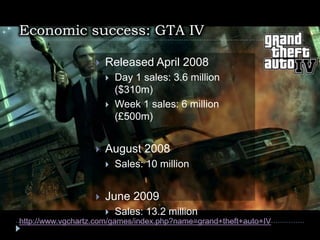
Economic success: GTA IV
 Released April 2008
 Day 1 sales: 3.6 million
($310m)
 Week 1 sales: 6 million
(£500m)
 August 2008
 Sales: 10 million
 June 2009
 Sales: 13.2 millionSource:
http://www.vgchartz.com/games/index.php?name=grand+theft+auto+IV
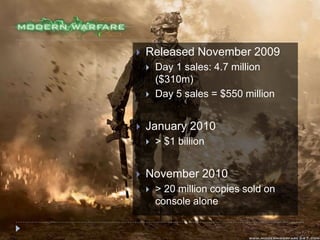
 Released November 2009
 Day 1 sales: 4.7 million
($310m)
 Day 5 sales = $550 million
 January 2010
 > $1 billion
 November 2010
 > 20 million copies sold on
console alone
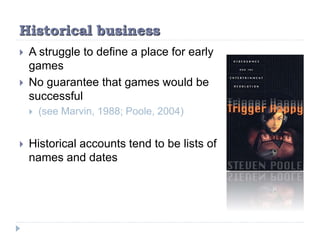
Historical business
 A struggle to define a place for early
games
 No guarantee that games would be
successful
 (see Marvin, 1988; Poole, 2004)
 Historical accounts tend to be lists of
names and dates
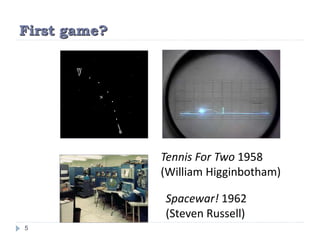
First game?
5
Spacewar! 1962
(Steven Russell)
Tennis For Two 1958
(William Higginbotham)
Cold War kids
1950s….
 Emerged during a period of intense socio-economic
and geo-political changes:
 Space Race (USSR)
 Cold War paranoia (nuclear anxiety)
 Decline of heavy industry
 Major changes in life style
 Advent of domestic mass communication
 Consumer confidence
Game development…
 Largely due to
 “university computing departments, the military, the
interest of the first game developers, the first games and
the subsequent development of game playing as an
activity embraced largely by young males”
 (Kerr, 2006: 14; see also Haddon, 1988; 1993)
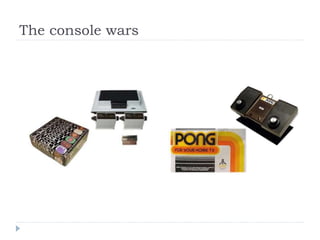
The console wars
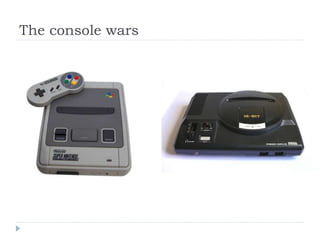
The console wars
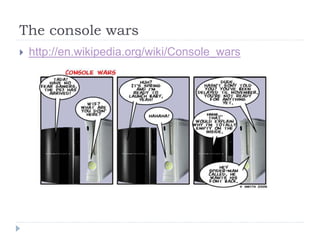
The console wars
The console wars
 http://en.wikipedia.org/wiki/Console_wars
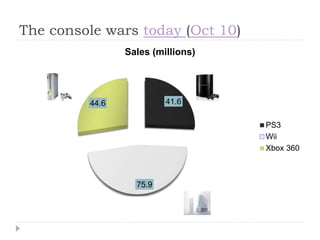
The console wars today (Oct 10)
41.6
75.9
44.6
Sales (millions)
PS3
Wii
Xbox 360
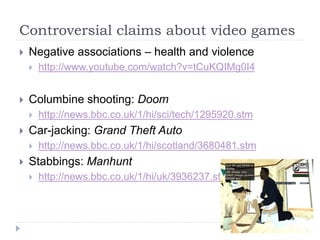
Controversial claims about video games
 Negative associations – health and violence
 http://www.youtube.com/watch?v=tCuKQIMg0I4
 Columbine shooting: Doom
 http://news.bbc.co.uk/1/hi/sci/tech/1295920.stm
 Car-jacking: Grand Theft Auto
 http://news.bbc.co.uk/1/hi/scotland/3680481.stm
 Stabbings: Manhunt
 http://news.bbc.co.uk/1/hi/uk/3936237.stm
(Un)popular claims about video games
 Positive claims?
 Surgeons who played games for at least 3 hours a week
made ‘37% fewer errors, were 27% faster’ than surgeons
who did not play games. (Hall, 2007)
 Safe environment to enact fantasy
 Creativity of ‘modders’
Games emerge from a cultural context
 US military funding?
Always a ‘politics’ in every representation
 Representations are never innocent.
 Representations are always a ‘construction’ in
accordance with the producer’s politics.
 Representations reflect cultural attitudes and beliefs.
Under-representation = social inequality
 “In television, it was always a landmark moment
when some minority or disenfranchised group
appeared on the screen for the first time”
 “That kind of visibility is really the first step toward
leading to public consciousness and equal
treatment. These cultural markers matter.”
 D. Williams et al (2009), New Media & Society
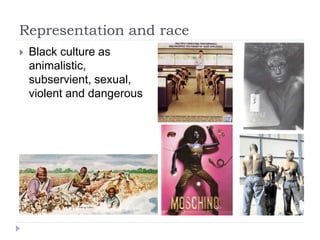
Representation and race
 Black culture as
animalistic,
subservient, sexual,
violent and dangerous
Resident Evil 5 Race Row
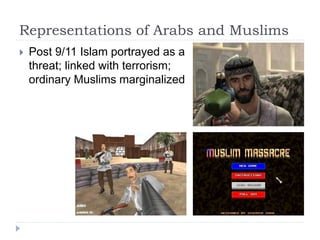
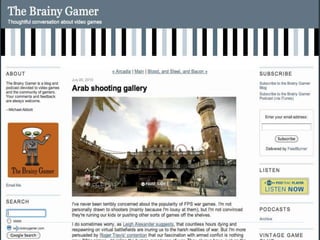
Representations of Arabs and Muslims
 Post 9/11 Islam portrayed as a
threat; linked with terrorism;
ordinary Muslims marginalized
Depictions of ‘Others’
 Games set against the backdrop of current real-world
conflicts?
 The narratives help shape understandings of the conflict:
 its morality
 Hero-ification of some groups
 Dehumanising others
 Normalizing warfare
 “These types of images […] reinforce the perception of
Arabs and Muslims as racialized Others, bloodthirsty
terrorists whose acts of aggression are inherently
illegitimate, while any by the Coalition forces are, by
definition, moral and justifiable in the face of such an
enemy.”
 Gwen Sharp, 2010, Sociological Images
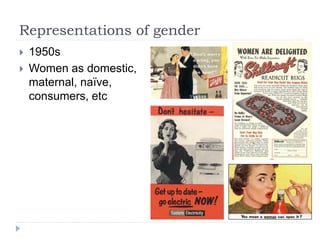
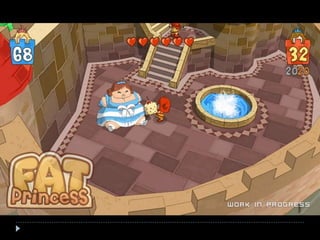
Representations of gender
 1950s
 Women as domestic,
maternal, naïve,
consumers, etc
 http://www.feministgamers.com/?p=466
 http://shakespearessister.blogspot.com/2008/07/i-
write-letters.html
 http://www.feministe.us/blog/archives/2008/07/23/wel
l-that-was-bound-to-happen/
Representation of gender
 Feminist critics have argued that many media texts
represent women as:
 Sex objects
 Dutiful housewives / virginal daughters
 Mad, bad, dangerous women who need punishment
 Are video games any different?
 Jiggle physics?
 http://archive.gamespy.com/fargo/january02/jiggle/
 See also:
 ‘Top 10 Boobies in Video Games’
 ‘Sexy Video Game Babes’
Game design
 Studies of digital games have noted a ‘consistent
pattern of male technocratic privilege’
 Williams, cited in Kerr, 2006: 19
 Game development & design, production, marketing
& construction, dominated by heterosexual
masculine fantasies
 Gansmo et al, 2003
Gender in games
 Traditional stereotype of femininity evoked
 Relationships
 Romance
 Emotions
 Role-play
 Gansmo (2003): little understanding within the
industry about how game design might be linked
to gender socialisation
Consequences of stereotypes…
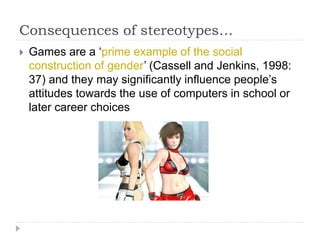
 Games are a ‘prime example of the social
construction of gender’ (Cassell and Jenkins, 1998:
37) and they may significantly influence people’s
attitudes towards the use of computers in school or
later career choices
Women do play games!?
 Funk (1993):
 75% of females play games at home (90% males)
 Colwell and Payne (2000):
 88% of females aged 12-14 play games regularly
 ESA (2004):
 39% of US gamers are female and females account for 40% of
online players.
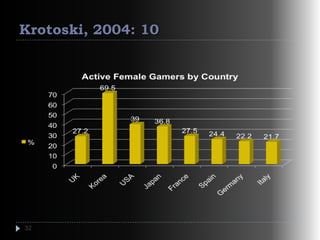
 Krotoski (2004):
 approx 25% of gamers are female in Europe, compared to 70%
in Korea
 Crawford & Gosling (2005):
 Women much less likely to play the older they get
 Alexanda (2009):
 Female console gamers grew from 23 to 28 percent in 2009
Krotoski, 2004: 10
32
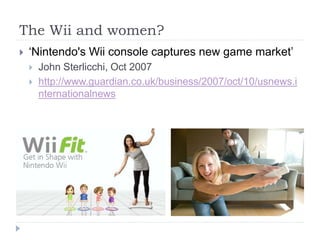
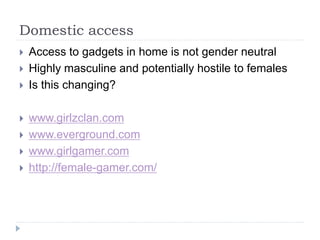
The Wii and women?
 ‘Nintendo's Wii console captures new game market’
 John Sterlicchi, Oct 2007
 http://www.guardian.co.uk/business/2007/oct/10/usnews.i
nternationalnews
Domestic access
 Access to gadgets in home is not gender neutral
 Highly masculine and potentially hostile to females
 Is this changing?
 www.girlzclan.com
 www.everground.com
 www.girlgamer.com
 http://female-gamer.com/
Domestic context
 Space
 a greater percentage of girls’ play has been centred in or
around the home
 Time
 females still spend more time engaged in domestic labour
than males (typically 1.5 hours per day more than males
in the UK)
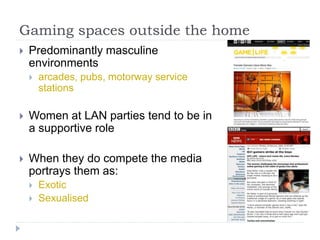
Gaming spaces outside the home
 Predominantly masculine
environments
 arcades, pubs, motorway service
stations
 Women at LAN parties tend to be in
a supportive role
 When they do compete the media
portrays them as:
 Exotic
 Sexualised
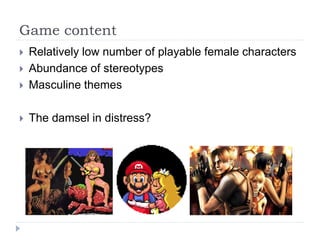
Game content
 Relatively low number of playable female characters
 Abundance of stereotypes
 Masculine themes
 The damsel in distress?
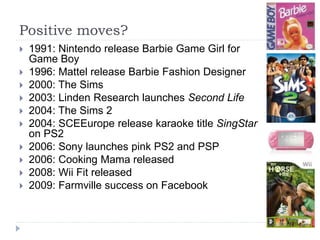
Positive moves?
 1991: Nintendo release Barbie Game Girl for
Game Boy
 1996: Mattel release Barbie Fashion Designer
 2000: The Sims
 2003: Linden Research launches Second Life
 2004: The Sims 2
 2004: SCEEurope release karaoke title SingStar
on PS2
 2006: Sony launches pink PS2 and PSP
 2006: Cooking Mama released
 2008: Wii Fit released
 2009: Farmville success on Facebook
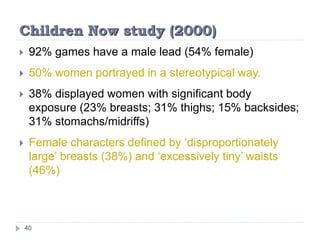
Children Now study (2000)
 92% games have a male lead (54% female)
 50% women portrayed in a stereotypical way.
 38% displayed women with significant body
exposure (23% breasts; 31% thighs; 15% backsides;
31% stomachs/midriffs)
 Female characters defined by ‘disproportionately
large’ breasts (38%) and ‘excessively tiny’ waists
(46%)
40
See: http://www.remedialthoughts.com/2008/11/can-women-in-games-ever-be-
more-than.html
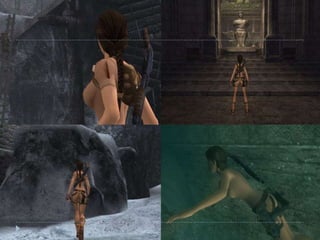
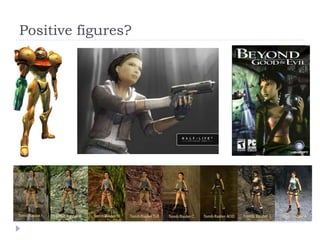
Positive figures?
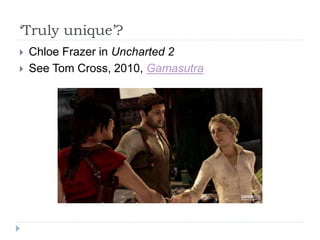
‘Truly unique’?
 Chloe Frazer in Uncharted 2
 See Tom Cross, 2010, Gamasutra
Conclusion
 History of games has been male dominated
 Industry can be conservative and not welcome
change (can be risky)
 Women increasingly more important to the industry
 Positive changes ahead?
Sources and further reading
 Leigh Alexander, 2009, ‘NPD: Female Gamer Population Increasing On Consoles’, Gamasutra,
http://www.gamasutra.com/php-bin/news_index.php?story=24245
 Jo Bryce & Jason Rutter, 2003, ‘Gender dynamics and the social and spatial organisation of computer
gaming’, Leisure Studies, 22: 1-15
 Jo Bryce, Jason Rutter and Cath Sullivan, 2006, ‘Digital games and gender’, in Jason Rutter & Jo Bryce
(eds.), Understanding Digital Games, London: Sage.
 Judith Butler, 1990, Gender Trouble: Feminism and the Subversion of Identity, London: Routledge.
 Children Now, 2000, Girls and Gaming: A Console Video Game Content Analysis, Oakland, CA: Children
Now
 J. Colwell & J. Payne, 2000, ‘Negative correlates of computer game play in adolescents’, British Journal of
Psychology, 91: 295-310.
 G. Crawford & V. Gosling, 2005, ‘Toys for boys? Women’s marginalization and participation as digital
gamers’, Sociological Research Online, 10, (1), http://www.socresonline.org.uk/10/1/crawford.html
 M. Cundy, 2009, “Absolutely terrifying ‘sexy’ images of 8-bit ‘babes’”, Games Radar,
http://www.gamesradar.com/f/absolutely-terrifying-sexy-images-of-8-bit-babes/a-2009093014448271099
 T.L. Dietz, 1998, ‘An Examination of violence and gender role portrayals in video games’, Sex Roles, 38
(5-6): 425-42
 J. B. Funk, 1993, ‘Re-evaluating the impact of computer games’, Clinical Paediatrics, 32: 86-90
 Aleks Krotoski, 2004, ‘Chicks and joysticks: an exploration of women and gaming’, ELSPA white paper,
http://www.elspa.com/assets/files/c/chicksandjoysticksanexplorationofwomenandgaming_176.pdf
 Carolyn Marvin, 1988, When Old Technologies Were New. Thinking about Electric Communication in the
Late Nineteenth Century, New York: Oxford University Press
 Steven Poole, 2000, Trigger Happy: the inner life of videogames, London: Fourth Estate
 Steven Poole, 2004, Trigger Happy: videogames and the entertainment revolution, New York: Arcade
Publishing
 G. R. Schott & K.R. Horrell, 2000, ‘Girl gamers and their relationship with the gaming culture’
Convergence, 6: 36-53
 D. Willams, N. Martins, M. Consalvo & J.D. Ivory, 2009, ‘The virtual census: representations of gender,
race and age in video games’ in New Media & Society, Vol 11, No 5.
Some questions to consider?
 What are your earliest video game memories?
 Have you ever played a game where the
represented characters seem problematic?
 Has gender/race/sexuality ever caused you to question
the representation?
 Do games evoke stereotypes and cliches, and
should we be concerned about these?
 Games are often regulated (ratings system). Does
regulation work to protect people?

Mac129 MED102 video games and representation 2010 11

  • 1.
  • 2.
    Economic success: GTAIV  Released April 2008  Day 1 sales: 3.6 million ($310m)  Week 1 sales: 6 million (£500m)  August 2008  Sales: 10 million  June 2009  Sales: 13.2 millionSource: http://www.vgchartz.com/games/index.php?name=grand+theft+auto+IV
  • 3.
     Released November2009  Day 1 sales: 4.7 million ($310m)  Day 5 sales = $550 million  January 2010  > $1 billion  November 2010  > 20 million copies sold on console alone
  • 4.
    Historical business  Astruggle to define a place for early games  No guarantee that games would be successful  (see Marvin, 1988; Poole, 2004)  Historical accounts tend to be lists of names and dates
  • 5.
    First game? 5 Spacewar! 1962 (StevenRussell) Tennis For Two 1958 (William Higginbotham)
  • 6.
    Cold War kids 1950s…. Emerged during a period of intense socio-economic and geo-political changes:  Space Race (USSR)  Cold War paranoia (nuclear anxiety)  Decline of heavy industry  Major changes in life style  Advent of domestic mass communication  Consumer confidence
  • 7.
    Game development…  Largelydue to  “university computing departments, the military, the interest of the first game developers, the first games and the subsequent development of game playing as an activity embraced largely by young males”  (Kerr, 2006: 14; see also Haddon, 1988; 1993)
  • 8.
  • 9.
  • 10.
  • 11.
    The console wars http://en.wikipedia.org/wiki/Console_wars
  • 12.
    The console warstoday (Oct 10) 41.6 75.9 44.6 Sales (millions) PS3 Wii Xbox 360
  • 13.
    Controversial claims aboutvideo games  Negative associations – health and violence  http://www.youtube.com/watch?v=tCuKQIMg0I4  Columbine shooting: Doom  http://news.bbc.co.uk/1/hi/sci/tech/1295920.stm  Car-jacking: Grand Theft Auto  http://news.bbc.co.uk/1/hi/scotland/3680481.stm  Stabbings: Manhunt  http://news.bbc.co.uk/1/hi/uk/3936237.stm
  • 14.
    (Un)popular claims aboutvideo games  Positive claims?  Surgeons who played games for at least 3 hours a week made ‘37% fewer errors, were 27% faster’ than surgeons who did not play games. (Hall, 2007)  Safe environment to enact fantasy  Creativity of ‘modders’
  • 15.
    Games emerge froma cultural context  US military funding?
  • 16.
    Always a ‘politics’in every representation  Representations are never innocent.  Representations are always a ‘construction’ in accordance with the producer’s politics.  Representations reflect cultural attitudes and beliefs.
  • 17.
    Under-representation = socialinequality  “In television, it was always a landmark moment when some minority or disenfranchised group appeared on the screen for the first time”  “That kind of visibility is really the first step toward leading to public consciousness and equal treatment. These cultural markers matter.”  D. Williams et al (2009), New Media & Society
  • 18.
    Representation and race Black culture as animalistic, subservient, sexual, violent and dangerous
  • 19.
  • 21.
    Representations of Arabsand Muslims  Post 9/11 Islam portrayed as a threat; linked with terrorism; ordinary Muslims marginalized
  • 23.
    Depictions of ‘Others’ Games set against the backdrop of current real-world conflicts?  The narratives help shape understandings of the conflict:  its morality  Hero-ification of some groups  Dehumanising others  Normalizing warfare  “These types of images […] reinforce the perception of Arabs and Muslims as racialized Others, bloodthirsty terrorists whose acts of aggression are inherently illegitimate, while any by the Coalition forces are, by definition, moral and justifiable in the face of such an enemy.”  Gwen Sharp, 2010, Sociological Images
  • 24.
    Representations of gender 1950s  Women as domestic, maternal, naïve, consumers, etc
  • 26.
     http://www.feministgamers.com/?p=466  http://shakespearessister.blogspot.com/2008/07/i- write-letters.html http://www.feministe.us/blog/archives/2008/07/23/wel l-that-was-bound-to-happen/
  • 27.
    Representation of gender Feminist critics have argued that many media texts represent women as:  Sex objects  Dutiful housewives / virginal daughters  Mad, bad, dangerous women who need punishment  Are video games any different?  Jiggle physics?  http://archive.gamespy.com/fargo/january02/jiggle/  See also:  ‘Top 10 Boobies in Video Games’  ‘Sexy Video Game Babes’
  • 28.
    Game design  Studiesof digital games have noted a ‘consistent pattern of male technocratic privilege’  Williams, cited in Kerr, 2006: 19  Game development & design, production, marketing & construction, dominated by heterosexual masculine fantasies  Gansmo et al, 2003
  • 29.
    Gender in games Traditional stereotype of femininity evoked  Relationships  Romance  Emotions  Role-play  Gansmo (2003): little understanding within the industry about how game design might be linked to gender socialisation
  • 30.
    Consequences of stereotypes… Games are a ‘prime example of the social construction of gender’ (Cassell and Jenkins, 1998: 37) and they may significantly influence people’s attitudes towards the use of computers in school or later career choices
  • 31.
    Women do playgames!?  Funk (1993):  75% of females play games at home (90% males)  Colwell and Payne (2000):  88% of females aged 12-14 play games regularly  ESA (2004):  39% of US gamers are female and females account for 40% of online players.  Krotoski (2004):  approx 25% of gamers are female in Europe, compared to 70% in Korea  Crawford & Gosling (2005):  Women much less likely to play the older they get  Alexanda (2009):  Female console gamers grew from 23 to 28 percent in 2009
  • 32.
  • 33.
    The Wii andwomen?  ‘Nintendo's Wii console captures new game market’  John Sterlicchi, Oct 2007  http://www.guardian.co.uk/business/2007/oct/10/usnews.i nternationalnews
  • 34.
    Domestic access  Accessto gadgets in home is not gender neutral  Highly masculine and potentially hostile to females  Is this changing?  www.girlzclan.com  www.everground.com  www.girlgamer.com  http://female-gamer.com/
  • 36.
    Domestic context  Space a greater percentage of girls’ play has been centred in or around the home  Time  females still spend more time engaged in domestic labour than males (typically 1.5 hours per day more than males in the UK)
  • 37.
    Gaming spaces outsidethe home  Predominantly masculine environments  arcades, pubs, motorway service stations  Women at LAN parties tend to be in a supportive role  When they do compete the media portrays them as:  Exotic  Sexualised
  • 38.
    Game content  Relativelylow number of playable female characters  Abundance of stereotypes  Masculine themes  The damsel in distress?
  • 39.
    Positive moves?  1991:Nintendo release Barbie Game Girl for Game Boy  1996: Mattel release Barbie Fashion Designer  2000: The Sims  2003: Linden Research launches Second Life  2004: The Sims 2  2004: SCEEurope release karaoke title SingStar on PS2  2006: Sony launches pink PS2 and PSP  2006: Cooking Mama released  2008: Wii Fit released  2009: Farmville success on Facebook
  • 40.
    Children Now study(2000)  92% games have a male lead (54% female)  50% women portrayed in a stereotypical way.  38% displayed women with significant body exposure (23% breasts; 31% thighs; 15% backsides; 31% stomachs/midriffs)  Female characters defined by ‘disproportionately large’ breasts (38%) and ‘excessively tiny’ waists (46%) 40
  • 41.
  • 43.
  • 44.
    ‘Truly unique’?  ChloeFrazer in Uncharted 2  See Tom Cross, 2010, Gamasutra
  • 45.
    Conclusion  History ofgames has been male dominated  Industry can be conservative and not welcome change (can be risky)  Women increasingly more important to the industry  Positive changes ahead?
  • 46.
    Sources and furtherreading  Leigh Alexander, 2009, ‘NPD: Female Gamer Population Increasing On Consoles’, Gamasutra, http://www.gamasutra.com/php-bin/news_index.php?story=24245  Jo Bryce & Jason Rutter, 2003, ‘Gender dynamics and the social and spatial organisation of computer gaming’, Leisure Studies, 22: 1-15  Jo Bryce, Jason Rutter and Cath Sullivan, 2006, ‘Digital games and gender’, in Jason Rutter & Jo Bryce (eds.), Understanding Digital Games, London: Sage.  Judith Butler, 1990, Gender Trouble: Feminism and the Subversion of Identity, London: Routledge.  Children Now, 2000, Girls and Gaming: A Console Video Game Content Analysis, Oakland, CA: Children Now  J. Colwell & J. Payne, 2000, ‘Negative correlates of computer game play in adolescents’, British Journal of Psychology, 91: 295-310.  G. Crawford & V. Gosling, 2005, ‘Toys for boys? Women’s marginalization and participation as digital gamers’, Sociological Research Online, 10, (1), http://www.socresonline.org.uk/10/1/crawford.html  M. Cundy, 2009, “Absolutely terrifying ‘sexy’ images of 8-bit ‘babes’”, Games Radar, http://www.gamesradar.com/f/absolutely-terrifying-sexy-images-of-8-bit-babes/a-2009093014448271099  T.L. Dietz, 1998, ‘An Examination of violence and gender role portrayals in video games’, Sex Roles, 38 (5-6): 425-42  J. B. Funk, 1993, ‘Re-evaluating the impact of computer games’, Clinical Paediatrics, 32: 86-90  Aleks Krotoski, 2004, ‘Chicks and joysticks: an exploration of women and gaming’, ELSPA white paper, http://www.elspa.com/assets/files/c/chicksandjoysticksanexplorationofwomenandgaming_176.pdf  Carolyn Marvin, 1988, When Old Technologies Were New. Thinking about Electric Communication in the Late Nineteenth Century, New York: Oxford University Press  Steven Poole, 2000, Trigger Happy: the inner life of videogames, London: Fourth Estate  Steven Poole, 2004, Trigger Happy: videogames and the entertainment revolution, New York: Arcade Publishing  G. R. Schott & K.R. Horrell, 2000, ‘Girl gamers and their relationship with the gaming culture’ Convergence, 6: 36-53  D. Willams, N. Martins, M. Consalvo & J.D. Ivory, 2009, ‘The virtual census: representations of gender, race and age in video games’ in New Media & Society, Vol 11, No 5.
  • 47.
    Some questions toconsider?  What are your earliest video game memories?  Have you ever played a game where the represented characters seem problematic?  Has gender/race/sexuality ever caused you to question the representation?  Do games evoke stereotypes and cliches, and should we be concerned about these?  Games are often regulated (ratings system). Does regulation work to protect people?