ACQUISITION PLAN
WARSAW SCHOOL OF ECONOMICS
Mergers & Acquistion
Ph. D. Mariusz-Jan Radlo
Marcella Malpangotto 56100
Francesco Micaletti 56103
Henning Hoyer 56080
Laura Corallo 56058
and
1
AGENDA – Acquisition Process
1. Step : Business Plan
a. Goodyear Introduction
b. Industrial Analysis: Porters Five Forces
c. SWOT Analysis
2. Step: Acqusition Plan
a. Search/Screening Plan
b. Pirelli Introduction
c. Negotionation Strategy
d. Financing Plan
e. Integration Plan
2Mergers & Acquisition
AGENDA – Acquisition Process
3Mergers & Acquisition
1. Step : Business Plan
a. Goodyear Introduction
b. Industrial Analysis: Porters Five Forces
c. SWOT Analysis
2. Step: Acqusition Plan
a. Search/Screening Plan
b. Pirelli Introduction
c. Negotionation Strategy
d. Financing Plan
e. Integration Plan
Goodyear – At a glance
• Goodyear is one of the world's leading tire companies
(N. 1 in North America and Latin America)
• It designs, develops, manufactures and sells tyres - for motor
vehicles, industrial vehicles and motorcycles.
• It operates 53 manufacturing plants in 22 countries
• The Common stock is traded on the NASDAQ Global Select Market
• 73,000 employees (2011)
Mergers & Acquisition 4
USD in millions 2010 2011 Δ %
Sales 18,832 22,767 + 21%
Operating Income 917 1,368 + 49%
Net Income -216 343 /
Total Assets 15,630 17,629 + 13%
Businesses
What they do?
Development, manufacture, distribution and sale of
tires and related products and services worldwide.
• Automobiles, trucks,
buses, aviation,
motorcycles.
ORIGINAL
EQUIPMENT
• Automobiles, trucks,
buses, motorcycles,
others.
REPLACEMENT
Primary production of tyres
which are assembled and
branded by an organization
down the supply chain:
automotive manufactures
Technical assistance and repair
centres for automobiles,
garages, fast fitters, tyre
wholesalers, retail shops
(In millions of tires)
Replacement Units 2010
North American Tire 50.8
International 82.2
Total 133
OE Units 2010
North American Tire 15.9
International 31.9
Total 47.8
Worldwide tire units 180.8
Businesses
AGENDA – Acquisition Process
7Mergers & Acquisition
1. Step : Business Plan
a. Goodyear Introduction
b. Industrial Analysis: Porters Five Forces
c. SWOT Analysis
2. Step: Acqusition Plan
a. Search/Screening Plan
b. Pirelli Introduction
c. Negotionation Strategy
d. Financing Plan
e. Integration Plan
External Analysis: Porters Five Forces
Mergers & Acquisition 8
Industry
Rivalry
Potential Entrants
(Threat of Mobility)
Buyers
(Buyer Power)
Substitutes
(Threat of
Substitutes)
Suppliers
(Supplier Power)
Porters Five Forces
Mergers & Acquisition 9
INDUSTRY COMPETITORS: Intensity of Rivarly
• Concentrated industry:
the first 7 firm >65% of the market share
• Increasing competition at low-cost
from Asian companies.
• High market growth (When industries are
growing revenue quickly, they are less likely
to compete, because the total industry size
is also growing
• High levels of product differentiation (lower levels of price competition)
Medium/Low rivalry, but the scenario could change in the future
COMPANIES MARKET SHARE
1 Michelin 17.1%
2 Bridgestone 16.9%
3 Goodyear 14.9%
4 Continental 5.9%
5 Pirelli 4.5%
6 Sumitomo 3.2%
7 Yokohama 2.9%
Industry
Rivalry
Potential
Entrants
(Threat of
Mobility)
Buyers
(Buyer Power)
Substitutes
(Threat of
Substitutes)
Suppliers
(Supplier
Power)
Porters Five Forces
Mergers & Acquisition 10
SUPPLIERS: Bargaining Power of Suppliers
Natural rubber, synthetic rubber (Butadiene) and petroleum
based raw materials represent the main raw material for
tyres.
Even if…
• A low concentration of suppliers
• Critical production inputs are similar
… Natural rubber, butadiene
and petroleum
prices are volatile,
because they depends on
many other factors
Industry
Rivalry
Potential
Entrants
(Threat of
Mobility)
Buyers
(Buyer Power)
Substitutes
(Threat of
Substitutes)
Suppliers
(Supplier
Power)
Porters Five Forces
Mergers & Acquisition 11
POTENTIAL ENTRANTS: Threats of new entrants
• High capital requirements
• High sunk costs limit competition
• Strong brand names are important
• Industry requires economies of scale
• Advanced technologies are required
 No threats from potential entrants
Industry
Rivalry
Potential
Entrants
(Threat of
Mobility)
Buyers
(Buyer Power)
Substitutes
(Threat of
Substitutes)
Suppliers
(Supplier
Power)
Porters Five Forces
Mergers & Acquisition 12
ORIGINAL EQUIPMENT (“OE”):
Automotive manufactures
• highly concentrated market (About 10
global automakers account for over
77% of the production worldwide).
• Low switching cost for buyers
• Sales depend on automotive market
trends
High bargaining power
REPLACEMENT
Technical assistance centres for
automobiles, garages, fast fitters, tyre
wholesalers, retail shops.
It requires a high service level in terms of
short delivery times
• Not concentrated buyers
• Low switching cost for buyers
• Small size buyers
Low bargaining power
BUYERS: Bargaining Power of Buyers
Industry
Rivalry
Potential
Entrants
(Threat of
Mobility)
Buyers
(Buyer Power)
Substitutes
(Threat of
Substitutes)
Suppliers
(Supplier
Power)
Porters Five Forces
Mergers & Acquisition 13
SUBSTITUTES: Threat of substitutes
• The only threat can be caused by the increasing of public
transport that reduces use of cars
• High switching costs: customers cannot easily switch to
other products or services of similar price and still receive
the same benefits
• Limited number of substitutes: customers cannot easily
find other products or services that fulfil their needs
 No threats from susbtitutes
Industry
Rivalry
Potential
Entrants
(Threat of
Mobility)
Buyers
(Buyer Power)
Substitutes
(Threat of
Substitutes)
Suppliers
(Supplier
Power)
AGENDA – Acquisition Process
14Mergers & Acquisition
1. Step : Business Plan
a. Goodyear Introduction
b. Industrial Analysis: Porters Five Forces
c. SWOT Analysis
2. Step: Acqusition Plan
a. Search/Screening Plan
b. Pirelli Introduction
c. Negotionation Strategy
d. Financing Plan
e. Integration Plan
SWOT Analysis - Goodyear
Mergers & Acquisition 15
+ -
INTERNAL
Strengths
* Innovation
* Loyal customers
* Strong management team
* Strong financial position
* Brand Identity
* M&A competences
Weaknesses
* Bad communication
* Over leveraged financial position
* Poor supply chain
* Weaker position in Non-US markets
relative to competitors
* 19th largest air polluter in the U.S.
EXTERNAL
Opportunities
* Increasing growth rate of European Market
* Higher operating margin from Premium
sector
* Emerging markets
Threats
* Increasing Competition from Asian
Companies
* Exchange rate fluctuations
* Volatile prices of raw materials
Objectivies
Sought Synergies from Acquisition
Mergers & Acquisition 16
1. INCREASING MARKET SHARE Getting a leading position
2. GEOGRAPHICAL DIVERSIFICATION Higher penetration of European Market
New sales opportunities
3. SALES GROWTH Improving product-mix  Premium
Segment
Cross selling
4. COST REDUCTION Economies of scale: reaching the
maximum safe production capacity
Sharing the distribution network:
divestment of the overlapping facilities
Increasing of purchasing power
Sharing technological know-how
Type of Acquisition
Mergers & Acquisition 17
HORIZONTAL ACQUISITION
allowing
DOMAIN EXPANSION
Segment
expansion:
Premium Segment
Geographical
expansion:
European Market
AGENDA – Acquisition Process
18Mergers & Acquisition
1. Step : Business Plan
a. Goodyear Introduction
b. Industrial Analysis: Porters Five Forces
c. SWOT Analysis
2. Step: Acqusition Plan
a. Search/Screening Plan
b. Pirelli Introduction
c. Negotionation Strategy
d. Financing Plan
e. Integration Plan
Search/Screening Plan
Screening criteria
1. Industry: same industry
2. Market segment: High-quality tires, premium sector
3. Market share: getting the leadership in the tire industry
(at least 3% market share)
4. Geographic location: Outside America, mostly Europe
5. Degree of leverage: Relatively low (D/E < 80%)
Mergers & Acquisition 19
Which potential targets?
x Michelin
x Bridegeston
Continental
Pirelli
Sumitomo
Yokohama
Why not?
• It would be very difficult for
Goodyear to buy a company
of such dimensions
• The acquisition of one of
those two companies is likely
to trigger the antitrust
issues.
Which target is the most suitable?
Mergers & Acquisition 21
COMPANY
1
MARKET
SHARE
2
MARKET
SEGMENT
3
GEOGRAPHIC
LOCATION
4
MARKET
DEBT/EQUITY
Continental 5.9%
High-quality and
standard-quality
tires
Europe (Germany)
Asia
98.03%
Pirelli 4.5%
High-quality
tires
Europe (Italy, Spain)
Latin America
57.69%
Sumitomo 3.7% High-quality tires
Asia (Japan)
North America
114.03%
Yokohama 2.9%
Standard-quality
tires
Japan
North America
116.32%
Combined market share
Mergers & Acquisition 22
COMPANIES MARKET SHARE
1 Goodyear + Pirelli 14.9% + 4.5% = 19.4%
2 Michelin 17.1%
3 Bridgestone 16.9%
4 Continental 5.9%
AGENDA – Acquisition Process
23Mergers & Acquisition
1. Step : Business Plan
a. Goodyear Introduction
b. Industrial Analysis: Porters Five Forces
c. SWOT Analysis
2. Step: Acqusition Plan
a. Search/Screening Plan
b. Pirelli Introduction
c. Negotionation Strategy
d. Financing Plan
e. Integration Plan
Pirelli – At a glance
• Pirelli Tyre is the fifth largest global tyre maker by revenues:
5.6 billion € (2011)
• It is leader in the high-end segments with high technological
content.
• It designs, develops, manufactures and markets tyres - for
motor vehicles, industrial vehicles and motorcycles.
• It operates 22 plants in more than 160 countries.
• It is listed on the Milan Stock Exchange
• 34,259 employees (2011)
Mergers & Acquisition 24
Business
Mergers & Acquisition 25
1. A growing focus on the Premium Segment
2. A strong presence in
the Replacement channel
3. A balanced distribution of revenues
amongst Mature Markets and Rapid
Development Economies
% of 2011 Revenues
AGENDA – Acquisition Process
26Mergers & Acquisition
1. Step : Business Plan
a. Goodyear Introduction
b. Industrial Analysis: Porters Five Forces
c. SWOT Analysis
2. Step: Acqusition Plan
a. Search/Screening Plan
b. Pirelli Introduction
c. Negotionation Strategy
d. Financing Plan
e. Integration Plan
Shareholders structure (2012)
Mergers & Acquisition 27
CAMFIN totally owns 26.2% of ordinary share capital
CEO: M. T. Provera
Chairman: M. T. Provera
• Main Shareholder:
M. T. Provera
• Chairman:
M. T. Provera
Negotiation Structure - Requests
PIRELLI:
- Keep managerial indipendence due to overlap of
Management and Shareholders
- Keep brand integrity
- Shared-based Payment due to the will of main shareholder
to carry on with the business
Mergers & Acquisition 28
GOODYEAR:
- Friendly Acquisition due to overlap of Management and
Shareholders
- Shared-based Payment due to high leverage
- Balanced Integration to let Pirelli focusing on the
Premium Segment, while Goodyear on the Standard one
 Compatibility of both parts needs
Alternatives
x Merger: too much integration and loss of Pirelli’s brand identity
x Alliances: it doesn’t allow exploitation of synergies in a proper way,
because of the lack of complete control
Mergers & Acquisition 29
Acquisition is the best alternative allowing in the same time:
- Balanced Integration
- the possibility to keep separated the brands identities
- the possibility to share technological know-how
- the possibility to exploit synergies
DEAL STRUCTURE
Mergers & Acquisition 30
Acquisition vehicle Holding Company: the target is a foreing firms
and earn-outs could be involved
Post closing organization Holding company: to preserve Pirelli’s culture and
implement earn-outs
Form of payment Combination of cash and stocks
Tax structure To avoid a high taxation resulting from a holding
company, they could:
- use more stock than cash
- start the Holding in Switzerland:
- Holding tax system: 8%
- No tax on capital income for Swiss
Closing the possible gap on
price
Earn-outs
AGENDA – Acquisition Process
31Mergers & Acquisition
1. Step : Business Plan
a. Goodyear Introduction
b. Industrial Analysis: Porters Five Forces
c. SWOT Analysis
2. Step: Acqusition Plan
a. Search/Screening Plan
b. Pirelli Introduction
c. Negotionation Strategy
d. Financing Plan
e. Integration Plan
Pirelli: DCF Assumptions
Variable Value Source
Two-stage
Growth
Model
Short-term 6% Analyst estimate
Long-term 2.5%
Long-term growth rate of economy
EBIT Margin 14%
Higher than historical and industry average because
new Pirelli’s strategy concentrates mainly on the
premium segment that has higher margin
Gross Capex (%on sales) 6%
• Historical average
• 4% for the year 2017 in order to guarantee the
maintenance capex in the long period
D&A (%on sales) 4% Industry average
Non-cash Working Capital
(%on sales)
14.8% Analyst estimate
Tax rate 31.5%
Weighted average of the marginal tax rate of the
countries where Pirelli sells its products, with weights
equal to the percentage of sales in each country
Mergers & Acquisition 32
Pirelli: WACC
Variable Value Source
β 1.42 Bloomberg
Risk-free rate 4.5% Italian BTP 10 YRS
Equity risk premium 6% Analyst estimate
Cost of equity Ke 13.02% CAPM: Ke = 4.5%+1.42*6%
Cost of debt Kd 5.6% Analyst estimate
D/(D+E) 42% Book value of debt
Market value of equityE/(D+E) 58%
WACC 9.16% WACC= 42%*5.6%*(1-0.315)+58%*13.02%
Mergers & Acquisition 33
Pirelli & C: DCF Valuation
Mergers & Acquisition 34
= 8,356,060,000 €
*All values are in Million Euros
Enterprise Value
Of Pirelli
Goodyear: Assumptions
Mergers & Acquisition 35
Variable Value Source
Two-stage
Growth
Model
Short-term 4% Analyst estimate
Long-term 2.5% Long-term growth rate of economy
EBIT Margin 5%
• Historical average
• Goodyear’s EBIT margin is much lower than
Pirelli’s because its strategy is mainly focused on
the standard segment
Gross Capex (%on sales) 4.6%
• Historical average
• 4% for the year 2017 in order to guarantee the
maintenance capex in the long period
D&A (%on sales) 4% Industry average
Non-cash Working Capital
(%on sales)
6.7% Analyst estimate
Tax rate 35% US corporate marginal tax rate
Goodyear: WACC
Mergers & Acquisition 36
Variable Value Source
β 2.66 Bloomberg
Risk-free rate 4.5% US treasury notes
Equity risk premium 5% Analyst estimate
Cost of equity Ke 17.8% CAPM: Ke = 4.5%+2.66*5%
Cost of debt Kd 6.7% Analyst estimate
D/(D+E) 65% Book value of debt
Market value of equityE/(D+E) 35%
WACC 9.06% WACC= 65%*6.7%*(1-0.35)+35%*17.8%
Goodyear: DCF Valuation
Mergers & Acquisition 37
= 11,954,220,000 $
*All values are in Million Dollars
Enterprise Value
Of Goodyear
= 9,085,207,200 €
Potential synergies
Growth in Revenues: the growth rate is
expected to switch from 4.5% to 5.5% in 2015
Cost Reduction: the EBIT margin is expected to
gradually increase from 7.3% to 9% by 2017
X Integration costs: 210 M € equally split in the
first two years
Mergers & Acquisition 38
Combined Company: DCF
Mergers & Acquisition 39
*All values are in Million Euros
**All values of Goodyear have been converted in Euro using USD/EUR=0.76
Enterprise Value
of combined-company = 23,622,690,000 €
Value of Synergies
• Combined-company’s EV = 23,622,690,000 €
• Pirelli’s EV+ Goodyear EV = 17,441,267,200 €
Synergies =6,181,422,800 €
Mergers & Acquisition 40
Pirelli & C: Comparable Companies Method
Mergers & Acquisition 41
*All values are in Million Euros
Weighted average value
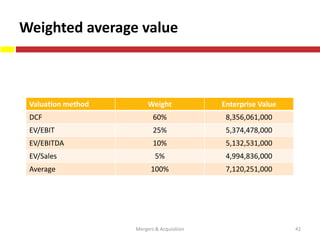
Mergers & Acquisition 42
Valuation method Weight Enterprise Value
DCF 60% 8,356,061,000
EV/EBIT 25% 5,374,478,000
EV/EBITDA 10% 5,132,531,000
EV/Sales 5% 4,994,836,000
Average 100% 7,120,251,000
Price Range and Offer Price
Mergers & Acquisition 43
Minimum Price
Stand-Alone price from
Weighted Average Value
7,120,251,000 €
Offer Price
Stand-Alone price from
Weighted Average Value
+
50% Synergies
10,210,926,400 €
Maximum Price
Stand-Alone price from
Weighted Average Value
+
Synergies
13,301,673,800 €
Financial Plan
Goodyear Pirelli Combined Company
Cash 2,107 557 2,664
Book Value of Debt 3,953 1,772 5,725
Book Value of Equity 773 2,191.60 2,965
Book Debt to Equity
Ratio
511.4% 80.85% 193.1%
Mergers & Acquisition 44
*All values are in Million Euros
• Even without considering any further borrowing,
the combined-company has a high Book D/E ratio
• Pirelli’s shareholders would like to retain
their interest in the tyre business
• Goodyear’s P/E (9.8811) > Pirelli’s P/E (8.6507)
which may increase value of the combined firm (Source: Bloomberg)
Deal paid
mainly by
STOCK
AGENDA – Acquisition Process
45Mergers & Acquisition
1. Step : Business Plan
a. Goodyear Introduction
b. Industrial Analysis: Porters Five Forces
c. SWOT Analysis
2. Step: Acqusition Plan
a. Search/Screening Plan
b. Pirelli Introduction
c. Negotionation Strategy
d. Financing Plan
e. Integration Plan
INTEGRATION PLAN
Mergers & Acquisition 46
COST EFFICIENCY
COMBINED
DEVELOPMENT
CO-LEARNING
TURNAROUND
PLATFORM
Increasing revenues
through new
markets/products,
exploiting the acquired
as platform for growth
LEARNING
Domain Domain Domain
Reinforcement Expansion Exploration
VALUE CRATION SOURCES
HOW TO CREATE
VALUE?
MAX
INTEGRATION
‘STAND-ALONE’
OPTIMIZATION
INTEGRATION PLAN
Mergers & Acquisition 47
INTEGRATION DEPTH:
How many functions or division
must be integrated?
“ARRANGMENT”
long-distance
cooperation, sharing of
best practises, results-
based management
INTEGRATION PACE:
How fast must be decisions and
implementations?
MEDIUM
INTEGRATION SENSIBILITY:
How many overlaps
keeping/cutting?
Which consensus level requested?
MEDIUM
Easier way to face COMMINCATION and CULTURAL problems
48
Thank you for paying attention!
Any questions?

M&A: acquisition plan Pirelli-Goodyear

  • 1.
    ACQUISITION PLAN WARSAW SCHOOLOF ECONOMICS Mergers & Acquistion Ph. D. Mariusz-Jan Radlo Marcella Malpangotto 56100 Francesco Micaletti 56103 Henning Hoyer 56080 Laura Corallo 56058 and 1
  • 2.
    AGENDA – AcquisitionProcess 1. Step : Business Plan a. Goodyear Introduction b. Industrial Analysis: Porters Five Forces c. SWOT Analysis 2. Step: Acqusition Plan a. Search/Screening Plan b. Pirelli Introduction c. Negotionation Strategy d. Financing Plan e. Integration Plan 2Mergers & Acquisition
  • 3.
    AGENDA – AcquisitionProcess 3Mergers & Acquisition 1. Step : Business Plan a. Goodyear Introduction b. Industrial Analysis: Porters Five Forces c. SWOT Analysis 2. Step: Acqusition Plan a. Search/Screening Plan b. Pirelli Introduction c. Negotionation Strategy d. Financing Plan e. Integration Plan
  • 4.
    Goodyear – Ata glance • Goodyear is one of the world's leading tire companies (N. 1 in North America and Latin America) • It designs, develops, manufactures and sells tyres - for motor vehicles, industrial vehicles and motorcycles. • It operates 53 manufacturing plants in 22 countries • The Common stock is traded on the NASDAQ Global Select Market • 73,000 employees (2011) Mergers & Acquisition 4 USD in millions 2010 2011 Δ % Sales 18,832 22,767 + 21% Operating Income 917 1,368 + 49% Net Income -216 343 / Total Assets 15,630 17,629 + 13%
  • 5.
    Businesses What they do? Development,manufacture, distribution and sale of tires and related products and services worldwide. • Automobiles, trucks, buses, aviation, motorcycles. ORIGINAL EQUIPMENT • Automobiles, trucks, buses, motorcycles, others. REPLACEMENT Primary production of tyres which are assembled and branded by an organization down the supply chain: automotive manufactures Technical assistance and repair centres for automobiles, garages, fast fitters, tyre wholesalers, retail shops
  • 6.
    (In millions oftires) Replacement Units 2010 North American Tire 50.8 International 82.2 Total 133 OE Units 2010 North American Tire 15.9 International 31.9 Total 47.8 Worldwide tire units 180.8 Businesses
  • 7.
    AGENDA – AcquisitionProcess 7Mergers & Acquisition 1. Step : Business Plan a. Goodyear Introduction b. Industrial Analysis: Porters Five Forces c. SWOT Analysis 2. Step: Acqusition Plan a. Search/Screening Plan b. Pirelli Introduction c. Negotionation Strategy d. Financing Plan e. Integration Plan
  • 8.
    External Analysis: PortersFive Forces Mergers & Acquisition 8 Industry Rivalry Potential Entrants (Threat of Mobility) Buyers (Buyer Power) Substitutes (Threat of Substitutes) Suppliers (Supplier Power)
  • 9.
    Porters Five Forces Mergers& Acquisition 9 INDUSTRY COMPETITORS: Intensity of Rivarly • Concentrated industry: the first 7 firm >65% of the market share • Increasing competition at low-cost from Asian companies. • High market growth (When industries are growing revenue quickly, they are less likely to compete, because the total industry size is also growing • High levels of product differentiation (lower levels of price competition) Medium/Low rivalry, but the scenario could change in the future COMPANIES MARKET SHARE 1 Michelin 17.1% 2 Bridgestone 16.9% 3 Goodyear 14.9% 4 Continental 5.9% 5 Pirelli 4.5% 6 Sumitomo 3.2% 7 Yokohama 2.9% Industry Rivalry Potential Entrants (Threat of Mobility) Buyers (Buyer Power) Substitutes (Threat of Substitutes) Suppliers (Supplier Power)
  • 10.
    Porters Five Forces Mergers& Acquisition 10 SUPPLIERS: Bargaining Power of Suppliers Natural rubber, synthetic rubber (Butadiene) and petroleum based raw materials represent the main raw material for tyres. Even if… • A low concentration of suppliers • Critical production inputs are similar … Natural rubber, butadiene and petroleum prices are volatile, because they depends on many other factors Industry Rivalry Potential Entrants (Threat of Mobility) Buyers (Buyer Power) Substitutes (Threat of Substitutes) Suppliers (Supplier Power)
  • 11.
    Porters Five Forces Mergers& Acquisition 11 POTENTIAL ENTRANTS: Threats of new entrants • High capital requirements • High sunk costs limit competition • Strong brand names are important • Industry requires economies of scale • Advanced technologies are required  No threats from potential entrants Industry Rivalry Potential Entrants (Threat of Mobility) Buyers (Buyer Power) Substitutes (Threat of Substitutes) Suppliers (Supplier Power)
  • 12.
    Porters Five Forces Mergers& Acquisition 12 ORIGINAL EQUIPMENT (“OE”): Automotive manufactures • highly concentrated market (About 10 global automakers account for over 77% of the production worldwide). • Low switching cost for buyers • Sales depend on automotive market trends High bargaining power REPLACEMENT Technical assistance centres for automobiles, garages, fast fitters, tyre wholesalers, retail shops. It requires a high service level in terms of short delivery times • Not concentrated buyers • Low switching cost for buyers • Small size buyers Low bargaining power BUYERS: Bargaining Power of Buyers Industry Rivalry Potential Entrants (Threat of Mobility) Buyers (Buyer Power) Substitutes (Threat of Substitutes) Suppliers (Supplier Power)
  • 13.
    Porters Five Forces Mergers& Acquisition 13 SUBSTITUTES: Threat of substitutes • The only threat can be caused by the increasing of public transport that reduces use of cars • High switching costs: customers cannot easily switch to other products or services of similar price and still receive the same benefits • Limited number of substitutes: customers cannot easily find other products or services that fulfil their needs  No threats from susbtitutes Industry Rivalry Potential Entrants (Threat of Mobility) Buyers (Buyer Power) Substitutes (Threat of Substitutes) Suppliers (Supplier Power)
  • 14.
    AGENDA – AcquisitionProcess 14Mergers & Acquisition 1. Step : Business Plan a. Goodyear Introduction b. Industrial Analysis: Porters Five Forces c. SWOT Analysis 2. Step: Acqusition Plan a. Search/Screening Plan b. Pirelli Introduction c. Negotionation Strategy d. Financing Plan e. Integration Plan
  • 15.
    SWOT Analysis -Goodyear Mergers & Acquisition 15 + - INTERNAL Strengths * Innovation * Loyal customers * Strong management team * Strong financial position * Brand Identity * M&A competences Weaknesses * Bad communication * Over leveraged financial position * Poor supply chain * Weaker position in Non-US markets relative to competitors * 19th largest air polluter in the U.S. EXTERNAL Opportunities * Increasing growth rate of European Market * Higher operating margin from Premium sector * Emerging markets Threats * Increasing Competition from Asian Companies * Exchange rate fluctuations * Volatile prices of raw materials
  • 16.
    Objectivies Sought Synergies fromAcquisition Mergers & Acquisition 16 1. INCREASING MARKET SHARE Getting a leading position 2. GEOGRAPHICAL DIVERSIFICATION Higher penetration of European Market New sales opportunities 3. SALES GROWTH Improving product-mix  Premium Segment Cross selling 4. COST REDUCTION Economies of scale: reaching the maximum safe production capacity Sharing the distribution network: divestment of the overlapping facilities Increasing of purchasing power Sharing technological know-how
  • 17.
    Type of Acquisition Mergers& Acquisition 17 HORIZONTAL ACQUISITION allowing DOMAIN EXPANSION Segment expansion: Premium Segment Geographical expansion: European Market
  • 18.
    AGENDA – AcquisitionProcess 18Mergers & Acquisition 1. Step : Business Plan a. Goodyear Introduction b. Industrial Analysis: Porters Five Forces c. SWOT Analysis 2. Step: Acqusition Plan a. Search/Screening Plan b. Pirelli Introduction c. Negotionation Strategy d. Financing Plan e. Integration Plan
  • 19.
    Search/Screening Plan Screening criteria 1.Industry: same industry 2. Market segment: High-quality tires, premium sector 3. Market share: getting the leadership in the tire industry (at least 3% market share) 4. Geographic location: Outside America, mostly Europe 5. Degree of leverage: Relatively low (D/E < 80%) Mergers & Acquisition 19
  • 20.
    Which potential targets? xMichelin x Bridegeston Continental Pirelli Sumitomo Yokohama Why not? • It would be very difficult for Goodyear to buy a company of such dimensions • The acquisition of one of those two companies is likely to trigger the antitrust issues.
  • 21.
    Which target isthe most suitable? Mergers & Acquisition 21 COMPANY 1 MARKET SHARE 2 MARKET SEGMENT 3 GEOGRAPHIC LOCATION 4 MARKET DEBT/EQUITY Continental 5.9% High-quality and standard-quality tires Europe (Germany) Asia 98.03% Pirelli 4.5% High-quality tires Europe (Italy, Spain) Latin America 57.69% Sumitomo 3.7% High-quality tires Asia (Japan) North America 114.03% Yokohama 2.9% Standard-quality tires Japan North America 116.32%
  • 22.
    Combined market share Mergers& Acquisition 22 COMPANIES MARKET SHARE 1 Goodyear + Pirelli 14.9% + 4.5% = 19.4% 2 Michelin 17.1% 3 Bridgestone 16.9% 4 Continental 5.9%
  • 23.
    AGENDA – AcquisitionProcess 23Mergers & Acquisition 1. Step : Business Plan a. Goodyear Introduction b. Industrial Analysis: Porters Five Forces c. SWOT Analysis 2. Step: Acqusition Plan a. Search/Screening Plan b. Pirelli Introduction c. Negotionation Strategy d. Financing Plan e. Integration Plan
  • 24.
    Pirelli – Ata glance • Pirelli Tyre is the fifth largest global tyre maker by revenues: 5.6 billion € (2011) • It is leader in the high-end segments with high technological content. • It designs, develops, manufactures and markets tyres - for motor vehicles, industrial vehicles and motorcycles. • It operates 22 plants in more than 160 countries. • It is listed on the Milan Stock Exchange • 34,259 employees (2011) Mergers & Acquisition 24
  • 25.
    Business Mergers & Acquisition25 1. A growing focus on the Premium Segment 2. A strong presence in the Replacement channel 3. A balanced distribution of revenues amongst Mature Markets and Rapid Development Economies % of 2011 Revenues
  • 26.
    AGENDA – AcquisitionProcess 26Mergers & Acquisition 1. Step : Business Plan a. Goodyear Introduction b. Industrial Analysis: Porters Five Forces c. SWOT Analysis 2. Step: Acqusition Plan a. Search/Screening Plan b. Pirelli Introduction c. Negotionation Strategy d. Financing Plan e. Integration Plan
  • 27.
    Shareholders structure (2012) Mergers& Acquisition 27 CAMFIN totally owns 26.2% of ordinary share capital CEO: M. T. Provera Chairman: M. T. Provera • Main Shareholder: M. T. Provera • Chairman: M. T. Provera
  • 28.
    Negotiation Structure -Requests PIRELLI: - Keep managerial indipendence due to overlap of Management and Shareholders - Keep brand integrity - Shared-based Payment due to the will of main shareholder to carry on with the business Mergers & Acquisition 28 GOODYEAR: - Friendly Acquisition due to overlap of Management and Shareholders - Shared-based Payment due to high leverage - Balanced Integration to let Pirelli focusing on the Premium Segment, while Goodyear on the Standard one  Compatibility of both parts needs
  • 29.
    Alternatives x Merger: toomuch integration and loss of Pirelli’s brand identity x Alliances: it doesn’t allow exploitation of synergies in a proper way, because of the lack of complete control Mergers & Acquisition 29 Acquisition is the best alternative allowing in the same time: - Balanced Integration - the possibility to keep separated the brands identities - the possibility to share technological know-how - the possibility to exploit synergies
  • 30.
    DEAL STRUCTURE Mergers &Acquisition 30 Acquisition vehicle Holding Company: the target is a foreing firms and earn-outs could be involved Post closing organization Holding company: to preserve Pirelli’s culture and implement earn-outs Form of payment Combination of cash and stocks Tax structure To avoid a high taxation resulting from a holding company, they could: - use more stock than cash - start the Holding in Switzerland: - Holding tax system: 8% - No tax on capital income for Swiss Closing the possible gap on price Earn-outs
  • 31.
    AGENDA – AcquisitionProcess 31Mergers & Acquisition 1. Step : Business Plan a. Goodyear Introduction b. Industrial Analysis: Porters Five Forces c. SWOT Analysis 2. Step: Acqusition Plan a. Search/Screening Plan b. Pirelli Introduction c. Negotionation Strategy d. Financing Plan e. Integration Plan
  • 32.
    Pirelli: DCF Assumptions VariableValue Source Two-stage Growth Model Short-term 6% Analyst estimate Long-term 2.5% Long-term growth rate of economy EBIT Margin 14% Higher than historical and industry average because new Pirelli’s strategy concentrates mainly on the premium segment that has higher margin Gross Capex (%on sales) 6% • Historical average • 4% for the year 2017 in order to guarantee the maintenance capex in the long period D&A (%on sales) 4% Industry average Non-cash Working Capital (%on sales) 14.8% Analyst estimate Tax rate 31.5% Weighted average of the marginal tax rate of the countries where Pirelli sells its products, with weights equal to the percentage of sales in each country Mergers & Acquisition 32
  • 33.
    Pirelli: WACC Variable ValueSource β 1.42 Bloomberg Risk-free rate 4.5% Italian BTP 10 YRS Equity risk premium 6% Analyst estimate Cost of equity Ke 13.02% CAPM: Ke = 4.5%+1.42*6% Cost of debt Kd 5.6% Analyst estimate D/(D+E) 42% Book value of debt Market value of equityE/(D+E) 58% WACC 9.16% WACC= 42%*5.6%*(1-0.315)+58%*13.02% Mergers & Acquisition 33
  • 34.
    Pirelli & C:DCF Valuation Mergers & Acquisition 34 = 8,356,060,000 € *All values are in Million Euros Enterprise Value Of Pirelli
  • 35.
    Goodyear: Assumptions Mergers &Acquisition 35 Variable Value Source Two-stage Growth Model Short-term 4% Analyst estimate Long-term 2.5% Long-term growth rate of economy EBIT Margin 5% • Historical average • Goodyear’s EBIT margin is much lower than Pirelli’s because its strategy is mainly focused on the standard segment Gross Capex (%on sales) 4.6% • Historical average • 4% for the year 2017 in order to guarantee the maintenance capex in the long period D&A (%on sales) 4% Industry average Non-cash Working Capital (%on sales) 6.7% Analyst estimate Tax rate 35% US corporate marginal tax rate
  • 36.
    Goodyear: WACC Mergers &Acquisition 36 Variable Value Source β 2.66 Bloomberg Risk-free rate 4.5% US treasury notes Equity risk premium 5% Analyst estimate Cost of equity Ke 17.8% CAPM: Ke = 4.5%+2.66*5% Cost of debt Kd 6.7% Analyst estimate D/(D+E) 65% Book value of debt Market value of equityE/(D+E) 35% WACC 9.06% WACC= 65%*6.7%*(1-0.35)+35%*17.8%
  • 37.
    Goodyear: DCF Valuation Mergers& Acquisition 37 = 11,954,220,000 $ *All values are in Million Dollars Enterprise Value Of Goodyear = 9,085,207,200 €
  • 38.
    Potential synergies Growth inRevenues: the growth rate is expected to switch from 4.5% to 5.5% in 2015 Cost Reduction: the EBIT margin is expected to gradually increase from 7.3% to 9% by 2017 X Integration costs: 210 M € equally split in the first two years Mergers & Acquisition 38
  • 39.
    Combined Company: DCF Mergers& Acquisition 39 *All values are in Million Euros **All values of Goodyear have been converted in Euro using USD/EUR=0.76 Enterprise Value of combined-company = 23,622,690,000 €
  • 40.
    Value of Synergies •Combined-company’s EV = 23,622,690,000 € • Pirelli’s EV+ Goodyear EV = 17,441,267,200 € Synergies =6,181,422,800 € Mergers & Acquisition 40
  • 41.
    Pirelli & C:Comparable Companies Method Mergers & Acquisition 41 *All values are in Million Euros
  • 42.
    Weighted average value Mergers& Acquisition 42 Valuation method Weight Enterprise Value DCF 60% 8,356,061,000 EV/EBIT 25% 5,374,478,000 EV/EBITDA 10% 5,132,531,000 EV/Sales 5% 4,994,836,000 Average 100% 7,120,251,000
  • 43.
    Price Range andOffer Price Mergers & Acquisition 43 Minimum Price Stand-Alone price from Weighted Average Value 7,120,251,000 € Offer Price Stand-Alone price from Weighted Average Value + 50% Synergies 10,210,926,400 € Maximum Price Stand-Alone price from Weighted Average Value + Synergies 13,301,673,800 €
  • 44.
    Financial Plan Goodyear PirelliCombined Company Cash 2,107 557 2,664 Book Value of Debt 3,953 1,772 5,725 Book Value of Equity 773 2,191.60 2,965 Book Debt to Equity Ratio 511.4% 80.85% 193.1% Mergers & Acquisition 44 *All values are in Million Euros • Even without considering any further borrowing, the combined-company has a high Book D/E ratio • Pirelli’s shareholders would like to retain their interest in the tyre business • Goodyear’s P/E (9.8811) > Pirelli’s P/E (8.6507) which may increase value of the combined firm (Source: Bloomberg) Deal paid mainly by STOCK
  • 45.
    AGENDA – AcquisitionProcess 45Mergers & Acquisition 1. Step : Business Plan a. Goodyear Introduction b. Industrial Analysis: Porters Five Forces c. SWOT Analysis 2. Step: Acqusition Plan a. Search/Screening Plan b. Pirelli Introduction c. Negotionation Strategy d. Financing Plan e. Integration Plan
  • 46.
    INTEGRATION PLAN Mergers &Acquisition 46 COST EFFICIENCY COMBINED DEVELOPMENT CO-LEARNING TURNAROUND PLATFORM Increasing revenues through new markets/products, exploiting the acquired as platform for growth LEARNING Domain Domain Domain Reinforcement Expansion Exploration VALUE CRATION SOURCES HOW TO CREATE VALUE? MAX INTEGRATION ‘STAND-ALONE’ OPTIMIZATION
  • 47.
    INTEGRATION PLAN Mergers &Acquisition 47 INTEGRATION DEPTH: How many functions or division must be integrated? “ARRANGMENT” long-distance cooperation, sharing of best practises, results- based management INTEGRATION PACE: How fast must be decisions and implementations? MEDIUM INTEGRATION SENSIBILITY: How many overlaps keeping/cutting? Which consensus level requested? MEDIUM Easier way to face COMMINCATION and CULTURAL problems
  • 48.
    48 Thank you forpaying attention! Any questions?