SCIENCE 9- Quarter 4
1. What can you say about
the path of the objects
you see?
2. What causes these
things to move that way?
SCIENCE 9- Quarter 4
WHAT IS PROJECTILE
MOTION?
It is a form of motion in which an
object or particle (called a projectile)
is thrown near the earth's surface, and
it moves along a curved path under the
action of gravity only.
Two dimensions:
1. Horizontal component
2. Vertical component
SCIENCE 9- Quarter 4
IT CAN BE:
•launched horizontally
•thrown vertically upward
•launched at an angle
SCIENCE 9- Quarter 4
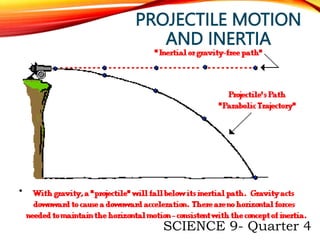
PROJECTILE MOTION
AND INERTIA
•
SCIENCE 9- Quarter 4
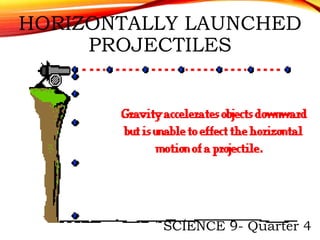
HORIZONTALLY LAUNCHED
PROJECTILES
SCIENCE 9- Quarter 4
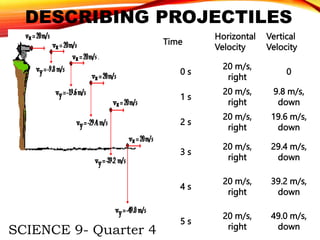
DESCRIBING PROJECTILES
Time
Horizontal
Velocity
Vertical
Velocity
0 s
20 m/s,
right
0
1 s
20 m/s,
right
9.8 m/s,
down
2 s
20 m/s,
right
19.6 m/s,
down
3 s
20 m/s,
right
29.4 m/s,
down
4 s
20 m/s,
right
39.2 m/s,
down
5 s
20 m/s,
right
49.0 m/s,
down
SCIENCE 9- Quarter 4
PROJECTILES LAUNCHED HORIZONTALLY
-a projectile launched horizontally has no
initial velocity
-the downward velocity increases
uniformly due to the gravity
-for a projectile beginning and ending at
the same height, the time it takes a
projectile to rise to its highest point
equals the time it takes to fall from the
highest point back to its original position
SCIENCE 9- Quarter 4
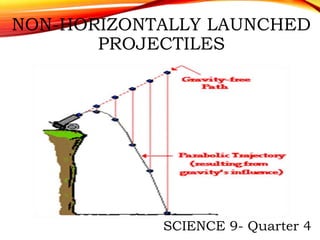
NON-HORIZONTALLY LAUNCHED
PROJECTILES
SCIENCE 9- Quarter 4
PROJECTILE LAUNCHED UPWARD AT AN
ANGLE
SCIENCE 9- Quarter 4
Time
Horizontal Velocity Vertical Velocity
0 s 73.1 m/s, right 19.6 m/s, up
1 s 73.1 m/s, right 9.8 m/s, up
2 s 73.1 m/s, right 0 m/s
3 s 73.1 m/s, right 9.8 m/s, down
4 s 73.1 m/s, right 19.6 m/s, down
5 s 73.1 m/s, right 29.4 m/s, down
6 s 73.1 m/s, right 39.2 m/s, down
7 s 73.1 m/s, right 49.0 m/s, down
SCIENCE 9- Quarter 4
PROJECTILES LAUNCHED AT AN ANGLE
TWO COMPONENTS
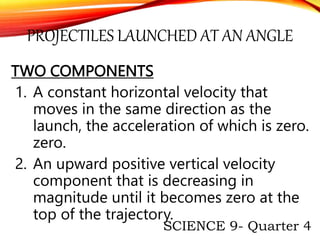
1. A constant horizontal velocity that
moves in the same direction as the
launch, the acceleration of which is zero.
zero.
2. An upward positive vertical velocity
component that is decreasing in
magnitude until it becomes zero at the
top of the trajectory.
SCIENCE 9- Quarter 4
PRINCIPLES OF
PROJECTILE MOTION
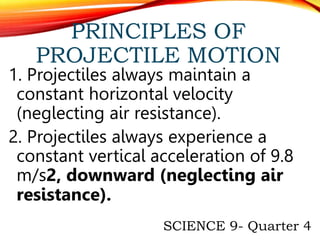
1. Projectiles always maintain a
constant horizontal velocity
(neglecting air resistance).
2. Projectiles always experience a
constant vertical acceleration of 9.8
m/s2, downward (neglecting air
resistance).
SCIENCE 9- Quarter 4
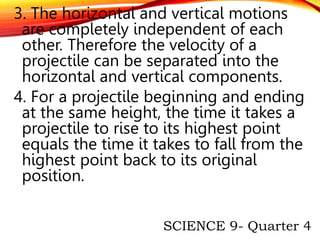
3. The horizontal and vertical motions
are completely independent of each
other. Therefore the velocity of a
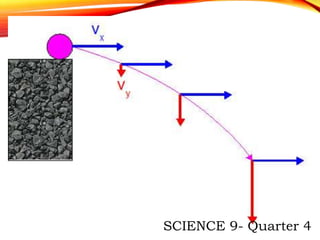
projectile can be separated into the
horizontal and vertical components.
4. For a projectile beginning and ending
at the same height, the time it takes a
projectile to rise to its highest point
equals the time it takes to fall from the
highest point back to its original
position.
SCIENCE 9- Quarter 4
VERTICAL AND HORIZONTAL
MOTION
SCIENCE 9- Quarter 4
VELOCITY VECTOR COMPONENTS
SCIENCE 9- Quarter 4
INITIAL COMPONENTS OF
VELOCITY
vx = v • cos α °
vy = v • sin α °
SCIENCE 9- Quarter 4
SAMPLE PROBLEMS
1. A water balloon
is launched with a
speed of 40 m/s at
an angle of 60
degrees to the
horizontal.
SCIENCE 9- Quarter 4
SAMPLE PROBLEMS
2. A springboard
diver jumps with a
velocity of 10 m/s at
an angle of 80
degrees to the
horizontal.
SCIENCE 9- Quarter 4
SAMPLE PROBLEMS
3. A motorcycle stunt
person traveling 70
m/s jumps off a
ramp at an angle of
35 degrees to the
horizontal.
SCIENCE 9- Quarter 4
where: d = displacement a = acceleration t = time
vf = final velocity vi = initial velocity
d = vi•t + 0.5*a*t2
vf = vi + a•t
vf
2 = vi
2 + 2*a•d
SCIENCE 9- Quarter 4
x = vix•t + 0.5*ax*t2
vfx = vix + ax•t
vfx
2 = vix
2 + 2*ax•x
where: x = horiz. displacement ax = horiz. acceleration t = time
vfx = final horiz. velocity vix = initial horiz. velocity
SCIENCE 9- Quarter 4
y = viy•t + 0.5*ay*t2
vfy = viy + ay•t
vfy
2 = viy
2 + 2*ay•y
where: y = vert. displacement ay = vert. acceleration t = time
vfy = final vert. velocity viy = initial vert. velocity
SCIENCE 9- Quarter 4
SAMPLE PROBLEM
1. A pool leaves a 0.60 meter high
table with an initial horizontal
velocity of 2.4 m/s. Predict the time
required for the pool ball to fall to
the ground and the horizontal
distance between the table’s edge
and the ball’s landing location.
SCIENCE 9- Quarter 4
2. A soccer ball is kicked
horizontally off a 22.0
meter high hill and lands a
distance of 35.0 meters
from the edge of the hill.
Determine the initial
horizontal velocity.
SCIENCE 9- Quarter 4
SAMPLE PROBLEMS
1. A golf ball was hit and projected
at an angle of 60 degrees with
the horizontal. If the initial
velocity of the ball was 50m/s,
calculate the
a. time the golf ball was in the
air (t)
b. horizontal distance (dx)
SCIENCE 9- Quarter 4
2. Alice throws the ball to the
horizontal direction with an
initial velocity of 10m/s. Time
elapsed during the motion is
5s, calculate the height that the
object is thrown and the Vy
component of the velocity after
it hits the ground.
SCIENCE 9- Quarter 4
3. Chris kick the ball and the ball
does projectile motion with an
angle of 53 degrees to
horizontal. Its initial velocity is
10m/s, find the maximum
height it can reach, horizontal
displacement and the total
time required for this motion.
SCIENCE 9- Quarter 4
4. A ball is launched into the
air at an angle of 32 degrees
with an initial velocity of
18.0m/s. Neglecting air
resistance, determine how
long the ball will be in the air?
SCIENCE 9- Quarter 4
5. John is on top of the
building and Jack is down. If
John throws a ball at an
angle of 60 degrees with an
initial velocity of 20 m/s. At
what height will the ball
reach after 2 seconds?
SCIENCE 9- Quarter 4

M1-projectile-motion (1).pptx

  • 1.
  • 3.
    1. What canyou say about the path of the objects you see? 2. What causes these things to move that way? SCIENCE 9- Quarter 4
  • 4.
    WHAT IS PROJECTILE MOTION? Itis a form of motion in which an object or particle (called a projectile) is thrown near the earth's surface, and it moves along a curved path under the action of gravity only. Two dimensions: 1. Horizontal component 2. Vertical component SCIENCE 9- Quarter 4
  • 5.
  • 6.
    IT CAN BE: •launchedhorizontally •thrown vertically upward •launched at an angle SCIENCE 9- Quarter 4
  • 7.
  • 8.
  • 9.
  • 10.
  • 11.
    DESCRIBING PROJECTILES Time Horizontal Velocity Vertical Velocity 0 s 20m/s, right 0 1 s 20 m/s, right 9.8 m/s, down 2 s 20 m/s, right 19.6 m/s, down 3 s 20 m/s, right 29.4 m/s, down 4 s 20 m/s, right 39.2 m/s, down 5 s 20 m/s, right 49.0 m/s, down SCIENCE 9- Quarter 4
  • 12.
    PROJECTILES LAUNCHED HORIZONTALLY -aprojectile launched horizontally has no initial velocity -the downward velocity increases uniformly due to the gravity -for a projectile beginning and ending at the same height, the time it takes a projectile to rise to its highest point equals the time it takes to fall from the highest point back to its original position SCIENCE 9- Quarter 4
  • 13.
  • 14.
  • 15.
    PROJECTILE LAUNCHED UPWARDAT AN ANGLE SCIENCE 9- Quarter 4
  • 16.
    Time Horizontal Velocity VerticalVelocity 0 s 73.1 m/s, right 19.6 m/s, up 1 s 73.1 m/s, right 9.8 m/s, up 2 s 73.1 m/s, right 0 m/s 3 s 73.1 m/s, right 9.8 m/s, down 4 s 73.1 m/s, right 19.6 m/s, down 5 s 73.1 m/s, right 29.4 m/s, down 6 s 73.1 m/s, right 39.2 m/s, down 7 s 73.1 m/s, right 49.0 m/s, down SCIENCE 9- Quarter 4
  • 17.
    PROJECTILES LAUNCHED ATAN ANGLE TWO COMPONENTS 1. A constant horizontal velocity that moves in the same direction as the launch, the acceleration of which is zero. zero. 2. An upward positive vertical velocity component that is decreasing in magnitude until it becomes zero at the top of the trajectory. SCIENCE 9- Quarter 4
  • 19.
    PRINCIPLES OF PROJECTILE MOTION 1.Projectiles always maintain a constant horizontal velocity (neglecting air resistance). 2. Projectiles always experience a constant vertical acceleration of 9.8 m/s2, downward (neglecting air resistance). SCIENCE 9- Quarter 4
  • 20.
    3. The horizontaland vertical motions are completely independent of each other. Therefore the velocity of a projectile can be separated into the horizontal and vertical components. 4. For a projectile beginning and ending at the same height, the time it takes a projectile to rise to its highest point equals the time it takes to fall from the highest point back to its original position. SCIENCE 9- Quarter 4
  • 21.
  • 22.
  • 23.
  • 24.
    INITIAL COMPONENTS OF VELOCITY vx= v • cos α ° vy = v • sin α ° SCIENCE 9- Quarter 4
  • 25.
  • 26.
    SAMPLE PROBLEMS 1. Awater balloon is launched with a speed of 40 m/s at an angle of 60 degrees to the horizontal. SCIENCE 9- Quarter 4
  • 27.
    SAMPLE PROBLEMS 2. Aspringboard diver jumps with a velocity of 10 m/s at an angle of 80 degrees to the horizontal. SCIENCE 9- Quarter 4
  • 28.
    SAMPLE PROBLEMS 3. Amotorcycle stunt person traveling 70 m/s jumps off a ramp at an angle of 35 degrees to the horizontal. SCIENCE 9- Quarter 4
  • 29.
    where: d =displacement a = acceleration t = time vf = final velocity vi = initial velocity d = vi•t + 0.5*a*t2 vf = vi + a•t vf 2 = vi 2 + 2*a•d SCIENCE 9- Quarter 4
  • 30.
    x = vix•t+ 0.5*ax*t2 vfx = vix + ax•t vfx 2 = vix 2 + 2*ax•x where: x = horiz. displacement ax = horiz. acceleration t = time vfx = final horiz. velocity vix = initial horiz. velocity SCIENCE 9- Quarter 4
  • 31.
    y = viy•t+ 0.5*ay*t2 vfy = viy + ay•t vfy 2 = viy 2 + 2*ay•y where: y = vert. displacement ay = vert. acceleration t = time vfy = final vert. velocity viy = initial vert. velocity SCIENCE 9- Quarter 4
  • 32.
    SAMPLE PROBLEM 1. Apool leaves a 0.60 meter high table with an initial horizontal velocity of 2.4 m/s. Predict the time required for the pool ball to fall to the ground and the horizontal distance between the table’s edge and the ball’s landing location. SCIENCE 9- Quarter 4
  • 33.
    2. A soccerball is kicked horizontally off a 22.0 meter high hill and lands a distance of 35.0 meters from the edge of the hill. Determine the initial horizontal velocity. SCIENCE 9- Quarter 4
  • 34.
    SAMPLE PROBLEMS 1. Agolf ball was hit and projected at an angle of 60 degrees with the horizontal. If the initial velocity of the ball was 50m/s, calculate the a. time the golf ball was in the air (t) b. horizontal distance (dx) SCIENCE 9- Quarter 4
  • 35.
    2. Alice throwsthe ball to the horizontal direction with an initial velocity of 10m/s. Time elapsed during the motion is 5s, calculate the height that the object is thrown and the Vy component of the velocity after it hits the ground. SCIENCE 9- Quarter 4
  • 36.
    3. Chris kickthe ball and the ball does projectile motion with an angle of 53 degrees to horizontal. Its initial velocity is 10m/s, find the maximum height it can reach, horizontal displacement and the total time required for this motion. SCIENCE 9- Quarter 4
  • 37.
    4. A ballis launched into the air at an angle of 32 degrees with an initial velocity of 18.0m/s. Neglecting air resistance, determine how long the ball will be in the air? SCIENCE 9- Quarter 4
  • 38.
    5. John ison top of the building and Jack is down. If John throws a ball at an angle of 60 degrees with an initial velocity of 20 m/s. At what height will the ball reach after 2 seconds? SCIENCE 9- Quarter 4