Summative Quiz
I. MultipleChoice
Instructions:
Write T if the statement is true and F is the
statement is false.
2.
Summative Quiz
I. MultipleChoice
Instructions:
Write T if the statement is true and F is the
statement is false.
3.
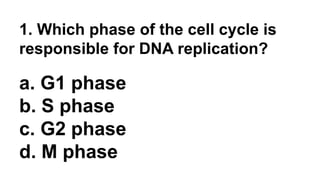
1. Which phaseof the cell cycle is
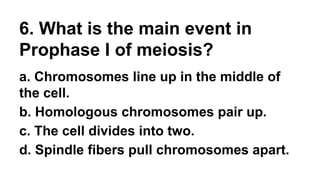
responsible for DNA replication?
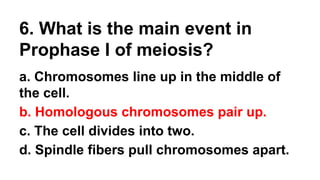
a. G1 phase
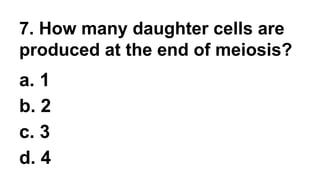
b. S phase
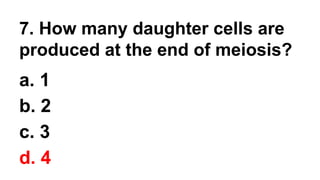
c. G2 phase
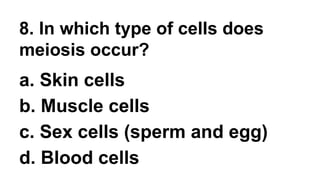
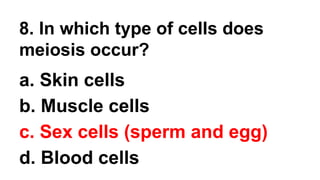
d. M phase
4.
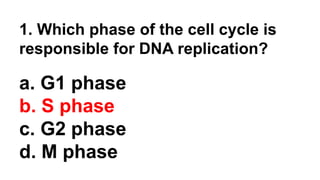
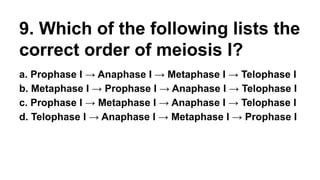
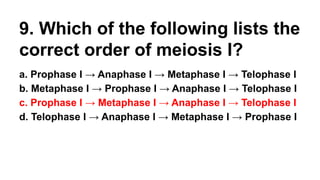
1. Which phaseof the cell cycle is
responsible for DNA replication?
a. G1 phase
b. S phase
c. G2 phase
d. M phase
5.
2. During whichphase of mitosis do
chromosomes line up in the middle
of the cell?
a. Prophase
b. Metaphase
c. Anaphase
d. Telophase
6.
2. During whichphase of mitosis do
chromosomes line up in the middle
of the cell?
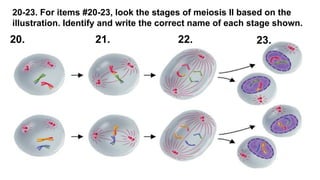
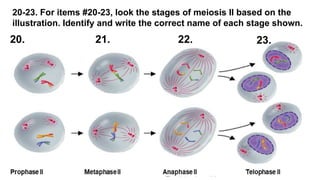
a. Prophase
b. Metaphase
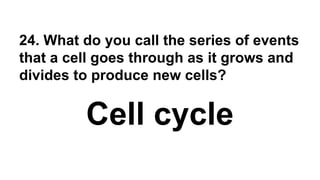
c. Anaphase
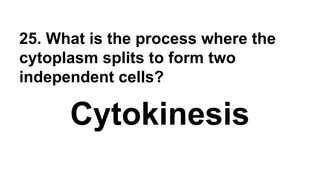
d. Telophase
7.
3. What happensto the
chromosomes during anaphase?
a. They become thicker and visible.
b. They line up in the middle of the cell.
c. They split apart and move to
opposite sides.
d. Two new nuclei begin to form.
8.
3. What happensto the
chromosomes during anaphase?
a. They become thicker and visible.
b. They line up in the middle of the cell.
c. They split apart and move to
opposite sides.
d. Two new nuclei begin to form.
9.
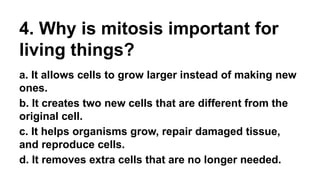
4. Why ismitosis important for
living things?
a. It allows cells to grow larger instead of making new
ones.
b. It creates two new cells that are different from the
original cell.
c. It helps organisms grow, repair damaged tissue,
and reproduce cells.
d. It removes extra cells that are no longer needed.
10.
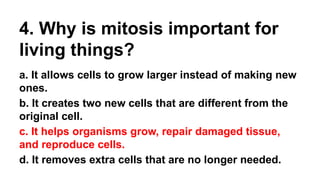
4. Why ismitosis important for
living things?
a. It allows cells to grow larger instead of making new
ones.
b. It creates two new cells that are different from the
original cell.
c. It helps organisms grow, repair damaged tissue,
and reproduce cells.
d. It removes extra cells that are no longer needed.
11.
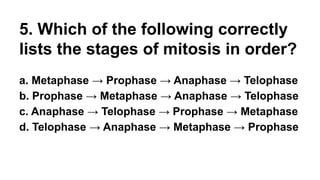
5. Which ofthe following correctly
lists the stages of mitosis in order?
a. Metaphase → Prophase → Anaphase → Telophase
b. Prophase → Metaphase → Anaphase → Telophase
c. Anaphase → Telophase → Prophase → Metaphase
d. Telophase → Anaphase → Metaphase → Prophase
12.
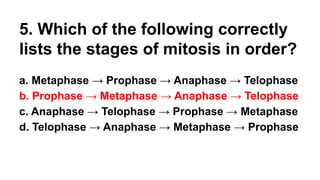
5. Which ofthe following correctly
lists the stages of mitosis in order?
a. Metaphase → Prophase → Anaphase → Telophase
b. Prophase → Metaphase → Anaphase → Telophase
c. Anaphase → Telophase → Prophase → Metaphase
d. Telophase → Anaphase → Metaphase → Prophase
13.
6. What isthe main event in
Prophase I of meiosis?
a. Chromosomes line up in the middle of
the cell.
b. Homologous chromosomes pair up.
c. The cell divides into two.
d. Spindle fibers pull chromosomes apart.
14.
6. What isthe main event in
Prophase I of meiosis?
a. Chromosomes line up in the middle of
the cell.
b. Homologous chromosomes pair up.
c. The cell divides into two.
d. Spindle fibers pull chromosomes apart.
15.
7. How manydaughter cells are
produced at the end of meiosis?
a. 1
b. 2
c. 3
d. 4
16.
7. How manydaughter cells are
produced at the end of meiosis?
a. 1
b. 2
c. 3
d. 4
17.
8. In whichtype of cells does
meiosis occur?
a. Skin cells
b. Muscle cells
c. Sex cells (sperm and egg)
d. Blood cells
18.
8. In whichtype of cells does
meiosis occur?
a. Skin cells
b. Muscle cells
c. Sex cells (sperm and egg)
d. Blood cells
19.
9. Which ofthe following lists the
correct order of meiosis I?
a. Prophase I → Anaphase I → Metaphase I → Telophase I
b. Metaphase I → Prophase I → Anaphase I → Telophase I
c. Prophase I → Metaphase I → Anaphase I → Telophase I
d. Telophase I → Anaphase I → Metaphase I → Prophase I
20.
9. Which ofthe following lists the
correct order of meiosis I?
a. Prophase I → Anaphase I → Metaphase I → Telophase I
b. Metaphase I → Prophase I → Anaphase I → Telophase I
c. Prophase I → Metaphase I → Anaphase I → Telophase I
d. Telophase I → Anaphase I → Metaphase I → Prophase I
21.
10. Why ismeiosis important?
a. It helps the body grow and repair.
b. It creates sex cells for reproduction.
c. It makes cells with the same number of
chromosomes.
d. It produces energy for the cell.
22.
10. Why ismeiosis important?
a. It helps the body grow and repair.
b. It creates sex cells for reproduction.
c. It makes cells with the same number of
chromosomes.
d. It produces energy for the cell.
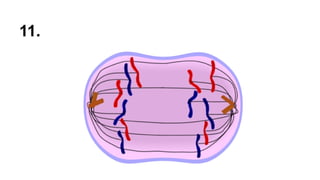
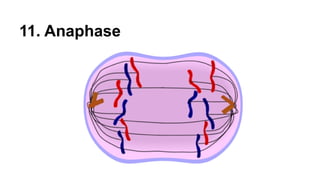
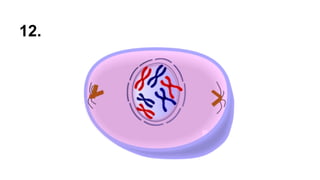
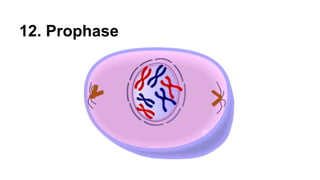
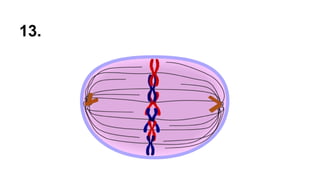
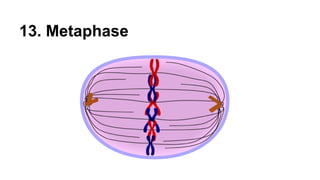
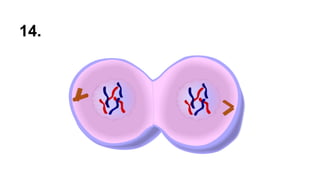
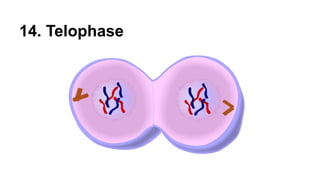
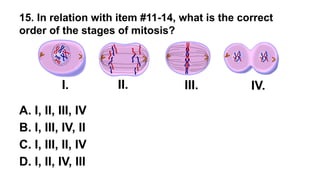
15. In relationwith item #11-14, what is the correct
order of the stages of mitosis?
A. I, II, III, IV
B. I, III, IV, II
C. I, III, II, IV
D. I, II, IV, III
I. II. III. IV.
34.
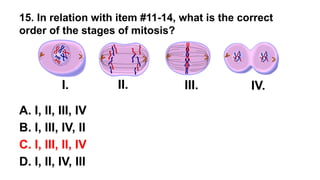
15. In relationwith item #11-14, what is the correct
order of the stages of mitosis?
A. I, II, III, IV
B. I, III, IV, II
C. I, III, II, IV
D. I, II, IV, III
I. II. III. IV.
35.
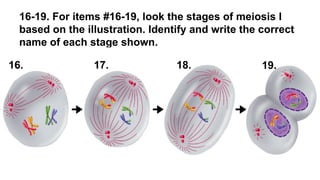
16-19. For items#16-19, look the stages of meiosis I
based on the illustration. Identify and write the correct
name of each stage shown.
16. 17. 18. 19.
36.
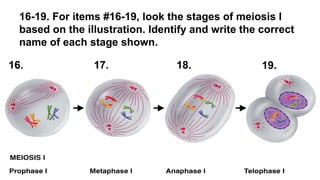
16-19. For items#16-19, look the stages of meiosis I
based on the illustration. Identify and write the correct
name of each stage shown.
16. 17. 18. 19.
37.
20-23. For items#20-23, look the stages of meiosis II based on the
illustration. Identify and write the correct name of each stage shown.
20. 21. 22. 23.
38.
20-23. For items#20-23, look the stages of meiosis II based on the
illustration. Identify and write the correct name of each stage shown.
20. 21. 22. 23.
39.
24. What doyou call the series of events
that a cell goes through as it grows and
divides to produce new cells?
Cell cycle
40.
25. What isthe process where the
cytoplasm splits to form two
independent cells?
Cytokinesis
41.
Summative Quiz
III. Trueor False
Instructions:
Write T if the statement is true and F is the
statement is false.
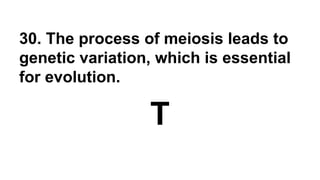
30. The processof meiosis leads to
genetic variation, which is essential
for evolution.
T
Editor's Notes
#4 B. S phase – The S phase (Synthesis phase) is the part of interphase where DNA replication occurs. This ensures that each daughter cell will have an identical copy of genetic material.
#6 B. Metaphase – During metaphase of mitosis, chromosomes align in the middle of the cell, preparing to be split and distributed to the two new cells.
#8 C. They split apart and move to opposite sides. – In anaphase, the sister chromatids are separated and pulled to opposite poles of the cell by spindle fibers.
#10 C. It helps organisms grow, repair damaged tissue, and reproduce cells. – Mitosis is essential for growth, tissue repair, and replacing old or damaged cells in multicellular organisms.
#12 B. Prophase → Metaphase → Anaphase → Telophase – This is the correct sequence of mitosis. Prophase (chromosomes condense), Metaphase (chromosomes align), Anaphase (chromosomes separate), and Telophase (two new nuclei form).
#14 B. Homologous chromosomes pair up. – In Prophase I of meiosis, homologous chromosomes pair up in a process called synapsis, which allows crossing-over and genetic recombination.
#15 D. 4 – Meiosis results in four genetically different daughter cells, each with half the number of chromosomes of the original cell.
#16 D. 4 – Meiosis results in four genetically different daughter cells, each with half the number of chromosomes of the original cell.
#18 C. Sex cells (sperm and egg) – Meiosis occurs in gametes (sex cells), reducing the chromosome number by half to ensure genetic stability during reproduction.
#20 C. Prophase I → Metaphase I → Anaphase I → Telophase I – This is the correct order of meiosis I, where homologous chromosomes are separated.
#22 B. It creates sex cells for reproduction. – Meiosis is important because it produces gametes (sperm and egg cells), which combine during fertilization to form a new organism with the correct chromosome number.


![谷歌留痕技术 [ 𝙩𝙤𝙥 𝟮𝟯𝟯. 𝙘 𝙤𝙢 ]](https://cdn.slidesharecdn.com/ss_thumbnails/top233-260130174328-3833018c-thumbnail.jpg?width=640&height=640&fit=bounds)


