biodiversity &
evolution
chapter 4
environmental
science
learning objectives
1
Research and describe an example of
an endemic species threatened by
human activities.
Explain the process of natural selection and
how it leads to adaptations in populations
2
Reflect on the importance of biodiversity and
discuss the potential consequences of human
activities on the environment.
3
Identify your personal role in
protecting biodiversity and discuss
potential actions you can take.
4
core case
study
Why are Amphibians Vanishing? Unraveling a Mystery
biodiversity
Also known as Biological
Diversity
The variety of the Earth`s species, the
genes they contain, the ecosystems in
which they live, and the ecosystem
processes of energy flow and nutrient
cycling that sustains all life.
species
A set of individuals that can
mate and produce fertile
offspring.
Scientists have identified about 2 million.
Insects make up most of the world`s
known species.
GENETIC
DIVERSITY
SPECIES
DIVERSITY
the variety of genetic
material within a species or a
population.
the number and abundance
of species present in
different communities.
major
components of
biodiversity
FUNCTIONAL
DIVERSITY
ECOLOGICAL
DIVERSITY
The biological and chemical
processes, such as energy flow and
matter recycling needed for the
survival of species, communities,
and ecosystems.
The variety of terrestrial and
aquatic ecosystems found in
an area or on the earth.
major
components of
biodiversity
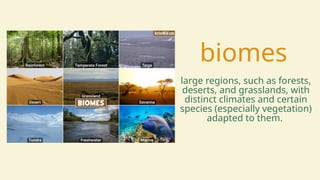
biomes
large regions, such as forests,
deserts, and grasslands, with
distinct climates and certain
species (especially vegetation)
adapted to them.
scientific focus
HAVE YOU THANKED THE INSECTS TODAY?
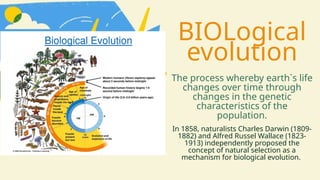
BIOLogical
evolution
The process whereby earth`s life
changes over time through
changes in the genetic
characteristics of the
population.
In 1858, naturalists Charles Darwin (1809-
1882) and Alfred Russel Wallace (1823-
1913) independently proposed the
concept of natural selection as a
mechanism for biological evolution.
natural
selection
a process in which individuals
with certain traits are more
likely to survive and reproduce
under a particular set of
environmental conditions than
are those without the traits.
The process of biological evolution by
natural selection involves changes in a
population`s genetic makeup.
biological evolution
by natural selection
The first step, the
development of
Genetic variability,
or variety in the
genetic makeup of
individuals in a
population.
The next step is
natural selection, in
which
environmental
conditions favor
some individuals
over others.
scientific focus
HOW DID HUMANS BECOME SUCHA POWERFUL
SPECIES?
Three human
adaptations:
• Strong opposable
thumbs
• Walk upright
• Complex brain
ADAPTATIO
NS
THROUGH
NATURAL
SELECTION
HAS LIMITS
3
2
1
·Evolution by natural
selection involves some
grand plan of nature in
which species became more
perfectly adapted.
Organisms develop
certain traits
because they need
them.
“Survival of the
fittest” means
`”survival of the
strongest”.
three common myths
about evolution
through nATURAL
GEOLOGIC PROCESS
AFFECT NATURAL
SELECTION
CLIMATE
CHANGE AND
CATASTROPHE
S AFFECT
NATURAL
SELECTION
scientific focus
EARTH IS JUST RIGHT FOR LIFE TO THRIVE
How do
Speciation,
Extinction, and
Human Activities
Affect
Biodiversity?
Human activities can decrease
biodiversity by causing the
premature extinction of species and
by destroying or degrading habitats
needed for the development of new
species.
SPECIATION
the process when one species
split into two or more different
species.
SPECIATION
OCCURS IN 2
PHASES:
occurs when different groups
of the same population of a
species become physically
isolated from one another
for a long period of time.
mutation and change by
natural selection operate
independently in the gene
pools of geographically
isolated populations.
GEOGRAPHIC
ISOLATION
REPRODUCTIVE
ISOLATION
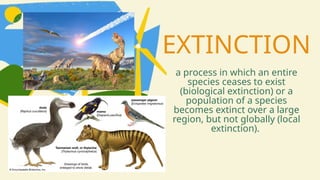
EXTINCTION
a process in which an entire
species ceases to exist
(biological extinction) or a
population of a species
becomes extinct over a large
region, but not globally (local
extinction).
endemic
species
Species that are found in only
one area.
When environmental
conditions change, a
population of a
species faces three
possible futures:
• Migrate (if possible) to an area
with more favorable conditions,
or;
• Become extinct
• Adapt to the new conditions
through natural selection
background
EXTINCTIO
Throughout most of the earth's
long history, species have
disappeared at a low rate.
MASS
EXTINCTIO
is a significant rise in extinction
rates above the background
level.
connection
s
Endemic Species, Climate Change, and Extinction
scientific focus
WE HAVE DEVELOPED TWO WAYS TO CHANGE THE
GENETIC TRAITS OF POPULATIONS
ARTIFICIAL SELECTION
Artificial selection is the process by which humans
choose individual organisms with certain phenotypic
trait values for breeding.
GENETIC ENGINEERING
is the alteration of an organism's genetic material,
through adding. deleting, or changing segments of its
DNA to produce desirable traits or eliminate
undesirable ones.
species diversity
An important characteristic of a
community and the ecosystem to
which it belongs is its species
diversity: the number of different
species it contains (species
richness) combined with the relative
abundance of individuals within
each of those species (species
evenness).
• The species diversity of communities varies
with their geographical location.
what is
and why is it
important?
SPECIES-RICH
ECOSYSTEMS
TEND TO BE
PRODUCTIVE
AND
SUSTAINABLE
·According to the first hypothesis, the
more diverse an ecosystem is, the
more productive it will be.
·A related hypothesis is that greater
species richness and productivity will
make an ecosystem more stable or
sustainable.
ecological
niche
is the role that a species plays in
its ecosystem.
WHAT ROLES DO SPECIES
PLAY IN AN ECOSYSTEM?
Generalist
species
have broad niches.
broad classification of niches
case
study
Cockroaches: Nature's Ultimate Survivors
Specialist
species
occupy narrow niches.
China’s giant panda broad classification of niches
five classification
of niches
native
species
are those species that normally
live and thrive in a particular
ecosystem.
Philippine tarsier
(Carlito syrichta)
nonnative
species
Also referred to as invasive,
alien, and exotic species, are
other species that migrate into,
or are deliberately or
accidentally introduced into, an
ecosystem.
indicator
species
Species that provide early
warnings of damage to a
community or an ecosystem.
Coal Mining and Canaries
Revisiting
Amphibian
Species
Why should we care if some
amphibian species become extinct?
• Frogs are especially
sensitive and vulnerable
to environmental
disruption at various
points in their life cycle.
Keystone
species
are species whose roles have a
large effect on the types and
abundances of other species in
an ecosystem.
A hummingbird pollinating
a flower
scientific focus
WHY SHOULD WE CARE
ABOUT THE AMERICAN
ALLIGATOR?
case
study
Why Should We Protect Sharks?
Foundation
species
plays a major role in shaping
communities by creating and
enhancing their habitats in ways
that benefit other species.
3
2
1
·Each species plays a specific
ecological role in the
ecosystem where it is found
(ecological niche).
·Human activities are
decreasing the earth's vital
biodiversity by causing the
premature extinction of
species and by disrupting
habitats needed for the
development of new species.
·Populations evolve when
genes mutate and give some
individuals genetic traits that
enhance their abilities to
survive and to produce
offspring with these traits
(natural selection).
Three Big Ideas of
chapter 4
Questions and
Discussion
We invite your
questions, thoughts,
and ideas.
Lorem ipsum dolor sit amet,
consectetur adipiscing elit. Ut
pharetra dignissim lectus sed
porttitor. Nullam facilisis vel eros
in tempus. Suspendisse ultrices
orci id odio rhoncus, vitae aliquet
purus placerat.
thanks for listening!
Contact us at hello@reallygreatsite.com

Environmental Science Biodiversity and Evolution.pptx

Editor's Notes

  • #3 Since 1980, populations of hundreds of the earth's almost 6,000 amphıbian species have been vanishing or declining in almost every part of the world. Scientists have identified a number of factors that can affect frogs and other amphibians at various points in their life cycles: Habitat loss and fragmentation, Prolonged drought, increases in ultraviolet (UV) radiation, Parasites, Viral and fungal diseases, Pollution, Climate change, Overhunting, and Natural or deliberate immigration. Deeper explanation Amphibians (frogs, toads, and salamanders) live part of their lives in water and part on land. They were the first annals with backbones (the first vertebrates) to set foot on the earth and they have been better at adapting to environmental changes than many other species have been. But many amphibian species apparently are having dıfficulty adapting to some of the rapid envıronmental changes that have taken place during the past few decades--changes resulting mostly from human activıties. Since 1980, populations of hundreds of the earth's almost 6,000 amphıbian species have been vanishing or declining in almost every part of the world, even in protected wildlife reserves and parks. Accordıng to scientists who study amphıbians, about 33% of all known amphibian species (and more than 80% of those in the Caribbean) are threatened with extinction--in which whole species cease to exist-and populations of another 43% of these species are declınıng. No single cause has been identıfied to explain these amphibian declines. However, scientists have identified a number of factors that can affect frogs and other amphibians at various points in their life cycles: Habitat loss and fragmentation, especially from the draining and filling of inland wetlands. deforestation, and urban development. Prolonged drought, which can dry up breedıng pools so that few tadpoles survive. Increases in ultraviolet (UV) radiation due to reductions in stratospheric ozone during the past few decades, caused by ozone-depleting chemicals we have put into the air. Higher doses of UV radıation can harm amphibian embryos lying in shallow ponds and adults exposing themselves to the sun for warmth. Parasites such as trematode flatworms, which feed on the amphıbian eggs laid in water, apparently have caused an increase in births of amphıbians with missing or extra limbs and other deformities. Viral and fungal diseases, especially the chytrid fungus that attacks the skin of frogs, apparently reducing their ability to take in water; this leads to death from dehydration. Such diseases can spread among adults of many amphibian species that congregate in large numbers to breed. Pollution, especially exposure to pesticides in ponds and in the bodies of insects consumed by frogs, which can make them more vulnerable to bacterial, viral, and fungal diseases and to some parasites. Climate change, which has been identified as the primary cause of the extinction of the golden toad in Costa Rica. Overhunting, especially in Asia and France, where frog legs are a delicacy. Natural immigration of, or deliberate introduction of nonnative predators and competitors (such as certain fish species). A combination of such factors, which vary from place to place probably, is responsible for the decline or disappearance of most amphibian species.
  • #4 WHAT IS BIODIVERSITY AND WHY IS IT IMPORTANT? The biodiversity found in genes, species, ecosystems, and ecosystem processes is vital to sustaining life on earth. Biodiversity Is a Crucial Part of the Earth's Natural Capital Biological diversity, or biodiversity, is the variety of the earth's species, the genes they contain, the eco-systems in which they live, and the ecosystem processes of energy flow and nutrient cycling that sustain all life.
  • #5 Species Make Up the Encyclopedia of Life Biodiversity and Evolution For a group of sexually reproducing organisms, a species is a set of individuals that can mate and produce fertile offspring. Every organism is a member of a certain species with certain distinctive traits. For example, all humans are members of the species Homo sapiens sapiens. Scientists have developed a system for classifying and naming each species. We do not know how many species are on the earth. Estimates range from 8 million to 100 million. The best guess is that there are 10-14 million species. So far biologists have identified about 2 million. These and millions of species still to be discovered and classified are the entries in the encyclopedia of life found on the earth. Up to half of the world's plant and animal species live in tropical rain forests that are being cleared rapidly (Figure 3-1, p. 70). Insects make up most of the world's known species (Science Focus, p. 90).
  • #6 Species diversity is the most obvious, but not the only, component of biodiversity. We discuss species diversity in greater detail in Section 4-5 of this chapter. Another important component is genetic diversity. The earth's variety of species contains an even greater variety of genes (Figure 2-4, p. 50). This genetic diversity enables life on the earth to adapt to and survive dramatic environmental changes.
  • #7 Ecosystem diversity--the earth’s variety of deserts, grasslands, forests, mountains, oceans, lakes, rivers, and wetlands is another major component of biodiversity. Each of these ecosystems is a storehouse of genetic and species diversity. Functional Diversity- The biological and chemical processes, such as energy flow and matter recycling needed for the survival of species, communities, and ecosystems.
  • #9 Biologists have classified the terrestrial (land) portion of the biosphere into biomes-large regions, such as forests, deserts, and grasslands, with distinct climates and certain species (especially vegetation) adapted to them.
  • #10 HAVE YOU THANKED THE INSECTS TODAY? Insects are an important part of the earth's natural capital, although they generally have a bad reputation. We classify many insect species as pests because they compete with us for food, spread human diseases such as malaria, bite or sting us, and invade our lawns, gardens, and houses. Some people fear insects and think the only good bug is a dead bug. They fail to recognize the vital roles insects play in helping to sustain life on earth. For example, pollination is a natural service that allows plants to reproduce sexually when pollen grains are transferred from one plant to a receptive part of another plant. Many of the earth's plant species depend on insects to pollinate their flowers (Figure 4-A, top). Insects that eat other insects--such as the praying mantis (Figure 4-A, bottom)–help control the populations of at least half the species of insects we call pests. This free pest control service is an important part of the earth’s natural capıtal. Some insects also play a key role in loosening and renewing the soil that supports plant life on land. Insects have been around for at least 400 million years about 4,000 times longer than the latest versions of the human species. They are phenomenally successful forms of life. Some reproduce at an astoundıng rate and can rapidly develop new genetic traits such as resistance to pesticides. They also have an exceptional abılity to evolve into new species when faced with new environmental condıtıons, and they are very resistant to extinction. This is fortunate because, according to ant specialist and biodiversity expert E. O. Wilson, if all insects dısappeared, parts of the life support systems for us and other species would be greatly disrupted. The environmental lesson: although insects do not need newcomer species such as us, we and most other land organisms need them.
  • #11 CONCEPT 4-2: The scientific theory of evolution explains how life on earth changes over time through changes in the genes of populations. CONCEPT 4-2B: Populations evolve when genes mutate and give some individuals genetic traits that enhance their abilities to survive and to produce offspring with these traits (natural selection). Biological Evolution by Natural Selection Is the Scientific Explanation of How the Earth's Life Changes over Time The history of life on earth is colorful, deep, and complex. Most of what we know of this story comes from fossils: mineralized or petrified replicas of skeletons, bones, teeth, shells, leaves, and seeds, or impressions of such items found in rocks. Scientists also drill core samples from glacial ice at the earth's poles and on mountaintops and examine the signs of ancient life found at different layers in these cores. The entire body of evidence gathered in these ways, called the fossil record, is uneven and incomplete. Some forms of life left no fossils, and some fossils have decomposed. The fossils found so far represent probably only 1%o of all species that have ever Iived. But we know with great certainty that the earth has hosted a huge and extremely diverse number of different species over time. How did we end up with the current amazing array of 8 million to 100 million species? The scientific answer involves biological evolution: the process whereby earth's life changes over time through changes in the genetic characteristics of populations (Concept 4-2A). According to the theory of evolution, all species descended from earlier, ancestral species. In other words, life comes from life. In 1858 naturalists Charles Darwin (1809-1882) and Alfred Russel Wallace (1823-1913) independently proposed the concept of natural selection as a mechanism for biological evolution. However, it was Darwin; who meticulously gathered evidence for this idea and published it in 1859 in his book, On the Origin of Species by Means of Natural Selection. Darwin and Wallace observed that individual organisms must constantly struggle to survive by getting enough food and other resources, to avoid being eaten, and to reproduce. They also observed that individuals in a population with a specific advantage over other individuals were more likely to survive and produce offspring that had the same specific advantage. The advantage was due to a characteristic, or trait, possessed by these individuals but not by others.
  • #12 Based on these observations, Darwin and Wallace described a process called natural selection, in which individuals with certain traits are more likely to survive and reproduce under a particular set of environ- mental conditions than are those without the traits (Concept 4-2B). The scientists concluded that these survival traits would become more prevalent in future populations of the species as individuals with those traits became more numerous. (94) A huge body of field and laboratory evidence has supported this idea. As a result, biological evolution through natural selection has become an important scientific theory that generally explains how life has changed over the past 3.5 billion years and why life is so diverse today. However, there are still many unanswered questions that generate scientific debate about the details of evolution by natural selection.
  • #13 The process of biological evolution by natural selection involves changes in a population's genetic makeup through successive generations. Note that populations-not individuals--evolve by becoming genetically different. The first step in this process is the development of genetic variability, or variety in the genetic makeup of individuals in a population. This occurs through mutations: random changes in the DNA molecules of a gene in any cell. Mutations can result from random changes that occur spontaneously within a cell or from exposure to external agents such as radioactivity. Mutations can occur in any cell, but only those taking place in genes of reproductive cells are passed on to offspring. Sometimes, such a mutation can result in a new genetic trait, called a heritable trait, which can be passed from one generation to the next. In this way, populations develop differences among individuals, including genetic variability (Figure 4-3). The next step in biological evolution is natural selection, in which environmental conditions favor some individuals over others. The favored individuals possess heritable traits (resulting from mutations) that give them some advantage over other individuals. Such a trait is called an adaptation, or adaptive trait. It is any heritable trait that improves the ability of an individual organism to survive and to reproduce at a higher rate than other individuals in a population can under prevailing environmental conditions. For example, in the face of snow and cold, a few gray wolves in a population that have thicker fur might live longer and thus produce more offspring than do those without thicker fur. As those longer-lived wolves mate, genes for thicker fur spread throughout the population and individuals with those genes increase in number and pass this helpful trait on to more offspring. Another important example of natural selection at work is the evolution of genetic resistance to widely used antibacterial drugs, or antibiotics. These drugs are administered by doctors with the goal of controlling disease-causing bacteria, but they have become a force of natural selection. When such a drug is used, the few bacteria that are genetically resistant to it (because of some trait they possess) survive and rapidly produce more offspring than the bacteria that were killed by the drug could have produced. Thus, the antibiotic eventually loses its effectiveness as genetically resistant bacteria rapidly reproduce and th0se that are susceptible to the drug die off (Figure 4-5). Here is one way to summarize the process of biological evolution by natural selection: Genes mutate, individuals are selected, and populations evolve such that they are better adapted to survive and reproduce under existing environmental conditions (Concept 4-2B). A remarkable example of evolution by natural selection is human beings (Science Focus, p. 95). We have evolved certain traits that have allowed us to take over much of the world.
  • #14 HOW DID HUMANS BECOME SUCHA POWERFUL SPECIES? Like many other species, humans have survived and thrived because we have certain traits that allow us to adapt to and modify parts of the environment to increase our survival chances. Evolutionary biologists attribute our success to three adaptations: strong opposable thumbs that allow us to grip and use tools better than the few other animals that have thumbs can do; an ability to walk upright, which gave us agility and freed up our hands for many uses; and a complex brain, which allowed us to develop many skills, including the ability to use speech to transmit complex ideas. These adaptations have helped us to develop weapons, protective devices, and technologies that extend our limited senses and make up for some of our deficiencies. Thus, in an eye blink of the 3.5-billion-year history of life on earth, we have developed powerful technologies and taken over much of the earth's net primary productivity for our own use. At the same time, we have degraded much of the planet's life-support system, as our ecological footprints have grown (Figure -5,p. 22). But adaptations that make a species successful during one period of time may not be enough to ensure the species' survival when environmental conditions change. This is no less true for humans, and some environ- mental conditions are now changing rapidly, largely due to our own actions. One of our adaptations--our powerful brain--may enable us to live more sustainably by under- standing and copying the ways in which nature has sustained itself for billions of years, despite major changes in environmental conditions (Concept I-5, p. 33).
  • #15 Adaptation through Natural Selection Has Limits In the not-too-distant future, will adaptations to new environmental conditions through natural selection allow our skin to become more resistant to the harmful effects of UV radiation, our lungs to cope with a1 pollutants, and our livers to better detoxify pollutants? According to scientists in this field, the answer is no because of two limits to adaptations in nature through natural selection. First, a change in environmental conditions can lead to such an adaptation only for genetic traits already present in a population's gene pool or for traits resulting from mutations. Second, even if a beneficial heritable trait is present in a population, the population's ability to adapt may be limited by its reproductive capacity. Populations of genetically diverse species that reproduce quickly- such as weeds, mosquitoes, rats, cockroaches, and bacteria--often adapt to a change in environmental conditions in a short time (days to years). By contrast, species that cannot produce large numbers of offspring rapidly--such as elephants, tigers, sharks, and humans--take a much longer time (typically thousands or even millions of years) to adapt through natural selection. 2 limitations on adaptation through natural selection. • First, a change in environmental conditions can lead to such an adaptation only for genetic traits already present in a populations gene pool or for traits resulting from mutations, which occur randomly. • Second, even if a beneficial heritable trait is present in a population, the populations ability to adapt may be limited by its reproductive capacity.
  • #16 Three Common Myths about Evolution through Natural Selection According to evolution experts, there are three common misconceptions about biological evolution through natural selection. One is that "survival of the fittest" means "survival of the strongest." To biologists, fitness is a measure of reproductive success, not strength. Thus, the fittest individuals are those that leave the most descendants. Another misconception is that organisms develop certain traits because they need them. A giraffe has a very long neck not because it needs it to feed on vegetation high in trees. Rather, some ancestor had a gene for long necks that gave it an advantage over other members of its population in getting food, and that giraffe produced more offspring with long necks. A third misconception is that evolution by natural selection involves some grand plan of nature in which species become more perfectly adapted. From a scientific standpoint, no plan or goal for genetic perfection has been identified in the evolutionary process.
  • #17 CONCEPT 4-3 Tectonic plate movements, volcanic eruptions, earthquakes, and climate change have shifted wildlife habitats, wiped out large numbers of species, and created opportunities for the evolution of new species. Geologic Processes Affect Natural Selection The earth's surface has changed dramatically over its long history. Scientists have discovered that huge flows of molten rock within the earth’s interior break its surface into a series of gigantic solid plates, called tectonic plates. For hundreds of millions of years, these plates have drifted slowly on the planet's mantle (Figure 4-6). This process has had two important effects on the evolution and distribution of life on the earth. First, the locations (latitudes) of continents and oceanic basins have greatly influenced the earth’s climate and thus helped to determine where plants and animals can live. Second, the movement of continents has allowed species to move, adapt to new environments, and form new species through natural selection. When continents join together, populations can disperse to new areas and adapt to new environmental condıtions. When continents separate and when islands are formed, populations must evolve under isolated conditions or become extinct. The shifting of tectonic plates, which results in earthquakes, can also affect biological evolution by causıng fissures in the earth's crust that can separate and isolate populations of species. Over long periods of time, this can lead to the formation of new species as each isolated population changes genetically in response to new environmental conditions. And volcanic eruptions affect biological evolution by destroying habitats and reducing or wiping out populations of species (Concept 4-3). First, the location (latitudes) of continents and oceanic basins have greatly influenced the earth`s climate and thus helped to determine where plants and animals can live. • Second, the movement of continents has allowed species to move, adapt to new environments, and form new species through natural selection. • The shifting of tectonic plates, which results in earthquakes, can also affect biological evolution by causing fissures in the earth`s crust that can separate and isolate populations of species. • Volcanic eruptions can affect biological evolution by destroying habitats and reducing or wiping out populations of species.
  • #18 Climate Change and Catastrophes Affect Natural Selection Throughout its long history, the earth's climate has changed drastically. Sometimes it has cooled and covered much of the earth with ice. At other times it has warmed, melted ice, and drastically raised sea levels, which in turn increased the total area covered by oceans and decreased the earth's total land area. Such alternating periods of cooling and heating have led to advances and retreats of ice sheets at high latitudes over much of the northern hemisphere. The most recent advance occurred about 18,000 years ago (Figure +-7). These long-term climate changes have a major effect on biological evolution by determining where different types of plants and animals can survive and thrive and by changing the locations of different types of ecosystems such as deserts, grasslands, and forests (Concept 4-3). Some species became extinct because the climate changed too rapidly for them to survive and new species evolved to fill their ecological roles. Another force affecting natural selection has been catastrophic events such as collisions between the earth and large asteroids. There probably have been many of these collisions during the earths 3.5 billion years of life. Such impacts have caused widespread destruction of ecosystems and wiped out large numbers of species. The long-term climate changes have a major effect on biological evolution determining where different types of plants and animals can survive and thrive and by changing the locations of different types of ecosystems such as deserts, grasslands, and forests Another force affecting natural selection has been catastrophic events such as collisions between the earth and large asteroids.
  • #19 EARTH IS JUST RIGHT FOR LIFE TO THRIVE Life on the earth, as we know it, can thrive only within a certain temperature range, which depends on the liquid water that dominates the earth's surface. Most life on the earth requires average temperatures between the freezing and boiling points of water. The earth's orbit is the right distance from the sun to provide these conditions. If the earth were much closer to the sun, it would be too hot--like Venus-for water vapor to condense and form rain. If it were much farther away, the earth's surface would be so cold--like Mars---that water would exist only as ice. The earth also spins fast enough to keep the sun from overheating any part of it. If it did not, water-based ife could not exist. The size of the earth is also just right for life. It has enough gravitational mass to keep its iron and nickel core molten and to keep the atmosphere-made up of light gaseous molecules required for life (such as N, O,, CO,, and H,0)–-from flying off into space. Although life on earth has been enormously resilient and adaptive, it has benefitted from a favorable temperature range. During the 3.5 billion years since life arose, the average surface temperature of the earth has remained within the narrow range of I0-20 °C (50-68 °F), even with a 30-40% increase in the sun's energy output. One reason for this is the evolution of organisms that modify levels of the temperature-regulating gas carbon dioxide in the atmosphere as a part of the carbon cycle (Figure 3-13, p. 78). For several hundred million years, oxygen has made up about 2 |% of the volume of earth's atmosphere. If this oxygen content dropped to about |5%, it would be lethal for most forms of life. If it increased to about 25%, oxygen in the atmosphere would probably ignite into a giant fireball. The current oxygen content of the atmosphere is largely the result of producer and consumer organisms (especially phytoplankton and certain types of bacteria) interacting in the carbon cycle. Also, because of the development of photosynthesizing bacteria that have been addıng oxygen to the atmosphere for more than 2 billion years, an ozone sunscreen in the stratosphere protects us and many other forms of life from an overdose of UV radiation. In short, this remarkable planet we live on is uniquely suited for life as we know it. Suppose the oxygen content of the atmosphere dropped to 13%. What types of organisms might eventually arise on the earth? Critical Thinking But they have also caused shifts' in the locations of ecosystems and created opportunities for the evolution of new species. On a long-term basis, the three principles of sustainability, especially the biodiversity principle (Figure 4-2), have enabled life on earth to adapt to drastic changes in environmental conditions (sce Science Focus, p. 98 and The Habitable Planet, Vidco 1, at www.learner.org resources/series209.html).
  • #20 How Do New Species Evolve? CONCEPT 4-4 Human activities can decrease biodiversity by causing the premature extinction of species and by destroying or degrading habitats needed for the development of new species.
  • #21 Under certain circumstances, natural selection can lead to an entirely new species. In this process, called speciation, one species splits into two or more different species. For sexually reproducing organisms, a new species is formed when one population of a species has evolved to the point where its members no longer can breed and produce fertile offspring with members of another population that did not change or that evolved in a different way. The most common way in which speciation occurs, especially among sexually reproducing species, is when a barrier or distant migration prevents the flow of genes between two or more populations of a species. This happens in two phases: geographic isolation and reproductive isolation.
  • #22 Geographic isolation occurs when different groups of the same population of a species become physically isolated from one another for a long period of time. For example, part of a population may migrate in search of food and then begin living as a separate population in another area with different environmental conditions. Populations can also be separated by a physical barrier (such as a mountain range, stream, or road), a volcanic eruption, tectonic plate movements, or winds or flowing water that carry a few individuals to a distant area. In reproductive isolation, mutation and change by natural selection operate independently in the gene pools of geographically isolated populations. If this process continues long enough, members of the geographically and reproductively isolated populations of sexually reproducing species may become so different in genetic makeup that they cannot produce live, fertile offspring if they are rejoined. Then one species has become two, and speciation has occurred (Figure 4-8). Humans are playing an increasing role in the process of speciation. We have learned to shuffle genes from one species to another through artificial selection and, more recently, through genetic engineering (Science Focus, p. 101).
  • #23 Another process affecting the number and types of species on the earth is extinction, a process in which an entire species ceases to exist (biological extinction) or a population of a species becomes extinct over a large region, but not globally (local extinction), When environmental conditions change, a population of a species faces three possible futures: adapt to the new conditions through natural selection, migrate (if possible) to an area with more favorable conditions, or become extinct.
  • #24 Species that are found in only one area are called endemic species and are especially vulnerable to extinction, They exist on islands and in other unique small areas, especially in tropical rain forests where most species have highly specialized roles. For these reasons, they are unlikely to be able to migrate or adapt in the face of rapidly changing environmental conditions.
  • #26 The background extinction rate, also called the normal extinction rate, is the natural evolution and elimination of species from the Earth over a long period of time.
  • #27 Earth's species have experienced at least three and probably five mass extinctions (20-60 million years apart) during the past 500 million years.
  • #28 The brilliantly colored golden toad was once found only in a small area of lush rain forests in Costa Rica. Although it lived in the well-protected Monteverde Cloud Forest Reserve, this endemic species had apparently become extınct by 1989. Much of the moisture that supported its habıtat came in the form of moisture-laden clouds blowing in from the Caribbean Sea. But warmer air resulting from global climate change caused these clouds to rise, depriving the forests of moisture and the habitat for the golden toad and many other species dried up.
  • #32 WHAT ROLES DO SPECIES PLAY IN AN ECOSYSTEM? Each species plays a specific ecological role called its niche. An important principle of ecology is that each species has a specific role to play in the ecosystems where it is found. Scientists describe the role that a species plays in its ecosystem as its ecological niche or simply niche (pronounced "nitch"). It is a species' way of life in a community and includes everything.
  • #36 Native Species Ex. The Philippine tarsier (Carlito syrichta) is native to the southeastern Philippines. While tarsiers once ranged across Europe, northern Africa, Asia, and North America, they all now live in the lush islands of Southeast Asia.
  • #37 Native Species Ex. The Philippine tarsier (Carlito syrichta) is native to the southeastern Philippines. While tarsiers once ranged across Europe, northern Africa, Asia, and North America, they all now live in the lush islands of Southeast Asia.
  • #38 Native Species Ex. The Philippine tarsier (Carlito syrichta) is native to the southeastern Philippines. While tarsiers once ranged across Europe, northern Africa, Asia, and North America, they all now live in the lush islands of Southeast Asia.