THE DIGESTIVE SYSTEM
THEDIGESTIVE SYSTEM IS A
COMPLEX NETWORK
RESPONSIBLE FOR BREAKING
DOWN FOOD, ABSORBING
NUTRIENTS, AND ELIMINATING
WASTE.
4.
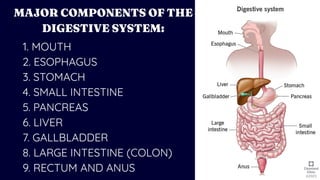
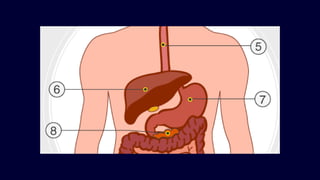
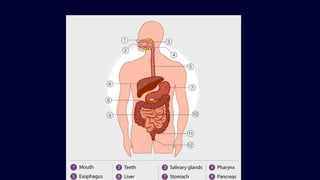
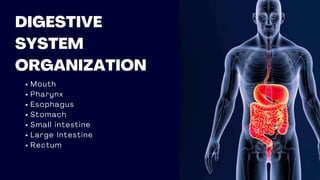
1. MOUTH
2. ESOPHAGUS
3.STOMACH
4. SMALL INTESTINE
5. PANCREAS
6. LIVER
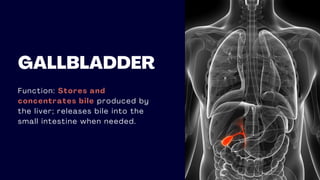
7. GALLBLADDER
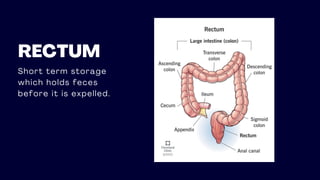
8. LARGE INTESTINE (COLON)
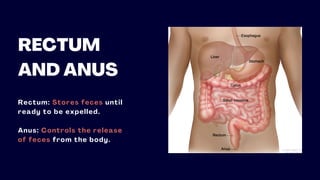
9. RECTUM AND ANUS
MAJOR COMPONENTS OF THE
DIGESTIVE SYSTEM:
5.
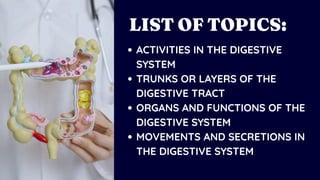
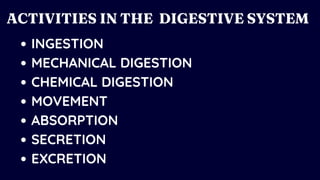
ACTIVITIES IN THEDIGESTIVE
SYSTEM
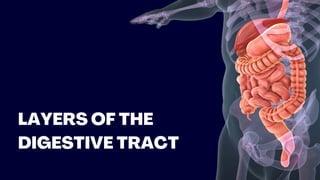
TRUNKS OR LAYERS OF THE
DIGESTIVE TRACT
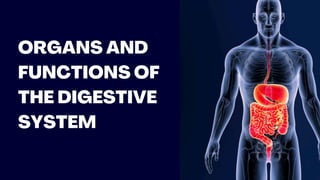
ORGANS AND FUNCTIONS OF THE
DIGESTIVE SYSTEM
MOVEMENTS AND SECRETIONS IN
THE DIGESTIVE SYSTEM
LIST OF TOPICS:
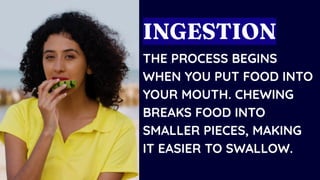
THE PROCESS BEGINS
WHENYOU PUT FOOD INTO
YOUR MOUTH. CHEWING
BREAKS FOOD INTO
SMALLER PIECES, MAKING
IT EASIER TO SWALLOW.
INGESTION
8.
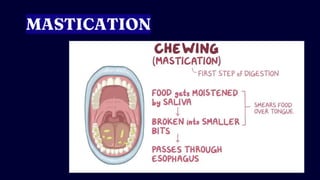
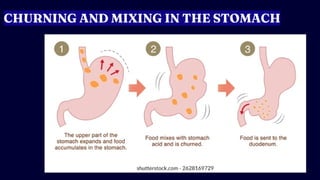
THIS INCLUDES THE
PHYSICALBREAKDOWN OF
FOOD THROUGH CHEWING
(MASTICATION) IN THE
MOUTH AND THE
CHURNING AND MIXING IN
THE STOMACH.
MECHANICAL
DIGESTION
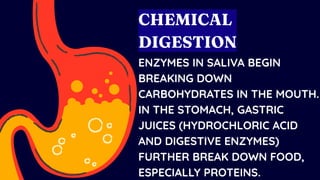
ENZYMES IN SALIVABEGIN
BREAKING DOWN
CARBOHYDRATES IN THE MOUTH.
IN THE STOMACH, GASTRIC
JUICES (HYDROCHLORIC ACID
AND DIGESTIVE ENZYMES)
FURTHER BREAK DOWN FOOD,
ESPECIALLY PROTEINS.
CHEMICAL
DIGESTION
12.
• ENZYMES AREBIOLOGICAL CATALYSTS MADE OF
PROTEINS.
• THEY SPEED UP CHEMICAL REACTIONS IN THE BODY
WITHOUT BEING USED UP THEMSELVES.
• IN DIGESTION, ENZYMES BREAK DOWN LARGE FOOD
MOLECULES (LIKE PROTEINS, FATS, AND
CARBOHYDRATES) INTO SMALLER, ABSORBABLE UNITS
(LIKE AMINO ACIDS, FATTY ACIDS, AND GLUCOSE).
• EACH ENZYME IS SPECIFIC - IT ONLY WORKS ON ONE
TYPE OF SUBSTANCE (CALLED A SUBSTRATE).
ENZYMES
13.
AMYLASE →BREAKS DOWNSTARCH INTO
SUGAR.
PROTEASE (PEPSIN/TRYPSIN) →BREAKS
DOWN PROTEINS INTO AMINO ACIDS.
LIPASE →BREAKS DOWN FATS INTO
GLYCEROL AND FATTY ACIDS.
EXAMPLE IN DIGESTION:
14.
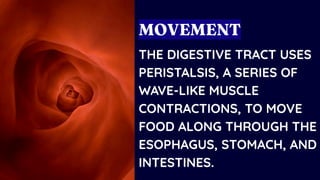
THE DIGESTIVE TRACTUSES
PERISTALSIS, A SERIES OF
WAVE-LIKE MUSCLE
CONTRACTIONS, TO MOVE
FOOD ALONG THROUGH THE
ESOPHAGUS, STOMACH, AND
INTESTINES.
MOVEMENT
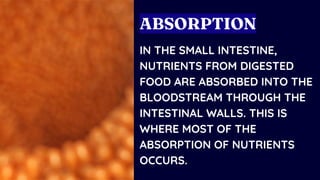
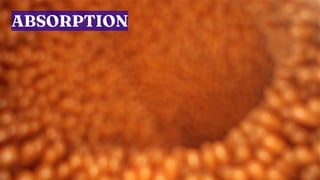
IN THE SMALLINTESTINE,
NUTRIENTS FROM DIGESTED
FOOD ARE ABSORBED INTO THE
BLOODSTREAM THROUGH THE
INTESTINAL WALLS. THIS IS
WHERE MOST OF THE
ABSORPTION OF NUTRIENTS
OCCURS.
ABSORPTION
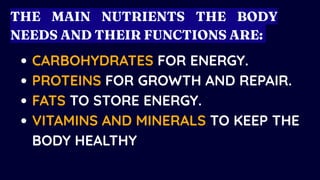
CARBOHYDRATES FOR ENERGY.
PROTEINSFOR GROWTH AND REPAIR.
FATS TO STORE ENERGY.
VITAMINS AND MINERALS TO KEEP THE
BODY HEALTHY
THE MAIN NUTRIENTS THE BODY
NEEDS AND THEIR FUNCTIONS ARE:
19.
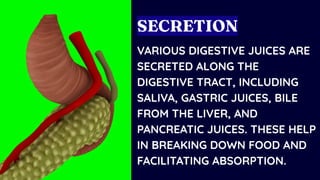
VARIOUS DIGESTIVE JUICESARE
SECRETED ALONG THE
DIGESTIVE TRACT, INCLUDING
SALIVA, GASTRIC JUICES, BILE
FROM THE LIVER, AND
PANCREATIC JUICES. THESE HELP
IN BREAKING DOWN FOOD AND
FACILITATING ABSORPTION.
SECRETION
20.
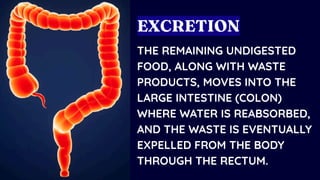
THE REMAINING UNDIGESTED
FOOD,ALONG WITH WASTE
PRODUCTS, MOVES INTO THE
LARGE INTESTINE (COLON)
WHERE WATER IS REABSORBED,
AND THE WASTE IS EVENTUALLY
EXPELLED FROM THE BODY
THROUGH THE RECTUM.
EXCRETION
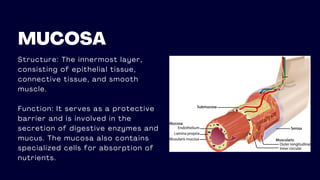
Structure: The innermostlayer,
consisting of epithelial tissue,
connective tissue, and smooth
muscle.
Function: It serves as a protective
barrier and is involved in the
secretion of digestive enzymes and
mucus. The mucosa also contains
specialized cells for absorption of
nutrients.
MUCOSA
25.
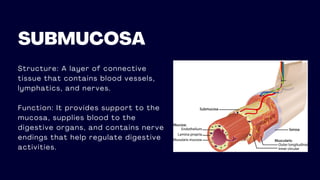
Structure: A layerof connective
tissue that contains blood vessels,
lymphatics, and nerves.
Function: It provides support to the
mucosa, supplies blood to the
digestive organs, and contains nerve
endings that help regulate digestive
activities.
SUBMUCOSA
26.
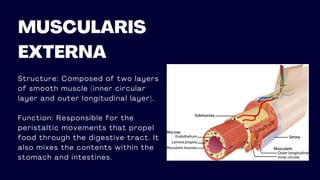
Structure: Composed oftwo layers
of smooth muscle (inner circular
layer and outer longitudinal layer).
Function: Responsible for the
peristaltic movements that propel
food through the digestive tract. It
also mixes the contents within the
stomach and intestines.
MUSCULARIS
EXTERNA
28.
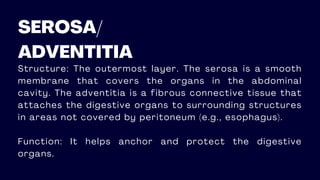
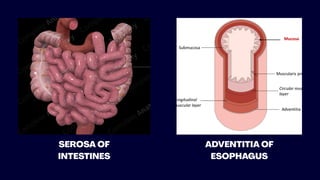
Structure: The outermostlayer. The serosa is a smooth
membrane that covers the organs in the abdominal
cavity. The adventitia is a fibrous connective tissue that
attaches the digestive organs to surrounding structures
in areas not covered by peritoneum (e.g., esophagus).
Function: It helps anchor and protect the digestive
organs.
SEROSA/
ADVENTITIA
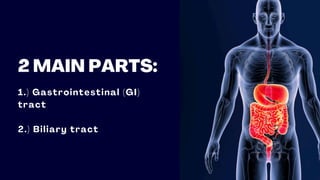
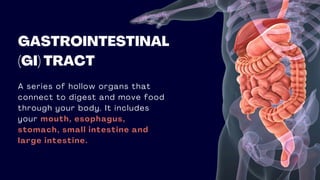
GASTROINTESTINAL
(GI) TRACT
A seriesof hollow organs that
connect to digest and move food
through your body. It includes
your mouth, esophagus,
stomach, small intestine and
large intestine.
37.
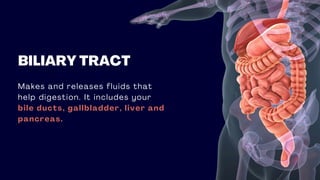
BILIARY TRACT
Makes andreleases fluids that
help digestion. It includes your
bile ducts, gallbladder, liver and
pancreas.
38.
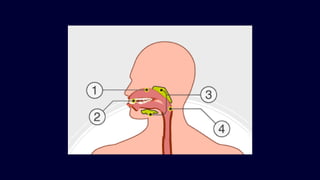
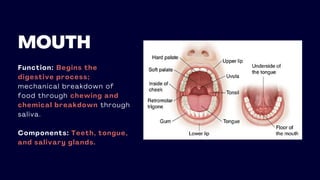
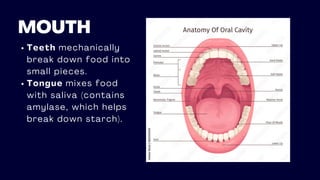
MOUTH
Function: Begins the
digestiveprocess;
mechanical breakdown of
food through chewing and
chemical breakdown through
saliva.
Components: Teeth, tongue,
and salivary glands.
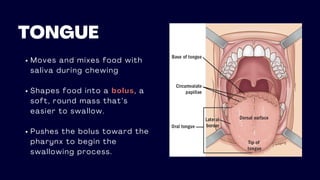
TONGUE
Moves and mixesfood with
saliva during chewing
Shapes food into a bolus, a
soft, round mass that’s
easier to swallow.
Pushes the bolus toward the
pharynx to begin the
swallowing process.
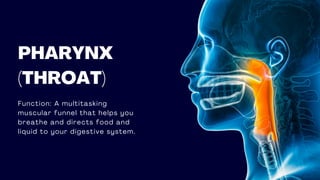
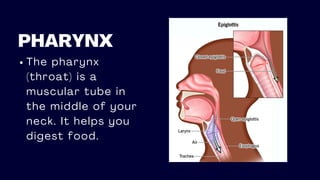
Function: A multitasking
muscularfunnel that helps you
breathe and directs food and
liquid to your digestive system.
PHARYNX
(THROAT)
47.
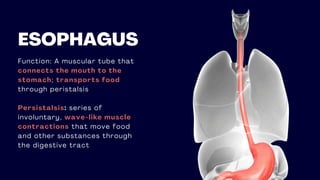
Function: A musculartube that
connects the mouth to the
stomach; transports food
through peristalsis
Persistalsis: series of
involuntary, wave-like muscle
contractions that move food
and other substances through
the digestive tract
ESOPHAGUS
48.
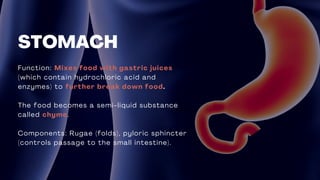
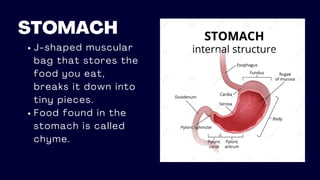
Function: Mixes foodwith gastric juices
(which contain hydrochloric acid and
enzymes) to further break down food.
The food becomes a semi-liquid substance
called chyme.
Components: Rugae (folds), pyloric sphincter
(controls passage to the small intestine).
STOMACH
49.
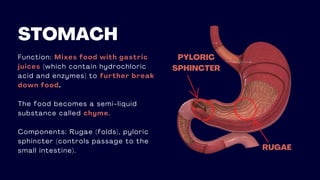
STOMACH
RUGAE
PYLORIC
SPHINCTER
Function: Mixes foodwith gastric
juices (which contain hydrochloric
acid and enzymes) to further break
down food.
The food becomes a semi-liquid
substance called chyme.
Components: Rugae (folds), pyloric
sphincter (controls passage to the
small intestine).
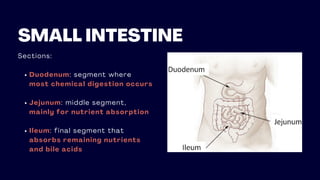
Sections:
Duodenum: segment where
mostchemical digestion occurs
Jejunum: middle segment,
mainly for nutrient absorption
Ileum: final segment that
absorbs remaining nutrients
and bile acids
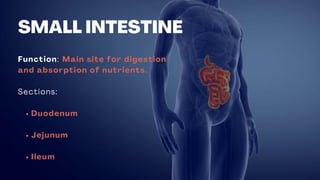
SMALL INTESTINE
52.
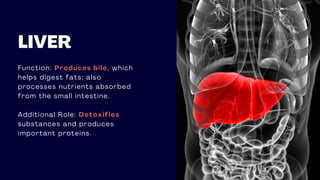
LIVER
Function: Produces bile,which
helps digest fats; also
processes nutrients absorbed
from the small intestine.
Additional Role: Detoxifies
substances and produces
important proteins.
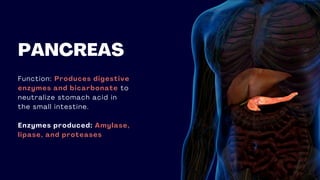
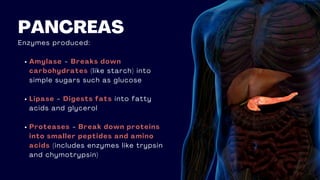
PANCREAS
Enzymes produced:
Amylase -Breaks down
carbohydrates (like starch) into
simple sugars such as glucose
Lipase - Digests fats into fatty
acids and glycerol
Proteases - Break down proteins
into smaller peptides and amino
acids (includes enzymes like trypsin
and chymotrypsin)
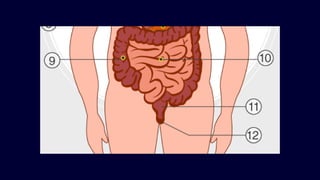
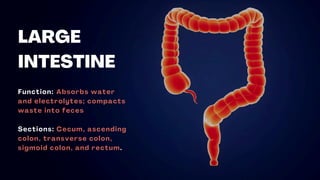
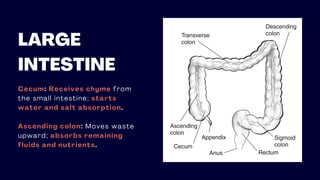
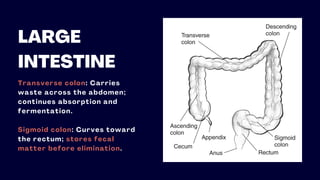
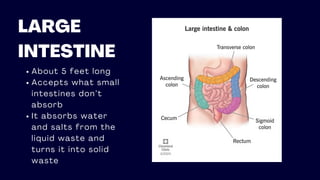
LARGE
INTESTINE
Cecum: Receives chymefrom
the small intestine; starts
water and salt absorption.
Ascending colon: Moves waste
upward; absorbs remaining
fluids and nutrients.
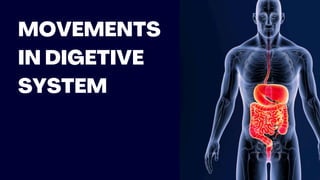
MOVEMENTS IN THE
DIGESTIVESYSTEM
1.Ingestion:
The process of taking food into the mouth.
2.Mastication:
Mechanical breakdown of food by chewing, which
increases surface area for enzymes to act.
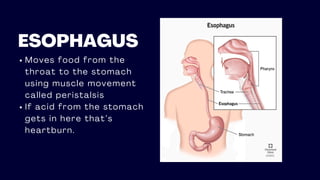
ESOPHAGUS
Moves food fromthe
throat to the stomach
using muscle movement
called peristalsis
If acid from the stomach
gets in here that’s
heartburn.
67.
MOVEMENTS IN THE
DIGESTIVESYSTEM
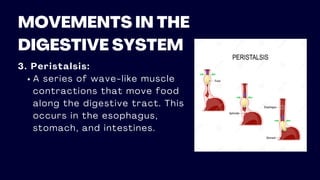
3. Peristalsis:
A series of wave-like muscle
contractions that move food
along the digestive tract. This
occurs in the esophagus,
stomach, and intestines.
68.
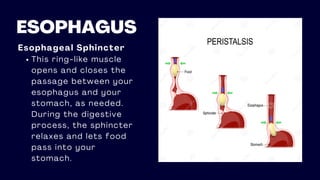
ESOPHAGUS
Esophageal Sphincter
This ring-likemuscle
opens and closes the
passage between your
esophagus and your
stomach, as needed.
During the digestive
process, the sphincter
relaxes and lets food
pass into your
stomach.
69.
MOVEMENTS IN THE
DIGESTIVESYSTEM
4. Swallowing (Deglutition):
The movement of food from the mouth
to the esophagus. This can be broken
down into three phases:
70.
MOVEMENTS IN THE
DIGESTIVESYSTEM
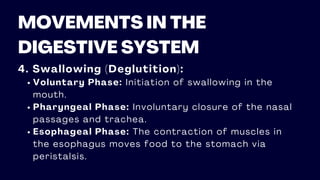
4. Swallowing (Deglutition):
Voluntary Phase: Initiation of swallowing in the
mouth.
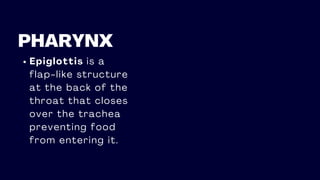
Pharyngeal Phase: Involuntary closure of the nasal
passages and trachea.
Esophageal Phase: The contraction of muscles in
the esophagus moves food to the stomach via
peristalsis.
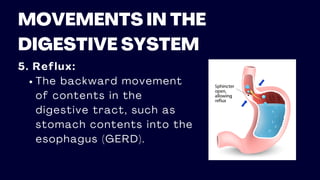
MOVEMENTS IN THE
DIGESTIVESYSTEM
5. Reflux:
The backward movement
of contents in the
digestive tract, such as
stomach contents into the
esophagus (GERD).
73.
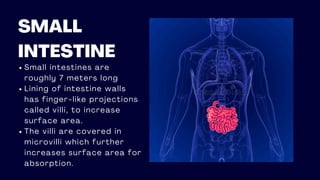
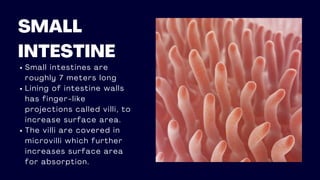
SMALL
INTESTINE
Small intestines are
roughly7 meters long
Lining of intestine walls
has finger-like projections
called villi, to increase
surface area.
The villi are covered in
microvilli which further
increases surface area for
absorption.
74.
SMALL
INTESTINE
Small intestines are
roughly7 meters long
Lining of intestine walls
has finger-like
projections called villi, to
increase surface area.
The villi are covered in
microvilli which further
increases surface area
for absorption.
75.
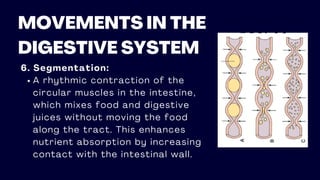
MOVEMENTS IN THE
DIGESTIVESYSTEM
6. Segmentation:
A rhythmic contraction of the
circular muscles in the intestine,
which mixes food and digestive
juices without moving the food
along the tract. This enhances
nutrient absorption by increasing
contact with the intestinal wall.
76.
LARGE
INTESTINE
About 5 feetlong
Accepts what small
intestines don’t
absorb
It absorbs water
and salts from the
liquid waste and
turns it into solid
waste
SECRETION IN THE
DIGESTIVESYSTEM
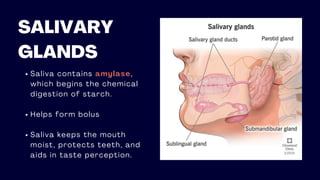
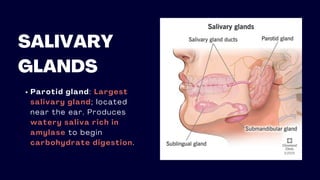
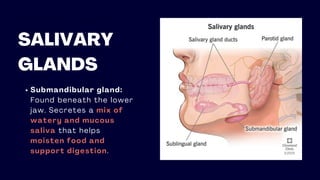
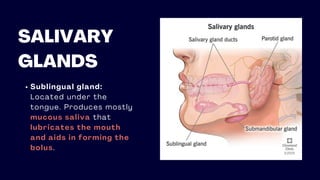
1.Saliva
Produced by salivary glands in the
mouth; contains enzymes (amylase and
lysozyme) that begin the digestion of
carbohydrates and provide lubrication
for easier swallowing.
81.
SECRETION IN THE
DIGESTIVESYSTEM
2.Bile
Produced in the liver and stored in the
gallbladder, bile contains bile salts that
emulsify fats, making them easier to
digest by pancreatic lipase.
82.
SECRETION IN THE
DIGESTIVESYSTEM
3. Pancreatic Juice
Secreted by the pancreas into the
small intestine, this juice contains:
83.
SECRETION IN THE
DIGESTIVESYSTEM
3. Pancreatic Juice
Digestive Enzymes: Amylase
(carbohydrates), lipase (fats), and
proteases (proteins).
84.
SECRETION IN THE
DIGESTIVESYSTEM
3. Pancreatic Juice
Bicarbonate: Neutralizes gastric acid
from the stomach, providing an
optimal pH for enzyme activity in the
small intestine.
85.
SECRETION IN THE
DIGESTIVESYSTEM
5. Intestinal Juices
Secreted by the intestinal glands in the
small intestine. These juices contain
various enzymes (like maltase, lactase,
and sucrase) that help break down
disaccharides into monosaccharides, as
well as peptidases for protein digestion.
86.
SECRETION IN THE
DIGESTIVESYSTEM
6. Mucus
Secreted throughout the digestive
tract to lubricate and protect the
lining of the organs from digestive
acids and enzymes (particularly in the
stomach and intestines).
87.
SECRETION IN THE
DIGESTIVESYSTEM
7. Hormones
Hormones are chemical messengers
that coordinate different functions in
your body. Several glands, organs and
tissues make and release hormones,
some of which make up your digestive
system.
88.
7. Hormones regulatedigestive
process:
Gastrin: Stimulates secretion of gastric acid in
the stomach.
Cholecystokinin (CCK): Stimulates bile release
from the gallbladder and pancreatic enzyme
secretion.
Secretin: Stimulates the pancreas to release
bicarbonate, neutralizing stomach acid.