
A2 Drama : Lysistrata

     Aristotle’s Poetics
 Activities for CHARACTER
   Activities for THEME
Firstly>>>
•   A slide or two about the exam
•   To check our understanding
•   To settle any nerves
•   To feel better prepared for the task ahead.
Unit 4- The Written Exam
• Split into 3 sections- A, B and C
• Duration – 2 hours 30 minutes
• You must answer three questions, one from Section
  A, one from Section B and one from Section C.
• The marks for individual questions and the parts of
  questions are shown in round brackets: e.g. (2).
• There are 11 questions in this question paper.
  (sample)The total mark for this paper is 80.
• There are questions about texts which we have not
  studied – don’t attempt these ones please!
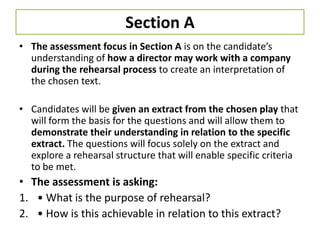
Section A
• The assessment focus in Section A is on the candidate’s
  understanding of how a director may work with a company
  during the rehearsal process to create an interpretation of
  the chosen text.

• Candidates will be given an extract from the chosen play that
  will form the basis for the questions and will allow them to
  demonstrate their understanding in relation to the specific
  extract. The questions will focus solely on the extract and
  explore a rehearsal structure that will enable specific criteria
  to be met.
• The assessment is asking:
1. • What is the purpose of rehearsal?
2. • How is this achievable in relation to this extract?
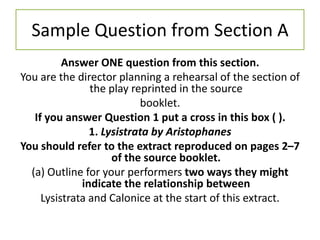
Sample Question from Section A
          Answer ONE question from this section.
You are the director planning a rehearsal of the section of
                the play reprinted in the source
                           booklet.
   If you answer Question 1 put a cross in this box ( ).
                1. Lysistrata by Aristophanes
You should refer to the extract reproduced on pages 2–7
                     of the source booklet.
  (a) Outline for your performers two ways they might
              indicate the relationship between
     Lysistrata and Calonice at the start of this extract.
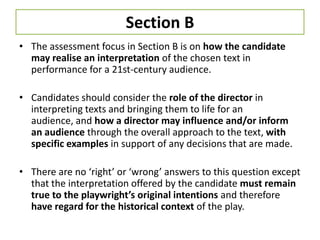
Section B
• The assessment focus in Section B is on how the candidate
  may realise an interpretation of the chosen text in
  performance for a 21st-century audience.

• Candidates should consider the role of the director in
  interpreting texts and bringing them to life for an
  audience, and how a director may influence and/or inform
  an audience through the overall approach to the text, with
  specific examples in support of any decisions that are made.

• There are no ‘right’ or ‘wrong’ answers to this question except
  that the interpretation offered by the candidate must remain
  true to the playwright’s original intentions and therefore
  have regard for the historical context of the play.
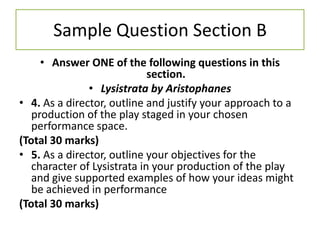
Sample Question Section B
     • Answer ONE of the following questions in this
                             section.
               • Lysistrata by Aristophanes
• 4. As a director, outline and justify your approach to a
   production of the play staged in your chosen
   performance space.
(Total 30 marks)
• 5. As a director, outline your objectives for the
   character of Lysistrata in your production of the play
   and give supported examples of how your ideas might
   be achieved in performance
(Total 30 marks)
Now on with the lesson...
Learning OUTCOMES
1. Able to explain the three unities (of
   time, place and plot)
2. Able to describe at least one activity used by
   performers to understand Character
   development
3. Can identify one of the play’s THEMES from a
   director’s viewpoint to develop their own
   interpretation of the play for a modern
   audience
Further understanding of the play
•   The Poetics of Aristotle
•   Activities around PLOT
•   Activities around CHARACTER
•   Activities around THEME
Starter activity- 15 minutes
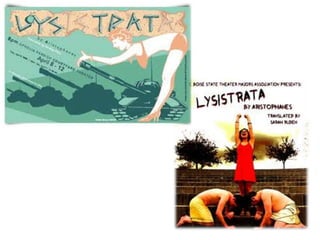
• Look at the example of Theatre programme/s
• Using pens and paper provided, create a
  POSTER DESIGN for your MODERN version of
  Lysistrata.
• The Poster should contain image/s which
  clearly illustrate your central THEME for the
  play.
Aristotle 384-322 BC
• Aristotle writes of the poets of his time in his
  famous work The Poetics.
• He sets forth the principles of quality poetry in
  order of importance:
• plot,
• character,
• thought (theme),
• language,
• song, and
• spectacle
Origins of Greek Plays
• Classical Greek plays originated from
  dithyrambic poetry, which are short poems
  written in an inspired, wild, and irregular
  strain.
• (The early playwrights eventually developed the dialogue
  format later recognized as dramatic literature, but the poetic
  nature of the writing remained inherent. )
• Therefore, classic plays of this time are often
  analyzed using Aristotelian Theory
Three ‘Unities’ (Yew-ni-teas)
• Classic Greek plays : A strict formula -
1. The stage represents a single locale.
2. The plot recounts the events of a single day, and
3. The actions follow one storyline with no
   subplots.
• Aristotle’s dramatic structure was eventually
  adopted as the rules of playwrighting and
  became known as the three unities: unity of
  place, time, and action.
Three Unities cont...
• Place. The setting of the play should be one
  location, usually on the street in front of an
  architectural structure.
• Time. The action of the play should represent the
  passage of no more than twenty-four hours.
  Previous events leading to the action are
  recounted on stage as exposition.
• Action. No action or scene in the play is a
  digression. All actions in the play must contribute
  directly to the single plotline
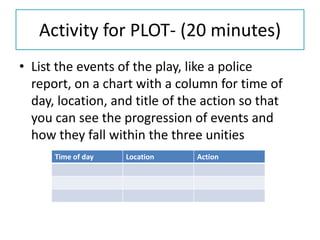
Activity for PLOT- (20 minutes)
• List the events of the play, like a police
  report, on a chart with a column for time of
  day, location, and title of the action so that
  you can see the progression of events and
  how they fall within the three unities
      Time of day   Location    Action
The Players & Characters
• As we have discussed before, originally whole play
  was presented by one CHORUS
• Later the individual actor, known as hypokrites, or
  “answerer,” was added to answer the calls of the
  chorus. Later the single actor was called
  protagonistes, meaning “first competitor.”
  Protagonistes later developed into the main
  character or “protagonist.”
Performance space creates
            a style of acting
• The plays were often performed in theatres
  that held thousands of spectators, therefore
  the actors wore full masks of wood or leather
  to help accentuate their features. The masks
  had large gaping mouths carved out to aid in
  vocal amplification.
• The acting style was broad and highly physical
  so that all could see and hear each gesture.
Character Discussions and Activities
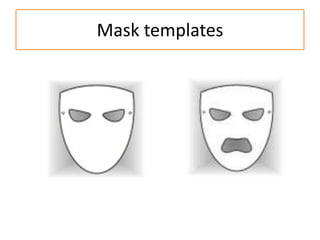
• Imagine the characters in mask. What expressions
  might each character have to represent their
  character and help differentiate themselves from
  other characters?
• See if you can make the expression and have your
  partner sketch it or photograph it. See if you can do
  different but relevant masks like this for all the main
  characters. (15 minutes)
Mask templates
Character discussions
• How are the male characters depicted differently than the
  female characters in language, actions, and physical
  appearance?

• In a play filled with common characters, which character
  appears to hold the highest social standing? Why? How is this
  character treated by others?

• How would modern audiences respond if Lysistrata were
  performed only by men?

• How would modern audiences respond to the phalluses and
  nudity?
Character Activity- (20 Minutes)
• Wear masks and attempt to act one or two of
  the scenes in the play.
• Work on projecting your voice beyond the
  mask and using exaggerated movements with
  your body and full gestures so that they can
  be seen from a distance
• Use the stage (or outside) to test this if it is
  safe to do so.
• Discuss what it was like to act with a mask.
Character activity – Choral reading
• Choral readings can be very challenging to keep
  together. It is difficult to remain in unison, deliver
  dramatically, and be understood.
• Explore the challenges of performing in a Greek
  chorus by chorally reading with 6 to 8 students
  the choral odes from the text.
• First simply reading together, then add group
  movements and dramatic expressions, all in
  unison (20 minutes)
Thought/Theme
• Classic Greek comedy was the political satire of
  its age. Looking at the thought or theme behind
  the comedy gives modern audiences insight into
  political issues in ancient Greece.
• 6 minute activity
• Do you know what the themes of the play are?
• On the next slide are 14. You have 6 minutes with
  a partner to try and list as many as you can. GO
Themes in the Play
•   1. The war between the sexes.
•   2. Abstinence brings about peace.
•   3. Make love not war.
•   4. “Never underestimate the power of a woman.” (Lysistrata)
•   5. Behind every great man is a great woman.
•   6. Love your neighbour.
•   7. The brute man is saved by the love of a good woman.
•   8. The city folk and the country folk join forces.
•   9. The power of united nations.
•   10. Moral chaos ensues when women are missing.
•   11. The veil of silence will be lifted.
•   12. Brawn vs. Brains.
•   13. Nakedness reveals the truth
•   14. “Life with women is hell. Life without women is hell, too.” (Koryphaios
    of Men)
Adapting the play for a modern
               audience
• Using the list of themes, which ones would
  seem most fitting for a modern interpretation
  of the play?
• Consider how the three unities, of
  location, time and action we discussed
  earlier, can fit into your idea.
• Make notes in your journals/log books of your
  ideas – spider diagrams are good too!
• (10 minutes)
Activities for THEME
• Since titles often reflect theme, suggest a
  new title for the play that best reflects its
  theme
• Add it to the poster you started at the
  beginning of the lesson.
• Would your poster be different now that you
  have considered other themes?
• (6 minutes)
Activities for THEME
• Although theme is often assigned to an entire play or
  story, individual scenes in a play can also be assigned
  themes.
• One can easily assign scene beginnings and endings
  with the entrance or exit of a character. E.g., the first
  scene ends when Lysistrata is no longer alone; a new
  scene begins with Calonice’s entrance.
• ‘French Scene’ identification, originating from French
  method of play writing predominant in the 1600-
  1700’s.
• Break the remainder of the play into scenes and
  identify a theme for each (20 minutes)
Learning OUTCOMES – check up
1. Able to explain the three unities (of
   time, place and plot)
2. Able to describe at least one activity used by
   performers to understand Character
   development
3. Can identify one of the play’s THEMES from a
   director’s viewpoint to develop their own
   interpretation of the play for a modern
   audience
Happy Easter!

Lysistrata: Aristotle,Plot,Character,Theme

  • 1.
    A2 Drama :Lysistrata Aristotle’s Poetics Activities for CHARACTER Activities for THEME
  • 2.
    Firstly>>> • A slide or two about the exam • To check our understanding • To settle any nerves • To feel better prepared for the task ahead.
  • 3.
    Unit 4- TheWritten Exam • Split into 3 sections- A, B and C • Duration – 2 hours 30 minutes • You must answer three questions, one from Section A, one from Section B and one from Section C. • The marks for individual questions and the parts of questions are shown in round brackets: e.g. (2). • There are 11 questions in this question paper. (sample)The total mark for this paper is 80. • There are questions about texts which we have not studied – don’t attempt these ones please!
  • 4.
    Section A • Theassessment focus in Section A is on the candidate’s understanding of how a director may work with a company during the rehearsal process to create an interpretation of the chosen text. • Candidates will be given an extract from the chosen play that will form the basis for the questions and will allow them to demonstrate their understanding in relation to the specific extract. The questions will focus solely on the extract and explore a rehearsal structure that will enable specific criteria to be met. • The assessment is asking: 1. • What is the purpose of rehearsal? 2. • How is this achievable in relation to this extract?
  • 5.
    Sample Question fromSection A Answer ONE question from this section. You are the director planning a rehearsal of the section of the play reprinted in the source booklet. If you answer Question 1 put a cross in this box ( ). 1. Lysistrata by Aristophanes You should refer to the extract reproduced on pages 2–7 of the source booklet. (a) Outline for your performers two ways they might indicate the relationship between Lysistrata and Calonice at the start of this extract.
  • 6.
    Section B • Theassessment focus in Section B is on how the candidate may realise an interpretation of the chosen text in performance for a 21st-century audience. • Candidates should consider the role of the director in interpreting texts and bringing them to life for an audience, and how a director may influence and/or inform an audience through the overall approach to the text, with specific examples in support of any decisions that are made. • There are no ‘right’ or ‘wrong’ answers to this question except that the interpretation offered by the candidate must remain true to the playwright’s original intentions and therefore have regard for the historical context of the play.
  • 7.
    Sample Question SectionB • Answer ONE of the following questions in this section. • Lysistrata by Aristophanes • 4. As a director, outline and justify your approach to a production of the play staged in your chosen performance space. (Total 30 marks) • 5. As a director, outline your objectives for the character of Lysistrata in your production of the play and give supported examples of how your ideas might be achieved in performance (Total 30 marks)
  • 8.
    Now on withthe lesson...
  • 9.
    Learning OUTCOMES 1. Ableto explain the three unities (of time, place and plot) 2. Able to describe at least one activity used by performers to understand Character development 3. Can identify one of the play’s THEMES from a director’s viewpoint to develop their own interpretation of the play for a modern audience
  • 10.
    Further understanding ofthe play • The Poetics of Aristotle • Activities around PLOT • Activities around CHARACTER • Activities around THEME
  • 11.
    Starter activity- 15minutes • Look at the example of Theatre programme/s • Using pens and paper provided, create a POSTER DESIGN for your MODERN version of Lysistrata. • The Poster should contain image/s which clearly illustrate your central THEME for the play.
  • 13.
    Aristotle 384-322 BC •Aristotle writes of the poets of his time in his famous work The Poetics. • He sets forth the principles of quality poetry in order of importance: • plot, • character, • thought (theme), • language, • song, and • spectacle
  • 14.
    Origins of GreekPlays • Classical Greek plays originated from dithyrambic poetry, which are short poems written in an inspired, wild, and irregular strain. • (The early playwrights eventually developed the dialogue format later recognized as dramatic literature, but the poetic nature of the writing remained inherent. ) • Therefore, classic plays of this time are often analyzed using Aristotelian Theory
  • 15.
    Three ‘Unities’ (Yew-ni-teas) •Classic Greek plays : A strict formula - 1. The stage represents a single locale. 2. The plot recounts the events of a single day, and 3. The actions follow one storyline with no subplots. • Aristotle’s dramatic structure was eventually adopted as the rules of playwrighting and became known as the three unities: unity of place, time, and action.
  • 16.
    Three Unities cont... •Place. The setting of the play should be one location, usually on the street in front of an architectural structure. • Time. The action of the play should represent the passage of no more than twenty-four hours. Previous events leading to the action are recounted on stage as exposition. • Action. No action or scene in the play is a digression. All actions in the play must contribute directly to the single plotline
  • 17.
    Activity for PLOT-(20 minutes) • List the events of the play, like a police report, on a chart with a column for time of day, location, and title of the action so that you can see the progression of events and how they fall within the three unities Time of day Location Action
  • 18.
    The Players &Characters • As we have discussed before, originally whole play was presented by one CHORUS • Later the individual actor, known as hypokrites, or “answerer,” was added to answer the calls of the chorus. Later the single actor was called protagonistes, meaning “first competitor.” Protagonistes later developed into the main character or “protagonist.”
  • 19.
    Performance space creates a style of acting • The plays were often performed in theatres that held thousands of spectators, therefore the actors wore full masks of wood or leather to help accentuate their features. The masks had large gaping mouths carved out to aid in vocal amplification. • The acting style was broad and highly physical so that all could see and hear each gesture.
  • 20.
    Character Discussions andActivities • Imagine the characters in mask. What expressions might each character have to represent their character and help differentiate themselves from other characters? • See if you can make the expression and have your partner sketch it or photograph it. See if you can do different but relevant masks like this for all the main characters. (15 minutes)
  • 21.
  • 22.
    Character discussions • Howare the male characters depicted differently than the female characters in language, actions, and physical appearance? • In a play filled with common characters, which character appears to hold the highest social standing? Why? How is this character treated by others? • How would modern audiences respond if Lysistrata were performed only by men? • How would modern audiences respond to the phalluses and nudity?
  • 23.
    Character Activity- (20Minutes) • Wear masks and attempt to act one or two of the scenes in the play. • Work on projecting your voice beyond the mask and using exaggerated movements with your body and full gestures so that they can be seen from a distance • Use the stage (or outside) to test this if it is safe to do so. • Discuss what it was like to act with a mask.
  • 24.
    Character activity –Choral reading • Choral readings can be very challenging to keep together. It is difficult to remain in unison, deliver dramatically, and be understood. • Explore the challenges of performing in a Greek chorus by chorally reading with 6 to 8 students the choral odes from the text. • First simply reading together, then add group movements and dramatic expressions, all in unison (20 minutes)
  • 25.
    Thought/Theme • Classic Greekcomedy was the political satire of its age. Looking at the thought or theme behind the comedy gives modern audiences insight into political issues in ancient Greece. • 6 minute activity • Do you know what the themes of the play are? • On the next slide are 14. You have 6 minutes with a partner to try and list as many as you can. GO
  • 26.
    Themes in thePlay • 1. The war between the sexes. • 2. Abstinence brings about peace. • 3. Make love not war. • 4. “Never underestimate the power of a woman.” (Lysistrata) • 5. Behind every great man is a great woman. • 6. Love your neighbour. • 7. The brute man is saved by the love of a good woman. • 8. The city folk and the country folk join forces. • 9. The power of united nations. • 10. Moral chaos ensues when women are missing. • 11. The veil of silence will be lifted. • 12. Brawn vs. Brains. • 13. Nakedness reveals the truth • 14. “Life with women is hell. Life without women is hell, too.” (Koryphaios of Men)
  • 27.
    Adapting the playfor a modern audience • Using the list of themes, which ones would seem most fitting for a modern interpretation of the play? • Consider how the three unities, of location, time and action we discussed earlier, can fit into your idea. • Make notes in your journals/log books of your ideas – spider diagrams are good too! • (10 minutes)
  • 28.
    Activities for THEME •Since titles often reflect theme, suggest a new title for the play that best reflects its theme • Add it to the poster you started at the beginning of the lesson. • Would your poster be different now that you have considered other themes? • (6 minutes)
  • 29.
    Activities for THEME •Although theme is often assigned to an entire play or story, individual scenes in a play can also be assigned themes. • One can easily assign scene beginnings and endings with the entrance or exit of a character. E.g., the first scene ends when Lysistrata is no longer alone; a new scene begins with Calonice’s entrance. • ‘French Scene’ identification, originating from French method of play writing predominant in the 1600- 1700’s. • Break the remainder of the play into scenes and identify a theme for each (20 minutes)
  • 30.
    Learning OUTCOMES –check up 1. Able to explain the three unities (of time, place and plot) 2. Able to describe at least one activity used by performers to understand Character development 3. Can identify one of the play’s THEMES from a director’s viewpoint to develop their own interpretation of the play for a modern audience
  • 31.