LABOUR WELFARE &
INDUSTRIAL SAFETY
UNIT 1: LABOUR WELFARE
Vijay H. Masarkar, Ast. Prof. - Mgt.
Objectives
After completing this session, you will be able to;
• Evaluate the nature of the labour welfare
• Classify labour welfare facilities
• Identify the objectives and merits of labour welfare
measures
• Distinguish between extramural and intramural welfare
measures
• Enumerate the approaches to labour welfare
Structure
1.1 Introduction
1.2 Definitions
1.3 Objectives of Labour Welfare
1.4 Classification of Labour Welfare Facilities
1.5 Approaches to Labour Welfare
1.6 Theories of Labour Welfare
1.7 History of Labour Welfare in India
1.7.1 Social Security: Concept and Evolution
1.1 INTRODUCTION
 Welfare means well -being, betterment or
satisfaction of the member of the society by
introducing activities like facilities for education of
the children, recreation, cultural activities, etc.
 ‘All such activities introduced by the Employer,
Govt., Trade Unions as well as voluntary agencies
for the benefits of the employees and their family
members over the law customs and traditions for
their socio- economic and cultural development.
1.2 DEFINITIONS
 “A state of faring or doing well. Freedom from calamity, enjoyment of health
and prosperity”. By Chambers dictionary
 ‘Efforts to make life worth living for the workers.’ By Oxford Dictionary
 ‘Anything done for the intellectual, physical, moral and economic
betterment of the workers, whether by employers, by Govt. or by other
agencies, over and above what is laid down by law’ By Labour Investigation
Committee
 “Such services, facilities and amenities as adequate canteens, rest and
recreation facilities, arrangements for travel to and from work, and for the
accommodation of workers employed at a distance from their houses, and
such other services, amenities and facilities as contribute to improve the
conditions under which workers are employed.” By ILO 1947
1.3 OBJECTIVES OF LABOUR WELFARE
1. To provide better life and health to the workers.
2. To make the workers happy and satisfied.
3. To relieve workers from industrial fatigue and to improve
intellectual, cultural and material conditions of living of
the workers
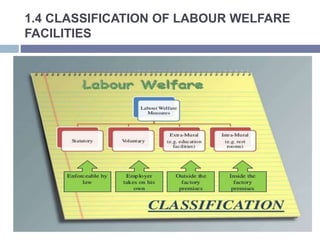
1.4 CLASSIFICATION OF LABOUR WELFARE
FACILITIES
1.4 CLASSIFICATION OF LABOUR WELFARE
FACILITIES
 1. Statutory Welfare Provisions
 Washing facility
 Facility for storing and drying clothes
 Facilities for sitting
 First aid appliances (150 workers)
 Canteen (250 workers)
 Shelters, Rest rooms and Lunch rooms (150 workers)
 Crèches (30 woman workers)
 Welfare Officers (500 workers)
1.4 CLASSIFICATION OF LABOUR WELFARE
FACILITIES
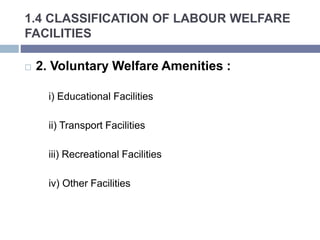
 2. Voluntary Welfare Amenities :
i) Educational Facilities
ii) Transport Facilities
iii) Recreational Facilities
iv) Other Facilities
1.4 CLASSIFICATION OF LABOUR WELFARE
FACILITIES
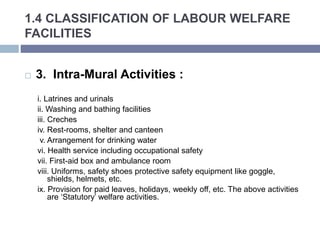
 3. Intra-Mural Activities :
i. Latrines and urinals
ii. Washing and bathing facilities
iii. Creches
iv. Rest-rooms, shelter and canteen
v. Arrangement for drinking water
vi. Health service including occupational safety
vii. First-aid box and ambulance room
viii. Uniforms, safety shoes protective safety equipment like goggle,
shields, helmets, etc.
ix. Provision for paid leaves, holidays, weekly off, etc. The above activities
are ‘Statutory’ welfare activities.
1.4 CLASSIFICATION OF LABOUR WELFARE
FACILITIES
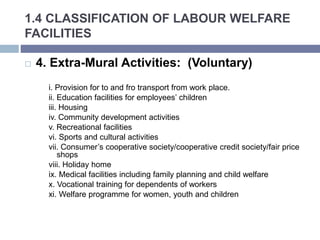
 4. Extra-Mural Activities: (Voluntary)
i. Provision for to and fro transport from work place.
ii. Education facilities for employees’ children
iii. Housing
iv. Community development activities
v. Recreational facilities
vi. Sports and cultural activities
vii. Consumer’s cooperative society/cooperative credit society/fair price
shops
viii. Holiday home
ix. Medical facilities including family planning and child welfare
x. Vocational training for dependents of workers
xi. Welfare programme for women, youth and children
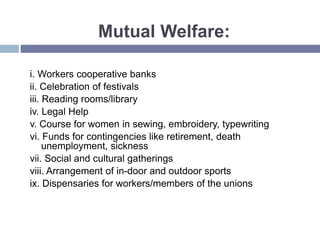
Mutual Welfare:
i. Workers cooperative banks
ii. Celebration of festivals
iii. Reading rooms/library
iv. Legal Help
v. Course for women in sewing, embroidery, typewriting
vi. Funds for contingencies like retirement, death
unemployment, sickness
vii. Social and cultural gatherings
viii. Arrangement of in-door and outdoor sports
ix. Dispensaries for workers/members of the unions
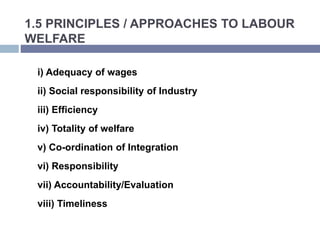
1.5 PRINCIPLES / APPROACHES TO LABOUR
WELFARE
i) Adequacy of wages
ii) Social responsibility of Industry
iii) Efficiency
iv) Totality of welfare
v) Co-ordination of Integration
vi) Responsibility
vii) Accountability/Evaluation
viii) Timeliness
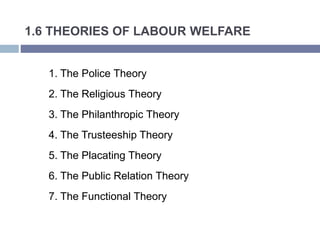
1.6 THEORIES OF LABOUR WELFARE
1. The Police Theory
2. The Religious Theory
3. The Philanthropic Theory
4. The Trusteeship Theory
5. The Placating Theory
6. The Public Relation Theory
7. The Functional Theory
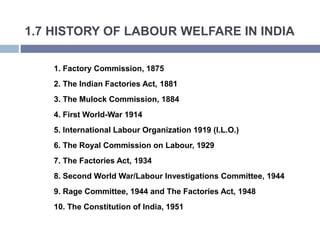
1.7 HISTORY OF LABOUR WELFARE IN INDIA
1. Factory Commission, 1875
2. The Indian Factories Act, 1881
3. The Mulock Commission, 1884
4. First World-War 1914
5. International Labour Organization 1919 (I.L.O.)
6. The Royal Commission on Labour, 1929
7. The Factories Act, 1934
8. Second World War/Labour Investigations Committee, 1944
9. Rage Committee, 1944 and The Factories Act, 1948
10. The Constitution of India, 1951
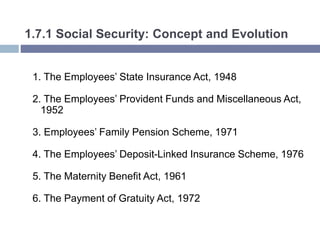
1.7.1 Social Security: Concept and Evolution
1. The Employees’ State Insurance Act, 1948
2. The Employees’ Provident Funds and Miscellaneous Act,
1952
3. Employees’ Family Pension Scheme, 1971
4. The Employees’ Deposit-Linked Insurance Scheme, 1976
5. The Maternity Benefit Act, 1961
6. The Payment of Gratuity Act, 1972
Summary
 This unit has highlighted the need of these benefits
and welfare measures from the viewpoint of the
employee and the advantages that they may bring to
enhance the efficiency, morale and productivity.
 • Labour welfare is an important dimension of
industrial relation; labour welfare includes overall
welfare facilities designed to take care of well-being of
employee’s and in order to increase their living
standard.
Your valuable feedback is solicited
Please do write to;
vijay.masarkar@scdl.net
Thank you!

Labour welfare unit 1 Notes

  • 1.
    LABOUR WELFARE & INDUSTRIALSAFETY UNIT 1: LABOUR WELFARE Vijay H. Masarkar, Ast. Prof. - Mgt.
  • 2.
    Objectives After completing thissession, you will be able to; • Evaluate the nature of the labour welfare • Classify labour welfare facilities • Identify the objectives and merits of labour welfare measures • Distinguish between extramural and intramural welfare measures • Enumerate the approaches to labour welfare
  • 3.
    Structure 1.1 Introduction 1.2 Definitions 1.3Objectives of Labour Welfare 1.4 Classification of Labour Welfare Facilities 1.5 Approaches to Labour Welfare 1.6 Theories of Labour Welfare 1.7 History of Labour Welfare in India 1.7.1 Social Security: Concept and Evolution
  • 4.
    1.1 INTRODUCTION  Welfaremeans well -being, betterment or satisfaction of the member of the society by introducing activities like facilities for education of the children, recreation, cultural activities, etc.  ‘All such activities introduced by the Employer, Govt., Trade Unions as well as voluntary agencies for the benefits of the employees and their family members over the law customs and traditions for their socio- economic and cultural development.
  • 5.
    1.2 DEFINITIONS  “Astate of faring or doing well. Freedom from calamity, enjoyment of health and prosperity”. By Chambers dictionary  ‘Efforts to make life worth living for the workers.’ By Oxford Dictionary  ‘Anything done for the intellectual, physical, moral and economic betterment of the workers, whether by employers, by Govt. or by other agencies, over and above what is laid down by law’ By Labour Investigation Committee  “Such services, facilities and amenities as adequate canteens, rest and recreation facilities, arrangements for travel to and from work, and for the accommodation of workers employed at a distance from their houses, and such other services, amenities and facilities as contribute to improve the conditions under which workers are employed.” By ILO 1947
  • 6.
    1.3 OBJECTIVES OFLABOUR WELFARE 1. To provide better life and health to the workers. 2. To make the workers happy and satisfied. 3. To relieve workers from industrial fatigue and to improve intellectual, cultural and material conditions of living of the workers
  • 7.
    1.4 CLASSIFICATION OFLABOUR WELFARE FACILITIES
  • 8.
    1.4 CLASSIFICATION OFLABOUR WELFARE FACILITIES  1. Statutory Welfare Provisions  Washing facility  Facility for storing and drying clothes  Facilities for sitting  First aid appliances (150 workers)  Canteen (250 workers)  Shelters, Rest rooms and Lunch rooms (150 workers)  Crèches (30 woman workers)  Welfare Officers (500 workers)
  • 9.
    1.4 CLASSIFICATION OFLABOUR WELFARE FACILITIES  2. Voluntary Welfare Amenities : i) Educational Facilities ii) Transport Facilities iii) Recreational Facilities iv) Other Facilities
  • 10.
    1.4 CLASSIFICATION OFLABOUR WELFARE FACILITIES  3. Intra-Mural Activities : i. Latrines and urinals ii. Washing and bathing facilities iii. Creches iv. Rest-rooms, shelter and canteen v. Arrangement for drinking water vi. Health service including occupational safety vii. First-aid box and ambulance room viii. Uniforms, safety shoes protective safety equipment like goggle, shields, helmets, etc. ix. Provision for paid leaves, holidays, weekly off, etc. The above activities are ‘Statutory’ welfare activities.
  • 11.
    1.4 CLASSIFICATION OFLABOUR WELFARE FACILITIES  4. Extra-Mural Activities: (Voluntary) i. Provision for to and fro transport from work place. ii. Education facilities for employees’ children iii. Housing iv. Community development activities v. Recreational facilities vi. Sports and cultural activities vii. Consumer’s cooperative society/cooperative credit society/fair price shops viii. Holiday home ix. Medical facilities including family planning and child welfare x. Vocational training for dependents of workers xi. Welfare programme for women, youth and children
  • 12.
    Mutual Welfare: i. Workerscooperative banks ii. Celebration of festivals iii. Reading rooms/library iv. Legal Help v. Course for women in sewing, embroidery, typewriting vi. Funds for contingencies like retirement, death unemployment, sickness vii. Social and cultural gatherings viii. Arrangement of in-door and outdoor sports ix. Dispensaries for workers/members of the unions
  • 13.
    1.5 PRINCIPLES /APPROACHES TO LABOUR WELFARE i) Adequacy of wages ii) Social responsibility of Industry iii) Efficiency iv) Totality of welfare v) Co-ordination of Integration vi) Responsibility vii) Accountability/Evaluation viii) Timeliness
  • 14.
    1.6 THEORIES OFLABOUR WELFARE 1. The Police Theory 2. The Religious Theory 3. The Philanthropic Theory 4. The Trusteeship Theory 5. The Placating Theory 6. The Public Relation Theory 7. The Functional Theory
  • 15.
    1.7 HISTORY OFLABOUR WELFARE IN INDIA 1. Factory Commission, 1875 2. The Indian Factories Act, 1881 3. The Mulock Commission, 1884 4. First World-War 1914 5. International Labour Organization 1919 (I.L.O.) 6. The Royal Commission on Labour, 1929 7. The Factories Act, 1934 8. Second World War/Labour Investigations Committee, 1944 9. Rage Committee, 1944 and The Factories Act, 1948 10. The Constitution of India, 1951
  • 16.
    1.7.1 Social Security:Concept and Evolution 1. The Employees’ State Insurance Act, 1948 2. The Employees’ Provident Funds and Miscellaneous Act, 1952 3. Employees’ Family Pension Scheme, 1971 4. The Employees’ Deposit-Linked Insurance Scheme, 1976 5. The Maternity Benefit Act, 1961 6. The Payment of Gratuity Act, 1972
  • 17.
    Summary  This unithas highlighted the need of these benefits and welfare measures from the viewpoint of the employee and the advantages that they may bring to enhance the efficiency, morale and productivity.  • Labour welfare is an important dimension of industrial relation; labour welfare includes overall welfare facilities designed to take care of well-being of employee’s and in order to increase their living standard.
  • 18.
    Your valuable feedbackis solicited Please do write to; vijay.masarkar@scdl.net Thank you!