Commercial Development Programme Commercial Essentials Workshop 5 – Understanding, Finding and Developing Markets
NORTHUMBRIA COMMERCIAL ENTERPRISES  INNOVATION CAMPUS Ross Golightly
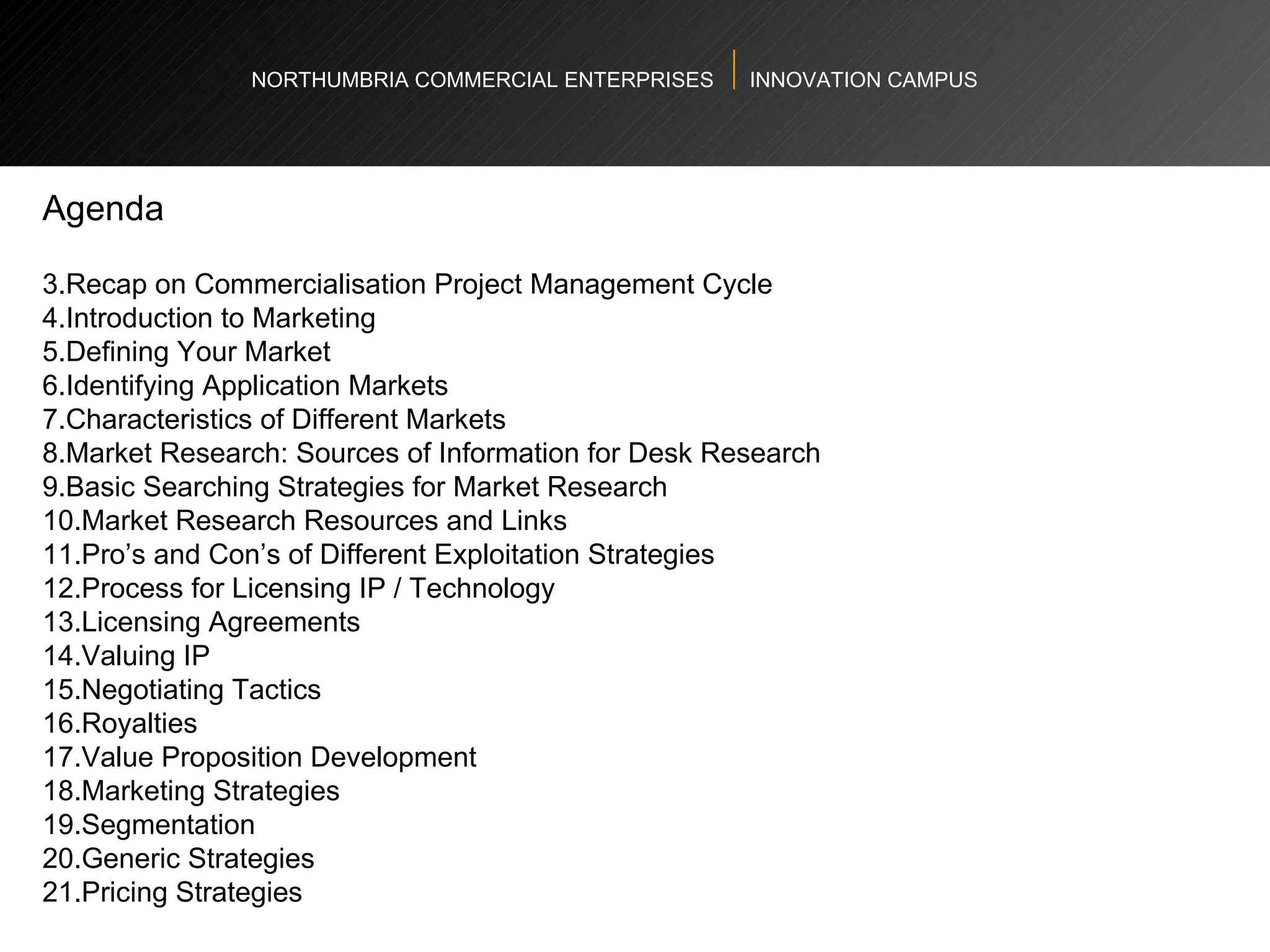
NORTHUMBRIA COMMERCIAL ENTERPRISES  INNOVATION CAMPUS Agenda Recap on Commercialisation Project Management Cycle  Introduction to Marketing Defining Your Market  Identifying Application Markets  Characteristics of Different Markets  Market Research: Sources of Information for Desk Research Basic Searching Strategies for Market Research Market Research Resources and Links  Pro’s and Con’s of Different Exploitation Strategies  Process for Licensing IP / Technology Licensing Agreements  Valuing IP  Negotiating Tactics  Royalties Value Proposition Development Marketing Strategies  Segmentation  Generic Strategies  Pricing Strategies
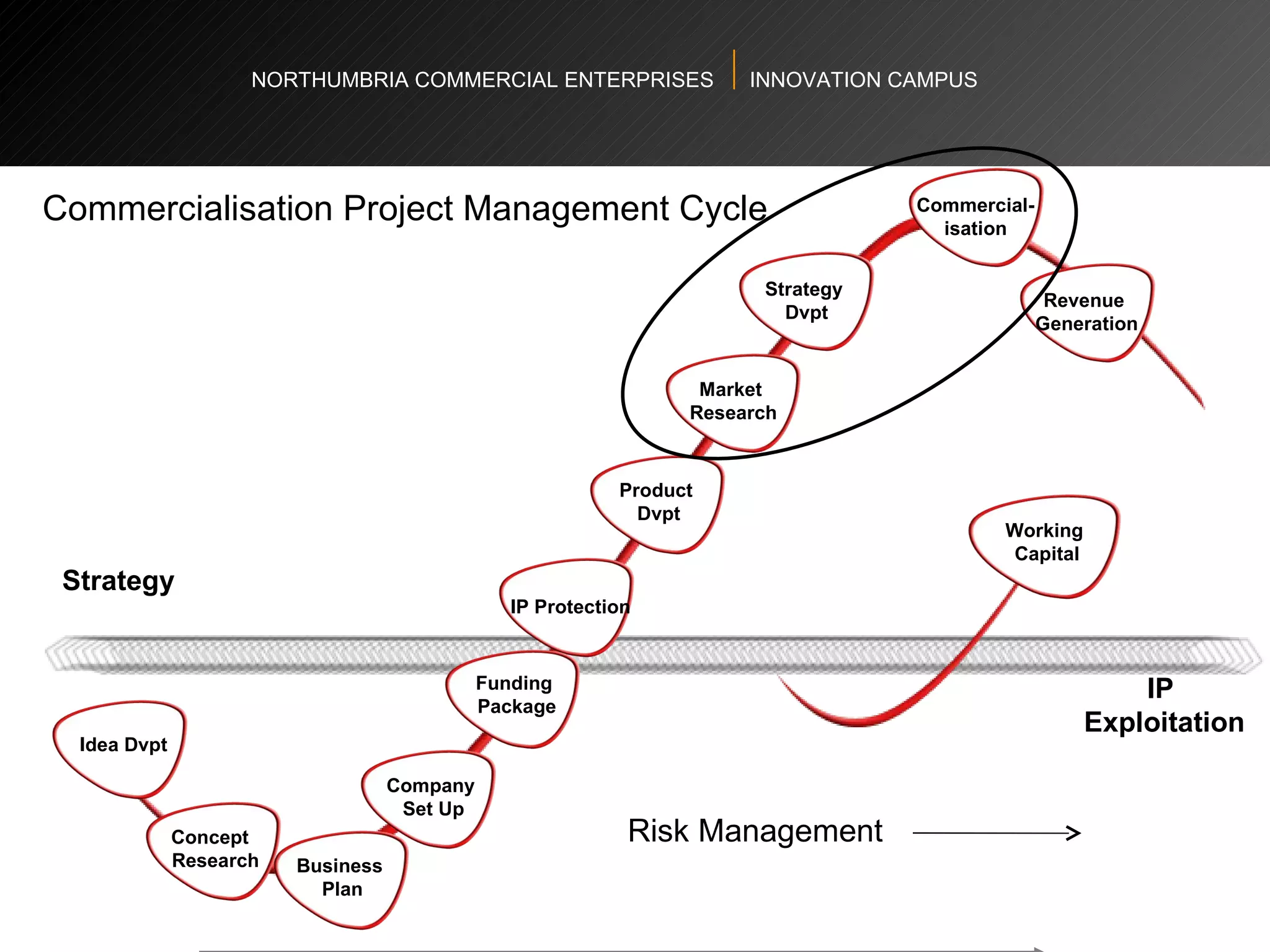
NORTHUMBRIA COMMERCIAL ENTERPRISES  INNOVATION CAMPUS Commercialisation Project Management Cycle Risk Management Strategy IP  Exploitation Concept  Research Business  Plan IP Protection Funding  Package Product  Dvpt Commercial- isation Working  Capital Strategy  Dvpt Market  Research Company  Set Up Idea Dvpt Revenue  Generation
NORTHUMBRIA COMMERCIAL ENTERPRISES  INNOVATION CAMPUS Our Basic Function is to Create a Customer, profitably.  This we do by focussing on  Marketing and Innovation  The rest are merely support functions where cost must be contained, reduced and waste eliminated  Marketing and Innovation generate  Margins! Margins generate profits!
NORTHUMBRIA COMMERCIAL ENTERPRISES  INNOVATION CAMPUS Define Your Research from the Perspective of Needs: A Market  … £100m Value? (That’s Financial)  …  France and Germany? (That’s Geography) …  High Street / On-Line? (That’s a Channel) A Market    People with a Common  Need  or  Want If You Start with a Definition of a Technology or Research Piece,  You will never Define a Need!
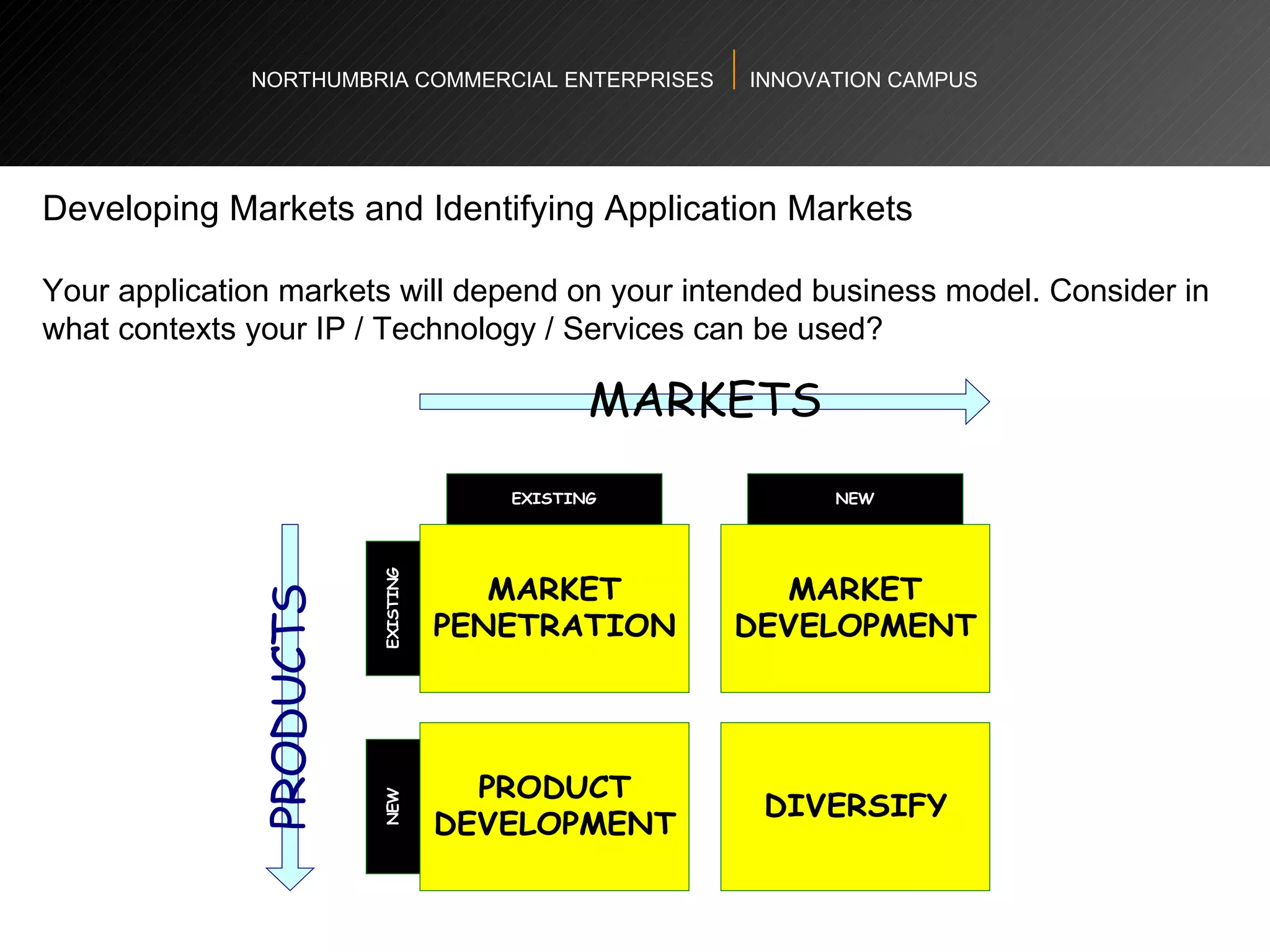
NORTHUMBRIA COMMERCIAL ENTERPRISES  INNOVATION CAMPUS Developing Markets and Identifying Application Markets  Your application markets will depend on your intended business model. Consider in what contexts your IP / Technology / Services can be used?
NORTHUMBRIA COMMERCIAL ENTERPRISES  INNOVATION CAMPUS Characteristics of Different Markets: Consumer Markets  Simple supply chain with high visibility but difficult to enter as a start-up  Usually manufacturer to retailer (and sometimes via distributor/wholesaler)  More easy to map out the potential market through desk research Generally highly price driven and very product driven  Aggressive marketing based on emotional pull of the product  Multiple margin tiers: trade price to retailer, end-user price plus VAT uplift  Generally two revenue stream options: 1) direct, 2) indirect (retail distribution)  Twin marketing requirements: 1) Trade marketing and 2) Consumer marketing
NORTHUMBRIA COMMERCIAL ENTERPRISES  INNOVATION CAMPUS Characteristics of Different Markets: Industrial / B2B Markets  More complex market structures with inter-dependent supply chains Think: application markets (especially for technology)  Often difficult to quantify market size and characteristics (lots of data is “invisible”  or unavailable) Performance-driven relationships (i.e. supply chain KPI’s, rate of defects etc.)  Several stages in supply chains – e.g. Automotive and Aerospace tier 1 and 2  Distinction between OEM and Aftermarkets (two different product offers) Relationships and selling are often contractual or tender led (customer-supplier  integration)  High importance placed on quality
NORTHUMBRIA COMMERCIAL ENTERPRISES  INNOVATION CAMPUS Characteristics of Different Markets: Services Markets  Lowest barriers to entry (easy to establish and less overheads)  Relationship driven and less price sensitive Very little “consumer-type” marketing, such as advertising  People to people marketing (i.e. networking, referrals, personal introductions)  More smaller, focussed markets  Proposition often based on exploitation of some level of intellectual capital Selling based on business value to the third party
NORTHUMBRIA COMMERCIAL ENTERPRISES  INNOVATION CAMPUS Market Research: Sources of Information for Desk Research Online information alone is doubling every 6 months  Information is available: - On the web (free) - In the web (invisible) - Via the web (fee based) Knowing where to start looking for information is the key to success  Search Strategies: - Know what you are looking for before you begin - Refine results - Use more than one search tool
NORTHUMBRIA COMMERCIAL ENTERPRISES  INNOVATION CAMPUS Basic Searching Strategies for Market Research Basic search strategies can greatly increase your recall of relevant information:  Keywords – specific, unique and descriptive as possible Use parentheses to keep words and phrases together Use +/- to add or delete words from your search Think of word order – it does matter  Define by further specificity: +statistics /+ map/+ database Limit search to title only: intitle: Limit search to text only: intext: Limit search to links only: inlink: Limit search to site type: site:edu Limit search by date: daterange: (start date-end date)
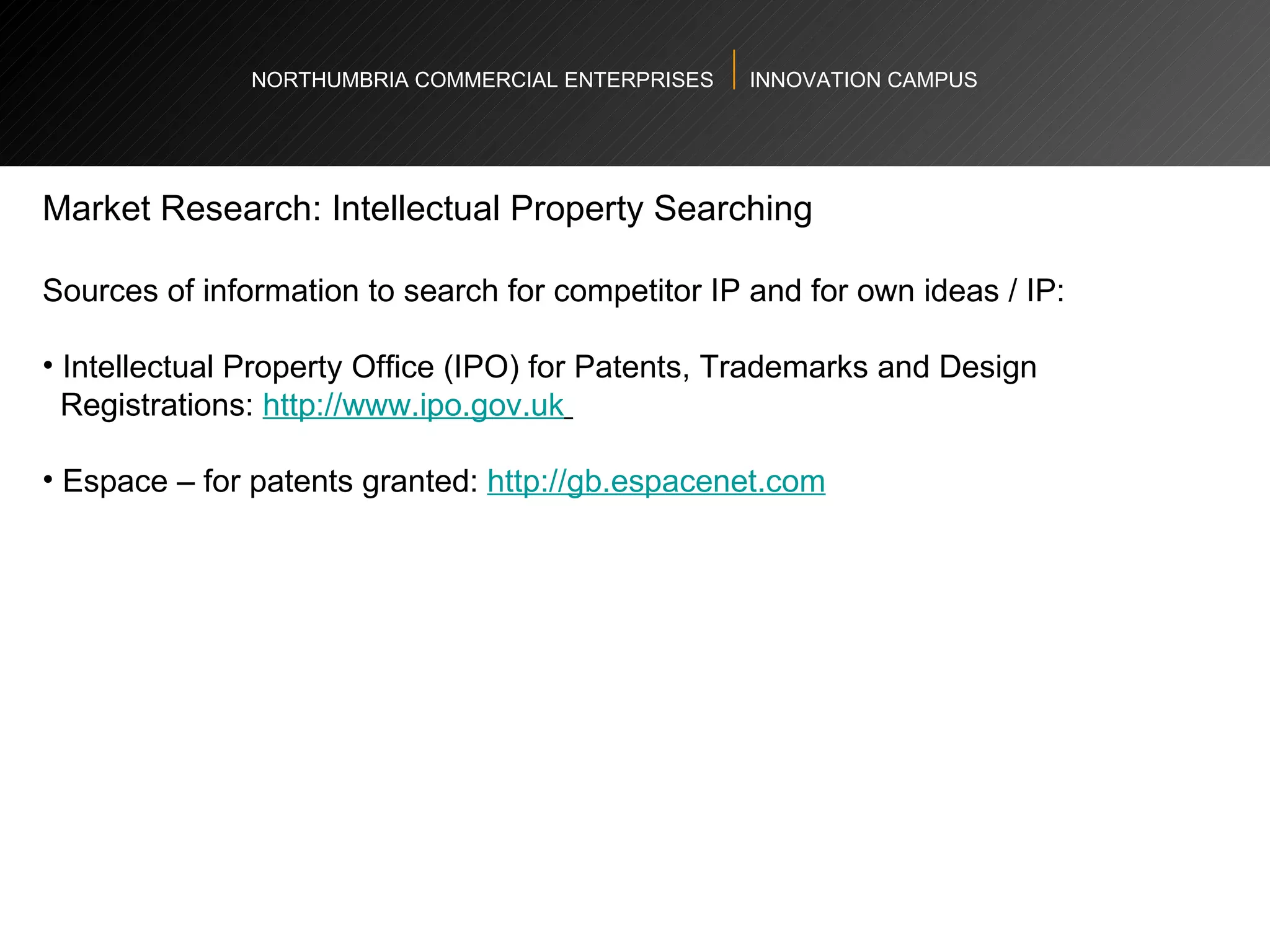
NORTHUMBRIA COMMERCIAL ENTERPRISES  INNOVATION CAMPUS Market Research: Intellectual Property Searching  Sources of information to search for competitor IP and for own ideas / IP: Intellectual Property Office (IPO) for Patents, Trademarks and Design  Registrations:  http://www.ipo.gov.uk   Espace – for patents granted:  http://gb.espacenet.com
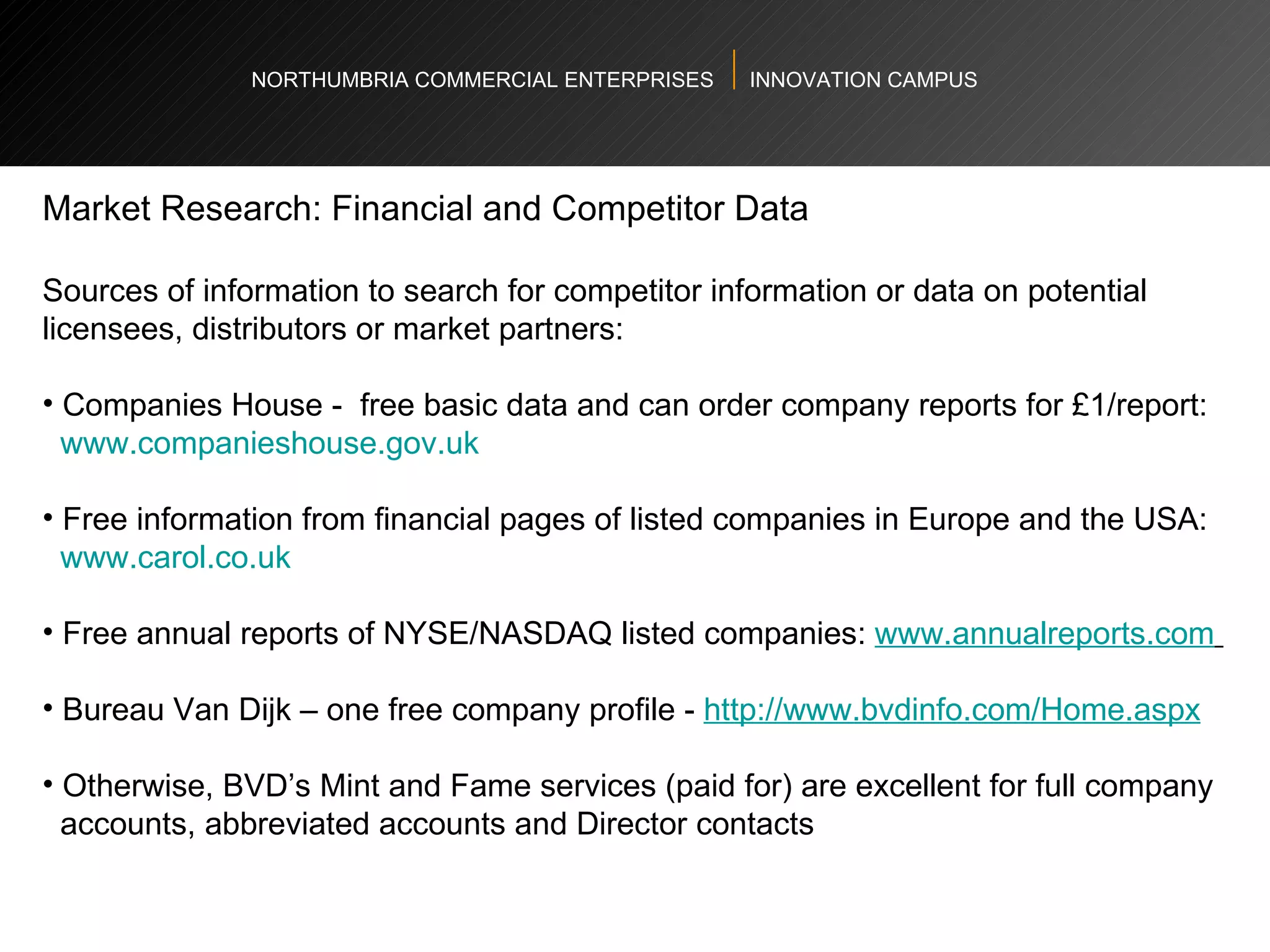
NORTHUMBRIA COMMERCIAL ENTERPRISES  INNOVATION CAMPUS Market Research: Financial and Competitor Data  Sources of information to search for competitor information or data on potential licensees, distributors or market partners: Companies House -  free basic data and can order company reports for £1/report: www.companieshouse.gov.uk   Free information from financial pages of listed companies in Europe and the USA: www.carol.co.uk   Free annual reports of NYSE/NASDAQ listed companies:  www.annualreports.com   Bureau Van Dijk – one free company profile -  http://www.bvdinfo.com/Home.aspx   Otherwise, BVD’s Mint and Fame services (paid for) are excellent for full company  accounts, abbreviated accounts and Director contacts
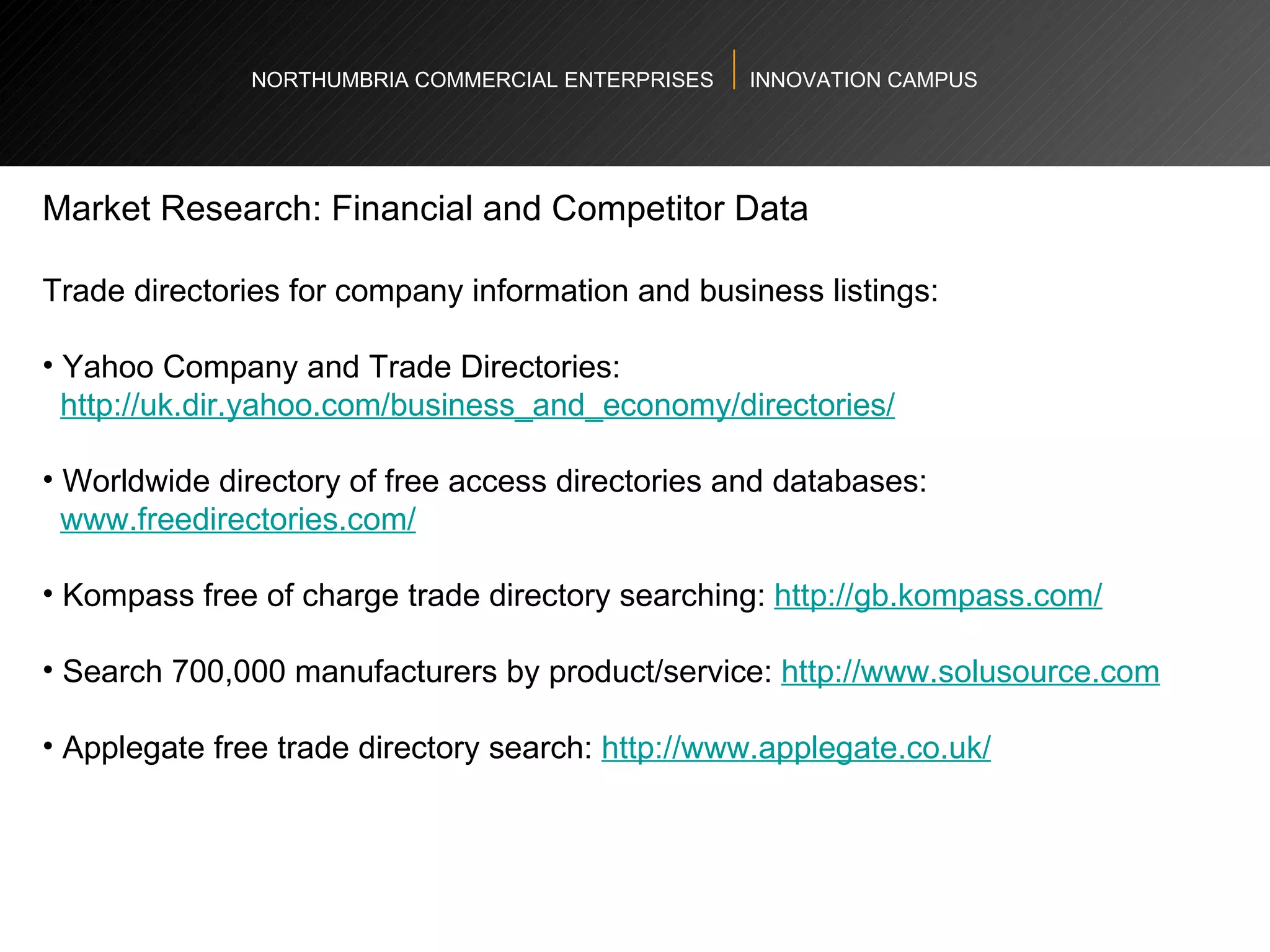
NORTHUMBRIA COMMERCIAL ENTERPRISES  INNOVATION CAMPUS Market Research: Financial and Competitor Data  Trade directories for company information and business listings: Yahoo Company and Trade Directories:  http://uk.dir.yahoo.com/business_and_economy/directories/   Worldwide directory of free access directories and databases: www.freedirectories.com/   Kompass free of charge trade directory searching:  http://gb.kompass.com/   Search 700,000 manufacturers by product/service:  http://www.solusource.com   Applegate free trade directory search:  http://www.applegate.co.uk/
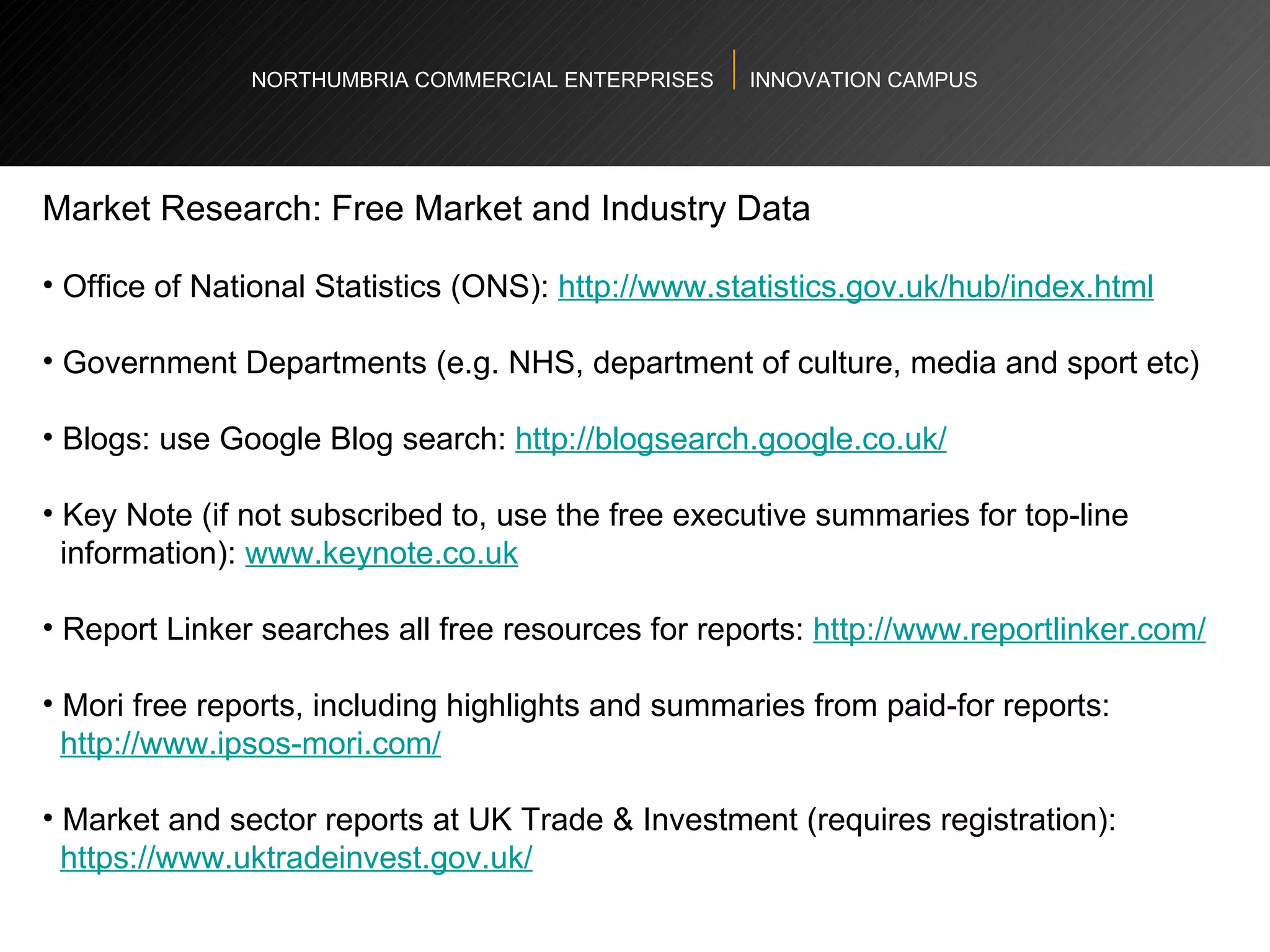
NORTHUMBRIA COMMERCIAL ENTERPRISES  INNOVATION CAMPUS Market Research: Free Market and Industry Data  Office of National Statistics (ONS):  http://www.statistics.gov.uk/hub/index.html   Government Departments (e.g. NHS, department of culture, media and sport etc)  Blogs: use Google Blog search:  http://blogsearch.google.co.uk/   Key Note (if not subscribed to, use the free executive summaries for top-line  information):  www.keynote.co.uk   Report Linker searches all free resources for reports:  http://www.reportlinker.com/   Mori free reports, including highlights and summaries from paid-for reports: http://www.ipsos-mori.com/   Market and sector reports at UK Trade & Investment (requires registration): https://www.uktradeinvest.gov.uk/
NORTHUMBRIA COMMERCIAL ENTERPRISES  INNOVATION CAMPUS Market Research: Business Opportunities  Set up tender monitoring for business opportunities via free sites:  Free public sector Tender monitoring service:  http://www.supply2.gov.uk/   Tenders Electronic Daily (TED):  http://www.tenders.com/   Websites of key organisations seeking to appoint service providers where tenders  may be published
NORTHUMBRIA COMMERCIAL ENTERPRISES  INNOVATION CAMPUS Paid-For Resources (A Small Selection of the Useful Ones) The University may be able to provide or access these at no cost to you:  Mintel:  http://reports.mintel.com   MarketResearch.com (120,000 market research reports):  ww.marketresearch.com/   Research and Markets:  http://www.researchandmarkets.com/   Datamonitor:  http://www.datamonitor.com/   Euromonitor:  http://www.euromonitor.com/   Technology Markets: Frost & Sullivan:  www.frost.com/prod/servlet/frost-home.pag   IT Industry: Gartner:  http://www.gartner.com/technology/home.jsp
NORTHUMBRIA COMMERCIAL ENTERPRISES  INNOVATION CAMPUS Licensing Based Exploitation Strategy: Pro’s  Requires substantially less cost to commercialise your IP: costs are largely front- ended (R&D, IP Protection, Commercialisation, Licensing Agreement)  Requires substantially less management time and resources and has little/no  ongoing costs, other than patent renewals, accounting fees and incidental costs A third party assumes the risk of commercialising your IP An established player will be able to get your product to market quicker than you  can and possibly generate higher sales volumes than a start-up would  Although you are giving away a larger share of the profitability, the likelihood is the  licensee is capturing a share of a larger opportunity  Licensing provides passive and secondary income streams for the inventor who  can be working on other ideas
NORTHUMBRIA COMMERCIAL ENTERPRISES  INNOVATION CAMPUS Licensing Based Exploitation Strategy: Con’s  A less equitable business model for the entrepreneur or inventor  Entirely reliant on a third party to commercialise your IP  Less relevant for service-based businesses Less likely to attract funding from investors or VC’s because its deemed less of a  scalable business model You are an invisible entity to the end-user – the licensee is associated with the IP Doesn't lend itself as well to service businesses
NORTHUMBRIA COMMERCIAL ENTERPRISES  INNOVATION CAMPUS Manufacturing / Scalable Trading Business: Pro’s  Building a scalable business is more equitable and financially rewarding (in the  longer-term)  More personally rewarding / fulfilling  The inventor / entrepreneur retains control  A manufacturing business is more attractive to an investor or VC Will attract higher grant funding
NORTHUMBRIA COMMERCIAL ENTERPRISES  INNOVATION CAMPUS Manufacturing / Scalable Trading Business: Con’s Requires higher financing and has high cash demands during the early trading  stages  Some markets (e.g. consumer products) have higher barriers for entry for start- up’s  Requires significant investment of time and resources  Unlikely to return high profits in the short-term unless robust and clear routes to  market are established
NORTHUMBRIA COMMERCIAL ENTERPRISES  INNOVATION CAMPUS Go to Market Strategy: Licensing  There is a basic process to follow for licensing IP / Technology:  Map out the potential application markets for your product, service or technology Undertake due diligence on each of those application markets: - Market size  - Historical performance (growth, decline, stagnation)  - Market trends and key issues  - Sales channels and routes into the sector (distributors, intermediaries, agents)  - Barriers to entry (technological / legislative etc.)  Identify the potential end-users of your product, service or technology within those application markets Go back up the supply chain by one immediate step to the organisations supplying those end users
NORTHUMBRIA COMMERCIAL ENTERPRISES  INNOVATION CAMPUS Go to Market Strategy: Licensing  Look at strategic fit of each major player to your IP:  Is your product, service or technology complimentary as an add on to the  company’s existing core range? Are they manufacturing similar products/services/technologies where your IP  would be a logical add-on?  - Do you have visibility on their major customers and key markets? Do they have manufacturing capability or are they merely a sales  organisation?
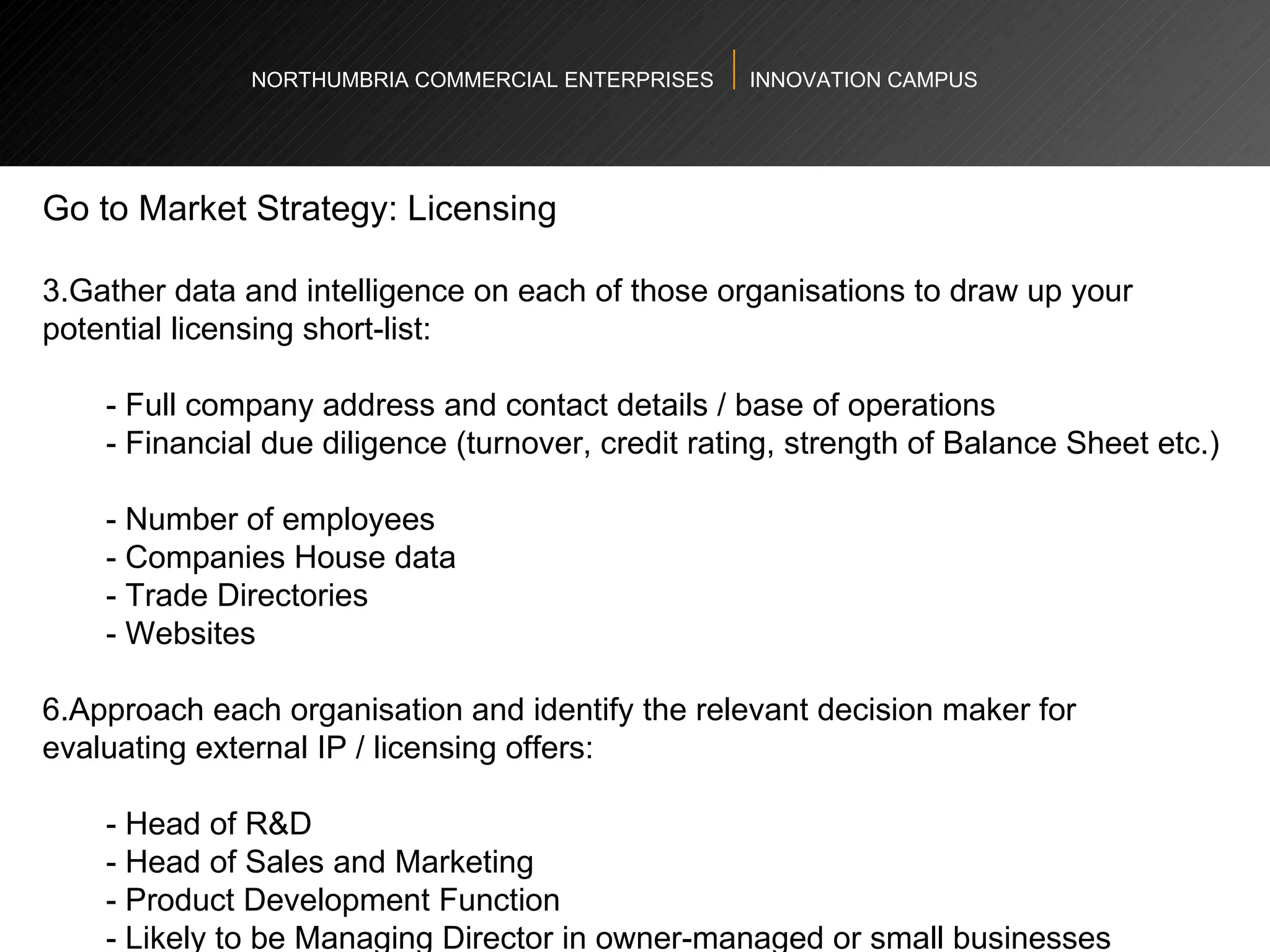
NORTHUMBRIA COMMERCIAL ENTERPRISES  INNOVATION CAMPUS Go to Market Strategy: Licensing  Gather data and intelligence on each of those organisations to draw up your potential licensing short-list:   - Full company address and contact details / base of operations  - Financial due diligence (turnover, credit rating, strength of Balance Sheet etc.)  - Number of employees  - Companies House data  - Trade Directories  - Websites  Approach each organisation and identify the relevant decision maker for evaluating external IP / licensing offers: - Head of R&D  - Head of Sales and Marketing  - Product Development Function  - Likely to be Managing Director in owner-managed or small businesses
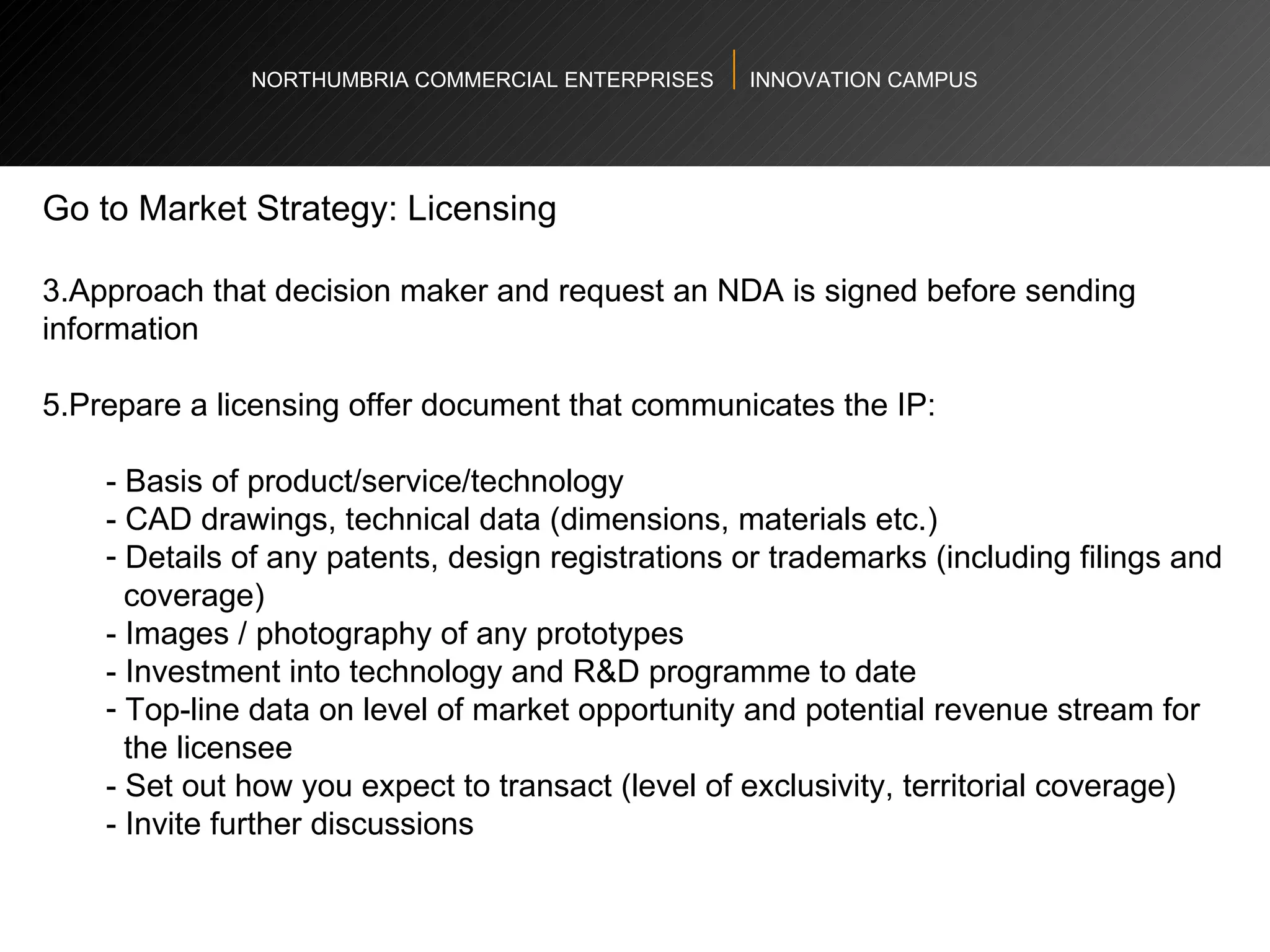
NORTHUMBRIA COMMERCIAL ENTERPRISES  INNOVATION CAMPUS Go to Market Strategy: Licensing  Approach that decision maker and request an NDA is signed before sending information Prepare a licensing offer document that communicates the IP:   - Basis of product/service/technology  - CAD drawings, technical data (dimensions, materials etc.)  Details of any patents, design registrations or trademarks (including filings and  coverage)  - Images / photography of any prototypes  - Investment into technology and R&D programme to date  Top-line data on level of market opportunity and potential revenue stream for  the licensee  - Set out how you expect to transact (level of exclusivity, territorial coverage)  - Invite further discussions
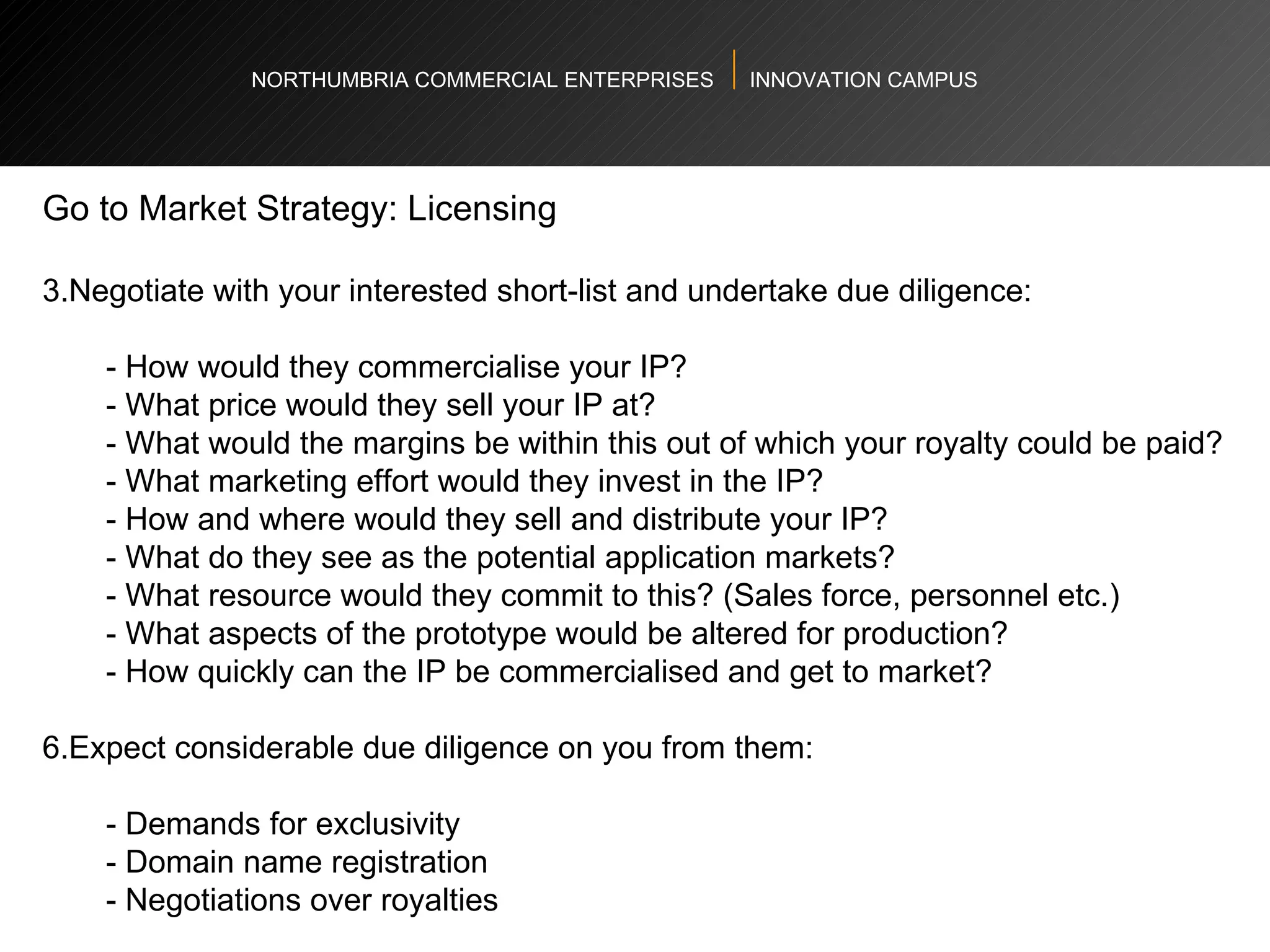
NORTHUMBRIA COMMERCIAL ENTERPRISES  INNOVATION CAMPUS Go to Market Strategy: Licensing  Negotiate with your interested short-list and undertake due diligence: - How would they commercialise your IP?  - What price would they sell your IP at?  - What would the margins be within this out of which your royalty could be paid?  - What marketing effort would they invest in the IP?  - How and where would they sell and distribute your IP?  - What do they see as the potential application markets? - What resource would they commit to this? (Sales force, personnel etc.) - What aspects of the prototype would be altered for production?  - How quickly can the IP be commercialised and get to market?    Expect considerable due diligence on you from them:    - Demands for exclusivity  - Domain name registration  - Negotiations over royalties
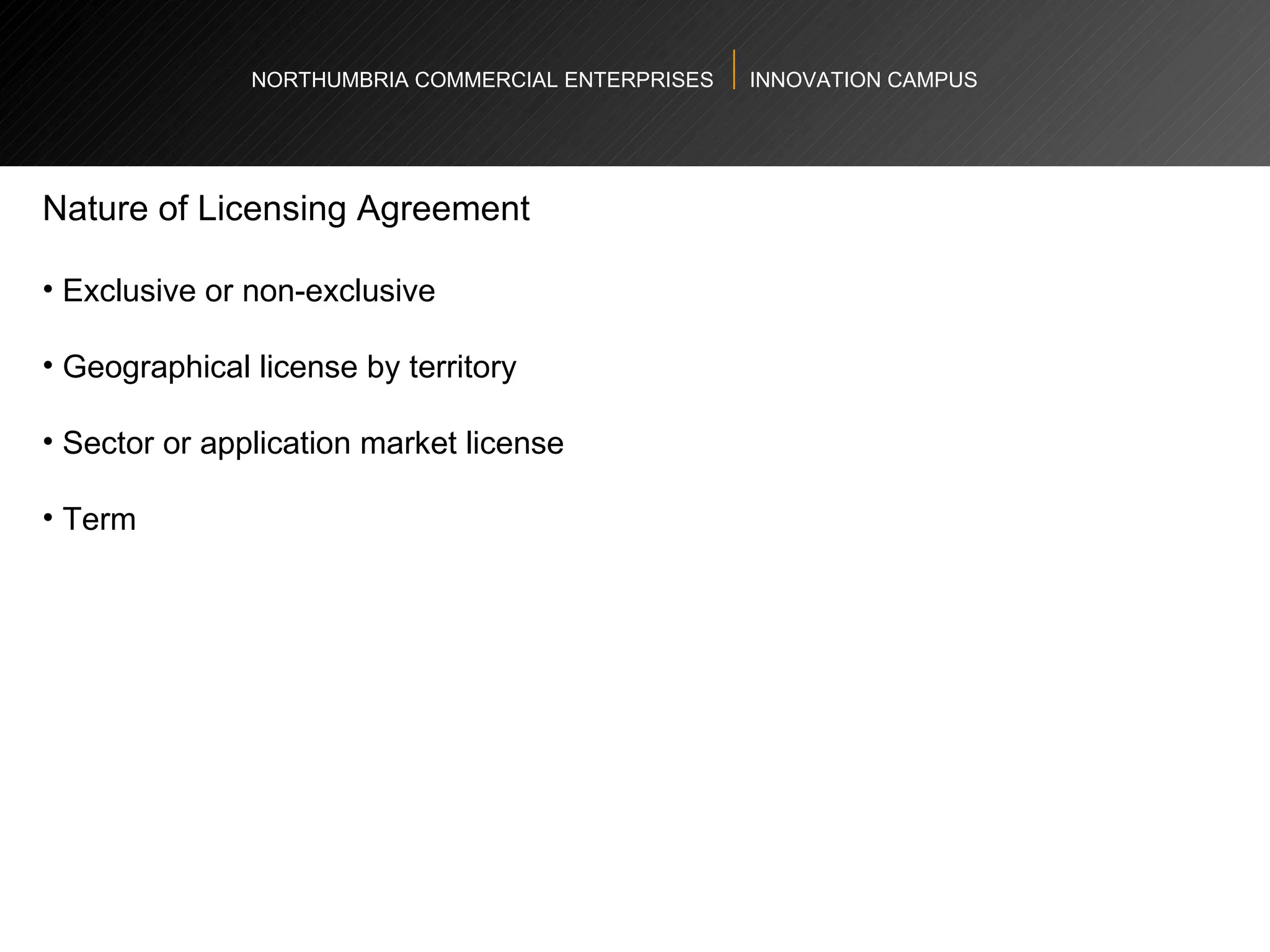
NORTHUMBRIA COMMERCIAL ENTERPRISES  INNOVATION CAMPUS Nature of Licensing Agreement  Exclusive or non-exclusive  Geographical license by territory  Sector or application market license  Term
NORTHUMBRIA COMMERCIAL ENTERPRISES  INNOVATION CAMPUS Negotiating Royalties for Licensing: Valuing IP There are no hard and fast rules. Key considerations include:  Anticipated volume levels Value of product and end user price (including margins)  Level of further investment licensee may need to make in R&D and  commercialisation (amortised over manufacturing) – i.e. how quickly can they  recover initial investment?  Ease of product imitation and strength of security on the IP (are competitors locked  out?)  Competitor products – is anyone else manufacturing or offering similar  products/services?
NORTHUMBRIA COMMERCIAL ENTERPRISES  INNOVATION CAMPUS Negotiating Royalties for Licensing: Valuing IP Further considerations include:  Bear in mind a patent can be on a novel feature/component within a product so  there could still be similar products/services competing within a marketplace Market conditions (price driven or value driven)  Royalties can range from 3% to 20% (rarely higher) Higher end royalties tend to be associated with lower volume, high value products /  services or a major disruptive technological innovation  Lower end royalties tend to be associated with higher volume, lower value  products/services  The overall commercial transaction you negotiate also influences royalties (more  later)
NORTHUMBRIA COMMERCIAL ENTERPRISES  INNOVATION CAMPUS Tactics to Strengthen Your Negotiating Position to Increase Royalties Value your IP strongly on the potential revenue opportunity for the licensee  (“business case selling”) If the IP is a major innovation and no prior market exists, value strongly on other  trends, such as market and technological drivers (build your case positively)  Have your prototype as well developed as possible – (reduce the level of  expenditure likely to be incurred by the licensee and subsequently risk)  Ensure you are well prepared and knowledgeable on the technology and market  opportunity (this makes you more investible)  Know what concessions you’re prepared to grant (e.g. exclusivity / geographical  territories etc.)  Use an advisor – this is an investment, not a cost. Negotiating is a skill in its own  right.
NORTHUMBRIA COMMERCIAL ENTERPRISES  INNOVATION CAMPUS Considerations for Structuring Your Royalty Remuneration  Consider the following when structuring your deal:  Frequency of payments (quarterly, twice yearly, annually)  Seek minimum payments (irrespective of product sales) in addition to direct  royalties  Some licensors successfully negotiate an upfront license fee
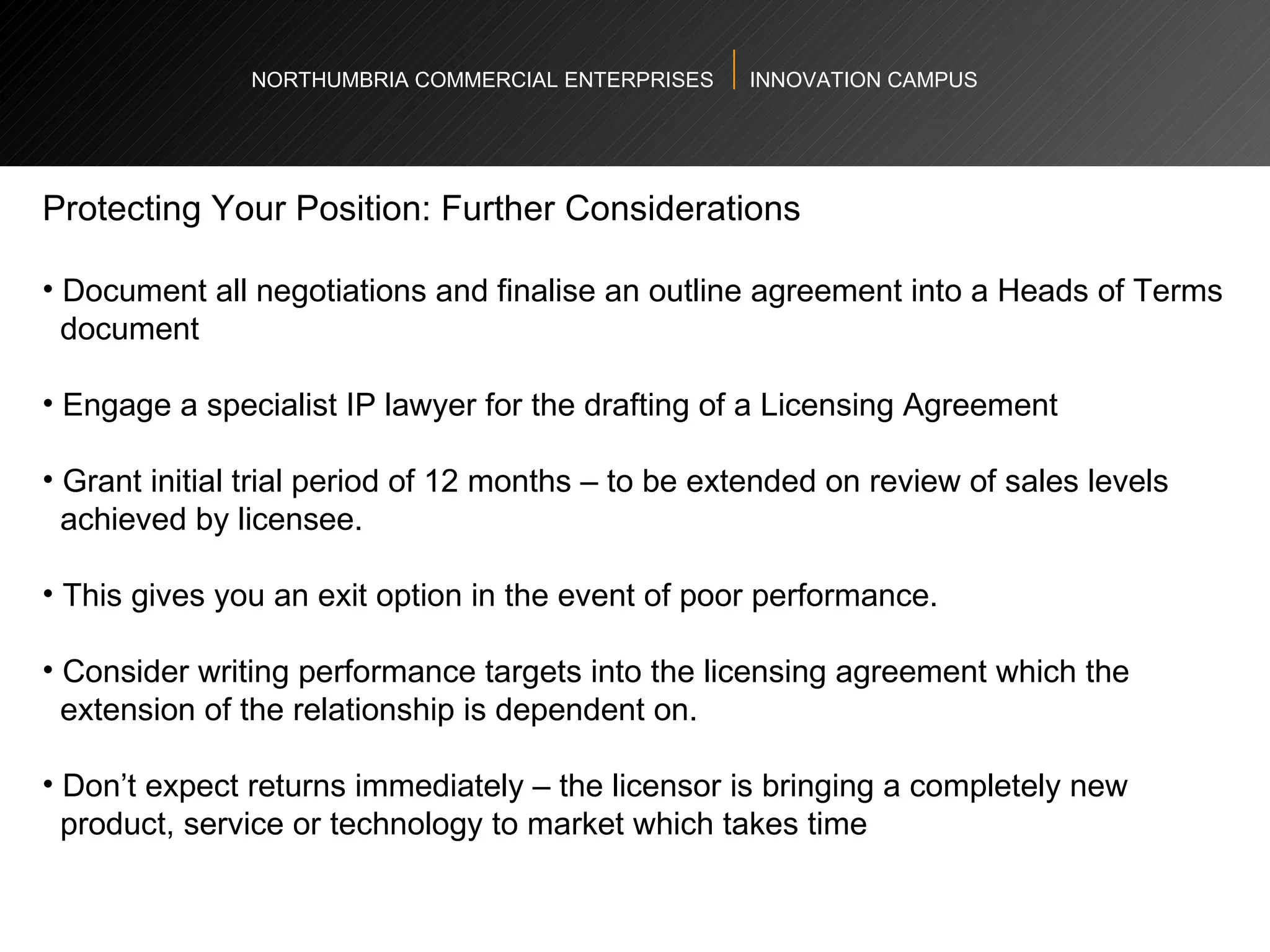
NORTHUMBRIA COMMERCIAL ENTERPRISES  INNOVATION CAMPUS Protecting Your Position: Further Considerations  Document all negotiations and finalise an outline agreement into a Heads of Terms  document  Engage a specialist IP lawyer for the drafting of a Licensing Agreement  Grant initial trial period of 12 months – to be extended on review of sales levels  achieved by licensee.  This gives you an exit option in the event of poor performance.  Consider writing performance targets into the licensing agreement which the  extension of the relationship is dependent on.  Don’t expect returns immediately – the licensor is bringing a completely new  product, service or technology to market which takes time
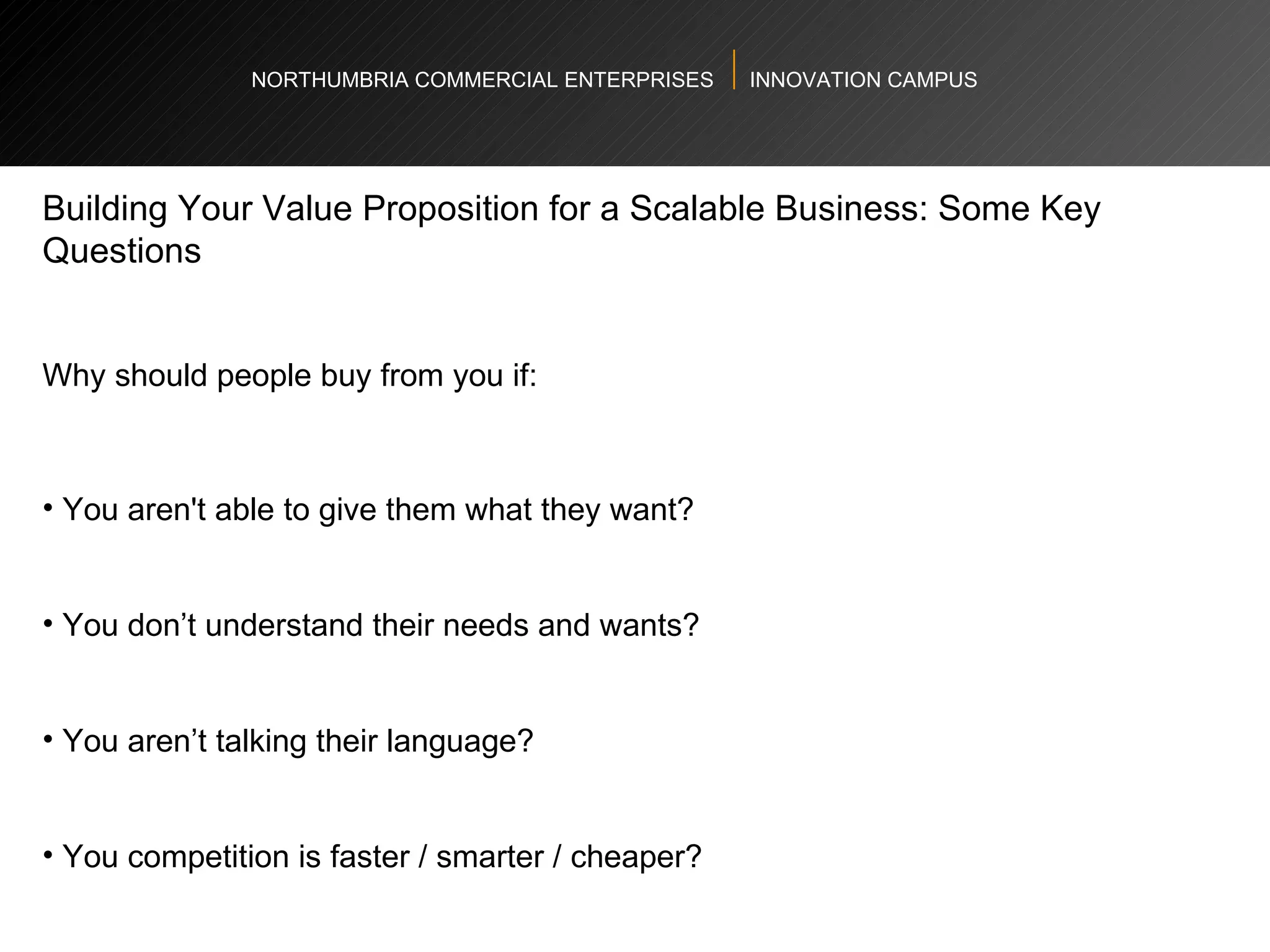
NORTHUMBRIA COMMERCIAL ENTERPRISES  INNOVATION CAMPUS Building Your Value Proposition for a Scalable Business: Some Key Questions  Why should people buy from you if:  You aren't able to give them what they want? You don’t understand their needs and wants?  You aren’t talking their language?  You competition is faster / smarter / cheaper?
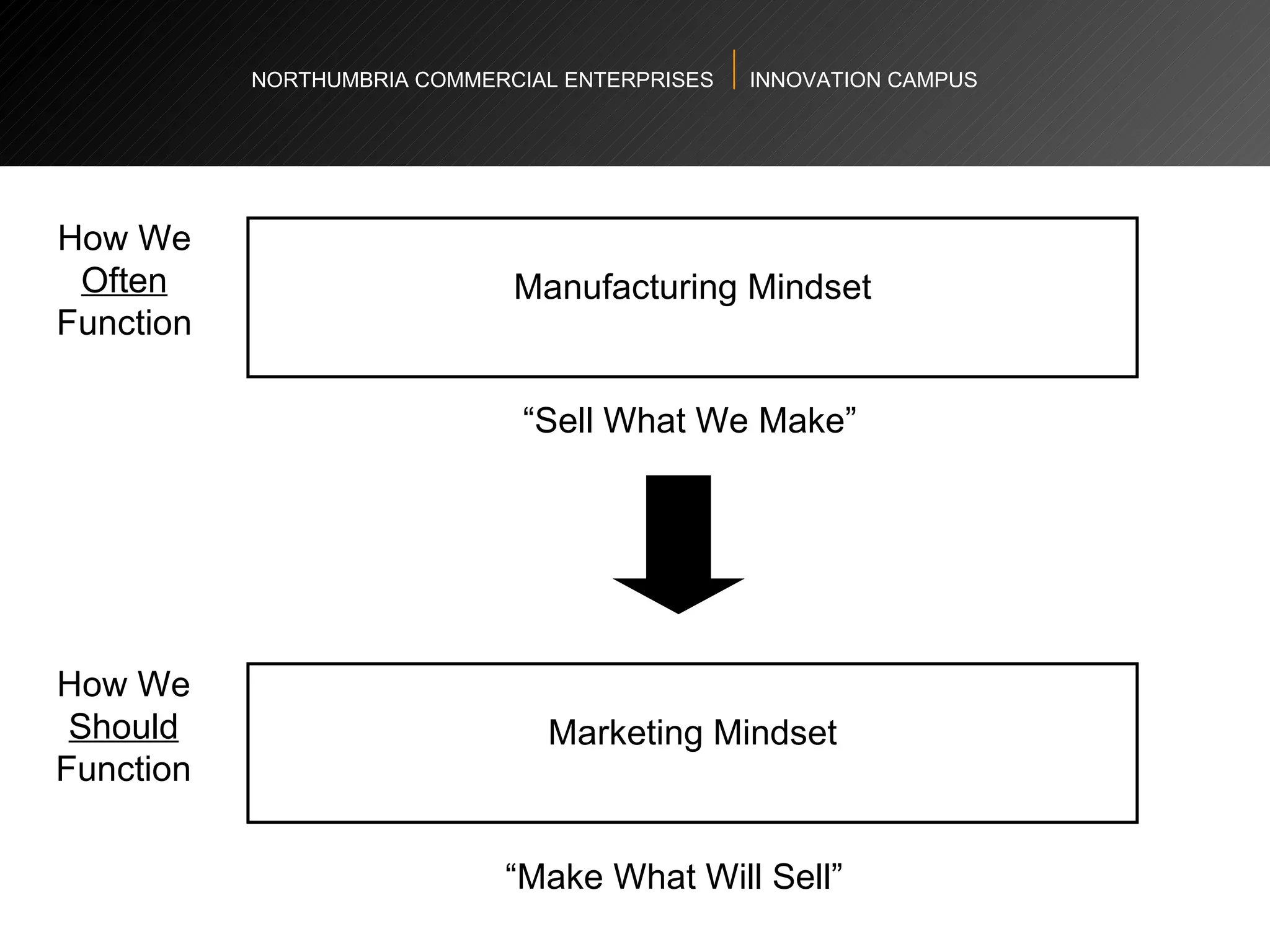
NORTHUMBRIA COMMERCIAL ENTERPRISES  INNOVATION CAMPUS Manufacturing Mindset “ Sell What We Make” “ Make What Will Sell” How We  Often  Function How We  Should  Function Marketing Mindset
“ MORE OF THE SAME” Don’t be a “Karaoke Product”
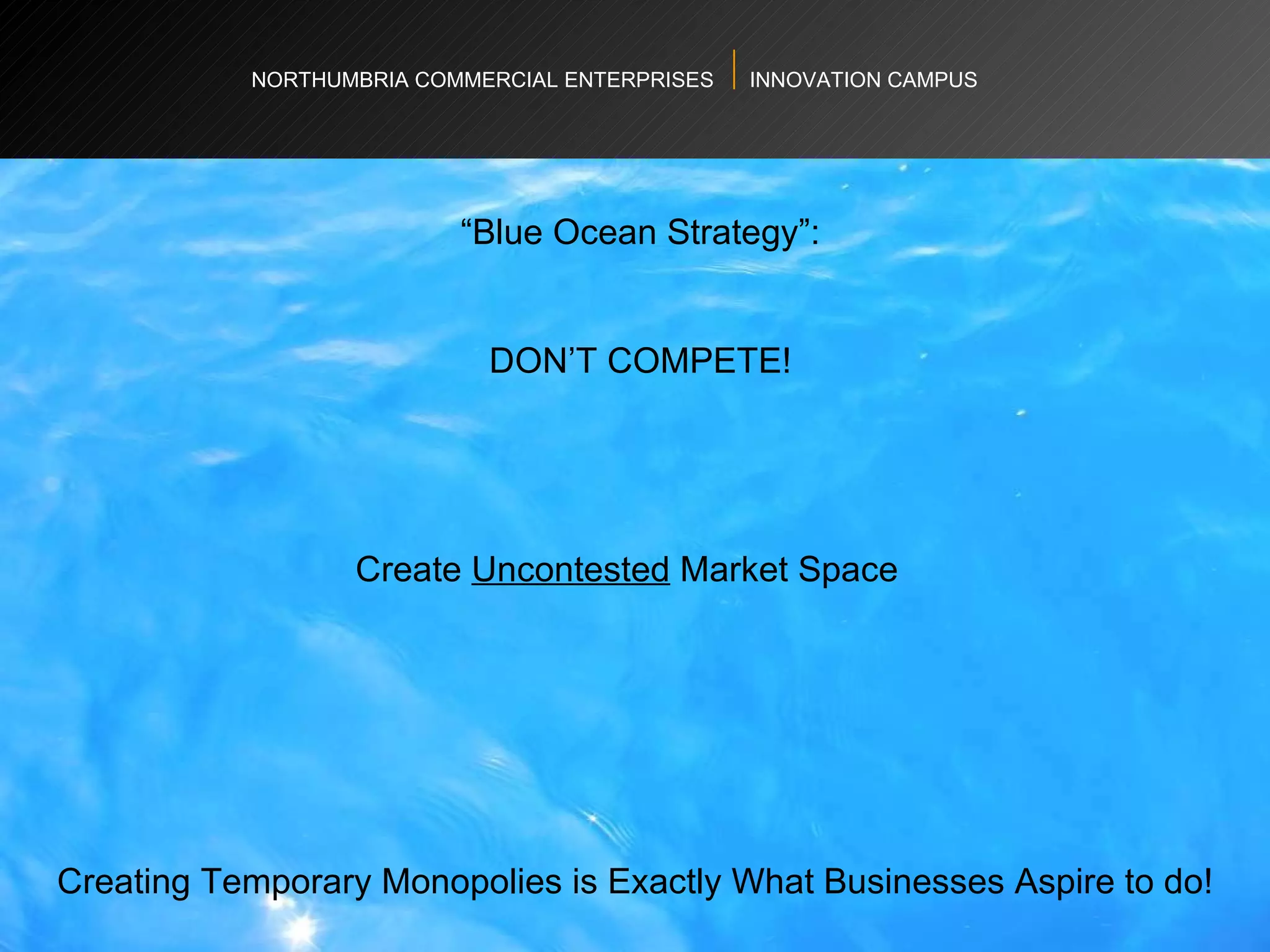
NORTHUMBRIA COMMERCIAL ENTERPRISES  INNOVATION CAMPUS Development “ Blue Ocean Strategy”: DON’T COMPETE! Create  Uncontested  Market Space  Creating Temporary Monopolies is Exactly What Businesses Aspire to do!
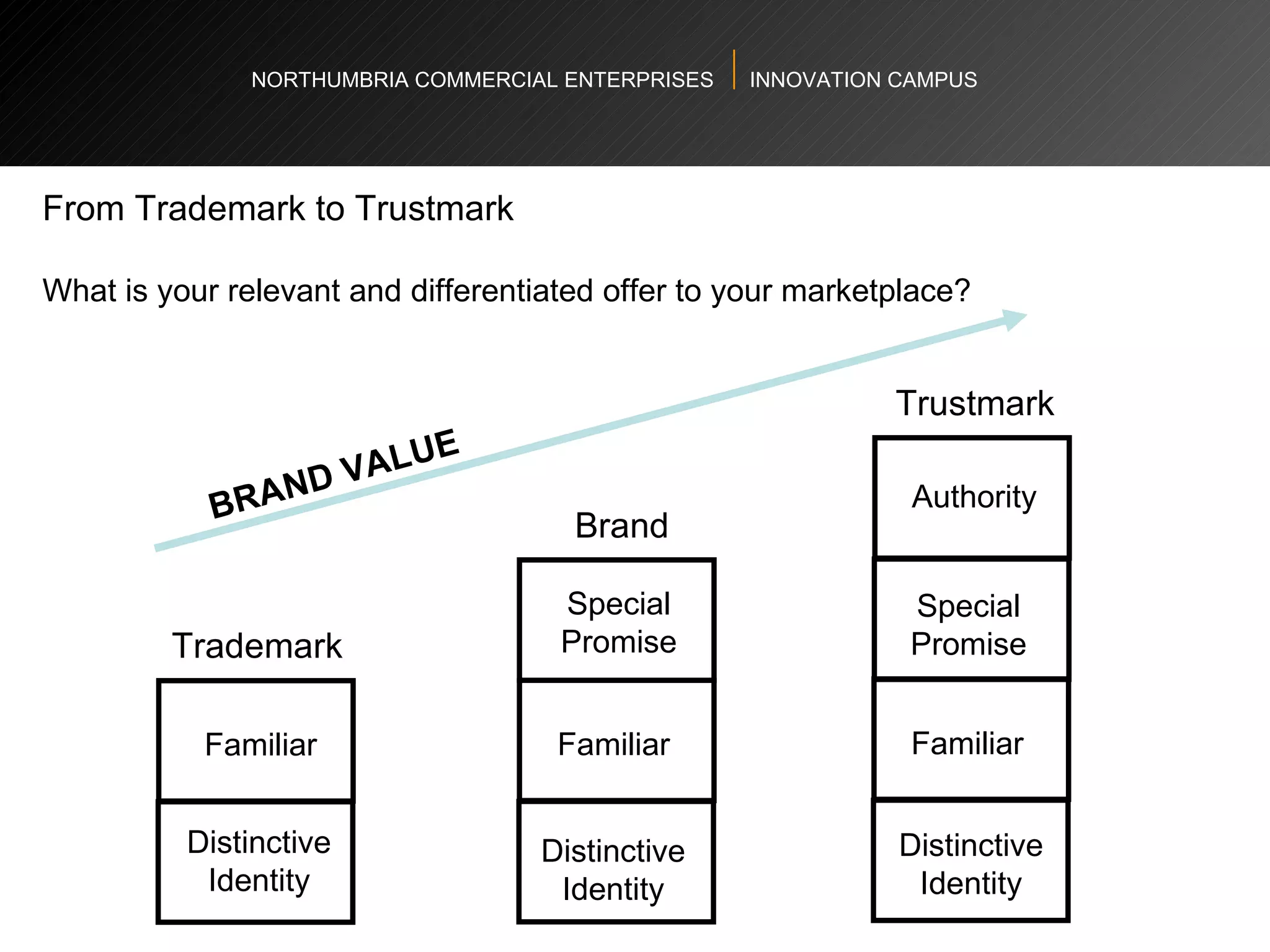
NORTHUMBRIA COMMERCIAL ENTERPRISES  INNOVATION CAMPUS From Trademark to Trustmark What is your relevant and differentiated offer to your marketplace?  BRAND VALUE Trademark Familiar Distinctive Identity Familiar Distinctive Identity Special Promise Brand Familiar Distinctive Identity Special Promise Authority Trustmark
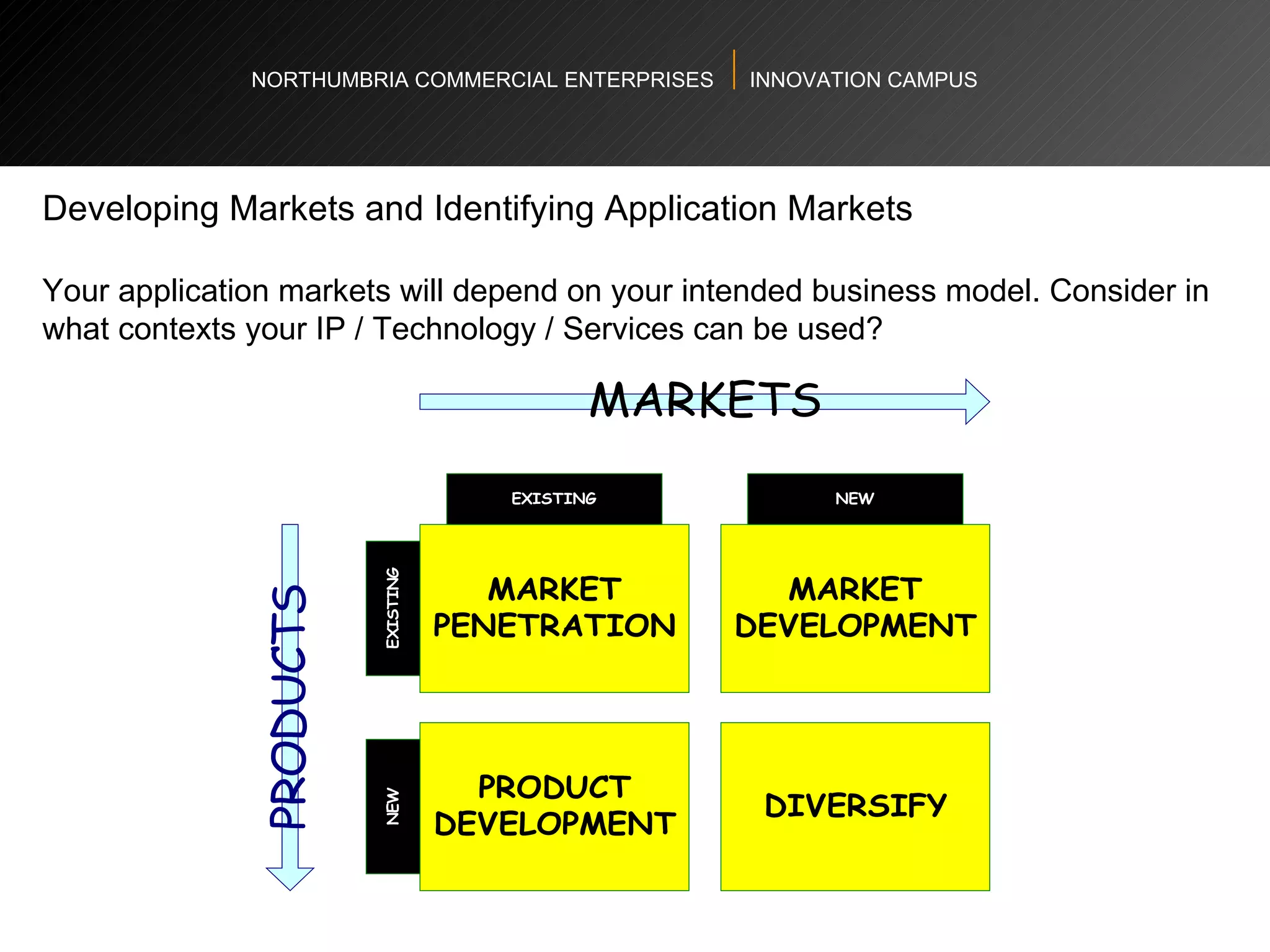
NORTHUMBRIA COMMERCIAL ENTERPRISES  INNOVATION CAMPUS Developing Markets and Identifying Application Markets  Your application markets will depend on your intended business model. Consider in what contexts your IP / Technology / Services can be used?
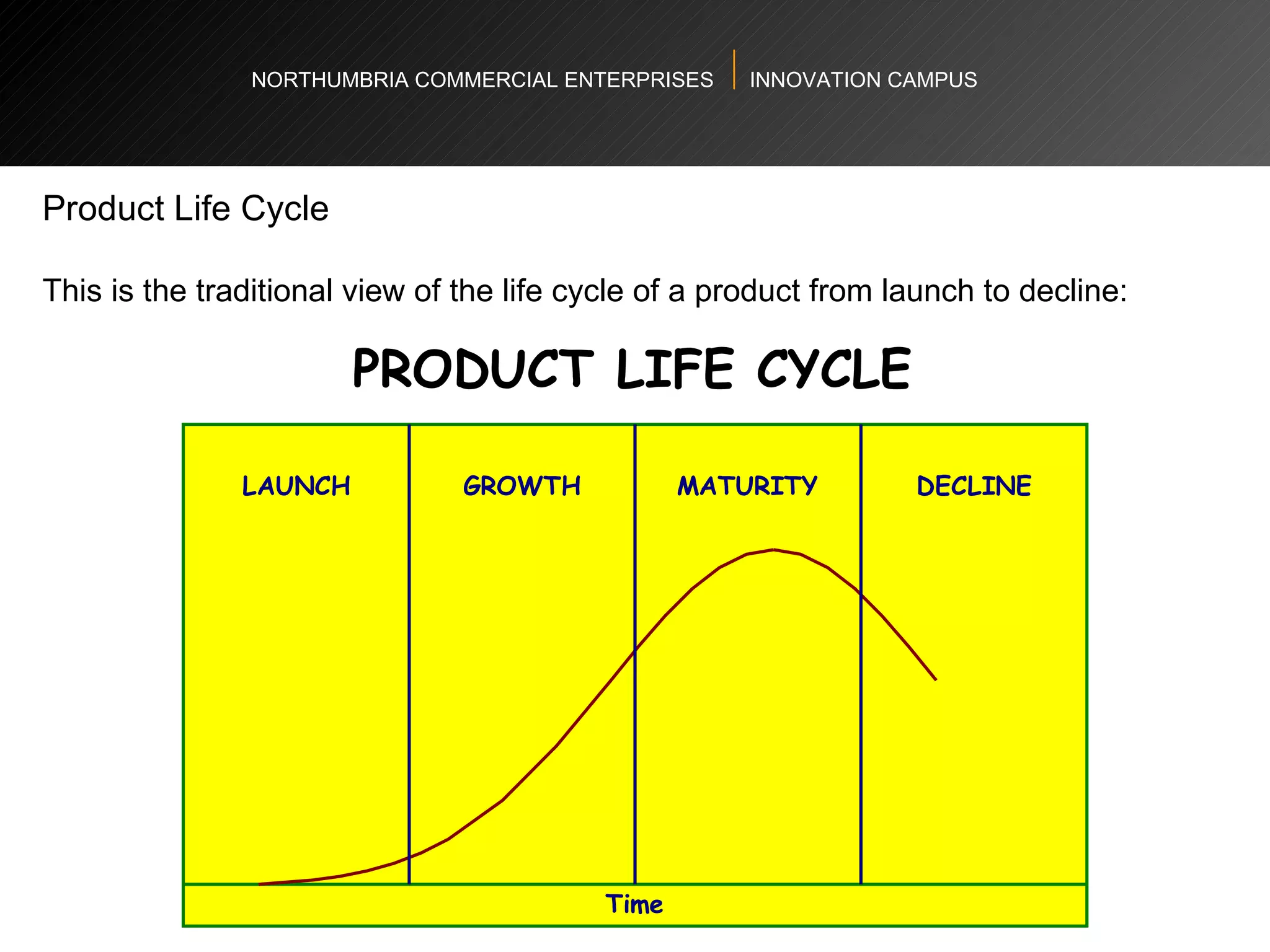
NORTHUMBRIA COMMERCIAL ENTERPRISES  INNOVATION CAMPUS Product Life Cycle  This is the traditional view of the life cycle of a product from launch to decline:
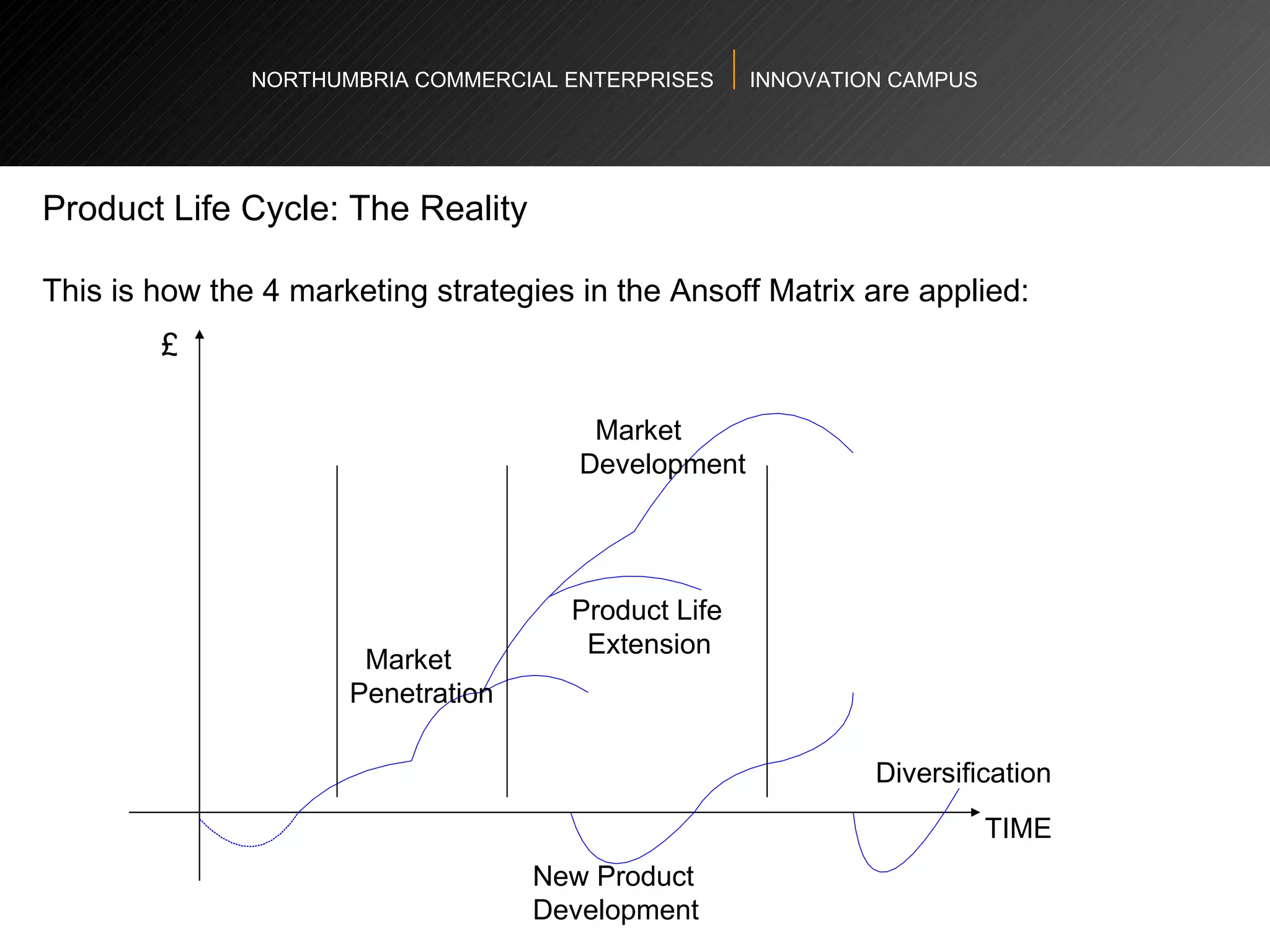
NORTHUMBRIA COMMERCIAL ENTERPRISES  INNOVATION CAMPUS Product Life Cycle: The Reality  This is how the 4 marketing strategies in the Ansoff Matrix are applied: £ TIME Market Penetration Product Life Extension New Product Development Market Development Diversification
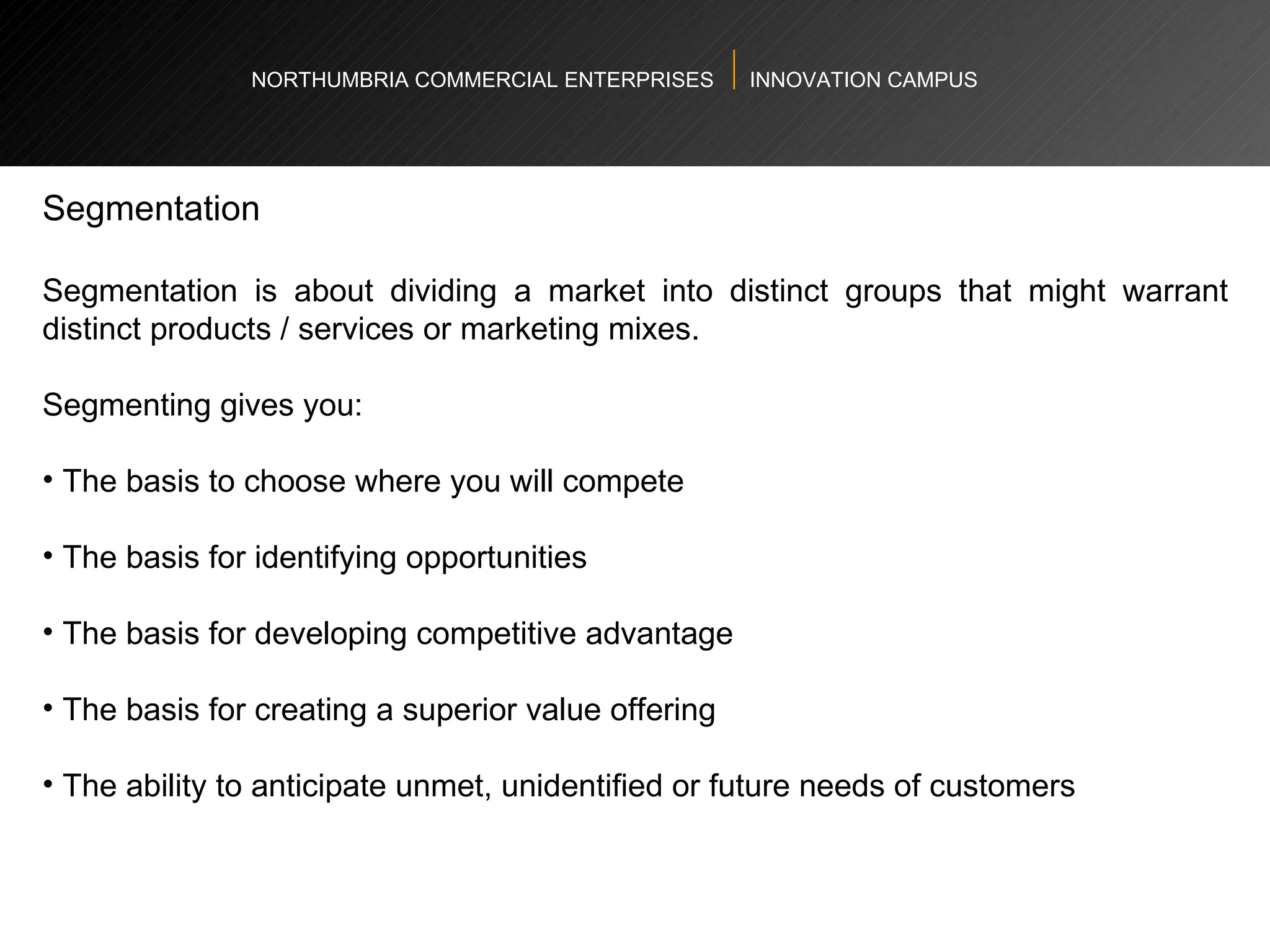
NORTHUMBRIA COMMERCIAL ENTERPRISES  INNOVATION CAMPUS Segmentation Segmentation is about dividing a market into distinct groups that might warrant distinct products / services or marketing mixes. Segmenting gives you:  The basis to choose where you will compete The basis for identifying opportunities The basis for developing competitive advantage The basis for creating a superior value offering The ability to anticipate unmet, unidentified or future needs of customers
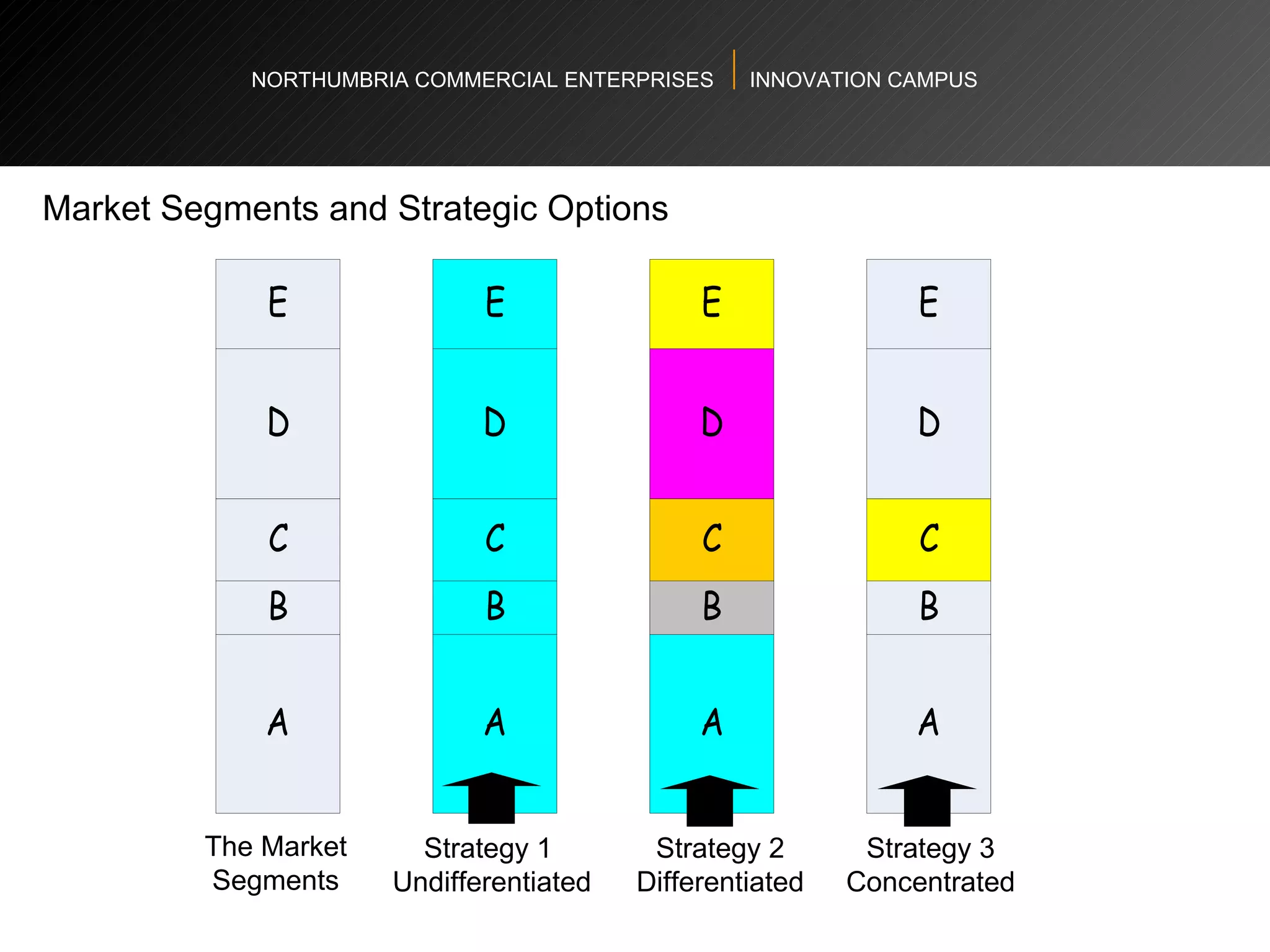
NORTHUMBRIA COMMERCIAL ENTERPRISES  INNOVATION CAMPUS Market Segments and Strategic Options The Market Segments Strategy 1  Undifferentiated Strategy 2 Differentiated Strategy 3 Concentrated
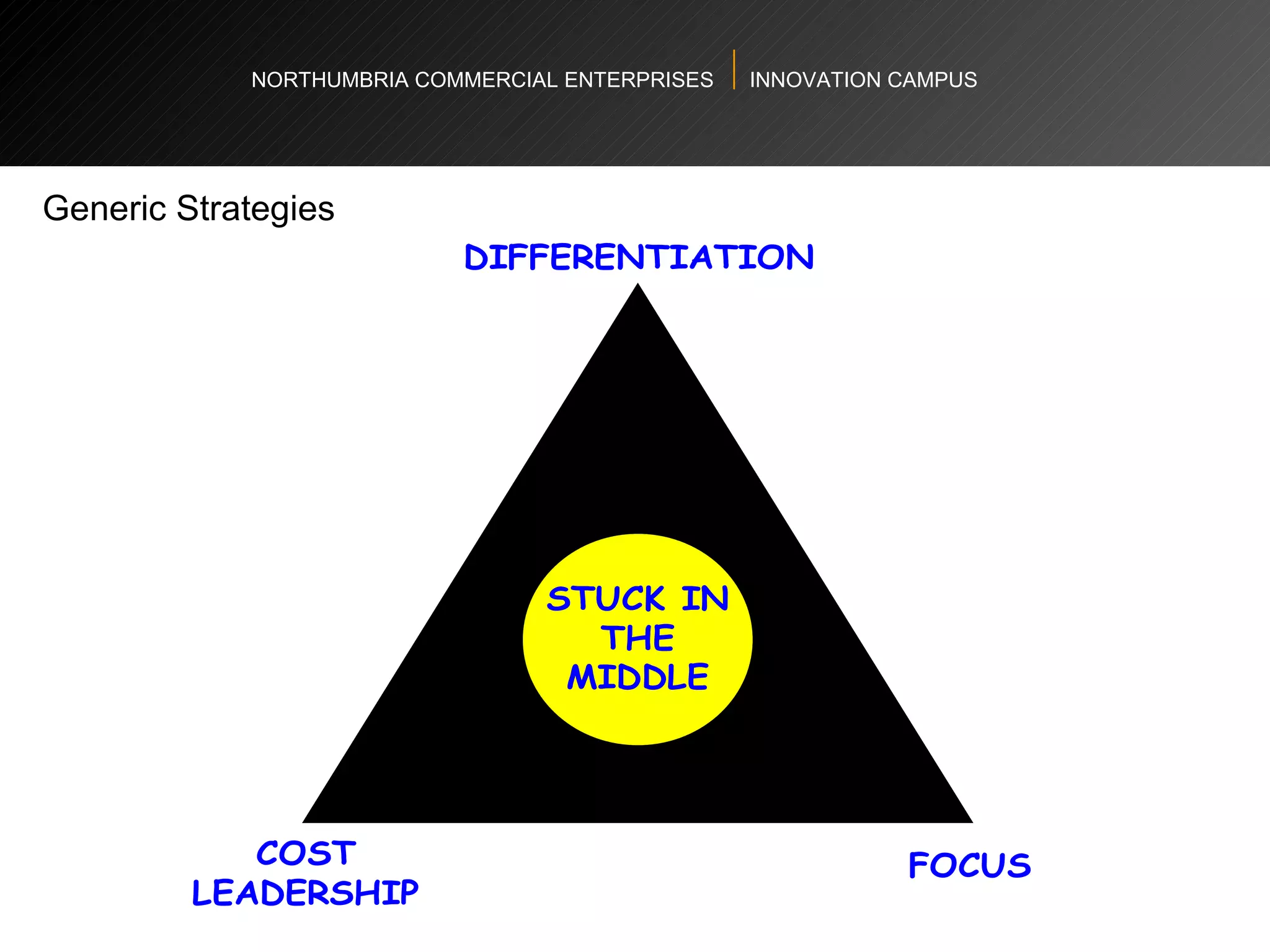
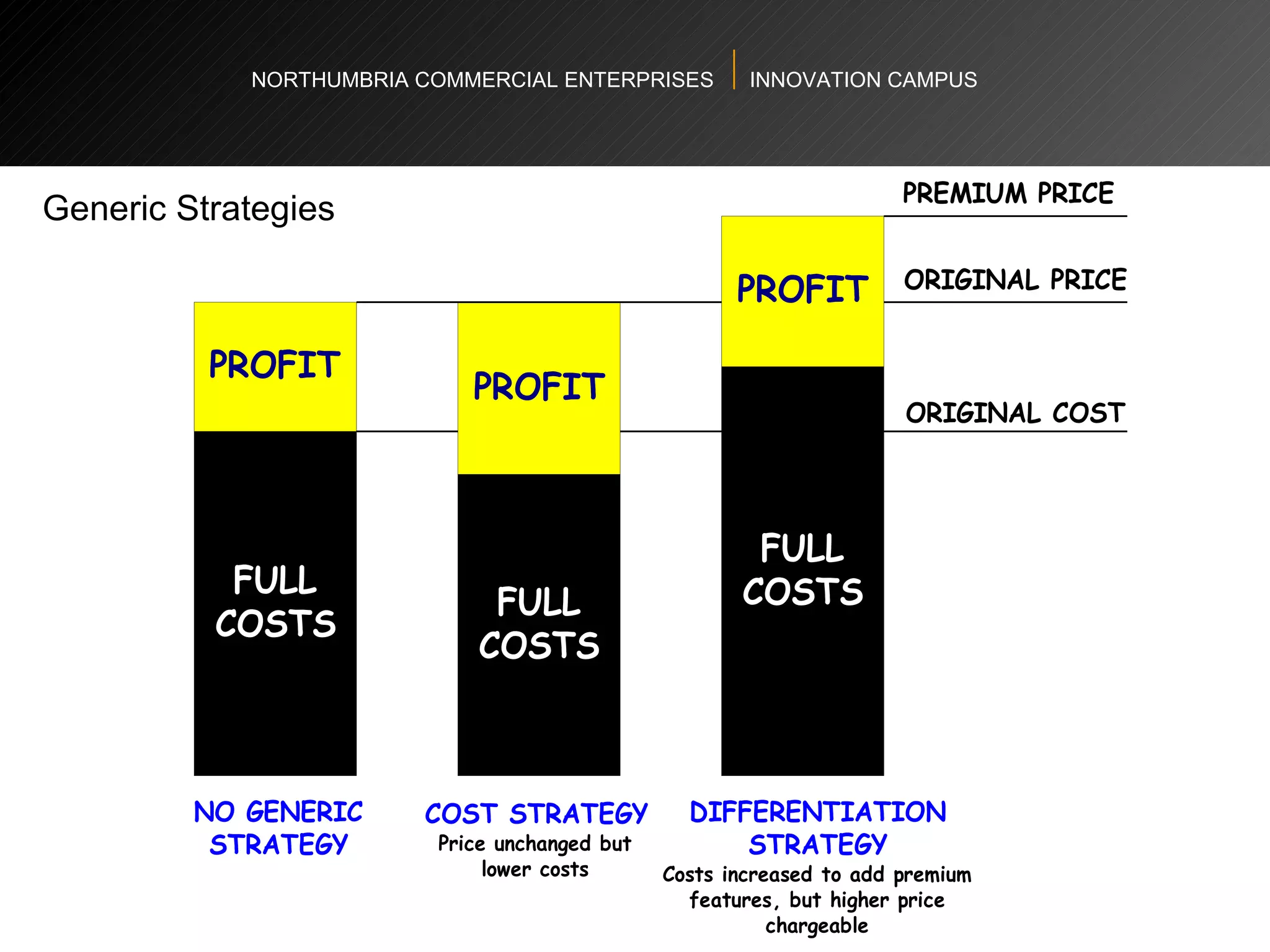
NORTHUMBRIA COMMERCIAL ENTERPRISES  INNOVATION CAMPUS Generic Strategies
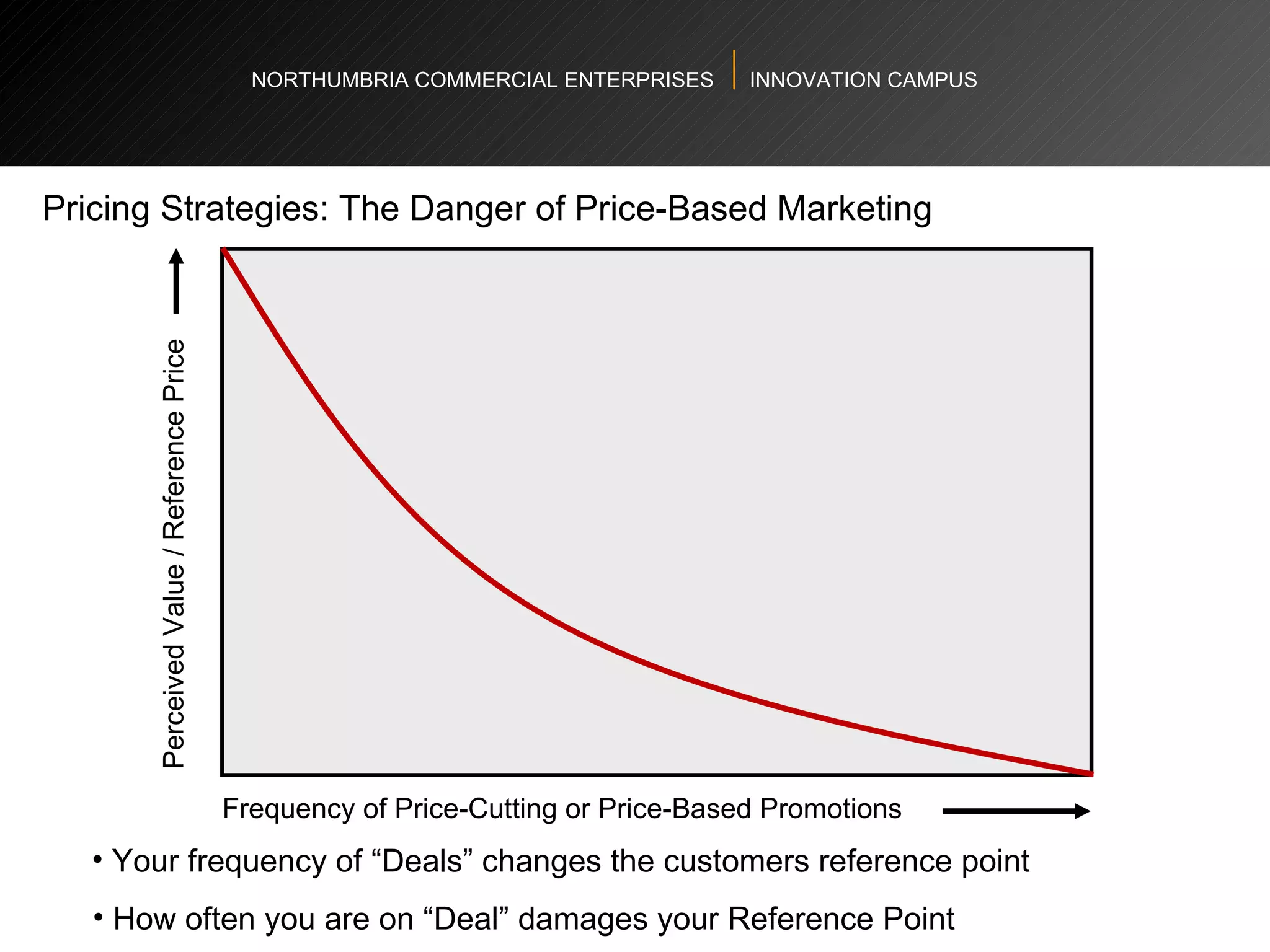
NORTHUMBRIA COMMERCIAL ENTERPRISES  INNOVATION CAMPUS Pricing Strategies: The Danger of Price-Based Marketing Your frequency of “Deals” changes the customers reference point  How often you are on “Deal” damages your Reference Point Frequency of Price-Cutting or Price-Based Promotions Perceived Value / Reference Price
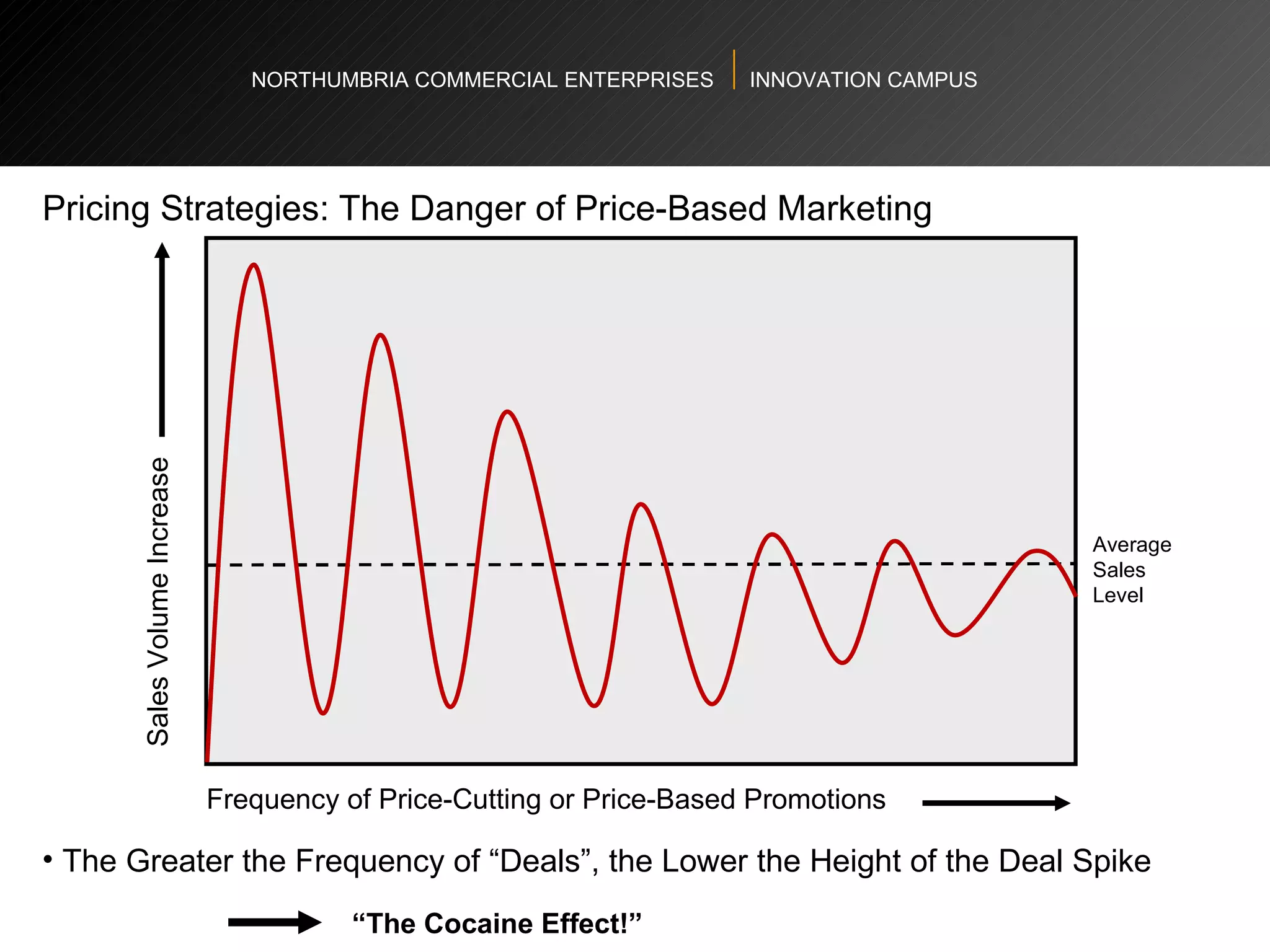
NORTHUMBRIA COMMERCIAL ENTERPRISES  INNOVATION CAMPUS Pricing Strategies: The Danger of Price-Based Marketing Frequency of Price-Cutting or Price-Based Promotions Sales Volume Increase The Greater the Frequency of “Deals”, the Lower the Height of the Deal Spike  Average Sales Level “ The Cocaine Effect!”
NORTHUMBRIA COMMERCIAL ENTERPRISES  INNOVATION CAMPUS Thanks for Listening ... Q&A Ross Golightly [email_address]   Tel: 07984 379 558 / 0191 4604126 www.twitter.com/RossGolightly www.spheraconsulting.co.uk
Workshop 5 slides

  • 1.
    Commercial Development ProgrammeCommercial Essentials Workshop 5 – Understanding, Finding and Developing Markets
  • 2.
    NORTHUMBRIA COMMERCIAL ENTERPRISES INNOVATION CAMPUS Ross Golightly
  • 3.
    NORTHUMBRIA COMMERCIAL ENTERPRISES INNOVATION CAMPUS Agenda Recap on Commercialisation Project Management Cycle Introduction to Marketing Defining Your Market Identifying Application Markets Characteristics of Different Markets Market Research: Sources of Information for Desk Research Basic Searching Strategies for Market Research Market Research Resources and Links Pro’s and Con’s of Different Exploitation Strategies Process for Licensing IP / Technology Licensing Agreements Valuing IP Negotiating Tactics Royalties Value Proposition Development Marketing Strategies Segmentation Generic Strategies Pricing Strategies
  • 4.
    NORTHUMBRIA COMMERCIAL ENTERPRISES INNOVATION CAMPUS Commercialisation Project Management Cycle Risk Management Strategy IP Exploitation Concept Research Business Plan IP Protection Funding Package Product Dvpt Commercial- isation Working Capital Strategy Dvpt Market Research Company Set Up Idea Dvpt Revenue Generation
  • 5.
    NORTHUMBRIA COMMERCIAL ENTERPRISES INNOVATION CAMPUS Our Basic Function is to Create a Customer, profitably. This we do by focussing on Marketing and Innovation The rest are merely support functions where cost must be contained, reduced and waste eliminated Marketing and Innovation generate Margins! Margins generate profits!
  • 6.
    NORTHUMBRIA COMMERCIAL ENTERPRISES INNOVATION CAMPUS Define Your Research from the Perspective of Needs: A Market … £100m Value? (That’s Financial) … France and Germany? (That’s Geography) … High Street / On-Line? (That’s a Channel) A Market People with a Common Need or Want If You Start with a Definition of a Technology or Research Piece, You will never Define a Need!
  • 7.
    NORTHUMBRIA COMMERCIAL ENTERPRISES INNOVATION CAMPUS Developing Markets and Identifying Application Markets Your application markets will depend on your intended business model. Consider in what contexts your IP / Technology / Services can be used?
  • 8.
    NORTHUMBRIA COMMERCIAL ENTERPRISES INNOVATION CAMPUS Characteristics of Different Markets: Consumer Markets Simple supply chain with high visibility but difficult to enter as a start-up Usually manufacturer to retailer (and sometimes via distributor/wholesaler) More easy to map out the potential market through desk research Generally highly price driven and very product driven Aggressive marketing based on emotional pull of the product Multiple margin tiers: trade price to retailer, end-user price plus VAT uplift Generally two revenue stream options: 1) direct, 2) indirect (retail distribution) Twin marketing requirements: 1) Trade marketing and 2) Consumer marketing
  • 9.
    NORTHUMBRIA COMMERCIAL ENTERPRISES INNOVATION CAMPUS Characteristics of Different Markets: Industrial / B2B Markets More complex market structures with inter-dependent supply chains Think: application markets (especially for technology) Often difficult to quantify market size and characteristics (lots of data is “invisible” or unavailable) Performance-driven relationships (i.e. supply chain KPI’s, rate of defects etc.) Several stages in supply chains – e.g. Automotive and Aerospace tier 1 and 2 Distinction between OEM and Aftermarkets (two different product offers) Relationships and selling are often contractual or tender led (customer-supplier integration) High importance placed on quality
  • 10.
    NORTHUMBRIA COMMERCIAL ENTERPRISES INNOVATION CAMPUS Characteristics of Different Markets: Services Markets Lowest barriers to entry (easy to establish and less overheads) Relationship driven and less price sensitive Very little “consumer-type” marketing, such as advertising People to people marketing (i.e. networking, referrals, personal introductions) More smaller, focussed markets Proposition often based on exploitation of some level of intellectual capital Selling based on business value to the third party
  • 11.
    NORTHUMBRIA COMMERCIAL ENTERPRISES INNOVATION CAMPUS Market Research: Sources of Information for Desk Research Online information alone is doubling every 6 months Information is available: - On the web (free) - In the web (invisible) - Via the web (fee based) Knowing where to start looking for information is the key to success Search Strategies: - Know what you are looking for before you begin - Refine results - Use more than one search tool
  • 12.
    NORTHUMBRIA COMMERCIAL ENTERPRISES INNOVATION CAMPUS Basic Searching Strategies for Market Research Basic search strategies can greatly increase your recall of relevant information: Keywords – specific, unique and descriptive as possible Use parentheses to keep words and phrases together Use +/- to add or delete words from your search Think of word order – it does matter Define by further specificity: +statistics /+ map/+ database Limit search to title only: intitle: Limit search to text only: intext: Limit search to links only: inlink: Limit search to site type: site:edu Limit search by date: daterange: (start date-end date)
  • 13.
    NORTHUMBRIA COMMERCIAL ENTERPRISES INNOVATION CAMPUS Market Research: Intellectual Property Searching Sources of information to search for competitor IP and for own ideas / IP: Intellectual Property Office (IPO) for Patents, Trademarks and Design Registrations: http://www.ipo.gov.uk Espace – for patents granted: http://gb.espacenet.com
  • 14.
    NORTHUMBRIA COMMERCIAL ENTERPRISES INNOVATION CAMPUS Market Research: Financial and Competitor Data Sources of information to search for competitor information or data on potential licensees, distributors or market partners: Companies House - free basic data and can order company reports for £1/report: www.companieshouse.gov.uk Free information from financial pages of listed companies in Europe and the USA: www.carol.co.uk Free annual reports of NYSE/NASDAQ listed companies: www.annualreports.com Bureau Van Dijk – one free company profile - http://www.bvdinfo.com/Home.aspx Otherwise, BVD’s Mint and Fame services (paid for) are excellent for full company accounts, abbreviated accounts and Director contacts
  • 15.
    NORTHUMBRIA COMMERCIAL ENTERPRISES INNOVATION CAMPUS Market Research: Financial and Competitor Data Trade directories for company information and business listings: Yahoo Company and Trade Directories: http://uk.dir.yahoo.com/business_and_economy/directories/ Worldwide directory of free access directories and databases: www.freedirectories.com/ Kompass free of charge trade directory searching: http://gb.kompass.com/ Search 700,000 manufacturers by product/service: http://www.solusource.com Applegate free trade directory search: http://www.applegate.co.uk/
  • 16.
    NORTHUMBRIA COMMERCIAL ENTERPRISES INNOVATION CAMPUS Market Research: Free Market and Industry Data Office of National Statistics (ONS): http://www.statistics.gov.uk/hub/index.html Government Departments (e.g. NHS, department of culture, media and sport etc) Blogs: use Google Blog search: http://blogsearch.google.co.uk/ Key Note (if not subscribed to, use the free executive summaries for top-line information): www.keynote.co.uk Report Linker searches all free resources for reports: http://www.reportlinker.com/ Mori free reports, including highlights and summaries from paid-for reports: http://www.ipsos-mori.com/ Market and sector reports at UK Trade & Investment (requires registration): https://www.uktradeinvest.gov.uk/
  • 17.
    NORTHUMBRIA COMMERCIAL ENTERPRISES INNOVATION CAMPUS Market Research: Business Opportunities Set up tender monitoring for business opportunities via free sites: Free public sector Tender monitoring service: http://www.supply2.gov.uk/ Tenders Electronic Daily (TED): http://www.tenders.com/ Websites of key organisations seeking to appoint service providers where tenders may be published
  • 18.
    NORTHUMBRIA COMMERCIAL ENTERPRISES INNOVATION CAMPUS Paid-For Resources (A Small Selection of the Useful Ones) The University may be able to provide or access these at no cost to you: Mintel: http://reports.mintel.com MarketResearch.com (120,000 market research reports): ww.marketresearch.com/ Research and Markets: http://www.researchandmarkets.com/ Datamonitor: http://www.datamonitor.com/ Euromonitor: http://www.euromonitor.com/ Technology Markets: Frost & Sullivan: www.frost.com/prod/servlet/frost-home.pag IT Industry: Gartner: http://www.gartner.com/technology/home.jsp
  • 19.
    NORTHUMBRIA COMMERCIAL ENTERPRISES INNOVATION CAMPUS Licensing Based Exploitation Strategy: Pro’s Requires substantially less cost to commercialise your IP: costs are largely front- ended (R&D, IP Protection, Commercialisation, Licensing Agreement) Requires substantially less management time and resources and has little/no ongoing costs, other than patent renewals, accounting fees and incidental costs A third party assumes the risk of commercialising your IP An established player will be able to get your product to market quicker than you can and possibly generate higher sales volumes than a start-up would Although you are giving away a larger share of the profitability, the likelihood is the licensee is capturing a share of a larger opportunity Licensing provides passive and secondary income streams for the inventor who can be working on other ideas
  • 20.
    NORTHUMBRIA COMMERCIAL ENTERPRISES INNOVATION CAMPUS Licensing Based Exploitation Strategy: Con’s A less equitable business model for the entrepreneur or inventor Entirely reliant on a third party to commercialise your IP Less relevant for service-based businesses Less likely to attract funding from investors or VC’s because its deemed less of a scalable business model You are an invisible entity to the end-user – the licensee is associated with the IP Doesn't lend itself as well to service businesses
  • 21.
    NORTHUMBRIA COMMERCIAL ENTERPRISES INNOVATION CAMPUS Manufacturing / Scalable Trading Business: Pro’s Building a scalable business is more equitable and financially rewarding (in the longer-term) More personally rewarding / fulfilling The inventor / entrepreneur retains control A manufacturing business is more attractive to an investor or VC Will attract higher grant funding
  • 22.
    NORTHUMBRIA COMMERCIAL ENTERPRISES INNOVATION CAMPUS Manufacturing / Scalable Trading Business: Con’s Requires higher financing and has high cash demands during the early trading stages Some markets (e.g. consumer products) have higher barriers for entry for start- up’s Requires significant investment of time and resources Unlikely to return high profits in the short-term unless robust and clear routes to market are established
  • 23.
    NORTHUMBRIA COMMERCIAL ENTERPRISES INNOVATION CAMPUS Go to Market Strategy: Licensing There is a basic process to follow for licensing IP / Technology: Map out the potential application markets for your product, service or technology Undertake due diligence on each of those application markets: - Market size - Historical performance (growth, decline, stagnation) - Market trends and key issues - Sales channels and routes into the sector (distributors, intermediaries, agents) - Barriers to entry (technological / legislative etc.) Identify the potential end-users of your product, service or technology within those application markets Go back up the supply chain by one immediate step to the organisations supplying those end users
  • 24.
    NORTHUMBRIA COMMERCIAL ENTERPRISES INNOVATION CAMPUS Go to Market Strategy: Licensing Look at strategic fit of each major player to your IP: Is your product, service or technology complimentary as an add on to the company’s existing core range? Are they manufacturing similar products/services/technologies where your IP would be a logical add-on? - Do you have visibility on their major customers and key markets? Do they have manufacturing capability or are they merely a sales organisation?
  • 25.
    NORTHUMBRIA COMMERCIAL ENTERPRISES INNOVATION CAMPUS Go to Market Strategy: Licensing Gather data and intelligence on each of those organisations to draw up your potential licensing short-list:   - Full company address and contact details / base of operations - Financial due diligence (turnover, credit rating, strength of Balance Sheet etc.) - Number of employees - Companies House data - Trade Directories - Websites Approach each organisation and identify the relevant decision maker for evaluating external IP / licensing offers: - Head of R&D - Head of Sales and Marketing - Product Development Function - Likely to be Managing Director in owner-managed or small businesses
  • 26.
    NORTHUMBRIA COMMERCIAL ENTERPRISES INNOVATION CAMPUS Go to Market Strategy: Licensing Approach that decision maker and request an NDA is signed before sending information Prepare a licensing offer document that communicates the IP:   - Basis of product/service/technology - CAD drawings, technical data (dimensions, materials etc.) Details of any patents, design registrations or trademarks (including filings and coverage) - Images / photography of any prototypes - Investment into technology and R&D programme to date Top-line data on level of market opportunity and potential revenue stream for the licensee - Set out how you expect to transact (level of exclusivity, territorial coverage) - Invite further discussions
  • 27.
    NORTHUMBRIA COMMERCIAL ENTERPRISES INNOVATION CAMPUS Go to Market Strategy: Licensing Negotiate with your interested short-list and undertake due diligence: - How would they commercialise your IP? - What price would they sell your IP at? - What would the margins be within this out of which your royalty could be paid? - What marketing effort would they invest in the IP? - How and where would they sell and distribute your IP? - What do they see as the potential application markets? - What resource would they commit to this? (Sales force, personnel etc.) - What aspects of the prototype would be altered for production? - How quickly can the IP be commercialised and get to market?   Expect considerable due diligence on you from them:   - Demands for exclusivity - Domain name registration - Negotiations over royalties
  • 28.
    NORTHUMBRIA COMMERCIAL ENTERPRISES INNOVATION CAMPUS Nature of Licensing Agreement Exclusive or non-exclusive Geographical license by territory Sector or application market license Term
  • 29.
    NORTHUMBRIA COMMERCIAL ENTERPRISES INNOVATION CAMPUS Negotiating Royalties for Licensing: Valuing IP There are no hard and fast rules. Key considerations include: Anticipated volume levels Value of product and end user price (including margins) Level of further investment licensee may need to make in R&D and commercialisation (amortised over manufacturing) – i.e. how quickly can they recover initial investment? Ease of product imitation and strength of security on the IP (are competitors locked out?) Competitor products – is anyone else manufacturing or offering similar products/services?
  • 30.
    NORTHUMBRIA COMMERCIAL ENTERPRISES INNOVATION CAMPUS Negotiating Royalties for Licensing: Valuing IP Further considerations include: Bear in mind a patent can be on a novel feature/component within a product so there could still be similar products/services competing within a marketplace Market conditions (price driven or value driven) Royalties can range from 3% to 20% (rarely higher) Higher end royalties tend to be associated with lower volume, high value products / services or a major disruptive technological innovation Lower end royalties tend to be associated with higher volume, lower value products/services The overall commercial transaction you negotiate also influences royalties (more later)
  • 31.
    NORTHUMBRIA COMMERCIAL ENTERPRISES INNOVATION CAMPUS Tactics to Strengthen Your Negotiating Position to Increase Royalties Value your IP strongly on the potential revenue opportunity for the licensee (“business case selling”) If the IP is a major innovation and no prior market exists, value strongly on other trends, such as market and technological drivers (build your case positively) Have your prototype as well developed as possible – (reduce the level of expenditure likely to be incurred by the licensee and subsequently risk) Ensure you are well prepared and knowledgeable on the technology and market opportunity (this makes you more investible) Know what concessions you’re prepared to grant (e.g. exclusivity / geographical territories etc.) Use an advisor – this is an investment, not a cost. Negotiating is a skill in its own right.
  • 32.
    NORTHUMBRIA COMMERCIAL ENTERPRISES INNOVATION CAMPUS Considerations for Structuring Your Royalty Remuneration Consider the following when structuring your deal: Frequency of payments (quarterly, twice yearly, annually) Seek minimum payments (irrespective of product sales) in addition to direct royalties Some licensors successfully negotiate an upfront license fee
  • 33.
    NORTHUMBRIA COMMERCIAL ENTERPRISES INNOVATION CAMPUS Protecting Your Position: Further Considerations Document all negotiations and finalise an outline agreement into a Heads of Terms document Engage a specialist IP lawyer for the drafting of a Licensing Agreement Grant initial trial period of 12 months – to be extended on review of sales levels achieved by licensee. This gives you an exit option in the event of poor performance. Consider writing performance targets into the licensing agreement which the extension of the relationship is dependent on. Don’t expect returns immediately – the licensor is bringing a completely new product, service or technology to market which takes time
  • 34.
    NORTHUMBRIA COMMERCIAL ENTERPRISES INNOVATION CAMPUS Building Your Value Proposition for a Scalable Business: Some Key Questions Why should people buy from you if: You aren't able to give them what they want? You don’t understand their needs and wants? You aren’t talking their language? You competition is faster / smarter / cheaper?
  • 35.
    NORTHUMBRIA COMMERCIAL ENTERPRISES INNOVATION CAMPUS Manufacturing Mindset “ Sell What We Make” “ Make What Will Sell” How We Often Function How We Should Function Marketing Mindset
  • 36.
    “ MORE OFTHE SAME” Don’t be a “Karaoke Product”
  • 37.
    NORTHUMBRIA COMMERCIAL ENTERPRISES INNOVATION CAMPUS Development “ Blue Ocean Strategy”: DON’T COMPETE! Create Uncontested Market Space Creating Temporary Monopolies is Exactly What Businesses Aspire to do!
  • 38.
    NORTHUMBRIA COMMERCIAL ENTERPRISES INNOVATION CAMPUS From Trademark to Trustmark What is your relevant and differentiated offer to your marketplace? BRAND VALUE Trademark Familiar Distinctive Identity Familiar Distinctive Identity Special Promise Brand Familiar Distinctive Identity Special Promise Authority Trustmark
  • 39.
    NORTHUMBRIA COMMERCIAL ENTERPRISES INNOVATION CAMPUS Developing Markets and Identifying Application Markets Your application markets will depend on your intended business model. Consider in what contexts your IP / Technology / Services can be used?
  • 40.
    NORTHUMBRIA COMMERCIAL ENTERPRISES INNOVATION CAMPUS Product Life Cycle This is the traditional view of the life cycle of a product from launch to decline:
  • 41.
    NORTHUMBRIA COMMERCIAL ENTERPRISES INNOVATION CAMPUS Product Life Cycle: The Reality This is how the 4 marketing strategies in the Ansoff Matrix are applied: £ TIME Market Penetration Product Life Extension New Product Development Market Development Diversification
  • 42.
    NORTHUMBRIA COMMERCIAL ENTERPRISES INNOVATION CAMPUS Segmentation Segmentation is about dividing a market into distinct groups that might warrant distinct products / services or marketing mixes. Segmenting gives you: The basis to choose where you will compete The basis for identifying opportunities The basis for developing competitive advantage The basis for creating a superior value offering The ability to anticipate unmet, unidentified or future needs of customers
  • 43.
    NORTHUMBRIA COMMERCIAL ENTERPRISES INNOVATION CAMPUS Market Segments and Strategic Options The Market Segments Strategy 1 Undifferentiated Strategy 2 Differentiated Strategy 3 Concentrated
  • 44.
    NORTHUMBRIA COMMERCIAL ENTERPRISES INNOVATION CAMPUS Generic Strategies
  • 45.
    NORTHUMBRIA COMMERCIAL ENTERPRISES INNOVATION CAMPUS Generic Strategies
  • 46.
    NORTHUMBRIA COMMERCIAL ENTERPRISES INNOVATION CAMPUS Pricing Strategies: The Danger of Price-Based Marketing Your frequency of “Deals” changes the customers reference point How often you are on “Deal” damages your Reference Point Frequency of Price-Cutting or Price-Based Promotions Perceived Value / Reference Price
  • 47.
    NORTHUMBRIA COMMERCIAL ENTERPRISES INNOVATION CAMPUS Pricing Strategies: The Danger of Price-Based Marketing Frequency of Price-Cutting or Price-Based Promotions Sales Volume Increase The Greater the Frequency of “Deals”, the Lower the Height of the Deal Spike Average Sales Level “ The Cocaine Effect!”
  • 48.
    NORTHUMBRIA COMMERCIAL ENTERPRISES INNOVATION CAMPUS Thanks for Listening ... Q&A Ross Golightly [email_address] Tel: 07984 379 558 / 0191 4604126 www.twitter.com/RossGolightly www.spheraconsulting.co.uk