LUMApartners
LUMA Partners presents the first “State of Digital Marke9ng” from our
inaugural Digital Marke9ng Summit, which provides our views on the
market and significant industry trends in the digital marke9ng
ecosystem. We hope you enjoy it.
LUMApartners
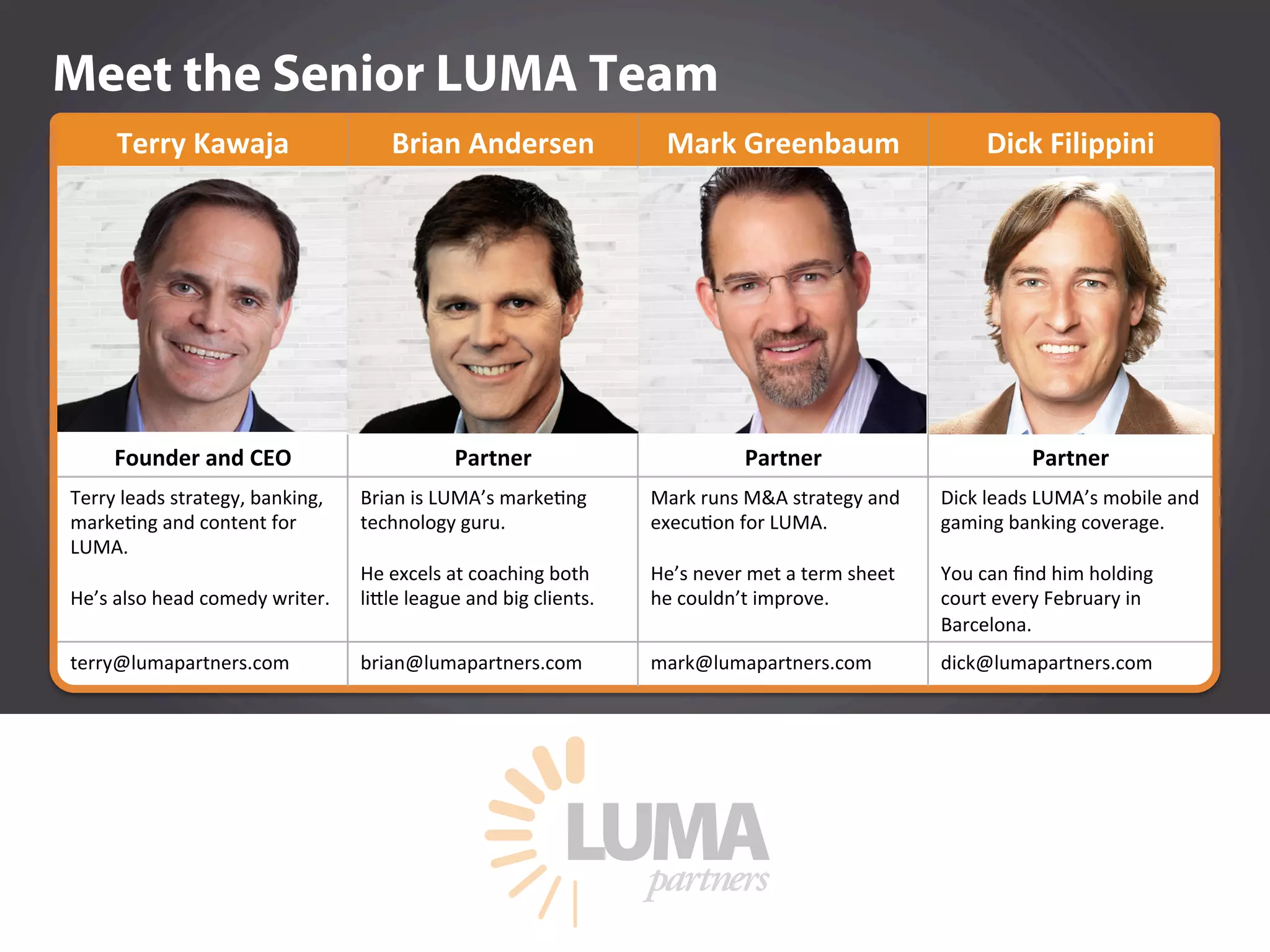
Meet the Senior LUMA Team
Terry Kawaja
 Brian Andersen
 Mark Greenbaum
 Dick Filippini


Founder and CEO
 Partner
 Partner
 Partner
Terry leads strategy, banking,
marke3ng and content for
LUMA.

He’s also head comedy writer.
Brian is LUMA’s marke3ng
technology guru.

He excels at coaching both
liCle league and big clients.
Mark runs M&A strategy and
execu3on for LUMA.

He’s never met a term sheet
he couldn’t improve.
Dick leads LUMA’s mobile and
gaming banking coverage.

You can find him holding
court every February in
Barcelona.
terry@lumapartners.com
 brian@lumapartners.com
 mark@lumapartners.com
 dick@lumapartners.com
LUMApartners
LUMApartners
LUMApartners
Good news (especially for an M&A guy)! Global M&A is on a record-
breaking pace this year. While this is an encouraging macro trend
driven by, among other factors, historically cheap debt and decreasing
organic growth opportuni9es, let’s drill down to take a look at the
markets on which we focus.
LUMApartners
Let me take this opportunity to highlight LUMA’s singular focus on the
intersec9on of Media, Marke9ng, and Technology; the sectors of Digital
Content, Ad Tech and MarTech all seen through the lens of mobile.
LUMApartners
The current M&A boom is also evident in our market sectors as deal
volume is up across almost every LUMAscape.
LUMApartners
Looking at the recent ac9vity on the Strategic Buyer LUMAscape, we’ve
seen plenty of ac9vity from the usual suspects . . .
LUMApartners
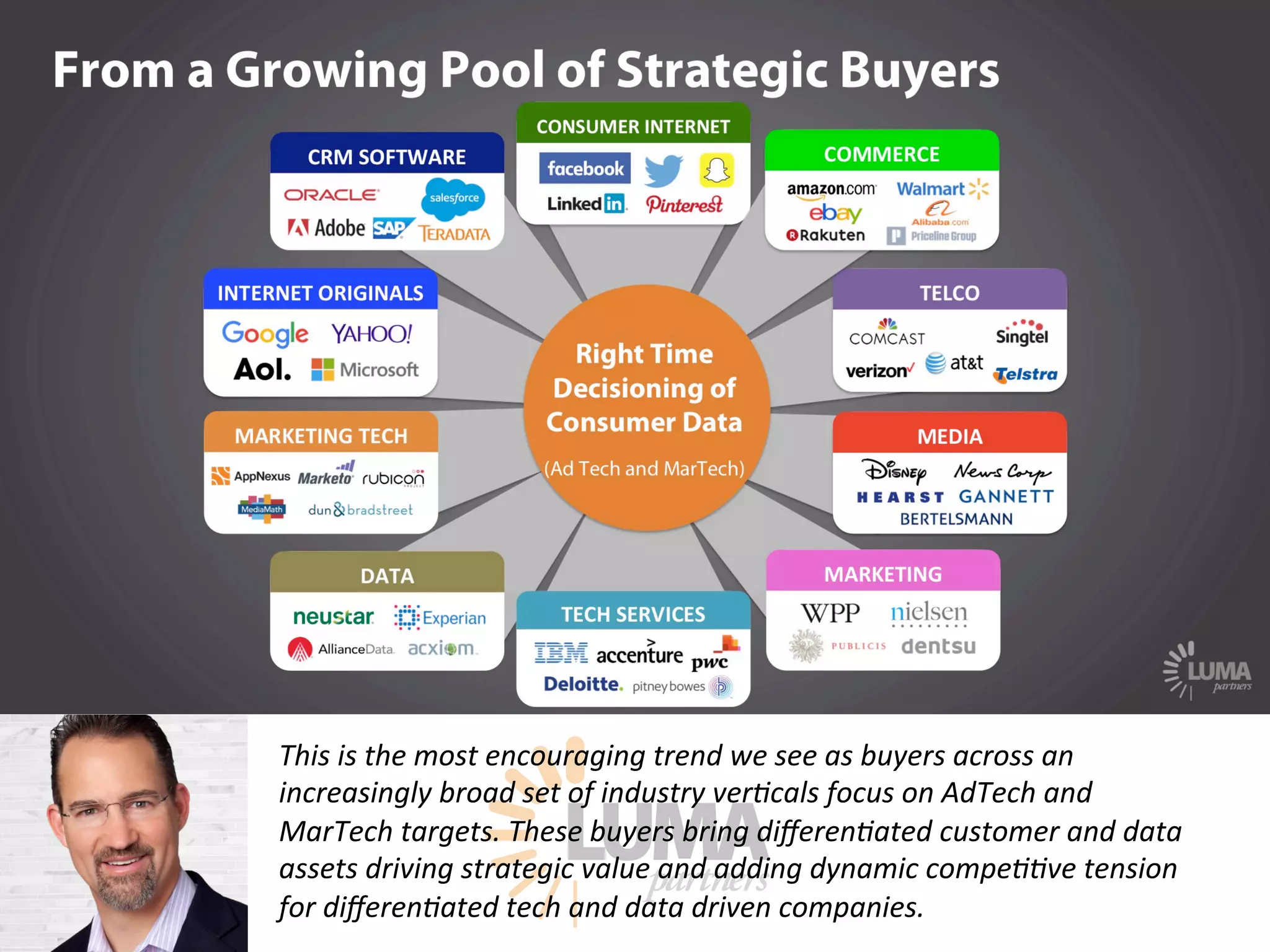
And increasingly, we’re seeing ac9ve interest from a growing pool of
strategic buyers.
LUMApartners
This is the most encouraging trend we see as buyers across an
increasingly broad set of industry ver9cals focus on AdTech and
MarTech targets. These buyers bring differen9ated customer and data
assets driving strategic value and adding dynamic compe99ve tension
for differen9ated tech and data driven companies.
LUMApartners
But not everything is up and to the right this year . . . the public markets
have been much less friendly with both MarTech and AdTech trailing
the broader tech index; AdTech has been hit especially hard as we
emerge from what has been deemed the “cruel summer.”
LUMApartners
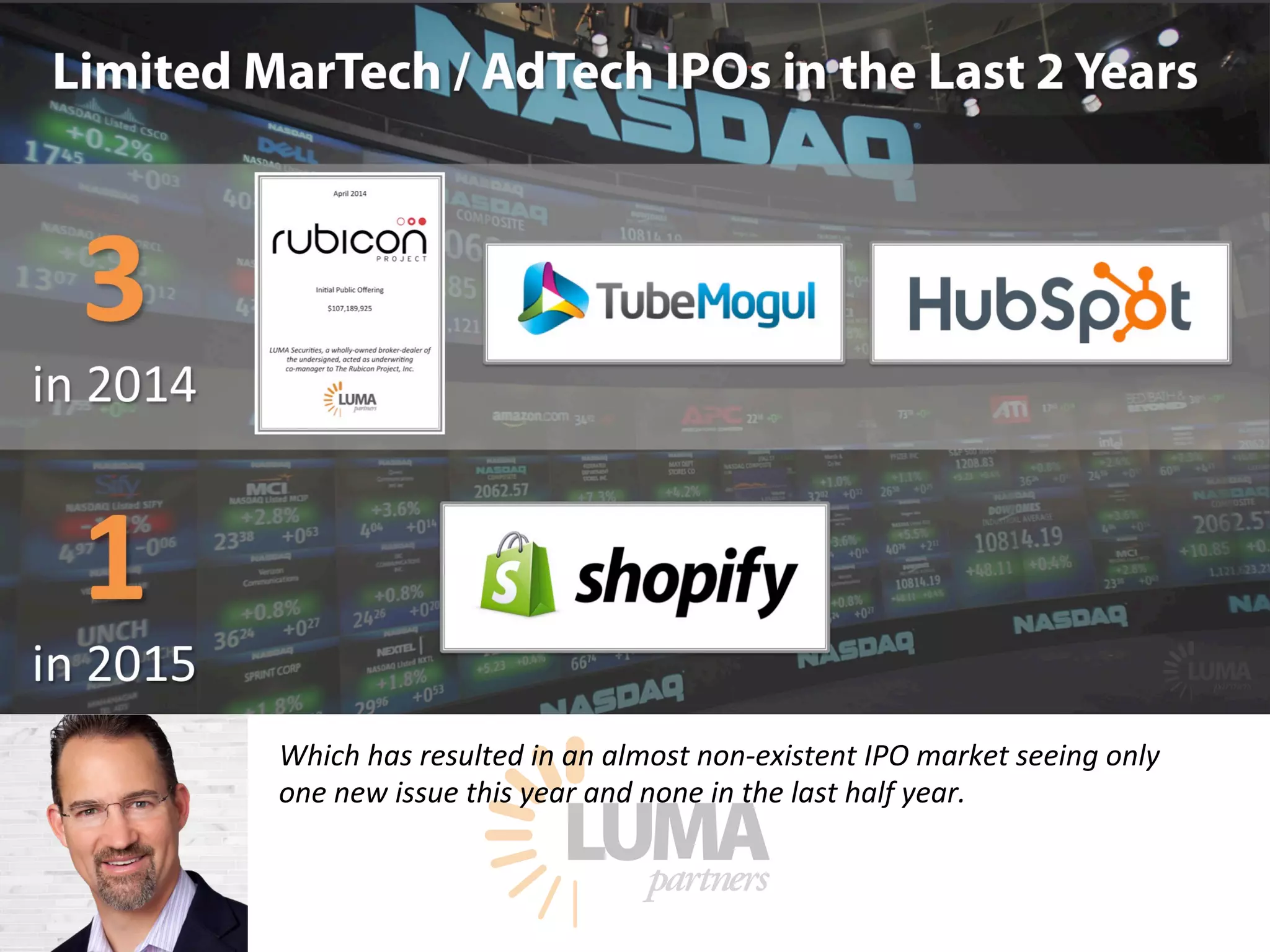
Which has resulted in an almost non-existent IPO market seeing only
one new issue this year and none in the last half year.
LUMApartners
To highlight a few bright spots: while public markets may struggle to
fully comprehend and value emerging AdTech and MarTech business
models, technology-driven business models are being rewarded. We see
this evidenced by the Marke9ng SaaS companies which have con9nued
to trade well or have been acquired at strategic mul9ples.
LUMApartners
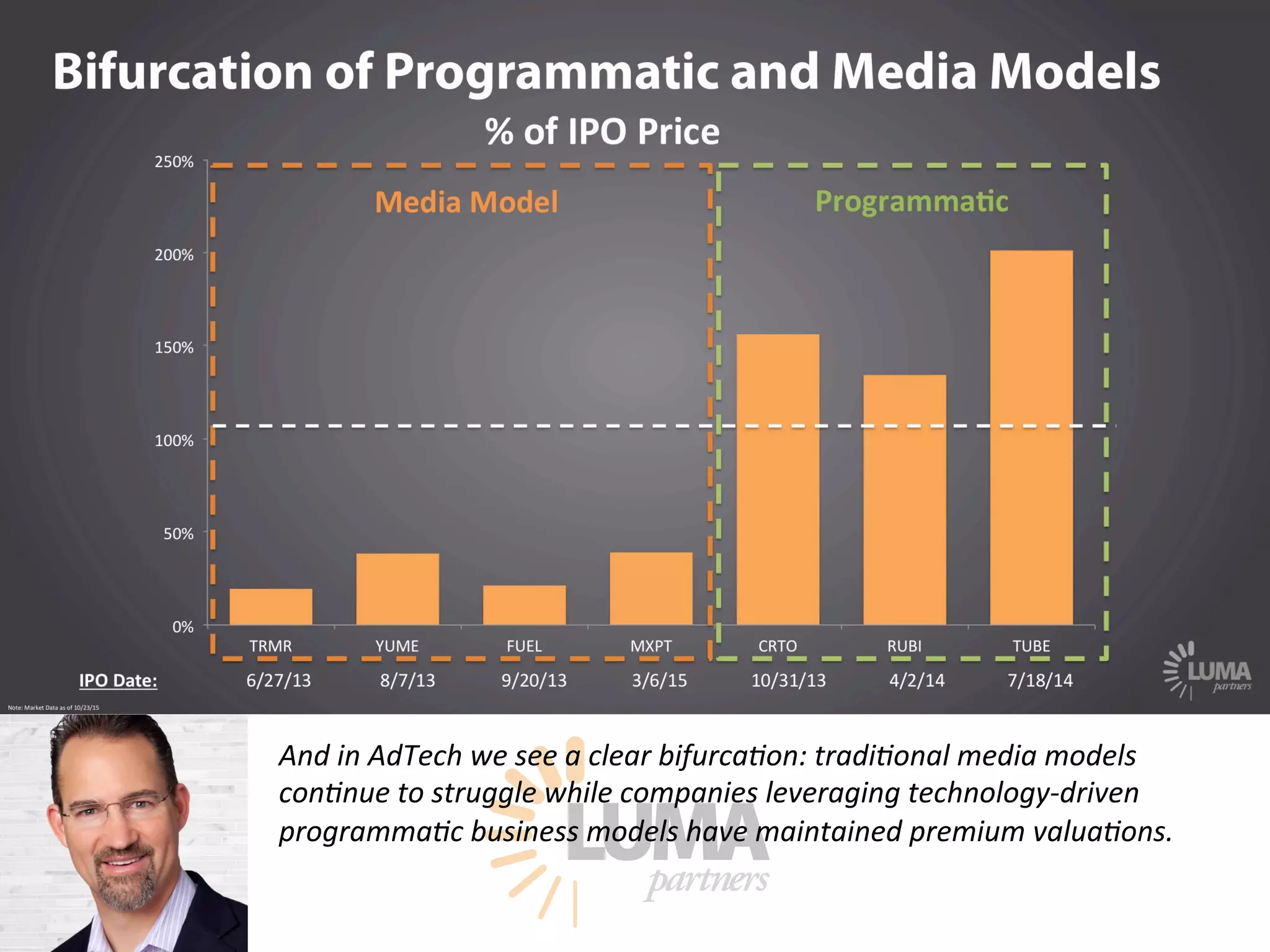
And in AdTech we see a clear bifurca9on: tradi9onal media models
con9nue to struggle while companies leveraging technology-driven
programma9c business models have maintained premium valua9ons.
LUMApartners
The private financing market remains ac9ve as we’ve seen a number of
sizable deals in the space. And while we’ve certainly heard increased
chaZer about fallen unicorns, this has largely impacted consumer-
driven businesses (especially those with immature models) and felt less
by companies in our coverage universe.
LUMApartners
LUMApartners
Some9mes the goal that marketers are trying to achieve gets lost in all
the noise when discussing marke9ng trends, companies or technologies.

But the goal is clear: drive more revenues... at the lowest cost.
LUMApartners
A key focus area for marketers trying to achieve this goal is to op9mize the
customer experience through delivering the right message at the right
9me to the right person. From the “marke9ng clouds” down to small
start-ups, technology vendors are focused on providing solu9ons to enable
this (or at least an element of this) for their clients.
LUMApartners
Two recurring technology themes we hear from MarTech vendors that
are focused on the customer experience is the use of “Predic9ve
Analy9cs” (which enables the “right message at the right 9me”) and
“Iden9ty” (which enables the message to be delivered to the consumer
on whatever device they may be on).
LUMApartners
LUMApartners
LUMApartners
The state of personaliza9on has advanced rapidly in the past five years.
Not long ago personaliza9on tools were very manual and / or broad-
brush. But now, with “big data” (and predic9ve analy9cs / iden9ty), 1:1
personaliza9on has become a reality (though is s9ll nascent in its
adop9on by marketers).
LUMApartners
In every interac9on, such as a brand ad driving a consumer to look at
women’s shoes on a website, marketers can start crea9ng a profile of
that user to more intelligently target future interac9ons.
LUMApartners
Display retarge9ng is one of the simplest, and most effec9ve, uses of
“personaliza9on” that u9lizes informa9on derived from a site
interac9on to bring that prospect back to the website.
LUMApartners
Once a user becomes known, such as when she makes a purchase, it
opens up even more marke9ng channels, such as email (and other
email-centric targe9ng solu9ons such as Facebook Customer Audiences
or TwiZer Tailored Audiences).
LUMApartners
Now, instead of just a “blast” email program, 1:1 marke9ng enables
“triggered” emails that can be personalized specifically for each
individual. These emails can be personalized with specific content /
products / offers as well as op9mize the send 9mes (by sending at the
9mes each user has the highest probability of opening the email).
LUMApartners
This 1:1 marke9ng is con9nuous, providing that consistent experience
across all channels over the life9me of a customer, which increases the
LTV of that customer.
LUMApartners
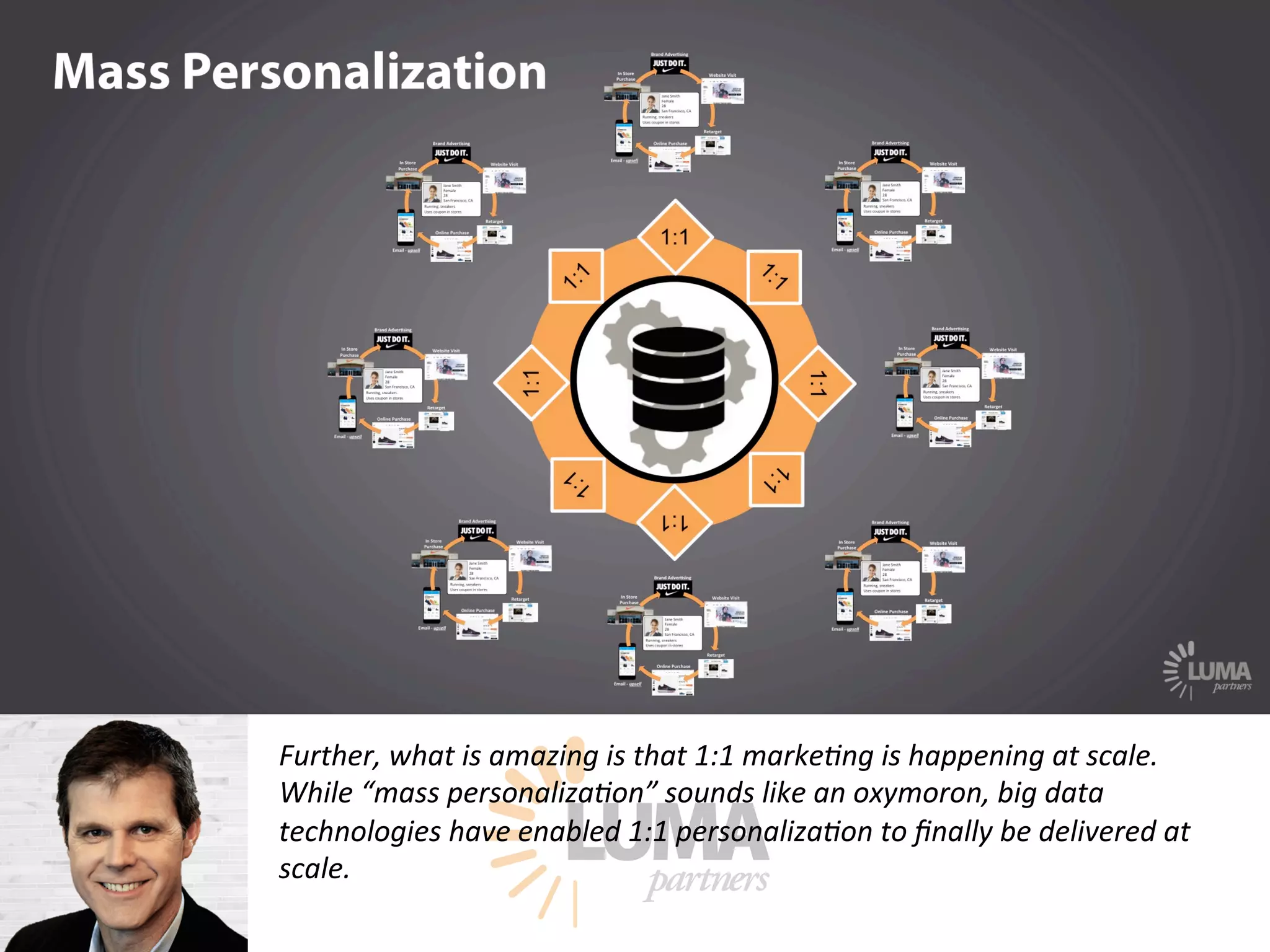
Further, what is amazing is that 1:1 marke9ng is happening at scale.
While “mass personaliza9on” sounds like an oxymoron, big data
technologies have enabled 1:1 personaliza9on to finally be delivered at
scale.
LUMApartners
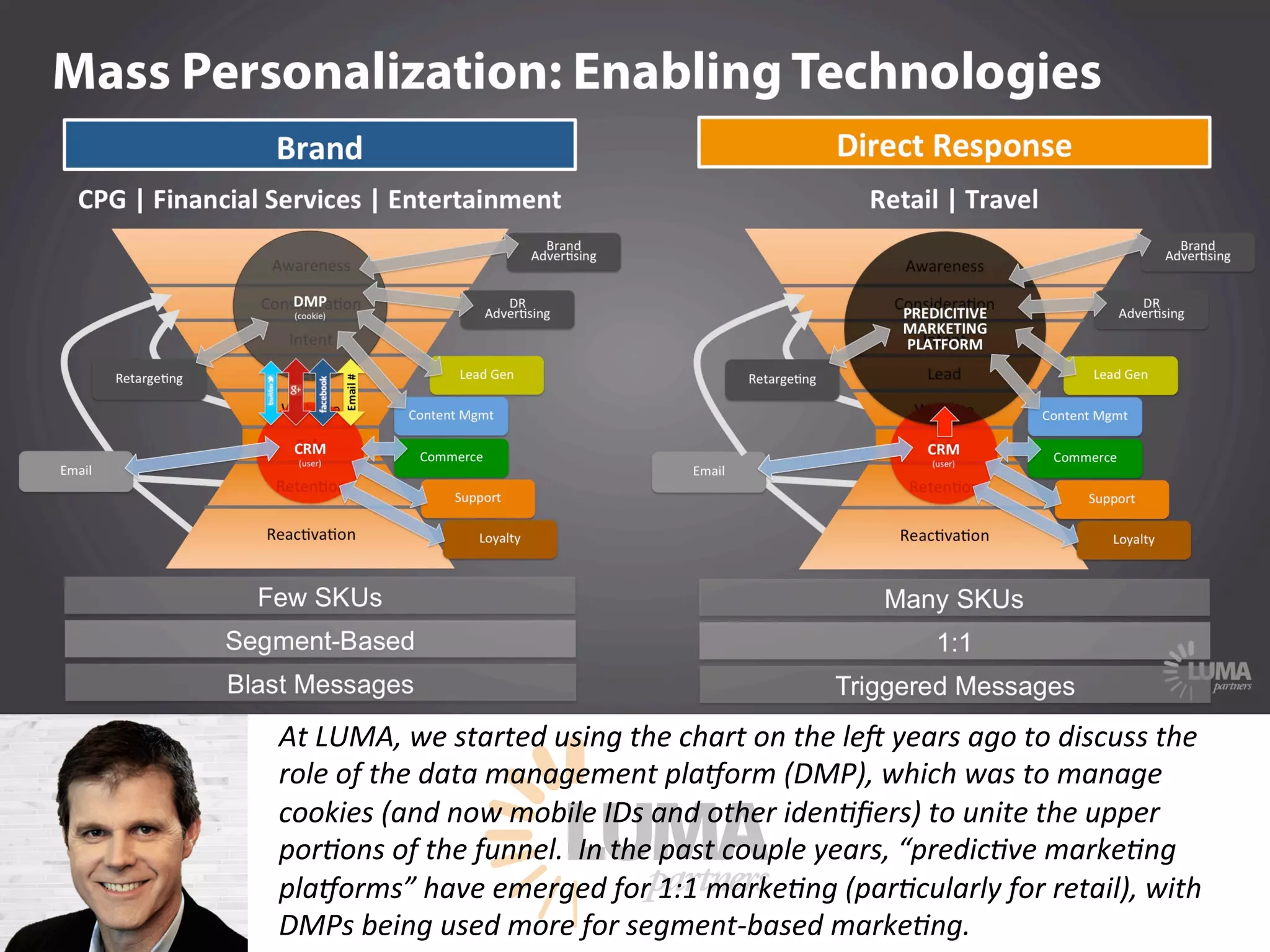
At LUMA, we started using the chart on the le` years ago to discuss the
role of the data management plaaorm (DMP), which was to manage
cookies (and now mobile IDs and other iden9fiers) to unite the upper
por9ons of the funnel. In the past couple years, “predic9ve marke9ng
plaaorms” have emerged for 1:1 marke9ng (par9cularly for retail), with
DMPs being used more for segment-based marke9ng.
LUMApartners
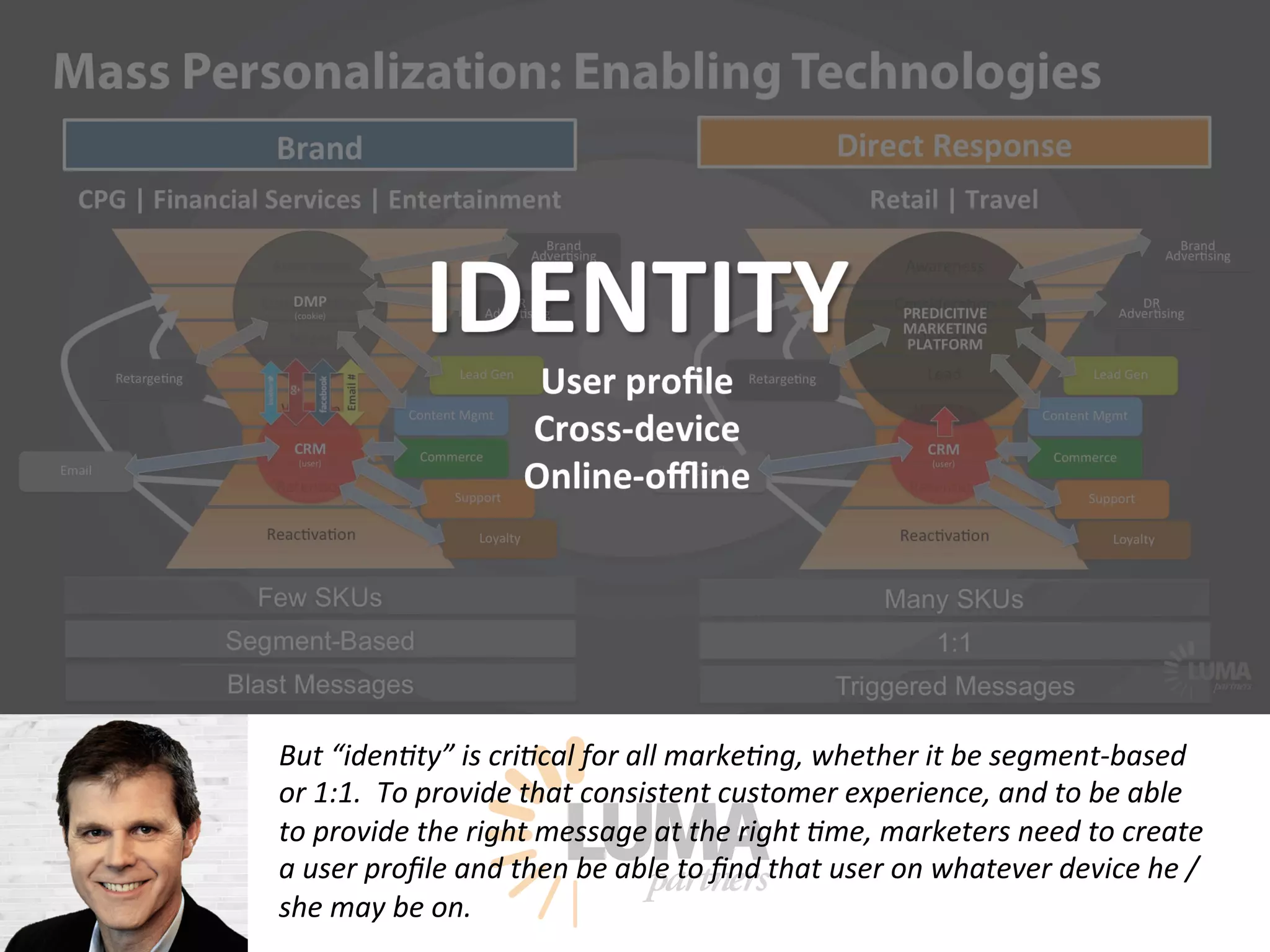
But “iden9ty” is cri9cal for all marke9ng, whether it be segment-based
or 1:1. To provide that consistent customer experience, and to be able
to provide the right message at the right 9me, marketers need to create
a user profile and then be able to find that user on whatever device he /
she may be on.
LUMApartners
The importance of “iden9ty” is clear. Facebook has long focused on, and
had significant success with, its “people-based marke9ng” solu9ons.
Other large so`ware vendors have responded with acquisi9ons (such as
LiveRamp and Datalogix), or organic development / partner programs.
LUMApartners
LUMApartners
Marketers used to have the luxury of being able to develop marke9ng
campaigns and cra` all the necessary marke9ng materials with
9melines set by the marketer. However, in today’s world with Facebook,
TwiZer and 24/7 news cycles, the marke9ng dynamic is much more
real-9me and dynamic – and marketers must adjust to this.
LUMApartners
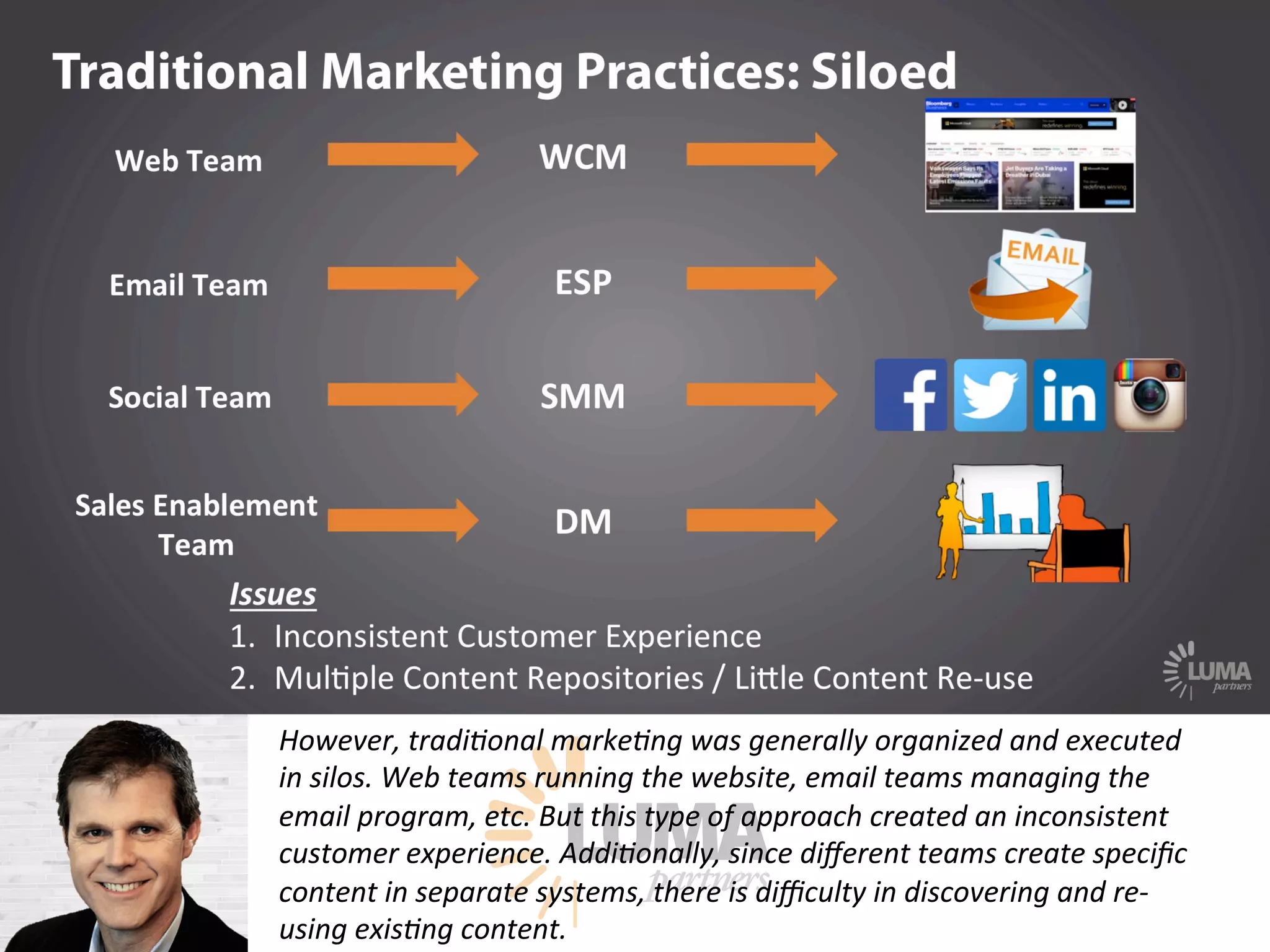
However, tradi9onal marke9ng was generally organized and executed
in silos. Web teams running the website, email teams managing the
email program, etc. But this type of approach created an inconsistent
customer experience. Addi9onally, since different teams create specific
content in separate systems, there is difficulty in discovering and re-
using exis9ng content.
LUMApartners
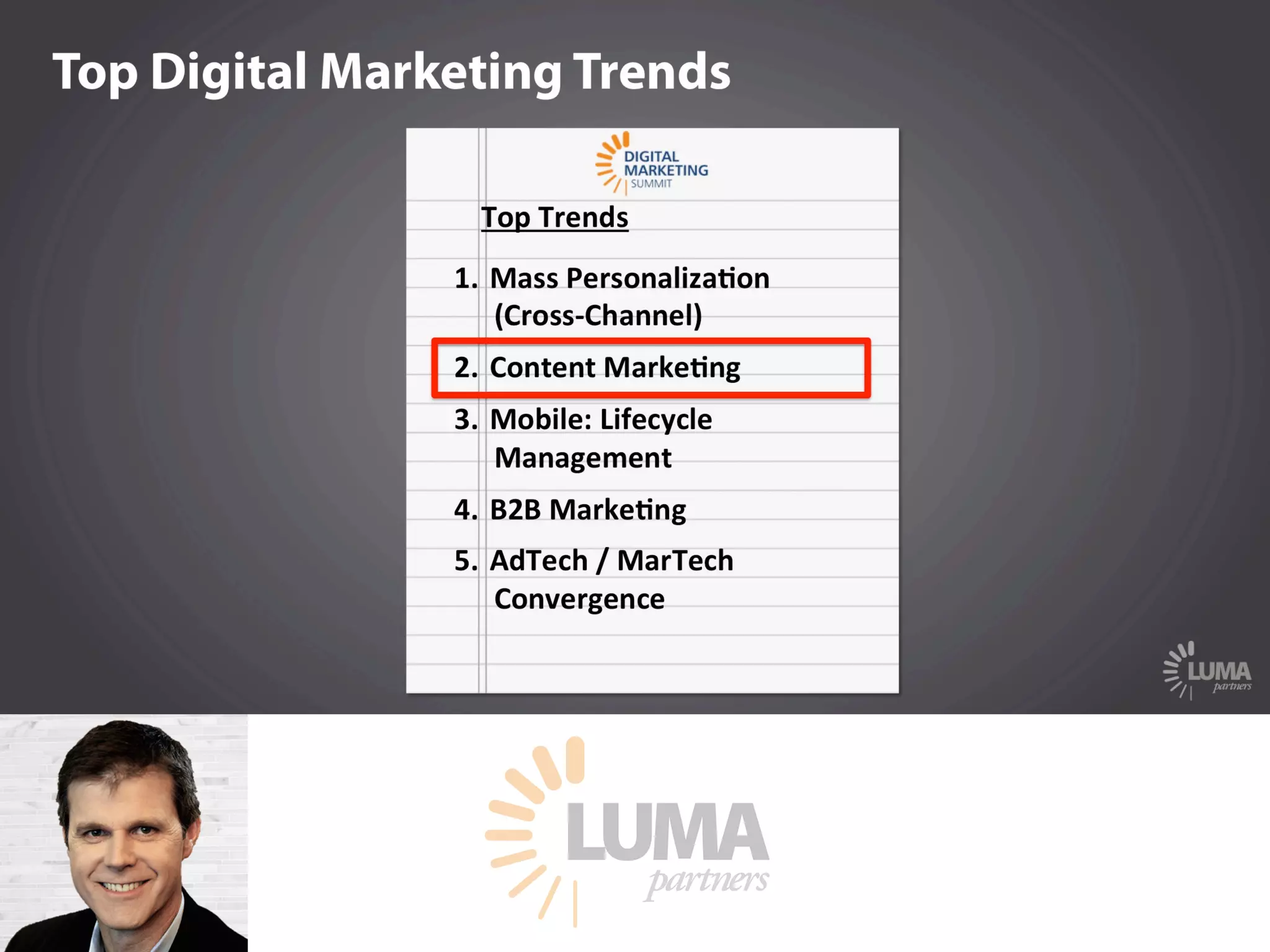
To break down these silos, leading marketers have created integrated
content marke9ng programs. As an example, Intel employs teams that
create content every day, deploy that content in a coordinated fashion
across channels, determine what content is resona9ng and then amplify
that content across paid channels.
LUMApartners
And we have seen so`ware companies emerge to enable efficient and
effec9ve content marke9ng programs. Companies such as Kapost,
NewsCred, Percolate, ScribbleLive and others are focused on providing
integrated plaaorms to plan, create, manage, distribute, measure and
amplify marke9ng content.
LUMApartners
LUMApartners
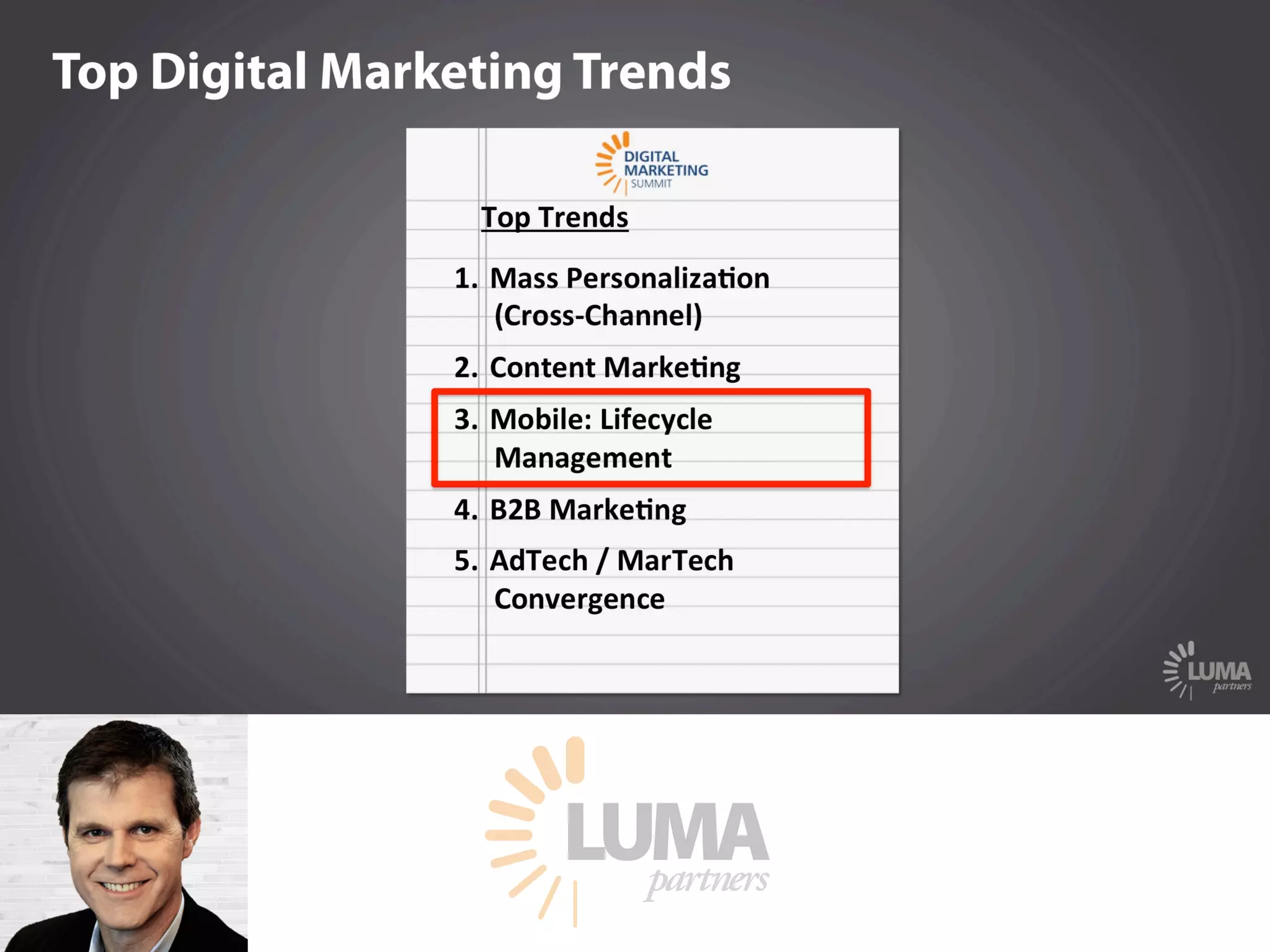
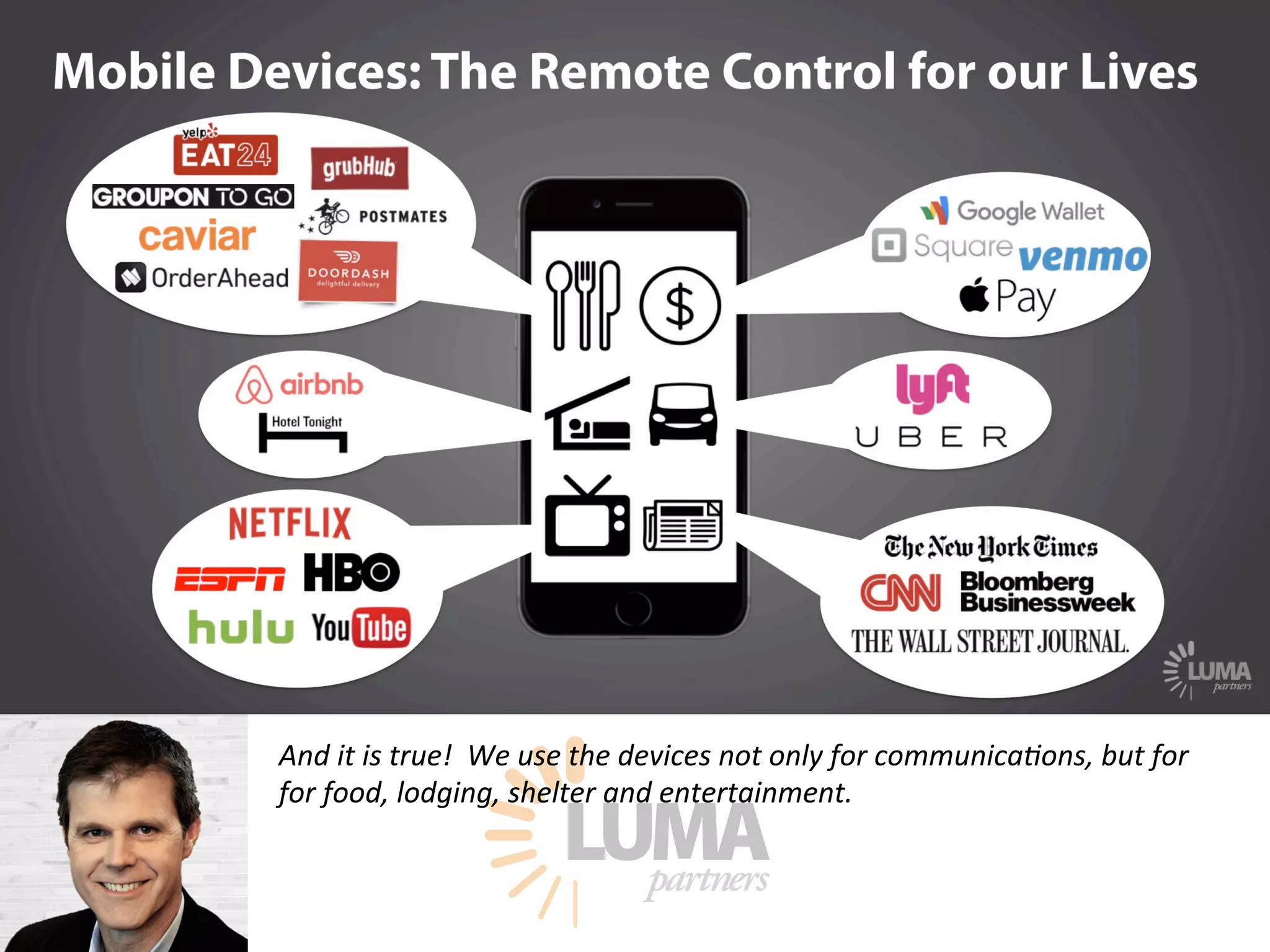
I recently heard a comment that mobile devices “are the remote control
for our lives.”
LUMApartners
And it is true! We use the devices not only for communica9ons, but for
for food, lodging, shelter and entertainment.
LUMApartners
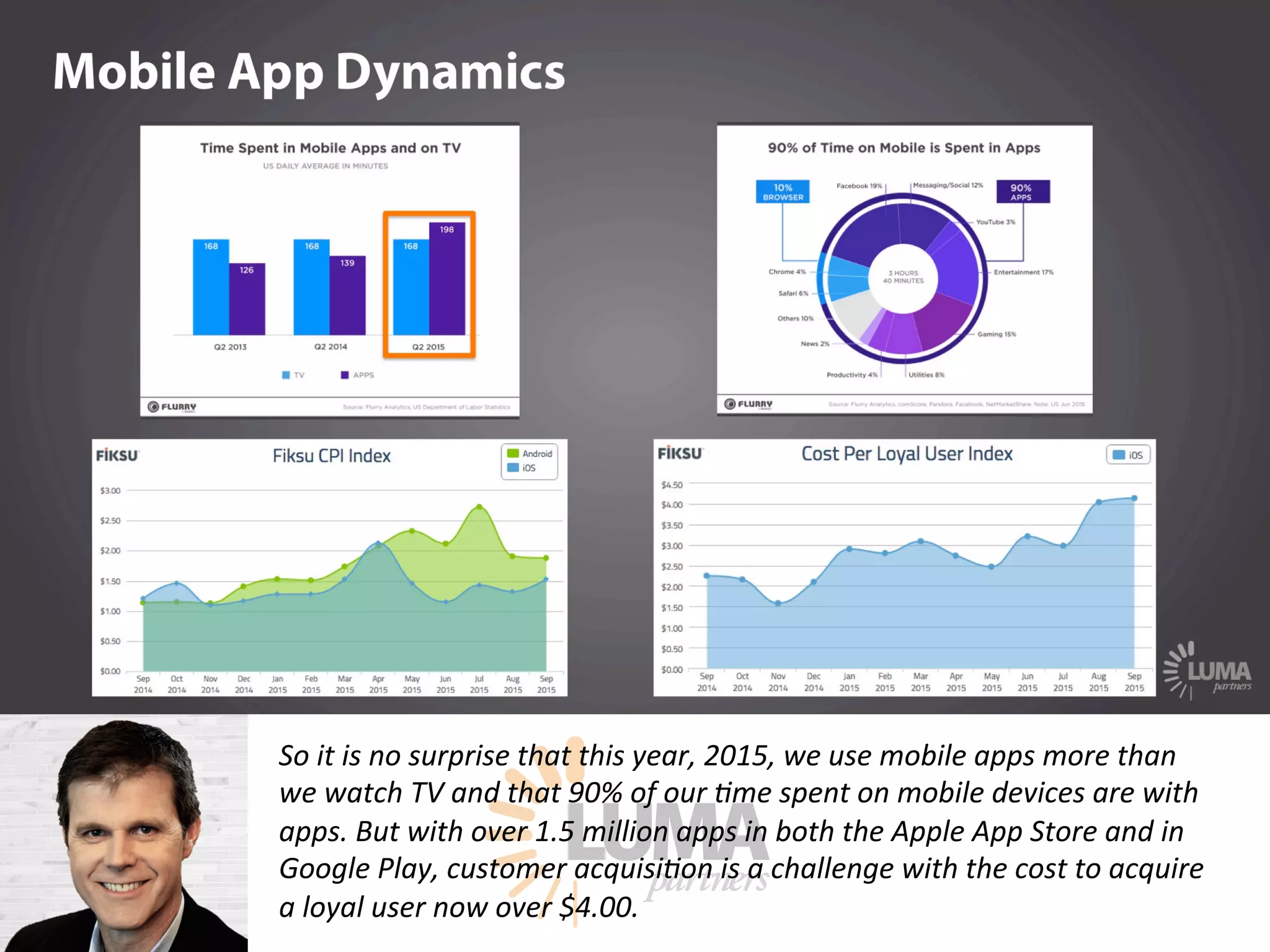
So it is no surprise that this year, 2015, we use mobile apps more than
we watch TV and that 90% of our 9me spent on mobile devices are with
apps. But with over 1.5 million apps in both the Apple App Store and in
Google Play, customer acquisi9on is a challenge with the cost to acquire
a loyal user now over $4.00.
LUMApartners
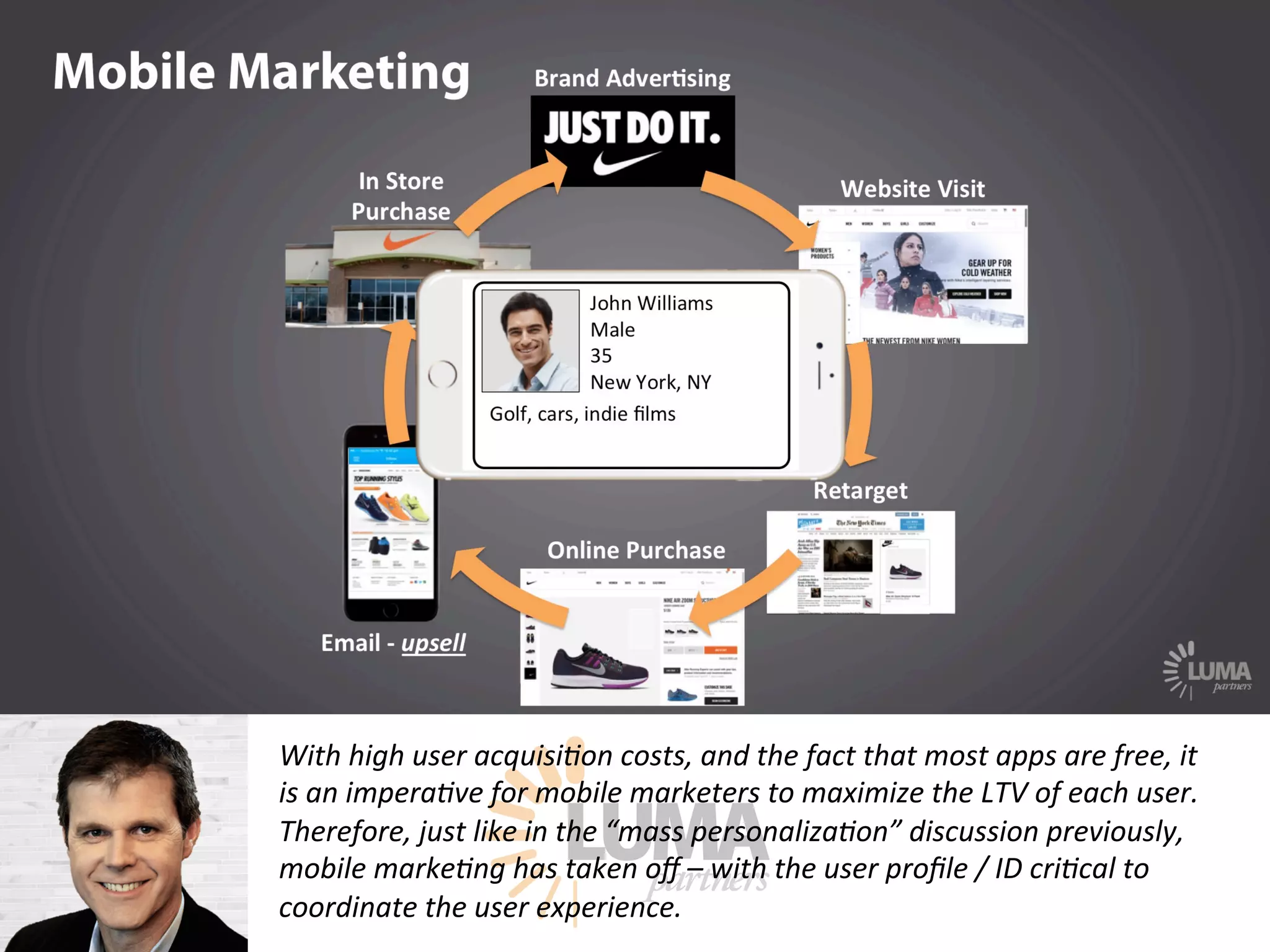
With high user acquisi9on costs, and the fact that most apps are free, it
is an impera9ve for mobile marketers to maximize the LTV of each user.
Therefore, just like in the “mass personaliza9on” discussion previously,
mobile marke9ng has taken off – with the user profile / ID cri9cal to
coordinate the user experience.
LUMApartners
Mobile marke9ng plaaorms are u9lizing tried-and-true methodologies such
as A/B tes9ng, retarge9ng and deep analy9cs. Addi9onally, in-app
messaging, push no9fica9ons and email are triggered to improve the
experience, bring back lapsed users or upsell virtual goods or services.
Finally, we have just started to see these plaaorms be used for general
purpose marke9ng for mobile-centric companies, displacing tradi9onal ESPs.
LUMApartners
LUMApartners
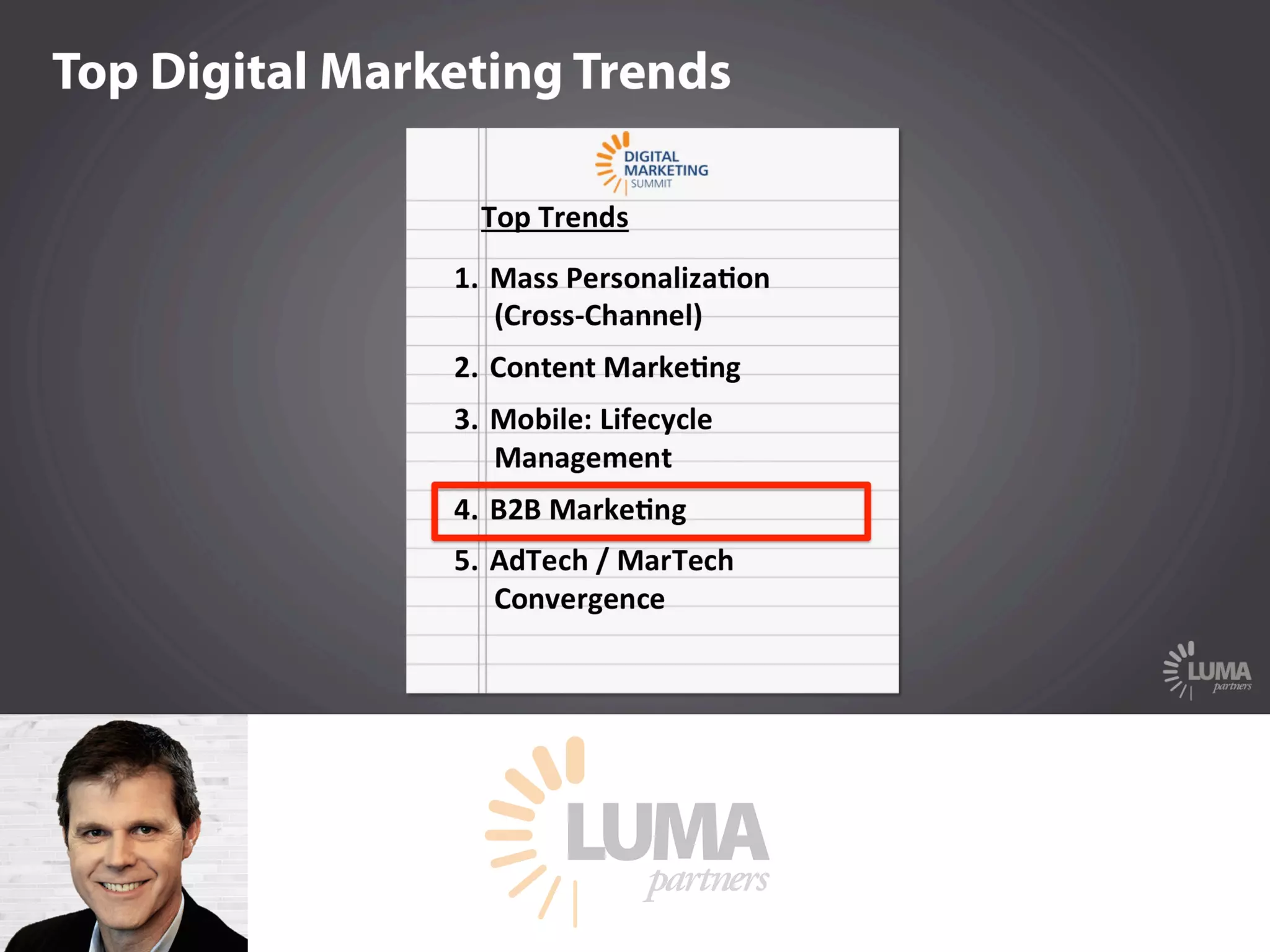
For a long 9me, B2B Marke9ng did not advance nearly as rapidly as
B2C. Salesforce.com dominated the sector with its CRM plaaorm. Then
marke9ng automa9on vendors helped drive more qualified leads into
the marke9ng funnel. But sales teams con9nued to demand more leads
and beZer leads!
LUMApartners
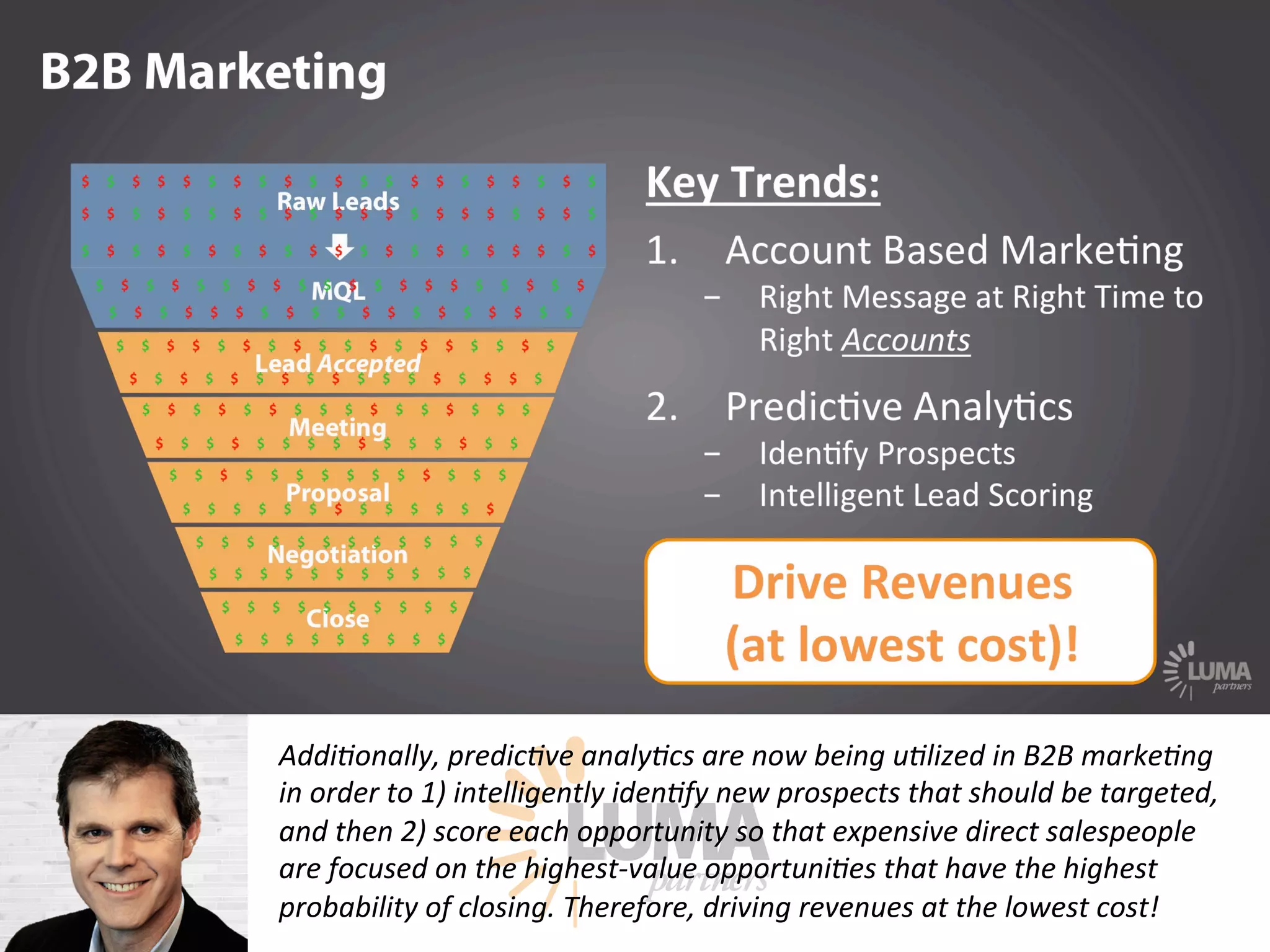
Two trends have emerged recently in B2B marke9ng. First, Account Based
Marke9ng is focused on delivering the right message at the right 9me to
the right accounts – since companies are the “buyers” in B2B, not
consumers. Therefore systems need to be designed specifically for accounts
and provide a consistent and personalized experience for those accounts.
LUMApartners
Addi9onally, predic9ve analy9cs are now being u9lized in B2B marke9ng
in order to 1) intelligently iden9fy new prospects that should be targeted,
and then 2) score each opportunity so that expensive direct salespeople
are focused on the highest-value opportuni9es that have the highest
probability of closing. Therefore, driving revenues at the lowest cost!
LUMApartners
LUMApartners
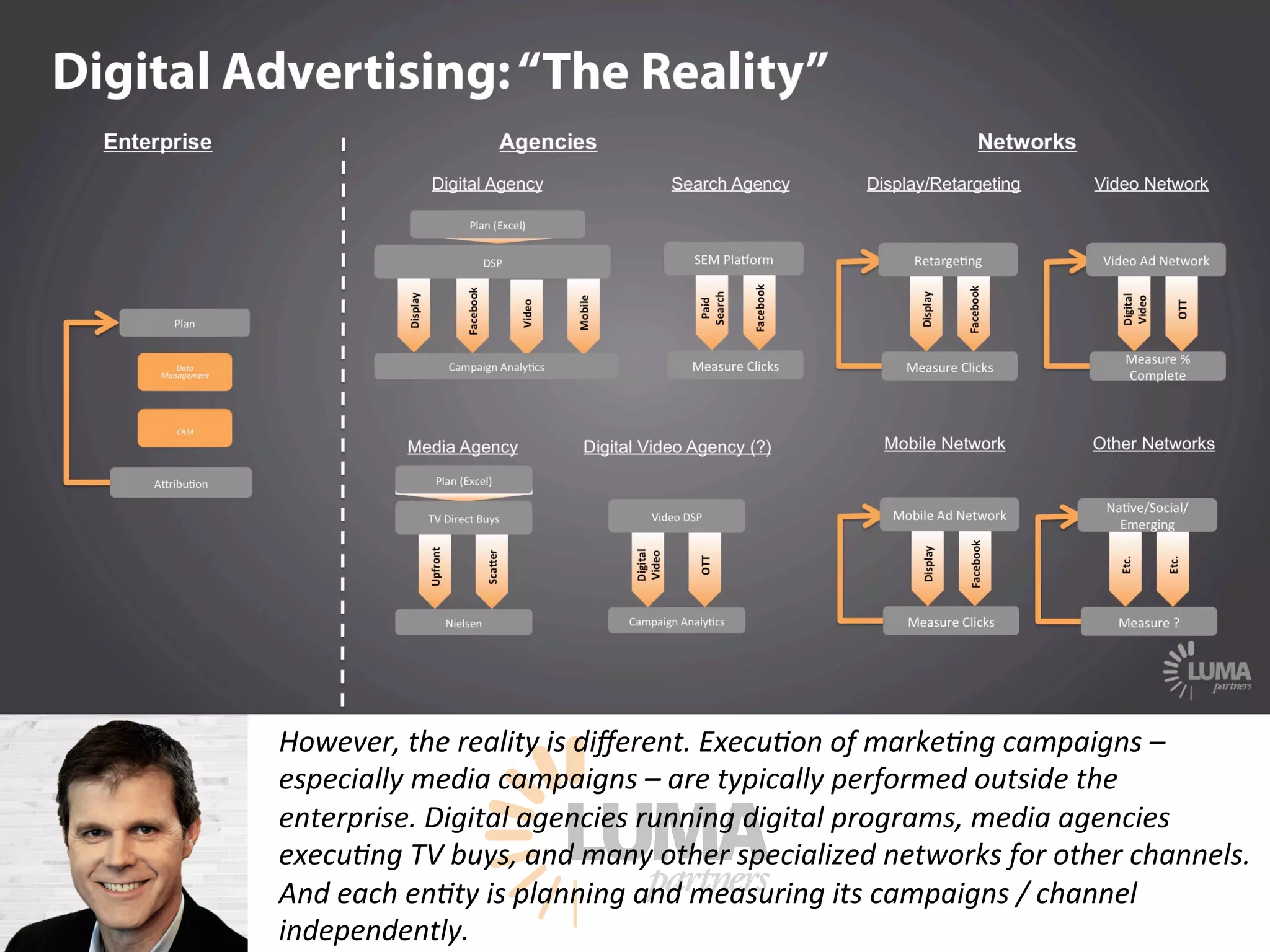
If you were to draw up a fully integrated adver9sing plaaorm for
enterprises, it would look something like this – integrated planning,
execu9on and aZribu9on with common data and campaign management,
and a feedback loop to the planning so`ware to adjust / op9mize spend.
LUMApartners
However, the reality is different. Execu9on of marke9ng campaigns –
especially media campaigns – are typically performed outside the
enterprise. Digital agencies running digital programs, media agencies
execu9ng TV buys, and many other specialized networks for other channels.
And each en9ty is planning and measuring its campaigns / channel
independently.
LUMApartners
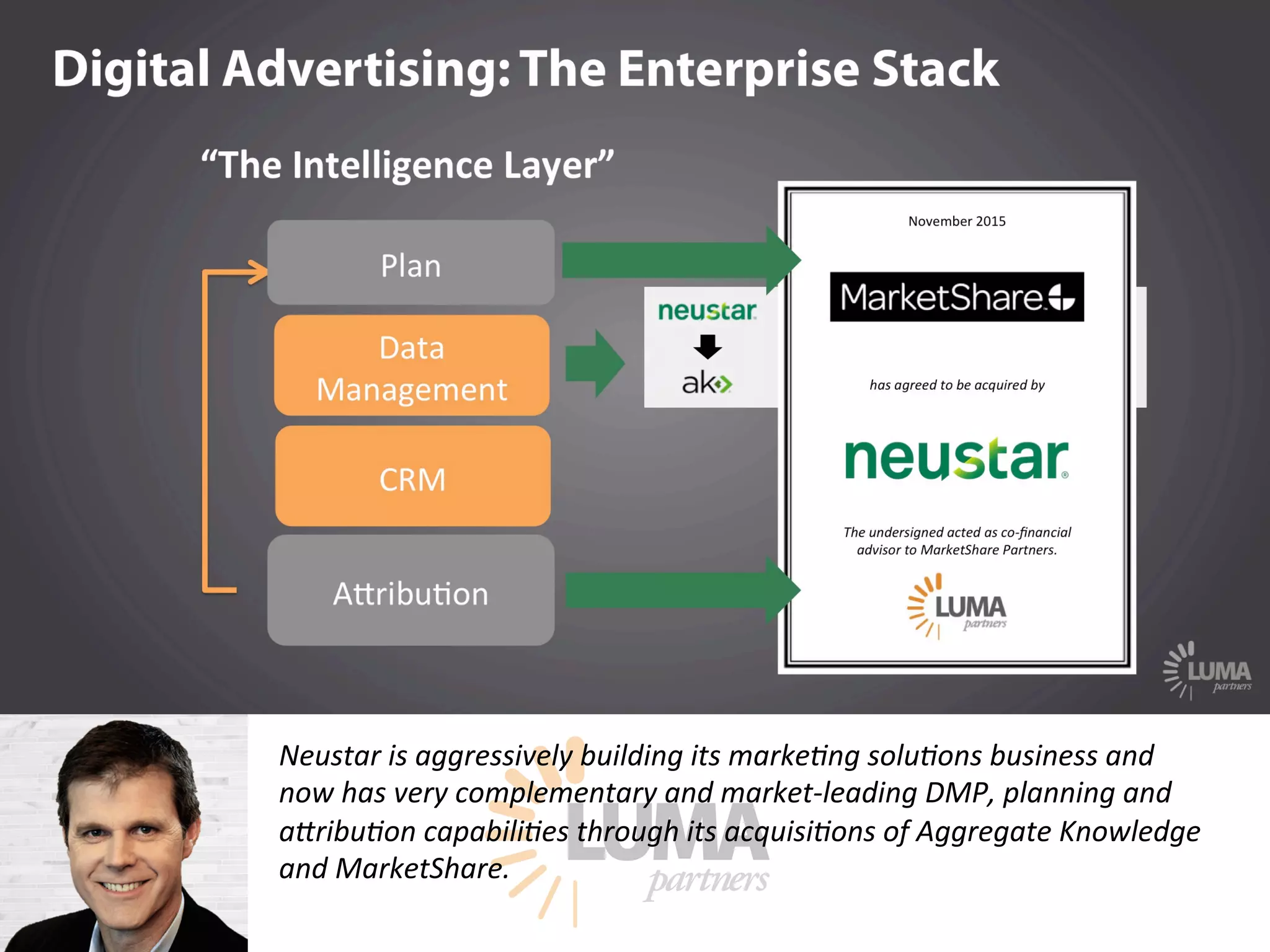
But there is an “enterprise stack” emerging. A planning solu9on to allocate
the spend among marke9ng and adver9sing channels. In today’s data-
driven marke9ng world, systems to manage, segment and ac9vate data is
required: a DMP to manage anonymous data and a CRM solu9on to
manage customer data. Finally, an aZribu9on system to measure results –
and to con9nually op9mize the marke9ng efforts.
LUMApartners
Strategic buyers have recognized the importance and strategic nature
of these categories with both large adver9sing and so`ware vendors
making acquisi9ons.
LUMApartners
Neustar is aggressively building its marke9ng solu9ons business and
now has very complementary and market-leading DMP, planning and
aZribu9on capabili9es through its acquisi9ons of Aggregate Knowledge
and MarketShare.
LUMApartners
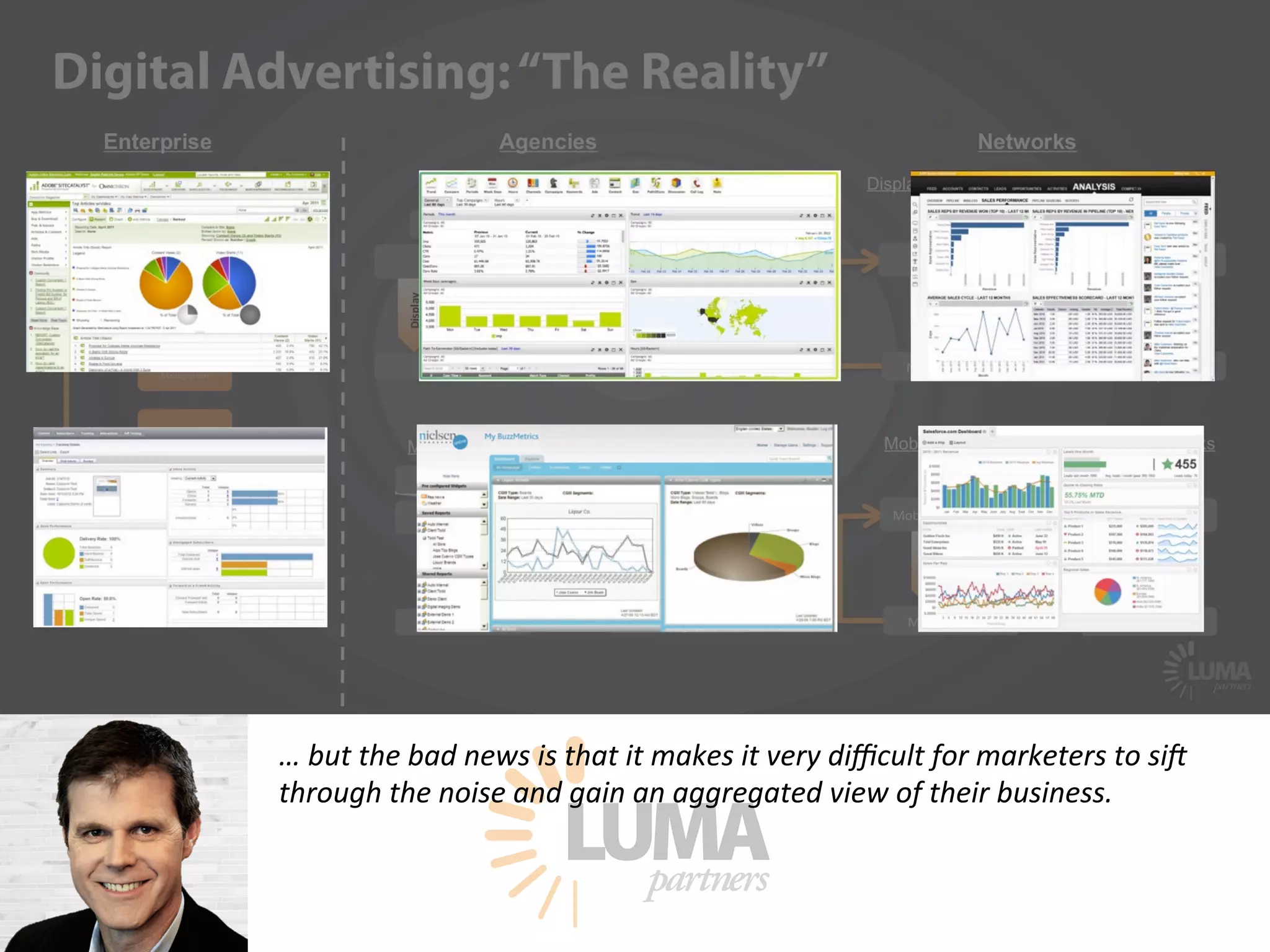
Another aspect created by the distributed aspect of execu9on is that it
makes it difficult for marketers to get a true understanding of what is
happening across their marke9ng ac9vi9es. The good news is that today’s
systems generally have robust analy9cs and repor9ng...
LUMApartners
… but the bad news is that it makes it very difficult for marketers to si`
through the noise and gain an aggregated view of their business.
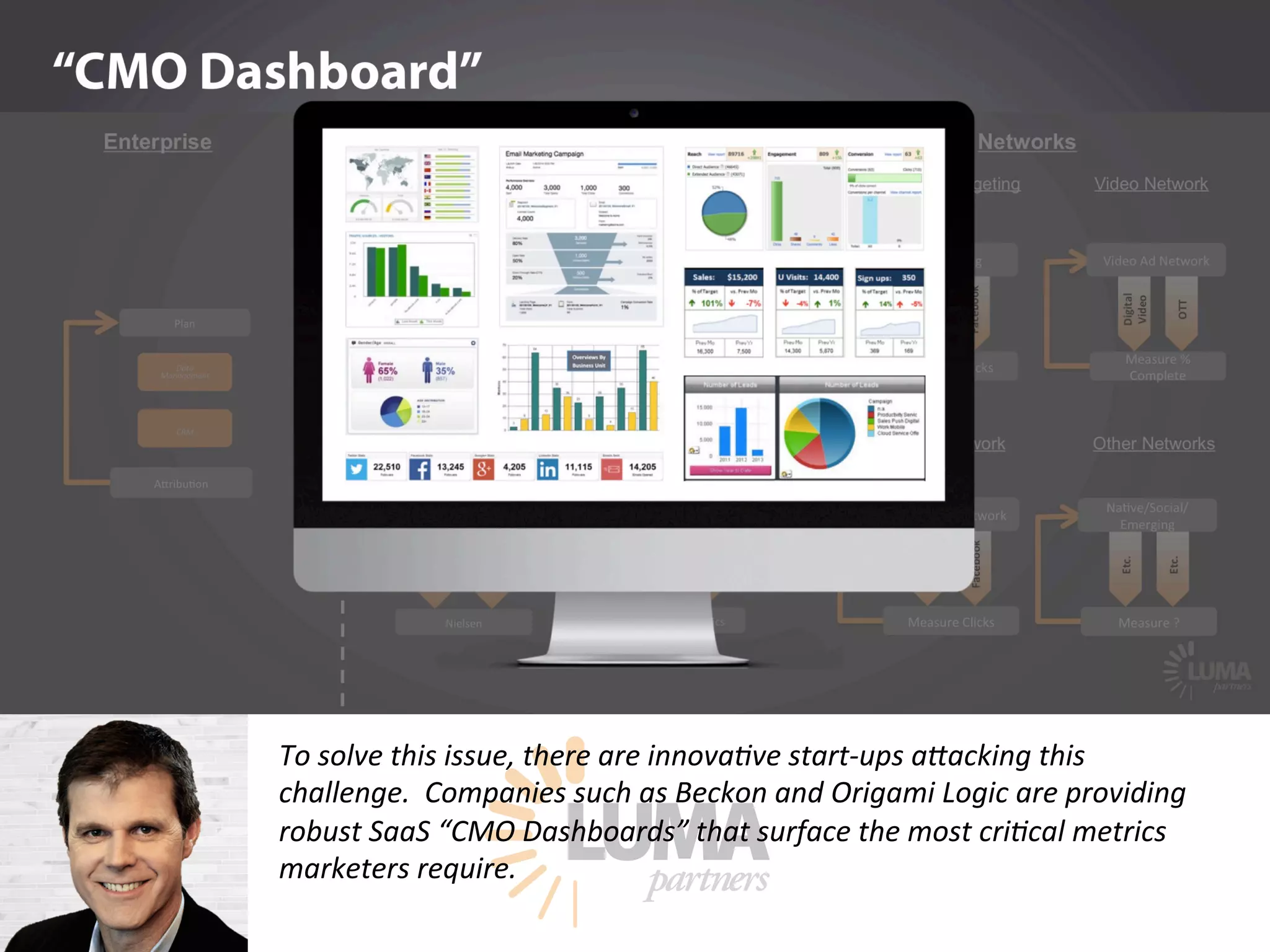
LUMApartners
To solve this issue, there are innova9ve start-ups aZacking this
challenge. Companies such as Beckon and Origami Logic are providing
robust SaaS “CMO Dashboards” that surface the most cri9cal metrics
marketers require.
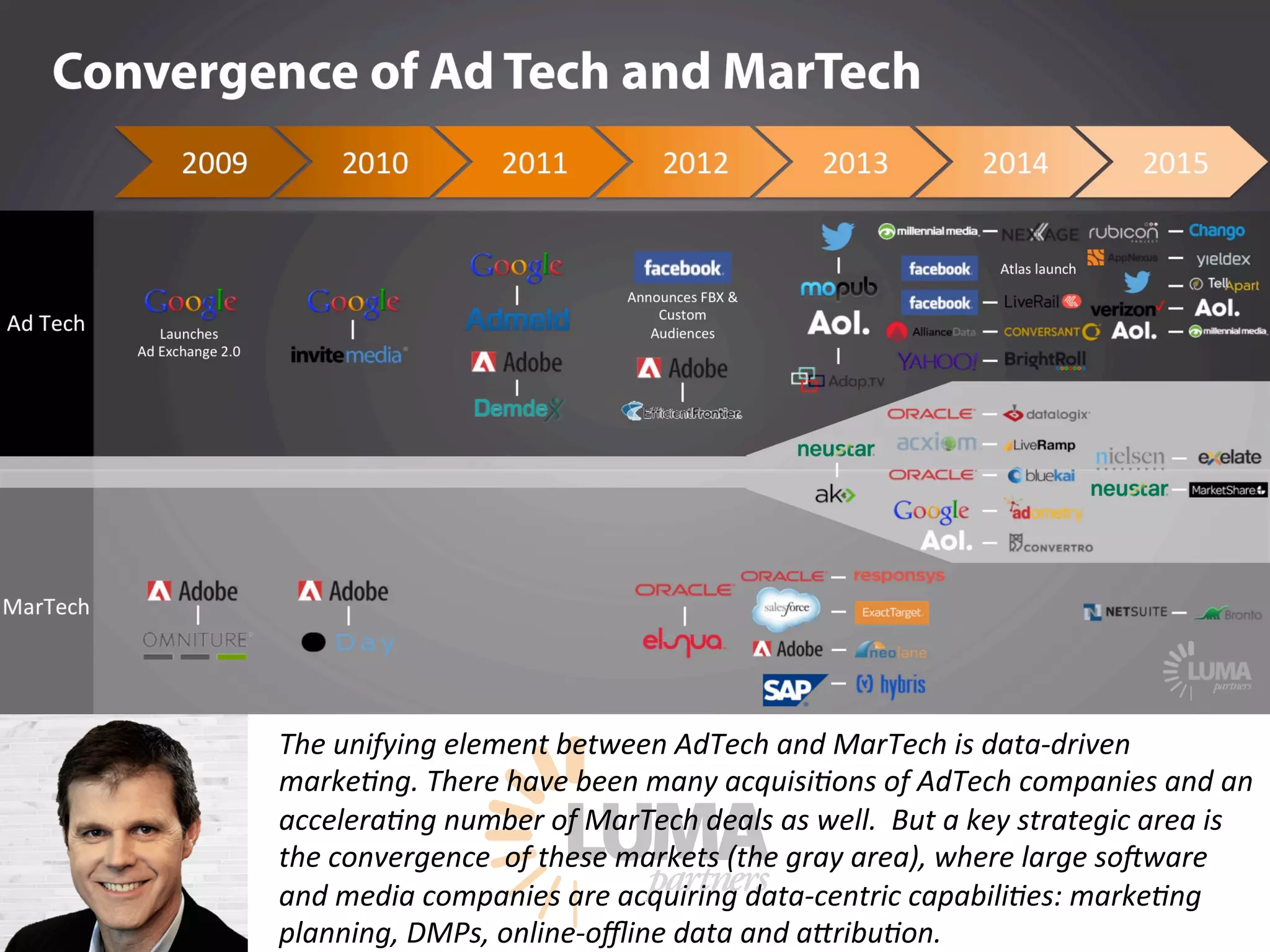
LUMApartners
The unifying element between AdTech and MarTech is data-driven
marke9ng. There have been many acquisi9ons of AdTech companies and an
accelera9ng number of MarTech deals as well. But a key strategic area is
the convergence of these markets (the gray area), where large so`ware
and media companies are acquiring data-centric capabili9es: marke9ng
planning, DMPs, online-offline data and aZribu9on.
LUMApartners
We hope you enjoyed the presenta9on! Please feel free to contact LUMA
Partners to discuss these trends – and M&A strategies and targets – in more
depth.
Thank you!

LUMA's State of Digital Marketing at DMS West 15

  • 1.
    LUMApartners LUMA Partners presentsthe first “State of Digital Marke9ng” from our inaugural Digital Marke9ng Summit, which provides our views on the market and significant industry trends in the digital marke9ng ecosystem. We hope you enjoy it.
  • 2.
    LUMApartners Meet the SeniorLUMA Team Terry Kawaja Brian Andersen Mark Greenbaum Dick Filippini Founder and CEO Partner Partner Partner Terry leads strategy, banking, marke3ng and content for LUMA. He’s also head comedy writer. Brian is LUMA’s marke3ng technology guru. He excels at coaching both liCle league and big clients. Mark runs M&A strategy and execu3on for LUMA. He’s never met a term sheet he couldn’t improve. Dick leads LUMA’s mobile and gaming banking coverage. You can find him holding court every February in Barcelona. terry@lumapartners.com brian@lumapartners.com mark@lumapartners.com dick@lumapartners.com
  • 3.
  • 4.
  • 5.
    LUMApartners Good news (especiallyfor an M&A guy)! Global M&A is on a record- breaking pace this year. While this is an encouraging macro trend driven by, among other factors, historically cheap debt and decreasing organic growth opportuni9es, let’s drill down to take a look at the markets on which we focus.
  • 6.
    LUMApartners Let me takethis opportunity to highlight LUMA’s singular focus on the intersec9on of Media, Marke9ng, and Technology; the sectors of Digital Content, Ad Tech and MarTech all seen through the lens of mobile.
  • 7.
    LUMApartners The current M&Aboom is also evident in our market sectors as deal volume is up across almost every LUMAscape.
  • 8.
    LUMApartners Looking at therecent ac9vity on the Strategic Buyer LUMAscape, we’ve seen plenty of ac9vity from the usual suspects . . .
  • 9.
    LUMApartners And increasingly, we’reseeing ac9ve interest from a growing pool of strategic buyers.
  • 10.
    LUMApartners This is themost encouraging trend we see as buyers across an increasingly broad set of industry ver9cals focus on AdTech and MarTech targets. These buyers bring differen9ated customer and data assets driving strategic value and adding dynamic compe99ve tension for differen9ated tech and data driven companies.
  • 11.
    LUMApartners But not everythingis up and to the right this year . . . the public markets have been much less friendly with both MarTech and AdTech trailing the broader tech index; AdTech has been hit especially hard as we emerge from what has been deemed the “cruel summer.”
  • 12.
    LUMApartners Which has resultedin an almost non-existent IPO market seeing only one new issue this year and none in the last half year.
  • 13.
    LUMApartners To highlight afew bright spots: while public markets may struggle to fully comprehend and value emerging AdTech and MarTech business models, technology-driven business models are being rewarded. We see this evidenced by the Marke9ng SaaS companies which have con9nued to trade well or have been acquired at strategic mul9ples.
  • 14.
    LUMApartners And in AdTechwe see a clear bifurca9on: tradi9onal media models con9nue to struggle while companies leveraging technology-driven programma9c business models have maintained premium valua9ons.
  • 15.
    LUMApartners The private financingmarket remains ac9ve as we’ve seen a number of sizable deals in the space. And while we’ve certainly heard increased chaZer about fallen unicorns, this has largely impacted consumer- driven businesses (especially those with immature models) and felt less by companies in our coverage universe.
  • 16.
  • 17.
    LUMApartners Some9mes the goalthat marketers are trying to achieve gets lost in all the noise when discussing marke9ng trends, companies or technologies. But the goal is clear: drive more revenues... at the lowest cost.
  • 18.
    LUMApartners A key focusarea for marketers trying to achieve this goal is to op9mize the customer experience through delivering the right message at the right 9me to the right person. From the “marke9ng clouds” down to small start-ups, technology vendors are focused on providing solu9ons to enable this (or at least an element of this) for their clients.
  • 19.
    LUMApartners Two recurring technologythemes we hear from MarTech vendors that are focused on the customer experience is the use of “Predic9ve Analy9cs” (which enables the “right message at the right 9me”) and “Iden9ty” (which enables the message to be delivered to the consumer on whatever device they may be on).
  • 20.
  • 21.
  • 22.
    LUMApartners The state ofpersonaliza9on has advanced rapidly in the past five years. Not long ago personaliza9on tools were very manual and / or broad- brush. But now, with “big data” (and predic9ve analy9cs / iden9ty), 1:1 personaliza9on has become a reality (though is s9ll nascent in its adop9on by marketers).
  • 23.
    LUMApartners In every interac9on,such as a brand ad driving a consumer to look at women’s shoes on a website, marketers can start crea9ng a profile of that user to more intelligently target future interac9ons.
  • 24.
    LUMApartners Display retarge9ng isone of the simplest, and most effec9ve, uses of “personaliza9on” that u9lizes informa9on derived from a site interac9on to bring that prospect back to the website.
  • 25.
    LUMApartners Once a userbecomes known, such as when she makes a purchase, it opens up even more marke9ng channels, such as email (and other email-centric targe9ng solu9ons such as Facebook Customer Audiences or TwiZer Tailored Audiences).
  • 26.
    LUMApartners Now, instead ofjust a “blast” email program, 1:1 marke9ng enables “triggered” emails that can be personalized specifically for each individual. These emails can be personalized with specific content / products / offers as well as op9mize the send 9mes (by sending at the 9mes each user has the highest probability of opening the email).
  • 27.
    LUMApartners This 1:1 marke9ngis con9nuous, providing that consistent experience across all channels over the life9me of a customer, which increases the LTV of that customer.
  • 28.
    LUMApartners Further, what isamazing is that 1:1 marke9ng is happening at scale. While “mass personaliza9on” sounds like an oxymoron, big data technologies have enabled 1:1 personaliza9on to finally be delivered at scale.
  • 29.
    LUMApartners At LUMA, westarted using the chart on the le` years ago to discuss the role of the data management plaaorm (DMP), which was to manage cookies (and now mobile IDs and other iden9fiers) to unite the upper por9ons of the funnel. In the past couple years, “predic9ve marke9ng plaaorms” have emerged for 1:1 marke9ng (par9cularly for retail), with DMPs being used more for segment-based marke9ng.
  • 30.
    LUMApartners But “iden9ty” iscri9cal for all marke9ng, whether it be segment-based or 1:1. To provide that consistent customer experience, and to be able to provide the right message at the right 9me, marketers need to create a user profile and then be able to find that user on whatever device he / she may be on.
  • 31.
    LUMApartners The importance of“iden9ty” is clear. Facebook has long focused on, and had significant success with, its “people-based marke9ng” solu9ons. Other large so`ware vendors have responded with acquisi9ons (such as LiveRamp and Datalogix), or organic development / partner programs.
  • 32.
  • 33.
    LUMApartners Marketers used tohave the luxury of being able to develop marke9ng campaigns and cra` all the necessary marke9ng materials with 9melines set by the marketer. However, in today’s world with Facebook, TwiZer and 24/7 news cycles, the marke9ng dynamic is much more real-9me and dynamic – and marketers must adjust to this.
  • 34.
    LUMApartners However, tradi9onal marke9ngwas generally organized and executed in silos. Web teams running the website, email teams managing the email program, etc. But this type of approach created an inconsistent customer experience. Addi9onally, since different teams create specific content in separate systems, there is difficulty in discovering and re- using exis9ng content.
  • 35.
    LUMApartners To break downthese silos, leading marketers have created integrated content marke9ng programs. As an example, Intel employs teams that create content every day, deploy that content in a coordinated fashion across channels, determine what content is resona9ng and then amplify that content across paid channels.
  • 36.
    LUMApartners And we haveseen so`ware companies emerge to enable efficient and effec9ve content marke9ng programs. Companies such as Kapost, NewsCred, Percolate, ScribbleLive and others are focused on providing integrated plaaorms to plan, create, manage, distribute, measure and amplify marke9ng content.
  • 37.
  • 38.
    LUMApartners I recently hearda comment that mobile devices “are the remote control for our lives.”
  • 39.
    LUMApartners And it istrue! We use the devices not only for communica9ons, but for for food, lodging, shelter and entertainment.
  • 40.
    LUMApartners So it isno surprise that this year, 2015, we use mobile apps more than we watch TV and that 90% of our 9me spent on mobile devices are with apps. But with over 1.5 million apps in both the Apple App Store and in Google Play, customer acquisi9on is a challenge with the cost to acquire a loyal user now over $4.00.
  • 41.
    LUMApartners With high useracquisi9on costs, and the fact that most apps are free, it is an impera9ve for mobile marketers to maximize the LTV of each user. Therefore, just like in the “mass personaliza9on” discussion previously, mobile marke9ng has taken off – with the user profile / ID cri9cal to coordinate the user experience.
  • 42.
    LUMApartners Mobile marke9ng plaaormsare u9lizing tried-and-true methodologies such as A/B tes9ng, retarge9ng and deep analy9cs. Addi9onally, in-app messaging, push no9fica9ons and email are triggered to improve the experience, bring back lapsed users or upsell virtual goods or services. Finally, we have just started to see these plaaorms be used for general purpose marke9ng for mobile-centric companies, displacing tradi9onal ESPs.
  • 43.
  • 44.
    LUMApartners For a long9me, B2B Marke9ng did not advance nearly as rapidly as B2C. Salesforce.com dominated the sector with its CRM plaaorm. Then marke9ng automa9on vendors helped drive more qualified leads into the marke9ng funnel. But sales teams con9nued to demand more leads and beZer leads!
  • 45.
    LUMApartners Two trends haveemerged recently in B2B marke9ng. First, Account Based Marke9ng is focused on delivering the right message at the right 9me to the right accounts – since companies are the “buyers” in B2B, not consumers. Therefore systems need to be designed specifically for accounts and provide a consistent and personalized experience for those accounts.
  • 46.
    LUMApartners Addi9onally, predic9ve analy9csare now being u9lized in B2B marke9ng in order to 1) intelligently iden9fy new prospects that should be targeted, and then 2) score each opportunity so that expensive direct salespeople are focused on the highest-value opportuni9es that have the highest probability of closing. Therefore, driving revenues at the lowest cost!
  • 47.
  • 48.
    LUMApartners If you wereto draw up a fully integrated adver9sing plaaorm for enterprises, it would look something like this – integrated planning, execu9on and aZribu9on with common data and campaign management, and a feedback loop to the planning so`ware to adjust / op9mize spend.
  • 49.
    LUMApartners However, the realityis different. Execu9on of marke9ng campaigns – especially media campaigns – are typically performed outside the enterprise. Digital agencies running digital programs, media agencies execu9ng TV buys, and many other specialized networks for other channels. And each en9ty is planning and measuring its campaigns / channel independently.
  • 50.
    LUMApartners But there isan “enterprise stack” emerging. A planning solu9on to allocate the spend among marke9ng and adver9sing channels. In today’s data- driven marke9ng world, systems to manage, segment and ac9vate data is required: a DMP to manage anonymous data and a CRM solu9on to manage customer data. Finally, an aZribu9on system to measure results – and to con9nually op9mize the marke9ng efforts.
  • 51.
    LUMApartners Strategic buyers haverecognized the importance and strategic nature of these categories with both large adver9sing and so`ware vendors making acquisi9ons.
  • 52.
    LUMApartners Neustar is aggressivelybuilding its marke9ng solu9ons business and now has very complementary and market-leading DMP, planning and aZribu9on capabili9es through its acquisi9ons of Aggregate Knowledge and MarketShare.
  • 53.
    LUMApartners Another aspect createdby the distributed aspect of execu9on is that it makes it difficult for marketers to get a true understanding of what is happening across their marke9ng ac9vi9es. The good news is that today’s systems generally have robust analy9cs and repor9ng...
  • 54.
    LUMApartners … but thebad news is that it makes it very difficult for marketers to si` through the noise and gain an aggregated view of their business.
  • 55.
    LUMApartners To solve thisissue, there are innova9ve start-ups aZacking this challenge. Companies such as Beckon and Origami Logic are providing robust SaaS “CMO Dashboards” that surface the most cri9cal metrics marketers require.
  • 56.
    LUMApartners The unifying elementbetween AdTech and MarTech is data-driven marke9ng. There have been many acquisi9ons of AdTech companies and an accelera9ng number of MarTech deals as well. But a key strategic area is the convergence of these markets (the gray area), where large so`ware and media companies are acquiring data-centric capabili9es: marke9ng planning, DMPs, online-offline data and aZribu9on.
  • 57.
    LUMApartners We hope youenjoyed the presenta9on! Please feel free to contact LUMA Partners to discuss these trends – and M&A strategies and targets – in more depth. Thank you!