POSSIBLESOLUTIONFOREXTREMESPACELIFECONDITIONS
Presentation by,
Pau Jover Font
Premkumara Viswanathan
Index
1. Why can’t we survive in space?
2. The tardigrade
a.Capabilities
b.Reproduction
c.Life cycle
d.Anathomy
3. How do they survive?
4. Testing viability
5. Resurrection Plant
6. Applications
1.Whycan’twesurviveinspace?
Extreme conditions in space
1.Lack of Oxygen
2.Lack of Pressure
3.Solar Radiation
4.Vacuum
5.Temperatures
Previous experiments
Dogs can survive for 90sec
Chimpanzee can survive for 3 min 30 sec
TheTardigrade
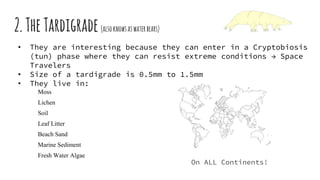
2.TheTardigrade(alsoknowsaswaterbears)
• They are interesting because they can enter in a Cryptobiosis
(tun) phase where they can resist extreme conditions → Space
Travelers
• Size of a tardigrade is 0.5mm to 1.5mm
• They live in:
Moss
Lichen
Soil
Leaf Litter
Beach Sand
Marine Sediment
Fresh Water Algae
On ALL Continents!
CRYPTOBIOSIS
1. Anhydrobiosis (lack of water)
2. Cryobiosis (low temperature)
3. Osmobiosis (increased solute concentration, eg. salt
water)
4. Anoxybiosis (lack of oxygen)
The most common type of cryptobiosis studied in tardigrades is
anhydrobiosis.
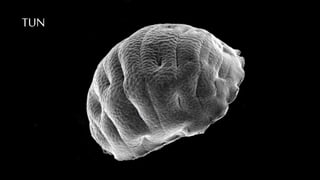
TUN
2.AtheTardigradeCapabilities
❖ Temperature
■ 272.95 Cº 20 Hours
■ -200 Cº 20 Months
■ +120 deg C Above boiling
❖ Radiation
■ Can withstand upto 5000Gy (gray scale)
❖ Pressure
■ 1800 Atmosphere
■ Pure Vacuum
❖ Excessive concentrations: CO, CO2, N2, H2S
❖ Lifespan
■ Live over 125 Years
■ Live in tun state for 10 years
2.b.Anathomy
• 5 body segments
• Separate sexes, lays eggs
• 4 pair of legs ending in claws
• Nervous System with light
sensitive spots
• Full Digestive & Excretory
Systems
• Complex mouth & pharynx System
• Well developed muscles
• NO Respiratory or Circulatory
Systems
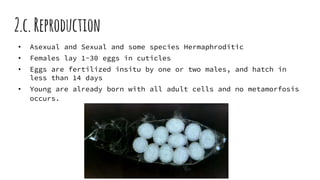
2.c.Reproduction
• Asexual and Sexual and some species Hermaphroditic
• Females lay 1-30 eggs in cuticles
• Eggs are fertilized insitu by one or two males, and hatch in
less than 14 days
• Young are already born with all adult cells and no metamorfosis
occurs.
2.d.LifeCycle
3.Howdotheysurvive
1. During extreme conditions tardigrades enter a state of Suspended
animation (tun state)
a. They can remain in this state for up to 10 years
b. The come back to norman state when they sense an hospitable environment
2. European space agency experiment (2007)
a. More than half of the tardigrade survived
3. Secret to their survival
a.Dehydration
b.Trehalose(sugar)
c.Antioxidants
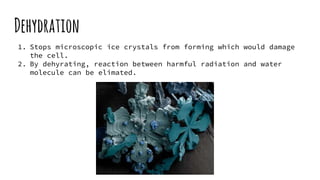
Dehydration
1. Stops microscopic ice crystals from forming which would damage
the cell.
2. By dehyrating, reaction between harmful radiation and water
molecule can be elimated.
Trehalose(sugar):
1. Trehalose is a disaccharide formed by a bond between two α-
glucose units.
2. Trehalose protects proteins membranes, etc from getting damaged.
3. Some tardigrades survive without trehalose.
Antioxidants
1. They produre antioxidant that would cleanup molecule which would
damage cells.
4.TestingViability
1. The experimental samples are first dehydrated.
2. Then we cultivate trehalose into a DNA medium or nourishment.
3. Antioxidents to repair the DNA are provided to the sample.
4. After which the test samples are subjected
a.Harmful ultraviolet radiations
b.Extreme pressure and temperature
c.Vacuum and with high concentration gases
d.The time periord of survival during this conditions
5. If the measured results are satisfying we can implement this idea for
space explorations to produce food which can last longer.
5.Resurrection Plant
1. A resurrection plant is any poikilohydric plant that can survive
extreme dehydration, even over months or years.
2. They can live without 95% of water, these species of plants and
seeds are drought-tolerant.
3. An understanding of these plants from a systems biology approach
should be made, in which everything from the molecular level to
the whole plant eco-physiological level to understand the
changes.
4. Interaction of free radicals are avoided by antioxidants, sun
block pigments and by removing chlorophyll.
6.Potential Applications
Tardigrade  Animal
Resurrection Plant  Plant
Applications
1. Tuning fresh food in order it dosn’t expire.
2. Tuning animals and untun them only for reproduction, in this way
we can produce and store more food.
3. Tuning astronauts for certain kind of missions which requires
them to survive extreme conditions.
4. To start a poblation in a planet we may need to bring the
especimens in different timing. Tuning can be used to kick-off
the new ecosystem at the same time.
5. We can produce crops and letuces which can stay live without
water for 100s of years.
6. Seeds can be kept at anhydrobiosis state for years before they
are planted, suitable for long duration space applications.
References
1. Miller, W.R., 1997, Bears of the Moss, The Kansas School Naturalist, Vol.
43, No. 3. pp. 16.
2. Kinchin, I.M., 1994, The Biology of Tardigrades, Portland Press, pp 186.
3. Ramazzotti, G. & Maucci, W., 1983, Il Phylum Tardigrada (3rd ed.), Memorie
dell’Istuto italiano di Idrobiologia Marco Marchi, Vol. 41, pp. 1-1012.
4. http://www.esa.int/Our_Activities/Human_Spaceflight/Research/Tiny_animals_
survive_exposure_to_space
5. https://www.youtube.com/watch?v=wIVk-SJFxCQ
6. https://www.youtube.com/watch?v=B1sUdu7ISZA
7. https://www.youtube.com/watch?v=PWokVlZFK9E (study by Jill Farrant)

LSSS Project final

  • 1.
  • 2.
    Index 1. Why can’twe survive in space? 2. The tardigrade a.Capabilities b.Reproduction c.Life cycle d.Anathomy 3. How do they survive? 4. Testing viability 5. Resurrection Plant 6. Applications
  • 3.
    1.Whycan’twesurviveinspace? Extreme conditions inspace 1.Lack of Oxygen 2.Lack of Pressure 3.Solar Radiation 4.Vacuum 5.Temperatures Previous experiments Dogs can survive for 90sec Chimpanzee can survive for 3 min 30 sec
  • 4.
  • 5.
    2.TheTardigrade(alsoknowsaswaterbears) • They areinteresting because they can enter in a Cryptobiosis (tun) phase where they can resist extreme conditions → Space Travelers • Size of a tardigrade is 0.5mm to 1.5mm • They live in: Moss Lichen Soil Leaf Litter Beach Sand Marine Sediment Fresh Water Algae On ALL Continents!
  • 6.
    CRYPTOBIOSIS 1. Anhydrobiosis (lackof water) 2. Cryobiosis (low temperature) 3. Osmobiosis (increased solute concentration, eg. salt water) 4. Anoxybiosis (lack of oxygen) The most common type of cryptobiosis studied in tardigrades is anhydrobiosis.
  • 7.
  • 8.
    2.AtheTardigradeCapabilities ❖ Temperature ■ 272.95Cº 20 Hours ■ -200 Cº 20 Months ■ +120 deg C Above boiling ❖ Radiation ■ Can withstand upto 5000Gy (gray scale) ❖ Pressure ■ 1800 Atmosphere ■ Pure Vacuum ❖ Excessive concentrations: CO, CO2, N2, H2S ❖ Lifespan ■ Live over 125 Years ■ Live in tun state for 10 years
  • 9.
    2.b.Anathomy • 5 bodysegments • Separate sexes, lays eggs • 4 pair of legs ending in claws • Nervous System with light sensitive spots • Full Digestive & Excretory Systems • Complex mouth & pharynx System • Well developed muscles • NO Respiratory or Circulatory Systems
  • 10.
    2.c.Reproduction • Asexual andSexual and some species Hermaphroditic • Females lay 1-30 eggs in cuticles • Eggs are fertilized insitu by one or two males, and hatch in less than 14 days • Young are already born with all adult cells and no metamorfosis occurs.
  • 11.
  • 12.
    3.Howdotheysurvive 1. During extremeconditions tardigrades enter a state of Suspended animation (tun state) a. They can remain in this state for up to 10 years b. The come back to norman state when they sense an hospitable environment 2. European space agency experiment (2007) a. More than half of the tardigrade survived 3. Secret to their survival a.Dehydration b.Trehalose(sugar) c.Antioxidants
  • 13.
    Dehydration 1. Stops microscopicice crystals from forming which would damage the cell. 2. By dehyrating, reaction between harmful radiation and water molecule can be elimated.
  • 14.
    Trehalose(sugar): 1. Trehalose isa disaccharide formed by a bond between two α- glucose units. 2. Trehalose protects proteins membranes, etc from getting damaged. 3. Some tardigrades survive without trehalose.
  • 15.
    Antioxidants 1. They produreantioxidant that would cleanup molecule which would damage cells.
  • 16.
    4.TestingViability 1. The experimentalsamples are first dehydrated. 2. Then we cultivate trehalose into a DNA medium or nourishment. 3. Antioxidents to repair the DNA are provided to the sample. 4. After which the test samples are subjected a.Harmful ultraviolet radiations b.Extreme pressure and temperature c.Vacuum and with high concentration gases d.The time periord of survival during this conditions 5. If the measured results are satisfying we can implement this idea for space explorations to produce food which can last longer.
  • 17.
    5.Resurrection Plant 1. Aresurrection plant is any poikilohydric plant that can survive extreme dehydration, even over months or years. 2. They can live without 95% of water, these species of plants and seeds are drought-tolerant. 3. An understanding of these plants from a systems biology approach should be made, in which everything from the molecular level to the whole plant eco-physiological level to understand the changes. 4. Interaction of free radicals are avoided by antioxidants, sun block pigments and by removing chlorophyll.
  • 19.
    6.Potential Applications Tardigrade Animal Resurrection Plant  Plant
  • 20.
    Applications 1. Tuning freshfood in order it dosn’t expire. 2. Tuning animals and untun them only for reproduction, in this way we can produce and store more food. 3. Tuning astronauts for certain kind of missions which requires them to survive extreme conditions. 4. To start a poblation in a planet we may need to bring the especimens in different timing. Tuning can be used to kick-off the new ecosystem at the same time. 5. We can produce crops and letuces which can stay live without water for 100s of years. 6. Seeds can be kept at anhydrobiosis state for years before they are planted, suitable for long duration space applications.
  • 21.
    References 1. Miller, W.R.,1997, Bears of the Moss, The Kansas School Naturalist, Vol. 43, No. 3. pp. 16. 2. Kinchin, I.M., 1994, The Biology of Tardigrades, Portland Press, pp 186. 3. Ramazzotti, G. & Maucci, W., 1983, Il Phylum Tardigrada (3rd ed.), Memorie dell’Istuto italiano di Idrobiologia Marco Marchi, Vol. 41, pp. 1-1012. 4. http://www.esa.int/Our_Activities/Human_Spaceflight/Research/Tiny_animals_ survive_exposure_to_space 5. https://www.youtube.com/watch?v=wIVk-SJFxCQ 6. https://www.youtube.com/watch?v=B1sUdu7ISZA 7. https://www.youtube.com/watch?v=PWokVlZFK9E (study by Jill Farrant)