PrimeOne School Science Department | 1 |
LESSON PLAN
SCHOOL YEAR 2023 – 2024
Date : September 1st
-September 30th
2023
Subject : Physics
Grade/Semester : XI / I
Time Allocated : 8 sessions x 45 minutes
Chapter 4: Forces - vectors and moments
Time
Allocatio
n
Learning objectives Teaching Activities
Teacher guidance notes
and key concepts Learning resources
2 x 45’ 4.1.a
Understand frictional
forces and viscous forces
including air resistance
Learning models: Contextual Teaching and Learning (CTL)
Real life relatedness: sailing a boat into the wind.
● Introduction (10’)
o Orientation: Greeting and Praying, 30 school culture,
checking the cleanliness, checking the completeness of
students, etc
● Main Activity (70’)
o Teacher makes discussion groups consist of 5 students.
Key concepts
Forces
Vectors
Combining forces
Value instilled:
In this learning model,
students are given chance to
share ideas. During
discussion students are
advised to:
1. Collaborate
2. Appreciate others
3. Be Perseverance
Textbook/Publicatio
ns
- Physics A level
textbook (Pg. 54-56)
http://youtube.com/pr
ofesordaveexpalins/sa
ilingboat.htm
Teaching Media
PrimeOne School Science Department | 2 |
Time
Allocatio
n
Learning objectives Teaching Activities
Teacher guidance notes
and key concepts Learning resources
● Constructivism: Teacher and students discuss how to
resolve a vector into two components, and relate it to the
forces acting on the car moves up a hill.
● Inquiry
Teachers give students examples of vector diagram of a
man sliding on a waterslide and ask the students to find his
acceleration going down.
● Questioning: Teacher asks the students to analyse kinds of
forces acting on a car moves up hill and draw it on a paper.
● Learning community: Teacher asks each group to present
their discussion result.
4. Pride
Big Question:
How frictional force affect
the motion of object?
Big Question from another
resources:
Explain forces works in a
sailing boat
Progressive question:
How to combine forces
which work in one object?
Whiteboard,
Presentation of Forces
Teaching Aid
Video of combining
forces, simulation
website
(Ophysics.com)
Past papers
Paper 21, June 2013,
Q4 (c)
Paper 22, Nov 2012,
Q2 (c)(ii)
Paper 21, June 2012,
Q2 (c)
Paper 23, June 2013,
Q3 (b)(ii)
Paper 21, Nov 2011,
Q3 (c)(ii)
PrimeOne School Science Department | 3 |
Time
Allocatio
n
Learning objectives Teaching Activities
Teacher guidance notes
and key concepts Learning resources
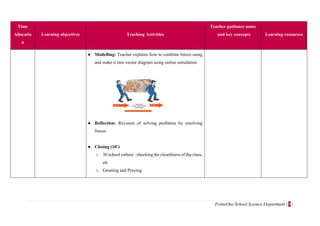
● Modelling: Teacher explains how to combine forces using
and make it into vector diagram using online simulation
● Reflection: Revision of solving problems by resolving
forces.
● Closing (10’)
o 30 school culture : checking the cleanliness of the class,
etc
o Greeting and Praying
PrimeOne School Science Department | 4 |
Time
Allocatio
n
Learning objectives Teaching Activities
Teacher guidance notes
and key concepts Learning resources
o Teacher and students review and summarize the topics
learning
2 x 45’ 4.1.b
define and apply the
moment of a force
4.2.a
Analyse that the weight
of a body may be taken
as acting at a single point
known as its centre of
gravity
Learning models: Inquiry
Real life relatedness: the shape of body and balance of
gymnastics athletes.
1. Introduction (10’)
● Orientation: Greeting and Praying, 30 school culture :
checking the cleanliness, checking the completeness of
students, etc
2. Main Activity (70’)
● Teacher makes discussion groups consist of 5 students.
Key concepts
Forces
Centre of gravity
Value instilled:
In this learning model,
students are given chance to
share ideas and practical,
students are advised to:
1. Collaborate
2. Appreciate others
3. Be Perseverance
4. Pride in work
Textbook/Publicatio
ns
- Physics A level
textbook (Pg. 59)
http://www.s-
cool.co.uk/a-
level/physics/moment
s-couples-and-
equilibrium/revise-
it/centre-of-gravity-
and-centre-of-mass
PrimeOne School Science Department | 5 |
Time
Allocatio
n
Learning objectives Teaching Activities
Teacher guidance notes
and key concepts Learning resources
● Modelling: Teacher asks one students to stand up in
front of the class while explaining the centre of gravity
on his body.
● Inquiry
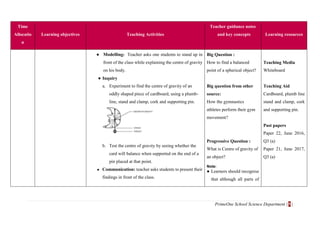
a. Experiment to find the centre of gravity of an
oddly shaped piece of cardboard, using a plumb-
line, stand and clamp, cork and supporting pin.
b. Test the centre of gravity by seeing whether the
card will balance when supported on the end of a
pin placed at that point.
● Communication: teacher asks students to present their
findings in front of the class.
Big Question :
How to find a balanced
point of a spherical object?
Big question from other
source:
How the gymnastics
athletes perform their gym
movement?
Progressive Question :
What is Centre of gravity of
an object?
Note:
● Learners should recognise
that although all parts of
Teaching Media
Whiteboard
Teaching Aid
Cardboard, plumb line
stand and clamp, cork
and supporting pin.
Past papers
Paper 22, June 2016,
Q3 (a)
Paper 21, June 2017,
Q3 (a)
PrimeOne School Science Department | 6 |
Time
Allocatio
n
Learning objectives Teaching Activities
Teacher guidance notes
and key concepts Learning resources
3. Closing (10’)
● 30 school culture : checking the cleanliness of the
class, etc
● Greeting and Praying
● Teacher and students review and summarize the topics
learning
the card possess weight,
some problems can be
solved more easily by
assuming that all the
weight acts downwards
from this particular point.
2x45’ 4.2.a
define and apply the
moment of a force
4.3.a
state and apply the
principle of moments
Learning models: Discussion
Real life relatedness: daily tools around which use the concept
of moments such as pliers and seesaw.
1. Introduction (10’)
● Orientation: Greeting and Praying, 30 school culture :
checking the cleanliness, checking the completeness of
students, etc
Key concepts
Forces
Moments
Value instilled:
In this learning model,
students are given chance to
share ideas and practical,
students are advised to:
1. Be Perseverance
2.Collaborate
3. Be Reflective
Textbook/Publicatio
ns
- Physics A level
textbook (Pg. 63)
http://www.tap.iop.or
g/mechanics/static/20
3/page_46264.html
Teaching Media
PrimeOne School Science Department | 7 |
Time
Allocatio
n
Learning objectives Teaching Activities
Teacher guidance notes
and key concepts Learning resources
2. Main activity (70’)
● Teacher asks students to pair up.
● Discuss in pairs the occasions when they have applied
a force to something which resulted in a turning motion
today, and make a list. The suggestions could be
brought together to make a longer group list. Examples
could include turning on a tap, or opening or closing a
door.
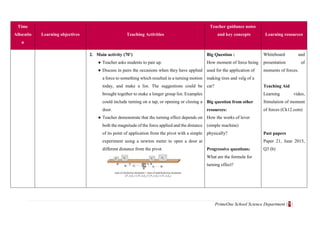
● Teacher demonstrate that the turning effect depends on
both the magnitude of the force applied and the distance
of its point of application from the pivot with a simple
experiment using a newton meter to open a door at
different distance from the pivot.
Big Question :
How moment of force being
used for the application of
making tires and velg of a
car?
Big question from other
resources:
How the works of lever
(simple machine)
physically?
Progressive questions:
What are the formula for
turning effect?
Whiteboard and
presentation of
moments of forces.
Teaching Aid
Learning video,
Simulation of moment
of forces (Ck12.com)
Past papers
Paper 21, June 2015,
Q3 (b)
PrimeOne School Science Department | 8 |
Time
Allocatio
n
Learning objectives Teaching Activities
Teacher guidance notes
and key concepts Learning resources
● Teacher shows video of rotating a retort stand from
lying down to horizontal. Calculate the moment at each
distance to show it is the same.
● Teacher gives one example questions related to
moments, and discuss it with the students.
● Teacher gives practise solving 5 examples from the
textbook and asks the students to do it at home and
submit it online via Google classroom..
3. Closing (10’)
● 30 school culture : checking the cleanliness of the
class, etc
● Greeting and Praying
● Teacher and students review and summarize the topics
learning
PrimeOne School Science Department | 9 |
Time
Allocatio
n
Learning objectives Teaching Activities
Teacher guidance notes
and key concepts Learning resources
2 x 45’ 4.2.b
understand that a couple
is a pair of forces that
tends to produce rotation
only
4.2.c
define and apply the
torque of a couple
4.3.b
Evaluate when there is no
resultant force and no
Learning models: Discussion
Real life relatedness: the use of steering wheel.
1. Introduction (10’)
● Orientation: Greeting and Praying, 30 school culture :
checking the cleanliness, checking the completeness of
students, etc
2. Main activity (70’)
● Teacher asks students to pair up.
● Discuss how, for example, a screwdriver or bicycle
handle bars work. Two forces of equal size in opposite
directions.
Key concepts
Forces
Torque
Moments
Value instilled:
In this learning model,
students are given chance to
share ideas. During
discussion students are
advised to:
1. Be Perseverance
2.Collaborate
3. Be Reflective
Big Question :
Textbook/Publicatio
ns
- Physics A level
textbook (Pg.63)
http://www.tap.iop.or
g/mechanics/static/20
2/page_46254.html
http://www.s-
cool.co.uk/a-
level/physics/moment
s-couples-and-
equilibrium/revise-
it/equilibrium-
conditions
PrimeOne School Science Department | 10 |
Time
Allocatio
n
Learning objectives Teaching Activities
Teacher guidance notes
and key concepts Learning resources
resultant torque, a system
is in equilibrium
● Students draw the picture of couple of force that have
been discussed on a paper.
● Teacher show a picture of an object with a couple
acting on it, and discuss with students if is it in
equilibrium.
● Teacher and students examine the differences between
the moment of a single force and the moment produced
by a couple by looking at the picture drawn before.
● Teacher Illustrate the torque of a couple by taking
moments for a body with a couple acting on it about a
number of places, for example where one force acts, on
the line joining the two forces, along the same line but
How to describe an object
which has reach its
equilibrium position?
Big question from other
resources:
How is the applications of
torque in steering wheel?
Progressive question:
What is the formula for
torque?
Note:
● As mentioned for learning
objective 4.3.b, there
needs to be a clear
distinction made between
Teaching Media
Whiteboard,
Presentation slides.
Teaching Aid
Learning video of
torque, related pictures
to torque.
Past papers
Paper 21, Nov 2017,
Q4 (b)(iii)(iv)
Paper 21, June 2016,
Q3 (a)
PrimeOne School Science Department | 11 |
Time
Allocatio
n
Learning objectives Teaching Activities
Teacher guidance notes
and key concepts Learning resources
outside of the object entirely. Show that the torque is
always the same.
● Discuss what learners understand by equilibrium.
● Teacher gives question example related to torque of a
couple.
● Teacher gives practise solving 5 examples from the
textbook and asks the students to do it at home.
3. Closing (10’)
● 30 school culture : checking the cleanliness of the
class, etc
● Greeting and Praying
● Teacher and students review and summarize the topics
learning
the case of a single turning
force which has a moment
about a pivot, and a
couple, which always
consists of two forces,
equal and opposite, which
produce a torque.
● Torque (of a couple)
should be defined
carefully, and learners
should ensure they are
using the correct wording.
Paper 22, June 2016,
Q3 (c)
Paper 23, June 2016,
Q1 (c)(i)
Paper 22, June 2016,
Q3 (b)(i)
Paper 21, Nov 2015,
Q2 (b)(ii)
Paper 23, June 2015,
Q2 (a)
Paper 21, June 2015,
Q3 (c)(i)
PrimeOne School Science Department | 12 |
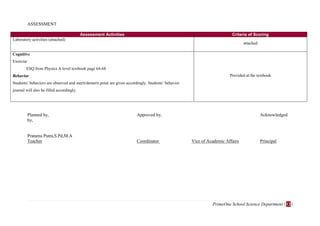
ASSESSMENT
Assessment Activities Criteria of Scoring
Laboratory activities (attached)
attached
Cognitive
Exercise
ESQ from Physics A level textbook page 64-68
Behavior
Students’ behaviors are observed and merit/demerit point are given accordingly. Students’ behavior
journal will also be filled accordingly.
Provided at the textbook
Planned by, Approved by, Acknowledged
by,
Pratama Putra,S.Pd,M.A
Teacher Coordinator Vice of Academic Affairs Principal

LP CH 4 updated(lesson plan for physics As level).docx

  • 1.
    PrimeOne School ScienceDepartment | 1 | LESSON PLAN SCHOOL YEAR 2023 – 2024 Date : September 1st -September 30th 2023 Subject : Physics Grade/Semester : XI / I Time Allocated : 8 sessions x 45 minutes Chapter 4: Forces - vectors and moments Time Allocatio n Learning objectives Teaching Activities Teacher guidance notes and key concepts Learning resources 2 x 45’ 4.1.a Understand frictional forces and viscous forces including air resistance Learning models: Contextual Teaching and Learning (CTL) Real life relatedness: sailing a boat into the wind. ● Introduction (10’) o Orientation: Greeting and Praying, 30 school culture, checking the cleanliness, checking the completeness of students, etc ● Main Activity (70’) o Teacher makes discussion groups consist of 5 students. Key concepts Forces Vectors Combining forces Value instilled: In this learning model, students are given chance to share ideas. During discussion students are advised to: 1. Collaborate 2. Appreciate others 3. Be Perseverance Textbook/Publicatio ns - Physics A level textbook (Pg. 54-56) http://youtube.com/pr ofesordaveexpalins/sa ilingboat.htm Teaching Media
  • 2.
    PrimeOne School ScienceDepartment | 2 | Time Allocatio n Learning objectives Teaching Activities Teacher guidance notes and key concepts Learning resources ● Constructivism: Teacher and students discuss how to resolve a vector into two components, and relate it to the forces acting on the car moves up a hill. ● Inquiry Teachers give students examples of vector diagram of a man sliding on a waterslide and ask the students to find his acceleration going down. ● Questioning: Teacher asks the students to analyse kinds of forces acting on a car moves up hill and draw it on a paper. ● Learning community: Teacher asks each group to present their discussion result. 4. Pride Big Question: How frictional force affect the motion of object? Big Question from another resources: Explain forces works in a sailing boat Progressive question: How to combine forces which work in one object? Whiteboard, Presentation of Forces Teaching Aid Video of combining forces, simulation website (Ophysics.com) Past papers Paper 21, June 2013, Q4 (c) Paper 22, Nov 2012, Q2 (c)(ii) Paper 21, June 2012, Q2 (c) Paper 23, June 2013, Q3 (b)(ii) Paper 21, Nov 2011, Q3 (c)(ii)
  • 3.
    PrimeOne School ScienceDepartment | 3 | Time Allocatio n Learning objectives Teaching Activities Teacher guidance notes and key concepts Learning resources ● Modelling: Teacher explains how to combine forces using and make it into vector diagram using online simulation ● Reflection: Revision of solving problems by resolving forces. ● Closing (10’) o 30 school culture : checking the cleanliness of the class, etc o Greeting and Praying
  • 4.
    PrimeOne School ScienceDepartment | 4 | Time Allocatio n Learning objectives Teaching Activities Teacher guidance notes and key concepts Learning resources o Teacher and students review and summarize the topics learning 2 x 45’ 4.1.b define and apply the moment of a force 4.2.a Analyse that the weight of a body may be taken as acting at a single point known as its centre of gravity Learning models: Inquiry Real life relatedness: the shape of body and balance of gymnastics athletes. 1. Introduction (10’) ● Orientation: Greeting and Praying, 30 school culture : checking the cleanliness, checking the completeness of students, etc 2. Main Activity (70’) ● Teacher makes discussion groups consist of 5 students. Key concepts Forces Centre of gravity Value instilled: In this learning model, students are given chance to share ideas and practical, students are advised to: 1. Collaborate 2. Appreciate others 3. Be Perseverance 4. Pride in work Textbook/Publicatio ns - Physics A level textbook (Pg. 59) http://www.s- cool.co.uk/a- level/physics/moment s-couples-and- equilibrium/revise- it/centre-of-gravity- and-centre-of-mass
  • 5.
    PrimeOne School ScienceDepartment | 5 | Time Allocatio n Learning objectives Teaching Activities Teacher guidance notes and key concepts Learning resources ● Modelling: Teacher asks one students to stand up in front of the class while explaining the centre of gravity on his body. ● Inquiry a. Experiment to find the centre of gravity of an oddly shaped piece of cardboard, using a plumb- line, stand and clamp, cork and supporting pin. b. Test the centre of gravity by seeing whether the card will balance when supported on the end of a pin placed at that point. ● Communication: teacher asks students to present their findings in front of the class. Big Question : How to find a balanced point of a spherical object? Big question from other source: How the gymnastics athletes perform their gym movement? Progressive Question : What is Centre of gravity of an object? Note: ● Learners should recognise that although all parts of Teaching Media Whiteboard Teaching Aid Cardboard, plumb line stand and clamp, cork and supporting pin. Past papers Paper 22, June 2016, Q3 (a) Paper 21, June 2017, Q3 (a)
  • 6.
    PrimeOne School ScienceDepartment | 6 | Time Allocatio n Learning objectives Teaching Activities Teacher guidance notes and key concepts Learning resources 3. Closing (10’) ● 30 school culture : checking the cleanliness of the class, etc ● Greeting and Praying ● Teacher and students review and summarize the topics learning the card possess weight, some problems can be solved more easily by assuming that all the weight acts downwards from this particular point. 2x45’ 4.2.a define and apply the moment of a force 4.3.a state and apply the principle of moments Learning models: Discussion Real life relatedness: daily tools around which use the concept of moments such as pliers and seesaw. 1. Introduction (10’) ● Orientation: Greeting and Praying, 30 school culture : checking the cleanliness, checking the completeness of students, etc Key concepts Forces Moments Value instilled: In this learning model, students are given chance to share ideas and practical, students are advised to: 1. Be Perseverance 2.Collaborate 3. Be Reflective Textbook/Publicatio ns - Physics A level textbook (Pg. 63) http://www.tap.iop.or g/mechanics/static/20 3/page_46264.html Teaching Media
  • 7.
    PrimeOne School ScienceDepartment | 7 | Time Allocatio n Learning objectives Teaching Activities Teacher guidance notes and key concepts Learning resources 2. Main activity (70’) ● Teacher asks students to pair up. ● Discuss in pairs the occasions when they have applied a force to something which resulted in a turning motion today, and make a list. The suggestions could be brought together to make a longer group list. Examples could include turning on a tap, or opening or closing a door. ● Teacher demonstrate that the turning effect depends on both the magnitude of the force applied and the distance of its point of application from the pivot with a simple experiment using a newton meter to open a door at different distance from the pivot. Big Question : How moment of force being used for the application of making tires and velg of a car? Big question from other resources: How the works of lever (simple machine) physically? Progressive questions: What are the formula for turning effect? Whiteboard and presentation of moments of forces. Teaching Aid Learning video, Simulation of moment of forces (Ck12.com) Past papers Paper 21, June 2015, Q3 (b)
  • 8.
    PrimeOne School ScienceDepartment | 8 | Time Allocatio n Learning objectives Teaching Activities Teacher guidance notes and key concepts Learning resources ● Teacher shows video of rotating a retort stand from lying down to horizontal. Calculate the moment at each distance to show it is the same. ● Teacher gives one example questions related to moments, and discuss it with the students. ● Teacher gives practise solving 5 examples from the textbook and asks the students to do it at home and submit it online via Google classroom.. 3. Closing (10’) ● 30 school culture : checking the cleanliness of the class, etc ● Greeting and Praying ● Teacher and students review and summarize the topics learning
  • 9.
    PrimeOne School ScienceDepartment | 9 | Time Allocatio n Learning objectives Teaching Activities Teacher guidance notes and key concepts Learning resources 2 x 45’ 4.2.b understand that a couple is a pair of forces that tends to produce rotation only 4.2.c define and apply the torque of a couple 4.3.b Evaluate when there is no resultant force and no Learning models: Discussion Real life relatedness: the use of steering wheel. 1. Introduction (10’) ● Orientation: Greeting and Praying, 30 school culture : checking the cleanliness, checking the completeness of students, etc 2. Main activity (70’) ● Teacher asks students to pair up. ● Discuss how, for example, a screwdriver or bicycle handle bars work. Two forces of equal size in opposite directions. Key concepts Forces Torque Moments Value instilled: In this learning model, students are given chance to share ideas. During discussion students are advised to: 1. Be Perseverance 2.Collaborate 3. Be Reflective Big Question : Textbook/Publicatio ns - Physics A level textbook (Pg.63) http://www.tap.iop.or g/mechanics/static/20 2/page_46254.html http://www.s- cool.co.uk/a- level/physics/moment s-couples-and- equilibrium/revise- it/equilibrium- conditions
  • 10.
    PrimeOne School ScienceDepartment | 10 | Time Allocatio n Learning objectives Teaching Activities Teacher guidance notes and key concepts Learning resources resultant torque, a system is in equilibrium ● Students draw the picture of couple of force that have been discussed on a paper. ● Teacher show a picture of an object with a couple acting on it, and discuss with students if is it in equilibrium. ● Teacher and students examine the differences between the moment of a single force and the moment produced by a couple by looking at the picture drawn before. ● Teacher Illustrate the torque of a couple by taking moments for a body with a couple acting on it about a number of places, for example where one force acts, on the line joining the two forces, along the same line but How to describe an object which has reach its equilibrium position? Big question from other resources: How is the applications of torque in steering wheel? Progressive question: What is the formula for torque? Note: ● As mentioned for learning objective 4.3.b, there needs to be a clear distinction made between Teaching Media Whiteboard, Presentation slides. Teaching Aid Learning video of torque, related pictures to torque. Past papers Paper 21, Nov 2017, Q4 (b)(iii)(iv) Paper 21, June 2016, Q3 (a)
  • 11.
    PrimeOne School ScienceDepartment | 11 | Time Allocatio n Learning objectives Teaching Activities Teacher guidance notes and key concepts Learning resources outside of the object entirely. Show that the torque is always the same. ● Discuss what learners understand by equilibrium. ● Teacher gives question example related to torque of a couple. ● Teacher gives practise solving 5 examples from the textbook and asks the students to do it at home. 3. Closing (10’) ● 30 school culture : checking the cleanliness of the class, etc ● Greeting and Praying ● Teacher and students review and summarize the topics learning the case of a single turning force which has a moment about a pivot, and a couple, which always consists of two forces, equal and opposite, which produce a torque. ● Torque (of a couple) should be defined carefully, and learners should ensure they are using the correct wording. Paper 22, June 2016, Q3 (c) Paper 23, June 2016, Q1 (c)(i) Paper 22, June 2016, Q3 (b)(i) Paper 21, Nov 2015, Q2 (b)(ii) Paper 23, June 2015, Q2 (a) Paper 21, June 2015, Q3 (c)(i)
  • 12.
    PrimeOne School ScienceDepartment | 12 | ASSESSMENT Assessment Activities Criteria of Scoring Laboratory activities (attached) attached Cognitive Exercise ESQ from Physics A level textbook page 64-68 Behavior Students’ behaviors are observed and merit/demerit point are given accordingly. Students’ behavior journal will also be filled accordingly. Provided at the textbook Planned by, Approved by, Acknowledged by, Pratama Putra,S.Pd,M.A Teacher Coordinator Vice of Academic Affairs Principal