Chapter 20
Electric Current and
Resistance
Units of Chapter 20
Batteries and Direct Current
Current and Drift Velocity
Resistance and Ohm’s Law
Electric Power
20.1 Batteries and Direct Current
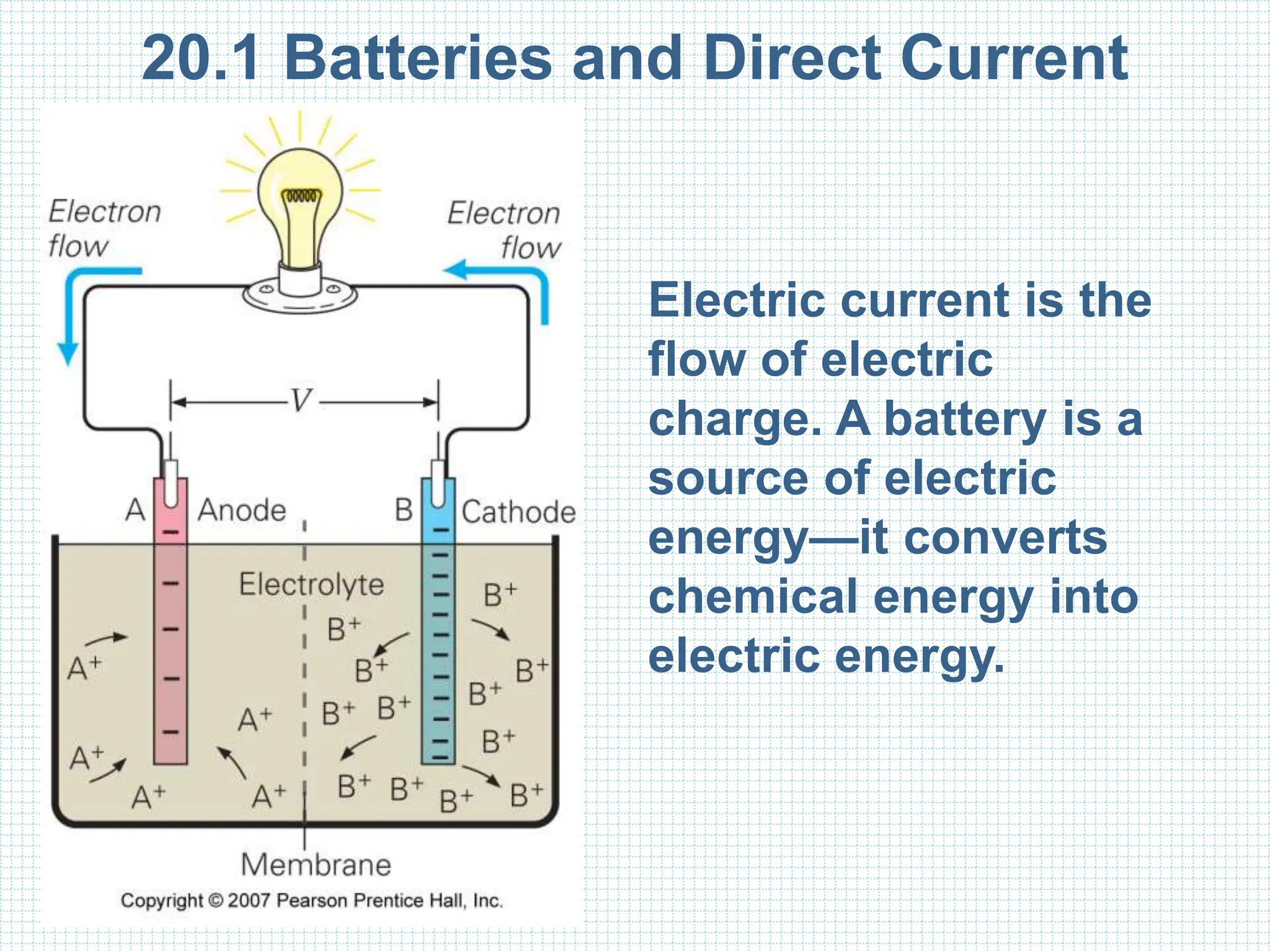
Electric current is the
flow of electric
charge. A battery is a
source of electric
energy—it converts
chemical energy into
electric energy.
20.1 Batteries and Direct Current
In a complete circuit, electrons flow from the
negative electrode to the positive one.
The positive electrode is called the anode; the
negative electrode is the cathode.
A battery provides a constant source of
voltage—it maintains a constant potential
difference between its terminals.
20.1 Batteries and Direct Current
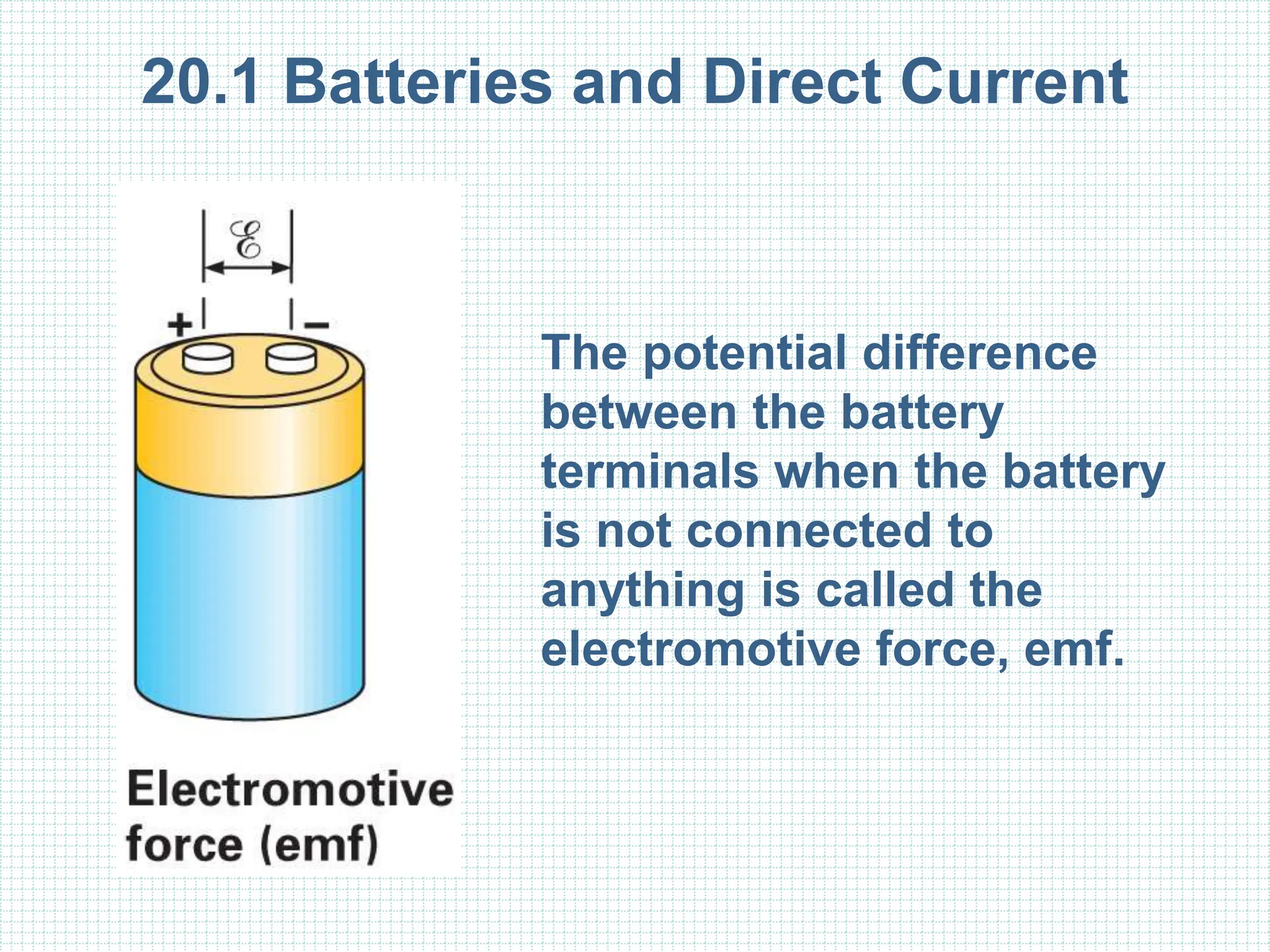
The potential difference
between the battery
terminals when the battery
is not connected to
anything is called the
electromotive force, emf.
20.1 Batteries and Direct Current
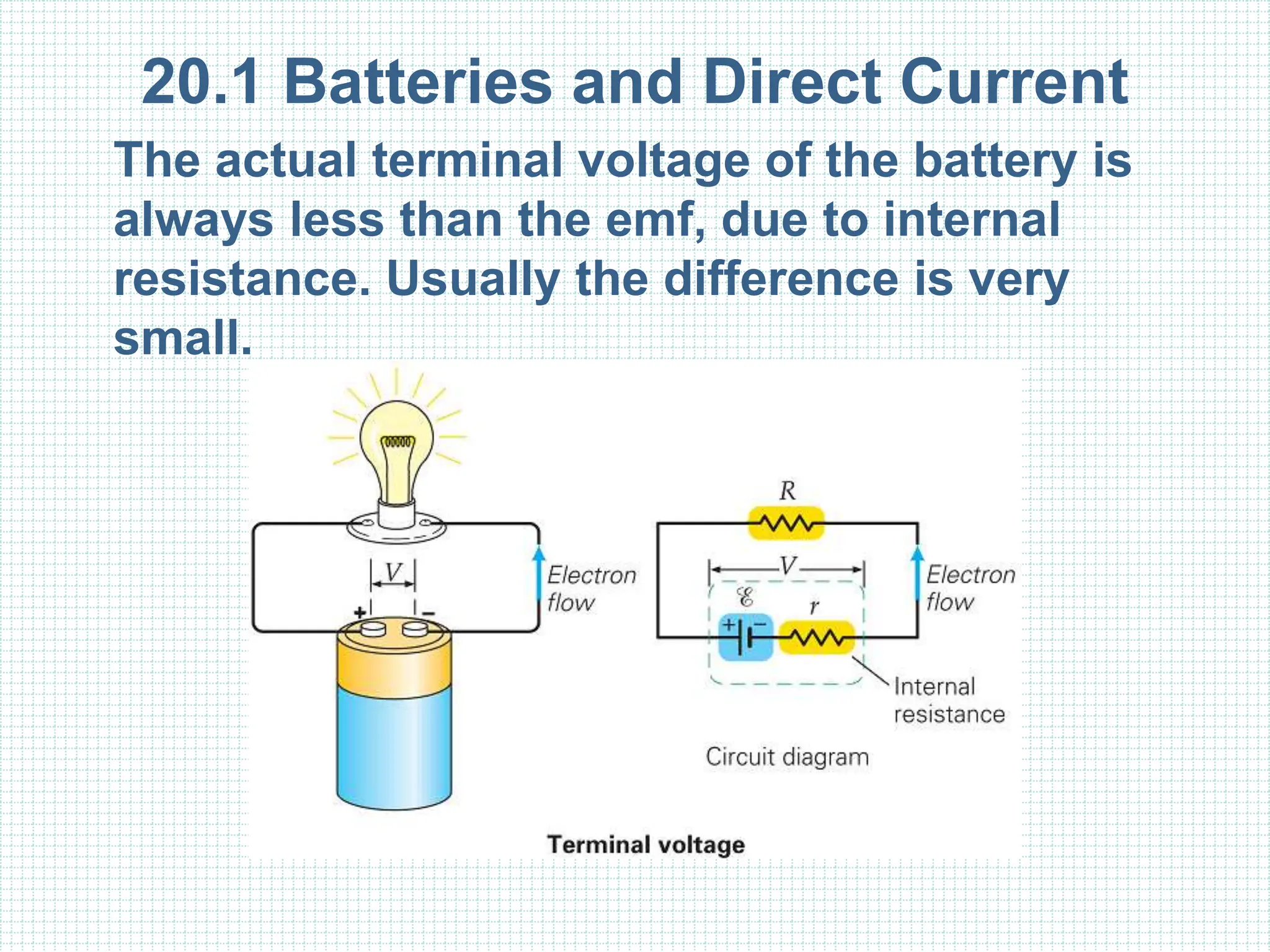
The actual terminal voltage of the battery is
always less than the emf, due to internal
resistance. Usually the difference is very
small.
20.1 Batteries and Direct Current
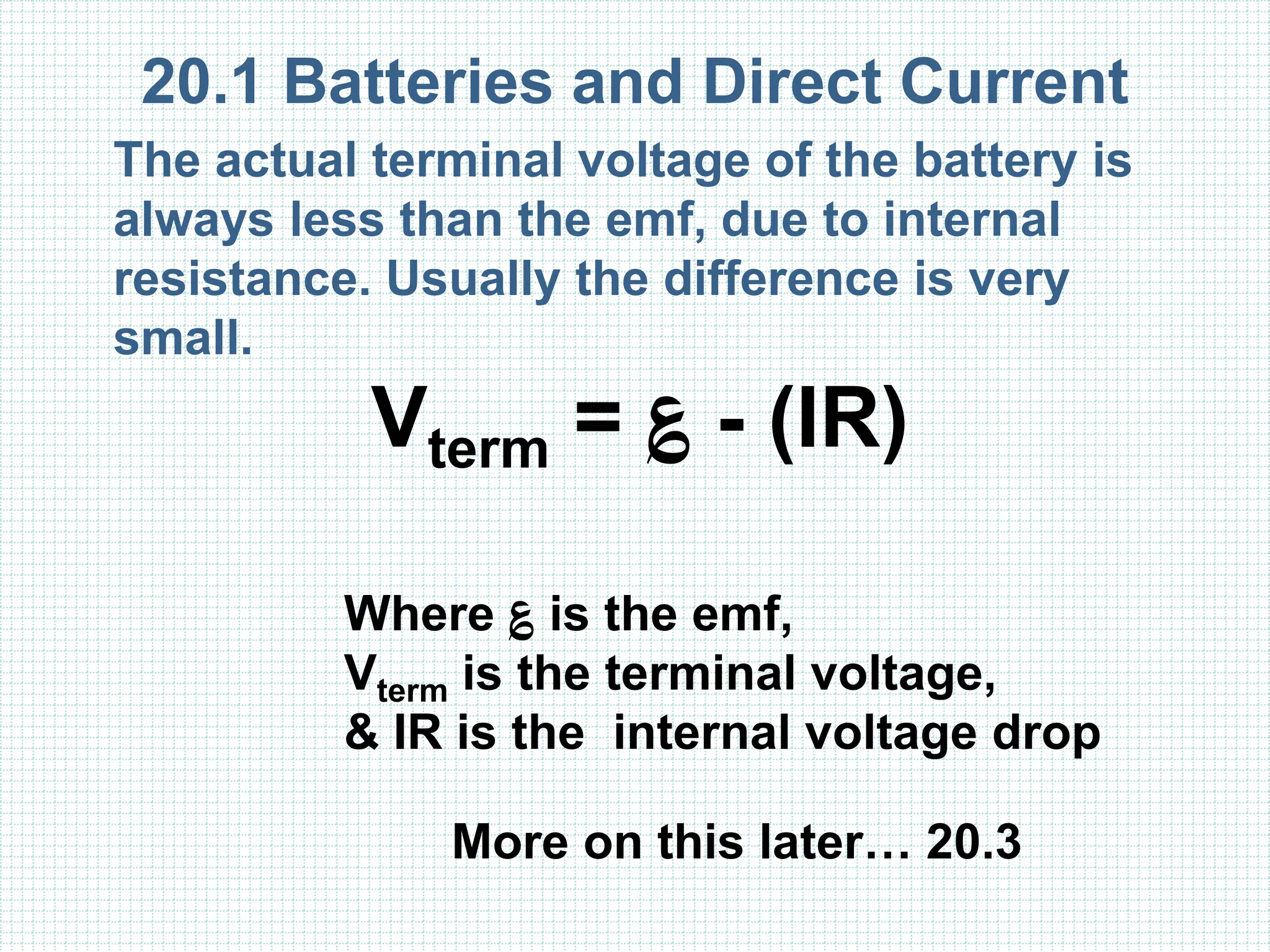
The actual terminal voltage of the battery is
always less than the emf, due to internal
resistance. Usually the difference is very
small.
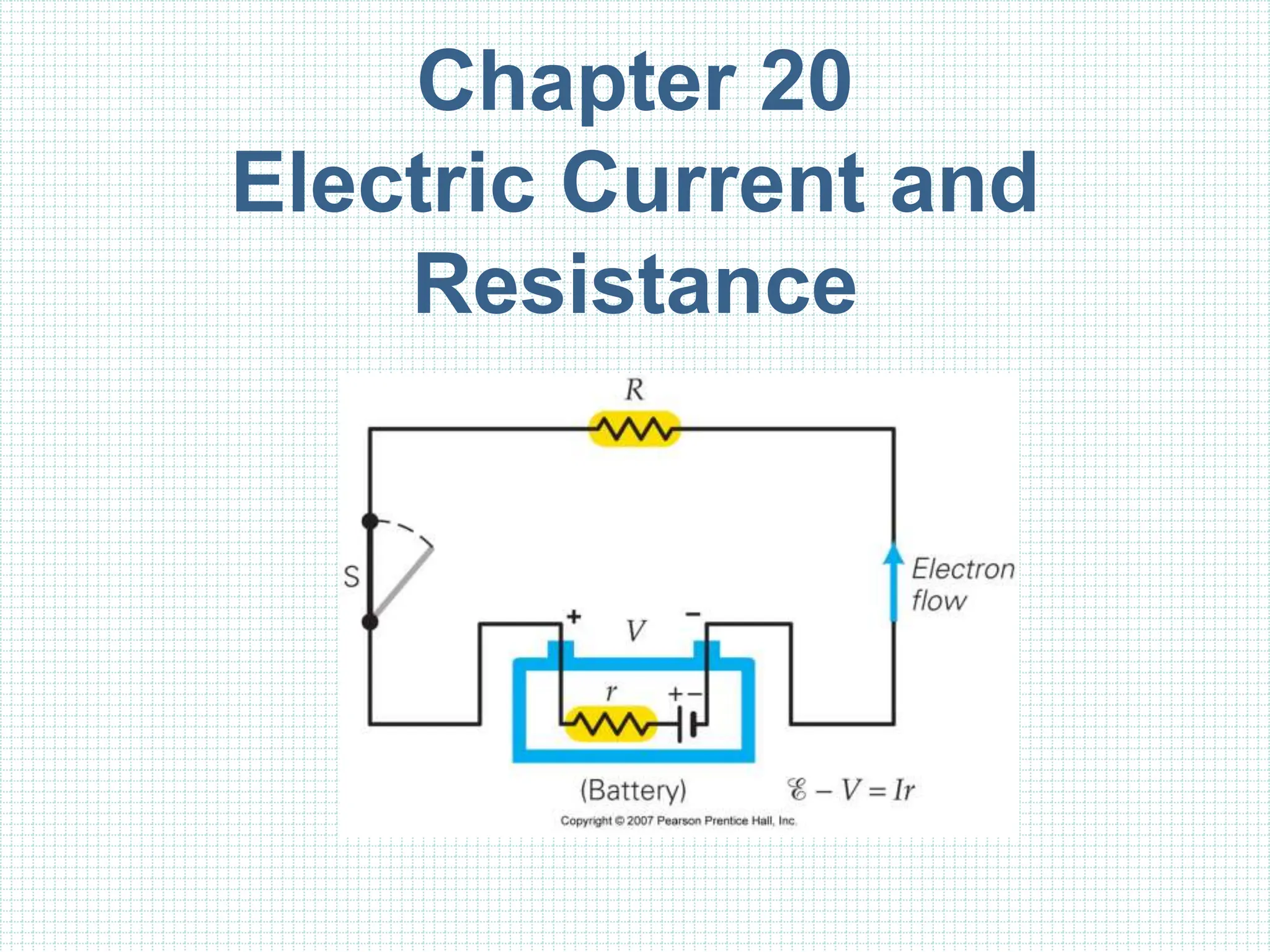
Vterm = ؏ - (IR)
Where ؏ is the emf,
Vterm is the terminal voltage,
& IR is the internal voltage drop
More on this later… 20.3
20.1 Batteries and Direct Current
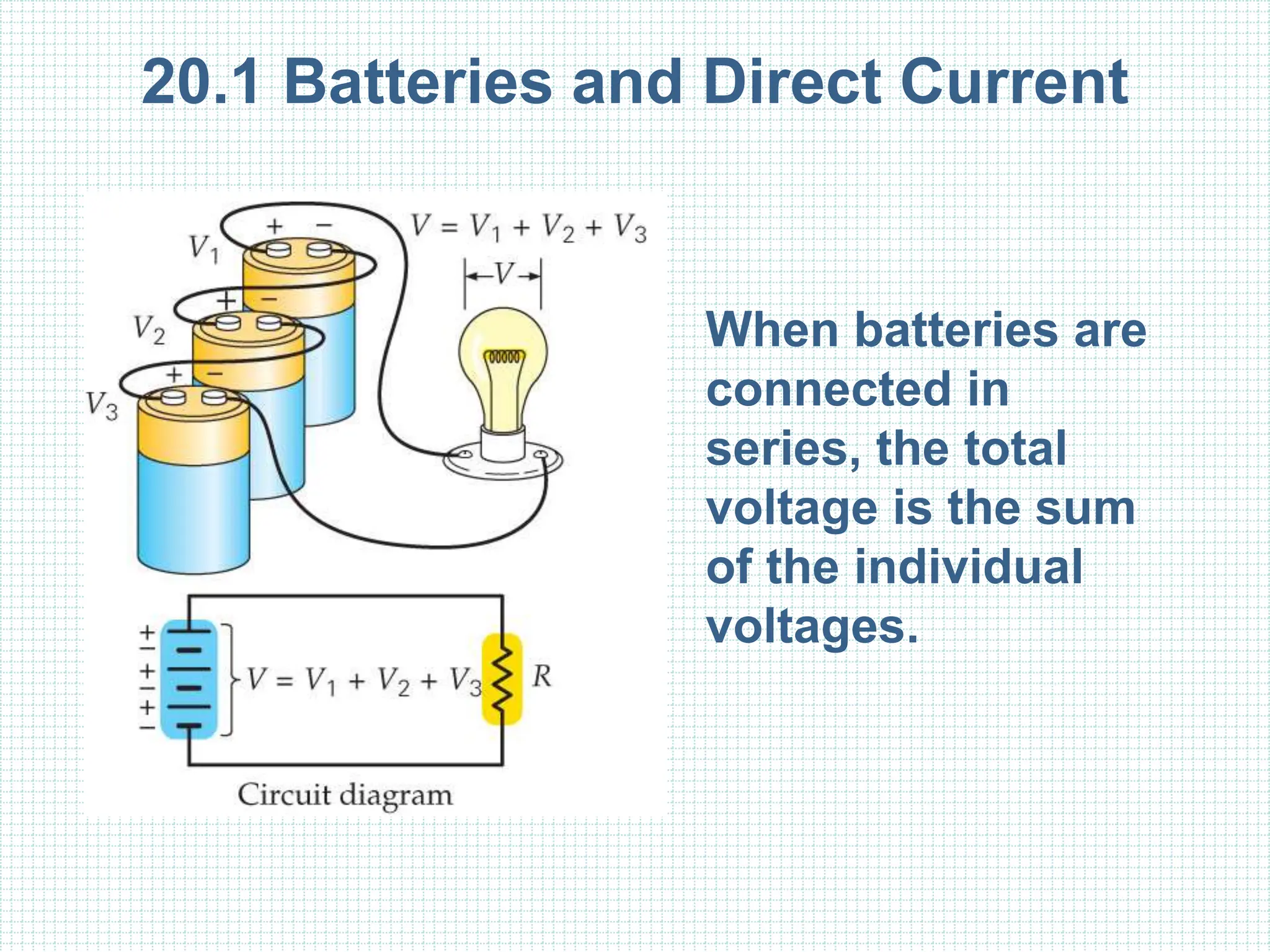
When batteries are
connected in
series, the total
voltage is the sum
of the individual
voltages.
20.1 Batteries and Direct Current
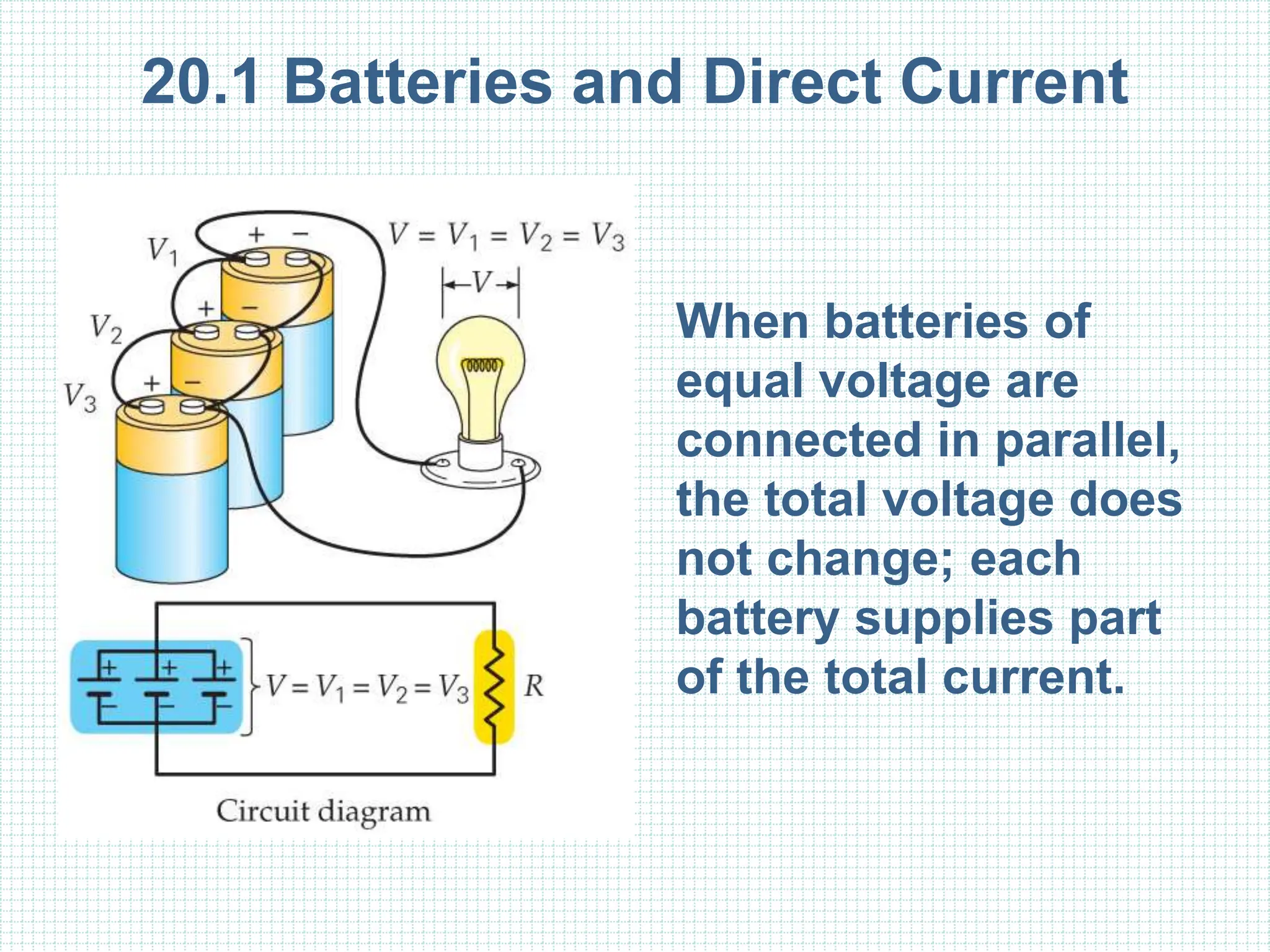
When batteries of
equal voltage are
connected in parallel,
the total voltage does
not change; each
battery supplies part
of the total current.
20.1 Batteries and Direct Current
20.1 Current and Drift Velocity
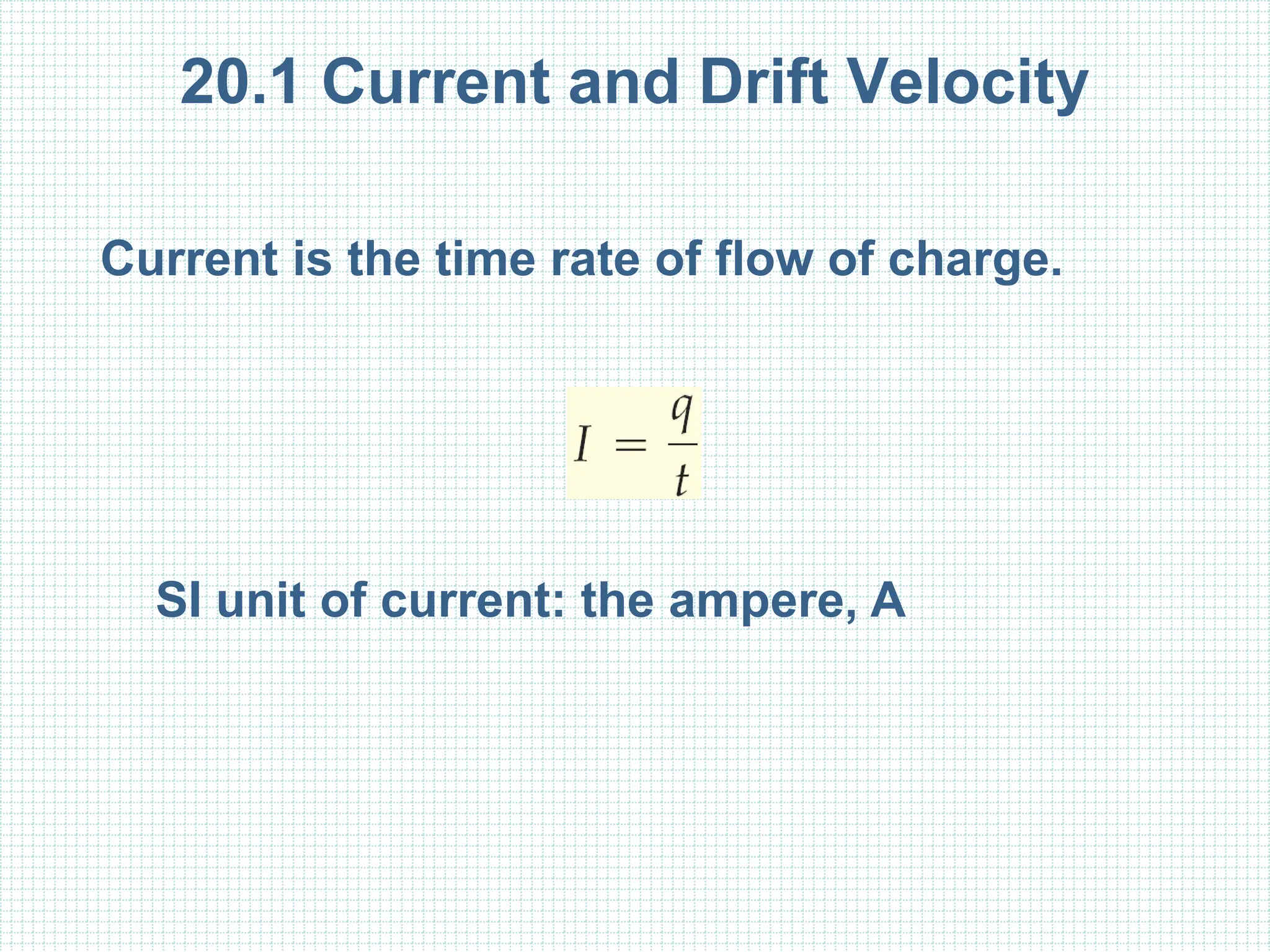
Current is the time rate of flow of charge.
SI unit of current: the ampere, A
20.1 Current and Drift Velocity
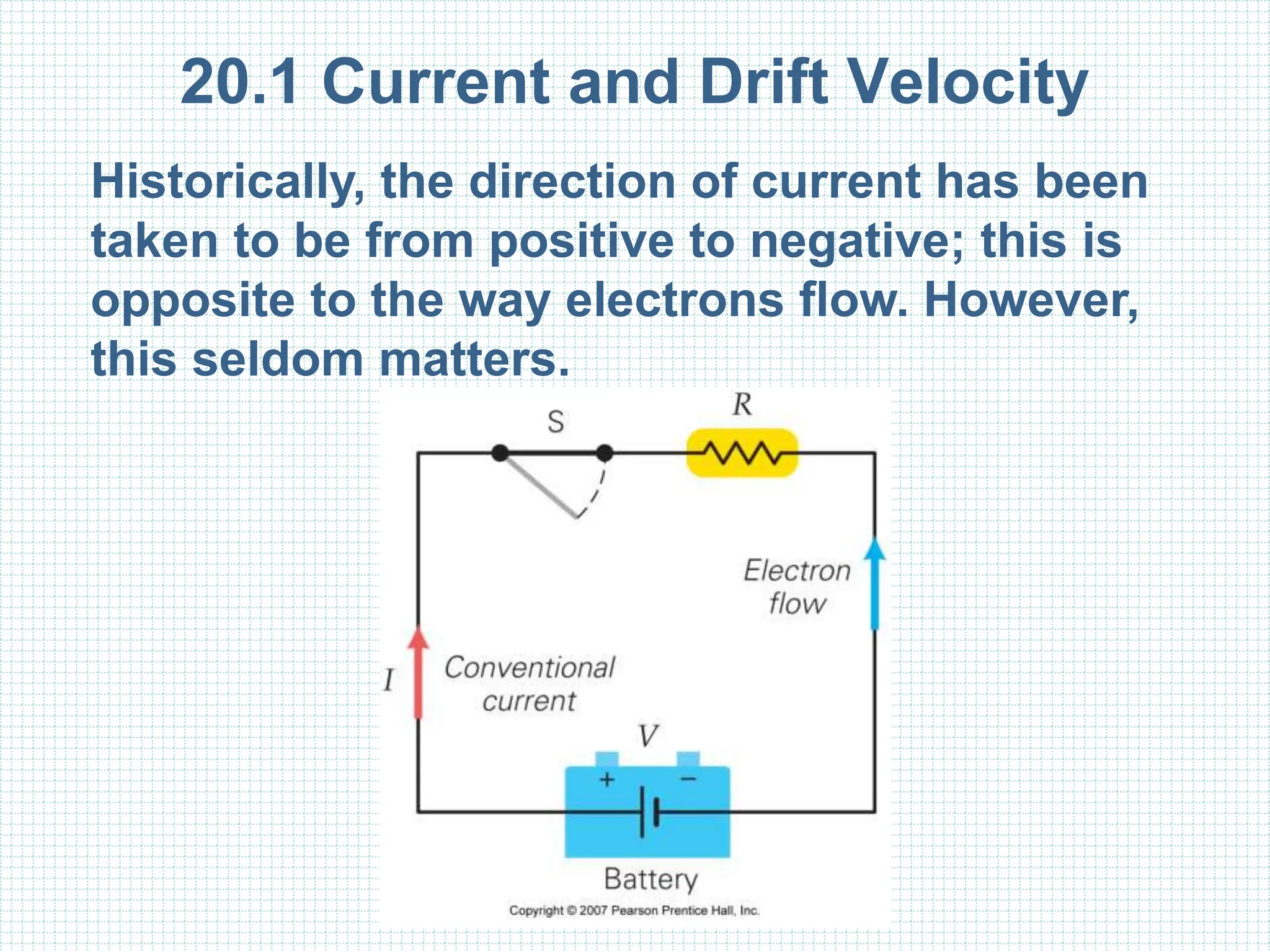
Historically, the direction of current has been
taken to be from positive to negative; this is
opposite to the way electrons flow. However,
this seldom matters.
20.1 Current and Drift Velocity
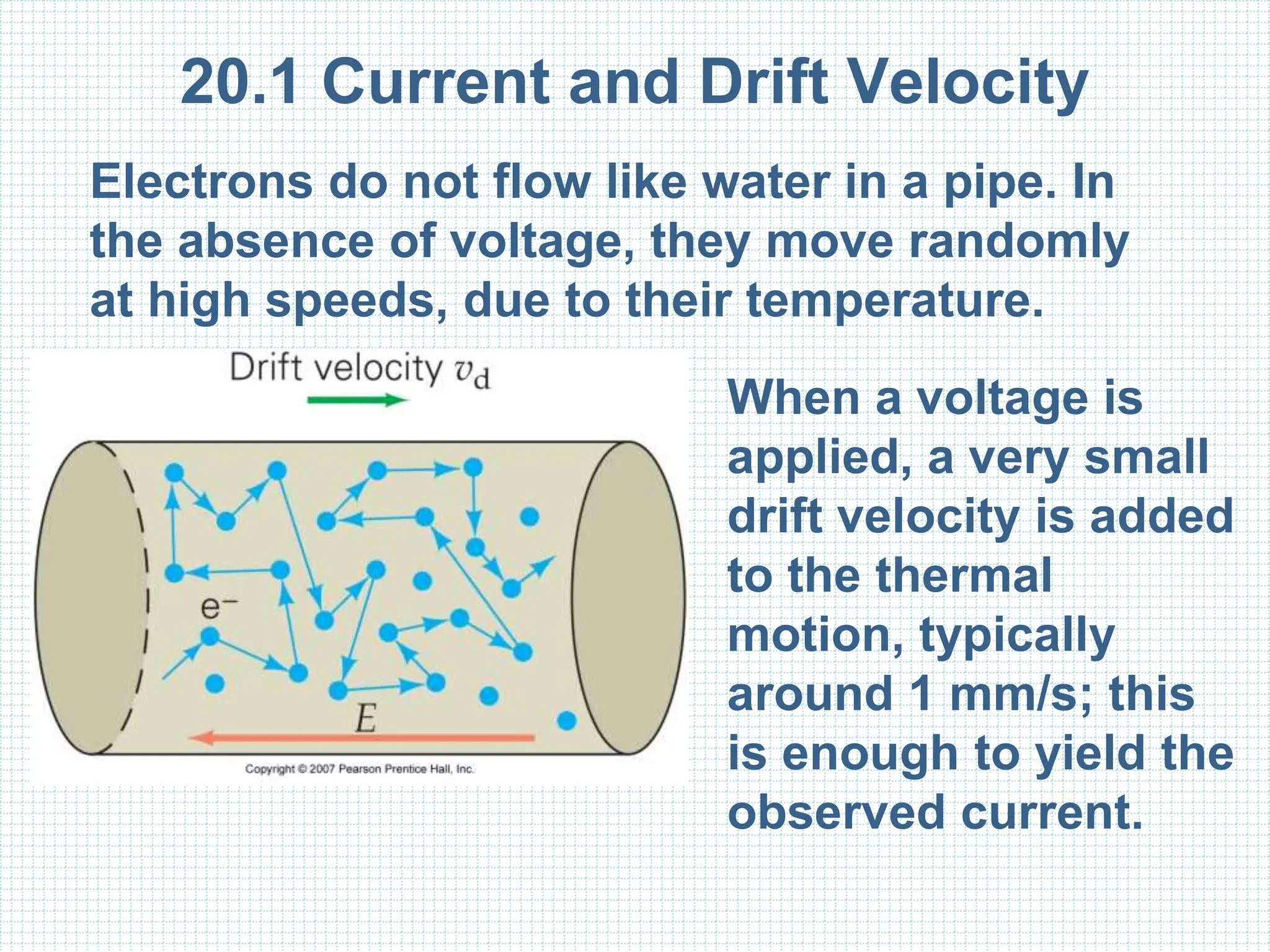
Electrons do not flow like water in a pipe. In
the absence of voltage, they move randomly
at high speeds, due to their temperature.
When a voltage is
applied, a very small
drift velocity is added
to the thermal
motion, typically
around 1 mm/s; this
is enough to yield the
observed current.
20.2 Resistance and Ohm’s Law
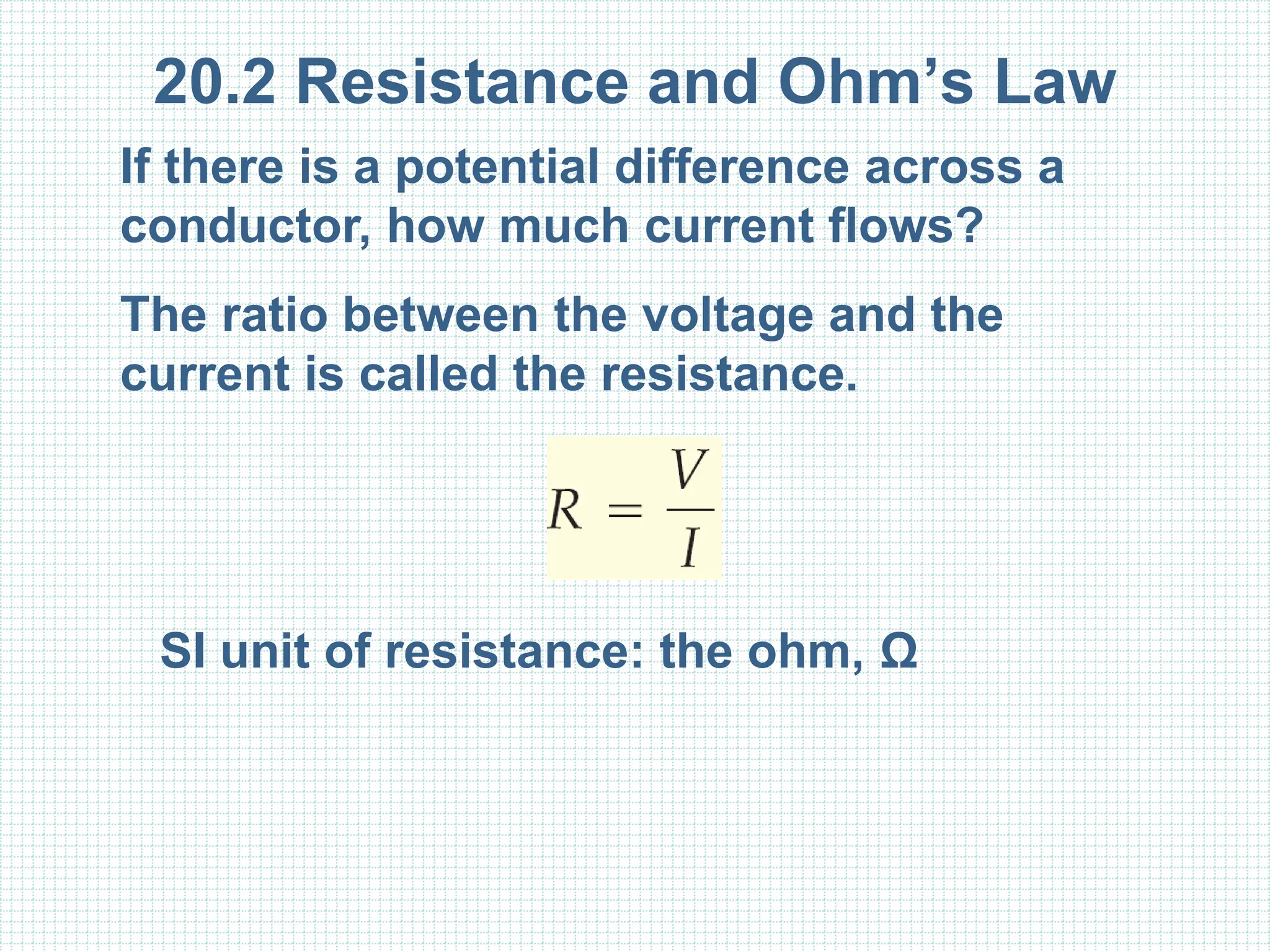
If there is a potential difference across a
conductor, how much current flows?
The ratio between the voltage and the
current is called the resistance.
SI unit of resistance: the ohm, Ω
20.2 Resistance and Ohm’s Law
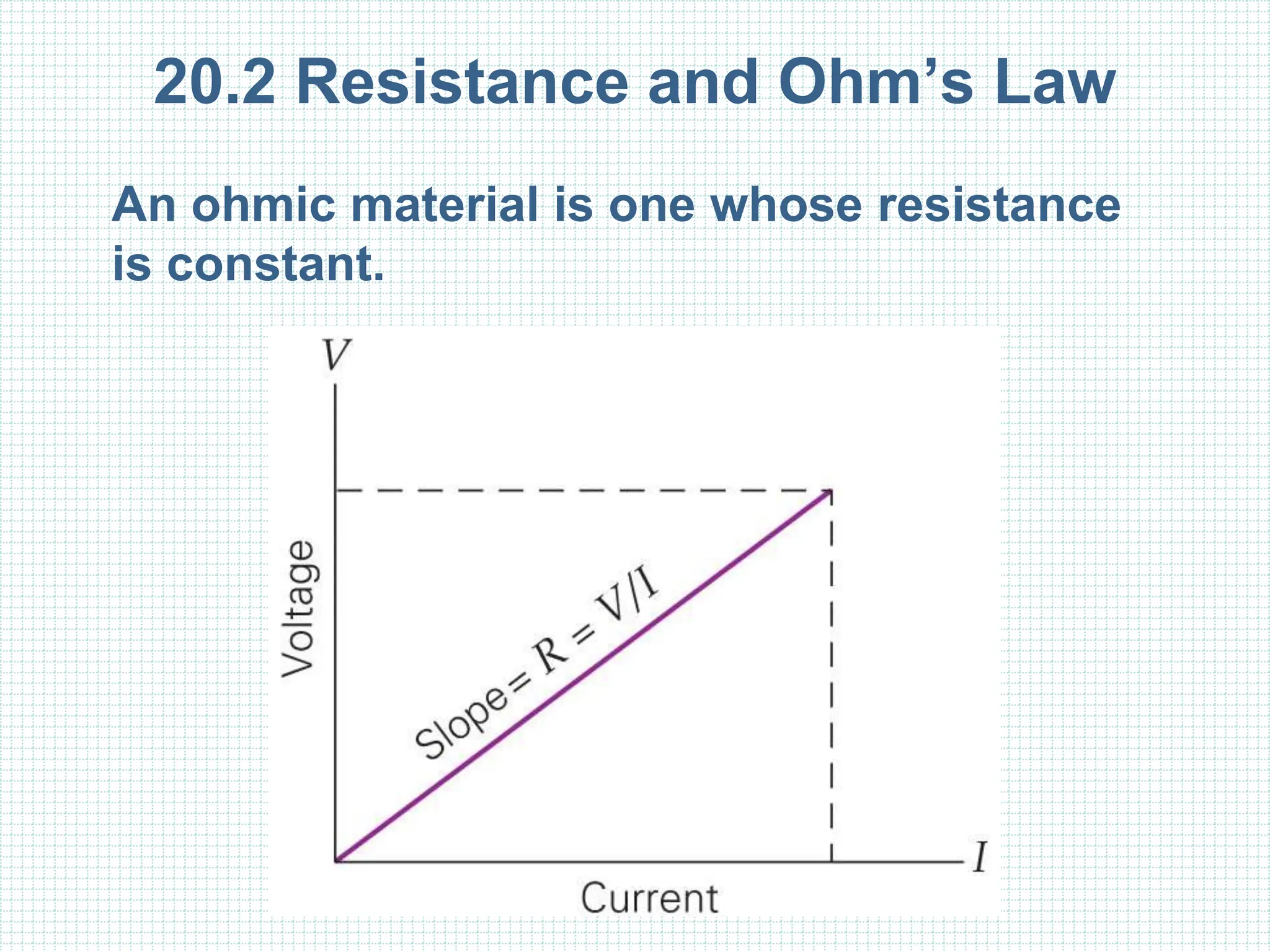
An ohmic material is one whose resistance
is constant.
20.2 Resistance and Ohm’s Law
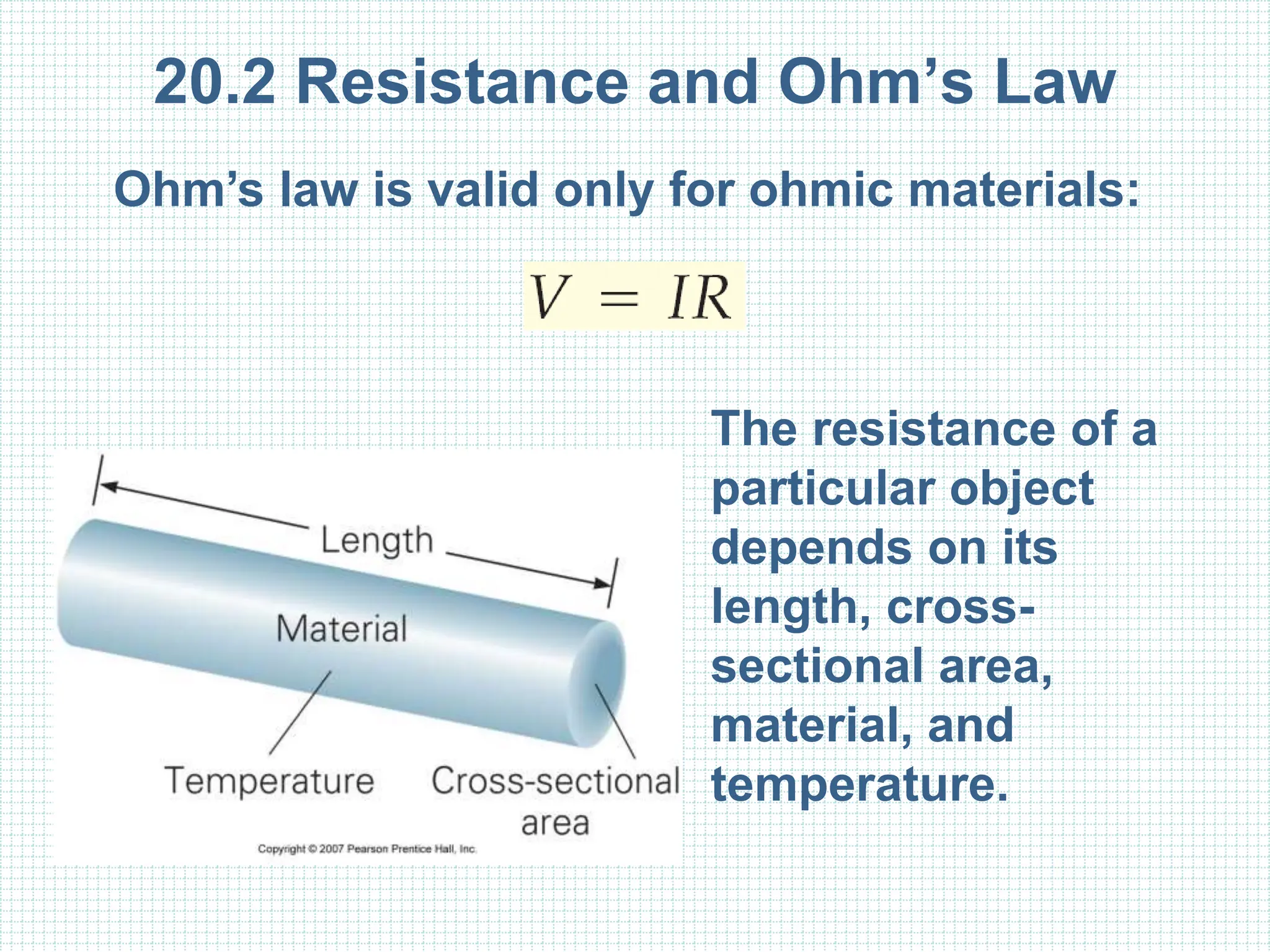
Ohm’s law is valid only for ohmic materials:
The resistance of a
particular object
depends on its
length, cross-
sectional area,
material, and
temperature.
20.3 Resistance and Ohm’s Law
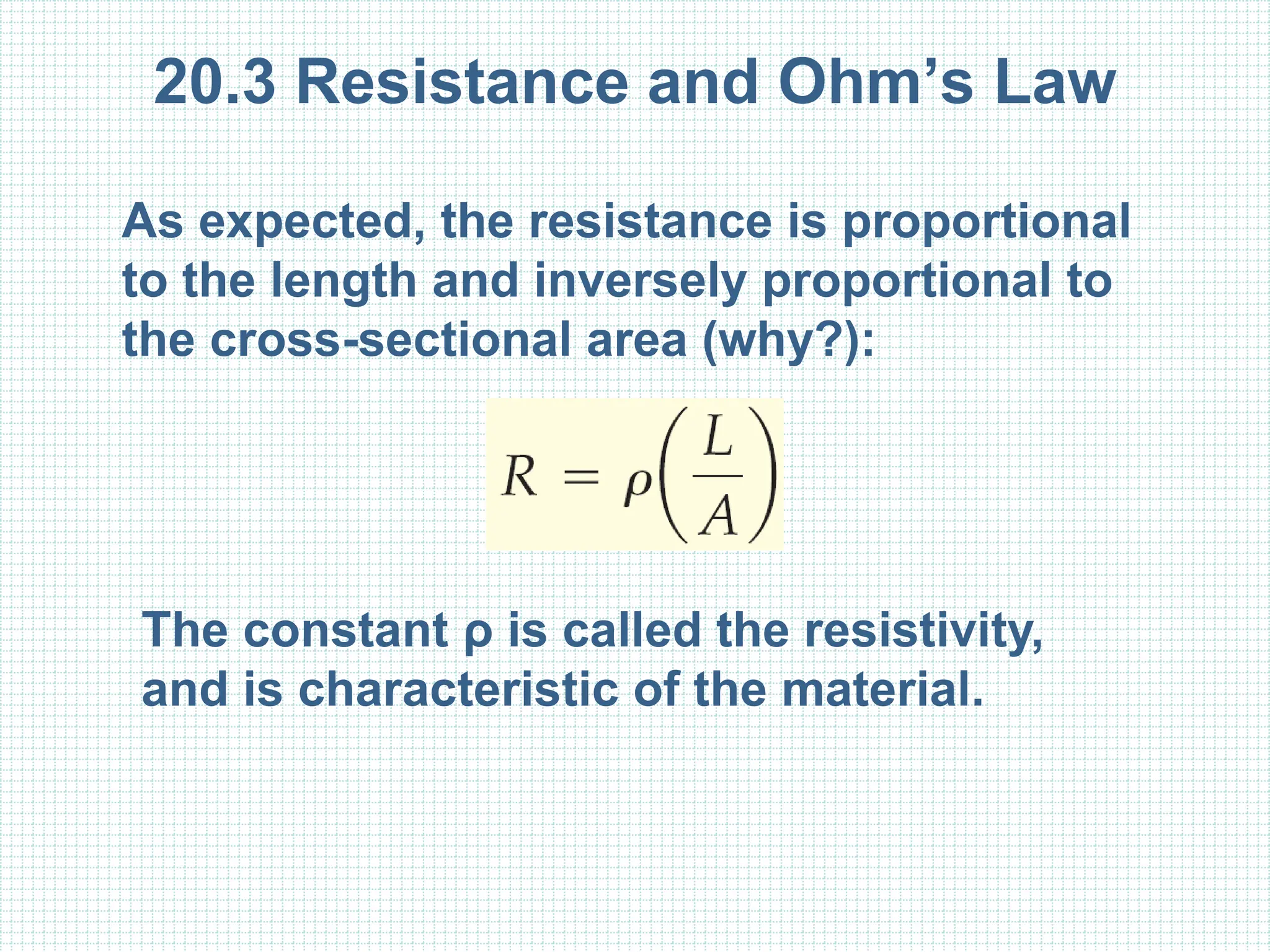
As expected, the resistance is proportional
to the length and inversely proportional to
the cross-sectional area (why?):
The constant ρ is called the resistivity,
and is characteristic of the material.
20.3 Resistance and Ohm’s Law
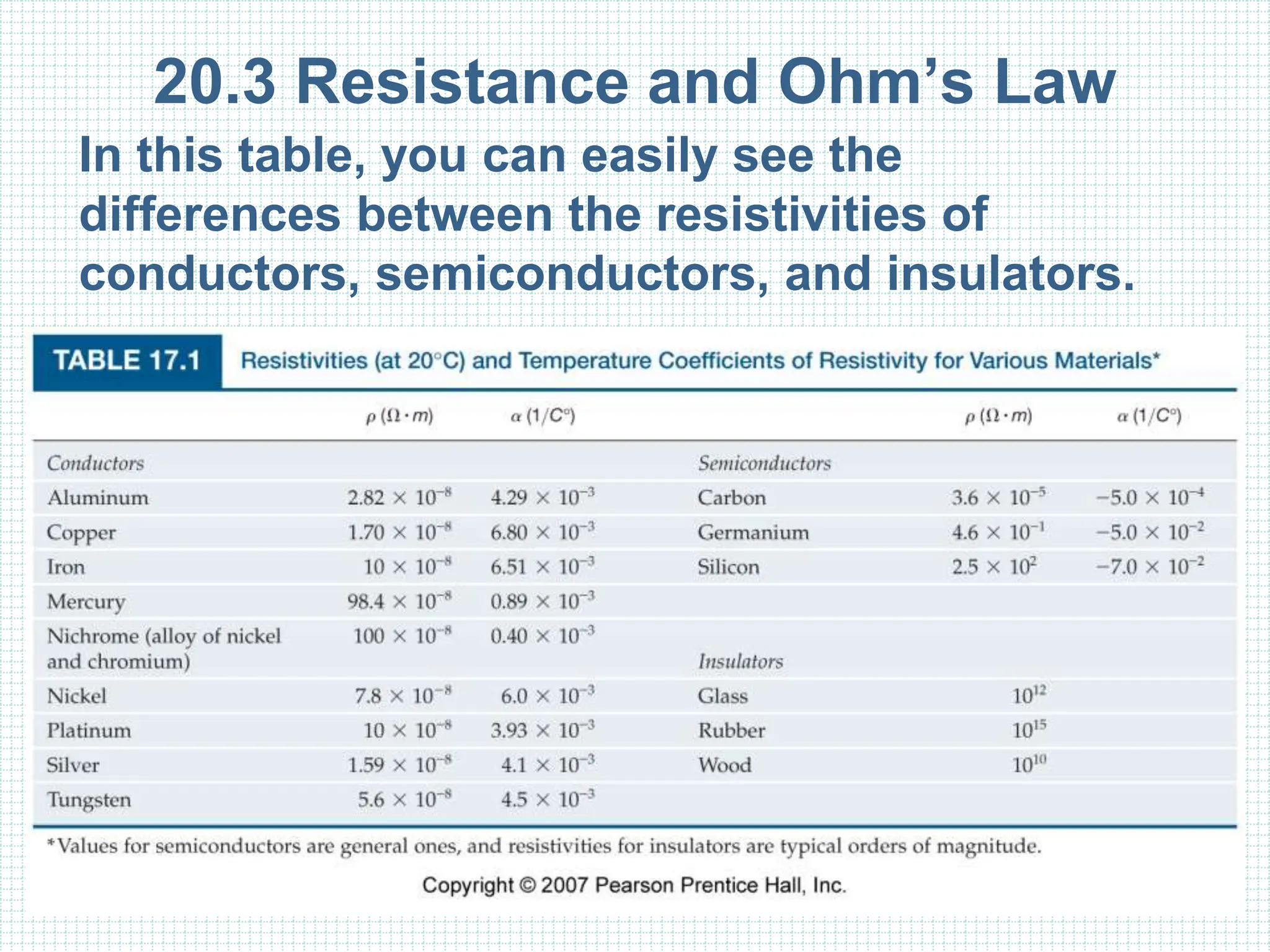
In this table, you can easily see the
differences between the resistivities of
conductors, semiconductors, and insulators.
20.4 Electric Power
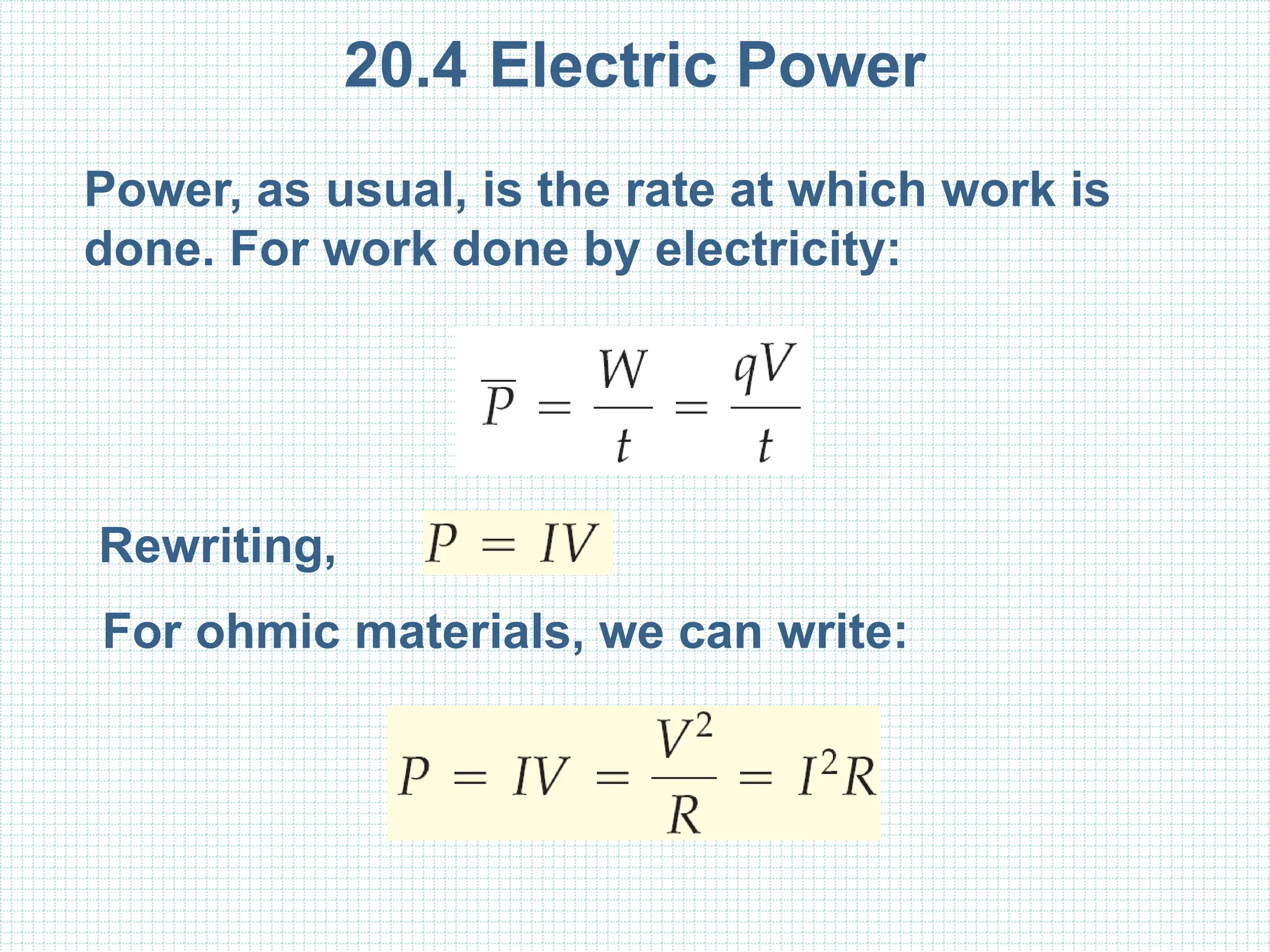
Power, as usual, is the rate at which work is
done. For work done by electricity:
Rewriting,
For ohmic materials, we can write:
20.4 Electric Power
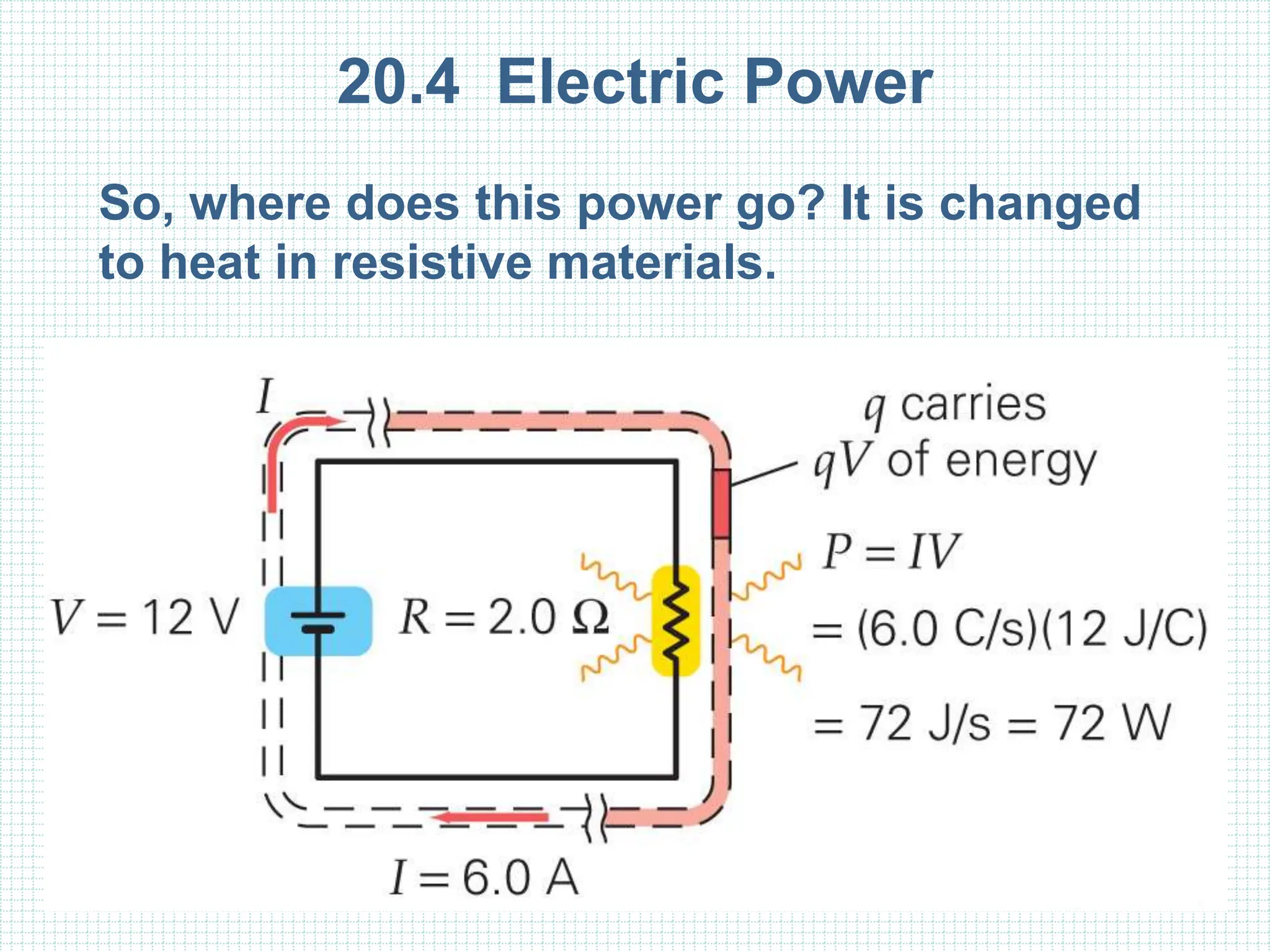
So, where does this power go? It is changed
to heat in resistive materials.
20.4 Electric Power
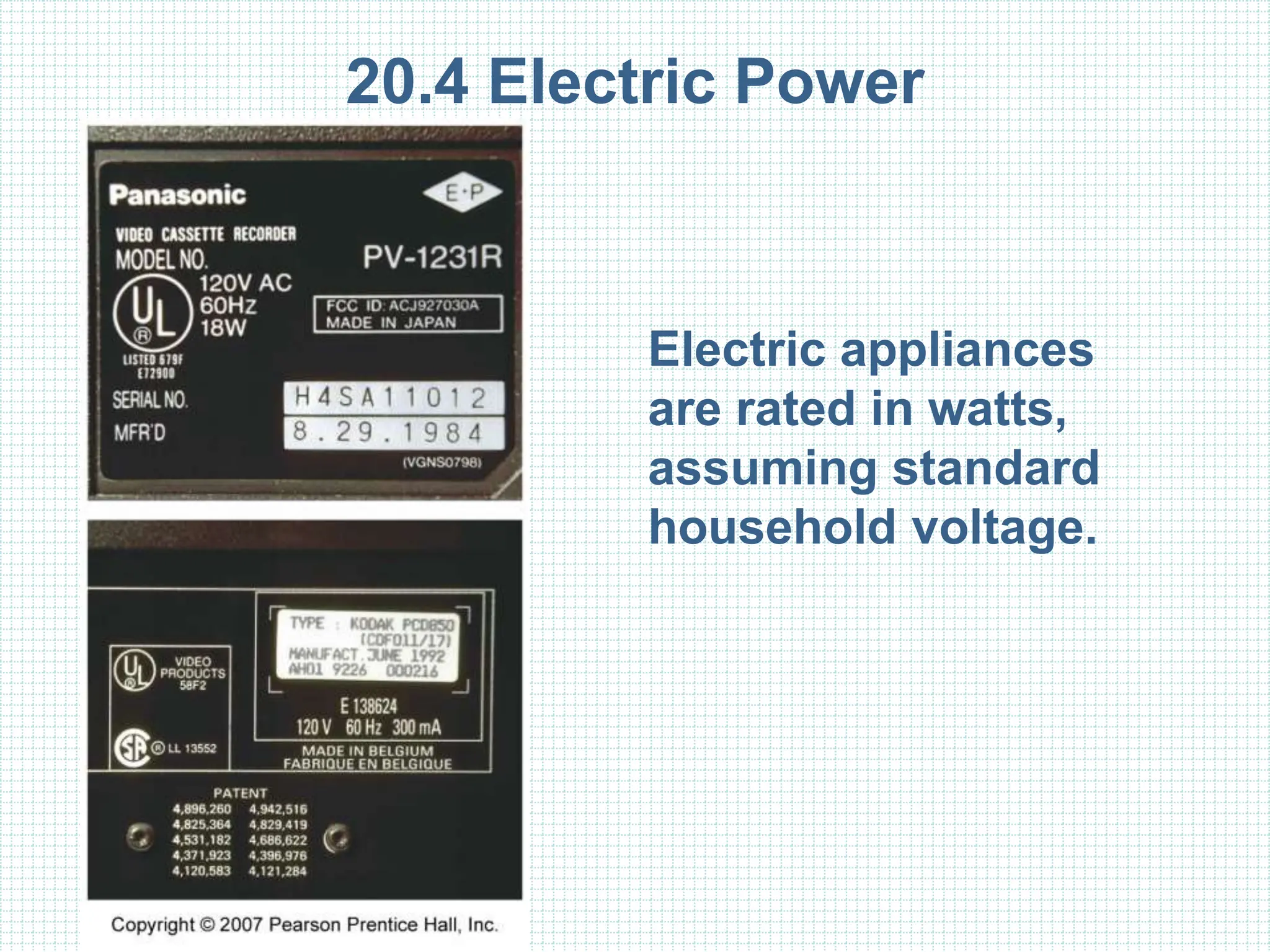
Electric appliances
are rated in watts,
assuming standard
household voltage.
20.4 Electric Power
20.4 Electric Power
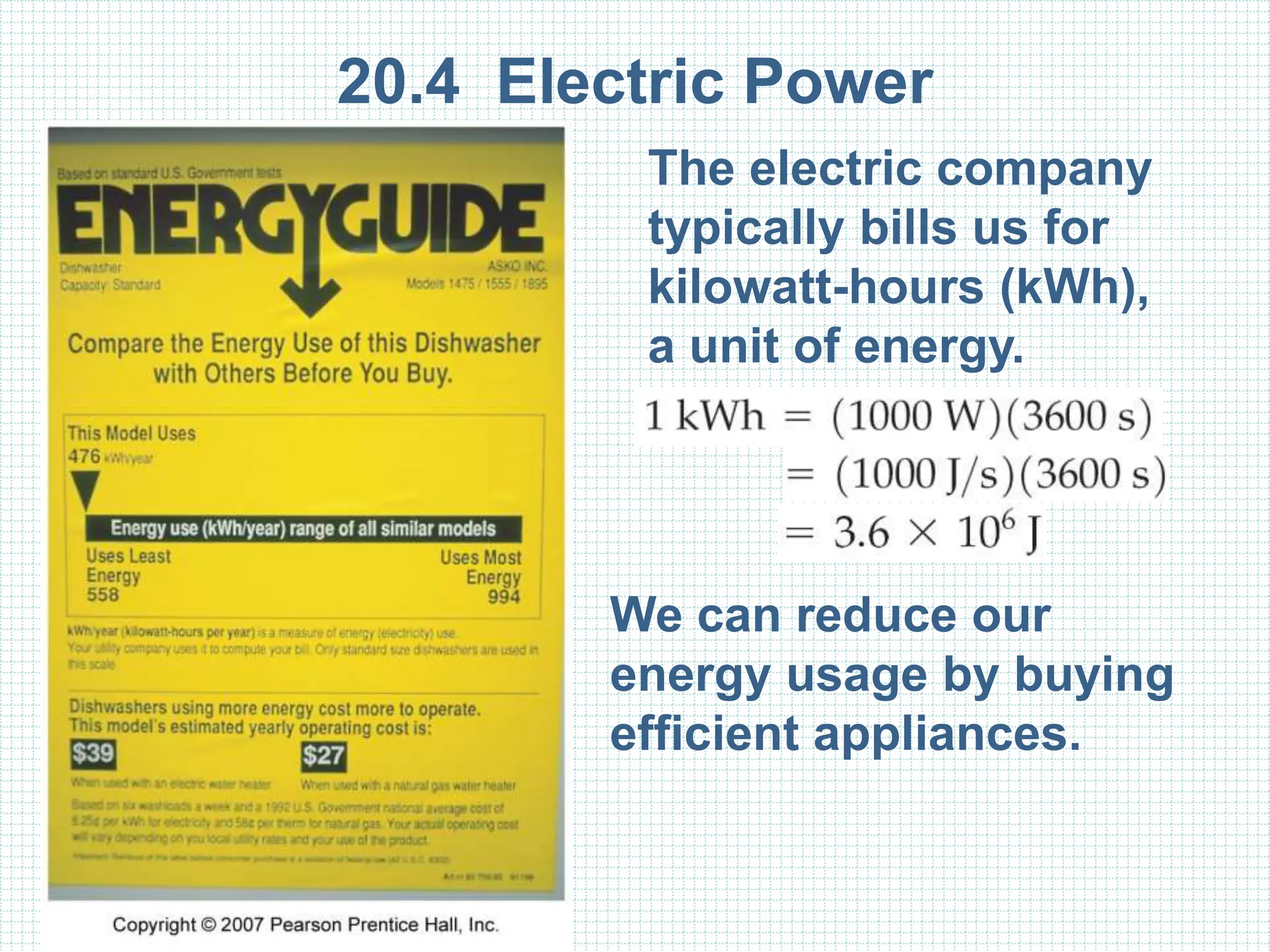
The electric company
typically bills us for
kilowatt-hours (kWh),
a unit of energy.
We can reduce our
energy usage by buying
efficient appliances.
Review of Chapter 20
A battery produces emf; positive terminal is
the anode, negative is the cathode.
emf is measured in volts; it is the number of
joules the battery supplies per coulomb of
charge.
An electric current can exist only in a
complete circuit.
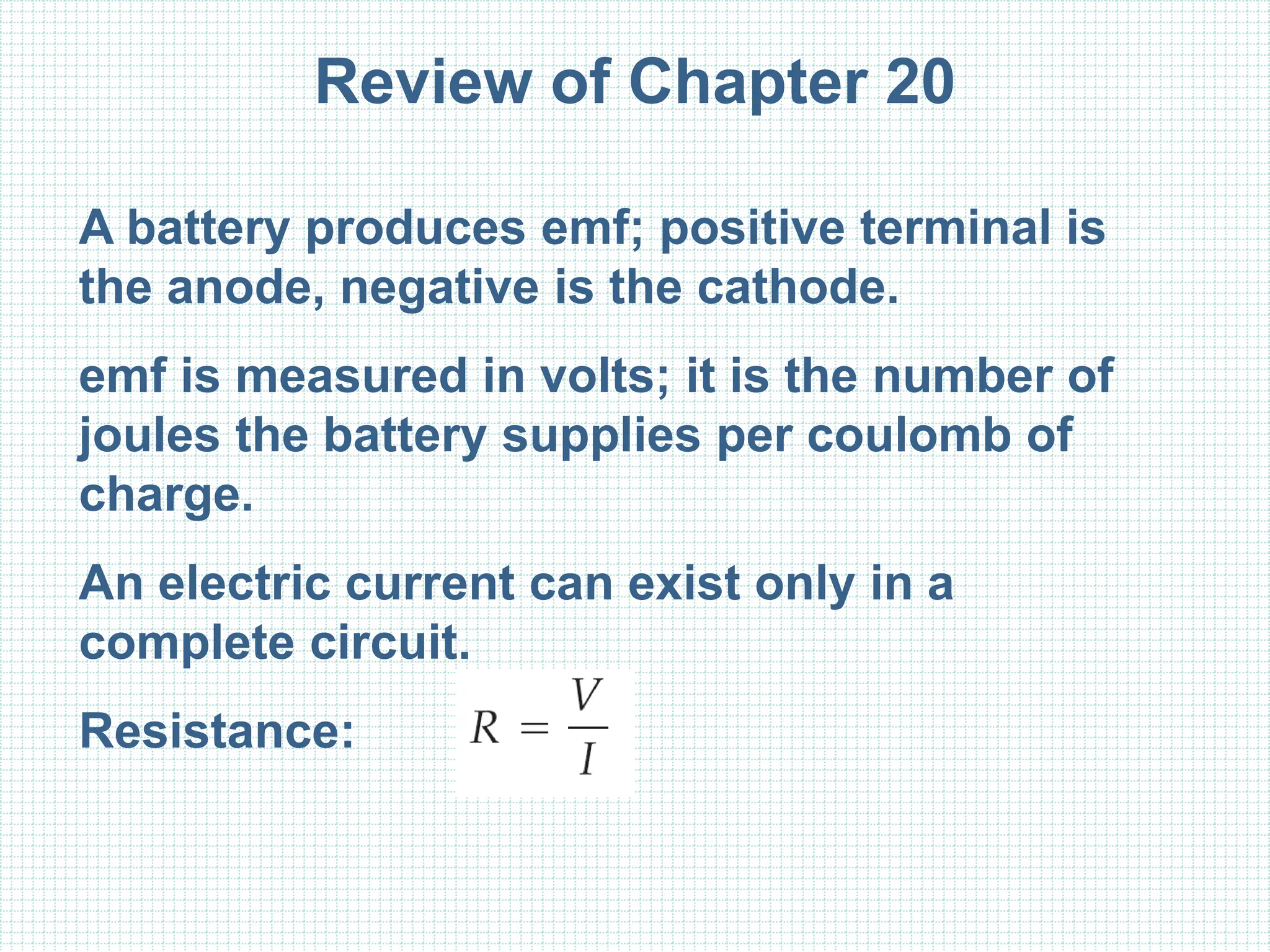
Resistance:
Review of Chapter 20
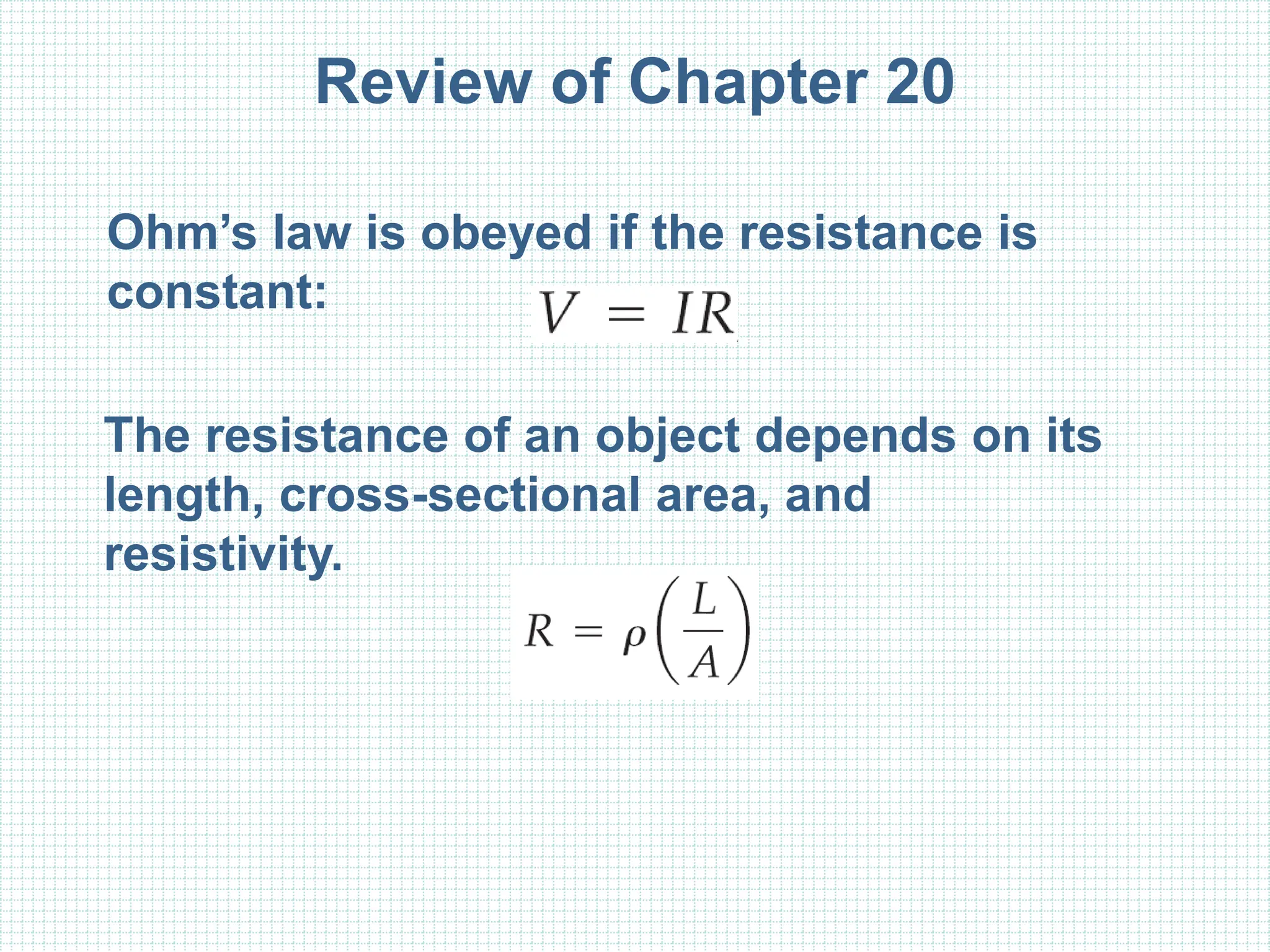
Ohm’s law is obeyed if the resistance is
constant:
The resistance of an object depends on its
length, cross-sectional area, and
resistivity.
Review of Chapter 20
Power is the rate at which work is done.

1 Electric Current and Resistance Lecture Ch 20.ppt

  • 1.
  • 2.
    Units of Chapter20 Batteries and Direct Current Current and Drift Velocity Resistance and Ohm’s Law Electric Power
  • 3.
    20.1 Batteries andDirect Current Electric current is the flow of electric charge. A battery is a source of electric energy—it converts chemical energy into electric energy.
  • 4.
    20.1 Batteries andDirect Current In a complete circuit, electrons flow from the negative electrode to the positive one. The positive electrode is called the anode; the negative electrode is the cathode. A battery provides a constant source of voltage—it maintains a constant potential difference between its terminals.
  • 5.
    20.1 Batteries andDirect Current The potential difference between the battery terminals when the battery is not connected to anything is called the electromotive force, emf.
  • 6.
    20.1 Batteries andDirect Current The actual terminal voltage of the battery is always less than the emf, due to internal resistance. Usually the difference is very small.
  • 7.
    20.1 Batteries andDirect Current The actual terminal voltage of the battery is always less than the emf, due to internal resistance. Usually the difference is very small. Vterm = ؏ - (IR) Where ؏ is the emf, Vterm is the terminal voltage, & IR is the internal voltage drop More on this later… 20.3
  • 8.
    20.1 Batteries andDirect Current When batteries are connected in series, the total voltage is the sum of the individual voltages.
  • 9.
    20.1 Batteries andDirect Current When batteries of equal voltage are connected in parallel, the total voltage does not change; each battery supplies part of the total current.
  • 10.
    20.1 Batteries andDirect Current
  • 11.
    20.1 Current andDrift Velocity Current is the time rate of flow of charge. SI unit of current: the ampere, A
  • 12.
    20.1 Current andDrift Velocity Historically, the direction of current has been taken to be from positive to negative; this is opposite to the way electrons flow. However, this seldom matters.
  • 13.
    20.1 Current andDrift Velocity Electrons do not flow like water in a pipe. In the absence of voltage, they move randomly at high speeds, due to their temperature. When a voltage is applied, a very small drift velocity is added to the thermal motion, typically around 1 mm/s; this is enough to yield the observed current.
  • 14.
    20.2 Resistance andOhm’s Law If there is a potential difference across a conductor, how much current flows? The ratio between the voltage and the current is called the resistance. SI unit of resistance: the ohm, Ω
  • 15.
    20.2 Resistance andOhm’s Law An ohmic material is one whose resistance is constant.
  • 16.
    20.2 Resistance andOhm’s Law Ohm’s law is valid only for ohmic materials: The resistance of a particular object depends on its length, cross- sectional area, material, and temperature.
  • 17.
    20.3 Resistance andOhm’s Law As expected, the resistance is proportional to the length and inversely proportional to the cross-sectional area (why?): The constant ρ is called the resistivity, and is characteristic of the material.
  • 18.
    20.3 Resistance andOhm’s Law In this table, you can easily see the differences between the resistivities of conductors, semiconductors, and insulators.
  • 19.
    20.4 Electric Power Power,as usual, is the rate at which work is done. For work done by electricity: Rewriting, For ohmic materials, we can write:
  • 20.
    20.4 Electric Power So,where does this power go? It is changed to heat in resistive materials.
  • 21.
    20.4 Electric Power Electricappliances are rated in watts, assuming standard household voltage.
  • 22.
  • 23.
    20.4 Electric Power Theelectric company typically bills us for kilowatt-hours (kWh), a unit of energy. We can reduce our energy usage by buying efficient appliances.
  • 24.
    Review of Chapter20 A battery produces emf; positive terminal is the anode, negative is the cathode. emf is measured in volts; it is the number of joules the battery supplies per coulomb of charge. An electric current can exist only in a complete circuit. Resistance:
  • 25.
    Review of Chapter20 Ohm’s law is obeyed if the resistance is constant: The resistance of an object depends on its length, cross-sectional area, and resistivity.
  • 26.
    Review of Chapter20 Power is the rate at which work is done.