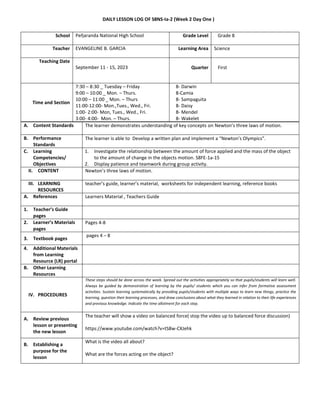
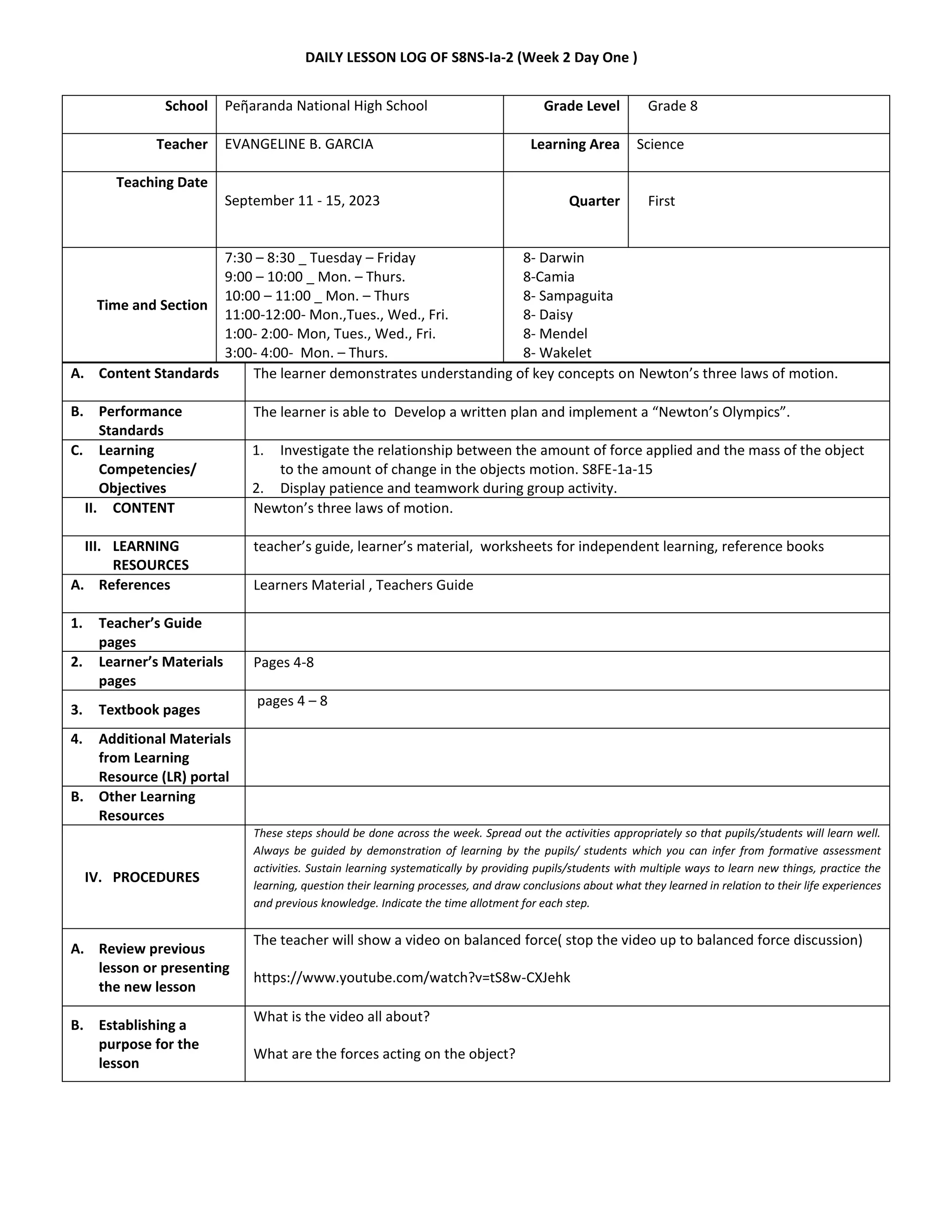
School Peῆaranda National High School Grade Level Grade 8
Teacher EVANGELINE B. GARCIA Learning Area Science
Teaching Date
September 11 - 15, 2023 Quarter First
Time and Section
7:30 – 8:30 _ Tuesday – Friday
9:00 – 10:00 _ Mon. – Thurs.
10:00 – 11:00 _ Mon. – Thurs
11:00-12:00- Mon.,Tues., Wed., Fri.
1:00- 2:00- Mon, Tues., Wed., Fri.
3:00- 4:00- Mon. – Thurs.
8- Darwin
8-Camia
8- Sampaguita
8- Daisy
8- Mendel
8- Wakelet
A. Content Standards The learner demonstrates understanding of key concepts on Newton’s three laws of motion.
B. Performance
Standards
The learner is able to Develop a written plan and implement a “Newton’s Olympics”.
C. Learning
Competencies/
Objectives
1. Investigate the relationship between the amount of force applied and the mass of the object
to the amount of change in the objects motion. S8FE-1a-15
2. Display patience and teamwork during group activity.
II. CONTENT Newton’s three laws of motion.
III. LEARNING
RESOURCES
teacher’s guide, learner’s material, worksheets for independent learning, reference books
A. References Learners Material , Teachers Guide
1. Teacher’s Guide
pages
2. Learner’s Materials
pages
Pages 4-8
3. Textbook pages
pages 4 – 8
4. Additional Materials
from Learning
Resource (LR) portal
B. Other Learning
Resources
IV. PROCEDURES
These steps should be done across the week. Spread out the activities appropriately so that pupils/students will learn well.
Always be guided by demonstration of learning by the pupils/ students which you can infer from formative assessment
activities. Sustain learning systematically by providing pupils/students with multiple ways to learn new things, practice the
learning, question their learning processes, and draw conclusions about what they learned in relation to their life experiences
and previous knowledge. Indicate the time allotment for each step.
A. Review previous
lesson or presenting
the new lesson
The teacher will show a video on balanced force( stop the video up to balanced force discussion)
https://www.youtube.com/watch?v=tS8w-CXJehk
B. Establishing a
purpose for the
lesson
What is the video all about?
What are the forces acting on the object?
DAILY LESSON LOG OF S8NS-Ia-2 (Week 2 Day One )
In balanced force, are the objects in motion?
C. Presenting
examples/ instances
of the new lesson
1. Group the students into 3, give pictures of the following situations below. Let the students
discuss among themselves the condition of the object at rest. Does this mean that there
are no forces acting on them? So what causes them to stay in place?
2. Group 1 – Hanging pen
3. Group 2 – Book on top of the table
4. Group 3 – A boy standing still on the floor
D. Discussing new
concepts and
practicing new skills
#1
. Let each group select a reporter to discuss the answers on the activity Ask the students the
following questions:
Group 1, Is the pen at rest or in motion? Are there forces acting on the pen? If Yes, draw the
forces. You may use arrows to represent these forces.(The pen is at rest; Yes, refer to the drawing
o Group 2, Is the book at rest or in motion? Are there forces acting on the book? If Yes, draw the
forces acting on the book. Use arrows to represent the forces.
(The book is at rest; Yes, refer to the drawing on page 8,figure 5 of the learner’s manual)
Group 3, What are the forces present on the boy standing still on the floor? Are the forces
equal?(force of gravity, frictional force, and the floor pushes upward on the person;Yes)n page
8,figure 5 of the learner’s manual)
E. Discussing new
concepts and
practicing new skills
#2
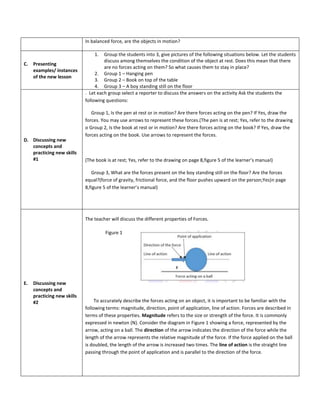
The teacher will discuss the different properties of Forces.
Figure 1
To accurately describe the forces acting on an object, it is important to be familiar with the
following terms: magnitude, direction, point of application, line of action. Forces are described in
terms of these properties. Magnitude refers to the size or strength of the force. It is commonly
expressed in newton (N). Consider the diagram in Figure 1 showing a force, represented by the
arrow, acting on a ball. The direction of the arrow indicates the direction of the force while the
length of the arrow represents the relative magnitude of the force. If the force applied on the ball
is doubled, the length of the arrow is increased two times. The line of action is the straight line
passing through the point of application and is parallel to the direction of the force.
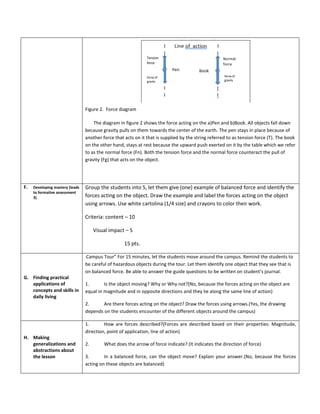
Figure 2. Force diagram
The diagram in figure 2 shows the force acting on the a)Pen and b)Book. All objects fall down
because gravity pulls on them towards the center of the earth. The pen stays in place because of
another force that acts on it that is supplied by the string referred to as tension force (T). The book
on the other hand, stays at rest because the upward push exerted on it by the table which we refer
to as the normal force (Fn). Both the tension force and the normal force counteract the pull of
gravity (Fg) that acts on the object.
F. Developing mastery (leads
to formative assessment
3)
Group the students into 5, let them give (one) example of balanced force and identify the
forces acting on the object. Draw the example and label the forces acting on the object
using arrows. Use white cartolina (1/4 size) and crayons to color their work.
Criteria: content – 10
Visual impact – 5
15 pts.
G. Finding practical
applications of
concepts and skills in
daily living
“Campus Tour” For 15 minutes, let the students move around the campus. Remind the students to
be careful of hazardous objects during the tour. Let them identify one object that they see that is
on balanced force. Be able to answer the guide questions to be written on student’s journal.
1. Is the object moving? Why or Why not?(No, because the forces acting on the object are
equal in magnitude and in opposite directions and they lie along the same line of action)
2. Are there forces acting on the object? Draw the forces using arrows.(Yes, the drawing
depends on the students encounter of the different objects around the campus)
H. Making
generalizations and
abstractions about
the lesson
1. How are forces described?(Forces are described based on their properties: Magnitude,
direction, point of application, line of action)
2. What does the arrow of force indicate? (It indicates the direction of force)
3. In a balanced force, can the object move? Explain your answer.(No, because the forces
acting on these objects are balanced)
I. Evaluating Learning
J. Additional activities
or remediation
“My Trip”. On your way back home, identify at least two objects that you see along the way that is
on balanced force. Be ready for an oral presentation the next meeting.
Criteria: Content – 10
Delivery – 5
15 pts.
V. REMARKS
Lesson was easily understood by the learners.
VI. REFLECTION
Lesson was done.
PREPARED BY: CHECKED: NOTED:
EVANGELINE B. GARCIA LORENA S. IMPELIDO VIVIAN P. MADUCDOC PhD
Teacher III Head Teacher VI School Principal IV

week 2day 1.docx

  • 1.
    School Peῆaranda NationalHigh School Grade Level Grade 8 Teacher EVANGELINE B. GARCIA Learning Area Science Teaching Date September 11 - 15, 2023 Quarter First Time and Section 7:30 – 8:30 _ Tuesday – Friday 9:00 – 10:00 _ Mon. – Thurs. 10:00 – 11:00 _ Mon. – Thurs 11:00-12:00- Mon.,Tues., Wed., Fri. 1:00- 2:00- Mon, Tues., Wed., Fri. 3:00- 4:00- Mon. – Thurs. 8- Darwin 8-Camia 8- Sampaguita 8- Daisy 8- Mendel 8- Wakelet A. Content Standards The learner demonstrates understanding of key concepts on Newton’s three laws of motion. B. Performance Standards The learner is able to Develop a written plan and implement a “Newton’s Olympics”. C. Learning Competencies/ Objectives 1. Investigate the relationship between the amount of force applied and the mass of the object to the amount of change in the objects motion. S8FE-1a-15 2. Display patience and teamwork during group activity. II. CONTENT Newton’s three laws of motion. III. LEARNING RESOURCES teacher’s guide, learner’s material, worksheets for independent learning, reference books A. References Learners Material , Teachers Guide 1. Teacher’s Guide pages 2. Learner’s Materials pages Pages 4-8 3. Textbook pages pages 4 – 8 4. Additional Materials from Learning Resource (LR) portal B. Other Learning Resources IV. PROCEDURES These steps should be done across the week. Spread out the activities appropriately so that pupils/students will learn well. Always be guided by demonstration of learning by the pupils/ students which you can infer from formative assessment activities. Sustain learning systematically by providing pupils/students with multiple ways to learn new things, practice the learning, question their learning processes, and draw conclusions about what they learned in relation to their life experiences and previous knowledge. Indicate the time allotment for each step. A. Review previous lesson or presenting the new lesson The teacher will show a video on balanced force( stop the video up to balanced force discussion) https://www.youtube.com/watch?v=tS8w-CXJehk B. Establishing a purpose for the lesson What is the video all about? What are the forces acting on the object? DAILY LESSON LOG OF S8NS-Ia-2 (Week 2 Day One )
  • 2.
    In balanced force,are the objects in motion? C. Presenting examples/ instances of the new lesson 1. Group the students into 3, give pictures of the following situations below. Let the students discuss among themselves the condition of the object at rest. Does this mean that there are no forces acting on them? So what causes them to stay in place? 2. Group 1 – Hanging pen 3. Group 2 – Book on top of the table 4. Group 3 – A boy standing still on the floor D. Discussing new concepts and practicing new skills #1 . Let each group select a reporter to discuss the answers on the activity Ask the students the following questions: Group 1, Is the pen at rest or in motion? Are there forces acting on the pen? If Yes, draw the forces. You may use arrows to represent these forces.(The pen is at rest; Yes, refer to the drawing o Group 2, Is the book at rest or in motion? Are there forces acting on the book? If Yes, draw the forces acting on the book. Use arrows to represent the forces. (The book is at rest; Yes, refer to the drawing on page 8,figure 5 of the learner’s manual) Group 3, What are the forces present on the boy standing still on the floor? Are the forces equal?(force of gravity, frictional force, and the floor pushes upward on the person;Yes)n page 8,figure 5 of the learner’s manual) E. Discussing new concepts and practicing new skills #2 The teacher will discuss the different properties of Forces. Figure 1 To accurately describe the forces acting on an object, it is important to be familiar with the following terms: magnitude, direction, point of application, line of action. Forces are described in terms of these properties. Magnitude refers to the size or strength of the force. It is commonly expressed in newton (N). Consider the diagram in Figure 1 showing a force, represented by the arrow, acting on a ball. The direction of the arrow indicates the direction of the force while the length of the arrow represents the relative magnitude of the force. If the force applied on the ball is doubled, the length of the arrow is increased two times. The line of action is the straight line passing through the point of application and is parallel to the direction of the force.
  • 3.
    Figure 2. Forcediagram The diagram in figure 2 shows the force acting on the a)Pen and b)Book. All objects fall down because gravity pulls on them towards the center of the earth. The pen stays in place because of another force that acts on it that is supplied by the string referred to as tension force (T). The book on the other hand, stays at rest because the upward push exerted on it by the table which we refer to as the normal force (Fn). Both the tension force and the normal force counteract the pull of gravity (Fg) that acts on the object. F. Developing mastery (leads to formative assessment 3) Group the students into 5, let them give (one) example of balanced force and identify the forces acting on the object. Draw the example and label the forces acting on the object using arrows. Use white cartolina (1/4 size) and crayons to color their work. Criteria: content – 10 Visual impact – 5 15 pts. G. Finding practical applications of concepts and skills in daily living “Campus Tour” For 15 minutes, let the students move around the campus. Remind the students to be careful of hazardous objects during the tour. Let them identify one object that they see that is on balanced force. Be able to answer the guide questions to be written on student’s journal. 1. Is the object moving? Why or Why not?(No, because the forces acting on the object are equal in magnitude and in opposite directions and they lie along the same line of action) 2. Are there forces acting on the object? Draw the forces using arrows.(Yes, the drawing depends on the students encounter of the different objects around the campus) H. Making generalizations and abstractions about the lesson 1. How are forces described?(Forces are described based on their properties: Magnitude, direction, point of application, line of action) 2. What does the arrow of force indicate? (It indicates the direction of force) 3. In a balanced force, can the object move? Explain your answer.(No, because the forces acting on these objects are balanced)
  • 4.
    I. Evaluating Learning J.Additional activities or remediation “My Trip”. On your way back home, identify at least two objects that you see along the way that is on balanced force. Be ready for an oral presentation the next meeting. Criteria: Content – 10 Delivery – 5 15 pts. V. REMARKS Lesson was easily understood by the learners. VI. REFLECTION Lesson was done. PREPARED BY: CHECKED: NOTED: EVANGELINE B. GARCIA LORENA S. IMPELIDO VIVIAN P. MADUCDOC PhD Teacher III Head Teacher VI School Principal IV