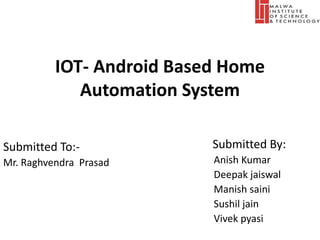
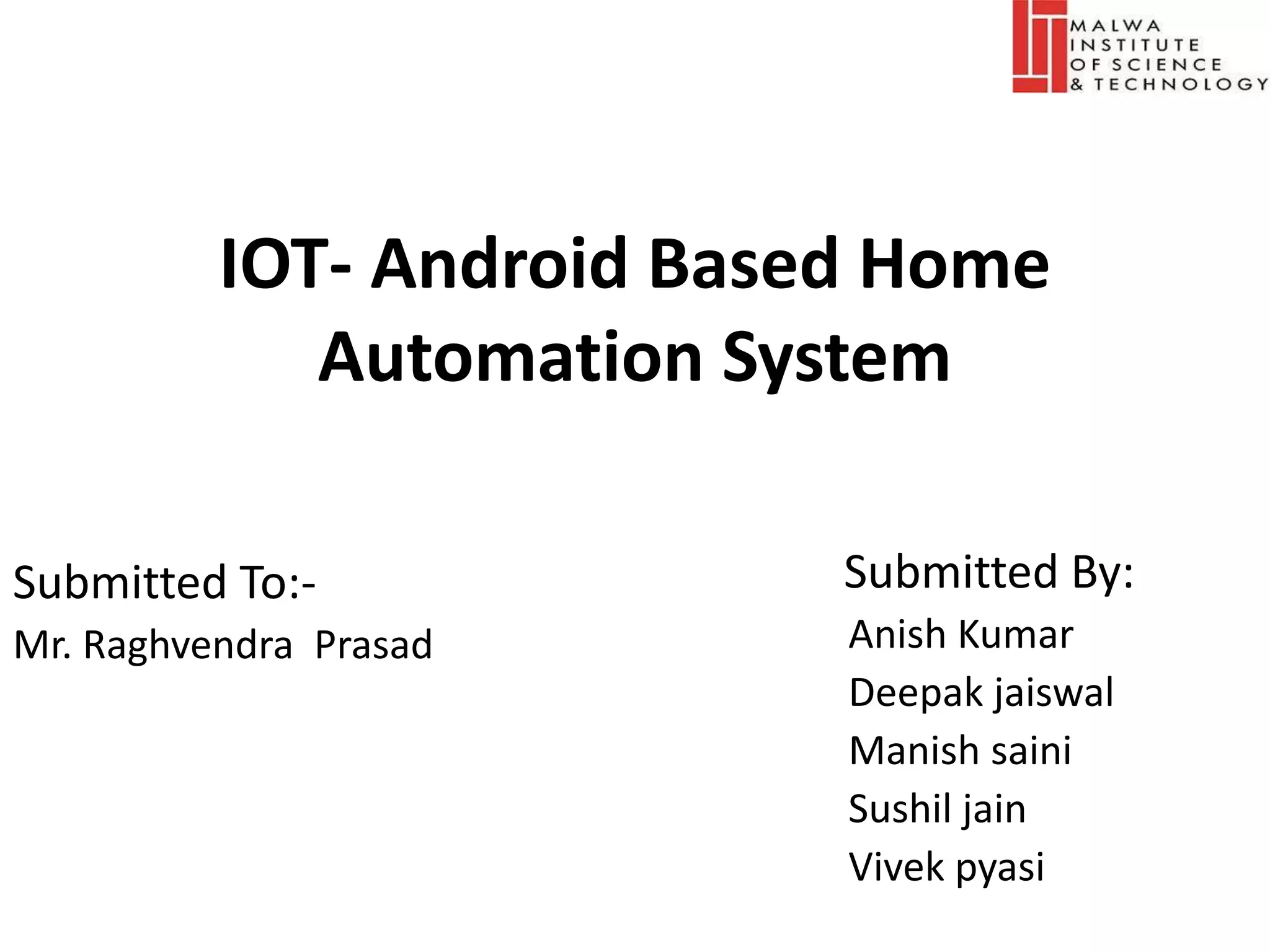
IOT- Android Based Home
Automation System
Submitted By:
Anish Kumar
Deepak jaiswal
Manish saini
Sushil jain
Vivek pyasi
Submitted To:-
Mr. Raghvendra Prasad
Contents
 Introduction
 Literature Survey
 System Overview
 EC V/S IT
 Problem Domain
 Solution Domain
 System Architecture
 Conclusion
 References
 Screen Short
Introduction
• Internet of Things is a communication paradigm in which
everyday devices such home appliances are connected over
the internet and can communicate with other devices.
• A Smartphone based home automation system permits user
to remotely control home appliances using their
android smart phones.
• This project will allow any person who had a Internet enabled
Android phone to download an application and control the
home appliances.
• This system is really helpful for the handicapped people.
• All of your home devices can be control from one place.
Research Survey
• Home automation was first introduced into the world market
in the 1970s, but it failed to meet the expectations of people
and was unsuccessful. There were various reasons associated
with the failure of the home automation system. The system
was neither user friendly nor cost efficient. Currently, the
foremost point to be kept in mind when designing a home
automation system is that it should be cost-efficient and easy
to install.
• K. Y. Lee and J. W. Choi in their research on the Housing
Learning and Improvement Network in 2003, defined a Smart
Home as a “unit where all the appliances of the house are
connected together and controlled and monitored remotely”.
System Overview
• The system is directly installed beside the conventional
electrical switches.
• The targeted home appliances are controlled by the hardware
system installed beside the switches.
• This hardware further control by the Android Application.
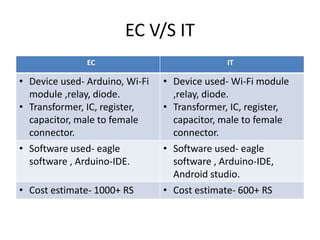
EC V/S IT
EC IT
• Device used- Arduino, Wi-Fi
module ,relay, diode.
• Transformer, IC, register,
capacitor, male to female
connector.
• Device used- Wi-Fi module
,relay, diode.
• Transformer, IC, register,
capacitor, male to female
connector.
• Software used- eagle
software , Arduino-IDE.
• Software used- eagle
software , Arduino-IDE,
Android studio.
• Cost estimate- 1000+ RS • Cost estimate- 600+ RS
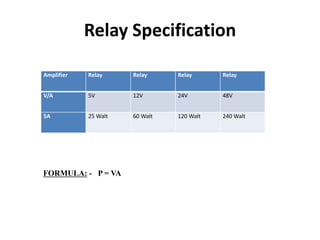
Relay Specification
Amplifier Relay Relay Relay Relay
V/A 5V 12V 24V 48V
5A 25 Walt 60 Walt 120 Walt 240 Walt
FORMULA: - P = VA
For control an air conditioner (only) following conditions
are-
 24 volt relay control an air conditioner.
 24-0-24 transformer are being used.
 At a same time only control an air conditioner.
 Speed of air conditioner are slow.
For control an air conditioner and other devices
following conditions are-
 48 volt relay control an air conditioner and other devices.
 48-0-48 transformer are being used.
 At a same time control an air conditioner and other
devices.
Problem Domain
The major problems arise in conventional and
regular home automation is:-
• Hardware cost arise due to use of Arduino.
• Inefficient use of existing hardware.
• Data communication speed is average.
• Wastage of energy due to unnecessary use of
Power.
• Inconvenience for handicapped person’s.
Solution Domain
The proposed solutions for given problem is:-
• Use of only Arduino code make it economical.
• Complete use of existing hardware.
• Communication speed get increased.
• We can remotely access the electrical devices.
• Power consumption get reduced.
• Switch ordinary home to smarter.
System Architecture
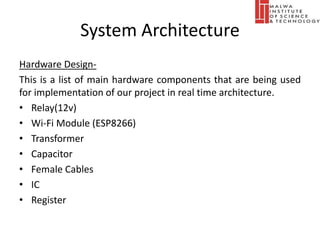
Hardware Design-
This is a list of main hardware components that are being used
for implementation of our project in real time architecture.
• Relay(12v)
• Wi-Fi Module (ESP8266)
• Transformer
• Capacitor
• Female Cables
• IC
• Register
Software Design :-
There are three main important software that we are using for
designing of system:-
• Android studio – for Android Application.
• Arduino IDE – for Arduino code.
• EAGLE software – for PCB designing.
These software are used for overall designing of software
module of our system.
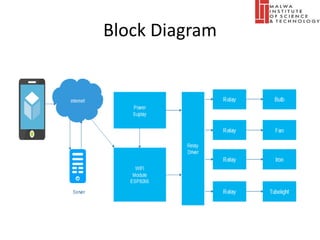
Block Diagram
Conclusion
The project has proposed the idea of smart homes that can
support a lot of home automation systems. A
smart home contains a connection between wireless
communication, sensors, monitoring and tracking. In this project,
an efficient approach for smart homes was proposed and
implemented.
References
• https://www.researchgate.net/publication/311923032_An_ov
erview_of_home_automation_systems.
• https://create.arduino.cc/projecthub/autoshack/android-app-
based-home-automation-system-using-iot-4cad38.
• http://ieeexplore.ieee.org/document/7475301/.
• https://en.wikipedia.org/wiki/Home_automation.
• https://www.arduino.cc/en/Tutorial/HomePage.
• https://www.electronicshub.org/what-is-relay-and-how-it-
works/.
• https://roboindia.com/tutorials/ESP-8266-wifi-module.
• https://www.elprocus.com/wireless-home-automation-using-
internet-of-things/.
• https://www.tutorialspoint.com/android/index.htm.
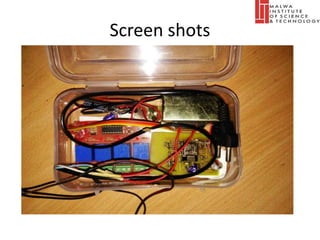
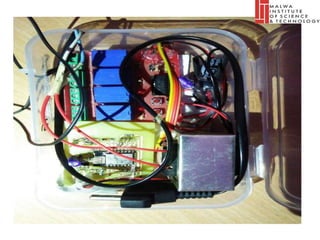
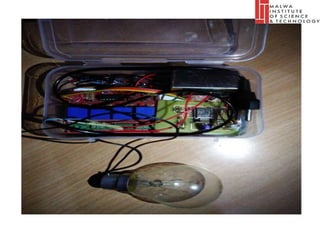
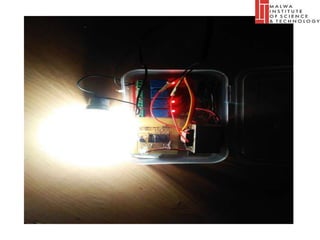
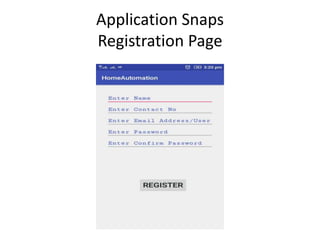
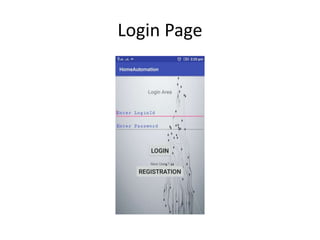
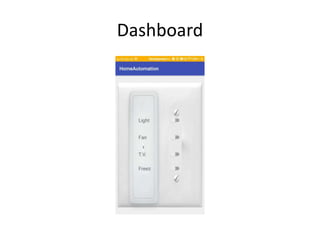
Screen shots
Application Snaps
Registration Page
Login Page
Dashboard
ANY QUERIES

IOT PPT

  • 1.
    IOT- Android BasedHome Automation System Submitted By: Anish Kumar Deepak jaiswal Manish saini Sushil jain Vivek pyasi Submitted To:- Mr. Raghvendra Prasad
  • 2.
    Contents  Introduction  LiteratureSurvey  System Overview  EC V/S IT  Problem Domain  Solution Domain  System Architecture  Conclusion  References  Screen Short
  • 3.
    Introduction • Internet ofThings is a communication paradigm in which everyday devices such home appliances are connected over the internet and can communicate with other devices. • A Smartphone based home automation system permits user to remotely control home appliances using their android smart phones. • This project will allow any person who had a Internet enabled Android phone to download an application and control the home appliances. • This system is really helpful for the handicapped people. • All of your home devices can be control from one place.
  • 4.
    Research Survey • Homeautomation was first introduced into the world market in the 1970s, but it failed to meet the expectations of people and was unsuccessful. There were various reasons associated with the failure of the home automation system. The system was neither user friendly nor cost efficient. Currently, the foremost point to be kept in mind when designing a home automation system is that it should be cost-efficient and easy to install. • K. Y. Lee and J. W. Choi in their research on the Housing Learning and Improvement Network in 2003, defined a Smart Home as a “unit where all the appliances of the house are connected together and controlled and monitored remotely”.
  • 5.
    System Overview • Thesystem is directly installed beside the conventional electrical switches. • The targeted home appliances are controlled by the hardware system installed beside the switches. • This hardware further control by the Android Application.
  • 6.
    EC V/S IT ECIT • Device used- Arduino, Wi-Fi module ,relay, diode. • Transformer, IC, register, capacitor, male to female connector. • Device used- Wi-Fi module ,relay, diode. • Transformer, IC, register, capacitor, male to female connector. • Software used- eagle software , Arduino-IDE. • Software used- eagle software , Arduino-IDE, Android studio. • Cost estimate- 1000+ RS • Cost estimate- 600+ RS
  • 7.
    Relay Specification Amplifier RelayRelay Relay Relay V/A 5V 12V 24V 48V 5A 25 Walt 60 Walt 120 Walt 240 Walt FORMULA: - P = VA
  • 8.
    For control anair conditioner (only) following conditions are-  24 volt relay control an air conditioner.  24-0-24 transformer are being used.  At a same time only control an air conditioner.  Speed of air conditioner are slow. For control an air conditioner and other devices following conditions are-  48 volt relay control an air conditioner and other devices.  48-0-48 transformer are being used.  At a same time control an air conditioner and other devices.
  • 9.
    Problem Domain The majorproblems arise in conventional and regular home automation is:- • Hardware cost arise due to use of Arduino. • Inefficient use of existing hardware. • Data communication speed is average. • Wastage of energy due to unnecessary use of Power. • Inconvenience for handicapped person’s.
  • 10.
    Solution Domain The proposedsolutions for given problem is:- • Use of only Arduino code make it economical. • Complete use of existing hardware. • Communication speed get increased. • We can remotely access the electrical devices. • Power consumption get reduced. • Switch ordinary home to smarter.
  • 11.
    System Architecture Hardware Design- Thisis a list of main hardware components that are being used for implementation of our project in real time architecture. • Relay(12v) • Wi-Fi Module (ESP8266) • Transformer • Capacitor • Female Cables • IC • Register
  • 12.
    Software Design :- Thereare three main important software that we are using for designing of system:- • Android studio – for Android Application. • Arduino IDE – for Arduino code. • EAGLE software – for PCB designing. These software are used for overall designing of software module of our system.
  • 13.
  • 14.
    Conclusion The project hasproposed the idea of smart homes that can support a lot of home automation systems. A smart home contains a connection between wireless communication, sensors, monitoring and tracking. In this project, an efficient approach for smart homes was proposed and implemented.
  • 15.
    References • https://www.researchgate.net/publication/311923032_An_ov erview_of_home_automation_systems. • https://create.arduino.cc/projecthub/autoshack/android-app- based-home-automation-system-using-iot-4cad38. •http://ieeexplore.ieee.org/document/7475301/. • https://en.wikipedia.org/wiki/Home_automation. • https://www.arduino.cc/en/Tutorial/HomePage. • https://www.electronicshub.org/what-is-relay-and-how-it- works/. • https://roboindia.com/tutorials/ESP-8266-wifi-module. • https://www.elprocus.com/wireless-home-automation-using- internet-of-things/. • https://www.tutorialspoint.com/android/index.htm.
  • 16.
  • 20.
  • 21.
  • 22.
  • 23.