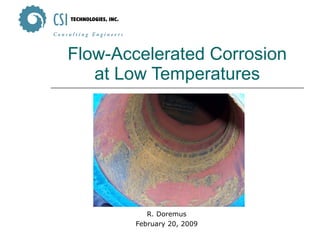
Flow-Accelerated Corrosion at Low Temperatures R. Doremus February 20, 2009
Overview Summary of EPRI TR-1015170 Definition of Low-Temperature FAC Cause Operating Experience PWR BWR EPRI Findings EPRI Recommendations Impact on CSI Procedures
Definition Typically, Flow-Accelerated Corrosion (FAC) occurs between 200ºF and 450ºF. Low-Temperature FAC is FAC occurring below 200ºF.
Cause “poor water chemistry” NOT  Low Temperature Low oxygen content < 20 ppb Neutral water pH ~ 7.0
Operating Experience in PWRs South Texas Project Palo Verde Surry Vogtle
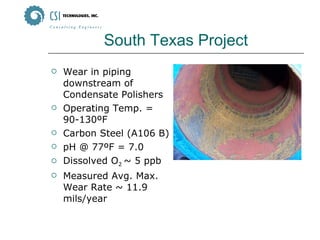
South Texas Project Wear in piping downstream of Condensate Polishers Operating Temp. = 90-130ºF Carbon Steel (A106 B) pH @ 77ºF = 7.0 Dissolved O 2  ~ 5 ppb Measured Avg. Max. Wear Rate ~ 11.9 mils/year
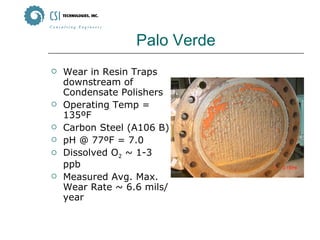
Palo Verde Wear in Resin Traps downstream of Condensate Polishers Operating Temp = 135ºF Carbon Steel (A106 B) pH @ 77ºF = 7.0 Dissolved O 2  ~ 1-3 ppb Measured Avg. Max. Wear Rate ~ 6.6 mils/year
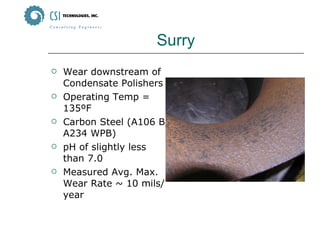
Surry Wear downstream of Condensate Polishers Operating Temp = 135ºF Carbon Steel (A106 B/A234 WPB) pH of slightly less than 7.0 Measured Avg. Max. Wear Rate ~ 10 mils/year
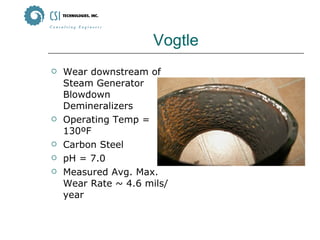
Vogtle Wear downstream of Steam Generator Blowdown Demineralizers Operating Temp = 130ºF Carbon Steel pH = 7.0 Measured Avg. Max. Wear Rate ~ 4.6 mils/year
Operating Experience in BWRs Fukushima Daini Nine Mile Point
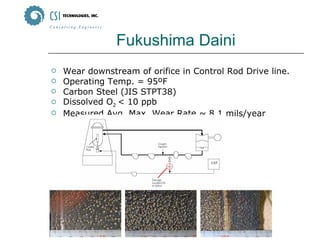
Fukushima Daini Wear downstream of orifice in Control Rod Drive line. Operating Temp. = 95ºF Carbon Steel (JIS STPT38) Dissolved O 2  < 10 ppb Measured Avg. Max. Wear Rate ~ 8.1 mils/year
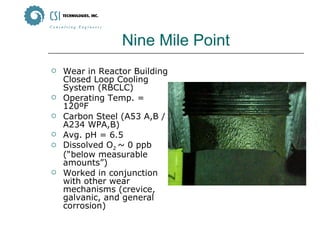
Nine Mile Point Wear in Reactor Building Closed Loop Cooling System (RBCLC) Operating Temp. = 120ºF Carbon Steel (A53 A,B / A234 WPA,B) Avg. pH = 6.5 Dissolved O 2  ~ 0 ppb (“below measurable amounts”) Worked in conjunction with other wear mechanisms (crevice, galvanic, and general corrosion)
EPRI Findings Susceptible areas in PWRs Downstream of Condensate Polishers before amine injection point Downstream of Steam Generator Blowdown Demineralizers Susceptible areas in BWRs Condensate upstream of oxygen injection point Anywhere with oxygen content < 20 ppb
EPRI Findings According to EPRI, CHECWORKS SFA can be applied to BWRs, CANDUs, and PWRs effectively for Low-Temperature FAC.
EPRI Recommendations PWRs Perform susceptibility analyses and, if necessary, inspections on Resin Traps and piping between polishers and amine injection points. Perform susceptibility analyses and, if necessary, inspections on piping downstream of Steam Generator Blowdown Demineralizers.
EPRI Recommendations BWRs Include all low-oxygen areas (< 20 ppb) of condensate, feedwater, and auxiliary systems in the FAC program. Be aware of possible damage upstream of oxygen injection location.  Analysis and inspection may be required.
Impact on CSI Projects PWRs Piping downstream of Condensate Polishers and Steam Generator Blowdown Demineralizers should not be excluded in a System Susceptibility Evaluation (SSE) analysis due to low temperature. These lines should be modeled, if possible. Otherwise, include in the Susceptible Non-Modeled (SNM) Program. Will need input from client on amine injection point if not obvious from P&IDs or isometrics.
Impact on CSI Projects BWRs Use Water Chemistry Analysis in SFA to determine low-oxygen areas of the plant. May require entering plant global data in CHECWORKS prior to completion of an SSE. Be aware piping upstream of oxygen injection points. Categorize all low-oxygen areas as susceptible, regardless of temperature. Model susceptible lines if possible. Otherwise, include in SNM.

Low Temperature FAC

  • 1.
    Flow-Accelerated Corrosion atLow Temperatures R. Doremus February 20, 2009
  • 2.
    Overview Summary ofEPRI TR-1015170 Definition of Low-Temperature FAC Cause Operating Experience PWR BWR EPRI Findings EPRI Recommendations Impact on CSI Procedures
  • 3.
    Definition Typically, Flow-AcceleratedCorrosion (FAC) occurs between 200ºF and 450ºF. Low-Temperature FAC is FAC occurring below 200ºF.
  • 4.
    Cause “poor waterchemistry” NOT Low Temperature Low oxygen content < 20 ppb Neutral water pH ~ 7.0
  • 5.
    Operating Experience inPWRs South Texas Project Palo Verde Surry Vogtle
  • 6.
    South Texas ProjectWear in piping downstream of Condensate Polishers Operating Temp. = 90-130ºF Carbon Steel (A106 B) pH @ 77ºF = 7.0 Dissolved O 2 ~ 5 ppb Measured Avg. Max. Wear Rate ~ 11.9 mils/year
  • 7.
    Palo Verde Wearin Resin Traps downstream of Condensate Polishers Operating Temp = 135ºF Carbon Steel (A106 B) pH @ 77ºF = 7.0 Dissolved O 2 ~ 1-3 ppb Measured Avg. Max. Wear Rate ~ 6.6 mils/year
  • 8.
    Surry Wear downstreamof Condensate Polishers Operating Temp = 135ºF Carbon Steel (A106 B/A234 WPB) pH of slightly less than 7.0 Measured Avg. Max. Wear Rate ~ 10 mils/year
  • 9.
    Vogtle Wear downstreamof Steam Generator Blowdown Demineralizers Operating Temp = 130ºF Carbon Steel pH = 7.0 Measured Avg. Max. Wear Rate ~ 4.6 mils/year
  • 10.
    Operating Experience inBWRs Fukushima Daini Nine Mile Point
  • 11.
    Fukushima Daini Weardownstream of orifice in Control Rod Drive line. Operating Temp. = 95ºF Carbon Steel (JIS STPT38) Dissolved O 2 < 10 ppb Measured Avg. Max. Wear Rate ~ 8.1 mils/year
  • 12.
    Nine Mile PointWear in Reactor Building Closed Loop Cooling System (RBCLC) Operating Temp. = 120ºF Carbon Steel (A53 A,B / A234 WPA,B) Avg. pH = 6.5 Dissolved O 2 ~ 0 ppb (“below measurable amounts”) Worked in conjunction with other wear mechanisms (crevice, galvanic, and general corrosion)
  • 13.
    EPRI Findings Susceptibleareas in PWRs Downstream of Condensate Polishers before amine injection point Downstream of Steam Generator Blowdown Demineralizers Susceptible areas in BWRs Condensate upstream of oxygen injection point Anywhere with oxygen content < 20 ppb
  • 14.
    EPRI Findings Accordingto EPRI, CHECWORKS SFA can be applied to BWRs, CANDUs, and PWRs effectively for Low-Temperature FAC.
  • 15.
    EPRI Recommendations PWRsPerform susceptibility analyses and, if necessary, inspections on Resin Traps and piping between polishers and amine injection points. Perform susceptibility analyses and, if necessary, inspections on piping downstream of Steam Generator Blowdown Demineralizers.
  • 16.
    EPRI Recommendations BWRsInclude all low-oxygen areas (< 20 ppb) of condensate, feedwater, and auxiliary systems in the FAC program. Be aware of possible damage upstream of oxygen injection location. Analysis and inspection may be required.
  • 17.
    Impact on CSIProjects PWRs Piping downstream of Condensate Polishers and Steam Generator Blowdown Demineralizers should not be excluded in a System Susceptibility Evaluation (SSE) analysis due to low temperature. These lines should be modeled, if possible. Otherwise, include in the Susceptible Non-Modeled (SNM) Program. Will need input from client on amine injection point if not obvious from P&IDs or isometrics.
  • 18.
    Impact on CSIProjects BWRs Use Water Chemistry Analysis in SFA to determine low-oxygen areas of the plant. May require entering plant global data in CHECWORKS prior to completion of an SSE. Be aware piping upstream of oxygen injection points. Categorize all low-oxygen areas as susceptible, regardless of temperature. Model susceptible lines if possible. Otherwise, include in SNM.