Louis Pierre Althusser
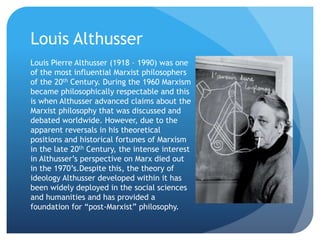
Louis Althusser
Louis Pierre Althusser (1918 – 1990) was one
of the most influential Marxist philosophers
of the 20th Century. During the 1960 Marxism
became philosophically respectable and this
is when Althusser advanced claims about the
Marxist philosophy that was discussed and
debated worldwide. However, due to the
apparent reversals in his theoretical
positions and historical fortunes of Marxism
in the late 20th Century, the intense interest
in Althusser’s perspective on Marx died out
in the 1970’s.Despite this, the theory of
ideology Althusser developed within it has
been widely deployed in the social sciences
and humanities and has provided a
foundation for “post-Marxist” philosophy.
Althusser’s take on Marxism
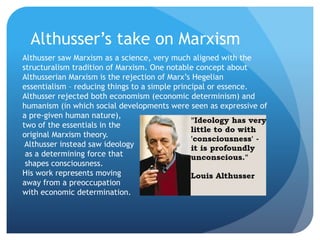
Althusser saw Marxism as a science, very much aligned with the
structuralism tradition of Marxism. One notable concept about
Althusserian Marxism is the rejection of Marx’s Hegelian
essentialism – reducing things to a simple principal or essence.
Althusser rejected both economism (economic determinism) and
humanism (in which social developments were seen as expressive of
a pre-given human nature),
two of the essentials in the
original Marxism theory.
Althusser instead saw ideology
as a determining force that
shapes consciousness.
His work represents moving
away from a preoccupation
with economic determination.
Althusser’s Ideology
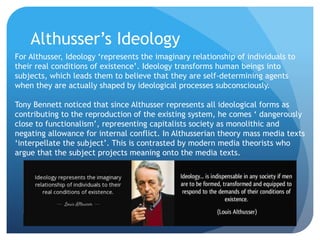
For Althusser, Ideology ‘represents the imaginary relationship of individuals to
their real conditions of existence’. Ideology transforms human beings into
subjects, which leads them to believe that they are self-determining agents
when they are actually shaped by ideological processes subconsciously.
Tony Bennett noticed that since Althusser represents all ideological forms as
contributing to the reproduction of the existing system, he comes ‘ dangerously
close to functionalism’, representing capitalists society as monolithic and
negating allowance for internal conflict. In Althusserian theory mass media texts
‘interpellate the subject’. This is contrasted by modern media theorists who
argue that the subject projects meaning onto the media texts.
Critics
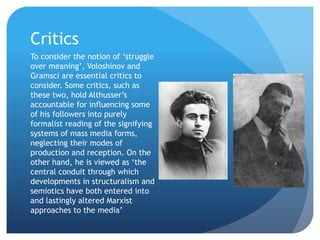
To consider the notion of ‘struggle
over meaning’, Voloshinov and
Gramsci are essential critics to
consider. Some critics, such as
these two, hold Althusser’s
accountable for influencing some
of his followers into purely
formalist reading of the signifying
systems of mass media forms,
neglecting their modes of
production and reception. On the
other hand, he is viewed as ‘the
central conduit through which
developments in structuralism and
semiotics have both entered into
and lastingly altered Marxist
approaches to the media’

Louis althusser

  • 1.
  • 2.
    Louis Althusser Louis PierreAlthusser (1918 – 1990) was one of the most influential Marxist philosophers of the 20th Century. During the 1960 Marxism became philosophically respectable and this is when Althusser advanced claims about the Marxist philosophy that was discussed and debated worldwide. However, due to the apparent reversals in his theoretical positions and historical fortunes of Marxism in the late 20th Century, the intense interest in Althusser’s perspective on Marx died out in the 1970’s.Despite this, the theory of ideology Althusser developed within it has been widely deployed in the social sciences and humanities and has provided a foundation for “post-Marxist” philosophy.
  • 3.
    Althusser’s take onMarxism Althusser saw Marxism as a science, very much aligned with the structuralism tradition of Marxism. One notable concept about Althusserian Marxism is the rejection of Marx’s Hegelian essentialism – reducing things to a simple principal or essence. Althusser rejected both economism (economic determinism) and humanism (in which social developments were seen as expressive of a pre-given human nature), two of the essentials in the original Marxism theory. Althusser instead saw ideology as a determining force that shapes consciousness. His work represents moving away from a preoccupation with economic determination.
  • 4.
    Althusser’s Ideology For Althusser,Ideology ‘represents the imaginary relationship of individuals to their real conditions of existence’. Ideology transforms human beings into subjects, which leads them to believe that they are self-determining agents when they are actually shaped by ideological processes subconsciously. Tony Bennett noticed that since Althusser represents all ideological forms as contributing to the reproduction of the existing system, he comes ‘ dangerously close to functionalism’, representing capitalists society as monolithic and negating allowance for internal conflict. In Althusserian theory mass media texts ‘interpellate the subject’. This is contrasted by modern media theorists who argue that the subject projects meaning onto the media texts.
  • 5.
    Critics To consider thenotion of ‘struggle over meaning’, Voloshinov and Gramsci are essential critics to consider. Some critics, such as these two, hold Althusser’s accountable for influencing some of his followers into purely formalist reading of the signifying systems of mass media forms, neglecting their modes of production and reception. On the other hand, he is viewed as ‘the central conduit through which developments in structuralism and semiotics have both entered into and lastingly altered Marxist approaches to the media’