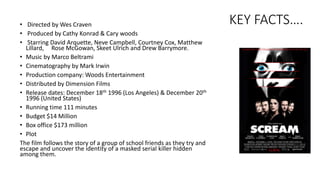
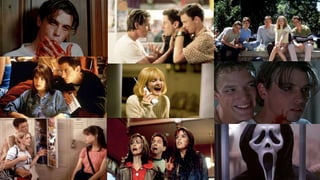
KEY FACTS….• Directed by Wes Craven
• Produced by Cathy Konrad & Cary woods
• Starring David Arquette, Neve Campbell, Courtney Cox, Matthew
Lillard, Rose McGowan, Skeet Ulrich and Drew Barrymore.
• Music by Marco Beltrami
• Cinematography by Mark Irwin
• Production company: Woods Entertainment
• Distributed by Dimension Films
• Release dates: December 18th 1996 (Los Angeles) & December 20th
1996 (United States)
• Running time 111 minutes
• Budget $14 Million
• Box office $173 million
• Plot
The film follows the story of a group of school friends as they try and
escape and uncover the identity of a masked serial killer hidden
among them.
Postmodern Theory Relating to Scream
- Scream is arguably the most influential film of the 1990s
- Copycats
- Layman’s Terms; mixes high and low art forms, Comedy and
Horror
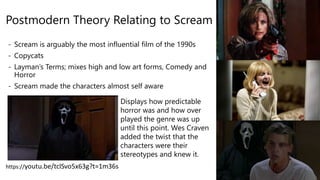
- Scream made the characters almost self aware
https://youtu.be/tclSvo5x63g?t=1m36s
Displays how predictable
horror was and how over
played the genre was up
until this point. Wes Craven
added the twist that the
characters were their
stereotypes and knew it.
How is Scream Postmodern?
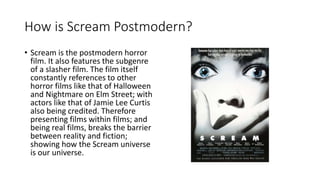
• Scream is the postmodern horror
film. It also features the subgenre
of a slasher film. The film itself
constantly references to other
horror films like that of Halloween
and Nightmare on Elm Street; with
actors like that of Jamie Lee Curtis
also being credited. Therefore
presenting films within films; and
being real films, breaks the barrier
between reality and fiction;
showing how the Scream universe
is our universe.
https://youtu.be/X-q-AWD_8AY
The scene shows how ‘self aware’ the teens are about slasher films;
hyper reality. The supporting charcter of Randy, seems to know exactly
how the film with pan out, as to knowing the rules and format horror
films usually follow; making Scream cliché to the horror genre. His
character goes onto foreshadow the end fate on who the killer actually
is in the middle of the film; without the audience knowing. As he
outlines the rules of surving the horror scenario, such as no drugs,
drinking, srx or saying certain dialogue like ‘ill be right back’ all of these
specific rules are broken again foreshadowing eventual death in the
final scenes of the film
References Jamie Lee Curtis star of Halloween and makes other
references to Halloween throughout the film as a way to pay homage
to it and show they know the cliché of horror films.
https://youtu.be/ZgKukhIw5eY from 1:39
Drew Barrymore’s character claims that all of the sequels to
Nightmare on Elm Street ‘sucked’. The first film was created by
Scream’s director Wes Craven and sold the rights to the
sequels before the badly reviewed sequel. With Drew
Barrymore being the ‘poster girl’ for the films marketing and
also the most significant star featured throughout it; due to
her already found fame; it is unusual that she is killed off in the
first scene of the film, and has no communication to any of the
main characters. Wes craven therefore gives the idea to the
film; that with her death; anything can happen. Adding
uncertainty for the viewers as to the plot.
How is Scream Postmodern?
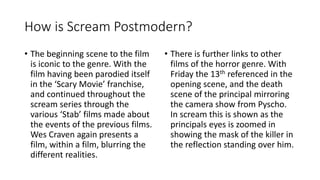
• The beginning scene to the film
is iconic to the genre. With the
film having been parodied itself
in the ‘Scary Movie’ franchise,
and continued throughout the
scream series through the
various ‘Stab’ films made about
the events of the previous films.
Wes Craven again presents a
film, within a film, blurring the
different realities.
• There is further links to other
films of the horror genre. With
Friday the 13th referenced in the
opening scene, and the death
scene of the principal mirroring
the camera show from Pyscho.
In scream this is shown as the
principals eyes is zoomed in
showing the mask of the killer in
the reflection standing over him.
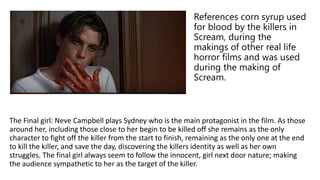
References corn syrup used
for blood by the killers in
Scream, during the
makings of other real life
horror films and was used
during the making of
Scream.
The Final girl: Neve Campbell plays Sydney who is the main protagonist in the film. As those
around her, including those close to her begin to be killed off she remains as the only
character to fight off the killer from the start to finish, remaining as the only one at the end
to kill the killer, and save the day, discovering the killers identity as well as her own
struggles. The final girl always seem to follow the innocent, girl next door nature; making
the audience sympathetic to her as the target of the killer.
Ending Scene
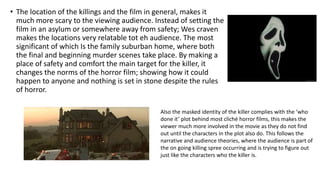
• The location of the killings and the film in general, makes it
much more scary to the viewing audience. Instead of setting the
film in an asylum or somewhere away from safety; Wes craven
makes the locations very relatable tot eh audience. The most
significant of which Is the family suburban home, where both
the final and beginning murder scenes take place. By making a
place of safety and comfort the main target for the killer, it
changes the norms of the horror film; showing how it could
happen to anyone and nothing is set in stone despite the rules
of horror.
Also the masked identity of the killer complies with the ‘who
done it’ plot behind most cliché horror films, this makes the
viewer much more involved in the movie as they do not find
out until the characters in the plot also do. This follows the
narrative and audience theories, where the audience is part of
the on going killing spree occurring and is trying to figure out
just like the characters who the killer is.
Theories
• Todorov: Todorov suggested that all
films follow a three part system, the
equilibrium where all is balanced,
there is a disruption, then a
resolution. However in this film
although after the first scene there is
somewhat of this structure, changing
when Sydney first gets the phone call,
as the opening scene is a murder
scene. The films narrative is already
disrupted from the outset. Therefore
scream does somewhat comply to this
theory, but mostly goes against it due
to the opening scenes nature.
• Representation: The women
particularly in the film are not shown
to be the subject of Laura Mulveys
male gaze. Although some parts in the
film do focus on the women it doesn’t
ever show them as damsels in distress
or having to rely on a man to save
them. Sydney, Gale, Casey and Tatum
all put up a fight against the killer,
ghost face and in the final scenes are
also shown to defeat the main male
leads. It does not show he women as
incapable of defending themselves,
this is continued throughout the
franchise.
Clips
• Trailer:
• https://www.youtube.com/watch?v=AWm_mkbdpCA
• Interview with the cast and crew:
• https://www.youtube.com/watch?v=x1Rmut42q94
• Behind the scenes:
• https://www.youtube.com/watch?v=9P5tZQJdJRM
Article 1
• Wes Craven's “Scream” violates one of the oldest rules in movie history: It's about
characters who go to the movies. They've even heard of movie stars. They refer by
name to Tom Cruise, Richard Gere, Jamie Lee Curtis. They analyze motivations (“Did
Norman Bates have a motive? Did Hannibal Lecter have a reason for wanting to eat
people?”) True, they went to the movies in “The Last Picture Show” and the heroes of
“Clerks” worked in a video store. Even Bonnie and Clyde went to the movies. But those
movies were about the *act* of going to the movies. “Scream” is about *knowledge* of
the movies: The characters in “Scream” are in a horror film, and because they've seen
so many horror films, they know what to do, and what not to do. “Don't say 'I'll be right
back,' “one kid advises a friend, “because whenever anybody says that, he's *never*
right back.” In a way, this movie was inevitable. A lot of modern film criticism involves
“deconstruction” of movie plots. “Deconstruction” is an academic word. It means saying
what everybody knows about the movies in words nobody can understand. “Scream” is
self-deconstructing; it's like one of those cans that heats its own soup….
• http://www.rogerebert.com/reviews/scream-1996
Article 2
http://mentalfloss.com/article/58039/15-things-you-may-not-have-known-about-scream
Bibliography
• https://en.wikipedia.org/wiki/Scream_(1996_film)
• http://www.rogerebert.com/reviews/scream-1996
• http://mentalfloss.com/article/58039/15-things-you-may-not-
have-known-about-scream
• https://www.youtube.com

Scream powerpoint

  • 2.
    KEY FACTS….• Directedby Wes Craven • Produced by Cathy Konrad & Cary woods • Starring David Arquette, Neve Campbell, Courtney Cox, Matthew Lillard, Rose McGowan, Skeet Ulrich and Drew Barrymore. • Music by Marco Beltrami • Cinematography by Mark Irwin • Production company: Woods Entertainment • Distributed by Dimension Films • Release dates: December 18th 1996 (Los Angeles) & December 20th 1996 (United States) • Running time 111 minutes • Budget $14 Million • Box office $173 million • Plot The film follows the story of a group of school friends as they try and escape and uncover the identity of a masked serial killer hidden among them.
  • 3.
    Postmodern Theory Relatingto Scream - Scream is arguably the most influential film of the 1990s - Copycats - Layman’s Terms; mixes high and low art forms, Comedy and Horror - Scream made the characters almost self aware https://youtu.be/tclSvo5x63g?t=1m36s Displays how predictable horror was and how over played the genre was up until this point. Wes Craven added the twist that the characters were their stereotypes and knew it.
  • 4.
    How is ScreamPostmodern? • Scream is the postmodern horror film. It also features the subgenre of a slasher film. The film itself constantly references to other horror films like that of Halloween and Nightmare on Elm Street; with actors like that of Jamie Lee Curtis also being credited. Therefore presenting films within films; and being real films, breaks the barrier between reality and fiction; showing how the Scream universe is our universe.
  • 5.
    https://youtu.be/X-q-AWD_8AY The scene showshow ‘self aware’ the teens are about slasher films; hyper reality. The supporting charcter of Randy, seems to know exactly how the film with pan out, as to knowing the rules and format horror films usually follow; making Scream cliché to the horror genre. His character goes onto foreshadow the end fate on who the killer actually is in the middle of the film; without the audience knowing. As he outlines the rules of surving the horror scenario, such as no drugs, drinking, srx or saying certain dialogue like ‘ill be right back’ all of these specific rules are broken again foreshadowing eventual death in the final scenes of the film References Jamie Lee Curtis star of Halloween and makes other references to Halloween throughout the film as a way to pay homage to it and show they know the cliché of horror films. https://youtu.be/ZgKukhIw5eY from 1:39 Drew Barrymore’s character claims that all of the sequels to Nightmare on Elm Street ‘sucked’. The first film was created by Scream’s director Wes Craven and sold the rights to the sequels before the badly reviewed sequel. With Drew Barrymore being the ‘poster girl’ for the films marketing and also the most significant star featured throughout it; due to her already found fame; it is unusual that she is killed off in the first scene of the film, and has no communication to any of the main characters. Wes craven therefore gives the idea to the film; that with her death; anything can happen. Adding uncertainty for the viewers as to the plot.
  • 6.
    How is ScreamPostmodern? • The beginning scene to the film is iconic to the genre. With the film having been parodied itself in the ‘Scary Movie’ franchise, and continued throughout the scream series through the various ‘Stab’ films made about the events of the previous films. Wes Craven again presents a film, within a film, blurring the different realities. • There is further links to other films of the horror genre. With Friday the 13th referenced in the opening scene, and the death scene of the principal mirroring the camera show from Pyscho. In scream this is shown as the principals eyes is zoomed in showing the mask of the killer in the reflection standing over him.
  • 7.
    References corn syrupused for blood by the killers in Scream, during the makings of other real life horror films and was used during the making of Scream. The Final girl: Neve Campbell plays Sydney who is the main protagonist in the film. As those around her, including those close to her begin to be killed off she remains as the only character to fight off the killer from the start to finish, remaining as the only one at the end to kill the killer, and save the day, discovering the killers identity as well as her own struggles. The final girl always seem to follow the innocent, girl next door nature; making the audience sympathetic to her as the target of the killer.
  • 8.
  • 9.
    • The locationof the killings and the film in general, makes it much more scary to the viewing audience. Instead of setting the film in an asylum or somewhere away from safety; Wes craven makes the locations very relatable tot eh audience. The most significant of which Is the family suburban home, where both the final and beginning murder scenes take place. By making a place of safety and comfort the main target for the killer, it changes the norms of the horror film; showing how it could happen to anyone and nothing is set in stone despite the rules of horror. Also the masked identity of the killer complies with the ‘who done it’ plot behind most cliché horror films, this makes the viewer much more involved in the movie as they do not find out until the characters in the plot also do. This follows the narrative and audience theories, where the audience is part of the on going killing spree occurring and is trying to figure out just like the characters who the killer is.
  • 10.
    Theories • Todorov: Todorovsuggested that all films follow a three part system, the equilibrium where all is balanced, there is a disruption, then a resolution. However in this film although after the first scene there is somewhat of this structure, changing when Sydney first gets the phone call, as the opening scene is a murder scene. The films narrative is already disrupted from the outset. Therefore scream does somewhat comply to this theory, but mostly goes against it due to the opening scenes nature. • Representation: The women particularly in the film are not shown to be the subject of Laura Mulveys male gaze. Although some parts in the film do focus on the women it doesn’t ever show them as damsels in distress or having to rely on a man to save them. Sydney, Gale, Casey and Tatum all put up a fight against the killer, ghost face and in the final scenes are also shown to defeat the main male leads. It does not show he women as incapable of defending themselves, this is continued throughout the franchise.
  • 11.
    Clips • Trailer: • https://www.youtube.com/watch?v=AWm_mkbdpCA •Interview with the cast and crew: • https://www.youtube.com/watch?v=x1Rmut42q94 • Behind the scenes: • https://www.youtube.com/watch?v=9P5tZQJdJRM
  • 13.
    Article 1 • WesCraven's “Scream” violates one of the oldest rules in movie history: It's about characters who go to the movies. They've even heard of movie stars. They refer by name to Tom Cruise, Richard Gere, Jamie Lee Curtis. They analyze motivations (“Did Norman Bates have a motive? Did Hannibal Lecter have a reason for wanting to eat people?”) True, they went to the movies in “The Last Picture Show” and the heroes of “Clerks” worked in a video store. Even Bonnie and Clyde went to the movies. But those movies were about the *act* of going to the movies. “Scream” is about *knowledge* of the movies: The characters in “Scream” are in a horror film, and because they've seen so many horror films, they know what to do, and what not to do. “Don't say 'I'll be right back,' “one kid advises a friend, “because whenever anybody says that, he's *never* right back.” In a way, this movie was inevitable. A lot of modern film criticism involves “deconstruction” of movie plots. “Deconstruction” is an academic word. It means saying what everybody knows about the movies in words nobody can understand. “Scream” is self-deconstructing; it's like one of those cans that heats its own soup…. • http://www.rogerebert.com/reviews/scream-1996
  • 14.
  • 15.
    Bibliography • https://en.wikipedia.org/wiki/Scream_(1996_film) • http://www.rogerebert.com/reviews/scream-1996 •http://mentalfloss.com/article/58039/15-things-you-may-not- have-known-about-scream • https://www.youtube.com