

Planning for Long-Term Care
Protecting Your Life Savings
Planning for Long-Term Care
Protecting Your Life Savings
Is Long-Term Care in Your Future?
...that’s 7out of 10 people…will need
long-term care.
Source: U.S. Department of Health and Human
Services, December 31, 2016
Statistically, 70%
of people over age
65…
What Is Long-Term Care?
 Ongoing services and
support needed
because of chronic
health condition or
disability
 Three levels of care:
skilled, intermediate,
and personal care
 Care can be provided in
a variety of settings
Where Can You Receive Care?
 At home
 At an assisted-living
facility or other senior
living facility
 At an adult day-care
center
 In a nursing home
Annual Cost of Nursing Home Care
$0
$20,000
$40,000
$60,000
$80,000
$100,000
$120,000
$140,000
Today 10
years
20
years
 Average nationwide
cost of nursing home
care is $74,820 per
year*
 If costs rise at an
average rate of 3% per
year, in 20 years the
average cost of nursing
home care will be
approximately $135,133
per year
*Source: U.S. Department of Health
and Human Services, December 31,
2016
How Will You Pay for Long-Term Care?
 Pay out-of-pocket
 Rely on government
programs such as
Medicare or Medicaid
 Buy long-term care
insurance
Paying for Long-Term Care
Out-of-Pocket
 More freedom to
choose care
 May be ideal if you can
afford to pay for care
indefinitely
But…
 You must be willing to
liquidate assets if
necessary
 May impact ability to
pass on assets to family
 If you run out of money,
relying on family
members or the
government may be
your only options
Paying for Long-Term Care
Out-of-Pocket: Reverse Mortgage
 Live at home for as long
as you are able
 No mortgage payments
to make
 Loan is repaid when you
vacate the home
A reverse mortgage
allows you to borrow
against your home
equity. You can use
the cash you receive
to pay for the long-
term care services
that will help you
remain in your home.
Paying for Long-Term Care - Medicare
 Pays costs only after
3-day hospitalization
 Pays full cost of
skilled nursing care
for only 20 days
 Pays partial cost from
day 21 to day 100
 Pays nothing after
100 days
 Does not pay for
personal or custodial
care
 Home health benefits
are limited
Medicare is federal health insurance that provides only limited coverage for long-
term care services.
Paying for Long-Term Care -Medicaid
 Medicaid, not Medicare, is
the joint federal-state
program that pays for long-
term care expenses
 Medicaid is the largest
public payer of long-term
care services
But…
 Medicaid is means-based
 Medicaid limits where you
can receive care
Source: U.S. Department of Health and Human
Services, December 31, 2016
Nursing home care expenditures
Medicaid
Out-of-Pocket
Other Public/Private
Medicare
LTC Insurance
Medicaid Eligibility
 Each state establishes its
own eligibility criteria under
federal guidelines
 In most states, an
individual’s income must be
less than cost of care
 In some states, income cap
applies (usually 300% of SSI
benefit)
 In most states, asset limit is
$2,000 (limits may be higher
if married)
 Your house (if your spouse is
living)
 One car
 Household and personal
belongings
 Term life insurance
 Burial plots and funeral
expenses
But some assets are not
counted:
Medicaid Planning - What Is It?
 Using assets that count
(e.g., savings) to
purchase assets that
don’t count (e.g., a
small term life
insurance policy)
 Transferring assets in
an irrevocable trust
 Giving assets away
Strategies may include…
Distributing or protecting
your assets in advance may
help you qualify for
Medicaid.
Medicaid Planning
Benefits and Drawbacks
 Qualify for Medicaid as
soon as possible
 Protect a healthy
spouse
 Preserve assets for
loved ones
 Ethically problematic for
some
 May require you to give
up rights to your assets
 Medicaid laws are
complex
Benefits Drawbacks
Medicaid Planning
Example
 You transfer ownership of
house to your son
 Fair market value of
house is $400,000
 Average cost of nursing
home care in your area is
$8,000
 Ineligibility period is
50months
Paying for Long-Term Care
Long-Term Care Insurance
 Pays benefits when you
need extended care
 Especially valuable for
middle income
Americans who want to
preserve financial
independence and
quality of life
 Freedom to choose care
 Can help preserve
assets
Long-Term Care Insurance
How Does It Work?
 You must be in reasonably good
health to buy policy
 Premium is based on your age,
and the features and benefits
you choose
 Benefit is typically triggered
when you become chronically ill
or cognitively impaired and need
help with 2 out of 6 activities of
daily living (ADLs)
 Once elimination period
(waiting period) is satisfied,
benefits paid as long as
necessary until policy limits are
reached
Long-Term Care Insurance
Should You Invest Instead?
Investing $3,042 annually at 5%
after-tax rate of return: $105,616
accumulated after 20 years*
Paying $3,042 annual premium for
a 3-year LTC policy with a $150
daily benefit and 5% compound
inflation protection: $435,804
benefit after 20 years
*This is a hypothetical
example and doesn’t reflect
the return of any specific
investment.
Long-Term Care Insurance
5 Key Features
What is the amount of the benefit
payable?
How long will benefits last?
How long will you wait before benefits
begin?
Does the policy cover care in different
settings?
Will your benefits keep up with rising
costs?
Long-Term Care Insurance
Managing the Cost
 The younger you are
when you buy a long-term
care policy, the less
expensive the premium
 Make sure you can afford
the premium now and in
the future
 Buy from a reputable
company
 Choose features and
benefits wisely
Long-Term Care Insurance
Government Incentives
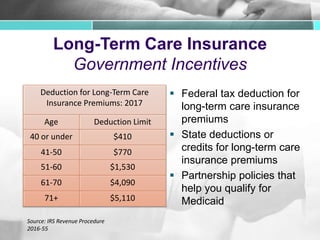
 Federal tax deduction for
long-term care insurance
premiums
 State deductions or
credits for long-term care
insurance premiums
 Partnership policies that
help you qualify for
Medicaid
Deduction for Long-Term Care
Insurance Premiums: 2017
Age Deduction Limit
40 or under $410
41-50 $770
51-60 $1,530
61-70 $4,090
71+ $5,110
Source: IRS Revenue Procedure
2016-55
Other Insurance Options
 Combines life insurance or annuities with long-term
care insurance benefits
 Need for large lump sum
 No medical expense deduction
Combination Policies
Begin Planning Today
 While you’re healthy
enough to take
advantage of all options
 While you have enough
time to plan for
Medicaid
 To relieve your family of
the burden of making
decisions
Long-Term Care Planning Checklist
 Explore services and
costs in your area
 Assess your finances
 Talk to your family
about your plans
 Compare options with
the help of a qualified
financial professional
 Prepare health-care
directives
Conclusion
Thank you for joining me today.
I would welcome the
opportunity to meet individually
with each of you to address any
specific concerns or questions
you may have.
Bobby Cherry
D’Arcy Wealth Management
Darcywealthmanagement.com
909-754-1570
Disclaimer
IMPORTANT DISCLOSURES
D’Arcy Wealth Management, Inc. does not provide investment, tax, or legal advice. The information presented
here is not specific to any individual's personal circumstances.
To the extent that this material concerns tax matters, it is not intended or written to be used, and cannot be used,
by a taxpayer for the purpose of avoiding penalties that may be imposed by law. Each taxpayer should seek
independent advice from a tax professional based on his or her individual circumstances.
These materials are provided for general information and educational purposes based upon publicly available
information from sources believed to be reliable—we cannot assure the accuracy or completeness of these
materials. The information in these materials may change at any time and without notice.

Long Term Care

  • 1.
    Planning for Long-TermCare Protecting Your Life Savings Planning for Long-Term Care Protecting Your Life Savings
  • 2.
    Is Long-Term Carein Your Future? ...that’s 7out of 10 people…will need long-term care. Source: U.S. Department of Health and Human Services, December 31, 2016 Statistically, 70% of people over age 65…
  • 3.
    What Is Long-TermCare?  Ongoing services and support needed because of chronic health condition or disability  Three levels of care: skilled, intermediate, and personal care  Care can be provided in a variety of settings
  • 4.
    Where Can YouReceive Care?  At home  At an assisted-living facility or other senior living facility  At an adult day-care center  In a nursing home
  • 5.
    Annual Cost ofNursing Home Care $0 $20,000 $40,000 $60,000 $80,000 $100,000 $120,000 $140,000 Today 10 years 20 years  Average nationwide cost of nursing home care is $74,820 per year*  If costs rise at an average rate of 3% per year, in 20 years the average cost of nursing home care will be approximately $135,133 per year *Source: U.S. Department of Health and Human Services, December 31, 2016
  • 6.
    How Will YouPay for Long-Term Care?  Pay out-of-pocket  Rely on government programs such as Medicare or Medicaid  Buy long-term care insurance
  • 7.
    Paying for Long-TermCare Out-of-Pocket  More freedom to choose care  May be ideal if you can afford to pay for care indefinitely But…  You must be willing to liquidate assets if necessary  May impact ability to pass on assets to family  If you run out of money, relying on family members or the government may be your only options
  • 8.
    Paying for Long-TermCare Out-of-Pocket: Reverse Mortgage  Live at home for as long as you are able  No mortgage payments to make  Loan is repaid when you vacate the home A reverse mortgage allows you to borrow against your home equity. You can use the cash you receive to pay for the long- term care services that will help you remain in your home.
  • 9.
    Paying for Long-TermCare - Medicare  Pays costs only after 3-day hospitalization  Pays full cost of skilled nursing care for only 20 days  Pays partial cost from day 21 to day 100  Pays nothing after 100 days  Does not pay for personal or custodial care  Home health benefits are limited Medicare is federal health insurance that provides only limited coverage for long- term care services.
  • 10.
    Paying for Long-TermCare -Medicaid  Medicaid, not Medicare, is the joint federal-state program that pays for long- term care expenses  Medicaid is the largest public payer of long-term care services But…  Medicaid is means-based  Medicaid limits where you can receive care Source: U.S. Department of Health and Human Services, December 31, 2016 Nursing home care expenditures Medicaid Out-of-Pocket Other Public/Private Medicare LTC Insurance
  • 11.
    Medicaid Eligibility  Eachstate establishes its own eligibility criteria under federal guidelines  In most states, an individual’s income must be less than cost of care  In some states, income cap applies (usually 300% of SSI benefit)  In most states, asset limit is $2,000 (limits may be higher if married)  Your house (if your spouse is living)  One car  Household and personal belongings  Term life insurance  Burial plots and funeral expenses But some assets are not counted:
  • 12.
    Medicaid Planning -What Is It?  Using assets that count (e.g., savings) to purchase assets that don’t count (e.g., a small term life insurance policy)  Transferring assets in an irrevocable trust  Giving assets away Strategies may include… Distributing or protecting your assets in advance may help you qualify for Medicaid.
  • 13.
    Medicaid Planning Benefits andDrawbacks  Qualify for Medicaid as soon as possible  Protect a healthy spouse  Preserve assets for loved ones  Ethically problematic for some  May require you to give up rights to your assets  Medicaid laws are complex Benefits Drawbacks
  • 14.
    Medicaid Planning Example  Youtransfer ownership of house to your son  Fair market value of house is $400,000  Average cost of nursing home care in your area is $8,000  Ineligibility period is 50months
  • 15.
    Paying for Long-TermCare Long-Term Care Insurance  Pays benefits when you need extended care  Especially valuable for middle income Americans who want to preserve financial independence and quality of life  Freedom to choose care  Can help preserve assets
  • 16.
    Long-Term Care Insurance HowDoes It Work?  You must be in reasonably good health to buy policy  Premium is based on your age, and the features and benefits you choose  Benefit is typically triggered when you become chronically ill or cognitively impaired and need help with 2 out of 6 activities of daily living (ADLs)  Once elimination period (waiting period) is satisfied, benefits paid as long as necessary until policy limits are reached
  • 17.
    Long-Term Care Insurance ShouldYou Invest Instead? Investing $3,042 annually at 5% after-tax rate of return: $105,616 accumulated after 20 years* Paying $3,042 annual premium for a 3-year LTC policy with a $150 daily benefit and 5% compound inflation protection: $435,804 benefit after 20 years *This is a hypothetical example and doesn’t reflect the return of any specific investment.
  • 18.
    Long-Term Care Insurance 5Key Features What is the amount of the benefit payable? How long will benefits last? How long will you wait before benefits begin? Does the policy cover care in different settings? Will your benefits keep up with rising costs?
  • 19.
    Long-Term Care Insurance Managingthe Cost  The younger you are when you buy a long-term care policy, the less expensive the premium  Make sure you can afford the premium now and in the future  Buy from a reputable company  Choose features and benefits wisely
  • 20.
    Long-Term Care Insurance GovernmentIncentives  Federal tax deduction for long-term care insurance premiums  State deductions or credits for long-term care insurance premiums  Partnership policies that help you qualify for Medicaid Deduction for Long-Term Care Insurance Premiums: 2017 Age Deduction Limit 40 or under $410 41-50 $770 51-60 $1,530 61-70 $4,090 71+ $5,110 Source: IRS Revenue Procedure 2016-55
  • 21.
    Other Insurance Options Combines life insurance or annuities with long-term care insurance benefits  Need for large lump sum  No medical expense deduction Combination Policies
  • 22.
    Begin Planning Today While you’re healthy enough to take advantage of all options  While you have enough time to plan for Medicaid  To relieve your family of the burden of making decisions
  • 23.
    Long-Term Care PlanningChecklist  Explore services and costs in your area  Assess your finances  Talk to your family about your plans  Compare options with the help of a qualified financial professional  Prepare health-care directives
  • 24.
    Conclusion Thank you forjoining me today. I would welcome the opportunity to meet individually with each of you to address any specific concerns or questions you may have. Bobby Cherry D’Arcy Wealth Management Darcywealthmanagement.com 909-754-1570
  • 25.
    Disclaimer IMPORTANT DISCLOSURES D’Arcy WealthManagement, Inc. does not provide investment, tax, or legal advice. The information presented here is not specific to any individual's personal circumstances. To the extent that this material concerns tax matters, it is not intended or written to be used, and cannot be used, by a taxpayer for the purpose of avoiding penalties that may be imposed by law. Each taxpayer should seek independent advice from a tax professional based on his or her individual circumstances. These materials are provided for general information and educational purposes based upon publicly available information from sources believed to be reliable—we cannot assure the accuracy or completeness of these materials. The information in these materials may change at any time and without notice.