Long-term Care and Asset Protection Planning Sandra L. Smith, CELA Oast  &  Hook, P.C. Attorneys and Counselors at Law Serving Virginia and North Carolina Tel: 757-399-7506 | Tel: 252-722-2890 Fax: 757-397-1267  www.oasthook.com
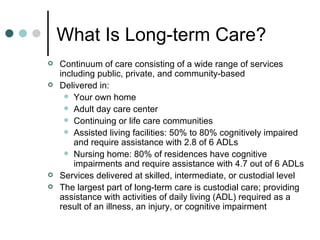
What Is Long-term Care? Continuum of care consisting of a wide range of services including public, private, and community-based Delivered in: Your own home Adult day care center Continuing or life care communities Assisted living facilities: 50% to 80% cognitively impaired and require assistance with 2.8 of 6 ADLs Nursing home: 80% of residences have cognitive impairments and require assistance with 4.7 out of 6 ADLs Services delivered at skilled, intermediate, or custodial level The largest part of long-term care is custodial care; providing assistance with activities of daily living (ADL) required as a result of an illness, an injury, or cognitive impairment
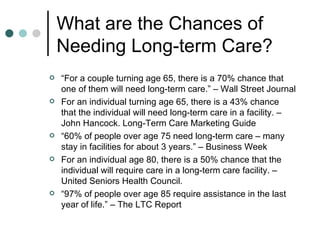
What are the Chances of Needing Long-term Care? “ For a couple turning age 65, there is a 70% chance that one of them will need long-term care.” – Wall Street Journal For an individual turning age 65, there is a 43% chance that the individual will need long-term care in a facility. – John Hancock. Long-Term Care Marketing Guide “ 60% of people over age 75 need long-term care – many stay in facilities for about 3 years.” – Business Week For an individual age 80, there is a 50% chance that the individual will require care in a long-term care facility. – United Seniors Health Council. “ 97% of people over age 85 require assistance in the last year of life.” – The LTC Report
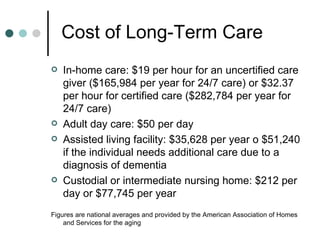
Cost of Long-Term Care   In-home care: $19 per hour for an uncertified care giver ($165,984 per year for 24/7 care) or $32.37 per hour for certified care ($282,784 per year for 24/7 care) Adult day care: $50 per day Assisted living facility: $35,628 per year o $51,240 if the individual needs additional care due to a diagnosis of dementia Custodial or intermediate nursing home: $212 per day or $77,745 per year Figures are national averages and provided by the American Association of Homes and Services for the aging
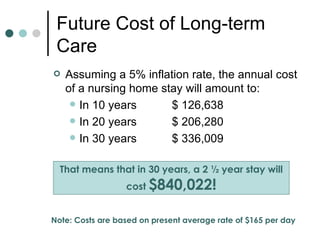
Future Cost of Long-term Care Assuming a 5% inflation rate, the annual cost of a nursing home stay will amount to: In 10 years  $ 126,638 In 20 years  $ 206,280 In 30 years  $ 336,009 That means that in 30 years, a 2 ½ year stay will cost  $840,022! Note: Costs are based on present average rate of $165 per day
Why Do We Care About Asset Protection Planning? Long-term Care will become more prevalent as our population ages, many clients will have questions or be in the midst of planning. There are many forms of asset protection and all people are concerned in some ways Think car insurance or homeowner’s insurance
What is Asset Protection Planning? Positioning assets to minimize the impact of a catastrophic event LTC, lawsuit, divorce, etc – all require asset protection planning We will focus on LTC
Is Asset Protection Appropriate for Everyone? Asset protection has a variety of meanings Think long-term care insurance Investment planning Life insurance Medicaid planning Example – client with $12,000,000 in gas, coal, and mineral properties Example – married clients with approximately $1,000,000 net worth
Prior Planning Improves Results Locate and organize Information (critical for good planning) Deeds, stock certificates, annuities and bonds Financial statements and records Insurance policies (life, health, long-term care and property) List of advisors Tax returns Consolidate investment accounts to simplify management Update legal documents  for entire family  (especially gift provisions and choice of fiduciaries) Wills and trusts Powers of attorney Advance medical directive Designations of beneficiary Plan for the payment of the cost of long-term care
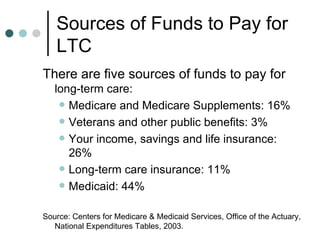
Sources of Funds to Pay for LTC There are five sources of funds to pay for  long-term care: Medicare and Medicare Supplements: 16% Veterans and other public benefits: 3% Your income, savings and life insurance: 26% Long-term care insurance: 11% Medicaid: 44% Source: Centers for Medicare & Medicaid Services, Office of the Actuary, National Expenditures Tables, 2003.
Medicare and Medicare Supplements Medicare pays only for skilled nursing home care As a result, according to Medicare itself, Medicare pays less than 5% of the costs of nursing home stays Medicare Supplement policies pay only approved Medicare expenses. This means that supplements pay less than 1% of nursing home costs So, Medicare really does not serve as a source of funds

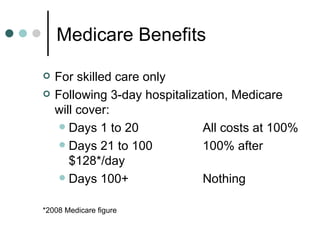
Medicare Benefits For skilled care only  Following 3-day hospitalization, Medicare will cover: Days 1 to 20 All costs at 100% Days 21 to 100 100% after $128*/day Days 100+ Nothing *2008 Medicare figure
Medicare Facts Medicare was not designed to address custodial, long-term care needs and does not do so. Medicare pays only for short-term medical treatment, such as hospital and doctor bills Medicare only covers skilled care and under limited circumstances For Medicare to pay for nursing home care: Care must be provided in a skilled nursing facility Care must be provided within 30 days after a prior hospital stay of at least 3 consecutive days Care must be restorative in nature—must be designed to make patient well.  Any type of intermediate or custodial care (99.5% of care provided in a nursing home) is not covered
That Leaves Four Choices Veterans benefits or Your income, savings and life insurance or Long-term care insurance or Medicaid
Veterans Benefits Special Pension benefits to help pay for health care TRICARE FOR LIFE VA hospitals offer free health care
Planning for VA benefits If this is an available benefit pension may be preferable to Medicaid planning.  Pension may help cover the cost of assisted living which is not typically covered by Medicaid Currently no restrictions on transferring property to qualify for benefits
That Leaves Three Choices Your income, savings and life insurance or Long-term care insurance or Medicaid
Income, Savings, and Life Insurance Can client contribute a portion of their income to long-term care costs? Do they have a substantial savings? Do they have a life insurance policy with cash value or an accelerated death benefit? Do they have a life insurance policy that can be sold using a viatical or life settlement?
Use Life Insurance Cash value life insurance.  Cancel the policy or take a loan against the cash value Accelerated death benefits.  Some life insurance policies permit you to withdraw death benefits while you are alive if you meet eligibility standards which typically include have a year or less to live and confinement to a LTC facility Viatical or life settlements
Life and Viatical Settlements Proceeds received from viatical settlements, life proceeds from life insurance, are not considered income for federal tax purposes. Proceeds from a life settlement may be considered ordinary income, capital gains, or a combination of the two.  The law is not clear regarding taxation of life settlements. As a result, using monies from such a benefit to supplement pension or social security income may be enough to cover cost of care and not force you to withdraw amounts from principal investments, which may force capital gains tax.
That Leaves Two Choices Long-term care insurance or Medicaid
LTC Insurance Deductibility The Health Insurance Portability and Accountability Act of 1996 (HIPAA) requires that long-term care carriers change their current policies to meet guidelines called for under this legislation. The law allows: Individuals who itemize to deduct premiums as a medical expense LTC benefits received by a claimant to be tax free to the recipient Individuals who itemize to deduct LTC expenses not covered by insurance Self-employed individuals to deduct 100% of their LTC premiums as a business expense directly on Form 1040
Finally -  That Leaves One Choice Medicaid long-term care assistance State program funded in part by the federal government 209(b) states which have some eligibility rules which differ from Supplemental Security Income (SSI) eligibility rules Administered by the Department of Medical Assistance Services (DMAS) Eligibility determined locally by the Department of Social Services
Overview  Medicaid eligibility and asset transfer rules are extremely complicated Rules vary substantially from state to state, and they change constantly Don’t rely on advice from friends, family, or even someone that had the same experience in the past.  You must do your own research
Medicaid Manual Handbook for eligibility workers Different in every state and is called something different in every state Department of Social Services will not give opinions on hypothetical situations
Basic Criteria for Eligibility Be a state resident Membership in covered group Functional and medical criteria Resource eligibility rules Income eligibility rules Asset transfer rules
Financial Criteria: Resources  Default rule is that an asset is countable unless it is specifically exempt Assets must be substantiated from the first day of the first month in which continuous institutionalization occurs All transfers for the last five years must be disclosed Maximum is $2,000 in countable resources
Countable Assets Includes jointly-held property IRAs and retirement plans generally count 100% Cash value of life insurance policies when face values exceed $1,500 Conversion of exempt resources during eligibility counts as income in the month received
Common Thought Give it away –  Local divisor – varies from state to state and by region in the state (current in Southeastern Virginia is $4,954) Pre DRA: Penalty period begins on first day of month in which gift is made Post DRA: Penalty period begins when funds are spent down and NH care required Penalty periods can be concurrent No limit on penalty periods Not all transfers give rise to penalties
Lookback Periods Pre DRA Gifts: 36 Months for direct gifts and 60 months for gifts involving a trust Post DRA Gifts: 60 months for all uncompensated transfers
Non-countable/exempt Resources Personal possessions One automobile  Principal residence (with limitations) Trade or business property Certain prepaid burial arrangements Term life insurance Life estates (but avoid uncompensated transfers) d(4)(A) trusts Assets that are considered inaccessible
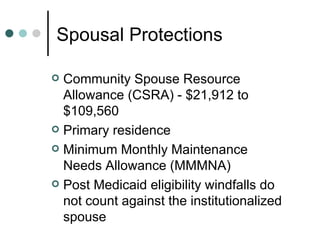
Spousal Protections Community Spouse Resource Allowance (CSRA) - $21,912 to $109,560 Primary residence Minimum Monthly Maintenance Needs Allowance (MMMNA) Post Medicaid eligibility windfalls do not count against the institutionalized spouse
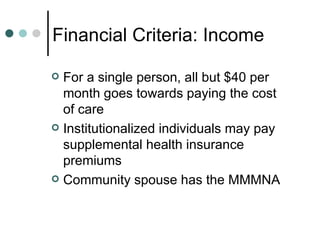
Financial Criteria: Income For a single person, all but $40 per month goes towards paying the cost of care Institutionalized individuals may pay supplemental health insurance premiums Community spouse has the MMMNA
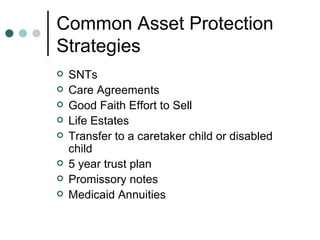
Common Asset Protection Strategies SNTs Care Agreements Good Faith Effort to Sell Life Estates Transfer to a caretaker child or disabled child 5 year trust plan Promissory notes Medicaid Annuities
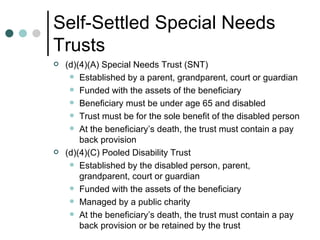
Self-Settled Special Needs Trusts (d)(4)(A) Special Needs Trust (SNT) Established by a parent, grandparent, court or guardian Funded with the assets of the beneficiary Beneficiary must be under age 65 and disabled Trust must be for the sole benefit of the disabled person At the beneficiary’s death, the trust must contain a pay back provision (d)(4)(C) Pooled Disability Trust Established by the disabled person, parent, grandparent, court or guardian Funded with the assets of the beneficiary Managed by a public charity At the beneficiary’s death, the trust must contain a pay back provision or be retained by the trust
Care Agreement Contract to provide care services Many feel this is an easy way to compensate children Virginia has special rules Cannot be in a facility Must have a physician’s statement
Good Faith Effort to Sell List real property for tax assessed value What happens when it sells? – capital gains
Life Estates Once a very popular planning strategy May soon no longer be available in Virginia Remainderman gets a step up in basis
Transfer to caretaker child or adult disabled child Certain transfers are not penalized for Medicaid Transfer = gift. Carryover basis and loss of step up in basis both should be considered
5 year trust plan Involves gifting assets to a trust. Leaves individual ineligible for Medicaid for 5 years.  Trust should be a defective grantor trust so an incomplete gift for tax purposes.
Promissory notes Irrevocable, non-assignable, non-transferable, actuarially sound, based on life expectancy. Must charge interest, interest is income – but will medical expenses cause this to be a moot point? What about a business, purchasing asset, then interest may be deductible
Medicaid Annuity Same requirements as promissory note Must name Commonwealth of VA as remainder beneficiary Excellent option for qualified benefits, if using other assets, does this become a realization event?
Estate Recovery Virginia has the right to recover against a decedent’s estate for past Medicaid benefits paid Virginia generally recovers against probate assets, but could pursue non-probate assets
Conclusion LTC will be an important concern in the upcoming years Asset protection strategies are numerous and should be handled by specialists You may be able to advise those who have not considered the consequences of their actions
  Oast   &   Hook, P.C. Attorneys and Counselors at Law Offices in Elizabeth City, Portsmouth, and Virginia Beach Tel:  757-399-7506 | Tel:  252-722-2890 | Fax: 757-397-1267   Please visit our web site at  www.oasthook.com Estate Planning Asset Protection Planning Long-term Care Planning Veterans Benefits Financial Planning and Advice regarding Investments, Insurance, Annuities, Reverse Mortgages, and Equity Lines Tax Planning Guardianships and Conservatorships Estate and Trust Administration Special Needs Trusts Care Management Services Business Planning and Succession Planning

Long Term Care Planning 20090608

  • 1.
    Long-term Care andAsset Protection Planning Sandra L. Smith, CELA Oast & Hook, P.C. Attorneys and Counselors at Law Serving Virginia and North Carolina Tel: 757-399-7506 | Tel: 252-722-2890 Fax: 757-397-1267 www.oasthook.com
  • 2.
    What Is Long-termCare? Continuum of care consisting of a wide range of services including public, private, and community-based Delivered in: Your own home Adult day care center Continuing or life care communities Assisted living facilities: 50% to 80% cognitively impaired and require assistance with 2.8 of 6 ADLs Nursing home: 80% of residences have cognitive impairments and require assistance with 4.7 out of 6 ADLs Services delivered at skilled, intermediate, or custodial level The largest part of long-term care is custodial care; providing assistance with activities of daily living (ADL) required as a result of an illness, an injury, or cognitive impairment
  • 3.
    What are theChances of Needing Long-term Care? “ For a couple turning age 65, there is a 70% chance that one of them will need long-term care.” – Wall Street Journal For an individual turning age 65, there is a 43% chance that the individual will need long-term care in a facility. – John Hancock. Long-Term Care Marketing Guide “ 60% of people over age 75 need long-term care – many stay in facilities for about 3 years.” – Business Week For an individual age 80, there is a 50% chance that the individual will require care in a long-term care facility. – United Seniors Health Council. “ 97% of people over age 85 require assistance in the last year of life.” – The LTC Report
  • 4.
    Cost of Long-TermCare In-home care: $19 per hour for an uncertified care giver ($165,984 per year for 24/7 care) or $32.37 per hour for certified care ($282,784 per year for 24/7 care) Adult day care: $50 per day Assisted living facility: $35,628 per year o $51,240 if the individual needs additional care due to a diagnosis of dementia Custodial or intermediate nursing home: $212 per day or $77,745 per year Figures are national averages and provided by the American Association of Homes and Services for the aging
  • 5.
    Future Cost ofLong-term Care Assuming a 5% inflation rate, the annual cost of a nursing home stay will amount to: In 10 years $ 126,638 In 20 years $ 206,280 In 30 years $ 336,009 That means that in 30 years, a 2 ½ year stay will cost $840,022! Note: Costs are based on present average rate of $165 per day
  • 6.
    Why Do WeCare About Asset Protection Planning? Long-term Care will become more prevalent as our population ages, many clients will have questions or be in the midst of planning. There are many forms of asset protection and all people are concerned in some ways Think car insurance or homeowner’s insurance
  • 7.
    What is AssetProtection Planning? Positioning assets to minimize the impact of a catastrophic event LTC, lawsuit, divorce, etc – all require asset protection planning We will focus on LTC
  • 8.
    Is Asset ProtectionAppropriate for Everyone? Asset protection has a variety of meanings Think long-term care insurance Investment planning Life insurance Medicaid planning Example – client with $12,000,000 in gas, coal, and mineral properties Example – married clients with approximately $1,000,000 net worth
  • 9.
    Prior Planning ImprovesResults Locate and organize Information (critical for good planning) Deeds, stock certificates, annuities and bonds Financial statements and records Insurance policies (life, health, long-term care and property) List of advisors Tax returns Consolidate investment accounts to simplify management Update legal documents for entire family (especially gift provisions and choice of fiduciaries) Wills and trusts Powers of attorney Advance medical directive Designations of beneficiary Plan for the payment of the cost of long-term care
  • 10.
    Sources of Fundsto Pay for LTC There are five sources of funds to pay for long-term care: Medicare and Medicare Supplements: 16% Veterans and other public benefits: 3% Your income, savings and life insurance: 26% Long-term care insurance: 11% Medicaid: 44% Source: Centers for Medicare & Medicaid Services, Office of the Actuary, National Expenditures Tables, 2003.
  • 11.
    Medicare and MedicareSupplements Medicare pays only for skilled nursing home care As a result, according to Medicare itself, Medicare pays less than 5% of the costs of nursing home stays Medicare Supplement policies pay only approved Medicare expenses. This means that supplements pay less than 1% of nursing home costs So, Medicare really does not serve as a source of funds
  • 12.
    Medicare Benefits Forskilled care only Following 3-day hospitalization, Medicare will cover: Days 1 to 20 All costs at 100% Days 21 to 100 100% after $128*/day Days 100+ Nothing *2008 Medicare figure
  • 13.
    Medicare Facts Medicarewas not designed to address custodial, long-term care needs and does not do so. Medicare pays only for short-term medical treatment, such as hospital and doctor bills Medicare only covers skilled care and under limited circumstances For Medicare to pay for nursing home care: Care must be provided in a skilled nursing facility Care must be provided within 30 days after a prior hospital stay of at least 3 consecutive days Care must be restorative in nature—must be designed to make patient well. Any type of intermediate or custodial care (99.5% of care provided in a nursing home) is not covered
  • 14.
    That Leaves FourChoices Veterans benefits or Your income, savings and life insurance or Long-term care insurance or Medicaid
  • 15.
    Veterans Benefits SpecialPension benefits to help pay for health care TRICARE FOR LIFE VA hospitals offer free health care
  • 16.
    Planning for VAbenefits If this is an available benefit pension may be preferable to Medicaid planning. Pension may help cover the cost of assisted living which is not typically covered by Medicaid Currently no restrictions on transferring property to qualify for benefits
  • 17.
    That Leaves ThreeChoices Your income, savings and life insurance or Long-term care insurance or Medicaid
  • 18.
    Income, Savings, andLife Insurance Can client contribute a portion of their income to long-term care costs? Do they have a substantial savings? Do they have a life insurance policy with cash value or an accelerated death benefit? Do they have a life insurance policy that can be sold using a viatical or life settlement?
  • 19.
    Use Life InsuranceCash value life insurance. Cancel the policy or take a loan against the cash value Accelerated death benefits. Some life insurance policies permit you to withdraw death benefits while you are alive if you meet eligibility standards which typically include have a year or less to live and confinement to a LTC facility Viatical or life settlements
  • 20.
    Life and ViaticalSettlements Proceeds received from viatical settlements, life proceeds from life insurance, are not considered income for federal tax purposes. Proceeds from a life settlement may be considered ordinary income, capital gains, or a combination of the two. The law is not clear regarding taxation of life settlements. As a result, using monies from such a benefit to supplement pension or social security income may be enough to cover cost of care and not force you to withdraw amounts from principal investments, which may force capital gains tax.
  • 21.
    That Leaves TwoChoices Long-term care insurance or Medicaid
  • 22.
    LTC Insurance DeductibilityThe Health Insurance Portability and Accountability Act of 1996 (HIPAA) requires that long-term care carriers change their current policies to meet guidelines called for under this legislation. The law allows: Individuals who itemize to deduct premiums as a medical expense LTC benefits received by a claimant to be tax free to the recipient Individuals who itemize to deduct LTC expenses not covered by insurance Self-employed individuals to deduct 100% of their LTC premiums as a business expense directly on Form 1040
  • 23.
    Finally - That Leaves One Choice Medicaid long-term care assistance State program funded in part by the federal government 209(b) states which have some eligibility rules which differ from Supplemental Security Income (SSI) eligibility rules Administered by the Department of Medical Assistance Services (DMAS) Eligibility determined locally by the Department of Social Services
  • 24.
    Overview Medicaideligibility and asset transfer rules are extremely complicated Rules vary substantially from state to state, and they change constantly Don’t rely on advice from friends, family, or even someone that had the same experience in the past. You must do your own research
  • 25.
    Medicaid Manual Handbookfor eligibility workers Different in every state and is called something different in every state Department of Social Services will not give opinions on hypothetical situations
  • 26.
    Basic Criteria forEligibility Be a state resident Membership in covered group Functional and medical criteria Resource eligibility rules Income eligibility rules Asset transfer rules
  • 27.
    Financial Criteria: Resources Default rule is that an asset is countable unless it is specifically exempt Assets must be substantiated from the first day of the first month in which continuous institutionalization occurs All transfers for the last five years must be disclosed Maximum is $2,000 in countable resources
  • 28.
    Countable Assets Includesjointly-held property IRAs and retirement plans generally count 100% Cash value of life insurance policies when face values exceed $1,500 Conversion of exempt resources during eligibility counts as income in the month received
  • 29.
    Common Thought Giveit away – Local divisor – varies from state to state and by region in the state (current in Southeastern Virginia is $4,954) Pre DRA: Penalty period begins on first day of month in which gift is made Post DRA: Penalty period begins when funds are spent down and NH care required Penalty periods can be concurrent No limit on penalty periods Not all transfers give rise to penalties
  • 30.
    Lookback Periods PreDRA Gifts: 36 Months for direct gifts and 60 months for gifts involving a trust Post DRA Gifts: 60 months for all uncompensated transfers
  • 31.
    Non-countable/exempt Resources Personalpossessions One automobile Principal residence (with limitations) Trade or business property Certain prepaid burial arrangements Term life insurance Life estates (but avoid uncompensated transfers) d(4)(A) trusts Assets that are considered inaccessible
  • 32.
    Spousal Protections CommunitySpouse Resource Allowance (CSRA) - $21,912 to $109,560 Primary residence Minimum Monthly Maintenance Needs Allowance (MMMNA) Post Medicaid eligibility windfalls do not count against the institutionalized spouse
  • 33.
    Financial Criteria: IncomeFor a single person, all but $40 per month goes towards paying the cost of care Institutionalized individuals may pay supplemental health insurance premiums Community spouse has the MMMNA
  • 34.
    Common Asset ProtectionStrategies SNTs Care Agreements Good Faith Effort to Sell Life Estates Transfer to a caretaker child or disabled child 5 year trust plan Promissory notes Medicaid Annuities
  • 35.
    Self-Settled Special NeedsTrusts (d)(4)(A) Special Needs Trust (SNT) Established by a parent, grandparent, court or guardian Funded with the assets of the beneficiary Beneficiary must be under age 65 and disabled Trust must be for the sole benefit of the disabled person At the beneficiary’s death, the trust must contain a pay back provision (d)(4)(C) Pooled Disability Trust Established by the disabled person, parent, grandparent, court or guardian Funded with the assets of the beneficiary Managed by a public charity At the beneficiary’s death, the trust must contain a pay back provision or be retained by the trust
  • 36.
    Care Agreement Contractto provide care services Many feel this is an easy way to compensate children Virginia has special rules Cannot be in a facility Must have a physician’s statement
  • 37.
    Good Faith Effortto Sell List real property for tax assessed value What happens when it sells? – capital gains
  • 38.
    Life Estates Oncea very popular planning strategy May soon no longer be available in Virginia Remainderman gets a step up in basis
  • 39.
    Transfer to caretakerchild or adult disabled child Certain transfers are not penalized for Medicaid Transfer = gift. Carryover basis and loss of step up in basis both should be considered
  • 40.
    5 year trustplan Involves gifting assets to a trust. Leaves individual ineligible for Medicaid for 5 years. Trust should be a defective grantor trust so an incomplete gift for tax purposes.
  • 41.
    Promissory notes Irrevocable,non-assignable, non-transferable, actuarially sound, based on life expectancy. Must charge interest, interest is income – but will medical expenses cause this to be a moot point? What about a business, purchasing asset, then interest may be deductible
  • 42.
    Medicaid Annuity Samerequirements as promissory note Must name Commonwealth of VA as remainder beneficiary Excellent option for qualified benefits, if using other assets, does this become a realization event?
  • 43.
    Estate Recovery Virginiahas the right to recover against a decedent’s estate for past Medicaid benefits paid Virginia generally recovers against probate assets, but could pursue non-probate assets
  • 44.
    Conclusion LTC willbe an important concern in the upcoming years Asset protection strategies are numerous and should be handled by specialists You may be able to advise those who have not considered the consequences of their actions
  • 45.
    Oast & Hook, P.C. Attorneys and Counselors at Law Offices in Elizabeth City, Portsmouth, and Virginia Beach Tel: 757-399-7506 | Tel: 252-722-2890 | Fax: 757-397-1267 Please visit our web site at www.oasthook.com Estate Planning Asset Protection Planning Long-term Care Planning Veterans Benefits Financial Planning and Advice regarding Investments, Insurance, Annuities, Reverse Mortgages, and Equity Lines Tax Planning Guardianships and Conservatorships Estate and Trust Administration Special Needs Trusts Care Management Services Business Planning and Succession Planning

Editor's Notes