

Confidential
Planning for
Long-Term Care – A
consumer’s guide
1
Nobody Likes to Talk About Long-Term Care
1. U.S. Department of Health and Human Services, National Clearinghouse for Long-Term Care Information, www.longtermcare.gov, August 2016.
2. http://jhinsurancewebsitedev.azurewebsites.net/long-term-care/cost-of-long-term-care-calculator/index.aspx Based on five years of private room nursing home care during the years 2046 to 2050, and assumes
a hypothetical 4.1% annual inflation rate, October 2016.
Which Is ExactlyWe ShouldTalk About Long-Term Care (LTC)
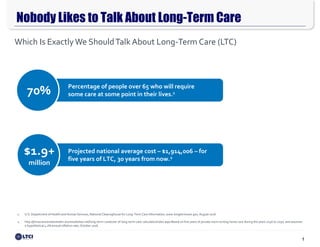
Projected national average cost – $1,914,006 – for
five years of LTC, 30 years from now.2
Percentage of people over 65 who will require
some care at some point in their lives.170%
$1.9+
million
2
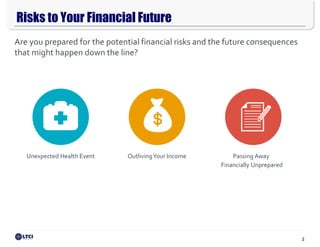
Risks to Your Financial Future
$165,000
$91,000
$15,600
Unexpected Health Event OutlivingYour Income Passing Away
Financially Unprepared
Are you prepared for the potential financial risks and the future consequences
that might happen down the line?
3
What Is Long-Term Care (LTC)?
$165,000
$91,000
$15,600
Personal care or supervision needed by persons of all ages for an extended
period of time. LTC is associated with the effects of aging, but may be needed at
any time, due to an accident or illness.
Some conditions that may require LTC:
• Head Injury
• Stroke
• Cancer
• Parkinson’s Disease
• Heart Disease
• Multiple Sclerosis
• Alzheimer’s Disease / Dementia
4
Who Will Need LTC?
* Long-Term Services and Supports for Older Americans: Risks and Financing Research Brief, Judith Dey, February 2016.
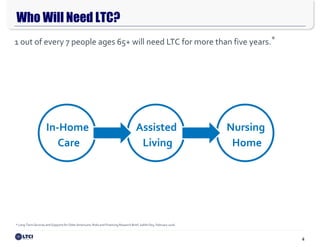
1 out of every 7 people ages 65+ will need LTC for more than five years.*
In-Home
Care
Assisted
Living
Nursing
Home
5
The Case for LTC Planning
1. U.S. Department of Health and Human Services, National Clearinghouse for Long-Term Care Information, www.longtermcare.gov, August 2016.
2. The 2015/2016 Sourcebookfor Long-Term Care information, American Association for Long-Term Care Insurance.
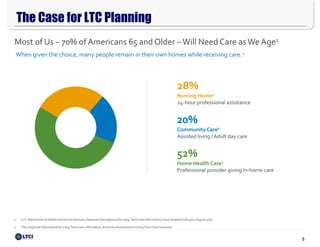
52%
Home HealthCare2
Professional provider giving in-home care
28%
Nursing Home2
24-hour professional assistance
20%
CommunityCare2
Assisted living / Adult day care
Most of Us – 70% of Americans 65 and Older –Will Need Care asWe Age1
When given the choice, many people remain in their own homes while receiving care.2
6
The Case for LTC in the U.S.
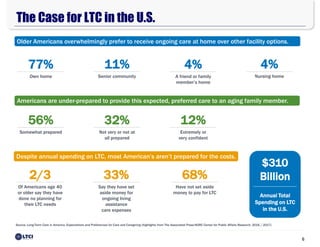
77%
Own home
11%
Senior community
4%
A friend or family
member’s home
4%
Nursing home
56%
Somewhat prepared
32%
Not very or not at
all prepared
12%
Extremely or
very confident
Older Americans overwhelmingly prefer to receive ongoing care at home over other facility options.
Americans are under-prepared to provide this expected, preferred care to an aging family member.
Despite annual spending on LTC, most American’s aren’t prepared for the costs.
2/3
Of Americans age 40
or older say they have
done no planning for
their LTC needs
33%
Say they have set
aside money for
ongoing living
assistance
care expenses
68%
Have not set aside
money to pay for LTC
Annual Total
Spending on LTC
in the U.S.
$310
Billion
Source: Long-Term Care in America: Expectations and Preferences for Care and Caregiving (highlights from The Associated Press-NORC Center for Public Affairs Research, 2016 / 2017)
7
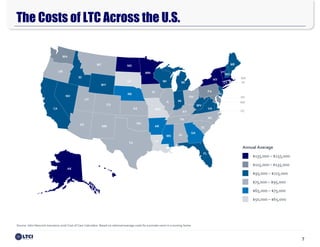
The Costs of LTC Across the U.S.
$91,000
$15,600
Source: John Hancock Insurance 2016 Cost of Care Calculator. Based on national average costs for a private room in a nursing home
FL
NM
MD
TX
OK
KS
NE
SD
NDMT
WY
CO
UT
ID
AZ
NV
WA
CA
OR
KY
NY
PA
MI
NH
MA
CT
VA
WV
OH
INIL
NCTN
SC
AL
AR
LA
MO
IA
MN
WI
GA
MS
VT
NJ
ME
RI
AK
HI
DC
Annual Average
$135,000 – $255,000
$115,000 – $135,000
$95,000 – $115,000
$75,000 – $95,000
$65,000 – $75,000
$50,000 – $65,000
DE
8
Future LTC Costs
$165,000
$15,600
* Assumed rate of inflation is hypothetical, based on a 4.1% average annual increase in the Consumer Price Index for All-Urban Consumers (CPI-U) for the 50-year period ending 12/31/15. CPI-related data obtained
from the Bureau of Labor Statistics of the U.S Department of Labor at www.bls.gov, October 2016
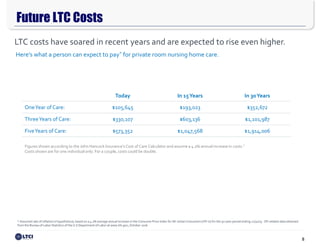
LTC costs have soared in recent years and are expected to rise even higher.
Here’s what a person can expect to pay* for private room nursing home care.
Figures shown according to the John Hancock Insurance’s Cost of Care Calculator and assume a 4.1% annual increase in costs.*
Costs shown are for one individual only. For a couple, costs could be double.
Today In 15Years In 30Years
OneYear of Care: $105,645 $193,023 $352,672
ThreeYears of Care: $330,107 $603,136 $1,101,987
FiveYears of Care: $573,352 $1,047,568 $1,914,006
9
Paying for LTC
$165,000
$15,600
Source: LongTermCare.gov (Medicare and Medicaid) 2017
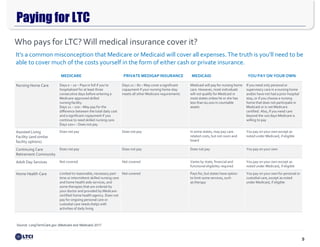
Who pays for LTC?Will medical insurance cover it?
It’s a common misconception that Medicare or Medicaid will cover all expenses.The truth is you’ll need to be
able to cover much of the costs yourself in the form of either cash or private insurance.
MEDICARE PRIVATE MEDIGAP INSURANCE MEDICAID YOU PAY ON YOUR OWN
Nursing Home Care Days 0 – 20 – Pays in full if you’re
hospitalized for at least three
consecutive days before entering a
Medicare-approved skilled
nursing facility.
Days 21 – 100 – May pay for the
difference between the total daily cost
and a significant copayment if you
continue to need skilled nursing care.
Days 100+ – Does not pay
Days 21 – 80 – May cover a significant
copayment if your nursing home stay
meets all other Medicare requirements
Medicaid will pay for nursing home
care. However, most individuals
will not qualify for Medicaid in
most states unless he or she has
less than $2,000 in countable
assets
If you need only personal or
supervisory care in a nursing home
and/or have not had a prior hospital
stay, or if you choose a nursing
home that does not participate in
Medicaid or is not Medicare
certified. Also, if you need care
beyond the 100 days Medicare is
willing to pay
Assisted Living
Facility (and similar
facility options)
Does not pay Does not pay In some states, may pay care-
related costs, but not room and
board
You pay on your own except as
noted under Medicaid, if eligible
Continuing Care
Retirement Community
Does not pay Does not pay Does not pay You pay on your own
Adult Day Services Not covered Not covered Varies by state, financial and
functional eligibility required
You pay on your own except as
noted under Medicaid, if eligible
Home Health Care Limited to reasonable, necessary part-
time or intermittent skilled nursing care
and home health aide services, and
some therapies that are ordered by
your doctor and provided by Medicare-
certified home health agency. Does not
pay for ongoing personal care or
custodial care needs (help) with
activities of daily living
Not covered Pays for, but states have option
to limit some services, such
as therapy
You pay on your own for personal or
custodial care, except as noted
under Medicaid, if eligible
10
Important LTC Questions to consider
$165,000
$15,600
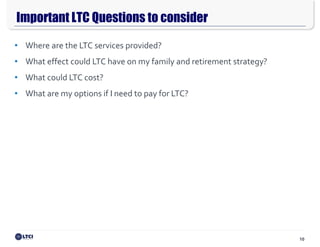
• Where are the LTC services provided?
• What effect could LTC have on my family and retirement strategy?
• What could LTC cost?
• What are my options if I need to pay for LTC?
11
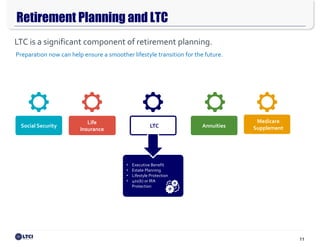
Retirement Planning and LTC
• Executive Benefit
• Estate Planning
• Lifestyle Protection
• 401(k) or IRA
Protection
LTCSocial Security
Life
Insurance
Annuities
Medicare
Supplement
Preparation now can help ensure a smoother lifestyle transition for the future.
LTC is a significant component of retirement planning.
12
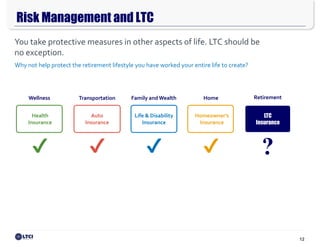
Risk Management and LTC
You take protective measures in other aspects of life. LTC should be
no exception.
Why not help protect the retirement lifestyle you have worked your entire life to create?
Health
Insurance
Auto
Insurance
Life & Disability
Insurance
Homeowner’s
Insurance
LTC
Insurance
?
Wellness Family and WealthTransportation Home Retirement
13
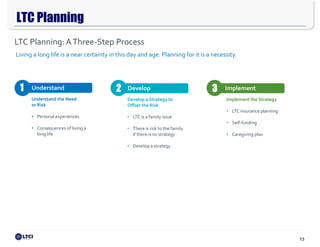
LTC Planning
Living a long life is a near certainty in this day and age. Planning for it is a necessity.
LTC Planning: AThree-Step Process
Ownership Structure
Understand
Understand the Need
or Risk
• Personal experiences
• Consequences of living a
long life
1 Develop
Develop a Strategy to
Offset the Risk
• LTC is a family issue
• There is risk to the family
if there is no strategy
• Develop a strategy
2 Implement
Implement the Strategy
• LTC insurance planning
• Self-funding
• Caregiving plan
3
14
How LTC Insurance Works
LTC provides a “pool of benefit dollars” for LTC to be used when and where it
may be needed.
Assisted
Living Care
Nursing
Facility Care
Care
Coordination
Services
Home
Care
15
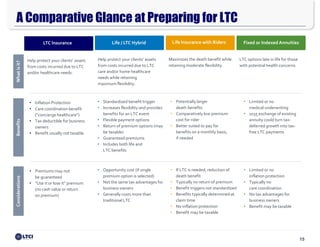
A Comparative Glance at Preparing for LTC
Help protect your clients’ assets
from costs incurred due to LTC
and/or healthcare needs.
LTC Insurance
Help protect your clients’ assets
from costs incurred due to LTC
care and/or home healthcare
needs while retaining
maximum flexibility.
Life / LTC Hybrid
Maximizes the death benefit while
retaining moderate flexibility.
Life Insurance with Riders
LTC options late in life for those
with potential health concerns.
Fixed or Indexed Annuities
Whatisit?BenefitsConsiderations
• Inflation Protection
• Care coordination benefit
(“concierge healthcare”)
• Tax deductible for business
owners
• Benefit usually not taxable
• Standardized benefit trigger
• Increases flexibility and provides
benefits for an LTC event
• Flexible payment options
• Return of premium options (may
be taxable)
• Guaranteed premiums
• Includes both life and
LTC benefits
• Potentially larger
death benefits
• Comparatively low premium
cost for rider
• Better suited to pay for
benefits on a monthly basis,
if needed
• Limited or no
medical underwriting
• 1035 exchange of existing
annuity could turn tax-
deferred growth into tax-
free LTC payments
• Premiums may not
be guaranteed
• “Use it or lose it” premium
(no cash value or return
on premium)
• Opportunity cost (if single
premium option is selected)
• Not the same tax advantages for
business owners
• Generally costs more than
traditional LTC
• If LTC is needed, reduction of
death benefit
• Typically no return of premium
• Benefit triggers not standardized
• Benefits typically determined at
claim time
• No inflation protection
• Benefit may be taxable
• Limited or no
inflation protection
• Typically no
care coordination
• No tax advantages for
business owners
• Benefit may be taxable
16
Next Steps
Insert disclosure text here.
Steven M. Cain, CLTC®, Director
D: 608.807.2540
C: 818.645.9894
steve.cain@nfp.com
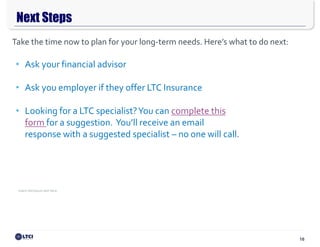
• Ask your financial advisor
• Ask you employer if they offer LTC Insurance
• Looking for a LTC specialist?You can complete this
form for a suggestion. You’ll receive an email
response with a suggested specialist – no one will call.
Take the time now to plan for your long-term needs. Here’s what to do next:
Copyright © 2018 LTCI Partners, LLC. All rights reserved.

Planning for Long-Term Care - A consumer's guide

  • 1.
  • 2.
    1 Nobody Likes toTalk About Long-Term Care 1. U.S. Department of Health and Human Services, National Clearinghouse for Long-Term Care Information, www.longtermcare.gov, August 2016. 2. http://jhinsurancewebsitedev.azurewebsites.net/long-term-care/cost-of-long-term-care-calculator/index.aspx Based on five years of private room nursing home care during the years 2046 to 2050, and assumes a hypothetical 4.1% annual inflation rate, October 2016. Which Is ExactlyWe ShouldTalk About Long-Term Care (LTC) Projected national average cost – $1,914,006 – for five years of LTC, 30 years from now.2 Percentage of people over 65 who will require some care at some point in their lives.170% $1.9+ million
  • 3.
    2 Risks to YourFinancial Future $165,000 $91,000 $15,600 Unexpected Health Event OutlivingYour Income Passing Away Financially Unprepared Are you prepared for the potential financial risks and the future consequences that might happen down the line?
  • 4.
    3 What Is Long-TermCare (LTC)? $165,000 $91,000 $15,600 Personal care or supervision needed by persons of all ages for an extended period of time. LTC is associated with the effects of aging, but may be needed at any time, due to an accident or illness. Some conditions that may require LTC: • Head Injury • Stroke • Cancer • Parkinson’s Disease • Heart Disease • Multiple Sclerosis • Alzheimer’s Disease / Dementia
  • 5.
    4 Who Will NeedLTC? * Long-Term Services and Supports for Older Americans: Risks and Financing Research Brief, Judith Dey, February 2016. 1 out of every 7 people ages 65+ will need LTC for more than five years.* In-Home Care Assisted Living Nursing Home
  • 6.
    5 The Case forLTC Planning 1. U.S. Department of Health and Human Services, National Clearinghouse for Long-Term Care Information, www.longtermcare.gov, August 2016. 2. The 2015/2016 Sourcebookfor Long-Term Care information, American Association for Long-Term Care Insurance. 52% Home HealthCare2 Professional provider giving in-home care 28% Nursing Home2 24-hour professional assistance 20% CommunityCare2 Assisted living / Adult day care Most of Us – 70% of Americans 65 and Older –Will Need Care asWe Age1 When given the choice, many people remain in their own homes while receiving care.2
  • 7.
    6 The Case forLTC in the U.S. 77% Own home 11% Senior community 4% A friend or family member’s home 4% Nursing home 56% Somewhat prepared 32% Not very or not at all prepared 12% Extremely or very confident Older Americans overwhelmingly prefer to receive ongoing care at home over other facility options. Americans are under-prepared to provide this expected, preferred care to an aging family member. Despite annual spending on LTC, most American’s aren’t prepared for the costs. 2/3 Of Americans age 40 or older say they have done no planning for their LTC needs 33% Say they have set aside money for ongoing living assistance care expenses 68% Have not set aside money to pay for LTC Annual Total Spending on LTC in the U.S. $310 Billion Source: Long-Term Care in America: Expectations and Preferences for Care and Caregiving (highlights from The Associated Press-NORC Center for Public Affairs Research, 2016 / 2017)
  • 8.
    7 The Costs ofLTC Across the U.S. $91,000 $15,600 Source: John Hancock Insurance 2016 Cost of Care Calculator. Based on national average costs for a private room in a nursing home FL NM MD TX OK KS NE SD NDMT WY CO UT ID AZ NV WA CA OR KY NY PA MI NH MA CT VA WV OH INIL NCTN SC AL AR LA MO IA MN WI GA MS VT NJ ME RI AK HI DC Annual Average $135,000 – $255,000 $115,000 – $135,000 $95,000 – $115,000 $75,000 – $95,000 $65,000 – $75,000 $50,000 – $65,000 DE
  • 9.
    8 Future LTC Costs $165,000 $15,600 *Assumed rate of inflation is hypothetical, based on a 4.1% average annual increase in the Consumer Price Index for All-Urban Consumers (CPI-U) for the 50-year period ending 12/31/15. CPI-related data obtained from the Bureau of Labor Statistics of the U.S Department of Labor at www.bls.gov, October 2016 LTC costs have soared in recent years and are expected to rise even higher. Here’s what a person can expect to pay* for private room nursing home care. Figures shown according to the John Hancock Insurance’s Cost of Care Calculator and assume a 4.1% annual increase in costs.* Costs shown are for one individual only. For a couple, costs could be double. Today In 15Years In 30Years OneYear of Care: $105,645 $193,023 $352,672 ThreeYears of Care: $330,107 $603,136 $1,101,987 FiveYears of Care: $573,352 $1,047,568 $1,914,006
  • 10.
    9 Paying for LTC $165,000 $15,600 Source:LongTermCare.gov (Medicare and Medicaid) 2017 Who pays for LTC?Will medical insurance cover it? It’s a common misconception that Medicare or Medicaid will cover all expenses.The truth is you’ll need to be able to cover much of the costs yourself in the form of either cash or private insurance. MEDICARE PRIVATE MEDIGAP INSURANCE MEDICAID YOU PAY ON YOUR OWN Nursing Home Care Days 0 – 20 – Pays in full if you’re hospitalized for at least three consecutive days before entering a Medicare-approved skilled nursing facility. Days 21 – 100 – May pay for the difference between the total daily cost and a significant copayment if you continue to need skilled nursing care. Days 100+ – Does not pay Days 21 – 80 – May cover a significant copayment if your nursing home stay meets all other Medicare requirements Medicaid will pay for nursing home care. However, most individuals will not qualify for Medicaid in most states unless he or she has less than $2,000 in countable assets If you need only personal or supervisory care in a nursing home and/or have not had a prior hospital stay, or if you choose a nursing home that does not participate in Medicaid or is not Medicare certified. Also, if you need care beyond the 100 days Medicare is willing to pay Assisted Living Facility (and similar facility options) Does not pay Does not pay In some states, may pay care- related costs, but not room and board You pay on your own except as noted under Medicaid, if eligible Continuing Care Retirement Community Does not pay Does not pay Does not pay You pay on your own Adult Day Services Not covered Not covered Varies by state, financial and functional eligibility required You pay on your own except as noted under Medicaid, if eligible Home Health Care Limited to reasonable, necessary part- time or intermittent skilled nursing care and home health aide services, and some therapies that are ordered by your doctor and provided by Medicare- certified home health agency. Does not pay for ongoing personal care or custodial care needs (help) with activities of daily living Not covered Pays for, but states have option to limit some services, such as therapy You pay on your own for personal or custodial care, except as noted under Medicaid, if eligible
  • 11.
    10 Important LTC Questionsto consider $165,000 $15,600 • Where are the LTC services provided? • What effect could LTC have on my family and retirement strategy? • What could LTC cost? • What are my options if I need to pay for LTC?
  • 12.
    11 Retirement Planning andLTC • Executive Benefit • Estate Planning • Lifestyle Protection • 401(k) or IRA Protection LTCSocial Security Life Insurance Annuities Medicare Supplement Preparation now can help ensure a smoother lifestyle transition for the future. LTC is a significant component of retirement planning.
  • 13.
    12 Risk Management andLTC You take protective measures in other aspects of life. LTC should be no exception. Why not help protect the retirement lifestyle you have worked your entire life to create? Health Insurance Auto Insurance Life & Disability Insurance Homeowner’s Insurance LTC Insurance ? Wellness Family and WealthTransportation Home Retirement
  • 14.
    13 LTC Planning Living along life is a near certainty in this day and age. Planning for it is a necessity. LTC Planning: AThree-Step Process Ownership Structure Understand Understand the Need or Risk • Personal experiences • Consequences of living a long life 1 Develop Develop a Strategy to Offset the Risk • LTC is a family issue • There is risk to the family if there is no strategy • Develop a strategy 2 Implement Implement the Strategy • LTC insurance planning • Self-funding • Caregiving plan 3
  • 15.
    14 How LTC InsuranceWorks LTC provides a “pool of benefit dollars” for LTC to be used when and where it may be needed. Assisted Living Care Nursing Facility Care Care Coordination Services Home Care
  • 16.
    15 A Comparative Glanceat Preparing for LTC Help protect your clients’ assets from costs incurred due to LTC and/or healthcare needs. LTC Insurance Help protect your clients’ assets from costs incurred due to LTC care and/or home healthcare needs while retaining maximum flexibility. Life / LTC Hybrid Maximizes the death benefit while retaining moderate flexibility. Life Insurance with Riders LTC options late in life for those with potential health concerns. Fixed or Indexed Annuities Whatisit?BenefitsConsiderations • Inflation Protection • Care coordination benefit (“concierge healthcare”) • Tax deductible for business owners • Benefit usually not taxable • Standardized benefit trigger • Increases flexibility and provides benefits for an LTC event • Flexible payment options • Return of premium options (may be taxable) • Guaranteed premiums • Includes both life and LTC benefits • Potentially larger death benefits • Comparatively low premium cost for rider • Better suited to pay for benefits on a monthly basis, if needed • Limited or no medical underwriting • 1035 exchange of existing annuity could turn tax- deferred growth into tax- free LTC payments • Premiums may not be guaranteed • “Use it or lose it” premium (no cash value or return on premium) • Opportunity cost (if single premium option is selected) • Not the same tax advantages for business owners • Generally costs more than traditional LTC • If LTC is needed, reduction of death benefit • Typically no return of premium • Benefit triggers not standardized • Benefits typically determined at claim time • No inflation protection • Benefit may be taxable • Limited or no inflation protection • Typically no care coordination • No tax advantages for business owners • Benefit may be taxable
  • 17.
    16 Next Steps Insert disclosuretext here. Steven M. Cain, CLTC®, Director D: 608.807.2540 C: 818.645.9894 steve.cain@nfp.com • Ask your financial advisor • Ask you employer if they offer LTC Insurance • Looking for a LTC specialist?You can complete this form for a suggestion. You’ll receive an email response with a suggested specialist – no one will call. Take the time now to plan for your long-term needs. Here’s what to do next:
  • 18.
    Copyright © 2018LTCI Partners, LLC. All rights reserved.