lONG QUESTION ANSWER PAKISTAN STUDIES10.by
MS.SAJIDALODHI
Key Aspects of the Constitution of 1973
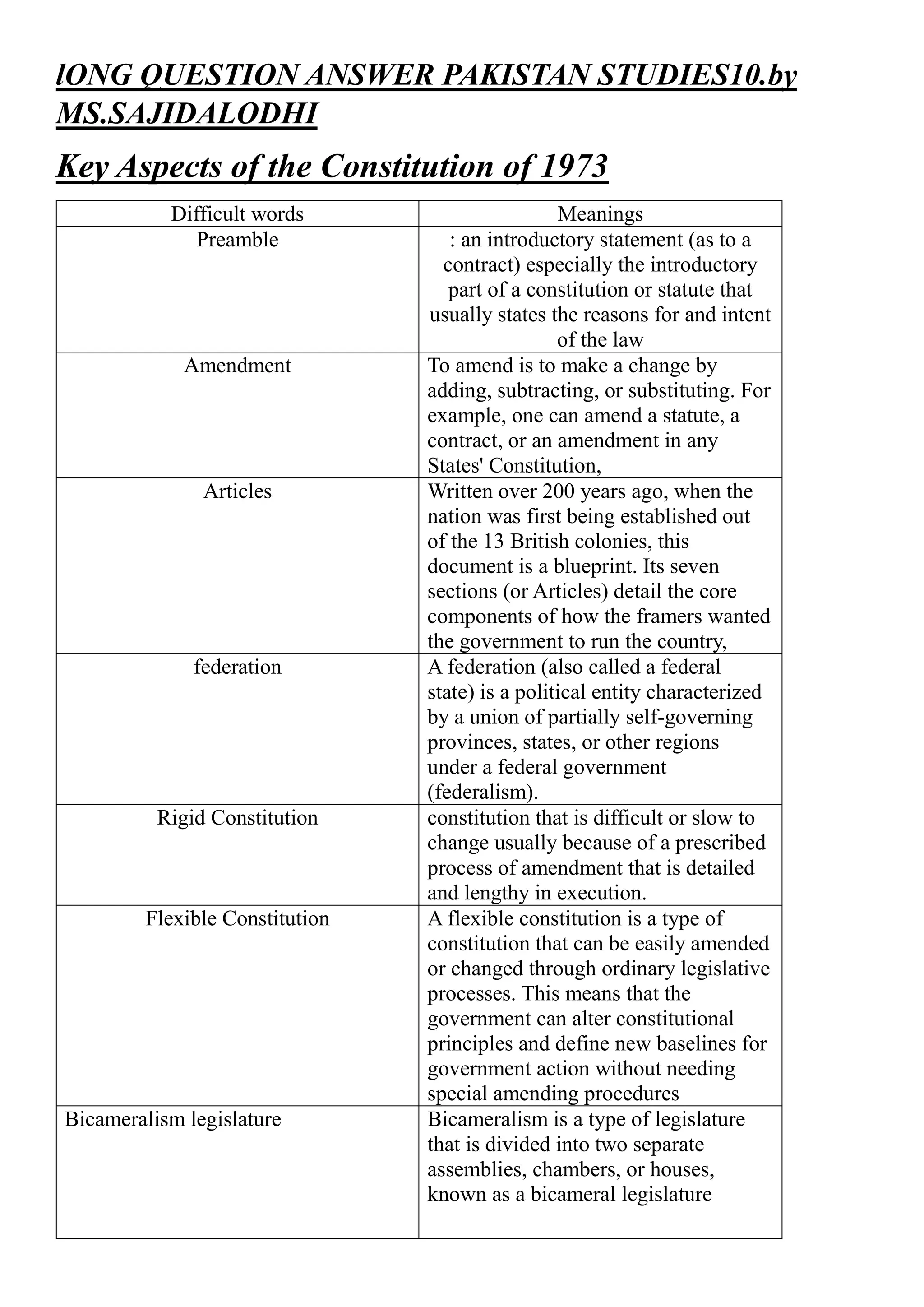
Difficult words Meanings
Preamble : an introductory statement (as to a
contract) especially the introductory
part of a constitution or statute that
usually states the reasons for and intent
of the law
Amendment To amend is to make a change by
adding, subtracting, or substituting. For
example, one can amend a statute, a
contract, or an amendment in any
States' Constitution,
Articles Written over 200 years ago, when the
nation was first being established out
of the 13 British colonies, this
document is a blueprint. Its seven
sections (or Articles) detail the core
components of how the framers wanted
the government to run the country,
federation A federation (also called a federal
state) is a political entity characterized
by a union of partially self-governing
provinces, states, or other regions
under a federal government
(federalism).
Rigid Constitution constitution that is difficult or slow to
change usually because of a prescribed
process of amendment that is detailed
and lengthy in execution.
Flexible Constitution A flexible constitution is a type of
constitution that can be easily amended
or changed through ordinary legislative
processes. This means that the
government can alter constitutional
principles and define new baselines for
government action without needing
special amending procedures
Bicameralism legislature Bicameralism is a type of legislature
that is divided into two separate
assemblies, chambers, or houses,
known as a bicameral legislature
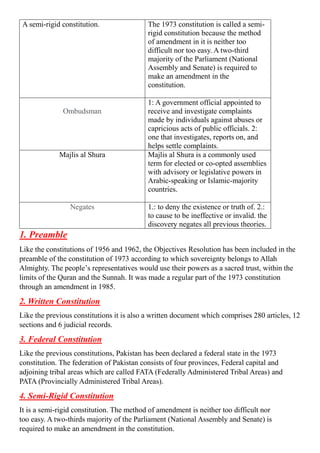
A semi-rigid constitution. The 1973 constitution is called a semi-
rigid constitution because the method
of amendment in it is neither too
difficult nor too easy. A two-third
majority of the Parliament (National
Assembly and Senate) is required to
make an amendment in the
constitution.
Ombudsman
1: A government official appointed to
receive and investigate complaints
made by individuals against abuses or
capricious acts of public officials. 2:
one that investigates, reports on, and
helps settle complaints.
Majlis al Shura Majlis al Shura is a commonly used
term for elected or co-opted assemblies
with advisory or legislative powers in
Arabic-speaking or Islamic-majority
countries.
Negates 1.: to deny the existence or truth of. 2.:
to cause to be ineffective or invalid. the
discovery negates all previous theories.
1. Preamble
Like the constitutions of 1956 and 1962, the Objectives Resolution has been included in the
preamble of the constitution of 1973 according to which sovereignty belongs to Allah
Almighty. The people’s representatives would use their powers as a sacred trust, within the
limits of the Quran and the Sunnah. It was made a regular part of the 1973 constitution
through an amendment in 1985.
2. Written Constitution
Like the previous constitutions it is also a written document which comprises 280 articles, 12
sections and 6 judicial records.
3. Federal Constitution
Like the previous constitutions, Pakistan has been declared a federal state in the 1973
constitution. The federation of Pakistan consists of four provinces, Federal capital and
adjoining tribal areas which are called FATA (Federally Administered Tribal Areas) and
PATA (Provincially Administered Tribal Areas).
4. Semi-Rigid Constitution
It is a semi-rigid constitution. The method of amendment is neither too difficult nor
too easy. A two-thirds majority of the Parliament (National Assembly and Senate) is
required to make an amendment in the constitution.
5. National Language
Urdu has been declared the national language. In a period of 15 years arrangements will
be made to implement the status of Urdu as the official language. During this period
English will be used as the official language. This has not been possible so far.
6. Islamic Constitution
Islam has been declared as the state religion in the constitution of Pakistan. It has been
declared essential for the President and the Prime Minister to be Muslims. The official
name of the state is the ‘Islamic Republic of Pakistan’. It encourages the practice of the
Islamic mode of life among the citizens. Steps will be taken to abolish interest. Zakat,
Auqaf and Ushr will be enforced.
7. Independent Judiciary
A guarantee has been provided for an independent judiciary. The judges are paid
handsome salaries and have job security. The judiciary has been separated from the
Executive. The judges will perform their duties without any fear or pressure.
8. Parliamentary Constitution
According to the Constitution of 1973, the National Assembly will have a tenure of
five years. The parliamentary form of government was implemented in the country.
The head of the country is the President, and the Prime Minister is the head of the
government. The President is elected by the Parliament and the Provincial Assemblies,
whereas the Prime Minister is elected by a majority in the National Assembly.
9. Supremacy of Constitution
If any person abrogates the constitution or tries to abrogate it, he will be charged with
high treason and prosecuted accordingly.
10. Constitutional Institutions
The constitution of 1973 has set up several institutions like the Council for Common
Interest, National Economic Council, National Finance Commission, Election
Commission of Pakistan and Federal Ombudsman, etc. These institutions work within
their limits and prefer national interest.
11. Bicameral Legislature
The parliament will consist of two houses according to 1973 constitution. The Upper
House is called the Senate and the Lower House is the National Assembly. The provinces
have been given equal representation in Senate and it is a permanent House. Its tenure
is of six years. It consists of 104 members. The National Assembly comprises of 342
members. The total number of the members of the Parliament (Majlis-e-Shoora) is 446.
12. Fundamental Rights
The citizens have all the fundamental rights. The Parliament and Provincial Assemblies
cannot make any law that negates any fundamental right.

lONG QUESTION ANSWER PAKISTAN STUDIES10.docxon friday.docx

  • 1.
    lONG QUESTION ANSWERPAKISTAN STUDIES10.by MS.SAJIDALODHI Key Aspects of the Constitution of 1973 Difficult words Meanings Preamble : an introductory statement (as to a contract) especially the introductory part of a constitution or statute that usually states the reasons for and intent of the law Amendment To amend is to make a change by adding, subtracting, or substituting. For example, one can amend a statute, a contract, or an amendment in any States' Constitution, Articles Written over 200 years ago, when the nation was first being established out of the 13 British colonies, this document is a blueprint. Its seven sections (or Articles) detail the core components of how the framers wanted the government to run the country, federation A federation (also called a federal state) is a political entity characterized by a union of partially self-governing provinces, states, or other regions under a federal government (federalism). Rigid Constitution constitution that is difficult or slow to change usually because of a prescribed process of amendment that is detailed and lengthy in execution. Flexible Constitution A flexible constitution is a type of constitution that can be easily amended or changed through ordinary legislative processes. This means that the government can alter constitutional principles and define new baselines for government action without needing special amending procedures Bicameralism legislature Bicameralism is a type of legislature that is divided into two separate assemblies, chambers, or houses, known as a bicameral legislature
  • 2.
    A semi-rigid constitution.The 1973 constitution is called a semi- rigid constitution because the method of amendment in it is neither too difficult nor too easy. A two-third majority of the Parliament (National Assembly and Senate) is required to make an amendment in the constitution. Ombudsman 1: A government official appointed to receive and investigate complaints made by individuals against abuses or capricious acts of public officials. 2: one that investigates, reports on, and helps settle complaints. Majlis al Shura Majlis al Shura is a commonly used term for elected or co-opted assemblies with advisory or legislative powers in Arabic-speaking or Islamic-majority countries. Negates 1.: to deny the existence or truth of. 2.: to cause to be ineffective or invalid. the discovery negates all previous theories. 1. Preamble Like the constitutions of 1956 and 1962, the Objectives Resolution has been included in the preamble of the constitution of 1973 according to which sovereignty belongs to Allah Almighty. The people’s representatives would use their powers as a sacred trust, within the limits of the Quran and the Sunnah. It was made a regular part of the 1973 constitution through an amendment in 1985. 2. Written Constitution Like the previous constitutions it is also a written document which comprises 280 articles, 12 sections and 6 judicial records. 3. Federal Constitution Like the previous constitutions, Pakistan has been declared a federal state in the 1973 constitution. The federation of Pakistan consists of four provinces, Federal capital and adjoining tribal areas which are called FATA (Federally Administered Tribal Areas) and PATA (Provincially Administered Tribal Areas). 4. Semi-Rigid Constitution It is a semi-rigid constitution. The method of amendment is neither too difficult nor too easy. A two-thirds majority of the Parliament (National Assembly and Senate) is required to make an amendment in the constitution.
  • 3.
    5. National Language Urduhas been declared the national language. In a period of 15 years arrangements will be made to implement the status of Urdu as the official language. During this period English will be used as the official language. This has not been possible so far. 6. Islamic Constitution Islam has been declared as the state religion in the constitution of Pakistan. It has been declared essential for the President and the Prime Minister to be Muslims. The official name of the state is the ‘Islamic Republic of Pakistan’. It encourages the practice of the Islamic mode of life among the citizens. Steps will be taken to abolish interest. Zakat, Auqaf and Ushr will be enforced. 7. Independent Judiciary A guarantee has been provided for an independent judiciary. The judges are paid handsome salaries and have job security. The judiciary has been separated from the Executive. The judges will perform their duties without any fear or pressure. 8. Parliamentary Constitution According to the Constitution of 1973, the National Assembly will have a tenure of five years. The parliamentary form of government was implemented in the country. The head of the country is the President, and the Prime Minister is the head of the government. The President is elected by the Parliament and the Provincial Assemblies, whereas the Prime Minister is elected by a majority in the National Assembly. 9. Supremacy of Constitution If any person abrogates the constitution or tries to abrogate it, he will be charged with high treason and prosecuted accordingly. 10. Constitutional Institutions The constitution of 1973 has set up several institutions like the Council for Common Interest, National Economic Council, National Finance Commission, Election Commission of Pakistan and Federal Ombudsman, etc. These institutions work within their limits and prefer national interest. 11. Bicameral Legislature The parliament will consist of two houses according to 1973 constitution. The Upper House is called the Senate and the Lower House is the National Assembly. The provinces have been given equal representation in Senate and it is a permanent House. Its tenure is of six years. It consists of 104 members. The National Assembly comprises of 342 members. The total number of the members of the Parliament (Majlis-e-Shoora) is 446. 12. Fundamental Rights The citizens have all the fundamental rights. The Parliament and Provincial Assemblies cannot make any law that negates any fundamental right.