CONSTITUTION.
 The word Constitution comes through a French language from
a Latin word constitutio, used for regulations and orders.
 The Fundamental Laws and Principles.
 Body of rules.
 Constitution is the Necessity of a State.
Mostly every democratic country has a
constitution which is a vital document,
according to which the country carries
out its operations.
The primary function of a constitution is
to lay out the basic structure of the
government according to which the
people are to be governed.
The constitution of a country not only
defines the powers allotted to each of the
three main organs, but it also
significantly makes a clear demarcation
of the responsibilities assigned to each of
them. It effectively regulates the
relationship between these organs as
well as the relationship between the
government and its people.
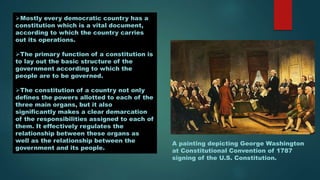
A painting depicting George Washington
at Constitutional Convention of 1787
signing of the U.S. Constitution.
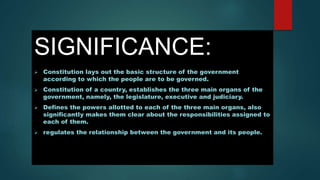
SIGNIFICANCE:
 Constitution lays out the basic structure of the government
according to which the people are to be governed.
 Constitution of a country, establishes the three main organs of the
government, namely, the legislature, executive and judiciary.
 Defines the powers allotted to each of the three main organs, also
significantly makes them clear about the responsibilities assigned to
each of them.
 regulates the relationship between the government and its people.
CONSTITUTION OF PAKISTAN
ORIGIN AND BACKGROUND
 Pakistan was founded in 1947. Before writing a
constitution, a Constitution Assembly passed
an Objectives Resolution in March 1949 to define
the basic directive principles of the new state.
 A constitution was approved in 1956 but abrogated
in 1958.
 On 7 October 1958, President Iskander Mirza
overthrowed it.
 Imposed Martial Law and appointed General
Muhammad Ayub Khan as the Chief Martial Law
Administrator.
 And Aziz Ahmad as Secretary General and Deputy
Chief Martial Law Administrator.
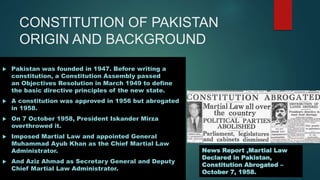
News Report ,Martial Law
Declared in Pakistan,
Constitution Abrogated –
October 7, 1958.
CONSTITUTION OF 1962
 Pakistan's second constitution was approved in 1962.
 It granted executive power to the president and abolished the office of the
prime minister
 It also institutionalized to use the help of military in politics by providing
that for twenty years, the president or the defense minister must be a
person who had held a rank not lower than that of lieutenant-general in the
army.
 The 1962 constitution was suspended in 1969 and abrogated in 1972.
CONSTITUTIONAL
CRISIS: First 8 years after independence without a constitution.
 First Constitutional assembly was dissolved in 1954.
 Second Constitutional assembly was dissolved by President Sikandar
Mirza and Martial Law was imposed.
CONSTITUTION OF
PAKISTAN (1973)
 Bhutto’s Government’s first achievement was to prepare a
constitution.
 Approved by Parliament: 10 April 1973.
 Created: 19 April 1973.
 Ratified: 14 August 1973.
 Author: 12th Parliament.
PURPOSE
 To replace the ARTICLES of 1962 confederation and LFO order, 1970.
 With regard to provincial rights the 1973 constitution was in fact the
most centralized of constitutions. The Government of India Act of
1935, which Pakistan adopted as its first working constitution,
granted the federal government 96 items of power. The 1956
constitution reduced that number to 49, and this was retained in the
1962 constitution. In 1973, however, it was then enlarged to 114.
Salient Features:
 Written constitution
 Consisted of 12 parts and 280 articles
 Islamic System
 Rigid Constitution
 Parliamentary form of Government
 Direct Method of Election
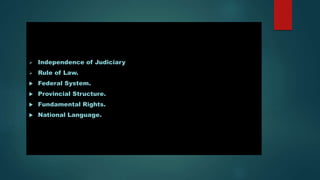
 Independence of Judiciary
 Rule of Law.
 Federal System.
 Provincial Structure.
 Fundamental Rights.
 National Language.
ISLAMIC FEATURES
OF 1973
CONSTITUTION.
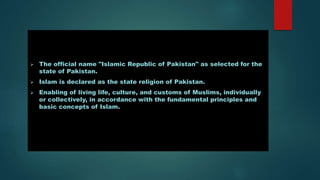
 The official name "Islamic Republic of Pakistan" as selected for the
state of Pakistan.
 Islam is declared as the state religion of Pakistan.
 Enabling of living life, culture, and customs of Muslims, individually
or collectively, in accordance with the fundamental principles and
basic concepts of Islam.
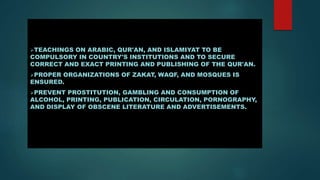
TEACHINGS ON ARABIC, QUR'AN, AND ISLAMIYAT TO BE
COMPULSORY IN COUNTRY'S INSTITUTIONS AND TO SECURE
CORRECT AND EXACT PRINTING AND PUBLISHING OF THE QUR'AN.
PROPER ORGANIZATIONS OF ZAKAT, WAQF, AND MOSQUES IS
ENSURED.
PREVENT PROSTITUTION, GAMBLING AND CONSUMPTION OF
ALCOHOL, PRINTING, PUBLICATION, CIRCULATION, PORNOGRAPHY,
AND DISPLAY OF OBSCENE LITERATURE AND ADVERTISEMENTS.
 Required to be a Muslim in order to run for bid of becoming the
President (male or female) and/or Prime Minister (male or female). No
restriction as to religion or gender on any other post, up to and
including provincial governor and Chief Minister.
 All existing laws shall be brought in conformity with the injunctions of
Islam as laid down in the Qur'an and Sunnah and no law shall be
enacted which is repugnant to such injunctions.
 A Council of Islamic Ideology shall be constituted referred to as the
Islamic advisory council.
 For the first time, the Constitution of Pakistan gave definition of a
Muslim which states: 'Muslim' means a person who believes in the
unity and oneness of Allah, in the absolute and unqualified finality of
the Prophethood of the Islamic prophet, Muhammad, and does not
believe in, or recognise as a prophet or religious reformer, any person
who claimed or claims to be a prophet, in any sense of the word or of
any description whatsoever, after Muhammad.
 The state shall try hard to strengthen the bonds of unity among
Muslim countries.
 The Second Amendment to the Constitution declared for the first time
the Ahmadiyya Community and/or the Lahori Group as non-Muslims,
and their leader, Mirza Ghulam Ahmad, who claimed to be prophet of
God, to which mainstream Muslims do not agree with.
 Islamic revisions and introduction in Pakistan Penal Code.
CONCLUSION
 The constitutional history of Pakistan is a reflection of
contradictions of its social, economical and political development
since independence for more than a quarter of the century. The
struggle over particular formulations of the constitution which
went on in the legislative bodies was often an expression of clash
between the vital interests of the main social groups in Pakistan.
 The struggle over many constitutional issues (the state language,
form of election, division of powers, etc.) went on for years,
leading to bloody clashes in which thousands of people were
victims and resulted in political crises.
 Unfortunately, today Law and Order does not exist.
 We don’t seem to find it being implemented in our country.
 We are facing Corruption and terrorism.
 drugs and narcotics is also a major outbreak these days.
 The Rich people can break any Law they want. Only poor
citizen has to go through the all trials and punishments.

Constitution completed exluded video

  • 1.
  • 2.
     The wordConstitution comes through a French language from a Latin word constitutio, used for regulations and orders.  The Fundamental Laws and Principles.  Body of rules.  Constitution is the Necessity of a State.
  • 3.
    Mostly every democraticcountry has a constitution which is a vital document, according to which the country carries out its operations. The primary function of a constitution is to lay out the basic structure of the government according to which the people are to be governed. The constitution of a country not only defines the powers allotted to each of the three main organs, but it also significantly makes a clear demarcation of the responsibilities assigned to each of them. It effectively regulates the relationship between these organs as well as the relationship between the government and its people. A painting depicting George Washington at Constitutional Convention of 1787 signing of the U.S. Constitution.
  • 4.
    SIGNIFICANCE:  Constitution laysout the basic structure of the government according to which the people are to be governed.  Constitution of a country, establishes the three main organs of the government, namely, the legislature, executive and judiciary.  Defines the powers allotted to each of the three main organs, also significantly makes them clear about the responsibilities assigned to each of them.  regulates the relationship between the government and its people.
  • 5.
    CONSTITUTION OF PAKISTAN ORIGINAND BACKGROUND  Pakistan was founded in 1947. Before writing a constitution, a Constitution Assembly passed an Objectives Resolution in March 1949 to define the basic directive principles of the new state.  A constitution was approved in 1956 but abrogated in 1958.  On 7 October 1958, President Iskander Mirza overthrowed it.  Imposed Martial Law and appointed General Muhammad Ayub Khan as the Chief Martial Law Administrator.  And Aziz Ahmad as Secretary General and Deputy Chief Martial Law Administrator. News Report ,Martial Law Declared in Pakistan, Constitution Abrogated – October 7, 1958.
  • 6.
    CONSTITUTION OF 1962 Pakistan's second constitution was approved in 1962.  It granted executive power to the president and abolished the office of the prime minister  It also institutionalized to use the help of military in politics by providing that for twenty years, the president or the defense minister must be a person who had held a rank not lower than that of lieutenant-general in the army.  The 1962 constitution was suspended in 1969 and abrogated in 1972.
  • 7.
    CONSTITUTIONAL CRISIS: First 8years after independence without a constitution.  First Constitutional assembly was dissolved in 1954.  Second Constitutional assembly was dissolved by President Sikandar Mirza and Martial Law was imposed.
  • 8.
  • 9.
     Bhutto’s Government’sfirst achievement was to prepare a constitution.  Approved by Parliament: 10 April 1973.  Created: 19 April 1973.  Ratified: 14 August 1973.  Author: 12th Parliament.
  • 10.
    PURPOSE  To replacethe ARTICLES of 1962 confederation and LFO order, 1970.  With regard to provincial rights the 1973 constitution was in fact the most centralized of constitutions. The Government of India Act of 1935, which Pakistan adopted as its first working constitution, granted the federal government 96 items of power. The 1956 constitution reduced that number to 49, and this was retained in the 1962 constitution. In 1973, however, it was then enlarged to 114.
  • 11.
    Salient Features:  Writtenconstitution  Consisted of 12 parts and 280 articles  Islamic System  Rigid Constitution  Parliamentary form of Government  Direct Method of Election
  • 12.
     Independence ofJudiciary  Rule of Law.  Federal System.  Provincial Structure.  Fundamental Rights.  National Language.
  • 13.
  • 14.
     The officialname "Islamic Republic of Pakistan" as selected for the state of Pakistan.  Islam is declared as the state religion of Pakistan.  Enabling of living life, culture, and customs of Muslims, individually or collectively, in accordance with the fundamental principles and basic concepts of Islam.
  • 15.
    TEACHINGS ON ARABIC,QUR'AN, AND ISLAMIYAT TO BE COMPULSORY IN COUNTRY'S INSTITUTIONS AND TO SECURE CORRECT AND EXACT PRINTING AND PUBLISHING OF THE QUR'AN. PROPER ORGANIZATIONS OF ZAKAT, WAQF, AND MOSQUES IS ENSURED. PREVENT PROSTITUTION, GAMBLING AND CONSUMPTION OF ALCOHOL, PRINTING, PUBLICATION, CIRCULATION, PORNOGRAPHY, AND DISPLAY OF OBSCENE LITERATURE AND ADVERTISEMENTS.
  • 16.
     Required tobe a Muslim in order to run for bid of becoming the President (male or female) and/or Prime Minister (male or female). No restriction as to religion or gender on any other post, up to and including provincial governor and Chief Minister.  All existing laws shall be brought in conformity with the injunctions of Islam as laid down in the Qur'an and Sunnah and no law shall be enacted which is repugnant to such injunctions.  A Council of Islamic Ideology shall be constituted referred to as the Islamic advisory council.  For the first time, the Constitution of Pakistan gave definition of a Muslim which states: 'Muslim' means a person who believes in the unity and oneness of Allah, in the absolute and unqualified finality of the Prophethood of the Islamic prophet, Muhammad, and does not believe in, or recognise as a prophet or religious reformer, any person who claimed or claims to be a prophet, in any sense of the word or of any description whatsoever, after Muhammad.
  • 17.
     The stateshall try hard to strengthen the bonds of unity among Muslim countries.  The Second Amendment to the Constitution declared for the first time the Ahmadiyya Community and/or the Lahori Group as non-Muslims, and their leader, Mirza Ghulam Ahmad, who claimed to be prophet of God, to which mainstream Muslims do not agree with.  Islamic revisions and introduction in Pakistan Penal Code.
  • 18.
    CONCLUSION  The constitutionalhistory of Pakistan is a reflection of contradictions of its social, economical and political development since independence for more than a quarter of the century. The struggle over particular formulations of the constitution which went on in the legislative bodies was often an expression of clash between the vital interests of the main social groups in Pakistan.  The struggle over many constitutional issues (the state language, form of election, division of powers, etc.) went on for years, leading to bloody clashes in which thousands of people were victims and resulted in political crises.
  • 19.
     Unfortunately, todayLaw and Order does not exist.  We don’t seem to find it being implemented in our country.  We are facing Corruption and terrorism.  drugs and narcotics is also a major outbreak these days.  The Rich people can break any Law they want. Only poor citizen has to go through the all trials and punishments.