Recognizing Logical Fallacies !


   A logical fallacy is a mistake in
   reasoning; it is a MENTAL TRAP!
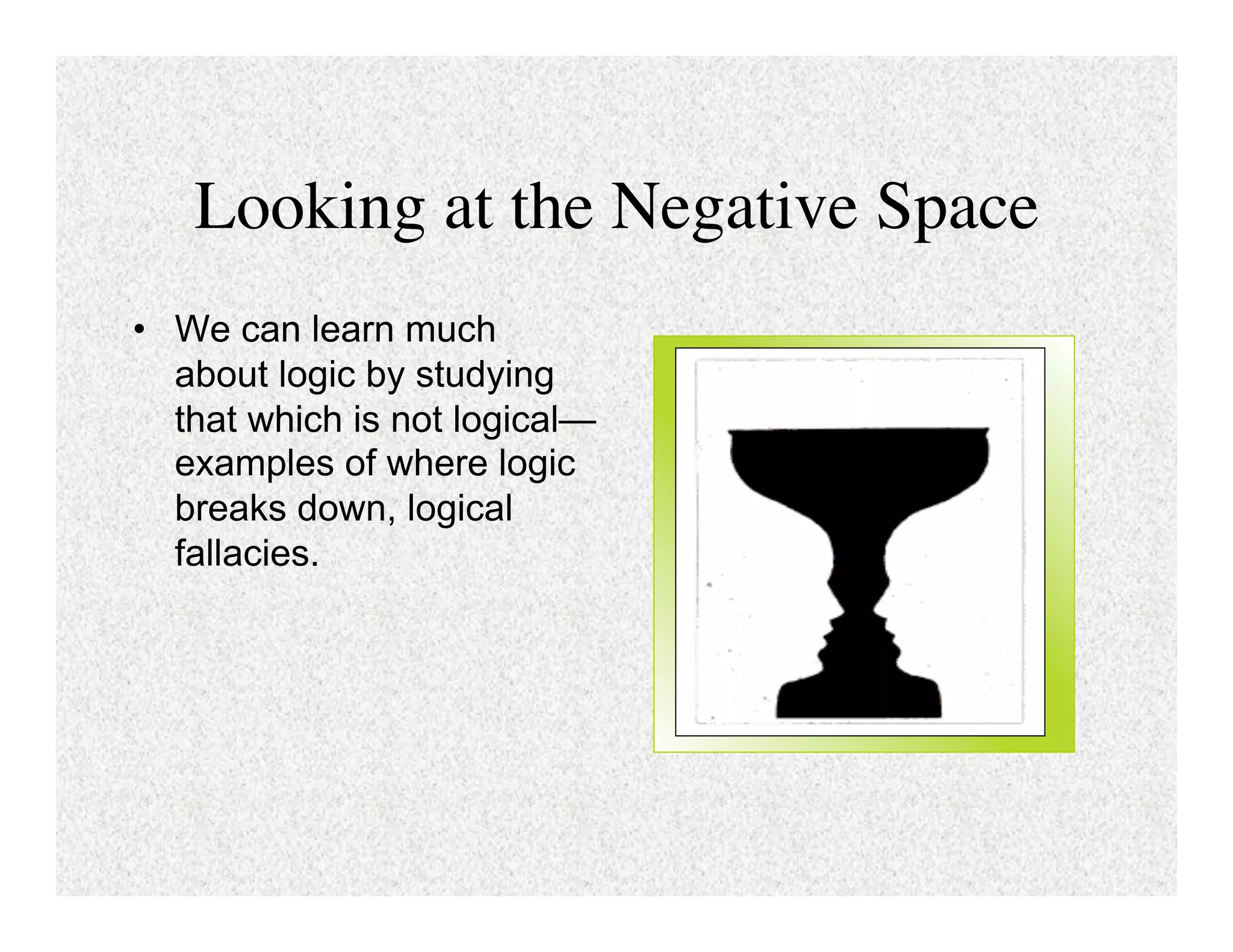
Looking at the Negative Space
•  We can learn much
   about logic by studying
   that which is not logical—
   examples of where logic
   breaks down, logical
   fallacies.
1. Over-generalization !
•  Drawing too wide a conclusion from the
   given facts !
•  Example: !
  –  All kids cause trouble.!
  –  Timmy is a kid. !
  –  Therefore, Timmy causes trouble.!


  Fix this by recognizing qualifiers
       (many, few, some, all, etc.)
2. Arguing in Circles
•  Def: Supporting an opinion not with evidence but with
   the same opinion, slightly disguised (restating the
   argument in different words). Using the word you’re
   defining in the definition is a classic example.!
•  Example:!
    –  Education is important for kids, so they should get an
       education.!
    –  Everybody likes ice cream because it is liked by all.!
    –  “Belligerently” means in a belligerent way.!


 Fix it by making sure you are giving support,
    not just repeating the idea. Never use the
      word you’re defining in the definition.!
3. Black & White Thinking

•  Def. An opinion that claims there are only
   two alternatives (when there might be more)
•  Examples: 
   –  You’re either for it or against it.
   –  Are you a jock or a nerd?
  Fix this by remembering that the world is a
   complicated place and that on most issues
            there are many alternatives.
4. Red Herring 
•  Def. Presenting an irrelevant topic to divert
   attention away from the original issue.
•  Also known as Ad hominem: getting
   personal as you discredit someone. 
•  Examples:
  –  What do you know? You’re just a kid.
  –  I got an F. Mr. X hates me.


  Fix this by staying focused on the topic;
        watch out for those who don’t.
5. Loaded Questions and
           Statements
•  Def. A question or a statement that
   conceals an opinion or assumption.
•  Examples: 
  –  Do you still beat your dog?
  –  You don’t think that, do you?
  –  All intelligent people agree that …

   Fix this by listening carefully and
      separating fact from opinion.
6. Statistical Fallacies
                   False Authority
•  Def. People usually believe in numbers and experts
   without questioning them. Here statistics are used to
   misrepresent rather than describe.
•  Examples:
    –  3 out of 4 dentists prefer Crest. (Did Crest pick the dentists?)
    –  I surveyed 100 people and they all agreed with me. (I chose my
       friends).
    –  Dr. X says this is the fastest and safest way to lose weight. (Did he/
       she get paid? Where do they practice?)
   Fix this by analyzing the evidence. Where did the support come
       from? Is there self interest involved? Did you get the whole
                                     picture?
7. Faulty Causal Relationship
            (also called Post Hoc)
•  Def. To excuse an action or belief by making it sound
   sensible. Often this assumes that anything that came
   before an event caused it to happen.
•  Example:
   –  I stole the towel from the hotel. They expect people to take
      them.
   –  Eating 5 energy bars and drinking 2 Cokes helps me get better
      grades. I did this and got an A on my history test.
  Fix this by examining the relationship between ideas.
   Make sure the facts precede the theory and the reasons
                precede and cause the belief.
8. Misleading Comparison
•  Def. Mistakenly believing that two
   situations or people can be compared.
•  Examples:
  –  Jill looks good in red. I’ll buy red pants, too.
  –  Forcing students to read books is like herding
     cattle to slaughter.
  –  You gave him extra time on the test, so I should
     get extra time too.
  –  Saddam Hussien is Hitler.
Fix this by remembering that every person
 and situation has different circumstances.
9. Bandwagon
•  Def. Lots of people do this, so you should,
   too.
•  Examples: 
  –  Adults are smoking, so it is ok to do so.
  –  The American people do not stand for . . .


Fix this by making decisions based on facts,
               not popularity.

9 Logical Fallacies(Slideshare)

  • 1.
    Recognizing Logical Fallacies! A logical fallacy is a mistake in reasoning; it is a MENTAL TRAP!
  • 2.
    Looking at theNegative Space •  We can learn much about logic by studying that which is not logical— examples of where logic breaks down, logical fallacies.
  • 3.
    1. Over-generalization ! • Drawing too wide a conclusion from the given facts ! •  Example: ! –  All kids cause trouble.! –  Timmy is a kid. ! –  Therefore, Timmy causes trouble.! Fix this by recognizing qualifiers (many, few, some, all, etc.)
  • 4.
    2. Arguing inCircles •  Def: Supporting an opinion not with evidence but with the same opinion, slightly disguised (restating the argument in different words). Using the word you’re defining in the definition is a classic example.! •  Example:! –  Education is important for kids, so they should get an education.! –  Everybody likes ice cream because it is liked by all.! –  “Belligerently” means in a belligerent way.! Fix it by making sure you are giving support, not just repeating the idea. Never use the word you’re defining in the definition.!
  • 5.
    3. Black &White Thinking •  Def. An opinion that claims there are only two alternatives (when there might be more) •  Examples: –  You’re either for it or against it. –  Are you a jock or a nerd? Fix this by remembering that the world is a complicated place and that on most issues there are many alternatives.
  • 6.
    4. Red Herring •  Def. Presenting an irrelevant topic to divert attention away from the original issue. •  Also known as Ad hominem: getting personal as you discredit someone. •  Examples: –  What do you know? You’re just a kid. –  I got an F. Mr. X hates me. Fix this by staying focused on the topic; watch out for those who don’t.
  • 7.
    5. Loaded Questionsand Statements •  Def. A question or a statement that conceals an opinion or assumption. •  Examples: –  Do you still beat your dog? –  You don’t think that, do you? –  All intelligent people agree that … Fix this by listening carefully and separating fact from opinion.
  • 8.
    6. Statistical Fallacies False Authority •  Def. People usually believe in numbers and experts without questioning them. Here statistics are used to misrepresent rather than describe. •  Examples: –  3 out of 4 dentists prefer Crest. (Did Crest pick the dentists?) –  I surveyed 100 people and they all agreed with me. (I chose my friends). –  Dr. X says this is the fastest and safest way to lose weight. (Did he/ she get paid? Where do they practice?) Fix this by analyzing the evidence. Where did the support come from? Is there self interest involved? Did you get the whole picture?
  • 9.
    7. Faulty CausalRelationship (also called Post Hoc) •  Def. To excuse an action or belief by making it sound sensible. Often this assumes that anything that came before an event caused it to happen. •  Example: –  I stole the towel from the hotel. They expect people to take them. –  Eating 5 energy bars and drinking 2 Cokes helps me get better grades. I did this and got an A on my history test. Fix this by examining the relationship between ideas. Make sure the facts precede the theory and the reasons precede and cause the belief.
  • 10.
    8. Misleading Comparison • Def. Mistakenly believing that two situations or people can be compared. •  Examples: –  Jill looks good in red. I’ll buy red pants, too. –  Forcing students to read books is like herding cattle to slaughter. –  You gave him extra time on the test, so I should get extra time too. –  Saddam Hussien is Hitler. Fix this by remembering that every person and situation has different circumstances.
  • 11.
    9. Bandwagon •  Def.Lots of people do this, so you should, too. •  Examples: –  Adults are smoking, so it is ok to do so. –  The American people do not stand for . . . Fix this by making decisions based on facts, not popularity.