LOCATION STRATEGY AND
LAYOUT STRATEGY
Presented by: Harrison
Torres
WHAT IS A BUSINESS LOCATION
STRATEGY?
A business location strategy is an organized plan for selecting the
location for starting a business to achieve its goals and objectives. It
aids in customer analysis, market segmentation, localization, and
business branding at large.
If you’re picking a location for your business, you’ll want to think
about things like accessibility to roads, utilities, and training centers.
Local and surrounding population demographics should be taken
into account as well.
REASONS WHY LOCATION IS
IMPORTANT FOR A BUSINESS
1. Target Market Reach - Proximity to target demographics, high-
traffic areas, and transportation hubs can enhance visibility and
footfall, leading to increased sales and revenue.
2. Competitive Advantage- a well-chosen location may offer unique
advantages such as lower costs, proximity to suppliers or
distribution channels, or access to specialized labor, which can
contribute to a competitive advantage in the industry.
REASONS WHY LOCATION IS
IMPORTANT FOR A BUSINESS
3.) Access to Resources and Talent- being in an area with a skilled
labor pool or specialized talent relevant to the business can enhance
operational efficiency and innovation.
4.) Regulatory and Legal Considerations:-Understanding and aligning
with the legal and regulatory environment of a location can mitigate
compliance risks and ensure smooth business operations.
REASONS WHY LOCATION IS
IMPORTANT FOR A BUSINESS
5.) Business Image and Branding- Choosing a location that aligns with
the business's target market, industry positioning, and desired brand
image can enhance credibility and attract the right customer base.
6.) Expansion and Growth Opportunities- Selecting a location that
allows for scalability and accommodates potential business growth
ensures long-term viability. It minimizes the need for costly
relocations or disruptions when expanding operations or entering new
markets.
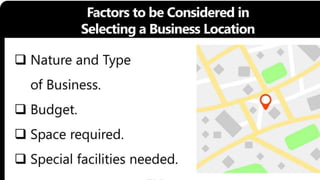
FACTORS INFLUENCING LOCATION
STRATEGY
 Proximity to
clients/customers
Distribution network
Customer service
Accessibility to
resources
 Market research
 Cost of building
materials
• Transport cost
• Local Labor
• Relocation Cost
TYPES OF LOCATION STRATEGIES
There are three basic types of place strategy:
1.) Intensive: An intensive place strategy is when a
company places its product in as many stores as
possible. Candy companies often use this strategy, as
they place their products in supermarkets, movie
theaters, convenience stores and airports.
2.) Selective: A selective place strategy is when a
company places its product in only a few retail stores.
For example, companies that manufacture expensive
TYPES OF LOCATION STRATEGIES
(2)
3.) Exclusive: An exclusive place strategy is
when a company places its product in one
retailer. This is usually for luxury products that
require salespeople to convey a lot of
information about the product during the sale,
such as cars.
LOCATION ANALYSIS TECHNIQUES
WHAT IS A BUSINESS LAYOUT
STRATEGY?
 The process of arranging physical facilities and
resources within a facility to optimize efficiency and
productivity.
 A layout strategy is a plan that specifies how an
organization will use its space and resources to meet
its objectives efficiently. It is one of the key decisions
that determines the long-run efficiency of operations.
STRATEGIC IMPORTANCE OF
LAYOUT
Proper layout enables:
1. Higher utilization of space, equipment, and people
2. Improved flow of information, materials, or people
3. Improved employee morale and safer working
conditions
4. Improved customer/client interaction
5. Flexibility
SIX LAYOUT STRATEGIES
1.) Fixed- Position Layout
 large bulky projects such as ships and
buildings
2.) Process-oriented layout
deals with low-volume, high-variety
production (“job shop”, intermittent production)
3.) Office Layout
positions workers, their equipment, and
SIX LAYOUT STRATEGIES (2)
4.) Retail Service Layout
 allocates shelf space and responds to
customer behavior
5.) Warehouse Layout
 addresses trade-offs between space and
material handling
6.) Product Oriented layout
seeks the best personnel and machine use in
FIXED- POSITION LAYOUT
Design is for stationary project
Workers and equipment come to site
Factors Complicating a Fixed Position Layout:
- There is limited space at virtually all sites
- At different stages in the construction process,
different materials are needed – therefore, different
items become critical as the project develops.
- The volume of materials needed is dynamic.
PROCESS-ORIENTED LAYOUT
 Design places departments with large flows of
material or people together
Department areas having similar processes
located in close proximity
- e.g., All x-ray machines in same area
EMERGENCY ROOM LAYOUT
OFFICE LAYOUT
Design positions people, equipment, & offices
for maximum information flow
Arranged by process or product
Example: Payroll dept. is by process
Examples :
- Insurance company
- Software company
OFFICE LAYOUT
RETAIL/SERVICE LAYOUT
Design maximizes product exposure to
customers Arranged by process or product
Decision variables
1. Store Flow pattern
2. Allocation of space to products
Types
- Grid Design
- Fee- flow design
RETAIL/SERVICE LAYOUT – GRID
DESIGN
RETAIL/SERVICE LAYOUT - FREE-
FLOW DESIGN
WAREHOUSE LAYOUT
Design balances space (cube) utilization &
handling cost.
Store Flow pattern
Similar to process layout
- Items moved between dock & various storage
areas
Optimum layout depends on
-Variety of items stored
-Number of items picked
WAREHOUSE LAYOUT
PRODUCT-ORIENTED LAYOUT
In a product layout, the machines, material and other facilities
are placed as per the order of processing. It is often used when the
production is to be performed on a large scale.
Facility organized around product
Types: Fabrication line; assembly line
PRODUCT-ORIENTED LAYOUT
FACTORS INFLUENCING LAYOUT
STRATEGY
Layout strategy is influenced by several factors that need to be
considered to create an efficient and effective layout within a facility.
 Product design
Process flow of materials , information, and people throughout the
production or service processes.
Equipment and Machinery
Material Handling
Workforce
Safety and regulations
REFERENCES
Location Strategy
https://www.wealthgist.com/why-location-is-important-for-a-business/
https://www.indeed.com/career-advice/career-development/place-
strategy#:~:text=There%20are%20three%20basic%20types%20of%20place%20strategy%3A,company%20places
%20its%20product%20in%20one%20retailer.%20
https://www.iedunote.com/business-location-analysis
Layout Strategy:

Location Strategy and Layout Strategy.pptx

  • 1.
    LOCATION STRATEGY AND LAYOUTSTRATEGY Presented by: Harrison Torres
  • 2.
    WHAT IS ABUSINESS LOCATION STRATEGY? A business location strategy is an organized plan for selecting the location for starting a business to achieve its goals and objectives. It aids in customer analysis, market segmentation, localization, and business branding at large. If you’re picking a location for your business, you’ll want to think about things like accessibility to roads, utilities, and training centers. Local and surrounding population demographics should be taken into account as well.
  • 3.
    REASONS WHY LOCATIONIS IMPORTANT FOR A BUSINESS 1. Target Market Reach - Proximity to target demographics, high- traffic areas, and transportation hubs can enhance visibility and footfall, leading to increased sales and revenue. 2. Competitive Advantage- a well-chosen location may offer unique advantages such as lower costs, proximity to suppliers or distribution channels, or access to specialized labor, which can contribute to a competitive advantage in the industry.
  • 4.
    REASONS WHY LOCATIONIS IMPORTANT FOR A BUSINESS 3.) Access to Resources and Talent- being in an area with a skilled labor pool or specialized talent relevant to the business can enhance operational efficiency and innovation. 4.) Regulatory and Legal Considerations:-Understanding and aligning with the legal and regulatory environment of a location can mitigate compliance risks and ensure smooth business operations.
  • 5.
    REASONS WHY LOCATIONIS IMPORTANT FOR A BUSINESS 5.) Business Image and Branding- Choosing a location that aligns with the business's target market, industry positioning, and desired brand image can enhance credibility and attract the right customer base. 6.) Expansion and Growth Opportunities- Selecting a location that allows for scalability and accommodates potential business growth ensures long-term viability. It minimizes the need for costly relocations or disruptions when expanding operations or entering new markets.
  • 6.
    FACTORS INFLUENCING LOCATION STRATEGY Proximity to clients/customers Distribution network Customer service Accessibility to resources  Market research  Cost of building materials • Transport cost • Local Labor • Relocation Cost
  • 7.
    TYPES OF LOCATIONSTRATEGIES There are three basic types of place strategy: 1.) Intensive: An intensive place strategy is when a company places its product in as many stores as possible. Candy companies often use this strategy, as they place their products in supermarkets, movie theaters, convenience stores and airports. 2.) Selective: A selective place strategy is when a company places its product in only a few retail stores. For example, companies that manufacture expensive
  • 8.
    TYPES OF LOCATIONSTRATEGIES (2) 3.) Exclusive: An exclusive place strategy is when a company places its product in one retailer. This is usually for luxury products that require salespeople to convey a lot of information about the product during the sale, such as cars.
  • 10.
  • 11.
    WHAT IS ABUSINESS LAYOUT STRATEGY?  The process of arranging physical facilities and resources within a facility to optimize efficiency and productivity.  A layout strategy is a plan that specifies how an organization will use its space and resources to meet its objectives efficiently. It is one of the key decisions that determines the long-run efficiency of operations.
  • 12.
    STRATEGIC IMPORTANCE OF LAYOUT Properlayout enables: 1. Higher utilization of space, equipment, and people 2. Improved flow of information, materials, or people 3. Improved employee morale and safer working conditions 4. Improved customer/client interaction 5. Flexibility
  • 13.
    SIX LAYOUT STRATEGIES 1.)Fixed- Position Layout  large bulky projects such as ships and buildings 2.) Process-oriented layout deals with low-volume, high-variety production (“job shop”, intermittent production) 3.) Office Layout positions workers, their equipment, and
  • 14.
    SIX LAYOUT STRATEGIES(2) 4.) Retail Service Layout  allocates shelf space and responds to customer behavior 5.) Warehouse Layout  addresses trade-offs between space and material handling 6.) Product Oriented layout seeks the best personnel and machine use in
  • 15.
    FIXED- POSITION LAYOUT Designis for stationary project Workers and equipment come to site Factors Complicating a Fixed Position Layout: - There is limited space at virtually all sites - At different stages in the construction process, different materials are needed – therefore, different items become critical as the project develops. - The volume of materials needed is dynamic.
  • 16.
    PROCESS-ORIENTED LAYOUT  Designplaces departments with large flows of material or people together Department areas having similar processes located in close proximity - e.g., All x-ray machines in same area
  • 17.
  • 18.
    OFFICE LAYOUT Design positionspeople, equipment, & offices for maximum information flow Arranged by process or product Example: Payroll dept. is by process Examples : - Insurance company - Software company
  • 19.
  • 20.
    RETAIL/SERVICE LAYOUT Design maximizesproduct exposure to customers Arranged by process or product Decision variables 1. Store Flow pattern 2. Allocation of space to products Types - Grid Design - Fee- flow design
  • 21.
  • 22.
    RETAIL/SERVICE LAYOUT -FREE- FLOW DESIGN
  • 23.
    WAREHOUSE LAYOUT Design balancesspace (cube) utilization & handling cost. Store Flow pattern Similar to process layout - Items moved between dock & various storage areas Optimum layout depends on -Variety of items stored -Number of items picked
  • 24.
  • 25.
    PRODUCT-ORIENTED LAYOUT In aproduct layout, the machines, material and other facilities are placed as per the order of processing. It is often used when the production is to be performed on a large scale. Facility organized around product Types: Fabrication line; assembly line
  • 26.
  • 27.
    FACTORS INFLUENCING LAYOUT STRATEGY Layoutstrategy is influenced by several factors that need to be considered to create an efficient and effective layout within a facility.  Product design Process flow of materials , information, and people throughout the production or service processes. Equipment and Machinery Material Handling Workforce Safety and regulations
  • 28.