
In The Name Of GOD
‫در‬ ‫موضعی‬ ‫حسی‬ ‫بی‬ ‫اصول‬
‫دندانپزشکی‬
‫مشکالت‬ ‫و‬ ‫عوارض‬
‫نظری‬ ‫جراحی‬ ‫درس‬
‫حسینی‬ ‫هادی‬ ‫سید‬ ‫دکتر‬
‫صورت‬ ‫و‬ ‫فک‬ ‫جراحی‬ ‫متخصص‬
www.drhadihoseini.com
‫در‬ ‫اسالید‬ ‫دانلود‬:
http://www.slideshare.net/hadidezyan
‫موضعی‬ ‫حسی‬ ‫بی‬ ‫های‬ ‫دارو‬ ‫از‬ ‫استفاده‬ ‫در‬ ‫مشکالت‬ ‫و‬ ‫عوارض‬
‫موضعی‬ ‫عوارض‬
‫سیستمیک‬ ‫عوارض‬
Local Complications
1) Needle breakage
2) Prolonged Anesthesia or Paresthesia
3) Facial Nerve palsy
4) Trismus
5) Soft tissues injury
6) Hematoma :
7) Pain on injection
8) Burning on Injection
9) Infection :
10) Edema
11) Postanesthetic Intra-oral lesion:
12) Sloughing of tissue
Needle breakage
Prevention
• Do not use short needles for inferior alveolar nerve
block in adults or larger children.
• Do not use 30-gauge needles for inferior alveolar nerve
block in adults or children.
• Do not bend needles when inserting them into soft
tissue.
• Do not insert a needle into soft tissue to its hub, unless
it is absolutely essential for the success of the injection.
• Observe extra caution when inserting needles in
younger children or in extremely phobic adult or child
patients.
Prolonged Anesthesia or Paresthesia
• Strict adherence to injection protocol
• Most paresthesias resolve within approximately 8
weeks to 2 months without treatment.
• Determine the degree and extent of paresthesia.
• Explain to the patient that paresthesia
• Record all findings
• Second opinion
• Examination every 2 months
• It would be prudent to contact your liability insurance
carrier should the paresthesia persist without evident
improvement beyond 1 to 2 months.
Facial Nerve palsy
• Reassure the patient
• Contact lenses should be removed until muscular
movement returns.
• An eye patch should be applied to the affected eye
until muscle tone returns
• Record the incident on the patient's chart.
• Although no contraindication is known to
reanesthetizing the patient to achieve mandibular
anesthesia, it may be prudent to forego further
dental care at this appointment.
Trismus
• Prescribe heat therapy, warm saline rinses,
analgesics (Aspirin 325 mg)
• If necessary, muscle relaxants to manage the
initial phase of muscle spasm - Diazepam
(approximately 10 mg bid)
• Initiate physiotherapy
• Antibiotics should be added to the treatment
regimen described and continued for 7 full days
• Patients report improvement within 48 to 72 hours
Soft tissues injury
• Analgesics, antibiotics, lukewarn saline rinse,
petroleum jelly
• Cotton roll placed between lips and teeth,
secured with dental floss, minimizes risk of
accidental mechanical trauma to anesthetized
tissues.
Hematoma
• Hematoma is not always preventable. Whenever a
needle is inserted into tissue, the risk of inadvertent
puncturing of a blood vessel is present.
• When swelling becomes evident during or immediately
after a local anesthetic injection, direct pressure should
be applied to the site of bleeding.
• For most injections, the blood vessel is located between
the surface of the mucous membrane and the bone;
localized pressure should be applied for not less than 2
minutes. This effectively stops the bleeding.
• Ice may be applied to the region immediately on
recognition of a developing hematoma.
Pain on injection
• Adhere to proper techniques of injection, both anatomic
and psychological.
• Use sharp needles.
• Use topical anesthetic properly before injection.
• Use sterile local anesthetic solutions.
• Inject local anesthetics slowly.
• Make certain that the temperature of the solution is
correct
• Buffered local anesthetics, at a pH of approximately
7.4, have been demonstrated to be more comfortable on
administration
Burning on Injection
• By buffering the local anesthetic solution to a
pH of approximately 7.4 immediately before
injection, it is possible to eliminate the burning
sensation that some patients experience during
injection of a local anesthetic solution
containing a vasopressor.
• Slowing the speed of injection also helps
Edema
If edema occurs in any area where it compromises breathing, treatment consists of the
following:
• P (position): if unconscious, the patient is placed supine.
• A-B-C (airway, breathing, circulation): basic life support is administered, as
needed.
• D (definitive treatment): emergency medical services (e.g., 9-1-1) is summoned.
• Epinephrine is administered: 0.3 mg (0.3 mL of a 1:1000 epinephrine solution)
(adult), 0.15 mg (0.15 mL of a 1:1000 epinephrine solution) (child [15 to 30 kg]),
intramuscularly (IM) or 3 mL of a 1:10,000 epinephrine solution intravenously (IV-
adult), every 5 minutes until respiratory distress resolves.
• Histamine blocker is administered IM or IV.
• Corticosteroid is administered IM or IV.
• Preparation is made for cricothyrotomy if total airway obstruction appears to be
developing. This is
• extremely rare but is the reason for summoning emergency medical services early.
• The patient's condition is thoroughly evaluated before his or her next appointment
to determine the cause of the reaction.
Infection
• Use sterile disposable needles.
• Properly care for and handle needles.
• Properly prepare the tissues before penetration.
• Prescribe 29 (or 41, if 10 days) tablets of
penicillin V (250-mg tablets).
• Erythromycin may be substituted if the patient
is allergic to penicillin.
Sloughing of tissue
• Usually, no formal management is necessary
for epithelial desquamation or sterile abscess.
Be certain to reassure the patient of this fact.
• For pain, analgesics such as aspirin or other
NSAIDs and a topically applied ointment
(Orabase)
• The course of a sterile abscess may run 7 to 10
days
Postanesthetic Intra-oral lesion:
• Primary management is symptomatic
• No management is necessary if the pain is not severe
• Topical anesthetic solutions (e.g., viscous lidocaine)
• A mixture of equal amounts of diphenhydramine
(Benadryl) and milk of magnesia rinsed in the mouth
effectively coats the ulcerations and provides relief
from pain.
• Orabase, a protective paste, without Kenalog can
provide a degree of pain relief.
• A tannic acid preparation (Zilactin) can be applied
topically to the lesions extraorally or intraorally (dry
the tissues first).
Local Anesthetic Systemic
Complications and Treatment
• Toxicity Caused by Direct Extension of the Usual Pharmacologic Effects
of the Drug:
1) Side effects
2) Overdose reactions
3) Local toxic effects
• Toxicity Caused by Alteration in the Recipient of the Drug:
1) A disease process (hepatic dysfunction, heart failure, renal dysfunction)
2) Emotional disturbances
3) Genetic aberrations (atypical plasma cholinesterase, malignant hyperthermia)
4) Idiosyncrasy
• Toxicity Caused by Allergic Responses to the Drug
Adverse drug reaction
Signs and Symptoms – Toxic Reaction
to Local Anesthesia
• Talkativeness
• Slurred speech
• Dizziness
• Nausea
• Depression
• Euphoria
• Excitement
• Convulsions
‫حسی‬ ‫بی‬ ‫داری‬ ‫اوردوز‬ ‫واکنش‬
Clinical signs and symptoms that
develop as a result of an
over-administration of a drug
Overdose Contributing Factors
• Age
• Weight
• Other medications
• Presence of disease
• Genetics
• Mental wellbeing
Drug Factors
• Vasoactivity
• Concentration
• Dose
• Route of administration
• Rate of injection
• Vascularity of the injection site
• Presence of vasoconstrictors
‫حسی‬ ‫بی‬ ‫اوردوز‬ ‫کلینیکی‬ ‫عالیم‬
LOW TO MODERATE OVERDOSE LEVELS:
Confusion
Talkativeness
Apprehension
Excitedness
Slurred speech
Generalized stutter
Muscular twitching, tremor of face and
extremities
Elevated BP, heart rate and respiratory rate
‫حسی‬ ‫بی‬ ‫اوردوز‬ ‫کلینیکی‬ ‫عالیم‬
MODERATE TO HIGH BLOOD LEVELS:
 Generalized tonic clonic seizure, followed by
 Generalized CNS depression
 Depressed BP, heart rate and respiratory rate
SYMPTOMS:
 Headache
 Light headedness
 Auditory distrurbances
 Dizziness
 Blurred vision
 Numbness of tongue and perioral tissues
 Loss of consciousness
‫سیستمیک‬ ‫عوارض‬ ‫کنترل‬
1) Basic emergency management : A-B-C-D
approach
2) Allergy : Medical history questionnaire is
important.
3) Elective dental care
4) Emergency dental care:
- Protocol no.1 : no treatment of an invasive nature
- Protocol no.2 : use general anesthesia
- Protocol no.3: Histamine blockers
- Protocol no.4 : Electronic dental anesthesia/hypnosis
‫خاص‬ ‫بیماران‬ ‫کنترل‬
• Uncooperative child
The maximum safe dose of lidocaine for a
child is 4.5 mg/kg per dental appointment.
Local infiltration of anesthesia is sufficient for
all dental treatment procedures in 90% of cases
even in the mandible.
‫خاص‬ ‫بیماران‬ ‫کنترل‬
• Handicapped Patient
• retarded patients
choose a shorter needle and/or a larger
gauge needle which is less likely to be
bent or broken.
better to use general anesthesia
‫خاص‬ ‫بیماران‬ ‫کنترل‬
Patients receiving anticoagulation or suffering from bleeding
disorders
 Oral procedures must be done at the beginning of the day & must be
performed early in the week, allowing delayed re-bleeding episodes,
usually occurring after 24-48 h, to be dealt with during the working
weekdays.
 Local anesthetic containing a vasoconstrictor should be
administered by infiltration or by intraligamentary injection
wherever practical.
Regional nerve blocks should be avoided when possible.
 Local vasoconstriction may be encouraged by infiltrating a small
amount of local anesthetic containing adrenaline (epinephrine) close
to the site of surgery.
‫خاص‬ ‫بیماران‬ ‫کنترل‬
PREGNANCY
• Lidocaine + vasoconstrictor: most common
local anesthetic used in dentistry extensively
used in pregnancy with no proven ill effects,
Esters are better to be used.
• Accidental intravascular injections of lidocaine
pass through the placenta but the
concentrations are too low to harm fetus.
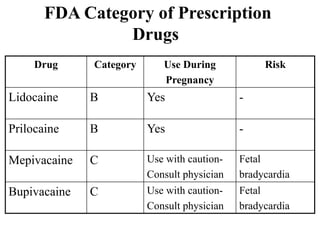
FDA Category of Prescription
Drugs
Drug Category Use During
Pregnancy
Risk
Lidocaine B Yes -
Prilocaine B Yes -
Mepivacaine C Use with caution-
Consult physician
Fetal
bradycardia
Bupivacaine C Use with caution-
Consult physician
Fetal
bradycardia
‫خاص‬ ‫بیماران‬ ‫کنترل‬
GERIATRIC PATIENT
– When choosing an anesthetic, we are largely
concerned with the effect of the anesthetic agent upon
the patient's cardiovascular and respiratory systems.
– increased tissue sensitivity to drugs acting on the CNS
– Decreased hepatic size and blood flow may reduce
hepatic metabolism of drugs
– hypertension is common and can reduce renal function
– Same prevention procedures used with children
‫خاص‬ ‫بیماران‬ ‫کنترل‬
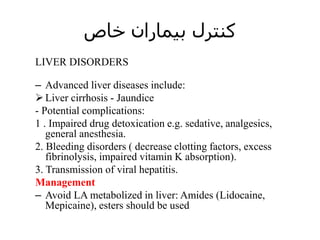
LIVER DISORDERS
– Advanced liver diseases include:
Liver cirrhosis - Jaundice
- Potential complications:
1 . Impaired drug detoxication e.g. sedative, analgesics,
general anesthesia.
2. Bleeding disorders ( decrease clotting factors, excess
fibrinolysis, impaired vitamin K absorption).
3. Transmission of viral hepatitis.
Management
– Avoid LA metabolized in liver: Amides (Lidocaine,
Mepicaine), esters should be used
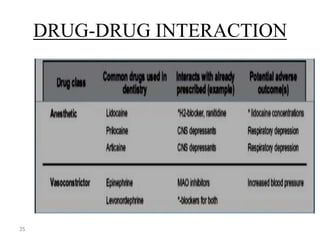
DRUG-DRUG INTERACTION
35
‫آلرژی‬
• Incidents of allergy are low
• Often allergic reaction is to one of the
ingredients within the cartridge, not the
local anesthesia itself
• Hypersensitive state as a result of
exposure to an allergen
• Re-exposure can heighten the initial
reaction
‫آلرژی‬ ‫کلینیکی‬ ‫عالیم‬
• Fever
• Angioedema
• Urticaria
• Dermatitis
• Depression of blood-forming organs
• Photosensitivity
• Anaphylaxis
Angioedema
‫کنیم‬ ‫جلوگیری‬ ‫آلرژی‬ ‫بروز‬ ‫از‬ ‫چگونه‬
• Take a thorough medical history
• Dialogue the medical history with the
patient
‫رایج‬ ‫سواالت‬
• Allergic to any medications?
• Have you ever had a reaction to local
anesthesia?
• If yes, describe what happened
• Was treatment given? If so, what?
‫موضعی‬ ‫های‬ ‫حسی‬ ‫بی‬ ‫به‬ ‫آلرژیک‬ ‫های‬ ‫واکنش‬
• Dermatitis
• Bronchospasm
• Systemic anaphylaxis
• Hypersensitivity to esters
(atypical pseudo cholinesterase, PABA)
‫دارو‬ ‫گیرنده‬ ‫تغییرات‬ ‫بعلت‬ ‫حسی‬ ‫بی‬ ‫داروی‬ ‫سمیت‬
1) Disease process
2) Emotional disturbances
3) Genetic aberrations
4) Idiosyncrasy
‫نفرین‬ ‫اپی‬ ‫اوردوز‬
Very rare for patient to experience an
epinephrine overdose
‫عروقی‬ ‫کننده‬ ‫تنگ‬ ‫با‬ ‫اوردوز‬ ‫های‬ ‫نشانه‬ ‫و‬ ‫عالیم‬
• Fear, anxiety
• Tenseness
• Restlessness
• Throbbing headache
• Tremor
• Perspiration
• Weakness
• Dizziness
• Pallor
• Respiratory difficulty
• Palpitations
‫عروقی‬ ‫کننده‬ ‫تنگ‬ ‫دوز‬ ‫اور‬ ‫در‬ ‫کنترل‬
• Terminate dental procedure
• Sit patient upright in the dental chair
• Reassure patient
• Monitor blood pressure
• Administer oxygen
‫حسی‬ ‫بی‬ ‫مصرف‬ ‫های‬ ‫کنتراندیکاسیون‬
‫عروقی‬ ‫کننده‬ ‫تنگ‬ ‫با‬ ‫موضعی‬ ‫های‬
• Uncontrolled hypertension
• Myocardial infarction (within 6 months)
• Unstable angina
• Coronary artery bypass graft (> 3 months)
Asthma Patient
• Thorough medical and dental history
• Avoid use of anesthesia that contain
epinephrine or levonordefrin because of
sulfites (may cause wheezing)
• Asthma patient that is steroid dependant
may develop brochospasms
• Establish rapport and calm environment
‫خون‬ ‫فشار‬
• Stress and anxiety may raise the patient’s blood
pressure (>160/100)
• Thorough medical, dental and patient history
• Norepinephrine and levonordefrin should not be
used because of alpha1 stimulation
(2% Mepivacaine with 1:20,000 levonordefrin)
• Up to two cartridges of 2% lidocaine with
1:100,000 epinephrine is safe
local anesthesia in dentistry 7 copmlicatin

local anesthesia in dentistry 7 copmlicatin

  • 1.
  • 2.
    ‫در‬ ‫موضعی‬ ‫حسی‬‫بی‬ ‫اصول‬ ‫دندانپزشکی‬ ‫مشکالت‬ ‫و‬ ‫عوارض‬ ‫نظری‬ ‫جراحی‬ ‫درس‬ ‫حسینی‬ ‫هادی‬ ‫سید‬ ‫دکتر‬ ‫صورت‬ ‫و‬ ‫فک‬ ‫جراحی‬ ‫متخصص‬ www.drhadihoseini.com ‫در‬ ‫اسالید‬ ‫دانلود‬: http://www.slideshare.net/hadidezyan
  • 3.
    ‫موضعی‬ ‫حسی‬ ‫بی‬‫های‬ ‫دارو‬ ‫از‬ ‫استفاده‬ ‫در‬ ‫مشکالت‬ ‫و‬ ‫عوارض‬ ‫موضعی‬ ‫عوارض‬ ‫سیستمیک‬ ‫عوارض‬
  • 4.
    Local Complications 1) Needlebreakage 2) Prolonged Anesthesia or Paresthesia 3) Facial Nerve palsy 4) Trismus 5) Soft tissues injury 6) Hematoma : 7) Pain on injection 8) Burning on Injection 9) Infection : 10) Edema 11) Postanesthetic Intra-oral lesion: 12) Sloughing of tissue
  • 5.
    Needle breakage Prevention • Donot use short needles for inferior alveolar nerve block in adults or larger children. • Do not use 30-gauge needles for inferior alveolar nerve block in adults or children. • Do not bend needles when inserting them into soft tissue. • Do not insert a needle into soft tissue to its hub, unless it is absolutely essential for the success of the injection. • Observe extra caution when inserting needles in younger children or in extremely phobic adult or child patients.
  • 6.
    Prolonged Anesthesia orParesthesia • Strict adherence to injection protocol • Most paresthesias resolve within approximately 8 weeks to 2 months without treatment. • Determine the degree and extent of paresthesia. • Explain to the patient that paresthesia • Record all findings • Second opinion • Examination every 2 months • It would be prudent to contact your liability insurance carrier should the paresthesia persist without evident improvement beyond 1 to 2 months.
  • 7.
    Facial Nerve palsy •Reassure the patient • Contact lenses should be removed until muscular movement returns. • An eye patch should be applied to the affected eye until muscle tone returns • Record the incident on the patient's chart. • Although no contraindication is known to reanesthetizing the patient to achieve mandibular anesthesia, it may be prudent to forego further dental care at this appointment.
  • 8.
    Trismus • Prescribe heattherapy, warm saline rinses, analgesics (Aspirin 325 mg) • If necessary, muscle relaxants to manage the initial phase of muscle spasm - Diazepam (approximately 10 mg bid) • Initiate physiotherapy • Antibiotics should be added to the treatment regimen described and continued for 7 full days • Patients report improvement within 48 to 72 hours
  • 9.
    Soft tissues injury •Analgesics, antibiotics, lukewarn saline rinse, petroleum jelly • Cotton roll placed between lips and teeth, secured with dental floss, minimizes risk of accidental mechanical trauma to anesthetized tissues.
  • 10.
    Hematoma • Hematoma isnot always preventable. Whenever a needle is inserted into tissue, the risk of inadvertent puncturing of a blood vessel is present. • When swelling becomes evident during or immediately after a local anesthetic injection, direct pressure should be applied to the site of bleeding. • For most injections, the blood vessel is located between the surface of the mucous membrane and the bone; localized pressure should be applied for not less than 2 minutes. This effectively stops the bleeding. • Ice may be applied to the region immediately on recognition of a developing hematoma.
  • 11.
    Pain on injection •Adhere to proper techniques of injection, both anatomic and psychological. • Use sharp needles. • Use topical anesthetic properly before injection. • Use sterile local anesthetic solutions. • Inject local anesthetics slowly. • Make certain that the temperature of the solution is correct • Buffered local anesthetics, at a pH of approximately 7.4, have been demonstrated to be more comfortable on administration
  • 12.
    Burning on Injection •By buffering the local anesthetic solution to a pH of approximately 7.4 immediately before injection, it is possible to eliminate the burning sensation that some patients experience during injection of a local anesthetic solution containing a vasopressor. • Slowing the speed of injection also helps
  • 13.
    Edema If edema occursin any area where it compromises breathing, treatment consists of the following: • P (position): if unconscious, the patient is placed supine. • A-B-C (airway, breathing, circulation): basic life support is administered, as needed. • D (definitive treatment): emergency medical services (e.g., 9-1-1) is summoned. • Epinephrine is administered: 0.3 mg (0.3 mL of a 1:1000 epinephrine solution) (adult), 0.15 mg (0.15 mL of a 1:1000 epinephrine solution) (child [15 to 30 kg]), intramuscularly (IM) or 3 mL of a 1:10,000 epinephrine solution intravenously (IV- adult), every 5 minutes until respiratory distress resolves. • Histamine blocker is administered IM or IV. • Corticosteroid is administered IM or IV. • Preparation is made for cricothyrotomy if total airway obstruction appears to be developing. This is • extremely rare but is the reason for summoning emergency medical services early. • The patient's condition is thoroughly evaluated before his or her next appointment to determine the cause of the reaction.
  • 14.
    Infection • Use steriledisposable needles. • Properly care for and handle needles. • Properly prepare the tissues before penetration. • Prescribe 29 (or 41, if 10 days) tablets of penicillin V (250-mg tablets). • Erythromycin may be substituted if the patient is allergic to penicillin.
  • 15.
    Sloughing of tissue •Usually, no formal management is necessary for epithelial desquamation or sterile abscess. Be certain to reassure the patient of this fact. • For pain, analgesics such as aspirin or other NSAIDs and a topically applied ointment (Orabase) • The course of a sterile abscess may run 7 to 10 days
  • 16.
    Postanesthetic Intra-oral lesion: •Primary management is symptomatic • No management is necessary if the pain is not severe • Topical anesthetic solutions (e.g., viscous lidocaine) • A mixture of equal amounts of diphenhydramine (Benadryl) and milk of magnesia rinsed in the mouth effectively coats the ulcerations and provides relief from pain. • Orabase, a protective paste, without Kenalog can provide a degree of pain relief. • A tannic acid preparation (Zilactin) can be applied topically to the lesions extraorally or intraorally (dry the tissues first).
  • 18.
  • 19.
    • Toxicity Causedby Direct Extension of the Usual Pharmacologic Effects of the Drug: 1) Side effects 2) Overdose reactions 3) Local toxic effects • Toxicity Caused by Alteration in the Recipient of the Drug: 1) A disease process (hepatic dysfunction, heart failure, renal dysfunction) 2) Emotional disturbances 3) Genetic aberrations (atypical plasma cholinesterase, malignant hyperthermia) 4) Idiosyncrasy • Toxicity Caused by Allergic Responses to the Drug Adverse drug reaction
  • 20.
    Signs and Symptoms– Toxic Reaction to Local Anesthesia • Talkativeness • Slurred speech • Dizziness • Nausea • Depression • Euphoria • Excitement • Convulsions
  • 21.
    ‫حسی‬ ‫بی‬ ‫داری‬‫اوردوز‬ ‫واکنش‬ Clinical signs and symptoms that develop as a result of an over-administration of a drug
  • 22.
    Overdose Contributing Factors •Age • Weight • Other medications • Presence of disease • Genetics • Mental wellbeing
  • 24.
    Drug Factors • Vasoactivity •Concentration • Dose • Route of administration • Rate of injection • Vascularity of the injection site • Presence of vasoconstrictors
  • 25.
    ‫حسی‬ ‫بی‬ ‫اوردوز‬‫کلینیکی‬ ‫عالیم‬ LOW TO MODERATE OVERDOSE LEVELS: Confusion Talkativeness Apprehension Excitedness Slurred speech Generalized stutter Muscular twitching, tremor of face and extremities Elevated BP, heart rate and respiratory rate
  • 26.
    ‫حسی‬ ‫بی‬ ‫اوردوز‬‫کلینیکی‬ ‫عالیم‬ MODERATE TO HIGH BLOOD LEVELS:  Generalized tonic clonic seizure, followed by  Generalized CNS depression  Depressed BP, heart rate and respiratory rate SYMPTOMS:  Headache  Light headedness  Auditory distrurbances  Dizziness  Blurred vision  Numbness of tongue and perioral tissues  Loss of consciousness
  • 27.
    ‫سیستمیک‬ ‫عوارض‬ ‫کنترل‬ 1)Basic emergency management : A-B-C-D approach 2) Allergy : Medical history questionnaire is important. 3) Elective dental care 4) Emergency dental care: - Protocol no.1 : no treatment of an invasive nature - Protocol no.2 : use general anesthesia - Protocol no.3: Histamine blockers - Protocol no.4 : Electronic dental anesthesia/hypnosis
  • 28.
    ‫خاص‬ ‫بیماران‬ ‫کنترل‬ •Uncooperative child The maximum safe dose of lidocaine for a child is 4.5 mg/kg per dental appointment. Local infiltration of anesthesia is sufficient for all dental treatment procedures in 90% of cases even in the mandible.
  • 29.
    ‫خاص‬ ‫بیماران‬ ‫کنترل‬ •Handicapped Patient • retarded patients choose a shorter needle and/or a larger gauge needle which is less likely to be bent or broken. better to use general anesthesia
  • 30.
    ‫خاص‬ ‫بیماران‬ ‫کنترل‬ Patientsreceiving anticoagulation or suffering from bleeding disorders  Oral procedures must be done at the beginning of the day & must be performed early in the week, allowing delayed re-bleeding episodes, usually occurring after 24-48 h, to be dealt with during the working weekdays.  Local anesthetic containing a vasoconstrictor should be administered by infiltration or by intraligamentary injection wherever practical. Regional nerve blocks should be avoided when possible.  Local vasoconstriction may be encouraged by infiltrating a small amount of local anesthetic containing adrenaline (epinephrine) close to the site of surgery.
  • 31.
    ‫خاص‬ ‫بیماران‬ ‫کنترل‬ PREGNANCY •Lidocaine + vasoconstrictor: most common local anesthetic used in dentistry extensively used in pregnancy with no proven ill effects, Esters are better to be used. • Accidental intravascular injections of lidocaine pass through the placenta but the concentrations are too low to harm fetus.
  • 32.
    FDA Category ofPrescription Drugs Drug Category Use During Pregnancy Risk Lidocaine B Yes - Prilocaine B Yes - Mepivacaine C Use with caution- Consult physician Fetal bradycardia Bupivacaine C Use with caution- Consult physician Fetal bradycardia
  • 33.
    ‫خاص‬ ‫بیماران‬ ‫کنترل‬ GERIATRICPATIENT – When choosing an anesthetic, we are largely concerned with the effect of the anesthetic agent upon the patient's cardiovascular and respiratory systems. – increased tissue sensitivity to drugs acting on the CNS – Decreased hepatic size and blood flow may reduce hepatic metabolism of drugs – hypertension is common and can reduce renal function – Same prevention procedures used with children
  • 34.
    ‫خاص‬ ‫بیماران‬ ‫کنترل‬ LIVERDISORDERS – Advanced liver diseases include: Liver cirrhosis - Jaundice - Potential complications: 1 . Impaired drug detoxication e.g. sedative, analgesics, general anesthesia. 2. Bleeding disorders ( decrease clotting factors, excess fibrinolysis, impaired vitamin K absorption). 3. Transmission of viral hepatitis. Management – Avoid LA metabolized in liver: Amides (Lidocaine, Mepicaine), esters should be used
  • 35.
  • 36.
    ‫آلرژی‬ • Incidents ofallergy are low • Often allergic reaction is to one of the ingredients within the cartridge, not the local anesthesia itself
  • 37.
    • Hypersensitive stateas a result of exposure to an allergen • Re-exposure can heighten the initial reaction
  • 38.
    ‫آلرژی‬ ‫کلینیکی‬ ‫عالیم‬ •Fever • Angioedema • Urticaria • Dermatitis • Depression of blood-forming organs • Photosensitivity • Anaphylaxis
  • 39.
  • 40.
    ‫کنیم‬ ‫جلوگیری‬ ‫آلرژی‬‫بروز‬ ‫از‬ ‫چگونه‬ • Take a thorough medical history • Dialogue the medical history with the patient
  • 41.
    ‫رایج‬ ‫سواالت‬ • Allergicto any medications? • Have you ever had a reaction to local anesthesia? • If yes, describe what happened • Was treatment given? If so, what?
  • 42.
    ‫موضعی‬ ‫های‬ ‫حسی‬‫بی‬ ‫به‬ ‫آلرژیک‬ ‫های‬ ‫واکنش‬ • Dermatitis • Bronchospasm • Systemic anaphylaxis • Hypersensitivity to esters (atypical pseudo cholinesterase, PABA)
  • 43.
    ‫دارو‬ ‫گیرنده‬ ‫تغییرات‬‫بعلت‬ ‫حسی‬ ‫بی‬ ‫داروی‬ ‫سمیت‬ 1) Disease process 2) Emotional disturbances 3) Genetic aberrations 4) Idiosyncrasy
  • 44.
    ‫نفرین‬ ‫اپی‬ ‫اوردوز‬ Veryrare for patient to experience an epinephrine overdose
  • 45.
    ‫عروقی‬ ‫کننده‬ ‫تنگ‬‫با‬ ‫اوردوز‬ ‫های‬ ‫نشانه‬ ‫و‬ ‫عالیم‬ • Fear, anxiety • Tenseness • Restlessness • Throbbing headache • Tremor • Perspiration • Weakness • Dizziness • Pallor • Respiratory difficulty • Palpitations
  • 46.
    ‫عروقی‬ ‫کننده‬ ‫تنگ‬‫دوز‬ ‫اور‬ ‫در‬ ‫کنترل‬ • Terminate dental procedure • Sit patient upright in the dental chair • Reassure patient • Monitor blood pressure • Administer oxygen
  • 47.
    ‫حسی‬ ‫بی‬ ‫مصرف‬‫های‬ ‫کنتراندیکاسیون‬ ‫عروقی‬ ‫کننده‬ ‫تنگ‬ ‫با‬ ‫موضعی‬ ‫های‬ • Uncontrolled hypertension • Myocardial infarction (within 6 months) • Unstable angina • Coronary artery bypass graft (> 3 months)
  • 48.
    Asthma Patient • Thoroughmedical and dental history • Avoid use of anesthesia that contain epinephrine or levonordefrin because of sulfites (may cause wheezing) • Asthma patient that is steroid dependant may develop brochospasms • Establish rapport and calm environment
  • 49.
    ‫خون‬ ‫فشار‬ • Stressand anxiety may raise the patient’s blood pressure (>160/100) • Thorough medical, dental and patient history • Norepinephrine and levonordefrin should not be used because of alpha1 stimulation (2% Mepivacaine with 1:20,000 levonordefrin) • Up to two cartridges of 2% lidocaine with 1:100,000 epinephrine is safe