Accounting for Pre-Production Costs Livent Inc. Team C1 Saturday, February 12, 2011
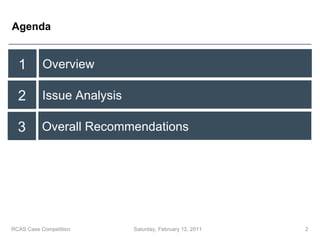
Agenda Saturday, February 12, 2011 RCAS Case Competition 1 Overview 2 Issue Analysis 3 Overall Recommendations
Overview RCAS Case Competition Saturday, February 12, 2011
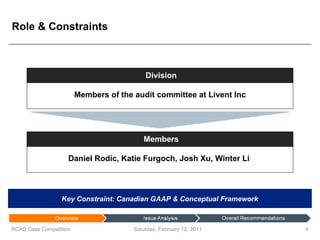
Role & Constraints Saturday, February 12, 2011 RCAS Case Competition Key Constraint: Canadian GAAP & Conceptual Framework Members of the audit committee at Livent Inc Division Daniel Rodic, Katie Furgoch, Josh Xu, Winter Li  Members
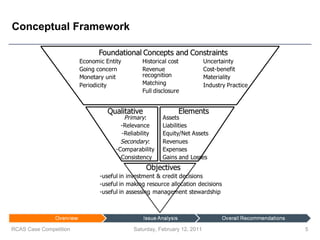
Conceptual Framework Saturday, February 12, 2011 RCAS Case Competition
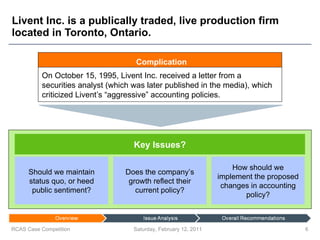
Livent Inc. is a publically traded, live production firm located in Toronto, Ontario. Saturday, February 12, 2011 RCAS Case Competition Should we maintain status quo, or heed public sentiment? Does the company’s growth reflect their current policy? How should we implement the proposed changes in accounting policy? Complication On October 15, 1995, Livent Inc. received a letter from a securities analyst (which was later published in the media), which criticized Livent’s “aggressive” accounting policies. Key Issues?
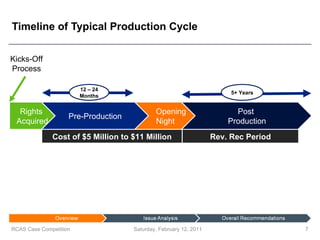
Timeline of Typical Production Cycle Post  Production Opening Night Saturday, February 12, 2011 RCAS Case Competition Pre-Production Rights  Acquired 12 – 24 Months 5+ Years Cost of $5 Million to $11 Million Rev. Rec Period Kicks-Off Process
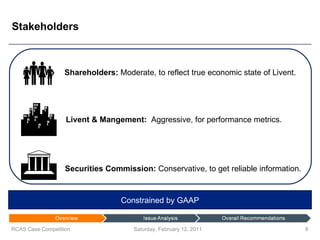
Stakeholders Saturday, February 12, 2011 RCAS Case Competition    Shareholders:  Moderate, to reflect true economic state of Livent. Livent & Mangement:  Aggressive, for performance metrics. Securities Commission:  Conservative, to get reliable information. Constrained by GAAP
Issue Analysis RCAS Case Competition Saturday, February 12, 2011
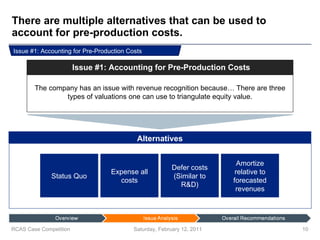
There are multiple alternatives that can be used to account for pre-production costs. Saturday, February 12, 2011 RCAS Case Competition Expense all costs Defer costs (Similar to R&D) Amortize relative to forecasted revenues Status Quo Issue #1: Accounting for Pre-Production Costs The company has an issue with revenue recognition because… There are three types of valuations one can use to triangulate equity value. Issue #1: Accounting for Pre-Production Costs Alternatives
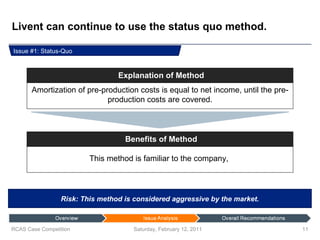
Livent can continue to use the status quo method. Saturday, February 12, 2011 RCAS Case Competition Risk: This method is considered aggressive by the market. Issue #1: Status-Quo Amortization of pre-production costs is equal to net income, until the pre-production costs are covered. Explanation of Method This method is familiar to the company,  Benefits of Method
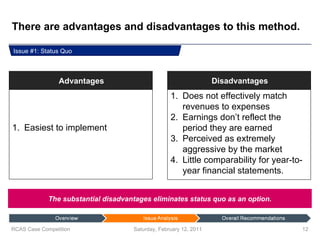
There are advantages and disadvantages to this method. Saturday, February 12, 2011 RCAS Case Competition The substantial disadvantages eliminates status quo as an option. Issue #1: Status Quo Easiest to implement Advantages Does not effectively match revenues to expenses Earnings don’t reflect the period they are earned Perceived as extremely aggressive by the market Little comparability for year-to-year financial statements. Disadvantages
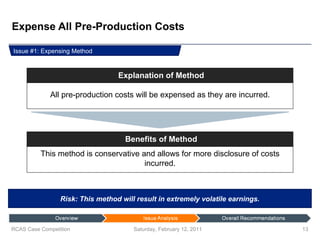
Expense All Pre-Production Costs Saturday, February 12, 2011 RCAS Case Competition Risk: This method will result in extremely volatile earnings. Issue #1: Expensing Method All pre-production costs will be expensed as they are incurred. Explanation of Method This method is conservative and allows for more disclosure of costs incurred. Benefits of Method
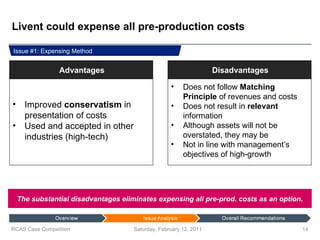
Livent could expense all pre-production costs Saturday, February 12, 2011 RCAS Case Competition The substantial disadvantages eliminates expensing all pre-prod. costs as an option. Issue #1: Expensing Method Improved  conservatism  in presentation of costs Used and accepted in other industries (high-tech) Advantages Does not follow  Matching Principle  of revenues and costs Does not result in  relevant  information Although assets will not be overstated, they may be  Not in line with management’s objectives of high-growth Disadvantages
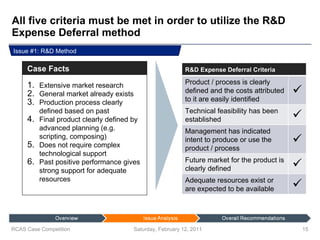
All five criteria must be met in order to utilize the R&D Expense Deferral method Saturday, February 12, 2011 RCAS Case Competition Issue #1: R&D Method R&D Expense Deferral Criteria Product / process is clearly defined and the costs attributed to it are easily identified Technical feasibility has been established Management has indicated intent to produce or use the product / process Future market for the product is clearly defined Adequate resources exist or are expected to be available Case Facts Extensive market research General market already exists Production process clearly defined based on past Final product clearly defined by advanced planning (e.g. scripting, composing) Does not require complex technological support Past positive performance gives strong support for adequate resources
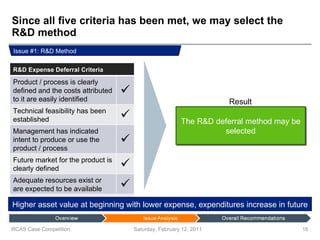
Since all five criteria has been met, we may select the R&D method Saturday, February 12, 2011 RCAS Case Competition The R&D deferral method may be selected Result Higher asset value at beginning with lower expense, expenditures increase in future Issue #1: R&D Method R&D Expense Deferral Criteria Product / process is clearly defined and the costs attributed to it are easily identified Technical feasibility has been established Management has indicated intent to produce or use the product / process Future market for the product is clearly defined Adequate resources exist or are expected to be available
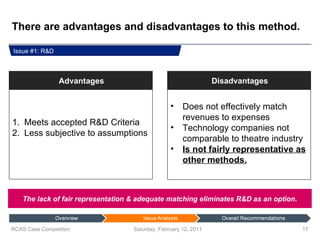
There are advantages and disadvantages to this method. Saturday, February 12, 2011 RCAS Case Competition The lack of fair representation & adequate matching eliminates R&D as an option. Issue #1: R&D Meets accepted R&D Criteria Less subjective to assumptions Advantages Does not effectively match revenues to expenses Technology companies not comparable to theatre industry Is not fairly representative as other methods. Disadvantages
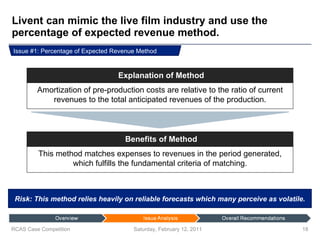
Livent can mimic the live film industry and use the percentage of expected revenue method. Saturday, February 12, 2011 RCAS Case Competition Risk: This method relies heavily on reliable forecasts which many perceive as volatile. Issue #1: Percentage of Expected Revenue Method Amortization of pre-production costs are relative to the ratio of current revenues to the total anticipated revenues of the production. Explanation of Method This method matches expenses to revenues in the period generated, which fulfills the fundamental criteria of matching. Benefits of Method
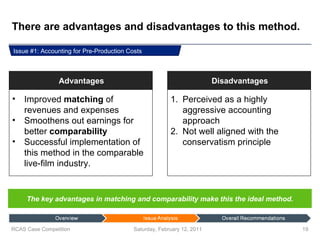
There are advantages and disadvantages to this method. Saturday, February 12, 2011 RCAS Case Competition The key advantages in matching and comparability make this the ideal method. Issue #1: Accounting for Pre-Production Costs Improved  matching  of revenues and expenses Smoothens out earnings for better  comparability Successful implementation of this method in the comparable live-film industry. Advantages Perceived as a highly aggressive accounting approach Not well aligned with the conservatism principle Disadvantages
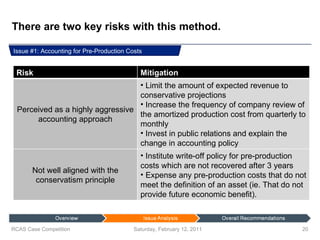
There are two key risks with this method. Saturday, February 12, 2011 RCAS Case Competition Issue #1: Accounting for Pre-Production Costs Risk Mitigation Perceived as a highly aggressive accounting approach Limit the amount of expected revenue to conservative projections Increase the frequency of company review of the amortized production cost from quarterly to monthly Invest in public relations and explain the change in accounting policy Not well aligned with the conservatism principle Institute write-off policy for pre-production costs which are not recovered after 3 years Expense any pre-production costs that do not meet the definition of an asset (ie. That do not provide future economic benefit).
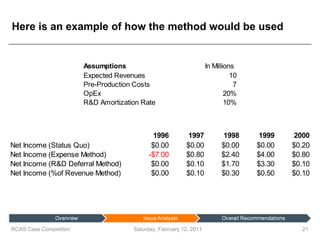
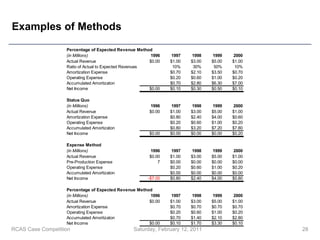
Here is an example of how the method would be used Saturday, February 12, 2011 RCAS Case Competition
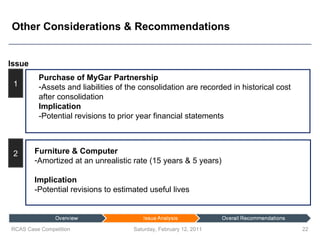
Other Considerations & Recommendations Saturday, February 12, 2011 RCAS Case Competition Issue 1 2 Purchase of MyGar Partnership Assets and liabilities of the consolidation are recorded in historical cost after consolidation Implication -Potential revisions to prior year financial statements Furniture & Computer  Amortized at an unrealistic rate (15 years & 5 years) Implication -Potential revisions to estimated useful lives
Overall Recommendation RCAS Case Competition Saturday, February 12, 2011
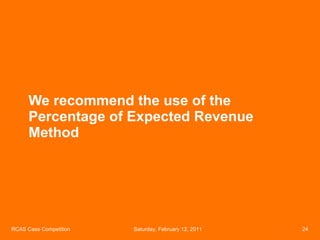
We recommend the use of the Percentage of Expected Revenue Method RCAS Case Competition Saturday, February 12, 2011
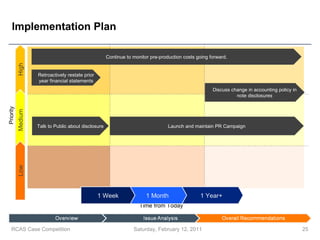
Implementation Plan Saturday, February 12, 2011 RCAS Case Competition High Priority Time from Today Talk to Public about disclosure Medium Low Retroactively restate prior year financial statements Discuss change in accounting policy in note disclosures Launch and maintain PR Campaign Continue to monitor pre-production costs going forward. 1 Year+ 1 Month 1 Week
Questions? RCAS Case Competition Saturday, February 12, 2011
Appendix RCAS Case Competition Saturday, February 12, 2011
Examples of Methods Saturday, February 12, 2011 RCAS Case Competition

Livent - Accounting Policy

  • 1.
    Accounting for Pre-ProductionCosts Livent Inc. Team C1 Saturday, February 12, 2011
  • 2.
    Agenda Saturday, February12, 2011 RCAS Case Competition 1 Overview 2 Issue Analysis 3 Overall Recommendations
  • 3.
    Overview RCAS CaseCompetition Saturday, February 12, 2011
  • 4.
    Role & ConstraintsSaturday, February 12, 2011 RCAS Case Competition Key Constraint: Canadian GAAP & Conceptual Framework Members of the audit committee at Livent Inc Division Daniel Rodic, Katie Furgoch, Josh Xu, Winter Li Members
  • 5.
    Conceptual Framework Saturday,February 12, 2011 RCAS Case Competition
  • 6.
    Livent Inc. isa publically traded, live production firm located in Toronto, Ontario. Saturday, February 12, 2011 RCAS Case Competition Should we maintain status quo, or heed public sentiment? Does the company’s growth reflect their current policy? How should we implement the proposed changes in accounting policy? Complication On October 15, 1995, Livent Inc. received a letter from a securities analyst (which was later published in the media), which criticized Livent’s “aggressive” accounting policies. Key Issues?
  • 7.
    Timeline of TypicalProduction Cycle Post Production Opening Night Saturday, February 12, 2011 RCAS Case Competition Pre-Production Rights Acquired 12 – 24 Months 5+ Years Cost of $5 Million to $11 Million Rev. Rec Period Kicks-Off Process
  • 8.
    Stakeholders Saturday, February12, 2011 RCAS Case Competition    Shareholders: Moderate, to reflect true economic state of Livent. Livent & Mangement: Aggressive, for performance metrics. Securities Commission: Conservative, to get reliable information. Constrained by GAAP
  • 9.
    Issue Analysis RCASCase Competition Saturday, February 12, 2011
  • 10.
    There are multiplealternatives that can be used to account for pre-production costs. Saturday, February 12, 2011 RCAS Case Competition Expense all costs Defer costs (Similar to R&D) Amortize relative to forecasted revenues Status Quo Issue #1: Accounting for Pre-Production Costs The company has an issue with revenue recognition because… There are three types of valuations one can use to triangulate equity value. Issue #1: Accounting for Pre-Production Costs Alternatives
  • 11.
    Livent can continueto use the status quo method. Saturday, February 12, 2011 RCAS Case Competition Risk: This method is considered aggressive by the market. Issue #1: Status-Quo Amortization of pre-production costs is equal to net income, until the pre-production costs are covered. Explanation of Method This method is familiar to the company, Benefits of Method
  • 12.
    There are advantagesand disadvantages to this method. Saturday, February 12, 2011 RCAS Case Competition The substantial disadvantages eliminates status quo as an option. Issue #1: Status Quo Easiest to implement Advantages Does not effectively match revenues to expenses Earnings don’t reflect the period they are earned Perceived as extremely aggressive by the market Little comparability for year-to-year financial statements. Disadvantages
  • 13.
    Expense All Pre-ProductionCosts Saturday, February 12, 2011 RCAS Case Competition Risk: This method will result in extremely volatile earnings. Issue #1: Expensing Method All pre-production costs will be expensed as they are incurred. Explanation of Method This method is conservative and allows for more disclosure of costs incurred. Benefits of Method
  • 14.
    Livent could expenseall pre-production costs Saturday, February 12, 2011 RCAS Case Competition The substantial disadvantages eliminates expensing all pre-prod. costs as an option. Issue #1: Expensing Method Improved conservatism in presentation of costs Used and accepted in other industries (high-tech) Advantages Does not follow Matching Principle of revenues and costs Does not result in relevant information Although assets will not be overstated, they may be Not in line with management’s objectives of high-growth Disadvantages
  • 15.
    All five criteriamust be met in order to utilize the R&D Expense Deferral method Saturday, February 12, 2011 RCAS Case Competition Issue #1: R&D Method R&D Expense Deferral Criteria Product / process is clearly defined and the costs attributed to it are easily identified Technical feasibility has been established Management has indicated intent to produce or use the product / process Future market for the product is clearly defined Adequate resources exist or are expected to be available Case Facts Extensive market research General market already exists Production process clearly defined based on past Final product clearly defined by advanced planning (e.g. scripting, composing) Does not require complex technological support Past positive performance gives strong support for adequate resources
  • 16.
    Since all fivecriteria has been met, we may select the R&D method Saturday, February 12, 2011 RCAS Case Competition The R&D deferral method may be selected Result Higher asset value at beginning with lower expense, expenditures increase in future Issue #1: R&D Method R&D Expense Deferral Criteria Product / process is clearly defined and the costs attributed to it are easily identified Technical feasibility has been established Management has indicated intent to produce or use the product / process Future market for the product is clearly defined Adequate resources exist or are expected to be available
  • 17.
    There are advantagesand disadvantages to this method. Saturday, February 12, 2011 RCAS Case Competition The lack of fair representation & adequate matching eliminates R&D as an option. Issue #1: R&D Meets accepted R&D Criteria Less subjective to assumptions Advantages Does not effectively match revenues to expenses Technology companies not comparable to theatre industry Is not fairly representative as other methods. Disadvantages
  • 18.
    Livent can mimicthe live film industry and use the percentage of expected revenue method. Saturday, February 12, 2011 RCAS Case Competition Risk: This method relies heavily on reliable forecasts which many perceive as volatile. Issue #1: Percentage of Expected Revenue Method Amortization of pre-production costs are relative to the ratio of current revenues to the total anticipated revenues of the production. Explanation of Method This method matches expenses to revenues in the period generated, which fulfills the fundamental criteria of matching. Benefits of Method
  • 19.
    There are advantagesand disadvantages to this method. Saturday, February 12, 2011 RCAS Case Competition The key advantages in matching and comparability make this the ideal method. Issue #1: Accounting for Pre-Production Costs Improved matching of revenues and expenses Smoothens out earnings for better comparability Successful implementation of this method in the comparable live-film industry. Advantages Perceived as a highly aggressive accounting approach Not well aligned with the conservatism principle Disadvantages
  • 20.
    There are twokey risks with this method. Saturday, February 12, 2011 RCAS Case Competition Issue #1: Accounting for Pre-Production Costs Risk Mitigation Perceived as a highly aggressive accounting approach Limit the amount of expected revenue to conservative projections Increase the frequency of company review of the amortized production cost from quarterly to monthly Invest in public relations and explain the change in accounting policy Not well aligned with the conservatism principle Institute write-off policy for pre-production costs which are not recovered after 3 years Expense any pre-production costs that do not meet the definition of an asset (ie. That do not provide future economic benefit).
  • 21.
    Here is anexample of how the method would be used Saturday, February 12, 2011 RCAS Case Competition
  • 22.
    Other Considerations &Recommendations Saturday, February 12, 2011 RCAS Case Competition Issue 1 2 Purchase of MyGar Partnership Assets and liabilities of the consolidation are recorded in historical cost after consolidation Implication -Potential revisions to prior year financial statements Furniture & Computer Amortized at an unrealistic rate (15 years & 5 years) Implication -Potential revisions to estimated useful lives
  • 23.
    Overall Recommendation RCASCase Competition Saturday, February 12, 2011
  • 24.
    We recommend theuse of the Percentage of Expected Revenue Method RCAS Case Competition Saturday, February 12, 2011
  • 25.
    Implementation Plan Saturday,February 12, 2011 RCAS Case Competition High Priority Time from Today Talk to Public about disclosure Medium Low Retroactively restate prior year financial statements Discuss change in accounting policy in note disclosures Launch and maintain PR Campaign Continue to monitor pre-production costs going forward. 1 Year+ 1 Month 1 Week
  • 26.
    Questions? RCAS CaseCompetition Saturday, February 12, 2011
  • 27.
    Appendix RCAS CaseCompetition Saturday, February 12, 2011
  • 28.
    Examples of MethodsSaturday, February 12, 2011 RCAS Case Competition

Editor's Notes

  • #13 Asset = Present economic resource, entity has access to this resource where others do not
  • #15 Asset = Present economic resource, entity has access to this resource where others do not
  • #18 Asset = Present economic resource, entity has access to this resource where others do not
  • #20 Asset = Present economic resource, entity has access to this resource where others do not
  • #21 Asset = Present economic resource, entity has access to this resource where others do not