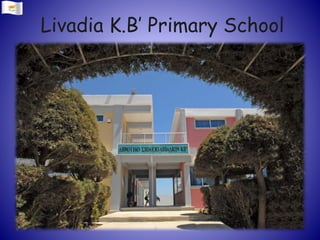
Livadia K.B’ Primary School
If you look from a
satellite above the
earth you will see this
picture!
It looks like it is in the Middle East!
Geographically speaking, this may be true. But,
its culture and history place Cyprus in Europe!
Nicosia with its Venetian walls (unique in
the whole world).
In the centre of
the island is the
capital city of
NICOSIA!
Nicosia (Lefkosia)
The capital of Cyprus
 Nicosia is the
capital of Cyprus.
 The population of
Nicosia is about
200000.
 It is the last
divided capital in
the world.
The central square of
Nicosia
Map of Larnaka
LIVADIA
MUNICIPALITY
This map shows modern Larnaka with its suburbs. One of them is Livadia, the
area of our school.
Livadia
 The Municipality was named Livadia thanks
to the ground of the region, on which is
built.
 It is a grassland, in other words a flat place
with running water and abundant vegetation
for grazing. The word "livadi – λειβάδι"
comes from the ancient greek word "limon -
λειμών".
 The population of Livadia was about 7200
in 2011.
Our School
The first primary school was built in Livadia
in 1911.
 Main characteristics;
 Pupils
 4th, 5th and 6th Grade (10, 11 and 12 year olds)
 9 classrooms (3 for each grade)
 Approximately 193 pupils
 The average teacher/pupil ratio is 20-23 pupils in
each class.
 Equipment
 All classrooms have at least one computer and a
video-projector unit and a interactive board nearly
in all classrooms
 There are special classrooms for Art, Music, Design
and TechnologyHome Economics (Health
Education) and Computers.
Teachers of the school
 There are 15 full time and part time
teachers (including me and three
assistant head teachers)
 There are also two part-time
teachers for children with special
needs and a speech-therapist.
Cyprus Educational System
HISTORICAL MOMENTS
 1960: The establishment of the Republic of
Cyprus
 Greek Cypriots – Turkish Cypriots
( Separate administrations for education but both
controlled by the government)
 1960: Free primary education
 1964: Inter-communal problems
 1972: Free secondary education
 1974: Turkish invasion
 1992: University of Cyprus
 2004: Accession to the EU
Cyprus Educational System
 The Cyprus Educational System is very centralized.
 It is organized and administrated by the Ministry of
Education and Culture.
 There is also an independent Commission, the Educational
Service Commission, appointed directly by the President
of the Republic, which is responsible for the recruitment,
placement, transfer and promotion of teachers.
 Teachers can stay at one school for the maximum of 6
years.
 There are about 340 schools in Cyprus with 50 000 pupils.
Cyprus Educational System
 The Cyprus Educational System is centralized.
 It is organized and administrated by the Ministry of
Education and Culture.
 There is also an independent Commission, the Educational
Service Commission, appointed directly by the President
of the Republic, which is responsible for the recruitment,
placement, transfer and promotion of teachers.
 Teachers can stay at one school for the maximum of 6
years.
 There are about 340 schools in Cyprus with 50 000 pupils.
STAGES IN THE EDUCATIONAL SYSTEM
 Pre-primary
 Primary
 Secondary, technical
and vocational
 Higher and tertiary
Free and Compulsory
 Pre-Primary 5 years old
 Primary 6-11 years ”
 Secondary 12-14 years ”
 Lyceum 15-17 years ”
 University 18 +
a. State universities of Cyprus
b. Private universities and
colleges
Cyprus Educational System
18
PRE-PRIMARY EDUCATION
 Its importance is recognised by the
Government
 Since 2004, it is compulsory and free
for one year prior to attending the
primary school
 Three types of pre-primary institutions:
public, community and private
19
PRIMARY EDUCATION
 Six-year free and compulsory
 Teacher salaries paid by the Government
 Annual grants to School Boards
 Schools in every town and village with 15+
pupils
 Pupil/teacher ratio 17:1
 Class size: Grade 1-6: 25 pupils maximum
20
Curriculum of the school
 There is a National Curriculum, which
is compulsory for all public schools in
the island. The Curriculum is under
reform and at the beginning of next
year several changes will take place.
 There are also specific aims for every
school year, set by the Department
of Primary Education.
Content of the Curriculum
 Language (Greek)
 Mathematics
 Science
 History
 Geography
 Religious Education
 English (as a foreign language)
 Art
 Music
 Physical Education
 Design and Technology
 Home Economics (Health Education)
The Educational Reform
 In 2005 the Educational Reform (ER) was launched;
 ER objectives;
 The aim is to turn into reality the vision of a better educational
system that would meet pupils´ future needs and society's
challenges of the 21st century.
 Special emphasis is given on the “democratic and humanistic
school”.
 In terms of school practice knowledge is “measured” through
“skills” and “indicators” that are placed on all curriculum
subjects
 Thematic working groups are preparing teacher material and
textbooks; in all working groups there is an substantive number
of active teachers involved.
 Innovations; teaching EFL from kindergarten and Year 1;
transforming curriculum subjects either through new content
(Health Education) or joint subjects (i.e. Science and
Technology);
 Still there is a lot of work to be done especially in the field of
teacher education.
 Now we are in the process to evaluate this reform.
School year
 The school year starts on the first
Monday of September and ends on
the last but one Friday of June.
 We have Christmas Vacations (from
23rd of December – 6th of January)
 We have (Greek Orthodox) Easter
Vacations for two weeks.
Timetable
 The school week is from Monday to Friday.
 A school day starts at 07:45 a.m. (teachers
must be at school from 07:30 a.m.) and ends
at 1:05 p.m.
 A school day consists of 7 (40 minutes )
periods, with three breaks.
 Once a week, on Wednesday, there is a 50
minutes staff meeting.
WE SHOULD ALWAYS HAVE IN MIND THAT
 If you plan for one year,
plant rice.
 If you plan for ten years,
plant trees.
 If you plan for centuries,
educate people.
26
Thank you for your attention!

Livadia kb comenius

  • 1.
  • 2.
    If you lookfrom a satellite above the earth you will see this picture!
  • 3.
    It looks likeit is in the Middle East! Geographically speaking, this may be true. But, its culture and history place Cyprus in Europe!
  • 4.
    Nicosia with itsVenetian walls (unique in the whole world). In the centre of the island is the capital city of NICOSIA!
  • 5.
    Nicosia (Lefkosia) The capitalof Cyprus  Nicosia is the capital of Cyprus.  The population of Nicosia is about 200000.  It is the last divided capital in the world. The central square of Nicosia
  • 6.
    Map of Larnaka LIVADIA MUNICIPALITY Thismap shows modern Larnaka with its suburbs. One of them is Livadia, the area of our school.
  • 7.
    Livadia  The Municipalitywas named Livadia thanks to the ground of the region, on which is built.  It is a grassland, in other words a flat place with running water and abundant vegetation for grazing. The word "livadi – λειβάδι" comes from the ancient greek word "limon - λειμών".  The population of Livadia was about 7200 in 2011.
  • 9.
    Our School The firstprimary school was built in Livadia in 1911.
  • 10.
     Main characteristics; Pupils  4th, 5th and 6th Grade (10, 11 and 12 year olds)  9 classrooms (3 for each grade)  Approximately 193 pupils  The average teacher/pupil ratio is 20-23 pupils in each class.  Equipment  All classrooms have at least one computer and a video-projector unit and a interactive board nearly in all classrooms  There are special classrooms for Art, Music, Design and TechnologyHome Economics (Health Education) and Computers.
  • 11.
    Teachers of theschool  There are 15 full time and part time teachers (including me and three assistant head teachers)  There are also two part-time teachers for children with special needs and a speech-therapist.
  • 12.
  • 13.
    HISTORICAL MOMENTS  1960:The establishment of the Republic of Cyprus  Greek Cypriots – Turkish Cypriots ( Separate administrations for education but both controlled by the government)  1960: Free primary education  1964: Inter-communal problems  1972: Free secondary education  1974: Turkish invasion  1992: University of Cyprus  2004: Accession to the EU
  • 14.
    Cyprus Educational System The Cyprus Educational System is very centralized.  It is organized and administrated by the Ministry of Education and Culture.  There is also an independent Commission, the Educational Service Commission, appointed directly by the President of the Republic, which is responsible for the recruitment, placement, transfer and promotion of teachers.  Teachers can stay at one school for the maximum of 6 years.  There are about 340 schools in Cyprus with 50 000 pupils.
  • 15.
    Cyprus Educational System The Cyprus Educational System is centralized.  It is organized and administrated by the Ministry of Education and Culture.  There is also an independent Commission, the Educational Service Commission, appointed directly by the President of the Republic, which is responsible for the recruitment, placement, transfer and promotion of teachers.  Teachers can stay at one school for the maximum of 6 years.  There are about 340 schools in Cyprus with 50 000 pupils.
  • 16.
    STAGES IN THEEDUCATIONAL SYSTEM  Pre-primary  Primary  Secondary, technical and vocational  Higher and tertiary
  • 17.
    Free and Compulsory Pre-Primary 5 years old  Primary 6-11 years ”  Secondary 12-14 years ”  Lyceum 15-17 years ”  University 18 + a. State universities of Cyprus b. Private universities and colleges Cyprus Educational System
  • 18.
  • 19.
    PRE-PRIMARY EDUCATION  Itsimportance is recognised by the Government  Since 2004, it is compulsory and free for one year prior to attending the primary school  Three types of pre-primary institutions: public, community and private 19
  • 20.
    PRIMARY EDUCATION  Six-yearfree and compulsory  Teacher salaries paid by the Government  Annual grants to School Boards  Schools in every town and village with 15+ pupils  Pupil/teacher ratio 17:1  Class size: Grade 1-6: 25 pupils maximum 20
  • 21.
    Curriculum of theschool  There is a National Curriculum, which is compulsory for all public schools in the island. The Curriculum is under reform and at the beginning of next year several changes will take place.  There are also specific aims for every school year, set by the Department of Primary Education.
  • 22.
    Content of theCurriculum  Language (Greek)  Mathematics  Science  History  Geography  Religious Education  English (as a foreign language)  Art  Music  Physical Education  Design and Technology  Home Economics (Health Education)
  • 23.
    The Educational Reform In 2005 the Educational Reform (ER) was launched;  ER objectives;  The aim is to turn into reality the vision of a better educational system that would meet pupils´ future needs and society's challenges of the 21st century.  Special emphasis is given on the “democratic and humanistic school”.  In terms of school practice knowledge is “measured” through “skills” and “indicators” that are placed on all curriculum subjects  Thematic working groups are preparing teacher material and textbooks; in all working groups there is an substantive number of active teachers involved.  Innovations; teaching EFL from kindergarten and Year 1; transforming curriculum subjects either through new content (Health Education) or joint subjects (i.e. Science and Technology);  Still there is a lot of work to be done especially in the field of teacher education.  Now we are in the process to evaluate this reform.
  • 24.
    School year  Theschool year starts on the first Monday of September and ends on the last but one Friday of June.  We have Christmas Vacations (from 23rd of December – 6th of January)  We have (Greek Orthodox) Easter Vacations for two weeks.
  • 25.
    Timetable  The schoolweek is from Monday to Friday.  A school day starts at 07:45 a.m. (teachers must be at school from 07:30 a.m.) and ends at 1:05 p.m.  A school day consists of 7 (40 minutes ) periods, with three breaks.  Once a week, on Wednesday, there is a 50 minutes staff meeting.
  • 26.
    WE SHOULD ALWAYSHAVE IN MIND THAT  If you plan for one year, plant rice.  If you plan for ten years, plant trees.  If you plan for centuries, educate people. 26
  • 27.
    Thank you foryour attention!